
Free Agent Profile: Dennis Wideman
Recently, PHR has been shining some light on remaining free agents in a very quiet market, with players like P.A. Parenteau, Daniel Winnik, Brian Gionta, Jarome Iginla, and Drew Stafford getting some extra attention. The one thing that those players have in common is that there is not a defenseman among them. The last defenseman profiled was Johnny Oduya, who signed with the Ottawa Senators the next day and remains the last major UFA to have signed an NHL deal. Meanwhile, veteran Andrei Markov left for Russia, while big blue liner Cody Franson remains in limbo (and should consider investing in some real estate there).
Why have no other defenseman garnered attention, both from NHL teams nor the PHR team? There are simply few quality defenders left on the market. Outside of Franson, one lone defenseman remains unsigned from PHR’s list of the Top 50 2017 Free Agents: Dennis Wideman. Wideman was the last man to make the list, ranking 50th overall and 14th among defenseman. At 34 years old and coming off back-to-back seasons that could both be considered the worst of his career, Wideman wasn’t exactly a hot commodity. However, it was still projected that Wideman would find work based on a long track record of being able to play major minutes and put up points, even if just on a short-term inexpensive deal.
Luckily for Wideman, that is still a distinct possibility even in mid-August. The free agent market, for not only defenseman but for all players, is all but dead, yet opportunities remain. Signings have been few and far in between, but Wideman faces only Franson for any open blue line spots and brings a very different skill set. Wideman is an 11-year veteran with 387 points in 815 NHL games and was once considered one of the top puck-movers in the game. Wideman even drew Norris Trophy votes in 2008-09 with the Boston Bruins and turned his impressive resume into a five-year, $26.25MM contract with the Calgary Flames in 2012. Wideman is far from that player today, but still carries the pedigree of a possession defenseman capable of playing big minutes when needed and helping out on the power play.
Even if Franson signs a new contract first, Wideman’s chances of landing a deal of his own are still fair. In each of the past two years, two legitimate NHL defenseman have signed contracts late in free agency. Last year, it was Dennis Seidenberg going to the New York Islanders and Kyle Quincey signing with the New Jersey Devils. Seidenberg looked rejuvenated in Brooklyn and earned himself an extension, while Quincey proved to be a valuable veteran and trade chip for the Devils and has already signed with the Minnesota Wild this summer. In 2015, it was Franson himself, ending up with the Buffalo Sabres on a two-year deal, and David Schlemko, yet another one-year value deal for the Devils.
Potential Suitors
If the pattern isn’t clear yet, a one-year “show me” deal for Wideman with the New Jersey Devils remains a very real possibility. For the third season in a row, the Devils could greatly benefit from adding a talented veteran on the cheap. Although the team has a pair of consummate pros in captain Andy Greene and veteran Ben Lovejoy, as well as some exciting young players like Damon Severson, Mirco Mueller, and John Moore, the team is lacking in depth. Bringing in Wideman, who has become accustomed to a part-time role in Calgary over the past few years, to be a spot starter, capable injury replacement, and mentor to the young offensive blue liners would be a savvy signing by GM Ray Shero.
Another team that is going to be rumored to be in on a top-four defenseman until they actually go out and get one is the Colorado Avalanche. With just three defenseman currently signed to one-way deals and a depth chart lacking in legitimate NHLers, the rebuilding Avs are desperate for help on the blue line. It would not come as surprise if Colorado ended up signing both Wideman and Franson if their “D” corps looks as bad in camp as it does on paper.
Other interested parties that may be looking for affordable veteran depth – and specifically keyed in on a right-handed shot – include the Columbus Blue Jackets, Montreal Canadiens, Los Angeles Kings, or a return to the Washington Capitals.
Expected Contract
The original speculation for Wideman was that he would sign a one-year deal worth $1.5MM. At this point in the off-season and given Wideman’s age and the substantial wear on his tires, a one-year pact is all but certain. The $1.5MM? That isn’t out of the question. Wideman’s past two seasons with the Flames were none toof inspiring and Calgary fans were happy to see him go. However, that doesn’t mean that Wideman can’t return to form with a change of scenery and is just two years removed from a career-high 56 points. He may still be able to command a seven figure salary. The longer he goes unsigned though, the more and more likely he ends up under $1MM. Wideman seems unlikely to take the absolute minimum, $650K, and will hold out hope that he can get somewhere in the neighborhood of the $1.25MM deals that Quincey signed last year and this year. In the end, he may have to settle for only a bit more if he wants to extend his NHL playing career. One way or another, Wideman will be making much less and will have a very different role with his next contract versus his last.
Islanders’ 2017-18 Season Could Spark Roster Turnover
The New York Islanders have a difficult season ahead of them, not least of which the arena uncertainty which has been plaguing the team for a decade. After a tumultuous season in Brooklyn at the Barclay’s Center, many fans are simply concerned with finding a proper home in the New York area. Additionally, much attention has been paid to the impending unrestricted free agency of John Tavares at the conclusion of the season. There is good reason for the fanbase’s focus to be centered around captain Tavares, as he will likely be the domino that needs to fall first. That said, the Islanders have 11 expiring NHL contracts at the end of the 2017-18 season, and if the team fails to make the playoffs again, even more expansive changes could be on the horizon.
It should be noted that the Islanders weren’t entirely quiet this off-season, as GM Garth Snow made some unorthodox but ultimately effective moves with Vegas to shield younger players and ship out injured Mikhail Grabovski‘s contract. Perhaps more importantly, regards to retaining Tavares, was the acquisition of good friend and skillful finisher Jordan Eberle to play on the star center’s wing. Travis Hamonic was able to be moved for a hefty return from Calgary, and although the team was unable to draw in names from free agency, their young forwards look capable of taking a step forward this season. Although Snow has certainly struggled at times in his tenure, this off-season went about as well as could be expected. All that remains is to sign RFA Calvin de Haan.
The panic begins to set in when you compare the Islanders’ roster with that of the rest of the Metropolitan Division. Pittsburgh will again be a contender. Washington got worse but still won the President’s Trophy last season. Columbus almost unquestionably improved their roster on paper. Carolina added depth in all areas of the ice, including Scott Darling in net. The New York Rangers saw a massive upgrade on defense by subtracting Dan Girardi and adding Kevin Shattenkirk. And the less intimidating Philadelphia Flyers and New Jersey Devils each added a monumental talent to their forward groups at the draft in Nolan Patrick and Nico Hischier, respectively. It’s rather arguably the toughest division in the entire league, and the Islanders will have no guarantees of making the playoffs. If they fail to do so, Tavares may only be the beginning of their issues.
Among the unrestricted free agents after the conclusion of the season are Nikolai Kulemin, Josh Bailey, Jason Chimera, Thomas Hickey, Dennis Seidenberg, Jaroslav Halak and the aforementioned Tavares. The restricted free agents on NHL contracts include Brock Nelson, Shane Prince, Alan Quine, Ryan Pulock, Scott Mayfield. Although no name on either list is truly vital, losing 4 or 5 free agents for nothing at the conclusion of the season could be a disastrous error in asset management. Bailey and Hickey in particular may attract solid interest at the trade deadline, but Snow and management will necessarily be determined to make the post-season. If they are still in contention for a spot, it’s hard to see them shipping any roster assets away as long as they are not mathematically eliminated. This situation will only become more dramatic if the Tavares negotiations are still ongoing.
Plainly, the worst case scenario for the Isles would be that Tavares leaves at the conclusion of the year. But it must also be realized that the longer the process drags on, the more consideration might be paid to the feasibility of moving him. The coming season cannot be the entire focus of the franchise. If minimal progress is made by the new year, the team could see a situation where an important cog on the team might leave for absolutely nothing. Worse, his situation may lead to the sacrificing of other assets in the confusion. The Islanders dealt with this last off-season when Frans Nielsen decided to depart for Detroit, stunning Islanders management. Repeating such a mistakewould be absolutely inexcusable, and if unrestricted free agents are unwilling to re-sign or no longer part of the team’s future, they must be moved in the interest of the organization. The same goes for Tavares. Although losing Tavares would be absolutely crippling, it would be fatal to lose him without recouping any assets whatsoever.
Dead Space: Bought-Out, Buried, And Retained Salaries For Every Team
It’s something that often goes unnoticed, but with the cap showing minimal growth the last few years, teams are starting to feel the crunch more than ever. Buyouts have become more common, especially with players with under three remaining years on their contracts. And it’s not just the big name busts that have seen the ax lately – we’ve seen lesser names at lesser money take the fall for their respective teams, then needing to scramble for work elsewhere in the league. Additionally, salary retention in trades has become a more utilized tactic as of late. Teams with “unmovable” contracts have offered to retain part of a poor contract in order to entice a team into giving them some relief.
All this said, some teams have been better with foresight than others. Some teams have shown a track record of being entirely unable of handing out poor contracts over the past five or so seasons. Considering many teams showed some progress in being more frugal this off-season, it seems a wise time to review the dead space every team has accumulated, either due to poor management decisions or poor luck.
Colorado Avalanche – $4.83 MM in 2017-18, issues resolved after current year – Francois Beauchemin buyout; Cody McLeod retained
Arizona Coyotes – $4.61 MM in 2017-18, issues resolved after 2020-21 – Mike Smith retained; Mike Ribeiro, Antoine Vermette buyouts
Columbus Blue Jackets – $4.025 MM in 2017-18, issues resolved after 2020-21 – Fedor Tyutin, Jared Boll, Scott Hartnell buyouts
Carolina Hurricanes – $3.71 MM in 2017-18, issues resolved after 2020-21 – Eddie Lack retained; Alexander Semin, James Wisniewski buyouts
Toronto Maple Leafs – $3.28 MM in 2017-18, issues resolved after 2021-22 – Tim Gleason, Jared Cowen buyouts; Phil Kessel retained
Nashville Predators – $2.83 MM in 2017-18, issues resolved after 2018-19 – Viktor Stalberg, Eric Nystrom, Barret Jackman buyouts
Boston Bruins – $2.73 MM in 2017-18, issues resolved 2019-20 – Dennis Seidenberg, Jimmy Hayes buyouts
New York Rangers – $2.61 MM in 2017-18, issues resolved after 2022-23 – Dan Girardi buyout
Minnesota Wild – $2.5 MM in 2017-17, issues resolved after current year – Thomas Vanek buyout
Los Angeles Kings – $2.4 MM in 2017-18, issues resolved after 2023-24 – Matt Greene buyout; Mike Richards termination/recapture
Edmonton Oilers – $2.33 MM in 2017-18, issues resolved after 2020-21 – Lauri Korpikoski, Benoit Pouliot buyouts
Anaheim Ducks – $2.21 MM in 2017-18, issues resolved after 2023-24 – Mark Fistric, Simon Despres buyouts; Patrick Maroon retained
Vancouver Canucks – $2.13 MM in 2017-18, issues resolved after 2021-22 – Roberto Luongo, Jannik Hansen retained; Chris Higgins buyout
New Jersey Devils – $2.09 MM in 2017-18, issues resolved after 2023-24 – Mike Cammalleri, Devante Smith-Pelly buyouts; Ilya Kovalchuk recapture
Tampa Bay Lightning – $1.83 MM in 2017-18, issues resolved after 2019-20 – Matt Carle buyout
Calgary Flames – $1.82 MM in 2017-18, issues resolved after 2018-19 – Mason Raymond, Lance Bouma, Ryan Murphy buyouts
Detroit Red Wings – $1.67 MM in 2017-18, issues resolved after 2020-21 – Stephen Weiss buyout
Dallas Stars – $1.5 MM in 2017-18, issues resolved after 2018-19- Antti Niemi buyout
Philadelphia Flyers – $1.5 MM in 2017-18, issues resolved after current year – R.J. Umberger buyout
Winnipeg Jets – $1.46 MM in 2017-18, issues resolved after 2018-19 – Mark Stuart buyout
Florida Panthers – $1.33 MM in 2017-18, issues resolved after 2018-19 – Jussi Jokinen buyout
Las Vegas Golden Knights – $1.1 MM in 2017-18, issues resolved after current year – Alexei Emelin retained
Ottawa Senators – $350,000 in 2017-18, issues resolved after current year – Andrew Hammond buried
Buffalo Sabres – Minimal in 2017-18, increased issues ($791,00) resolved after 2022-23 – Cody Hodgson buyout
Chicago Blackhawks, St. Louis Blues, Washington Capitals, Pittsburgh Penguins, New York Islanders, San Jose Sharks, Montreal Canadiens – No dead cap space
After compiling the list, it became clear that utilizing these options isn’t a complete hindrance to competing in the NHL. In fact, most clubs have between $1 MM and $3 MM in dead space. That said, of the teams that have not needed to utilize the buyout or retention options, there has been a great deal of success. And among the five worst offenders, the Leafs, Hurricanes, Blue Jackets, Avalanche, and Coyotes, none has moved past the first-round in multiple years. It’s hard to draw massive conclusions without taking the context of each individual situation into account, but there is something to be said for making every dollar of cap space count. Perhaps this is merely a byproduct of past success rather than an indicator of future success, but considering how amenable many managers have become to the option, it bears consideration.
(All totals courtesy of the fantastic CapFriendly.com)
Will Hamonic Stay In Brooklyn?
In an off-season where the Islanders’ primary concerns will be extending John Tavares to quell rumors of his departure at the end of the season, and developing prospects into NHL ready contributors, focus on the blueline should not be overlooked.
Travis Hamonic‘s stats aren’t particularly glamorous, with 3 goals and 11 assists through 49 games this past year. His Corsi For % was a career worst at a very unfortunate 43.0%, but many players struggled mightily this season in Brooklyn. He is the assistant captain of the team and his leadership with young players has been particularly important in the wake of losing both Kyle Okposo and Frans Nielsen a year ago. While Nick Leddy and Johnny Boychuk have been brilliant in their roles, Hamonic rounds the defense out with a shutdown type. Calvin de Haan has developed well and will contribute after the RFA negotiates his own contract with New York ownership. The potential error going forward is that the Islanders will see Hamonic as relatively expendable, and that could prove a costly mistake. For a franchise trying yet again to find a way back into the playoffs in a brutally competitive Metropolitan Division, losing top-4 defensemen at their lowest value is not acceptable asset management. If Hamonic were indeed dealt, it would presumably be for far less than Taylor Hall, which according to Arthur Staple and Lighthouse Hockey was an offer rejected by GM Garth Snow last off-season.
Hamonic is listed as the #5 prize in this years trade bait list by TSN which is slightly surprising for a relatively unassuming player. The Wild will almost assuredly trade one of Jonas Brodin (#2) or Mathew Dumba (#3) – leaving the Islanders with an enticing stalwart in a league with lots of struggling defensive squads. That said, it’s difficult to imagine a top line talent being the piece coming back. The Islanders’ stockpile of young players is already quite impressive, so established production is imperative. The player would also likely need to be a winger who could play with John Tavares, but he has had difficulty gelling with players in the past. Although Hamonic had a down year, management should view his overall performance with the franchise rather than drawing conclusions from a tough final season under former coach Jack Capuano. Perhaps the wisest option is to allow Hamonic’s stock to rise again before considering a move.
High Likelihood Of Free Agent Class Shrinking Further
Let’s state the facts: the 2017 unrestricted free agent class is really weak. Even before the season started it wasn’t full of household names, but with Brent Burns, Patrik Berglund, and, most recently, Ben Bishop agreeing to extensions already, the list has shrunk even further. The 2017 class has few impact players available, so much so that the New York Islanders easily have single-handedly deprived the rest of the league of three of the top fifty free agents simply by re-signing the likes of Thomas Greiss, Dennis Seidenberg, and Cal Clutterbuck.
Unfortunately, the trend of teams retaining their own talent and further forecasting a dull summer may not be done. The Washington Capitals have four of the best free agent names out there in T.J. Oshie, Kevin Shattenkirk, Karl Alzner, and Justin Williams and even given their tight cap space, it is reasonable to assume that at least one or two of that group will re-up with the President’s Trophy winners. Initially, many felt that the San Jose Sharks would not bring back both of their aging stars, Joe Thornton and Patrick Marleau, and possibly even neither. However, after a strong season from career-Shark Marleau, the team will likely look to retain him, and with Thornton turning 38 soon and facing significant injury questions, he simply might take a hometown discount to stay in San Jose as well. In Montreal, revelation Alexander Radulov and key veteran Andrei Markov are impending free agents, but many assume in name only as handshake agreements seem to have been made on new deals following the Expansion Draft. Anaheim Ducks trade deadline acquisition Patrick Eaves has been a great fit and has expressed an interest in extending his stay. Same goes for Drew Stafford and the Boston Bruins. Even veterans like Radim Vrbata, Mike Fisher, and Jaromir Jagr seem likely to stay put in their current homes.
This does seem to be an awful lot of deals to be made in less than two months before free agency opens on July 1st, but don’t rule it out. Many teams are wary of the Expansion Draft ramifications of re-signing their impending free agents too early and may instead act swiftly in the waning days of June. Most, if not all, of these names could be off the table by the time free agency opens. Could we be looking at a free agent class highlighted by the likes of Sam Gagner, Martin Hanzal, and Michael Del Zotto? Let’s hope not.
Notable Contracts Signed During Playoffs
The NHL’s regular season ended on April 9. Since then, there have been six notable contracts handed out by teams who either missed the playoffs or were eliminated early. We also saw the first major signing by the expansion Vegas Golden Knights.
At the half-way mark of the playoffs, let’s take a look at the bigger contracts signed so far:
April 24 – The New York Islanders re-signed Dennis Seidenberg to a one-year extension worth $1.25MM. A year removed from being bought-out by the Boston Bruins, Seidenberg signed with the Islanders during training camp. The defensive defenseman scored five goals and 22 points in 73 games with the Islanders. Seidenberg will be exposed in the expansion draft, but is not the most-appealing option that will be available to the Golden Knights from the Islanders roster.
May 2 – The Toronto Maple Leafs finally confirmed the long-rumored signing of defenseman Nikita Zaitsev to a seven-year, $31.5MM extension. That’s an average of $4.5MM per season, which is fair value for a top-four defenseman on a long-term deal. The 25-year old transitioned exceptionally to the NHL, registering 36 points while leading the Maple Leafs in ice-time and playing in all 82 regular season games. The term is likely longer than most Maple Leafs’ fans wanted, but will keep the cap hit down. He will also be exempt from this spring’s expansion draft.
May 4 – The Vegas Golden Knights made their first major acquisition (sorry, Reid Duke) by signing KHL star Vadim Shipachyov to a two-year, $9MM contract. The 30-year-old center scored 76 points in 50 games this season for SKA St. Petersburg. That was good for third in the KHL and second on SKA, behind only Ilya Kovalchuk. Shipachyov is a highly-skilled offensive player, but isn’t a big body at 6’1, 190 lbs. Vegas hopes he’ll be a marquee talent for the expansion club.
May 5 – The Carolina Hurricanes traded for Chicago Blackhawks backup goaltender Scott Darling in late April, and spent less than a week negotiating a new four-year, $16.6MM contract. Darling spent three seasons with the Blackhawks, going from a little-known name to one of this summer’s most highly sought-after goaltenders. In 32 games this season, Darling went 18-5-5 with a 0.924 SV% and a 2.38 GAA. The Hurricanes still owe Eddie Lack and Cam Ward over $6MM for the upcoming season.
May 9 – The Los Angeles Kings’ new GM Rob Blake locked up one of his team’s key young players to a four-year, $15MM contract. Tanner Pearson finished third on the Kings in scoring, with a career-high 44 points. The Kings had a disappointing season, but Pearson was one of their few bright spots.
May 11 – After a 22-goal season, Richard Panik signed a two-year, $5.8MM extension with the Chicago Blackhawks this morning. Panik caught on with the Chicago Blackhawks last season and has been a regular fixture with captain Jonathan Toews on the top line. Prior to his 44-points this season, Panik’s previous career-high was 17 points. While he left some money on the table, it was unlikely that he would find a better spot than on Toews’ wing.
New York Islanders Sign Dennis Seidenberg
The New York Islanders have signed Dennis Seidenberg to a one-year contract through 2017-18. The 35-year old defenseman was to become an unrestricted free agent once again this summer. The deal will pay Seidenberg $1.25MM, a slight raise over the $1MM he earned this season.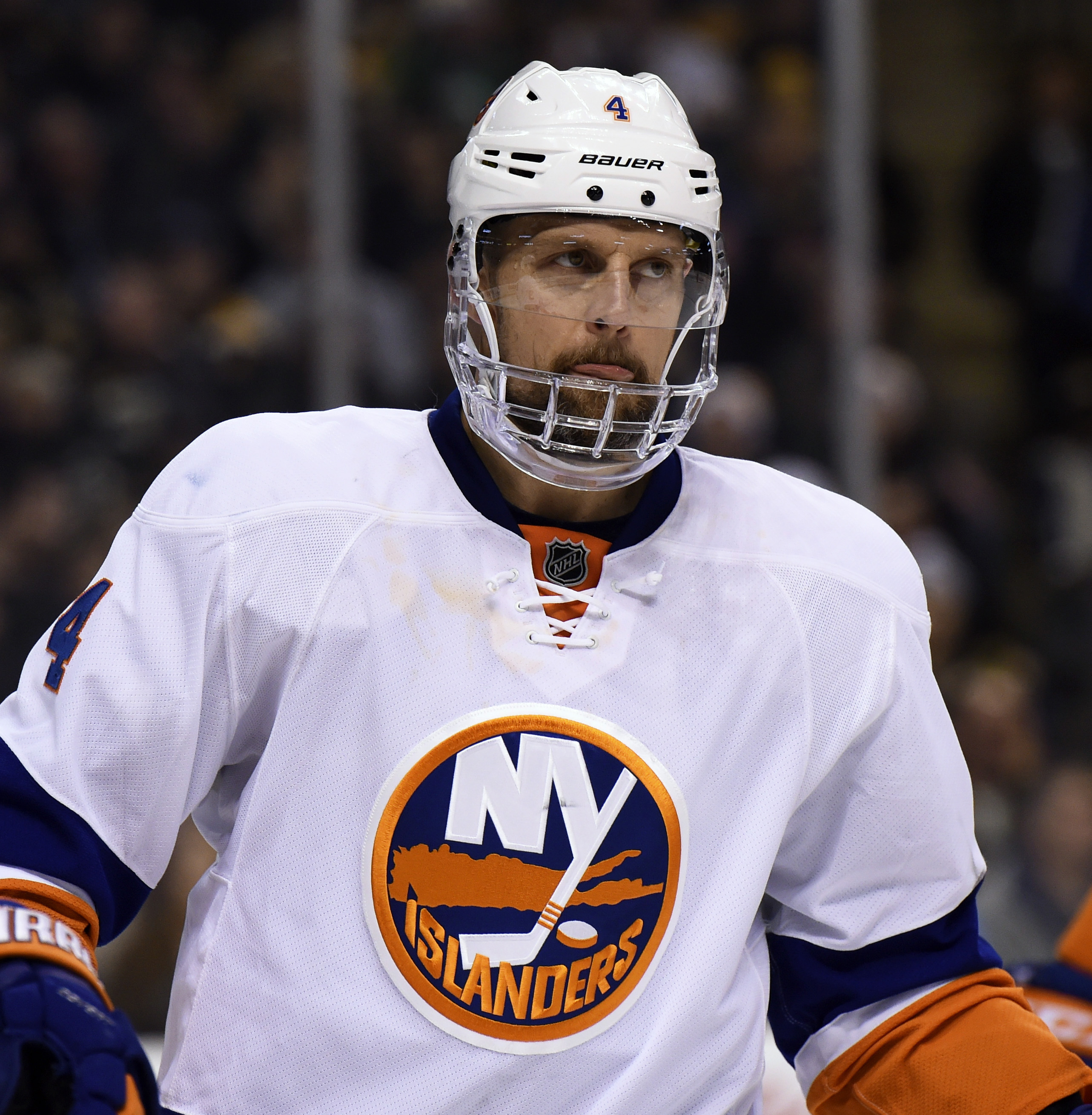
After being bought out by the Boston Bruins last summer, Seidenberg struggled to find any potential contracts until the World Cup. By showing he could still compete at the highest level playing with Team Europe, he earned a one-year deal with the Islanders and actually had somewhat of a renaissance early in the year. Scoring eight points in his first twelve games, he unfortunately broke his jaw in mid-November and would never quite get back to the same level of play. Still, he scored 22 points in 73 games for the Isles—his highest total since 2011-12—and was a team-high +25 (for what it’s worth). That kind of production for such a low cost is a good deal for anyone, as the Bruins actually paid him more to not play on their team this season.
It is interesting to note that Seidenberg will now fill the Islanders’ defense requirement for the expansion draft should they head into the June event with changes on their blueline. While currently the team must protect Johnny Boychuk due to a no-movement clause, they would only have two remaining protection slots (should they decide to go the 7-3-1 route) for some combination of Nick Leddy, Travis Hamonic, Calvin de Haan, Ryan Pulock and Thomas Hickey. That doesn’t seem like a perfect situation, and inking Seidenberg may be a signal that the Islanders are preparing for life without one or two of their current or upcoming defensemen.
A possible move of one of them is even more likely due to the cap-crunch the Islanders find themselves in, already with over $70MM committed to next season. With a new contract due for de Haan, and at least some tweaking needed in the forward group—which could come in the form of a promotion for top prospect Michael Dal Colle—the Islanders will be very tight to the cap all summer. Boychuk’s $6MM hit that doesn’t expire until the end of 2022 is the tough one, as he’ll start next season at 33.
Arthur Staple was first to break the deal on Twitter, and also provided the financial details.
Photo courtesy of USA Today Sports Images
Trade Deadline Summary: Winners & Losers Of The Metropolitan Division
The NHL Trade Deadline has come and gone, and while it wasn’t the most exciting deadline day in recent memory, there were quite a few notable moves. Here are the winners and losers of the dominant Metropolitan Division:
Winners
Carolina Hurricanes:
- Acquired 2017 second-round pick and Danny Kristo from Pittsburgh Penguins for Ron Hainsey
- Acquired 2017 third-round pick from the Ottawa Senators for Viktor Stalberg
Not all that much happening in Raleigh, but what GM Ron Francis did do, he did well. Both Hainsey and Stalberg brought back returns that were greater than their market value. It was also nice of Francis to send Hainsey to a team where his career-long playoff drought would definitely be snapped. Not sure why Jay McClement wasn’t moved, but there simply may not have been interest. The Hurricanes have a ton of salary cap space and have to dip into their depth on defense sooner or later, but this year’s deadline was definitely not the time for big moves. Expect Carolina to be a major player in the off-season trade market.
New Jersey Devils:
- Acquired Dalton Prout from the Columbus Blue Jackets for Kyle Quincey
- Acquired 2017 sixth-round pick from the Nashville Predators for P.A. Parenteau
The Devils didn’t really have any trade capital today other than Quincey and Parenteau, so good on GM Ray Shero for doing what he could with what he had. It’s strange that New Jersey was able to get a higher pick from the Predators for Vernon Fiddler earlier this season than they did for Parenteau, but injuries may have played into that. A full season of production and a draft pick in compensation isn’t that bad a return for an early-season waiver claim. The Quincey deal was the real star of the show though. The Devils went from taking a risk on an older, washed-up defenseman this off-season to trading him for a young, strong defensive defenseman who can be a starter for years with the team. Shero played the long con on the league this year, and it paid off.
Trade Candidates: Dennis Seidenberg
With the trade deadline quickly approaching, we will be profiling several players in the weeks ahead that are likely to be dealt by March 1st.
The Islanders may be 8-3-2 since they replaced head coach Jack Capuano with Doug Weight, but their early season struggles still have them in a hole in the pursuit of a playoff spot. The Islanders trail the Toronto Maple Leafs by three points for the final wild card spot in the Eastern Conference, still sit a point back of the Philadelphia Flyers as well and must make the most of their games in hand to catch the Boston Bruins. Their 7-1 loss to the Leafs last night doesn’t help the cause. The Islanders will surely take the rest of the month to decide if they are sellers, but if they do, Dennis Seidenberg is clearly a prime target. Seidenberg signed late in the off-season, September 28th to be exact, to an affordable, one-year deal and has provided the Islanders with more value than anyone could’ve anticipated. Should they swap him for a pick or prospect at the deadline, it would only make the deal that much better.
Contract
Seidenberg is on a one-year, $1MM deal and will become an unrestricted free agent this summer. His cap hit will have been accumulated to around only $250K by the March 1st Trade Deadline.
2016-17
Though a fan favorite with the Boston Bruins, Seidenberg struggled in his final three seasons with the team. Between battling injuries and struggling to put up points, it seemed as though Seidenberg had hit a wall in his early 30s. When the Bruins decided to re-sign John-Michael Liles and not bring back Seidenberg, many felt it would be the end of his career. However after an impressive performance at the World Cup of Hockey for Team Europe, the New York Islanders decided to give the veteran blue liner a shot. Their decision has paid off; Seidenberg is in the middle of his best season since the lockout-shortened 2012-13 campaign and has been a key component in the Isles’ turnaround. At 34 years old, the German defender is on pace for what could be his best offensive year since the 2010-11 Cup-winning season in Boston. He also leads the Islanders with a whopping +18 rating, twice what the next man up, Casey Cizikas, has on the year. Seidenberg appears to be back to his old self, and his old self was one of the premiere shutdown defensemen in the NHL over the last decade.
Season Stats
48 GP: 4 goals, 13 assists, 17 points, +18 rating, 87 hits, 100 blocks, 19:34 ATOI
Suitors
If the Islanders choose to trade Seidenberg, that likely means that either they are struggling or the Boston Bruins are continuing their strong play under new head coach Bruce Cassidy. What better story for Seidenberg than a return to Boston for yet another playoff run. Many said this summer that Seidenberg felt he would either play for the Bruins or retire, as he wanted to remain in the city of Boston. While the Bruins have Zdeno Chara and Torey Krug on the left side, as well as the veteran Liles, they have been using right-shot defenseman Kevan Miller as the pair-mate of young Colin Miller, also a right-handed shot, and could stand to upgrade that slot. The Bruins have made it known that they are looking for another left-handed defenseman, and while their search may be more for a long-term replacement for Chara, they likely would not turn their back on a deal to bring back one of the most successful players in recent memory of Bruins hockey. That is, if it’s at the right price. With Liles likely a goner after this season, the Bruins may be more willing to acquire Seidenberg if they plan to give him another year as a veteran safety net on a defense that could lose a contributor in the Expansion Draft.
There certainly are teams with a greater need on defense though, and willing to pay higher prices as well. Atlantic contenders like the Pittsburgh Penguins, Washington Capitals, Columbus Blue Jackets, and New York Rangers are all in need of defensive depth. However there’s always the possibility that the Islanders refrain from trading Seidenberg within the division on the off chance that they keep pace in the postseason race following March 1st. The last thing that GM Garth Snow wants is for his diamond in the rough off-season addition to be a cause of the Islanders playoff elimination.
Out west, one team in desperate need of a veteran top six defenseman is the Los Angeles Kings. While the Kings would likely rather add a right-shot defenseman, those can be hard to find and Seidenberg presents a great option for the team regardless. Seidenberg has a history of playing on the right side, and would be a significant upgrade to Kevin Gravel on the bottom pair. Also, don’t be surprised if the Nashville Predators start sniffing around for a stay at home defensive defenseman like Seidenberg prior to the trade deadline. Although they have tremendous blue line depth, the Predators could use a player with Seidenberg’s two-way tendencies and defensive instincts. Seidenberg would fill out what would likely be the best six-man blue line group in hockey.
Likelihood Of A Trade
Seidenberg’s trade fate is obviously tied to the success of the Islanders. New York is battling just for the final wild card spot in the Eastern Conference and assuming they have that space locked up on March 1st, even if they are currently in position then, is a precarious situation. If the Islanders want to hedge their bet on a postseason run, they may choose to trade Seidenberg, who could potentially earn them a good return. Meanwhile, Seidenberg is an ideal trade candidate for a contenders due to his extensive postseason experience and performance history, his checking ability and strong two-way game, and of course a cap hit that will hardly make a dent. For all those reasons though, the Islanders could also choose to simply retain the big veteran. They don’t have a readily available option to step in as a replacement and they too face a very strong chance of losing a defenseman in the Expansion Draft and could seek to extend Seidenberg. For those reasons the probability of this deal will remain uncertain unless the next couple of weeks really paint a clear picture of the Eastern Conference playoff race.
What’s Next For The Islanders?
In the midst of a disappointing 2016-17 campaign, the New York Islanders made a change behind the bench yesterday, relieving Jack Capuano of his duties and turning the team over to AGM Doug Weight on an interim basis. The team has also received permission from the Florida Panthers to speak with their former head coach, Gerard Gallant, about taking the reins with the Isles on a full time basis. While the coaching change was surely made with the idea of sparking a second half playoff charge, it’s also quite possible this is just the first of several moves intended to get the Islanders back on the right track.
First and foremost, the goal for the Islanders will be to show superstar center John Tavares that the organization is fully committed to icing a competitive team around him. Tavares is eligible to become a free agent following the 2017-18 season and despite repeatedly stating his desire to remain with the organization that drafted him first overall in 2009, many in the industry feel that unless he views the Islanders as a legitimate contender, he’ll consider other options in free agency. That may pressure the front office into action, both at this year’s trade deadline and during the upcoming summer.
Assuming the new voice – whether Weight remains in charge for the duration of the campaign or the team hires another head coach such as Gallant – is unable to alter the team’s course ahead of the deadline, it’s conceivable the team will look to cash in veteran assets for controllable young talent and/or draft choices. Unfortunately the Islanders don’t possess much in the way of pending free agents that would appeal to other teams. Only Dennis Seidenberg, Stephen Gionta and Thomas Greiss are scheduled for unrestricted free agency after the season and none represent the type of asset that would command a significant return in trade.
The team could look to this summer’s free agent class in an effort to improve the roster but with more than $61MM already committed to 19 players in 2017-18, there won’t be much room to do so. It’s also possible the Islanders will look to move a big salary to create needed roster flexibility but other teams simply won’t have much interest in taking on the contract of someone like Andrew Ladd, who has six years and $33MM left on his deal and has struggled with just eight goals and 12 points in 41 contests this season. Mikhail Grabovski, who has been out all season with post-concussion syndrome, and Nikolai Kulemin are also unlikely to generate much interest on the trade market. Dealing any other roster player would only serve to create another hole the Islanders would have to fill.
It’s also fair to wonder whether GM Garth Snow will be the team’s leading decision-maker for much longer. After all, his offseason moves this past summer have not worked out particularly well and new ownership may not be as committed to the longtime Islanders executive as was Charles Wang. Remember, it was Wang who abruptly fired Neil Smith just six weeks into his tenure as GM and hired Snow, then the team’s backup goaltender, back in 2009. It has been reported that the organization’s new leaders, Jon Ledecky and Scott Malkin, have already been on the hunt for a “big name” executive to lead the team’s hockey operations department. The Islanders on-ice struggles could prompt ownership to transition away from Snow and bring in new leadership.
Clearly the Islanders organization has their work cut out for them and big decisions yet to make. The key question will be whether those decisions are enough to convince Tavares to sign on beyond the expiration of his current contract.