
Connor Bedard Hopes Patrick Kane Will Return To Blackhawks
Two teams remain in the running for future Hall-of-Fame winger Patrick Kane. Now 37 years old, Kane’s next contract will likely be his last – and he hopes to spend it on a homecoming. That could be with the Buffalo Sabres, the club that Kane grew up watching from upstate New York, or it could be with the Chicago Blackhawks, where his career blossomed en route to three Stanley Cup wins. Current Blackhawks star Connor Bedard has made it clear that he is hoping for the latter. In a press scrum captured by Scott Powers of The Athletic, the freshly-signed Bedard said:
I hope so… I can’t imagine his first game back at the UC, the reaction he’d get and how much juice that would bring not only to our team but our fans as well… You talk about the legacy aspect of it, but as a team, it would make us a way better team. He’s still an amazing player.
Closing out his career in Chicago would only feel right for Kane. He became a superstar almost immediately after Chicago drafted him with the first-overall pick in 2007. Kane scored 21 goals and 72 points in his rookie year, in tandem with fellow rookie and premier playmaker Jonathan Toews. Together, the two formed one of the most complete duos in NHL history – with Kane offering sharp goal-scoring and high-finesse skills while Toews served as the setup man and two-way star. Their presence helped Chicago strongarm the Western Conference for much of the 2010s, with a dominance that peaked with Stanley Cup wins in 2010, 2013, and 2015.
Kane was a routine point-per-game scorer in that stretch, though he routinely missed 15-to-20 games each season due to injury. He played a full season in 2015-16 and made the most of his prime year, finishing second in the NHL with 46 goals and first in the league with 106 points. Kane crossed the century mark again three seasons later, netting 44 goals and 110 points in 81 games of the 2018-19 season. His pair of 100-point seasons stand as Kane’s career-years, though he crossed 70 points in 10 seasons and 80 points in six seasons.
Kane has remained a cornerstone of his team’s offense into his late-30s. He scored 41 assists and 57 points in just 67 games with the Detroit Red Wings last season. That production continued Kane’s run of strong scoring in Detroit. He has scored 163 points in 189 games with the Red Wings, or an average of 71 points per 82 games, through three seasons.
As has become well-known across the hockey world, Kane’s offense comes with major tradeoffs on defense. He has recorded 2.77 expected goals-against per 60 minutes of ice time since joining the Red Wings in 2023. That mark ranks as the 56th-worst in the NHL in that span, on a list that ends with Bedard himself. The Blackhawks don’t need to kneecap their defense any further after allowing the fifth-most goals in the NHL last season. Then again, Kane’s presence could bolster the top-six, while allowing young prospects like Anton Frondell and Roman Kantserov the chance to ease into their roles. Kane’s defensive deficiencies won’t be unfamiliar to the Blackhawks – but the value he could bring with a return to the United Center, in terms of mentorship and fan service, could outweigh the negatives in a year where the Hawks likely won’t push for playoff contention.
Canada Announces World Juniors Coaching Staff
Hockey Canada has announced their bench bosses for the 2027 World Junior Championships. The Canadian side will be led by head coach Misha Donskov, earning a promotion after serving as associate head coach and vice president of hockey operations at the 2026 World Juniors. Donskov also served as head coach at the 2026 World Championship and an assistant coach at the 2026 Winter Olympics, while also carrying his VP title through those tournaments. Alongside Donskov will be assistant coaches Drew Bannister, Jim Hulton, Brad Lauer, and Ryan Getzlaf. The staff will be rounded out by Dan De Palma serving as the goalie coach.
Per usual, Canada’s coaching staff will bring a wealth of experience from across the hockey world. Donskov served as Director of Hockey Operations for the Vegas Golden Knights beginning in their inaugural 2016-17 season. He continued in that role until the 2019-20 season, when he was moved to an assistant coach role that he held through Vegas’ Stanley Cup-winning season in 2022-23. After lifting the Cup, Donskov moved to the Dallas Stars bench for two seasons, before taking on an exclusive role with Hockey Canada. His trophy cabinet is filled to the brim. Donskov has won a Gold Medal at the Men’s (2016) and Women’s (2011) World Championship. He also won Gold at the 2012 Hlinka Gretzky Cup, the 2015 World Juniors, the 2017 World Cup, and the 2025 4-Nations Face-Off. He also has an OHL Championship (2012), Spengler Cup championship (2020), World Juniors Bronze medal (2026), and Olympic Silver medal (2026) to his name.
Bannister will reappear across the hockey world after only coaching at the Spengler Cup and World U18 Championship in the 2025-26 season. The former St. Louis Blues head coach has taken over the OHL’s Soo Greyhounds for the 2026-27 season. He last coached for Soo from 2015 to 2018, a run marked by two quarterfinal losses and one loss in the OHL Championship. This will be Bannister’s first time coaching at the World Juniors, though he has supported the World U17 Hockey Challenge, Hlinka Gretzky Cup, and World U18 tournament previously. Bannister played with Team Canada at the 1994 World Junior Championship, where he chipped in four points and 10 penalty minutes in seven games en route to a Gold Medal. That championship predated a playing career that spanned 164 NHL games, 149 IHL games, and 204 AHL games.
Hulton represents the journeyman on Canada’s bench, having coached in the OHL, NHL, USHL, and QMJHL. He most recently manned the QMJHL’s Saint John Sea Dogs bench after 11 seasons overseeing the Charlottetown Islanders. Hulton has won league recognition as a general manager and head coach, taking home the USHL ‘GM of the Year’ award in 2014-15, both ‘GM of the Year’ and ‘Coach of the Year’ in the QMJHL’s 2020-21 season, and QMJHL and CHL ‘Coach of the Year’ honors in 2021-22. He has also won Silver and Gold at the World Juniors, in 2004 and 2005 respectively.
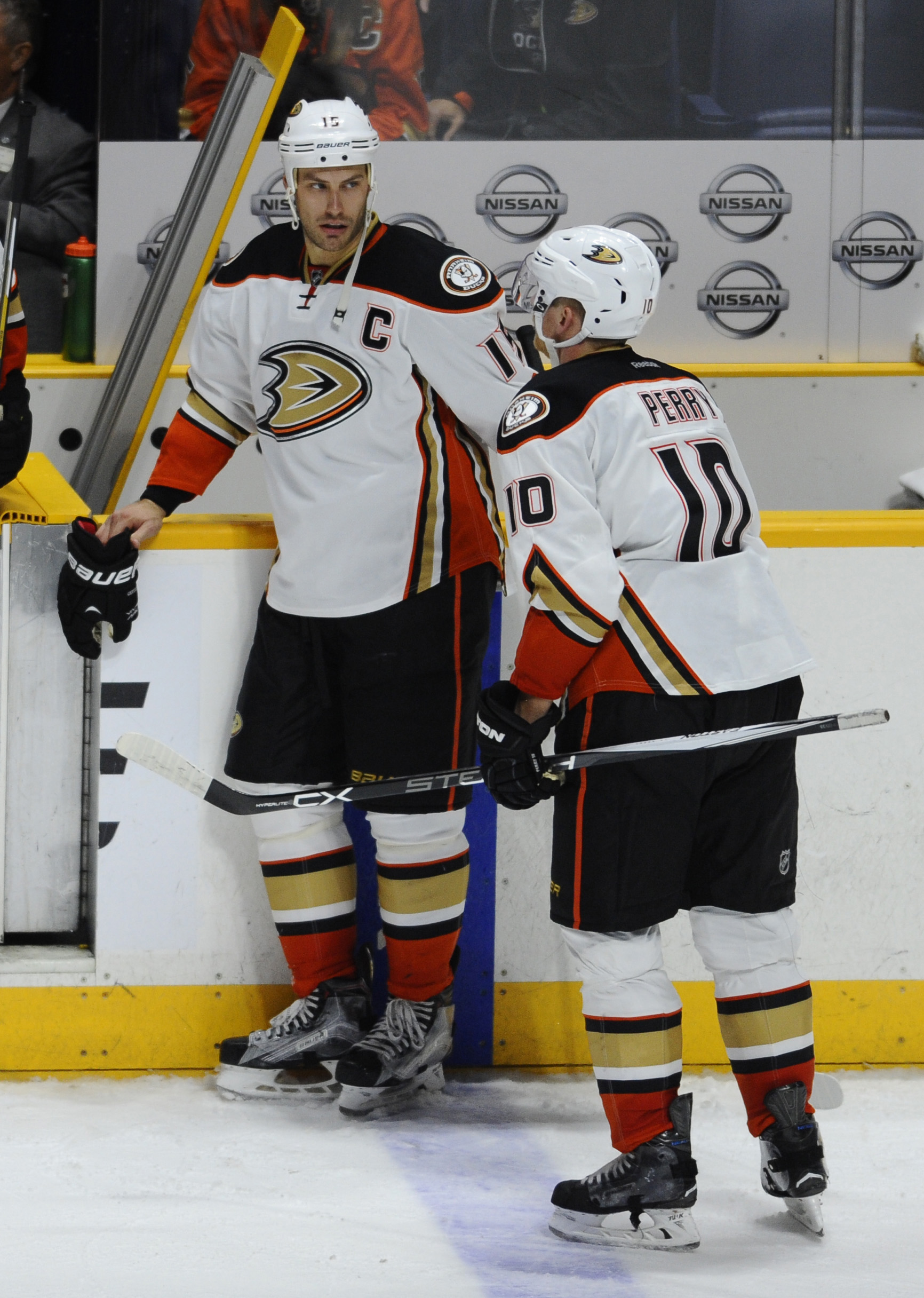 Perhaps the heaviest hitter on the bench – literally and figuratively – will be former Anaheim Ducks captain Ryan Getzlaf. The 17-year NHL veteran has climbed the ranks of Canada’s international presence over the last two seasons. He was a senior advisor at the 2025 World Championship and 2026 Olympic Games – and now takes another step forward overseeing Canada’s next crop of top prospects. Getzlaf is also well-decorated, having won Gold at nearly every level of international competition. That includes the World U18 Championship, World Junior Championship, World Cup, and twice at the Olympic Games. Those accolades were interwoven with an NHL career marked by 1,019 points in 1,157 games – and a Stanley Cup win in 2007.
Lauer marks another veteran of the coaching world. He served as assistant coach to the Anaheim Ducks from 2012 to 2015, then the Tampa Bay Lightning from 2015 to 2018. Lauer then stepped back to a head coach role with the WHL’s Edmonton Oil Kings. He held that role until 2022, then returned to the NHL for a pair of seasons with the Winnipeg Jets, before stepping back into a head coach role with the WHL’s Spokane Chiefs in the last two seasons. Lauer has a thin trophy cabinet despite 25 years of experience – currently filled by a 2022 WHL championship and 2026 World Junior Bronze medal.
The coaching staff closes with longtime goaltending coach De Palma, who has served on WHL benches since the 2006-07 season. He has taken the mantle with the Prince George Cougars and Kamloops Blazers, overseeing parts or all of the junior careers of Taylor Gauthier, Connor Ingram, Dylan Garand, Dylan Ferguson, and Kurtis Mucha. De Palma has served as the goalie coach for Canada’s U18 team since 2023, and also joined the national team at the 2025 and 2026 World Juniors.
Team Canada will be an early favorite under the guide of decades of NHL experience and two former Stanley Cup champions. They should pull together an incredibly strong roster – headlined by Boston University duo Caleb Malhotra and Tynan Lawrence and potentially bolstered by reigning first-overall pick Gavin McKenna. Canada will also bring 2027 first-overall favorite Landon DuPont and may even roster 2028 star prospects Maddox Schultz and Liam Pue. The litany of top-end talent will champion a roster that could feature NHL prospects at every position.
Photo courtesy of Christopher Hanewinckel-USA TODAY Sports.
Minnesota-Duluth Extends Scott Sandelin Through 2029-30
The University of Minnesota-Duluth have no plans to change coaches any time soon. Scott Sandelin has signed an extension with the school through the 2029-30 season. Sandelin’s contract was originally set to expire after the 2026-27 season. The former NHL pro has presided over the Bulldogs bench since the 2000-01 season. He has led the club to highs and lows in 26 seasons since, including national championships in 2011, 2018, and 2019.
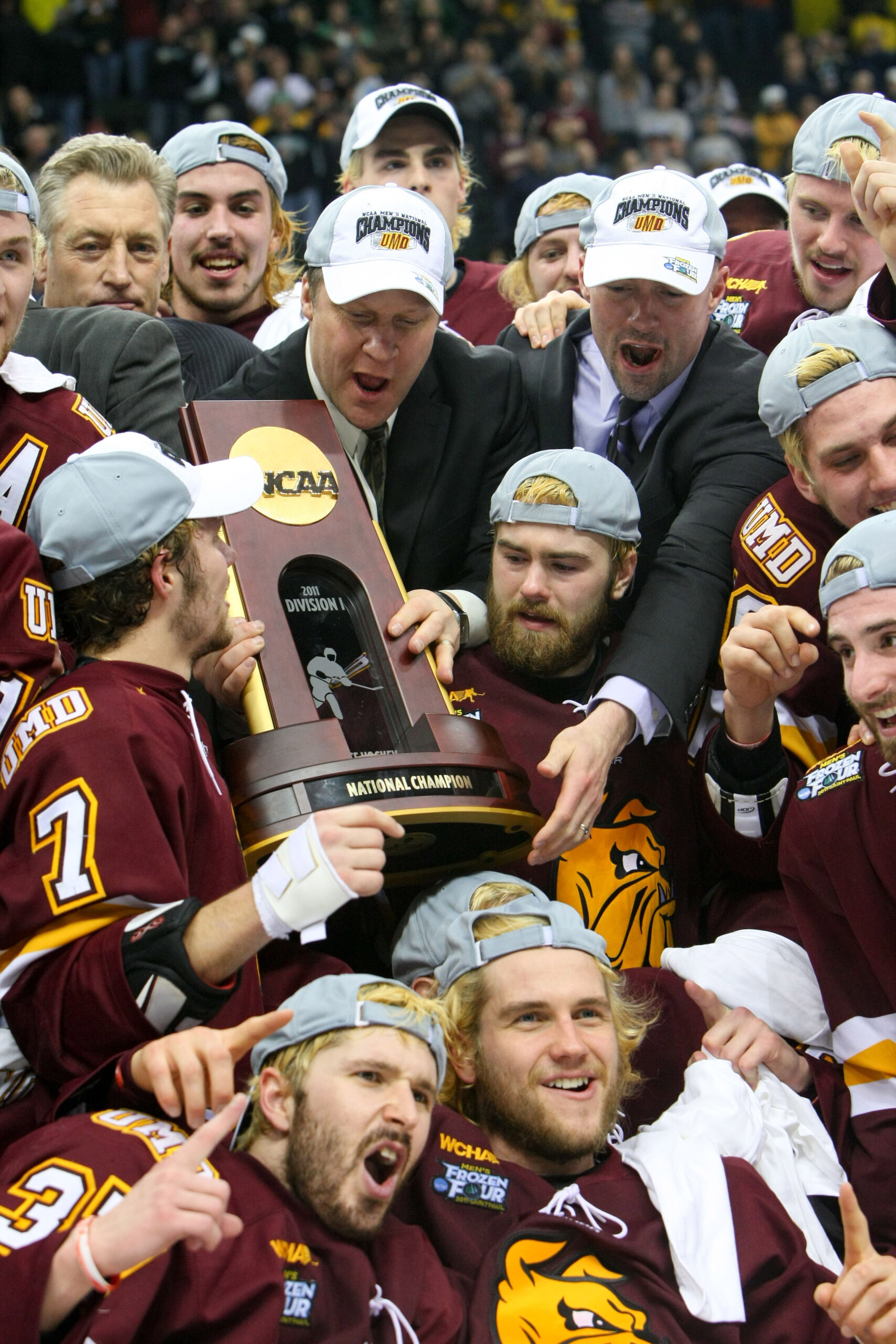 Sandelin has coached four Hobey Baker Award winners in his quarter-century on the Bulldogs’ bench. That includes Detroit Red Wings prospect and 2026 winner Max Plante, who sealed college hockey’s MVP title after forming an explosive duo with brother Zam Plante. Plante breaks the mold of Sandelin’s past Hobey Baker-winners. Scott Perunovich (2020), Jack Connolly (2012), and Junior Lessard (2004) all won in their senior seasons and moved to the pros immediately after. Plante became the first sophomore to win since Cole Caufield in 2021 – and he will become the first Hobey-winner to return to school since North Dakota’s Ryan Duncan in 2007.
Plante’s return will equip Sandelin with college hockey’s sharpest duo for a second season. The brothers will be joined by their youngest sibling – recent Red Wings draft pick Victor Plante – after he completed two seasons with the U.S. National Team Development Program. The Bulldogs will also add Seattle Kraken center prospect Barrett Hall and Utah Mammoth goalie prospect Carl Axelsson for the 2026-27 season. They are two members of a small-but-mighty recruiting class set to bolster a roster with multiple returnees.
The split between lofty experience and fresh-faced NHL prospects could help Minnesota-Duluth find another gear in the 2026-27 season. They will face serious competition from Sandelin’s alma mater, the University of North Dakota, and 2026 national champions, the University of Denver – but could best both with experience and hard work. Ensuring that will be the task ahead of Sandelin as he enters his 27th season overseeing the Minnesota-Duluth bench.
Photo courtesy of Brace Hemmelgarn-Imagn Images.
Canadiens Sign Jared Davidson, Hunter McKown To Two-Way Contracts
The Montreal Canadiens have announced the signings of two forwards, Jared Davidson and Hunter McKown, to one-year, two-way contracts, according to the team’s website.
Davidson, the 24-year-old, earned ten games with the Canadiens, logging an assist in 2025-26 after a strong start to his season in the minor leagues. The majority of his season was spent in Laval with the Rockets, Montreal’s affiliate in the AHL, where he registered 16 goals for 25 points in 53 games. The Edmonton native was originally a fifth-round pick selected at 130th overall in 2022 and was a member of the WHL’s Seattle Thunderbirds, where he won a WHL championship in 2023 before his first contract with the Habs.
He’s considered to be a hard-working, physical forward who has improved his skating, which could help him further carve out a bottom-six NHL role if the opportunity presents in Montreal.
McKown, the 23-year-old, was a member of the Columbus Blue Jackets organization last year but has not seen NHL time since the 2022-23 season, when he was 20, where he logged 2 assists in 12 games. McKown has been with the Cleveland Monsters, the Blue Jackets’ AHL affiliate, where he scored 25 points last season in 63 games played. The San Jose native will play on his third NHL contract, with his last deal paying him $800K in 2025-26 and before that, a three-year, entry-level contract making $950K annually. McKown was undrafted out of Colorado College in the NCAA.
He is known as a player who can play strong defensively as a center, as a formidable in-zone presence, helping his defense and wingers be able to break out in transition.
Canadiens Hire Derek Lalonde As Associate Coach
According to a team announcement, Former Detroit Red Wings head coach Derek Lalonde has landed on the Montreal Canadiens coaching staff as an associate coach, first reported by Eric Engels of Sportsnet.
Lalonde spent the past season in Toronto in a similar role. He wasn’t out of a gig for long, as the Maple Leafs announced just yesterday that he wouldn’t be returning, with the news of Daniel Alfredsson coming aboard. Speaking of elite players of the 2000s, the 53-year-old Lalonde moves on to Martin St. Louis‘ staff at an exciting time, fresh off the club’s unlikely run to the Eastern Conference Finals. According to Engels, he is directly replacing Trevor Letowski in Montreal, who has stepped away from the demands of coaching to spend more time with family, while the organization hopes to retain him in a smaller capacity after five years behind the bench.
A native of Brasher Falls, New York, Lalonde earned his stripes starting out at an assistant at the NCAA Division III level in 1995, moving up to serve on the staffs of Division I Ferris State as well as the University of Denver. A former goaltender at the collegiate level with SUNY-Cortland (NCAA DIII), his first head coaching job came with the ECHL’s Toledo Walleye in 2014, immediately taking home Coach of the Year honors in his first campaign. After a two-year stint with the Iowa Wild (AHL) from 2016-18, he was brought on to Jon Cooper‘s staff starting in 2018. Lalonde did excellent work there, winning two Stanley Cups with his defensive units and stout penalty kill making a big impact.
Pulled along to the Motor City from Tampa Bay by Steve Yzerman in 2022 as the 28th head coach in franchise history, he was fired midway through his third season in Detroit after an 89-86-23 record, not able to qualify for the playoffs. A defensive-minded coach, the Wings struggled to put the puck in the net, ranking 26th in the league across his tenure, and their defending efforts weren’t much better, allowing 3.33 goals per game, 27th. Detroit hasn’t exactly made huge strides since his departure, while Lalonde is perhaps best suited in a role where he can fully lean into his past duties in Tampa. He helped the Maple Leafs to an 81.2% penalty kill success rate, ranking 8th, despite the team’s overall struggles, surrendering the second highest goals in the entire league (299) only better than the league’s worst Canucks. It was reported in late May that Lalonde got an interview for the Leafs’ head coaching job, although they ended up deciding on Jim Hiller, leaving Lalonde to move on despite solid work in Toronto.
Hoping to bring that same success to Montreal, the Canadiens have room to improve on the PK as their 78.2% rate this past season was 18th in the NHL. A team offering a pair of strong defensive centers in Phillip Danault and Jake Evans, it has the makings of a nice fit. Depending on how Lalonde’s results as an assistant continue to go, perhaps one day the Stanley Cup winner will get another head coaching opportunity.
The Largest NHL Cap Hits Signed In The 2026 Offseason
Every year, with the NHL Salary Cap rising, articles like these will constantly highlight the growth of hockey. Players are looking to make more money, and teams are avoiding sticker shock in the moment of inking the deal.
As major free agents have put pen to paper, and some remain in play to receive their payday. Most notably, UFA’s Patrick Kane, Anthony Mantha, and Vladimir Tarasenko remain open to veteran NHL contracts, and RFAs Jason Robertson and Adam Fantilli, all need new deals too and may even join this list.
So far, we’ve seen over 200 NHL contracts signed. Today, we will examine this offseason’s largest contracts signed by analyzing which players have the largest cap hit out of the signings made in the summer of 2026. Considering players can (and have) inked extensions ahead of their status for the 2027-28 season, we’ll include those deals in as well.
1. Leo Carlsson — 5 years, $18MM AAV ($90.00MM), Anaheim Ducks
I think a lot of us expected a large sum of money to head to Carlsson’s bank account; however, I don’t think any of us saw him ending up first on this list. The former No. 2 overall pick in 2023 received a lucrative offer sheet from the Philadelphia Flyers, which the Anaheim Ducks matched. With Verbeek retaining the young Swedish phenom, it’ll be interesting when we look back on the drama from this past week, and the gamble to use 17.3% of Anaheim’s cap hit on the 21-year-old, and how it impacted the Ducks and the NHL.
2. Connor Bedard — 5 years, $15MM AAV (75.00MM), Chicago Blackhawks
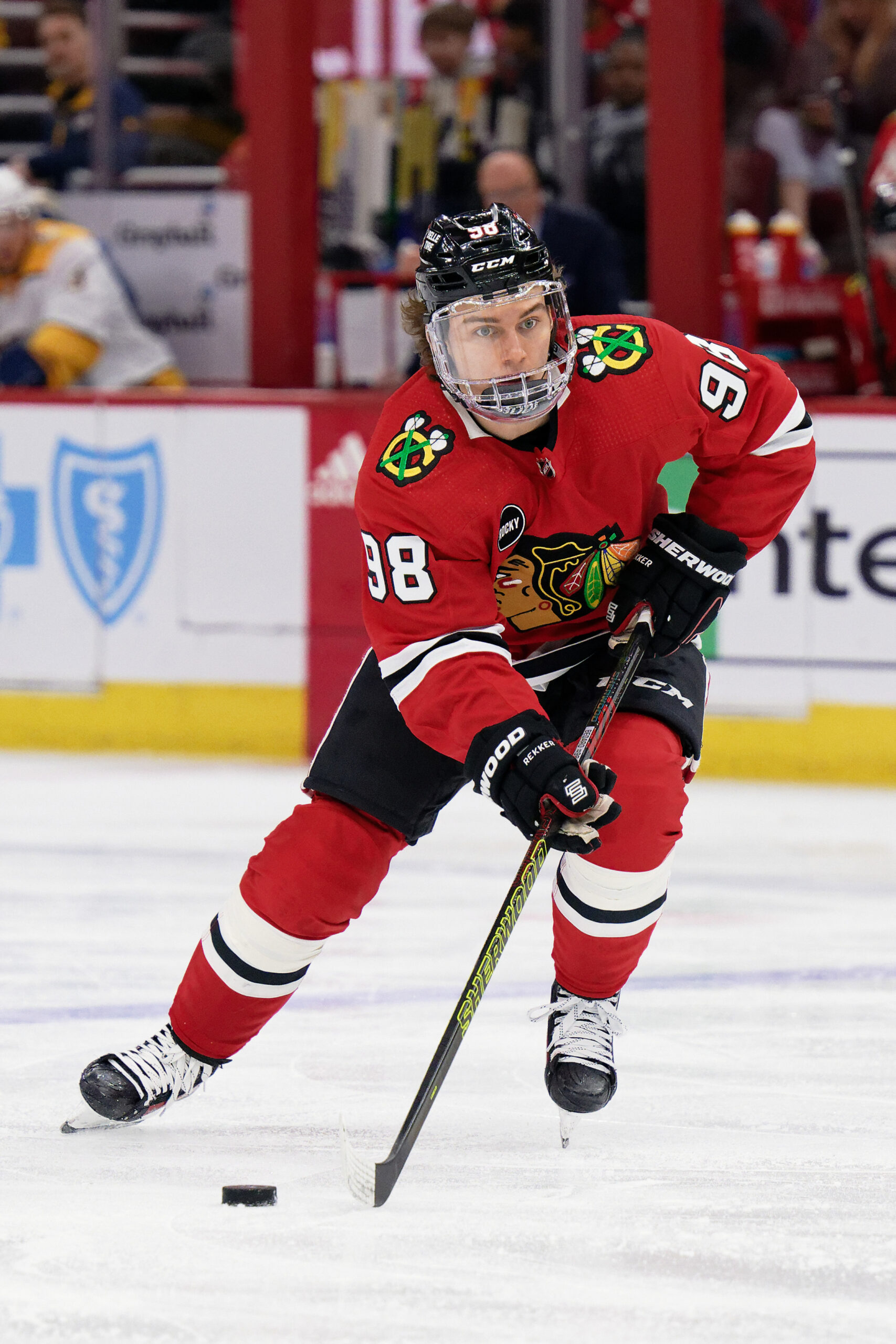
Chicago had to open its checkbooks this offseason but paid less money than Anaheim did for the player taken after his No. 1 overall selection in the 2023 NHL draft. One of the NHL’s brightest young superstars and the poster boy of the next generation of Blackhawks will make less money than Carlsson despite scoring around 60 more points than him. Nonetheless, Bedard is third in the NHL among the highest-paid players and will be a free agent again just before his prime at age 26. It should make the Hawks happy that situationally, their star man is committed to the Windy City.
3. Bowen Byram — 6 years, $12.5MM AAV (75.00MM), Chicago Blackhawks
The Blackhawks found their No. 1 defenseman, but it cost them a hefty price to do so, which included trading away the 2026 fourth-overall pick. Byram wanted to be the go-to man on the blue line for an NHL club, and this fits for Chicago. The funny way to put this is that in 2027-28, when the contract kicks in, Byram will have the same income as Connor McDavid and a higher annual paycheck than his former Sabres teammate, Rasmus Dahlin. Last season was the former No. 4 overall pick’s best season offensively, but Chicago is hoping that he’ll elevate that production with the keys to the backend.
4. Nico Hischier — 5 years, $11.7MM AAV ($58.5MM), New Jersey Devils
The Devils wanted to extend their captain this offseason, and they checked that box. The 2017 first overall pick was entering the final season of a seven-year, $50.75MM deal signed with New Jersey back in 2019. Now, the Devils will keep their 27-year-old top-line center through the 2031-32 season while giving him around an 65% salary increase. Rightfully so for one of three Devils to score over 300 points up to today (1st. Jesper Bratt, 418 points and 2nd. Jack Hughes, 407 points), that’s an integral piece to retain towards the ultimate goal.
5. Pavel Dorofeyev — 7 years, $11.0MM AAV ($77.00MM), New York Rangers
The Rangers have lost some key pieces over the course of 2026. Their retool should see a bump from Dorofeyev, who is receiving a lucrative pay raise from his former contracts that paid below $2MM AAV. New York has made him the second-highest earning rostered player for 2026-27, behind fellow countryman Igor Shesterkin. They hope that the 25-year-old Russian can build on his two 30+ goal campaigns and seamlessly fit in a new scene. Ideally, considering his deep playoff experience and elite scoring touch, he’s a huge core piece that’ll have to shine on Broadway.
6. Alex Tuch — 8 years, $10.5MM AAV ($84.00MM), Washington Capitals
It was pretty obvious that Tuch was the biggest UFA name on the market. The consideration of whether to keep the veteran forward was one of the Sabres’ biggest decisions after making the playoffs for the first time in a while. Alas, letting go of a hometown player with the contract Washington is paying is the direction the Sabres went. Tuch will make a lot of money until his age 38 season, but for a tenacious forward who’s proven to perform in previous playoff stints, he’s a key forward Washington could use.
7. Ivan Demidov — 8 years, 9.15MM AAV ($73.2MM), Montreal Canadiens
The youngest player on this list will be a Hab for a long time. The 20-year-old Russian winger won’t need another contract until 2035, and at the cap hit he signed for, GM Kent Hughes was probably ecstatic knowing he inked Demidov to this deal after the Flyers went ahead and reset the market entirely. When this contract takes effect in 2027-28, as of this writing, the former fifth-overall pick will be around the 40th-highest-paid player in the NHL. Chances are, if his sophomore season saw above 60 points in production, who knows what Demidov will produce in his prime based on that trajectory.
8. Trevor Zegras — 4 years, 9.125MM AAV ($36.5MM), Philadelphia Flyers
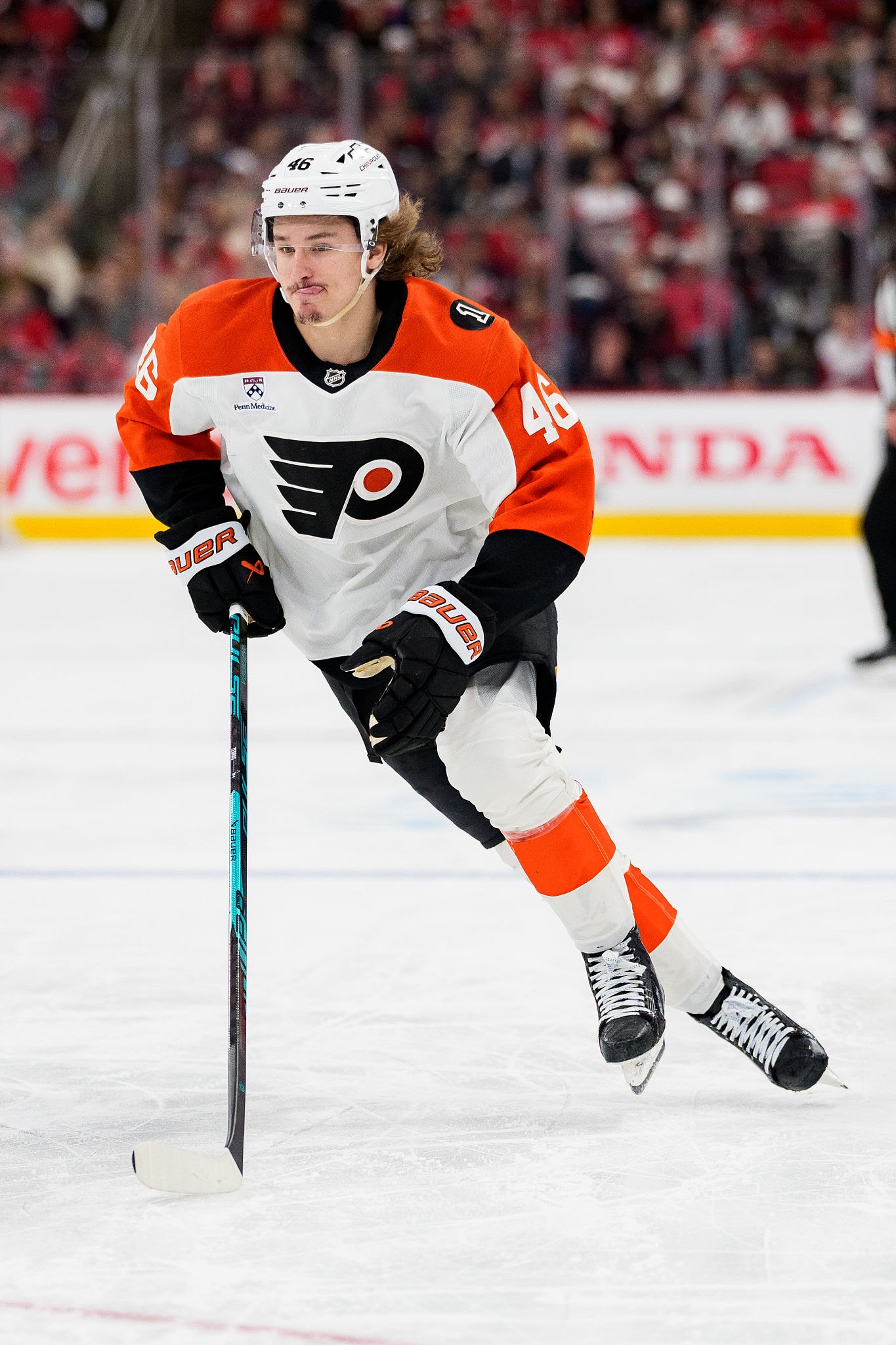
The former No. 9 overall pick in 2019 just became the Flyers highest paid-player this offseason, beating Travis Konecny‘s $8.75MM AAV. After filing for arbitration, the 25-year-old extends his time in Philadelphia after being traded there by the Anaheim Ducks in the summer of 2025. His 26 goals for 67 points in 81 games elevated the Flyers into a playoff position, all of which were career-high tallies in his first year in a different shade of orange. The young American star is locked down until 2030 as part of Philadelphia’s build-up into what they hope to be an extension and growth of contending with a young group for the playoffs within the East.
9. John Carlson — 2 years, 8.5MM AAV ($17.00MM), Tampa Bay Lightning
The veteran is headed to a sure playoff contender, an environment he’s been in his whole career. Carlson wanted to remain out east after being dealt to the Ducks, and given the Lightning’s unwillingness to pay Raddysh on their right side for the long term, they opted for the more sure bet of an established former Stanley Cup winner. Having J.J. Moser and Erik Cernak on the right side as well will round out one of the league’s more formidable blue lines with Carlson in the fold. Don’t forget he’s one of three 35+ aged defensemen, along with Victor Hedman and Ryan McDonagh.
10. Rasmus Andersson — 7 years, $8.5MM AAV ($59.5MM), Vegas Golden Knights
The Golden Knights are probably very happy bringing Andersson back into the fold, especially after dealing away two top-64 draft picks and Zach Whitecloud to Calgary at the deadline. As the top right defenseman UFA available, with Darren Raddysh signed and traded to the Toronto Maple Leafs, Andersson cashed in. What the Golden Knights can hope for is a bounce back from what many considered a lackluster playoff performance, registering six assists en route to a Stanley Cup Runner-up finish. Right defensemen with an offensive touch are available on the market once in a blue moon, and for a player who has provided 10+ goals and 50 points, it’s a reasonable payment until 2033.
Previously listed in Top 10:
11. Darren Raddysh — 8 years, $8.5MM AAV ($68.00MM), Toronto Maple Leafs
12. Jacob Trouba — 4 years, $8.25MM AAV ($33.00MM), San Jose Sharks
Accurate as of July 20, 10:28 AM ET, (h/t Puckpedia.com Player Dashboard: signings filtered since June 10, 2026)
Photo Credit: Jamie Sabau-USA TODAY Sports, Jacob Kupferman/Getty Images
Jack Campbell Retires From Professional Hockey
Jack Campbell has announced his retirement from professional hockey at the age of 34. He announced on his Instagram.
The veteran goaltender had not played professionally since the 2024-25 season, under a one-year, $775K contract with the Detroit Red Wings, where he did not see NHL time and played 14 games with the Grand Rapids Griffins, the AHL affiliate. Early into that season, the Port Huron, Michigan native entered the Player Assistance Program. He had hoped to raise his value in Detroit after a disappointing tenure with the Edmonton Oilers, two seasons where he combined for a -21.83 goals saved above expected. The Oilers bought out the last three years of his five-year, $25MM contract signed back in 2022.
In his NHL tenure, he posted a 93-52-18 record across his career that began with the Dallas Stars, the team that selected him 11th overall in the 2010 NHL draft and gave him the first of his seven total contracts signed in his career. His entry-level deal, a three-year, $4.2MM ($1.4MM AAV) contract signed in 2010, didn’t take effect until 2012, after he split time with the Windsor Spitfires and Sault Ste. Marie Greyhounds in major junior hockey. Campbell also spent those days with Team USA in three straight IIHF World Junior Championships within that span, earning a gold medal in 2010 and a bronze medal in 2011 as the competition’s best goaltender.
From there, Campbell was with the Texas Stars, the AHL affiliate of Dallas, winning a Calder Cup in 2014 before making his NHL debut at age 21. He didn’t see an extended run as an NHL goaltender until 2018 with the Los Angeles Kings, signing with the club after being traded by Dallas further west in June of 2016. That run came due to the injury of Kings legendary goaltender, Jonathan Quick, forcing LA to call Campbell to the NHL. In 31 games, he posted a career best 10.72 GSAx, from a .928 save percentage and 2.3 goals against average. His tenure out west caught the eyes of the Toronto Maple Leafs; where they’d eventually trade for the then 27-year-old goaltender.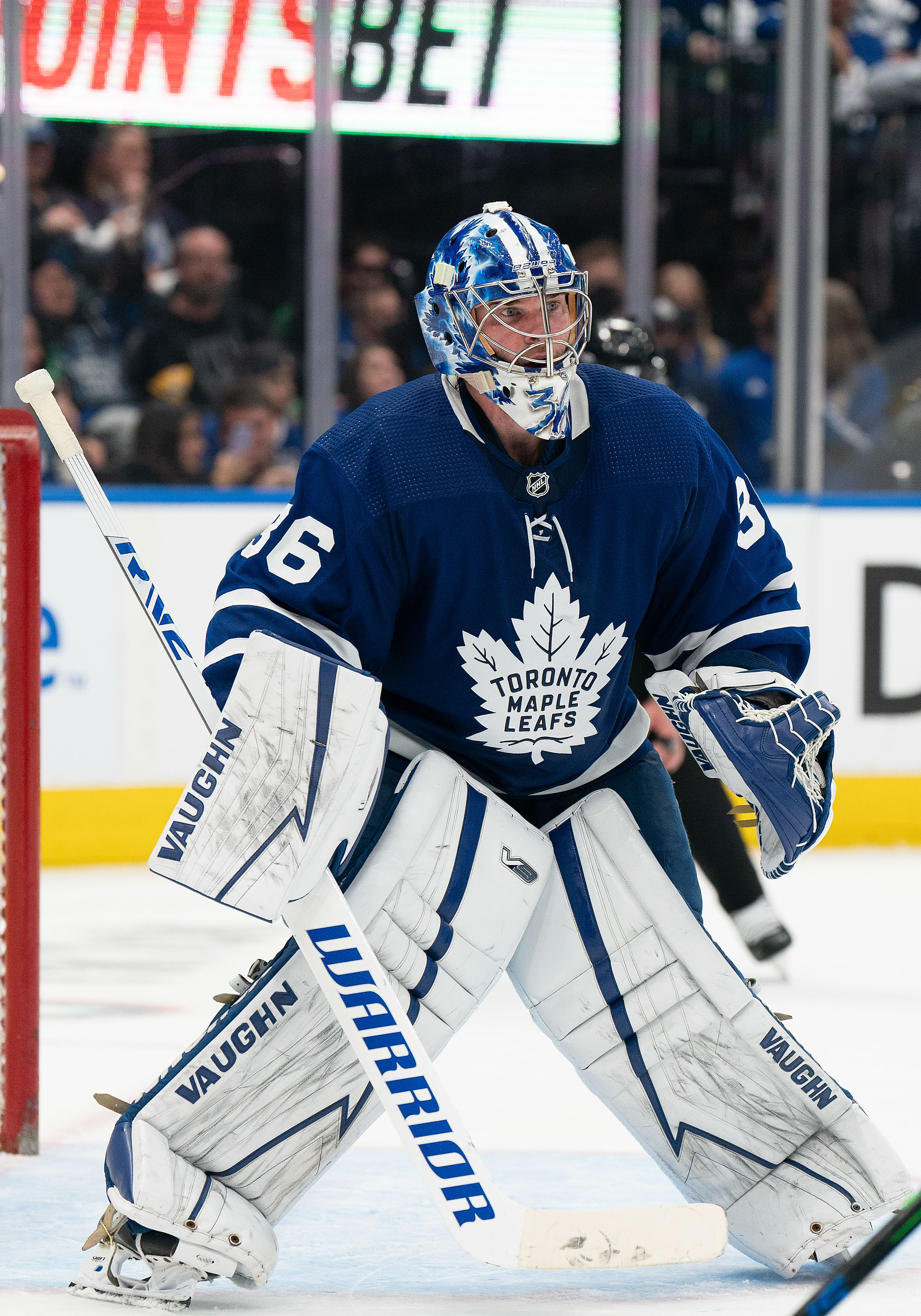
Campbell truly shined in the NHL’s modern mecca. On the two-year, $1.65MM AAV deal he signed with the Kings that didn’t kick in until 2021, he served as backup to then Leaf goaltender Frederik Andersen before eventually earning the starting role, off a stellar start with 11 straight wins, the most by a goalie to start a season up to that point. ‘Soupy’ then was named an NHL All-Star in 2021-22, posting a .914 Sv% and 2.64 GAA in 49 games, winning 31 of them in his age-30 season with 5 shutouts.
That earned him his 5-year deal in Edmonton, where the Oilers believed Campbell was the solution to their problems in goal. However, he did not live up to his previous all-star numbers and since had not been able to recoup such consistency, before his buyout, Edmonton sent him down to the Bakersfield Condors in the AHL.
Throughout his career, Campbell mentioned times when pressure and expectations for himself have weighed heavily on him. In the announcement, he said he’ll move forward as a life coach and referred to times in his life when he needed someone who could advise him and hold him accountable. He tagged Novus Global, saying, “I’m incredibly grateful to begin this next chapter as a coach with @novus.global. I can’t wait to walk alongside athletes, leaders, and high performers as they create bigger visions for their lives and become the people those visions require.”
Devils’ Sergei Brylin Departs Organization For KHL
Sergei Brylin, a former New Jersey Devils player and an organizational mainstay as an assistant coach, has elected to depart the team and take a new role as head coach in the KHL. Per a team announcement, Brylin will become head coach of the KHL’s Dinamo Minsk.
Brylin, 52, won three Stanley Cups in his playing days as a center for the Devils, and in 2023 was inducted into the club’s Ring of Honor.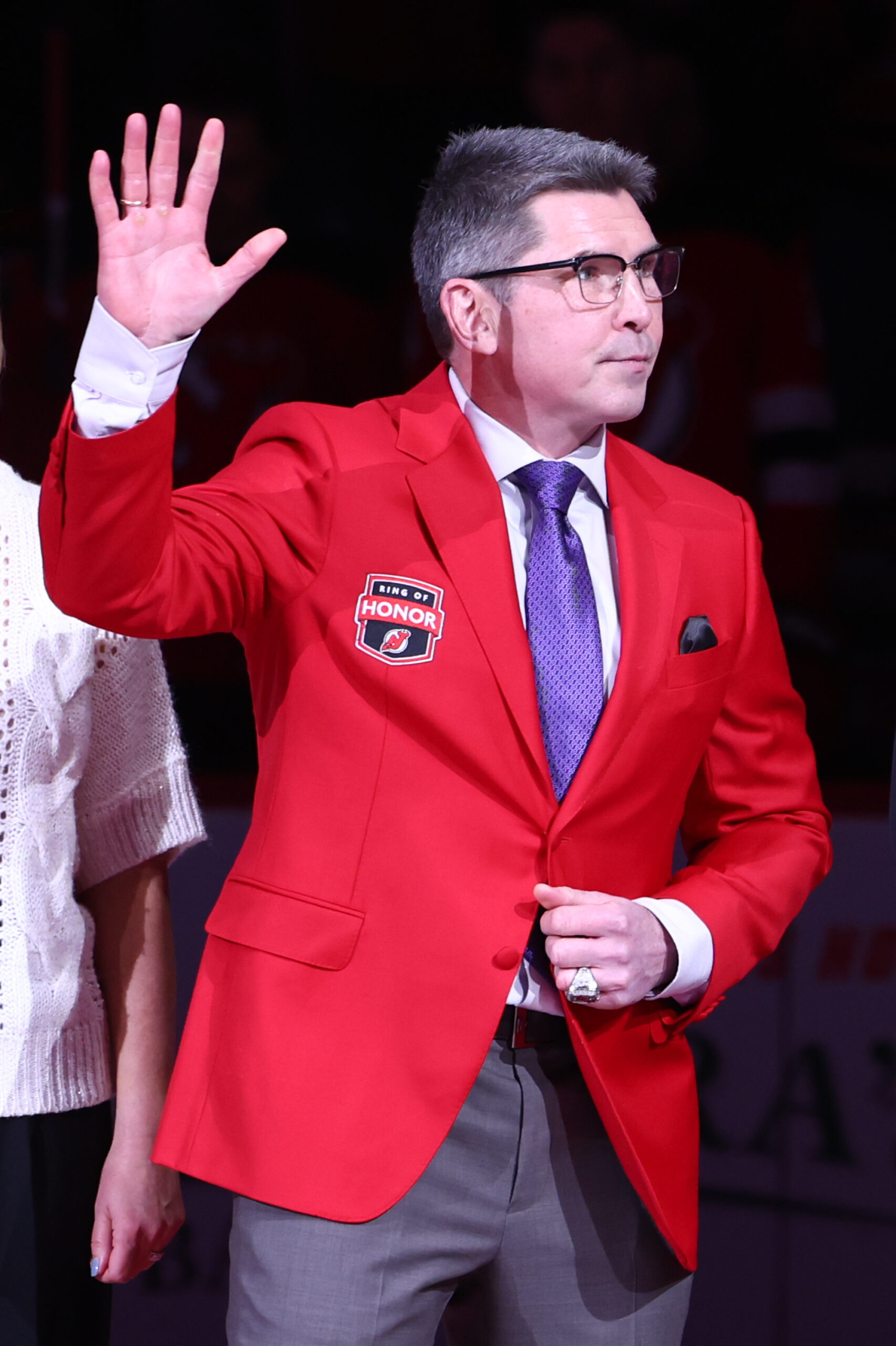
After his final season as a player in 2011-12, Brylin joined the Devils organization in 2013 as an assistant coach for what at the time was the team’s AHL affiliate, the Albany Devils.
Brylin would go on to spend nearly a decade as an AHL assistant in the Devils organization, coaching in Albany, Binghamton, and Utica.
In 2022-23, former Devils head coach Lindy Ruff overhauled his staff of assistant coaches, and in the process elevated Brylin from AHL Utica to the organization’s NHL coaching staff.
Brylin spent four seasons as an assistant coach in New Jersey under two head coaches, Ruff and current coach Sheldon Keefe.
In that span of time, he helped the Devils reach the playoffs twice, including in 2022-23 when he helped the team upset its arch-rival, the New York Rangers, in a dramatic first-round playoff series.
With the Devils enduring an extremely disappointing 2025-26 campaign, vast organizational changes occurred in New Jersey. Former GM Tom Fitzgerald was replaced in the position by Florida Panthers executive Sunny Mehta, and other changes have occurred across the team’s hockey operations department.
One of those changes came in May, when the team announced Brylin would step away from Keefe’s staff to assume an unnamed new role within the organization. Now, it appears that new role with the club will not materialize, and instead Brylin will get his chance to become a head coach for the first time.
While he has no KHL experience as a coach, Brylin does have nearly 200 games of KHL experience as a player. He joins a Minsk team that is the highest-profile club in Belarus, and has been moderately successful over the past half-decade.
Minsk has lost in the KHL’s quarterfinals in each of the last two seasons, helped by contributions from import players such as 2017 Devils first-round pick Ty Smith, and former AHL top scorer Sam Anas. The team is backstopped by former top NHL prospect Zachary Fucale, who has been a KHL All-Star in each of the last two seasons. Anas, Smith, and Fucale, among others, are all under contract for next season.
Brylin replaces Dmitri Kvartalnov as head coach in Minsk, after Kvartalnov departed for the head coaching role at Lokomotiv Yaroslavl. Kvartalnov was the KHL’s coach of the year in 2015-16 back during his tenure with CSKA Moscow, and was able to reach the playoffs in all three seasons coaching in Belarus.
Photos courtesy of Ed Mulholland-USA TODAY Sports
Brandon Saad Garnering SHL Interest
The weight of 15 seasons in the NHL is beginning to wear on two-time Stanley Cup-winner Brandon Saad. He played in only 49 games in the 2025-26 season, marking the first time that Saad has ever appeared in under 50 games in a full season since becoming a full-time NHL winger. The career-worst performance is underlined by Saad’s nine points on the year – his first single-digit scoring performance in the NHL. It seems Saad’s days in an NHL top-six may be in the rearview – but teams overseas are seeing his spinout as shrewd opportunity. Two clubs in Sweden’s SHL – Brynas IF and Djugardens IF – have expressed interest in bringing the American winger into their fold per Johan Svensson of Expressen.
An NHL alum has led the SHL in scoring in four of the last five seasons, generously including 22-game Edmonton Oilers veteran David Tomasek. The path to strong scoring in Sweden is clear for NHL veterans who begin to fall a step behind their leaguemates. The SHL style relies less on athletics and more on smart playmaking and gradual build-ups – creating a system that many players in the top flight can fit into through their 30s.
Saad carries much more pedigree than recent SHL scoring leaders Tomasek, Oscar Lindberg, Antti Suomela, or Marek Hrivik. The former NHL champion was a golden lineup piece through much of his career. Saad offered impactful two-way play to compliment scoring that seemed to stick no matter where he went. His first full year in the NHL saw Saad score 47 points on the Conference Finals-bound Chicago Blackhawks. Saad returned with his first 50-point season in the next year. His scoring propped up Chicago’s middle-six en route to the 2015 Cup, while also sparking a three-year streak of 50-points that Saad carried through a move to the Columbus Blue Jackets. He continued to rival 40 or 45 points through the late-2010s and early-2020s, and through a career that also stopped in Colorado and St. Louis.
Having settled in Vegas for the last two years, Saad’s days as a plug-and-play, two-way winger are in the past. He most recently offered the Golden Knights a veteran benchwarmer who could fill in without mistakes when injuries popped up. That’s low standing for a man just 16 games away from 1,000 in the NHL – and could be the motivator for an SHL move. Saad’s off-puck work ethic and heads-up playmaking would be coveted in the Swedish league – particularly on a Brynas offense that ranked fourth in scoring last season, or on a Djugardens team flanked by up-and-coming NHL prospects.
It would be no surprise to see Saad return to his high-scoring ways on either lineup – though both teams face one snag in recruiting the NHL free agent. Saad has made no indication that he is interested in a move to Europe. As a veteran of American hockey, there is a strong chance that the 33 year old would prefer to stay close to home while chasing his next milestone in the NHL. If that is the case, Saad will spend the rest of the summer trying to convince a team to sign him to a cheap, short-term deal – or a camp try-out. Should those arguments fall flat, it seems Saad would have no shortage of alternative options in the hockey world.
PHR Mailbag: Yzerman, Bourque, Robertson, Larkin, Jets, Korczak, Carlsson
Topics in this edition of the PHR Mailbag include the newest GM vacancy in Detroit, the Jason Robertson situation in Dallas, and much more. With all of the questions submitted, we’re going to do four columns so if your question doesn’t appear here, keep an eye on upcoming mailbags.
Johnny Z: Who is Y’s successor. A successor should be more successful than he! Please skip past Kris Draper……
Let’s jump right in to the big news of the week, Steve Yzerman stepping away from Detroit’s General Manager position to become a senior advisor. It’s worth noting that until a successor is named, Yzerman is still the GM.
You may not want to hear Draper but I’m sure he’ll get consideration, especially if Yzerman has any influence in the selection process. He has been with the organization in some sort of front office role since 2011 so it’s quite reasonable to think he’ll be interviewed at least. Shawn Horcoff (who has held various roles since 2016) should get an interview as well. Both are currently assistant GMs.
I’m going to suggest a few other names as well. Ryan Martin has some ties to Detroit and is currently an assistant GM with the Rangers. He has interviewed for several GM roles and it feels like only a matter of time before he gets one. Outgoing Bruins assistant GM Evan Gold went pretty deep into interviews for a couple of teams this year by the sounds of it so he probably gets consideration as well. Tom Fitzgerald is still out there and given Carolina’s success, it wouldn’t shock me if AGM Darren Yorke at least gets an interview.
But I think Detroit will basically repeat the past with the hiring of Yzerman’s replacement by hiring Brendan Shanahan. He has years of experience running the show in Toronto (more on that shortly) and of course has plenty of ties to the organization and community. Installing him as Executive VP (the other title Yzerman has) with a less-experienced GM working underneath him (any of Martin, Gold, or Yorke qualify, if not one of their internal AGMs) seems like the safe way to change things up. I think taking the safe route is what they’ll ultimately prioritize.
FearTheWilson: Which was the bigger fail: the Yzer-plan or the Shana-plan?
This is an especially fitting question given how I just answered the last one. The good news (I suppose) is that I’d have Yzerman’s tenure as the bigger negative between the two.
With Shanahan, there was at least a general baseline of some success. The Maple Leafs were a consistently strong regular season team that regularly made the playoffs. Did they underachieve? Sure. But there was a rebuild with talent accumulation (a pretty good group of talent, to be fair) and a sustained period of something better than mediocrity.
Compare that to Yzerman’s tenure. Detroit didn’t make the playoffs once, didn’t rebuild, and with how some of their recent draft picks are developing, even the asset accumulation section has taken a bit of a beating lately. Even if you don’t factor in his captain wanting to be traded and just compared the team’s success rate, something going somewhat right (Toronto with Shanahan) beats almost nothing going right (Detroit with Yzerman).
letsgonats: Do you think Dallas sold too low on Bourque? I do. They got a 27 2nd and 28 3rd (via Vegas). And Nashville quickly locked him up for $33M for six years.
They also threw in Lyubushkin who I think could have gotten a 3rd by himself. At over $5MM AAV in an offer sheet would have netted DAL a 1st and a 3rd. Why did they pull the trigger so soon?
I don’t think Mavrik Bourque would have been offer-sheeted in the $5MM range, knowing the compensation it would have taken. If a team wanted to do one, the target would have been $4.775MM, the same amount Barrett Hayton received from New Jersey. That still would have put the screws to the Stars while only costing the signing team a single second-round pick.
 In essence, they got the second rounder for him and the third rounder for Ilya Lyubushkin as you suggested. The veteran blueliner was someone they had been trying to move for a while with no success; it was thought by some that teams wanted an incentive to take on the final year and $3.25MM left on his contract. (Though, with some of the deals signed in free agency, that price doesn’t look quite so bad now.)
I’m sure GM Jim Nill wanted a better return but he was up against the gun to a point. As soon as Bourque signed an offer sheet, any leverage was gone and the return would have been less than what they ultimately got (unless a team put one in at the higher price tag which seems less likely). And they still would have had Lyubushkin’s salary to offload.
From a straight-up value standpoint, I agree, the return for Bourque seems light. But given the circumstances (including the Jason Robertson situation and a second leaked trade that fell through along with few movable pieces to open up cap space), I don’t think they had a choice. This way, they got the offer sheet value plus a bit more, plus get Lyubushkin’s deal off the books to help in their efforts to retain Robertson. It’s underwhelming but I don’t think they could have realistically done much better given everything else involved.
bottlesup: What do you think the eventual outcome will be between Robertson and the Stars? Long-term deal with Dallas or someone else? Do you think a Larkin for Robertson swap makes sense? Thanks!
For Robertson, can I go with neither, at least for this year? As of this moment, I think the likeliest scenario is that it’s a one-year deal, whether it’s through an arbitration hearing or pre-hearing settlement. That might be the only way to afford him without drastically having to shake up the rest of their roster for the upcoming season.
In an ideal world for them, there’s also a wink-wink-nudge-nudge side agreement that says on January 1st when he’s extension-eligible, he signs a seven-year deal in the range of $15MM per season. That’s more than the ask is now but that’s reflective of there being no RFA year in the agreement and the acknowledgement of how close to UFA eligibility he’d be. That would only hit the books in 2027-28 when Tyler Seguin is no longer under contract and they would be able to afford it much easier. Both sides get what they ultimately want which is a long-term contract; it just would take a little longer to get there.
I don’t dislike the idea of a Dylan Larkin for Robertson framework but unless Dallas is really worried about controlling long-term costs, it’s not something they have to do, assuming they can squeak him in using my approach above. The Stars have solid center depth in Wyatt Johnston, Roope Hintz, and Matt Duchene so it’s not a need-driven move although Larkin would open up some options and keep their current cap structure intact. Meanwhile, Detroit would get a much-needed scoring winger but would be entirely bereft of quality centers and we know how hard those are to get. I think there would have to be a second trade lined up to land another pivot and given the uncertainty now in their front office, I’d be surprised if something like this got done.
deca guard: Would a Larkin for Harley deal be one-for-one?
Well, here’s a different idea. We know the Stars are open to moving Thomas Harley given his reported inclusion in the deal that would have sent Zach Werenski to Dallas but in that swap, they were getting a franchise defenseman in return. Their blueline is already viewed as being a bit iffy despite the presence of Miro Heiskanen and Esa Lindell and further weakening it to add at a position they’re already deep in (at center) probably isn’t the best idea. I say that while acknowledging the salary difference might be enough to get Robertson locked up long-term now which is an important consideration.
Similarly for Detroit, this leaves them without one above-average center, though a very promising back end. As I noted in the last question, there would have to be something else in place and given their GM situation at the moment, that’s not happening.
In terms of straight-up value, if all the above concerns weren’t in place and there was a need for them on the acquiring teams, I’d say Dallas would have to add. Larkin’s contract is arguably below-market now and he’s signed for five more years while playing the premium position. I think that’s worth a bit more than eight years of Harley on a richer price tag.
Cla23: Do the Jets have the best goaltending tandem in the NHL?
Is Yager ready to be #2c?
The good news for Winnipeg is that Stuart Skinner should be an upgrade on Eric Comrie as the backup goalie. But knowing that Skinner is prone to periods of wild inconsistency, I’d have a hard time elevating Winnipeg to the best goalie tandem in the league. I’m also not entirely convinced that Connor Hellebuyck will be there when the season starts either so I’m not going to make that proclamation just yet. If he’s there, they’re among the best but probably not the best.
With your question about Brayden Yager, I’d say he’s ready to be the second-line center in AHL Manitoba next season. I don’t think that’s the team you’re asking about though. In terms of being Winnipeg’s second-line pivot in 2026-27, I’d say the answer is an unequivocal no. He’s coming off producing 10 goals in 68 games for the Moose, hardly production worthy of top-six NHL time, or frankly any NHL time coming out of training camp barring a rash of injuries. Add to that the extra challenges associated with being an impact center at the NHL level (the defensive responsibilities, for example) and that’s too much, too fast for Yager.