
Maple Leafs Considering Joe Pavelski For Head Coaching Role
A totally unexpected name has entered into contention for the Toronto Maple Leafs’ vacant head coaching role: former San Jose Sharks forward Joe Pavelski. According to Sportsnet’s Elliotte Friedman, Pavelski is “on the Maple Leafs’ radar as the team begins the next phase of its interview process.”
Pavelski’s presence as a candidate for Toronto’s vacancy stands in stark contrast to the other coaches Toronto is reportedly considering.
The other names that have surfaced, such as Peter Laviolette, Patrick Roy, and Dallas Eakins are all coaches with significant experience as an NHL head coach.
All three have been head coaches at multiple stops around the NHL. Pavelski, 41, is just two seasons removed from the end of his playing career.
Although Pavelski is indeed a significantly less experienced candidate than the others Toronto is reportedly considering, it’s not difficult to see why Toronto is looking at going in this direction. The team doesn’t need to go far to see how a team can benefit by placing its faith in a hugely respected, recently retired former player lacking in any formal professional coaching experience.
The Montreal Canadiens took a leap of faith early in their rebuild when they hired Hall of Fame winger Martin St. Louis to be their head coach, replacing Dominique Ducharme, the coach that won the team a Clarence S. Campbell Bowl less than a year earlier. St. Louis had been considered for an AHL coaching role in the past, and even served as a consultant for the Columbus Blue Jackets, but had not been a head coach outside of coaching his children in minor hockey.
The Canadiens made a bet that St. Louis’ unique perspective as a Hall of Fame player who had to battle his way into the NHL as an undersized waiver-wire depth forward, combined with his work ethic, character, and highly-regarded leadership skills would eventually make St. Louis a uniquely valuable head coach – even if he had to develop into that kind of role without much prior experience.
Montreal’s bet on St. Louis paid off handsomely. While it did not result in winning in the immediate term, the impact St. Louis had on player development was almost instant. Star prospect Cole Caufield had endured a nightmarish rookie campaign under Ducharme, but after St. Louis arrived, he took off.
Over the last two years, St. Louis’ player development acumen began to finally translate into the standings. He took the Canadiens to a surprising playoff berth last season, and this year, the team finished with 106 points in the standings. Montreal reeled off two consecutive upsets in the postseason, defeating a veteran Tampa Bay Lightning squad and a dominant Buffalo Sabres team in two dramatic seven-game series. While the Canadiens ultimately ran out of gas against the Carolina Hurricanes, St. Louis’ run to the Eastern Conference Final proved just how effective of an NHL coach he had developed into.
The Maple Leafs have watched Montreal – their arch-rival – enjoy a massive amount of success in large part because they took a leap of faith on a widely respected veteran player without coaching experience, betting that the intangible traits that made him a special player would also make him a special coach. It seems Toronto is considering making a similar bet of their own.
It’s worth noting that while the Maple Leafs are certainly eyeing the success Montreal has had with St. Louis, their situation is not an exact one-to-one comparable. When Montreal hired St. Louis, they did so on an interim basis in a season where they would finish in last place.
They were firmly in the early stages of their rebuild, and even if St. Louis’ tenure ended up not working out, the team’s recently-hired front office would have at least been able to rely on St. Louis, someone they trusted and had pre-existing connections to, to provide them with detailed information on players in order to help inform the team’s future plans.
In other words, St. Louis was under no pressure to immediately deliver wins. And that helped him, because he was not able to deliver those immediate wins, his instant impact came in the form of player development, and the winning took some time to arrive.
The Maple Leafs are not, at this point, at a similar stage. The team is under significant pressure to return to the postseason in 2026-27, as the club’s ability to retain franchise center Auston Matthews may depend on it. There will not be time for Pavelski to slowly come into his own as a winning coach the way St. Louis did – the franchise simply can’t afford to give him that kind of runway. So it’ll be a unique challenge if Pavelski ends up with the job, without question.
While it is far from certain that Pavelski would actually receive the job in Toronto, he does stand out as an ideal candidate in the St. Louis mold, even in the face of those aforementioned challenges. One of the greatest forwards in the history of the San Jose Sharks, Pavelski captained the team and led them on numerous deep playoff runs, including a run to the Stanley Cup Final in 2016.
Pavelski’s work ethic, character, and leadership allowed him to have a 1,332-game NHL career with 1,068 points, one of the best careers ever for a player drafted in the seventh round. He even had some of the best years of his career in his late thirties on the Dallas Stars, serving as a veteran mentor to some of the team’s emerging young stars such as Jason Robertson and Wyatt Johnston.
According to Friedman, Pavelski has spent much of his early retirement like St. Louis – coaching his son in minor hockey. He spent the 2025-26 season as head coach of the Madison Capitols 15U AAA. One should not downplay the challenge of going from there to coaching the Maple Leafs – an NHL team in a supremely hockey-mad market – would be a real challenge.
But if there is any player who possesses the kind of work ethic, character, and leadership ability to handle the task, it would be Pavelski.
Photos courtesy of Jamie Sabau-USA TODAY Sports
Heise Makes College Commitment
- Sharks prospect Max Heise will be one-and-done in the WHL. Earlier this week, he revealed on his Instagram account that he will suit up for the University of Denver next season. He was selected 150th overall in the draft last month and had been playing in the BCHL to keep his college eligibility intact under the old rules. But when major junior players became NCAA-eligible, Guite made the jump to Prince Albert and had a productive year, picking up 63 points in as many games to finish third on the Raiders in scoring.
Prospect Notes: Meyer, MacKinnon, Second Overall
Top 2027 NHL Draft prospect Carter Meyer could be making a groundbreaking change of leagues. The U.S. star has requested release from the U.S. National Team Development Program per Jeff Marek of Daily Faceoff. Meyer is undoubtedly the top player of the NTDP’s U17 squad and is currently projected to be drafted in the 2027 top-10. Should he be granted release, Meyer would likely move to the QMJHL’s Quebec Remparts, who picked up his rights with the 17th-overall pick in the 2025 QMJHL Entry Draft.
Meyer is a true, top playmaker who proved he had the top-end motor to support his top-end skill during his first year at the NTDP. He led the team in scoring with 15 goals and 37 points in 42 total games – four points more than Nolan Fitzhenry in second place. The Boston University-commit also led the U.S. roster in scoring with 10 points in four games of the World U17 Hockey Championship. That performance earned him a promotion to the roster for the U18 Men’s World Championship, where he notched five points in five games. Meyer is the son of 281-game veteran of the NHL Freddy Meyer, who currently serves as the head coach of The Rivers School in Massachussetts high school hockey.
Other notes from the prospect world:
- The Providence Bruins have signed defenseman Dylan MacKinnon to a one-year, two-way, AHL contract. MacKinnon wrapped up his fifth season in the QMJHL this year, finishing with just 12 points in 47 games between the Moncton Wildcats and Charlottetown Islanders. He signed with the ECHL’s Maine Mariners to finish the season and managed no scoring in three pro games. MacKinnon was the shutdown defender on strong, offense-first teams during his junior career. That style didn’t pop much, leading the Nashville Predators to forgo signing MacKinnon after drafting him in the 2023 third-round. He will look to fit in a bit better at the AHL flight.
- Speculation around the San Jose Sharks’ dangling of the second-overall pick continues to grow. The team could find potential trade partners across the top-15 per NBCS’ Sheng Peng. The St. Louis Blues and Calgary Flames have already expressed interest in moving up on draft day – but Peng points out that the Chicago Blackhawks could also be an interesting candidate. Any deal would need to land San Jose a player close to the NHL – and with some upside worth looking forward to. A tinge of promise could help San Jose justify stepping back in a top-10, or top-15, filled with upside and interesting defense prospects.
Barracuda Sign Hasley To One-Year Deal
- The Sharks have added some minor-league depth. Their AHL affiliate announced that they’ve signed goaltender Connor Hasley to a one-year deal. The 25-year-old wrapped up his college career with Arizona State, posting a 3.12 GAA and a .907 SV% in 24 games. He then joined ECHL Wichita for four contests to wrap up the season. San Jose liked what they saw in those outings and will now keep Hasley around for a full year.
Sharks Expected To Name Macklin Celebrini Captain
- Coming as a shock to nobody, Emily Kaplan of ESPN reported that it’s highly likely Macklin Celebrini will be named captain of the San Jose Sharks ahead of next season. Specifically, Kaplan said, “Celebrini wearing a “C” as captain next season is all but guaranteed.” Eligible for an extension this summer, Celebrini would become the 14th captain in franchise history, and the first since Logan Couture in the 2023-24 campaign.
[SOURCE LINK]
Four-Time Cup Winner Claude Lemieux Passes Away At Age 60
New Jersey Devils cult star and four-time Stanley Cup-winner Claude Lemieux has passed away at the age of 60. Lemieux played through 21 seasons and 1,215 games in the NHL between 1983 and 2009. He was a true pest, filling a unique and impactful lineup role through seven years with the Montreal Canadiens, six with the Devils, five with the Colorado Avalanche, three with the Phoenix Coyotes, and one each with the Dallas Stars and San Jose Sharks.
Lemieux’s hockey career began in the QMJHL. He racked up 66 points and 213 penalty minutes in the 1982-83 QMJHL season, immediately establishing his place as a forward adamant about making the scoresheet in one way or another. Montreal drafted Lemieux in the second-round of the 1983 NHL Draft and returned him to the junior league for the next two seasons. He finished his QMJHL career with a staggering 210 points and 379 PIMs in 103 games before turning pro full-time in 1985.
Lemieux spent his first pro season in the AHL. He finished the year with 53 points and 145 PIMs in 58 games – then stepped up as an X-factor addition to Montreal’s run to the 1986 Stanley Cup. Lemieux recorded three points and 31 PIMs in five games of the 1986 Stanley Cup Finals, helping the Canadiens seal a 4-1 series win over the Calgary Flames. The gritty winger would go on to net 53 points in his NHL rookie season in 1986-87 and would continue to pace for 50-to-60 points on Montreal’s second-line role through the 1989-90 season.
Montreal sought a bit more well-roundedness in the 1990 summer, leading the Canadiens to trading their gritty winger to the Devils in exchange for playmaker Sylvain Turgeon. That move kicked off the heart of Lemieux’s career, as he joined a loaded New Jersey offense already featuring Brendan Shanahan, Peter Stastny, Kirk Muller, and John MacLean. Lemieux scored 47 points in 78 games of his first season in New Jersey.
That dip below 50 points was quickly forgotten when Lemieux led the team in scoring with 68 points of their transformative 1991-92 season. Through major roster turnover, including the emergence of Scott Stevens and Martin Brodeur, it was Lemieux’s all-out energy and work ethic that held the Devils together. He willed the team to the 1992 postseason to extend what was, then, a six-year streak of playoff appearances for the winger. He topped the lineup again with a career-high 81 points in 1992-93, while continuing to pace for 150 PIMs every season.
The 1993-94 season brought some relief to Lemieux’s lineup-leading responsibilities. He scored just 44 points and 84 PIMs in 79 games that season – but seemed to be conserving his energy all year long, and spent that reserve on a tremendous 1994 playoff run. Always a playoff star, Lemieux raced to 18 points and 44 PIMs in 20 games of the ‘94 postseason as New Jersey pushed to the Eastern Conference Finals.
They would lose that series to the New York Rangers – but Lemieux repeated his performance in 1995, with a quiet regular season followed by a loud playoffs. He recorded 13 goals, 16 points, and a tame 20 PIMs in 20 playoff games as New Jersey breezed to the 1995 Stanley Cup. While the lineup was full of superstars – including the legendary defense pairing of Stevens and Scott Niedermayer and starting goaltender Brodeur – it was again Lemieux’s nasty edge that brought the Devils life. His ability to play a chippy, relentless style proved exhausting for opponents and led to multiple goals scored from seemingly inside of the opposing crease. His ability to tie everything together landed Lemieux the 1995 Conn Smythe trophy – the only individual award he would win in his expansive career.
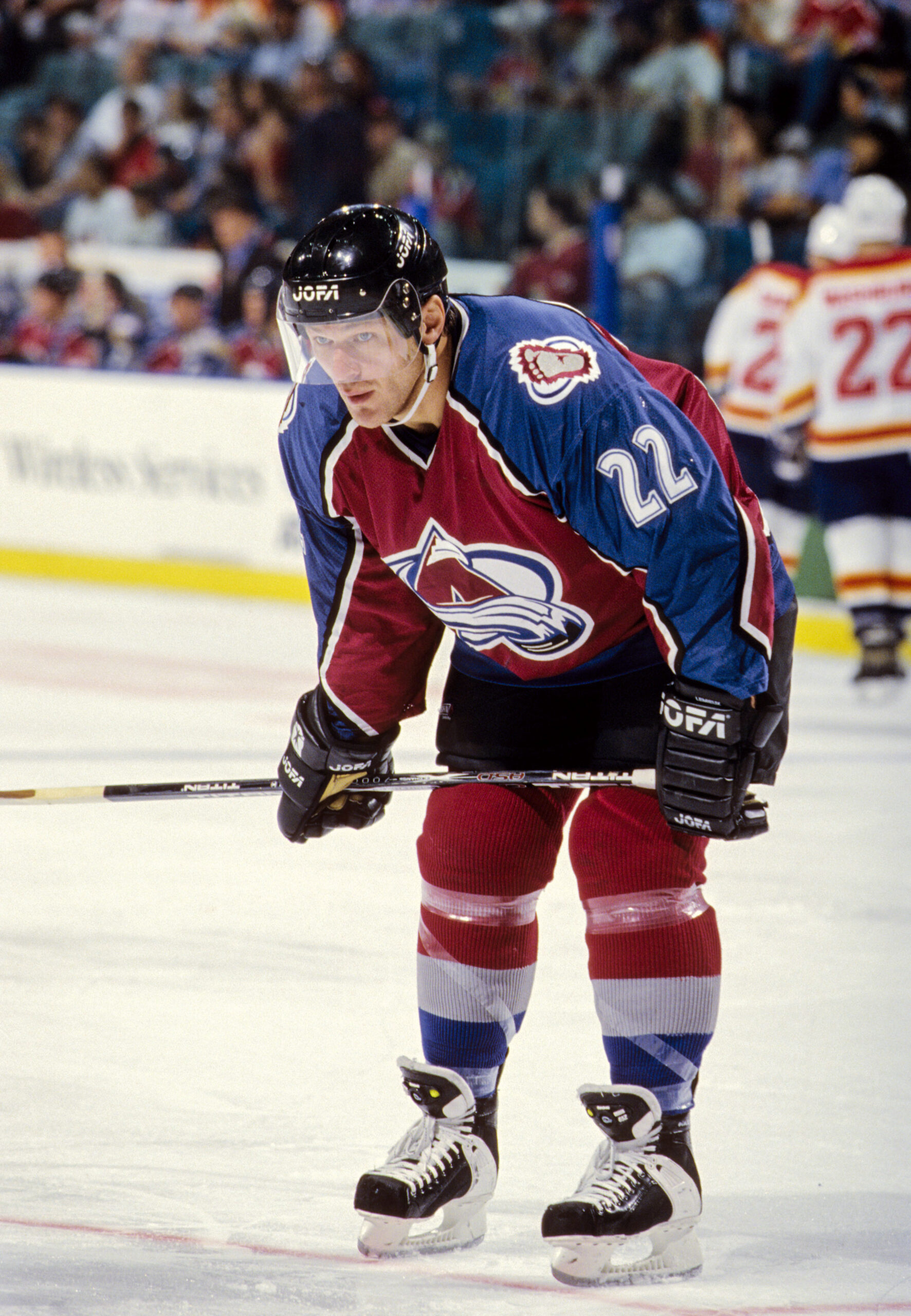 The Devils, surprisingly, traded Lemieux to the Colorado Avalanche ahead of the 1995-96 season. He was again swapped in a one-for-one deal, this time returning Wendel Clark to the Devils. Lemieux was in a familiar situation, joining a strong Avalanche lineup that included Joe Sakic, Peter Forsberg, and Patrick Roy. He was the final addition in Colorado’s top-six and reached a lofty 39 goals and 71 points in 79 games of the regular season. Lemieux kept it rolling with 12 points and 55 PIMs in the 1996 Stanley Cup playoffs, once again proving to be the X-factor behind a loaded offense en route to his third Stanley Cup win and second consecutive win.
It was in the 1996 postseason that Lemieux delivered one of his most notorious hits. He hit Detroit Red Wings star Kris Draper into the boards, resulting in Draper sustaining a concussion, broken jaw, broken nose, and broken cheekbone. The injuries required reconstructive surgery that forced Draper to have his jaw temporarily wired shut. The hit cemented Lemieux’s status as a cheap-shotting grinder and would lead to a prolonged rivalry between the Avalanche and Red Wings.
Lemieux continued to perform at a top level and help ensure runs to the playoffs through Colorado’s next three seasons. He was traded back to the Devils in 2000 in a colossal exchange that sent Brian Rolston back to the Avalanche. Lemieux didn’t miss a beat in one year back in New Jersey, notably notching 10 points and 28 PIMs in 23 games of the 2000 Stanley Cup playoffs as he supported a fourth Stanley Cup win.
Lemieux moved to the Phoenix Coyotes after winning another Cup with the Devils. He was an early great in the Coyotes franchise but the move would bring an end to Lemieux’s 15 consecutive postseason berths in 2001. He willed the Coyotes back to the postseason in 2002, all while notching diminishing offense and penalty totals on a roster still trying to find its core. The Coyotes flipped Lemieux to the Dallas Stars in January 2003. After another down year, he opted to step away from the NHL for the 2003-04 season, moving to Switzerland’s National League for one season before announcing his retirement in 2004.
Retirement did not keep Lemieux out of the spotlight. He assumed the president role for the ECHL’s Phoenix RoadRunners from 2005 to 2007 and was frequently featured in TV and media. After stepping down from his front office role in the ECHL, Lemieux built up towards a return in the 2008-09 season. At the age of 43, Lemieux began the year with the China Sharks of the Asia League, then signed a contract with the AHL’s Worcester Sharks in November. That led to a two-way contract with San Jose in December and a call-up to the NHL in January. Lemieux would score one point in 18 games with San Jose as the Sharks chased the President’s Trophy as the league’s top team.
Lemieux stayed a prominent hockey figure well after his second retirement in 2009. He was most recently a torch-bearer in one of Montreal’s pre-game ceremonies during the 2026 Eastern Conference Final. It was his final public appearance. Lemieux will be remembered as one of the greatest NHL players to hate among many fans. He was a tenacious, relentless, and aggressive winger who seemed to constantly deliver devastating blows – whether it was timely goals or injury-inducing hits. Pro Hockey Rumors sends our condolences to Lemieux’s family, friends, and countless fans.
Photo courtesy of RVR Photos-Imagn Images.
Sharks Sign Phillip Sinn To Entry-Level Contract
The San Jose Sharks have looked towards Germany to reinforce their blue line. Defenseman Phillip Sinn has signed a two-year, entry-level contract with the Sharks set to begin next season. Sinn spent last season with EHC Munchen of Germany’s DEL and played five games with Team Germany at the 2026 World Championships. Reports of NHL interest around Sinn was first reported by German hockey news source Eisblog.
Sinn, 22, is a true shutdown-defenseman. He scored just nine points across all levels of competition in the 2025-26 season, including three points in 35 games of his DEL season. Despite those low marks, Sinn stood out with a long reach and physical style that helped secure an otherwise offensively-leaning defense corps – led by former Carolina Hurricanes defender Ryan Murphy. Sinn was most productive in a seven-game assignment to Germany’s minor-pro league, where he recorded four assists.
The 6-foot-2 defender rose through the ranks of Austrian hockey and made his debut in the country’s top league in 2023. He finished his first pro season with seven points in 30 games with EC Salzburg and captained Team Germany at the 2024 World Junior Championships – where he scored four points in five games. Sinn has since built a tendency for very little scoring in top pro leagues, but near point-per-game scoring in minor-pro leagues, through trips in Austria and Germany. Those tenures include no scoring in 12 games in the Champions Hockey League, but two points in three games of Germany’s Deutschland Cup.
Sinn will bring another big body and shutdown ability to the Sharks defense corps. He could have a hope at one day filling the hard-working, shutdown role filled by Mario Ferraro in his final months in the Sharks lineup. That dream will be far off, though, as Sinn enters his North American career behind prospect Leo Sahlin Wallenius on the depth chart and almost certainly headed for a second-pair role in the AHL.
Canada Registers Sam Dickinson, Jack Ivankovic At World Championship
Team Canada will finish off the World Championship with the help of two top prospects. San Jose Sharks defenseman Sam Dickinson and Nashville Predators goalie prospect Jack Ivankovic have been registered for the remainder of the tournament per Steven Ellis of Daily Faceoff. Neither player is expected to suit up for Thursday’s quarterfinal matchup against Team USA, which could be Canada’s last of the tournament.
Both Dickinson and Ivankovic have been with the Canadian side through the extent of the World Championships – but are only now lineup-eligible, after being registered. Circumstance may keep the duo from debuting with Canada’s men’s team but the chance to spend time with NHL greats like Sidney Crosby, Evan Bouchard, and Ryan O’Reilly will nonetheless be invaluable.
Dickinson wrapped up his rookie season in the NHL with quiet totals. After notching historic scoring during his three-year career in the OHL, the puck-moving defender only scored one goal and 14 points in the first 72 NHL games of his career. He struggled to bring his dominant offense to the pro flight – but still showed flashes of the heads-up playmaking that earned him 91 points in 55 OHL games just last season. Dickinson will be leaned on as a core, offensive-defenseman behind San Jose’s young forwards for years to come. The chance to join his future-captain, Macklin Celebrini, at the 2026 World Championships will be another chance to find his comfort at the top level.
Ivankovic played through his freshman season at the University of Michigan after being drafted in the 2025 second round. He was called upon right away by the Wolverines and quickly stood out as one of the team’s biggest difference-makers. Ivankovic stuck around a .920 save percentage for much of the year, until his season was derailed by a scary-looking, lower-body injury sustained in a January matchup against rival Notre Dame. The injury was believed to be long-term – but Ivankovic was only out of the lineup for one month before returning to full-time, starting duties. He finished the year with a .921 save percentage and 25-8-1 record while backstopping the school that spent much of the year ranked #1. He also followed an NHL teammate – O’Reilly – to this tournament but lost his chances to start thanks to Jet Greaves‘ .926 save percentage through five wins.
While both prospects may continue to watch the tournament from the press box, their addition to the roster will stand as a bode of confidence from Hockey Canada. Both players will almost certainly be major parts of Canada’s World Championship, and other international, rosters in the years to come.
Sharks Sign Jimmy Huntington To One-Year Extension
The San Jose Sharks shared earlier today that forward Jimmy Huntington has been re-signed on a one-year, two-way contract. Financial terms have not yet been reported, but as a two-way pact it automatically carries at least a league minimum $850k at the NHL level.
A veteran of the AHL, the 27-year-old joined the San Jose Barracuda this past season and put together his best campaign yet, recording 48 points in 71 games. The center was third in team scoring, producing alongside several skilled youngsters such as Filip Bystedt and Quentin Musty.
Undrafted out of the QMJHL, Huntington feasted alongside Alexis Lafrenière with the Rimouski Oceanic in 2018-19. Catching on with the Lightning organization after a 92-point season, he went on to make a two-year stop with the Milwaukee Admirals. The Laval, Quebec native moved on to the Hershey Bears for 2023-24, helping lead the Capitals affiliates to a Calder Cup title, with 14 points in 20 games during the run.
Since finding himself out west, Huntington’s efforts this season in San Jose helped the Barracuda rank 13th in the AHL, although they were sent home by the Henderson Silver Knights in the opening round. Still seeking his NHL debut, the 6’0″ lefty will aim to build off a strong season, continuing to bring a well-rounded two-way game to the Sharks organization.
Flames Want To Move Up From Sixth Overall In Draft
A hot market for top-five picks in the 2026 NHL Draft is beginning to form. On the heels of reports that the St. Louis Blues want to crack into the top 10, it appears the Calgary Flames could stand in their way. The Flames are hoping to move up from their current spot of sixth-overall, per David Pagnotta of The Fourth Period and Kyle Morton of Daily Faceoff. The San Jose Sharks’ second-overall pick could be Calgary’s target, with TSN’s Darren Dreger sharing that the Sharks could part ways with their pick. Pagnotta also said that the Chicago Blackhawks could shop around the fourth-overall pick.
It has been more than 20 years since the last time a team traded a top-three pick after it was declared. The last instance – Pittsburgh’s move to first-overall in 2003 to select Marc-Andre Fleury – saw the third-overall pick go the other way. Calgary would pull off an unprecedented move if they were able to swing their way into the top-five.
Moving up in the draft could be a strong way for Calgary to spark their rebuild. The draft class is led by premium forward talents Gavin McKenna, Ivar Stenberg, and Caleb Malhotra. Each of the three have the potential to one day lead an NHL lineup, as do top defense prospects Chase Reid and Keaton Verhoeff. Should those five names all slide off the board before Calgary’s pick, the Flames would be left with the tough job of guessing the next-best star. Left-defensemen Carson Carels and Alberts Smits have caught attention all season with their dominant two-way play and play-driving ability respectively; while centermen Viggo Bjorck, Tynan Lawrence, and Oliver Suvanto have each held high-end acclaim through points in the season.
Outside of the top-five, there seems to be no guarantee of who will hit. Calgary would be stuck in a guessing game as they look for the draft selection who could propel their young lineup forward. Acquiring either San Jose or Chicago’s pick would effectively subvert that issue, allowing Calgary the chance to land a player with a strong chance of becoming a difference-maker. Their roster could use impacts at seemingly every position – whether it’s a playmaking winger to support Matthew Coronato, a true top-center, or an all-around defenseman who can take pressure off of the offensive-minded Zayne Parekh.
The uncertainty of a lower, top pick would be less of a concern for the Sharks or Blackhawks, who have each landed multiple top-five picks over the last four seasons. The draft class still boasts upside through the teens and the pair of rebuilders could stock their cupboards by pushing Calgary to add more draft capital and a strong prospect like Andrew Basha, Henry Mews, or even breakout college star Ethan Wyttenbach.
The package needed to trade into the top-five will only richen as more teams eye a potential trade. It seems to be a great year to be an established-rebuilder like San Jose and Chicago, who could field a long list of offers as they consider whether to take another star prospect or prioritize quantity over quality. Meanwhile, Calgary’s focus appears set to shift towards finding the X-factor they need to pull together a lineup that – thanks to the emergence of players like Kevin Bahl, Yan Kuznetsov, and Connor Zary – seems to wield promising depth.