
Nikita Kucherov, Andrei Vasilevskiy Make First All-Star Team
And with that, the NHL Award season is over. On the heels of announcing the 2025-26 All-Rookie Team, the NHL has also revealed the First & Second All-Star Teams from this past season. Now, the only two awards left to hand out are the Stanley Cup and the Conn Smythe Trophy. The two All-Star Teams are as follows:
First All-Star Team
LW Jason Robertson, Dallas Stars
C Connor McDavid, Edmonton Oilers
RW Nikita Kucherov, Tampa Bay Lightning
D Cale Makar, Colorado Avalanche
D Zach Werenski, Columbus Blue Jackets
G Andrei Vasilevskiy, Tampa Bay Lightning
Second All-Star Team
LW Cole Caufield, Montreal Canadiens
C Nathan MacKinnon, Colorado Avalanche
RW David Pastrnak, Boston Bruins
D Rasmus Dahlin, Buffalo Sabres
D Evan Bouchard, Edmonton Oilers
G Logan Thompson, Washington Capitals
There are no real surprises among the forwards and defensemen. It’s difficult to argue that anyone should be excluded from this list, as many of the names included were finalists for major awards during the 2025-26 campaign.
There is one big surprise for the goaltenders. Vasilevskiy makes plenty of sense, given that he won the Vezina Trophy this season. However, Thompson finished fourth in Vezina Trophy voting behind Ilya Sorokin of the New York Islanders and Jeremy Swayman of the Boston Bruins.
Arguably, Thompson should have been a finalist for the Vezina. He finished the season with a 31-21-6 record in 58 games with a .912 SV%, 2.44 GAA, and 29.3 GSAx according to MoneyPuck. His GSAx wasn’t the best per 60 minutes, but he finished ahead of Vasilevskiy in both metrics, demonstrating how strong he played this year. The difference is in who votes for each; the Vezina is voted on by the league’s General Managers, while the All-Star Teams are chosen by the Professional Hockey Writers Association.
Nikita Kucherov Wins 2026 Hart Trophy
Tampa Bay Lightning forward Nikita Kucherov has been named the 2026 Hart Trophy winner, the annual award for the top player in the National Hockey League. The honors were announced this evening on ESPN’s “The Point” prior to Game 5 of the Stanley Cup Final.
Awarded to the player selected in a poll of the Professional Hockey Writers Association in all NHL cities upon the end of the regular season, Kucherov takes home the MVP for the second time in his career, the first coming in 2019. The soon-to-be 33-year-old beat out other finalists Nathan MacKinnon and Connor McDavid.
Final voting totals were revealed by The Athletic’s Chris Johnston, with Kucherov’s 1,436 points just ahead of McDavid’s 1,426, a razor thin margin. His four more first-place ballots over the Edmonton captain were the difference. MacKinnon came away with 1,297 points, while San Jose’s Macklin Celebrini finished fourth (625 points, five first-place votes) and Montreal’s Nick Suzuki rounded out the top five (102 points), netting one first-place vote.
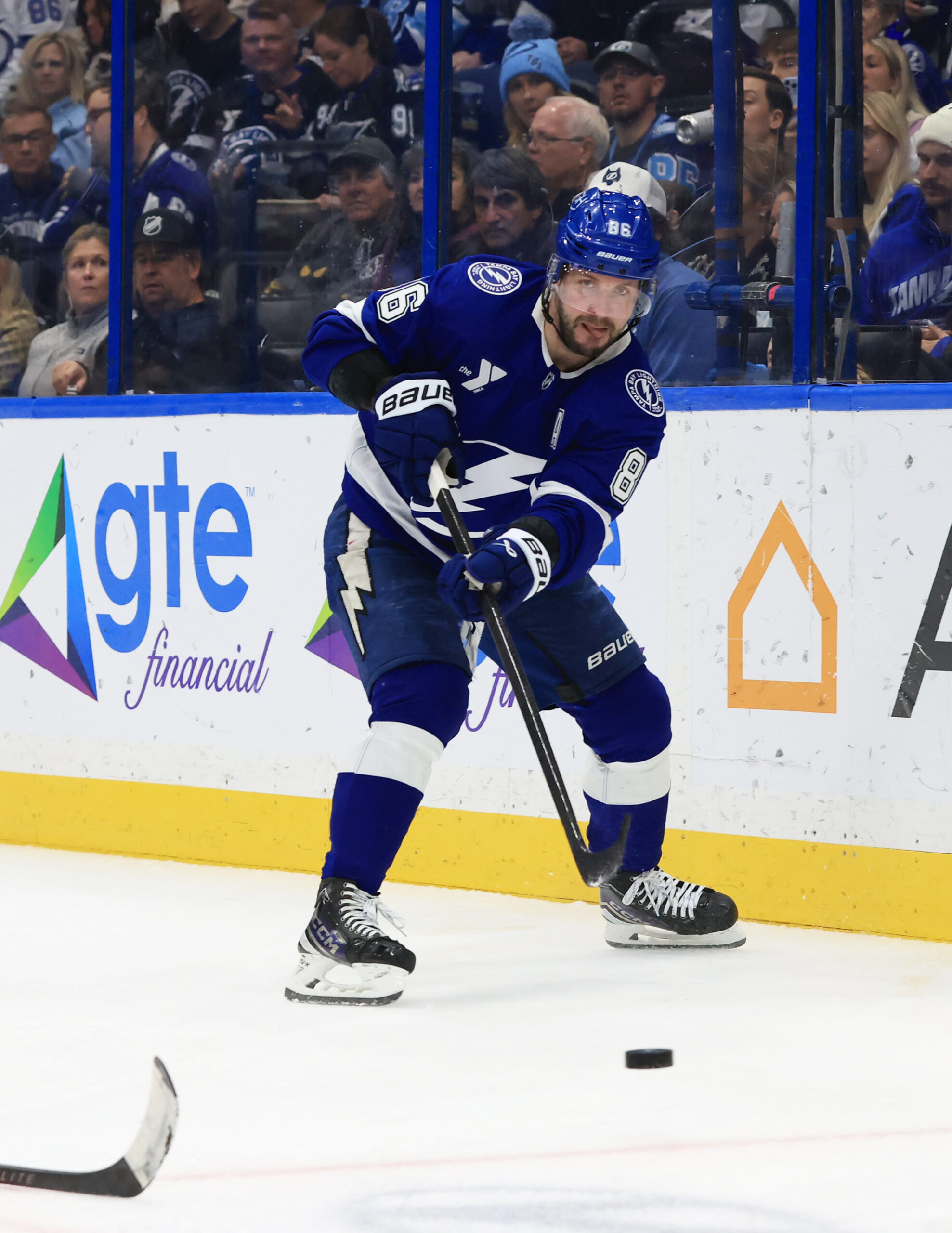
Kucherov continues to produce at an incredible level, coming away second in the league with 130 points (44 goals, 86 assists) in 76 regular season games. Dishing out an absurd number of helpers, he always evoked fear in goaltenders when looking toward the net instead, shooting at a 19.0% clip, with 44 goals as eighth highest in the NHL. The Russian winger’s 1.71 points-per-game stands out as the league best out of qualified players, and on that rate, had he not missed six contests Kucherov would have been on track to surpass the first ranked McDavid’s 138 points in 82 games. The fourth straight season in which he recorded at least 80 assists, the winger came away second behind McDavid in that statistical category.
Based on those metrics, Kucherov stood out to voters after a 2025-26 where he helped carry the Lighting through what was an injury-riddled campaign along their way to 50 wins. He wasn’t the only Tampa Bay star to take major honors, as Andrei Vasilevskiy won the 2026 Vezina Trophy as the league’s top goaltender. As if that wasn’t enough, head coach Jon Cooper received honors as the 2026 Jack Adams Award winner for best coach. Despite the regular season hardware, the Lightning’s season ended in a Game 7 defeat of the opening round at the hands of the tenacious Montreal Canadiens.
The unceremonious ending aside, Kucherov’s tremendous campaign adds to an already deep trophy shelf, with two Stanley Cups and three Art Ross trophies as top league scorer. Even at age 32, he beat out point totals from his 2018-19 Hart-winning season, going nuclear then in year six of his NHL career with 128 points in 82 games.
An award reserved for the best of the best, Kucherov is in an exclusive company for his position. Only he and Corey Perry (2011) are forwards who won the award in the past 20 years who were not chosen in the top three selections of the NHL draft. A heist by the Lightning at 58th overall in 2011, one has to look back to 2004 as the last time a non-first round forward won the Hart besides Kucherov, that being fellow franchise legend Martin St. Louis.
An unrestricted free agent after 2026-27, Kucherov needs just 13 more points to beat out Steven Stamkos as #1 all time in Tampa Bay franchise history. At the pace he’s going, that should be another accolade in his pocket very soon next fall. From there, he’ll look to lead the Bolts back into a deep playoff run for the first time since 2022, as there’s little doubt they’ll continue to be among the NHL’s best teams next season, boasting the top head coach, best goaltender, along with the most valuable player.
Image Credit: Kim Klement Neitzel-Imagn Images
Andrei Vasilevskiy Wins 2026 Vezina Trophy
While the playoffs didn’t end the way that Andrei Vasilevskiy would have liked, there was no questioning his strong regular season performance. He was recognized for those efforts on Saturday as the league announced that Vasilevskiy is this year’s Vezina Trophy winner. The award is given to “the goaltender adjudged to be the best at his position,” as voted on by NHL General Managers.
It’s the second time that the 31-year-old has won the award but it has been a while since his victory, one that came back in the 2018-19 season. Since then, he had been a top-three finalist three other times (finishing in the top six in two other years) but had been unable to pick up this second win until now.
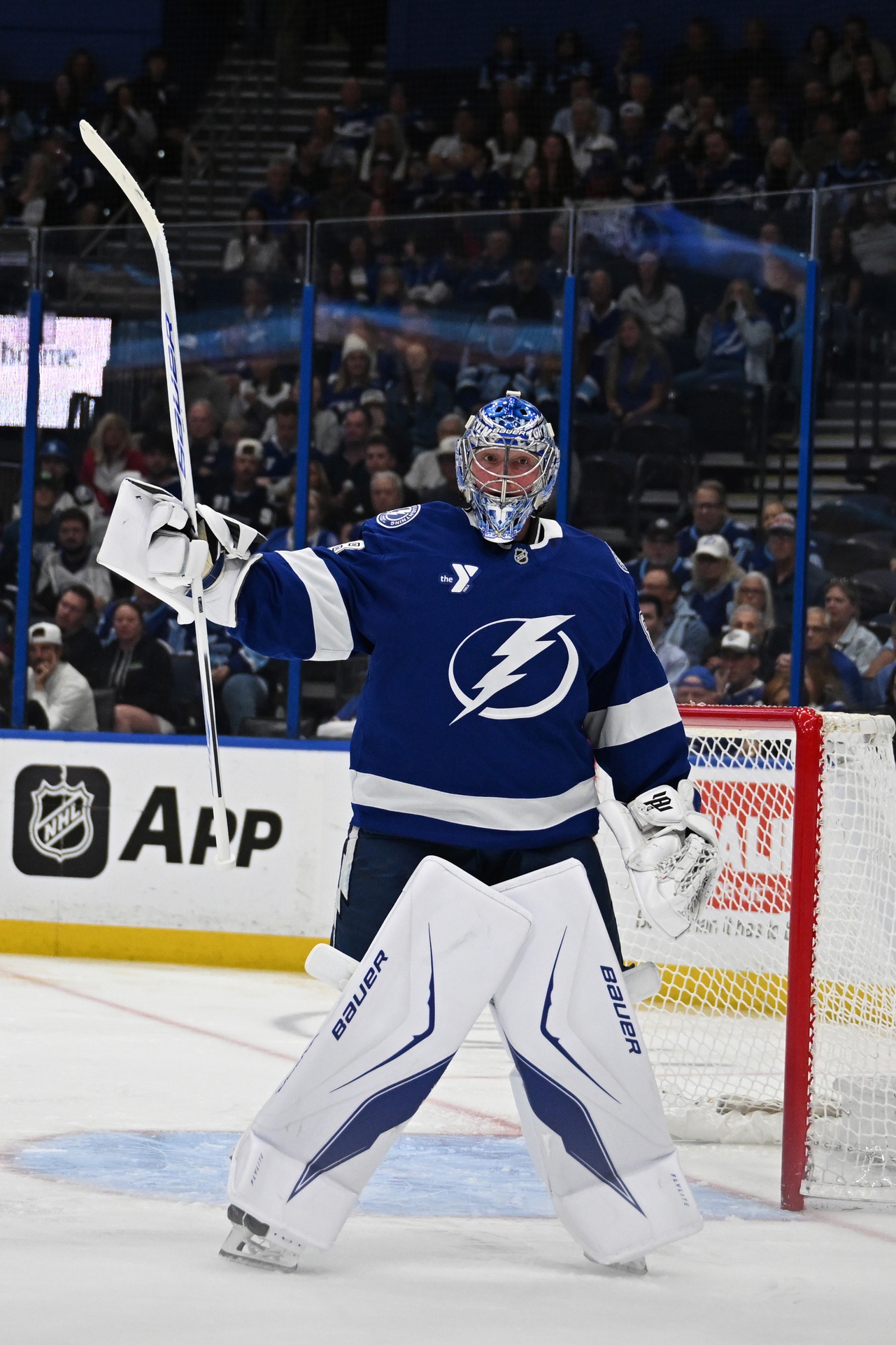 Vasilevskiy posted a 2.31 GAA along with a .911 SV% and two shutouts in 58 games during the regular season while finishing fourth in Goals Saved Above Expected with a mark of 24.7, per MoneyPuck. He also led the league with 39 victories, leading in that department for the sixth time in his career. A big chunk of those wins came from a very impressive 17-0-1 run that spanned more than two months, beginning in late December and ending shortly after the Olympic break, one that helped vault the Lightning back into contention for the Atlantic Division title.
Vasilevskiy took home 17 of 31 first-place ballots to give him a comfortable margin of victory over Ilya Sorokin of the Islanders and Jeremy Swayman of the Bruins, who were the other finalists for the award. Their combined vote point totals (97) came in below Vasilevskiy’s (114). Capitals netminder Logan Thompson and Avalanche goalie Scott Wedgewood also received first-place votes while three other netminders had down-ballot consideration as well.
With the award, Vasilevskiy is now the third active goaltender with multiple Vezina Trophy wins, joining Sergei Bobrovsky and Connor Hellebuyck. He is also now the fifth netminder in NHL history to have multiple Vezina Trophies and multiple Stanley Cup championships. Bobrovsky is still playing while the other three, Martin Brodeur, Dominik Hasek, and Patrick Roy, are all in the Hall of Fame.
Photo courtesy of Jonathan Dyer-Imagn Images.
Halpern Interviewed For Maple Leafs Head Coaching Position
- During his presser today, Chayka indicated that he spoke to many candidates with only some moving on to the next stage. One who won’t be doing so is Jeff Halpern. Sportsnet’s Elliotte Friedman reported on the latest 32 Thoughts podcast (audio link) that Halpern did interview with the Maple Leafs for the role but isn’t moving to the next stage. Halpern has been coaching in Tampa Bay’s organization since 2015-16, spending three seasons as an AHL assistant and has been up with the Lightning as an assistant with them since 2018-19.
Jon Cooper Wins 2026 Jack Adams Award
Tampa Bay Lightning head coach Jon Cooper has added another crowning achievement to a storied NHL career.
Cooper was announced Wednesday as the 2026 recipient of the Jack Adams Award, granted each season to the NHL coach “adjudged to have contributed the most to his team’s success.” Voted on by members of the NHL Broadcasters’ Association, Cooper becomes just the second coach in franchise history to capture the honor, joining John Tortorella (2004).
This marked Cooper’s third time as a finalist for the award. Voters ultimately selected the veteran bench boss over fellow 2026 finalists Dan Muse (PIT) and Lindy Ruff (BUF).
The league’s longest-tenured head coach guided the Lightning to a ninth consecutive playoff berth in 2025-26. Tampa Bay navigated an injury-filled campaign to finish with a 50-26-6 record, securing 106 standings points to tie for fifth overall in the NHL. It marks the organization’s first 50-win season since 2021-22.
Under Cooper’s stewardship this year, the Lightning finished among the NHL’s elite, ranking near the top of the league in wins, goals scored, goals against, goal differential, road wins, regulation wins, and comeback wins, as well as penalty kill percentage.
The award puts a bow on a milestone-heavy season for the prospective Hall of Fame coach. Cooper coached his 1,000th career NHL game, all with Tampa Bay, on December 31, and quickly followed that up on January 12 by becoming the second-fastest coach in league history to reach 600 wins with a 5-1 victory over the Philadelphia Flyers.
Multiple Players Have NHL Draft Rights Expire
According to PuckPedia, multiple prospects had their draft rights expire at the deadline today, meaning they’ll re-enter the 2026 NHL Draft or become unrestricted free agents.
Two distinct groups are impacted by this deadline. Prospects playing in the Canadian Major Junior leagues (OHL, QMJHL, or WHL) or those playing in Europe.
Of those players from the CHL who have played through their age-20 seasons, they’ll re-enter the 2026 NHL Draft, or become unrestricted free agents if they go undrafted. For the European players, they’ll become unrestricted free agents, though many typically stay in Europe to continue their professional careers.
The only other prospect whose draft rights expired, and didn’t meet either of the above requirements, was Toronto Maple Leafs 2025 draftee Matthew Hlacar. Hlacar was taken with the 217th overall pick of last year’s draft, and scored six goals and 12 points in 51 games for the OHL’s Kitchener Rangers this season. Toronto didn’t issue him a bona fide offer, which is simply tendering the player a league-minimum, entry-level deal to extend their signing rights.
The remaining prospects who will re-enter the 2026 NHL Draft or become UFAs are as follows:
D Ales Cech (Mammoth, 5-153, 2024)
D Simon Forsmark (Hurricanes, 4-101, 2022)
F Max Graham (Penguins, 5-139*, 2024)
F Petr Hauser (Oilers, 5-141**, 2022)
F Nils Juntorp (Hurricanes, 6-188***, 2022)
F Gustav Karlsson (Sabres, 6-187, 2022)
F Maximilian Kilpinen (Red Wings, 4-129, 2022)
D Kasper Kulonummi (Predators, 3-84, 2022)
F Hunter Laing (Flames, 6-170, 2024)
G Ryerson Leenders (Sabres, 7-219, 2024)
D Nathan Mayes (Maple Leafs, 7-225, 2024)
G Landon Miller (Red Wings, 4-126, 2024)
F Kaden Pitre (Lightning, 6-181, 2024)
F Joel Ratkovic Berndtsson (Sabres, 7-202, 2022)
F Santeri Sulku (Flyers, 7-197, 2022)
D Albin Sundin (Oilers, 6-183, 2024)
F Riku Tohila (Blackhawks, 7-199, 2022)
G Jakub Vondras (Hurricanes, 6-171, 2022)
* Originally drafted by the New Jersey Devils; traded to the Penguins in March 2025.
** Originally drafted by the New Jersey Devils; traded to the Oilers in March 2025.
*** Originally drafted by the Chicago Blackhawks; traded to the Hurricanes in January 2025.
Lightning Acquire Rights To Jack Pridham
1:30 p.m.: As alluded to earlier, Pridham is expected to name a new NCAA commitment in the coming days, which would extend the Lightning’s ability to sign him by an additional two years. According to Sean Shapiro of EliteProspects, Pridham appears headed to the University of Denver, the reigning National Champions, to continue his development.
10:17 a.m.: The Tampa Bay Lightning have acquired the rights of forward prospect Jack Pridham from the Chicago Blackhawks. The 20-year-old Pridham was not expected to sign with Chicago before the 5 P.M. deadline on June 1st, which would have terminated Chicago’s holds over his player rights after a third-round selection in 2024. Tampa Bay has sent a 2027 third-round pick back to Chicago in exchange for Pridham’s rights.
Additionally, the Lightning announced that Pridham will announce an NCAA commitment in the coming days, which will extend his NHL rights until his graduation or departure from school. That will give Tampa Bay plenty of time to decide if they would like to ink Pridham to an entry-level deal. The young forward was previously committed to Boston University; a commitment that he has since rescinded.
Pridham took home the CHL’s Memorial Cup with the OHL’s Kitchener Rangers on the eve of his trade to Tampa Bay. He was a true star for Kitchener all season long, racking up a team-leading 46 goals and 90 points in 65 regular season games. That dominance continued into the postseason, when Pridham totaled 17 points in 18 games – fourth-most on the team. The performance was an exciting step forward after Pridham’s OHL debut last season. He scored 54 points, split evenly, in 48 games of his first OHL season after spending just over one season in the BCHL.
The young forward has long used his strong, 6-foot-2 frame to battle for space and protect the puck. This season, he added an encouraging layer of speed to his game, and found more space operating off of stellar additions to the Rangers lineup, including fellow Bolts prospect Sam O’Reilly, who won the OHL’s regular-season MVP, playoffs MVP, and Memorial Cup MVP. The two-way center, and two-time Memorial Cup-winner, put in a lot of the hard-work needed to open space for scorers like Pridham.
Now, Tampa Bay will hope the duo can one day rediscover their spark in the NHL. First, Pridham will pursue a career in college hockey. He will stand as, perhaps, the top available recruit and could be a strong addition to the Boston circuit, Big Ten, or a trailblazer in the NCHC. Pridham is the son of former Toronto Maple Leafs’ assistant general manager Brandon Pridham. That NHL experience should drive the younger Pridham towards big goals, though his ability to reach them will be rooted in his ability to keep the scoring rolling through a step up in competition next season.
Steen Scores OT Winner For Norway's First World Championship Medal
Meanwhile, in the Bronze Medal Game, Norway pulled off the upset, overcoming a blown two-goal lead with less than two minutes to go to beat Canada 3-2 in overtime. The winner was scored by Lightning prospect Noah Steen, who finished off the season in the minors with Syracuse. Heading into the tournament, Norway’s best finish came all the way back in 1951 when they finished fourth. It’s their first-ever medal in any IIHF top-division tournament. Canada, meanwhile, has now failed to secure a medal for the third straight year.
Lightning Sign Benjamin Rautiainen To Entry-Level Contract
The Tampa Bay Lightning have inked one of their draft selections from last summer. According to a team announcement, the Lightning have signed forward Benjamin Rautiainen to a three-year, entry-level contract. According to Eduardo A. Encina of the Tampa Bay Times, the Lightning had to buy out the final year of Rautiainen’s contract with Tappara to facilitate the deal.
As mentioned, Rautiainen, 20, was drafted 108th overall by the Lightning in the 2025 NHL Draft. The Tampere, Finland native was playing for the Finnish Liiga’s Tappara, scoring 10 goals and 33 points in 50 games with a +4 rating. Additionally, he registered two goals and four points in nine postseason contests.
This season, Rautiainen turned heads. He was easily the most dominant force in Finland’s professional ranks, scoring 25 goals and 77 points in 59 games with a +24 rating. The next closest scorer was Joachim Blichfeld (33 goals and 71 points in 52 games), who is seven years older than Rautiainen.
Always looking for cheap depth, Rautiainen made Tampa Bay’s decision relatively easy. Although it’s typically unreasonable to expect a younger player to make the jump from Europe to the NHL, unless they’re coming from the KHL, there’s a non-zero chance Rautiainen cracks the Lightning’s roster out of training camp, albeit as a 12th or 13th forward.
Still, it wouldn’t hurt Rautiainen to begin the 2026-27 season with the AHL’s Syracuse Crunch. Rautiainen’s ability to provide offense in multiple ways should blend well with his peers in Syracuse, who recently tied for eighth in AHL scoring.
Corey Perry Intends To Continue Playing Career
Recently turned 41-year-old Corey Perry is looking to extend his career into a 22nd season, confirmed by Pierre LeBrun of The Athletic earlier today.
Playing in unusual colors back in 2019 as a Dallas Star at age 34, it already looked like Perry hardly had much left in the tank, with just five goals in 57 regular season games. Nobody back then would have expected that the 6’3” winger would be a notable member of the 2026 free agent class, but sure enough, it looks like that’ll be the case.
By now everyone knows about Perry’s five losses in the Stanley Cup Final, but the power forward impressively keeps humming along, notching 17 goals in 72 games this season, six of them in just 22 games after being traded back to the Lightning at the deadline. Fetching his short-term club in Los Angeles a 2028 second-round pick, it goes to show how high Perry remains valued today.
Lebrun speculates that a return to the Bolts won’t be happening, and assuming Perry is picked up by a hypothetical eighth club (barring a return to any of his previous seven) he’d have major milestones in store. The Ontario native needs just 36 regular season appearances to become the 26th player in league history to reach 1,500 games. Only Alex Ovechkin and Brent Burns are in that club as fellow active players.
As long as Tampa Bay can be crossed off the list, Perry should have several other suitors to choose from on July 1. A deal right in line with last summer’s one year, $2MM contract, that one offered by the Kings, would be in order. With practically an entire portfolio of recent one year contracts to draw upon as examples, the possibility also exists of one like his 2023 agreement with Chicago, a higher rate to join a younger squad, with the idea of later choosing his favored destination at the trade deadline. Of course, at this point it’s not so much about the money as it is about the fit, ideally one which would lead Perry to his ever-elusive second Stanley Cup ring one way or another.
While the veteran was making the rounds on various teams and going on deep playoff runs, his original club in Anaheim built a formidable roster which is ready to contend. A Ducks return would be a storybook ending for Perry, who broke into the NHL in 2005 as a “Mighty Duck”, donning the eggplant alongside franchise legends Teemu Selänne and Scott Niedermayer. Back to the present day, it’s worth mentioning that their forward corps already feature Alex Killorn and Chris Kreider as aging veterans offering similar on-ice traits to Perry. Still, the 2011 Hart Trophy winner would be a great model for 20-year-old Beckett Sennecke.
Tack on Perry’s 244 playoff games to his total resume, and it has been an incredible career for the 28th overall selection in 2003. Somewhat hard to believe, just he and Burns are the only remaining active players from the draft 23 years ago which has gone down as arguably the best in NHL history. At least for one more year, its impact will continue to be felt, all while more rising young stars emerge who were born years after Perry’s name was called at the draft.