
Panthers Make An Offer For Larkin; Svrcek Commits To OHL For Next Season
- Red Wings prospect Michal Svrcek will have a new team next season. OHL Windsor announced that they’ve signed the 19-year-old for the 2026-27 campaign. Svrcek was a fourth-round pick last year, going 119th overall after playing in Brynas’ system in Sweden. Windsor used a first-round Import Draft selection on him soon after but Svrcek elected to stay in Sweden. This season, he played at three different levels, putting up strong production at the junior level (18 points in 11 games) but was held off the scoresheet in the pros across a dozen SHL games and 10 Allsvenskan appearances. Svrcek also suited up at the World Juniors for Slovakia, picking up a goal and an assist in five contests.
Morning Notes: Larkin, Kuefler, Hurricanes
Dylan Larkin is believed to be entertaining three popular trade destinations after requesting a move from the Detroit Red Wings. Not being on his initial list won’t stop other teams from calling on the top center, though. Always involved in trade buzz, the Dallas Stars are believed to have checked in on Larkin’s trade price per EliteProspects’ Sean Shapiro.
In what would feel like the antithesis to Mike Modano‘s heralded move to Detroit in 2010 in many ways, Dallas could muster a package rich enough to land Detroit’s star forward of the last decade. Larkin has routinely rivaled 70 points, with strong defensive performances, over each of the last five seasons. His consistency – and potential for even more in a strong offense – will make him an expensive asset for the rebuilding Red Wings. Dallas may need to part with promising youngsters like Lian Bichsel, Thomas Harley, or Emil Hemming in the name of bolstering Detroit’s future. In return, they would land a strong successor for the aging Tyler Seguin and Matt Duchene. Larkin is signed to a manageable $8.7MM cap hit through the 2030-31 season, which would align with potential-battery mate Roope Hintz‘s contract.
Larkin would need to approve of any trade but Dallas proved their ability to pull off blockbusters with their acquisiton of Mikko Rantanen. They will be a notable team to follow as the saga around Larkin’s move grows.
Other notes from around the league:
- The New York Islanders have signed AHL forward Daylan Kuefler to a two-year, two-way contract extension per NHL.com’s Stefen Rosner. The deal will carry an $850K salary in the NHL and $105K salary in the AHL in year-one, then grow to a $900K salary in the NHL and $125K salary in the AHL in year-two per Rosner. $290K of that salary will be guaranteed. This deal marks a tidy bit of assurance for the third-year pro. This year marked Kuefler’s first full season with the Bridgeport Islanders. He finished the season with 25 points and 64 penalty minutes in 67 games. He will likely hang onto a depth role in the AHL lineup as he grows into a leading role on the newly-unveiled Hamilton Hammers.
- Carolina Hurricanes goaltender Frederik Andersen took the practice sheet and was announced as “available” for Game 5, per ESPN’s Greg Wyshynski. Despite that, the Hurricanes seem set to keep Brandon Bussi and Pyotr Kochetkov as their tandem after a Game 4 win. Bussi has stopped 36 of the 40 shots he has faced since replacing Andersen partway through Game 3. The decision came after Andersen paved over the first three rounds, marked by 13 wins and a .910 save percentage in 16 games. It seems the hot hand will hold favor in the Hurricanes net, though. Until Bussi struggles, Andersen’s action may be limited to the practice sheet.
Poll: Which Team Will Acquire Dylan Larkin?
The summer trade market got a major injection last week, with the captain of the Detroit Red Wings, Dylan Larkin, requesting a trade from the team. Given how many teams are searching for a top-six center, Larkin immediately became the top available trade target. However, thanks to the full no-trade clause in his contract, Larkin controls his destiny for the most part, and notified the Red Wings that he would only be open to a trade to the Florida Panthers, Minnesota Wild, or Vegas Golden Knights.
The trickiest part of a hypothetical Larkin trade is what the Red Wings would want. Despite missing the playoffs the last three years, it wasn’t for a lack of trying. The team is eager to jump into their competitive window, so they will likely want NHL-ready players in return. Given that all three teams on Larkin’s list are not only in their competitive windows but legitimate Stanley Cup threats, it doesn’t make a ton of sense for them to trade off their roster either, so the Red Wings may have to settle for future assets or a mixture of both.
Assuming everyone is healthy to begin the 2026-27 campaign, the Panthers have little need for Larkin. They may still want him, but if Florida is going to target anything this summer, it’ll be goaltending. The Panthers already have a relatively deep center corps with Aleksander Barkov, Sam Bennett, and Anton Lundell at the top of the hierarchy. However, compared to the Wild and Golden Knights, the Panthers have much more cap space to work with.
Florida could dangle the eighth overall pick of the 2026 NHL Draft, but it has very little to offer outside of that. It’s well known that the Panthers have the worst farm system in the NHL, so it’s unlikely the Red Wings would be interested in any prospect capital. Additionally, given that they’re in the same division, Detroit will be competing with the Panthers for a postseason spot next season, so Florida would have to overpay more than the Wild or Golden Knights. The Red Wings may aim for the Panthers to include Eetu Luostarinen and/or Niko Mikkola with the eighth overall pick, but Florida will have little appetite to move them after the injury concerns from the 2025-26 season.
Meanwhile, of all three clubs, the Wild have the biggest need for a top-six center. It was evident during the 2026 Stanley Cup playoffs that this was a significant factor in their inability to advance beyond Round Two. In a recent article from Joe Smith of The Athletic, he speculated that Minnesota could offer Danila Yurov and Charlie Stramel in a hypothetical trade for Larkin, but have little else to offer beyond that. The team traded some of their most enticing capital for Quinn Hughes and doesn’t have a ton left to add another All-Star talent.
However, the Wild’s potential offer to the Red Wings isn’t necessarily dead on arrival. Minnesota still has its 2027 first-round pick, although it’s expected to fall well outside of the lottery range. Would it make sense for Minnesota to offer Jonas Brodin, as well? He hasn’t completed a full season in seven years, so the team has learned to operate without him by now. Furthermore, his contract does not include any trade protection, and his $6MM salary would help create some cap space for other acquisitions this summer.
Lastly, like the Wild, the Golden Knights will have some salary cap hurdles to overcome. Still, that’s never stopped them before. Currently embroiled in a tightly contested Stanley Cup Final with the Carolina Hurricanes, the Golden Knights will enter the summer with approximately $4.625MM in space, and that’s without factoring in a possible extension for Rasmus Andersson.
Given that they don’t have a pick in the first two rounds until the 2028 NHL Draft, Vegas will undoubtedly have to include prospect Trevor Connelly in any hypothetical deal for Larkin, as well as players on their roster. Unfortunately, the Golden Knights don’t have many players without trade protection in their contracts, and it wouldn’t make a ton of sense for a player to greenlight a trade to Detroit after playing in the Stanley Cup Final.
Another possibility is that Larkin ultimately remains with the Red Wings. General Manager Steve Yzerman isn’t afraid to play hardball, as he did with the Tampa Bay Lightning and Jonathan Drouin many moons ago. As much as Larkin can pick where he goes due to the no-trade clause, he’s still contractually committed to Detroit through the 2030-31 season. It’s highly unlikely that Yzerman will be bullied into a bad deal, so if Larkin doesn’t expand his list, or Detroit doesn’t get an offer to their liking, they may tell Larkin they can’t wait to see him in Traverse City for training camp in September.
Now it’s time for you to pick: will Larkin be on one of the three teams on his trade list come next season, be on a different organization than those he originally listed, or with the Red Wings? Vote below!
Which Team Will Acquire Dylan Larkin?
Three Teams Believed To Be On Dylan Larkin’s Trade List
According to a report by Helene St. James of the Detroit Free Press, Red Wings forward Dylan Larkin wants to be traded to one of three teams. Those include the Florida Panthers, the Vegas Golden Knights, and the Minnesota Wild. It was reported by Pierre LeBrun of The Athletic that Larkin’s list was short in destinations he wanted to go to.
LeBrun had originally speculated in his rumblings that Larkin would have nearly half the league inquiring about the services of the 29-year-old forward, who turns 30 on July 30th. The Waterford, MI native finished his 2025-26 season scoring 67 points in 74 games and had a +3 rating. After 11 seasons with the Red Wings, they have not made the playoffs for ten straight. Larkin has only played five career games in the postseason, which came in his rookie year of 2015-16. He has five years left on an eight-year contract at an $8.7MM cap hit, which will pay him until he is 34 years old in 2031. He holds a full no-trade clause for the next 2 seasons, then becomes a 10-team trade list.
Here is a look at the three teams situationally and the potential package each club could pony up to get Larkin on their roster:
1. Florida Panthers
The Panthers finished the 2025-26 season far off from their usual Stanley Cup-contending ways, ending the year seventh in the Atlantic division after five straight seasons with 90+ points and three straight Stanley Cup Final appearances. Instead, their end-of-season prize awarded them with the ninth overall pick in the 2026 NHL Draft, which could be a huge kickstart for their prospect pool, or it could be a key asset dealt to the Red Wings for a win-now center like Larkin.
Along with that first-round pick, the Panthers could also include younger players on their roster to package a deal for Larkin, who spent February in Italy with Florida’s Matthew Tkachuk, winning a gold medal at the 2026 Olympics with the star winger. Tkachuk was traded from the Calgary Flames to the Panthers after informing them he wanted to go elsewhere in a large package deal. Similarly, Florida would need to send a hefty package considering the proximity of dealing with a division opponent. Perhaps forwards Eetu Luostarinen, Anton Lundell, or the rights for restricted free agent Mackie Samoskevich could be names within this deal, along with the draft pick.
2. Vegas Golden Knights
Another team that is consistently contending for the Stanley Cup, so much so, they’re actively in their third final in just nine seasons as an NHL franchise. Vegas has demonstrated nearly 100% of the time that it does not care what it takes to win, making several trades to acquire top talent. As first reported by David Pagnotta of The Fourth Period, he wondered if the Golden Knights would be a spot, and it appears they are.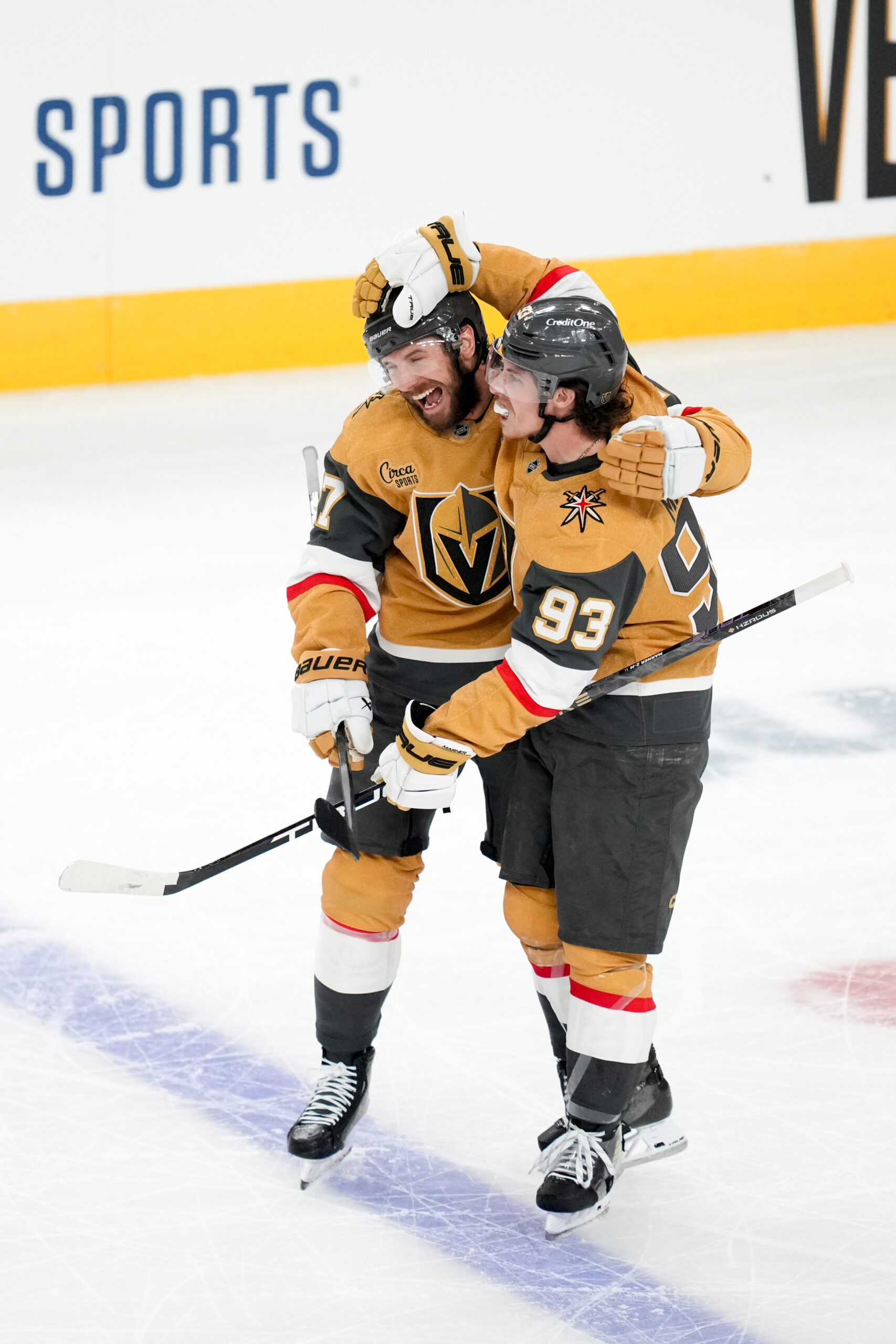
Regarding more Olympic connections, Jack Eichel, the former No. 2 overall pick by Buffalo, was dealt to Vegas from the Sabres in a blockbuster deal. The Golden Knights are tight against the cap in 2026-27, with just a little over $4MM in space to work with a few free agents at season’s end, including standout goal scorer Pavel Dorofeyev, an RFA. Two questions come to mind in Vegas’s end: what contracts would Detroit take back to help Vegas offset the cap hit? And do they have enough in their short list of prospects, like Trevor Connelly or a later first-round pick in 2028 or 2029, that would add enough value?
3. Minnesota Wild
There are quite a few gold medal connections in the State of Hockey, including a chance to make history for the 25-year-old franchise to bring the Stanley Cup to Minnesota. Larkin is familiar with Quinn Hughes, Matt Boldy, and Brock Faber, all of whom were key parts of bringing the U.S. the gold in Milan via GM Bill Guerin assembling such players together. Guerin has also demonstrated his yearning to build the Wild’s first cup-winning team, emerging victorious in the Quinn Hughes sweepstakes, whom he pulled out from Vancouver.
Minnesota saw difficulties in their Center depth this past playoffs, and adding Larkin would prove worthwhile to supplement the services of Joel Eriksson Ek down the middle. The Wild have a deeper pool of prospects and draft picks to send Steve Yzerman‘s way if an agreement is to be settled between these two teams. Perhaps a goalie swap could occur here, too, if Minnesota wanted to exchange one of its two goaltenders, either Filip Gustavsson or Jesper Wallstedt, for Sebastian Cossa.
Photo Credit: Lucas Peltier-Imagn Images
Dylan Larkin Requests Trade From Red Wings
Detroit Red Wings captain and No. 1 center Dylan Larkin has requested to be traded from the team, reports Elliotte Friedman of Sportsnet. Darren Dreger added that “this move has been in the works for a while.”
According to Friedman, that neither Red Wings GM Steve Yzerman nor Larkin’s agent Pat Brisson would comment on the report, but cited a “frosty relationship” between Larkin and Yzerman as potential factor that have contributed to Larkin’s decision, alongside the team’s inability to reach the postseason at any point beyond the center’s rookie campaign. 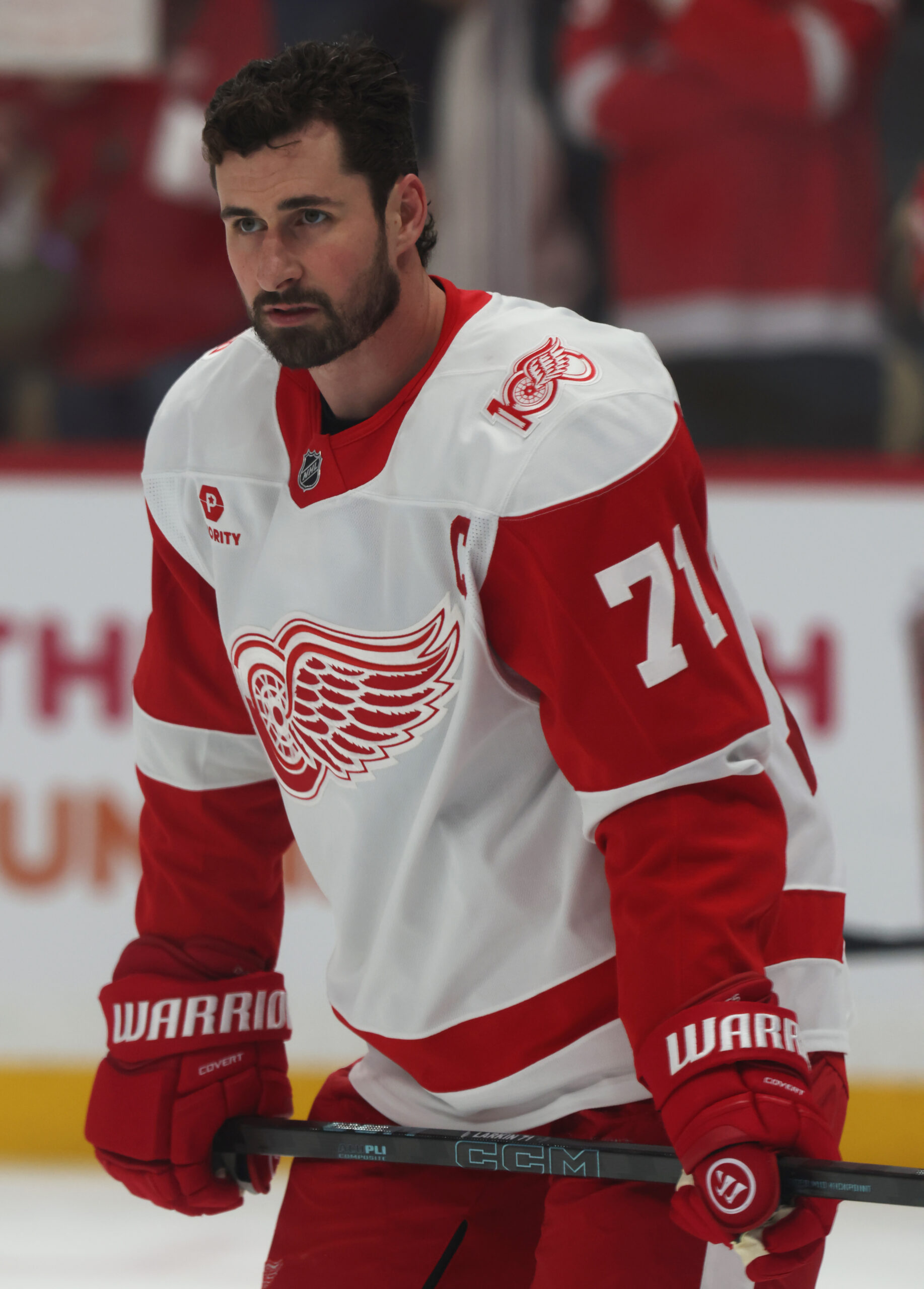
Larkin made headlines at the end of the Red Wings’ season when he criticized Yzerman and the team’s hockey operations department for not adding enough talent at the trade deadline.
In his end-of-season media availability, Larkin told reporters “it was hard that we didn’t do anything,” and “we didn’t gain any momentum from the trade deadline. Guys were kind of down about it. So it would have been nice to add something and bring a little bit of a spark on the ice.”
The Red Wings traded first and second-round picks to the St. Louis Blues to acquire veteran Justin Faulk at the trade deadline. The club also traded a fourth-rounder to the Ottawa Senators for veteran forward David Perron. Those additions were not enough to halt the Red Wings’ second-half slide out of playoff position.
Per Emily Kaplan of ESPN, the issues between Larkin and the Red Wings’ front office “[date] back at least to testy contract negotiations in 2023,” meaning beyond just Larkin’s unhappiness with the team’s work at the trade deadline.
If his request is fulfilled, a Larkin trade would mark the end of the player’s decade-long tenure in Detroit. The Waterford, Michigan native has spent his entire hockey career in the state. He spent his amateur career at the U.S. National Team Development Program in Plymouth, Michigan, his collegiate career at the University of Michigan in Ann Arbor, his very brief minor-league career in Grand Rapids, and his NHL career in Detroit. That Larkin is not only willing to move on from the Red Wings, but is actively pursuing the move, suggests something in his relationship with the team has become fractured – though it is important to stress that is just speculation.
What’s clear is that this will not be an easy trade to complete. That is not because there will not be league-wide interest in Larkin, of course. Roster building in the NHL is defined by scarcity at the center position, and in-their-prime No. 1 centers are very rarely ever available on the trade market. Those factors alone will mean there is likely to be a massive amount of interest in Larkin from across the league. Rather, the path to an eventual Larkin trade will be a difficult one because of the two key parties involved at its outset, and the varying degrees of control and leverage each party has.
Larkin, 29, signed an eight-year contract extension with the Red Wings in March 2023. The deal carries an $8.7MM AAV (which may be below market-value for No. 1 centers at this point) and crucially carries a full no-trade clause through next season. That will allow Larkin to hand-pick what teams he is willing to be traded to.
In the past, players empowered by no-trade protections have been able to severely constrict how many teams their clubs are able to negotiate with, often dramatically reducing what the acquiring team needs to surrender in order to acquire the player. Notable examples of this include this past season’s Artemi Panarin deal, or the trade that brought Taylor Hall to the Boston Bruins from the Buffalo Sabres.
Although the no-trade clause gives Larkin the ability to exert a significant amount of control over the trade process, there are limits to his leverage. Larkin is under contract through the 2030-31 season, a factor that gives Yzerman and the Red Wings a considerable amount of their own leverage. Larkin has requested to be traded, but the Red Wings have zero obligation to acquiesce to his request. He is contracted to the team, and will remain so until his age-34 season. They are fully capable of retaining Larkin through what could be the end of his prime playing years.
That could limit the extent to which Larkin is able to wield his no-trade clause. If he wants to hand-pick his destination, leaving Detroit in a position where they would need to accept a sub-optimal return package for their No. 1 center, it’s likely the Red Wings would simply elect to keep Larkin. But if Larkin does want to be traded as his No. 1 priority, he may need to allow the Red Wings to open up the trade process and allow for as many bidders as possible. His best chance of securing a trade from Detroit could very well be Yzerman simply receiving an offer he can’t refuse – something that is unlikely to happen if he exercises his contractual right to severely restrict what teams he can be traded to.
There is also the chance that Detroit very simply will not entertain a Larkin trade, regardless of the player’s wishes. Teams typically only want to roster players who actually want to play there, but Larkin would not be the first player to make a trade request that goes unfulfilled. While Friedman called the relationship between Larkin and team management “frosty,” it may not be an irreparable fracture. For both Larkin and the Red Wings, the best course of action could very well be staying the course.
For the Red Wings, it’s difficult to imagine them winning a Larkin trade. As previously mentioned, finding a No. 1 center is extremely difficult in the NHL, let alone one who is under team control and within the prime years of his career. Larkin fits the bill there, having scored at just below a point-per-game rate over the last half-decade. The Red Wings are the owners of the league’s longest playoff drought, and are desperate to return to the playoffs after an extended rebuild.
For as much talent as the team has right now – like young stars Moritz Seider and Lucas Raymond – they lack a center at Larkin’s level. J.T. Compher and Andrew Copp are both middle-six types, and top prospects Marco Kasper and Nate Danielson are both considered by most public-facing scouts to have a No. 2 center ceiling. Unless the Red Wings can find a pivot with true No. 1 center upside as part of a return package for Larkin (and the odds of doing that seem long), a Larkin trade could set their franchise back at an extremely important time.
But without question, there will be a lot of interest from around the league to navigate. The Minnesota Wild stick out as a team likely to be proactive in pursuing Larkin. Wild GM Bill Guerin got to see Larkin up close in his position as GM of the U.S. Men’s National Team, and Larkin’s efforts helped the nation secure a gold medal at the 2026 Winter Olympics in Milano-Cortina. The Wild believe they have a championship-level roster, just missing a top-line center to pair with No. 2 pivot Joel Eriksson Ek. Larkin immediately surpasses Vincent Trocheck as the top veteran center potentially available via trade, meaning he will be a key target for Guerin.
Other teams, such as the Montreal Canadiens (who need a No. 2 center behind Nick Suzuki) and Los Angeles Kings (who need help at the position in the wake of Anze Kopitar‘s retirement) stick out as potential bidders. But in the former’s case, the Red Wings may be loath to deal Larkin to a division rival. And in the latter’s, the Kings may not be willing to part with the high-end assets necessary to put together a winning offer for Larkin.
In any case, this is an absolutely seismic development, one that has franchise-altering potential for the Red Wings. If the Red Wings do end up seriously considering trading Larkin, his presence on the trade market will likely shape the course of the offseason.
Photos courtesy of Charles LeClaire-Imagn Images
Free Agent Focus: Detroit Red Wings
Free agency is just over a month away, and teams are looking ahead to when it opens. Even with the UFA crop being thinned out in recent months, there will be some quality veterans set to hit the open market in July, while many teams also have key restricted free agents to re-sign. We continue our look around the NHL with an overview of the free agent situation for the Red Wings.
Key Restricted Free Agents
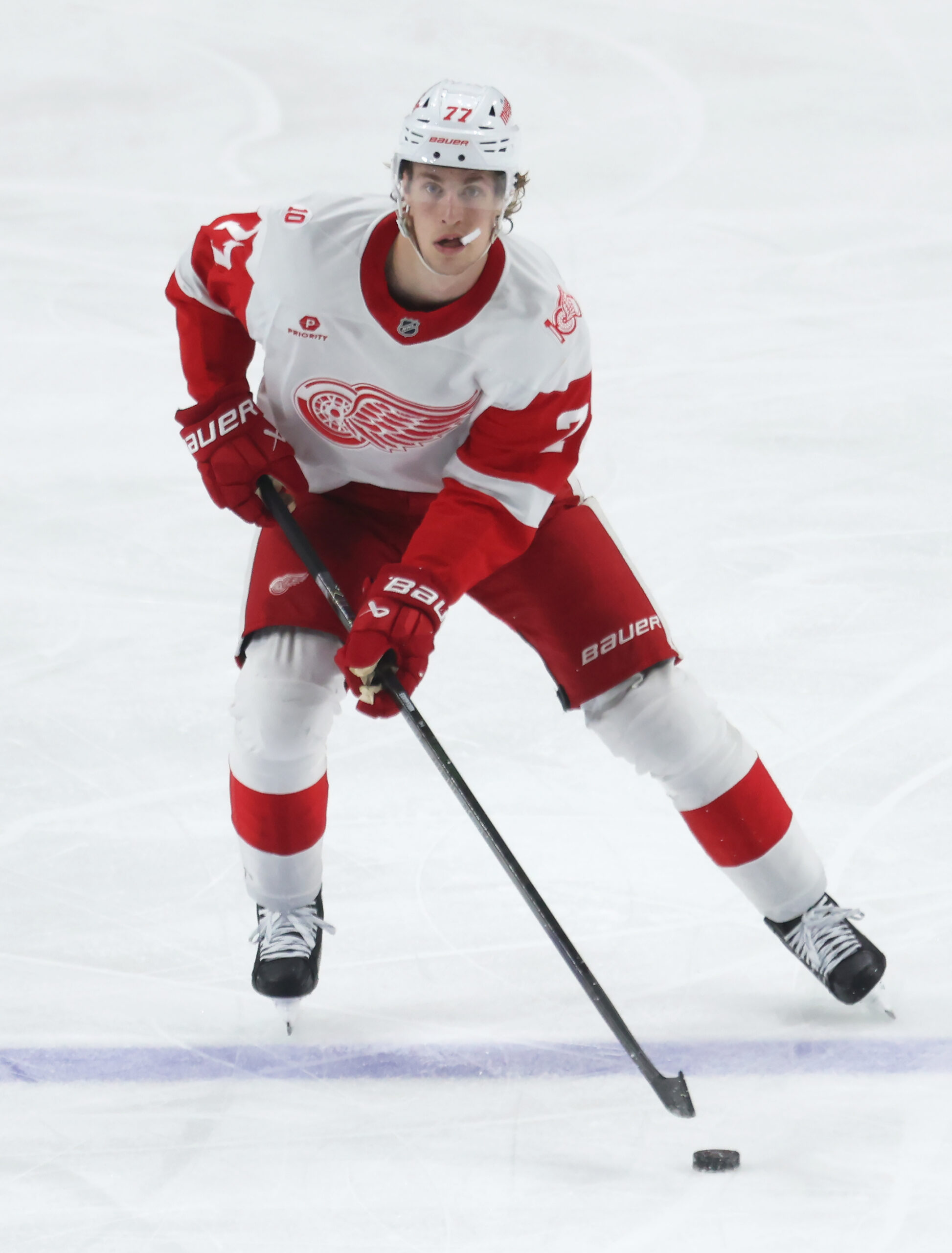 D Simon Edvinsson – Regarding their internal free agents, Edvinsson will be the most important negotiation for the Red Wings this offseason. Not only has Edvinsson proven that he can handle heavy minutes, but he’s also a flawless partner next to Moritz Seider, something Detroit has struggled to fill the past two years. According to MoneyPuck, of the eight defensive pairings that finished with over 1000 minutes played, the combination of Edvinsson and Seider finished third with a 54.8% xGoals%. He’s mildly struggled on offense, scoring 16 goals and 56 points in 150 games the past two years, but Edvinsson has consistently put his body on the line to block shots, and uses his size and reach to his advantage on defense. On a long-term deal, AFP Analytics projects Edvinsson to sign a seven-year, $61.6MM ($8.8MM AAV). Given their unwillingness to pay anyone more than captain Dylan Larkin‘s $8.7MM salary, it’s far likelier that Edvinsson will sign closer to the $8MM to $8.25MM range, ensuring he remains below Larkin and Seider in the salary cap table.
G Sebastian Cossa – Despite being the subject of trade speculation heading into the offseason, it’s become clear that Cossa has become the heir-apparent in Detroit. The former 15th overall pick has been lights out for the AHL’s Grand Rapids Griffins the past two years and will likely make the full-time jump to the NHL next season, albeit in a backup role. At some point, several years in the future, the Red Wings will likely be in a position to move one of Cossa or Trey Augustine off the roster, but that’s a ways away from being an issue. Throughout the past two years, the 6’6″, 209lbs netminder has managed a 47-23-10 record in 80 AHL contests with a SV% higher than .910 and a GAA lower than 2.50. Given that he only has one game of NHL experience, it’s likely that the two sides will agree on a one- to two-year deal this summer.
Other RFAs: F Carter Mazur, F Michael Milne, F Amadeus Lombardi, F Alexandre Doucet, F Jakub Rychlovsky, F Wojciech Stachowiak, D William Wallinder, D Eemil Viro, G Carter Gylander
Key Unrestricted Free Agents
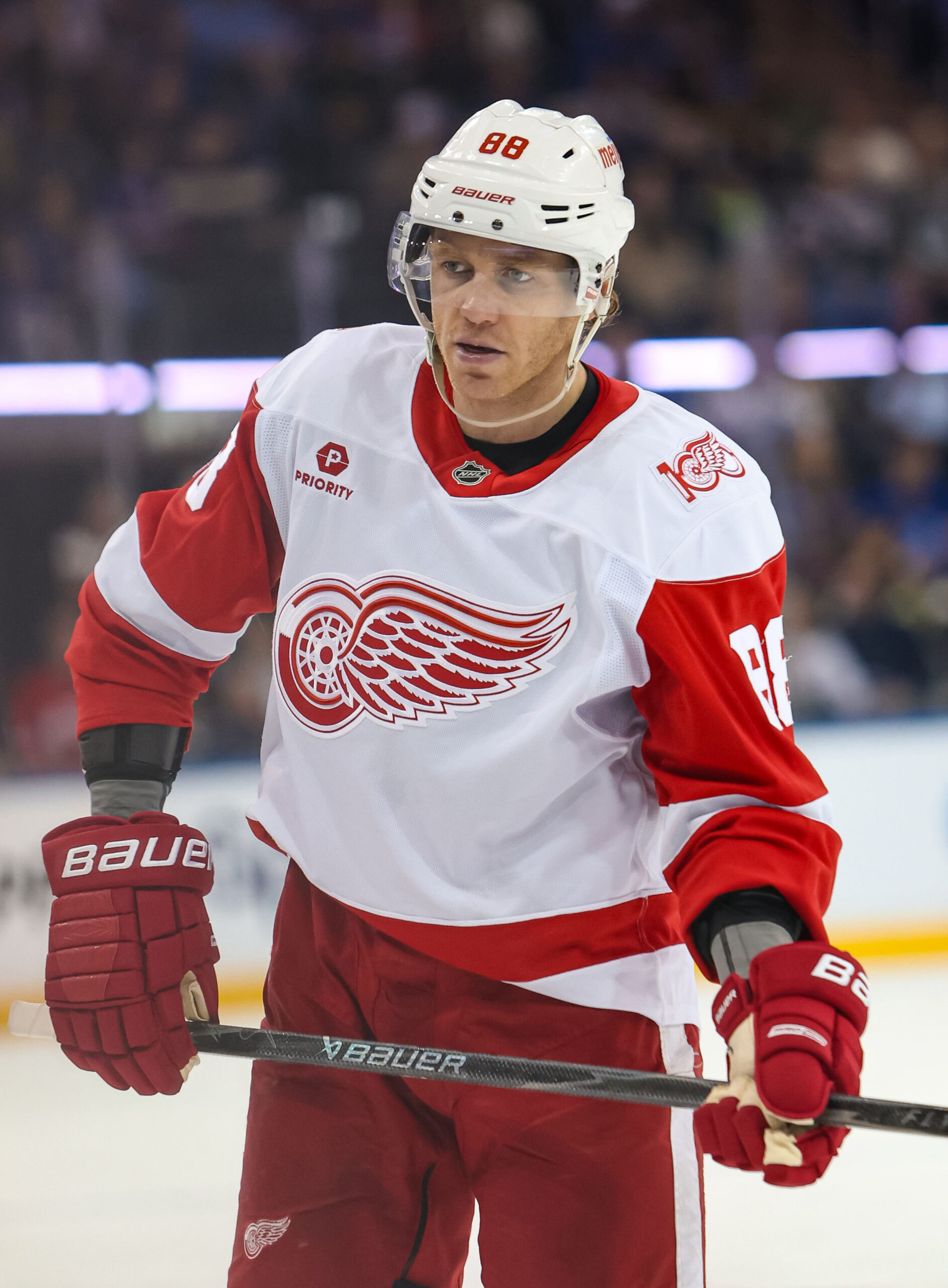 F Patrick Kane – Of all the pending unrestricted free agents on the Red Wings, recent reporting indicates that Kane is the only one they have a desire to retain. It’s clear he’s lost a step, but a 19-year career and hip resurfacing surgery will do that to anyone. Regardless, the former MVP has continued to produce as a respectable secondary scorer, registering 16 goals and 57 points in 67 games this past season. During the past season, more injury concerns arose, but it seems that both Detroit and Kane would prefer a one-year deal anyway. Still, given his steady production, it wouldn’t be surprising to see Kane re-up with the Red Wings for an identical one-year, $3MM contract this summer, with another $4MM available in performance bonuses.
F David Perron – Although Justin Faulk stole many of the eyes as the Red Wings’ big deadline acquisition, Detroit also returned a familiar face in Perron from the Ottawa Senators. Unfortunately, all signs indicate that the remarriage will end in another divorce. Perron was nearly unnoticeable in his second stint with the Red Wings, scoring three goals in 16 games with a -9 rating, averaging 13:59 of ice time per game. Given his recent injury concerns and distressing health concerns with his daughter, it wouldn’t be surprising to see Perron hang up his skates this summer. If he does continue to play, he should be able to find a bottom-six role elsewhere. However, after winning a Stanley Cup and enjoying a 19-year career, nobody would blame Perron if he decided to spend more time with his family.
F James van Riemsdyk – Detroit brought in ‘JVR’ last summer in the hopes that he would offer tertiary scoring and a veteran presence in the locker room. Through the first half of the season, that’s exactly what he provided. Heading into the Olympic break, van Riemsdyk had scored 14 goals and 25 points in 49 games, averaging 13:31 of ice time. Unfortunately, he and the rest of the team fell off a cliff after returning from the break. In his final 23 games, van Riemsdyk registered only one goal and six points. He is another bubble player that wouldn’t be surprising to see retire; however, if he does continue to play, the Los Angeles Kings, Winnipeg Jets, and New York Islanders all seem like decent landing spots for the 37-year-old winger.
Other UFAs: D Travis Hamonic, G Cam Talbot, F Austin Watson, F Eduards Tralmaks, D Erik Gustafsson, D Antti Tuomisto
Projected Cap Space
Detroit won’t have any issues making additions this summer. Even if the team spends $11MM to $13MM on retaining Edvinsson and Kane, they’ll still have more than $16MM to use to add to the roster. Although it’ll be difficult to move some bad contracts, the Red Wings could trim even more off the roster by trading Andrew Copp, J.T. Compher, Michael Rasmussen, and/or Mason Appleton. Unfortunately, it’ll be equally challenging to find suitable talent on the free agent market this summer. Detroit needs to prioritize goal-scoring and could likely use a fourth/fifth defenseman to help stabilize the defensive corps. Still, they are free to use the available dollars on the trade market, which is likely something General Manager Steve Yzerman will look toward this offseason.
Photos courtesy of Charles LeClaire (Edvinsson) and Danny Wild (Kane) of Imagn Images. Contract information courtesy of PuckPedia.
Multiple Players Have NHL Draft Rights Expire
According to PuckPedia, multiple prospects had their draft rights expire at the deadline today, meaning they’ll re-enter the 2026 NHL Draft or become unrestricted free agents.
Two distinct groups are impacted by this deadline. Prospects playing in the Canadian Major Junior leagues (OHL, QMJHL, or WHL) or those playing in Europe.
Of those players from the CHL who have played through their age-20 seasons, they’ll re-enter the 2026 NHL Draft, or become unrestricted free agents if they go undrafted. For the European players, they’ll become unrestricted free agents, though many typically stay in Europe to continue their professional careers.
The only other prospect whose draft rights expired, and didn’t meet either of the above requirements, was Toronto Maple Leafs 2025 draftee Matthew Hlacar. Hlacar was taken with the 217th overall pick of last year’s draft, and scored six goals and 12 points in 51 games for the OHL’s Kitchener Rangers this season. Toronto didn’t issue him a bona fide offer, which is simply tendering the player a league-minimum, entry-level deal to extend their signing rights.
The remaining prospects who will re-enter the 2026 NHL Draft or become UFAs are as follows:
D Ales Cech (Mammoth, 5-153, 2024)
D Simon Forsmark (Hurricanes, 4-101, 2022)
F Max Graham (Penguins, 5-139*, 2024)
F Petr Hauser (Oilers, 5-141**, 2022)
F Nils Juntorp (Hurricanes, 6-188***, 2022)
F Gustav Karlsson (Sabres, 6-187, 2022)
F Maximilian Kilpinen (Red Wings, 4-129, 2022)
D Kasper Kulonummi (Predators, 3-84, 2022)
F Hunter Laing (Flames, 6-170, 2024)
G Ryerson Leenders (Sabres, 7-219, 2024)
D Nathan Mayes (Maple Leafs, 7-225, 2024)
G Landon Miller (Red Wings, 4-126, 2024)
F Kaden Pitre (Lightning, 6-181, 2024)
F Joel Ratkovic Berndtsson (Sabres, 7-202, 2022)
F Santeri Sulku (Flyers, 7-197, 2022)
D Albin Sundin (Oilers, 6-183, 2024)
F Riku Tohila (Blackhawks, 7-199, 2022)
G Jakub Vondras (Hurricanes, 6-171, 2022)
* Originally drafted by the New Jersey Devils; traded to the Penguins in March 2025.
** Originally drafted by the New Jersey Devils; traded to the Oilers in March 2025.
*** Originally drafted by the Chicago Blackhawks; traded to the Hurricanes in January 2025.
Dennis Hull Passes Away At 81
In an unfortunate announcement, the Chicago Blackhawks revealed that long-time player Dennis Hull has passed away at the age of 81. Dennis was the younger brother of Bobby Hull and the uncle of Brett Hull.
By the time Dennis reached the “Black Hawks” for the 1964-65 season, Bobby had already become a phenom and earned his iconic nickname, the “Golden Jet”. Still, being overshadowed by his larger-than-life brother, Dennis put together a quality career in the NHL.
It took him a few years to get everything figured out, but by the 1966-67 season, he had become a consistent scoring threat. Even after Bobby departed for the WHA’s Winnipeg Jets in 1972 for a whopping $1MM signing bonus ($13.94MM in today’s dollars), Dennis remained with the Black Hawks. In total, he spent 13 years in Chicago, scoring 298 goals and 640 points in 904 games while playing in five All-Star Games.
Although he never won a Stanley Cup during his tenure with the Black Hawks (though he played in three finals), the highlight of Dennis’ career was the 1972 Summit Series between Canada and the Soviet Union. Dennis initially intended to boycott the event because Bobby was excluded from the team due to his participation in the WHA. After receiving encouragement from his older brother, Dennis played on a line with Jean Ratelle and Rod Gilbert, scoring two goals and four points in four games, helping Canada to a series victory.
A few years later, Dennis would retire at the age of 33 after a one-year stint with the Detroit Red Wings. Despite appearing on a handful of broadcasts, Dennis lived a relatively private life after retirement. His most notable post after his playing career was as Athletic Director for the Illinois Institute of Technology in Chicago.
We at PHR offer our condolences to Dennis’s friends, family, and loved ones.
Morning Notes: Malkin, Kane, Pronger
Some familiar names from the 2000’s have circulated recently in the hockey world.
The biggest is one who, as expected, doesn’t appear to be going anywhere. Evgeni Malkin is not likely to sign anywhere but Pittsburgh, according to Pierre LeBrun of The Athletic. The long-time Russian star turns 40 a month after free agency opens on July 31, and his agent, J.P. Barry, has already been in discussions with the Pittsburgh Penguins about coming back on a one-year deal. The length appears to be consistent with both parties, but now it comes down to the question of how much money Malkin is to be paid.
Malkin is coming off the final season of a four-year contract worth $24.4MM ($6.1MM AAV). He finished his age-39 season with 19 goals for 61 points in a season where he played just 56 games, finishing fifth on Pittsburgh in scoring. That tally puts him at a cost of $100k per point, however, because of his contract being frontloaded, his $4.8MM in total salary from 2025-26 is likely where LeBrun believes the Penguins want to begin their number, while Malkin’s camp wants to start around his previous cap hit. It’s not out of the question that if Pittsburgh, who carries $42.5MM in cap space, wants to save as much as they can among their eight free agents and beyond, they can give Malkin performance bonuses to hinder the AAV on the contract.
Additional notes include:
- According to Kevin Allen of Detroit Hockey Now, Patrick Kane‘s name has emerged as the potential lone unrestricted free agent that the Detroit Red Wings could be considered in re-signing in Hockeytown. The all-time American star finished with 57 points in 67 games in his third consecutive one-year contract with the Wings that paid him $3MM in his age 37 season. Kane’s cost per point carried a low $53K that Detroit would hope to continue benefiting from. If true, general manager Steve Yzerman will be parting ways with forwards David Perron and James van Riemsdyk, as well as defenseman Travis Hamonic and goaltender Cam Talbot. Simon Edvinsson is the lone defensive restricted free agent, and with $32.6MM in cap space to spare, a chunk of that will head towards the young Swede’s future paycheck.
- Allen’s tweet in particular referenced that van Riemsdyk’s spot, which fluctuated in many spots on the wing, would be filled by a younger player. Perhaps Carter Mazur (8 GP in 2025-26), Michael Brandsegg-Nygard (14 GP in 2025-26), and even Nate Danielson (28 GP in 2025-26) can compete for more ice time if this development comes to fruition.
- Chris Pronger interviewed for the Toronto Maple Leafs president of Hockey operations role, he confirmed as a guest on TSN 1050’s OverDrive show. The 51-year-old said that he had a good conversation about the team’s direction and his thoughts on their needs with MLSE president and CEO Keith Pelly. While he received positive feedback for his discussions, Toronto ultimately went for their options in John Chayka and Mats Sundin. Pronger previously denied rumors that he was interviewing for the Leafs GM role on another TSN show. The Hockey Hall of Fame defenseman, while working in media right now, isn’t opposed to a front office role but emphasized that it needs to be a situation that is right for him to take a new opportunity.
Offseason Checklist: Detroit Red Wings
The offseason has arrived for half of the league’s teams that aren’t taking part in the playoffs plus those who have already been eliminated. Accordingly, it’s now time to examine what they will need to accomplish over the coming months. Next up is a look at Detroit.
Patience has run out for the Detroit Red Wings. The team’s playoff drought has run into a decade, and there are still more questions than answers. Despite not only being in a playoff position for much of the season but leading the hotly contested Atlantic Division, a third consecutive collapse in March had the Red Wings on the outside looking in for this year’s postseason. The silver lining is that Detroit has oodles of money to spend and one of the deeper prospect pools in the league. Ultimately, it will require Steve Yzerman to bite the bullet, change his typically conservative approach, and make the changes necessary to get this Original Six franchise back into the playoffs.
Acquire Top-Six Center
This has been an issue plaguing the Red Wings and most of the league for some time. They’ve taken shots at it, mostly by signing Andrew Copp and J.T. Compher in back-to-back offseasons. This season, the hope was that Marco Kasper could assume that role after a solid rookie campaign. Unfortunately, Kasper was flat out of the gates and finished with nine goals and 19 points in 81 contests. His poor play since the start of the campaign vaulted Copp back into the top six.
Despite being one of the best faceoff takers in the league, Copp doesn’t have the offensive punch to warrant a spot in the top six. Yes, he finished with the second-highest scoring output of his career, but it mostly came by the way of assists with the benefit of playing on a line with Alex DeBrincat, who finished with 41 goals.
Detroit was heavily linked to Vincent Trocheck of the New York Rangers and Robert Thomas of the St. Louis Blues leading up to the deadline, but ultimately didn’t have the appetite to pay the heavy price to address their need. That’s generally a respectable position, given that the General Manager is tasked with managing the team’s assets as well as putting the best team out on the ice. Still, it was a noticeable hole from the jump, and the lack of aggressiveness left many fans, and likely the team, disappointed.
Given the Rangers’ direction, it’s safe to say that Trocheck will again be available for the right price this summer. For Thomas, there’s no indication what direction new General Manager Alex Steen will want to take the team, so it’s no longer a guarantee that he’ll be shopped. As for other options, the Red Wings could take an expensive flyer on Elias Pettersson of the Vancouver Canucks, go on the cheaper side and target Morgan Frost of the Calgary Flames, or go bold and try to pry Nico Hischier away from the New Jersey Devils, especially if his extension talks stall.
Re-Work Defensive Corps
One of the most peculiar themes from Detroit over the past several years has been the organization’s infatuation with Ben Chiarot. Yes, he’s physical and blocks shots, but he doesn’t have the on-ice awareness to have a meaningful role in the top four of the defensive corps. He hasn’t had an on-ice goals percentage greater than 50.0% since his time with the Winnipeg Jets, and he’s continued to get worse since then. Despite his decline in play, the Red Wings signed Chiarot to an extension, keeping him in HockeyTown through the 2028-29 campaign.
Although they started strong, Albert Johansson and Jacob Bernard-Docker both declined significantly towards the end of the season. Detroit attempted to give its defensive corps a jolt by acquiring Justin Faulk at the deadline, but he wasn’t enough to get them over the finish line. By the end of the season, the Red Wings could really only rely on their top unit of Moritz Seider and Simon Edvinsson.
Youngster Axel Sandin Pellikka still has a high ceiling, but has some maturing to do, which isn’t atypical for younger defensemen. Throughout the season, it was evident that the Red Wings’ coaching staff lacked trust in him during challenging situations, leading to his demotion to AHL Grand Rapids before the campaign ended.
Detroit hopes that a full season with Faulk next to Sandin Pellikka will be beneficial, especially if it moves Chiarot to a bottom-pairing role. However, if injuries occur, Detroit lacks sufficient reserves. The Red Wings should target a defenseman who will primarily play in the bottom pairing, but wouldn’t look out of place in the top four if needed. They should be able to recruit this on the free agent market this summer, such as Mario Ferraro, Logan Stanley, or Ryan Shea.
Lock Up Edvinsson
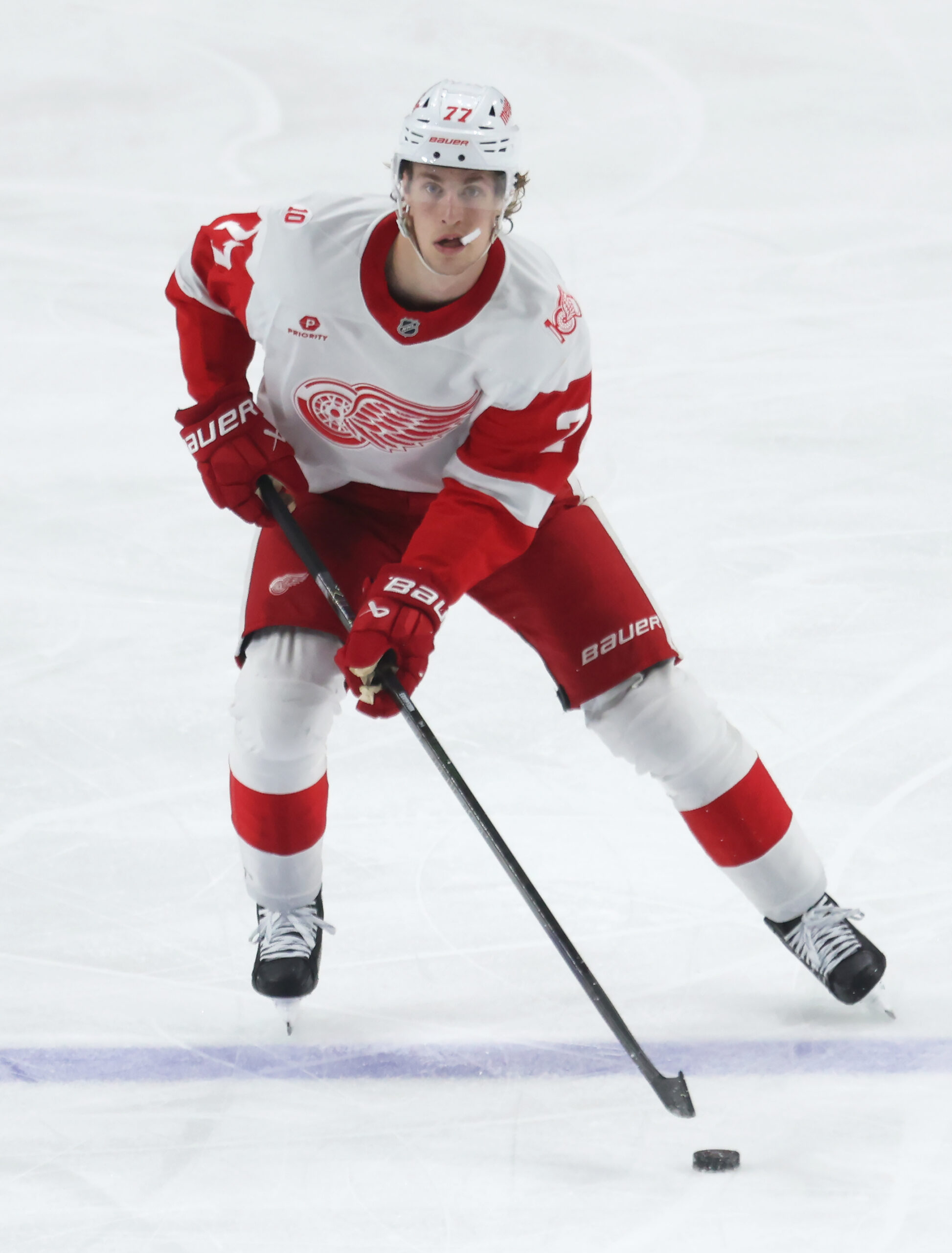 One key factor in solidifying the defensive corps is locking down Edvinsson this summer. He’s set to become a restricted free agent on July 1st without arbitration rights, giving Detroit plenty of time to work something out long-term.
Although he hasn’t taken off as immediately as Seider, it’s clear that the two play well together. Now a full-time player, Edvinsson has scored 16 goals and 56 points in 150 games over the past two years, averaging 21:43 of ice time per game. Additionally, he plays into his frame, blocking 292 shots and delivering 180 hits in that time. The pairing of Edvinsson and Seider played the third-most totals of any defensive pairing this year, and they finished with a 54.8% xGoals% in all situations, according to MoneyPuck.
At the very least, the Red Wings should target a five-year contract if not longer. Should they agree to a five-year deal, that would line Edvinsson up with Seider for their contract expirations. As of now, AFP Analytics projects Edvinsson to sign a seven-year, $61.4MM ($8.77MM AAV) on a long-term deal. It’s unlikely that Detroit would be willing to go above Seider’s $8.55MM salary on any new deal, so they would likely play hardball in getting Edvinsson down to an $8MM to $8.5MM range.
Add Depth Scoring
Connected to their need for a second-line center, the Red Wings must add additional scoring, particularly to their bottom-six. In what has become another theme for this team over the last few years, Detroit struggles to produce at even strength, costing them several games. This season, the team finished in 30th place in even-strength goals.
Of those that finished the season in Detroit, the combination of James van Riemsdyk, Michael Rasmussen, Mason Appleton, Compher, and Kasper finished with 47 goals on the season. As mentioned previously, DeBrincat finished with 41 himself.
Fortunately, the Red Wings don’t need to go big-game hunting in this regard. In fact, most of it could come from within. If Detroit can move Rasmussen and Appleton this summer, as well as let van Riemsdyk walk in free agency, the Red Wings could begin adding in some of their prospects to the NHL roster and let their youthful energy take over.
Photo courtesy of Charles LeClaire of Imagn Images.