
Morning Notes: Boeser, Hall, Norris
Team USA is expected to add a goal-scoring punch to their roster for the 2026 IIHF World Championship. Top Vancouver Canucks winger Brock Boeser is expected to suit up for the Stars and Stripes in the summer tournament per Rick Dhaliwal of CHEK News.
Boeser notched 22 goals and 48 points in 75 games this season. The performance continued his downward turn after posting a career-high 40 goals and 73 points in 81 games of the 2023-24 season. Boeser earned All-Star recognition that season, an accolade that he hasn’t received since his rookie season in 2017-18. He followed the career year with just 25 goals and 50 points in 75 games last season.
This will be Boeser’s first chance to suit up for the USA’s men’s national team. He played in three international tournaments during his days in junior hockey, including captaining USA at the 2014 Hlinka Gretzky Cup. He scored eight points in five games at that tournament, then later notched five points in four games at the 2015 World Junior-A Challenge and three points in seven games at the 2016 World Junior Championships. Boeser has stood out as a shoot-first winger dating back to those international appearances and should bring a similar impact to USA’s middle-six at Worlds.
Other notes from around the league:
- Carolina Hurricanes forward Taylor Hall is not expected to receive supplemental discipline for his hit that injured Ottawa Senators defenseman Jake Sanderson, per hockey insider Frank Seravalli and TSN’s Bruce Garrioch. Senators head coach Travis Green criticized the decision, saying that the hit was blatantly high. Hall seemed to contact Sanderson’s head, and even knocked off his helmet, with a corner hit in the third period of Thursday night’s game. He was assessed a minor penalty on the play, while Sanderson left the game with 15 minutes to go. The star defenseman will now move forward with a questionable tag for the rest of the first round series. That will be a major absence with Ottawa at risk of being swept on Saturday. Sanderson is the only Senators defenseman to record a point this series. He has two assists.
- It seems the Buffalo Sabres could be without Joshua Norris for the foreseeable future. After being designated as out day-to-day, head coach Lindy Ruff shared that Norris is currently questionable to practice with the team. Norris sat out of Game 3 with an undisclosed injury. He has battled routine absence all season long and ultimately sat out of 38 games. Norris was a major part of the Sabres’ offense in his healthy stretches. He scored 34 points in 44 games and gave the team an extra motor in their top-six. Unfortunately, the Sabres will have to revert to their backup lineup with Norris again on the mend. His absence will be, in part, filled by rookie Noah Ostlund who scored two points in his Stanley Cup Playoffs debut in Thursday night’s win.
USA Hockey Finalizes Coaching Staff For 2026 Worlds
USA Hockey has rounded out its coaching staff for next month’s 2026 World Championship in Switzerland, the organization announced Thursday. Former Sabres bench boss Don Granato was previously announced as the head coach in March as the Americans aim to win back-to-back gold medals at the event for the first time ever.
Joining Granato as assistants will be Canucks assistant Kevin Dean, Predators assistant Darby Hendrickson, Rangers assistant Ty Hennes and University of Michigan head coach Brandon Naurato. Sharks goaltending coach Thomas Speer is joining in the same role, while Predators video coach Lawrence Feloney and Islanders video coordinator Matt DeMado have also been added to the staff.
It’s a very similar group to the contingent that led the Americans to the promised land last season. Dean, Speer, and Feloney are all returnees, as are general manager Brett Peterson and assistant general manager Jeff Kealty.
Dean had no previous national team experience up until last year’s tournament, but they obviously liked what they saw, then under Sharks head coach Ryan Warsofsky. He’ll be primarily responsible for the defensemen and penalty kill, the same role he holds in Vancouver, although the Canucks had a league-worst 71.5% penalty kill success rate and ranked 29th in the league in shots against per game with 29.8 in Dean’s first season behind the bench there. He had previous stints with the Bruins (2017-22) and Blackhawks (2022-25) as an assistant.
In Nashville, Hendrickson is more of a roving assistant focused on player development. This marks his first national team appearance as a coach, although he scored 14 points in 44 World Championship games for the U.S. as a player in six tournaments (1996-2001) and also suited up for them at the 1994 Winter Olympics.
Hennes returns to the United States bench after first serving as an assistant coach at the 2024 Worlds. The Americans went 5-1-1 in group play that year but were upset by the host Czechia in the quarterfinals. Hennes is coming off his first season with the Rangers, following Mike Sullivan to New York last summer after spending the previous three seasons under him as an assistant with the Penguins.
Naurato, one of the brighter coaching prospects in the sport, is 41 years old and just wrapped up his fourth season heading up the Wolverines’ bench. A former player development consultant with the Red Wings from 2018-21, he spent only one season at Michigan as an assistant before earning the promotion. During that time, he’s won a pair of Big 10 championships and got Michigan to its fourth Frozen Four in the last five years, although they’ve been bounced in the national semifinal each time.
Latest On Arshdeep Bains
Vancouver Canucks forward Arshdeep Bains is entering a significant offseason, one that could determine his chances of becoming a full-time NHLer in Vancouver, writes Thomas Drance of The Athletic. According to Drance, “it’s clear” that Bains is “going to have to change his approach to take a stab at becoming a regular.” The 25-year-old entered 2025-26 on a high. He scored 24 points in 24 playoff games en route to a Calder Cup final to cap off the prior campaign, and got a real chance in the NHL to start this season. But he was unable to translate his strong track record of scoring at the AHL level to Vancouver, and finished the season with just five points in 28 games.
Canucks Granted Permission From Leafs To Speak With Shane Doan
The Vancouver Canucks are continuing to seek out new names for their front office. Their latest candidate could come from the Toronto Maple Leafs. Vancouver has requested permission to speak with Toronto special advisor Shane Doan position per Sportsnet’s Elliotte Friedman. It was later reported that permission was granted per John Shannon of 100% Hockey.
It is not yet clear what position Vancouver sees Doan stepping into. Doan has filled a GM advisory role in Toronto for the last three seasons, after three seasons as the Director of Hockey Administration with his alumni Arizona Coyotes.
Doan has not yet filled a GM role at the NHL or AHL level but the job is not unfamiliar. He served as Team Canada’s GM at the 2022 Winter Olympics, World Championship, and Spengler Cup. Canada won a Silver Medal at the World Championship but did not reach the podium at the other two events . Doan was also an assistant GM at the 2019 Spengler Cup, 2021 World Championship, and 2023 World Championship. Canada won the Spengler Cup and two Golds at the World Championship in those tournaments.
Doan is much more known for his accomplishments as a player. He was originally drafted by the Winnipeg Jets and played his NHL rookie season in the team’s final season before moving to Phoenix. Doan became a star in the desert, routinely rivaling 50 points and 50 penalty minutes each season. He was quickly one of the team’s most reliable forwards and took on a top-line role next to hockey legends Jeremy Roenick and Keith Tkachuk in his early career. He did not leave that role through the final 20 years of his career, all spent with the Coyotes franchise. Doan was awarded the Coyotes’ captaincy in 2003 and carried it until he retired in 2017. He called his career to a close with the most games (1,540), goals (402), assists (570), and points (972) in Coyotes history. Doan’s son, Josh Doan, was drafted by Arizona in 2021 – but has since been traded to the Buffalo Sabres. Doan’s wife, Andrea Doan, was named to the Phoenix Hockey Exploratory Committee – a group geared towards returning NHL hockey to Phoenix – in September.
How the Vancouver Canucks see Doan fitting in is not clear but there is no doubt about his rich experience in NHL and international hockey. He has now served six seasons in NHL front offices and could fit in a variety of assistant, advisory, or development roles. Before they can brainstorm around a job title, Vancouver will first need to get permission from the Maple Leafs, who may see Doan as a helpful support to their own search for a new GM.
Latest On Zeev Buium, Canucks General Manager Search
Vancouver Canucks young star Zeev Buium won’t play for Team USA in the upcoming IIHF World Championships, Rick Dhaliwal of CHEK reports.
Assuming today’s news to be the case, the skilled lefty will focus on resting up after the long grind of 76 NHL games in his rookie year. After being dealt to the Canucks, Buium’s ice time jumped nearly two full minutes, averaging 20:21 wearing the blue and green.
Offseason Checklist: Vancouver Canucks
The offseason has arrived for half of the league’s teams that aren’t taking part in the playoffs. Accordingly, it’s now time to examine what they will need to accomplish over the coming months. First up is a look at Vancouver.
After keeping some veterans around and signing others to extensions as soon as possible, there was a clear internal expectation of a rebound season from 2024-25, even with a first-time head coach in Adam Foote. However, those expectations didn’t last long as things went downhill in a hurry, resulting in their best player being moved early in the season. As a result, things are even murkier than before heading into their offseason. Here’s what’s on their to-do list this summer.
Hire A GM
Before they can work on too much this offseason, they need to have their next decision-maker in place. On Friday, GM Patrik Allvin was let go after a little more than four years on the job. The team had a points percentage of .531 over his tenure but the last two years weren’t overly pretty with some questionable decisions made along the way on the trade and contract front.
President of Hockey Operations Jim Rutherford (himself potentially not around for much longer given that he’s 77 and has been with the team longer than originally planned) indicated that whoever takes over will have full autonomy on the roster. That’s particularly noteworthy as more teams start to look at an operation where the POHO role has more authority on that front.
Assistant GM Ryan Johnson has been linked to other teams in their searches. However, there have been also been some suggestions that Vancouver may have him as the perceived frontrunner at this point and is unwilling to let him interview elsewhere although the organization should undoubtedly look at external options as well. There is lots of time to make a hire at this time of year but with other teams on the lookout for a new GM, the Canucks may have to move quickly on this front to ensure that they get the candidate they want as New Jersey did with the hiring of Sunny Mehta earlier this week.
Choose A Path
It seems like a long time ago but just two years ago, the Canucks won the Pacific Division. While some of the key pieces from that roster are gone (highlighted by the Quinn Hughes trade), several are still around. And with an owner that has been suggested to be resistant to an extended rebuild in the past, a decision to try to retool this roster to get back into Wild Card contention next season can’t be ruled out.
Of course, that path seems suboptimal in the long run. But it’s not implausible to think that several of the veterans who underachieved this season bounce back while if Thatcher Demko’s surgery ultimately is as successful as he thinks it was, the floor of this group is going to be a lot higher. With over $21MM in cap space this summer per PuckPedia and no free agents of consequence, they could try to add a few pieces, add that to the potential bounce backs, and try their luck that way.
Alternatively, with the crash landing that this season yielded, a retooling of sorts or a full-fledged rebuild may be the more logical course of action. Determining the extent of the remaining teardown (a retool being shorter term and a rebuild likely lasting several more seasons based on recent comparisons) will be at the top of the priority list. It’ll certainly be a discussion point in interviews for the position.
Once that determination is made, it might influence whether Foote returns behind the bench to get another shot or if the new GM wants to bring in their own handpicked choice. But after a season of spinning their wheels followed by one where things went off the rails relative to expectations almost immediately, identifying and executing a clear direction will be crucial this offseason.
When they decide the route they want to take, that will naturally go a long way toward dictating what comes next and what moves they should be looking to make. Are they trying to add pieces or will a bigger selloff begin? With that not yet certain, the remaining items on their checklist are ones they should be trying to do regardless of the direction the new GM elects to go in.
Explore Boeser Trade Options
A year ago, few thought Vancouver would be in this situation when it comes to long-time winger Brock Boeser. Not because of their struggles either, simply because a year ago, few thought Boeser would still be around. After Allvin publicly lamented a lack of interest in Boeser at the 2025 deadline, it was widely expected that he’d move on in free agency. Instead, he re-signed just as the market opened up, signing a seven-year, $50.25MM deal.
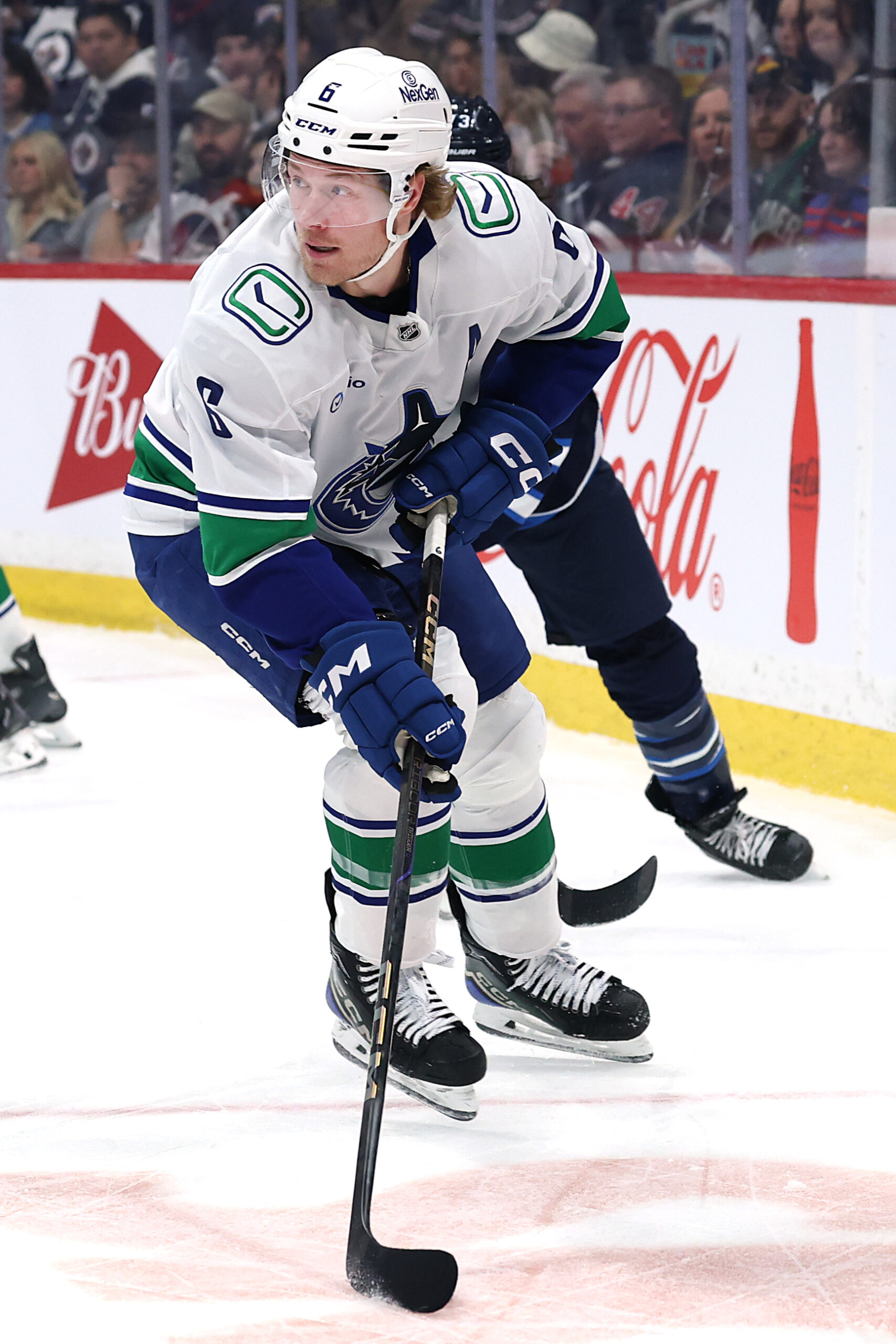 That contract came on the heels of a down year that saw his output go from 40 goals and 73 points in 2023-24 to just 25 and 50 in 2024-25. The contract suggested an expectation that Boeser would rebound. Not necessarily to his career-year levels but perhaps something in between. However, with 22 goals and 48 points this season, his output basically was the same.
As a result, there are certainly some questions about his fit moving forward, whichever direction the Canucks ultimately go. If they look to rebuild or retool, the 29-year-old becomes a logical trade candidate as by the time they emerge from it, his prime years will be over. And if they’re looking to try to compete for a playoff spot next season, his struggles make him a potential change-of-scenery candidate to try to shake up the veteran core.
A $7.25MM cap hit given the year he had is on the higher side but the UFA market has been thinned out considerably in recent months. Meanwhile, the higher salary cap environment should make the deal more palatable as it goes on. If Boeser were to be made available (and he’d be willing to waive his no-move protection), there should be a market for his services. And if the team opts for a rebuild, he becomes a very realistic candidate to move. Whoever takes over as GM should be investigating what the trade options would be with the veteran winger.
Look Into Buium Extension
One of the key pieces of the return for Hughes was defenseman Zeev Buium. A first rounder in 2024 (12th overall), the 20-year-old has shown signs of impressive offensive upside, especially in college when he had 98 points in two seasons at Denver University. He is expected to be a foundational piece for the Canucks before too long, no matter if they look to rebuild or try to get back to the playoffs next season.
Buium burned the first year of his entry-level deal last season when he joined Minnesota for their playoff run. Accordingly, even though this season was his rookie year, he’s already gone through two of his three contract years already. That makes him eligible for a contract extension as of July 1st. Allvin wasn’t believed to be too keen on the idea of an early extension but his replacement may be wise to give the possibility some thought.
Finding the right number for both sides will be a challenge, however. Buium had six goals and 20 assists in 76 games between Minnesota and Vancouver this season. Those are certainly respectable numbers for a first-year pro defenseman but Buium’s camp won’t be willing to sign an extension with 26 points being used as the basis of an offer. No, if a deal were to be done this summer, it would be based on a much higher projected output.
The market for promising young defensemen with offensive upside has certainly gone up lately and it’s reasonable to think that Buium’s camp would be looking at the seven-year, $63MM deal New Jersey gave Luke Hughes heading into this season and be hoping to get something similar. His performance doesn’t warrant that type of money yet but his next contract will start in 2027-28 when the projected salary cap will be $113.5MM which will only drag the AAV higher.
This is also the last stretch where eight-year contracts will be allowable. Once the full new CBA kicks in (September 16th), the maximum term will be seven years. Considering Buium has five years of club control remaining when his entry-level deal expires in 2027, a max-term extension would only add two years. Getting a deal done this summer where they could get an extra year of control may be worthwhile, even if it results in a higher AAV. If the team believes he’s the type of core piece to build around, they’d be wise to get a sense for what type of contract will be needed to make that a reality.
Photo courtesy of James Carey Lauder-Imagn Images.
Canucks Notes: Demko, Forbort, Johnson
Vancouver Canucks netminder Thatcher Demko told the media today, including Thomas Drance of The Athletic, that his hip surgery “is going to address everything [he has] dealt with in the past” as it relates to injuries. Demko has missed significant time over the last few years as the result of lingering injury issues, particularly regarding his hips. The 30-year-old has been limited to just 43 games played across the last two seasons. Demko’s persistently inconsistent availability over the last two years prompted Vancouver to invest in No. 2 netminder Kevin Lankinen, who secured a $4.5MM AAV contract extension from the club that runs through 2029-30.
Lankinen, 30, played in 51 games last season and got into 47 this year, with each mark leading the team. Heading into next season, the hope will be that what Demko has told the media comes to fruition, and he’s able to get into a regular starter’s workload of games for the first time since 2023-24. That year, Demko played in 51 games and posted a .918 save percentage. A .918 save percentage would be enough to lead the NHL in the statistic among goalies with at least 50 games played. If the Canucks can get a healthy Demko back on the ice, it would likely be a significant boost to the team’s hopes of remaining competitive on a nightly basis through their rebuild.
Other notes from British Columbia:
- Canucks defenseman Derek Forbort shed some light on the injury that sidelined him for all but two games of the 2025-26 season today, telling the media, including David Quadrelli of CanucksArmy, that he had surgery to fix a labral tear in his hip, and has since been rehabbing. The 34-year-old, when asked about the future of his playing career, said he would “like to try and maybe grind out a couple more [NHL seasons] depending how it feels.” The 6’4″ blueliner is a veteran of 552 NHL contests and has been a Canuck for the last two years, but is set to hit unrestricted free agency this summer.
- Vancouver’s president of hockey operations Jim Rutherford told the media today that assistant general manager Ryan Johnson was not asked to interview with other NHL clubs, denying a previous report that had indicated that the Nashville Predators requested to interview Johnson and were denied permission. Johnson is presumably a leading candidate to replace Patrik Allvin, who was fired earlier today, as Canucks GM. Johnson has served as GM of the Canucks’ AHL affiliates since 2017-18, and won the first Calder Cup in Abbotsford Canucks franchise history last season.
Canucks Fire Patrik Allvin
The Canucks have relieved general manager Patrik Allvin of his duties, per a team announcement. Darren Dreger of TSN was first on it this morning after Thomas Ros of Sweden’s Aftonbladet said overnight that the Canucks made the decision around last night’s season finale to let him go.
For now, that’s the only change. The futures of first-year head coach Adam Foote and president of hockey operations Jim Rutherford are also up in the air after a woeful season in Vancouver finally came to an end last night with a 6-1 loss to the Oilers. Vancouver’s 25-49-8 record left them as the worst in the NHL by a 14-point margin, with their .354 points percentage serving as the franchise’s worst result since the 1998-99 campaign that rewarded them with the assets to draft franchise cornerstones Daniel Sedin and Henrik Sedin.
Ideally, the trials of this season will yield another franchise forward for the Canucks – whether that’s Gavin McKenna or another Swede in Ivar Stenberg. However, Allvin won’t be the one entrusted to steer the team through the early stages of that next era.
Allvin just finished his fourth full season in the GM’s chair in Vancouver and fifth overall. After Rutherford was hired as POHO midway through the 2021-22 season in the wake of Jim Benning‘s firing, he served as interim GM for a few weeks before eventually hiring Allvin to fill the role. The duo had worked together previously with the Penguins, where Allvin had served as director of various scouting departments from 2012 to 2021 before being promoted to assistant GM.
Since Allvin’s appointment on Jan. 26, 2022, the Canucks have a record of 173-150-45 (.531). That’s 23rd out of 33 NHL franchises (the Coyotes are tracked separately from the Mammoth) during that time.
The tinge of disappointment in Allvin and Rutherford’s tenure will be most felt by a roller-coaster graph in team success. A rebuild that failed to get off the ground in several years under Benning finally seemed to do so under Allvin’s direction in 2023-24. After hiring a new bench boss in Rick Tocchet and largely staying the course with his group, the Canucks exploded for a 50-win, 109-point season and their first division title in 11 years. That also yielded just their third playoff berth in that span, driving the eventual conference champion Oilers to seven games in the second round despite injuries forcing them to ice third-string goaltender Arturs Silovs from Game 4 of the first round onward.
Yet the Canucks have been in a free fall ever since. They failed to retain multiple key unrestricted free agents the following offseason, and while they netted some solid depth replacements like Jake DeBrusk, the team couldn’t recover. Their All-Star starter, Thatcher Demko, being limited to 43 starts over the last two seasons certainly didn’t help matters, but a slow degradation in their defensive structure – followed by a full-blown collapse once they failed to work out an extension with Tocchet and let him go following the 2024-25 season – destroyed any hope of being able to compensate for Demko’s absence.
In Tocchet’s second and final season, the team was salvageable. The loss of finishing talent in free agency was felt in an already defense-heavy system, but improved goaltending could have steered the Canucks back toward the playoff picture. Under Foote, though, a roster that was designed for Tocchet’s defense-first system imploded. The team allowed the most goals per game (3.83) by a wide margin, had the league’s worst penalty kill at 71.5%, and the second-most expected goals against per 60 at 5-on-5 at 2.80, per MoneyPuck.
Despite acquiring several young assets when the team was essentially forced into trading franchise defender Quinn Hughes to the Wild amid this season’s free-fall, Allvin’s middle-of-the-road drafting has only left the Canucks with a league-average prospect pool, Scott Wheeler of The Athletic opines. That will obviously get a jumpstart with the best odds at the first overall pick this June, plus three other selections they’ve accumulated through the first two rounds, but there’s still some work for Allvin’s successor to do before exiting their retool becomes a viable strategy.
As for who that successor might be, there’s a strong feeling it could be an internal promotion. The Canucks have denied other teams permission to speak to their assistant/AHL GM, longtime NHL center Ryan Johnson. He’s been with the organization since 2013, first as a development coach, before working his way up the ladder over the next decade-plus.
Evening Notes: Canucks, Ducks, Psenicka
The Vancouver Canucks will need to reconsider much of their roster after a last-place finish this season. Winger Evander Kane and defenseman Pierre-Olivier Joseph are not expected to be a part of the plans moving forward per Thomas Drance of The Athletic. Both players will enter unrestricted free agency on July 1st.
Kane played a full season after missing the entirety of the 2024-25 campaign. He recorded 13 goals, 31 points, and 92 penalty minutes in 71 games. He proved capable of filling an every-night role in the NHL but still underperformed his $5.125MM cap hit. The silver lining of Kane’s season was the 1,000th game of his NHL career, played on March 30th. He has 339 goals and 648 points in 1,001 career NHL games.
Joseph has fought to move out of an extra defender role for much of the last three seasons. He recorded six points and a minus-16 in 31 games this season. That is a slight boost from three points and a minus-23 in 47 games, split between the St. Louis Blues and Pittsburgh Penguins, last season. He will eye a cheap contract, and promise of NHL minutes, should he hit free agency this summer.
Other notes from the Western Conference:
- The Anaheim Ducks have signed San Diego Gulls head coach Matt McIlvane to a multi-year extension per Patrick Present of The Hockey News. McIlvane posted his best record in three years as San Diego’s head coach with a 33-24-12 finish this season. That performance has pushed the Gulls into their first Calder Cup Playoff appearance since 2022. McIlvane, an Illinois native, coached five seasons with EHC Salzburg, in Austria’s IceHL, before being hired by San Diego in 2023. He led the team to two IceHL championships. He also won three DEL championships as an assistant coach with EHC Munchen from 2014 to 2019. That role also earned McIlvane an assistant coach role on Germany’s Men’s Hockey team at the 2018 Winter Olympics. He helped lead the country to a Silver medal finish, their first men’s hockey medal in modern Olympic history.
- Utah Mammoth defense prospect Max Psenicka has signed an amateur try-out contract with the AHL’s Tucson Roadrunners. Psenicka is coming off his second season with the WHL’s Portland Winterhawks. He recorded eight goals, 30 points, and 67 penalty minutes in 53 games – and no scoring and a minus-10 in four playoff games. He brings some pro experience to the AHL level, having played 16 games and scored two goals in Czechia’s Extraliga at the start of last season. Psenicka should bring an impactful, defensive presence to Tucson’s lineup as they approach the final three games of their season.
Canucks Recall Kirill Kudryavtsev
The Canucks have added some extra defensive depth heading into their game tonight against San Jose. The team announced (Twitter link) that they’ve recalled Kirill Kudryavtsev from AHL Abbotsford.
It’s the second recall of the season for the 22-year-old, who was up for a little more than a week early on although he didn’t see any game action. As a result, he’s still at a total of two career NHL appearances, those coming in Vancouver’s final two games of 2024-25 when he blocked five shots and logged a little more than 28 minutes total of ice time.
This season, Kudryavtsev has played in 41 games with AHL Abbotsford, picking up two goals and 16 assists. From a point-per-game standpoint, that puts him slightly ahead of last year when he had 26 points in 65 regular season contests before adding another 10 in Abbotsford’s Calder Cup run.
Kudryavtsev is in the second season of his three-year, entry-level contract. It’s unclear at this point if his recall is to cover against an injury or if it’s simply to have some extra depth heading into their final few games of the season.