
Jason Robertson Makes First All-Star Team
And with that, the NHL Award season is over. On the heels of announcing the 2025-26 All-Rookie Team, the NHL has also revealed the First & Second All-Star Teams from this past season. Now, the only two awards left to hand out are the Stanley Cup and the Conn Smythe Trophy. The two All-Star Teams are as follows:
First All-Star Team
LW Jason Robertson, Dallas Stars
C Connor McDavid, Edmonton Oilers
RW Nikita Kucherov, Tampa Bay Lightning
D Cale Makar, Colorado Avalanche
D Zach Werenski, Columbus Blue Jackets
G Andrei Vasilevskiy, Tampa Bay Lightning
Second All-Star Team
LW Cole Caufield, Montreal Canadiens
C Nathan MacKinnon, Colorado Avalanche
RW David Pastrnak, Boston Bruins
D Rasmus Dahlin, Buffalo Sabres
D Evan Bouchard, Edmonton Oilers
G Logan Thompson, Washington Capitals
There are no real surprises among the forwards and defensemen. It’s difficult to argue that anyone should be excluded from this list, as many of the names included were finalists for major awards during the 2025-26 campaign.
There is one big surprise for the goaltenders. Vasilevskiy makes plenty of sense, given that he won the Vezina Trophy this season. However, Thompson finished fourth in Vezina Trophy voting behind Ilya Sorokin of the New York Islanders and Jeremy Swayman of the Boston Bruins.
Arguably, Thompson should have been a finalist for the Vezina. He finished the season with a 31-21-6 record in 58 games with a .912 SV%, 2.44 GAA, and 29.3 GSAx according to MoneyPuck. His GSAx wasn’t the best per 60 minutes, but he finished ahead of Vasilevskiy in both metrics, demonstrating how strong he played this year. The difference is in who votes for each; the Vezina is voted on by the league’s General Managers, while the All-Star Teams are chosen by the Professional Hockey Writers Association.
Morning Notes: Larkin, Kuefler, Hurricanes
Dylan Larkin is believed to be entertaining three popular trade destinations after requesting a move from the Detroit Red Wings. Not being on his initial list won’t stop other teams from calling on the top center, though. Always involved in trade buzz, the Dallas Stars are believed to have checked in on Larkin’s trade price per EliteProspects’ Sean Shapiro.
In what would feel like the antithesis to Mike Modano‘s heralded move to Detroit in 2010 in many ways, Dallas could muster a package rich enough to land Detroit’s star forward of the last decade. Larkin has routinely rivaled 70 points, with strong defensive performances, over each of the last five seasons. His consistency – and potential for even more in a strong offense – will make him an expensive asset for the rebuilding Red Wings. Dallas may need to part with promising youngsters like Lian Bichsel, Thomas Harley, or Emil Hemming in the name of bolstering Detroit’s future. In return, they would land a strong successor for the aging Tyler Seguin and Matt Duchene. Larkin is signed to a manageable $8.7MM cap hit through the 2030-31 season, which would align with potential-battery mate Roope Hintz‘s contract.
Larkin would need to approve of any trade but Dallas proved their ability to pull off blockbusters with their acquisiton of Mikko Rantanen. They will be a notable team to follow as the saga around Larkin’s move grows.
Other notes from around the league:
- The New York Islanders have signed AHL forward Daylan Kuefler to a two-year, two-way contract extension per NHL.com’s Stefen Rosner. The deal will carry an $850K salary in the NHL and $105K salary in the AHL in year-one, then grow to a $900K salary in the NHL and $125K salary in the AHL in year-two per Rosner. $290K of that salary will be guaranteed. This deal marks a tidy bit of assurance for the third-year pro. This year marked Kuefler’s first full season with the Bridgeport Islanders. He finished the season with 25 points and 64 penalty minutes in 67 games. He will likely hang onto a depth role in the AHL lineup as he grows into a leading role on the newly-unveiled Hamilton Hammers.
- Carolina Hurricanes goaltender Frederik Andersen took the practice sheet and was announced as “available” for Game 5, per ESPN’s Greg Wyshynski. Despite that, the Hurricanes seem set to keep Brandon Bussi and Pyotr Kochetkov as their tandem after a Game 4 win. Bussi has stopped 36 of the 40 shots he has faced since replacing Andersen partway through Game 3. The decision came after Andersen paved over the first three rounds, marked by 13 wins and a .910 save percentage in 16 games. It seems the hot hand will hold favor in the Hurricanes net, though. Until Bussi struggles, Andersen’s action may be limited to the practice sheet.
Stars Get City Approval For New Arena
A few days ago, the Dallas Stars submitted a non-binding letter of intent to the Plano City Council, proposing a new entertainment district and stadium nearly 20 miles north of downtown Dallas. According to a new article from the Sports Business Journal, the Stars faced no adversity in the vote, with the Plano City Council unanimously supporting the proposal while offering up to $700MM in public funding.
Given that the proposal is non-binding, the Stars aren’t necessarily locked into moving to Plano, but today’s vote demonstrates that the interest goes both ways. Dallas’ ownership indicated that the stadium itself would cost around $1B, while the mixed-use district would cost around $3B, all things considered.
The Stars are locked into their lease at American Airlines Center until the 2030-31 season, so a new stadium would still be at least five years away, regardless. The city of Dallas remains in contact with the Stars to extend their lease, or keep the team downtown at the very least, but all signs indicate the Stars may be following their fans to the suburbs.
Offseason Checklist: Dallas Stars
The offseason has arrived for half of the league’s teams that aren’t taking part in the playoffs plus those who have already been eliminated. Accordingly, it’s now time to examine what they will need to accomplish over the coming months. Next up is a look at Dallas.
Coming into the season, the Stars were viewed as a legitimate Stanley Cup contender with one of the more well-rounded groups, albeit with a new head coach in Glen Gulutzan, back for a second stint with the team. However, while they finished third overall in the standings, their reward was a first-round battle with Minnesota (the seventh-best team) thanks to the gauntlet that is the Central Division. After coming up short in that round, GM Jim Nill is in for a busy summer. Here’s what should be on his checklist.
Guard Against A Bourque Offer Sheet
While there is a prominent pending restricted free agent to re-sign (which we’ll get to shortly), there is another one whose timing is perhaps more urgent. That would be forward Mavrik Bourque. This had the potential to be a problem last year but Dallas got ahead of it, signing him early. But it came at a cost. In exchange for taking a below-market $950K contract, Bourque only received a one-year deal. That means he’s a pending RFA this summer and this time, he has salary arbitration eligibility.
Bourque’s sophomore season saw him improve from 25 points to 41, thanks to 20 goals and 21 assists while his playing time jumped up by nearly three minutes per contest. He went from being more of a depth player to a relied-on second liner along the way and top-six players tend to be rewarded handsomely should things get to a hearing.
That’s where things get difficult. Dallas doesn’t want to take Bourque to arbitration and run the risk of a higher award than they can afford with their current salary cap structure. On the other hand, if they wait to sign him and focus on Jason Robertson, he becomes a threat for an offer sheet given that Dallas only has $10MM in cap room, per PuckPedia.
Using this summer’s offer sheet thresholds, a team could plausibly try to sign Bourque to a short-term deal worth $4.77MM per season and only be required to surrender a second-round pick in return. That’s plausibly higher than he could receive in arbitration and much higher than the Stars could conceivably match with Robertson’s contract looming as well.
Accordingly, that sets an artificial deadline for Dallas to try to get something done. Basically, June 30th becomes the last date for ‘safe talks’. After that, an offer sheet could be in play, or salary arbitration if either side decides to file. That gives them about three weeks to figure something out and protect themselves from a potentially undesirable situation later on.
Re-Sign Robertson
Let’s move on to the big one now, that being Robertson’s contract. Back in 2022, Dallas didn’t have a ton of cap flexibility (it’s somewhat of an ongoing theme for them) and opted for a rare four-year bridge deal, one that gave Robertson a huge raise off his entry-level deal but kept his salary below market value for a little while longer. But it was structured in such a way to land him a pricier deal at its expiration with a $9.3MM qualifying offer that carries arbitration rights.
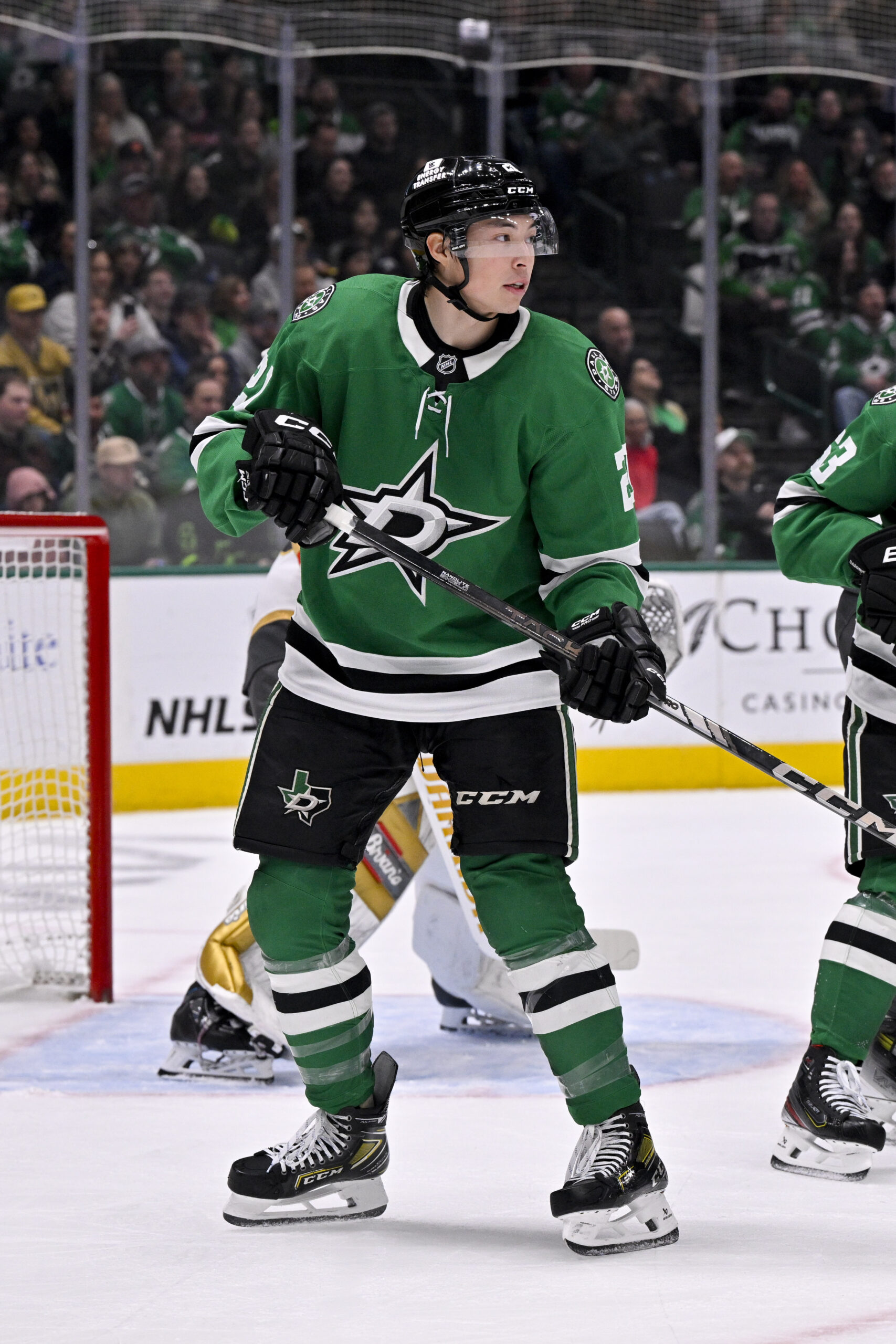 The 26-year-old provided fantastic value on the contract. Robertson hit the 80-point mark in all four seasons with the first and last years being his best. In the former, he finished sixth in NHL scoring with 109 points thanks to 46 goals and 63 assists. Then, after putting up two straight 80-point campaigns, he bounced back offensively this season, tallying 45 goals along with 51 helpers before adding eight points in their opening-round exit to Colorado. Over the last four years, only eight players have recorded more points. Only one of those, Nikita Kucherov, has an AAV below $11MM (and that might change before much longer). With only one RFA year left, this next contract will almost exclusively feature the full-priced UFA-eligible seasons, making an $11MM AAV look like an absolute minimum. AFP Analytics projects he could come close to the $12MM mark on a seven-year pact. As a reminder, they don’t have that much cap space to work with.
There’s also an arbitration risk here. Because he’s only a year away from being eligible to test the open market, he’s only eligible for a one-year award regardless of who files. Accordingly, if contract talks (which are almost certainly ongoing now) don’t go well, Robertson could opt to just go through the hearing, get what he gets, and then have even more leverage a year from now as a high-end pending UFA. That puts a bit of a pressure point on talks now, even though they don’t have enough cap space to re-sign Robertson at this point. But it’s a file they have to close with a long-term agreement, keeping a star winger in the fold for the long haul.
Clear Cap Space
Now that we’ve looked at who needs to be signed, let’s get the obvious out of the way. If Robertson is going to cost more than their current cap room, and Bourque needs to be signed, then something has to give. Someone (or more than just one) will need to move. Arttu Hyry also needs a new deal while it wouldn’t be shocking if they want to bring Jamie Benn back on what would probably have to be another bonus-laden agreement.
The problem is that there aren’t a lot of obvious candidates. Tyler Seguin is entering the final year of his deal at $9.85MM but he’s coming off ACL surgery which doesn’t help his value, nor does his full no-move clause. Even if he was open to being dealt, the list might not be too long, and the fact he hasn’t played since December will make the acquiring team more hesitant. The potential saving grace is that once his $5.75MM signing bonus paid, he’s only owed $1MM in salary. At that point, if the acquiring team is just eating the contract, any lingering concerns about his availability to start the season would go out the window. Dallas would likely have to incentivize a team to take him but if it keeps Robertson and Bourque in the fold (and allow them to re-sign Benn at the same time), they’d probably do it.
The problem is that this might be the end of the list. Their other top-paid players aren’t ones they’d want to move. Matt Duchene has a full no-move clause and probably isn’t going to want to move. Esa Lindell has a full no-trade clause and, frankly, is too valuable on the back end to consider moving. Basically, anyone else making more than $4MM isn’t a viable trade candidate. Considering they need more than that in cap space, that makes things tricky.
Moving Ilya Lyubushkin at $3.25MM for the limited role he fills would save some money although they’d need a replacement body so the net savings might be closer to $2MM. Radek Faksa’s $2MM AAV could be too expensive of a luxury but, again, with a replacement body needed, the actual savings might barely be half of that. Those two moves would help a bit but probably aren’t enough to accomplish everything that they need to.
Nill knows what needs to be done in terms of cutting down their cap charge. Despite few viable options, he needs to find a way to get it done.
Look For A Defensive Upgrade
Considering their financial circumstances, this one probably falls under the wishful thinking category. But defensive improvements have been on the wish list for a while now and while they took a swing at the deadline this past season when they added Tyler Myers from Vancouver, that didn’t quite go as planned. His playing dropped by more than three minutes a night following the swap while he was scratched at one point in the postseason.
A full training camp could help, sure, but if he’s not a fit, his contract is favorable enough to move. With the Canucks paying half of it, his cost to the Stars (or an acquiring team) is only $1.5MM. That’s an affordable price for a lot of teams for a potential upgrade on the third pairing if Nill decides he wants to try a different type of blueliner.
If Seguin ultimately moves to open up cap space, then Lyubushkin could be moved in a player-player swap to change up the defense corps as well.
In an ideal world, they’d find a way to upgrade in their top four but that’s rather unrealistic given the circumstances. But if there’s a way to make an affordable upgrade on the third pairing or shuffle up the personnel to fit Gulutzan’s system better, that would still be a useful approach to take. But until they deal with the two forwards, they won’t be able to do much on this end.
Photo courtesy of Jerome Miron-Imagn Images.
Evening Notes: Cassidy, Dallas, League Expansion
The NHL has publicly backed the Vegas Golden Knights in the Bruce Cassidy situation. Speaking ahead of Game 1 of the Stanley Cup Final in Raleigh, commissioner Gary Bettman and deputy commissioner Bill Daly said Vegas is well within its contractual rights to deny rival teams permission to interview Cassidy, whom the club fired in March but who remains under contract through next season. “Obviously, we don’t find it unreasonable because we’re allowing it to happen,” Daly said.
Bettman framed it as a consequence of the long-term deal Cassidy signed. ESPN’s Greg Wyshynski reported that the league stated, “There are contracts in the league that wouldn’t have allowed this to happen. His was not one of them.” Regarding that contract situation, Cassidy told The Athletic today that just for the chance to interview for the current NHL coaching vacancies, he’d forfeit the reported $5 million the Vegas Golden Knights are on the hook to pay him not to coach next season.
Additional Notes:
- In speaking with the media earlier today, Bettman tempered NHL expansion talks stating, “we’re not ready to expand yet, but we are exploring those expressions of interest”, as reported by Cory Lavalette with NSJNews. Bettman has maintained that an interested group needs to check every box: ownership, market, arena, and arrive with a concrete plan before he’d bring it to the Board. The NHL has sat at 32 teams since Seattle joined for the 2021-22 season.
- The Dallas Stars announced a non-binding letter of intent for a proposed new arena and entertainment district at The Shops at Willow Bend in Plano, roughly 18 miles north of downtown, with the letter of intent heading to the Plano City Council on June 8. The lease at the current American Airlines Center run through 2031, putting any move about five years out, and the news landed a day after the Mavericks announced their own plans to leave downtown.
Free Agent Focus: Dallas Stars
Free agency is just over a month away, and teams are looking ahead to when it opens. Even with the UFA crop being thinned out in recent months, there will be some quality veterans set to hit the open market in July, while many teams also have key restricted free agents to re-sign. We continue our look around the NHL with an overview of the free agent situation for the Stars.
Key Restricted Free Agents
F Jason Robertson – Robertson is the domino that dictates everything else Dallas does this offseason. An elite top-line winger coming off a great year, he posted 45 goals and 96 points in 82 games this past season. Robertson leaned heavily on the power play, where 41 of his points were generated, and logged a career-high in ice time around 20:15 per game. The catch is the price tag. His next deal is projected to land among the league’s top winger comparables, with most reports pointing toward something near $12MM annually. Re-signing him is priority one, but fitting that number under the cap is the entire puzzle.
C Mavrik Bourque – After a quiet rookie year with 25 points (11 goals, 14 assists) in 73 games spent largely getting shuttled around the bottom six, Bourque roughly doubled his output to about 20 goals and 41 points in 82 games, finishing seventh on the team in scoring. The trend line is the selling point. He closed with nine goals and 19 points in 25 games while averaging 19 minutes a night after the Olympic break, the kind of usage-plus-production combination that suggests the role is finally catching up to the pedigree (Bourque was the 2024 AHL MVP and scoring champion). On an expiring $950K deal, he’s drawn mention as a realistic offer-sheet target, but a modest bridge contract is the likely outcome, and a strong value for a cap-strapped team.
Other RFAs: F Arttu Hyry, F Antonio Stranges, F Samu Tuomaala, F Matthew Seminoff, F Kyle McDonald, F Chase Wheatcroft, F Scott Harrison, D Vladislav Kolyachonok, D Jeremie Poirier, D Luke Krys, G Benjamin Kraws
Key Unrestricted Free Agents
F Jamie Benn – The Dallas captain of 13 years is no longer a focal point of the offense, though he remains a leadership presence that the Stars may be reluctant to move on from. The 36-year-old put up 15 goals and 36 points in 60 games, a respectable depth-scoring line for his age but a clear step down in volume, due in part to opening the season on long-term injured reserve with an upper-body injury. He’s been on a string of short, team-friendly deals, and his future remains unresolved; even a discounted contract would cut further into Dallas’s limited cap space. The angle here is sentiment and leadership weighed against a tight budget. AFP Analytics projects a one-year deal in the $1.3MM range, roughly the discount required for a reunion to make sense.
F Michael Bunting – A trade-deadline pickup whose Dallas tenure is a small sample. Acquired from Nashville in early March for a 2026 third-round pick, Bunting had posted 31 points (13 goals, 18 assists) in 61 games with the Predators before the deal, finishing the full season around 14 goals and 33 points in 74 games between the two stops. He’s a complementary middle-sixer who chips in power-play offense, roughly 10 of his points came on the man advantage, and a bit of grit, though his minus-24 rating is an eyesore. At 30, he’s the type of depth piece a cap-conscious team might let walk in favor of a cheaper option, making his return no sure thing. Notably, AFP Analytics is far more bullish, projecting a four-year deal near $5.8MM annually which, if accurate, would almost certainly price Dallas out and reframe him as a cap-casualty departure rather than a re-sign candidate.
F Nathan Bastian – A late-summer depth signing whose first year in Dallas was a quiet one. The 6-foot-4, 205-pound winger was brought in for size and physicality, he’d piled up 138 hits in 59 games with New Jersey the year before, but a limited role, a handful of healthy scratches, and a hand injury down the stretch held him to just three goals and three points in 24 games. His value was never about offense; he’s a heavy, penalty-killing fourth-liner (over 135 hits in four of his five full NHL seasons) who fits the Stars’ stated aim of getting bigger and harder to play against.
F Adam Erne – The feel-good depth case rather than a numbers case. Erne earned his first NHL contract in two years off a professional tryout out of training camp, the third straight year he’d attended a camp on a PTO, and turned it into five goals and six points across 39 games, a season interrupted by a lower-body injury that cost him about a month. He’s a forechecking, physical, bottom-six energy winger whose value is in hits and fourth-line minutes rather than scoring. For a team doing cap triage, he’s easy to bring back on another league-minimum deal or let walk without much consequence.
Other UFAs: D Alexander Petrovic, D Kyle Capobianco, F Kole Lind
Projected Cap Space
Dallas’s cap picture is a tight one. The NHL’s record $104MM ceiling for 2026-27 was expected to create flexibility across the league, but for the Stars the numbers remain cramped. Per PuckPedia, Dallas projects to enter the summer with roughly $10.1MM in functional cap space and 19 players already under contract, with nearly $94MM committed, leaving about $2.5MM per open roster spot. That’s a workable figure for depth pieces, right up until Jason Robertson enters the equation. A Robertson extension in the $12+MM range would swallow most of that room on its own, which is why the Stars spent last offseason shedding salary and why GM Jim Nill faces ugly triage this summer. Outside of re-signing Robertson and possibly squeezing in a discounted Benn return, Dallas is likely limited to league-minimum depth additions, and won’t want to lock itself into much term given the contracts still coming down the pipe.
Contract information courtesy of PuckPedia.
Texas Stars Sign Curtis McKenzie To One-Year Contract
- Despite being the subject of retirement rumors throughout the past season, Texas Stars captain Curtis McKenzie isn’t ready to hang up his skates. According to a team announcement, Texas has signed McKenzie to a one-year extension through the 2026-27 season. McKenzie has been the Stars’ captain since the 2021-22 campaign and has registered 206 goals and 510 points in 725 games throughout his 13-year AHL career.
[SOURCE LINK]
Four-Time Cup Winner Claude Lemieux Passes Away At Age 60
New Jersey Devils cult star and four-time Stanley Cup-winner Claude Lemieux has passed away at the age of 60. Lemieux played through 21 seasons and 1,215 games in the NHL between 1983 and 2009. He was a true pest, filling a unique and impactful lineup role through seven years with the Montreal Canadiens, six with the Devils, five with the Colorado Avalanche, three with the Phoenix Coyotes, and one each with the Dallas Stars and San Jose Sharks.
Lemieux’s hockey career began in the QMJHL. He racked up 66 points and 213 penalty minutes in the 1982-83 QMJHL season, immediately establishing his place as a forward adamant about making the scoresheet in one way or another. Montreal drafted Lemieux in the second-round of the 1983 NHL Draft and returned him to the junior league for the next two seasons. He finished his QMJHL career with a staggering 210 points and 379 PIMs in 103 games before turning pro full-time in 1985.
Lemieux spent his first pro season in the AHL. He finished the year with 53 points and 145 PIMs in 58 games – then stepped up as an X-factor addition to Montreal’s run to the 1986 Stanley Cup. Lemieux recorded three points and 31 PIMs in five games of the 1986 Stanley Cup Finals, helping the Canadiens seal a 4-1 series win over the Calgary Flames. The gritty winger would go on to net 53 points in his NHL rookie season in 1986-87 and would continue to pace for 50-to-60 points on Montreal’s second-line role through the 1989-90 season.
Montreal sought a bit more well-roundedness in the 1990 summer, leading the Canadiens to trading their gritty winger to the Devils in exchange for playmaker Sylvain Turgeon. That move kicked off the heart of Lemieux’s career, as he joined a loaded New Jersey offense already featuring Brendan Shanahan, Peter Stastny, Kirk Muller, and John MacLean. Lemieux scored 47 points in 78 games of his first season in New Jersey.
That dip below 50 points was quickly forgotten when Lemieux led the team in scoring with 68 points of their transformative 1991-92 season. Through major roster turnover, including the emergence of Scott Stevens and Martin Brodeur, it was Lemieux’s all-out energy and work ethic that held the Devils together. He willed the team to the 1992 postseason to extend what was, then, a six-year streak of playoff appearances for the winger. He topped the lineup again with a career-high 81 points in 1992-93, while continuing to pace for 150 PIMs every season.
The 1993-94 season brought some relief to Lemieux’s lineup-leading responsibilities. He scored just 44 points and 84 PIMs in 79 games that season – but seemed to be conserving his energy all year long, and spent that reserve on a tremendous 1994 playoff run. Always a playoff star, Lemieux raced to 18 points and 44 PIMs in 20 games of the ‘94 postseason as New Jersey pushed to the Eastern Conference Finals.
They would lose that series to the New York Rangers – but Lemieux repeated his performance in 1995, with a quiet regular season followed by a loud playoffs. He recorded 13 goals, 16 points, and a tame 20 PIMs in 20 playoff games as New Jersey breezed to the 1995 Stanley Cup. While the lineup was full of superstars – including the legendary defense pairing of Stevens and Scott Niedermayer and starting goaltender Brodeur – it was again Lemieux’s nasty edge that brought the Devils life. His ability to play a chippy, relentless style proved exhausting for opponents and led to multiple goals scored from seemingly inside of the opposing crease. His ability to tie everything together landed Lemieux the 1995 Conn Smythe trophy – the only individual award he would win in his expansive career.
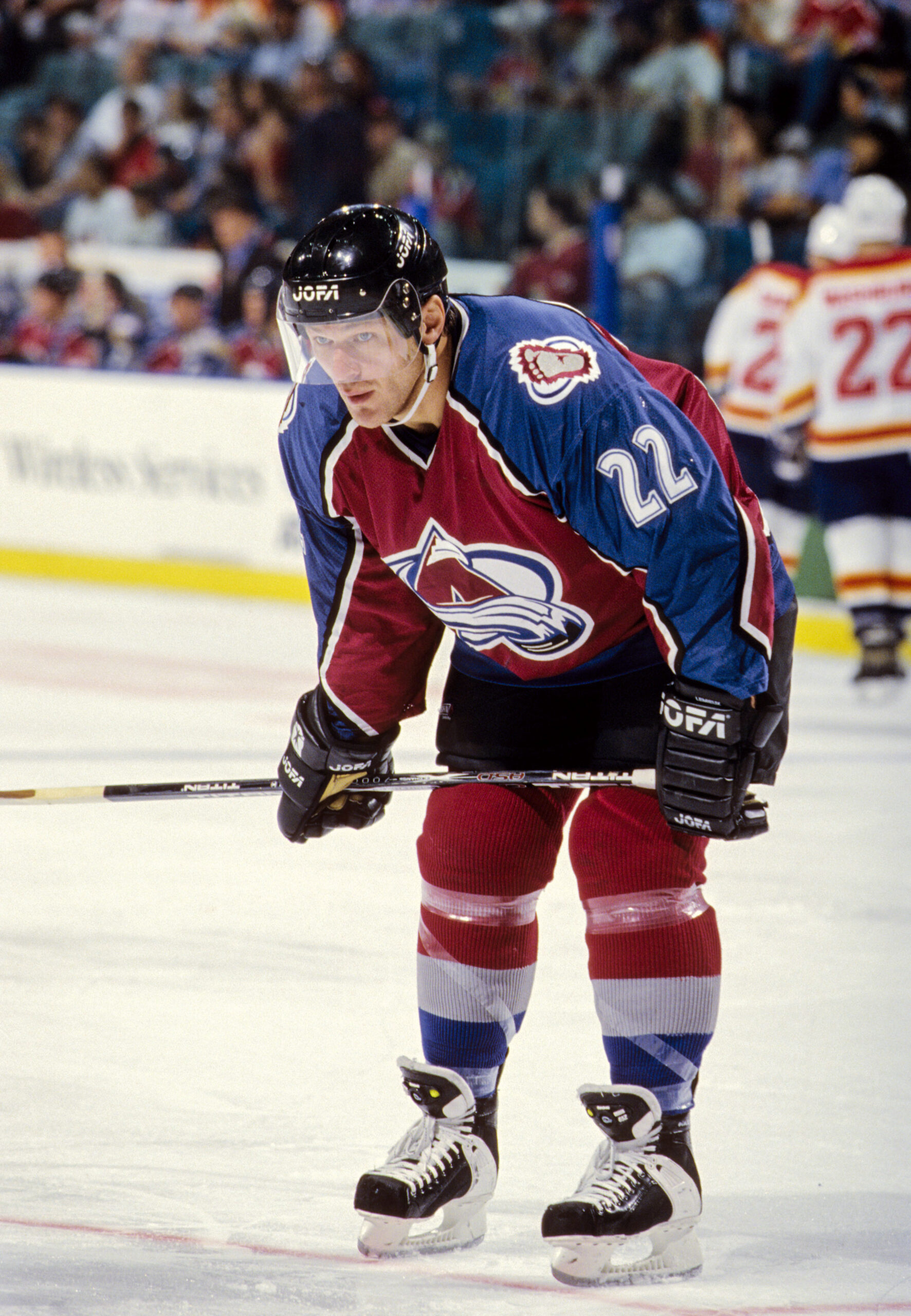 The Devils, surprisingly, traded Lemieux to the Colorado Avalanche ahead of the 1995-96 season. He was again swapped in a one-for-one deal, this time returning Wendel Clark to the Devils. Lemieux was in a familiar situation, joining a strong Avalanche lineup that included Joe Sakic, Peter Forsberg, and Patrick Roy. He was the final addition in Colorado’s top-six and reached a lofty 39 goals and 71 points in 79 games of the regular season. Lemieux kept it rolling with 12 points and 55 PIMs in the 1996 Stanley Cup playoffs, once again proving to be the X-factor behind a loaded offense en route to his third Stanley Cup win and second consecutive win.
It was in the 1996 postseason that Lemieux delivered one of his most notorious hits. He hit Detroit Red Wings star Kris Draper into the boards, resulting in Draper sustaining a concussion, broken jaw, broken nose, and broken cheekbone. The injuries required reconstructive surgery that forced Draper to have his jaw temporarily wired shut. The hit cemented Lemieux’s status as a cheap-shotting grinder and would lead to a prolonged rivalry between the Avalanche and Red Wings.
Lemieux continued to perform at a top level and help ensure runs to the playoffs through Colorado’s next three seasons. He was traded back to the Devils in 2000 in a colossal exchange that sent Brian Rolston back to the Avalanche. Lemieux didn’t miss a beat in one year back in New Jersey, notably notching 10 points and 28 PIMs in 23 games of the 2000 Stanley Cup playoffs as he supported a fourth Stanley Cup win.
Lemieux moved to the Phoenix Coyotes after winning another Cup with the Devils. He was an early great in the Coyotes franchise but the move would bring an end to Lemieux’s 15 consecutive postseason berths in 2001. He willed the Coyotes back to the postseason in 2002, all while notching diminishing offense and penalty totals on a roster still trying to find its core. The Coyotes flipped Lemieux to the Dallas Stars in January 2003. After another down year, he opted to step away from the NHL for the 2003-04 season, moving to Switzerland’s National League for one season before announcing his retirement in 2004.
Retirement did not keep Lemieux out of the spotlight. He assumed the president role for the ECHL’s Phoenix RoadRunners from 2005 to 2007 and was frequently featured in TV and media. After stepping down from his front office role in the ECHL, Lemieux built up towards a return in the 2008-09 season. At the age of 43, Lemieux began the year with the China Sharks of the Asia League, then signed a contract with the AHL’s Worcester Sharks in November. That led to a two-way contract with San Jose in December and a call-up to the NHL in January. Lemieux would score one point in 18 games with San Jose as the Sharks chased the President’s Trophy as the league’s top team.
Lemieux stayed a prominent hockey figure well after his second retirement in 2009. He was most recently a torch-bearer in one of Montreal’s pre-game ceremonies during the 2026 Eastern Conference Final. It was his final public appearance. Lemieux will be remembered as one of the greatest NHL players to hate among many fans. He was a tenacious, relentless, and aggressive winger who seemed to constantly deliver devastating blows – whether it was timely goals or injury-inducing hits. Pro Hockey Rumors sends our condolences to Lemieux’s family, friends, and countless fans.
Photo courtesy of RVR Photos-Imagn Images.
Stars Invite Justin Larose To Development Camp
- The Stars have invited undrafted forward Justin Larose to their upcoming development camp, notes Mark Divver of the New England Hockey Journal (Twitter link). The 21-year-old wrapped up his junior career with QMJHL Newfoundland this season, potting 32 goals and 56 assists in 64 games while adding nine more in 12 playoff contests. He has already committed to play for the University of Michigan next season although a strong showing in camp could plausibly earn Larose an entry-level deal to change his plans.
These Mid-Season Contract Extensions Have Not Aged Well
This year has been unique for in-season contract extensions, as a rising salary cap put pressure on teams to lock up their pending free agents before they could even sniff the open market. What once looked like a promising free-agent class in the summer of 2026 quickly turned into a very thin market void of big names and impact players. Some of those extensions were signed with players who had thrived in previous years and/or started the season well, but faltered after signing their big new contract, leaving teams in a tough spot heading into the summer. Here are five contracts that the signing teams would presumably like to have back.
The first player on our list could very well turn things around next season, and that is Dallas Stars defenseman Thomas Harley. The 24-year-old inked an eight-year, $84.7MM contract extension at the end of October ($10.587MM AAV), and it made perfect sense at the time, as Harley was the 15th-highest-scoring defenseman in the NHL over the previous three seasons, with 105 points in 166 games, and played a solid defensive game as well. However, he struggled this past season, posting his lowest offensive numbers in three years and struggling to drive play. Harley lacked a solid partner for much of the year, but given his new salary cap hit, the hope would be that he could overcome that obstacle, especially considering Dallas doesn’t have the cap space to really look at upgrades on their back end. Harley has plenty of time to turn things around, and he likely will, but Stars management has to be a little nervous about the deal they inked and the long-term ramifications if Harley can’t get his game back next season.
Sticking with Western Conference defensemen, Jake Walman of the Edmonton Oilers was a colossal disaster after signing his seven-year, $49MM extension with the team. The 30-year-old had been terrific after a trade from the San Jose Sharks, but after signing his extension in October, Walman began to struggle and never returned to his form for most of the season. Walman’s signing was made because Oilers management believed he was a good fit for the team’s style, with his solid first pass and heavy shot. But many of the warts in Walman’s game became evident as the season went on. He isn’t physical, he turns the puck over too much, and he doesn’t play a full season. These issues aren’t exactly unique, but for a player being signed to a $7MM AAV, you’d hope he would give you more than 21 points a season, something Walman has done just once in his NHL career. A big issue for the Oilers and Walman is that his contract will take him from his age 30-37 seasons, and at this point he is a finished product. It’s clear Edmonton overpaid to retain his services.
Moving up front, the Winnipeg Jets were quick to re-sign their captain Adam Lowry to a five-year, $25MM contract extension in late November. The deal looked fine at the time, though there were concerns about his age, as he was 32 at the time of signing, and five years is a long time for a player who plays the way he does. Lowry remains a solid shutdown center who can skate, outwork his opponents, and tilt the ice in the Jets’ favor. But given his age and style of play, it’s fair to wonder how much longer he can serve as a Jets top-nine center before his body breaks down and he is relegated to fourth-line duties. It’s a tough spot for Winnipeg because Lowry is a heart-and-soul player, but five years for him is a long time, and it’s a contract the Jets would probably like to renegotiate. Given the history with Lowry, the Jets would no doubt love to keep him in the fold, but at a lower cap rate.
Another late-October extension (two years, $12MM) was New Jersey Devils goaltender Jacob Markstrom, who had a decent first season with the Devils but was awful in his second year. The timing of this one was particularly peculiar, as Markstrom was off to a very slow start in October 2025, posting a 5.13 GAA and a .830 SV% in just four appearances. He was also coming off a lower-body injury and was 35 years old at the time, making the timing of the signing even stranger. Obviously, the Devils were concerned he might go on a heater and raise the price tag, but that never happened as Markstrom struggled through much of the year, finishing with a 3.07 GAA and a .883 SV%. Those numbers are clearly concerning, but the silver lining is that Markstrom has a history of struggling through a season and bouncing back the following year to get into Vezina Trophy contention, so a bounce-back season in 2026-27 can’t be discounted. However, for now the Devils must be looking at Markstrom’s $6MM AAV and wondering how much lower the number could have been or whether they should have gone in a different direction.
Finally, we have Detroit Red Wings defenseman Ben Chiarot, who inked a three-year extension this past January worth $3.85MM per season. The 35-year-old has his strengths, as he is reasonably good at skating and can move the puck. He’s also incredibly physical, playing on the edge much of the time and displaying a high level of orneriness in the defensive zone. But that is where his strengths wear off, and his weaknesses are becoming more glaring as he ages. Chiarot has been a drain on whoever he is paired with, particularly on the possession front, and he has posted the worst Wins Above Replacement score for two consecutive regular seasons (as per hockeystats.com). Chiarot can still be an effective defenseman in the NHL, but not in the top four, and that’s where Detroit may need to deploy him once again next season.
None of these contracts are going to be especially crippling to a team, but they do show how quickly the shine can wear off a high-priced extension and how much pressure teams are under to extend their players, thanks to a rising salary cap and many teams’ possession of additional cap space, chasing a few available players.