
Early Expansion Protection News: Capitals, Kings, Flames, Predators, And More
The 2017 NHL Expansion Draft is an exciting process. If you’re too riled up to wait until the lists are officially submitted in the morning, you’re in luck. As could be expected, information leaks are flooding in on who was and wasn’t protected by their teams ahead of the deadline this afternoon. This list will be updated all night long as more news comes in:
- Isabelle Khurshudyan of the Washington Post was the first reputable source to release her team’s protection list, as she confirmed the Washington Capitals’ names not long after the 5:00 PM ET deadline. The lists includes the expected names: Alex Ovechkin, Nicklas Backstrom, Evgeny Kuznetsov, Andre Burakovsky, Marcus Johansson, Lars Eller, Tom Wilson, Matt Niskanen, John Carlson, Dmitry Orlov, and Braden Holtby. While not surprising, the list does not include long-time Jay Beagle, promising young players Nate Schmidt and Brett Connolly, and a oft-rumored target of the Golden Knights, backup goaltender Philipp Grubauer.
- L.A.-based hockey writer John Hoven got the list of protected players for the Los Angeles Kings, which confirms that they will indeed protect eight-skaters, including four defenseman, rather than the 7/3 protection scheme. Among the safe are Anze Kopitar, Jeff Carter, Tyler Toffoli, Tanner Pearson, Drew Doughty, Jake Muzzin, Alec Martinez, and the key decision, Derek Forbort. Star goalie Jonathan Quick was also obviously protected. While the Kings succeeded in protecting the most valuable players on the roster, they still have left defenseman Brayden McNabb and a large assortment of forwards including Trevor Lewis, Nic Dowd, and Nick Shore open to selection.
- Sportsnet’s Eric Francis, who covers the Calgary Flames, has some key names for his team as well. Francis confirmed that the Flames did not protect 2016 free agent acquisition Troy Brouwer, but did opt to save younger assets like Sam Bennett, Micheal Ferland, and Curtis Lazar. Although Francis stops there, the rest of Calgary’s list is somewhat self explanatory with newly-acquired goalie Mike Smith, defensive core of Mark Giordano, T.J. Brodie, and Dougie Hamilton, and cornerstone forwards Johnny Gaudreau, Sean Monahan, Michael Frolik, and Mikael Backlund as obvious choices.
- One not so obvious choice has been made in Nashville. Adam Vingan of The Tennessean answered a question on the minds of many, reporting that the Predators did in fact protect forward Calle Jarnkrok. With the rest of the eight-skater list all but set in stone with goalie Pekka Rinne, defensemen Roman Josi, P.K. Subban, Ryan Ellis, and Mattias Ekholm, and star forwards Filip Forsberg, Ryan Johansen, and Viktor Arvidsson, the final forward spot came down to Jarnkrok, signed long-term, or James Neal, an elite scorer with just one year remaining on his contract. It seems that Neal will be open for selection, alongside names like Colton Sissons, Colin Wilson, and Craig Smith. Vignan adds that no deal has been struck between Vegas and the Predators to protect any of those players, with Nashville especially liking to retain Neal and Sissons.
- Sportsnet’s Elliotte Friedman reported that, interestingly enough, young Detroit Red Wings defenseman Xavier Ouellet was not protected by his team. This is the first real surprise of the expansion process and the first protection news that doesn’t match up with PHR’s Expansion Primer projections. The 23-year-old skated in 66 games this season for Detroit, third most among defenseman, and his 12 points tied that of top-pair man Danny DeKeyser. Yet, Ouellett will not join DeKeyser and Mike Green in protection, instead beaten out by another teammate. GM Ken Holland, who has gotten the reputation of perhaps being too loyal, possibly chose aging veteran Niklas Kronwall over Ouellet. Hopefully that doesn’t come back to bite the rebuilding Red Wings.
- Another name confirmed to be unprotected is young Vancouver Canucks center Brendan Gaunce. Vancouver sports anchor Rick Dhaliwal was told that that Gaunce, a 2012 first-round pick, did not make the protection list for the Canucks, expected to be a 7/3 format, meaning that the team saw him as outside the top seven forwards on the team. The 23-year-old two-way specialist has upside, but after registering just five points in 57 games last season, no one will blame Vancouver for that choice.
Expansion Primer: Tampa Bay Lightning
We’re continuing to break down each team’s situation as it pertains to the 2017 NHL Expansion Draft, coming up next week: which players are eligible, and which will likely warrant protection or may be on the block. Each team is required to submit their protection lists by 4pm CDT on June 17th. The full rules on eligibility can be found here, and CapFriendly has provided a handy expansion tool to make your own lists.
Steve Yzerman fired the first shot in the pre-expansion draft trade market by acquiring Mikhail Sergachev from Montreal for Jonathan Drouin, a move that gave the Lightning flexibility both with the cap and their expansion protection list. It also filled a need with the Bolts on defense. With that in mind, it makes Yzerman and the Lightning’s decisions slightly easier as to who to protect and who to expose. But there are still some tough choices to make.
Eligible Players (Non-UFA)
Forwards: Steven Stamkos (NMC), Ryan Callahan (NMC), Nikita Kucherov, Alex Killorn, Vladislav Namestnikov, J.T. Brown, Erik Condra, Cedric Paquette, Ondrej Palat (RFA), Tyler Johnson
Defensemen: Victor Hedman (NMC), Jason Garrison, Anton Stralman, Braydon Coburn, Andrej Sustr (RFA), Slater Koekkoek, Jake Dotchin
Goaltender: Andrei Vasilevskiy, Kristers Gudlevskis (RFA)
Notable Exemptions
Mikhail Sergachev, Brett Howden
Key Decisions
Unloading Drouin certainly helped from a financial and expansion list aspect. This makes it somewhat easier for forwards to put on the protected list.
Ondrej Palat and Alex Killorn are both choices that benefitted from Drouin being moved. Killorn netted 19 goals while Palat will continue to get better. Stamkos and Callahan both have NMCs. Despite fighting injury and not matching his production from 2014-15, Johnson is too good of a talent to leave exposed.
It’s on defense where tougher decisions need to be made, and it will come down to three players. Hedman and Stralman will both be protected, Hedman because he has a no-movement clause and Stralman is key to the Lightning blueline. Jason Garrison and Braydon Coburn are both carrying heavier hits for the cap and will most likely be left alone when they’re exposed. Garrison could hypothetically be taken with his deal ending at the conclusion of the 2017-18 season, but the $4.6MM hit would probably scare Vegas away.
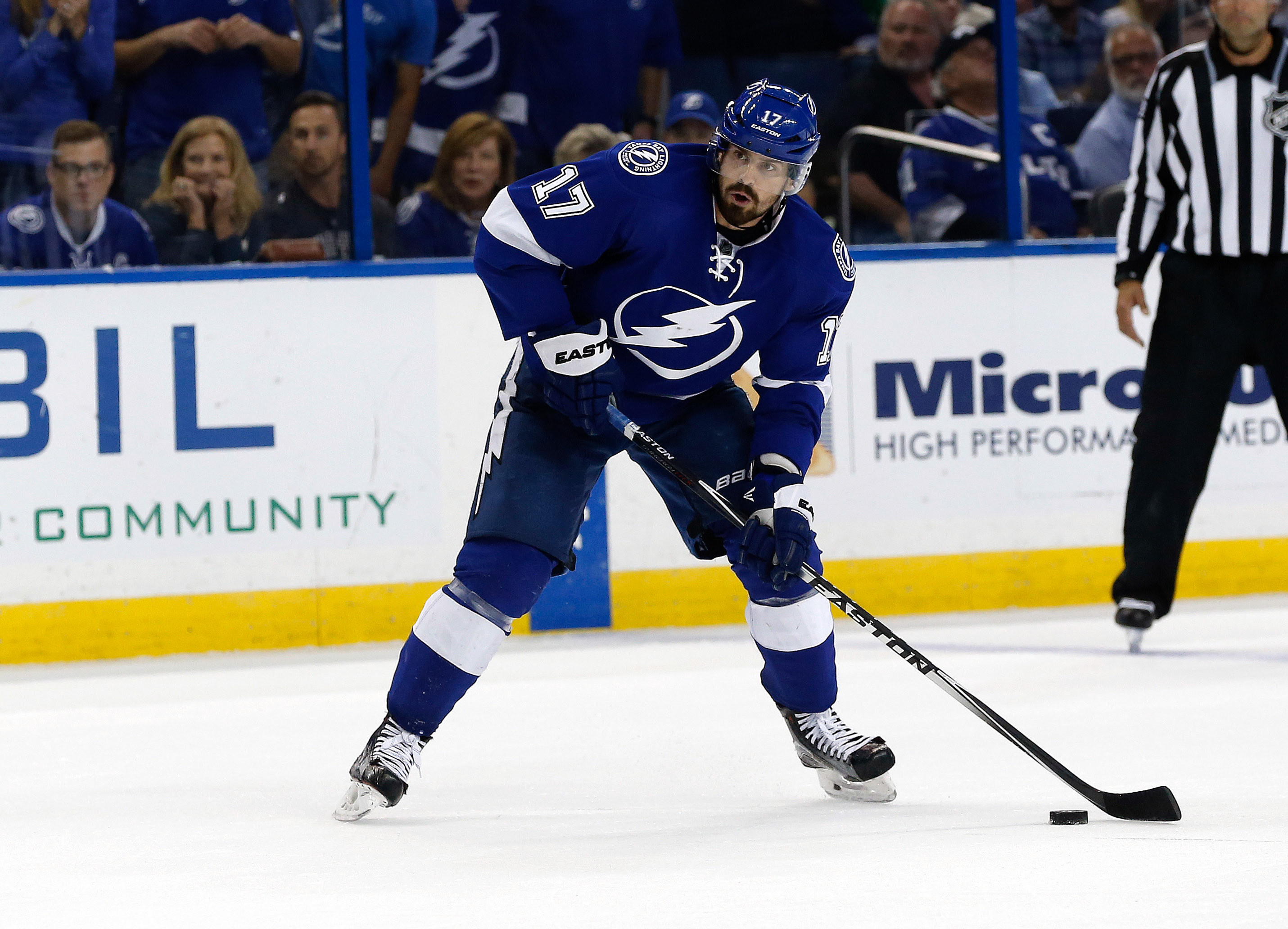 That leaves three choices to protect: Andrej Sustr, Jake Dotchin, and Slater Koekkoek. Sustr is a restricted free agent and won’t be able to command much in the way of money after having a down year. That doesn’t make him exempt from being exposed. If anything, seeing his numbers drop with a number of other options pounding on the door for the big club could make him the odd man out. However, he’s still an economical option and any leverage he had took a hit with the acquisition of Sergachev, who if scouting is correct, should find time on the Tampa blueline next season. But the problem with protecting Sustr is that Tampa would risk losing two young, and talented defensemen for nothing. In the same breath, would the Bolts want to possibly lose a steady defenseman who is only 26?
That leads to Dotchin and Koekkoek. Dotchin just turned 23, and registered 11 points in 35 games this season. The problem is, as Lightning blog Raw Charge pointed out, his sample size was limited compared to Koekkoek while being paired with Hedman. The 23-year-old Koekkoek logged 41 games over the past two seasons, but played strong for AHL affiliate Syracuse during the Calder Cup playoffs. Picking between them is essentially splitting hairs. Koekkoek appears to have the higher ceiling, and plays a cleaner game than Dotchin. Though they play different games, Yzerman might prefer a more disciplined, puck moving defenseman when choosing who to protect. At the same time, Dotchin plays a physical game, and can move the puck as well. He’s not afraid to muck it up, and provides a presence that protects his teammates on the ice–while still contributing on the score sheet. As Tampa Bay Times beat writer Joe Smith wrote, Dotchin has stood out to management, especially in the NHL and AHL during Syracuse’s Calder Cup Final run.
With two younger defensive prospects and after having a less than stellar season, predict Sustr to be exposed and Koekkoek protected. Don’t be surprised, as many others have written, if Yzerman pulls something off to keep all of his young defensemen so Dotchin remains in the fold.
Projected Protection List
F – Steven Stamkos (NMC)
F – Ryan Callahan (NMC)
F – Tyler Johnson (RFA)
F – Nikita Kucherov
F – Vladislav Namestnikov
F – Alex Killorn
F – Ondrej Palat (RFA)
D – Victor Hedman (NMC)
D – Anton Stralman
D –Slater Koekkoek (RFA)
Vasilevskiy is truly the only option to protect as 24-year-old netminder Kristers Gudlevskis is unlikely to be taken with other options presumably available from other teams. Of the decisions, it seems to be the least of Tampa’s worries.
The Lightning, despite missing the playoffs and sustaining injuries to one key player after another, still have a strong lineup that will absolutely compete next season. Peddling Drouin off certainly helped matters, but the third player to protect defensively is a tough decision to make. At the end of the day, though, Yzerman has shown skills deft enough to take a challenging situation and somehow make it work out. Don’t be surprised if he finds a way to do it again.
Photos courtesy of USA Today Sports Images
Snapshots: Despres, Shero, Hextall, Flames
Anaheim general manager Bob Murray released a statement regarding the buyout of defenseman Simon Despres. The 25-year-old was placed on waivers earlier in the day with the intention of being bought out. Murray said the following from Anaheim’s twitter account:
“Simon Despres is a good hockey player and a good person. But, at this point, we feel it is the best interests of both Simon and the organization to part ways. We wish him the very best in the future.”
Despres responded as well on Twitter, writing:
“I’d like to thank the
@AnaheimDucks for a wonderful 2 and a half years. I wish my teammates all the best moving forward.”
- Ray Shero still has the #1 pick with a week to go before the draft writes the AP’s Tom Canavan. Shero isn’t denying that he could still trade the pick away, but for all intents and purposes, he told his staff to prepare for taking someone with the first overall choice. The next question: who would they take? Shero told Canavan that the draft reminds him of 2013, where there were four very good players in Nathan MacKinnon, Aleksander Barkov, Jonathan Drouin, and Seth Jones. Canavan writes that the Devils need a goal scorer, which would definitely be found in either Nolan Patrick or Nico Hischier, both believed to be the top two prospects in the draft.
- Flyers general manager Ron Hextall might still make a move writes Philadelphia Inquirer’s Sam Carchidi. Saying there was a 25-75% chance he makes a move, Hextall is going with the 7-3-1 format and has to decide between Michal Neuvirth and Anthony Stolarz when choosing the one goaltender to protect. Hextall calls it a more “philosophical” decision than a “difficult” one since it essentially comes down to picking a veteran or a rookie. Carchidi also writes that Hextall may still re-sign Steve Mason while saying that he will not be buying out any contracts. Sitting behind New Jersey with the second pick, Hextall also professes to having “no idea” what the Devils will do with the first overall pick.
- Postmedia’s Kristen Odland reports that the process of an expansion draft is especially taxing to players who have no idea what to expect. She quotes assistant general manager Craig Conroy, who survived an expansion draft with the St.Louis Blues in both 1998 and 2000. Conroy likened it to the trade deadline, saying there’s nothing players can do about it and that they “signed up for this.” Odland lists netminder Brian Elliott as a question mark, wondering if he’ll be protected as free agency looms. With a goalie market that isn’t exactly full of options, she believes that he could be protected, but his struggles during the playoffs may be a reason he’s left off the list.
Expansion Notes: Phaneuf, McPhee, Final Decisions
TSN’s Pierre LeBrun tweets that nothing changed on Ottawa defenseman Dion Phaneuf‘s decision to waive his no-movement clause prior to the 5pm deadline today. This doesn’t mean, however, that he won’t be traded. Phaneuf is definitely in the mix to be dealt as Ottawa agonizes over who to protect and who to leave exposed as lists are due tomorrow at 5pm. Phaneuf has been the subject of trade rumors, and it was confirmed by general manager Pierre Dorion that he’s received calls about the 32-year-old defenseman. Some pundits thought Phaneuf might waive his NMC before the 5pm deadline, but with that now passed, it will be interesting to see if he’s one of many players shuttled to another team to ease the restrictions on the list.
- The USA Today’s Kevin Allen writes that Vegas general manager George McPhee has encouraged his staff to catch up on their sleep prior to the weekend as all NHL teams will have their protected lists submitted tomorrow. Noting that he only has 72 hours to put a team together, McPhee told Allen that teams have been straightforward with McPhee as to what they’re thinking and that it’s been in line with what McPhee and his staff expected. Allen reports that McPhee plans on informing each team who they plan on taking, so they can circle back to see if another deal can be worked out. Further, McPhee indicates that they are trying to build a balanced squad that can compete right away. He adds that they also want to acquire as many draft picks as possible to “expedite their building process.” McPhee also told Allen that even though he’s in his office at 6am Vegas time, his phone has been ringing non-stop with colleagues looking to make deals.
- On the other side of McPhee’s phone line are 30 general managers wrangling with what they’re going to do in anticipation of the draft. The AP’s Stephen Whyno spoke with general managers who are also losing sleep over the draft, albeit for different reasons. Minnesota’s Chuck Fletcher told Whyno that he often reminds himself at 3am that he can “only lose one player–go back to sleep.” Florida’s Dale Tallon remarked that “everyone’s a little nervous, a little reluctant” in anticipation of what will happen. Tampa general manager Steve Yzerman already responded by trading Jonathan Drouin to Montreal while New York and Colorado bought out the contracts of Dan Girardi and Francois Beauchemin respectively. Meanwhile, LeBrun tweets that deals could go down to the wire after speaking with Fletcher while Tampa Bay Times beat writer Joe Smith tweets that he sees Tampa Bay in potential talks with Fletcher since the Wild have a logjam at defense.
Expansion Primer: Detroit Red Wings
We’re continuing to break down each team’s situation as it pertains to the 2017 NHL Expansion Draft, coming up next week: which players are eligible, and which will likely warrant protection or may be on the block. Each team is required to submit their protection lists by 4pm CDT on June 17th. The full rules on eligibility can be found here, and CapFriendly has provided a handy expansion tool to make your own lists.
Missing the playoffs for only the first time in 25 years, the Detroit Red Wings plan on rebuilding but still keeping the playoffs in their sights. Detroit is in an interesting situation as they hold a slew of draft picks, and a number of contracts they could expose, giving some relief if one is taken.
Eligible Players (Non-UFA)
Forwards:
Henrik Zetterberg, Gustav Nyquist, Tomas Tatar (RFA), Justin Abdelkader, Darren Helm, Riley Sheahan, Luke Glendening, Anthony Mantha, Andreas Athanasiou (RFA), Frans Nielsen (NMC),
Defensemen:
Mike Green, Jonathan Ericsson, Danny DeKeyser, Niklas Kronwall, Nick Jensen, Xavier Ouellet (RFA).
Goaltender:
Jimmy Howard, Petr Mrazek, Jared Coreau
Notable Exemptions
Key Decisions
One of the chief reasons the Red Wings have lost their footing as a contender is not only a lack of high draft picks, but some disastrous decisions when it came to handing out contracts. Though I have written about this before, it bears repeating that under general manager Ken Holland, the Red Wings will always be loyal and choose to, as Holland always says, “draft and develop” before looking elsewhere for help. This is a key point to keep in mind as decisions are to be made. One of the biggest knocks on Holland is that he falls in love with his players–especially those he drafted.
One of the simplest ways Detroit could get salary cap room would be by protecting those who are absolutely necessary and allowing several high priced players to be exposed. Holland stipulated that he will be going with the 7-3-1 format when it comes to keeping players, and that will allow for some higher priced players to be exposed. Additionally, Holland has made it clear he will not part with draft picks in order to move contracts. Options, then, are aplenty.
Henrik Zetterberg will be protected because of his role as captain, and the all but guaranteed moment of his number hanging from the rafters. Barring some sort of crazy change, Zetterberg will be protected.
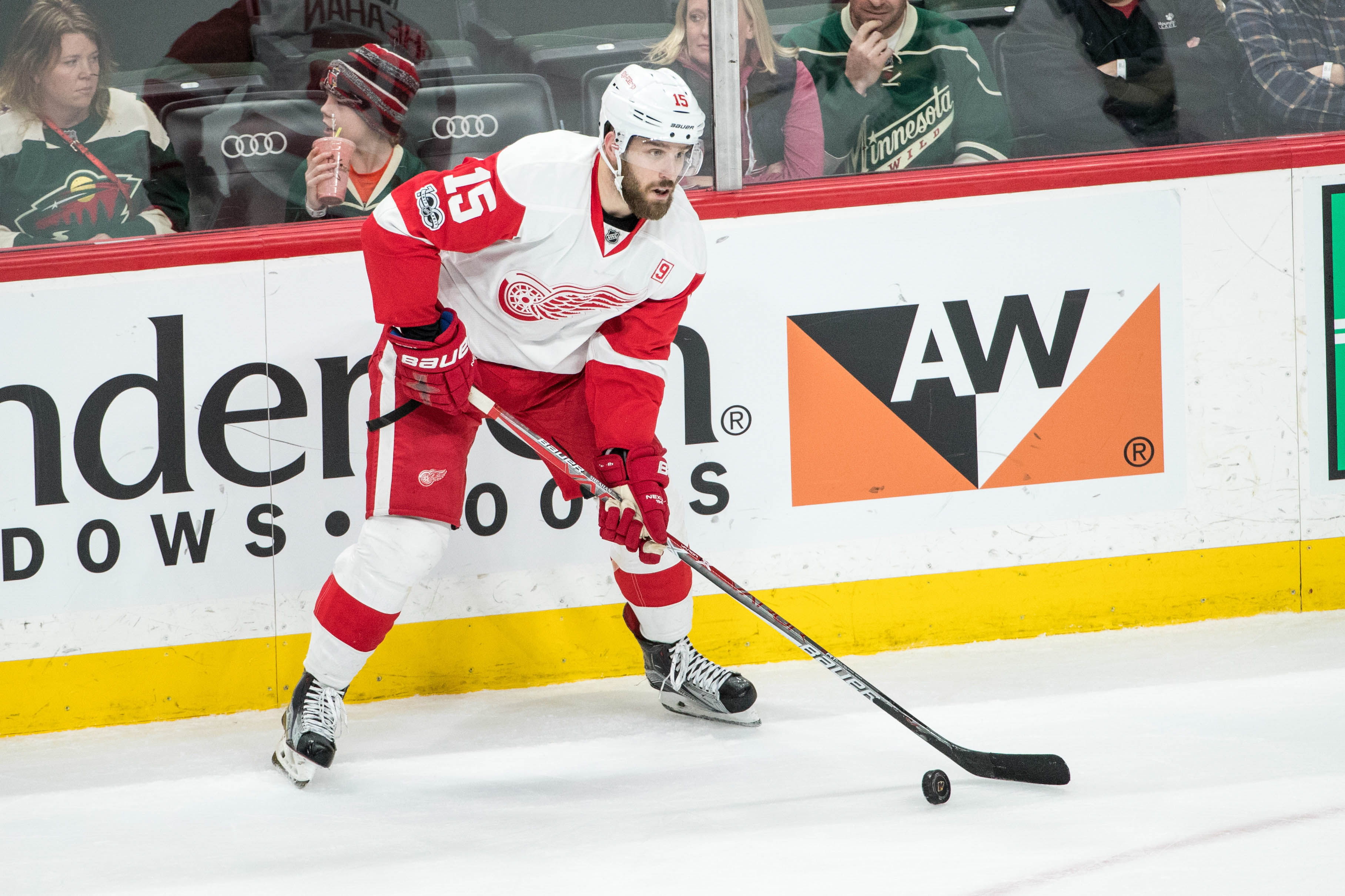
Riley Sheahan is a curious case. Sheahan struggled mightily, scoring two goals all season, both coming in the final game of the year. Still young and only a $2M cap hit, he could be snapped up. Sheahan has to be due for a bounce back, and with a hodgepodge of new talent and a fresh start in Vegas, it could be a boon for him professionally. It’s a risk the Wings have to look at, being that the bounce back could also occur in Hockeytown.
Abdelkader is also an interesting case. He is owed a lot of money ($4.25MM AAV) through 2023, and hasn’t produced to justify the expense. But this is where Holland’s loyalty comes in. It’s highly unlikely Vegas would take him at that hit for the next six years while the Red Wings are believed to be grooming Abdelkader as the next captain of the team. Expect Abdelkader to be on the protected list. But rolling the dice and putting Abdelkader out there would not only allow them to hold onto a cheaper player who seems prone for a bounce back, but also provides the chance of getting significant cap relief should Abdelkader be selected.
Darren Helm and Luke Glendening at this point are role players who both hold higher cap hits ($3.85MM and $1.8MM respectively). Helm has traditionally been a third line center while Glendening spends the majority of his time on the fourth. They should both be exposed.
Finally, a quirk in CBA wording made Anthony Mantha eligible for the expansion draft. Holland will have no choice but to include him on the list. Detroit blog Winging It In Motown did a great job of breaking down the verbiage in the CBA that makes Mantha eligible.
Projected Protection List
F – Henrik Zetterberg
F – Anthony Mantha
F – Andreas Athanasiou
F – Frans Nielsen (NMC)
F – Justin Abdelkader
F – Tomas Tatar
F – Gustav Nyquist
D – Mike Green
D – Xavier Ouellet
D – Danny DeKeyser
G – Petr Mrazek
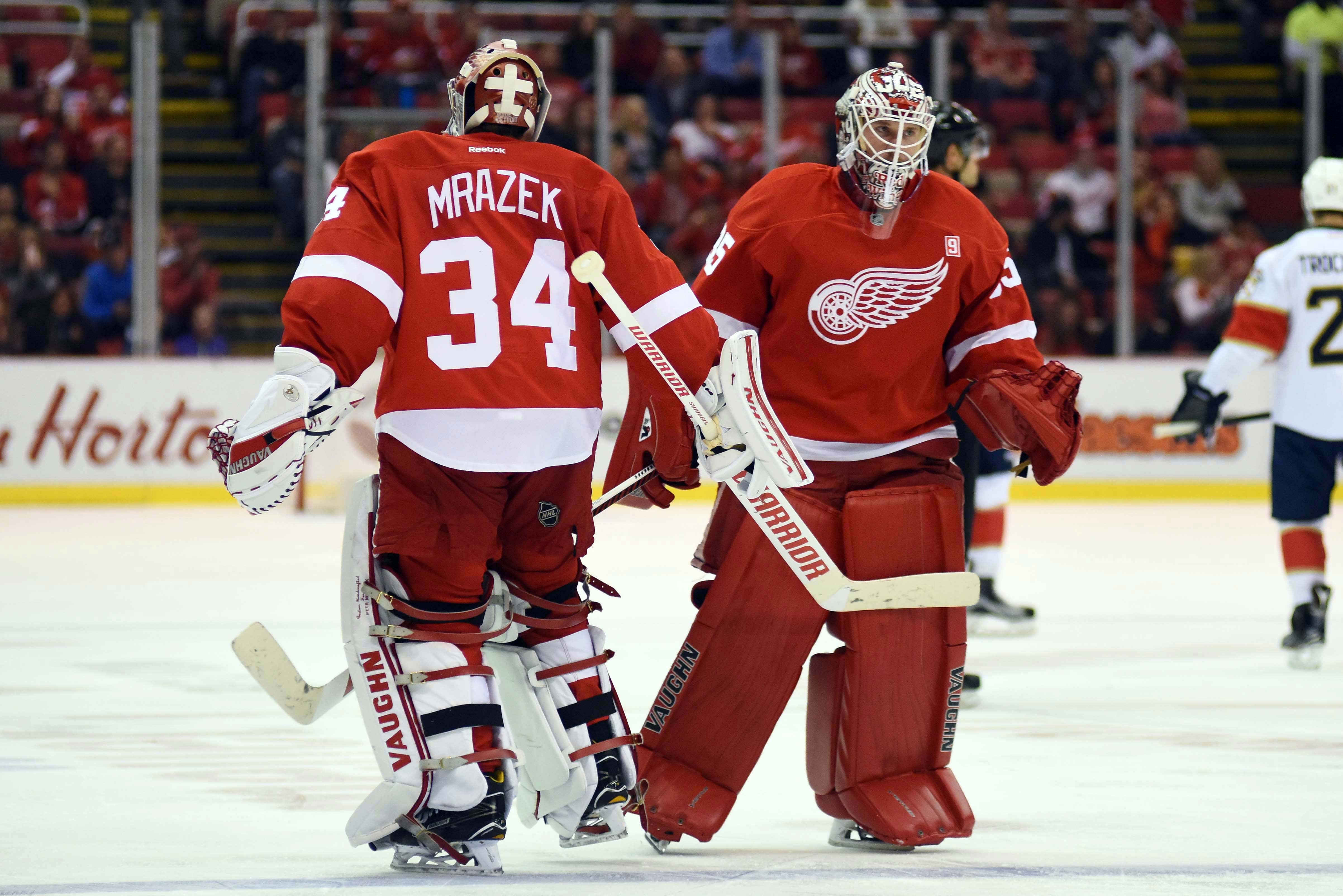
The goalie situation is another precarious case for the Wings, as Mrazek, who was anointed the starter last year, struggled to gain form and saw Howard take over the top spot until injury caught up with him. Coreau just backstopped the Grand Rapids Griffins to a Calder Cup trophy and comes very cheap as an NHL backup, especially with little NHL experience to his name. The choice here would have to be Mrazek, as Howard has only a couple years left and can rarely stay healthy enough to maintain a #1 job. Youth and Mrazek’s potential are reasons to protect him. The Czech netminder has flashes of brilliance and should Detroit restock with a stalwart defense and supportive scoring, it’s not out of the question that Mrazek could be one of the best in the league.
On defense, the Wings will protect both Green and DeKeyser, the latter who they re-signed to a large deal that was panned by many, especially after DeKeyser sputtered last season. Still relatively young at 27, the Wings are trying to find a #1 or 2 defenseman that would ease the pressure on DeKeyser. The real question comes in at who to protect after that. The loyalty piece of Holland could put Kronwall on the list of protected because of his time in Detroit. The 36-year-old defenseman has been lauded for his leadership abilities as well. But that leaves a number of young talent exposed, namely Ouellet, and Jensen. The better bet is that Kronwall will be exposed, and the Wings will protect Ouellet over Jensen. Their numbers were similar this season, but Ouellet, just about three years younger than Jensen, seems the smarter choice to place on the protected list. It is highly unlikely that Kronwall will be taken, being that he experienced a major dip in play last season due to a nagging knee injury. His mobility and skating ability isn’t close to what it once was.
The takeaway with the Red Wings is that they are truly a team in transition. Their building blocks for nearly a decade are aging, they have question marks in net, and defensively, there is no clear cut number one or number two defensemen. While they don’t have a lot to lose in terms of talent, Holland will most likely defer to youth rather than loyalty when making his final choices.
Photos courtesy of USA Today Sports Images
Thursday Trade Talk: Dumba, Brodin, Galchenyuk, Hjalmarsson
The Minnesota Wild find themselves the center of trade speculation, with Matt Dumba and Jonas Brodin headlining the rumors according to the Star Tribune’s Michael Russo. Wild general manager Chuck Fletcher has received “quality trade offers” revolving around Dumba and Brodin. It’s no secret that the Wild have difficult decisions to make before they make their final choices for the expansion list. According to Russo, it’s prudent to deal either Dumba or Brodin since Jared Spurgeon and Ryan Suter will take up two of the three slots for protected defenseman. Instead of losing one for nothing, Fletcher is listening in on trade offers, and one such team Russo sees as being targeted is Montreal. The player they’re most likely targeting? Alex Galchenyuk.
- TSN’s Ken Campbell writes that with the Canadiens acquiring Jonathan Drouin today, it likely means that Galchenyuk “won’t be back” in Montreal next season. Campbell adds that Galchenyuk is actively being shopped and Campbell figures that the target will be a young defenseman. With Carey Price in need of an extension, and the Montreal brass wanting to avoid “drama” in getting that extension, Galchenyuk would fetch the young d-man that would entice Price to stay and also fill a need for the Canadiens.
- The Chicago Tribune’s Chris Hine goes through a number of players who have been the subject of trade rumors. On the issue of Marcus Kruger, Hine writes that the veteran center is “all but gone” and that defenseman Trevor van Riemsdyk is all but certain to join him with Vegas being the likely destination. Kruger would be dealt while van Riemsdyk would be selected in the draft. Regarding a core player who could be traded, Hine opines that Niklas Hjalmarsson could be the choice to move. However, Hine points out that Hjalmarsson has a partial no-trade clause and would only accept a trade to 10 teams. Hine writes that a source within the organization indicated that the Hawks have not asked Hjalmarsson to do this.
Kevin Klein Nearing Retirement?
Per Larry Brooks of the New York Post, it seems possible that New York Ranger defenseman Kevin Klein will retire at the relatively young age of 32. Klein has suffered from a serious back injury issue which helped keep him sidelined for all but one playoff game. This news is a surprising turn of events, considering that he did partake in 60 regular season games. Apparently Klein is still considering playing elsewhere, perhaps Europe. Brooks cites inside sources to come to this conclusion, and it’s uncertain how close or far Klein might be from this decision.
If true, this potentiality might add sense to the decision to not ask Marc Staal or Dan Girardi to waive their no-movement clauses for the purpose of the expansion draft. The team may already be losing UFA Brendan Smith so losing Klein also could (temporarily) solidify those players’ positions in the top-4. Staal and Girardi are still candidates for buyouts, but this decision would further necessitate that the Rangers seek a defenseman this off-season.
Klein has played in 627 NHL games as of 2017, posting 38 goals and 116 assists. Klein was drafted in the second round of the notably deep 2003 draft and played parts of 9 seasons in Nashville before moving on to New York. He’s gotten Lady Byng votes in four separate seasons, which is awarded for sportsmanship. His game has slowed down, but he was still a near-neutral possession impact, logging over 17 minutes a night. If he were to retire, he would free up $2.9 MM in cap space for GM Jeff Gorton.
Evening Notes: Flames, Sound Tigers, Rinaldo
The Calgary Flames have opted to go with the 7 F/ 3 D / 1 G protection scheme, per Kristen Odland. With the team having both Dennis Wideman and Michael Stone hitting unrestricted free agency, this seems like a no brainer. Still, it is worthy of note that the team will not opt to protect any but the likely three of Mark Giordano, Dougie Hamilton, and T.J. Brodie. As mentioned by PHR’s own Gavin Lee, Troy Brouwer seems the most likely candidate for a claim, though a smart move on Vegas’ part would be to opt for underrated prospect Hunter Shinkaruk.
- The Bridgeport Sound Tigers have inked two players to amateur tryout contracts. A 5’9″ winger from Boston College, Matt Gaudreau is most notable for being the younger brother of Calgary’s Johnny Gaudreau. Matt is more of a depth player, potting only 8 goals in his senior year. By comparison, Johnny Gaudreau scored 36 goals to accompany his 45 assists in his junior year at the same school. John Stevens also has an NHL tie-in, as he is the son of the L.A. Kings head coach of the same name. Stevens (the player) is far safer of a bet to make an impact, as he had showed offensive growth before being sidelined by an injury his senior year at Northeastern. His advantage in size should also give him an edge, as he has 5 inches in height and 35 pounds on the younger Gaudreau.
- Boston’s Zac Rinaldo will not be extended an offer to re-join the team, per Andy Strickland. Rinaldo will become an unrestricted free agent, as he is 26, although the market for him will essentially be non-existent. Of note is the fact that Boston GM Don Sweeney traded a 3rd-round draft selection to Philadelphia to acquire his services in the summer of 2015. Rinaldo was waived and played no games for the team in 2016-17 after being suspended for a combined 10 games in the NHL and AHL the year prior. He only competed in 29 contests in Providence this season. The Bruin fanbase certainly hasn’t been enthusiastic about the organization’s asset management and this will only add fuel to that fire.
Expansion Primer: San Jose Sharks
We’re continuing to break down each team’s situation as it pertains to the 2017 NHL Expansion Draft, coming up next week: which players are eligible, and which will likely warrant protection or may be on the block. Each team is required to submit their protection lists by 4pm CDT on June 17th. The full rules on eligibility can be found here, and CapFriendly has provided a handy expansion tool to make your own lists.
The San Jose Sharks took an expected step backwards this season after an impressive display in 2015-16 saw them reach Game 6 of the Stanley Cup Final. The team is certainly at a crossroads, with long-time leaders Patrick Marleau and Joe Thornton hitting unrestricted free agency. They were ousted quite easily in the first round by the upstart Edmonton Oilers, and GM Doug Wilson will look to craft a strategy that will put them back in contention for a title.
Eligible Players (Non-UFA)
Forwards:
Logan Couture, Joe Pavelski, Mikkel Boedker, Joel Ward, Tomas Hertl, Melker Karlsson, Jannik Hansen, Chris Tierney (RFA), Barclay Goodrow (RFA)
Defensemen:
Brent Burns, Paul Martin, Marc-Edouard Vlasic, Justin Braun, Brenden Dillon, David Schlemko, Dylan DeMelo, Mirco Mueller (RFA)
Goaltenders:
Martin Jones, Troy Grosenick, Aaron Dell
Notable Exemptions
Joonas Donskoi, Timo Meier, Kevin Lebanc, Marcus Sorenson, Danny O’Regan, Tim Heed, Joakim Ryan
Key Decisions
The Sharks are looking to infuse some youth into their lineup next season, and they are hopeful that one of the poor-performing vets in Mikkel Boedker or Joel Ward will be the only loss to expansion. Unfortunately for them, it seems unlikely that the Golden Knights are looking to acquire many greybeards. A huge debate, at least from the outside, is whether they will opt to protect 8 skaters and one goalie, or the more popular 7F/3D/1G setup. San Jose has done quite well to build a stable group of defensemen, but they do have some forwards they’d prefer not to sacrifice.
On offense, there are three locks to be protected, at the least. Logan Couture and Joe Pavelski are the offensive leaders of this team and are both in the primes of their careers. Tomas Hertl has amazing creativity and flare, and will only improve as he just turned 23. Melker Karlsson seems the next safest bet, as he has displayed great defensive play and versatility. He is the team’s swiss-army knife, and has too much value to sacrifice. The remaining group of forwards that would be exposed if San Jose opts to go the 4F/4D/1G route would be thus: Mikkel Boedker, Joel Ward, Jannik Hansen, Chris Tierney. Losing one of Hansen or Tierney would be irritating, but surmountable.
On defense, Brent Burns is a dominant offensive force from the blueline – he led the league in points from the blueline. Marc-Eduoard Vlasic takes the bulk of quality competition and has been a rock defensively. Justin Braun didn’t have the most phenomenal year, but he is an integral piece of the team going forward. This leaves Paul Martin, David Schlemko, Mico Mueller, and Brenden Dillon all exposed – with one of the group nearly certain to be lost. Martin has been a top-pairing guy for a decade, and his loss would be significant. Vegas’ has stated the goal of starting young and could certainly pass over the 36 year-old. It’s a sizable risk, but it certainly seems a possible scenario that he remains untouched. Dillon hasn’t performed well enough to warrant protection over the other two D-men. He had a much better possession season this year (53.0 Corsi For %) than last (49.3% CF), but his offensive impact is truly minimal. He also sees bottom-pairing minutes and a lower quality of competition than Schlemko.
Of the remaining two, Schlemko is clearly the better player at this moment. Schlemko had a great possession year (54.6% CF)and has been a positive influence on every team he’s played. Protecting Schlemko would serve to provide insurance if Martin were for some reason claimed. There is a marginal case to protect the younger Muelller, as he is only 22 and could serve as a cheap option on the blueline for the next few years. He did only played 4 NHL games last year, and impressed no one, but as a recent first-rounder Vegas could jump on the opportunity. The organization does seem low on him, so he could easily find himself on the outs.
In net, Martin Jones will obviously be the protected asset. The team just re-signed backup Troy Grosenick, but with the plethora of available goalies Vegas can choose from, he’s entirely safe.
Although there are plenty of no-trade clauses (NTCs) on the roster, there are no players who require protection due to an NMC. Additionally, the Sharks will benefit heavily from their foresight (and/or luck) with having Thornton and Marleau both turning UFA this particular off-season. Vegas could theoretically “claim” either, but it wouldn’t do anything other than give the Knights a head start on potential contract negotiations. With those two older players relatively safe, the organization will focus on protecting others who will contribute to their chances in the near future. Schlemko had a solid year and will be playing long after Martin is retired, and that will likely be the tie-breaker.
Projected Protection List
F Joe Pavelski
F Logan Couture
F Tomas Hertl
F Melker Karlsson
D Brent Burns
D Marc-Edouard Vlasic
D Justin Braun
D David Schlemko
G Martin Jones
By all indication, the Sharks are trying to compete again next year. I fully expect them to sign at least one of Marleau and Thornton and to make another strong push in the Pacific before going complete re-build. Burns is still a top defenseman, and with a solid re-tooling of the bottom-six, it’s not an inconceivable goal. Schlemko is not too far behind Martin in terms of performance, and could see his role improved. They are flirting with moving him for assets, which wouldn’t be the worst decision if they then protected Martin. One of the two has to be there to round out the top-four on defense.
As for Vegas, they could go with a semi-“proven” commodity in the speedy Boedker, fill out the roster with the solid but unremarkable Tierney, take a risk on an unproven talent like Mueller, or go the safest route and employ the aged Martin to guide the youngsters along. They will have options, but no loss the Sharks couldn’t endure.
Leafs Notes: Kovalchuk, Nylander, Van Riemsdyk
Howard Berger praised Leafs’ management and their willingness to “think outside the box” with regards to player movement in a recent article. He revisits the Ilya Kovalchuk speculation and the article does beg the question of whether the Leafs were (or are) seriously interested. They do have a bit of cap room to play with, and are undoubtedly a team on the rise. Without taking a massive paycut, and with the New York area teams reportedly backing away, it does limit Kovalchuk’s potential landing spots were he to make an NHL return. A long-term deal would almost certainly be out of the question, but he could provide a noticeable veteran presence up front and would immediately catapult the Leafs into a dominant offensive team. With youngsters Mitch Marner, William Nylander, and Auston Matthews all looking to build upon their immensely successful season, the grizzled Kovalchuk could serve as a stabilizing mentor.
- Also mentioned in the article is potentiality of trading Nylander going forward. Berger cites the Chicago Blackhawks model of 3 core players – 2 forwards and 1 defenseman (Jonathan Toews, Patrick Kane, Duncan Keith) – as what GM Lou Lamoriello should seek to mimic. The core of Marner, Nylander, and Matthews needs a solidifying defensive force to round out the group (so the theory goes) and Berger believes Nylander is the weakest of the three. This would certainly be “outside the box”, but there is little logic in forfeiting an explosive talent up front merely because of contract concerns, at least at this early stage. As the Pittsburgh Penguins are proving this off-season, a solid group of defenseman is enough to overcome the absence of a marquee name.
- In spite of all the smoke that constantly surrounds the Maple Leafs in their hockey-crazed media market, management has been relatively conservative in their rebuilding approach. It seems unlikely that Toronto will make a massive transaction and will instead quietly build upon last season’s advances. Although they have been known to venture outside the league for help (Nikita Zaitsev, Leo Komarov), Kovalchuk will likely require too much money and term. If the team were to trade a forward for defensive help, it would almost certainly be a non-core piece at or near the age of 30. Komarov is likely too integral to the team’s leadership and mentality to be shipped off for anything short of an overpayment. Fellow 2018 UFAs Tyler Bozak and James van Riemsdyk are the obvious candidates for movement, with van Reimsdyk more likely to attract attention due to his greater goal-scoring prowess.