
Sharks Acquire Nolan Allan, Laurent Brossoit
The Sharks have acquired defenseman Nolan Allan, goaltender Laurent Brossoit, and a 2028 seventh-round pick from the Blackhawks in exchange for defenseman Jake Furlong, a 2028 fourth-round pick, and the contract of retired defenseman Ryan Ellis, both teams announced.
While Brossoit is the highest-priced piece of San Jose’s pickups, Allan’s name is of most intrigue. A first-round selection by Chicago out of WHL Prince Albert in 2021, he’s now in his third professional season. The 22-year-old has been in AHL Rockford for the entirety of 2025-26 but gained a fair bit of NHL experience last season, frequently forming a shutdown pairing with veteran T.J. Brodie and recording eight points and a -13 rating in 43 games.
 Nonetheless, Allan’s development hasn’t panned out as the Blackhawks hoped. Drafted as a shutdown D-man, his game hasn’t shown much development since debuting in the AHL in 2023. He ends his time in Rockford with 29 points and an even rating in 109 games, including six points and a -2 rating in 29 appearances this year.
Although it’s peculiar to see Chicago leverage Allan’s name in a move that’s otherwise a swap of negative-value contracts, it’s not surprising to see them move on. He was no longer even considered a top-15 prospect in their pool by McKeen’s Hockey entering the season and had little to no pathway to an NHL role with Alex Vlasic, Wyatt Kaiser, Kevin Korchinski, and Ethan Del Mastro all on the Hawks’ roster or system as more certain long-term options on the left side of their defense.
With the blue line being a bit of a weaker spot in the Sharks’ similarly well-stocked prospect pool, it makes sense they’d take up an interest in a shutdown rearguard with first-round pedigree. While Sam Dickinson is ticketed as their long-term left-side anchor, they don’t have very much behind him in terms of younger pieces aside from 2023 fourth-rounder Luca Cagnoni, who profiles as a high-end power play quarterback but faces questions of how well his defensive game will develop at even strength. Allan will thus immediately take on a significant role with the AHL’s San Jose Barracuda as he works to climb back to the NHL.
As for Brossoit, the 32-year-old gets the change of scenery he and the Blackhawks were looking for after he finally returned to play from a year-plus absence last month. One of the best pure backups in the league earlier in the decade, he signed a two-year, $6.6MM contract with Chicago in free agency in 2024 but sustained an offseason meniscus injury that effectively derailed his career.
After multiple knee surgeries and a hip procedure last summer, Brossoit finally returned to practice with the Hawks in November and started in Rockford on a conditioning stint in December. With no real spot available for him on the NHL or AHL depth chart after such a long absence, he cleared waivers without incident, and Chicago has been looking for a trade partner ever since.
Brossoit has done reasonably well in his return to play, logging a .901 SV% and 3.38 GAA and a 3-3-0 record in six games with Rockford. For a Sharks team that faced questions about its goaltending depth entering the season, he’s a legitimately impactful pickup. He won’t be supplanting Yaroslav Askarov or Alex Nedeljkovic on the NHL roster anytime soon, but he’s a significant upgrade as their third-stringer and AHL starter over Jakub Skarek, who owns a .894 SV% in 16 appearances for the Barracuda.
Chicago’s return centers around Ellis. The 35-year-old has now been traded twice since effectively hanging up his skates following a pelvic tear in 2021 that ended his career just four games into his tenure with the Flyers. The longtime Predators top-four piece remained on Philadelphia’s books until the beginning of this season, when the Sharks picked up his contract in the trade that sent Carl Grundström to Philadelphia in order to help them stay above the cap floor.
Ellis’ deal, which carries a cap hit of $6.25MM, runs through next season. Chicago pulled a similar move at last year’s trade deadline to help them stay above the cap floor, acquiring Shea Weber‘s deal from Utah. Weber’s contract expires next summer, though, so adding Ellis will give them floor protection heading into next season as they continue to hand the keys to their roster over to their next wave of young prospects on cheap entry-level deals.
As well as a three-round pick upgrade in the 2028 draft, the Hawks land some AHL depth in Furlong to help offset the loss of Allan and to keep the Sharks from exceeding the 50-contract limit, which they’re currently at. A fifth-rounder in 2022, Furlong was a dynamic two-way rearguard in juniors with the QMJHL’s Halifax Mooseheads but hasn’t yet found any success at the pro level. The 21-year-old is in his second AHL season and has been limited to one goal, 10 points, and a -20 rating in 78 games with the Barracuda, including just 12 appearances this year as a frequent healthy scratch.
Image courtesy of Russell LaBounty-Imagn Images.
Philadelphia Flyers Acquire Carl Grundström
The Philadelphia Flyers have acquired forward Carl Grundström and defenseman Artem Guryev from the San Jose Sharks in exchange for a conditional 2026 sixth-round pick and the contract of Ryan Ellis. The condition on the sixth-rounder is that the Sharks will receive either the Flyers’ sixth-round pick or the Columbus Blue Jackets’ – whichever is higher in the 2026 NHL Entry Draft order.
The Flyers appear to have made this trade for multiple reasons. First and foremost, trading away Ellis’ contract (runs through next season at $6.25MM AAV with $10MM in actual cash still to be paid out) not only saves the Flyers quite a bit of money, it also allows the team to avoid utilizing long-term injured reserve (LTIR) in order to gain cap relief.
Since Ellis’ injuries will keep him from ever playing again, the Flyers have, for almost all of Ellis’ tenure with the team, utilized LTIR to work around the defenseman’s $6.25MM cap hit. They’ll no longer need to do so, which will allow them to accumulate cap space over the course of the season. Since LTIR provides an allowance for a team to exceed the salary cap’s upper limit (rather than, say, a player on LTIR’s cap hit simply “no longer counting”) a team utilizing LTIR for relief cannot bank away cap space over the course of the season. Should the Flyers find themselves in position to potentially make additions at the trade deadline, this additional flexibility will come in handy.
Beyond just the financial motivations behind the trade, the Flyers also have an on-ice motivation to acquire a player like Grundström. The Athletic’s Kevin Kurz reported yesterday that the performance of a few of the Flyers’ younger forwards in training camp and the preseason was “underwhelming,” specifically naming two roster hopefuls (Alex Bump and Jett Luchanko) as players who did not meet expectations.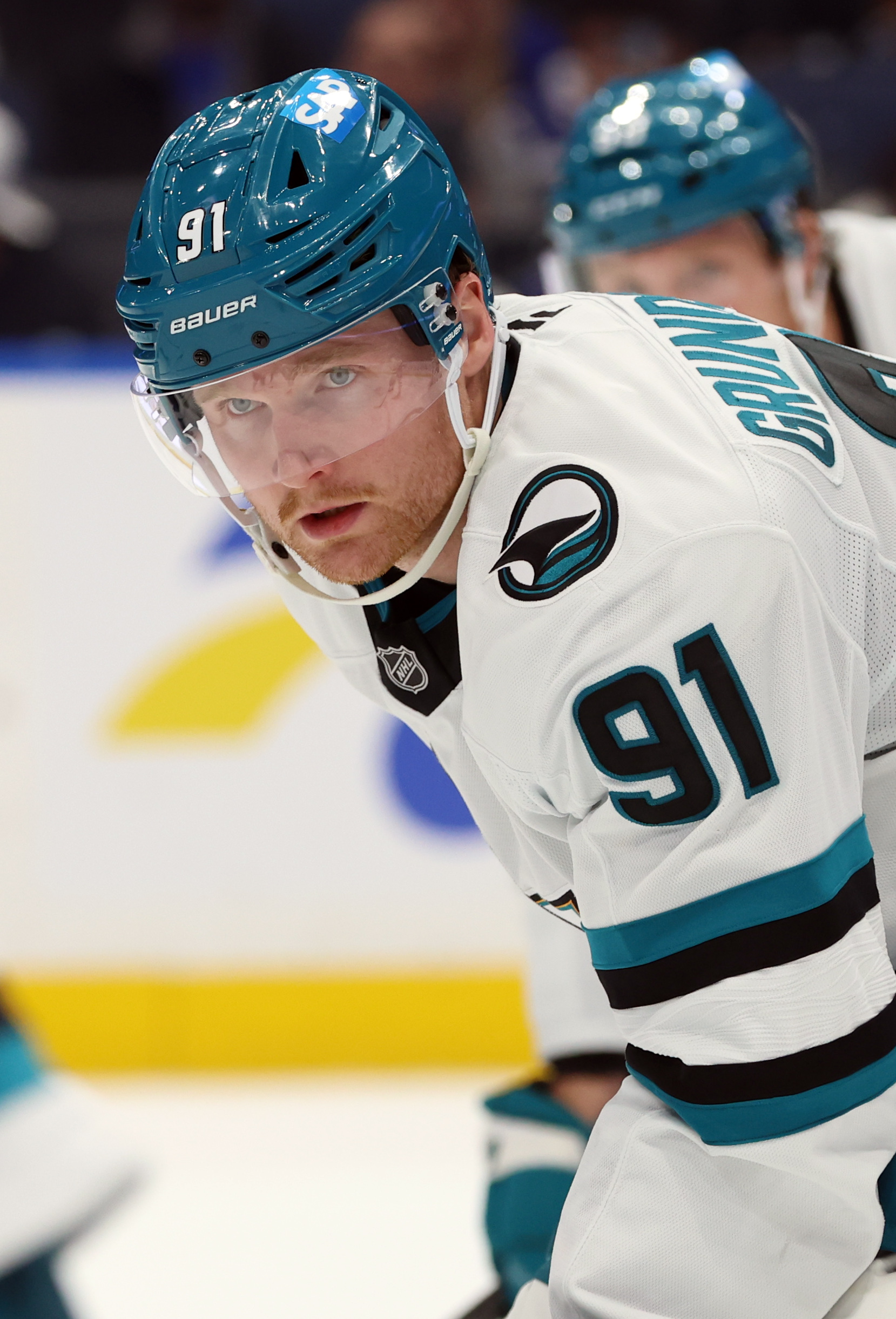
If the Flyers indeed believe their younger forwards who they may have expected to claim NHL jobs aren’t quite ready yet, it is understandable that they would seek outside reinforcement. The 27-year-old Grundström is a winger with nearly 300 games of NHL regular-season experience, who also brings 17 games of playoff experience. He was a steady bottom-six winger for the Los Angeles Kings from late 2020 through early 2024, before he was traded to the Sharks in June of that year.
Grundström’s season in San Jose was one he’d like to forget, though, as he scored just nine points in 56 games and averaged just 9:35 time-on-ice per game. He did not reach the standard of performance in San Jose that he set in Los Angeles, and as a result the Sharks have moved on. It’s an extremely important season for Grundstrom, whose two-year, $1.85MM AAV is set to expire in June. He’ll now look to carve out a role in the Flyers’ bottom-six to maintain his status as a full-time NHL player. (Update: The Flyers placed Grundström on waivers Sunday, indicating that he’s ticketed for the AHL, rather than fourth-line duty in Philadelphia.)
The other player the Flyers acquired in this trade is Guryev, a big 6’4 Russian blueliner. Guryev was a fifth-round pick of the Sharks at the 2021 draft and has spent the last two seasons with the Sharks’ minor-league affiliates. He played in 31 AHL games in his debut professional campaign in 2023-24 but spent all of 2024-25 in the ECHL. His entry-level contract expires after this season.
From the Sharks’ perspective, this deal accomplishes multiple things. Firstly, the team has cleared $1.85MM off its books by trading away Grundström, and while the winger is an experienced veteran, he never earned head coach Ryan Warsofsky’s trust, and the team has other players it can utilize in Grundström’s vacated fourth-line role.
The deal also adds another draft pick for San Jose, and those two goals come at a relatively limited cost. While the actual cash cost of Ellis’ contract is somewhat steep, there have been some (unconfirmed) reports that Ellis’ contract is insured, in which case the actual expenditure on the part of the Sharks’ organization would be limited.
From a cap hit perspective, this is more a matter of the Sharks trying to maximize the position they have found themselves in, rather than an attempt to materially alter their salary cap circumstances. Because of Logan Couture‘s early retirement due to injury, the Sharks were already expected to utilize LTIR for the next two seasons. That the team acquired Carey Price‘s contract from the Montreal Canadiens was reflective of their reality – they expect to be in LTIR, and as a result have sought opportunities to maximize their position.
This trade is another effort by the Sharks to do so, and while the return is somewhat limited, it’s still Grier executing on an opportunity to add assets to the organization. And with the Sharks still rebuilding (and prized young centers Macklin Celebrini and Will Smith still two years away from RFA status) the Sharks won’t be pressed to accumulate cap space and walk the salary cap tightrope the way other clubs have had to.
While this is hardly an Earth-shattering trade for either club, it is an example of each team working to maximize its respective positions. In a world where fans seek to assign a “winner” and “loser” to every transaction, this trade looks unlikely to have either, it’s simply two teams working together to make a deal that is likely to pay (likely marginal) dividends to each side.
Photo courtesy of Kim Klement Neitzel-Imagn Images
Players Who Could Start The Season On LTIR
While only a handful of teams project to need cap relief via long-term injured reserve to open the season, multiple candidates across the league might technically qualify for a placement. Doing so would bar the player from returning until Oct. 31 at the earliest – 24 days from the season start date of Oct. 7.
Avalanche: Logan O’Connor
O’Connor underwent hip surgery in early June. Given the five-to-six-month projected recovery window, he won’t be available until early November at best, putting him past the 10-game/24-day threshold required for LTIR. Colorado, which has $2.10MM in current cap space, will likely place O’Connor on standard IR if they don’t make any other cap-affecting moves between now and October. If they need the relief, though, they could create up to O’Connor’s $2.5MM cap hit in cushion for the first few weeks of the season if they need it.
Blues: Torey Krug
St. Louis general manager Doug Armstrong announced in May that Krug’s career is done because of pre-arthritic conditions in his left ankle that surgical intervention only slowly corrected. Since the Blues only have around $625K in cap space, Krug and his $6.5MM cap hit will be going on LTIR as soon as they need the flexibility for a call-up.
Canadiens: Carey Price
What’s certain is that Price won’t play this season or ever again. He’s entering the final season of his contract at a $10.5MM cap hit after confirming nearly two years ago that his knee injury would prohibit him from suiting up again. What’s uncertain is whether or not he’ll begin the season on LTIR. Montreal isn’t in a great position to optimize its LTIR relief, either by matching his cap hit in excess or getting down to $0 in space before placing him on the list. That’s made his contract a trade chip for teams who might need the relief more.
Devils: Johnathan Kovacevic
Kovacevic underwent knee surgery in early May and won’t be ready for training camp and likely opening night as well. Whether that stretches past Oct. 31 and makes him eligible for an LTIR placement if New Jersey needs cap relief early on remains to be seen.
Flyers: Ryan Ellis, Rasmus Ristolainen
Ellis’ career is over after sustaining a wide-ranging muscular injury in his pelvis just four games into his Flyers tenure in 2021. Ristolainen underwent a procedure on his right triceps tendon on March 26 with a six-month recovery time, putting him right on the edge of potential LTIR eligibility. Philly will have a better idea of the latter’s LTIR deployment potential after he undergoes his training camp physical. With $370K in cap space, they’re in a good position for near-max LTIR capture and will almost certainly at least place Ellis there to begin the year to give them call-up flexibility.
Golden Knights: Alex Pietrangelo
Pietrangelo is already on offseason LTIR, meaning the Knights actually still have to add an additional $1.2MM to their roster before opening night to optimize his capture and unlock his full $8.8MM cap hit’s worth of relief for this season. The team confirmed he requires multiple undisclosed but significant surgeries that will likely mark the end of his playing career, but it’s unclear if he’s actually had them done yet.
Jets: Adam Lowry
Lowry underwent hip surgery in late May and won’t be available until after Thanksgiving at the earliest. Winnipeg likely won’t be formalizing an LTIR placement with nearly $4MM in cap space, though.
Mammoth: Juuso Välimäki
Välimäki underwent ACL surgery in early March. He likely won’t end up on LTIR given Utah’s current cap flexibility ($6.68MM), but he’ll be out until at least early November so he’ll be there as an early-season option in case they need relief for whatever reason.
Oilers: Zach Hyman
Hyman’s inclusion here is on the speculative side. The winger could very well be ready for the start of the season. However, there hasn’t been much clarity on how much recovery he still needs after undergoing surgery to repair a severe wrist injury that kept him out of the Stanley Cup Final. A report in early June indicated there was uncertainty about his status for training camp, with no meaningful updates since then.
Panthers: Matthew Tkachuk
Tkachuk told ESPN’s Greg Wyshynski earlier this month that he’s still deciding whether he wants to undergo surgery to address the adductor issue that hampered him down the stretch and in the playoffs after sustaining it at the 4 Nations Face-Off. All signs point to him opting for it and spending the next two to three months on the shelf as a result, though. Placing him on LTIR is the only way the Panthers, who currently have a cap exceedance of $3.725MM, can be compliant to start the season without shedding a significant contract, something they aren’t keen to do.
Wild: Jonas Brodin
Minnesota has $9.41MM in cap space, but that number will shrink once they re-sign restricted free agent Marco Rossi (or add salary while trading his signing rights). Neither scenario will likely push them into a situation where they need to use LTIR relief, but they might have Brodin and his $6MM cap hit as an option for some short-term flexibility if required. He underwent an upper-body procedure in early June and is questionable for the beginning of the season, so it’s not yet clear if he’ll miss enough time to qualify.
Leafs Sign Dakota Mermis, Philippe Myers, Cédric Paré
The Toronto Maple Leafs have signed defenseman Dakota Mermis to a one-year, league-minimum contract, per CapFriendly (Twitter link). The deal was first reported by Jonas Siegel of The Athletic (Twitter link).
Toronto followed up this deal by signing defenseman Philippe Myers and forward Cédric Paré, shares Lance Hornby of the Toronto Sun (Twitter link). All three deals will expire next summer, with Pare’s deal a two-way contract.
Mermis clawed his way into an everyday role with the Minnesota Wild this season, after starting the year as their de facto call-up for injuries. He pulled into a bottom-line role following an injury to Alex Goligoski, proceeding to post eight points and 33 penalty minutes across 47 games. It was Mermis’ first year in the NHL, having spent the last seven years in the AHL, where he’s totaled 139 points across 431 games. Mermis will serve as a stout, defense-first depth option for Toronto.
Myers spent the past two seasons with the Tampa Bay Lightning, shuttling back and forth between the NHL and AHL. Last year, the 27-year-old dressed in five NHL games and went scoreless, while he played 61 AHL games with the Syracuse Crunch, registering four goals and 19 assists in 61 games. Myers was a highly coveted defenseman just a few years ago and was traded for Ryan Ellis in 2021 and Ryan McDonagh in 2022.
Paré will serve as AHL depth for the Toronto Marlies in 2024-25. The 25-year-old is a former sixth-round pick of the Boston Bruins and hasn’t dressed in an NHL game in four professional seasons. The Levis, Quebec native played for two different organizations last season and was relegated to the ECHL at one point. This past year, Paré tallied 14 goals and 21 assists in 61 AHL games.
Philadelphia Flyers Willing To Take On Salary
Anthony Di Marco of The Fourth Period is reporting that the Philadelphia Flyers are prepared to weaponize their cap space to acquire additional assets. The Flyers begin today with less than $1MM in salary cap space, a number that would translate to roughly $3.9MM at the NHL trade deadline. Now that number might not seem significant, but the Flyers can easily free up over $6MM by placing defenseman Ryan Ellis on LTIR, something they’ve been hesitant to do thus far, but are willing to do to make a trade work.
After years of being slammed up against the salary cap, the Flyers have finally created roster and salary cap flexibility after a summer in which they moved on from veterans Kevin Hayes, Tony DeAngelo, and Ivan Provorov. General Manager Daniel Briere seems fully committed to rebuilding the Flyers and appears willing to take on undesirable contracts in exchange for future assets.
Sportsnet’s Elliotte Friedman reported just two weeks ago that the Flyers were open to taking on Ottawa Senators forward Mathieu Joseph and his $2.95MM cap hit in exchange for a high prospect or a first-round pick, something Ottawa appears uninterested in entertaining. However that could change if they start the season slow without their second and third-line centres.
While a Joseph deal hasn’t materialized the Flyers will likely have their pick of suitors as the flat cap has created a financial landscape in which 19 NHL teams are within $1MM of the salary cap ceiling (including Philadelphia). There are a lot of teams that see themselves as Stanley Cup contenders who will be hard-pressed to make in-season improvements unless they can move out some salary, this is where the Flyers cap space could be leveraged to acquire assets.
The Flyers are early in their rebuild and are at least three or four years away from turning the corner. With that in mind, any contract they take on will probably fall into the one to three-year range similar to the contract they acquired with Cal Petersen. Philadelphia has several of their own undesirable contracts as well as over $5MM in dead cap space for the next few seasons in the DeAngelo buyout and the retained salary on Hayes.
Snapshots: Marchessault, Ellis, Kerfoot
During the Vegas Golden Knights run to their first Stanley Cup championship in franchise history, forward Jonathan Marchessault played a vital role in that effort. Finishing as the Conn Smythe Trophy winner of the 2022-23 Stanley Cup playoffs, Marchessault has cemented himself as a fan and locker room favorite in Vegas. With one year remaining on his current contract with the club, Marchessault should be one of the more important extension candidates for the team.
In an interview with TVA Sports, Marchessault spoke on extension talks, and also his relationship with head coach Bruce Cassidy. In his article on this relationship, Chris Gawlik of VegasHockeyNow reports a quote from Marchessault saying, “It hasn’t always been the rainbow and the good weather between us. We got into each other a couple of times, on the bench, during games, during the playoffs. But I think he wanted the best out of me and we managed to be able to work together“. Although interesting, it is hardly a surprising take from Marchessault, as Cassidy was regularly noted as an incredibly difficult coach to play for during his time with the Boston Bruins.
On the extension front, it does not sound like anything is close between the two parties. Marchessault said, “There are no negotiations that have been done. I know that sometimes the Golden Knights like to take their time with that. We will see what it will give“. Over the years, the Knights have been known to move some of their veteran original members, such as Reilly Smith and Marc-Andre Fleury, and if an extension cannot be agreed upon at a reasonable price for both player and team, Vegas may need to make another difficult decision with Marchessault this upcoming season.
Other snapshots:
- Speaking with the new President of Hockey Operations for the Philadelphia Flyers, Keith Jones, Adam Kimelman of the NHL reports that Jones firmly believes that the playing days of defenseman Ryan Ellis are over. Due to a back injury, Ellis has only been able to suit up in four games for the Flyers during the 2021-22 season and missed the entirety of last year. Ellis still has four years and $25MM remaining on his current contract and will spend the rest of that time on LTIR if his contract is not moved off the team before then.
- One of the several signings made by the Arizona Coyotes this offseason, Alexander Kerfoot is more than excited to get started with his new club. Speaking with Patrick Brown of the NHL, Kerfoot shed some light on his choosing Arizona over other offers saying, “It just feels like they’re in a different spot now. It feels like they’re trying to take the next step. Being part of that change and helping grow the culture is fun to be a part of. Things are trending really well for this group, and I’m happy to be part of it“. It is hard to envision the Coyotes returning to the playoffs anytime within the next two years, but they have set themselves up nicely by developing their core players and bringing in solid auxiliary pieces.
List Of Players Expected To Start 2023-24 On LTIR
We’re at the point in the summer where most major signings are complete, meaning only a handful of free agents left on the market could still command over the maximum buriable threshold of $1.15MM per year on their next contract. That means financial pictures are mostly set league-wide, and general managers can now focus more on the arduous task of salary cap management.
For many teams nowadays, long-term injured reserve (LTIR) is an important tool in helping teams keep below the salary cap’s Upper Limit, which is set at $83.5MM for 2023-24. It’s not as straightforward as it seems at first glance, though. Placing a player on LTIR does not eliminate their cap hit from the team’s books until they’re activated again. Instead, a team only gains cap relief if they exceed the Upper Limit, and the specific amount of relief received depends on the team’s cap situation on the day they place a player on LTIR. A more detailed explanation of how LTIR works can be found on CapFriendly.
All LTIR situations are not created equal. To be eligible for LTIR, a player must miss at least ten games or 24 days of action. However, they don’t need to be placed on LTIR if they’re projected to miss more than that amount of time. Oftentimes, a team operating far below the Upper Limit that won’t need any relief will simply keep the player on standard injured reserve, especially if they’re relying on an injured player’s cap hit to stay above the Lower Limit (set at $61.7MM next season).
With that said, here is a list of players who are projected to meet the injury requirements for LTIR to start 2023-24:
Atlantic Division
Buffalo Sabres – Jack Quinn
This offseason was a tough break for the young Quinn, who sustained an Achilles injury during offseason training in June and is expected to be out of the lineup through Thanksgiving. While eligible, he’s unlikely to actually be placed on LTIR. He’s still on his entry-level contract and carries a marginal cap hit of $863K, making a move extremely inconsequential to the Sabres, who CapFriendly projects with over $6MM in space.
Florida Panthers – Aaron Ekblad, Brandon Montour
The Panthers are set to begin the season without the services of their top two defensemen, thanks to shoulder injuries sustained and exacerbated during their run to the 2023 Stanley Cup Final. Combined, the players carry a rather significant $11MM cap hit, which should give the Panthers some season-opening flexibility. Ekblad’s expected to miss more time than Montour, but neither is expected to miss the whole season – both should be back in the fold by the time the calendar flips to 2024. CapFriendly currently projects the Panthers dipping into LTIR relief by $1.175MM to start the season.
Montreal Canadiens – Carey Price
The team’s legendary netminder isn’t expected to play again after a knee injury, and he hasn’t suited up since the end of the 2021-22 campaign. He’ll likely spend the last three seasons of his contract (carrying a $10.5MM cap hit) on LTIR. As we covered earlier in the week, Montreal is in a bit of a no man’s land with Price’s contract. They’ll likely either look to shed salary to get under the Upper Limit entirely (which they currently sit around $5MM over) or add money to maximize’s Price’s LTIR relief, which they could then weaponize in-season to be a cap broker for trades.
Tampa Bay Lightning – Brent Seabrook
Like Price, Seabrook will be on LTIR for the remainder of his $6.875MM cap hit contract, which expires next summer. Acquired from the Chicago Blackhawks after his injury made it clear he wouldn’t play again, Seabrook has provided additional options for cap flexibility for the Lightning over the last two seasons. Tampa is expected to use close to all of Seabrook’s potential relief to stay compliant throughout the season.
Toronto Maple Leafs – Jake Muzzin, Matt Murray
While not confirmed, Muzzin’s playing future remains in serious doubt after sustaining a cervical spine fracture at the beginning of last season. No recent update has been issued on his recovery, and he’s expected to miss the entire 2023-24 campaign and will spend the final year of his contract on LTIR. Murray’s situation is shrouded in much more mystery, however. The team announced last month he’d begin next season on LTIR, but no specific details of his injury were confirmed, and no timetable was issued for a potential return. Murray missed significant time last season with a concussion and an adductor injury.
Metropolitan Division
Philadelphia Flyers – Ryan Ellis
Forwards Cam Atkinson and Sean Couturier are expected to return to the lineup after missing all of last season with injuries, but the same can’t be said for Ryan Ellis. President of hockey operations Keith Jones said a few days ago that Ellis is unlikely to “be able to continue his playing career because of a torn psoas muscle in his back.” Ellis played just four games for the Flyers after they acquired him from the Nashville Predators in 2021 before sustaining the career-ending injury.
Washington Capitals – Max Pacioretty
Pacioretty’s timeline for a return after sustaining back-to-back Achilles injuries isn’t clear, but he likely won’t be available to the team to start the season and should meet the requirements for LTIR. The financial circumstances surrounding the potential relief will be tricky to navigate given the performance bonuses included in his contract, however. Pacioretty should be joining the Capitals after signing a one-year deal last month, sometime in November or December if everything goes well in his recovery.
Central Division
Arizona Coyotes – Jakub Voracek, Shea Weber, Bryan Little
All three are players acquired by the Coyotes for the express consideration of helping them stay above the cap floor – which they are now far above after being big players on the free-agent market this summer. Nonetheless, all three are done with their NHL careers due to various injuries and will remain members of the Coyotes organization by contract only.
Colorado Avalanche – Gabriel Landeskog
Colorado will be without their captain for a second straight season after the winger underwent a cartilage transplant on his right knee this summer. Landeskog hasn’t played since hoisting the Stanley Cup in 2022, a playoff run during which he played through a knee injury. He’s signed through 2029, and there’s still the potential he plays again, although it won’t be anytime soon.
Pacific Division
Anaheim Ducks – Isac Lundeström
Lundeström projects to be on the shelf through next January after sustaining an Achilles injury during offseason training in Sweden. Given the Ducks are far from the Upper Limit, and Lundeström carries just a $1.8MM cap hit, Anaheim could keep him on standard injured reserve for the duration of his absence.
Vegas Golden Knights – Robin Lehner
All has been quiet on Lehner’s health after he missed all of last season. The All-Star-caliber netminder had double hip surgery last summer, keeping him out for the entire 2022-23 campaign. He was not around the team at all during their run to the 2023 Stanley Cup, and the team has issued no updates on his recovery since undergoing the surgery last summer. Without any indication that he’s close to a return, Lehner closes out our list.
Latest On Availability Of Sean Couturier, Cam Atkinson, Ryan Ellis
Philadelphia Flyers president of hockey operations Keith Jones addressed the health and availability of three of his organization’s bigger-name players to NHL.com’s Adam Kimelman today. He spoke on Flyers number-one center Sean Couturier, veteran goal scorer Cam Atkinson, and defenseman Ryan Ellis.
On Couturier and Atkinson, Jones said that both are expected to be healthy and on the ice for the start of Flyers training camp next month. That’s not only major news for each player but also the Flyers organization at large, as the team’s offensive attack has suffered tremendously in the absence of two of the team’s most experienced players.
Couturier, 30, is arguably the Flyers’ best player. Couturier hasn’t played an NHL game since December 2021 and has had two back surgeries since that point.
Kimelman notes that Couturier “Couturier was practicing before the end of last season and had been hoping to get into a game,” but the Flyers made the decision not to rush Couturier back into what was a lost season, preferring to afford him the more extended timeline of a full offseason of training leading up to his first game back.
When healthy, Couturier is a top-of-the-line two-way center who is capable of scoring at a near-point-per-game rate. (he has crossed the 75-point plateau twice in his career) The 2019-20 Selke Trophy winner could very well compete for more Selke trophies when healthy, especially now that Patrice Bergeron has retired.
With the Flyers intensely interested in developing their young talent and providing young players with prime opportunities to succeed in the NHL, having Couturier healthy is a huge asset. For young wingers such as Tyson Foerster or Bobby Brink, players the Flyers desperately want to succeed in the NHL, having the chance to play on a line centered by Couturier could do wonders in easing their adjustment to the NHL.
As for Atkinson, as a 34-year-old under contract only through the 2024-25 season he is unlikely to be with the Flyers by the time they enter their next competitive phase. That’s unlike Couturier, who is signed to a long-term, $7.75MM AAV contract through the end of the decade. Atkinson is a favorite of head coach John Tortorella but missed all of last season after undergoing neck surgery.
The fact that the Flyers’ next playoff run will likely happen outside of Atkinson’s contract doesn’t mean he can’t provide value to the Flyers for the rest of his deal. The former 41-goal scorer returning to full health could improve the developmental environment in Philadelphia, just as having a healthy Couturier would.
Atkinson is a widely respected veteran who can capably score 20 goals and 50 points in a full season. For a young center the Flyers wish to see continue to develop, such as Morgan Frost or Noah Cates, having an accomplished veteran winger to play with and help the line succeed offensively could be genuinely helpful.
The key to the right developmental environment for a rebuilding club is to provide the right mix of young players and established talent, rather than just stocking a roster with as many unproven youngsters as possible. The issue for the Flyers has been that so many of the team’s key veteran forwards have been injured (such as Couturier and Atkinson) or a poor fit with Tortorella. (Kevin Hayes)
Getting both Atkinson and Couturier back from their season-long injuries not only helps the Flyers win more games in the immediate term, but it should also yield real benefits for the development of the Flyers’ young talent.
As for Ellis, Jones told Kimelman that the defenseman is unlikely to “be able to continue his playing career because of a torn psoas muscle in his back.” Jones added that Ellis is “exhausting everything that he can in order to play” but that the injury is simply making his return to the ice impossible.
Ellis, 32, was a high-end defenseman for the Nashville Predators for 562 games before he was dealt to Philadelphia in the summer of 2021 in exchange for Philippe Myers and 2017 number-two pick Nolan Patrick.
Ellis only managed to play in four games for the Flyers, scoring five points, before injuries knocked him out of the lineup. As long as this injury keeps Ellis from being able to play he will likely remain on the Flyers’ long-term injured reserve list in order for the team to receive cap relief for Ellis’ $6.25MM AAV contract, a deal that runs through 2026-27.
While Ellis appears to have every desire to return to the ice and continue his career, based on Jones comments it appears that expecting Ellis to ever suit up for another NHL game would be a mistake. While the organization must be happy to have Atkinson and Couturier back for training camp, the seemingly permanent absence of Ellis is undoubtedly unfortunate for both the Flyers and Ellis himself.
Photos courtesy of USA Today Sports Images.
Flyers Confirm Ryan Ellis Will Not Play This Season
Though it shouldn’t come as much of a surprise, Philadelphia Flyers general manager Chuck Fletcher confirmed to reporters including Adam Kimelman of NHL.com earlier today that Ryan Ellis will not play this season. In training camp, the team had admitted that it didn’t look likely.
Ellis, 31, has played just four games for the Flyers since arriving in the summer of 2021, acquired for Nolan Patrick and Philippe Myers. The former Nashville Predators star had five points in those four appearances, a tantalizing example of what he could have brought to the Philadelphia attack.
Instead, the team is stuck with him on injured reserve for another year, using his $6.25MM cap hit as LTIR flexibility instead. With Ellis ruled out, the team is in no danger of facing a cap squeeze later in the year, though with their recent struggles it likely wouldn’t matter much anyway. The Flyers are now 1-6-3 in their last ten after winning on Tuesday night, and don’t have the appearance of a team ready to compete for a playoff spot.
The frustrating part for fans and management alike is that Ellis has four more years on his contract after this one. Even if he never plays again, that will restrict some of the ways in which the team can operate. LTIR relief is not just free cap space, it has negative effects as well, like forcing bonus carryovers. The Flyers are paying $295K in those carryovers this year and could face more next season if a player like Noah Cates secures some of his performance bonuses.
It’s not like Ellis was ready for retirement. He won’t turn 32 until January and was legitimately in the prime of his career when the team acquired him, though injury was always a concern. In his last full season, 2018-19, the right-shot defenseman recorded a career-high 41 points. He was even better the following year, with 38 in just 49 games during the COVID-shortened campaign, but then was able to suit up just 35 times in 2020-21.
Now, it is unclear if he’ll ever get back on the ice with the Flyers or anyone else.
Ryan Ellis Not Expected To Play This Season
There is a chance we never see Ryan Ellis on the ice at an NHL hockey game again. Philadelphia Flyers general manager Chuck Fletcher met with the media today and explained to reporters including Charlie O’Connor of The Athletic that there is no timetable for Ellis’ return and that it would be a “bonus” if he played at all this season. Though he can’t say now, Fletcher explained that there is a possibility Ellis’ career is threatened by this injury, which he described as “multi-layered.”
Clarity on what Ellis’ injury actually is has been hard to come by, but Fletcher indicated today that it includes a torn psoas and issues with his hip and adductor muscle. He missed all but four games last season – the first four he had ever played outside of the Nashville Predators organization.
Acquired for Nolan Patrick (who also may not play this season) and Philippe Myers, Ellis was supposed to reshape the Flyers’ defense and give Ivan Provorov or Travis Sanheim a long-term partner. The 31-year-old is signed through the 2026-27 season and carries a $6.25MM cap hit, making him the second highest-paid defenseman on the Flyers roster.
It appears that contract will live on long-term injured reserve for a while.
Sean Couturier, meanwhile, hasn’t been ruled out for the entire season so far, though he is getting a second opinion this morning and has not been cleared to play at this point. Fletcher called it premature to speculate about his season-long outlook or even his career, despite this being his second back injury in 12 months.