
Brock Boeser, Vancouver Canucks To Discuss Extension Next Week
Though a ton of the focus in Vancouver this offseason has been on the somewhat odd additions they made in free agency, or the performance of top draft pick Quinn Hughes at the World Junior Summer Showcase, there is still plenty of work to be done to keep the organization on the tracks of their rebuild. One of those things is negotiating an extension with star forward Brock Boeser, who is already heading into the final year of his entry-level contract despite having just one full season under his belt in professional hockey.
Since Boeser was already 20 when he signed his first contract out of the University of North Dakota, he burned the first year of his ELC in just those nine games at the end of the 2016-17 season. He’s been eligible to sign an extension since July 1st, and according to Ben Kuzma of The Province the two sides had preliminary discussions last month. They also plan on talking again next week, though GM Jim Benning isn’t putting a deadline on anything:
We haven’t got down to talking term. We plan to circle back and I’m not sure where it’s going to go, but we want to see if we can get somewhere. There’s no time frame on it.
Brock is going to see the best matchup line and best defensive pair, but I don’t expect a drop-off. He has pushed himself hard to pick up where he left off and there are other contracts coming up in the league in the next six months that could drive up the price — I understand that part of it.
Benning is right about the fact that there are several potential extensions coming up around the league that could change the price tag for Boeser. Though he likely won’t quite match up with the mega contracts that Auston Matthews and Patrik Laine are headed for in their negotiations, there is a big group of other players that find themselves in a similar situation to Boeser after performing well early in their careers. Kyle Connor, Sebastian Aho, Matthew Tkachuk, Mikko Rantanen and Mitch Marner are all wingers who have found incredible success in their first few seasons, and are scheduled for restricted free agency in 2019.
All of them will be looking at other contracts signed by players like David Pastrnak, Nikolaj Ehlers and soon William Nylander as potential starting points but could eclipse the $6-7MM range that each of those players will fall into. Boeser could be the same, especially if he can prove he’s back to full health and can get back on a 40-goal pace to start the season.
There is little worry here that the two sides won’t be able to eventually come to some agreement, but the question is will the Canucks get any sort of discount by betting on Boeser before he’s shown his ability for a second season. With added pressure and tougher defensive matchups, there is always a real possibility that his numbers decline this season. Boeser did after all shoot 16.2% in 2017-18, though the eye test would lead you to believe that he’ll post above-average shooting percentages for his entire career. If that number drops significantly though, the Canucks might be able to parlay a down year into a better deal for themselves. The two sides are in a game of poker at the moment, wondering when to push all their chips to the middle. Whether that happens this summer or much further down the road still is yet to be seen.
Poll: Who Will Be The Top Free Agent Available In 2019?
The 2019 Superclass is losing some of its power. At this point a few months ago, hockey fans across North America were drooling with anticipation while thinking about the group of players scheduled to become unrestricted free agents in the summer of 2019. There were some incredible defensemen set to hit the open market, and real questions about whether their current teams would be able to hammer out an extension in time. Now, just six weeks into that extension period and we’ve already seen several names crossed off the list.
On July 1st alone, Oliver Ekman-Larsson, Drew Doughty, Ryan McDonagh and Niklas Hjalmarsson were all removed from a possible free agent frenzy by inking huge contract extensions with their respective teams. Ekman-Larsson and Doughty would re-up for eight years each, while McDonagh would receive seven and Hjalmarsson an extra two. It took a few more weeks but Ryan Ellis would join them with an eight-year extension of his own, taking another elite defenseman off the market well before anyone could even prepare a sales pitch.
It wasn’t just defensemen. Logan Couture received an eight-year $64MM extension from the San Jose Sharks as soon as they could give it out, and Adam Henrique was given five more years from their state rival Anaheim Ducks. Marc-Andre Fleury was rewarded for his playoff performance with a three-year deal that makes him one of the highest-paid goaltenders in the league, despite only playing 46 regular season games for the Vegas Golden Knights in 2017-18.
A ton of talent has already been locked up, but it wasn’t dubbed a Superclass because of just a few players. The 2019 market still has a long list of talent scheduled, including superstar forwards like Tyler Seguin and Artemi Panarin. Erik Karlsson hasn’t signed an extension with the Ottawa Senators and may still be traded before the season, while Sergei Bobrovsky and Pekka Rinne provide some elite goaltending options if they aren’t re-signed.
So who will be the best free agent to make it all the way to market? After John Tavares showed that a superstar can indeed change teams in the prime of their career, who will be next to follow the money (or the home cooking) to a new club? Cast your vote below not for the player who you think is currently the best, but the best player you think will actually become an unrestricted free agent on July 1st, 2019. Explain your thoughts in the comment section below.
Who will be the top UFA in 2019?
-
Erik Karlsson 31% (454)
-
Tyler Seguin 24% (347)
-
Artemi Panarin 18% (263)
-
Blake Wheeler 4% (52)
-
Matt Duchene 3% (50)
-
Sergei Bobrovsky 3% (39)
-
Mark Stone 2% (34)
-
Pekka Rinne 2% (34)
-
Wayne Simmonds 2% (33)
-
Max Pacioretty 2% (27)
-
Jordan Eberle 1% (19)
-
Joe Pavelski 1% (17)
-
Jeff Skinner 1% (11)
-
Tyler Myers 1% (9)
-
Jake Gardiner 1% (9)
-
Anders Lee 1% (9)
-
Gustav Nyquist 1% (8)
-
Nate Schmidt 0% (7)
-
Kevin Hayes 0% (6)
-
Eric Staal 0% (6)
-
Mats Zuccarello 0% (5)
-
Jakob Silfverberg 0% (5)
Total votes: 1,444
[Mobile users click here to vote!]
Zach Werenski On Track To Be Ready For Season
Considering Zach Werenski played with an injured shoulder for almost the entire 2017-18 season, imagine how good he could be if he is at 100% for all of the upcoming campaign. That is the goal for the young Blue Jackets blue liner, who recently sat down with Columbus beat writer Brian Hedger. Werenski continues to recover from off-season surgery, but says that his goal is to “be there for Game 1”.
Werenski suffered the injury of note all the way back on October 30th, 2017. The sophomore defenseman nevertheless played in 77 games and recorded 37 points, even though he played with a brace for much of the year. Werenski then underwent corrective surgery in early May and had his left arm immobilized for much of the summer. However, the 2015 eighth overall pick is already ahead of schedule in his rehab and training. Columbus GM Jarmo Kekalainen shared a recovery timeline back in June that assumed Werenski would miss most of training camp, but the young defender tells Hedger that he hopes to back toward the start of training camp. Werenski has already begun shooting drills and is essentially back to his regular off-season training minus taking any contact. While the offensive rearguard is obviously motivated to be ready for the season for his teammates, coaches, and fans, he also admits to Hedger that playing in the teams opener, a road game against the Detroit Red Wings in his home state of Michigan, is an added personal boost. “Suffer now, but I’m going to be able to play in my hometown in front of my family and friends ” has been Werenski’s mantra this summer and so far things seem to be going well.
Should Werenski suffer even a small setback that leaves him unable to start the season, the Blue Jackets are less equipped to deal with his absence than they would have been last year. With Jack Johnson, Ian Cole, and even others like Taylor Chorney now gone via free agency, Columbus is relatively thin on the blue line after their superstar young pairing of Werenski and Seth Jones. Ryan Murray or Markus Nutivaara would likely be the replacement on the top pair with Jones while the other skates with David Savard, leaving the Jackets with a bottom pair featuring two of Scott Harrington, Gabriel Carlsson, Dean Kukan or new addition Adam Clendening. Count the Blue Jackets as being right there with Werenski in hopes that he is able to go from day one.
Silence Surrounds Erik Karlsson, Ottawa Senators
At one point this summer the biggest story on almost a daily basis was the future of Ottawa Senators captain Erik Karlsson, but since trade talks seemed to have broken down there have been almost no reports to update his status. Brent Wallace of TSN says it has been “eerily quiet” in Ottawa regarding Karlsson, and doesn’t believe that will change until he addresses the media at the start of training camp. Karlsson is still under contract with the Senators, but after the team reportedly offered a long-term extension in early July there has been very little talk about any potential negotiations between the two sides.
We’ve seen a situation extremely similar to this play out recently, ultimately ending in the Senators themselves acquiring Matt Duchene from the Colorado Avalanche just a few weeks into the 2017-18 season. Duchene basically avoided speaking to the media entirely during training camp, not willing to feed into the speculation around whether he was unhappy in Colorado and had requested a trade. A similar thing might be happening with Karlsson, who has given no indication that he would hold out from camp to demand a trade, or in fact has even asked for a trade at all. The Senators obviously will have to continue contemplating that option if the two sides aren’t progressing in extension negotiations, given their expected struggles this season and Karlsson’s immense value as a trade asset.
Senators training camp opens in just under a month’s time, at which point we should start to get at least some answers from the team on whether Karlsson is expected to start the year on the roster. While the hockey world has seemingly taken a bit of a vacation in early August, things will begin heating up quickly as the calendar turns and the start of the season creeps closer. Not only will teams be able to evaluate their roster by seeing them first hand on the ice, but injuries to key players could always create a potential trade candidate where one didn’t appear before.
Karlsson remains the biggest fish on the trade market, and actually saw another one of his free agent contemporaries scratch their name off the UFA list for next summer. When Ryan Ellis inked his eight-year, $50MM contract extension today it marked the fourth big-name defenseman scheduled for 2019 free agency to sign a long-term contract. Drew Doughty, Oliver Ekman-Larsson and Ryan McDonagh have already been locked in, meaning Karlsson could find himself as the unchallenged king of the unrestricted free agent market—at least among defensemen— on July 1st.
The Rest Of The Goaltending Market
Most teams are set between the pipes heading into next season but there is still likely to be a little bit of movement at that position in the weeks to come as training camps get closer. With that in mind, here is an overview of the goaltending market.
Free Agent Options
Kari Lehtonen – His final season in Dallas resembled a lot of his tenure there. Lehtonen had some good moments but also some particularly rough ones at inopportune times including down the stretch when Ben Bishop was injured. After being a starter for the majority of his career, the 34-year-old is now going to have to settle for a backup job at best.
Steve Mason – The Jets were hoping that Mason would improve on his prior year numbers with Philadelphia and give youngster Connor Hellebuyck a serious run for the starting role. That didn’t happen. He wound up dealing with concussion troubles and struggled when he was healthy which resulted in him only playing in 11 games. He was dealt in a cap-clearing move to Montreal last month and was subsequently bought out.
Ondrej Pavelec – After spending most of 2016-17 in the minors, Pavelec was the backup for the Rangers last season and he didn’t exactly make the most of his opportunity, posting a 3.05 GAA and a .910 SV% in 19 games. If he wants to stay in North America, he may have to sign with a team that has a starting job at the AHL level available and then try to make the most of any recalls he gets.
Trade Options
Craig Anderson (Ottawa) – The Sens have been shopping Anderson following his trade request which came out last month. However, the 37-year-old is coming off a rough campaign and is now in the first year of a two-year extension he signed last season, one that carries a $4.75MM cap hit. With there only being backup slots available, it’s likely that Ottawa will have to wait until injuries strike somewhere midseason as it’s unlikely that they’ll be willing to retain any amount of consequence to facilitate a move.
Anton Forsberg (Chicago) – When he was given the starting job following what was believed to be a concussion for Corey Crawford, Forsberg struggled to the point where management felt it was necessary to get a more proven player behind Crawford. That’s why they moved quickly to sign Cam Ward and in doing so, shifted Forsberg to the third-string role. Head coach Joel Quenneville said recently that they won’t carry three goalies which appears to make the 25-year-old the odd man out. He has one year left on his deal with a $750K cap hit and will be eligible for restricted free agency next summer.
Al Montoya (Edmonton) – The Oilers brought in Montoya midseason to try to shore up their backup position and while he helped, he didn’t do enough to instil confidence from management as in May, the team moved quickly to bring in Mikko Koskinen from the KHL which has relegated the 33-year-old to third-string status. Edmonton could conceivably keep him around as insurance but they already have three goalies signed that are likely to contend for AHL time so they may want to move Montoya to alleviate the logjam. He has one year left at a cap hit just over $1.06MM and will be a UFA next July.
Calvin Pickard/Garret Sparks (Toronto) – With the season Curtis McElhinney had, he’s a safe bet to return as Toronto’s backup. That leaves both Pickard (26) and Sparks (25) in some limbo. Both are coming off very strong seasons in the minors and require waivers to return to the Marlies next season. A team that thinks one of these players has some upside may be willing to look at one as a backup; in Pickard’s case, he has been one in the past with Colorado. Pickard is set to make $800K next year and will be a UFA after that while Sparks checks in at $675K and will be an RFA next summer.
Potential Interested Teams
Washington dealt backup Philipp Grubauer to Colorado back at the draft and they are presently set to use Pheonix Copley, a veteran of two NHL games, as their backup. A big reason for that is the salary cap as Copley makes the league minimum but if one of the veterans is willing to accept a similar salary, they would be better suited going with a more proven option between the pipes.
Winnipeg added Laurent Brossoit early in free agency with the expectation that he would be the new backup for Hellebuyck. However, since they weren’t able to keep center Paul Stastny around, they will have more salary cap flexibility than they were initially expecting. Considering that Brossoit struggled considerably in Edmonton last season, they would be wise to consider adding another option between the pipes.
The Rangers currently have youngster Alexandar Georgiev positioned to be Henrik Lundqvist’s backup next season. While that makes some sense given their commitment to go younger, Georgiev only has one year in North America under his belt and is still waiver exempt. From a development standpoint, it would make sense for him to play more in AHL Hartford than simply spell Lundqvist every fourth or fifth game. A stopgap veteran or one of the potential waiver-bound players would allow Georgiev to develop a little more which would make a lot of sense for them to do.
Calgary has a pair of youngsters set to battle for the backup role in David Rittich and Jon Gillies but both struggled down the stretch last season when Mike Smith was injured. The Flames, who have some more space to work with following the buyout of winger Troy Brouwer, may be better served looking for a more proven insurance policy.
Most of the goaltending tandems for 2018-19 are already in place but between now and the start of the season, there is still bound to be a little more movement at that position in the weeks to come.
Roster Battles Should Dominate Anaheim Ducks Training Camp
More so than almost any team in the league, the Anaheim Ducks look to have uncertainty at the bottom of their roster. So far the 2018 offseason has been for the most part spent re-signing their own players, inking John Gibson and Adam Henrique to long-term extensions while reaching a two-year bridge deal with Brandon Montour. In free agency, the Ducks failed to secure any of the top names and now find themselves in a position where training camp could have a huge impact on who starts the season in Anaheim.
Up front, the Ducks have just ten forwards currently signed to one-way deals, not including Ben Street or Anton Rodin who have limited NHL experience and didn’t play in the league at all last season. Neither veteran minor league player should really be in contention for a roster spot with the Ducks, but that doesn’t mean there won’t be competition. Even once Ondrej Kase and Nick Ritchie are signed and given their spots, the team has a group of other forwards competing for the last few roles.
Brian Gibbons and Carter Rowney were both signed early in free agency and given $1MM+ salaries to provide some depth at the bottom of the lineup. Neither player has really proven himself at the NHL level though, with Gibbons playing 59 of his 125 career games last season for the New Jersey Devils and Rowney suiting up just 44 times last season for the Pittsburgh Penguins. The idea of handing either of them a full-time role without competition seems foolish, though since Rowney was brought in on a three-year deal he will obviously have the upper hand.
Behind them are several players on two-way or entry-level contracts, like Troy Terry, Kalle Kossila, Kiefer Sherwood and Kevin Roy. The latter three all spent time in the minor leagues with the San Diego Gulls last season, while Terry played just three games for the Ducks after signing out of the University of Denver. Given the uncertainty around Ryan Kesler‘s health and the limited upside of both Gibbons and Rowney, you could see Anaheim decide to give a real chance to one of these players in 2018-19. That is, if they can hold off the competition.
One of the questions most often asked in our PHR Live Chats is whether or not Sam Steel and Max Jones are ready for the NHL. The pair of first-round picks from 2016 are now both 20 years old and will be beginning their professional careers, but there’s no guarantee that either will see the NHL just yet. Jones in fact was listed pretty far down in Corey Pronman’s recent prospect rankings for The Athletic (subscription required), including him in the “Have A Chance” section. There will be a huge battle between all of the listed forwards (and probably several others) for playing time in Anaheim this season.
On defense it’s also not clear who will shake out at the end of camp. The team signed Andrej Sustr and Luke Schenn this summer to improve their depth on the right side, but both likely can’t play with Josh Manson and Montour already locked into positions there. Marcus Pettersson, Jacob Larsson, Josh Mahura, Jaycob Megna, Andy Welinski and Korbinian Holzer are also all still in the organization and could challenge for the 6-7-8 spots, with no clear choice on who would play where. The departure of Kevin Bieksa and Francois Beauchemin certainly opens up some playing time, but the team will likely wait for someone to step up and prove they deserve regular minutes before handing them out.
All of this just makes for an interesting next few months for the Ducks, who are trying to get back to Stanley Cup contention with much the same team as the last few seasons. With Ryan Getzlaf and Corey Perry now entering their mid-thirties, more responsibility will have to be heaped upon the next wave of talent if the team is to stay respectable. Battles like the ones that will take place in training camp will determine whether this Ducks team is just a very good one, or a real contender for the Stanley Cup.
Poll: Who Is The Best UFA Left On The Market?
The unrestricted free agent frenzy dried up extremely quickly this season, and we haven’t seen single contract signed in the first week of August. The last UFA to ink a deal was Matt Read, who signed a two-way contract with the Minnesota Wild to try and compete for some fourth line minutes and continue his NHL career. Though the cap situation for many teams is quite tight and roster spots are more and more valuable every year, it is somewhat shocking to see how much NHL experience is still out there. The talent of the remaining players can be questioned, but the league has always seemed willing to give veteran players a chance on one-year deals in the past.
Last August, we saw older players like Matt Cullen, Francois Beauchemin, Drew Stafford and Matt Hendricks given another chance to extend their careers while several minor league players were brought back on two-way contracts. That is still bound to happen over the next few weeks, but the more surprising part is how many veteran names may be left searching for a professional tryout or heading to Europe to find work. There are dozens of skaters who played in at least one NHL game last season still available on the UFA market, and several goaltenders including three with plenty of previous experience.
So which would you most likely sign if you had control of your favorite franchise? Rick Nash may be the obvious choice, given his relative youth and previous star status, but he’s been kept out of our poll given that he hasn’t even decided whether he wants to play next season. Nash may come back to the game at some point, but right now he should be considered off limits. Among the other names though there are several players who’ve shown real effectiveness in the past, some even as recently as last season.
Cast your vote to decide who is the best free agent left on the market, and make sure to leave a comment down below explaining your choice. We’ve included many of the available options, but speak up if there’s someone you think is being overlooked.
Who is the best unrestricted free agent left on the market?
-
Toby Enstrom 12% (181)
-
Luca Sbisa 10% (158)
-
Mike Cammalleri 7% (104)
-
Scott Hartnell 6% (94)
-
Kris Versteeg 6% (90)
-
Antoine Vermette 6% (89)
-
Joel Ward 5% (78)
-
Tommy Wingels 5% (71)
-
Troy Brouwer 5% (71)
-
Alexei Emelin 4% (67)
-
Kari Lehtonen 4% (66)
-
Steve Mason 4% (59)
-
Drew Stafford 4% (54)
-
Nick Shore 3% (49)
-
Mark Letestu 3% (47)
-
Kevin Bieksa 3% (46)
-
Johnny Oduya 3% (43)
-
Lee Stempniak 3% (42)
-
Benoit Pouliot 2% (31)
-
Dominic Moore 2% (29)
-
Ondrej Pavelec 2% (28)
-
Daniel Winnik 2% (26)
-
Jakub Jerabek 1% (8)
Total votes: 1,531
[Mobile users click here to vote]
Dylan Larkin, Detroit Red Wings Inching Closer To Contract
Among the names left on the restricted free agent list, Dylan Larkin stands out as a potential franchise linchpin. Though William Nylander and Sam Reinhart are important forwards, and Noah Hanifin, Darnell Nurse, Shea Theodore and Josh Morrissey are all talented defensmen, it’s Larkin that could be the face of the Detroit Red Wings for quite some time and probably the most important contract to still be worked out. Larkin recently said that he believed something would be done before training camp, and yesterday reiterated that fact to Sportsnet’s Luke Fox.
Something’s coming. I’ve told everyone I think it’ll be before training camp. It’s right there. I’m just waiting to iron out the details.
There have been reports that the Red Wings have been working towards a five or six year contract, but Larkin indicated that there are “different offers out there” that could also include a shorter bridge deal. That depends on how much room GM Ken Holland and the Detroit front office can clear up this summer, given that the Red Wings only have $2.83MM in cap space. Larkin would take up more than that even on a bridge deal, meaning there is plenty more work to be done for the club over the next few weeks.
Teams can go over the cap in the offseason (up to 10% or $7.95MM), and the Red Wings still have Johan Franzen‘s cap hit that can be placed on long-term injured reserve for additional cap flexibility. But if Larkin does end up signing a long-term deal, it would take up a considerable amount of space given that he has just four years of restricted free agency remaining.
Even with the crunch that is occurring right now for Detroit, the may rather get Larkin under contract for some of his unrestricted free agent years given that their cap situation starts clearing up as soon as 2019-20. With nearly $18MM scheduled to come off the books in the form of Gustav Nyquist, Jimmy Howard, Thomas Vanek and Niklas Kronwall, the team can certainly afford to give the next wave of talent substantial raises. As a team the Red Wings are getting closer to financial freedom and a real chance at a rebuild, and Larkin’s next deal will set the precedent for all the players that come after him. It might still take a little while to work through, but at this point both sides seem confident something will get done.
Brock Boeser Camp In No Rush For New Contract
The Vancouver Canucks signed several veteran forwards in this summer to insulate their young core, bringing in Antoine Roussel, Jay Beagle and Tim Schaller on multi-year deals. While that solidifies the roster for the next few years, everyone is watching to see if the team will lock up Brock Boeser long term before he becomes a restricted free agent next summer. Boeser is eligible to sign an extension already, but his agent Ben Hankinson was on Sportsnet radio today explaining that they’re not in a rush to get something done.
I don’t think there’s any rush. Obviously Brock knows he has another year left and he’s going to go out there and play no matter what. He’ll probably be on the ice the next October in 2019 to start that season with a new contract too. Whenever it happens it happens. There’s no rush on our end.
I’d say, without putting a deadline on it, we’d like to get going once the season rolls and just play hockey. But there’s no deadline on it. [Canucks GM] Jim [Benning’s] a very level-headed guy and we have a really good relationship. So I’m not gonna say we won’t talk during the season if we don’t get something done, but who knows, it’s too early to say.
Boeser has been a star for the Canucks since the day he signed with them, scoring in his first NHL game just a day after being eliminated from the NCAA tournament. The young sniper went on to record 29 goals and 55 points in his first full season, though he was limited to just 62 games due to a scary back injury that put him on the shelf in early March. He’ll be back and ready to go in 2018-19, and could set himself up for a huge extension with another big season.
Though Boeser has just one season under his belt he’ll be 22 in February, meaning that entry-level contract will come to an end next summer at which point he could easily eclipse Loui Eriksson and Bo Horvat as the team’s highest-paid forward. He’ll have five years of restricted free agency left, but as we’ve seen with other young stars teams now like to lock up their future right away. If both sides wait until after this season and he puts up another near point-per-game campaign, you can expect him to be asking for a deal somewhere along the lines of David Pastrnak ($6.67MM AAV) or Nikolaj Ehlers ($6.0MM AAV). Where Dylan Larkin and William Nylander land in their respective contract talks will also likely be a good comparison, though there could be an argument that Boeser is an even more valuable piece than either given his impressive goal scoring ability.
If the two sides can reach an agreement this summer the Canucks may be able to keep that cap hit slightly lower given that Boeser still has just 71 games under his belt in the NHL. Vancouver has plenty of cap space to fit Boeser in going forward, especially given that several other key players should be joining the organization in the next few years on entry-level deals.
Free Agent Profile: Mike Cammalleri
While he isn’t close to the point-per-game mark like he was with the Kings a decade ago, winger Mike Cammalleri has still been a decent secondary scorer in recent years. Despite that, he remains unsigned more than a month into the free agent period.
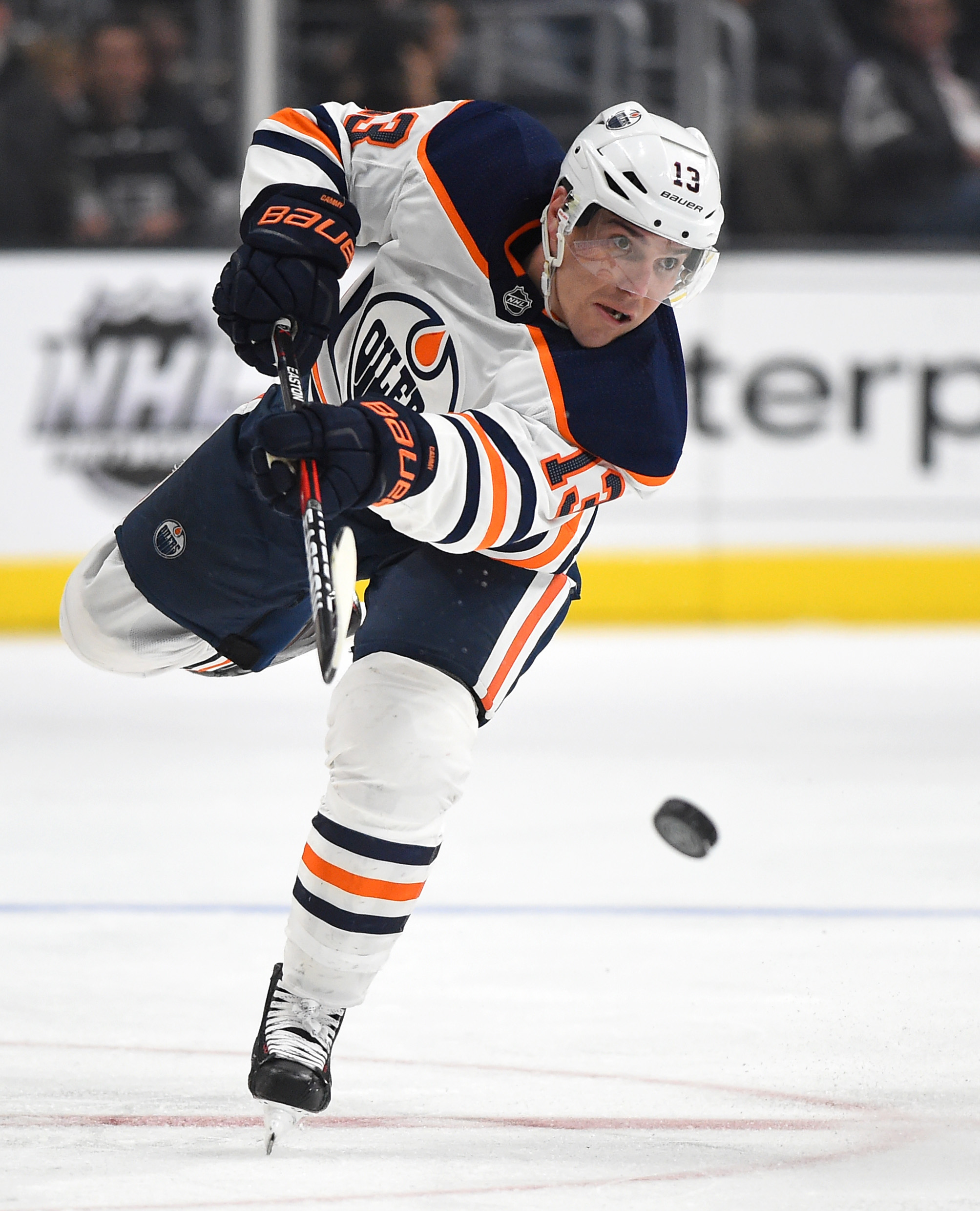 The 36-year-old signed with Los Angeles last summer after being bought out of the final two years of his deal with New Jersey. While he was fairly productive in limited playing time (seven points in 15 games), the Kings quickly moved him to Edmonton in exchange for Jussi Jokinen in a swap of veteran wingers. (Jokinen went on to be waived, claimed by Columbus, and then dealt to Vancouver at the trade deadline.)
Edmonton, meanwhile, got the better end of the swap. Although he didn’t light the lamp too often, Cammalleri was able to hold down a third line role and chip in on the playmaking side, notching 18 assists in 51 games. Between the two teams, he totalled 29 points in 66 contests which wound up being decent value for a $1MM base salary.
On the downside, this was the fourth straight season that his output dipped going back to 2013-14 when he collected 45 points. That may scare off some potential suitors as Cammalleri is slowing down and doesn’t bring a whole lot defensively to the table. Despite that, there could still be a market for the second highest point getter remaining in free agency.
Potential Suitors
There are two situations where a team could have interest in Cammalleri. The first is a team that’s right up against the salary cap that’s looking to add some depth or competition for a spot at the end of the roster. The other is a younger team that wants some insurance in case their younger talent isn’t quite ready or to serve as a short-term bridge to allow a prospect some more development time in the minors.
In the first group, Minnesota makes some sense. They’ve added some grit to their fourth line over the summer but those players aren’t good fits to move up the lineup when injury strikes. Cammalleri would be a better fit to do so. If Washington wants to add a bit more offense to their depth forwards, he would be a fit there as well. In the second group, the Senators and Rangers could stand to add a veteran buffer to hedge against some of their prospects not being quite ready for the NHL spotlight.
Projected Contract
With there being a limited group of potential suitors, Cammalleri doesn’t have much in the way of leverage. At this point, he’s going to have to settle for a PTO deal or something close to the league minimum $650K in salary. In the right situation though, the veteran could still provide a little bit of value for that contract.
Photo courtesy of USA Today Sports Images.