
Morning Notes: Boeser, Hall, Norris
Team USA is expected to add a goal-scoring punch to their roster for the 2026 IIHF World Championship. Top Vancouver Canucks winger Brock Boeser is expected to suit up for the Stars and Stripes in the summer tournament per Rick Dhaliwal of CHEK News.
Boeser notched 22 goals and 48 points in 75 games this season. The performance continued his downward turn after posting a career-high 40 goals and 73 points in 81 games of the 2023-24 season. Boeser earned All-Star recognition that season, an accolade that he hasn’t received since his rookie season in 2017-18. He followed the career year with just 25 goals and 50 points in 75 games last season.
This will be Boeser’s first chance to suit up for the USA’s men’s national team. He played in three international tournaments during his days in junior hockey, including captaining USA at the 2014 Hlinka Gretzky Cup. He scored eight points in five games at that tournament, then later notched five points in four games at the 2015 World Junior-A Challenge and three points in seven games at the 2016 World Junior Championships. Boeser has stood out as a shoot-first winger dating back to those international appearances and should bring a similar impact to USA’s middle-six at Worlds.
Other notes from around the league:
- Carolina Hurricanes forward Taylor Hall is not expected to receive supplemental discipline for his hit that injured Ottawa Senators defenseman Jake Sanderson, per hockey insider Frank Seravalli and TSN’s Bruce Garrioch. Senators head coach Travis Green criticized the decision, saying that the hit was blatantly high. Hall seemed to contact Sanderson’s head, and even knocked off his helmet, with a corner hit in the third period of Thursday night’s game. He was assessed a minor penalty on the play, while Sanderson left the game with 15 minutes to go. The star defenseman will now move forward with a questionable tag for the rest of the first round series. That will be a major absence with Ottawa at risk of being swept on Saturday. Sanderson is the only Senators defenseman to record a point this series. He has two assists.
- It seems the Buffalo Sabres could be without Joshua Norris for the foreseeable future. After being designated as out day-to-day, head coach Lindy Ruff shared that Norris is currently questionable to practice with the team. Norris sat out of Game 3 with an undisclosed injury. He has battled routine absence all season long and ultimately sat out of 38 games. Norris was a major part of the Sabres’ offense in his healthy stretches. He scored 34 points in 44 games and gave the team an extra motor in their top-six. Unfortunately, the Sabres will have to revert to their backup lineup with Norris again on the mend. His absence will be, in part, filled by rookie Noah Ostlund who scored two points in his Stanley Cup Playoffs debut in Thursday night’s win.
Canucks Make Several Roster Moves
On top of having a potential trade on the horizon to shake up the roster, the Canucks have made several roster moves today. The team announced (Twitter link) that defenseman Zeev Buium, winger Brock Boeser, and center Marco Rossi have all been activated off injured reserve. To make room on the roster, center Filip Chytil was placed on IR retroactive to February 18th.
Buium was the centerpiece of the return in the Quinn Hughes trade back in December. He’s in his first full NHL season (after a brief stint with Minnesota in the playoffs last year) and has shown some flashes of the dynamic offensive upside that made him the 12th overall pick in 2024. While he’s still going through the ups and downs of his first taste of NHL action, Vancouver has been deploying him in a top-four role when he has been healthy and he has six points in 20 games since the swap. Buium had been out for the last month due to a fractured cheekbone.
Boeser, meanwhile, missed the last month with a concussion. The 29-year-old has struggled by his standards this season, potting 12 goals and 13 assists in 50 games. Two years ago, he had a career-high 40 goals and 73 points and reached the 50-point mark for the fifth time last season, earning him a seven-year, $50.25MM agreement to remain with Vancouver in the opening day of free agency last summer. While this season is a write-off for the Canucks in terms of the standings, he’ll certainly be looking for a big finish to show he can still be a top contributor.
Rossi also came to Vancouver in the Hughes trade but hasn’t had a chance to showcase himself much since then. Injured at the time of the swap, he only got into eight games with his new team before sustaining a lower-body injury in late December, one that took nearly two months to return from. With the Canucks lacking capable options down the middle, it’s fair to say that they will be giving Rossi a big role over these next couple of months to try to determine what the best spot on the depth chart will be for him moving forward.
As for Chytil, his tough injury luck continues. While this particular injury isn’t a recurrence of the concussion symptoms he has battled frequently in recent years, it’s one he sustained in practice after taking a puck to the face. Chytil was also supposed to be a part of Vancouver’s solution down the middle after being acquired last season but has played in just 27 games with the Canucks since then, including 12 this season where he has three goals. The retroactive placement makes him eligible to be activated at any point moving forward once he’s cleared to return.
West Notes: Levshunov, Foligno, Boeser
According to Ben Pope of the Chicago Sun-Times, the Chicago Blackhawks have healthy-scratched defenseman Artyom Levshunov tonight. Pope added that the Blackhawks have put Levshunov into an internal program to fix some “foundational” parts of his game, and he likely wouldn’t play until the league resumes after the Olympics.
Scott Powers of The Athletic added some specifics, reporting that the Blackhawks wanted Levshunov to focus on his play with the puck, defensive fundamentals, and shooting technique. Rather than move Levshunov to the AHL, as they did with fellow prospect Kevin Korchinski, Chicago hopes that their current skills coaches can correct some of Levshunov’s flaws.
Levshunov is having a significantly better season than last year, but he still hasn’t met the Blackhawks’ expectations after being selected with the second overall pick in the 2024 NHL Draft. He is the team leader in scoring among defensemen, with two goals and 21 points in 52 games. His even-strength Corsi For percentage stands at 47.4%, and he has an on-ice save percentage of 88.3%, along with a -27 rating.
Other notes from the Western Conference:
- Staying in Chicago, the team is without their captain tonight against the Columbus Blue Jackets. Before tonight’s lone NHL contest, Charlie Roumeliotis of WGN Radio reported that Nick Foligno is considered day-to-day with an undisclosed injury. The 38-year-old veteran has played in 17 games for the Blackhawks since returning from a longer-term injury in late December, scoring two goals and four points.
- Moving further west, there is a possibility that Brock Boeser will return to the Vancouver Canucks’ lineup during their upcoming roadtrip. According to Jeff Paterson of Canucks Army, Boeser will join the Canucks when they travel to Utah and Las Vegas. Still, it’s far likelier that Vancouver will hold Boeser out through the Olympic break as he recovers from an upper-body injury that warranted a suspension to Pittsburgh Penguins’ forward Bryan Rust.
Penguins’ Bryan Rust Suspended Three Games
The NHL’s Department of Player Safety has imposed a three-game suspension on Penguins winger Bryan Rust for an illegal check to the head against Canucks winger Brock Boeser during the closing seconds of Sunday’s game in Vancouver. While suspended, he continues to count against Pittsburgh’s salary cap and active roster.
Rust was in the defensive zone while the Penguins were fending off a late challenge from the Canucks to tie the game. While Boeser was attempting to join a net-front battle, Rust dove down from the slot and attempted a hard hit, missing Boeser’s core entirely and striking his head with his right shoulder. Rust was given a two-minute minor on the play for a check to the head. As the game was over, there wasn’t any consequence.
In their explanation video today, DoPS deemed the head contact avoidable. “Rust takes a poor angle of approach, choosing an angle that causes him to cut across the front of Boeser’s body, missing his core,” the video states. “Rust then raises his arm and leans into contact, causing direct contact with Boeser’s head with requisite force for supplemental discipline.” It’s the first interaction Rust has had with DoPS over his 12-year career, though, making the penalty seem steep at first glance, although the fact that Boeser sustained a head injury on the play factored into the length.
Rust isn’t on pace to match the career-high 31 goals he tallied last season, but he’s still a crucial part of the Pens’ top six. The 33-year-old owns an 18-21–39 scoring line in 47 appearances while averaging a career-high 20:07 of ice time per game. For a streaking Pens team with a six-point cushion on a playoff spot, that’s a significant loss – especially with their offense clicking so well at 4.67 goals per game over their last six.
Vancouver Canucks Recall Victor Mancini, Jonathan Lekkerimaki
The Vancouver Canucks announced today that defenseman Victor Mancini and forward Jonathan Lekkerimaki have been recalled from the team’s AHL affiliate, the Abbotsford Canucks. In a pair of corresponding moves, the Canucks placed forward Brock Boeser and defenseman Zeev Buium on injured reserve. Both IR placements were made retroactive to Jan. 25.
In the Canucks’ loss to the Pittsburgh Penguins on Sunday, Boeser took a high hit from Penguins forward Bryan Rust, which appears to have left Boeser with an injury. The NHL Department of Player Safety announced that Rust will have a hearing tomorrow for the hit, while Boeser now figures to miss at least three games. The earliest Boeser can return is for Vancouver’s contest against the Utah Mammoth on Feb. 2. There also appears to be a chance Boeser will not return until after the league’s Olympic break, though a more detailed recovery timeline for the forward was not disclosed by the club.
Buium was struck with a puck to the face early in Vancouver’s contest against the Canucks, and after missing some time in the game, returned wearing a bubble cage for the rest of the contest. A more detailed recovery timeline for Buium was also not made available, but like Boeser, he will miss at least three games due to his injury.
While the Canucks’ season, as far as playoff contention is concerned, is all but over already, the loss of both Buium and Boeser for these few games is nonetheless unfortunate.
Buium was the centerpiece of the Quinn Hughes trade from the Canucks’ perspective, as one of the game’s top blueliner prospects. The 20-year-old former college hockey star has averaged 20:24 time on ice per game as a Canuck and has six points in 20 contests. Boeser, 28, is one of Vancouver’s core players, signed through 2031-32 at a $7.25MM AAV. While his 25 points in 50 games certainly represents a scoring decline compared to prior years, his presence in Vancouver’s forward lineup nonetheless helps give some of the team’s younger, developing players an experienced, accomplished veteran to line up next to. Because of this injury, the Canucks lose that presence for the next few games.
Replacing Boeser in the lineup is Lekkerimaki, who was the 15th overall pick at the 2022 draft and is among the club’s top prospects. The 21-year-old has scored 16 points in 16 AHL games this season, and added two points in his eight games of NHL experience in 2025-26. There’s a chance he could slot directly into Boeser’s vacated spot on the Canucks’ second line, putting him in a trio with Filip Chytil and Drew O’Connor. That would be a significant opportunity for a forward who has thus far averaged 10:53 time on ice per game this season.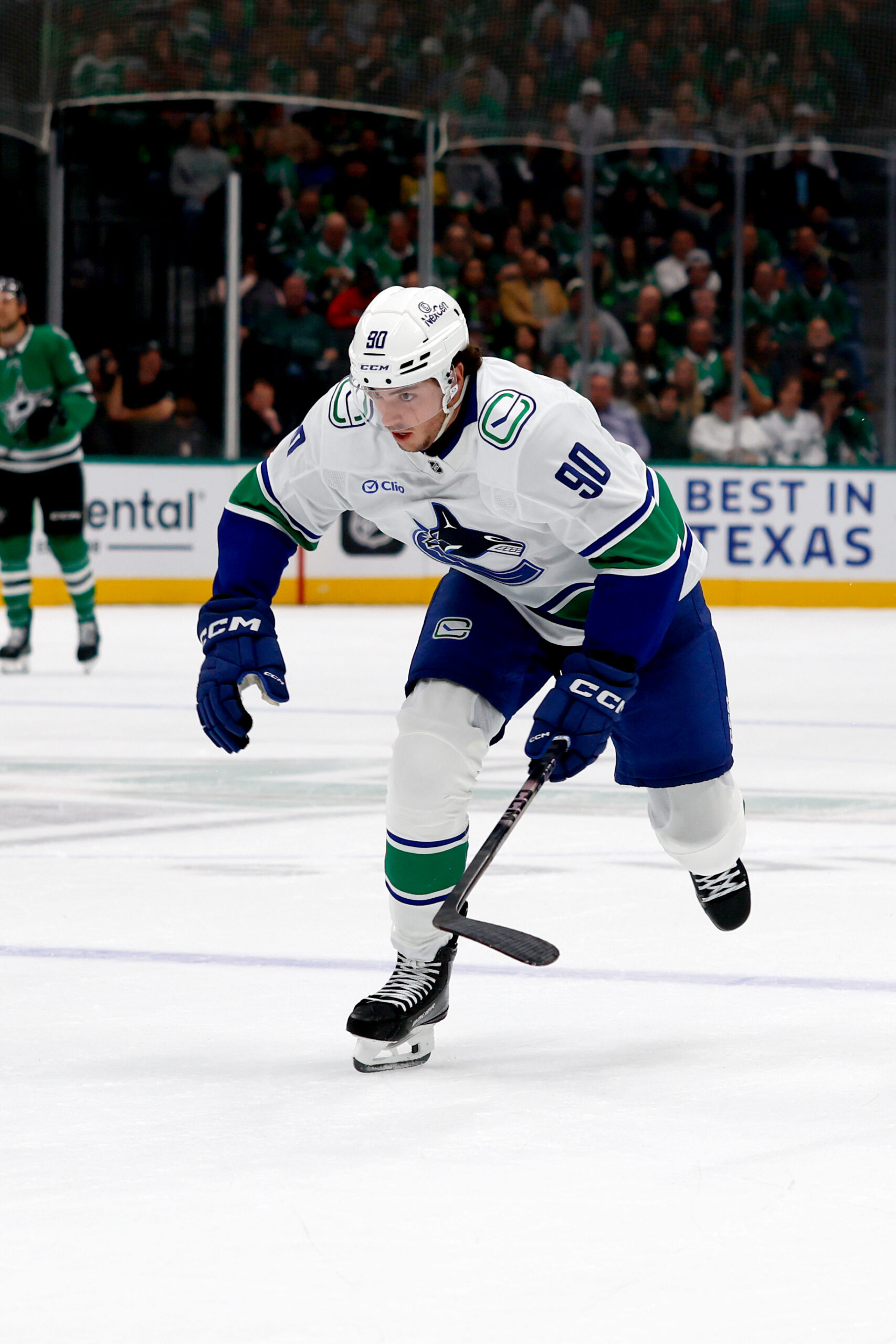
Taking Buium’s spot on the Canucks roster is another young player: Mancini. The 23-year-old was acquired from the New York Rangers last season as part of the J.T. Miller trade, and has had an up-and-down stint in the Canucks organization thus far.
He’s excelled at times, both in spurts at the NHL level and more consistently at the AHL level, where he helped Abbotsford win the Calder Cup last spring. So far this season, he’s only skated in nine games at the NHL level, averaging just 13:12 time on ice per game with little usage on special teams.
This recall places Mancini in a position to push young blueliner Tom Willander, who missed Sunday’s game with an illness, for a regular spot on the right side of the Canucks defense. Filip Hronek and Tyler Myers, the two veterans on that side of the blueline, are unlikely to be going anywhere, meaning Willander, the 11th overall pick at the 2023 draft, represents the clearest candidate from whom Mancini might try to win a lineup spot.
While it’s likely Willander has a clear leg up in terms of his chances of dressing in head coach Adam Foote’s nightly lineup, this recall is still a significant opportunity for Mancini as he tries to stake his claim to a spot in the Canucks’ future plans. At this point, Mancini’s place in Vancouver’s long-term strategy is unclear.
Three days ago, The Athletic’s Harman Dayal wrote that “the lack of improvement in his NHL play is becoming a bit concerning,” adding that “the clock is ticking for Mancini to make meaningful strides and prove he’s still an important piece of the organization’s future.” While he might not receive a significant amount of NHL time on this current recall, making the most out of whatever opportunities he receives will be imperative for the pending RFA.
Photos courtesy of Chris Jones-Imagn Images
Assessing The Canucks’ Direction
Reports surfaced earlier this month that the Canucks had re-engaged in contract talks with pending free-agent forward Kiefer Sherwood and were discussing a potential five- or six-year deal worth over $4MM per season. It’s hard to say whether the reports had merit, or whether the Canucks were serious about retaining Sherwood – or merely posturing to get a better trade return before the trade deadline.
Regardless of their true intentions, the Canucks’ direction is tough to figure out. They currently sit last in the NHL standings and, since New Year’s Day, are 0-7-2 and have been outscored 40-14. They don’t appear close to a winning run, yet there is little talk of a sell-off or a pivot into a rebuild. Their fans certainly like to talk on social media about embracing the tank, and the Canucks are reportedly willing to listen to offers for Elias Pettersson.
The truth about Vancouver is that it’s been a mess, off and on, for the better part of the last 10 to 15 years, from the top of the organization down to the players. There have been highs and moments of hope when it looked like the team was on the cusp of greatness, but those highs have been short-lived, followed by rapid declines.
The last two years are a clear example: the Canucks went from a team that was a win away from the Western Conference Final to one that missed the playoffs last season and appears destined to do the same this year. Those falls aren’t all that common (although the Rangers are living through a familiar descent) and are generally the result of self-inflicted missteps or a run of terrible luck.
In Vancouver’s case, it appears to be a mix of both, but there is no doubt that the J.T. Miller/Pettersson rift did irreparable damage that could have long-standing effects on Vancouver’s locker room.
Miller’s departure should have signaled the Canucks’ direction. Still, a quick trade for defenseman Marcus Pettersson and forward Drew O’Connor then implied that Vancouver intended to compete for a playoff spot last season, and the subsequent re-signing of both players certainly reinforced that notion.
Internal and external pressures aside, the trade to bring in Pettersson and O’Connor added to the Canucks’ depth, and they shed some bad contracts (Danton Heinen and Vincent Desharnais) in the deal with Pittsburgh. But the trades showed a lack of direction for Vancouver, and that carried into last year’s trade deadline as well as the summer, when the Canucks showed a lack of forward thinking. All of that leads us to this season, where Vancouver has spun its wheels despite rostering an ageing, expensive core.
The Miller trade to the Rangers had to happen, and while the return wasn’t great, it wasn’t awful either, as Miller has struggled to regain his form in the Big Apple. But the moves that followed the trade felt reactionary and forced, and ultimately proved in vain.
Pettersson was a top-pairing defender in Pittsburgh, but this season with the Canucks has been perhaps the worst of his career. The 29-year-old looks to be a shell of his former self and, like many players in Vancouver, has been terrible.
O’Connor has been fine in Vancouver, tallying 10 goals and seven assists in 47 games thus far while continuing to use his speed and size to be disruptive on the forecheck. That move, while tainted by Pettersson’s play this year, made sense at the time, but as the Canucks approached the trade deadline, some of management’s decision-making left a lot to be desired.
There was a moment after the Miller trade when the Canucks could have pivoted to a quick retool that might have been tough to stomach for the rest of last year and this season, but it would likely have yielded results next season. Instead, the Canucks did what they did, extended both Pettersson and O’Connor, and inked backup goaltender Kevin Lankinen to a deal that pays him $4.5MM per season for five years. All of it was reactionary, in the hope of getting the Canucks into the postseason last year. They didn’t.
The Canucks also tried to trade Brock Boeser last year at the deadline, but weren’t able to come to terms on a deal. It seemed all but certain he would bolt elsewhere in free agency last summer, but there he was on July 1, surprisingly signing a seven-year agreement with Vancouver that appears set to age like milk.
The Canucks added to their forward depth in another move, acquiring Evander Kane via trade from Edmonton. It was an acceptable deal in a vacuum; however, given Vancouver’s overall roster construction, it was a head-scratcher, as the Canucks used much of their cap space to fix the wing while watching their already thin center position get worse when Pius Suter departed in free agency.
Vancouver spent the rest of the summer making small roster changes in hopes that the core would find its mojo again. Still, a few months into the season, it was clear that wasn’t going to happen, which sparked trade rumours for their star defenseman, Quinn Hughes, whom they eventually dealt to Minnesota towards the end of 2025. The Hughes deal was actually a great haul for Vancouver given the circumstances, but it has officially put them into a hybrid retool that probably should’ve happened a year ago.
Hindsight is 20/20, but had Vancouver pivoted in early 2025 after trading Miller, they might have avoided some of the mistakes they’ve made over the past year, which have effectively set them back a few years. Instead, Vancouver is locked into long-term deals with underperforming forwards, a talented yet expensive goalie tandem that has injury and inconsistency issues, and a defense core that is now average at best.
Sure, they do have some nice young players who will likely become NHLers, but they will be surrounded by an old, pricey core unless the Canucks can start moving out from under some of the contracts they’ve locked in. No one is taking Boeser’s deal this year; the same could probably be said for Elias Pettersson’s.
But Vancouver could move their pending UFAs before the trade deadline and have nearly $17MM in cap space next summer to sign just two roster players (as per PuckPedia). That type of wiggle room could allow for additions before next season, but it’s not clear whether Vancouver should do that in the midst of what appears to be either a retool or a rebuild.
Patience might be the best thing for the president of hockey ops, Jim Rutherford and general manager Patrik Allvin to exercise, but given their track records, that has not been their strong suit, and it is a big part of the reason the Canucks find themselves where they are.
Evening Notes: Couturier, Boeser, Blue Jackets, Avalanche
Two notable players have left their respective games after taking hard shots: Sean Couturier and Brock Boeser. First, the Flyers announced mid-game their captain Couturier will not return vs Nashville. The 32-year-old’s injury was not disclosed, but he appeared bothered after blocking a shot in the first period. Couturier has been off to a great start so far this season, with nine points in nine games, looking like his old self after two straight seasons not passing the 45-point mark.
Meanwhile, the Vancouver Canucks confirmed Boeser will not return after being struck in the midsection point-blank from his teammate Elias Pettersson (defenseman) on a slap shot just 33 seconds into the game vs St. Louis. It’s an extra tough blow considering that the team is already missing Conor Garland, Quinn Hughes, and several other forwards.
Elsewhere across the league:
- The Columbus Blue Jackets recalled defenseman Dysin Mayo from AHL Cleveland, per the team. With veteran Erik Gudbranson day-to-day, having already missed time this season, Columbus has called upon the 29-year-old with 82 games of NHL experience in advance of Saturday’s game vs St. Louis. Although Mayo is likely just insurance, if he is to appear, it will be his first NHL game since 2022-23, all 82 of his so far as an Arizona Coyote. The right-hander leads the Cleveland Monsters in points, with four helpers in five games.
- In what has been a big day for the Avalanche, after locking up Martin Necas, the team announced that they have recalled defenseman Wyatt Aamodt from AHL Colorado. While Samuel Girard remains sidelined, Jack Ahcan has drawn into the lineup for the last two games, but Aamodt will be added depth if needed, as the Avs head to Vegas, then San Jose, on a road trip this coming weekend. The 27-year-old has spent the last four seasons with the Colorado Eagles, earning a two-game stint with the Avalanche last year.
Pacific Notes: Chytil, Boeser, Stone, Kapanen
While it was a good day for the Canucks on the scoreboard, it was a tough one on the injury front. Ben Kuzma of the Vancouver Province relays that center Filip Chytil exited today’s game on a hit from Washington’s Tom Wilson and had to be helped off the ice. A major penalty was initially assessed on the play but was rescinded after review. The 26-year-old has a long documented history of concussion troubles with five already and while it’s unclear at this point if that’s something he may have or not, it’s something that will ensure the team errs on the side of caution. Chytil had three goals in his first five games to tie him for the team lead heading into today’s action. Meanwhile, Rick Dhaliwal of CHEK and The Athletic adds (Twitter link) that the Department of Player Safety will review the hit but no supplemental discipline is expected.
More from the Pacific:
- Still with the Canucks, the team announced (Twitter link) that winger Brock Boeser missed today’s game for personal reasons; no further details were provided by the club. The 28-year-old had gotten off to a decent start to the season with three goals in five games while also seeing some playing time on the penalty kill, a role he hasn’t filled in a while. Jonathan Lekkerimaki took his place in the lineup but he, too, left today’s game early with an undisclosed injury.
- Golden Knights winger Mark Stone left last night’s game with what looked to be a wrist injury. Head coach Bruce Cassidy told reporters postgame including Danny Webster of the Las Vegas Review-Journal that there was no immediate update and that they were hoping to know more information about the injury by Monday. The captain has had a great start to the season, leading the league in assists with 11 through his first six games.
- Oilers winger Kasperi Kapanen left today’s game against Detroit in the second period with an undisclosed injury, the team announced. The veteran has been a regular in Edmonton’s bottom six through the first six games of the season where he has two assists. Notably, the team does not have enough accrued cap space to recall anyone from AHL Bakersfield (even with LTIR) as things stand which could be something to keep an eye on if he’s set to miss any more time.
Pacific Notes: Boeser, Janmark, Sharks
Brock Boeser played more shorthanded in Vancouver’s season opener than he did all of last season combined. That might not just be an outlier either as head coach Adam Foote told reporters including Sportsnet’s Iain MacIntyre that he hopes that the winger can become a regular on the penalty kill, a role he hasn’t held since his college days. The Canucks lost arguably their top player shorthanded this summer when Pius Suter signed with St. Louis while Teddy Blueger, another regular in that department, is banged up. Armed with the security of a seven-year deal signed at the beginning of free agency this summer, it appears that Boeser is welcoming the chance to play a bigger role this season.
Elsewhere in the Pacific:
- Oilers winger Mattias Janmark is expected to return to the lineup in about a week, notes Daniel Nugent-Bowman of The Athletic (subscription link). At that time, Edmonton will be forced into a tough roster decision. The addition of Jack Roslovic gives them 23 players on the active roster, excluding Janmark (and Jake Walman) on injured reserve. When either is activated, someone will have to be cut while the eventual return of Zach Hyman (likely sometime next month) may necessitate two players getting sent down to get back to cap compliance. With Janmark due back soon, the first of those decisions will need to be made fairly quickly.
- In recent years, the Sharks haven’t been a high-spending team and even this year, while they’re in LTIR, it’s due to taking on two significant contracts for injured players whose deals are largely covered by insurance. But as they eventually look to emerge from their rebuild, they’ll have to spend more on active players, upping their actual payroll as a result. Speaking with reporters Friday including Curtis Pashelka of The Mercury News, owner Hasso Plattner indicated that the money should be there when they need it once the team starts playing better. San Jose has been at the bottom of the standings for the last two seasons and finished fourth-last in 2022-23 and is still in its rebuilding process. Accordingly, it might be a little longer yet before Plattner needs to increase his payroll spending.
East Notes: Rust, Rakell, Boeser, Tambellini
According to Josh Yohe of The Athletic, before inking Nikolaj Ehlers to a new six-year contract, the Carolina Hurricanes were interested in a pair of veteran wingers from the Pittsburgh Penguins. The Hurricanes reportedly called on the availability of Bryan Rust and Rickard Rakell, and league sources believe one of the two will be dealt this summer.
Given his use of the past tense in his article, it doesn’t appear that Carolina has continued their interest in Rust or Rakell. Still, with more than $10MM in cap space after adding Ehlers, the Hurricanes could conceivably add another top-six winger to their forward group to put themselves over the top in the Eastern Conference.
Neither player has indicated a desire to leave the Penguins organization, but neither has the necessary protection to block a trade outright. If Carolina reconsiders in the offseason, they would likely target Rust for a middle-six role, adding more physicality and playoff experience to a high-skill lineup.
Other notes from the Eastern Conference:
- Although they only came away with Jonathan Drouin to improve their offensive woes, the New York Islanders had their eyes on a bigger prize once free agency began. According to a new article from Stefen Rosner in The Elmonters, the Islanders were the highest on the list for winger Brock Boeser, if he wanted to leave Vancouver. Ultimately, although he would have been a tremendous goal-scoring asset for New York, Boeser remained with the Canucks on a new seven-year, $50.75MM deal.
- The Tampa Bay Lightning announced that they’ve hired Jeff Tambellini as their new Assistant General Manager and Director of Hockey Operations. Tambellini is a former six-year veteran of the NHL, playing for the Islanders, Canucks, and Los Angeles Kings. He had previously worked for the Lightning as a collegiate scout from 2020 to 2022 and the Seattle Kraken’s Director of Player Development from 2022 to 2025.