
Penguins Sign Nick Robertson To Two-Year Deal
According to Elliotte Friedman, the Penguins have settled with Nicholas Robertson on a new contract.
The forward was one of 15 RFAs who filed for Salary Arbitration. A few days ago, the dates for each player’s arbitration hearings were set, including Robertson. If a deal wasn’t reached before the proceedings, the Penguins had the option to choose between a one or two-year contract for Robertson, with the arbitrator settling the value of the contract.
His arbitration hearing was on the calendar for later this month, on July 28th. Robertson avoids that hearing by signing a two-year, $6.5MM ($3.25MM AAV) contract, per Friedman. The deal will pay him through the 2028-29 season, when he’ll turn 26 and become an RFA again.
He finished his 2025-26 season scoring 16 goals for 32 points with the Toronto Maple Leafs, setting career-highs for the former 2019 second-round pick. The Leafs traded him to Pittsburgh on July 1st for a 2028 fourth-round pick, reuniting Robertson with the GM who originally drafted him, Kyle Dubas.
The 24-year-old winger, a second-round pick in 2019, has profiled as a useful supplementary scoring forward in a middle-six role, especially in the last three seasons as a 20-30 point player, with 14, 15, and 16 goals in each of those three seasons. He’s built that up through his six bumpy seasons under the Toronto organization, where, with much trade speculation, linking him to the Penguins all the way back to 2024, he had signed two one-year deals after his entry-level contract’s end in 2024 and never received over 13 minutes of ice time.
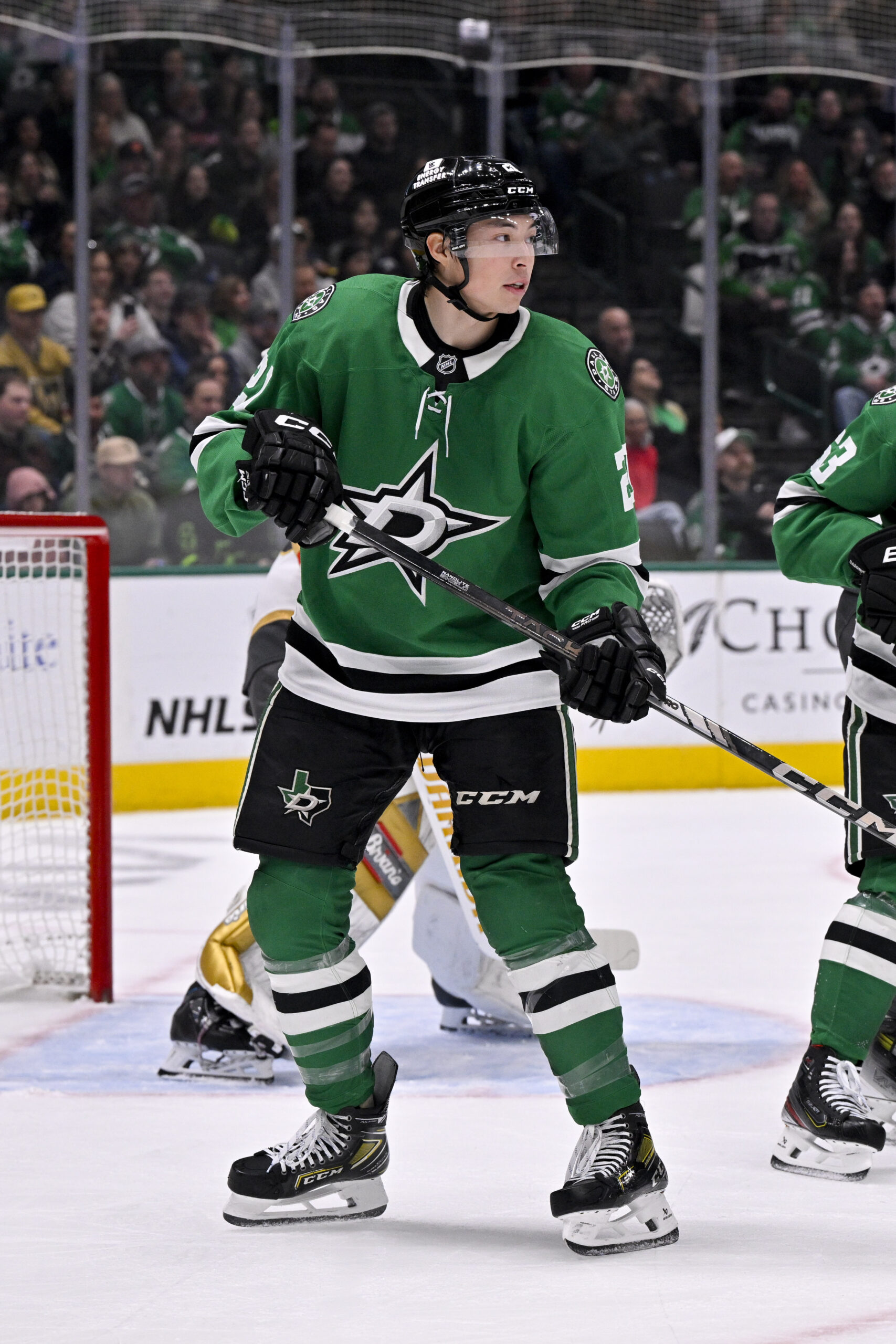
Now with Pittsburgh, Robertson is a younger option within the forward group for the Penguins, turning 25 in September. The Pens now have around $13MM in cap space and 14 forwards on their books. It should be noted that Nicholas is the younger brother of Stars star Jason Robertson, who remains in need of a new contract. If the Penguins are attempting to pony up to acquire the American scorer, signing his brother is one way to start.
More to come.
Rangers Sign Braden Schneider To A One-Year Extension
The Rangers have avoided an arbitration hearing, signing defenseman Braden Schneider to a one-year contract carrying a $5.5MM cap hit, per PuckPedia. The deal consists entirely of salary, with no signing bonus. Schneider’s hearing had been scheduled for July 29.
It’s a significant raise for the 24-year-old, who was coming off a two-year bridge deal worth $2.2MM annually and had been issued a qualifying offer of $2.64MM. Schneider filed for arbitration ahead of the July 5 deadline, one of 15 players league-wide to do so, a move that also removed the possibility of an offer sheet. The new contract leaves him a restricted free agent again next summer.
Schneider handled the heaviest workload of his career in 2025-26. He played all 82 games and averaged 20:27 per night, a career high, while leading the club with 140 blocked shots and ranking third in hits with 163. The Prince Albert native finished with 18 points (two goals, 16 assists). The bulk of that ice time came under difficult circumstances: with Adam Fox sidelined for two extended stretches, Schneider was pushed into 27 games on the top pair, as reported by John Kreiser, and inherited the toughest matchups on the roster, an assignment well above what he had been asked to shoulder to that point. His underlying numbers took a hit accordingly, though the context is hard to separate from the results.
New York reinforced the group around him this offseason, acquiring Sean Durzi and Marcus Pettersson to solidify their defensive pairings heading into the 2026-27 season. That should return Schneider to a third-pair role with more manageable five-on-five deployment. At 24, he’s still on the early side of the development curve for a defenseman, and this contract gives both sides a season to sort out what comes next.
Sabres Extend Peyton Krebs After Arbitration
According to Elliotte Friedman, the Buffalo Sabres and Peyton Krebs have settled their arbitration case.
Krebs will sign a four-year extension in Buffalo with a $4.5MM cap hit, per Friedman. The Sabres later confirmed the report. Krebs will make $18MM across that timeframe, having a modified no-trade clause that includes seven teams for the 2028-29 and 2029-30 seasons, which takes him into UFA status at age 29.
The young forward was one of 15 RFAs who filed for Salary Arbitration. Yesterday, the dates for each player’s arbitration hearings were set, including Krebs, who was scheduled for August 1st of this summer. If a deal wasn’t reached before the proceedings, the Sabres had the option to choose between a one or two-year contract for Krebs, with the arbitrator settling the value of the contract.
The 25-year-old is coming off a career-best 12 goals for 39 points in 2025-26 and was arbitration-eligible while being owed a $1.45MM qualifying offer. He added six points in six playoff games against the Boston Bruins, competing in 13 total postseason games for the Sabres in the second season of a two-year, $2.9MM ($1.45MM AAV) contract signed back in 2024. After serving as a bottom-six presence in previous seasons with Buffalo, Krebs was elevated into a top-line role with Tage Thompson and proved reliable.
“He’s like my Swiss Army Knife that I can just flip out a different blade at any time and let him go at it,” coach Lindy Ruff said per the press release.
Krebs joined the Sabres back in 2021, as part of the blockbuster trade package in return from the Vegas Golden Knights for Jack Eichel. Over the past couple of seasons, since that, he’s played 243 games, the most by a Sabre in a three-season span. He notably finished second on the Sabres in hits with 201, making him one of seven NHLers to produce as many hits with his point production. The Calgary native also provides much-needed speed for the up-and-coming Sabres, ranking one of the NHL’s faster skaters in the 92nd percentile for max speed at 23.28 mph and 90th percentile for 20-22 mph bursts, with 158 total in 2025-26.
The former 17th overall pick in the 2019 NHL Draft signed a three-year $2.59MM ($863K AAV) deal with the Golden Knights shortly after he was selected and didn’t make his NHL debut until the 2020-21 season, finishing out his major junior career with the Wenatchee Wild in the WHL, winning the leagues Player of the Year Award and finishing a silver medalist with Canada at the World Junior Championships.
The Sabres cut their cap space in half with the signing of Krebs to this extension. They now have $4.1MM in cap space with Krebs being the 14th forward now on the team’s books. Buffalo also still has the buyout of Jeff Skinner on their payroll, as it counts towards 6.2% of the team’s overall cap hit, denting them as they progress forward with the losses of Alex Tuch to Washington and trading Bowen Byram to Chicago. While bringing in defenseman Olen Zellweger, the Sabres could still have more in store if they can get fancy with their moves, with the intrigue of potentially acquiring goaltender Connor Hellebuyck and Buffalo native Patrick Kane remaining unsigned as a free agent.
Photo Credit: Kamil Krzaczynski-Imagn Images
Hearing Dates Set For Players Who Filed For Arbitration
Salary arbitration hearings are a little more than a week away with a total of 15 players filing for one earlier this month. Ottawa’s Xavier Bourgault has already signed while the other 14 are still without contracts. PuckPedia has received the schedule for hearing dates, which is as follows:
July 20
D Jamie Drysdale, Flyers
F Cole Perfetti, Jets
July 22
F Trevor Zegras, Flyers
July 23
G Jet Greaves, Blue Jackets
July 25
F Connor McMichael, Blues
F Jason Robertson, Stars
July 27
F Cole Sillinger, Blue Jackets
July 28
F Nicholas Robertson, Penguins
July 29
D Braden Schneider, Rangers
D Ronan Seeley, Hurricanes
July 30
F Kirby Dach, Canadiens
F Alex Jefferies, Islanders
August 1
F Peyton Krebs, Sabres
G Akira Schmid, Panthers
Philadelphia will be busy early in the process but that is by choice, as teams can request where their players are scheduled on the arbitration docket. Conversely, teams like Montreal, Florida, and Buffalo likely requested that their players be placed at the back, allowing for more time for negotiations or planning.
A refresher on the arbitration rules:
- A player and team can settle on a deal at any point before the hearing starts.
- Once the hearing has taken place, the arbitration decision must be issued by email within 48 hours of the closing.
- Arbitration awards can only be one or two years in length; players who are in their final year of restricted free agency are only entitled to a one-year term.
- The team decides on the awarded term, as these were all player elections.
- The team can walk away from the arbitration decision if a contract with an average annual value of more than $4.9508MM is Teams have 48 hours to decide if they’ll accept or walk away.
Once a team has had all of its cases settled or awarded, a second buyout window will open up three days later. However, only a player who was on the roster at the trade deadline and has a cap charge of $4MM or more is eligible to be bought out during this 48-hour window.
15 Players Elect For Salary Arbitration
The deadline to file for salary arbitration passed at 5 P.M. ET on July 5. 15 players elected to head to arbitartion before then, including the market’s top free agent, Dallas Stars’ winger Jason Robertson. Arbitration hearings will take place between late-July and early-August. Filing for arbitration will restrict players from negotiating contracts with any other team, removing high-value RFAs like Robertson from offer sheet eligibility. Players will have the opportunity to continue negotiating with their current team and could avoid arbitration by reaching a new deal before their hearing occurs. The full list of players who filed for salary arbitration in 2026, per Chris Johnston of The Athletic, is as follows:
F Xavier Bourgault (Ottawa Senators)
F Kirby Dach (Montreal Canadiens)
D Jamie Drysdale (Philadelphia Flyers)
G Jet Greaves (Columbus Blue Jackets)
F Alex Jefferies (New York Islanders)
F Peyton Krebs (Buffalo Sabres)
F Connor McMichael (St. Louis Blues)
F Cole Perfetti (Winnipeg Jets)
F Jason Robertson (Dallas Stars)
F Nicholas Robertson (Pittsburgh Penguins)
G Akira Schmid (Florida Panthers)
D Braden Schneider (New York Rangers)
D Ronan Seeley (Carolina Hurricanes)
F Cole Sillinger (Columbus Blue Jackets)
F Trevor Zegras (Philadelphia Flyers)
Jason Robertson To File For Arbitration
Ahead of today’s 4 p.m. CT deadline for eligible players to file for arbitration, Dallas Stars winger Jason Robertson “has indicated he will file,” reports Elliotte Friedman of Sportsnet.
By filing for arbitration, Robertson would lose the ability to sign an offer sheet with another club. If Robertson and the Stars cannot reach a deal on their own, the case will go before an arbitrator. In that course of events, Robertson’s one-year award would consume the final year of team control the Stars have over him. As a result, he would become an unrestricted free agent in one year’s time, assuming no other contract is signed.
This is, of course, an outcome the Stars are likely to want to avoid. While GM Jim Nill has said repeatedly that his organization’s No. 1 priority is getting Robertson signed to a contract extension, an actual agreement on a new deal has proved elusive.
After the American winger scored 45 goals and 96 points (his third time crossing the 40-goal mark), Robertson and his representatives (led by Andy Scott of Octagon Hockey) have a strong argument to receive at least the $12MM AAV pledged to teammate Mikko Rantanen on his current contract.
After Leo Carlsson of the Anaheim Ducks signed a deal carrying an $18MM AAV in the form of an offer sheet with the Philadelphia Flyers, Robertson’s case to earn $12MM or above has only strengthened. Whether the Stars are willing to go beyond that figure is unclear at this time, though one presumes if the team was willing to go to such great lengths to re-sign Robertson, a deal would have already been made.
The Stars currently have just under $10MM in cap space according to PuckPedia. While that could be enough to absorb whatever salary an arbitrator might award to Robertson, it almost certainly won’t be enough to fit in a full contract extension. More moves may be required.
Dallas also has the option of trading Robertson, a possibility they have been actively exploring this offseason. The team reached an agreement with the Seattle Kraken on a sign-and-trade involving Robertson in late June, but Robertson blocked the deal by rejecting the Kraken’s $15MM AAV contract offer.
Seeing as the Stars appear unlikely to reach an agreement with Robertson on a new deal, a trade that secures his exit from Dallas a year in advance of a potential trip to unrestricted free agency could be the best move for all involved parties. From Dallas’ perspective, the outcome where Robertson exits via unrestricted free agency – with no compensation returning in Dallas’ direction – must be avoided at all costs.
The Stars have been one of the NHL’s premier competitive franchises over the last half-decade, arguably the league’s strongest overall franchise to still lack a Stanley Cup ring from that period. With how close Dallas has gotten to a Stanley Cup throughout the 2020s, it is imperative that the club secure as much value as it can possibly get out of the remaining control it has over Robertson in his final year before UFA status.
Photos courtesy of Nick Wosika-Imagn Images
2026 NHL Offseason Need To Know Dates
The NHL offseason is officially underway with the Carolina Hurricanes defeating the Vegas Golden Knights in just six games, thus concluding the 2026 Stanley Cup Final. All 32 teams are now in summertime mode, and with that, there is not much rest, even for the Stanley Cup Champions in Raleigh. Throughout the next few weeks, teams have many dates on the calendar that they’ll need to prepare themselves for as the calendar continues to flip into the summer months.
Provided is an overview of some dates to look out for:
- 48 hours after the Stanley Cup Final, the NHL buyout window will open. NHL teams can only complete a buyout on a player’s contract from the start of that window until June 30th, when the timeframe closes at 5 p.m. ET. Of note, there is wiggle room where teams can also receive a second 48-hour buyout window if a player files for arbitration and the case is settled. This window applies only to players with more than a cap hit of $4MM AAV and who had been rostered by their team at the most recent trade deadline. Once a buyout occurs, a player becomes an unrestricted free agent and can sign with any team they choose.
- The 2026 NHL Draft takes place on June 26-27, with the first round taking place on Friday, the 26th at 7 p.m. ET at the KeyBank Center in Buffalo, NY. Rounds 2-7 will begin at 11 a.m. on the 27th, and all coverage will be provided on ESPN, ESPN+, SN, and TVAS. The Toronto Maple Leafs hold the No. 1 overall pick, with Gavin McKenna and Ivar Stenberg highlighted as the top skaters to be taken.
- Restricted Free Agent qualifying offers are due on June 29th. For a team to be able to keep a player’s RFA status, it must make a Qualifying Offer. If a team does not provide a Qualifying Offer, their player can become a UFA. Qualifying Offers must be offered to the player by the later of Monday after the Draft or June 25. Notable names to make decisions on include top 2023 draft picks like Connor Bedard, as well as other Western Conference star scorers like Jason Robertson and Pavel Dorofeyev.
- RFAs can begin discussions regarding offer sheets on June 30th. Offer sheets are contracts that other teams can present to a player whose rights are under an organization. If the player signs the contract, the original team that owns the player’s rights is given seven days, and therefore, the rights to match the terms of the initial offer. If not, they can receive compensation, such as draft capital from the team that offered the contract, based on the terms.
- NHL Free Agency begins on July 1st at noon E.T. Unrestricted free agents are open to sign with any team, and their previous team receives no compensation. UFAs cannot sign contracts with new teams until the window opens, which is when we’ll ultimately see where top names like forward Alex Tuch and defenseman Darren Raddysh cash in, but where?
- Deadline for Arbitration from eligible RFAs is due by July 5th at 5 p.m. ET. Based on the player’s age, years, and pro experience, they can elect to go to arbitration to settle the player’s next contract with the team. Teams can also elect for arbitration, but are limited to two per offseason. Ultimately, an arbitrator can only award up to two years on the next contract. Hearings can take place from July 20th, all the way through August 1st.
Photo Credit: Jerome Miron-Imagn Images
Players Eligible For Salary Arbitration In 2026
Salary arbitration is a rare occurrence in hockey. The process is limited to restricted free agents, and even then, there are restrictions about which RFAs can utilize the tool to resolve contract disputes. Depending on the age at which a player signed their first NHL contract, they must have a certain number of years of professional experience before being able to elect for it (full table via PuckPedia).
Only 11 players filed for arbitration last season. None of those cases required a hearing. Nonetheless, countless more names are actually eligible to file for arbitration. That eligibility factor, in and of itself, can influence how teams handle earlier rounds of negotiations. Teams never want to be locked into an award they can’t opt out of (which is the case below the ~$5MM mark; this year’s number is yet to be decided), and the undesirable hearing process can fracture long-term relationships between team and player.
Most commonly, it will be the player electing for arbitration. Teams can also do so if the player is eligible, but there are added restrictions. They can only make two elections per year, and the player in question can still sign an offer sheet before July 5, even if the team has already filed for arbitration. A player can also only be subject to one team election in their entire career, and a salary of $2.43MM or greater in the previous season locks in the award at no less than 85% of their preceding salary. That restriction does not exist for player-elected arbitration.
Even in cases where arbitration is elected, the vast majority of them will result in a settlement before a hearing is reached. This can even happen after both sides submit their salary filings to the arbitrator, right up until the hearing begins.
There has been a consistent downward trend in the number of arbitration filings since 2022. It’s hard to imagine that number bottoming out more than last year’s, but it’s something to consider.
Here’s each team’s list of players they’ll have to be on the lookout for this summer for a potential filing:
Avalanche (6)
Blackhawks (2)
Blue Jackets (5)
Blues (6)
Bruins (4)
Maple Leafs Re-Sign Nicholas Robertson
There will be no arbitration hearings in the NHL this summer. The last remaining case has settled as the Maple Leafs announced that they have re-signed winger Nicholas Robertson to a one-year, $1.825MM contract.
The agreement comes one day after the two sides made their submissions in advance of Sunday’s scheduled hearing. Toronto filed at $1.2MM while Robertson’s camp came in at $2.25MM. The midpoint of those numbers is $1.725MM so Robertson was able to beat that by $100K with this agreement while it represents a big raise on the $875K he received last season.
The 23-year-old has shown himself to be a capable depth scorer but that alone hasn’t been enough to stay in the lineup with much consistency. After notching 14 goals in 56 games in 2023-24, Robertson was able to slightly beat that total last season, tallying 15 times while adding seven assists in 69 games. He also averaged a career-high 12:00 per game of playing time.
However, while he was in the lineup more often than not during the regular season, that wasn’t the case in the playoffs. Robertson played in just three games for the Maple Leafs during the playoffs despite picking up points in two of those outings, a goal and an assist.
The lack of consistent playing time led Robertson to request a trade last summer, an ask that wasn’t granted. At this point, it doesn’t appear as if the request has been dropped either. However, a $1.825MM price tag for a player who hasn’t been able to stay in the lineup on a regular basis might be on the high side for some teams although a swap of young forwards on similar contracts could be a viable path to a change of scenery for Robertson.
On the other hand, Toronto’s most prominent offseason addition up front to replace Mitch Marner was winger Matias Maccelli, acquired from Utah. With the Maple Leafs looking to ice a more balanced lineup, there could be a chance for Robertson to get more of a look in a top-six or even top-nine role in 2025-26 and if that were to happen, he might be inclined to rescind his request to be moved.
With the signing, Toronto has all its NHL restricted free agents under contract but they still have a pair of prospects to re-sign over the coming weeks in goaltender Dennis Hildeby and defenseman William Villeneuve. While Hildeby was arbitration-eligible, he declined to file for a hearing early last month.
Now that Robertson is signed, the cap picture for the Maple Leafs looks clearer. Per PuckPedia, Toronto has around $1.1MM in flexibility, albeit with 24 players on its roster with the maximum being 23 healthy players. That gives GM Brad Treliving a bit of wiggle room to work with while they’re believed to be looking to move winger Calle Jarnkrok ($2.1MM) and David Kampf ($2.4MM) to open up both cap and roster space. Their ability (or lack thereof) to do so might ultimately dictate if they can make any other moves this summer.
Sportsnet’s Elliotte Friedman was the first to report the deal.
Arbitration Breakdown: Nicholas Robertson
Every player to file for arbitration so far this offseason has avoided a hearing, and only one case even got remotely close. That likely won’t be the case for the Maple Leafs and Nicholas Robertson, who have until their hearing starts on Sunday to settle before an arbitrator’s award will decide their fate.
Filings
Team: $1.2MM
Player: $2.25MM
Midpoint: $1.725MM
(via Elliotte Friedman of Sportsnet)
The Numbers
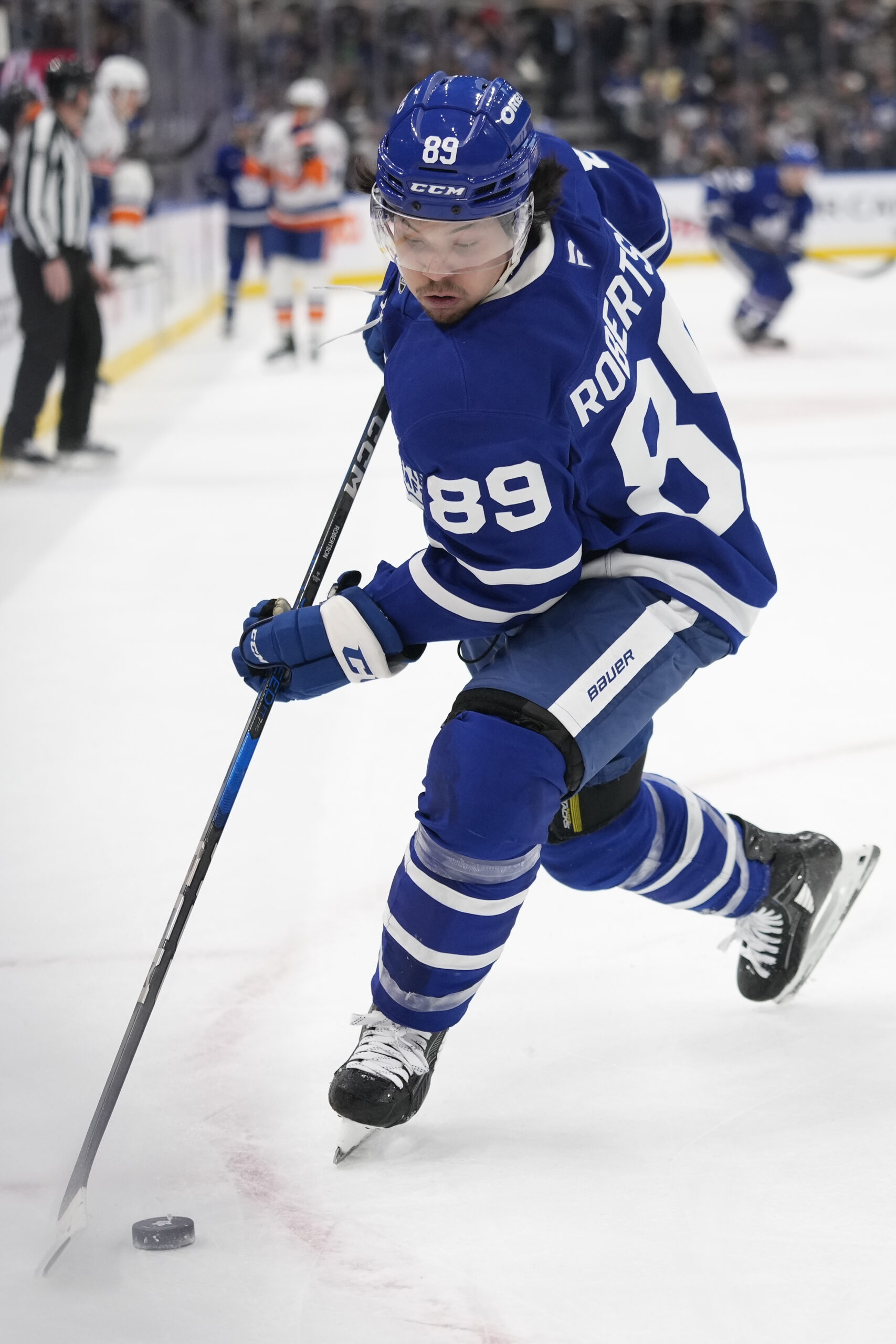 Nothing much really changed last season for Robertson. After a trade request last summer didn’t come to fruition, he ended up inking a one-year, $875K deal to return to Toronto in hopes of landing a more consistent role in their top-nine forward group. That didn’t happen. While he did make a career-high 69 appearances, the 23-year-old’s usage remained conservative at 12 minutes per game, and his point pace dropped off from his 2023-24 performance. He finished the year with 15 goals – seventh on the team – but only seven assists for 22 points, a rate of 0.32 per game after he recorded 0.48 per game the year before in lesser minutes.
The younger brother of Stars centerpiece Jason Robertson has always been viewed as one of the higher-ceiling young offensive options in Toronto’s system. He’s shown it in flashes, but it’s clear at this stage he needs a longer leash and more minutes to truly be effective without many other elements to his game (although he did manage a career-high 79 hits last year).
Whether he’ll receive that in Toronto remains to be seen. In any event, the Leafs’ seven-figure filing is significantly higher than his $775K cap hit from 2024-25, so it’s clear they’re anticipating on him playing a slightly more regular role in 2025-26 and will presumably count on him for more depth scoring in the wake of Mitch Marner‘s departure. But for a player with just over 150 career appearances, it’s going to be a tad difficult to project how a potential hearing may shake out.
2024-25 Stats: 69 GP, 15-7–22, -1 rating, 16 PIMs, 112 shots, 12:00 ATOI
Career Stats: 156 GP, 32-24–56, +2 rating, 24 PIMs, 258 shots, 11:28 ATOI
Potential Comparables
Comparable contracts are restricted to those signed within restricted free agency, which means UFA deals and entry-level pacts are ineligible to be used. The contracts below fit within those parameters. Player salaries (or current-year equivalents) also fall within the parameters of the submitted numbers by both sides. Career stats listed are as of the time of signing.
Jonatan Berggren (Red Wings) – Berggren is a year older than Robertson and has fewer seasons of NHL experience, but they’ve both clicked at around a 30-point pace for their career in similar deployment. Like Robertson, Berggren’s platform year saw him play the most games of his career, but not with the best per-game production rate. While an imperfect science, there’s good evidence for both sides here to argue for a deal closer to the midpoint rather than an extreme swing toward either Toronto’s or the player’s filing.
Contract (2025): One year, $1.825MM AAV, 1.9 CH%
Platform Stats: 75 GP, 12-12–24, -13 rating, 14 PIMs, 88 shots, 12:59 ATOI
Career Stats: 154 GP, 29-29–58, -28 rating, 32 PIMs, 200 shots, 13:01 ATOI
Sonny Milano (Ducks) – This may be the best comparable available aside from its outdatedness. Milano was also coming off his age-23 season and, like Robertson, had five years of NHL experience despite the lower games-played total. Note the higher cap hit percentage since the deal was signed five years ago – that might be something Robertson’s camp puts on the table to get him closer to or at the $2MM mark for his award (a 2.1 CH% with a $95.5MM cap ceiling is almost exactly $2MM on the dot).
Contract (2020): Two years, $1.7MM AAV, 2.1 CH%
Platform Stats: 55 GP, 7-16–23, -7 rating, 26 PIMs, 75 shots, 13:06 ATOI
Career Stats: 125 GP, 22-25–47, -17 rating, 36 PIMs, 153 shots, 12:07 ATOI
Jack Quinn (Sabres) – Quinn comes across near the higher end of these comparables. While the perception around Quinn having a down year last season may have some truth to it, the numbers still point to him being at least a tier above Robertson in terms of what he’s actually produced. Add in Quinn’s draft pedigree as a No. 9 overall pick, and it’s easier to see why Robertson’s filing wasn’t higher than it was, although his camp may still attempt to draw comparisons to convince the arbitrator to side with them outright.
Contract (2025): Two years, $3.375MM AAV, 3.5 CH%
Platform Stats: 74 GP, 15-24–39, -18 rating, 18 PIMs, 123 shots, 14:52 ATOI
Career Stats: 178 GP, 39-58–97, -26 rating, 41 PIMs, 311 shots, 14:33 ATOI
Filip Zadina (Red Wings) – Aside from the draft pedigree, Zadina’s comparable here is also a pretty direct one. He was only one year younger than Robertson was at the time of their contract signings, but had seen more deployment to the tune of similar career offensive results with worse defensive impacts. Given the cap percentage, this would come across as a more advantageous comparable for Robertson.
Contract (2022): Three years, $1.825MM AAV, 2.2 CH%
Platform Stats: 74 GP, 10-14–24, -24 rating, 10 PIMs, 154 shots, 14:11 ATOI
Career Stats: 160 GP, 25-36–61, -46 rating, 12 PIMs, 329 shots, 15:13 ATOI
Projection
Since Robertson was the one to file and has multiple years of team control remaining, the Maple Leafs can pick a one or two-year term for his next contract after the arbitrator awards the AAV. Considering his inconsistent year-to-year pace, it stands to reason they’d pick a one-year deal to make him a more attractive trade chip if he doesn’t pan out this year (or give themselves the option to walk away entirely next summer).
The comparable contracts advocate for a deal near the midpoint but slightly in Robertson’s favor, likely in the $1.8MM-$2MM range. It may not be as much as he wanted, but it still doubles last year’s salary and will give him a seven-figure salary for the first time in his career.
Image courtesy of John E. Sokolowski-Imagn Images.