
Plenty Of Talent Remains Unsigned Among Restricted Free Agents
Now that all of the arbitration hearings have concluded and any player filings resolved, 21 restricted free agents remain unsigned around the league. These players must have a contract by December 1st in order to play at all this season, otherwise they will have to sit out the whole season. On the list are several players who play a huge role on their respective teams, and are likely in negotiations on long-term contracts.
Dylan Larkin, perhaps the most talented offensive player on the Detroit Red Wings, expects to sign before training camp begins in a little over a month. There have been reports that he’s looking at a five or six year contract, which would take him right to unrestricted free agency. The talented forward scored 62 points last season and is a huge part of the future for the Red Wings, but the team is currently in salary cap trouble and likely needs to make a move of some sort before the start of the year to fit Larkin in.
William Nylander has also been clear in his desire for a long-term deal, but isn’t stressing about the negotiations. The Toronto Maple Leafs will face questions over the next few seasons of how to fit all of their talented forwards under the cap, and the first real step towards that salary structure is getting something done with Nylander. The 22-year old forward finished with 61 points for the second year in a row, but could take another step forward if the Maple Leafs second powerplay unit rebounds in 2018-19.
Among defensemen, Noah Hanifin, Shea Theodore and Josh Morrissey stand out as some of the most important names. Hanifin’s contract is finally on the front burner after a busy arbitration schedule for the Calgary Flames, and things are progressing in a “positive” direction. When the Flames bought out Troy Brouwer‘s contract last week they gave themselves some flexibility for signing Hanifin to a long-term deal, but could always go the bridge route to make sure he fits into their organization properly. Theodore developed into a key piece for the Vegas Golden Knights this season after starting in the minor leagues due to a roster crunch, and should be rewarded accordingly on his new deal. The Golden Knights haven’t been shy about locking up some of their key players recently, and Theodore should likely be no different.
Morrissey is interesting, given the uncertainty around the Jets blue line in general. Jacob Trouba is once again on a short-term deal and could bolt for unrestricted free agency in 2020, while Tyler Myers is scheduled to become a UFA next summer. If the team has plans on retaining either of them they’ll have to be careful with how much money they commit to Morrissey, despite his obvious talent and fit for the club.
The full list of restricted free agents is below:
Ondrej Kase (ANA)
Nick Ritchie (ANA)
Marek Langhamer (ARZ)
Sam Reinhart (BUF)
Noah Hanifin (CGY)
Hunter Shinkaruk (CGY)
Dylan Larkin (DET)
Matt Puempel (DET)
Darnell Nurse (EDM)
Michael McCarron (MTL)
Kerby Rychel (MTL)
Kevin Rooney (NJD)
Steven Santini (NJD)
Miles Wood (NJD)
Jordan Schmaltz (STL)
William Nylander (TOR)
Shea Theodore (VGK)
Eric Comrie (WPG)
Nicolas Kerdiles (WPG)
J.C. Lipon (WPG)
Josh Morrissey (WPG)
Edmonton Fans Still Waiting For Big Changes
The Edmonton Oilers were one of the biggest disappointments of the 2017-18 season. Despite being led by one of the best players in the world in Connor McDavid, the team dropped 25 points in the standings and finished well out of the playoffs. Only three players on the team broke the 15-goal or 40-point thresholds, and goaltender Cam Talbot posted his worst season as a professional. Changes were obviously needed, and big things were expected from GM Peter Chiarelli, who had never been known for his hesitation in the past. Chiarelli has always been willing to trade players who he believed were problems, and acquire assets that could help his team.
In April, just after the Oilers season had come to a close, Jim Matheson of the Edmonton Journal wrote a piece outlining ten changes that could happen in order to get the team back to the playoffs in 2018-19. Among them was a common thread, that basically everyone on the roster outside of McDavid, Leon Draisaitl and Ryan Nugent-Hopkins should be considered available. Real additions also needed to be made up front, to help add some secondary scoring to the rest of the lineup. A puck-moving defenseman should be added, and something needs to be done about the left-handed imbalance of the blue line.
This summer though, almost none of those things have happened.
A change in the coaching staff was expected, and the team did bring in several new faces to help head coach Todd McLellan this season. Glen Gulutzan, Trent Yawney and Manny Viveiros were all hired as assistants, replacing several outgoing names. That should give the team a different look in terms of system, but those asked to perform will be the same. The defense corps remains relatively unchanged, other than the fact that Darnell Nurse is still without a contract and Kevin Gravel was brought in on a two-way contract. No additional puck-movers have been added, meaning as it stands the burden will once again fall on players like Nurse and Oscar Klefbom to really drive the team.
 On the topic of secondary scoring, there has been little change. Tobias Rieder and Kyle Brodziak were the Oilers’ big free agent additions, giving the team two more middling offensive talents to plug into the lineup. While Rieder has shown potential at times, he still only recorded 12 goals and 25 points last season. Brodziak is actually coming off one of the better offensive campaigns of his career with 10 goals and 33 points, but shouldn’t be expected at age-34 to be an answer to the team’s problems.
Perhaps the biggest change came in net, where the team opted to avoid signing one of the more proven names in free agency and instead brought in Mikko Koskinen from the KHL. The 30-year old goaltender had an incredible season for SKA St. Petersburg in 2017-18, but hasn’t played in North America on a full-time basis since 2011. If Koskinen can push Talbot back to the level he had previously shown the Oilers will be much more competitive, but there’s no guarantee they’ll have any consistency in the position this year.
No instead of the big changes that were expected, the Oilers have generally sat on their hands this summer and hoped a change could come from within. Even their 10th-overall pick in the draft which they were open about potentially trading, was eventually used to pick Evan Bouchard. There’s clearly a boatload of talent in the London Knights blueliner, but if Bouchard isn’t able to jump right to the NHL this season he can’t help a team that needs to compete immediately. If it’s not Bouchard, then perhaps Jesse Puljujarvi is the key to the offseason in Edmonton. The fourth-overall pick from 2016 is now 20 years old, and needs to become an impact player this season. In 65 NHL games last year he registered 12 goals and 20 points, but those numbers need to improve drastically if the Oilers are to expect a winning season.
There is a chance that the team still makes a big splash to bring in some scoring help, but there financial situation is obviously limiting them. With just $4.98MM in cap space and Nurse still to sign, the team likely couldn’t go after someone like Jeff Skinner. In order to land the talented winger from Carolina, the Hurricanes would have had to accept another contract back in order to even out the salaries. That puts the Oilers in a distinct disadvantage in trade talks, and one that won’t be fixed anytime soon. None of the hefty Oilers contracts come off the books next season outside of Talbot and Koskinen, but there isn’t a brilliant young goaltender ready to step into that void on an inexpensive contract. Without moving a defenseman or Milan Lucic‘s contract, the Oilers will remain in salary trouble as they try to add pieces in the future.
For an offseason that was expected to bring fireworks in Edmonton, and help surround McDavid with a team that could give him a legitimate chance for the Stanley Cup, things have been awfully quiet. Oilers fans will have to hope that change is coming from places they didn’t expect, and someone can step up to alter their fortunes. Otherwise it could be a long season, and another wasted opportunity with one of the game’s premiere talents.
Photo courtesy of USA Today Sports Images
Poll: Ottawa’s Impending Free Agents
The Ottawa Senators are a team in trouble. The Senators finished with a 28-43-11 record last season for a total of 67 points, second-lowest in the NHL. The team also placed close to the bottom in both goals for and goals against, which combined for a the league’s second-worst goal differential of -70. Ottawa dealt with a public relations nightmare this summer surrounding Mike Hoffman and ended up having to deal the dependable scorer away for pennies on the dollar. They have thus far failed to add any difference-makers via trade or free agency this off-season as well. On top of that, owner Eugene Melnyk is reportedly hemorrhaging money and appears to have a singular focus of spending as little as possible this season. That task is made difficult by a roster that features overpaid, ineffective veterans such as Bobby Ryan, Marian Gaborik, and Mikkel Boedker and a 37-year-old goalie coming off the worst season of his career in Craig Anderson. The Senators are the popular pick to be the worst team in the NHL in 2018-19, but even that has no silver lining, as the Colorado Avalanche own Ottawa’s first-round pick, potentially the first overall pick in next year’s draft.
It almost seems like so much is going wrong in Ottawa that things can only get better. Unfortunately, that is simply not the case. Early in this off-season, the Senators made a contract extension offer to all-world defenseman Erik Karlsson, who is slated for free agency next summer. When Karlsson dismissed this initial offer, the team made it know that they were open to trading the face of the franchise. Just this week, the team was unable to come to terms on a long-term extension with top scorer Mark Stone, instead signing him to a one-year deal that will make him an unrestricted free agent after the season, where he will potentially be the biggest available name behind Karlsson. Perhaps the biggest bargain on the team, Ryan Dzingel‘s team-friendly contract runs out after next season and the young forward will want a significant raise, even if that means it doesn’t come from the penny-pinching Senators. Finally, Matt Duchene, who Ottawa gave up substantial trade capital to acquire early last season – when their future looked much brighter – is also entering the final year of his contract and may not want to stick around any longer in Ottawa after the team fell apart soon after his acquisition.
With Hoffman and Derick Brassard already gone, the Senators face a very real possibility that they will begin the 2019-20 season without all of their top six scorers from the 2017-18 season (make that top seven if they succeed in trading Ryan). Between the value each would have on the open market prompting them to test the waters and the mounting pressure on the team to trade them during what will almost certainly be another season of struggles, the odds of each of them returning is slim. If the team was second-worst last year, did nothing to improve this off-season, and doesn’t have the pick that could otherwise land them a franchise cornerstone in next year’s draft, it is scary to think about how much worse things could get in Ottawa if all four of these prominent free agents depart.
This begs the question: how many of Karlsson, Stone, Dzingel, and Duchene will still be Senators this time next year?
How Many Impending Senators' Star Free Agents Will Return To Ottawa?
-
None 51% (426)
-
One 27% (224)
-
Two 13% (112)
-
All Four 6% (48)
-
Three 3% (28)
Total votes: 838
Free Agent Profile: Kris Versteeg
Kris Versteeg has been a quietly productive secondary scorer in recent years but has had difficulty securing contracts on the open market for the most part. That happens to be the case again this time around as more than a month into free agency, he’s still looking for a deal.
 Interestingly enough, last summer was the lone time he was able to sign early, inking an extension to stay with Calgary. The one-year, $1.75MM deal seemed to make plenty of sense as he was coming off a season that saw him produce 15 goals and 22 assists in just 69 games in 2016-17.
Unfortunately for Versteeg and the Flames, last season didn’t go quite as swimmingly. He picked up a respectable eight points through the first 22 games before suffering a hip injury. He underwent surgery which kept him out of the lineup until mid-March. After that, he got into two games and then was sat down for the remainder of the year as the hip problems continued.
When healthy, Versteeg can help add some production from the middle six and he has been an effective player on the man advantage quite recently. However, questions about his health certainly isn’t helping his cause this offseason.
Potential Suitors
There are a few scenarios that make sense for Versteeg. A contending team that’s tight to the salary cap may have interest in him as extra depth or injury insurance. It also helps that he’s eligible for a one-year deal with performance bonuses as he spent 104 days on IR last season and has over 400 games of NHL experience. Rebuilding teams may also have interest in him as a buffer player to allow a prospect some more time to develop in the minors before trying to flip Versteeg closer to the trade deadline.
In the first group, the Penguins, Lightning, and Capitals fit as teams expected to contend that have limited cap space. Pittsburgh’s depth is at center and it’s likely that at least one of their bottom-six options will go to the wing so they may not be a great fit. Tampa and Washington have several cheap forwards rounding out their roster and a healthy Versteeg could represent an upgrade. As for rebuilding teams that could use him early and flip him later, the Senators and Rangers come to mind if they want some insurance for one of their youngsters (or even simply want some competition in training camp).
Projected Contract
Versteeg was ranked 47th on our Top 50 UFA list with a projected one-year, $1MM contract. There’s still a good chance he gets a deal around that mark although he may have to take some of that in the form of performance bonuses, likely games played related. A training camp PTO could be a reasonable outcome as well as teams may want to wait until they have a better idea if he has fully recovered from his hip troubles.
Photo courtesy of USA Today Sports Images.
Mark Stone, Ottawa Senators Avoid Arbitration
With neither side really wanting to go through the arbitration process today in Toronto, Mark Stone and the Ottawa Senators have settled on a one-year contract. The deal will pay Stone $7.35MM this season, and carry him through to unrestricted free agency in the summer of 2019. The two sides cannot sign an extension until January. Our Brian La Rose projected this exact contract yesterday when he broke down the Stone arbitration case.
 The 26-year old played just 58 games for the Senators last season, but was easily the team’s best forward registering 20 goals and 62 points. That point-per-game pace pushed Stone from a very good player to one of the league’s best, especially when combined with his trademark takeaway ability and solid defensive presence. Even with the limited number of games, he still earned Selke votes for the fourth consecutive year and led all Senators in takeaways.
For all the positive things Stone brings, a one-year contract will lead to immediate speculation about his future in Ottawa. The team is heading for a rebuild, and now all three of their best players are scheduled to become unrestricted free agents next summer. Stone, Erik Karlsson and Matt Duchene all have just one year remaining on their deals, making them prime trade candidates over the next few months. Even if things go better than expected during the first half of the 2018-19 season, the team still has to consider moving these big assets for whatever they can get, depending on whether they’re willing to sign a long-term extension. Though it’s unclear if Stone would even re-enter negotiations, the fact that the two sides couldn’t come to an agreement this summer only puts creates more pressure down the road.
The Senators will have a two-month window to sign Stone at the beginning of 2019 before facing the trade deadline. If he remains unsigned, you can bet there will be dozens of teams clamoring to get a piece of him as a playoff rental with a chance to re-sign him to a long-term deal. Evander Kane, Paul Stastny and others set the market this season, but Stone is a more effective offensive piece than either of them and could bring back a bigger package should his contributions on the ice continue this season. As one of only a few top-end options in Ottawa, it wouldn’t be surprising to see him receive more than 20 minutes a night once again.
Those first line minutes shouldn’t come as a surprise now that Stone carries such a huge salary. His new contract makes him the 24th-highest paid forward in the league for 2018-19, putting pressure on him to perform as the best player up front for Ottawa. It also means that a long-term extension would be incredibly pricey, something that the Senators may just not have the money for. Remember this was a restricted free agent year still, which usually comes in at a lower price than the player would be demanding on the UFA market. If Stone wanted an even bigger cap hit for seven or eight years, Ottawa might have to back out of negotiations purely from a financial standpoint.
Photo courtesy of USA Today Sports Images
Negotiation Notes: Arbitration Hearings, Nylander, Islanders
Two more players sat down for arbitration hearings today, as Sportsnet’s Chris Johnston reports that neither the Ottawa Senators and Cody Ceci nor the Dallas Stars and Gemel Smith were able to come to terms beforehand. Both situations bear watching over the next 48 hours, as they must agree to a deal in that window or else get stuck with the arbitrator’s award. Ceci’s case is similar to that of the Winnipeg Jets’ Jacob Trouba, which went through to a decision earlier this off-season. Both Ceci and Trouba filed at a number that shares few reasonable comparisons – Trouba at $7MM and Ceci at $6MM. While Trouba’s side likely tried to use several recent cases of offensive-minded defenseman who settled for $5.5MM and then argue that he is the superior defensive player, Ceci does not have the comparable offense to make as strong a case. As such, he is unlikely to get the $5.5MM award that Trouba landed, the midpoint of his case. Instead, look for Ceci to get somewhere in the $4-4.5MM range. Smith’s is a much different scenario, similar to another previously decided case this summer, that of Calgary Flames defenseman Brett Kulak. In both cases, the team offered only a minimum, two-way contract while the player filed at a higher value for a one-way deal – Kulak at $1.15MM and Smith at $900K. While Kulak was able to land a $850K one-way deal from the arbitrator, he also played in 71 games in the platform year, while Smith only suited up for 46. Smith faces a far tougher argument that he is a bona fide NHL player at this point in his career.
- Restricted free agent William Nylander continues to negotiate with the Toronto Maple Leafs, but the explosive young forward is not interested in a short-term bridge deal. Sportsnet’s Luke Fox suggests that Nylander is only talking about a long-term deal right now. While the Leafs might be trying to play it safe, with both Auston Matthews and Mitch Marner also in need of extensions next summer (along with the majority of their roster), Nylander doesn’t seem willing to take a bridge deal only to watch his fellow budding stars sign long-term contracts instead. Nylander may have hit restricted free agency earlier than Matthews and Marner, but the trio all have similar games played and points since Nylander only played in 22 games with Toronto in his first season before the other two joined the squad. All three have been remarkably consistent early on and, given their similarities, it is hard to blame Nylander for wanting a long-term deal when he knows that Matthews and Marner are likely to get them.
- While it makes sense that the New York Islanders have focused on adding forwards and a new goaltender this season, after losing superstar center John Tavares and starting goalie Jaroslav Halak to free agency, Newsday’s Andrew Gross thinks it’s strange that the team has not added to the blue line at all. The team re-signed Thomas Hickey and Ryan Pulock, but have added no one else while losing Calvin de Haan and opting not to bring back Brandon Davidson and Dennis Seidenberg. Gross notes that recently re-signed center Brock Nelson, an impending free agent, could be used as a trade chip to add to a blue line that struggled greatly last season. There are certainly teams out there with a plethora of defensemen who could use Nelson up front. The Carolina Hurricanes, Boston Bruins, and Winnipeg Jets are clubs that fit the bill, but Nelson would not be nearly enough to land a Justin Faulk, Torey Krug, or Jacob Trouba and an expendable piece that he might fetch, like a Trevor van Riemsdyk, Adam McQuaid, or Tucker Poolman might not be enough to fix the Islanders blue line. New York may have to up the ante beyond Nelson to land a difference-maker on the back end.
The Contract Each Team Would Most Like To Trade: Part III
Nearly every team has one of those players: a top talent they were excited to sign and never thought could do anything but help them. In hindsight, history shows that more often than not, expensive, long-term free agent contracts don’t work out. It may look good at first (or it may look bad right away to the outside observer), but players struggle to make their value last throughout a lengthy contract. Those contracts come back to bite teams and are hard to get rid of. As teams begin to finalize their rosters at this point in the off-season, many are struggling to make everyone fit under the salary cap and are regretting these past signings that exasperate a cap crunch that can be tough for even a mistake-free club. We already took a look at the first third and second third of the league; here are the contracts that each of the final ten teams would most like to trade, from Philadelphia to Winnipeg:
Philadelphia Flyers: Andrew MacDonald – two years, $10MM remaining
Based purely on salary versus what he brings to the table, Jori Lehtera‘s $4.7MM contract is the worst on the Flyers. However, Philadelphia is far from cap trouble this season, currently among the five lightest payrolls in the league, and Lehtera’s deal expires after this season. However, next year the Flyers will need to re-sign or replace Wayne Simmonds, hand new deals to Ivan Provorov and Travis Konecny, and likely find a new starting goalie. The cap crunch will be much more real and the over-inflated $5MM contract of Andrew MacDonald will hurt. MacDonald’s six-year, $30MM contract was immediately panned by the public and it wasn’t long after that he was buried in the minors for cap relief and to keep him out of the lineup. MacDonald simply is not the player he was with the New York Islanders earlier in his career when he could eat major minutes, was stellar in man-to-man defense, and could block shots with the best. What he is being paid now is far beyond what he is actually worth. Some would say that Radko Gudas is worse, but that is an argument that suffers from recency bias. Combining the past two seasons, Gudas actually has the same amount of points as MacDonald in fewer games and less ice time, a better plus/minus rating, far more shots, and of course infinitely more hits. At $3.35MM for the next two years, Gudas is a far better deal.
Pittsburgh Penguins: Carl Hagelin – one year, $4MM remaining
The real answer is that GM Jim Rutherford would not like to trade any more players. He already ditched two of his worst contracts by sending Matt Hunwick and Conor Sheary to the Buffalo Sabres and he isn’t eager to make another salary dump. However, the reality is that Rutherford is going to find it hard to manipulate his roster this season with just over $1MM in cap space. As such, it is likely that another Penguin could be on the move. An outside observer could easily point to the Jack Johnson contract as one that stands little chance of maintaining its value over the term and the same argument could be made for Patric Hornqvist as well. However, Rutherford just signed those deals and wouldn’t move them even if he could. That leaves a short list of players who could be moved and the only one that sticks out as being overpriced is Carl Hagelin. Hagelin has played an important part of the Penguins’ reign over the past few years, but at $4MM he has not cracked 40 points in any of the three seasons and can go cold for weeks at a time. Rutherford won’t make a move unless it can benefit the team, but if he can get another scoring winger in exchange for a package that dumps Hagelin’s salary, he’ll do it.
San Jose Sharks: None
Mikkel Boedker, Joel Ward, and Paul Martin are all gone. Two top forwards, the two best defensemen, and the starting goalie are all locked up long-term at a reasonable rate. The Sharks have almost $4.5MM in cap space this season, giving them room to add. Congratulations to GM Doug Wilson and his staff. This roster is the epitome of cap compliance mixed with depth and talent. There is not one contract that the team would be interested in dumping.
St. Louis Blues: Alexander Steen – three years, $17.25MM remaining
The Blues currently have all but $285K of their cap space committed to 24 players. The team may send Chris Thorburn or Jordan Nolan down to the AHL, but will only gain marginal space. Something else has to give. If they could target any player to move to alleviate some pressure, it would be Alexander Steen. With just seven forwards and three defensemen (as of now) signed beyond next season and the majority of players in line for raises or free agent replacements, these cap woes aren’t going away anytime soon and an expensive long-term deal needs to be shipped out. Understandably, St. Louis is all in this season and wouldn’t be eager to ship out an important top-six piece. However, Ryan O’Reilly, Vladimir Tarasenko, Brayden Schenn, and Jaden Schwartz are the new young core up front now and paying 34-year-old Steen $5.75MM for three more years for declining production just doesn’t make sense. The Blues could potentially land some nice pieces from another contender for Steen as well. Admittedly, the Tyler Bozak contract looks even worse than Steen’s, but the Blues won’t be looking to trade a player they just signed.
Tampa Bay Lightning: Ryan Callahan – two years, $11.6MM remaining
The long-term implications of several other deals aside, the Lightning’s Stanley Cup window is wide open and their focus is on the here and now. The one player really impeding their ability to add freely to the roster is Ryan Callahan. While GM Steve Yzerman has excelled at extending most of his core below market value, the six-year, $34.8MM contract for Callahan was a mistake. Injuries limited Callahan to just 18 games in 2016-17, but last year he played in 67 games yet he only managed to score 18 points. Callahan’s days as an impact player are over, but he is still being paid like one at $5.8MM. While Tampa Bay can manage this season with close to $3MM in cap space, they would have more to work with without him. However, Callahan’s contract will really present a major road block next summer, when the Bolts need to re-sign Brayden Point, Yanni Gourde, Anton Stralman, and more. There is no doubt that Yzerman will look to unload Callahan’s contract before it comes to that point.
Toronto Maple Leafs: Nikita Zaitsev – six years, $27MM remaining
The Maple Leafs severely jumped the gun when they rewarded Nikita Zaitsev with a seven-year deal after his rookie season in 2016-17. Although Zaitsev was an import, making his NHL debut at 25 years old, his situation epitomizes why bridge deals exist. Toronto sought to lock him up long term and gave him nearly a maximum term at $4.5MM, just $500K less per year than top defender Morgan Rielly. In his encore performance last season, he showed that he is not worthy of the salary nor length of that contract, dropping from 36 points to 13 points for the year, turning the puck over at an alarming rate, and eventually becoming a healthy scratch. This team simply can’t afford the type of long-term mistake that they made with Zaitsev. While it’s nice that they have Reilly, John Tavares, and Nazem Kadri signed long-term, it’s Auston Matthews, Mitch Marner, and William Nylander they need to worry about. The Maple Leafs will have to balance multiple expensive, long-term deals moving forward and would love for Zaitsev’s to not be one of them.
Vancouver Canucks: Loui Eriksson – four years, $24MM remaining
It seems unlikely that the recently-signed deals for Jay Beagle and Antoine Roussel will work out well, but they at least deserve some time. Loui Eriksson has had his time and has done nothing with it. While the Canucks aren’t under any cap pressure, they can’t enjoy seeing Eriksson’s $6MM cap hit – the highest on the team – on the books for four more years, especially when the bulk of his front-loaded salary has already been paid out. Eriksson was brought in with an expectation that he would be the ultimate fit with Daniel and Henrik Sedin. Instead, he has scored just 47 points combined over two seasons, less than his final season total with the Boston Bruins. The Sedins are now gone, the team is trying to get both younger and more physical and defensive-minded, and Eriksson is simply an expensive poor fit. There’s not much more to say about a player who desperately needs a change of scenery and a team that wants him gone.
Vegas Golden Knights: None
The Golden Knights are riding high after an outrageously successful first season in the NHL. It is highly unlikely that they see anything wrong with their current contracts, almost all of which were either hand-picked or signed by GM George McPhee. Give it some time and that could change. Reilly Smith is notorious for a significant drop in production in his second year with a team, but is signed for four more years at $5MM. Paul Stastny for three years at $6.5MM per seems like a solid deal, but he has always produced better surrounded by equal talent. Does Vegas have enough to justify his signing? A $2.775MM cap hit for Ryan Reaves doesn’t seem to make a whole lot of sense. Finally, there’s the three-year, $21MM extension for heroic goalie but also 33-year-old well-worn vet Marc-Andre Fleury, which could end poorly. And this isn’t even counting what could be a massive reactionary contract for one-year breakout star William Karlsson. The Knights don’t see any problems right now after finding immediate success, but if they slide significantly in year two, things could get ugly.
Washington Capitals: T.J. Oshie – seven years, $40.25MM remaining
No, it’s not Tom Wilson. The call of the question is which contract each team wants to trade, not which is objectively the worst. Wilson’s contract does seem excessive, but he is just 24 and could grow into that salary (doubtful but possible). Plus, the organization loves what he brings to the team. T.J. Oshie on the other hand is heading in the wrong direction. Oshie has done what he was brought in to do: help the Capitals win the Stanley Cup. It took a max eight-year term to keep Oshie off the market last summer and now Washington has their Cup but also has a 31-year-old with diminishing returns signed for seven more years. Oshie could absolutely still help the Capitals over the next few years, but it’s doubtful that he will be back in 60-point range in that time. He also will be nothing more than a cap space vacuum when he’s in his late thirties making $5.75MM. Oshie is a great player and one of the more likeable guys in the league, but this contract has little upside left. The Capitals would at the very least consider trading Oshie now, which can’t be said for most of their other core players.
Winnipeg Jets: Jacob Trouba – one year, $5.5MM remaining
The list ends with a tricky one. Is $5.5MM a fair value for Trouba? An arbitrator thinks so and the Jets would likely agree. However, Trouba’s contract has been a nightmare for the team. The young defenseman clearly does not want to be in Winnipeg and has set himself up for yet another arbitration clash next summer, after which he will bolt in free agency. The Jets have no long-term security with Trouba and that meddles with their future planning. With Blake Wheeler, Tyler Myers, and several others also in need of new contracts next summer, the Jets don’t need another Trouba arbitration award cutting into their cap space just so that he can walk after the season. The team will definitely look to get maximum value in a trade for Trouba over the next season.
Dallas Stars Still Scouring Trade Market
It has been a quiet off-season for trades to this point, with the last major deal being the St. Louis Blues’ acquisition of Ryan O’Reilly for a package of three players and two picks back on July 1st. It has also been close to a month since the Dallas Stars were named the front runners for superstar defenseman Erik Karlsson – or any legitimate Karlsson rumors for that matter. Yet, the Stars still remain active on the trade market, according to Dallas beat writer Mark Stepenski. Could they be the team that makes the next big trade?
Stepenski recently spoke with Stars GM Jim Nill about the off-season. While their discussion mostly centered on a Tyler Seguin extension, Martin Hanzal‘s recovery progress, and the restricted free agency situations of Mattias Janmark and Gemel Smith, the two also talked about bringing in players not currently on the roster. Nill admitted that the team was still interested in making additions this summer, saying:
“I can’t name things, but there is still lots out there. We’re talking to teams. There is still a lot of movement happening within the business. I can’t say there is anything happening overnight, but there is a lot of dialogue still.”
The Stars are clearly interested in adding another big-name defenseman to add to defense that already sports John Klingberg and a now-healthy Marc Methot among others. Karlsson is obviously the top available defenseman, but the Ottawa Senators’ asking price was reportedly too high. The team could also look at the likes of Justin Faulk, Chris Tanev, or perhaps even disgruntled Jacob Trouba. However, the team actually performed better at preventing goals than they did scoring them last season. Despite impressive forward depth on paper, the Stars tied for 18th in the league in goals for and a scoring drought was one of the main factors behind the late-season collapse that cost them a playoff spot. While the team has already re-added Valeri Nichushkin and signed Blake Comeau and Erik Condra, it wouldn’t be surprise if the “lots out there” that Nill is looking into are forwards. Artemi Panarin, Max Pacioretty, Jeff Skinner, and Mathieu Perreault have all been considered likely to move at one point this summer and now New York Rangers’ center Kevin Hayes can be added to that list as well.
It does seem that Nill is right that there are a lot of talented players available and he is no doubt talking to teams, but the question remains whether he can actually put together a big trade to help his team this off-season. Dallas has more than $6MM in cap space and many intriguing young players and prospects. They certainly seems like a team that could make a splash at some point this summer.
Free Agent Profile: Tommy Wingels
Depth center options are always in need, so it’s a bit of a surprise to see a fourth-line forward like Tommy Wingels remain unemployed at this point in the offseason. Teams are especially now starting to look for depth to add to their system and Wingels could find himself near the top of a list of quality veterans that teams can pick from.
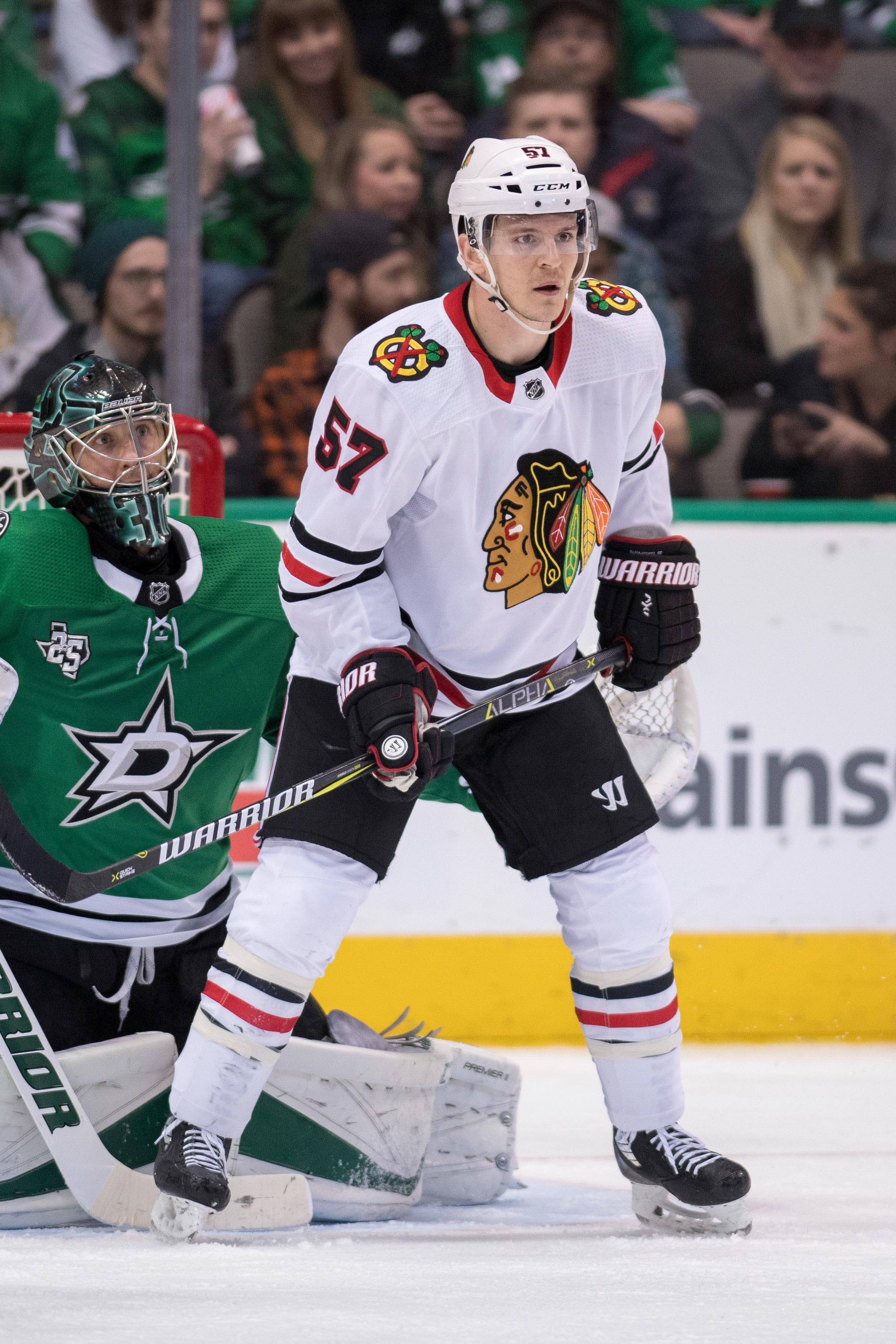 Wingels, who was a solid contributor for years with the San Jose Sharks as a bottom-six forward, signed with the Chicago Blackhawks last offseason who were in desperate need of depth. Wingels performed well, but as Chicago’s season began to go south, the team instead opted to trade him, sending him to the Boston Bruins for a conditional 2019 fifth-round pick.
Wingels provides teams with that gritty edge and experience that many teams covet for their fourth line. On top of that, he has the ability to produce some offense despite his limited minutes. He posted two goals and five points in 18 games when he arrived in Boston, but failed to produce in four playoff games as he missed time after taking a hit to the head from Toronto’s Nazem Kadri. Wingels is also only four years from two 30-point seasons. In all, he totaled nine goals, 17 points, 179 hits and 45 penalty minutes in 75 games, while averaging 11:29 of ATOI.
Potential Suitors
The most obvious match would be for the Bruins to bring back Wingels. While the veteran helped fill in for an injury-plagued team in their stretch run, Wingels hardly dominated and with the plethora of young talent waiting in the wings, it’s hard to tell whether Boston would want to bring Wingels back. On top of that, the 2019 fifth-rounder they gave to Chicago would turn into a 2019 fourth-rounder if they brought Wingels back, although that may not be that significant if they wanted him.
While there are a number of teams that may look to add some grit to their depth, there are a few teams known to hoard depth, especially at the center position. The Nashville Predators are already deep, but there are some who believe the team might continue to look at a player like Wingels if they think they can pass him eventually through waivers.
A potential return to Chicago would also make sense as the Blackhawks, with their salary cap issues, are always in need for depth and are already familiar with Wingels. The team even has some cap room to afford a relatively cheap contract that Wingels would require.
Projected Contract
Wingels days of making big numbers are gone as he had to settle for $750K last year in Chicago and likely will sign a deal with similar numbers this offseason, which will make him a solid bargain. However, if he can’t get an official contract, the veteran may have to settle for a PTO.
Photo courtesy of USA Today Sports Images.
Tampa Bay Still Has Several Other Extension Candidates
The offseason has been busy for the Tampa Bay Lightning, despite never completing a rumored Erik Karlsson deal. The team has already re-signed restricted free agent J.T. Miller to a long-term deal and negotiated huge extensions for Ryan McDonagh and Nikita Kucherov. The team has no arbitration cases pending and no restricted free agents threatening a holdout, but the work is far from over for GM Steve Yzerman and the rest of the front office.
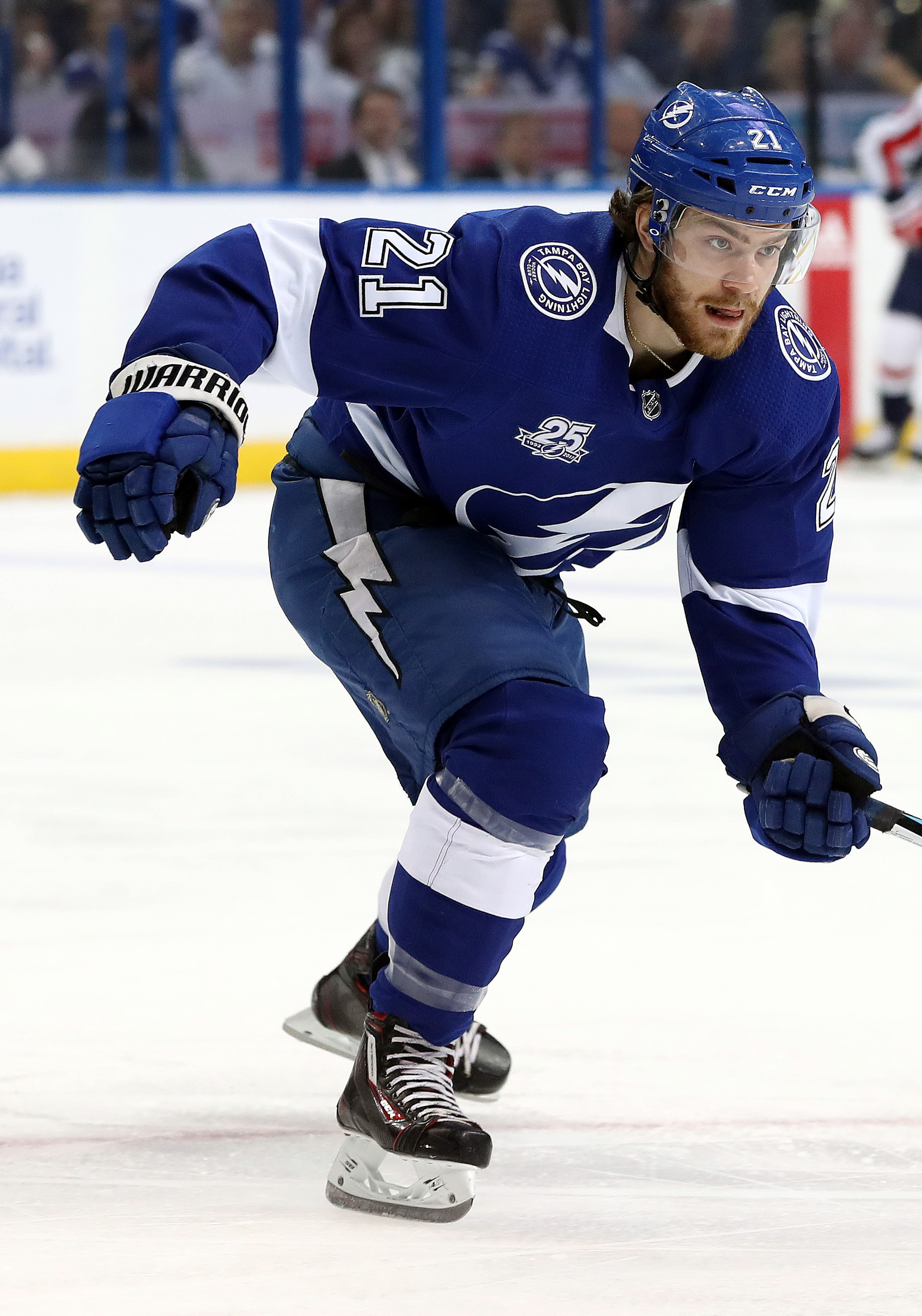 Even outside of trade talks, Yzerman and company must be working through potential contract extensions for several other players on the roster. Brayden Point is the obvious candidate, after showing in his first two NHL seasons that he should be considered among the very best centers in the league despite his late draft status and diminutive size. Point is a workhorse in the defensive zone and should challenge for Selke trophies over the next few years as a shutdown option. He also added 32 goals and 66 points this season, and then followed that performance with a nearly point-per-game pace in the playoffs (16P in 17GP). In the final year of his entry-level contract, it will be interesting to see if the Lightning go the bridge deal route as they did with Kucherov, or immediately sign Point to a long-term deal.
On defense the team will have to make a decision at some point regarding Anton Stralman, who continues to be one of the league’s most underrated players and is heading into the final year of his current deal. At 31, Stralman likely still has a few productive years ahead of him as a mistake-free top-four defenseman and could fetch a multi-year contract on the open market. A right-handed option, plenty of teams would be thrilled to add a player capable of logging more than 20 minutes a night on a regular basis. Stralman might just be out of the question though for the Lightning after inking McDonagh to his $6.75MM cap hit, given that the team will have to extend Mikhail Sergachev and Andrei Vasilevskiy at some point down the road as well. While Dan Girardi and Braydon Coburn both come off the books along with Stralman, there might not be enough money to go around.
That lack of finances could also be thanks to the final big extension candidate, 26-year old Yanni Gourde. Gourde was one of the very best bargains in the league last season, scoring 64 points as a rookie in the first season of a two-year $2MM (total) contract. After several good seasons in the minor leagues the Lightning gave him a chance to play consistent minutes in the NHL and he rewarded them with an incredible year, leading the team with a whopping +34 rating. While Point is still young enough to consider a bridge deal that will keep him a restricted free agent in a few seasons, Gourde will be an unrestricted free agent next summer without an extension. The undrafted winger would put himself among the very best options available with another season like 2017-18, and will force the Lightning into an incredibly tough decision. The team has been doing a wonderful job of managing the cap so far, but a Gourde contract would be 100% UFA seasons and likely fairly expensive even before this year takes place. Afterwards, he might just be out of their price range.
These players are all extension candidates because of their excellent play for Tampa Bay, and they make the Lightning a very interesting team to watch this season. Even if the team is in a solid playoff position and looking like the Stanley Cup contender many believe them to be, several players on their roster may be available in trade. Whether that is players like Gourde and Stralman who are scheduled for unrestricted free agency or others like Alex Killorn and Tyler Johnson who could be flipped to free up space, there is so much talent on Tampa Bay that someone might need to go.
One last option for the team to free up some space would be to trade Ryan Callahan and his $5.8MM cap hit, which was rumored to be discussed when the Karlsson talks were heating up. Callahan underwent another shoulder surgery at the end of May, and is nowhere near the player he once was. Though his leadership and experience is valued in the Tampa Bay locker room, his cap hit might force them to move on from another more talented player. If Yzerman is known for anything as a GM it’s avoiding giving up excess value, meaning if Callahan—who it should be noted now only has a 15-team no-trade clause—is the only way out of this issue he won’t wait to pull the trigger. Regardless of what happens, the Lightning find themselves just starting a very busy season and won’t be sitting on their hands for very long.