
Hurricanes Still Talking Deals With Other Teams
- Hurricanes GM Ron Francis is still talking with other teams about possible moves, he told NHL.com’s Tom Gulitti. However, he is prepared to enter next season with the roster he has if nothing else pans out. Carolina has already added several players this offseason including new starting goaltender Scott Darling, defenseman Trevor van Riemsdyk, and center Marcus Kruger while most recently inking blueliners Jaccob Slavin and Brett Pesce to long-term extensions.
Is Houston A Viable NHL Hockey Market?
When the NHL began discussing expansion a few years ago, the plan was never to add one team. No owner or league executive stood up and said “31 is the perfect number!” The idea has always been to bring in two more teams to bring the total to 32, the same number that the National Football League has managed since 2002. So whether you are of the opinion that the Arizona Coyotes, Carolina Hurricanes, or New York Islanders need to re-locate or not, the fact of the matter is that the NHL will welcome a new city regardless in the near future.
The overwhelming opinion seems to be that Seattle, Washington is next in line to follow Las Vegas. The city is full of die-hard sports fans who cheer vehemently for the Seahawks, Mariners, and Sounders and have been clamoring for a basketball team since the SuperSonics left. They also show up to watch junior hockey, as the WHL’s Seattle Thunderbirds finished in the top half of attendance in 2016-17. Millionaire Chris Hansen has been pushing hard for support to build a new arena with plans to bring back the NBA and bring in the NHL, while Seattle mayor Ed Murray has been negotiating with the NHL on the city’s behalf as well.
Seattle could very well be the 32nd NHL team. However, some hockey purists would like to see the league go back to the small market of Quebec City and revive the Nordiques. Others don’t mind the Seattle plans, but would rather a team go about 150 miles south to Portland, Oregon, where the WHL’s Portland Winterhawks outdraw the Seattle Thunderbirds. Some stand up for places like Kansas City, Missouri, Milwaukee, Wisconsin, and Hartford, Connecticut. You may even hear a few in favor of going back to Atlanta already. What you don’t hear much of though is talk about Houston, Texas. That is until now.
Last month, Leslie Alexander, the owner of the NBA’s Houston Rockets and the Toyota Center, announced that he would be selling the team. While this may simply seem like the NBA’s business on its face, it could have big implications for the NHL. Alexander had attempted to purchase the Edmonton Oilers back in 1998 with a plan to move them to Houston. However, the league turned the offer down, opting instead to keep one of it’s most well-known franchises in Canada where it belonged. Alexander held a grudge not only against the NHL, but against hockey. He all but forced the AHL’s Houston Aeros, beloved by the local fan base, out of the city by charging unreasonable rent at the Toyota Center. The Minnesota Wild had to move their part-owned affiliate to Iowa, where they remain today. With the Aeros gone, the city’s interest in hockey seemingly disappeared and with Alexander remaining in charge of the Rockets and Toyota Center, there was little hope of the NHL or AHL ever returning.
With Alexander selling the Rockets, and likely his stake in the Toyota Center as well, those hopes are alive once again. But is Houston interested in having an NHL team? Is the NHL interested in going to Houston? It certainly makes some sense on paper. Houston is the fifth largest city in the United States – behind only New York, L.A., Chicago, and nearby Dallas – and has only seen its population grow in recent years. It is also a major three-sport city. The Rockets have always been very successful, recently the MLB’s Astros have righted the ship and boast a strong team, and the NFL’s Texans, still the league’s newest team dating back to 2002, are wildly popular. With that success comes both a strong fan base and a industry that is comfortable with throwing lots of money into athletic sponsorship. Financially, Houston would seem to be as good a fit as any. They also have a suitable arena, which Seattle does not, and a much greater population and pro sports history than any of Quebec City, Portland, Milwaukee, or Hartford.
The NHL sought expansion bids three years ago and accepted just one: Bill Foley‘s Las Vegas bid. Many were surprised that Seattle and Quebec City among other could not place a suitable bid. If that process was to occur again, after the Rockets deal is done, would the new owner or another interested Texan place a bid? Or would a perceived lack of interest in the NHL prevent it from happening, yet another surprise in the NHL bidding process? There is still plenty of uncertainty surrounding the situation, but NHL Expansion is not over yet and now, for the first time in years, Houston is at least back in the conversation.
What Do You Think? Is Houston A Viable Hockey Market?
-
Yes. Houston would be great for the NHL 54% (605)
-
It doesn't matter, they're going to Seattle 26% (289)
-
No. Houston would not work out for the NHL 20% (229)
Total votes: 1,123
Cost Per Point: The Best Value Deals In The NHL
When working with a salary cap, especially one that has not been increasing as expected in recent year, it is vital for general managers to get the most production out of their players. Teams with players who meet the expected level of production implied by their contracts and teams that lack wasted dollars in bad, expensive deals are often the same teams that thrive in today’s NHL. Forget market size or free agent appeal, the key to a winning franchise nowadays is getting the best bang for your buck on every player on the roster. While no player can be fully quantified by their scoring, cost per point is an easy way to look at which players are producing at the most team-friendly rate and which have been more of a cap space killer than a positive member of the team. Thanks to CapFriendly, that information is readily available to fans and NHL executives alike.
The benchmark for this metric is about $100K/point, as GM’s expect those big-time forwards and offensive defenseman who they award with $6MM, $7MM, and $8MM per year contracts to be putting up 60, 70, or 80 points respectively. For the second year in a row, St. Louis Blues superstar Vladimir Tarasenko was the poster boy for this standard, coming in at exactly $100K/point with 75 points on a $7.5MM deal. Winnipeg’s Bryan Little and New Jersey’s Adam Henrique are two other notable names that hit the mark exactly, while phenoms like Sidney Crosby and Duncan Keith landing close to the $100K/point mark show that it is an accurate expectation.
However, the exception to the rule is obviously entry-level contracts. It is no secret that drafting and developing well is the best way to improve you team, beginning with affordable scoring from players on their rookie deals. Nowhere is that more apparent than in cost per point, where nine of the top ten and 17 of the top 20 best contracts were rookie deals. To no one surprise, 20-year-old MVP Connor McDavid and his 100 points on a $925K entry-level contract was far and away the best bargain in hockey. McDavid cost the Oilers only $9,250 per point in 2016-17. That will all change soon, as McDavid is set to begin an eight-year, $100MM contract in 2018-19, after which a 100-point campaign will cost Edmonton $125,000/point, closer to the expectations of a standard contract. For now, the Oilers can enjoy one more year of McDavid likely being the best deal in the NHL, as well as the best player. Entry-level deals joining McDavid in the top ten last year (in order) were Viktor Arvidsson, Artemi Panarin, teammate Leon Draisaitl, Conor Sheary, David Pastrnak, Auston Matthews, Nikolaj Ehlers, and Patrik Laine. Not all entry-level deals are created equal, so while Draisaitl and Pastrnak were second and fourth respectively in entry-level scoring, they were also on the ELC maximum deal of $925K and of slightly lesser value to their teams than the likes of Arvidsson ($632K) and Sheary ($667.5K). Panarin had the best contract in the league in 2015-16 and fell only to third with $10,980/point for the Chicago Blackhawks. Now in Columbus and on a two-year, $12MM deal, the Blue Jackets have to hope that they can continue to get 70+ point seasons out of him to maximize the value of that deal.
So, entry-level contracts aside, who was the best contract in hockey last season? Another easy answer, former Blue Jacket gamble Sam Gagner. After a horrendous 2015-16 campaign with the Philadelphia Flyers, Gagner struggled to find a new team last summer, eventually settling on a $650K “show me” deal with Columbus. Right away people tagged that contract, for a six-time 40+ point scorer, as an absolute bargain, even if Gagner simply bounced back to normal production. He did one better, posting a career-high 50 points for the Jackets and coming in at $13K/point, good enough for sixth in the NHL. Gagner has since moved on to the Vancouver Canucks, signing a three-year, $9.45MM contract on July 1st. However, if he is able to continue to produce at 40-50 point levels over that deal, his $3.15MM cap hit will remain a great bargain deal. Behind Gagner, another player on the move this summer, former Florida Panther and current Vegas Golden Knight Jonathan Marchessault had the 13th-ranked cost per point last year at $14,706/point. Marchessault had a breakout year, netting 51 points in the first season of a two-year, $1.5MM deal. Rather than take advantage of one more $750K season for a 30-goal scorer, the Panthers allowed Marchessault to be selected in the Expansion Draft and Vegas surely hopes he continues to be one of the best values in hockey in 2017-18. The final contract in the top 20 not belonging to an entry-level player, and the only 35+ veteran contract in the top 50, belongs to Marchessault’s replacement in Florida, Radim Vrbata. Vrbata returned home to Arizona last season after a down year in Vancouver the season prior, and the swift 36-year old proceeded to score 55 points, more than double his previous year’s total. On a one-year deal with a $1MM base salary, that only cost the Coyotes $18,182/point last season. Now at a base salary of $2.5MM in Florida, the Panthers hope that Vrbata isn’t starting to slow down just yet. Other impressive value contracts included Patrick Eaves, whose breakout season in Dallas led to a trade and subsequent extension with the Anaheim Ducks, Derek Ryan, who shocked the hockey world with 29 points for the Carolina Hurricanes in his first full NHL season at age 30, and a quartet of recently re-signed RFAs in Richard Panik, Ryan Dzingel, Ryan Spooner, and Jordan Martinook.
With the good comes the bad, and there were certainly some poor value contracts in the NHL last year. Many of the worst belong to players who were injured or AHL depth players that saw only limited time. With zero points in 13 games with a $1.25MM cap hit, Tampa Bay Lightning winger Erik Condra‘s value was not even quantifiable it was so bad, and at the highest salary of any player who went pointless last season. Limited to just 18 games with only four points, another Bolts forward, Ryan Callahan, was one of the worst values due to injury with $1.45MM per point on his $5.8MM cap hit. However, the truly worst contract in the NHL has to belong to a player that player a majority of the season. Sadly for a Detroit fan base that is already feeling pretty down-and-out, that designation belongs to Red Wings defenseman Danny DeKeyser, who began a six-year, $30MM extension by scoring about a third less points for the third season in a row. With 12 points in 82 games at $5MM, DeKeyser’s $416.7K/point is pretty ugly. The Buffalo Sabres struck out twice on the blue line, with both Dmitry Kulikov (five points in 47 games at $4.33MM) and Josh Gorges (six points in 66 games at $3.9MM) coming in at $866.7K/point and $650K/point respectively, though neither is known as a major point producer. The worst forward contract? Andrew Desjardins may not have been relied upon as a full-time player with much ice time last season with the Chicago Blackhawks, but with only one point in 46 games, $800K/point, it’s not difficult to see why he remains an unsigned free agent.
While statistics and analytics in hockey are normally geared toward displaying on-ice production, it is always interesting to look at the game from a business perspective. It is important for teams and fans alike to understand not just the absolute of how a player is producing, but the relative value of that production based on how much money that player is being paid. In a salary cap league, there is nothing more important that production value, and as the game grows the focus will only further tighten on scoring as a function of dollars and the cost per point metric.
Hurricanes, Flames Hire Analytics Experts
The analytics movement in hockey is no longer a novel thing. Nearly every team has embraced advanced analytics, with some teams housing entire analytics departments even. Thus, it is no surprise when teams announce that they have hired an analytics expert to their front office staff. What remains interesting however is where some teams find these new additions. Last year, the Vegas Golden Knights hired General Fanager creator Tom Poraszka as a Hockey Operations Analyst to help get their player evaluations off an running ahead of the NHL Expansion Draft and Entry Draft. Now, it seems the Carolina Hurricanes and Calgary Flames have taken a page out of that book.
The Hurricanes announced today that they have hired datarink.com creator Kevin Kan to join their staff. Kan will be given the title of Data Engineer and will surely have similar duties to the function of his website. Data Rink was a hockey statistics visualizations site, scraping NHL data and putting it into forms that better displayed the co-mingling of different stats and advanced analytics. Carolina has already put together a talented and extremely deep defensive corps, not to mention acquiring their presumed franchise goalie in Scott Darling, but need to find a way to boost scoring. Whether examining data from draft-eligible prospects or current pros, Kan can help GM Ron Francis in his search for that missing link up front that can take the ‘Canes to contender status.
The Flames had a similar thought, hiring David Johnson, the mind behind both hockeyanalysis.com and puckalytics.com, which have already been taken down. Sportsnet’s John Shannon reported the hire, adding that Calgary has recently been focused on improving its analytics ability. Johnson is a good fit for the job, as he was one of the first to adopt and explore both Corsi and Fenwick, major advanced analytic statistics. Unlike Kan, who simply displayed data in creative ways, Johnson has used his analysis to often fight for or against the value of one player or another. Johnson has had his fair share of both hits and misses in that practice, but what he provides to the Flames is a knowledge base and different point of view on any projects and questions facing GM Brad Treliving, who has been plenty busy this off-season with the addition of Travis Hamonic, Spencer Foo, Mike Smith, and Eddie Lack already. Now that the championship window is open in Calgary, Johnson will come in handy when evaluation is necessary to make sure no further moves derail those title chances.
While it is tough for fans to see some of their favorite analytics sites continue to disappear, it is refreshing to see the game continue to embrace analytics and those leading the charge find employment at the highest level.
Teams Currently Without Captains
The Nashville Predators are the latest team to join the ranks of the uncaptained, after Mike Fisher officially announced his retirement from the NHL this morning. They’ll now have to make a decision on whether or not to give one of their current players the “C”, or wait until a leader emerges at some point down the road. Perhaps one of their young stars will show enough this year to deserve it, if they don’t immediately give it to one of their stud defensemen. Much of the chatter among fans has been about Roman Josi or Ryan Ellis taking on the mantle, though nothing is clear just yet.
There are five other teams who have yet to name a captain for the upcoming season, and though some may go through the year with three alternates instead, there are several options to take up the leadership and stitch that curved letter to the front of their jersey.
Buffalo Sabres
Brian Gionta wore the “C” for the past three seasons, but it seems as though the team might go in a different direction this year. Gionta remains unsigned, and though a return is still a possibility it seems remote. Gionta himself gave some options for the next captain next year, listing Ryan O’Reilly, Kyle Okposo and Jack Eichel as obvious possibilities. O’Reilly does seem to be the most logical choice right now, after playing as an alternate last season and generally being regarded as one of the team’s best players. It will be hard to deny Eichel of it though, who was drafted as the face of the franchise and will likely one day lead the team.
An outside chance could be Josh Gorges for a season, as he finishes his current contract. The 32-year old defenseman has been part of the leadership group since coming over from the Montreal Canadiens in 2014, and could prove to be a nice buffer for another season before handing it over to Eichel.
Carolina Hurricanes
The Hurricanes haven’t had a captain since Eric Staal was moved at the 2016 trade deadline to the New York Rangers, instead using Jordan Staal, Justin Faulk, Jeff Skinner and Victor Rask as their leadership group. There isn’t any indication on whether the Hurricanes will name a captain before the season, but any of those four could be successful options.
There is also the possibility of the newly extended Brett Pesce and Jaccob Slavin, both of whom are quite young but figure to be huge parts of the franchise for many years. It will be interesting to see who is picked to lead the young group, as the core is set to stay together for quite some time.
Toronto Maple Leafs
The Maple Leafs have always held their captaincy as a sacred role, and after the ugly exit that was Dion Phaneuf‘s departure may wait a little longer to embroider their next jersey. Auston Matthews is the obvious option, but it’s clear the team doesn’t want to put too much on his shoulders right away. Morgan Rielly has developed into a leader on the blueline, and is still young enough to grow with the rookies and help the Maple Leafs find glory once again.
Leo Komarov, Tyler Bozak and Matt Hunwick also wore letters last season, but the latter is already in Pittsburgh and the former two are free agents at the end of the year. It will likely be a whole new leadership group in 2018-19.
Arizona Coyotes
After parting ways with their long-time captain Shane Doan, the Coyotes have yet to announce the next captain of their team. Though it’s not official yet, many believe that role will go to Oliver Ekman-Larsson in part as an attempt to sway him to re-sign next summer. OEL has just two years left on his contract before becoming one of the highest-paid defensemen in the league, and is clearly Arizona’s best player.
This summer the team brought in a friend and former teammate Niklas Hjalmarsson to try and prove to Ekman-Larsson that they’re ready to take a step forward, and if he’s there long-term he would undoubtedly have a “C” sewn on.
Vegas Golden Knights
The Golden Knights haven’t announced any of their captains as of yet, and it will be a very interesting decision when they do. Only three active players are signed for more than two years, and you would think the expansion franchise would want a stable leader to grow with the team for some time. That said, announcing a captain would be a big marketing play for an organization that is trying to connect with fans.
Deryk Engellend was brought in because of his ties to the Las Vegas community, but he’s only under contract for a single season and is already declining rapidly in effectiveness. Marc-Andre Fleury is likely the face of the franchise for now, but isn’t signed long-term and can’t officially have the “C” as a goaltender. Reilly Smith—one of the only players signed for more than two years—did captain his college team once upon a time, and could potentially grow into that role with his new club. They could also wait and hope Cody Glass or Nick Suzuki make an immediate impact in the NHL, and give the role to one of them in a few years.
Carolina Hurricanes Sign Brett Pesce To Six-Year Extension
The Carolina Hurricanes have signed Brett Pesce to a six-year, $24.15MM contract extension that will kick in for the 2018-19 season. The $4.025MM average annual value will make him the third-highest defenseman on the team, behind Jaccob Slavin‘s own extension at $5.3MM per season and Justin Faulk‘s $4.83MM cap hit. Hurricanes GM Ron Francis released a statement on the signing:
Brett took another big step forward last season. He plays a smart defensive game and has good ability to move the puck and contribute offensively. We plan for him to be a part of the Hurricanes’ defensive corps for a long time.
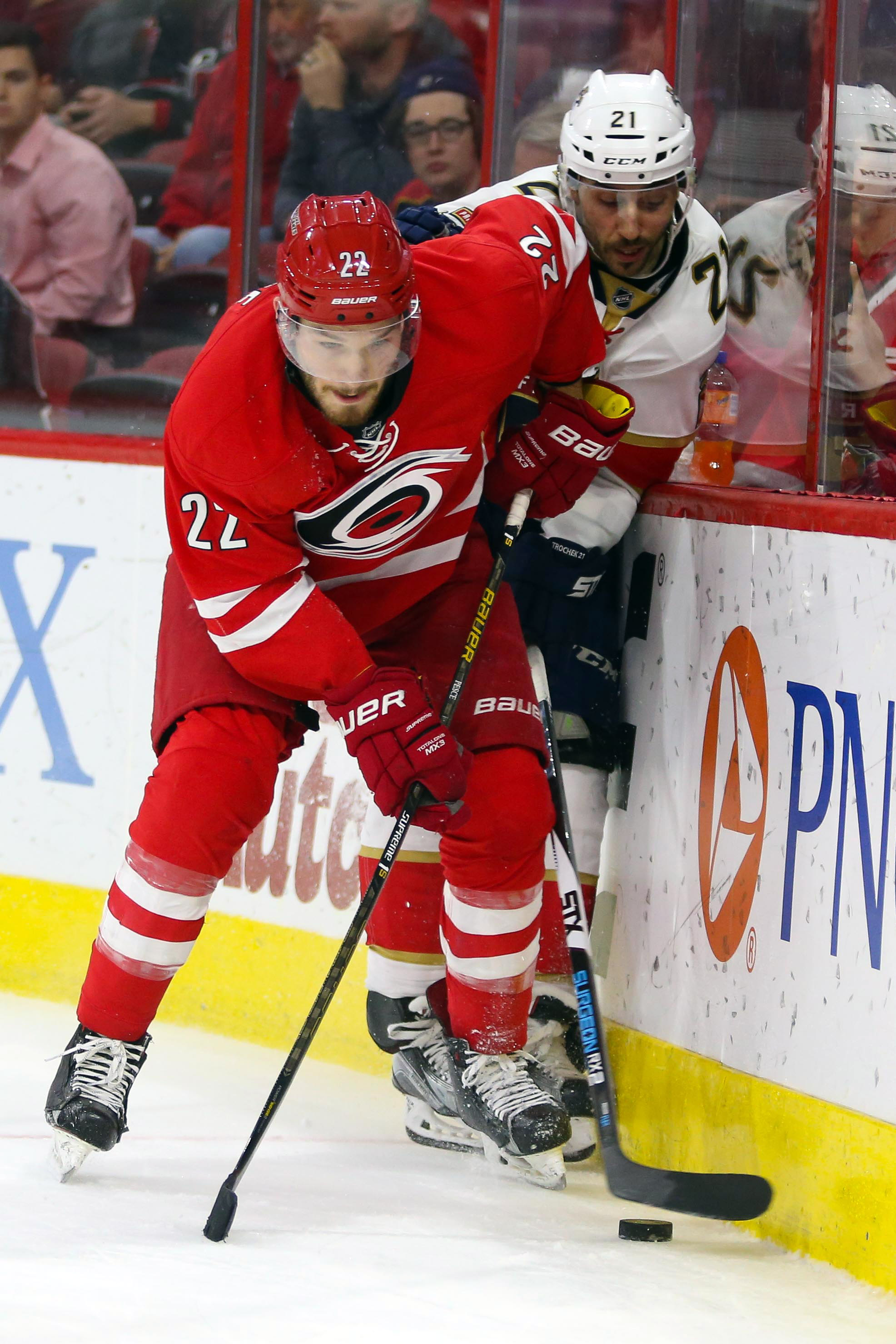
Alongside Slavin, Pesce may be one of the most underappreciated defensemen in the league; one who has blossomed into a top-pairing player without anyone noticing. Some of that is due to playing in Carolina, and some is due to the extremely low-key style he plays. Logging over 21 minutes a night last season. Pesce recorded 20 points but was an absolute rock in his own end. His defensive positioning and ability to skate the puck out of trouble when he needs to make him an elite shot-suppressor, and his incredibly active stick gives him a knack for poke checks and clearing rebounds from in front of his net. As part of the extremely young defense corps in Carolina, he may even be the most reliable in his own end and someone who you can match against the opponent’s top lines for years to come.
Just 22, Pesce was a third-round pick by Carolina back in 2013 and has developed alongside Faulk and Slavin as three excellent players selected outside of the first-round. The rest of the defensive pipeline, made up of players like Noah Hanifin, Haydn Fleury and Jake Bean, will allow Carolina to work from a position of strength in any trade negotiations as they inch closer to playoff contention. Their defensive group is close to rivaling some of the best in the league, and is expected to be made up this year of six players who are 26-and-under. It’s impressive what they’ve built, but there are some downsides to the big extensions kicking in next season.
Carolina is a cap-floor team, and nowhere close to being able to spend all the way up to the $75MM ceiling (barring a huge salary increase from a potential purchase). Next season, when there is a ~8MM salary bump from these two extensions, the team will have to make some tough decisions on their restricted free agents. Hanifin, Trevor van Riemsdyk—who, incidentally was Pesce’s roommate at the University of New Hampshire—and Klas Dahlbeck are all RFAs in 2018, along with Elias Lindholm and Joakim Nordstrom, two important forwards. While some money is due to come off the books in the way of Cam Ward and Lee Stempniak, those players will need to be replaced as well making it hard to see how Carolina can afford to keep everyone.
Even if they do have to move some of their pieces, this deal could look like another steal for the Hurricanes if Pesce continues to develop. Buying out just two years of free agency allows them to keep the cap hit relatively low for the time being, while taking them right through most of his prime years.
Photo courtesy of USA Today Sports Images
Carolina Hurricanes Have 11 Or 12 Interested Buyers
After a report came out last month that indicated Chuck Greenberg, former minority owner of the Texas Rangers, had signed a letter of intent to purchase the Carolina Hurricanes, there had been little news from current owner Peter Karmanos on whether the sale would go through. Today, Chip Alexander of the Raleigh News & Observer caught up with Karmanos who told him that around a dozen groups had already expressed interest in buying the team, and that he’d wait to see what Greenberg’s offer is.
Andrej Nestrasil Signs In KHL
According to Igor Eronko of Sport-Express, HC Neftekhimik has signed free agent forward Andrej Nestrasil for the upcoming season. Nestrasil was not issued a qualifying offer by the Carolina Hurricanes this spring after a scathing interview he gave in the Czech Republic in which he said “I’m done here, 100%. I do not want to continue here.”
Nestrasil played just 19 games for the Hurricanes last season, bouncing up and down constantly from the minor leagues as an injury replacement, but spending the majority of his time in the AHL. The 26-year old was a third-round pick by Detroit in 2009, but hasn’t ever really shown an ability to consistently contribute at the NHL level. In 128 career games he has just 48 points, and rarely found the scoresheet even at the minor league level this year.
Instead he’ll head to Neftekhimik who went 28-28-4 last season but drew just over 5,000 fans on average. One of the much less popular teams, Neftekhimik could use a player to excite their fans and perhaps Nestrasil can be that. After all, during his time in the QMJHL he was a highlight machine that seemed to do everything at top speed. It’s hard to see him ever returning to the NHL after his poor experience, though if he breaks out there may be a little more guarantee coming from another team. Carolina no longer holds his rights after failing to qualify him.
Carolina Hurricanes Extend Phil Di Giuseppe
The Carolina Hurricanes and Phil Di Giuseppe have come to terms on a new contract that will keep the young winger in Raleigh, or at least across the state in Charlotte, for another year. TSN’s Aaron Ward reports that Di Giuseppe has re-signed with the ‘Canes on a one-year, two-way deal that will pay him $725K at the NHL level.
Di Giuseppe, a 2012 second-round pick of the Hurricanes, will enter his fourth pro season in 2017-18, but is still looking for his breakout campaign. The 23-year-old has had modest success in the NHL, but has been unable to carve out a full-time role for himself in Carolina. A former star at the University of Michigan and a consistent scoring threat in the AHL in with the Charlotte Checkers, Di Giuseppe’s skill is undeniable. A swift skater with good instincts, Di Giuseppe has complied 77 points in 144 AHL games over the last three seasons after registering 78 points in 115 games for the Wolverines. However, that scoring pace has not quite translated to success with the Hurricanes, where Di Giuseppe has 24 points in 77 games over the past two seasons. Still working to build a well-rounded game, Di Giuseppe’s ability to put up points is nothing to complain about – he could very well be a 30-point player over the course of an 82-game NHL schedule – but on a team full of young talent, Di Giuseppe has simply been unable to hold onto a roster spot due. The young forward could stand to bring a little more two-way play and special teams ability to the mix if he wants to make himself into a valuable piece of the puzzle for a Carolina team that is desperate to get back to the playoffs.
For now, Di Giuseppe is likely to be given a shot to make the NHL roster in camp, but faces an uphill battle to secure a spot with Jeff Skinner, Sebastian Aho, Teuvo Teravainen, Elias Lindholm, Lee Stempniak, Brock McGinn and now Justin Williams as the competition for a shot on the wing. Di Giuseppe seems likely to head back to the Checkers to begin this season, but must capitalize on the next chance he gets in Carolina. The scoring forward seems like he has what it takes, but has simply lacked the ability to hold on to his job for longer than 30 or 4o games in a season. We’ll see if that changes in 2017-18.
With Di Giuseppe signed, the Carolina Hurricanes have dealt with all of their restricted free agents and look to have a deep and promising lineup that is ready to go for the new season. Predicted to be one of the worst teams in the NHL in 2016-17, the ‘Canes showed everyone with a season that nearly ended in a playoff berth. The young squad hopes that they can take that next step this year.
Minor Transactions: 7/25/17
For a Tuesday in late July, it’s been an especially busy day for hockey transactions, including the NHL signings of Mika Zibanejad with the New York Rangers, Robin Lehner with the Buffalo Sabres, Mark Streit with the Montreal Canadiens, and several deals by the Colorado Avalanche and New Jersey Devils. Yet, there has been a flurry of notable activity in the AHL and overseas today too, including the following:
- The once-promising NHL career of Matt Fraser has taken another odd turn away from its original path. Fraser, still just 27 years old, has signed with Dornbirner EC of the EBEL, a lower tier European league based mostly out of Austria. The team has announced the deal, though terms have not been released. Fraser moves to the EBEL after a season in Sweden, where injuries limited him to only four games with Rogle BK. Before that, many will remember Fraser as a star in the AHL for the Texas Stars and, after the Tyler Seguin trade, the Providence Bruins. Fraser even played in 60 NHL games with the Boston Bruins and Edmonton Oilers in 2014-15 and looked to be on his way to becoming an NHL regular. However, after signing a one-year deal with the Winnipeg Jets in 2015 and failing to make the team, Fraser had the worst AHL season of his career and decided to head overseas. So far, it has not worked out, but Fraser will now try his hand at EBEL action, where he could easily be the best player for Dornbirner, who currently count another former Bruin, Jamie Arniel, as their top scorer.
- Another player who failed to meet expectatiosn in North America and will now head to a lesser European league is Dane Fox. The former Erie Otters superstar, who scored 107 points in 67 games in his final OHL season, has not found anywhere near the same success at the pro level. A high-profile signing by the Vancouver Canucks in 2014, the undrafted forward has made his last junior season look very much like a fluke with his play since then. Fox has skated almost exclusively in the ECHL over the past three seasons, playing in only two AHL games and not even in consideration for an NHL look with the Canucks and Carolina Hurricanes. Now, Fox will head to Germany to play with the Nurnberg Ice Tigers of the DEL. Nurnberg is the likely favorite in the DEL next season and roster many players with NHL experience, including 2016-17 top scorer Steve Reinprecht and recent signee Tom Gilbert. Fox’s pro hockey career is very much up in the air right now, but if he can shine through on an experience Ice Tigers roster, perhaps he’ll get another shot in North America .
- The AHL’s San Diego Gulls, the Anaheim Ducks’ affiliate, has re-signed forward Jordan Samuels-Thomas to a two-year minor league deal, the league announced. The 27-year-old recorded a pro career-high 24 points and +13 rating for the Gulls last year and is a fan favorite and active member of the San Diego community. The former NCAA standout was a seventh-round pick of the Atlanta Thrashers in 2009, but was never signed to an entry-level deal after spending five years in college.
- The Chicago Wolves, now the new affiliate of the Vegas Golden Knights, have signed one of their own, inking Scooter Vaughan to a one-year deal, according to a team release. The hard-nosed defenseman worked his way up through hockey’s ranks, spending four years at the University of Michigan, three years in the ECHL, and going on four years in the AHL, with the last two spent in Chicago. The next stop could be the NHL, now that the Wolves are associated with the Knights, who obviously have the least organizational depth of any team in the league. A career-best performance in 2017-18 could earn Vaughan his first NHL contract next year.
- A pair of AHL defenseman will change teams for the upcoming season as Paul Geiger, recently of the Rochester Americans, has signed with the Hershey Bears, the Washington Capitals’ affiliate, while the Carolina Hurricanes’ minor league partners, the Charlotte Checkers, have signed former St. John’s Ice Caps defender Josiah Didier. Both Geiger and Didier are still just 24 years old and were solid college players, at Clarkson and Denver respectively, but need big seasons with their new teams after pedestrian starts to their pro careers, that is if they want to reach the NHL someday.
- The 2016-17 captain at Rensselaer Polytechnic Institute (RPI) has found his new home, and he’s in a good spot. Riley Bourbonnais, a 23-year-old center who was nearly a point per game player for RPI last year, has inked his first AHL deal with the Wilkes-Barre Scranton Penguins, the feeder team of the two-time Stanley Cup champs. The team announced their newest addition and have high hopes that he can bring the same well-rounded game he showed in college to the pros.