
RFA Profile: Rasmus Dahlin
After his sophomore season, Sabres defenseman Rasmus Dahlin looked primed to take another step forward and potentially establish himself as one of the premier blueliners in the NHL. Unfortunately for him and Buffalo, that didn’t happen. Instead, he struggled considerably (as did many others on the team) and the end result was a step backwards while he remains unsigned with training camp fast approaching.
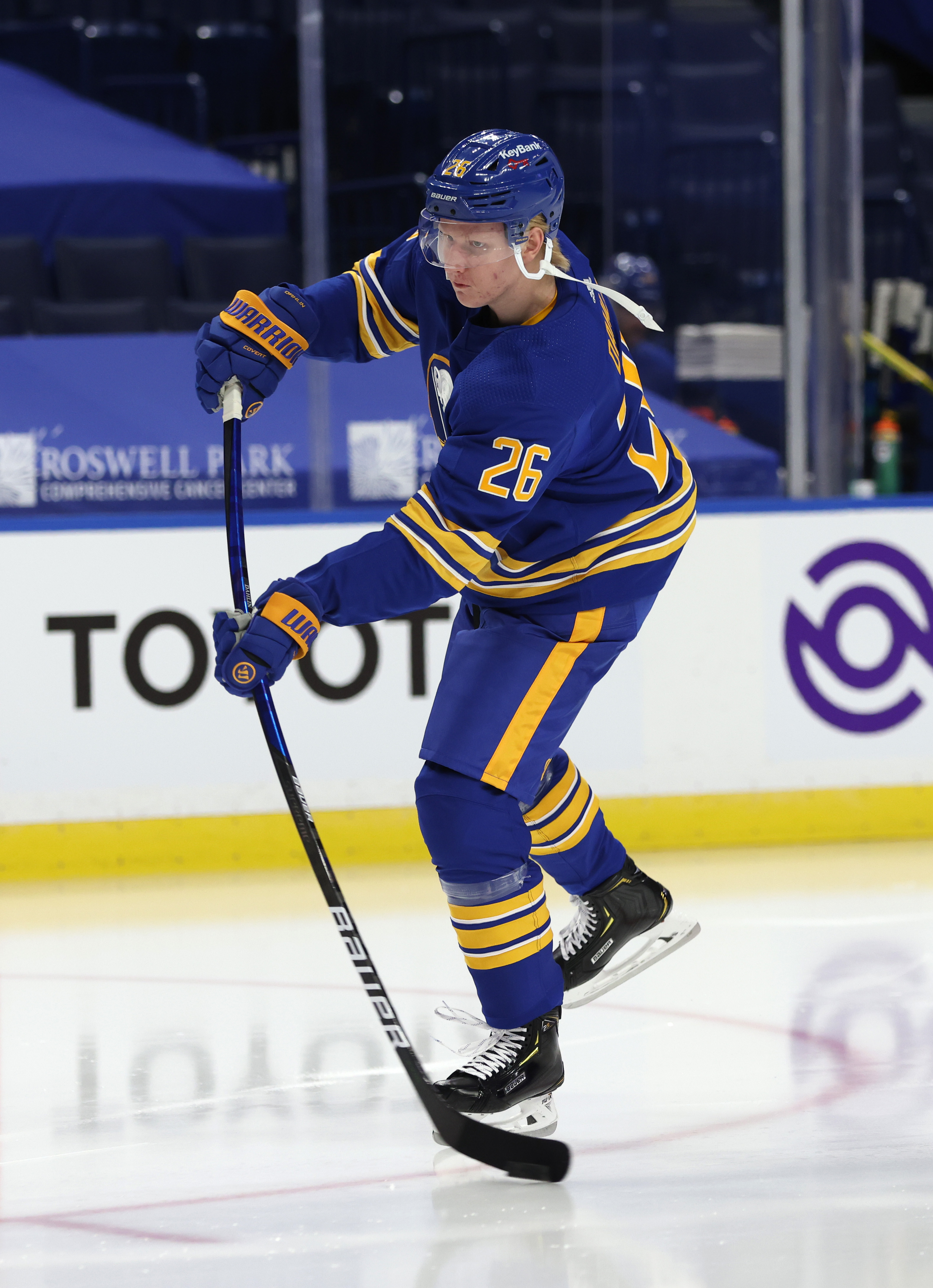 Despite the dip in production last season, Dahlin has shown himself to be a capable offensive blueliner already with a pair of 40-point years under his belt. He’s not going to be at the level of someone like Cale Makar or Quinn Hughes offensively but the 21-year-old has already shown himself to be above average at that end of the ice.
But what about his play in his own end? That hasn’t progressed anywhere near as well and part of the reason his ATOI hasn’t jumped up much at all since his rookie season is that Dahlin still doesn’t kill penalties. His in-zone play under Ralph Krueger left a lot to be desired although there was some improvement following the coaching change to Don Granato. Offensive numbers drive contract negotiations but Dahlin can’t command top dollar since he isn’t as well-rounded as others around the league are and some of his potential contractual comparables were at the time of signing.
That might seemingly push Dahlin towards a short-term deal, giving him a chance to improve defensively and bounce back offensively while getting arbitration rights along the way. Buffalo has shown a willingness to do that in the past although the end results haven’t been pretty with recent examples of that approach (Sam Reinhart and Linus Ullmark) now playing on other teams. Accordingly, it wouldn’t be surprising to see them try for a long-term pact here even if it might carry a little bit of risk.
Statistics
2020-21: 56 GP, 5-18-23, -36, 26 PIMS, 115 shots, 21:36 ATOI
Career: 197 GP, 18-89-107, -56, 98 PIMS, 382 shots, 20:44 ATOI
Comparables
Zach Werenski (Columbus) – While Werenski didn’t take a big step forward in his platform year, he didn’t take a step back either. The offensive numbers are somewhat similar from a per-game perspective although Werenski was better in his own end then compared to Dahlin now. Even so, this would likely represent the low end of what a bridge deal would cost as Dahlin’s draft status gives him a leg up on most of the options here.
Platform Year Stats: 82 GP, 11-33-44, -12, 18 PIMS, 168 shots, 22:54 ATOI
Career Stats at ELC Expiration: 237 GP, 38-90-128, +13, 48 PIMS, 563 shots, 22:08 ATOI
Contract: Three years, $15MM
Cap Hit Percentage: 6.14%
Current Equivalent: Same as above
As this contract was basically the top standard, there aren’t really other viable comparable players for bridge deals. $5MM would be the starting point on a bridge contract with anything over two years exceeding this price tag quickly. Accordingly, let’s now look at longer-term options.
Ivan Provorov (Philadelphia) – Like Dahlin, Provorov entered his platform season as someone looking primed to take a big step forward but ultimately underachieved, leading to some questions as to whether a bridge deal would come his way. He was more of a number one than Dahlin has been which could be a factor.
Platform Year Stats: 82 GP, 7-19-26, -16, 32 PIMS, 145 shots, 25:07 ATOI
Career Stats at ELC Expiration: 246 GP, 30-67-97, -6, 86 PIMS, 509 shots, 23:45 ATOI
Contract: Six years, $40.5MM
Cap Hit Percentage: 8.28%
Current Equivalent: Same as above
Aaron Ekblad (Florida) – For years, this was the top standard that any young blueliner would want to use as a comparable and like Dahlin, he’s a number one pick. Ekblad’s better defensive game looms large here so from a comparable standpoint, this one is a little weaker but it’s possible Dahlin still gets something like that (more on why that could be the case shortly).
Platform Year Stats: 68 GP, 10-11-21, -23, 58 PIMS, 225 shots, 21:28 ATOI (deal was signed pre-platform)
Career Stats at ELC Expiration: 227 GP, 37-59-96, +7, 131 PIMS, 577 shots, 21:40 ATOI
Contract: Eight years, $60MM
Cap Hit Percentage: 10.27%
Current Equivalent: Eight years, $66.96MM ($8.37MM AAV)
Dougie Hamilton (Calgary) – After acquiring him from Boston, Calgary quickly inked Hamilton to the contract that he just wrapped up before signing with New Jersey. The development path was the opposite of what Dahlin’s has been so far (his was a slow start and annual improvement) but the overall numbers are relatively close.
Platform Year Stats: 72 GP, 10-32-42, -3, 41 PIMS, 188 shots, 21:20 ATOI
Career Stats at ELC Expiration: 178 GP, 22-61-83, +23, 95 PIMS, 385 shots, 19:32 ATOI
Contract: Six years, $34.5MM
Cap Hit Percentage: 8.05%
Current Equivalent: Six years, $39.365MM ($6.56MM AAV)
Tyler Myers (Buffalo) – Let’s use another Sabres deal as the final comparable. Myers’ first two seasons were a lot better than his third year (and as it turns out, those two remain his top years offensively) so at the time, Buffalo was thinking they had a core two-way player on their hands. Of course, it didn’t work out that way in the end but the numbers are somewhat comparable to Dahlin’s so far.
Platform Year Stats: 55 GP, 8-15-23, +5, 33 PIMS, 84 shots, 22:29 ATOI
Career Stats at ELC Expiration: 217 GP, 29-79-108, +18, 105 PIMS, 310 shots, 22:57 ATOI
Contract: Seven years, $38.5MM
Cap Hit Percentage: 8.55%
Current Equivalent: Seven years, $48.778MM ($6.968MM AAV)
Projected Contract
In terms of fits for a long-term deal, Dahlin’s comparables appear to be in the high-$6MM range. But if that’s the baseline for that type of contract, his camp would argue that a bridge contract would be the better way to go and rightfully so. If Buffalo wants to buy out a couple of UFA years, they’ll need to go a bit higher, perhaps around the $7.5MM range to persuade Dahlin to go that route; a max-term (eight-year) deal could push it closer to $8MM. Otherwise, a bridge contract starting at over $5MM for an AAV (one that is back-loaded to yield a higher qualifying offer) could very well wind up being the outcome here.
Photo courtesy of USA Today Sports Images. Contract information via CapFriendly.
East Notes: Laine, Dahlin, Ullmark, Kravtsov
Blue Jackets winger Patrik Laine has received his $7.5MM qualifying offer from the team and is giving strong consideration to simply accepting it, suggests Brian Hedger of the Columbus Dispatch. The 23-year-old disappointed after being acquired from Winnipeg, notching just 21 points in 45 games. While he’s eligible for salary arbitration, Laine would be hard-pressed to land considerably more than that in a hearing even factoring in his previous success with the Jets. If Laine does indeed accept the offer, he will be a restricted free agent with arbitration rights again next summer and will be owed a $7.5MM qualifier once again. Notably, he’d also be a year away from unrestricted free agency at that time.
More from the Eastern Conference:
- The Sabres have started contract discussions with pending RFA defenseman Rasmus Dahlin, reports Lance Lysowski of The Buffalo News. The number one pick in 2018 took a considerable step back offensively in 2020-21, notching just 23 points in 56 games after putting up 40 in 59 contests in his sophomore season. As a result, it seems unlikely that Dahlin and Buffalo will be able to work out a long-term agreement that satisfies both sides so instead, a shorter-term pact that leaves the blueliner as a restricted free agent at the end of it is a more realistic outcome.
- Still with Buffalo, the Sabres are continuing discussions with goaltender Linus Ullmark who is set to become an unrestricted free agent, relays John Vogl of The Athletic (Twitter link). The 27-year-old was one of three pending UFAs protected from Seattle in expansion but that was more of a case of Buffalo not having another one worth protecting than a sign that talks were progressing. They opted not to trade him back at the trade deadline in the hopes that they’d be able to Ullmark under contract and they now have less than a week to do so before the free agent market opens up.
- Rangers winger Vitali Kravtsov has changed agents, PuckPedia reports (Twitter link). He’s now represented by Gold Star Hockey’s Dan Milstein, an agent that represents several Russian-born players. Kravtsov is eligible to sign a contract extension this summer and will be a restricted free agent next summer.
COVID Notes: Dahlin, Wild, Kuznetsov
The Buffalo Sabres will have another big name on the COVID Protocol Related Absences list when it comes out later today as they have already announced that Rasmus Dahlin has been added. The team now has nine players in the protocol, plus head coach Ralph Krueger.
Technically, Dahlin was actually added to the list last night. It originally had just Casey Mittelstadt joining the other seven players previously listed—Taylor Hall, Jake McCabe, Brandon Montour, Tobias Rieder, Rasmus Ristolainen, Dylan Cozens, and Curtis Lazar—but Dahlin was an update given later. Like with any other player, being on the list does not necessarily mean you have tested positive for COVID-19. The Sabres are currently scheduled to resume play on February 11.
- The Minnesota Wild will also likely have some names added today, or at least in the near future. GM Bill Guerin implied that to Michael Russo of The Athletic, who did a very interesting examination of the outbreak with the Wild and the related league protocols. The Wild are also off until February 11, though that game against the St. Louis Blues seems very much in jeopardy should the team add several names today. Minnesota currently has nine players on the CPRA list.
- Evgeny Kuznetsov and Ilya Samsonov of the Washington Capitals spoke to reporters today following their own bouts with COVID-19 and provided a bit different experiences. When asked if he was scared at any point while experiencing symptoms, Kuznetsov told Samantha Pell of the Washington Post “no, I’m from Russia.” Samsonov meanwhile told Pell through an interpreter that there were a few days where he had trouble breathing and walking. Both players were on the ice today at practice.
PHR Panel: Revisiting The 2018 Draft
We’re now two months into an NHL postponement and there is still no clear timeline on when professional hockey will return. While fans of the sport have received small tidbits of news over that time, including college signings and contract extensions, the thirst for discussion has rarely been quenched.
With that in mind, we’re happy to continue our new feature: The PHR Panel. Our writing staff will give our individual takes on a question many hockey fans have been wondering about. If you’d ever like to submit a subject for us to discuss, be sure to put it in the comments.
To catch up on the previous edition, click here.
Today, with the 2020 draft still not set in stone, we take a look at how some top picks are performing a few years into their careers.
Q: Who will end up being the best player from the 2018 draft?
Brian La Rose:
Back in 2018, the answer was Rasmus Dahlin. Nearly two years later, I don’t think that answer has changed.
While the Sabres have continued to struggle even with Dahlin in the fold, it certainly hasn’t been because of him. He had a lot thrown at him during his rookie season, perhaps too much for an 18-year-old defenseman. Despite that, he still did quite well. He was even better this season and was on pace to set new career-highs in points in spite of a dip in playing time if it wasn’t for a concussion and a minor upper-body issue that cost him ten games combined.
Defensively, Dahlin is still a little shaky at times but that’s par for the course for a young blueliner. He has made considerable improvements over his first two years and that should continue as he plays more and gets stronger.
At the end of the day, I’m not sure he’ll be the top offensive defender from this class but Dahlin’s all-around game will be enough to put him ahead of Quinn Hughes in terms of value. There will be some quality scorers from the 2018 draft (there already are) but they won’t be able to impact the game like a franchise defender that should consistently log over 25 minutes a night in his prime. Buffalo picking Dahlin back in June of 2018 signaled that they felt he was the best player in his draft class. There’s little reason to think otherwise at this point.
Holger Stolzenberg:
There are quite a few players that I like from this draft, but I’m going to go with the belief that the Buffalo Sabres got it right. Yes, Dahlin may not be that flashy defenseman who immediately dominated the league like fellow young blueliners Cale Makar and Hughes. Yet Dahlin is exactly what the team needed and has filled a major role in the two years he’s been in the league.
While his numbers look rather pedestrian through two seasons with 84 combined points, considering his status as the first-overall pick in 2018, those are actually impressive numbers for a teenaged blueliner. While they hardly compare to the first two seasons that Phil Housley had with Buffalo (he had 143 points), the league was quite different back in the early 80s with more goal scoring. In fact, the Sabres average more than one fewer goal per game now than they did back then, suggesting that Dahlin is much more comparable.
Now 20 years old, Dahlin is getting close to hitting his prime and should eventually have that breakout year to prove that he’s the best player in this draft. The blueliner has proven to be solid defensively and has good offensive skills, both of which should only get better. He will be a great player for years to come. We just might have to wait a little longer to see that play out.
Zach Leach:
The 2018 draft class has yet to produce enough players with considerable NHL experience to truly make an educated guess on this question. Many, like college standouts Scott Perunovich (STL) and Tyler Madden (LAK), have yet to even debut, while some top picks like Oliver Wahlstrom (NYI) and Evan Bouchard (EDM) have only played in a handful of games. I like all four of these players to have good NHL careers, but I simply don’t have the sample size I need to say that any could be the best player of the class.
For now, I still consider the players that I personally felt were the top four players in the 2018 class to be the leading contenders to have the best NHL career: Carolina’s Andrei Svechnikov, Buffalo’s Dahlin, Ottawa’s Brady Tkachuk, and Vancouver’s Hughes (I had Wahlstrom at No. 5). Even in the midst of Dahlin mania back in June 2018, I felt Svechnikov was a special talent and a dynamic presence that was deserving of being the top overall pick. That’s why I listed him first and will stick with him as the player that I feel has the best chance to be the top player in his class. Dahlin, Tkachuk, and especially Hughes have certainly shown that they can be elite players and difference-makers for their respective franchises, but I feel that Svechnikov will outplay and outlast the field.
Svechnikov, who leads the 2018 class in goals, points, and games played, has already asserted himself as a franchise centerpiece for the Hurricanes. He has the natural offensive instincts as well as the willingness to play physically and win puck battles to be a scoring threat and key presence on offense for a long time still to come. I do not see Svechnikov’s offense drying up; in fact, his growth from year one to year two shows me that he is absolutely still on the rise and his near point-per-game pace this season is just the beginning of his offensive upside and I feel he will have staying power among the NHL’s elite once he arrives. I see Alex Ovechkin as the ceiling for Svechnikov, which would certainly give him a good chance at the title of best player in the 2018 class, both in ability and longevity.
Gavin Lee:
While I may not quite be on the same level as Zach when it comes to Svechnikov—what a comparable!—I too had him ranked as the best player in 2018 over Dahlin. There’s simply nothing that Svechnikov can’t do offensively. I was actually surprised he didn’t have a better rookie season, but the Hurricanes brought him along slowly with severely limited even-strength minutes and often only had him on the second powerplay unit. There’s nothing wrong with that, but when the team let him loose this season you started to see what Svechnikov is truly capable of.
No, it’s not all lacrosse goals and nifty dangles. The 6’2″ forward is a force when he gets to full speed, and can seemingly still make crisp passes with a defender hanging onto his back. He was on a 73-point pace this season while still averaging fewer than 14 minutes of even-strength ice time. When 16:44 (total) per game starts creeping close to 20:00, watch out for a player who one day may legitimately contend for both the Rocket Richard and Art Ross (remember, he only just turned 20).
There are some outstanding players in the field, but I’ll still put my money on the big Russian.
Erik Cernak Suspended Two Games
The Department of Player Safety has had a busy few days. Their latest discipline has been handed out to Tampa Bay Lightning defenseman Erik Cernak, who has been suspended for two games. Cernak elbowed Buffalo Sabres defenseman Rasmus Dahlin in the head, resulting in a concussion for the young player. As the accompanying video explains:
It is important to note that while we acknowledge the Lightning argument that they believe Dahlin’s glove drove Cernak’s elbow upward and caused the head contact on this play, we disagree.
While Dahlin’s glove does make glancing contact with Cernak’s forearm, it is clear to us that Cernak’s elbow is already on a trajectory where head contact is inevitable.
The Lightning will be without Cernak for the next couple of games, but the concern now is how long Dahlin will be out after being placed in the concussion protocol. The young phenom has had his share of struggles this season but the Sabres were already looking to move one of their other defensemen to upgrade the forward ranks.
Atlantic Notes: Babcock, Dahlin, Anderson
Three weeks ago, the Toronto Maple Leafs were just OK. They weren’t dominating the Atlantic Division, but their underlying numbers were acceptable. However, quite a bit has changed in three weeks. The team has just one regulation victory in its last nine games (two in their last 15 games) and the team’s special teams are at the bottom of the league.
Now, after defending Mike Babcock three weeks ago, The Athletic’s James Mirtle (subscription required) now compares the pros and cons on whether it might be time to remove the head coach. While he points out that some of the team’s struggles are out of Babcock’s control, there are more reasons to look at the coaching staff skeptically within the last nine-game stretch.
Mirtle examines the coaches’ tactics and the special teams challenges (including 11.8 percent success rate on the power play and a 71.4 percent kill ratio on the penalty kill). However, the most interesting take is that the scribe believes that the head coach has lost his team in the locker room. Whether that will eventually fuel a coaching change is unknown, but Toronto fans won’t be happy long with a 9-9-4 record with all the expectations that were expected from this team.
- Despite being benched for the third period Saturday night, the Buffalo Sabres still intend to play second-year defenseman Rasmus Dahlin Sunday, who has struggled in the eyes of head coach Ralph Krueger. “We’re making decisions for the team in the moment. It was a coaching room decision, not against Rasmus at all; it was for the other guys to just tighten things up,” said Krueger (according to The Athletic’s John Vogl). “It worked, but Rasmus will grow from it, learn from it and move forward quickly from it, I’m sure. … Just sometimes wanting too much maybe and finding the balance between his amazing genius and skill and what we need when. He’ll improve from it.”
- The Fourth Period’s Matteo Pasculli wonders whether Ottawa Senators goaltender Craig Anderson‘s career with the Senators could be coming to an end. The 38-year-old veteran has been struggling this season with a 3.31 GAA and a .894 save percentage in 12 appearances this year. With Anderson losing hold of his job to Anders Nilsson, who has been steadier, Anderson could find himself on the trade block as a potential backup goalie for a playoff team. Of course, a playoff team would require some cap space to accommodate his $4.75MM contract, although Ottawa could retain some of that salary. He is, however, in the last year of his deal, which could be appealing to a team looking for a rental.
Stars Notes: Khudobin, Pavelski, Heiskanen, Dellandrea
In two seasons with the Dallas Stars, goaltender Ben Bishop has already appeared in 112 games if you include the playoffs. And while the goaltender put up Vezina-caliber numbers last year after posting a 1.98 GAA and a .934 save percentage in 46 regular season games. However, how long can the 32-year-old keep that pace up?
The Athletic’s Sean Shapiro (subscription required) writes that the team needs to turn backup goaltender Anton Khudobin into a tandem 1B goaltender. Despite appearing in 41 games with Dallas last season, his role has obviously been as a backup as he made just one playoff appearance in 13 games, and the 33-year-old played just 11:05 in that one game. Regardless, he has put up solid 2.57 GAA and a .923 save percentage.
With Bishop getting older, Shapiro writes that the team needs to include Khudobin more and give him an even bigger role, which would include making the goalie situation more of a tandem. Khudobin has never thrived when sitting on the bench cold and has proven to be stronger when he gets streaks of starts. That might make a tandem combination work better for Dallas.
- SportsDay’s Matthew DeFranks writes that while the 38 goals that new Dallas Stars’ Joe Pavelski scored with San Jose last season were nice, what the team is really hoping for is that the veteran forward can turn Dallas’ power play into an elite one. What the Stars are hoping for is that Pavelski can provide the power play with versatility and movement in the offensive zone, something that San Jose has always been great at. The Stars want the same mobility on their power play. “When the bodies are moving, the puck’s moving, it gets hard for penalty killers to keep track of everybody,” Dallas coach Jim Montgomery said. “That’s where you find the open lanes, seams for tips and one-timers.”
- NHL.com’s Rob Reese writes that while Dallas Stars defenseman Miro Heiskanen had an impressive season, it’s even more impressive when you look at the numbers that the rookie put up. The blueliner was first among rookies, averaging 23:07 of ATOI, almost two minutes more than Buffalo’s Rasmus Dahlin. His 12 goals was ranked 17th among all NHL defensemen and his 10 even-strength were tied for eighth in the league. With more playing time expected next season, Heiskanen should continue to evolve into one of the elite defensemen.
- NHL.com’s Brett Amadon writes that Montgomery has made it clear that he is open to giving top prospect Ty Dellandrea a legitimate shot to make the team during training camp this season. The 13th-overall pick in the 2018 draft has been impressive in juniors and looked pretty good in a short stint with the AHL’s Texas Stars last season, but would have to make Dallas’ roster next year or be returned to his junior club, the Flint Firebirds in the OHL. “I’ve got to work extremely hard and take the stuff I learned from a bit of pro experience,” Dellandrea said at Stars development camp in June. “I’ve got to come in, do everything I can and give myself the best shot to make the team.”
Snapshots: Sabres, Gardiner, Tkachyov
Few have criticized the Sabres’ side of the recent Henri Jokiharju–Alexander Nylander trade, but it’s a fact that Buffalo is overflowing with defenders after acquiring the young right-hander from the Chicago Blackhawks. As Lance Lysowski of The Buffalo News’ points out, the Sabres still have needs to fill up front and they could use their defensive depth to do so. Lysowski writes that Buffalo has ample cap space to make an addition at forward, but there are few ideal candidates left on the free agent market and the team may as well use their surplus of blue liners to swing a deal. Jokiharju is safe, as are fellow recent additions Brandon Montour and Colin Miller and 2017 No. 1 pick Rasmus Dahlin. RFA Jake McCabe is not likely to be dealt, but a potential candidate and injury-prone Zach Bogosian and overpaid veteran Matt Hunwick might be hard to move. That would seemingly leave Rasmus Ristolainen, a fixture on the rumor mill, Marco Scandella, and Casey Nelson as the most likely names to be dealt and it would not be a surprise if more than one ends up elsewhere. The Sabres are certainly not done making moves this summer.
- Of course, this makes Buffalo just one of a surprising number of teams not biting on Jake Gardiner this summer. PHR’s top-ranked UFA defenseman, Gardiner remains unsigned more than a week after the market opened. NBC Sports’ Scott Billeck reports that Gardiner is seeking $7MM annually in his next year, which is likely pricing himself out of the range that many D-needy teams are looking for. It’s hard to argue that Gardiner was not the best available defenseman when free agency opened, but he’s also not a top-pair defenseman by most metrics and teams aren’t willing to shell out right now simply due to a weak market. Billeck names the Winnipeg Jets as a team that could use Gardiner, but can’t afford him at his current asking price. The Montreal Canadiens, Detroit Red Wings, and his own Toronto Maple Leafs also fit that description. Billeck feels the New Jersey Devils could be the leading candidate to land Gardiner right now, but there really aren’t many clear fits for the defender at this time unless he changes his expectations.
- Despite flirting with a jump to the NHL for several years, Vladimir Tkachyov has decided to re-sign in the KHL once again. SKA St. Petersburg has announced an extension with the young scorer. Tkachyov, 23, has been a solid offensive contributor for the past several years but the best may still be yet to come. The winger was acquired by SKA last month from Salavat Yulaev Ufa for the rights to Nikita Soshnikov, who has since signed in Ufa, and Tkachyov could be set for some career-highs with the perennial contenders in St. Petersburg. It is a two-year contract with SKA, so Tkachyov has a couple more years to further prove he is a formidable forward, and could very well drawn NHL attention once again in 2021.
2019 Calder Memorial Trophy Finalists Announced
The finalists for the Calder Memorial Trophy, given each year to the most proficient first-year player in the NHL, have been announced. The three rookies are Vancouver Canucks forward Elias Pettersson, St. Louis Blues goaltender Jordan Binnington, and Buffalo Sabres defenseman Rasmus Dahlin, according to Sportsnet’s John Shannon. New York Islanders center Mathew Barzal was the 2018 winner of the award.
While it seemed like a forgone conclusion that the Canucks’ Pettersson would walk away with the award early in the season, the young Swede has gotten some good competition from Binnington as well as fellow Swede Dahlin. However, Pettersson remains the front runner. The 20-year-old came over from Sweden this year and immediately posted 28 goals and 38 assists for 66 points, making the loss of both Henrik and Daniel Sedin, who retired a season ago, less noticeable. What’s interesting is that Pettersson was initially pegged to play the wing for a season as he transitioned to North American hockey. Instead, within a week or two of training camp the team announced he would play center immediately and fared extremely well at that. Despite the impressive numbers, the other two candidates have a legitimate chance at the award, as much of Pettersson’s production was concentrated in the first half of the season. He tallied 23 goals and 45 points in the first 40 games of the season, but struggled more in the second half, totaling just five goals and 21 points in his final 31 games.
Binnington didn’t make his first start this year until Jan. 7, but he made it count, posting a shutout against the Philadelphia Flyers and leading a struggling Blues team to the playoffs with a 24-5-1 record with a 1.89 GAA and a .927 save percentage. The 25-year-old netminder was not even considered the team’s top goalie prospect at the start of the season, as he was behind Ville Husso in San Antonio of the AHL, but a strong start to the season with the Rampage and his immediate success with St. Louis give the goaltender a good chance at challenging for the Calder.
Dahlin comes from a much more conventional place, as he was the 2018 No. 1 overall pick and immediately steadied a struggling Buffalo defense this season. He had one of the best seasons for an 18-year-old defensemen ever, as he posted nine goals and 44 points, second most in the NHL history for his age and position. Only his former coach, Phil Housley, did better as an 18-year-old defender, as Housley put up 57 points back in the 1982-83 season. Dahlin also played the second-most minutes among NHL rookies, averaging 21:09, behind Dallas Stars’ defenseman Miro Heiskanen, who many felt deserved to be among the top three in this race. Dahlin is the first Buffalo Sabres player to be a finalist for the award since Tyler Myers was nominated in 2009-10.
Colorado’s Odds At The First Overall Pick
Early this season, the Colorado Avalanche were in the most enviable position in sports. Their team was excelling and looking playoff-bound, but without any negative effect on their draft status. Because as the Avs won games, the Ottawa Senators were losing them and Colorado owned the Sens’ first-round pick this year as part of last season’s Matt Duchene trade. There was a real possibility that the Avalanche could be Stanley Cup contenders and also have the first overall pick in the draft. Lately, the Avs have looked less like a playoff team and more like the Senators. Colorado has four wins in their past 23 games dating back to mid-December and have slipped into a tie for tenth-place in the Western Conference, three points out of a playoff spot. The one silver lining: their odds at drafting No. 1 have improved and might end up being the best in several years.
Ahead of the 2014 NHL Draft, the NHL changed the draft lottery rules. Any team in the lottery could now move up into a top-three position and the odds would be more fairly distributed among all lottery teams. There have been slight variations in the odds for each draft, but the biggest shift came last year when the addition of the Vegas Golden Knights to the league added a fifteenth member of the lottery group and further split the odds. Yet, with 18.5% odds, the last-placed Buffalo Sabres still retained the first overall pick and drafted Rasmus Dahlin, a generational defenseman. This year’s prize, play-making forward Jack Hughes, is seen by most scouts as a guaranteed top-six center and power play wizard and the team with the worst record still stands the best chance of getting him by a significant margin.
Of course, the worst record looks like it will belong to Ottawa and thus the pick will belong to Colorado. The Senators are currently in 31st overall in the league standings, three points back of the Los Angeles Kings and New Jersey Devils. If those standings hold, based on last year’s odds Colorado will have a 18.5% chance that the Ottawa pick will be first overall, compared to 13.5% for L.A. and 11.5% for New Jersey. Then, Colorado’s own pick comes into play. Currently, the Avs are technically 23rd overall. If they remain in that spot, they would have 5% odds that their own pick would be No. 1. Combined, they would have a 23.5% shot at picking first. Since 2014, no team has come close to having odds that high at the top pick and Colorado could continue to struggle down the stretch and improve the odds on their own pick. If the Avs were to slip three more spots in the league standings, their odds would be greater than 25%, giving them better than a one-in-four shot at Hughes.
The possibilities are even more intriguing when you consider the odds of both picks winning the lottery instead of just one. Currently, there is about a 0.9% chance that Colorado could pick first and second, not dissimilar odds to those that the final lottery team has of picking first. The addition of both Hughes and the presumptive No. 2 pick, Finnish winger Kaapo Kakko, would be an enormous influx of elite draft talent unseen since the Sedin twins landed with the Vancouver Canucks at second and third overall in 1999. There is a whopping 58% chance that both of their picks land in the top four, which would also be an unbelievable boost for the Avalanche with a number of impact forwards available in this class. And again, these odds can only improve if the Avalanche continue on this downward spiral. If the current standings hold, the worst that Colorado could do is to pick fourth and twelfth – which would still be a better first-round combination than any team in recent years – and the odds of that happening are approximately 18x less likely than picking both first and second; the best case is greater reality than the worst-case.
The moral of the story is that, while it’s disappointing for Avalanche fans to see a talented team plummeting down the standings, there is some upside as well. The team is young and built for the future and are in better shape than any team in recent memory to add the best player in the draft and perhaps two of the best available. So whether you’re a Colorado fan soley focused on Hughes or holding out for another top prospect as well, the team’s current slump is only helping in that pursuit. The ping pong balls will ultimately decide the Avs’ fate, but the future is bright.