
Pacific Notes: Pettersson, Wright, Dach
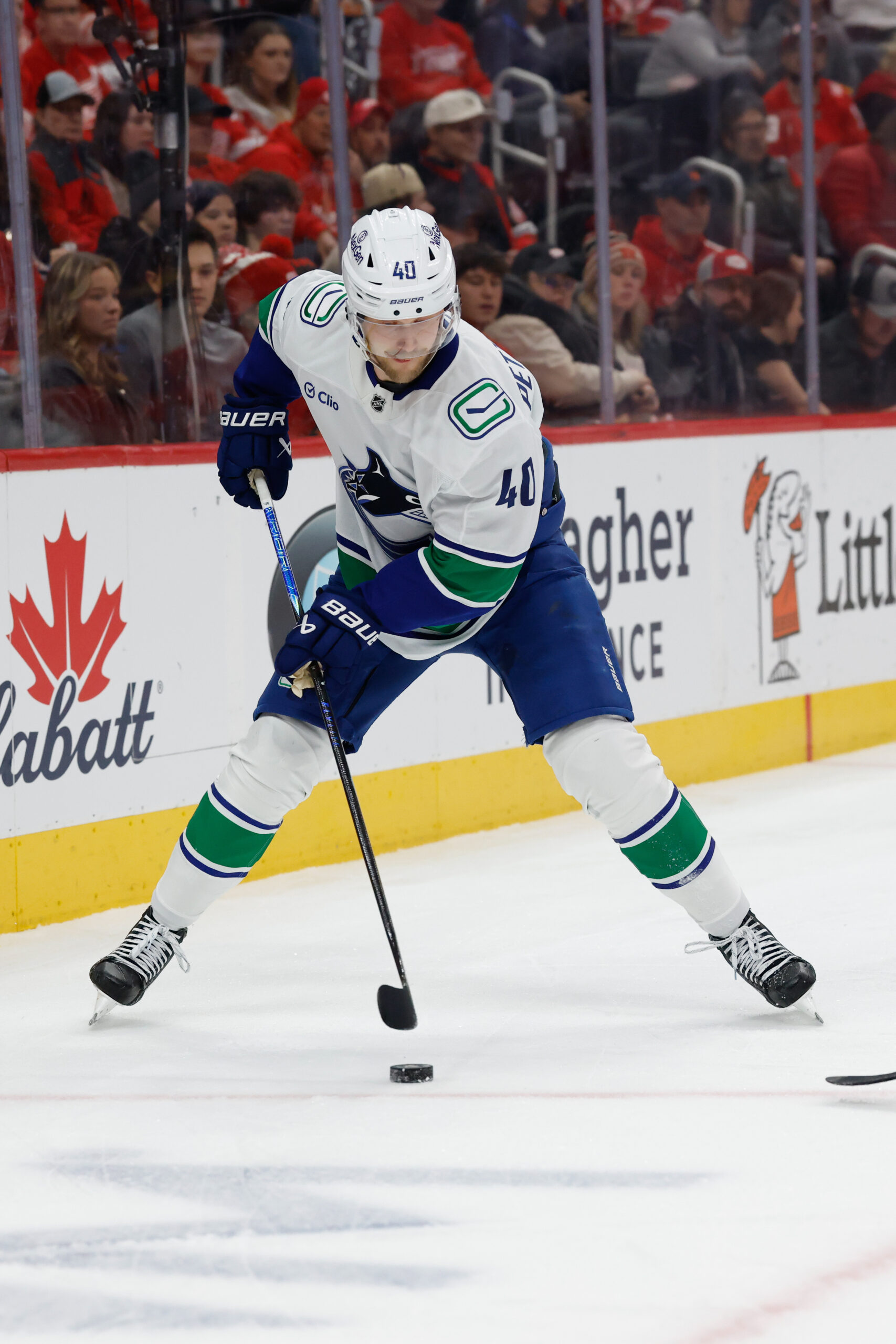
As new Canucks GM Ryan Johnson works to change up his roster, there has been plenty of speculation about Elias Pettersson’s future. Speaking with Sportsnet’s Iain MacIntyre, Johnson made it clear that any trade wouldn’t be about dumping salary; they’d be looking for strong value in return. Pettersson is two years into an eight-year, $92.8MM contract ($11.6MM AAV) and has managed just 96 points in 138 games on that deal after putting up 191 points in 162 games in the two years before it started. That led some to wonder if Vancouver might be open to taking a lesser return in order to get themselves out of at least most of the contract. Instead, that won’t be the case, with Johnson noting that there are no payroll restrictions on his group as the team embarks on what looks to be a lengthy rebuilding process.
More from the Pacific:
- Still with the Canucks, CHEK’s Rick Dhaliwal reported on a recent Oilers Now podcast (audio link) that Vancouver has inquired about Kraken center Shane Wright. While Seattle is believed to be trying to facilitate a suitable trade, they’re believed to have a high price tag for his services. Dhaliwal indicated that Seattle’s ask in return was either defenseman Zeev Buium or blueliner Tom Willander, a price Vancouver isn’t willing to pay. It’s understandable that Kraken GM Jason Botterill would be seeking a core piece with several years of club control remaining as that’s effectively the situation Wright finds himself in, still being five years away from UFA eligibility.
- The Oilers have one remaining restricted free agent, winger Colton Dach. However, his agent Gerry Johansson indicated to Jim Matheson of the Edmonton Journal that the team has communicated that they need some more time to work things out. Edmonton has a little under $6MM in cap space per PuckPedia and it appears they’re prioritizing getting an external acquisition in place before deciding what type of contract to give to Dach. The 23-year-old had 13 points and 219 hits in 61 games between Chicago and Edmonton last season.
Can The Canucks Move Elias Pettersson?
The Canucks are wrapping up a difficult season, set to finish at the bottom of the standings after trading their captain, Quinn Hughes. This rebuild came just a year after another disappointing season, during which they traded their arguably best forward, J.T. Miller.
It’s been a tumultuous period in Vancouver, and with numerous bad contracts on the books, the outlook doesn’t seem much better. The worst of those deals, and possibly the worst in the NHL, concerns Canucks forward Elias Pettersson, who is ending another disappointing season, his second in a row.
With two subpar seasons on his record and six years remaining on his contract at $11.6MM annually, is it even practical for the Canucks to move on from Pettersson, or are they stuck with the 27-year-old for the foreseeable future?
To provide some context, let’s start by examining Pettersson’s contract, which was signed just over two years ago on March 2, 2024, when Pettersson was a year removed from a 102-point season and was amid an 89-point year. The contract committed Vancouver and Pettersson to an agreement that Vancouver hoped would see him through his prime years and lead to significant success.
However, with roughly $63.8MM still remaining on the deal, Vancouver has not received good value for its investment, and, even more concerning, it is tied to arguably the most unmovable contract in hockey.
 The deal is effectively designed to be buyout-proof, thanks to the five separate $5MM bonuses spread across the final five seasons of Pettersson’s contract. These signing bonuses don’t offer much savings for Vancouver if they choose a buyout, meaning Pettersson remains their problem unless they can trade him.
Now, if Pettersson were a $5MM or $6MM center, there would be no problem. He would be a relatively productive middle-six centre with some offensive flair.
But, given that he earns the money he does, Vancouver can’t afford to insulate Pettersson or give him the additional support needed to bring out the best in his game. It’s a problem for both sides, and one without an easy fix.
So, is there a solution? It’s possible, and Elliotte Friedman has previously discussed an Eastern Conference team showing interest in Pettersson, likely the Red Wings.
Besides the clear Swedish connections in Detroit, Pettersson could fit well as a second-line center behind Dylan Larkin, where he would face less pressure and scrutiny. Detroit could afford Pettersson’s salary, but probably wants Vancouver to cover some of the cap hit, something the Canucks are unlikely to be interested in.
If Vancouver isn’t interested in retaining significant money on Pettersson, they essentially have only two options left. The first is to keep Pettersson and hope he works his way out of his slump long enough to be traded. This is similar to what the Penguins did with Tristan Jarry, and it has worked well for them, although it has been disastrous so far for the Oilers, who paid the price to acquire him.
The other option for Vancouver would be to trade Pettersson for another expensive contract or multiple poor-value deals. Vancouver might also look beyond provincial borders to Alberta, where two players – the Flames’ Jonathan Huberdeau and Edmonton’s Darnell Nurse — are currently tied to hefty, hard-to-trade contracts.
Like Pettersson, both Huberdeau and Nurse have buyout- and trade-proof contracts, thanks to the high price tags attached to them for the foreseeable future. Huberdeau has five years remaining on his deal at $10.5MM annually, while Nurse has four years left at a $9.25MM AAV.
Considering their performance, these players could be candidates to be traded for Pettersson. However, another major obstacle to any trade involving these players is the trade protection embedded in their contracts.
Nurse has a full no-movement clause through the 2026-27 season, which then becomes a 10-team no-trade list for the last three years of his deal (per PuckPedia). While Huberdeau carries a full no-move clause for another three years after this one, it then shifts to a 12-team no-trade list for the final two seasons of his contract.
Although both Nurse and Huberdeau could benefit from a fresh start, the Canucks are about to rebuild, and veteran players won’t be lining up to join Vancouver at the bottom of the league standings.
All of that doesn’t put Vancouver in a strong position, and unless a team takes a big risk on Pettersson, Vancouver is likely stuck with him and his $11.6MM contract. Even though it seems like a deal that’s hard to move, it’s not unheard of for large cap hits to be traded.
Dion Phaneuf carried a $7MM cap hit on a long-term deal a decade ago while he was mainly a third-pairing defenceman, but that didn’t stop Ottawa from acquiring him and his full cap hit, which they eventually traded to the Kings in 2018 while retaining 25% of the cap hit.
The same applies to Oliver Ekman-Larsson, who was acquired by the Vancouver Canucks along with Conor Garland in exchange for a ninth overall pick, a 2022 second-round pick, and forwards Antoine Roussel, Loui Eriksson, and Jay Beagle. The deal mainly helped Vancouver offload several spare parts with high cap hits, but make no mistake, Ekman-Larsson was a failure in Vancouver, which is why he was bought out in June 2023.
Trades involving Phaneuf and Larsson show that trades for bloated contracts are possible. However, there are many cases like Marc-Edouard Vlasic, who could never be dealt because his play declined so much that no matter what assets were included, no team wanted him. Pettersson isn’t quite there yet, but another season or two like this past one and he probably won’t be moved without 50% retention of his cap hit.
Photo by Rick Osentoski-Imagn Images
Trade Notes: Kane, Pettersson, Laine
On the trade market for nearly a month, the expectation remains that Vancouver Canucks forward Evander Kane will be moved in the next few days before the trade deadline. On Insider Trading, TSN’s Chris Johnston reported renewed interest in Kane from playoff-bound teams after the Olympic break.
He didn’t provide an exhaustive list, but Johnston stated that the Carolina Hurricanes, Dallas Stars, Tampa Bay Lightning, among others, have each inquired about Kane to some capacity. Johnston doesn’t expect the price to be all that high, and he indicated that the Canucks have no issue retaining half of Kane’s salary for the rest of the season, making him much more financially palatable.
There’s no question that Kane has had a disappointing season by his standards, scoring nine goals and 25 points in 56 games with a -18 rating, averaging 16:50 of ice time per game. Still, he remains a physical middle-six winger who’s one year removed from scoring six goals and 12 points in 21 postseason games for the Edmonton Oilers.
Additional trade notes:
- On Insider Trading, TSN’s Darren Dreger spoke briefly about Kane’s teammate, Elias Pettersson. Although there is heightened interest in Pettersson, Dreger shared that the Canucks haven’t received any legitimate offers for their first-line center and haven’t had any reason to contact Pettersson or his agency about waiving his full no-movement clause. After scoring 73 goals and 191 points in 162 games from 2022 to 2024, Pettersson has only registered 28 goals and 79 points in 113 games since, making him a difficult player to assess. Factoring in his $11.6MM cap hit through the 2031-32 season, it’s becoming increasingly likely that Vancouver won’t find a suitable offer.
- After the injury to winger Kevin Fiala in the Olympics, the Los Angeles Kings have a near-drastic need for a scoring winger if they have any hopes of reaching the playoffs this year. One player that has been mildly linked to Los Angeles in the last few days is Montreal Canadiens winger Patrik Laine, though that no longer appears to be in the cards. According to Dennis Bernstein of The Fourth Period, the Kings checked in on Laine over the last few days, but no longer believe there’s a fit between the two. Bernstein didn’t clarify if the Kings were turned off by the price, Laine’s injury history, a combination of the two, or something else entirely.
The NHL Is Ripe For A Big Change Of Scenery Trade
The classic change-of-scenery move was once standard in the NHL. Still, with the emergence of the salary cap, analytics, and entire departments dedicated to player projections, the number of big-name change-of-scenery trades has declined.
These deals were often made in hopes of inspiring two struggling players to return to their career averages or better. The most recent example of this kind of deal is the goalie trade between the Penguins and Oilers earlier this year, which involved Tristan Jarry and Stuart Skinner.
Another recent example came at last year’s trade deadline, when the Sabres sent Dylan Cozens and a draft pick to the Senators for Josh Norris and Jacob Bernard-Docker. This season, there are multiple change-of-scenery trade candidates, with the biggest names being forward Elias Pettersson of the Canucks and Andrei Svechnikov of the Hurricanes.
Don’t get it wrong. There are still plenty of change-of-scenery trades in the NHL involving fringe and depth players, and some don’t work out, but some do in a big way. Egor Chinakhov of the Penguins is a glaring example of a change-of-scenery move that has worked out thus far, as he is playing with more confidence and fire than he has in years.
In addition to the Chinakhov and Skinner moves, the Penguins have made several low-end versions of these trades this season, most recently this week’s deal with the Avalanche, which sent forward Valtteri Puustinen to the Avalanche in exchange for defenseman Ilya Solovyov. The trade barely made waves around the NHL, but it does provide an example of two players who need fresh starts being swapped by teams in the hope of reigniting their play.
Outside of the aforementioned Pettersson and Svechnikov, who are some other big-name players who could use a change of scenery? The big name has to be defenseman Dougie Hamilton of the Devils, who was a healthy scratch last week and hasn’t produced nearly the way you would hope from a $9MM offensive defenseman.
Hamilton has dealt with a couple of injury-riddled seasons and has just five goals and 12 assists in 46 games this year. While Hamilton’s play hasn’t been great this season, that hasn’t stopped the Devils from upping his usage from 19:51 a game last year to 21:33 this season.
Hamilton is still a good player and would be a likely candidate to bounce back in a new environment. But would any team want to take a gamble like that on a 32-year-old making $9MM annually over the next two and a half years?
There is interest, and why wouldn’t there be? Hamilton is a talented player who could very well thrive on a new team, but the Devils aren’t going to just give him a way or retain half his salary in exchange for peanuts. The best course of action for New Jersey might be to try to find a hockey deal for another player in need of a change.
Pivoting to the Western Conference, the Blues look to be going nowhere fast and have a few players who could use a fresh start, including forward Jordan Kyrou and defenseman Colton Parayko. Kyrou is probably the most intriguing name on this list, a 27-year-old with a healthy track record of success.
His decline this season (11 goals and 13 assists in 42 games) isn’t overly complicated. His shooting percentage has dropped almost a full six points from last year, and with it, so has his goal-scoring production. Kyrou has another five years on his contract after this season at an AAV of $8.13MM, and he could be a bargain depending on how motivated St. Louis is to shake things up.
The Blues are in no rush, though, and might hold firm on their asking price if they don’t get reasonable offers. From Kyrou’s perspective, this year has been one to forget offensively. However, many of his underlying numbers remain strong, and he should still be productive for the majority of his contract. The Blues have been a bad team this year, and without much support, Kyrou hasn’t been as effective as he was in years past, when he was a consistent 70-point threat.
Another Blues player who could use a new look is Parayko, who has been a mess this season after a good year last year. Parayko has never been an analytics darling, but some of his underlying numbers are ugly this season. Now, in fairness to the 32-year-old, he is being asked to shoulder a very heavy defensive load on a bad team that is going nowhere. It can’t be easy for the veteran to go in night after night knowing he’ll spend most of the game working in his own zone, but that is his reality in St. Louis. A fresh start in a less stressful role could be precisely what Parayko needs at this stage of his career, but he won’t come cheap, as St. Louis likely still views him as a premium asset.
Moving back east, the Devils paid a premium three years ago to acquire Timo Meier from the San Jose Sharks and hoped he would become a force in their top six as they entered their window of contention. Meier quickly signed a pricey extension with the Devils worth $8.8MM annually (on an eight-year deal), and it looked as though it was an excellent match for both sides.
Since joining New Jersey, Meier hasn’t been the same offensive contributor he was in San Jose, and some of his underlying numbers have taken a hit as well. Offensively, he is still a 50+ point player, but that likely isn’t what the Devils had hoped for when they made the moves to bring him in long-term. Meier just ended a six-game pointless drought the other night and has been dealing with personal matters on the side, taking a leave of absence last month to attend to a family health matter.
It’s hard to say whether he would welcome a move or not, but it probably wouldn’t be the worst thing for the 29-year-old or the team. Once again, the Devils aren’t going to give Meier away, as he remains an effective player, but given how rough the last 18 months have been for the team, it might not be the worst thing to shake up the roster by moving on from Meier, Hamilton, or perhaps both players.
Morning Notes: Pettersson, Thomas, Avalanche
As the Vancouver Canucks enter a turning point for the organization, much has been made of the trade candidacy of center Elias Pettersson. Multiple teams have shown interest in the former 102-point scorer, but there are no reports of any substantial developments.
Furthermore, it doesn’t sound like Pettersson has any interest in leaving Vancouver. Speaking on Donnie and Dhali, Sportsnet’s Elliotte Friedman said, “I know there’s a lot of talk about Elias Pettersson right now, I just haven’t been given any indication that he is willing to waive at this point in time.”
If the Canucks cannot find a suitable trade partner that Pettersson would consider, or if he simply does not want to leave Vancouver, he has the right to block the trade. Pettersson has a full no-movement clause in his contract, and it will remain through the 2031-32 NHL season.
Additional morning notes:
- According to an article from Anthony Di Marco of Daily Faceoff, the St. Louis Blues have understandably set an extremely high asking price for forward Robert Thomas. Even as perceived sellers leading up to the trade deadline, the Blues aren’t actively looking to move Thomas, though they will do their due diligence if a suitor gives them an offer they can’t refuse. Still, Di Marco spoke with an anonymous team source of a club that contacted St. Louis regarding Thomas, and that negotiations were killed relatively quickly due to the asking price.
- The Colorado Avalanche had a slight change to their forward core in last night’s blowout loss to the Philadelphia Flyers. Before the game, Aarif Deen of Colorado Hockey Now reported that Ross Colton would miss the contest with a lower-body injury (day-to-day) and that Joel Kiviranta would take his place in the lineup. Kiviranta recently missed nearly a month with his own injury, and went scoreless in last night’s contest.
Red Wings Interested In Canucks’ Elias Pettersson
As the Vancouver Canucks look to retool their roster, speculation has begun to grow surrounding the availability of forward Elias Pettersson. Speaking on Sportsnet’s Canucks Central last week, Frank Seravalli reported that the Detroit Red Wings are one of the interested teams if Vancouver becomes serious about moving Pettersson.
The news follows a report from last week indicating that the Canucks are willing to consider offers for Pettersson, although they are not yet actively committed to trading him. Regardless, given the multiple hurdles present in his contract, trading Pettersson would be one of the most complicated in-season trades to manufacture, and is likely better suited for an offseason move.
In our write-up, PHR’s Ethan Hetu clearly articulated these hurdles, saying, “Pettersson’s situation is quite a bit more complicated. First and foremost, the full no-move clause on his $11.6MM AAV deal gives the player and his representatives (led by CAA’s Pat Brisson) full control over where he is dealt to. Pettersson needs to sign off on any trade before it can be completed.”
Still, of all the competitive teams this season, the Red Wings are one of the few that could add Pettersson’s large cap hit outright. Additionally, given their success with Swedish players for the last three decades, Pettersson may be more apt to sign off on a trade to HockeyTown.
Pettersson’s fit in Detroit’s lineup is less obvious. Even with a return to his 2022-23 form, there’s no chance he’d usurp Dylan Larkin as the Red Wings’ top center, meaning he would become one of, if not the highest-paid, second-line center in the league. Throughout the past two years with Vancouver, Pettersson has scored 28 goals and 74 points in 104 games played, whereas Larkin has registered 54 goals and 114 points in 132 contests.
This season, the team has been utilizing Andrew Copp to center their second forward unit. Although he’s been best used as a third-line center for most of his career, he’s been one of the league’s top scorers for over a month. Since the calendar turned to December, Copp has scored seven goals and 21 points in 24 games with a 51.2% faceoff percentage, giving Detroit a formidable duo in their top six.
Furthermore, and what is the most important point for Detroit specifically, is that General Manager Steve Yzerman has historically held his cards very close to the vest. Given that there have been very few leaks coming from the Red Wings organization since Yzerman took over, a larger grain of salt must be consumed when Detroit is tied to a particular player. Still, given their lack of moves at recent trade deadlines and current spot in the standings, it would make a ton of sense for the Red Wings to take a shot or two leading up to this year’s deadline.
Assessing The Canucks’ Direction
Reports surfaced earlier this month that the Canucks had re-engaged in contract talks with pending free-agent forward Kiefer Sherwood and were discussing a potential five- or six-year deal worth over $4MM per season. It’s hard to say whether the reports had merit, or whether the Canucks were serious about retaining Sherwood – or merely posturing to get a better trade return before the trade deadline.
Regardless of their true intentions, the Canucks’ direction is tough to figure out. They currently sit last in the NHL standings and, since New Year’s Day, are 0-7-2 and have been outscored 40-14. They don’t appear close to a winning run, yet there is little talk of a sell-off or a pivot into a rebuild. Their fans certainly like to talk on social media about embracing the tank, and the Canucks are reportedly willing to listen to offers for Elias Pettersson.
The truth about Vancouver is that it’s been a mess, off and on, for the better part of the last 10 to 15 years, from the top of the organization down to the players. There have been highs and moments of hope when it looked like the team was on the cusp of greatness, but those highs have been short-lived, followed by rapid declines.
The last two years are a clear example: the Canucks went from a team that was a win away from the Western Conference Final to one that missed the playoffs last season and appears destined to do the same this year. Those falls aren’t all that common (although the Rangers are living through a familiar descent) and are generally the result of self-inflicted missteps or a run of terrible luck.
In Vancouver’s case, it appears to be a mix of both, but there is no doubt that the J.T. Miller/Pettersson rift did irreparable damage that could have long-standing effects on Vancouver’s locker room.
Miller’s departure should have signaled the Canucks’ direction. Still, a quick trade for defenseman Marcus Pettersson and forward Drew O’Connor then implied that Vancouver intended to compete for a playoff spot last season, and the subsequent re-signing of both players certainly reinforced that notion.
Internal and external pressures aside, the trade to bring in Pettersson and O’Connor added to the Canucks’ depth, and they shed some bad contracts (Danton Heinen and Vincent Desharnais) in the deal with Pittsburgh. But the trades showed a lack of direction for Vancouver, and that carried into last year’s trade deadline as well as the summer, when the Canucks showed a lack of forward thinking. All of that leads us to this season, where Vancouver has spun its wheels despite rostering an ageing, expensive core.
The Miller trade to the Rangers had to happen, and while the return wasn’t great, it wasn’t awful either, as Miller has struggled to regain his form in the Big Apple. But the moves that followed the trade felt reactionary and forced, and ultimately proved in vain.
Pettersson was a top-pairing defender in Pittsburgh, but this season with the Canucks has been perhaps the worst of his career. The 29-year-old looks to be a shell of his former self and, like many players in Vancouver, has been terrible.
O’Connor has been fine in Vancouver, tallying 10 goals and seven assists in 47 games thus far while continuing to use his speed and size to be disruptive on the forecheck. That move, while tainted by Pettersson’s play this year, made sense at the time, but as the Canucks approached the trade deadline, some of management’s decision-making left a lot to be desired.
There was a moment after the Miller trade when the Canucks could have pivoted to a quick retool that might have been tough to stomach for the rest of last year and this season, but it would likely have yielded results next season. Instead, the Canucks did what they did, extended both Pettersson and O’Connor, and inked backup goaltender Kevin Lankinen to a deal that pays him $4.5MM per season for five years. All of it was reactionary, in the hope of getting the Canucks into the postseason last year. They didn’t.
The Canucks also tried to trade Brock Boeser last year at the deadline, but weren’t able to come to terms on a deal. It seemed all but certain he would bolt elsewhere in free agency last summer, but there he was on July 1, surprisingly signing a seven-year agreement with Vancouver that appears set to age like milk.
The Canucks added to their forward depth in another move, acquiring Evander Kane via trade from Edmonton. It was an acceptable deal in a vacuum; however, given Vancouver’s overall roster construction, it was a head-scratcher, as the Canucks used much of their cap space to fix the wing while watching their already thin center position get worse when Pius Suter departed in free agency.
Vancouver spent the rest of the summer making small roster changes in hopes that the core would find its mojo again. Still, a few months into the season, it was clear that wasn’t going to happen, which sparked trade rumours for their star defenseman, Quinn Hughes, whom they eventually dealt to Minnesota towards the end of 2025. The Hughes deal was actually a great haul for Vancouver given the circumstances, but it has officially put them into a hybrid retool that probably should’ve happened a year ago.
Hindsight is 20/20, but had Vancouver pivoted in early 2025 after trading Miller, they might have avoided some of the mistakes they’ve made over the past year, which have effectively set them back a few years. Instead, Vancouver is locked into long-term deals with underperforming forwards, a talented yet expensive goalie tandem that has injury and inconsistency issues, and a defense core that is now average at best.
Sure, they do have some nice young players who will likely become NHLers, but they will be surrounded by an old, pricey core unless the Canucks can start moving out from under some of the contracts they’ve locked in. No one is taking Boeser’s deal this year; the same could probably be said for Elias Pettersson’s.
But Vancouver could move their pending UFAs before the trade deadline and have nearly $17MM in cap space next summer to sign just two roster players (as per PuckPedia). That type of wiggle room could allow for additions before next season, but it’s not clear whether Vancouver should do that in the midst of what appears to be either a retool or a rebuild.
Patience might be the best thing for the president of hockey ops, Jim Rutherford and general manager Patrik Allvin to exercise, but given their track records, that has not been their strong suit, and it is a big part of the reason the Canucks find themselves where they are.
Canucks Willing To Listen On Elias Pettersson
As the Vancouver Canucks continue to ponder seismic, franchise-altering changes, significant attention has been paid to the possibility of the club moving on from top center Elias Pettersson. TSN’s Darren Dreger spoke on that possibility on today’s Insider Trading segment, saying “the Vancouver Canucks are listening and will listen to interest in Pettersson.” Dreger also noted that the Canucks firmly believe that Pettersson will thrive if he ends up receiving a new opportunity and fresh start elsewhere.
This current Canucks management group, led by veteran executive Jim Rutherford and GM Patrik Allvin, is not shy about making franchise-altering deals. They traded Quinn Hughes to the Minnesota Wild earlier this season, for example. But it’s worth noting that Hughes’ trade was, on some levels, quite a bit more straightforward than a potential Pettersson trade.
Hughes is widely considered one of the game’s best players, and he had communicated, in no uncertain terms, that he was not prepared to commit to signing an extension in Vancouver. As a result, trading Hughes became a foregone conclusion for the franchise.The Canucks were able to shift their focus to figuring out the best way to maximize their return in a Hughes deal, rather than trying to decide whether or not to trade Hughes in the first place.
Pettersson’s situation is quite a bit more complicated. First and foremost, the full no-move clause on his $11.6MM AAV deal gives the player and his representatives (led by CAA’s Pat Brisson) full control over where he is dealt to. Pettersson needs to sign off on any trade before it can be completed. Dreger reported today that the Canucks have yet to communicate with Brisson regarding specific trade possibilities.
Pettersson could very well be receptive to a whole host of trade possibilities, so the more significant complicating factor is how exactly to properly value Pettersson in a trade. Hughes’ situation was, as mentioned, far more straightforward straightforward.
He is one of the NHL’s best players and a massive offer containing high-end young talent would be necessary to acquire him. But in Pettersson’s case, he has a few competing factors clouding where his exact trade value might land.
On one hand, Pettersson seems like a hugely valuable trade asset. He’s just 27 years old, and under contract through the 2031-32 season. He also has a 102-point season on his résumé, and managed 89 points as recently as 2023-24. He’s looked like an elite No. 1 center in some years, and at worst has played like a second-line pivot.
The center market is, at the moment, defined by its scarcity. When the Philadelphia Flyers signed Christian Dvorak recently to a five-year contract extension, GM Danny Briere cited the state of the center market, and the difficulty of acquiring centers, is part of the reason why he decided to push forward with the deal.
That environment could be one the Canucks are able to leverage to gain a significant return in any Pettersson deal. Put simply: centers in their prime who have scored at a point-per-game rate simply don’t become available very often. Even with his faults, Pettersson is likely to be a coveted trade asset.
There are some headwinds, of course, complicating Pettersson’s value on the market. Like Jack Eichel before him, Pettersson as a trade target carries a notable degree of risk. For Eichel, the risk largely lay in his uncertain medical situation. For Pettersson, the uncertainty and risk is largely of an on-ice variety. Pettersson hasn’t looked like the same player over the last season and a half, and his diminished level of production reflects that.
Despite scoring at a far lower rate than the best years of his career (he’s at 28 points in 38 games this season, and scored 45 points in 64 games last year), Pettersson’s salary still reflects his early-career promise. He’s set to make $11.6MM against the cap through 2031-32. While the cap is rising and it’s a less weighty commitment than it would have been a few years ago, $11.6MM is still an enormous cap hit. A team that is interested in acquiring Pettersson runs the risk of significant financial inefficiency down the middle should Pettersson be unable to return to his prior levels of play.
To be clear, the team control afforded by Pettersson’s contract also gives the acquiring team a significant amount of potential upside with a deal. They could get a top center they don’t have to worry about re-signing for the rest of the decade and beyond. That’s an extraordinarily valuable thing for an NHL team, something that can anchor a contending lineup. But that team control also brings with it a significant amount of risk in the event Pettersson isn’t able to excel in his new environment.
Regardless of those risk factors, it still seems overwhelmingly likely that a laundry list of teams will be interested in acquiring Pettersson. He’s simply too talented, and centers of his caliber are simply too rare. It also doesn’t hurt the Canucks’ efforts that teams have found success in similar deals in the past few years, most notably including the Flyers’ recent rehabilitation of Trevor Zegras or the Golden Knights’ Stanley Cup win soon after acquiring Eichel.
But even though Pettersson will likely still command a fair amount of interest, his deal won’t be a simple one to complete. His situation in Vancouver is emerging as one of this season’s most intriguing storylines to watch.
Photos courtesy of Rick Osentoski-Imagn Images
Canucks To Activate Elias Pettersson Off Injured Reserve
The Canucks will get some much-welcomed help down the middle tonight against San Jose. Speaking with reporters after practice today (Twitter link), center Elias Pettersson confirmed that he will make his return to the lineup.
Pettersson, who has missed the last eight games with an upper-body injury, is currently on injured reserve. However, Vancouver has an open roster spot available so they won’t need to make any moves to bring their top pivot back onto the roster.
The initial hope was that Pettersson wouldn’t be out that long but instead, he wound up missing three weeks with the injury, one that was causing a lot of pain when shooting the puck. Despite missing their top center, Vancouver wound up winning five of the eight games he missed, including four of their last five following the Quinn Hughes trade.
In the second season of an eight-year, $92.8MM deal, Pettersson hasn’t been able to live up to the price tag in terms of his production. While he’s on pace to put up more points than the 45 he did in 64 games last season, the 27-year-old has eight goals and 14 assists through 28 games this season. He’s averaging a career-high 20:37 per game of ice time while taking a regular turn on both special teams units.
While Vancouver GM Patrik Allvin spoke about entering a hybrid rebuilding phase, their recent run in the standings has them only six points out of a playoff spot. Getting Pettersson back should only help them so if the team continues its recent hot streak, they may not wind up being as much of a seller as initially thought.
Pacific Notes: Kuemper, Pettersson, Ohgren
Earlier today Zach Dooley, Manager of Editorial Content for the Kings, shared that Darcy Kuemper returned to practice and faced shots, working 1-on-1 with the team’s goaltender coach.
Los Angeles’ #1 netminder landed on injured reserve six days ago, after exiting mid-game with an apparent head injury, as Stars forward Mikko Rantanen fought to create a screen, and they collided. In the meantime, veteran Anton Forsberg has held things down, including a great performance in a win over Tampa Bay, and one loss to Florida. Phoenix Copley, once a Kings full-timer, was called up from the AHL but has yet to see action. Forsberg, 33, is a serviceable backup who had success at times over the past few seasons in Ottawa, but is still working to reach expectations from his two year deal worth $2.25MM inked over the summer with the silver and black.
Kuemper, now 35, has been a tremendous fit with the Kings. Originally a sixth-round pick, and eventually a Stanley Cup Champion, the Saskatoon native has been a model of determination throughout many highs and lows in his career. He has a .917 save percentage on the season, ranking among the league’s best. Thankfully, it appears Kuemper is gearing up for a return soon.
Elsewhere across the division:
- Canucks Head Coach Adam Foote told reporters, including Thomas Drance of The Athletic, that Elias Pettersson (center) had a setback from his upper-body injury and his return will be delayed past Christmas, if not slightly longer. The Swede has been out since early December, now eight games. During that timeline major changes have come to the organization, and with 22 points in 28 games, the club will be eager to welcome back their star and try to continue stringing together wins in their new era of sorts.
- Also in Canucks news, The Athletic’s Thomas Drance published an article on the team’s surge post-Hughes trade, focusing on things that have stood out, including Liam Ohgren’s play. Although the Canucks fell to the Flyers tonight, they had won four games in a row previously. Many had written them off, and the team appeared dead in the water, without their franchise star, no less. With all the rumors out of the way, and three young but immediate contributors coming over, it has brought fresh air to the group. Ohgren, a former first round pick, appeared to be more of a “throw in” that might end up in the AHL to try and find his game. The 21-year-old had no points in 18 games with the Wild. Instead, Ohgren has turned the page as a Canuck, with three points in five games, enough to be an instant middle-six contributor with untapped potential.