
Pacific Notes: Voynov, Theodore, Gusev, Sbisa
Despite rumors this morning that former Los Angeles Kings defenseman Slava Voynov has been cleared to talk to NHL teams, Sportsnet’s John Shannon tweets that a source told him the NHL has not cleared the 28-year-old defenseman who left the NHL in 2014 after he was suspended by the league due to a domestic abuse case.
Voynov, who has played the past three years in the KHL, has indicated he’d like to return to the NHL and looked to be close to getting that opportunity in July when he was granted an expungement of his domestic abuse conviction. The Kings still own the rights to Voynov as he currently sits on the voluntary retirement list. Assuming he gets cleared at some point, Voynov would have to find a team interested in him, which might be difficult. Then that team would have to trade for his rights as the Kings have showed no interest in bringing the blueliner back.
Shannon added that if the NHL eventually decides to allow Voynov to return, he still would face a suspension from the league. The league, union and Voynov’s agent are all discussing his return.
- Las Vegas Review Journals’ David Schoen reports there is little new information on the contract status of restricted free agent defenseman Shea Theodore. The scribe writes that with just three and a half weeks remaining until the start of training camp, there is some concern the 23-year-old blueliner might opt to hold out rather than settle. While there is no word how far apart they are in negotations, Theodore has expressed interest in signing a long-term deal and is likely to get money comparable to other deals signed by New Jersey Devils’ Damon Severson (six years, $25MM) and New York Rangers’ Brady Skjei (six years, $31.5MM), although a bridge deal isn’t out of the question either.
- After recently meeting with Russian forward Vladimir Tkachyov a couple of days ago, Vegas Golden Knights general manager George McPhee was also seen immediately after that in St. Petersburg at a preseason KHL game involving SKA, the team that Nikita Gusev plays for, tweeted international reporter Igor Eronko. The highly-touted 26-year-old, whose rights are owned by the Golden Knights, will be a free agent next season and the team has made it clear they would like to bring him over for the 2019-20 season. Gusev has scored at least 20 goals in each of the last four seasons.
- In another Golden Knights note, The Edmonton Journal’s Kurt Leavins tweets that he’s heard a rumor that Vegas is considering offer defenseman Luca Sbisa a PTO in the coming days. Sbisa produced a solid season for the Golden Knights when he wasn’t injured. Unfortunately, Sbisa only managed to be healthy for 30 contests, but proved to be a valuable leader. His offense also improved as he had 14 points in those 30 games, good second on his career-totals.
Metropolitan Notes: Dundon, Schneider, Devils Defense, O’Brien
When Tom Dundon took ownership of the Carolina Hurricanes earlier this year, he said he was going to make changes. Trading one of its top scorers in Jeff Skinner certainly qualifies, but the owner made it clear that it wasn’t even a hard decision to make, according to Chip Alexander and Luke DeCock of the News & Observer.
“It had to be done,” Dundon said Friday. “The consensus in the organization, and it has been for a while, was it was better for all parties. It’s good for him, too.”
The team didn’t get a top return for the 26-year-old who has scored 204 goals for Carolina over the course of eight seasons. He had a no-trade clause and could have chosen to play out his final season in Carolina and then walk away leaving the Hurricanes with nothing to show for him. Instead, Carolina walked away with prospect Cliff Pu and three draft picks, none of which are first-round picks. Buffalo has three of them in 2019.
“This was not money motivated,” Dundon said. “This was simply that we think the team has a better chance to perform at the level we think it can perform at right now.”
- New Jersey goaltender Cory Schneider isn’t going to be rushed back after undergoing hip surgery this offseason, according to Corey Masisak of The Athletic (subscription required). The 32-year-old goaltender had another turbulent season in which he started the season strong, struggled and then fared well to end the season. He finished the season with a 2.93 GAA and a .907 save percentage in 40 games, his worst season statistically of his career. Masisak says the timetable for Schneider to return remains murky and general manager Ray Shero has commented on Pekka Rinne‘s post-surgery success on multiple occasions, suggesting the team will almost certainly be starting the season with Keith Kinkaid as their starter.
- With four top defenders on their roster, the New Jersey Devils have to choose their new pairings between Sami Vatanen, Will Butcher, Andy Greene and Damon Severson. While the obvious choice might be that Vatanen and Greene should remain together as their shutdown line, Todd Cordell of HockeyBuzz writes that they should look at a different option which would be to match Severson with Greene instead, pointing out that Severson’s numbers alongside Greene have been as good, if not better, than Vatanen’s. That would leave Butcher with Vatanen, which could also provide a solid pairing.
- Bill Meltzer of NHL.com writes that the Philadelphia Flyers walked away with a good feeling about many of their prospects at the World Junior Summer Showcase today, especially with the success of their 2018 first-round pick Jay O’Brien. The 18-year-old has not had much of an opportunity to play against top competition against his own age, but thrived in the game against Canada where he was named Player of the Game for Team USA after potting two goals and showing a great defensive presence.
The Contract Each Team Would Most Like To Trade: Part II
Nearly every team has one of those players: a top talent they were excited to sign and never thought could do anything but help them. In hindsight, history shows that more often than not, expensive, long-term free agent contracts don’t work out. It may look good at first (or it may look bad right away to the outside observer), but players struggle to make their value last throughout a lengthy contract. Those contracts come back to bite teams and are hard to get rid of. As teams begin to finalize their rosters at this point in the off-season, many are struggling to make everyone fit under the salary cap and are regretting these past signings that exasperate a cap crunch that can be tough for even a mistake-free club. We already took a look at the first third of the league; here are the contracts that each team would most like to trade, from Detroit to Ottawa:
Detroit Red Wings: Frans Nielsen – four years, $21MM remaining
As speculated by some readers in the comments section, it was no mistake that Part I ended with Dallas. Detroit deserved both some extra consideration and to lead off an article about poor contracts. There is an argument to be made that almost every single player age 28 and over on the Red Wings roster is signed to a bad contract for one reason or another. Detroit is a team that ranks towards the bottom of the standings and towards the top of the salary cap and that is not just bad luck. However, some are much worse than others and they are so bad that it is tough to choose between them. Take this scenario: Player A scored 35 points in 75 games last season. It was 14 points more than the season prior, including six more goals, and Player A also led the team in hits. He is 31 years old and signed for five more years at $4.25MM per. Player B scored 33 points in 79 games last season. It was eight points less than the season prior, and Player B also had the worst face-off percentage among the team’s centers. He is 34 years old and signed for four more years at $5.25MM per. Still undecided about which contract the team would rather trade? Player A is a Michigan native and career Red Wing and Player B is entering only his third year after signing a lucrative free agent contract. Player A of course is perennial whipping boy Justin Abdelkader. Yes, the Abdelkader contract is terrible. At no point in his career has he been worth his current contract value. Yet, he improved last season, is younger and brings a defensive element to his game, and is also loyal to the current administration – the call of the question after all is which contract the team would most like to trade. That would instead be Player B, Frans Nielsen, who at 34 is predictably declining and last year made more than Abdelkader for less production and there is no reason to believe that trend won’t continue. The team rewarded Adbelkader for years of service, whereas they took a gamble on Nielsen that hasn’t paid off. One of those moves is far more regrettable. Nielsen is the guy, but he only narrowly edged out Abdelkader and defenseman Danny DeKeyser, who also has relative age and Detroit roots to his advantage.
Edmonton Oilers: Milan Lucic – five years, $30MM remaining
The Oilers can refute trade rumors surrounding Milan Lucic all they want. The truth of the matter is that GM Peter Chiarelli signed Lucic hoping that he could both produce with and protect Connor McDavid in Edmonton as he did for David Krejci in Boston. The only problem is that the 30-year-old power forward can no longer keep up with a player of McDavid’s caliber. Lucic managed to score 34 points last season, tied for fourth on the team, but that is nowhere near what is expected of a $6MM player, especially when he scored 50 in year one with the Oilers and topped that mark many times with the Bruins. Edmonton still may be holding out hope that Lucic can turn it around and be just as much of a scoring threat as he is a physical threat, but make no mistake that the team would be quick to get rid of his contract if the right deal came along. In contrast, the team would be far more hesitant to move a hefty contract like defenseman Andrej Sekera who has been good and injury-prone, rather than healthy and underwhelming.
Florida Panthers: Roberto Luongo – four years, $18.13MM remaining
Florida is a tough one. Dale Tallon has done a good job of locking up his core long-term and, despite being right up against the cap, there are few egregious contracts on the roster right now. Give it a few years and maybe Michael Matheson will hold this title, but for now it goes to Roberto Luongo by default. Of course, Luongo is beloved in Florida and the team doesn’t even have to carry the whole of his cap hit, with the Vancouver Canucks retaining $800K each year. However, the reality is that Luongo will turn 40 this season and it will be only the first of four years left on his deal. The Panthers have almost $8MM committed to two goalies for the next few years and the other, James Reimer, is younger and outplayed Luongo in 2016-17 and in more games to boot. While they both fought injuries this past season, it was Luongo back on top performance-wise, but the impressive numbers he did post came in just 35 appearances versus Reimer’s 44. Florida paying over $4.5MM per year to a backup goalie in his forties just doesn’t make sense and the team would be better off moving forward with just Reimer and Michael Hutchinson if they could find a way to trade Luongo. Another reason this contract is bad: both the Panthers and Canucks will be hit with cap recapture penalties if Luongo retires prior to 2022.
Los Angeles Kings: Dustin Brown – four years, $23.5MM remaining
For the first time in years, Kings fans are feeling good about Dustin Brown. That is why now is the perfect time to trade him. Brown had been the bane of L.A.’s existence for four years, registering no more than 36 points each year while eating up $5.875MM in cap space, when he finally broke out of his funk in 2017-18 with a massive 61-point season and one of the league’s best plus/minus ratings. The question now is whether the past four years were an aberration with this season setting a new baseline or will Brown regress back to his bottom-six production. With a cap-strapped roster full of expensive contracts for older players, L.A. can’t take the risk of keeping Brown around if the right opportunity presents itself. They would be forced to trade the career King if a taker came forward rather than hold out hope that he doesn’t revert back to his old ways of being drastically overpaid.
Minnesota Wild: Zach Parise – seven years, $52.77MM remaining
When the Wild signed 28-year-old’s Zach Parise and Ryan Suter to matching 13-year contracts worth almost $100MM apiece, they knew that those deals would have dark days at some point in the future. However, they never could have imagined that Parise’s decline would come so soon. Parise remains one of the most popular players on the team, but injuries have kept him off the ice and affected his play when on the ice over the ice and his stock is falling quickly. Parise has never been able to reach the peaks he enjoyed in New Jersey, but he still produced at a high level over his first four seasons with the team. The past two years have been a different story and Parise appears to be trending in the wrong direction. Now 33, Parise isn’t totally beyond help and could turn it around. If back at 100%, Parise has enough natural ability and enough talent around him to still be a $7.5MM player. However, it would be nearly impossible for Minnesota to ever move the behemoth that is his contract so, if somehow they received an offer, they would take it without a second thought. Fan favorite or not, there is too much risk associated with Parise moving forward.
Montreal Canadiens: Shea Weber – seven years, $55MM remaining
I know what you’re thinking and yes, the Carey Price contract doesn’t look great right now. However, an extension of any length and value for any player coming off an injury-riddled season would bring a skewed perception. Price has been one of the best goalies in the league for years and one bad season doesn’t change that. Will he lose that title in the next eight years? For sure, but it would be a shock to see the Canadiens move their poster boy any time soon. Their #1 defenseman is another question though. When Montreal acquired Shea Weber for P.K. Subban, they never could have anticipated that his body would break down so soon after. Injuries cost Weber all but 26 games last season and he will miss the beginning of 2018-19 as well. Weber doesn’t seem like the type of player who will retire early, but there is no guarantee that these injuries won’t slow him down significantly for the remainder of his contract. In fact, the only guarantee is that he will slow down over the next seven years. At $7.86MM, the Canadiens need Weber to be his dynamic two-way self. The team already has one overpaid stay-at-home defenseman in Karl Alzner and can’t afford another. If they could move Weber, they would.
Nashville Predators: None
GM David Poile flat out doesn’t sign bad contracts. Criticize the deals for Ryan Johansen and Kyle Turris if you like, but the bargain contracts throughout the rest of the lineup have allowed Poile to overpay for reliable centers and that is a team-building model that anyone can get behind.
New Jersey Devils: Corey Schneider – four years, $24MM remaining
The easy answer is that the Devils don’t feel any pressure to trade anyone on the roster. They currently have the lowest payroll in the league with nearly every player signed to a fair deal. Those who are overpriced – Travis Zajac and Andy Greene – play important leadership role and the only player signed to a substantially long-term deal is electric young blue liner Damon Severson. The one and only player that sticks out as a potential long-term cap problem is starting goaltender Corey Schneider. This may surprises some; after all Schneider trails only Tuukka Rask among active save percentage leaders. Schneider had been elite since arriving in New Jersey, but something started to change in 2016-17. His SV% fell to .908 and his GAA inflated to 2.82 and then things only got worse last season with a SV% of .907 and a GAA of 2.93. He was also limited to just 40 appearances this year and was outplayed by journeyman Keith Kinkaid. The Devils can’t count on Kinkaid to repeat his 2017-18 performance moving forward and if Schneider’s back-to-back bad years are more than a fluke, they can’t depend on him for four more years either. He’s not going to be a $6MM backup either. New Jersey will give Schneider the time he needs to return to form, but they may not hesitate if the right trade comes their way as well.
New York Islanders: Andrew Ladd – five years, $27.5MM remaining
The Islanders without John Tavares are a totally different animal. A six-year, $30MM extension for Josh Bailey now looks bad. A $5.75MM cap hit this season for free agents Leo Komarov and Valtteri Filppula signed to make up for Tavares’ lost production looks bad. The likes of Cal Clutterbuck, Casey Cizikas, and Matt Martin now look worse on a team that needs more offense and less grit. However, the one contract that looked miserable well before Tavares bolted to Toronto is Andrew Ladd and it is only going to get much worse. The veteran forward was intended to find chemistry with Tavares when he was signed to a seven-year, $38.5MM contract two years ago. Instead, Ladd has just 60 points over the past two seasons combined and has by all accounts been relegated to a bottom-six role. The 32-year-old will now be asked to take a bigger role in Tavares’ stead and that is a scary proposition. The Islanders aren’t in any cap trouble, but the team should be thinking rebuild and would likely take any offer at all to rid themselves of Ladd.
New York Rangers: Brendan Smith – three years, $13.05MM remaining
Has any free agent contract in recent memory soured as quickly as Brendan Smith’s? Smith signed a four-year deal with the Rangers last June and was expected to play a top-four role for the team for years to come. By February, he had been placed on waivers and buried in the AHL. Smith played in only 44 games with New York and saw less and less ice time as the season wore on and he continued to turn the puck over at an alarming rate and cost his team goals. Now what? One would assume that Smith will be given a second chance this season, but the relationship between he and the team may be beyond repair. There is no doubt that the Rangers would take a re-do on that deal and would move him if possible. Marc Staal is another player that New York wouldn’t mind moving, but as a player who can eat minutes and provide solid play most of the time, his $5.7MM contract seems like nothing next to Smith’s $4.35MM deal.
Ottawa Senators: Bobby Ryan – four years, $29MM remaining
No contract in the league has become as notorious for being labeled a “bad deal” that the team is desperate to trade like Bobby Ryan’s. The Senators are so determined to move on from Ryan that they are trying to force Erik Karlsson trade suitors to take the overpaid forward as well. At one point in time, $7.25MM per year for Ryan seemed like a fair deal. At 23 years old he was a 71-point player with the Anaheim Ducks and even after moving to Ottawa, Ryan started his tenure with three straight seasons in the 50-point range. However, the last two years have been very different. Ryan has only suited up for 62 games in each campaign and has looked like a different player on offense. At his best, he looks disinterested and lucky to be in the right place at the right time and at his worst he costs his team goals. Ryan has managed to register only 58 points combined over the past two years; he had 56 alone in 2015-16. Ryan may just need a change of scenery to jump start what used to be dynamic goal-scoring game, but the Senators don’t care about that. All he is to them is a waste of cap space and of owner Eugene Melnyk‘s dwindling wealth. They want him gone at any cost.
Look out for Part III of this three-part series early next week…
Devils Close To Deal With Defenseman Yegor Yakovlev
Another team eyeing overseas talent this off-season is one whose off-season has yet to begin. Russian news source Sport-Express reports that SKA St. Petersburg defenseman Yegor Yakovlev is planning to sign with the New Jersey Devils. It seems that GM Ray Shero and company have stayed busy on the talent acquisition front for next season, despite the team still being focused on their first-round playoff series.
Yakovlev, 26, is yet another talented member of KHL powerhouse SKA. Teammates like Ilya Kovalchuk, Nikita Gusev, Sergei Plotnikov, and Mikko Koskinen are among many on the roster who could sign in the NHL this summer, but Yakovlev seems to be closest to a concrete deal. Yakovlev lost games due to injury in 2017-18, but last season set career highs with 21 points and a +30 rating in 56 games. He made up for some missed time this year with a strong showing for Russia at the Olympics as well, skating on the team’s top pair. A high-energy two-way defenseman, Yakovlev certainly appears to have the talent to push for a regular role in the NHL.
Where exactly he fits in New Jersey is a different question. The Devils surprised many this season by earning a playoff berth just one season after finishing near the bottom of the league. Part of that turnaround has been the improved play on the blue line, greatly aided by the additions of Sami Vatanen and Will Butcher. On the left side, where Yakovlev plays, New Jersey has Butcher, captain Andy Greene, and – for now – John Moore. While admittedly it’s not as strong as the right side of Vatanen, Damon Severson, Ben Lovejoy, and seventh-man Steve Santini, it’s still a solid group and a consistent one at that, with all three playing in 81 games this year. Even if Moore, an impending unrestricted free agent, was to leave the Devils, Mirco Mueller is a promising lefty in need of some play time. While healthy competition never hurts, it certainly seems like Yakovlev is signing on to a situation where he won’t be guaranteed a starting job without earning it.
Restricted Free Agents Still To Sign
Originally published on August 8th, and updated as of September 15th.
While the offseason has crawled along, name after name has been knocked off the list of restricted free agents as teams try to put together their roster for next season. With Monday’s signing of Barclay Goodrow by the San Jose Sharks, there are only 20 RFAs remaining unsigned for the 2017-18 season.
Heading that list is still Leon Draisaitl and David Pastrnak, two young superstars looking for a long-term payday before they turn 22. Each of them scored at least 70 points last season and have established themselves in the top tier around the league. Past them there is still a ton of talent. Alexander Wennberg and Bo Horvat make up the next tier of RFAs, coming off 50+ point seasons and key building blocks for their respective teams down the middle. Both just 22-years old they’ll be important contracts for Columbus and Vancouver to deal with before training camp starts.
After that, the list is dotted with several useful players who should have full-time roles this season along with some who are on the edge of the NHL still. Calgary leads the way with three remaining, while many teams have all their free agents locked up. Below is a list of the remaining free agents, along with their point totals from last year.
Andreas Athanasiou (DET) – 64 GP, 18 G, 11 A, 29 P
Josh Anderson (CBJ) – 78 GP, 17 G, 12 A, 29 P
Nikita Zadorov (COL) – 56 GP, 0 G 10 A, 10 P (Signed, two years, $4.3MM)
Marcus Foligno (MIN) – 80 GP, 13 G, 10 A, 23 P (Signed, four years, $11.5MM)
David Pastrnak (BOS) – 75 GP, 34 G, 36 A, 70 P (Signed, six years, $40MM)
Leon Draisaitl (EDM) – 82 GP, 29 G, 48 A, 77 P (Signed, eight years, $68MM)
Alexander Wennberg (CBJ) – 80 GP, 13 G, 46 A, 59 P (Signed, six years, $29.4MM)
Bo Horvat (VAN) – 81 GP, 20 G, 32 A, 52 P (Signed, six years, $33MM)
Connor Brown (TOR) – 82 GP, 20 G, 16 A, 36 P (Signed, three years, $6.3MM)
Damon Severson (NJD) – 80 GP, 3 G, 28 A, 31 P (Signed, six years, $25MM)
Sam Bennett (CGY) – 81 GP, 13 G, 13 A, 26 P (Signed, two years, $3.9MM)
Zemgus Girgensons (BUF) – 75 GP, 7 G, 9 A, 16 P (Signed, two years, $3.2MM)
Anthony Duclair (ARZ) – 58 GP, 5 G, 10 A, 15 P (Signed, one year, $1.2MM)
Brendan Gaunce (VAN) – 57 GP, 0 G, 5 A, 5 P (Signed, two years $1.5MM)
Brett Kulak (CGY) – 21 GP, 0 G, 3 A, 3P (Signed, one year, $650K)
Robbie Russo (DET) – 19 GP, 0 G, 0 A, 0 P (Signed, two years, $650K)
Petteri Lindbohm (STL) – 7 GP, 0 G, 0 A, 0 P (Signed, one year, undisclosed)
Tyler Wotherspoon (CGY) – 4 GP, 0 G, 0 A, 0 P (Signed, one year, $650K)
Jean-Sebastien Dea (PIT) – 1 GP, 0 G, 0 A, 0 P (Signed, one year, $650K)
Tye McGinn (TB) – 0 GP, 0 G, 0 A, 0 P (Signed, one year, undisclosed)
Damon Severson Signs With New Jersey Devils
Another important—but perhaps underappreciated—restricted free agent is off the board, as Damon Severson has signed a new contract with the New Jersey Devils. The contract is for six years and $25MM, and does not include any trade protection. The salary breakdown is as follows:
- 2017-18: $2.5MM
- 2018-19: $3.0MM
- 2019-20: $4.675MM
- 2020-21: $4.675MM
- 2021-22: $5.05MM
- 2022-23: $5.1MM
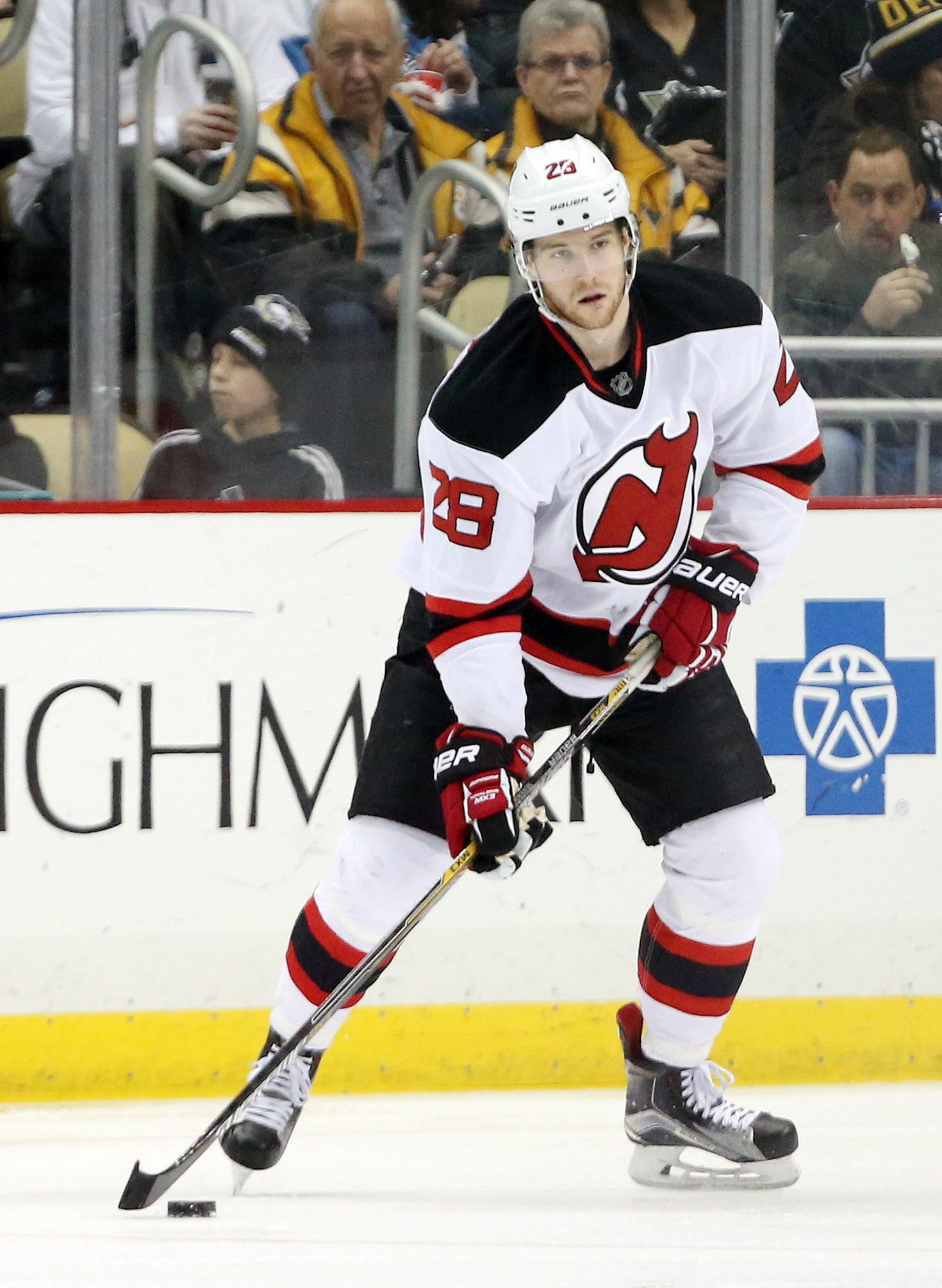 While many saw last season as a breakout for Severson, after Adam Larsson‘s departure put more of the spotlight on him in New Jersey, he’s been playing at an extremely high level since he entered the league in 2014. Now 23, Severson has recorded 69 points in 203 games while logging 20 minutes a night nearly every game for the Devils. He is the leader on their blueline, and will now be rewarded with a long term contract.
The Devils of course moved Larsson to the Edmonton Oilers last summer in exchange for Taylor Hall, leaving Severson as the top right-handed option and powerplay quarterback on the team. His point total raised to 31 this season on the back of a big performance with the man advantage, but his defensive play is also up to snuff. Severson can at times look shaky in his own end, but generally drives possession with quick decisions. He doesn’t just clear the puck blindly, but moves it out with his feet or a quick first pass.
Speaking of Larsson, the new contract is exactly the same as the six-year $25MM deal they gave him in 2015, though that had some trade protection and was actually buying out three years of free agency. Severson will give up just two UFA seasons, and could hit the market at 28.
New Jersey, who’ve struggled the past five years to even ice a competitive team, have just a inked a shining star long-term that they can build around. The Devils are clearly still trying to compete for a playoff spot, but eventually they may need to do a slight tear-down and rebuild the team around young Nico Hischier, Mike McLeod, Pavel Zacha and others. Severson is now locked in as a top option on the blueline for some time.
The $4.167MM cap hit is plenty affordable for the Devils, and carries incredible value. As Larsson demonstrated, puck-moving right-handed defensemen signed for less than $5MM are very rare to find. It’s very plausible that Severson even takes another step forward this season and starts to compete with players like Tyson Barrie and Torey Krug in that next tier of offensive production. If he can do that without sacrificing anything in his own end, the Devils will be quite pleased with his cap hit for years to come.
Bob McKenzie of TSN reported the length and financial details.
Photo courtesy of USA Today Sports Images
Salary Cap Deep Dive: New Jersey Devils
Navigating the Salary Cap is probably one of the more important tasks for any general manager to have. Teams that can avert total cap chaos by walking the tightrope of inking players to deals that match their value (or compensate for future value without breaking the bank) remain successful. Those that don’t see struggles and front office changes.
PHR will look at every NHL team and give a thorough look at their cap situation heading into the 2017-18 season. This will focus more on those players who are integral parts of the roster versus those who may find themselves shuttling between the AHL and NHL. All cap figures are courtesy of CapFriendly.
New Jersey Devils
Current Cap Hit: $57,037,501 (under the $75MM Upper Limit)
Entry-Level Contracts
F Nico Hischier (Three years remaining, $925K)
D Will Butcher (Two years remaining, $925K)
D Michael Kapla (One year remaining, $925K)
F Pavel Zacha (Two years remaining, $894K)
Potential Bonuses
Hischier: $2.85MM
Butcher: $2.85MM
Zacha: $850K
Total: $6.55MM
It turned into a solid summer for the Devils as they won the draft lottery and used that first-overall pick to select Hischier, a talented Swiss center, who put up 38 goals and 86 points in 57 games for the Halifax Mooseheads of the QMJHL. He is expected to break camp with the team and have an immediate impact. With recent injuries, Hischier could take over as the second-line center and start his career in a great position. The hope is he will help lead this team to the playoffs sooner rather than later.
Butcher has been a more recent signing sensation as the Devils also won the offseason bidding for the Hobey Baker Award winner after he became a free agent several weeks ago. Butcher picked the Devils with the hopes of getting immediate playing time, since no one is truly sure if he is an NHL impact player. The 22-year-old blueliner put up outstanding numbers as a junior and senior at the University of Denver, but chose not to sign with the team that drafted him, the Colorado Avalanche. With the Devils biggest weakness being their defense, the team is thrilled to bring him on board.
Zacha, the sixth overall pick in the 2015 draft, finished his first full season in New Jersey, playing in 70 games, while putting up eight goals and 16 assists for the year. While those numbers look disappointing, he didn’t play a lot of minutes last year (14:18) and didn’t play with much talent next to him, although he looked good playing alongside Taylor Hall at points during the season. He should take that next step this year. Kapla, like Butcher arrives to join the team’s defense from college. He played four years for the University of Massachusetts – Lowell and signed a two year deal immediately after ending his senior year. That first year consisted of five games. Already on year two of his deal, Kapla must prove he is an NHL defenseman this year.
One Year Remaining, Non-Entry-Level
F Ryane Clowe ($4.85MM, UFA)
D John Moore ($1.67MM, UFA)
D Dalton Prout ($1.575MM, UFA)
F Drew Stafford ($800K, UFA)
F Stefan Noesen ($660K, RFA)
The group is not filled with impact players, so the Devils have little to worry about in the short term. They will likely rejoice once’s Clowe’s contract comes off the books. The veteran signed a five-year deal back in 2013 and only played two years, before being forced to retire due to concussion issues. Moore is an offensive defenseman (22 points in 63 games last year), but is totally inept on the defensive end. It wouldn’t be a surprise if the team went in a different direction on defense next year.
Prout, who the team picked up at the trade deadline for veteran Kyle Quincey, only played 14 games for the Devils and it might take all season to determine whether or not he has value. Stafford, who just signed recently to a one-year deal, could easily be a bargaining chip at the trade deadline. After putting up 21 goals two seasons ago while with the Winnipeg Jets, his value dropped as he scored just eight goals between the Jets and the Boston Bruins last season. The Devils, however, are counting on a bounce-back season, which could eventually net them some more young talent. Noesen, who signed a one-year, two-way contract will try to make the roster this year after scoring six goals in 32 games for New Jersey last season.
Poll: Which Restricted Free Agents Will Miss The Start Of The Season?
After Toronto Maple Leafs’ forward Connor Brown signed this weekend, the count is now fourteen on remaining restricted free agents still to sign. David Pastrnak, Alexander Wennberg and Bo Horvat lead the group, while Damon Severson, Sam Bennett and Andreas Athanasiou all represent important players on their clubs.
While most of these fourteen will surely sign within the next few weeks and be ready for the start of the season, there are often a few that take a little longer to sign. Last year we saw Rickard Rakell, Hampus Lindholm and Jacob Trouba all sign contracts after the regular season had begun. Though Rakell was injured and wouldn’t return until the beginning of November anyway, the other two missed important game action that could have cost their teams in the standings.
With the end of August upon us, there could be more examples of RFAs holding out into the season. Below we’re asking you to vote on who you think will be left without a contract come the beginning of the year. Every RFA that has yet to be officially signed by his team is listed. You can vote for as many as you want, and make sure to leave how many games you think they’ll each miss in the comments.
Which RFAs Will Be Without A Contract At The Beginning Of The Season?
-
Andreas Athanasiou (DET) 24% (140)
-
David Pastrnak (BOS) 22% (131)
-
All will be signed 12% (68)
-
Nikita Zadorov (COL) 8% (46)
-
Anthony Duclair (ARZ) 6% (34)
-
Bo Horvat (VAN) 6% (33)
-
Sam Bennett (CGY) 6% (33)
-
Alexander Wennberg (CBJ) 5% (27)
-
Robbie Russo (DET) 3% (19)
-
Petteri Lindbohm (STL) 3% (16)
-
Damon Severson (NJD) 2% (12)
-
Tyler Wotherspoon (CGY) 2% (11)
-
Josh Anderson (CBJ) 2% (10)
-
Brett Kulak (CGY) 2% (10)
Total votes: 590
[Mobile users click here to vote!]
A Recent History Of Late-Summer RFA Signings
The hockey world has been swirling around David Pastrnak for the past few days, as negotiations with the Boston Bruins drag on late into the summer. Fans of the team are beginning to get nervous that there might be something standing in the way of a long-term deal, even while the Bruins’ front office assures everyone that they won’t be moving on from their young star. It’s not just Pastrnak though, as this summer seems to have a disproportional amount of high-level restricted free agents still unsigned into the middle of August. Leon Draisaitl, Alexander Wennberg, Bo Horvat, Connor Brown, Damon Severson and Andreas Athanasiou and many more are waiting for their next contracts and inching closer and closer to missing some of training camp.
Naturally, anyone’s instinct is to think that the longer the negotiation goes on, the more animosity can be built between the two sides. This is simply not true, and it’s been shown time and again that some RFAs—especially those who are coming off exceptional seasons—are in for long negotiations. It’s hard to remember how many players make it late in the summer without contracts once the season begins, so here is some of the history of some high profile late-summer RFA signings the last few years:
2016
Sean Monahan signs on August 19th. Seven years, $44.6MM.
Cody Ceci signs on August 23rd. Two years, $5.6MM.
Ryan Strome signs on September 20th. Two years, $5.0MM.
Johnny Gaudreau signs on October 10th. Six years, $40.5MM.
Nikita Kucherov signs on October 11th. Three years, $14.3MM.
Rasmus Ristolainen signs on October 11th. Six years, $32.4MM.
2015
Jonathan Bernier signs on August 2nd. Two years, $8.3MM.
Brock Nelson signs on September 16th. Three years, $7.5MM.
2014
P.K. Subban signs on August 2nd. Eight years, $72MM.
Tyson Barrie signs on September 7th. Two years, $5.2MM.
Danny DeKeyser signs on September 20th. Two years, $4.4MM.
Nino Niederreiter signs on September 20th. Three years, $8MM.
Ryan Ellis signs on October 5th. Five years, $12.5MM.
Jaden Schwartz signs on October 5th. Two years, $4.7MM.
Ryan Johansen signs on October 6th. Three years, $12MM.
2013
Adam Henrique signs on August 27th. Six years, $24MM.
Mikkel Boedker signs on September 7th. Two years, $5.1MM.
Marcus Johansson signs on September 8th. Two years, $4MM.
Nazem Kadri signs on September 10th. Two years, $5.8MM.
Alex Pietrangelo signs on September 14th. Seven years, $45.5MM.
Derek Stepan signs on September 26th. Two years, $6.2MM.
Free Agent Profile: Dennis Wideman
Recently, PHR has been shining some light on remaining free agents in a very quiet market, with players like P.A. Parenteau, Daniel Winnik, Brian Gionta, Jarome Iginla, and Drew Stafford getting some extra attention. The one thing that those players have in common is that there is not a defenseman among them. The last defenseman profiled was Johnny Oduya, who signed with the Ottawa Senators the next day and remains the last major UFA to have signed an NHL deal. Meanwhile, veteran Andrei Markov left for Russia, while big blue liner Cody Franson remains in limbo (and should consider investing in some real estate there).
Why have no other defenseman garnered attention, both from NHL teams nor the PHR team? There are simply few quality defenders left on the market. Outside of Franson, one lone defenseman remains unsigned from PHR’s list of the Top 50 2017 Free Agents: Dennis Wideman. Wideman was the last man to make the list, ranking 50th overall and 14th among defenseman. At 34 years old and coming off back-to-back seasons that could both be considered the worst of his career, Wideman wasn’t exactly a hot commodity. However, it was still projected that Wideman would find work based on a long track record of being able to play major minutes and put up points, even if just on a short-term inexpensive deal.
Luckily for Wideman, that is still a distinct possibility even in mid-August. The free agent market, for not only defenseman but for all players, is all but dead, yet opportunities remain. Signings have been few and far in between, but Wideman faces only Franson for any open blue line spots and brings a very different skill set. Wideman is an 11-year veteran with 387 points in 815 NHL games and was once considered one of the top puck-movers in the game. Wideman even drew Norris Trophy votes in 2008-09 with the Boston Bruins and turned his impressive resume into a five-year, $26.25MM contract with the Calgary Flames in 2012. Wideman is far from that player today, but still carries the pedigree of a possession defenseman capable of playing big minutes when needed and helping out on the power play.
Even if Franson signs a new contract first, Wideman’s chances of landing a deal of his own are still fair. In each of the past two years, two legitimate NHL defenseman have signed contracts late in free agency. Last year, it was Dennis Seidenberg going to the New York Islanders and Kyle Quincey signing with the New Jersey Devils. Seidenberg looked rejuvenated in Brooklyn and earned himself an extension, while Quincey proved to be a valuable veteran and trade chip for the Devils and has already signed with the Minnesota Wild this summer. In 2015, it was Franson himself, ending up with the Buffalo Sabres on a two-year deal, and David Schlemko, yet another one-year value deal for the Devils.
Potential Suitors
If the pattern isn’t clear yet, a one-year “show me” deal for Wideman with the New Jersey Devils remains a very real possibility. For the third season in a row, the Devils could greatly benefit from adding a talented veteran on the cheap. Although the team has a pair of consummate pros in captain Andy Greene and veteran Ben Lovejoy, as well as some exciting young players like Damon Severson, Mirco Mueller, and John Moore, the team is lacking in depth. Bringing in Wideman, who has become accustomed to a part-time role in Calgary over the past few years, to be a spot starter, capable injury replacement, and mentor to the young offensive blue liners would be a savvy signing by GM Ray Shero.
Another team that is going to be rumored to be in on a top-four defenseman until they actually go out and get one is the Colorado Avalanche. With just three defenseman currently signed to one-way deals and a depth chart lacking in legitimate NHLers, the rebuilding Avs are desperate for help on the blue line. It would not come as surprise if Colorado ended up signing both Wideman and Franson if their “D” corps looks as bad in camp as it does on paper.
Other interested parties that may be looking for affordable veteran depth – and specifically keyed in on a right-handed shot – include the Columbus Blue Jackets, Montreal Canadiens, Los Angeles Kings, or a return to the Washington Capitals.
Expected Contract
The original speculation for Wideman was that he would sign a one-year deal worth $1.5MM. At this point in the off-season and given Wideman’s age and the substantial wear on his tires, a one-year pact is all but certain. The $1.5MM? That isn’t out of the question. Wideman’s past two seasons with the Flames were none toof inspiring and Calgary fans were happy to see him go. However, that doesn’t mean that Wideman can’t return to form with a change of scenery and is just two years removed from a career-high 56 points. He may still be able to command a seven figure salary. The longer he goes unsigned though, the more and more likely he ends up under $1MM. Wideman seems unlikely to take the absolute minimum, $650K, and will hold out hope that he can get somewhere in the neighborhood of the $1.25MM deals that Quincey signed last year and this year. In the end, he may have to settle for only a bit more if he wants to extend his NHL playing career. One way or another, Wideman will be making much less and will have a very different role with his next contract versus his last.