
Injury Notes: Jets And Bruins
Two of the best teams in hockey, the Boston Bruins and Winnipeg Jets, are both in action today and will both see changes to their lineups due to injury. The Bruins take on the Minnesota Wild with a chance to climb within two points of the Atlantic-leading Tampa Bay Lightning while still holding a game in hand. The Jets need a win over the Central leading Predators to clinch a playoff spot with their own efforts, but could also get in today with at least one point and an Anaheim Ducks loss. However, the Jets will have to do so tonight and going forward down a man, whereas it seems like the Bruins task is about to get easier as their mountain of injuries is shrinking.
The Winnipeg Jets have a tough situation on their hands, but it could be worse. The team announced today that veteran defenseman Toby Enstrom will be shut down for the remainder of the regular season. Head coach Paul Maurice told TSN’s Brian Munz that Enstrom will not play again over the final two weeks as he nurses a lower-body injury. However, the important distinction is that this was the team’s choice and that it only includes the regular season. The team seems optimistic that some time off will give Enstrom a better chance of being ready to go in the postseason. With Dmitry Kulikov all but done for the year, the Jets could really use a healthy Enstrom if they want to make waves in the 2018 Stanley Cup playoffs.
Meanwhile, the Bruins also have their eye on the Cup and have somehow stayed on course through mounting injuries over the past month. Boston’s last two games in particular have lacked Patrice Bergeron, Charlie McAvoy, Zdeno Chara, Jake DeBrusk, David Backes, Rick Nash, and Torey Krug, yet the Bruins picked up a combined three points against the St. Louis Blues and Dallas Stars. Overall, the Bruins are shockingly 9-2-2 since Bergeron went down in late February, with McAvoy out since March 3rd and Chara and DeBrusk having missed the last two weeks. Now, the team is getting healthier, announcing that Bergeron and Krug are set to return to the lineup tonight and adding that Chara, McAvoy, and Backes are making their way back as well. That just leaves DeBrusk and Nash without an update and neither injury was reported to be overly serious when they first occurred, which means that Boston could be back at full strength before the start of the playoffs. Given the emergence of Ryan Donato and the strong play of Brian Gionta, Nick Holden, and others, that begs the question posed by beat writer Joe Haggerty today: who will start for the Bruins if everyone is healthy?
Dmitry Kulikov Out Eight Weeks Following Back Surgery
When Dmitry Kulikov was listed as day-to-day with an upper-body injury last week, it seemed completely innocuous. Now, it appears to be anything but and potentially season-altering for the Winnipeg Jets. Sportsnet’s Sean Reynolds reports that Kulikov is undergoing back surgery and will be out about eight weeks. For perspective, that would be a return around May 12th, most likely the conference finals round. This is likely season-ending surgery for Kulikov and Winnipeg hopes it won’t contribute to a premature end to their 2017-18 run as well.
For those trying to think of when Kulikov could have suffered such a major injury, you would have to go all the way back to the 2016-17 preseason. Then a newly-acquired Buffalo Sabre, Kulikov suffered a back injury before the season even began and dealt with repercussions all year. Kulikov missed 35 games due to injury last year, at least 22 of which were officially credited to his back, and landed on injured reserve twice. Now, Reynolds adds, the lingering issue has returned to plague him again. In his first season of a three-year deal with the Jets, one has to wonder what the future looks like for Kulikov as this back problem continues to stick around.
Until this point, Kulikov has been relatively healthy for Winnipeg, skating in 62 games thus far. Kulikov has fit in nicely for the Jets, far exceeding his performance in Buffalo last season. His numbers may not jump off the page, offensively or defensively, but as a third-pair pair blue liner he has done everything asked of him, including playing a solid game in his own zone and possessing the puck safely. While his absence may not hurt as much as the loss of a Jacob Trouba, Dustin Byfuglien, or Tyler Myers would for the rest of the year, it will certainly be felt. Especially with Toby Enstrom already on the shelf as well, the Jets are hurting for the strong defensive depth they began the year with. More pressure will certainly fall on the likes of Tucker Poolman and Joe Morrow for the remainder of the year, as Winnipeg looks to keep injuries from slowing down an incredible campaign.
Jets Notes: Hendricks, Hutchinson, Trouba
The Winnipeg Jets are in an unfamiliar position, firmly in a playoff spot with 12 games left to play. With 92 points, they trail only the Vegas Golden Knights and the Nashville Predators for the Western Conference lead, and are poised to do some damage in the postseason for the first time in their history. Still, that is only if they can stay healthy over the next few months. That’s not something that has come easily to the Jets of late, and Jamie Thomas of JetsTV gives us updates on several players.
- Matt Hendricks has played 60 games for the Jets this season as a fourth-line veteran presence, giving the team some valuable leadership and chipping in offense now and again. That role will have to go to someone else, as Hendricks is out six to eight weeks with a lower-body injury. That takes him out through the end of the season and much of the playoffs, meaning there is more ice time for the younger players in Winnipeg. Despite his near 600 games in the NHL, the 36-year old Hendricks has played in only 34 playoff games and none in the last five years.
- Luckily, it’s not all bad news in Winnipeg. There is a possibility that Jacob Trouba makes his return in tonight’s game which would be his first since January 15th. Trouba is a huge part of the Jets lineup, and with Dmitry Kulikov out with a minor injury his return would be extremely important. Trouba is up for another contract this summer, and an impressive playoff performance could increase his cost even more.
- Michael Hutchinson was forced out of Tuesday’s game against the Nashville Predators after three quick goals, but has now been diagnosed with a concussion. That’s the second goaltender out for the Jets, joining Steve Mason who is working his way back from a knee injury. Connor Hellebuyck will be relied upon even more, while Eric Comrie is the backup for the time being.
Salary Cap Deep Dive: Winnipeg Jets
Navigating the Salary Cap is probably one of the more important tasks for any general manager to have. Teams that can avert total cap chaos by walking the tightrope of inking players to deals that match their value (or compensate for future value without breaking the bank) remain successful. Those that don’t see struggles and front office changes.
PHR will look at every NHL team and give a thorough look at their cap situation heading into the 2017-18 season. This will focus more on those players who are integral parts of the roster versus those who may find themselves shuttling between the AHL and NHL. All cap figures are courtesy of CapFriendly.
Winnipeg Jets
Current Cap Hit: $67,661,666 (under the $75MM Upper Limit)
Entry-Level Contracts
F Patrik Laine (Two years remaining, $925K)
F Kyle Connor (Two years remaining, $925K)
F Nikolaj Ehlers (One year remaining, $894K)
D Josh Morrissey (One year remaining, $863K)
Potential Bonuses
Laine: $2.65MM
Ehlers: $850K
Connor: $850K
Morrissey: $500K
Total: $4.85MM
The future looks bright for the Jets, especially with Laine, who is constantly overshadowed by Toronto Maple Leafs Auston Matthews. Laine, who was taken second-overall in last year’s draft, put up phenomenal numbers that make Jets fans believe again in their team. He put up 36 goals in his rookie campaign and added 28 assists for a 64-point season. He should only get better and become the cornerstone of the franchise in the future. He should be joined by Ehlers, who also had a breakout year last year. The 2014 first-round pick had 15 goals in his rookie year, but added to that this past year, putting up 25 goals and 39 assists for 64 points.
The team also has high hopes for Connor to make the team and find himself a full-time role this year. The team’s 2015 first-round pick, put up big numbers a couple years ago at the University of Michigan two years ago, then scored 25 goals with the AHL’s Manitoba Moose and still managed to get 20 games in with the Jets, where he scored two goals and three assists. The team believes he has a good shot to end up on one of the back two lines. Morrissey, the team’s first-round pick back in 2013, found a full-time role with the Jets last year as he put up six goals and 14 assists. He is currently slated to start on the Jets’ third-line defense.
One Year Remaining, Non-Entry-Level
D Toby Enstrom ($5.75MM, UFA)
F Bryan Little ($4.7MM, UFA)
D Jacob Trouba ($2.81MM, RFA)
G Connor Hellebuyck ($2.25MM, RFA)
F Shawn Matthias ($2.13MM, UFA)
G Michael Hutchinson ($1.15MM, UFA)
F Adam Lowry ($1.13MM, RFA)
F Joel Armia ($925K, RFA)
F Marko Dano ($850K, RFA)
F Brandon Tanev ($700K, RFA)
F Matt Hendricks ($700K, UFA)
F Michael Sgarbossa ($650K, RFA)
That’s a long list, but most of the players are restricted free agents and should easily be retained. However, the team will have to make some decisions on some key veterans, including Little, who many feel is an underrated forward. The 29-year-old has been with the franchise from the start of his career when they were the Atlanta Thrashers and has scored 184 goals for the franchise. With the team’s large number of young forwards, might they move on from Little in a year? Injuries have plagued little over the past two years as he’s missed 48 games. His 21 goals last year were solid, but he will need to prove his value this year if he wants another long-term deal. Another potential unrestricted free agent would be Enstrom, who will be 33 next year and the team will have to decide whether to keep the veteran blueliner. His offensive numbers dropped into the teens in the last couple of years. Mattias and Hendricks are expendable fill-ins, but valuable veterans to hold that roster together.
The team will be looking to several of their restricted free agent as key players in the future. The team will be looking at Trouba to have a big season this year. The 23-year-old defenseman had a career-high 33 points a year ago and he did that in only 60 games, so many feel he may take his game up a notch this year if he can avoid injuries. Despite Hellebuyck’s down year as they attempted to hand him the starting goaltender job, the team still looks at him as a potential starter that just wasn’t ready to take their reigns last year. His 2.89 GAA in 56 games didn’t get the job done. With Mason coming in, Hellebuyck will have more time to develop as a backup.
The team will be looking for Lowry to continue to develop as well. Lowry had 15 goals last year and the 24-year-old is expected to center the team’s third line. Armia also has bigger expectations this year after putting up 10 goals a year ago. He could also end up as a wing next to Lowry on that third line. Dano could also pick up a full-time role with the Jets this year. The former 2013 first-rounder played 38 games for Winnipeg last year, putting up four goals and seven assists.
A Quiet 2017 Off-Season
By the time August rolls around each year, it seems like the off-season is dragging on. The July 1st free agent frenzy is long behind us and it’s been weeks since the last major signing. Fans are struggling to get their hockey fill and counting the days until the puck drops on preseason hockey. In 2017, fans have all the more reason to be sick of the off-season. When compared with the summer of 2016, this off-season has simply been boring. It was expected to be as such, but no one could have predicted just how quiet this summer could be.
As of today, August 6th, 2017, there have only been two unrestricted free agents signed to contracts worth more than $6MM per year: Kevin Shattenkirk to the New York Rangers (as predicted) and Alexander Radulov to the Dallas Stars. In contrast, there were four such deals signed on July 1st, 2016 alone. Drop that mark down to contracts worth more than $4MM annually, and you get uninspiring names this year like Evgeni Dadonov, Dmitry Kulikov, Nick Bonino, Karl Alzner, Martin Hanzal, and Steve Mason added to the list; hardly a superstar among them. 2016 saw high-profile players like Milan Lucic, David Backes, Loui Eriksson, Kyle Okposo, and Andrew Ladd all find new homes. Those signings came on the heels of the P.K. Subban – Shea Weber and Taylor Hall – Adam Larsson trades as well. The best swaps 2017 has to offer so far are Travis Hamonic or Marcus Johansson being dealt for draft picks. There have simply been a lack of franchise-altering moves made this summer.
Then you have the timeline of when deals got done. By August last year, the best unsigned free agents were Antoine Vermette, Jiri Hudler, and Jhonas Enroth. The year before, Cody Franson and David Schlemko highlighted the August market. In both cases, NHL teams got their deals done in July, filling the month with exciting signing news. This year? Not so much. Legendary players like Jaromir Jagr, Jarome Iginla, and Shane Doan remain available, alongside other able-bodied contributors like Thomas Vanek, Drew Stafford, and Daniel Winnik. That’s in addition to Franson and Hudler as well. Teams are simply waiting around on this market for reasons unknown. Could it end up as an exciting run of signing in August? Maybe, but don’t count on it.
The weak 2017 free agent market coupled with the challenge of preparing for June’s Expansion Draft has simply resulted in one of quietest off-seasons in recent memory. Several teams still have needs and spots to fill and signings and trades remain possible, but at this point the summer is a lost cause. Time to look forward to next season and even next summer when we *hope* to see the likes of John Tavares, Rick Nash, Evander Kane, James Neal, James van Riemsdyk, Paul Stastny, Mikko Koivu, Cam Atkinson, Jonathan Marchessault, Daniel and Henrik Sedin, Mike Green, Jack Johnson, Calvin de Haan, and Antti Raanta all hit the open market. Hopefully that list is enough excitement to get you through the rest of this one.
Cost Per Point: The Best Value Deals In The NHL
When working with a salary cap, especially one that has not been increasing as expected in recent year, it is vital for general managers to get the most production out of their players. Teams with players who meet the expected level of production implied by their contracts and teams that lack wasted dollars in bad, expensive deals are often the same teams that thrive in today’s NHL. Forget market size or free agent appeal, the key to a winning franchise nowadays is getting the best bang for your buck on every player on the roster. While no player can be fully quantified by their scoring, cost per point is an easy way to look at which players are producing at the most team-friendly rate and which have been more of a cap space killer than a positive member of the team. Thanks to CapFriendly, that information is readily available to fans and NHL executives alike.
The benchmark for this metric is about $100K/point, as GM’s expect those big-time forwards and offensive defenseman who they award with $6MM, $7MM, and $8MM per year contracts to be putting up 60, 70, or 80 points respectively. For the second year in a row, St. Louis Blues superstar Vladimir Tarasenko was the poster boy for this standard, coming in at exactly $100K/point with 75 points on a $7.5MM deal. Winnipeg’s Bryan Little and New Jersey’s Adam Henrique are two other notable names that hit the mark exactly, while phenoms like Sidney Crosby and Duncan Keith landing close to the $100K/point mark show that it is an accurate expectation.
However, the exception to the rule is obviously entry-level contracts. It is no secret that drafting and developing well is the best way to improve you team, beginning with affordable scoring from players on their rookie deals. Nowhere is that more apparent than in cost per point, where nine of the top ten and 17 of the top 20 best contracts were rookie deals. To no one surprise, 20-year-old MVP Connor McDavid and his 100 points on a $925K entry-level contract was far and away the best bargain in hockey. McDavid cost the Oilers only $9,250 per point in 2016-17. That will all change soon, as McDavid is set to begin an eight-year, $100MM contract in 2018-19, after which a 100-point campaign will cost Edmonton $125,000/point, closer to the expectations of a standard contract. For now, the Oilers can enjoy one more year of McDavid likely being the best deal in the NHL, as well as the best player. Entry-level deals joining McDavid in the top ten last year (in order) were Viktor Arvidsson, Artemi Panarin, teammate Leon Draisaitl, Conor Sheary, David Pastrnak, Auston Matthews, Nikolaj Ehlers, and Patrik Laine. Not all entry-level deals are created equal, so while Draisaitl and Pastrnak were second and fourth respectively in entry-level scoring, they were also on the ELC maximum deal of $925K and of slightly lesser value to their teams than the likes of Arvidsson ($632K) and Sheary ($667.5K). Panarin had the best contract in the league in 2015-16 and fell only to third with $10,980/point for the Chicago Blackhawks. Now in Columbus and on a two-year, $12MM deal, the Blue Jackets have to hope that they can continue to get 70+ point seasons out of him to maximize the value of that deal.
So, entry-level contracts aside, who was the best contract in hockey last season? Another easy answer, former Blue Jacket gamble Sam Gagner. After a horrendous 2015-16 campaign with the Philadelphia Flyers, Gagner struggled to find a new team last summer, eventually settling on a $650K “show me” deal with Columbus. Right away people tagged that contract, for a six-time 40+ point scorer, as an absolute bargain, even if Gagner simply bounced back to normal production. He did one better, posting a career-high 50 points for the Jackets and coming in at $13K/point, good enough for sixth in the NHL. Gagner has since moved on to the Vancouver Canucks, signing a three-year, $9.45MM contract on July 1st. However, if he is able to continue to produce at 40-50 point levels over that deal, his $3.15MM cap hit will remain a great bargain deal. Behind Gagner, another player on the move this summer, former Florida Panther and current Vegas Golden Knight Jonathan Marchessault had the 13th-ranked cost per point last year at $14,706/point. Marchessault had a breakout year, netting 51 points in the first season of a two-year, $1.5MM deal. Rather than take advantage of one more $750K season for a 30-goal scorer, the Panthers allowed Marchessault to be selected in the Expansion Draft and Vegas surely hopes he continues to be one of the best values in hockey in 2017-18. The final contract in the top 20 not belonging to an entry-level player, and the only 35+ veteran contract in the top 50, belongs to Marchessault’s replacement in Florida, Radim Vrbata. Vrbata returned home to Arizona last season after a down year in Vancouver the season prior, and the swift 36-year old proceeded to score 55 points, more than double his previous year’s total. On a one-year deal with a $1MM base salary, that only cost the Coyotes $18,182/point last season. Now at a base salary of $2.5MM in Florida, the Panthers hope that Vrbata isn’t starting to slow down just yet. Other impressive value contracts included Patrick Eaves, whose breakout season in Dallas led to a trade and subsequent extension with the Anaheim Ducks, Derek Ryan, who shocked the hockey world with 29 points for the Carolina Hurricanes in his first full NHL season at age 30, and a quartet of recently re-signed RFAs in Richard Panik, Ryan Dzingel, Ryan Spooner, and Jordan Martinook.
With the good comes the bad, and there were certainly some poor value contracts in the NHL last year. Many of the worst belong to players who were injured or AHL depth players that saw only limited time. With zero points in 13 games with a $1.25MM cap hit, Tampa Bay Lightning winger Erik Condra‘s value was not even quantifiable it was so bad, and at the highest salary of any player who went pointless last season. Limited to just 18 games with only four points, another Bolts forward, Ryan Callahan, was one of the worst values due to injury with $1.45MM per point on his $5.8MM cap hit. However, the truly worst contract in the NHL has to belong to a player that player a majority of the season. Sadly for a Detroit fan base that is already feeling pretty down-and-out, that designation belongs to Red Wings defenseman Danny DeKeyser, who began a six-year, $30MM extension by scoring about a third less points for the third season in a row. With 12 points in 82 games at $5MM, DeKeyser’s $416.7K/point is pretty ugly. The Buffalo Sabres struck out twice on the blue line, with both Dmitry Kulikov (five points in 47 games at $4.33MM) and Josh Gorges (six points in 66 games at $3.9MM) coming in at $866.7K/point and $650K/point respectively, though neither is known as a major point producer. The worst forward contract? Andrew Desjardins may not have been relied upon as a full-time player with much ice time last season with the Chicago Blackhawks, but with only one point in 46 games, $800K/point, it’s not difficult to see why he remains an unsigned free agent.
While statistics and analytics in hockey are normally geared toward displaying on-ice production, it is always interesting to look at the game from a business perspective. It is important for teams and fans alike to understand not just the absolute of how a player is producing, but the relative value of that production based on how much money that player is being paid. In a salary cap league, there is nothing more important that production value, and as the game grows the focus will only further tighten on scoring as a function of dollars and the cost per point metric.
Winnipeg’s Forward Depth And Versatility Valuable In Trade Market
The Winnipeg Jets finished just 7 points out of a playoff berth this season. Like the Islanders (41 wins) and Lightning (42 wins), the Jets (40 wins) were on the verge of making it to the show in the final weeks. As such, GM Kevin Cheveldayoff didn’t feel the necessity to spend large this off-season, nor make any substantial trades. Cheveldayoff shored up the goaltending position with Steve Mason on a two-year contract, and hopes that will be enough to push the team over the edge. Still, if management feels that improvements should be made, the team has the assets and the versatility up front to do so. It’s uncertain whether Dmitry Kulikov will be enough to shore up what was a poor-performing defensive group last year. A spare forward could be floated for more help in their own end, even though their 6 slots seem safely filled at the moment.
Particularly at the center position, the Jets have one of the more enviable situations league-wide. By my count, the Jets have 9 roster players who can theoretically slot in for center duties. Mark Scheifele, Bryan Little, Mathieu Perreault, Shawn Matthias, Adam Lowry, Michael Sgarbossa, Marko Dano and Brandon Tanev all can play up the middle. Scheifele is obviously the first line center, and Little is safely pegged at number two. After that, things get a bit interesting. Perreault finished the season while spending some time on the wing, and his goal scoring dried up – he only had 22 in the past two seasons. His point production is still locked in at 40+, but considering his $4.125 MM cap hit for the next four seasons, maybe now is the time to opt out. Matthias is interesting primarily because he only has one season remaining before he hits unrestricted free agency. He can slot on the third or fourth lines and provide mediocre depth production, but his marginal worth wouldn’t be enough to land a difference maker in a trade.
Little also sees his current deal expire at the conclusion off 2017-18, and his new contract could be relatively hefty. With Blake Wheeler due another contract hike after 2018-19, and Jacob Trouba looking for a raise after this year, there is the possibility Little could be moved for the right package. Still, he’s one of the more consistent players on the Jets and has never known another franchise. If he were to be shopped, the return could be quite pricey for many competing teams. He’s perceived as a top-end #2 center and his internal value is quite steep. Following that, Lowry will continue to build on his progression last year, where he tallied 29 points. He’s yet to put it all together, but his size and still tender age of 24 wouldn’t make him the first target for movement. Dano is far more comfortable on the wing, and he’s likely going nowhere. Sgarbossa is essentially a non-factor, as is Tanev, in terms of drawing league interest.
Another thing to keep in mind is that Nicolas Petan should find himself a regular this season, and many expect him to push for that 3rd line center position. As with many of the other names, he can slot on the wing instead, but that might not be the best use of his talents long-term. If he forces Lowry down the depth chart further, does that make a player like Little more expendable for the right move? What would the interest be like for a player of Perreault’s caliber? Unfortunately, it seems unlikely that we’ll know until well into the season. Cheveldayoff has been firm in staying the course with the young and promising Jets, and he’s more likely to wait at least until the conclusion of training camp before making any major transaction.
Overpriced: The Worst Contracts Of 2016-17
Recently we took a look at some of the best contracts in the league based on cost-per-point, and which off-season contract would hold that title this year. Patrick Sharp easily won the poll, and could provide great value on his $800K contract ($1MM with performance bonus). Among players still signed, excluding entry-level deals, Jon Marchessault has a good chance to repeat if he’s given the opportunity in Vegas. He was one of the brightest spots for Florida last year, after agreeing to a two-year deal that pays him just $750K per season. 
So what about the other side of the spectrum? Who are the most expensive players relative to their performance in the NHL? Luckily CapFriendly has a helpful tool that not only lists the per-point cost, but can standardize it to what it would have cost had the player spent 82 games in the NHL. That way a player like Milan Michalek who scored just one point won’t be penalized for the fact that he was buried in the minors all year.
As one would expect, this list is led by a glut of defensive defensemen who are paid more for what they do in their own end than their offense. Still, you can see how teams can get in trouble with players like Josh Gorges and Marc Staal costing more than $500K per point this season. The two combined for 16 on the year.
Interestingly another Buffalo defender is high on the list, as Dmitry Kulikov recorded just five points all season. Despite that $497K cost-per-point rate, he still locked down a deal that will continue to pay him $4.33MM for the next several years. He’s a bounce-back candidate for sure, but it was surprising to see his terrible year not affect his price tag.
If you eliminate defensemen, the picture becomes even uglier. Regardless of role, forwards are still expected to contribute at least somewhat on offense, especially those who earn hefty contracts. Andrew Desjardins leads the pack among players who spent the majority of the season in the NHL, scoring just a single point in his 46 games. He only cost the team $800K though, which means Carl Soderberg takes the cake as the worst contract in the league*.
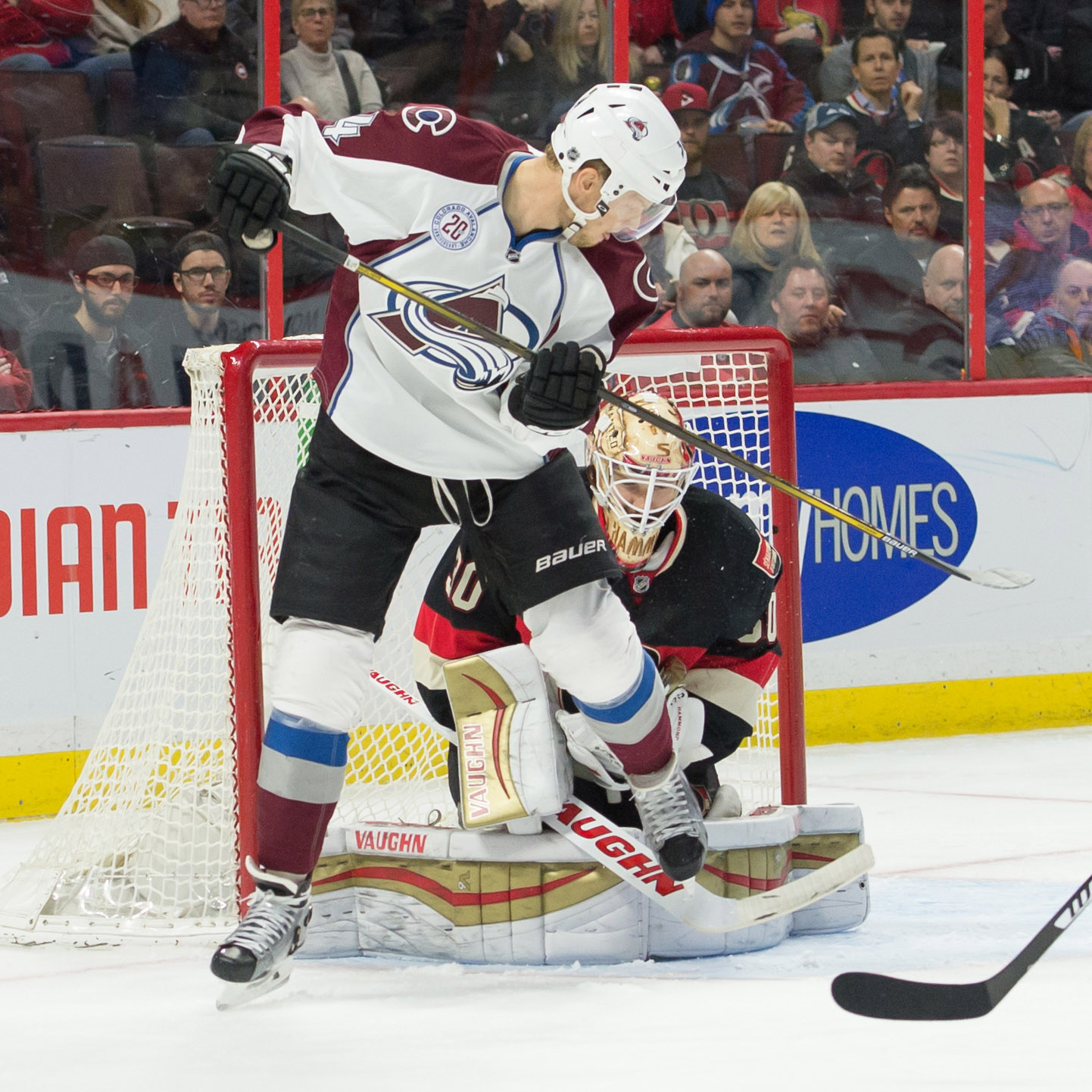 Soderberg was paid $4.75MM last season and recorded just 14 points. He’s not expected to be a huge offensive producer, but the fact that Colorado had to pay more than $330K per point this season was ridiculous. His fall off was immediate and precipitous, as he’s just a year removed from a 51-point year, but if he can’t climb back up the three remaining years on his contract look about as bad as they come. His no-trade clause has dropped to just a list of 10 teams he can’t be traded to, but if his production continues he’s more likely a buyout candidate than anything else.
Interestingly, not too far down the list is Bobby Ryan who at $7.8MM is one of the highest-paid players in the league. His 25-point season is completely unacceptable, though many will forget it due to his postseason performance. Ryan recorded 15 points in 19 playoff contests, but is now entering his thirties with five more years on his deal. Perhaps he was playing with an injury, or it’s just an aberration, but Ryan is expected to post nearly double his regular season performance. While he’s clearly not a 30-goal scorer any longer, 13 is just not acceptable.
So who will lead the list this year? Well, early favorites may be Tomas Plekanec in Montreal, who still has a cap-hit of $6MM this season and will play the year at age-35, and Marian Gaborik coming off an injury and turning 36 during the year. Even the new signing of Patrick Marleau to a $6.25MM cap hit could easily backfire for the Maple Leafs, and end up being the most expensive per-point forward in the league.
*Bryan Bickell’s $4MM deal could have been listed as the worst contract, though he was omitted due to his diagnosis of multiple sclerosis. Had Bickell been healthy enough to play he likely still could have ended up at the top, but that is far from certain.
Photos courtesy of USA Today Sports Images
Jets Hope Mason, Kulikov Will Send Winnipeg To Playoffs
Offensively, the Winnipeg Jets have few worries. They finished seventh in the NHL in goals scored, averaging 3.0 goals a game. Afterall, they have several talented players including Patrik Laine, who scored 36 goals in his rookie season after being drafted second overall in 2016 behind Auston Matthews. The team also got 32 goals from 24-year-old Mark Scheifele, 26 goals from veteran Blake Wheeler, 25 goals from 21-year-old wing Nikolaj Ehlers, not to mention 21 goals from veteran Bryan Little. So, goal scoring is in good shape You can check it off.
Defense is a totally different story as Winnipeg was fourth in goals against as the team allowed an average of 3.11 goals per game. They also were 11th in shots allowed, having allowed 31.0 shots per game. The Jets, who made two big acquisitions during the offseason have high hopes they can change their franchise’s fortunes this season, according to Adam Gretz of NBC Sports. The team signed veteran free agent goaltender Steve Mason to a two-year, $8.2MM deal and also signed enigmatic defenseman Dmitry Kulikov to a 3-year, $13MM deal.
The team hopes Mason can steady their issues in goal. The team has struggled to get consistent play from that position for years from the struggles of Ondrej Pavelec to Michael Hutchinson to Connor Hellebuyck. Pavelec, who had been the starter for years had always been inconsistent, but after a great year in 2014-15 in which he finished with a 2.28 GAA and a .920 save percentage, his production tailed off, moving to a backup role and this past year spent more time with the AHL’s Manitoba Moose than with the Jets. He signed with the New York Rangers this offseason. Hutchinson, 24, showed some promise in the 2014-15 season as well, but has struggled as the backup for the past two years. He finished this past year with a 2.92 GAA and a .903 save percentage in 28 games and will likely spend some time in the AHL this season. Hellebuyck, also 24, showed promise as the backup last season, but struggled when handed the starting job this year. He finished the season with a 2.89 GAA and .907 save percentage.
While Mason’s season in Philadephia was hardly phenomenal, he did finish with a 2.66 GAA and a .908 save percentage in 58 games. The hope is that Mason can provide the stability that the team needs to reach the playoffs. Whether Hellebuyck will be given an opportunity to split time with Mason remains to be seen.
Kulikov’s addition is another key to the team’s success. Often listed as one of the worst free agency signings due to Kulikov’s struggles in recent years, the Jets have high hopes that he will break out in Winnipeg. Despite missing time with a bone bruise, Kulikov had one of the worst seasons with Buffalo this year. In 47 games, he had just two goals and three assists. However, the hope is that if Kulikov can step up and with the return of Tyler Myers as well as the dependability of Toby Enstrom, Dustin Byfuglien, Josh Morrissey and Jacob Trouba, the Jets defense should be capable of improving, which should be enough to get them into the playoffs.
The Prettiest And Ugliest Contracts Of July 1
Although hindsight is usually the only way to be certain as to when a deal flops, it seems reasonable to make an immediate assessment as to what deals will backfire or pay dividends. Today was a far more reserved July 1st than the league has accustomed itself to, but there are still a few contracts that stick out – for better or for worse.
Pretty: Patrick Sharp – Chicago Blackhawks – $800,000, 1 year.
This doesn’t seem fair. Chicago has been trapped in cap jail, and suddenly, here arrives a productive asset at nearly no cost. Sharp, coming off an injury-filled season, is coming back to the Windy City at a dirt-cheap rate. If he can even find half of the production he had during his last outing, this is a monumental steal. There’s no risk here, and a ton of upside. He still has the hands and hockey IQ to contribute.
Ugly: Steve Mason – Winnipeg Jets – $4,1 MM per, 2 years
Winnipeg was seemingly the last team standing when the music stopped playing. With a goaltending market that inspired no one, the Jets decided today to place their faith in Steve Mason. Coming off a .908 save percentage year, it’s hard to see him doing much worse. But behind the Winnipeg defense, it’s hard to see him doing much better. The pricetag is what really seals this as poor value relative to play. Luckily, if things don’t pan out, it’s only for two seasons. Connor Hellebuyck better prepare himself just in case. Taken in tandem with the highly questionable Dmitry Kulikov contract, GM Kevin Cheveldayoff maybe should have taken the day off.
Pretty: Radim Vrbata – Florida Panthers – $2.5 MM per, 1 year
Vrbata is absolutely a top-six winger, and he was signed for bottom-six money. He can assist a powerplay, and slot up and down a lineup as needed. Florida desperately needed to re-coup some scoring on the cheap after letting so many of their top point-getters walk or be lost to Vegas. With bonuses added in, this becomes a good prove-it deal for Vrbata as well. Solid value was found here for both parties and for a 20 goal, 55 point player, Florida will happily run away from this one.
Ugly: Trevor Daley – Detroit – $3.18MM per, 3 years
Daley was bereft of ice time in these playoffs, and he was competing with some really underperforming defensemen. It’s not like he had a good regular season either – his Corsi For % fell off a proverbial cliff (53.7 to 46.1), and the eye test certainly agreed. He put up decent points, 5 goals and 14 assists through 56 contests, and he can still skate well enough. But long are the days where he can make a difference on special teams or drive an offense with confidence. His turnover rate and inconsistency are not what Detroit needed to stabilize the back-end, and Daley will be 36 at the conclusion of the deal. The last time Daley cut a lucrative free agent deal, Chicago had to offload him due to poor play.
Pretty: Kevin Shattenkirk – New York Rangers – $6.65MM per, 4 years
The money could end up being a slight overpayment, but at the moment it is solid value. Shattenkirk finished 4th in points among defensemen last season and St. Louis never looked the same after he left. He could instantly and single-handedly transform the Rangers’ defense from the jumbled mess they were last season. He will reliably feed the puck to the forward group, and be the quarterback of the Ranger powerplay. What makes this a beautiful deal, however, is the term. If Shattenkirk has a bad year or doesn’t fit the system, New York is not on the hook for eternity. One of the biggest pitfalls in free agency with the bigger names is offering far too many years on contracts. Time and time again, it burns teams who were looking to attract a big fish. GM Jeff Gorton deserves credit here for not going insane with the length, although he was helped by Shattenkirk’s strong desire to return home.
Ugly: Dan Girardi – Tampa Bay – $3 MM per, 2 years
Nothing about this deal makes sense. Girardi earned his buyout from New York through brutal play and horrible possession numbers. Of all the NHL defensemen who played more than 40 games, only Rasmus Ristolainen of Buffalo and Luke Schenn of Arizona had worse Corsi Against per 60 minutes – Girardi finished with 65.11 (versus a 51.67 CF60). By no metric other than shot blocks was he an effective player. He might be worth a flier in hopes of regaining form, but he’s not worth much more. This agreement is made even worse by the fact that Girardi will be stealing valuable playing time from a solid young defenseman like Slater Koekkoek or Jake Dotchin. Combined with the Chris Kunitz signing, this is a team that didn’t get any younger, or any better.