
Topics in this edition of the PHR Mailbag include what a successful offseason for the Rangers could be, the impact of back-to-backs, and more. If your question doesn’t appear here, check back in our last two mailbag columns.
Bill Blueshirt: The NYR has a long-standing interest in getting B. Tkachuk. Would a package of Cuylle, Schneider, their 1st rounder (#3 overall), and either Trocheck or Laba get it done?
When I first started reading the question, I thought ‘this is going to be a no’, especially with it being a package. But I have to say, I think this would get it done on Ottawa’s part, even if they have no interest in moving Brady Tkachuk. And this would assume that Vincent Trocheck wouldn’t have the Sens on his no-trade list; given that it seems as if he’s blocked trades to Western teams, there’s a chance of that happening.
Tkachuk has given no indication that he wouldn’t re-sign with the Senators, although that hasn’t stopped the speculation that he might do like his brother and give early notice that he won’t re-sign. In that scenario, Ottawa would probably want a return that gets them some future help but also allows them to stay competitive now. This would do that.
Trocheck, Tim Stutzle, Dylan Cozens, Shane Pinto, and Ridly Greig would be a solid center group and plausibly could allow Ottawa to move one to fill another hole. William Cuylle could be a second-line power forward; he’s pretty much close to being one already. Braden Schneider would help shore up the weak side of their back end. And the fifth pick (after the lottery didn’t go New York’s way) would net them a strong future piece as well. So, I think they’d do this.
I’m not sure it’s in New York’s best interest, however. Are they a better team after this swap? Yes, Tkachuk is the best player in it but the supporting cast takes a big hit and they lose most of their best trade chips. Less depth, fewer trade options, and they’re two years away from a very expensive contract to keep him in the fold. If the Rangers were one player away and had the depth of a few years ago, this would be defensible. Given that they’re in a spot where they’re looking to do at least some sort of rebuild though, this isn’t the right time to go in big on a player.
lgr34561: What do you think an ideal offseason looks like for the Rangers and what are your expectations for them next season?
I have my doubts that the Rangers will do a full-blown rebuild so a successful offseason for them, in my books, would simply be sticking to the path they’re on.
For Trocheck, I think they have to move him this summer. He’s going to be one of the top centers available, if not the best one (if you think Robert Thomas won’t be in play anymore). The demand is extremely high with a lot of teams looking to buy. Coming out of a Trocheck trade with at least two high-end futures pieces (a good first-round pick or prospect and a top-six prospect or potential impact blueliner) would be big as that could fill two of the foundational holes down the road. The trade wouldn’t be two-for-one as money dictates there would probably be other pieces but those would be the core of the return. I don’t think they want to move J.T. Miller so quickly and Mika Zibanejad doesn’t want to move so they’d still be in solid shape down the middle.
I’m skeptical that Alexis Lafreniere has another gear to get to. He might be someone who just sits in that 50-60-point range and while that’s solid, I’d like to see Chris Drury explore options on that front. This wouldn’t be a straight seller move but rather more of a one-for-one move with a similarly-aged player with lots of club control (or a long-term deal) doing the other way. Basically, a swap to try to find someone who better fits Mike Sullivan’s system as I don’t see a coaching change happening again anytime soon, not with his contract.
Ideally, I’d say sign Schneider long-term and trade Will Borgen but Borgen’s contract might make it tough. One of those two will be a bottom-pairing piece and the price tag doesn’t fit the role so if Borgen getting dealt for value isn’t an option, then I’d say move Schneider and capitalize on the demand for right-shot defensemen. The return wouldn’t be as significant as Trocheck’s but I could see them landing one A-level asset.
Beyond that, if they can move a lower-end veteran (guys like Taylor Raddysh, Urho Vaakanainen, and the like) and open up more of a full-time slot for some of their near-ready prospects, that would be worth doing as well. That’s a lot of selling for a team that I think isn’t necessarily quite that committed to moving out pieces but doing that would be a good summer in my books.
Red Wings: Wings need help. Robert Thomas could be the 1C and Larkin could slide down to 2C. What would it take to get him out of St. Louis?
Now that we’ve covered Trocheck, let’s look at the other prominent center who is no stranger to the rumor mill. Adding Thomas would certainly help fill the top-six middleman slot that they’ve tried several times to fill and he and Dylan Larkin would be a solid one-two punch.
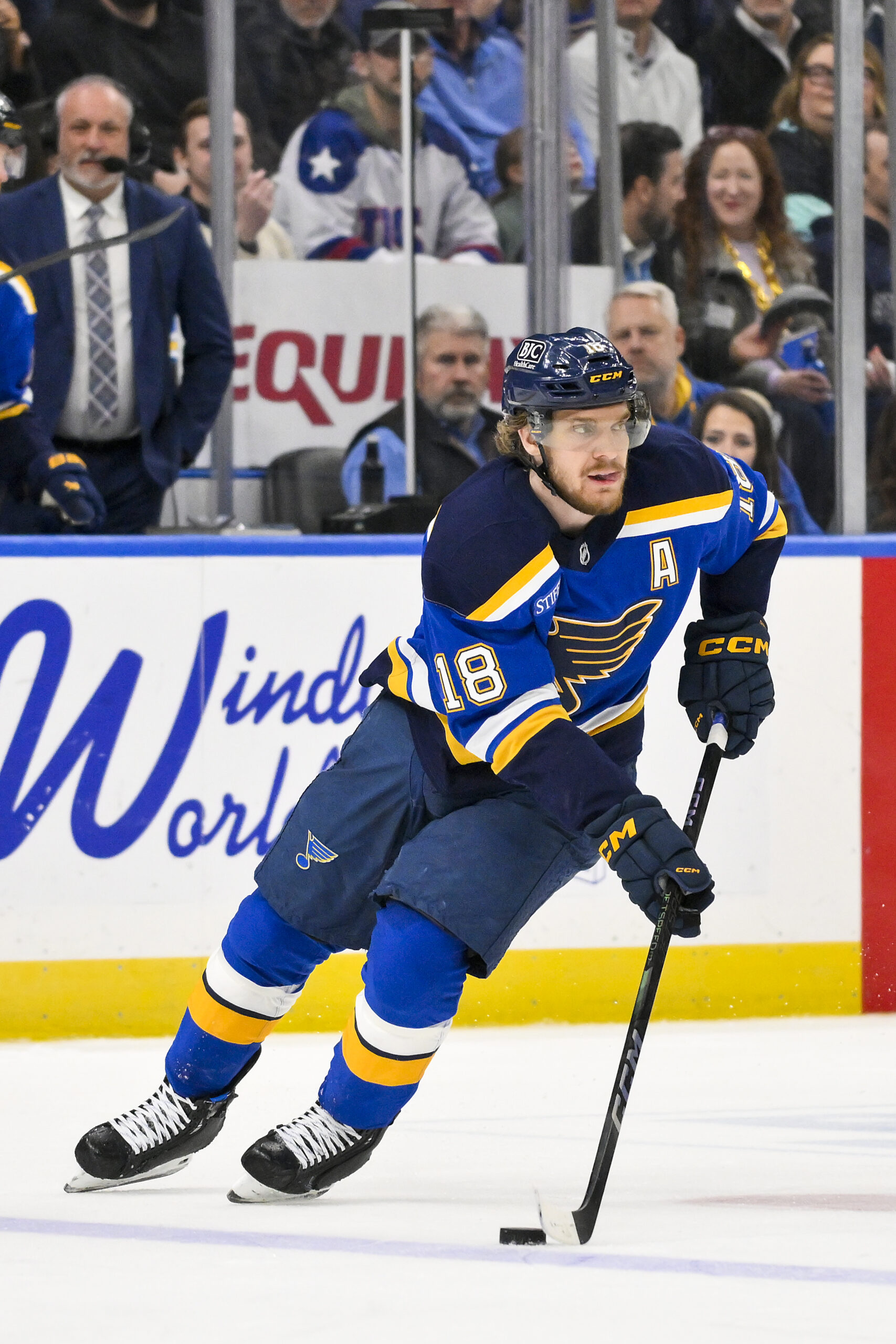 However, the asking price before the trade deadline was believed to be the equivalent of at least three top-15 assets. One theoretically could have been Detroit’s first-round pick but St. Louis already has that from the Justin Faulk trade. With it being too early to know where their 2027 pick could plausibly fall, I don’t think that could fill one of those slots, meaning we’re looking at three already-drafted pieces.
The Red Wings have several youngsters who technically fit the bill but some of those players have seen their stock drop as well. For example, Marco Kasper was an eighth-overall pick but he doesn’t carry that high a value now. That said, I could see him being one of the pieces. (If not him, then Nate Danielson makes sense.) For a winger, one of Michael Brandsegg-Nygard or 2025 first-round pick Carter Bear would fit the bill. Does St. Louis want more of a playmaker or a scorer and are they looking for someone close to ready now or a few years away? The answer to that dictates which one of those two would be in the offer. I don’t see the Blues having a ton of interest in Axel Sandin Pellikka so the other spot would either need to be one of the forwards already listed or goaltender Sebastian Cossa. (I’m not sure Trey Augustine carries top-15 value league-wide, as good a prospect as he is.) Cossa and Joel Hofer would be an interesting tandem for the near and long-term future with some upside.
On top of that, Detroit would probably need to offset the money somewhat. The good news is that there are some logical choices in J.T. Compher and Andrew Copp, veterans whose spots may be displaced by Thomas coming in anyway.
There are three questions I still have coming out of all of that. If I’m Alex Steen, I’m not sure that’d be enough for me as, again, some of the shine has come off some of these high-drafted pieces. The second is on Detroit’s end and it’s similar to the Tkachuk thing earlier, is this the right move for a team that keeps missing the playoffs to make? (I can come around to yes here, however, unlike the Tkachuk scenario.) The third is the biggest one: Would Thomas waive for the Red Wings? There’s a sense that GM Steve Yzerman has tried to swing big but has either had players tell them they’re not interested in going there or aren’t willing to sign long term. They only have to worry about the former here with Thomas signed through 2030-31 but there may be more appealing suitors for his services.
Duke II: While it may be common sense, is there any empirical data that confirms NHL players’ stats are worse in the second game of B-2-B games?
I’m going to try to answer this primarily from a team-based perspective. Statistically speaking, teams have a lower points percentage on back-to-backs so, therefore, it can also be gleaned that individual player stats aren’t quite as good as otherwise, there wouldn’t be a gap in points percentage. But the gap isn’t always as big as some might think. Here are the numbers, courtesy of More Hockey Stats (they have the team records, I’ve converted them to average points per game):
2025-26: Overall Average Points Per Game: 1.12
Points Per Game In Back Half Of Back-To-Back: 1.07
2024-25: Overall Average Points Per Game: 1.10
Points Per Game In Back Half Of Back-To-Back: 0.93
2023-24: Overall Average Points Per Game: 1.10
Points Per Game In Back Half Of Back-To-Back: 1.03
2022-23: Overall Average Points Per Game: 1.12
Points Per Game In Back Half Of Back-To-Back: 0.99
Now, you asked for the players. That’s a little harder to track down on an everything-in-one-place level but ESPN’s player profiles have this snuck in near the bottom. For example, here’s the profile for Minnesota’s Matt Boldy. He had 10 points in the second half of 12 back-to-backs this season, a 0.83 point-per-game average compared to 1.12 points per game for the full season. In 2024-25, he had a 0.33 point-per-game average in the second half of back-to-backs against a 0.89 full-season average. It wasn’t as pronounced in 2023-24 at a .786 point-per-game average in the back half of a back-to-back against a 0.92 mark for the season.
This is just one example but I suspect, given the reduced teams’ success in the back half of a back-to-back, that more players will follow Boldy and have a reduced output in those situations. If there are certain players you’re intrigued about specifically, the ESPN profiles can give you the breakdown you’re looking for.
Jolly Roger: Is there anything in the CBA regulating advertising on players’ helmets? Does every team make their own deal for such advertising? Do players receive a cut and can they opt out, for example if they disagree with the advertiser policies, or just don’t want to be a skating billboard?
Advertising isn’t a CBA element beyond that advertising revenue is part of Hockey Related Revenue, or HRR. HRR is what helps shape the salary cap with the players and owners getting 50% chunks of that revenue. That’s the players’ cut of it, so to speak. They are not able to opt out, nor can they solicit their own deal to stick a patch on a jersey or helmet.
Every team can make their own agreements for the advertising. Some have had sponsor changes already within the first few years. All 32 teams have at least one helmet agreement in place while many have separate agreements for home and away. Only 28 teams have jersey sponsorships for this season (soon to be 29 with the Sabres announcing Friday that they have a deal in place for next year) while, again, some have home and away sponsors as well.
Photo courtesy of Jeff Curry-Imagn Images.