
Snapshots: Backes, Ikonen, Luongo
Although he was listed among the worst contracts for 2017-18 earlier this evening, David Backes is hoping for a bounceback year in Boston. Per an article penned by NBC Sports’ Adam Gretz, Backes realizes that he has underperformed thus far during his Massachusetts tenure. In an interview, Backes highlighted that he will focus this off-season on improving his agility and acceleration, which were severely lacking last year. As Gretz mentioned, however, he is 33 years old and cannot be expected to transform overnight. Adjusting to the increased speed of the NHL game could prove a challenge for Backes, but Boston has little choice but to hope that he can become the asset that he was in St. Louis as their long-time captain. The contract is relatively unmovable unless salary is retained and there are four years left on the deal. If nothing else, Backes could learn to fit into a more sheltered third-line shutdown role, as his defensive ability is absolutely still present.
- Center Joni Ikonen is a cause for optimism in Montreal, or so says Grant McCagg of Recrutes. Ikonen’s performance in the recent Summer Showcase was truly head-turning, as the flash he displays on a regular basis is highly intriguing. He also produced enough for fourth-best in the tournament, while looking defensively capable all the while. He finished the tournament with an impressive hat trick in a loss to Sweden. Ryan Poehling, another prospect at the showcase, also played well enough to attract praise. Poehling is less dynamic that Ikonen, but he already has an NHL-ready body and two-way mindset. He, like Ikonen, netted 5 points in 5 games in the brief tournament. The comparisons to Ryan Kesler may be relatively premature, but he seems a solid bet to make an impact. If either, or both, players make the Canadiens roster in the next few seasons, it would go a long way towards alleviating the massive center-ice issues the team has struggled with for at least a decade. Alex Galchenyuk will still likely have to take the reigns for this year, however.
- The Panthers are hoping to run with the Roberto Luongo / James Reimer goalie tandem for the near future, and are seemingly OK with that. Cat Silverman wrote a piece for FanRag Sports that details how the combination might work out this season to propel the team into the post-season yet again. The duo performed admirably last year through a long down spell and a coaching change, with Reimer claiming 42 of the starts. Luongo’s save percentage was a respectable .915, just behind Reimer’s .920. Luongo will have every opportunity to return to his “starter” status, but competition isn’t always a bad thing. Luongo’s contract, with 5 years remaining at 38, looks really formidable though, so the organization has to hope he can maintain his form well enough to grind out at least 3 more seasons. Craig Anderson is still going strong at 36, and Tim Thomas had his best years after the age of 34. Lightening Luongo’s yearly load will go a long way towards keeping him fresh. Ultimately, GM Dale Tallon had a solid, if unremarkable off-season, and is staying patient with the progress of his young core. As long as neither goalie’s performance totally implodes, they should at least challenge for a playoff spot.
Which 2017 Draft Picks Will Make Their Teams?
This year’s draft was notoriously thin in terms of elite talent, but that doesn’t mean that some of the top choices won’t make an impact. Of course, a lot will depend on training camp and whether players will return to Juniors, College, or overseas. Nico Hischier has already signed his entry-level contract with New Jersey, as has Nolan Patrick with Philadelphia. Both look primed to make their teams out of camp, even though Patrick will be recovering from an injury. It’s common for top picks to make their teams, and it would be shocking to see either fall short. Beyond these two, however, many of the top players till need seasoning.
The third pick, Miro Heiskanen, very well could return to the Finish Elite League for IFK, or theoretically be taken in the CHL import draft. Dallas doesn’t look like they’ll try to rush it with him, but anything is possible with this talented a player. Fourth overall was defenseman Cale Makar for Colorado, who is committed to play with the University of Massachussetts. Still, Colorado is hurting badly for skill and could benefit mightily from his dynamic presence on the blueline. Fifth overall was Elias Pettersson for Vancouver, who should return to Vaxjo of the SHL. He hasn’t signed an ELC and won’t attend training camp. Sixth overall Cody Glass looks primed to make a push for a spot in Vegas if he can show he belongs. The offense acquired via the expansion draft is very lean, and if Glass can round out his frame, the team may opt to toss him into the fire. He comes from a solid program with the Portland Winterhawks, and already surprised many with his ascension to first-round status in 2016-17.
Seventh overall was 5’11 center Lias Anderssson, who will fight for a position on the New York Rangers. In May, he signed a two-year contract with SHL’s Frolunda, so he might be one of the least likely of the group to see playing time in the near future. Casey Mittelstadt went eighth overall to Buffalo, and his phenomenal performance in the 2016 U-18 World Juniors played a large role in that. He only has USHL experience under his belt, however, and is committed to the Minnesota Gophers for the 2017-18 season. Michael Rasmussen is a towering, 6’6 center from Tri City of the WHL, and his overall physical package propelled him into that 9th selection by Detroit. Detroit is in need of cheap roster players on ELCs, but rushing a player of his caliber, especially coming off an injury-marred 2016-17 season, seems unlikely. GM Ken Holland is known for his patience when it comes to prospects. Rounding out the list, we have one of the few wingers selected in the first round – Owen Tippett of the OHL’s Mississauga Steelheads. His 44 goals in 60 games caught the attention of Florida’s scouts, and he could make things interesting with a solid camp showing.
In the final evaluation, there are really only two sure-fire picks to make their teams in the 2017-18 season. Of course, there are players later in the order who could surprise and get a look as well. Gabriel Vilardi (11) would inject some much needed offense to a floundering Los Angeles squad, and already possesses NHL size. Nick Suzuki (13) could transcend Glass in Vegas as his flashy speed and exceptional passing are already pro-level. Future teammate Erik Brannstrom (15) proved again that he belongs in the conversation in the recent Summer Showcase. Timothy Liljegren (17) is already making Toronto fans salivate at his potential, and there is always someone unexpected who completely blows away the competition in camp. We shouldn’t see more than one or two surprises, but anything is possible once the players retake the ice in August for some internal competition.
In your mind, which 2017 draft picks make the NHL starting roster for their teams, excluding the obvious Hischier and Patrick? Will any of these names compete for a Calder, or will there only be one or two immediately successful rookies from this class? (For comparison’s sake, 4 players played regularly last season of all the players selected in 2016).
Please vote in our poll below!
Total votes: 777
Which 2017 Draft Picks Will Make Their Teams?
Mobile users can vote here.
Bad Value: The Worst Contracts League-Wide
It’s always interesting to see where teams are spending their money unwisely, especially to the armchair GMs of every fanbase. In a fine article by Satchel Price of SB Nation, he breaks down what he believes is each team’s worst contract currently on the books. After the slew of buyouts that happened early in the off-season, many teams were able to cut ties with some of the worst offenders. Still, some of the worst cap criminals are primed to haunt their teams yet again in 2017-18. Discounting the injured Nathan Horton, David Clarkson, and Dave Bolland, these were some of the names that stuck out on the list.
David Backes – Boston Bruins – 4 yrs x $6 MM
When Backes signed this contract, many were wondering what the Boston management were thinking. Backes already was showing signs of decline his last two seasons in St. Louis, and his tough style of play was always going to take away from his longevity. He still flirts with 40+ points and adds solid two-way ability. But in 2 seasons, if Backes continues to slow and falter possession-wise, this contract may become a brutal obstacle to beefing up the offense.
Brent Seabrook – Chicago Blackhawks – 7 yrs x $6.785 MM
Seabrook was a player who really piggy-backed off the success of the Hawks cup teams. He was a solid player, but by no means a core player. GM Stan Bowman thought differently, and handed out a massive, maximum-term contract, complete with a no-movement clause. Chicago has really struggled to fill their depth forward and bottom defensive positions out with cheap players, largely because of overpayments like this. Seabrook did accumulate a ton of assists last year, but his goal scoring has all but disappeared. Perhaps the worst negative to Seabrook? He’s never been a positive possession player in Corsi relative, in any single season he’s played. For a franchise that pays Jonathan Toews over $10 MM AAV, this contract is absolutely crippling.
Dustin Brown – L.A. Kings – 5 yrs x $5.875 MM
Brown benefited from the same intangibles-related inflation that Toews did. Leading a team to multiple Cups is generally a recipe to have your value balloon immensely. Winners are winners, after all. Brown, though, was never really integral to the team’s on-ice success in 2012 or 2014, and his undisputed leadership abilities didn’t help the team in the past few years when they have struggled to put pucks in the nett. His two-way ability is solid, but not elite, and he hasn’t broken 20 goals since 2011-12. Perhaps Brown can be revitalized under the system of coach John Stevens, but his body has to have taken a toll with the way he’s played the game. One need only look to former King Mike Richards to see what gritty, shot-blocking forwards have in the way of staying power.
Marc Staal – New York Rangers – 4 yrs x $5.75 MM
In all likelihood, the primary reason Staal has not already been bought out is because he had one more year on his contract than the much-maligned Dan Girardi. Staal has been a noticeably bad defender in terms of possession stats for the last three seasons, and showed few (if any) signs of improvement this season. He still logs over 19 minutes of ice a night, so he’s not stapled to the bench. But he’s not a top-four defender at this point, and considering how he’s never been a two-way threat, his one-dimensional game may only deteriorate further.
Andrew MacDonald – Philadelphia Flyers – 3 ys x $5 MM
This is a prime example of an error that most teams have learned to avoid – handing out multi-year deals to wildly inconsistent players. MacDonald had his offensive totals inflated by playing for a very lean New York Islanders team, and Philadelphia pounced on acquiring this player in the midst of a -9.0% Corsi Relative season. MacDonald has since dried up offensively, and while he has cleaned up his possession numbers against weaker competition, he still needs massive sheltering. He also has had a heck of a time staying healthy – he’s missed 93 contests over the last 3 campaigns. MacDonald is now taking valuable playing time from a young defensive core and hindering the team’s ability to acquire top free agents.
Rick Nash’s Future In New York
While it may be premature to look ahead to the 2018 off-season and those players who will become unrestricted free agents, it seems that general managers are already turning their focus toward the future. Notably, Cam Fowler, Martin Jones, Carey Price, Marc-Edouard Vlasic have already signed extensions, while the Islanders are clearly making a John Tavares extension their top priority. When one looks at the list of 2018 UFAs so far out, there are many enticing names, including John Carlson, Kyle Turris, Cam Atkinson and many more. Yet, with perhaps the exception of James van Riemsdyk, most of the names on the list appear destined to re-sign with their current clubs, barring unforeseen developments. Of the names that seem possible to move on, Rick Nash jumps out above many others.
Since Nash came into the league in 2002-03, he’s been a remarkably productive winger. Among active players, his 771 career points puts him at 18th. The only younger players above him on the list? Sidney Crosby, Alex Ovechkin, Eric Staal, Evgeni Malkin, and Ryan Getzlaf. Granted, Nash has started to show a serious drop-off in his production the last two season. He missed 35 games since the start of 2015-16 to injury, and totaled only 74 points in the 127 games he played. That’s not a poor figure, but when 23 goals for Nash is considered a positive season, it’s obvious that his prime years may be relegated to memory. Perhaps just as disheartening is his negative possession trend over that same time frame. His Fenwick and Corsi relative have consistently declined since 2012-13, and last season he posted a career worst 46.3% Corsi For.
With all that said, Nash is still an effective tool. He won’t make the $7.8 MM on his current contract, but considering how sparse the 2018 free agent list might actually be, he could find himself a long-term contract elsewhere in the league. The Rangers are already toward their cap ceiling with $71.9 MM on the books, and will have multiple RFAs to re-sign at the conclusion of the year. Notably Kevin Hayes, J.T. Miller, Jimmy Vesey, and Brady Skjei will all be due moderate raises. The team should have enough space to re-sign Nash to a reduced contract (assuming the cap continue to rise around $2 MM), but the team may be interested in accelerating a youth movement. Nash hasn’t under-performed since coming to Manhattan, but he hasn’t been the dominant marquee offensive player when they’ve needed him to be. Through 73 playoff games for NYR, he’s only scored 14 goals.
Nash has accumulated hard mileage due to the way he’s played the game, particularly early in his career. He was the primary offensive force for Columbus for many years, and consistently had to fend off multiple attackers using his frame. As the game has gotten faster over the last few seasons, size has meant less than it probably ever has. Nash is no slowpoke, but his power forward style is becoming less common and less effective as the game has transitioned. Nash will turn 34 at the conclusion of this contract, and he will likely seek out a longer term to assure his career safety. If New York is unwilling to make that commitment, he does have a modified no-trade clause which would complicate matters for GM Jeff Gorton would decide to move him. Nash has a list of 12 teams which he is allowed to be traded to, short of waiving the clause. It also seems unlikely that he will be traded, considering his still substantial role in the offense. If New York looks to be playoff bound when the deadline rolls around, it would be very difficult to ship him off for future assets. Consequently, there’s a very solid chance that this may be Nash’s last season in the Big Apple, and that he could attract a serious market next July. Despite his warts, Nash is a big-bodied winger who has shown he can finish, and shouldn’t be incredibly expensive.
Snapshots: Alexander Nylander, Jon Gillies, Max Talbot
19-year old winger Alexander Nylander may get his shot in Buffalo this season, according to Ian McLaren of the Score, who spoke with Nylander’s Swedish coach. Nylander was selected 8th overall in last year’s draft, and had a strong season in the AHL with Rochester. He saw action in 4 games for the Sabres, but tallied only one assist. He theoretically has the option to return to the Swedish Hockey League, for AIK, but there has been no indication he will do so. Nylander will have his work cut out for him if he hopes to crack the roster, however. The Sabres filled out their forward depth relatively well this off-season, adding Jason Pominville (right-winger) via trade and Jacob Josefson (right-winger) via free agency. He could likely find a home on the fourth-line, but he would likely benefit from more seasoning if he can’t force a decision outright. His older brother, William Nylander, did need parts of two seasons with the Marlies before he stuck with the Leafs. Alex Nylander’s dynamic offensive skillset is badly needed in Buffalo this season, however, especially when one considers the lean defense they will be trotting out.
- When Flames’ goalie Jon Gillies was signed to a two-way contract a few weeks ago, many wondered how much that would impact the team’s future plans in net. Gillies had a solid win in his first NHL start last season, but struggled slightly in Stockton. The 6’6 goalie is a third-round pick from 2012, but was solid in Providence and has shown flashes of brilliance at only 23. Gillies will need to string together a solid performance at the AHL level and hope for either Mike Smith or Eddie Lack to falter or fall to injury, as the two acquisitions by GM Brad Treliving put him in an unenviable position. The possibility of a goaltending carousel in Calgary seems more possible than many are willing to admit, especially if Gillies or Tyler Parsons push the issue from the minors with stellar performance. This will only be Gillies’ second pro season, after all, and he has the talent to make things interesting.
- With the certainty of NHL non-participation in the 2018 Olympics, it opens quite a few doors for players who have left the league for Europe or elsewhere. “Busts” and “has-beens” could make up a large portion of the U.S. and Canadian rosters, it seems. Today in Sochi, numerous ex-NHLers displayed their skills in hopes of impressing those who will choose the 2018 Olympic roster. A miniature tournament is essentially the beginning of the audition to be considered for the selection process. Canada faced off against Russia, and the teams will have friendly contests against one another later in August. According to Tim Wharnsby of CBS Sports, some of those hopefuls for Canada include Max Talbot, Gilbert Brule, and Rob Klinkhammer. Talbot was a gritty winger who clutched two goals against Detroit in Game 7 of the 2009 Stanley Cup Finals for Pittsburgh. Brule is a former top pick of CBJ who floated from team to team without much success, and Klinkhammer was a fringe bottom-sixer who never truly found a home. Many players of this ilk could claim roster spots, and fans of the sport may have some names from the past resurface to prominence as we approach Pyeongchang.
Blue Jackets Look To Fill Center Hole
When center William Karlsson was sacrificed to the Vegas Golden Knights, the Blue Jackets lost a potent two-way tool up the middle. For a team who scores as much by committee as Columbus did last season, the team was bound to lose a valuable roster player. Although he only scored 6 goals and 25 points, he logged tough minutes against tough competition. It should be noted that, for all his defensive starts (62%), his advanced stats have been persistently sub-par. While Karlsson easily passed the eye test, his Corsi For was a lousy 43% in 2016-17, and that isn’t far from his career average. It may be a situation where analytics don’t tell the entire story, but Karlsson was actually trending backwards last season when looking at relative possession. Regardless, someone will need to step up internally to fill that roster void at the the 3rd line center position, as noted in an article by Mark Scheig of the Hockey Writers.
Scheig of course notes the work of rookie Lukas Sedlak, who performed admirably in his fourth-line duties. Sedlak could be ready to step up, but a lot will depend on how he performs in camp. He showed a bit of offensive touch, with 7 goals in 62 NHL contests, and marginal point totals in his Junior days. However, Sedlak was injured down the stretch and will need to re-assert himself into the lineup. He won’t be nearly as sheltered as he was last season, either. Notably, he’ll be competing against Pierre-Luc Dubois, the #3 pick from last year’s draft. Dubois finished out his last year in the QJMHL with the Blanville-Boisbriand Armada after being traded min-season. In an injury shortened campaign, he only posted 55 points in 48 games, a sharp step down from his 99-point performance in 62 games during his draft year. Dubois arguably regressed more than any other 2016 top-10 pick, and it might be unreasonable to expect him to dominate in camp. Dubois still has a heavy shot, solid hockey IQ and uses his size effectively, but consistency at the NHL level may be a difficult ask from a 19 year old returning from a down year.
Internally, other players can slot to the position. Scheig mentions that Boone Jenner can fill in when needed, but it’s no permanent solution. Going the free agency route at this late stage seems rather unlikely, as well. That really leaves coach John Tortorella in a tough position if Dubois fails to make an impact and Sedlak remains what he is. The team does have a glut of defensive prospects, but considering that they went out of their way to protect them from Vegas’ expansion sights, they may not be willing to part with a major piece just yet. The Blue Jackets may simply need to ride out some of the season with a hole in their top-nine if training camp doesn’t crown a clear replacement for Karlsson. Unlike many of the Vegas selections, this one could impact a team’s makeup noticeably. In an incredibly competitive Metropolitan division, a solitary step back could mean the difference between eyeing a division title or fighting for a wild card berth. Still, after adding the dynamic Artemi Panarin this off-season and watching a talented young defense gain valuable playoff experience, Jackets’ fans will likely not be overly concerned just yet.
Winnipeg’s Forward Depth And Versatility Valuable In Trade Market
The Winnipeg Jets finished just 7 points out of a playoff berth this season. Like the Islanders (41 wins) and Lightning (42 wins), the Jets (40 wins) were on the verge of making it to the show in the final weeks. As such, GM Kevin Cheveldayoff didn’t feel the necessity to spend large this off-season, nor make any substantial trades. Cheveldayoff shored up the goaltending position with Steve Mason on a two-year contract, and hopes that will be enough to push the team over the edge. Still, if management feels that improvements should be made, the team has the assets and the versatility up front to do so. It’s uncertain whether Dmitry Kulikov will be enough to shore up what was a poor-performing defensive group last year. A spare forward could be floated for more help in their own end, even though their 6 slots seem safely filled at the moment.
Particularly at the center position, the Jets have one of the more enviable situations league-wide. By my count, the Jets have 9 roster players who can theoretically slot in for center duties. Mark Scheifele, Bryan Little, Mathieu Perreault, Shawn Matthias, Adam Lowry, Michael Sgarbossa, Marko Dano and Brandon Tanev all can play up the middle. Scheifele is obviously the first line center, and Little is safely pegged at number two. After that, things get a bit interesting. Perreault finished the season while spending some time on the wing, and his goal scoring dried up – he only had 22 in the past two seasons. His point production is still locked in at 40+, but considering his $4.125 MM cap hit for the next four seasons, maybe now is the time to opt out. Matthias is interesting primarily because he only has one season remaining before he hits unrestricted free agency. He can slot on the third or fourth lines and provide mediocre depth production, but his marginal worth wouldn’t be enough to land a difference maker in a trade.
Little also sees his current deal expire at the conclusion off 2017-18, and his new contract could be relatively hefty. With Blake Wheeler due another contract hike after 2018-19, and Jacob Trouba looking for a raise after this year, there is the possibility Little could be moved for the right package. Still, he’s one of the more consistent players on the Jets and has never known another franchise. If he were to be shopped, the return could be quite pricey for many competing teams. He’s perceived as a top-end #2 center and his internal value is quite steep. Following that, Lowry will continue to build on his progression last year, where he tallied 29 points. He’s yet to put it all together, but his size and still tender age of 24 wouldn’t make him the first target for movement. Dano is far more comfortable on the wing, and he’s likely going nowhere. Sgarbossa is essentially a non-factor, as is Tanev, in terms of drawing league interest.
Another thing to keep in mind is that Nicolas Petan should find himself a regular this season, and many expect him to push for that 3rd line center position. As with many of the other names, he can slot on the wing instead, but that might not be the best use of his talents long-term. If he forces Lowry down the depth chart further, does that make a player like Little more expendable for the right move? What would the interest be like for a player of Perreault’s caliber? Unfortunately, it seems unlikely that we’ll know until well into the season. Cheveldayoff has been firm in staying the course with the young and promising Jets, and he’s more likely to wait at least until the conclusion of training camp before making any major transaction.
Evening Snapshots: Babcock, Matthews, Bridge Deals
Toronto Maple Leafs coach Mike Babcock praised the performance of Auston Matthews, but believes there’s always room for improvement writes NHL.com’s Adam Kimelman. Matthews, who registered 40 goals and 69 points en route to a playoff appearance and Calder Award, will be expected to build on his performance last season as the Leafs look to take the next step in their rebuild. Babcock says that he isn’t one to “measure by points” but instead looks at how they “play” and “compete.” The young Leafs took a huge step forward, pushing the “painful rebuild” that Babcock once called it into a quicker ascent. But in true Babcockian form, he sprinkles praise while expecting more:
Obviously we have good young players,” Babcock said. “We have a lot of them. It’s kind of a group that’s growing up together. But it’s one year and one year doesn’t make a career. You have to do it again and again and again. We’re excited about our opportunities.
- Puck Daddy’s Ryan Lambert writes about how Ryan Johansen‘s deal certainly challenges the old guard way of thinking when it comes to bridge contracts. Rewarding Johansen with an eight-year deal instead of a one-two year contract. Lambert points out that going with the longer deal instead of a bridge and then the long deal seems like the better bet. The logic here would be getting the player through his prime instead of playing a “wait and see” game and then locking him up long after his prime has expired. There are a litany of examples of this in the NHL, but in an age of cost certainty and public outcry at what’s deemed a bad deal, general managers are often in a tight spot when it comes to choosing a bridge deal or a long-term contract.
Panthers Notes: Tippett, Tallon
Breathe easy, Panthers fans. Tenth overall pick Owen Tippett was hit hard (gif via Twitter) during today’s game against the United States during the World Junior Summer Showcase. NHL.com’s Mike Morreale tweeted that it didn’t look good after the hit, but Tippett was able to leave the ice under his own power. Morreale tweeted later that he observed Tippett with his teammates, going through exercises and appearing just fine. An injury scare for the high scoring winger would have been a difficult blow for Florida. Tippett has a chance to make the roster right out of training camp, and if the skills transfer over, can be a major contributor in the scoring column. The Sun-Sentinel’s Harvey Fialkov wrote about how general manager Dale Tallon believes Tippett to have the makeup of a player who is mature beyond his years. Today’s hit appears to be just a minor incident, and one that shouldn’t stunt Tippett’s chance at making the NHL roster.
- Tallon was featured in an Athletic article by Scott Powers, who wrote how Tallon holds a special place in his heart for Chicago. Tallon was responsible for the bulk of the drafting and free agent signings that turned the Blackhawks into a model franchise after being a league doormat for nearly a decade. Powers asked Tallon about his thoughts on the Panthers offseason, and he responded as such:
We had to rework it a little bit. We’re going younger, we’re going faster. We like what we’ve done. We’ve gotten quicker and faster, a little more depth. We added some grit, we added some speed and we added some skill. We got a lot of good young players that we still have coming in our organization that we really like, and we have a real strong core of young players that were injured last year. I think our team is going to be faster and younger and play with a little more energy than we did last year. The new coaches to our coaching staff are really good. I’m excited to work with them and get rolling here.
Tallon admitted that he wasn’t happy about last season and that it was a difficult decision not bringing Jaromir Jagr back, noting that he was great for leadership and exemplifying a strong work ethic. But like many executives in the NHL, Tallon felt it was time to get younger and faster.
Salary Cap Deep Dive: Detroit Red Wings
Navigating the Salary Cap is probably one of the more important tasks for any general manager to have. Teams that can avert total Cap chaos by walking the tightrope of inking players to deals that match their value (or compensate for future value without breaking the bank) remain successful. Those that don’t see struggles and front office changes.
PHR will look at every NHL team and give a thorough look at their cap situation heading into the 2017-18 season. This will focus more on those players who are integral parts of the roster versus those who may find themselves shuttling between the AHL and NHL. All cap figure were taken from CapFriendly.
Detroit Red Wings
Projected Cap Hit: $78,021,212 (Over by $3,021,212)
Entry Level Deals:
Dylan Larkin (1 year remaining/$925K)
Anthony Mantha (1 year remaining/$863,333)
Things will get interesting when the Wings sit down to negotiate with both Larkin and Mantha following the 2017-18 season. Both are considered the foundation that the Red Wings will build on for the future, but Larkin saw regression after a torrid rookie campaign in 2015-16. Larkin, who moved back to his native center position after spending the season at wing during his first season, is expected to bounce back. Mantha who scored at a high clip when given the ice time, will command a higher payout should his scoring continue. Mantha could be a 30-goal scorer in the league if the Red Wings allow him to play the role of goal scorer instead of two-way forward. Regardless, both will see a significant bump and this will only tighten things further.
1 Year Remaining
Mike Green ($6MM AAV)
Petr Mrazek ($4MM AAV)
Riley Sheahan ($2.08MM AAV)
Tyler Bertuzzi ($661K AAV)
Ryan Sproul ($625K AAV)
Jared Coreau ($613K AAV)
The deals falling off after the current season will account for a good chunk of change that will allow for Larkin and Mantha to be re-signed with ease. Additionally, some of these contracts, should Detroit struggle again as they’re widely expected to, could net some prospects or draft picks. Green is the likeliest candidate to be spun off while Sheahan is expected to bounce back after an offensive challenging season that saw him left off the goal sheet until the final game of the season.
Sproul will either be re-signed to a minor deal or left to go as other defensemen have rocketed up the prospect list. His suspect defense takes away from his roaring slap shot, which was counted on to one day sustain the Red Wings powerplay. Bertuzzi should see time with the big club, but with Witkowski being a hybrid defenseman/forward, he may be stuck in Grand Rapids as the tie always goes to the veteran in Detroit.
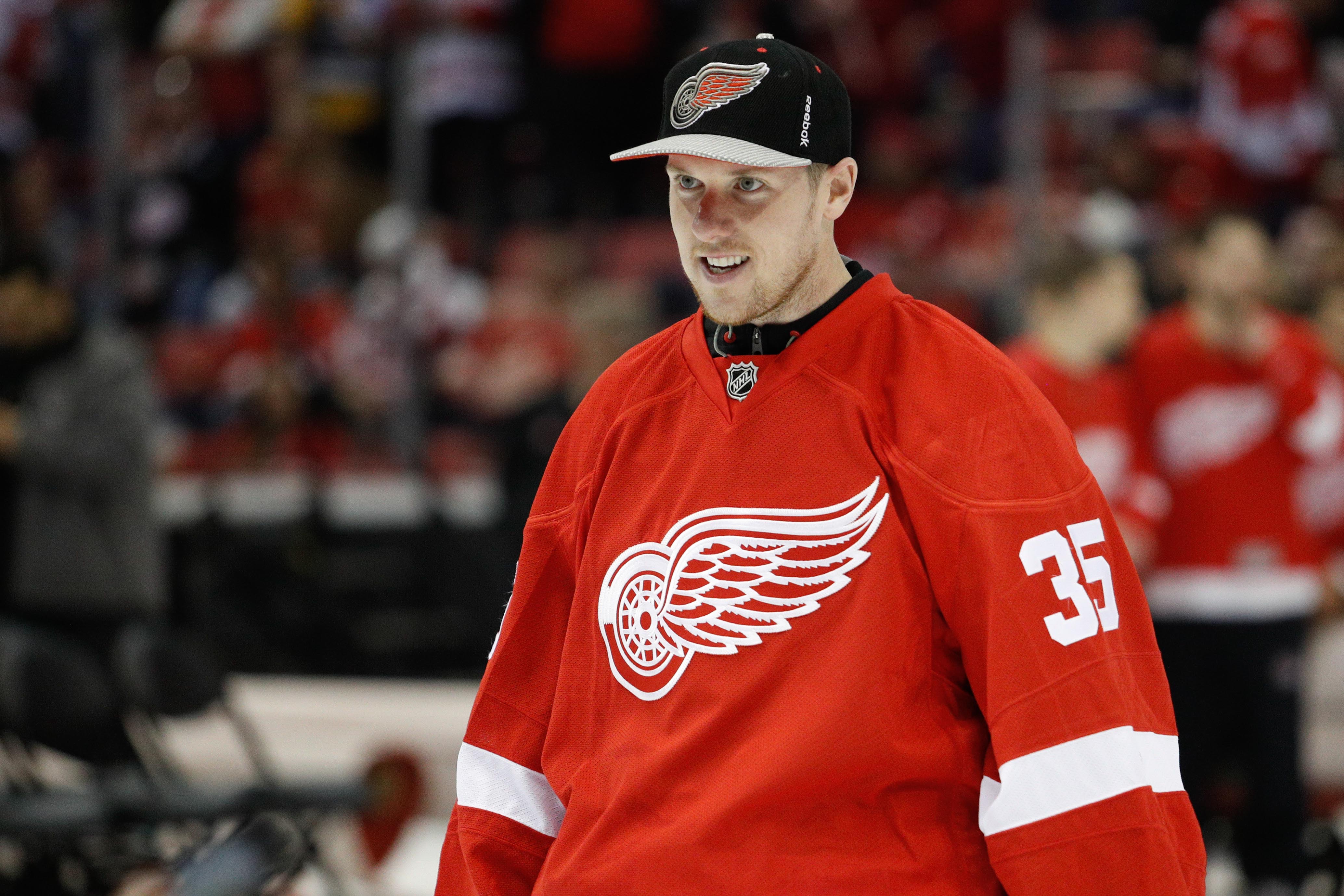
Mrazek is an odd case. Bemoaned for a bad attitude coupled with a below average season, it can’t be expected that unless he puts up Vezina like numbers or dramatically changes his standing with the team that he’ll be back. Though he could be dealt, teams have made it clear they’re not interested, which makes it likely both teams walks away at the end of the term. Coreau will likely see time like he did last season when either Mrazek or Howard were injured.
2 Years Remaining
Jimmy Howard ($5.29MM AAV)
Niklas Kronwall ($4.75MM AAV)
Gustav Nyquist ($4.75MM AAV)
Xavier Ouellet ($1.25MM AAV)
Nick Jensen ($812.5K AAV)
Luke Witkowski ($750K AAV)
Howard was expected to be dealt or drafted in the expansion draft until stories of Mrazek surfaced. Instead, Howard is now seen as the #1 goalie in Detroit. The contract itself, however, has been a bust as Howard has either not been healthy or inconsistent during the duration of the deal. It’s very likely that Kronwall ends up on the LTIR as he is literally skating on one knee. His mobility, and puck moving ability has deteriorated quickly, but the Red Wings still insist on giving him minutes on the power play. Should he not end up on the LTIR, he will most likely see his minutes decrease, which only makes his contract look worse.
Nyquist is a curious story as he was paid to score goals, but has still been very productive on the ice, being a boon for teammates in terms of setting up scoring chances. Witkowski was added for “grit” at a relatively cheap price.
The Red Wings cap issues began with some of these deals–offering money for players who didn’t exactly stay consistent with expectations. Things get considerably worse as years were added.
3 or More Years
Jonathan Ericsson ($4.25MM AAV – 3 years remaining)
Trevor Daley ($3.167MM AAV – 3 years remaining)
Henrik Zetterberg ($6.08MM AAV – 4 years remaining)
Tomas Tatar ($5.3MM AAV – 4 years remaining)
Darren Helm (3.85MM AAV – 4 years remaining)
Luke Glendening ($1.8MM AAV – 4 years remaining)
Frans Nielsen ($5.25MM AAV – 5 years remaining)
Danny DeKeyser ($5MM AAV – 5 years remaining)
Justin Abdelkader ($4.25MM AAV – 6 years remaining)
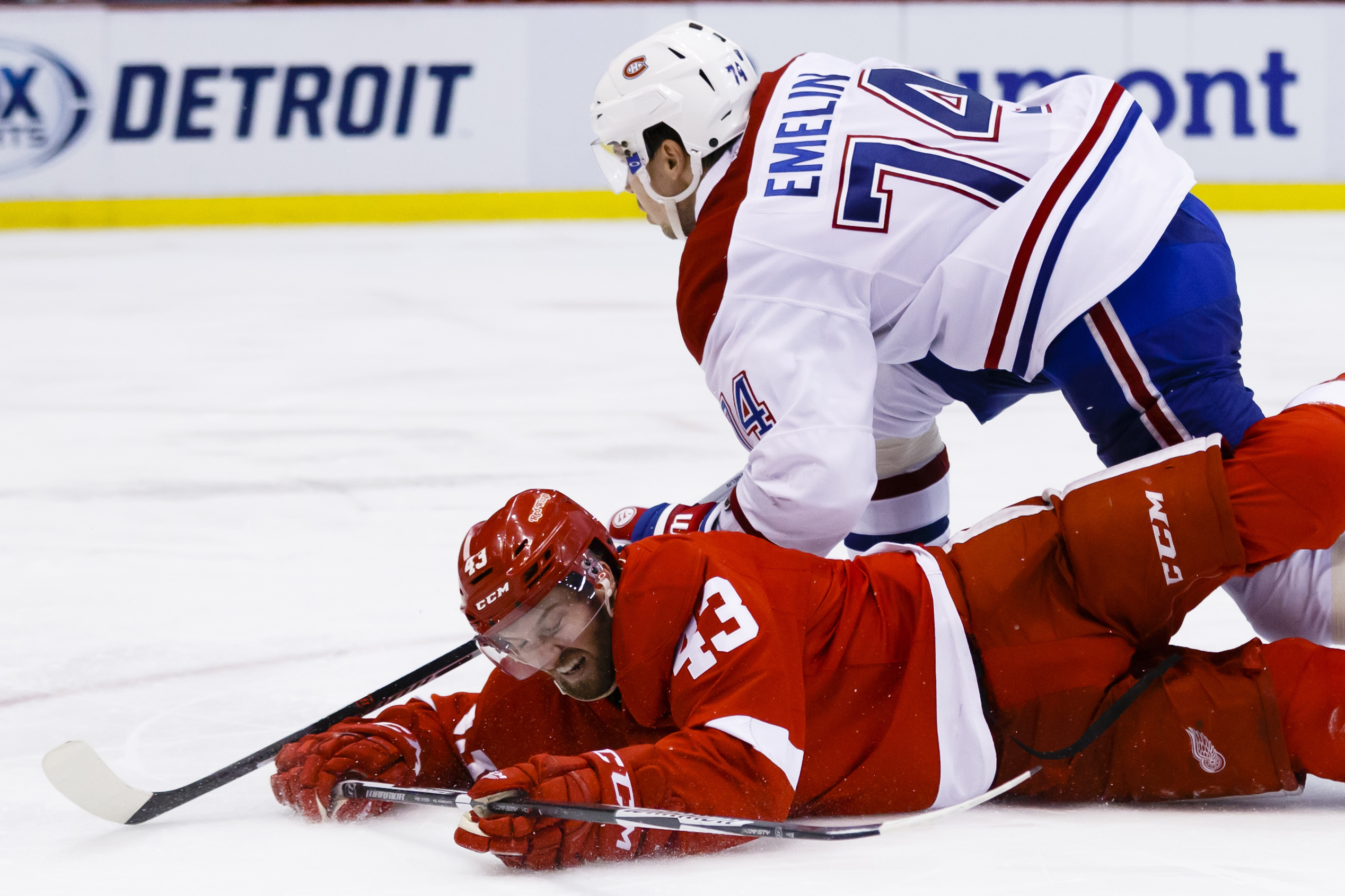
Here’s where the Red Wings have run into problems. The vast majority of players owed the bulk of dollars and years are not living up to expectations or are regressing with age. Zetterberg will be owed a sizable contract for another four years, and Father Time will slow him from his great season last year. Nielsen is also on the books for awhile, and is nearing his mid-30’s which doesn’t bode well for his numbers or the team’s overall performance.
But Ericsson, Glendening, Helm, DeKeyser, and Abdelkader have head scratching deals that could cripple Detroit for years to come. None of the aforementioned are top tier players, and Helm, Glendening, and Abdelkader are at best, third line forwards. Ericsson continues to struggle while DeKeyser is not a top pairing defenseman, yet is paid as one. The addition of Daley seems more cosmetic–an indicator that Detroit still wants to be considered a playoff team. But his projected 20 points will do little to help a team that has yet to reach bottom. When the figures are added, Detroit owes approximately $38.94MM of its cap to these players. Outside of Tatar, who just re-signed, this is problematic for a team that believes it can compete in the playoffs.
Buyouts
Stephen Weiss ($2.566MM AAV this season, $1.67MM AAV through 2021)
LTIR
Johan Franzen ($3.94MM AAV – 3 years remaining)
Un-signed
Andreas Athanasiou (RFA)
Best Value – Tomas Tatar
Worst Value – Justin Abdelkader
What does the future hold?
These aren’t the Red Wings of the 90’s or 2000’s where a blank check is afforded to get the best players. Detroit has serious issues in terms of cap management, and recent stories of the no-trade clauses afforded with many of these contracts are problematic as well. General manager Ken Holland has painted himself into a lonely corner, and a poor showing this season could possibly spell doom for his long tenure with Detroit. Maybe things will go favorably for Detroit this season, but after a challenging 2016-17 campaign and very little improvement on the roster, the Red Wings will be hard pressed to stay afloat in a competitive division and conference. Though they could try to peddle contracts away, the long terms and excessive dollars make it challenging for Holland and company to get them off the books–or worse–getting any value for those players shipped off.
Photos courtesy of USA Today Sports Images