
Injury Notes: Laine, Matthews, Tarasenko
The Winnipeg Jets have avoided a crushing blow after Patrik Laine was forced from their game after blocking a shot. Laine isn’t expected to miss a lot of time with the injury, if any at all.
The young sniper is having an outstanding season, but fell one behind Alex Ovechkin last night for the league-lead in goals. Though winning the Maurice Richard trophy would obviously be a nice prize, he and the rest of the Jets have their sights set on an even bigger trophy. The Jets are fighting through injuries to several of their key players, but are still one of the favorites in the Western Conference as the playoffs approach.
- Auston Matthews, the only player selected ahead of Laine in the 2016 draft, is also nearing a return for the Toronto Maple Leafs. The young center proclaimed himself ready to go after a 10-game layoff due to a shoulder injury, but head coach Mike Babcock wouldn’t go that far. The final decision on Matthews and Nikita Zaitsev for Thursday’s game will come after the morning skate, but both seem poised to return to the lineup.
- Vladimir Tarasenko is expected miss his second straight game with an upper-body injury, during a crucial time for the St. Louis Blues. The team is entering must-win territory with their last ten games as they sit three points back of the final wildcard spot with two additional teams between them and a playoff spot. That’s a tough hill to climb with so few games remaining, and losing Tarasenko is especially damaging. The 26-year old has had a down year by his standards, but is still second on the club with 58 points.
Snapshots: Three Stars, Mangiapane, NCAA
The NHL released their three stars from last week, and young Patrik Laine leads the way. The Winnipeg Jets sniper still hasn’t turned 20, but is now tied with Alex Ovechkin for the league lead in goals with 40 and is in the midst of an 11-game point streak.
Brad Marchand and Evgeni Malkin fill the other two spots, as both try to hunt down a nomination for the Hart Trophy. Malkin sits just a single point behind Nikita Kucherov for the league lead in scoring with 87, while Marchand now has 69 points in just 53 games. Though sometimes overshadowed by other superstars on their respective teams (Patrice Bergeron and Sidney Crosby usually), both Marchand and Malkin are having outstanding seasons and could meet late in the Eastern Conference playoffs.
- Andrew Mangiapane will miss the rest of the season following shoulder surgery, the latest bad break for a flailing Calgary Flames squad. The team sits just out of a playoff spot and could have lost Matthew Tkachuk to injury after he left Sunday’s game. Mangiapane had been playing with the Stockton Heat in the AHL, but could have been a potential call-up to add some offense to the lineup. Now he’ll have to focus on making the Flames out of camp next season.
- After our Brian La Rose gave some insight on the top names in college free agency, Corey Pronman of The Athletic (subscription needed) has done the same. The prospect guru points to several names who could make an impact in the NHL right away, including Daniel Brickley, the expected top name on the market. Brickley is a solid player in basically every situation, and Pronman explains that he has top-four potential in the NHL.
Deadline Notes: Plekanec, Green, Gionta, Kane, Lindberg
While it’s still to early to know, Winnipeg Free Press’ Jeff Hamilton feels that there is a strong indication that the Winnipeg Jets are pushing to acquire Montreal Canadiens center Tomas Plekanec tonight. The 34-year-old veteran was also scratched for tonight’s game against the Tampa Bay Lightning, although that may just be to ensure he doesn’t get hurt right before the deadline. While there are no details on how close the two teams are, the plan, according to Hamilton, is for the Jets to use Plekanec on the team’s third line alongside Patrik Laine and Nikolaj Ehlers, which would give the team a deep lineup. Andrew Copp would move to the team’s fourth line and would join Joel Armia and Adam Lowry.
The Jets were supposedly working hard to acquire Derrick Brassard Friday, but lost out to the Pittsburgh Penguins and were forced to look for another center to fill their needs. While Plekanec is a step down from Brassard, the veteran may get some new life with the Jets, especially if he gets to play with Laine and Ehlers.
- With the trade deadline less than two days away, the Detroit Red Wings still have their top trade chip remaining on their roster, but the problem is that he’s still hurt. In fact, the top rental defenseman on the market hasn’t played in five games and could miss Sunday’s game as well. While Green as practiced with the team twice now, including Friday, MLive’s Ansar Khan suggests that while there is little doubt that Green will be moved by Monday, the timing of the injury could easily diminish the team’s returns for him. He writes teams like the Tampa Bay Lightning might pause first if they feel he could re-injure himself the moment they acquire him.
- As mentioned earlier today, there has been some interest in Team USA captain Brian Gionta. However, Pierre LeBrun adds that a couple of East teams have expressed interest in Gionta, including the Boston Bruins. While nothing in imminent, a deal could be made at some point this weekend.
- The Buffalo News’ Mike Harrington writes that the Buffalo Sabres are holding forward Evander Kane out of the lineup tonight. Kane, one of the most anticipated trade candidates join a group of players who have been held out in the last day or two as the team doesn’t want to risk losing a player to injury just before the deadline. “Management thought it was the best decision moving forward and the best decision for Evander,” coach Phil Housley said in his pregame media briefing two hours before faceoff. “… That’s the situation for right now.” No other pending trade candidates were scratched.
- Tobias Lindberg, who the Pittsburgh Penguins acquired from the Vegas Golden Knights Friday in the Derrick Brassard trade, has been assigned to the AHL, but not to their affiliate, the Wilkes-Barre/Scranton Penguins, but back to the Chicago Wolves, the affiliate of the Vegas Golden Knights, according to Chicago Wolves broadcaster Jason Shaver. The Penguins didn’t want to move him at this point of the season to Wilkes-Barre/Scranton, but can still recall him at any point during the season.
Who Is On Pace To Score 60 Points In 2017-18?
In 2016-17, only 42 NHLers hit the 60-point benchmark for the season. It was the lowest total since the 2012-13 lockout-shortened season (obviously), when only Martin St. Louis notched sixty, and down eleven from the 53 players who hit the mark two years earlier in 2014-15. However, with scoring up this season in the NHL, will the league increase it’s number of top scorers? Or will a greater depth and distribution of talent continue to limit players from reaching the high numbers of yesteryear?
As of now, with the 2017 segment of the season about to close, here are the players on pace for 60 points in 2017-18:
- Nikita Kucherov, Tampa Bay Lightning – Currently: 54 points in 37 games, Projection: 120 points
- Steven Stamkos, Tampa Bay Lightning – Currently: 48 points in 37 games, Projection: 107 points
- John Tavares, New York Islanders – Currently: 49 points in 38 games, Projection: 106 points
- Josh Bailey, New York Islanders – Currently: 49 points in 38 games, Projection: 106 points
- Jakub Voracek, Philadelphia Flyers – Currently: 46 points in 38 games, Projection: 99 points
- Claude Giroux, Philadelphia Flyers – Currently: 46 points in 38 games, Projection: 99 points
- Connor McDavid, Edmonton Oilers – Currently: 45 points in 38 games, Projection: 97 points
- Nathan MacKinnon, Colorado Avalanche – Currently: 43 points in 37 games, Projection: 95 points
- Blake Wheeler, Winnipeg Jets – Currently: 44 points in 39 games, Projection: 93 points
- Johnny Gaudreau, Calgary Flames – Currently: 41 points in 38 games, Projection: 89 points
- Phil Kessel, Pittsburgh Penguins – Currently: 41 points in 39 games, Projection: 86 points
- Alex Ovechkin, Washington Capitals – Currently: 41 points in 40 games, Projection: 84 points
- Anze Kopitar, Los Angeles Kings – Currently: 40 points in 39 games, Projection: 84 points
- Anders Lee, New York Islanders – Currently: 39 points in 38 games, Projection: 84 points
- Patrick Kane, Chicago Blackhawks – Currently: 38 points in 37 games, Projection: 84 points
- Brock Boeser*, Vancouver Canucks – Currently: 38 points in 36 games, Projection: 84 points
- Brayden Schenn, St. Louis Blues – Currently: 41 points in 41 games, Projection: 82 points
- Brad Marchand, Boston Bruins – Currently: 32 points in 29 games, Projection: 82 points
- Jon Marchessault, Vegas Golden Knights – Currently: 34 points in 33 games, Projection: 81 points
- Evgeny Kuznetsov, Washington Capitals – Currently: 39 points in 40 games, Projection: 80 points
- Taylor Hall, New Jersey Devils – Currently: 36 points in 36 games, Projection: 80 points
- Jonathan Huberdeau, Florida Panthers – Currently: 36 points in 38 games, Projection: 78 points
- Vincent Trocheck, Florida Panthers – Currently: 36 points in 38 games, Projection: 78 points
- Mathew Barzal*, New York Islanders – Currently: 36 points in 38 games, Projection: 78 points
- Sean Couturier, Philadelphia Flyers – Currently: 36 points in 38 games, Projection: 78 points
- Evgeni Malkin, Pittsburgh Penguins – Currently: 35 points in 35 games, Projection: 78 points
- Vladimir Tarasenko, St. Louis Blues – Currently: 38 points in 41 games, Projection: 76 points
- Jack Eichel, Buffalo Sabres – Currently: 35 points in 38 games, Projection: 75 points
- David Pastrnak, Boston Bruins – Currently: 34 points in 37 games, Projection: 75 points
- Mark Stone, Ottawa Senators – Currently: 34 points in 37 games, Projection: 75 points
- Brayden Point, Tampa Bay Lightning – Currently: 34 points in 37 games, Projection: 75 points
- Sidney Crosby, Pittsburgh Penguins – Currently: 35 points in 39 games, Projection: 74 points
- Jamie Benn, Dallas Stars – Currently: 35 points in 39 games, Projection: 74 points
- David Perron, Vegas Golden Knights – Currently: 29 points in 30 games, Projection: 74 points
- Evander Kane, Buffalo Sabres – Currently: 34 points in 38 games, Projection: 73 points
- Aleksander Barkov, Florida Panthers – Currently: 33 points in 37 games, Projection: 73 points
- Mikko Rantanen, Colorado Avalanche – Currently: 33 points in 37 games, Projection: 73 points
- Leon Draisaitl, Edmonton Oilers – Currently: 32 points in 34 games, Projection: 73 points
- Auston Matthews, Toronto Maple Leafs – Currently: 29 points in 29 games, Projection: 72 points
- Artemi Panarin, Columbus Blue Jackets – Currently: 34 points in 39 games, Projection: 71 points
- Tyler Seguin, Dallas Stars – Currently: 34 points in 39 games, Projection: 71 points
- Vlad Namestnikov, Tampa Bay Lightning – Currently: 32 points in 37 games, Projection: 71 points
- Eric Staal, Minnesota Wild – Currently: 33 points in 39 games, Projection: 70 points
- Ryan Getzlaf, Anaheim Ducks – Currently: 18 points in 15 games, Projection: 70 points
- Sean Monahan, Calgary Flames – Currently: 32 points in 38 games, Projection: 69 points
- Dylan Larkin, Detroit Red Wings – Currently: 31 points in 37 games, Projection: 69 points
- John Klingberg, Dallas Stars – Currently: 32 points in 39 games, Projection: 67 points
- William Karlsson, Vegas Golden Knights – Currently: 29 points in 36 games, Projection: 66 points
- Gabriel Landeskog, Colorado Avalanche – Currently: 28 points in 33 games, Projection: 66 points
- Shayne Gostisbehere, Philadelphia Flyers – Currently: 29 points in 35 games, Projection: 66 points
- Nicklas Backstrom, Washington Capitals – Currently: 31 points in 39 games, Projection: 65 points
- Alexander Radulov, Dallas Stars – Currently: 31 points in 39 games, Projection: 65 points
- Patrik Laine, Winnipeg Jets – Currently: 31 points in 39 games, Projection: 65 points
- Clayton Keller*, Arizona Coyotes – Currently: 31 points in 40 games, Projection: 64 points
- John Carlson, Washington Capitals – Currently: 31 points in 40 games, Projection: 64 points
- Reilly Smith, Vegas Golden Knights – Currently: 28 points in 36 games, Projection: 64 points
- Nikolaj Ehlers, Winnipeg Jets – Currently: 30 points in 39 games, Projection: 63 points
- P.K. Subban, Nashville Predators – Currently: 29 points in 38 games, Projection: 62 points
- Mats Zuccarello, New York Rangers – Currently: 29 points in 38 games, Projection: 62 points
- Ryan Nugent-Hopkins, Edmonton Oilers – Currently: 29 points in 38 games, Projection: 62 points
- Teuvo Teravainen, Carolina Hurricanes – Currently: 29 points in 38 games, Projection: 62 points
- Sebastian Aho, Carolina Hurricanes – Currently: 29 points in 38 games, Projection: 62 points
- James Neal, Vegas Golden Knights – Currently: 27 points in 36 games, Projection: 62 points
- Kyle Turris, Nashville Predators – Currently: 27 points in 34 games, Projection: 62 points
- Danton Heinen*, Boston Bruins – Currently: 26 points in 33 games, Projection: 62 points
- Drew Doughty, Los Angeles Kings – Currently: 29 points in 39 games, Projection: 61 points
- Dustin Brown, Los Angeles Kings – Currently: 29 points in 39 games, Projection: 61 points
- Mitch Marner, Toronto Maple Leafs – Currently: 29 points in 39 games, Projection: 61 points
- Jordan Eberle, New York Islanders – Currently: 28 points in 38 games, Projection: 61 points
- Joe Thornton, San Jose Sharks – Currently: 26 points in 35 games, Projection: 61 points
- Mikael Granlund, Minnesota Wild – 27 points in 34 games, Projection: 61 points
- Rickard Rakell, Anaheim Ducks – Currently: 27 points in 34 games, Projection: 61 points
- Tyler Johnson, Tampa Bay Lightning – Currently: 27 points in 36 games, Projection: 61 points
- Erik Haula, Vegas Golden Knights – Currently: 25 points in 32 games, Projection: 61 points
- Victor Hedman, Tampa Bay Lightning – Currently: 27 points in 37 games, Projection: 60 points
- Patrice Bergeron, Boston Bruins- Currently: 25 points in 32 games, Projection: 60 points
- Erik Karlsson, Ottawa Senators – Currently: 25 points in 32 games, Projection: 60 points
What Your Team Is Thankful For: Winnipeg Jets
With the holiday season in full swing, PHR will look at what teams are thankful for so far this year. There also might be a few things your team would like down the road. We take a look at what’s gone well in the first few months and what could improve as the season rolls on. So far we’ve covered the following teams:
Atlantic: BOS, BUF, DET, FLA, TOR, MTL, OTT
Metropolitan: CAR, CBJ, NJD, NYI, NYR, PHI, PIT, WSH
Central: CHI, COL, DAL, MIN, NSH, STL
Pacific: ANA, ARZ, CGY, EDM, LAK, SJS, VAN, VGK
What are the Winnipeg Jets most thankful for?
Forward depth.
After years of struggling, the Winnipeg Jets are one of the most dangerous in the NHL. The Jets have four forwards with ten or more goals this season, and that doesn’t include their leading scorer in Blake Wheeler, who has nine goals and 41 points. There’s also Mathieu Perreault who would have double digits if he hadn’t missed a good chunk of the season (he has nine currently) and Bryan Little who already has 21 points.
The most impressive part of the Jets forward group might be its youth, as regulars Mark Scheifele (24), Joel Armia (24), and Adam Lowry (24), Andrew Copp (23), Nikolaj Ehlers (21), Kyle Connor (21), Patrik Laine (19) are all 24 or younger. That’s a group that could be together for a long time, with other young forwards like Jack Roslovic, Nic Petan, Brendan Lemieux and Marko Dano all potentially making an impact down the line.
 Who are the Jets most thankful for?
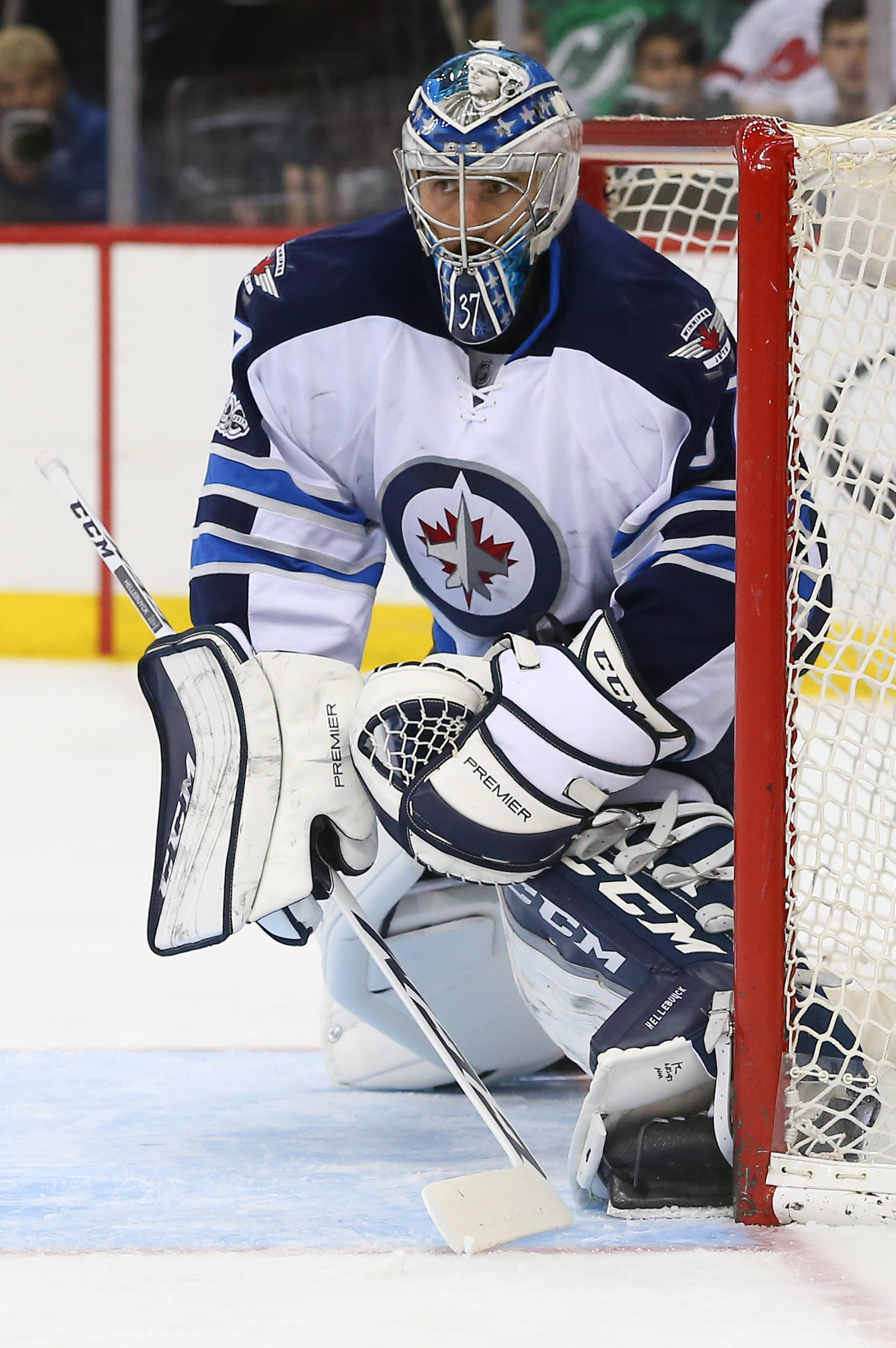
In the history of the Thrashers/Jets franchise, there is exactly one goaltender* that has recorded better than a .915 save percentage while with the team. That’s Al Montoya, who put up a .916 mark in 35 games between 2013-14. It’s an incredible run of futility by string of so-so goaltenders, and one that needed to change if the Jets were to ever really compete.
Enter 2017-18 Hellebuyck, who is carrying a .920 save percentage so far this season and has let everyone know that Steve Mason wasn’t needed. The 24-year old goaltender is 18-4-5 on the season, and is about as valuable of a piece as there is around the NHL. His play has allowed a team that was considered a playoff dark horse at best to become something of a powerhouse overnight.
What would the Jets be even more thankful for?
Division realignment.
Despite being 20-10-6 on the season, with a +19 goal differential and several All-Star level players, the Winnipeg Jets aren’t in first place in the Central Division. That honor goes to the Nashville Predators, who have the best points percentage out of the three teams (including the Jets and St. Louis Blues) tied with 46 points in the standings.
The Central doesn’t have any teams that are pushovers this season, after the Colorado Avalanche have turned things around from their historically bad 2016-17. It’ll take a continued effort from Winnipeg all season to secure one of the top three spots, and even then they’re more than likely going to lock horns with another excellent team in the first round.
What should be on the Jets’ Holiday Wish List?
Even more depth, preferably some that can kill penalties.
In all honesty, there’s not a lot that the Jets need to go out and acquire. If they can find a defenseman that is under contract or control for a few years it could help, with Toby Enstrom and Tyler Myers creeping towards free agency, but that can be dealt with in the offseason if need be. Adding Dmitri Kulikov last offseason has given them enough depth to survive injuries to Enstrom and Dustin Byfuglien, especially with the emergence of Josh Morrissey as a top option.
With some forwards coming back recently their lineup has been lengthened back out, but the penalty kill remains one of their warts, if fairly innocuous. Matt Hendricks leads all forwards in short handed time, but has been relatively ineffective in that role and barely plays at even strength. While he’s a “character guy” and from all accounts fits in perfectly to the dressing room, every fringe improvement gets the Jets closer to being a real Stanley Cup contender.
*Peter Mannino actually has a 1.000 save percentage for the Jets, but faced just four shots in his one-period relief appearance in 2011.
Photo courtesy of USA Today Sports Images
Winnipeg Jets Find Themselves In Enviable Position
When the Winnipeg Jets took the ice this morning to practice before their matchup with Arizona tomorrow night, Mathieu Perreault was with them. It wasn’t in the yellow non-contact jersey he’d been donning lately, but a white sweater indicating he was close to a return to game action. Perreault has played in just five games this season while dealing with injury, a trend that has dominated his playing career. The 29-year old forward has never played more than 71 games in a single season.
Perreault’s return and the subsequent assignment of Brendan Lemieux to the AHL had Pierre LeBrun of The Athletic thinking though, as he tweeted out his expectations for the next few months.
Jets lots of depth up front. Other teams looking for help at forward will come calling ahead of Feb. 26 trade deadline.
Indeed, the Jets have one of the more enviable forward groups in the NHL. Even without Perreault—a perennial 40+ point player even despite his injury history—the Jets are 10th in the league in goals per game and boast several budding superstars up front. Patrik Laine has given up his short residence as headline-maker to Mark Scheifele, who has seemingly taken a huge step forward every year of his NHL career. After breaking out last season with 82 points, the 24-year old Scheifele has 21 points in his first 16 games and is showing no signs of slowing down. Team captain Blake Wheeler is riding shotgun with 23 points already, and could challenge his career-high of 78 points set two seasons ago. Wheeler has turned into one of the most consistent offensive players in the league, with at least 26 goals 61 points in each of the last four seasons.
 Behind the top group (which also includes Nikolaj Ehlers, a 21-year old speed demon with a 30-goal future) the Jets find themselves flush with talent. Perreault and Bryan Little provide some veteran options, both of whom have plenty of experience at center ice and big scoring upside. But it’s the next wave that will allow them to be dealers at the deadline should they so choose. The team can’t even find room for Lemieux or Jack Roslovic, who has 17 points in 15 games for Manitoba and is patiently waiting for his chance.
An interesting name to watch out for in Winnipeg (and one that was mentioned in the most recent live chat) will be Adam Lowry. The 24-year old center is a big piece (not just figuratively, as he stands 6’5″) for the team down the middle but is a restricted free agent this summer. The Jets aren’t yet a cap team, spending right up to the ceiling every year and have to measure their finances carefully going forward. This summer will bring restricted free agency for Lowry, Jacob Trouba, Josh Morrissey and Connor Hellebuyck among others, while 2019 will have new deals due for Laine and Connor. With the clear need around the league for centers, and Lowry’s size, youth and relative inexpensiveness he would be a huge trade piece if the team ever decided to dangle him near the deadline. With the depth they have at center, it wouldn’t be crushing to them and another team may believe Lowry can better his 29-point career high if thrust into a more prominent role.
Either way, the Jets are one of the most interesting teams to watch as they head into the winter months. Their solid record of 9-4-3 combined with being one of the youngest teams in the league makes them one to not only consider playoff candidates, but up-and-coming Stanley Cup contenders in the years to come. A few well-timed moves could accelerate that contention.
Photo courtesy of USA Today Sports Images
Eichel Sets The Market For Matthews And Laine
While the eight-year, $80MM contract extension that the Sabres handed center Jack Eichel earlier this week ensures that Buffalo has their franchise player under contract for almost the next decade, it also goes a long way towards setting the market for 2016 top picks Auston Matthews (Toronto) and Patrik Laine (Winnipeg) this time one year from now.
Both Matthews and Laine surpassed Eichel’s rookie season output and at least are expected to do the same with their second-year production so it’s fair to say that both players should check in past that $10MM mark while Connor McDavid’s eight-year, $100MM extension with Edmonton from the summer will represent the high end.
Despite that, there’s a case to be made that Buffalo did the Leafs and Jets at least small favor by locking Eichel up now. With a more defined salary range to work with, it should be easier for GMs Lou Lamoriello and Kevin Cheveldayoff to plan around who they can keep and who may become a cost casualty. Both teams will have some tough calls to make.
For Toronto, they also have Mitch Marner eligible for an extension starting next summer while William Nylander’s entry-level contract will be up (with no in-season extension in the plans). That trio could cost somewhere around $25MM per year and Lamoriello will undoubtedly want to keep all three in the fold. Looking ahead to 2019-20 when the second contracts will kick in for Marner and Matthews, they’ll have over $55MM committed to just 11 players (which doesn’t include the injured Nathan Horton or any money allocated for pending UFAs Tyler Bozak, James van Riemsdyk, and Leo Komarov). Needless to say, that’s going to be a tight squeeze.
It isn’t much different in Winnipeg either, especially with the recent long-term extensions handed out to Bryan Little (six years) and Nikolaj Ehlers (seven years). They already have more than $33MM tied up in six players for 2019-20 when Laine’s next deal will begin plus they still have to re-sign Jacob Trouba this summer and either re-sign or replace key pieces in winger Blake Wheeler and defenseman Tyler Myers a year later. Put those four players (or replacements) under contract and they’ll be past the $60MM mark with still more than half a team to sign.
The 2019 offseason is still a long way away so there is plenty of time for Lamoriello and Cheveldayoff to determine how they’re going to fit in the big ticket deals for Matthews and Laine on their payroll. But at least now with the Eichel contract, they have a better idea of just how much it’s going to cost to keep them around for the long haul which gives them more time to plan out any corresponding moves.
Salary Cap Deep Dive: Winnipeg Jets
Navigating the Salary Cap is probably one of the more important tasks for any general manager to have. Teams that can avert total cap chaos by walking the tightrope of inking players to deals that match their value (or compensate for future value without breaking the bank) remain successful. Those that don’t see struggles and front office changes.
PHR will look at every NHL team and give a thorough look at their cap situation heading into the 2017-18 season. This will focus more on those players who are integral parts of the roster versus those who may find themselves shuttling between the AHL and NHL. All cap figures are courtesy of CapFriendly.
Winnipeg Jets
Current Cap Hit: $67,661,666 (under the $75MM Upper Limit)
Entry-Level Contracts
F Patrik Laine (Two years remaining, $925K)
F Kyle Connor (Two years remaining, $925K)
F Nikolaj Ehlers (One year remaining, $894K)
D Josh Morrissey (One year remaining, $863K)
Potential Bonuses
Laine: $2.65MM
Ehlers: $850K
Connor: $850K
Morrissey: $500K
Total: $4.85MM
The future looks bright for the Jets, especially with Laine, who is constantly overshadowed by Toronto Maple Leafs Auston Matthews. Laine, who was taken second-overall in last year’s draft, put up phenomenal numbers that make Jets fans believe again in their team. He put up 36 goals in his rookie campaign and added 28 assists for a 64-point season. He should only get better and become the cornerstone of the franchise in the future. He should be joined by Ehlers, who also had a breakout year last year. The 2014 first-round pick had 15 goals in his rookie year, but added to that this past year, putting up 25 goals and 39 assists for 64 points.
The team also has high hopes for Connor to make the team and find himself a full-time role this year. The team’s 2015 first-round pick, put up big numbers a couple years ago at the University of Michigan two years ago, then scored 25 goals with the AHL’s Manitoba Moose and still managed to get 20 games in with the Jets, where he scored two goals and three assists. The team believes he has a good shot to end up on one of the back two lines. Morrissey, the team’s first-round pick back in 2013, found a full-time role with the Jets last year as he put up six goals and 14 assists. He is currently slated to start on the Jets’ third-line defense.
One Year Remaining, Non-Entry-Level
D Toby Enstrom ($5.75MM, UFA)
F Bryan Little ($4.7MM, UFA)
D Jacob Trouba ($2.81MM, RFA)
G Connor Hellebuyck ($2.25MM, RFA)
F Shawn Matthias ($2.13MM, UFA)
G Michael Hutchinson ($1.15MM, UFA)
F Adam Lowry ($1.13MM, RFA)
F Joel Armia ($925K, RFA)
F Marko Dano ($850K, RFA)
F Brandon Tanev ($700K, RFA)
F Matt Hendricks ($700K, UFA)
F Michael Sgarbossa ($650K, RFA)
That’s a long list, but most of the players are restricted free agents and should easily be retained. However, the team will have to make some decisions on some key veterans, including Little, who many feel is an underrated forward. The 29-year-old has been with the franchise from the start of his career when they were the Atlanta Thrashers and has scored 184 goals for the franchise. With the team’s large number of young forwards, might they move on from Little in a year? Injuries have plagued little over the past two years as he’s missed 48 games. His 21 goals last year were solid, but he will need to prove his value this year if he wants another long-term deal. Another potential unrestricted free agent would be Enstrom, who will be 33 next year and the team will have to decide whether to keep the veteran blueliner. His offensive numbers dropped into the teens in the last couple of years. Mattias and Hendricks are expendable fill-ins, but valuable veterans to hold that roster together.
The team will be looking to several of their restricted free agent as key players in the future. The team will be looking at Trouba to have a big season this year. The 23-year-old defenseman had a career-high 33 points a year ago and he did that in only 60 games, so many feel he may take his game up a notch this year if he can avoid injuries. Despite Hellebuyck’s down year as they attempted to hand him the starting goaltender job, the team still looks at him as a potential starter that just wasn’t ready to take their reigns last year. His 2.89 GAA in 56 games didn’t get the job done. With Mason coming in, Hellebuyck will have more time to develop as a backup.
The team will be looking for Lowry to continue to develop as well. Lowry had 15 goals last year and the 24-year-old is expected to center the team’s third line. Armia also has bigger expectations this year after putting up 10 goals a year ago. He could also end up as a wing next to Lowry on that third line. Dano could also pick up a full-time role with the Jets this year. The former 2013 first-rounder played 38 games for Winnipeg last year, putting up four goals and seven assists.
Cost Per Point: The Best Value Deals In The NHL
When working with a salary cap, especially one that has not been increasing as expected in recent year, it is vital for general managers to get the most production out of their players. Teams with players who meet the expected level of production implied by their contracts and teams that lack wasted dollars in bad, expensive deals are often the same teams that thrive in today’s NHL. Forget market size or free agent appeal, the key to a winning franchise nowadays is getting the best bang for your buck on every player on the roster. While no player can be fully quantified by their scoring, cost per point is an easy way to look at which players are producing at the most team-friendly rate and which have been more of a cap space killer than a positive member of the team. Thanks to CapFriendly, that information is readily available to fans and NHL executives alike.
The benchmark for this metric is about $100K/point, as GM’s expect those big-time forwards and offensive defenseman who they award with $6MM, $7MM, and $8MM per year contracts to be putting up 60, 70, or 80 points respectively. For the second year in a row, St. Louis Blues superstar Vladimir Tarasenko was the poster boy for this standard, coming in at exactly $100K/point with 75 points on a $7.5MM deal. Winnipeg’s Bryan Little and New Jersey’s Adam Henrique are two other notable names that hit the mark exactly, while phenoms like Sidney Crosby and Duncan Keith landing close to the $100K/point mark show that it is an accurate expectation.
However, the exception to the rule is obviously entry-level contracts. It is no secret that drafting and developing well is the best way to improve you team, beginning with affordable scoring from players on their rookie deals. Nowhere is that more apparent than in cost per point, where nine of the top ten and 17 of the top 20 best contracts were rookie deals. To no one surprise, 20-year-old MVP Connor McDavid and his 100 points on a $925K entry-level contract was far and away the best bargain in hockey. McDavid cost the Oilers only $9,250 per point in 2016-17. That will all change soon, as McDavid is set to begin an eight-year, $100MM contract in 2018-19, after which a 100-point campaign will cost Edmonton $125,000/point, closer to the expectations of a standard contract. For now, the Oilers can enjoy one more year of McDavid likely being the best deal in the NHL, as well as the best player. Entry-level deals joining McDavid in the top ten last year (in order) were Viktor Arvidsson, Artemi Panarin, teammate Leon Draisaitl, Conor Sheary, David Pastrnak, Auston Matthews, Nikolaj Ehlers, and Patrik Laine. Not all entry-level deals are created equal, so while Draisaitl and Pastrnak were second and fourth respectively in entry-level scoring, they were also on the ELC maximum deal of $925K and of slightly lesser value to their teams than the likes of Arvidsson ($632K) and Sheary ($667.5K). Panarin had the best contract in the league in 2015-16 and fell only to third with $10,980/point for the Chicago Blackhawks. Now in Columbus and on a two-year, $12MM deal, the Blue Jackets have to hope that they can continue to get 70+ point seasons out of him to maximize the value of that deal.
So, entry-level contracts aside, who was the best contract in hockey last season? Another easy answer, former Blue Jacket gamble Sam Gagner. After a horrendous 2015-16 campaign with the Philadelphia Flyers, Gagner struggled to find a new team last summer, eventually settling on a $650K “show me” deal with Columbus. Right away people tagged that contract, for a six-time 40+ point scorer, as an absolute bargain, even if Gagner simply bounced back to normal production. He did one better, posting a career-high 50 points for the Jackets and coming in at $13K/point, good enough for sixth in the NHL. Gagner has since moved on to the Vancouver Canucks, signing a three-year, $9.45MM contract on July 1st. However, if he is able to continue to produce at 40-50 point levels over that deal, his $3.15MM cap hit will remain a great bargain deal. Behind Gagner, another player on the move this summer, former Florida Panther and current Vegas Golden Knight Jonathan Marchessault had the 13th-ranked cost per point last year at $14,706/point. Marchessault had a breakout year, netting 51 points in the first season of a two-year, $1.5MM deal. Rather than take advantage of one more $750K season for a 30-goal scorer, the Panthers allowed Marchessault to be selected in the Expansion Draft and Vegas surely hopes he continues to be one of the best values in hockey in 2017-18. The final contract in the top 20 not belonging to an entry-level player, and the only 35+ veteran contract in the top 50, belongs to Marchessault’s replacement in Florida, Radim Vrbata. Vrbata returned home to Arizona last season after a down year in Vancouver the season prior, and the swift 36-year old proceeded to score 55 points, more than double his previous year’s total. On a one-year deal with a $1MM base salary, that only cost the Coyotes $18,182/point last season. Now at a base salary of $2.5MM in Florida, the Panthers hope that Vrbata isn’t starting to slow down just yet. Other impressive value contracts included Patrick Eaves, whose breakout season in Dallas led to a trade and subsequent extension with the Anaheim Ducks, Derek Ryan, who shocked the hockey world with 29 points for the Carolina Hurricanes in his first full NHL season at age 30, and a quartet of recently re-signed RFAs in Richard Panik, Ryan Dzingel, Ryan Spooner, and Jordan Martinook.
With the good comes the bad, and there were certainly some poor value contracts in the NHL last year. Many of the worst belong to players who were injured or AHL depth players that saw only limited time. With zero points in 13 games with a $1.25MM cap hit, Tampa Bay Lightning winger Erik Condra‘s value was not even quantifiable it was so bad, and at the highest salary of any player who went pointless last season. Limited to just 18 games with only four points, another Bolts forward, Ryan Callahan, was one of the worst values due to injury with $1.45MM per point on his $5.8MM cap hit. However, the truly worst contract in the NHL has to belong to a player that player a majority of the season. Sadly for a Detroit fan base that is already feeling pretty down-and-out, that designation belongs to Red Wings defenseman Danny DeKeyser, who began a six-year, $30MM extension by scoring about a third less points for the third season in a row. With 12 points in 82 games at $5MM, DeKeyser’s $416.7K/point is pretty ugly. The Buffalo Sabres struck out twice on the blue line, with both Dmitry Kulikov (five points in 47 games at $4.33MM) and Josh Gorges (six points in 66 games at $3.9MM) coming in at $866.7K/point and $650K/point respectively, though neither is known as a major point producer. The worst forward contract? Andrew Desjardins may not have been relied upon as a full-time player with much ice time last season with the Chicago Blackhawks, but with only one point in 46 games, $800K/point, it’s not difficult to see why he remains an unsigned free agent.
While statistics and analytics in hockey are normally geared toward displaying on-ice production, it is always interesting to look at the game from a business perspective. It is important for teams and fans alike to understand not just the absolute of how a player is producing, but the relative value of that production based on how much money that player is being paid. In a salary cap league, there is nothing more important that production value, and as the game grows the focus will only further tighten on scoring as a function of dollars and the cost per point metric.
NHL Draft Lottery Notes: Odds, History, Viewing
For the fourteen teams that missed the playoffs and the expansion Vegas Golden Knights, they have one thing in common: they’re hoping Bill Daly is holding a card with their logo on it, announcing that they have the first overall pick.
At 7pm central, NBC, CBC, and Sportsnet will show the NHL Draft Lottery as the Colorado Avalanche lead all teams in terms of percentage for receiving the #1 pick. Below are the odds:
Colorado Avalanche — 18.0%
Vancouver Canucks — 12.1%
Vegas Golden Knights — 10.3%
Arizona Coyotes — 10.3%
New Jersey Devils — 8.5%
Buffalo Sabres — 7.6%
Detroit Red Wings — 6.7%
Dallas Stars — 5.8%
Florida Panthers — 5.4%
Los Angeles Kings — 4.5%
Carolina Hurricanes — 3.2%
Winnipeg Jets — 2.7%
Philadelphia Flyers — 2.2%
Tampa Bay Lightning 1.8%
New York Islanders — 0.9%
TSN has a lengthy writeup on the history of the lottery and how the current format differs from other versions. The biggest change for the draft is that instead of the worst team being guaranteed, at worst, a second overall pick, they are only promised a top four pick. This was placed to discourage teams from “tanking” to draft top-end talent, which hasn’t completely negated the idea of tanking as Toronto won the right to draft Auston Matthews last season with the #1 pick while securing the worst record in the NHL.
What’s new to 2017? From Sportsnet:
For just the second time in NHL draft lottery history, the top three picks are in play. This rule was implemented by the league in 2016 to dull incentive for any team to finish lower in the standings (i.e., tanking).
The odds of winning the second and third draws increases on a proportional basis depending on which team claimed the previous draw.
The addition of a 15th lottery team, Vegas, into the mix also affects the winning percentages.
This draft is different too, since the top two picks for the first time in three seasons are not considered the “generational talent” that Connor McDavid, Jack Eichel, Matthews or Patrik Laine were when looking back at the one and two overall picks respectively.
This isn’t to besmirch the top two candidates, Nolan Patrick or Nico Hischier. After all, “can’t miss” prospects have fooled scouts and analysts before while prospects that scouts didn’t think were as good sometimes exceeded expectations.
But before the talent can be chosen, there needs to be an order. Tonight will determine that.
Specifics:
Time: 7pm CST
Where to watch: CBC, Sportsnet, NBC