
Salary Cap Deep Dive: New York Rangers
Navigating the Salary Cap is probably one of the more important tasks for any general manager to have. Teams that can avert total cap chaos by walking the tightrope of inking players to deals that match their value (or compensate for future value without breaking the bank) remain successful. Those that don’t see struggles and front office changes.
PHR will look at every NHL team and give a thorough look at their cap situation heading into the 2018-19 season. This will focus more on those players who are integral parts of the roster versus those who may find themselves shuttling between the AHL and NHL. All cap figures are courtesy of CapFriendly.
New York Rangers
Current Cap Hit: $73,823,569 (under the $79.5MM Upper Limit)
Entry-Level Contracts
F Pavel Buchnevich (one year remaining, $925K)
D Neal Pionk (one year remaining, $925K)
F Lias Andersson (three years remaining, $894K)
F Filip Chytil (three years remaining, $894K)
D Anthony DeAngelo (one year remaining, $863K)
G Alexandar Georgiev (two years remaining, $793K)
Potential Bonuses
Pionk: $850K
Andersson: $850K
Deangelo: $400K
Chytil: $350K
Total: $2.45MM
With the team in quick rebuild mode, there are some entry-level deals already and if the team continues to trend in that direction, they will have quite a bit more. The team’s most prominent player at the NHL level to date would be Buchnevich, who improved on his rookie campaign with a 14-goal, 43-point season last year. He saw more ice time as well, improving from 13:16 ATOI to 15:01 as well as saw significant time on the team’s power play, potting five goals and 11 assists with the man advantage and has earned himself a solid spot in the team’s top-six. Another improved season could see him being an expensive restricted free agent.
The team has high expectations for their two 2017 first-rounders in Andersson and Chytil. Both have shown excellent skills and have received some time playing for the NHL with Andersson seeing seven games, while saw nine games. Both are expected to earn time with the Rangers out of training camp, but both may find themselves on bottom-six lines unless they can prove that they can center the second or third lines in training camp.
One Year Remaining, Non-Entry-Level
F Kevin Hayes ($5.18MM, UFA)
F Mats Zuccarello ($4.5MM, UFA)
D Rob O’Gara ($874K, RFA)
F Cody McLeod ($750K, UFA)
D Fredrik Claesson ($863K, RFA)
F Peter Holland ($675K, UFA)
D Steven Kampfer ($650K, UFA)
G Marek Mazanec ($650K, UFA)
The team agreed to a one-year deal with Hayes, avoiding arbitration, but now face the possibility that Hayes could walk away at the end of the season as he will be unrestricted, which will force the team into two possible directions, including attempting to work out a long-term deal with the team after Jan. 1, 2019, or trading him, possibly at the trading deadline if the two sides can’t agree on anything. Hayes, who has been a jack of all trades playing multiple positions, seems to have developed into a solid center as he produced his best season ever, which included 25 goals, eight more than any previous year. The question is, do the Rangers view him as a fixture in their lineup as they continue to rebuild?
At age 30, Zuccarrello still puts up solid numbers, but despite the high-end minutes that the veteran gets, he falls into a similar category to that of Hayes where you have to ask whether he is in the team’s long-term plans. The winger is penciled in to play on the team’s top line once again, but has only put up 31 goals over the past two seasons. He does produce quite a few assists (81 over the past two years), but what the Rangers need more than anything is goals. Zuccarello will also turn 32 before he begins his next contract and at that age, how long are the Rangers willing to commit to him?
Two Years Remaining
F Chris Kreider ($4.63MM, UFA)
F Ryan Spooner ($4MM, UFA)
F Vladislav Namestnikov ($4MM, UFA)
F Jimmy Vesey ($2.28MM, UFA)
F Matt Beleskey ($1.9MM, UFA)
F Jesper Fast ($1.85MM, UFA)
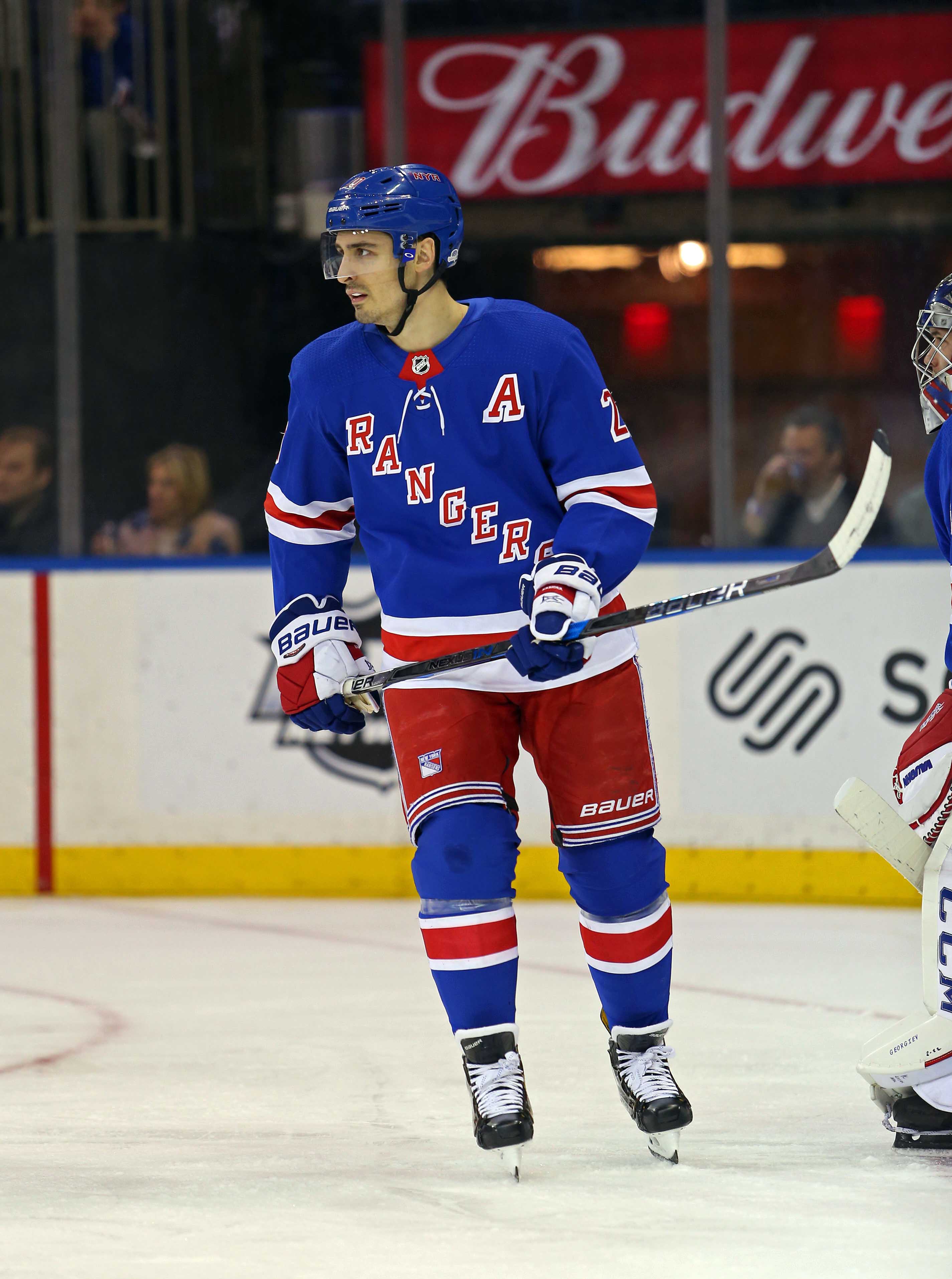
Kreider is coming off a tough year in which he had to deal with blood clots and had surgery to relieve the pressure and missed almost two months of time. The 27-year-old didn’t have as solid of a season as he tallied just 16 goals in 58 games, which is a far cry from the 28 goals he scored in 2016-17 although a lot of that is due to the fact that his playing time dipped as the team didn’t want to play him too many minutes due to the blood clot issue. Regardless with a full offseason to rest and recuperate, Kreider should be able to bounce back as one of the team’s top scorers.
The team also have high expectations from two other forwards that the team acquired through at the trade deadline a year ago in Namestnikov and Spooner. Namestnikov was the biggest name to arrive in New York in the Ryan McDonagh trade with Tampa Bay. He was a key player for the Lightning, posting 20 goals and 44 points with them, but he actually lost playing time once he arrived in New York and put up just two goals and four points in 19 games. The team hopes that a new coach and proper training camp with his new team will make quite a difference. Spooner came over in the Rick Nash trade with Boston and has posted solid numbers with the Bruins over the past few seasons and could turn out to be a top-six wing or third-line center in New York. Between the two teams, Spooner combined for 13 goals and 28 assists.
The team also expect big things from Vesey, who signed as a undrafted collegiate free agent a couple of years ago and if finally starting to show that he belongs in the NHL. The 25-year-old winger has put up solid numbers for two years, but could find himself getting more opportunities in the team’s rebuild. In two years, he’s combined for 33 goals and 55 points.
New York Rangers Re-Sign Cody McLeod
The New York Rangers have decided that the added leadership and toughness that Cody McLeod provided down the stretch last season is worth another go, and have signed the veteran forward to a one-year contract. No financial details have been released yet.
McLeod, 34, has played 738 regular season games in the NHL including 25 for the Rangers last season. The team claimed him off waivers from the Nashville Predators and played him regularly down the stretch. While New York is trying to become younger and quicker, McLeod should provide at least some level of professional accountability to the inexperienced prospects as they try to develop on the fly. He also gives the team a physical presence in the bottom six and a (perhaps only perceived) measure of protection against unwanted attacks on the team’s more skilled players.
What he doesn’t offer, is any measure of offensive production. McLeod has just 126 points in his long career, and registered just four of those last season in 48 games. He’s a brutal possession player, but won’t be asked to play the puck much during his stay in New York. Instead, he’ll likely be a part-time player that is only asked to hit the ice for 7-9 minutes a game whenever he does dress.
Free Agent Focus: New York Rangers
Free agency is now a little less than a month away from opening up and there are quite a few prominent players set to hit the open market while many teams have key restricted free agents to re-sign. Here is a breakdown of New York’s free agent situation.
Key Restricted Free Agents: F Vladislav Namestnikov – The Rangers have plenty of restricted free agents to sign this summer, and while Kevin Hayes and other forwards may have had a bigger impact on the team, it’s Namestnikov that remains the biggest enigma. After coming over from the Tampa Bay Lightning at the deadline as part of the Ryan McDonagh trade, Namestnikov failed to find much chemistry with his new team. The 25-year old registered just four points in 19 games down the stretch, after notching 44 in Tampa Bay (mostly alongside Steven Stamkos and Nikita Kucherov). Those 44 had already guaranteed he would reach a career-high in points, and he had already cracked 20 goals by the end of February.
There is still some question as to where he fits into the Rangers plans though. As the team continues to try and get younger, they essentially swapped two players the same age when they sent J.T. Miller along with McDonagh to Tampa Bay. Now Namestnikov, the 27th-overall pick from 2011, will have to show that the team actually upgraded with that trade and show he can be a top-six contributor in 2018-19 and beyond. Since he’ll be turning 26 in November any long-term deal will be buying out several unrestricted free agent seasons, substantially increasing the cap hit of the overall deal. After being paid an average of just $1.94MM the last two years, Namestnikov will be looking for a substantial raise. It’s not clear if New York wants to commit long-term to a player that has had trouble producing when not playing alongside elite linemates.
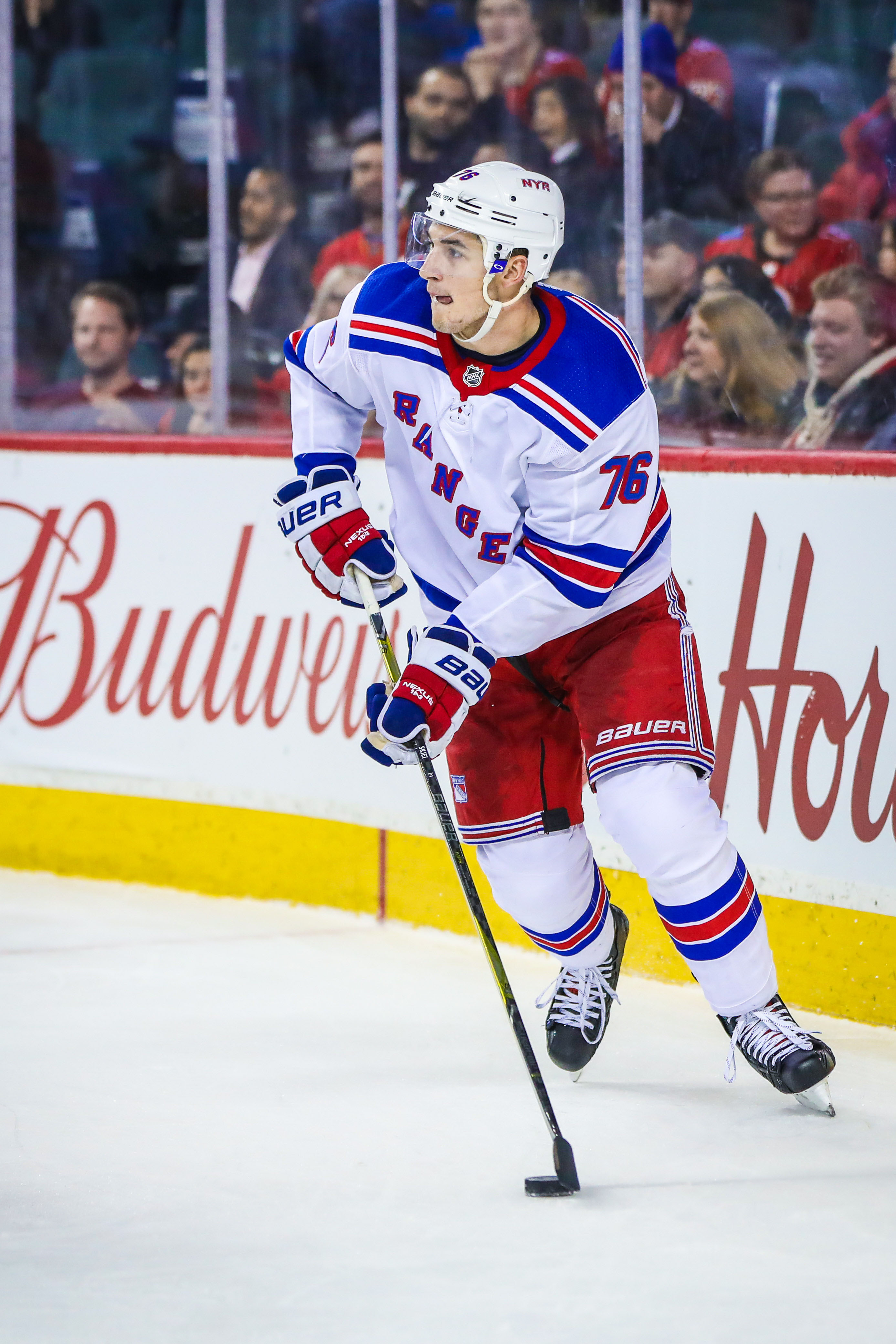 D Brady Skjei – If Namestnikov is the most unclear decision on the team’s RFA list, Skjei might be the most important. The 24-year old turned into one of the team’s most reliable defensemen in the second half of 2016-17, and showed again that he could be a big time contributor this season. Though his point production dropped significantly, Skjei was asked to log more than 21 minutes a night for a team whose defensive unit was constantly in flux. McDonagh was traded midseason, Kevin Shattenkirk dealt with injury and Brendan Smith was banished to the minor leagues, leaving Skjei the lone defender who could be counted on all season.
Skjei is coming off his entry-level contract later than many other impact players, meaning that he’s closer to unrestricted free agency than many would be heading into their second deal. It’s clear that he is a player to build around for the Rangers, and signing him long-term right now is the only way to really keep his cap hit to a reasonable amount. If the team (or player, for that matter) decides to mitigate risk and sign a short-term bridge deal, it could end up costing them in the long run if Skjei continues to improve and looks for a big-money extension when he’s 26 or 27.
Other RFAs: F Ryan Spooner, F Kevin Hayes, F Jimmy Vesey, D Rob O’Gara, D John Gilmour, G Marek Mazanec, F Steven Fogarty, F Boo Nieves, F Chris Bigras, F Adam Tambellini
Key Unrestricted Free Agent: G Ondrej Pavelec – The Rangers sold hard at the deadline to rid themselves of nearly all valuable unrestricted free agents, leaving Pavelec as the last remaining big ticket. The team does have other potential internal options as a backup for Henrik Lundqvist, but there’s not much to complain about with their situation this year. Pavelec recorded a .910 save percentage in 19 games, and though his record was poor that’s more a reflection on the team in front of him than his performance. The former Winnipeg Jets goaltender signed for just $1.3MM this season, and could likely be brought back for a similar amount in 2018-19.
Otherwise, Pavelec would likely have several suitors around the league as a reasonably priced backup with plenty of experience. The 30-year old goaltender has played 398 games in the NHL, and could come in as a 20-game backup for one of the more established goaltenders in the league. There is also always a chance he could return to the Czech Republic as a starter, though it’s been more than a decade since he played there full-time.
Other UFAs: F Paul Carey, F Cody McLeod, D Ryan Sproul, F Daniel Catenacci, F John Albert
Projected Cap Space: The Rangers currently project to have somewhere around $30MM in cap space to spend this summer, but a lot of that will be eaten up by the group of RFAs requiring new contracts. If every one of Skjei, Spooner, Hayes, Vesey and Namestnikov are signed, the team could be looking at a lot less room to operate with for the rest of the summer. The idea that they’ll just re-sign what they have and go into next season with the same group seems foolish, especially with young players like Filip Chytil and Lias Andersson knocking down the door.
With three first-round picks and plenty of young prospects starting to fill the cupboards, it wouldn’t be surprising if New York was one of the most active teams this offseason. Either continuing to trade experience for youth and building towards a window of contention in a few years, or reloading to get back to the playoffs in the short-term, the Rangers are a team to watch closely as the draft approaches in a few weeks.
Rangers Claim Cody McLeod; Blues Waive Magnus Paajarvi
The New York Rangers have decided to add a little toughness to their lineup, today claiming Cody McLeod off waivers from the Nashville Predators. Nathan Gerbe, who was also on waivers after signing with the Columbus Blue Jackets, has cleared and will be assigned to the Cleveland Monsters of the AHL. In addition, Magnus Paajarvi has been waived by the St. Louis Blues.
 This is the second time the Rangers have claimed a physical fourth-line presence this season after adding Adam Cracknell earlier in the year. While Cracknell was eventually flipped in a minor trade, McLeod could catch on as a bang-and-crash winger who is ready to drop the gloves in defense of a teammate. Though that style is rarely seen in the game these days, McLeod has continued to find work and will try to prove his value in New York.
The Rangers needed to make a corresponding roster move to fit McLeod in, and sent Daniel Catenacci to the minor leagues to make room. Vinni Lettieri and Anthony DeAngelo are the only players on the roster who are waiver exempt, however Peter Holland could’ve also still also been sent without having to clear waivers again, as he hasn’t been up long enough for his clock to reset.
Paajarvi’s inclusion on waivers is interesting, if not entirely unexpected. The Blues have activated Jaden Schwartz from injured reserve, and needed a roster spot for him to fit in. While Tage Thompson and Ivan Barbashev are both waiver-exempt, both have proven themselves as key parts of the forward group and won’t be sent down anytime soon.
Instead, it’s Paajarvi’s turn to be risked on waivers. The 10th-overall pick in 2009 hasn’t ever established himself as an offensive presence in the NHL, instead playing the roll of checking forward and penalty killer. In 352 career games, Paajarvi has 97 points including just four this season. While his age (26), size (6’3″ 206-lbs) and draft pedigree all suggest that there still could be another level to his play, nothing on the ice confirms it.
Still, he could be an interesting player for a contending team to add if they’re not happy with their own depth. Earning just $800K before hitting unrestricted free agency this summer, Paajarvi poses very little risk in terms of financial commitment. It’s important to note that Arizona, Toronto and Minnesota are all at their 50 contract limit, meaning they’d need to rid themselves of another player before making a claim.
Photo courtesy of USA Today Sports Images
Nashville Predators Place Cody McLeod On Waivers
The Nashville Predators have placed forward Cody McLeod on waivers, while the Columbus Blue Jackets have waived Nathan Gerbe as expected after signing him earlier today. The Predators will need another roster spot for Filip Forsberg when he comes off injured reserve, and only Kevin Fiala is waiver-exempt.
McLeod, 33, was acquired by the Predators last season to add some toughness and physicality to the fourth line. In 56 games with them last season including 15 playoff contests, McLeod recorded six goals and 152 hits, collecting 120 penalty minutes along the way. He’s returned on the final season of his three-year deal, recording two points in 23 games.
While McLeod does add some level of physicality, the Predators had been using him less and less recently, with his last game coming more than three weeks ago. He had played more than 10 minutes just once this season, and doesn’t seem to be a big part of the team’s plans going forward.
Interestingly though, the Colorado Avalanche are still retaining a portion of McLeod’s $1.33MM cap hit, meaning he is an extremely affordable piece for a club looking for that same physical play Nashville was after last season. If unclaimed, he would likely head to Milwaukee to play in the AHL.
Gerbe, signed out of the Swiss NLA today, requires waivers in order to be assigned to the NHL or AHL level. Usually a formality for signing players, it’s extremely unlikely that anyone would put in a claim on the diminutive forward.
Revisiting The January Trade Market
As front offices around the league call and text trying to find the right fit for their rosters, fans are waiting with bated breath wondering who could be pulling on their favorite sweater in the next few weeks. Will a superstar change hands and take over as the new face of a franchise? Will a veteran finally find his way to the Stanley Cup promised land? The deadline is now less than six weeks away.
We may not have to wait until the very end to answer these questions though, as January has been a busy month for trade action in the past. We’ve already had two moves this year, and several more could be finalized before the calendar turns over. For now, let’s take a look back at the last few years to see what kind of moves are made in the dawn of the new year.
2018:
January 4th: Edmonton acquires Al Montoya from Montreal in exchange for a 2018 conditional fourth-round pick.
January 10th: Chicago acquires Anthony Duclair and Adam Clendening from Arizona for Richard Panik and Laurent Dauphin.
2017:
January 1st: Arizona acquires Mitchell Moroz from Edmonton in exchange for Henrik Samuelsson.
January 11th: Anaheim acquires Jhonas Enroth from Toronto for a 2018 seventh-round pick.
January 13th: Nashville acquires Cody McLeod from Colorado in exchange for Felix Girard.
January 19th: Nashville acquires Andrew O’Brien from Anaheim for Max Gortz.
January 21st: Los Angeles acquires Cameron Schilling from Chicago for Michael Latta.
January 24th: Ottawa acquires Tommy Wingels in exchange for Zack Stortini, Buddy Robinson and a 2017 seventh-round pick.
January 26th: Montreal acquires Nikita Nesterov from Tampa Bay in exchange for Jonathan Racine and a 2017 sixth-round pick.
Obviously 2017 wasn’t filled with the most blockbuster trades in the month of January, but several teams did add small pieces for potential playoff runs. Nesterov didn’t really work out in Montreal, and Wingels couldn’t find his scoring touch in Ottawa.
2016:
January 3rd: Chicago acquires Richard Panik from Toronto in exchange for Jeremy Morin.
January 6th: Los Angeles acquires Vincent Lecavalier and Luke Schenn from Philadelphia in exchange for Jordan Weal and a 2016 third-round pick.
January 6th: Nashville acquires Ryan Johansen from Columbus in exchange for Seth Jones.
January 7th: Montreal acquires Max Friberg from Anaheim in exchange for Dustin Tokarski.
January 8th: Vancouver acquires Emerson Etem from New York in exchange for Nicklas Jensen and a 2017 sixth-round pick.
January 14th: Ottawa acquires Conor Allen from Nashville in exchange for Patrick Mullen.
January 15th: Montreal acquires Victor Bartley and John Scott from Arizona in exchange for Jarred Tinordi and Stefan Fournier.
January 15th: Arizona acquires Victor Bartley from Nashville in exchange for Stefan Elliott.
January 16th: Anaheim acquires David Perron and Adam Clendening from Pittsburgh in exchange for Carl Hagelin.
January 21st: Anaheim acquires Ryan Garbutt from Chicago in exchange for Jiri Sekac.
2016 was a much more active January, with big names like Lecavalier, Johansen and Jones all dealt. While the Nashville-Columbus trade might have had the biggest impact long-term, Pittsburgh’s acquisition of Hagelin was a big part of their Stanley Cup run, as he scored 27 points down the stretch and added another 16 in the playoffs.
There is certainly value to be had in January trades, and it’s clear that teams like Nashville and Anaheim aren’t scared of making an early move. While those two might not be the most watched teams on the trade market this year, don’t rule them out of making tweaks once again.
Salary Cap Deep Dive: Nashville Predators
Navigating the Salary Cap is probably one of the more important tasks for any general manager to have. Teams that can avert total cap chaos by walking the tightrope of inking players to deals that match their value (or compensate for future value without breaking the bank) remain successful. Those that don’t see struggles and front office changes.
PHR will look at every NHL team and give a thorough look at their cap situation heading into the 2017-18 season. This will focus more on those players who are integral parts of the roster versus those who may find themselves shuttling between the AHL and NHL. All cap figures are courtesy of CapFriendly.
Nashville Predators
Current Cap Hit: $68,913,333 (under the $75MM Upper Limit)
Entry-Level Contracts
F Kevin Fiala (Two years remaining, $863K)
G Juuse Saros (One year remaining, $693K)
Potential Bonuses
Fiala: $500K
Saros: $183K
Total: $683K
A team that is designed for a Stanley Cup run probably shouldn’t have too many players on entry level contracts and the Predators have just the two. Fiala is the team’s top young potential star as the former 2014 first-rounder found himself getting called up to the Predators and logged 54 games last year, scoring 11 goals. He even managed to cement himself in the starting lineup and played in five playoff games, scoring two goals, but then broke his femur and his playoffs were cut short. Nevertheless, the team is expecting a big year from the young wing and some even have him penciled in on the team’s second line. As for Saros, the 22-year-old goalie had a pretty good showing last year, playing in 21 contests (19 starts) and putting up a 2.35 GAA and a .923 save percentage. He should be able to shoulder the load as the backup and right now looks to be Nashville’s goaltender of the future.
One Year Remaining, Non-Entry-Level
D Alexei Emelin ($3MM, UFA)
F Scott Hartnell ($1MM, UFA)
F Cody McLeod ($800K, UFA)
D Yannick Weber ($650K, UFA)
D Matt Irwin ($650K, UFA)
D Anthony Bitetto ($613, UFA)
F Miikka Salomaki ($613K, RFA)
The team, already immersed in quality defenders, picked up another veteran defender in Emelin this offseason in a trade with the Vegas Golden Knights, who picked him from the Montreal Canadiens in the expansion draft. A solid veteran, Emelin, should fill in for the injured Ellis until he returns in December and then provide some veteran depth throughout the rest of the season, which should keep Nashville’s defensive corps as strong as it had always been and he will likely be allowed to move on when his contract expires next year.
Hartnell returns to Nashville after 10 years. Originally drafted in the first round by Nashville in 2000, the 35-year-old forward played six years for the Predators before being traded to Philadelphia. He has scored 314 goals, but only managed 13 in his last year in Columbus. The team hopes his presence will spark the team for another Stanley Cup run. The rest, including Weber, Irwin and McLeod
Dead Space: Bought-Out, Buried, And Retained Salaries For Every Team
It’s something that often goes unnoticed, but with the cap showing minimal growth the last few years, teams are starting to feel the crunch more than ever. Buyouts have become more common, especially with players with under three remaining years on their contracts. And it’s not just the big name busts that have seen the ax lately – we’ve seen lesser names at lesser money take the fall for their respective teams, then needing to scramble for work elsewhere in the league. Additionally, salary retention in trades has become a more utilized tactic as of late. Teams with “unmovable” contracts have offered to retain part of a poor contract in order to entice a team into giving them some relief.
All this said, some teams have been better with foresight than others. Some teams have shown a track record of being entirely unable of handing out poor contracts over the past five or so seasons. Considering many teams showed some progress in being more frugal this off-season, it seems a wise time to review the dead space every team has accumulated, either due to poor management decisions or poor luck.
Colorado Avalanche – $4.83 MM in 2017-18, issues resolved after current year – Francois Beauchemin buyout; Cody McLeod retained
Arizona Coyotes – $4.61 MM in 2017-18, issues resolved after 2020-21 – Mike Smith retained; Mike Ribeiro, Antoine Vermette buyouts
Columbus Blue Jackets – $4.025 MM in 2017-18, issues resolved after 2020-21 – Fedor Tyutin, Jared Boll, Scott Hartnell buyouts
Carolina Hurricanes – $3.71 MM in 2017-18, issues resolved after 2020-21 – Eddie Lack retained; Alexander Semin, James Wisniewski buyouts
Toronto Maple Leafs – $3.28 MM in 2017-18, issues resolved after 2021-22 – Tim Gleason, Jared Cowen buyouts; Phil Kessel retained
Nashville Predators – $2.83 MM in 2017-18, issues resolved after 2018-19 – Viktor Stalberg, Eric Nystrom, Barret Jackman buyouts
Boston Bruins – $2.73 MM in 2017-18, issues resolved 2019-20 – Dennis Seidenberg, Jimmy Hayes buyouts
New York Rangers – $2.61 MM in 2017-18, issues resolved after 2022-23 – Dan Girardi buyout
Minnesota Wild – $2.5 MM in 2017-17, issues resolved after current year – Thomas Vanek buyout
Los Angeles Kings – $2.4 MM in 2017-18, issues resolved after 2023-24 – Matt Greene buyout; Mike Richards termination/recapture
Edmonton Oilers – $2.33 MM in 2017-18, issues resolved after 2020-21 – Lauri Korpikoski, Benoit Pouliot buyouts
Anaheim Ducks – $2.21 MM in 2017-18, issues resolved after 2023-24 – Mark Fistric, Simon Despres buyouts; Patrick Maroon retained
Vancouver Canucks – $2.13 MM in 2017-18, issues resolved after 2021-22 – Roberto Luongo, Jannik Hansen retained; Chris Higgins buyout
New Jersey Devils – $2.09 MM in 2017-18, issues resolved after 2023-24 – Mike Cammalleri, Devante Smith-Pelly buyouts; Ilya Kovalchuk recapture
Tampa Bay Lightning – $1.83 MM in 2017-18, issues resolved after 2019-20 – Matt Carle buyout
Calgary Flames – $1.82 MM in 2017-18, issues resolved after 2018-19 – Mason Raymond, Lance Bouma, Ryan Murphy buyouts
Detroit Red Wings – $1.67 MM in 2017-18, issues resolved after 2020-21 – Stephen Weiss buyout
Dallas Stars – $1.5 MM in 2017-18, issues resolved after 2018-19- Antti Niemi buyout
Philadelphia Flyers – $1.5 MM in 2017-18, issues resolved after current year – R.J. Umberger buyout
Winnipeg Jets – $1.46 MM in 2017-18, issues resolved after 2018-19 – Mark Stuart buyout
Florida Panthers – $1.33 MM in 2017-18, issues resolved after 2018-19 – Jussi Jokinen buyout
Las Vegas Golden Knights – $1.1 MM in 2017-18, issues resolved after current year – Alexei Emelin retained
Ottawa Senators – $350,000 in 2017-18, issues resolved after current year – Andrew Hammond buried
Buffalo Sabres – Minimal in 2017-18, increased issues ($791,00) resolved after 2022-23 – Cody Hodgson buyout
Chicago Blackhawks, St. Louis Blues, Washington Capitals, Pittsburgh Penguins, New York Islanders, San Jose Sharks, Montreal Canadiens – No dead cap space
After compiling the list, it became clear that utilizing these options isn’t a complete hindrance to competing in the NHL. In fact, most clubs have between $1 MM and $3 MM in dead space. That said, of the teams that have not needed to utilize the buyout or retention options, there has been a great deal of success. And among the five worst offenders, the Leafs, Hurricanes, Blue Jackets, Avalanche, and Coyotes, none has moved past the first-round in multiple years. It’s hard to draw massive conclusions without taking the context of each individual situation into account, but there is something to be said for making every dollar of cap space count. Perhaps this is merely a byproduct of past success rather than an indicator of future success, but considering how amenable many managers have become to the option, it bears consideration.
(All totals courtesy of the fantastic CapFriendly.com)
Who’s Playing On Another Team’s Dime?
The most recent CBA introduced retained salary transactions—trades where a team trade a player but agree to pay a percentage of his salary. This is ideal when a team wants a player but will have trouble fitting him in under the cap. The ability to retain salary comes with restrictions, however, so let’s briefly look at how retained salary transactions work before looking at which players are subject to them.
- A team can retain up to 50% of a player’s average salary (including bonuses);
- The retained salary amount is uniform over the full length of the player’s contract;
- A team can retain up to three players’ salary at one time;
- A team cannot have more than 15% of the salary cap devoted to retained salary;
- A team cannot retain salary on a player who is already subject to two current retained salary transactions;
- If a team acquires a player with retained salary, then trades him while also retaining salary, the second retained salary agreement cannot modify the initial retained salary agreement;
- Teams cannot reacquire a player within a year of trading him if it agreed to retain salary in the initial transaction (unless the player’s contract terminated);
- Retained salary obligations apply to any cap advantage recapture amounts; and
- Retained salary obligations still apply if a player is bought out or loaned to an AHL club. The NHL team would pay a portion of the player’s AHL salary (if applicable).
Injury Update: Bonino, Colin Wilson Out
Nick Bonino could be facing a longer-term injury, as he has been spotted donning a suit, opting out of normal pre-game activities according to Dan Rosen of NHL.com. He has been utilizing a walking boot on his left foot and needs crutches to remain mobile. His position as 3rd line center will most likely be filled by the winger/center hybrid Carter Rowney, while the greybeard Matt Cullen will shift to center the 4th. Carl Hagelin found his way into the lineup as the replacement 12th forward at the last minute, in favor of the speedy Josh Archibald. Hagelin has a lot to prove to management following a down year. GM Jim Rutherford may be looking to shed a bit of salary this summer, as RFAs Brian Dumoulin and Conor Sheary will be looking for hefty raises.
Bonino has displayed his talents this post-season most obviously on the penalty kill. Although his even-strength production has picked up, especially in a game against where he centered Bryan Rust and the aforementioned Rowney, his shot-blocking prowess has been universally lauded. The forward has 4 goals and 3 assists through 21 playoff games after an up-and-down regular season performance where he posted 37 points. His 99 blocks during the season led all forwards, and his 15 this post-season have been instrumental in series where the Penguins have been drastically outshot.
As mentioned yesterday, this issue could affect Bonino’s future with the organization, as he was already facing an uncertain summer. The team will need to rely on the rest of the forward corps to up their defensive play if they hope to replace his presence tonight.
- Colin Wilson doesn’t look as though he will be fit to play this evening, according to Tomas Willis. Vernon Fiddler also remains sidelined, while Cody McLeod is expected to be a scratch. P.A. Parenteau and Harry Zolniercyzk look to take their forward spots in the lineup. Parenteau had a decent season before being traded from New Jersey, but only potted one assist in 8 games in Nashville. Zolniercyzk, himself an ex-Penguin, is a feisty physical presence who will be inserted to provide energy. Although Wilson has regressed offensively the last two seasons, he was a pivotal player for the Predators early in this playoff run, potting 4 points in 12 games on an offense that has performed largely by committee. His solid defensive play will also be need to be recouped, as his 53.1 Corsi For % was one of the team’s best during the season.
- Pekka Rinne finds the net this evening, despite his poor play in Games 1 and 2. Juuse Saros will not see his first start as head coach Peter Laviolette has chosen to place his confidence in the veteran tender. Rinne has posted a .778 save percentage in the Finals thus far, but will hope to turn it around in front of the home crowd.