
The Predators Need To Pick A Direction
The Nashville Predators have never truly done a tear-it-down-to-the-studs rebuild in their short history, yet it’s been rare for them to miss the playoffs. This recent two year absence from the postseason has been difficult for the Predators, especially after their free-agent haul in the summer of 2024. At that time, it looked like they were on their way to a solid retool, only to be a massive disappointment on the ice during the 2024-25 season. One of the players they signed to a massive contract was forward Steven Stamkos, who is now entering the third year of a four-year, $32MM contract. He was terrific for the team last year, putting them in a position to trade him (if he agrees to a move) or keep him and try to retool this summer to compete for a playoff spot next year. This crossroads isn’t unique to Stamkos; the Predators have a number of veterans in similar spots, along with some young players hoping to make a name for themselves sooner rather than later.
It’s hard to gauge whether Stamkos would welcome a trade, as he wasn’t interested in one prior to the trade deadline. But if he were put on the market, there would be suitors, particularly after he had 42 goals and 24 assists in 82 games last year. Stamkos doesn’t sound like a player who expects to be moved, and he also doesn’t sound like he expects Nashville to rebuild, which would mean another summer of aggressively trying to improve the NHL roster. The reality is that Stamkos doesn’t know 100% what the direction will be, as Nashville doesn’t have a general manager at the moment, and there won’t be any earth-shattering moves until that is in place.
A couple of interesting tidbits about Stamkos and his contract situation. The 36-year-old holds a full no-move clause, which means he controls his fate and could remain in Nashville if he prefers. The other note is that Stamkos is owed a $2MM signing bonus next year (reportedly in July), meaning that after that payment is made, he is owed just $11.75MM in actual cash for the final two seasons of the deal while carrying an $8MM cap hit. That information won’t sway any of the teams in the upper echelon of league revenue, but for a team like the Carolina Hurricanes, which watches the dollars in and out carefully, it will be quite intriguing to owe fewer actual cash to a potential top-six player.
Moving on from Stamkos, Ryan O’Reilly is another veteran center who could be traded, as he has just one year left on his deal at a bargain rate of $4.5MM. At 35 years of age, O’Reilly just finished one of the finest offensive seasons of his career, tallying 25 goals and 49 assists in 81 games while continuing his usual responsible defensive play. Like Stamkos, O’Reilly was a name thrown around before the NHL Trade Deadline, but he ultimately remained with the Predators through the end of the season. If Nashville were to make O’Reilly available, the asking price would be very high, as he remains a top-six center, and his cap hit is extraordinarily low for a player of his calibre. O’Reilly doesn’t technically have a no-movement clause but given the respect the Predators have for the veteran, one would have to believe they would involve him in the process.
If the Predators elect to move Stamkos and O’Reilly, it would be clear they’re embarking on a rebuild, and it would make sense to explore moves involving forwards Filip Forsberg and Jonathan Marchessault, defenders Brady Skjei and Roman Josi, and goaltender Juuse Saros. All of those veterans are on pricey contracts with multiple years left on their deals and are on the wrong side of 30. They effectively represent Nashville’s current core, and without Stamkos and O’Reilly, they are simply not good enough to even make the playoffs, let alone win a round or two. Moving Stamkos and/or O’Reilly would be the first step to signal a rebuild in Nashville.
But while moving one or two players, such as Stamkos and O’Reilly, makes sense in a vacuum (for the right price), it doesn’t make sense to move them and call it a summer. Nashville has to decide which direction to go. Is it a good opportunity to add veteran talent this summer, or is it time to tear things down and rebuild?
The decision will rest with the new general manager, but there are a few significant factors beyond the current roster. For one, Nashville currently has one of the five best farm systems in the entire NHL (according to Scott Wheeler of The Athletic), and if they choose to add to their lineup, they will lose some of those pieces. However, if they move out some veterans, it will only add to their growing cupboard of future talent.
Another factor is the division the Predators play in. You can make a strong case that the Central Division was the toughest in hockey this year, and it doesn’t look like it’s getting any easier anytime soon. If the Predators want to make a run at the playoffs next year, they will have to compete with Dallas, Colorado, Minnesota, Winnipeg, Utah, and a Chicago team that will be aggressive this summer. No easy task, but it does make one wonder whether the time to aggressively add to the roster is now or later.
Finally, we have the situation around the NHL: teams have an overwhelming amount of cap space to throw around this summer, but very little talent to spend it on. The free agent pool is about as thin as it’s ever been, and teams are going to be forced to make trades to get better. Enter Nashville, which could essentially name its price on some of its players, inflating the potential trade returns. It’s a good time to be a seller, and Nashville would be one of the few true sellers if it elects to go down that road.
Should The Predators Move Juuse Saros?
The Nashville Predators had another disappointing campaign, missing the playoffs for a second straight year. It’s hard to say they fell short of expectations this year, given how low they were, but that doesn’t remove the sting of failing to reach the postseason for a team with several proud veterans in its lineup.
 One of those veterans, goaltender Juuse Saros, had an especially frustrating season, facing the most shots in the NHL and finishing with the worst numbers of his 11-year career. The 31-year-old faced 1,701 shots this year and will likely face a similar workload next season unless significant changes take place in Nashville.
With his second straight sub-.900 SV%, Saros’s play is a cause for concern and could have management in Nashville debating whether he is still the guy for the Predators.
To put Saros’ decline into perspective, the first eight full seasons of his career saw him post a save percentage north of .900, including seven straight seasons above .910. Those are elite numbers among goaltenders, and that type of play garnered Saros some Vezina Trophy consideration in several of those years.
At the time of signing his current contract (July 1, 2024), Saros was among the league’s top netminders, which is why Nashville handed him an eight-year deal worth $61.92MM ($7.74MM AAV). It was a commitment to their star goalie, whom they had relied on for years, with 60+ games per season from 2021-2024.
That contract only kicked in this season, and the timing could not have been worse for Nashville, as Saros’ play fell off considerably in the first year of that lucrative extension.
This past season, Saros posted a .894 SV% to go with a 3.16 GAA and a 28-22-8 record in 59 appearances. Outside of the win-loss record, those numbers are very similar to last year’s, when he appeared in 58 games and had a 20-31-6 record with a .895 SV% and a 2.98 GAA.
Taking a deeper dive into some of his analytics, Saros had a -7.4 goals saved above expected (as per MoneyPuck) in 2024-25 and a -9.3 this past season. Taken together, those numbers paint the picture of a goaltender who has been significantly below average in each of the last two years.
With seven years left on that contract, Saros doesn’t look like the star netminder Nashville hoped he would be, and it is certainly a cause for concern. It’s hardly the first time a goalie on the wrong side of 30 has seen a drop-off in play, but it is especially troubling for Nashville for a variety of reasons, the biggest being the term and money left on the deal. Saros is still owed over $50MM over the remaining seven years, and if he struggles next season, that contract becomes an anchor.
So could they try to move him this summer, when his value is so low?
It might not be the worst time to do it, given how goalie-hungry the entire league is and how quickly the salary cap is accelerating. There are many teams with ample cap space and major goaltending issues who would be all too happy to roll the dice on Saros despite his recent struggles and expensive contract.
Just look at how desperate the Oilers were this past fall when they traded for Tristan Jarry and his pricey contract, even though Jarry was one of, if not the, most inconsistent goaltenders in the entire NHL. Edmonton even paid handsomely to acquire Jarry, despite his warts, because they had no other options.
Many other teams could face the same goalie landscape if they try to upgrade, which is good news for Nashville if they do indeed pursue a Saros trade.
One major hiccup in trading Saros will be his full no-movement clause, which is in effect for another five years and will be a major hurdle if Nashville looks to move him. The clause will effectively limit Nashville’s market to Saros’s preferred destinations, which might be the biggest issue if they try to move him.
Another major issue is that if Nashville plans to bring up some of their promising prospects and complete, who out there could be a better option than Saros? The free-agent market for netminders is thin, to say the least.
Sure, the Predators could roll the dice on a Stuart Skinner, but he isn’t an upgrade and brings his own inconsistency into the fold.
Backup Justus Annunen is another option, as he is signed for another two seasons, but he’s never been an NHL starter and has never played more than 34 games in a season. He also has just 80 games of NHL experience, making him an unlikely option for a starting role at this time.
Truthfully, the best option is the one that aligns with Nashville’s future plans. If the team elects to rebuild in a dramatic way, trading a pricey starting goalie makes sense.
However, if the Predators have any plans to be competitive again, they have much bigger issues than Saros’s goaltending. In any event, it will be an interesting summer for the Predators, as they could look quite different come training camp in September.
Image courtesy of Katie Stratman-Imagn Images.
Predators Reassign Matt Murray
3/22: Ahead of their Sunday afternoon game in Chicago the Predators reassigned Murray to AHL Milwaukee. Still awaiting his debut with Nashville, the 28-year-old did not appear in a game, as Annunen won both games with excellent play in goal, headlined by a 40-save effort against Vegas. Saros has returned to action, getting the nod today.
3/19: The Nashville Predators had to change plans just before puck drop in Thursday night’s game against the Seattle Kraken. The team recalled depth goaltender Matt Murray to back up Justus Annunen after it was revealed that Juuse Saros would miss the game with an upper-body injury. The injury was sustained at morning practice, per Alex Daughterty of The Tennessean.
Murray is having to travel away from the AHL’s Milwaukee Admirals, who are on their own road trip through Canada, to fill his recall to the NHL. He is traveling from Winnipeg to Nashville and is expected to arrive in the second half of the game, per NHL.com’s Brooks Bratten. That news will likely necessitate an emergency backup goalie in the stands for the first half of the game, though Nashville did not officially sign any temporary tryouts.
Saros is officially listed as out day-to-day. His absence will leave big shoes to fill after the veteran goaltender posted wins in four of his last five games, including back-to-back shootout wins. He has faced an average of 31 shots against since March 1st and posted a .910 save percentage in that stretch. That stretch has far outperformed Saros’ season-long performance, marked by 24 wins and a .894 save percentage in 51 games.
The Predators haven’t found much more relief in turning to backup Annunen, who has six wins and a .888 save percentage in 21 games this season. He has matched the save percentage he posted in 23 games with the Predators last season, after joining the team in a December 2024 trade that sent Scott Wedgewood to the Colorado Avalanche. Annunen will stand as the de facto starter if Saros is forced to miss additional time, as Murray hasn’t played in the NHL since the Dallas Stars’ 2023-24 season. He recorded a shutout in his last NHL contest.
Murray has spent this season in command of the Admirals’ starting crease. He has recorded 17 wins and a .908 save percentage in 37 games: team-highs in all three stats. His stat line was much stronger in his debut with the Admirals last season, when Murray posted 28 wins and a .932 save percentage in 43 games. He will offer extra hands if Nashville runs into another goalie injury – though the team should go back to their usual pairing of Saros and Annunen as soon as the former is back to health.
The Danger Of Signing Goalies To Lucrative Contracts
The New York Rangers and Vancouver Canucks are two of the NHL’s worst teams this season and are both on the verge of massive roster changes. While both teams face unique challenges, one parallel is that they’ve made a mess of their goaltending finances with pricey extensions that were miscalculations.
The Rangers and Canucks are far from alone in this predicament. High-priced extensions have also burned several other teams at the bottom of the standings, leaving them with goaltenders who had been performing well but whose play fell off a cliff after signing their new deals.
That isn’t necessarily the case for Shesterkin, however, it is the case for Linus Ullmark of the Ottawa Senators, Juuse Saros of the Nashville Predators, and Jacob Markstrom of the New Jersey Devils, who are all making big money on recent contract extensions, with no guarantees their play will turn around. This has left three teams with win-now rosters featuring goaltenders who are vastly overpaid.
It’s become a trend over the past five-plus years that teams signing goaltenders to expensive deals must be seriously concerned about their performance throughout the term of the agreement.
There is concern about every player’s performance after they sign a lucrative long-term deal. However, goaltenders have become a unique cause for concern lately, and it’s hard to say why.
In the late 1990s and throughout the 2000s, many veteran goaltenders on the wrong side of 30 would sign expensive long-term deals without so much as a second thought from their new teams. In July 2002, for example, goalie Curtis Joseph signed a three-year, $24MM contract with the Detroit Red Wings, even though it wasn’t the best offer on the table.
Joseph had a three-year $26MM offer from the Toronto Maple Leafs but opted to move to Detroit. Toronto then pivoted and signed Ed Belfour to a two-year, $13.5MM deal.
By today’s standards, those contracts aren’t eye-popping, and the term is relatively short. But Belfour and Joseph were 37 and 35, respectively, and there was a chance their play would drop off significantly during the brief time they were signed.
Nowadays, it’s hard to imagine a team giving $8MM a season to a 35-year-old goaltender, and Joseph’s deal was inked 23 and a half years ago. The Senators gave Ullmark four years and $8.25MM annually just last year, but he had just turned 32 and was two seasons removed from a Vezina Trophy as the league’s top goaltender.
It was a pricey gamble for Ottawa and hasn’t looked like good value this season, but Ullmark has been dealing with personal issues, so it’s hard to project how the deal will work out long-term.
Circling back to the Rangers and Canucks, they are a tale of two teams whose expensive goaltending has led to team-wide issues, but for wildly different reasons. In Vancouver, Thatcher Demko was signed to a lucrative three-year deal at the start of free agency, worth $8.5MM annually.
It was a gamble by Vancouver, as they hoped the former Vezina Trophy finalist could bounce back from a poor showing last season. Had Demko had a good year, he would have been a candidate to get $9MM or more on a new contract, but Vancouver thought it was wise to jump the queue. It has not turned out well.
If Demko had played well, Vancouver likely would have paid him an AAV slightly higher than the $8.5MM they gave him, but would’ve been on the hook for more term, which would’ve been riskier. Instead, Vancouver made a different bet and is now on the hook for more term than Demko would’ve received in free agency. But hindsight is 20/20, and for the Canucks, they are stuck with the Demko deal, one they’d love to have back.
In New York, it was a different calculation. Rangers’ general manager Chris Drury believed he had a Stanley Cup contender on his hands, which meant doing everything he could to retain his Vezina Trophy-winning goaltender, Igor Shesterkin. Drury moved out his captain, Jacob Trouba, to open up space to sign Shesterkin to a record-breaking eight-year, $92MM contract.
While it was the right on-ice move given Trouba’s cap hit relative to his play, the Rangers have never been the same since the trade. New York fell off a cliff last season and has remained at the bottom of the league this year, despite Shesterkin being good.
But that is the issue: Shesterkin has only been good. In the years leading up to his extension, Shesterkin was elite.
His play in those seasons masked many of the Rangers’ problems and led Drury and New York management to think the team was much better than it actually was. Shesterkin’s goaltending was a mask, hiding the fact that Drury had built a fatally flawed roster that relied too much on out-of-this-world netminding, which was clearly unsustainable.
While the Rangers, Canucks, Devils and Predators aren’t the only teams with pricey goaltending, they are the most apparent examples of paying a premium for goaltending. But even middle-of-the-pack teams can run into issues where their extensions turn into disasters.
There are good examples in Washington: a few years ago, with Darcy Kuemper, who had just won a Stanley Cup, and Philipp Grubauer, who had been solid for years before signing as a free agent with Seattle and becoming unplayable in the NHL. Matt Murray in Ottawa was the same story, but none is more egregious and obvious than Tristan Jarry in Pittsburgh, who was recently dealt.
Pittsburgh is a relevant example because of Stuart Skinner, who has been a revelation with the Penguins but is a UFA at the end of the season. Pittsburgh already has its goalie of the future in tow in Sergey Murashov, and the Penguins would be wise to ride Skinner into the playoffs and then let him walk in the offseason if his salary demands exceed $5MM annually, which they surely will. It should be interesting to see the Skinner story unfold, but there is plenty of evidence that the Penguins would be wise to avoid giving term to a netminder who is unpredictable.
Central Notes: Bennett, Bednar, Wild, Predators
At least one change is coming to the Colorado Avalanche’s bench for the 2025-26 NHL season. President of Hockey Operations Joe Sakic and General Manager Chris MacFarland (via Meghan Angley of Guerrilla Sports) shared that the team is moving on from assistant coach Ray Bennett.
Bennett had been an assistant coach for the Avalanche since the 2017-18 season, primarily running the team’s power play. It’s somewhat of a surprise, given Colorado’s powerplay never finished outside the top-10 (outside of the 2019-20 season), and finished their Round One loss to the Dallas Stars with a 30.4% success rate. Given his success with the Avalanche, the Boston Bruins, Philadelphia Flyers, New York Islanders, and Anaheim Ducks could all look to Bennett for additional help with a man advantage.
Bennett is likely the only coach departing Colorado’s bench this offseason. Surprisingly, the pair of front office leaders were asked about head coach Jared Bednar‘s status, to which MacFarland replied, “100% confident Jared (Bednar) is our head coach.” Bednar has managed a 390-246-64 record in 700 games as the Avalanche’s head coach, including a Stanley Cup championship in 2022.
Other notes from the Central Division:
- Although the Minnesota Wild became the first professional team in North American sports to lose in the opening round of the playoffs for the eighth time in ten years, no changes are coming to their coaching staff. According to Michael Russo of The Athletic, General Manager Bill Guerin doesn’t expect any coaching changes for the Wild this offseason, which extends to their head coaching situation for their AHL affiliate, the Iowa Wild.
- Passing along a statement from their Director of Scouting, Alex Daugherty of The Tennessean, reiterated that the Nashville Predators want to select one or two goaltenders during this summer’s draft. The news is surprising, given that Nashville relatively recently extended starting netminder Juuse Saros to an eight-year extension and traded heir-apparent Yaroslav Askarov to the San Jose Sharks. Although some netminders could be taken in the first round, any of them would be a reach for the Predators with the fifth overall selection.
Nashville Predators Make Three Roster Moves
According to Nashville Predators’ reporter Nick Kieser, the team will look different tonight against the Buffalo Sabres. Kieser shared that the Predators have activated forward Luke Evangelista from the injured reserve, reassigned defenseman Kevin Gravel, and recalled goaltender Matt Murray from their AHL affiliate, the Milwaukee Admirals.
The talented middle-six forward Evangelista returns after missing nearly a month with a lower-body injury. He’s been on the team’s injured reserve since January 7th when he left the game against the Winnipeg Jets after only five shifts.
His offensive production is a bit depressed compared to last year and the injury will make it even more difficult to replicate last season’s totals. Evangelista has scored four goals and 14 points in 39 games for Nashville this season after scoring 16 goals and 39 points over 80 games last year.
Still, nothing indicates he’s lost his potential from last season and the Predators are hopeful for a fruitful rebound. The team is 5-3-0 since Evangelista exited the lineup and they’ll need his help building toward a more respectable record.
Gravel will look to continue a solid season with the Admirals. Although he’s never been known for his point production, the longtime AHL defenseman is only eight points away from matching his career-high set with the AHL’s Ontario Reign in the 2015-16 season.
Aside from his three-goal, 12-point performance with the Admirals, the Kingsford, MI native has played in three games for the Predators this year. It’s his first NHL action since the 2022-23 season where he’s already matched his point total in 20 fewer games.
Murray will replace Juuse Saros tonight, who seems to be dealing with an illness or ailment. This season, Murray has performed well with the Admirals, posting a record of 13 wins, 7 losses, and 6 overtime losses in 23 games, along with a .927 save percentage and a 2.31 goals-against average. Netminder Justus Annunen is expected to start tonight, although Murray could step in if there is an injury or the score becomes lopsided.
Predators Recall Matt Murray, Juuse Saros Out Day-To-Day
11:09 a.m.: Saros has officially been listed as day-to-day with a lower-body injury, per Daugherty. He hasn’t been officially ruled out for tomorrow’s game, however.
10:47 a.m.: The Predators have recalled netminder Matt Murray from AHL Milwaukee, per a team release. It’s a sign there may be an undisclosed injury bothering either Juuse Saros or Scott Wedgewood before tomorrow’s home opener against the Stars – perhaps the former after taking a maintenance day yesterday, as pointed out by Alex Daugherty of the Tennessean. Either way, the Preds have two open roster spots and ample cap space, so no corresponding transaction is required.
Murray, 26, enters the season as Nashville’s No. 3/4 option between the pipes after he inked a two-way deal with the Preds over the offseason. He’d spent the entirety of his NHL career up to that point in the Stars organization, where he landed as an undrafted free agent out of UMass in 2022. The Alberta native made four NHL starts for Dallas over the past two seasons, posting a 2-2-0 record with one shutout, a 2.53 GAA, and an .885 SV%.
Not to be confused with two-time Stanley Cup champion Matt Murray, this Murray fared well in the AHL with the Texas Stars up until last year. His numbers fell off a cliff, limited to a .896 SV% and 3.02 GAA in 31 games after logging a .911 SV% in 34 appearances the year prior. He lost the starters’ crease to 23-year-old Rémi Poirier and, unsurprisingly, wasn’t tendered a qualifying offer by Dallas, allowing him to head to Nashville as a UFA.
Murray will battle for starts this season in Milwaukee alongside 24-year-old Magnus Chrona, who was acquired from the Sharks in this offseason’s Yaroslav Askarov trade. He passed through waivers unclaimed on Sep. 30 and can be on the NHL roster for up to 30 days (or play 10 games) until he needs them again to return to the minors.
Predators’ Decision To Extend Juuse Saros Was An Easy One
The Nashville Predators were doomed for a goalie logjam the moment they selected Yaroslav Askarov in the first round of the 2020 NHL Draft. That’s since come to fruition, with Askarov outgrowing his box and demanding a trade to the San Jose Sharks, following Nashville’s long-term signing of starter Juuse Saros. Predators general manager Barry Trotz spoke intimately about the situation with The Athletic’s Michael Russo – sharing that, at the end of the day, Nashville couldn’t deny Saros’ winning precedent. Trotz said, “We went on a really incredible [16-0-2 run in March] and all of a sudden, everything came together and we were a good team… I saw that our older players — Saros, the Josis, Forsbergs and everybody — that they got themselves to a really high level. And I said, ‘If we’re going to have a little bit of a window, elite goalies don’t grow on trees.'”
That was the mindset that drove Nashville to sign Saros the day he became eligible for an extension. Trotz said that it was an easy decision for both sides, adding that Saros had always wanted to be a Predator, and carries the exact mindset the organization looks for. The two sides landed on an eight-year, $61.9MM extension with an annual cap hit of $7.74MM, a nod to Saros’ jersey number.
On the surface, it’s hard to say Nashville made the wrong choice. Saros has emerged as a premier NHL starter after honing his skills through four seasons as the backup to franchise legend Pekka Rinne. The gradual climb paid off when Saros took on the starting role in the 2020-21 season and posted a .927 save percentage in 36 games – good for fourth-highest in the league. He’s stayed at that level ever since, appearing in a league-high 64 games this past season and maintaining a .906 save percentage. That statline brings Saros’ totals since 2020 up to 231 appearances and a cumulative .916 save percentage – good for second and seventh in the league respectively.
But while Saros has settled into Nashville’s starting role, Askarov has emerged as potentially the best goalie prospect in the league. That’s certainly the torch he was handed when Nashville selected him 11th-overall, making him the highest-drafted goalie since Jack Campbell in 2010, and Jonathan Bernier in 2007 before him. Askarov earned that acclaim with a dazzling start to his pro career, posting a .920 save percentage in 18 VHL games during his draft season. He carried that strong play through the next two seasons, but opted to move to America in 2022-23 after struggling to earn a spot on the KHL roster. He immediately earned the AHL starting role and posted a .911 through 48 games as a rookie – stout numbers for a goaltender adjusting to a smaller rink. Askarov matched that save percentage in 44 games this past season, and even managed 64 saves on 70 shots (a .914 save percentage) through his first three NHL games.
Trotz acknowledged that Askarov has developed into a special talent, telling Russo, “Asky is going to be an excellent goaltender because he’s got unbelievable athletic skills and he’s got a very confident personality — all that.” He continued by acknowledging the steep mental fortitude needed to succeed at the NHL level, stating that Askarov – still just 22 years old – isn’t there just yet. Trotz cited his partnership with goalie coach Mitch Korn – formed over their 15 years coaching together in Nashville – as a key piece of his decision-making. Korn was reportedly prepared to work intimately with Askarov this season, should he have made the NHL out of camp, with an emphasis on building him into a starting goalie.
But the star Russian instead opted to find opportunity where it lay, and is now a favorite to take the reins of a Sharks team that bombarded their goaltenders last season. And as difficult of a decision as it was to let Askarov go, Trotz isn’t worried about Nashville’s long-term success. He shared that expectations are high after the additions of Steven Stamkos, Jonathan Marchessault, and Brady Skjei this summer – but refrained from jinxing the team too much, adding, “It’s fantasy hockey until we become a good team… right now we’re just excited that Saros will be here for a long time to come.”
The Predators will move forward with Saros maintaining his lion’s share of the team’s starts, while Scott Wedgewood, Magnus Chrona, and Matthew Murray all compete in a now-open competition to be the team’s backup.
Predators, Juuse Saros Agree To Eight-Year Extension
July 1: The Predators have indeed signed Saros to his eight-year deal as rumored, per the league.
June 27: The Predators and goaltender Juuse Saros can’t officially reach an agreement on a new deal until Monday. It appears they’re getting close to having a deal in principle, however, as Sportsnet’s Elliotte Friedman reports (Twitter link) that the two sides are believed to be closing in on an eight-year contract extension. Financial terms are not known but Friedman adds that the AAV will apparently start with a seven if the deal is finalized; Chris Johnston of TSN and The Athletic suggests (Twitter link) that the cap charge should check in around $7.74MM. Pierre LeBrun of TSN and The Athletic adds (Twitter link) that while some details are being worked out, the framework of the agreement is in place.
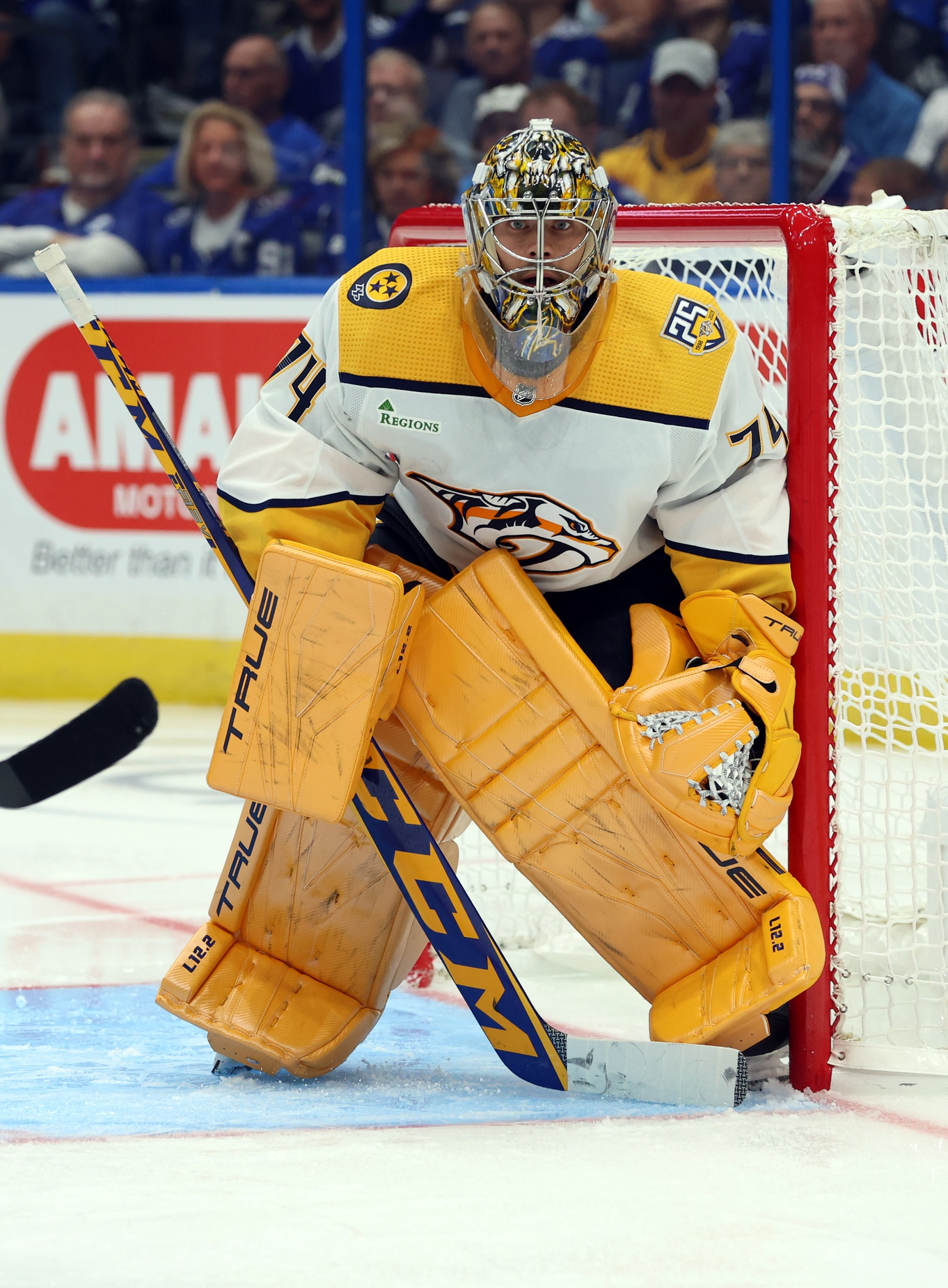 The 29-year-old has worked his way from being a little-used backup at the start of his career to one of the NHL’s true workhorse netminders in recent years. Saros has led the league in appearances in each of the last three years, facing the most shots and making the most saves in both 2022-23 and 2023-24, making him a bargain player with a $5MM AAV which runs through the 2024-25 campaign.
This season, Saros played in 64 games, posting a 2.86 GAA with a .906 SV%, numbers that were the worst of his career. However, given the workload and the fact that Nashville had several newcomers after shaking up their roster over the summer, it’s not surprising that he got off to somewhat of a quieter start. However, following the All-Star break, Saros was more effective, putting up a .912 SV% which helped lead the team to a franchise-best 18-game point streak. That stretch helped propel the Predators into a playoff spot where they were eliminated in the opening round by Vancouver.
Despite his performance in recent years, there was some speculation that Saros could be in play on the trade front this summer. The team has Yaroslav Askarov in the system, one of the NHL’s best goalie prospects and he’s not too far away from being NHL-ready. This potential agreement will now call into question Askarov’s long-term future with the franchise although the two netminders could work together for a few years at least, allowing the 22-year-old to ease into the NHL somewhat gradually. In the meantime, the team is expected to pursue a backup netminder in free agency, per Daily Faceoff’s Frank Seravalli (Twitter link).
While the Predators generally are hesitant to hand out trade protection in their contracts, GM Barry Trotz indicated earlier this week that if a new deal gets reached, it would have some no-trade provisions in there although it would be limited.
Assuming the price tag comes in around the $7.5MM mark as reported, that will be around $750K lower per season than what Connor Hellebuyck received from Winnipeg back in the fall, a contract that many felt would serve as a direct comparable for negotiations. Instead, it appears Saros is content to come in a little below that amount to ensure he’ll be sticking around for the long haul, giving the Predators long-term stability at that position in the process.
Photo courtesy of USA Today Sports Images.
West Notes: Saros, Sharks, Roadrunners
The Predators are a franchise that rarely hands out trade protection when they sign contracts, even to some of their longer-term veterans. However, in an appearance on 102.5 The Game today, GM Barry Trotz acknowledged that if he’s able to agree to terms on a long-term extension with goaltender Juuse Saros, he would have to give out some sort of trade protection though it would have to have some sort of limit to it. Saros will enter the final year of his contract in July making him extension-eligible and Trotz hasn’t hidden his desire to lock up the netminder. However, Saros is well-positioned for a significant raise on his current $5MM price tag and could push past $8MM on a new agreement. If a deal is reached, Saros would become just the third Nashville player with trade protection, joining captain Roman Josi and winger Filip Forsberg.
Elsewhere in the West:
- During his pre-draft press conference today, Sharks GM Mike Grier told reporters including Sheng Peng of San Jose Hockey Now (Twitter link) that center Logan Couture is working out and hopes to get back to skating next month. The 35-year-old was limited to just six games this season due to osteitis pubis; he twice tried to come back from it but had to shut those efforts down due to setbacks. Couture has three years left on his contract which carries an $8MM cap charge.
- Still with the Sharks, they’re expected to be more aggressive in terms of adding some veterans this summer, already picking up Barclay Goodrow and Ty Dellandrea up front. Grier noted (per Peng) that while they could look to add free agents, their internal cap on how long they want to sign a player for would be four years. We’ve seen plenty of speculation that there may be teams willing to offer a higher AAV in exchange for a shorter-term deal; San Jose would be a potentially viable candidate to offer a contract or two like that.
- Following the news that the land auction the Coyotes are hoping to win to get an NHL team back was canceled due to a lack of a proper zoning permit, the six games that AHL Tucson was set to play at Mullet Arena have now been moved back to Tucson, per a team announcement. The Roadrunners will serve as Utah’s primary affiliate next season.