
What Your Team Is Thankful For: Philadelphia Flyers
With American Thanksgiving now behind us and the holiday season coming up, PHR continues its look at what teams are thankful for in 2022-23. There also might be a few things your team would like down the road. We’ll examine what’s gone well in the early going and what could improve as the season rolls on for the Philadelphia Flyers.
Who are the Flyers thankful for?
Carter Hart, Kevin Hayes, and Travis Konecny
There’s plenty to take issue with as the Flyers stand right now, seventh in the Metropolitan Division, 27th in the entire league and after a strong first month of the season too. Not many expected Philadelphia to compete for the Stanley Cup, but a myriad of injuries and poor play that persists wasn’t exactly what the team had in mind when they began this season or when they hired veteran bench boss John Tortorella to shake things up. All of that said, one thing the organization has to be thankful for, likely for different reasons as to each, is the play of their top players.
Carter Hart‘s emergence is not necessarily a surprise to many, even if it is a bit later than he or the Flyers were hoping, however he finally seems to be the bona fide number one netminder the team had expected. His base numbers don’t necessarily strike the eye as elite, a .913 save-percentage and 2.82 goals-against average coming into Monday, but contextually, considering the play of the team in front of him, they seem better than at first glance. Also consider Hart’s numbers from the previous two seasons, a combined .895 save-percentage and 3.34 goals-against in 72 games over the two seasons, it stands to reason the Flyers can feel confident in the young goaltender as a building block going forward.
The Flyers’ signing of Kevin Hayes to a seven-year, $50MM contract during the 2019 offseason raised a few eyebrows at the time, and continued to draw criticism as the veteran never seemed to fully meet expectation. With three more seasons after this one with a cap hit just over $7.14MM, it seemed as though the Flyers would be saddled with Hayes, an otherwise fine player, and his large cap hit. However, this season has been a turnaround for Hayes, who is on his way to a career year, with 29 points in 31 games to date. There’s been controversy recently, Hayes listed as a healthy scratch against the New York Rangers, his former team, this weekend, but in the bigger picture, it seems at this point the Flyers might at least go from having the cap hit be a liability to something more along the lines of an asset, or perhaps even be able to deal Hayes and his hit altogether.
Finally, the 25-year-old Konecny is having a career-year of his own with 26 points in 26 games thus far. Always a reliable source of offense, the goals haven’t been there for Philadelphia this season like they have been in the past, but that’s been a non-issue for Konecny, who’s been able to drive offense nonetheless. Signed through 2024-25 at a relative bargain of $5.5MM AAV and just entering his prime, the Flyers may choose to utilize the forward as part of their long-term plans. But, given his control at a cost-effective price, the organization may just have a fantastic trade-chip on their hands either at the trade deadline or this offseason, should they choose to go that route.
What are the Flyers thankful for?
The Farm
As tough as things look right now for the Flyers, their group of young players and prospects appears to have them set up for a bright future. On the roster, Morgan Frost, Owen Tippett, and Noah Cates all appear headed in the right direction, while the recently-recalled Cam York is off to a strong start in the NHL with a pair of points in five games. After getting into 30 games with the Flyers last season, recording 10 points, York was sent back to the AHL to start this season, but his 13 points in 20 games with the Lehigh Valley Phantoms were enough to show he’d earned a recall.
In addition to York, players like Tyson Foerster, Olle Lycksell, Elliot Desnoyers, and Ronnie Attard have been developing nicely and contributing as key members of that team. Of course, there’s still plenty more for that group to work on to be ready for the NHL game, but it does appear to be a wave of talent that, when ready, will be able to lift the Flyers rather quickly. Currently injured, but expected to joint hat wave of talent is forward Bobby Brink who, after dominating in three years at the University of Denver, turned pro and joined the Flyers at the tail end of last year, adding four assists in 10 games in the NHL.
Perhaps the most exciting name in the farm right now is forward Cutter Gauthier, who the team drafted fifth overall in 2022. The forward, who brings size and elite offensive ability, already has 16 points, including 10 goals, through 13 games as a freshman with Boston College. Also of note, given their place in the standings this year, the Flyers will find themselves with another high pick in an incredibly strong NHL draft, giving them another name to add to this mix, as well as a strong lottery ticket in the Connor Bedard sweepstakes.
What would the Flyers be even more thankful for?
The long-term health of Sean Couturier
The last we heard of Couturier, the center had undergone back surgery and was expected to miss three to four months from that point. That was on October 29th, which puts a February return as a likely possibility if all goes well. The issue there is, when it comes to injuries and recovery, all has not gone well for Couturier in recent years, costing him 53 games last season, and likely at least 50 at minimum this year.
Whether Couturier can return to regular, healthy action and contribute as he had in the past is still a question to be answered, but with the perennial Selke candidate signed for $7.75MM through 2029-30, much of the Flyers’ long-term future hangs on what they will get out of Couturier. If he can return to the player he was beforehand, it will give the organization another big building block to try and turn things around quickly, one they can combine with players like Hart and Konecny, as well as the young players discussed above. If Couturier can’t become that player again, they may be bound by another rather large contract for a very long time. Still, if Couturier isn’t able to come back at all, at the very least, they can keep his contract in LTIR going forward.
Much of this sentiment can ring true for defenseman Ryan Ellis, who the Flyers have signed at $6.25MM through 2026-27, though it would seem Couturier’s future is a lot more crucial. For instance, compare Couturier to Ellis, who is a solid top-four defenseman when healthy and has only played four games with the team, while Couturier represents arguably the face of the franchise after Claude Giroux‘s trade, while playing on a much larger contract. That said, the long-term health and success of both players is incredibly important.
What should be on the Flyers holiday wishlist?
A rebuild, or at the least, a clear direction
Much has been made about the direction the Flyers are going in, whether that’s trying to compete now, taking a small step back to make some changes and wait for health, the possibility of going into a full rebuild, or something in between these. Many have wondered if the Flyers and their fans would even have the willingness to go through a full rebuild, something the organization has rarely, if ever, pursued in their long and storied past.
With the team making several, what felt almost contradictory, moves in recent months, the direction of the team grew more unclear, while the team remains towards the bottom of the standings. In previous years, the team has acquired and signed a number of star players to big contracts , such as Hayes, Ellis, James van Riemsdyk, and Rasmus Ristolainen. Then, last season, out of a playoff race, they dealt a franchise icon and pending UFA in Giroux, among others.
This offseason, the team appeared ready to make the moves to be competitive again, acquiring and extending Tony DeAngelo, but when the opportunity to sign hometown superstar Johnny Gaudreau presented itself in free agency, the team didn’t necessarily jump at the opportunity. On top of their somewhat confusing offseason dealings, the team also hired Tortorella, hoping he could change the team’s identity, getting more out of a cohesive group they believed they hadn’t had, perhaps sneaking into the playoffs, which doesn’t appear to be happening.
Whether a rebuild is the right move for the Flyers is something to be left up to the experts who actually run NHL teams. However, a clear “this is what we’re doing” direction, whether that’s a rebuild, a “retool” that goes a bit quicker using some of the pieces they have now, or simply doing all they can to turn the ship around now and be competitive as soon as possible, would seem to be a fair request from the fans and other stakeholders around the organization.
What Your Team Is Thankful For: Ottawa Senators
With American Thanksgiving now behind us and the holiday season coming up, PHR continues its look at what teams are thankful for in 2022-23. There also might be a few things your team would like down the road. We’ll examine what’s gone well in the early going and what could improve as the season rolls on for the Ottawa Senators.
Who are the Senators thankful for?
Pierre Dorion
There was once a time when Senators GM Pierre Dorion was anything but a fan favorite and far from the top of the list of people the Senators and their fans were most thankful. Now, beginning to put the finishing touches on a team rebuild and fresh off what was dubbed “the summer of Pierre,” Ottawa is most thankful for the executive responsible for bringing them their current and future core.
Dorion’s tenure in Ottawa certainly didn’t start off great, and the GM did have to eat much of the criticism for the team’s ultimate teardown and rebuild, which saw the team deal away their stars like Matt Duchene, Mark Stone, and Erik Karlsson. Since then, Dorion has used the assets he’s recouped to build an exciting young group headlined by players like Brady Tkachuk, Tim Stutzle, Joshua Norris, and Drake Batherson. Not wanting to run the risk of any of them leaving during their immediate prime, Dorion proceeded to extend all four long-term, not to mention extending franchise-defenseman Thomas Chabot.
Those players needed compliments of course and Dorion acquired just that, signing hometown star Claude Giroux and acquiring sniper Alex DeBrincat from the Chicago Blackhawks as well as starting netminder Cam Talbot from the Minnesota Wild.
There’s no doubt this team has underperformed expectations this year, something Dorion will have to take some responsibility for and address going forward, however this season is still a considerable step forward from the previous several. Beyond righting the ship on the ice, Dorion will have to work on long-term extensions for DeBrincat and defenseman Artem Zub, but given the executive’s track record, especially in the past year, the Senators should be thankful Dorion is in charge of solving these problems.
What are the Senators thankful for?
Progress off the ice
The team hasn’t been sold and there’s no immediate plans to break ground on a new arena, however the drama surrounding these subjects that has followed the Senators for years seems to be wearing off. Both stories still follow the team, but now appear to be painted in a much more positive light.
Recall back in June when the Senators organization was given preferred bidder status at the LeBreton Flats location, indicating a new arena was close once again. Sure, the team has been through this before with that location, but with new ownership expected to come on shortly, things may look different this time around.
Speaking of that ownership group, interest in buying the team appears to be as rich as ever and headlining the interested parties is actor Ryan Reynolds. It’s not expected that Reynolds would be able to purchase the team outright on his own, but it appears the NHL prefers that the winning bid for the Senators include Reynolds in the ownership group. Now, Reynolds coming into the mix isn’t just for the sake of vanity, the actor being a noted hockey fan with expressed interest in ownership and already a partial owner of a professional soccer team in that of Wrexham AFC, located in Wrexham, Wales.
What would the Senators be even more thankful for?
Sustained health
The star players discussed above that will make up the future of the Senators are all tremendous players performing at or close to the top of their abilities this season. Tkachuck, DeBrincat, Giroux, Batherson, and Stutzle are all at or near a point-per-game pace, Cam Talbot is having another strong season, and while the defense could be a little better, they’ve largely done their job. So, why is the team 14-14-2?
Well, one explanation is injuries. Outside of Norris, who was injured in the fifth game of the season and hasn’t played since, and Zub, who’s played in just 14 of 30 games, no player has missed all that much time this year. But, players missing a few games here and there does add up and prevents the team from sticking together for longer stretches of time and developing any sort of cohesiveness.
The team has turned it on lately, winning their last four games, but at the moment has Stutzle, Norris, Zub, Mathieu Joseph, and Jacob Bernard-Docker all on IR. Missing such a large contingent of players, it’s going to be difficult for a team that finished with 73 points a season ago to make the jump to the playoffs this season, especially if that group has won just 14 of its first 30 games to date.
What should be on the Senators holiday wishlist?
Another star defenseman
Thomas Chabot is clearly a top defenseman any team, including the Senators, would be happy to have, but amid a somewhat disappointing team-season so far, one thing has become clear: they could use another top-notch defenseman. The team has been connected to just about every top-pairing defenseman that’s been available this offseason and into this season.
The Senators had seemingly kicked tires on MacKenzie Weegar before he was included in the Jonathan Huberdeau–Matthew Tkachuk deal, and rumors of the team’s interest in Jakob Chychrun have persisted. Ottawa and Chychrun seem to fit like hand and glove together, however Arizona’s price remains high and appears to include Shane Pinto, a player the Senators are not only high on for the future, but view as a key piece right now, especially in light of the Norris injury.
The team had also apparently been connected to a swap of Nikita Zaitsev and Tyler Myers last month, however that trade didn’t materialize. Myers may be able to make a difference on the Senators as they are right now, but long-term, the organization will have to seriously consider the price-tag on a true top pair defenseman like a Chychrun.
What Your Team Is Thankful For: New York Rangers
With American Thanksgiving now behind us and the holiday season coming up, PHR continues its look at what teams are thankful for in 2022-23. There also might be a few things your team would like down the road. We’ll examine what’s gone well in the early going and what could improve as the season rolls on for the New York Rangers.
Who are the Rangers thankful for?
Finding a defenseman that can play shutdown defense as well as Fox or drive offense as well as he does is a very, very difficult thing for any team to do and generally involves a bit of luck. Finding one defenseman that does both seems to be a once-in-a-generation type of player, and that’s just who the Rangers have in Fox.
The defenseman’s 31 points in 31 games to date represents the best point-percentage of his career thus far and his 10.9% shooting percentage is up significantly from the 7.0% career-high he had last year. Outside of getting the puck into the net, Fox’s 60.9% Corsi and 61.0% Fenwick represent career-high’s to date, fantastic numbers even considering his 58.9% offensive-zone starts. While Fox’s play is representative of the players around him to an extent, his ability to play elite hockey at both ends is invaluable to any team and his ability to take another step even after winning a Norris Trophy is special on its own.
What are the Rangers thankful for?
A Shutdown Blueline
The Rangers come into today with a 16-10-5 record, good enough for the first Wild Card spot in the Eastern Conference, in the middle of a five-game winning streak, and fresh off a regulation win over the white-hot Toronto Maple Leafs. This short streak has certainly helped to get things going in the right direction for the team after a rather shaky start to the season, but amid the ups and downs to this point, one positive has stood out for the Rangers: the puck has stayed out of the net.
The team currently ranks 9th in the NHL in goals against, down from their second-place finish a season ago, however reigning Vezina Trophy winning goaltender Igor Shesterkin has taken a step back this season. Shesterkin’s struggles at points this season has been well documented, and this stretch has shown he could be turning things back to his 2021-22 ways, however it seems to be the Rangers defense this season that has made things easier for the team and netminder thus far.
According to Natural Stat Trick, the Rangers have two defense pairs in the top-12 league-wide, featuring Jacob Trouba and K’Andre Miller as well as Fox and Ryan Lindgren. What’s more, just two of their defensemen, Trouba and Zachary Jones (16 games) are minuses. Although their blueliners aren’t driving play offensively (omitting Fox), the team’s top forwards, and Fox, have been getting the job done well enough so far, thanks in part to the superb defense putting them in that position.
What would the Rangers be even more thankful for?
Kaapo Kakko and Alexis Lafreniere taking the next step
If you ask enough people, you’re likely to get a mixed bag of opinions on the Rangers’ development of young players and prospects. On one hand, the team can be praised for putting players like Fox and Shesterkin in positions to become elite, for helping good young players like Chris Kreider, Mika Zibanejad, and Ryan Strome and making them stars over time, and for turning prospects like Ryan Lindgren and K’Andre Miller into some of the league’s best shutdown defenseman. On the other hand, many would argue that Fox and Shesterkin came to the team ready for stardom while the team failed with it’s own blue-chip youngsters like Kakko, Lafreniere, and Vitali Kravtsov. Both are fair points.
One thing that should be conceded is the Rangers have done well to develop Miller, Lindgren, and center Filip Chytil, who’s enjoying a breakout season himself. In other words, this is an organization that can, has, and does develop young talent, whether or not that’s a strength is a separate argument. Now, what’s become of Kakko and Lafreniere, then? Second and first overall picks, respectively, both have clearly shown in their short careers that they are more than capable of playing NHL hockey. Both have been, overall, pretty good. Kakko has tallied 69 points over 188 career games, adding some physicality and two-way hockey into the mix, while Lafreniere has chipped in 66 points in 166 games, showing some flashes of the talent that made him a clear choice for the first overall selection.
Kakko and Lafreniere have produced, but neither has hit the ceiling expected of them or shown clear signs of getting there shortly. It’s not too late for either to get there and neither are at risk of ending their NHL careers any time soon, but a 30 or 40 point performance with a little extra from time to time isn’t the expectation of a top two pick.
On the team’s end, one would think they’d be happy to keep the pair around and see what happens, however as we’ll see in the next section, the Rangers could certainly use another top-six point-producer and with limited cap room, a breakout from even one of these two would be perfect timing.
What should be on the Rangers’ holiday wishlist?
Another top-nine scoring threat
The Rangers came into this evening 15th in the NHL in goals for, a near match to the 16th position they finished last season in. Though that’s impressive in a sense considering the team lost Andrew Copp and Frank Vatrano this offseason (Ryan Strome and Vincent Trocheck a wash offensively) and still has roughly the same offense, it does show what the team might be able to do if they could add a piece like that, or perhaps one even better, into the mix. As suggested above, a breakout of Kakko or Lafreniere starting right about now would be preferable, but at this point, that’s far less out of the Rangers’ control than bringing in a proven commodity.
There’s been plenty of rumors connecting Chicago Blackhawks superstar winger Patrick Kane to the Rangers and though that would obviously fit the bill, bringing Kane to the Big Apple would require a rather complex trade, given the Rangers, as of right now, have just over $1.6MM in cap space. Even if Chicago ate half of Kane’s salary, more work would have to be done, all of this before considering the size of the return the Blackhawks would expect.
More affordable from a salary cap perspective is Vancouver Canucks center Bo Horvat, who the team appears set to trade. However, the price to acquire Horvat could be greater than that of Kane, given his sensational goal-scoring pace. The Rangers have the assets to make a splash, including a pair of 2023 first-round picks, several prospects headlined by Brennan Othmann, and young roster players like Braden Schneider, Jones, Lafreniere, and Kakko.
The Rangers could also look to Vancouver for winger Brock Boeser, who would likely be cheaper to acquire, but does come with two more years after this one carrying a $6.65MM cap hit, a tougher sell given Boeser’s struggles this season. Beyond Kane, Horvat, and Boeser, the Rangers could look to more affordable options such as Nick Ritchie of the Arizona Coyotes or Max Domi and Andreas Athanasiou, both of the Blackhawks, though how much of an upgrade of their current group those players represent is a fair question.
What Your Team Is Thankful For: New York Islanders
With American Thanksgiving now behind us and the holiday season coming up, PHR continues its look at what teams are thankful for in 2022-23. There also might be a few things your team would like down the road. We’ll examine what’s gone well in the early going and what could improve as the season rolls on for the New York Islanders.
Who are the Islanders thankful for?
The Islanders have gotten strong bounce-back performances from their top players this season. Mathew Barzal and Brock Nelson are clicking at a point-per-game rate down the middle, and Noah Dobson is continuing his play as a premier young defenseman in the NHL.
But even after putting up an elite performance on a mediocre Islanders squad last season, Sorokin has turned up the dial even further in 2022-23. Despite receiving much less goal support than his counterpart, Semyon Varlamov, the Islanders have managed to crack the .500 mark mainly due to Sorokin’s .925 save percentage and two shutouts. His 13.8 goals saved above expected (MoneyPuck) is third in the league and second in the conference behind Boston’s Linus Ullmark.
The team hasn’t retained the same defensive structure under Lane Lambert they were known for in previous seasons, but the Islanders still sit in the top 10 leaguewide in goals against. With Sorokin helping to mask those weaknesses, the Islanders remain in the playoff conversation as the new year approaches.
What are the Islanders thankful for?
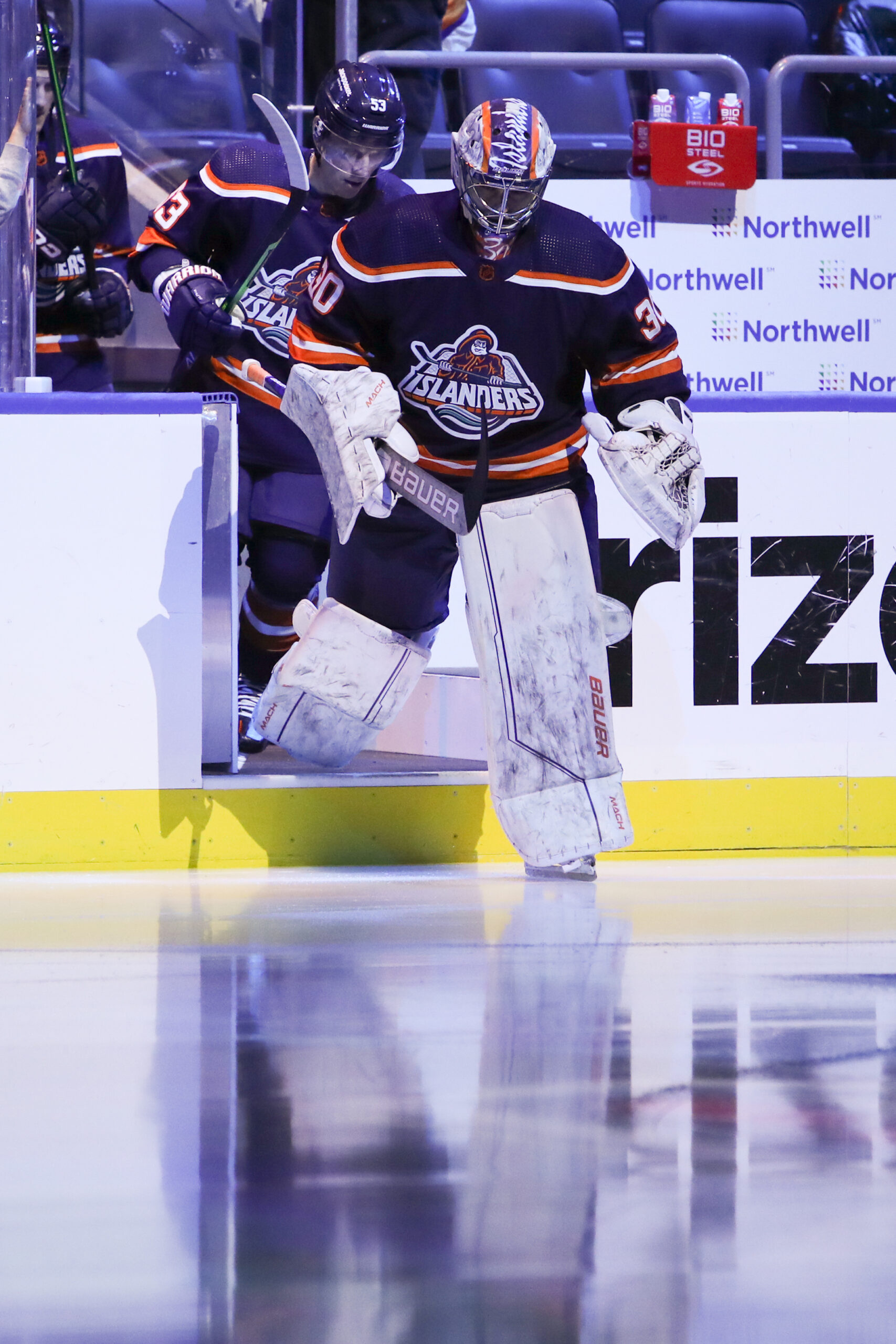 A healthy team and a stable home.
Last season was a very, very public meltdown for the Islanders. A team that entered the season with top-10 odds to win the Stanley Cup had to scratch and claw just to finish above .500.
The biggest reason why? Perhaps it was the team’s 13-game road trip to start the season, which ended amid an 11-game losing streak throughout November and December. Injuries and COVID also took an extreme toll on the team around the same time.
This time around, it’s a different story. 10 players have played in all 30 games so far. Only one Islander – Zach Parise – played in all 82 games last season. They’ve also got a full season at UBS Arena, and their 9-6-0 home record is third in the Metropolitan Division behind New Jersey and Pittsburgh.
What would the Islanders be even more thankful for?
Stronger defense from depth players.
The Islanders have had a gigantic offensive resurgence, but some less structured play post-coaching change has limited them from rocketing back to contender status. While their actual goals against remain near the league’s top, their expected goals share at all situations (MoneyPuck) is at the opposite end of the spectrum (23rd in the league). Their more traditional possession numbers haven’t been anything outstanding either, and their bottom-six forward group is getting caved in at times.
Solving this problem likely lies on general manager Lou Lamoriello to alter the makeup of the team’s depth forwards. Their heralded fourth line of Matt Martin, Casey Cizikas, and Cal Clutterbuck has been their best defensively, but the opposite is true for the unit of Jean-Gabriel Pageau, flanked by Parise and Kyle Palmieri. While Parise remains a valuable depth scorer, especially for his six-digit cap hit, Palmieri’s managed just nine points in 20 games and continues to battle injuries.
What should be on the Islanders’ holiday wishlist?
A true sniper for Barzal’s line.
Barzal’s playmaking has been at its most dynamic this season, notching 27 assists in just 30 games. But neither of his regular linemates, Josh Bailey nor Oliver Wahlstrom, are close to double-digit goal totals on the year.
The Islanders do have a deep attack, but it lacks any chemistry between a pair of true stars. A slam-dunk 30-goal scorer on Barzal’s wing could absolutely give New York’s offense the firepower necessary to approach the top 10 in league scoring. Lamoriello has hesitated to give up the assets required recently, though, whether on-ice or financial, to make such a move come to fruition.
Photo courtesy of USA Today Sports Images
What Your Team Is Thankful For: New Jersey Devils
With American Thanksgiving now behind us and the holiday season coming up, PHR continues its look at what teams are thankful for in 2022-23. There also might be a few things your team would like down the road. We’ll examine what’s gone well in the early going and what could improve as the season rolls on for the New Jersey Devils.
Who are the Devils thankful for?
There are a bunch of good answers to this question. Jack Hughes, Jesper Bratt, Nico Hischier – heck, even Tom Fitzgerald. But those that have watched the Devils for the last few years know that there was always something missing, something holding them back from taking that next step.
Marino, acquired from the Pittsburgh Penguins in the offseason in a deal that included prospect Ty Smith and a third-round pick going the other way, has been everything the Devils hoped for. The 25-year-old defenseman has been a rock for the team on the back end, eating up the toughest defensive minutes and tilting the ice in New Jersey’s favor. Despite starting far more shifts in his own end than in the opponent’s, the Devils have outscored teams 22-12 with Marino on the ice at even-strength this season.
Some of the credit for that should also go to Ryan Graves, his partner for most of the year, but there is just something that Marino has done to transform this group into the Stanley Cup contender that it has been through the first part of the year. The fact that he’s locked up at a $4.4MM cap hit through 2026-27 is just the cherry on top, and will allow the Devils to continue to invest in their dynamic young forward group in the coming years.
 What are the Devils thankful for?
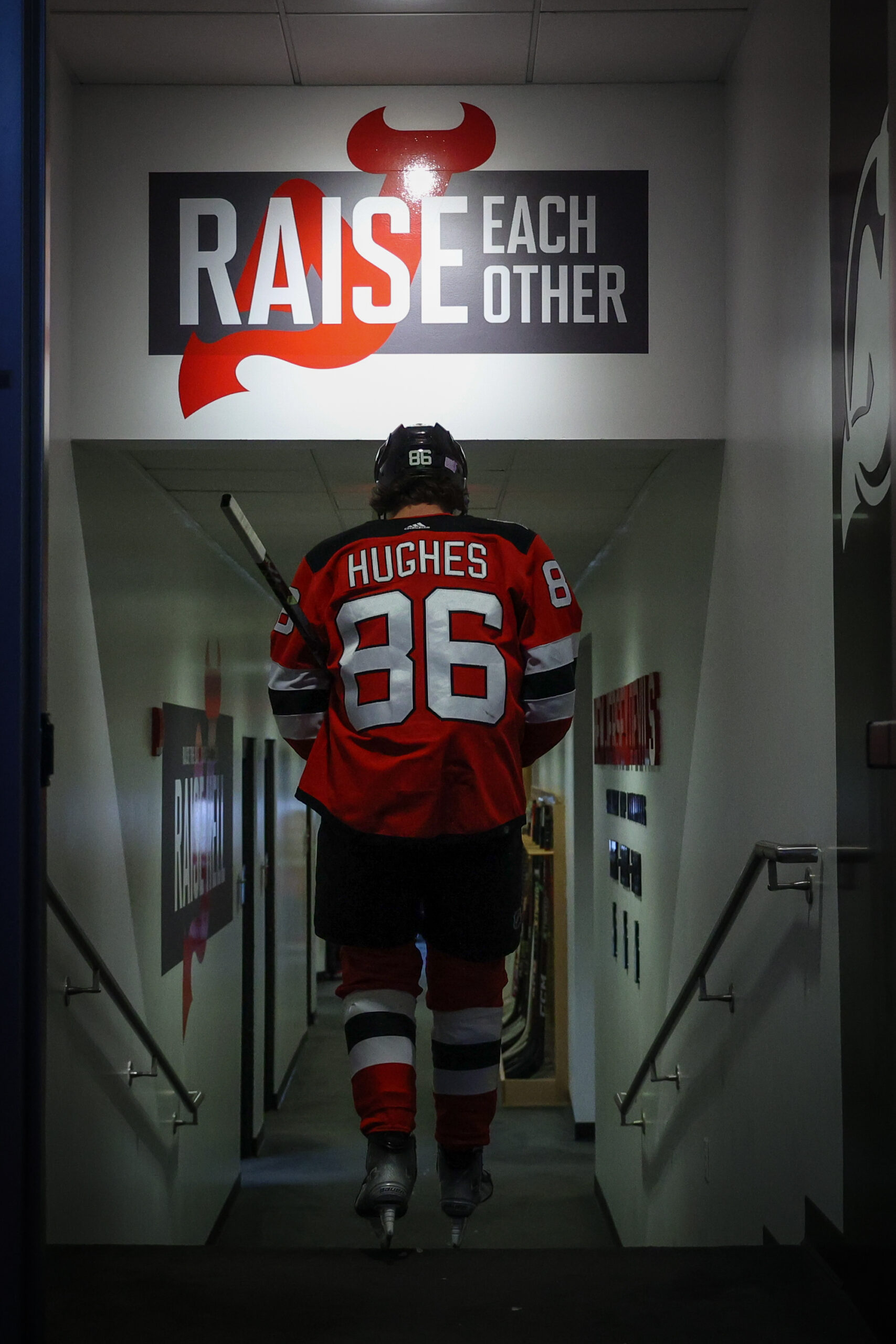
Front office patience.
When Jack Hughes stepped into the NHL, he was an extremely undersized, overmatched teenager. You could see his incredible skating ability, elite vision, and high hockey IQ, but he was being pushed around every night. Hughes couldn’t find a way to contribute on a regular basis, and through the first two seasons of his career, he had just 18 goals and 52 points.
Plenty of fans and media members alike wondered if he was a “bust,” because of the slow start to his career, and probably wouldn’t have blamed Fitzgerald for looking elsewhere for a franchise centerpiece. After all, he wasn’t in charge when the Devils used the first overall pick on Hughes in 2019 – he took over as general manager in early 2020.
But with a little patience and support, Hughes has brought the highlight reel that made him a star for the U.S. National Team Development Program to the NHL, and is now one of the must-see players in the NHL. With 15 goals and 34 points in 28 games this season, he is the engine that drives the offense.
Hischier too has rewarded the Devils’ patience. While his career started stronger than Hughes, there was plenty of time when people wondered if he would ever be more than a 50-60 point middle-six center. Now, with 29 points in 27 games and real momentum behind his candidacy as a Selke nominee, he’s showing he is an elite player in the NHL and the kind of foundational piece that powers a Cup contender.
What would the Devils be even more thankful for?
A breakout goaltending performance (which may already be underway).
Part of it was the holes on defense, part of it was health-related, but the Devils haven’t had a reliable goaltender for years now. They tried to fix that problem by signing Vitek Vanecek to a three-year deal, and while he has been solid, a breakout from one of their young netminders could push this team over the edge. With how well the Devils have played, they don’t need all-world goaltending every night. Vanecek’s .912 save percentage has resulted in a 12-2-2 record on the year.
But if they had a young option that could turn into a bonafide star, this core could be a legitimate force for quite some time.
Wouldn’t you know it – Akira Schmid has posted a .940 in six appearances this year. The 22-year-old hasn’t allowed more than two goals in any of his six appearances and may have found the key to unlocking his 6’5″ frame. Schmid and Nico Daws are still on their entry-level deals through 2023-24; if either one becomes a bonafide NHL starter by the end of it, the Devils will be set up for long-term success.
What should be on the Devils’ holiday wishlist?
A (net-front) powerplay piece.
If there is one spot where the Devils are actually underperforming, it’s with the man advantage. Despite having names like Hughes, Hischier, Bratt, and Dougie Hamilton to whip the puck around, the group sits 23rd in the NHL in powerplay percentage, at 20.69%. While this isn’t meant to be Nathan Bastian slander, an upgrade to the net front could make them even more dangerous and draw some focus to free up the elite talents on the wall.
When Bastian and Ondrej Palat return, the team will have plenty of options. But adding one more forward with experience playing that role would put them over the top. You can see the effect of a player like that in Edmonton, where the Oilers have the best powerplay in the league by a wide margin. Zach Hyman‘s five goals would lead the Devils, and his ability to pull a defender into the blue paint gives Connor McDavid and Leon Draisaitl an extra step. Though those two would likely find a way no matter who was on the ice with them, the reason Edmonton is up over 30% on the season is that they aren’t the only two threats.
There is also an option of bringing in another player to sit on the dot and hammer one-timers, though head coach Lindy Ruff explained to Ryan Novozinsky of NJ.com why he would hesitate at that idea.
If you look at the best powerplays, they have that flank-shooting one-timer that is dangerous. The trouble with going to something like that with us is that it means [Hughes] or [Bratt] has to come off the powerplay, and that’s a tough scenario.
In today’s NHL, it is difficult to compete without winning the special teams battle, and while the Devils are among the league’s best when shorthanded, they’re throwing away opportunities on the powerplay. For a team that looks like one of the best in the league, a small upgrade can make a big difference in the spring.
Photo courtesy of USA Today Sports Images
Salary Cap Deep Dive: Montreal Canadiens
Navigating the salary cap is one of the more important tasks for any GM. Teams that can avoid total cap chaos by walking the tightrope of inking players to deals that match their value (or compensate for future value without breaking the bank) remain successful. Those that don’t see struggles and front office changes.
PHR will look at every NHL team and give a thorough look at their cap situation for the 2022-23 season and beyond. This will focus more on players who are regulars on the roster versus those who may find themselves shuttling between the AHL and NHL. All cap figures are courtesy of CapFriendly.
Montreal Canadiens
Current Cap Hit: $93,451,094 (over the $82.5MM Upper Limit)
Entry-Level Contracts
F Cole Caufield (one year, $880.8K)
D Kaiden Guhle (three years, $863K)
D Jordan Harris (one year, $842.5K)
F Juraj Slafkovsky (three years, $950K)
D Arber Xhekaj (two years, $828.3K)
Potential Bonuses
Caufield: $850K
Guhle: $420K
Harris: $507.5K
Slafkovsky: $3.5MM
Total: $5.2775MM
Slafkovsky has the richest entry-level deal in league history as the ceilings got a small boost this season (and will go up again in 2024 and 2026). The first-overall pick has had a limited role so far as they ease him with a decision on whether or not to run him past the 40-game mark and accrue a season of service time still to come. If he can become the impact power forward they hope he can be in the next couple of seasons, he’s a strong candidate to bypass the bridge deal. With the limited usage, he’s unlikely to achieve any of his bonuses at this point.
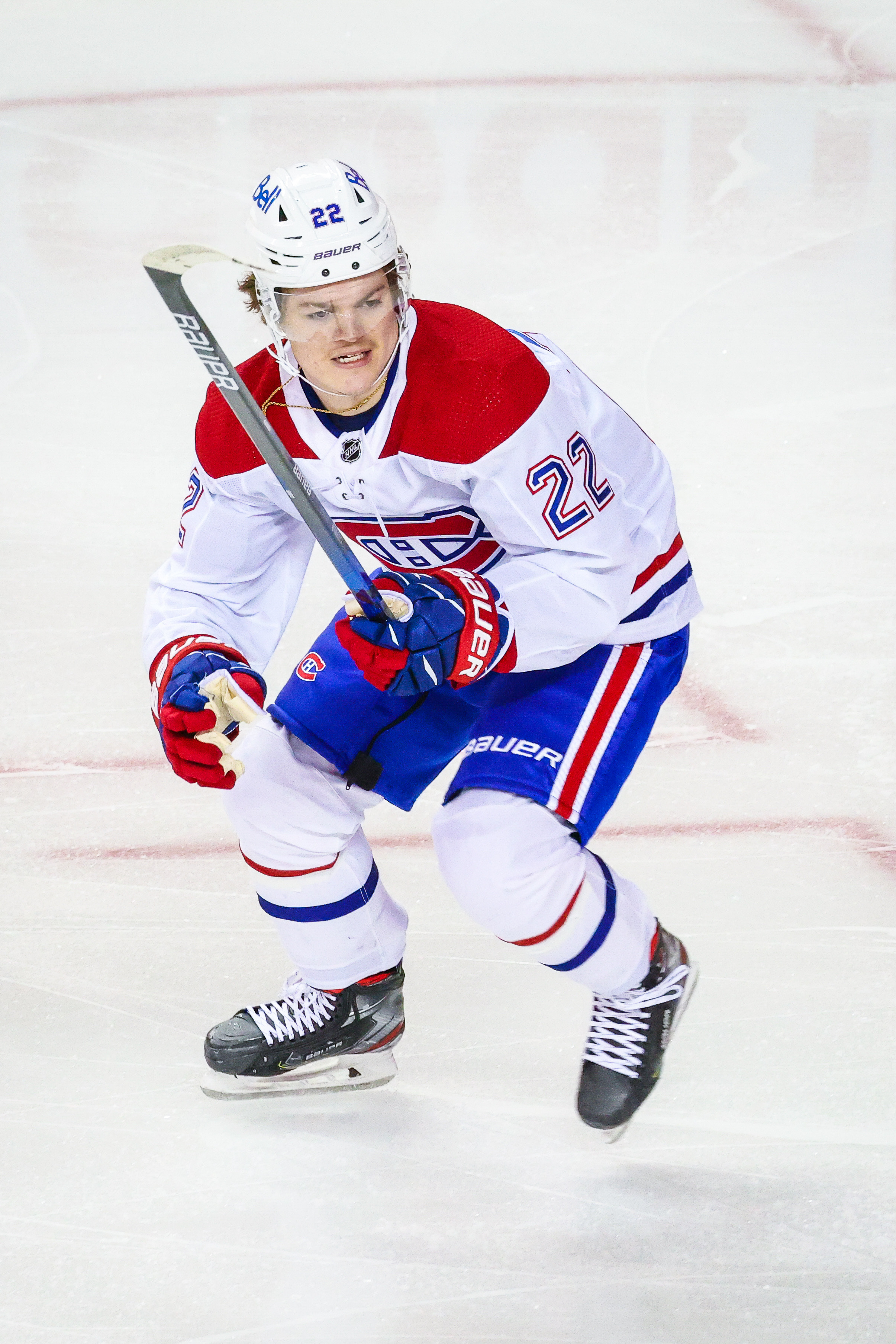 Caufield’s next contract is shaping up to be an intriguing one already. He recently reached 100 career NHL regular season appearances but has been one of the top goal-scorers in the league dating back to midway through last season. If Montreal wants to sign him to a max-term agreement (which they likely do at this point), they’ll have to make him the highest-paid forward on the team (and in franchise history) while a bridge contract could run in the range of Jason Robertson’s $7.75MM with Dallas. Notably, he still is five years away from UFA eligibility so a four-year bridge deal (like Robertson’s) is a legitimate option for both sides to consider. He’s on pace to reach all his ‘A’ bonuses.
Guhle hasn’t been eased into things in his rookie season, logging more than 20 minutes a night, often on the top pairing. If he stays in that role, he’s likely to hit his two ‘A’ bonuses this season and if he continues there for the next couple of years, he’s someone GM Kent Hughes will likely want to try to lock up long term. Harris, meanwhile, already is in line for a new deal after burning his first season down the stretch last year. He’s likely heading for a bridge contract with an AAV likely checking in a bit below the $1.5MM range while he’s on pace to hit his two ‘A’ bonuses and most of his ‘B’ ones for games played. Xhekaj has gone from being an undrafted free agent signing a year ago to a regular in Montreal’s lineup on the third pairing. Having burned the first year while playing in junior last season, he’ll be hard-pressed to command a long-term second deal and is likely heading for a bridge contract himself, potentially a little above the $1.5MM mark if he remains a fixture on the third pair.
Signed Through 2022-23, Non-Entry-Level
F Paul Byron ($3.4MM, UFA)
F Evgenii Dadonov ($5MM, UFA)
F Jonathan Drouin ($5.5MM, UFA)
F Sean Monahan ($6.375MM, UFA)
F Michael Pezzetta ($750K, RFA)
Calgary had to pay a high price tag (a first-round pick in either 2024, 2025, or 2026) to dump the final year of Monahan’s deal, allowing them to sign Nazem Kadri in the process. He has recovered well from the hip issues that plagued him over the last couple of years and is at his highest point-per-game pace since 2018-19. As a capable defensive forward that can kill penalties and do well at the faceoff dot, it’s certainly not impossible to think that he could get some interest as a second-line center on the open market this summer. If that happens, there’s a good chance that Monahan could land a contract similar to this one, a scenario that not many would have thought possible at this time a year ago.
Drouin hasn’t panned out as expected when Montreal sent Mikhail Sergachev (plus a conditional second-round pick that didn’t materialize) to Tampa Bay to secure him. He has the skills to play in the top six but hasn’t been able to produce with consistency or stay in the lineup with any consistency. He’s a prime candidate for a one-year pillow value elsewhere next season to try to rebuild some value in a new situation. Dadonov was picked up from Vegas in exchange for Shea Weber’s LTIR contract with the Canadiens likely hoping that they could flip him with retention at the trade deadline. Instead, he’s off to the worst start of his career offensively. His next deal could be closer to the $2MM mark if not a bit lower and at that point, it’s possible that he could look to return to the KHL if a significant offer materializes there.
Byron’s availability to play this season is in question as he continues to battle hip trouble. If he’s able to play next year, Byron would be eligible for a one-year deal with incentives due to his injuries (even though he’s not 35); such a contract would likely have a base salary closer to $1MM before bonuses. Pezzetta is on his first career one-way contract and has had a limited role so far. Assuming that continues, even with arbitration rights, it’s unlikely he’d be able to land more than $1MM for next season.
Signed Through 2023-24
D Joel Edmundson ($3.5MM, UFA)
F Mike Hoffman ($4.5MM, UFA)
G Samuel Montembeault ($1MM, UFA)
F Rem Pitlick ($1.1MM, UFA)
D Chris Wideman ($762.5K, UFA)
Hoffman was expected to help Montreal’s power play but that hasn’t been the case over his first year and a bit with the team to the point where he was scratched earlier this season. He’ll need to produce with much more consistency in the back half of this deal to have a shot at matching this price tag in 2024. Pitlick played well after coming to the Canadiens on waivers last season, earning this two-year deal, his first one-way pact. However, some early struggles landed him on the waiver wire again this season where he passed through unclaimed. Barring a change in his production, he’ll be in tough to match let alone beat this contract two summers from now.
Edmundson has battled injury trouble this season and last but when he has been in the lineup, he has been a dependable second-pairing option that can kill penalties and play physically. There’s a ceiling for those types of players in terms of their earnings upside but a small raise closer to the $4MM mark on a multi-year agreement could be doable if he’s able to stay healthy as he’ll hit the market at 31. Wideman is on a minimum deal for the second straight season and has a very limited role. In his second stint in the NHL, he’s more of a depth player so it’s likely that his next deal will also be close to the minimum salary.
Montembeault’s first full NHL season was a rocky one with Montreal struggling mightily last season. That allowed the team to give him a low-cost two-year commitment that could be fully buried in the minors. However, he’s off to a much better start this season and is starting to push for a little more playing time. He’s making well below the league average for a backup and a decent showing the rest of the way this season and next could push him closer to the $1.75MM range at least. Otherwise, he might be looking at something closer to this deal, a lower-cost one-way pact on a cap-strapped team.
Signed Through 2024-25
G Jake Allen ($2.875MM in 2022-23, $3.85MM in 2023-24/2024-25, UFA)
F Joel Armia ($3.4MM, UFA)
F Christian Dvorak ($4.45MM, UFA)
F Jake Evans ($1.7MM, UFA)
D Johnathan Kovacevic ($766.7K, UFA)
D David Savard ($3.5MM, UFA)
Dvorak was acquired to replace Jesperi Kotkaniemi in the 2021 offseason with the hopes that he could become a legitimate second-line center. That hasn’t happened yet. Instead, he appears to be heading for another season around the 30-point mark. His defensive game and faceoff ability give him some extra value but if this type of production is indeed his ceiling, he’s going to be in tough to get more than this on the open market. A similar contract is possible but even in a pricier cap environment, it’s hard to see him pushing for $5MM.
Armia’s strong showing in Montreal’s improbable run to the Stanley Cup Final strengthened his market to the point where he was able to land this commitment. Since then, he has 16 points in 76 games. Armia can kill penalties but he’s more of a fourth liner that should have a price tag closer to half of his current one. Evans had a strong year last season with 28 even-strength points in a bottom-six role but his playing time has been more limited this year. If he can get back to pushing for 30 points in that lower spot on the depth chart, he could generate enough interest to push his AAV past the $2MM mark in 2025.
Savard is playing a much bigger role than he was used to at the end of his time with Columbus (and a brief stint in Tampa Bay) as he sits second on the team in ATOI. Right now, they’re getting some value for their buck but he’ll turn 35 early on his next deal and at that point, Savard will likely be best suited for a third-pairing role. That should push his price tag down a little bit. Kovacevic was claimed off waivers late in training camp and has played in most of Montreal’s games since then. It’s still a bit early to forecast what’s next as he’s a late-bloomer rookie but if he plays more often than not on this deal, he could have a shot at doubling his AAV on the open market. If Kovacevic turns into a full-time regular, the cost will only go up.
Allen has had some ups and downs since effectively taking over as the starter last season, a role he struggled with when he had it in St. Louis. Even with the inconsistency, what he’s making now is well below market value for a starter and on his next contract, as long as he can hold down a regular spot in the platoon, Montreal should get a reasonable return on it as well.
What Your Team Is Thankful For: Nashville Predators
With American Thanksgiving now behind us and the holiday season coming up, PHR continues its look at what teams are thankful for in 2022-23. There also might be a few things your team would like down the road. We’ll examine what’s gone well in the early going and what could improve as the season rolls on for the Nashville Predators.
Who are the Predators thankful for?
There isn’t much that instantly stands out from this Predators season for the franchise to be thankful for. While the Predators seemed to cruise to another playoff spot last year, powered by the heroics of Juuse Saros, the early part of this year has been more of a challenge. The Predators are 12-10-2 with 26 points, just a single point behind the Minnesota Wild for the Central Division’s third playoff spot.
That on its own isn’t a bad spot for the Predators to be, but it’s the way they’ve gotten there that’s raised eyebrows. Outside of a core four players who are lugging the Predators to wins each night (Forsberg, Matt Duchene, Roman Josi, and Mikael Granlund), the number of players on the Predators roster who are playing to or above expectations is decidedly slim. Due to those circumstances, then, it gives the Predators all the more reason to be thankful for their leading scorer.
The Predators made a major investment in Forsberg last summer, committing $8.5MM against the cap per year until the summer of 2030. Some questioned that investment in Forsberg seeing that in his platform year he flew past his career highs in production, raising the issue of if his brilliant 2021-22 performance was the exception rather than the rule.
So far this year, Forsberg has been exactly what the Predators wanted him to be when they signed him to that major extension. In 24 games Forsberg leads the team with 23 points, and if he does end up finishing the season around a point-per-game mark, the Predators will surely consider that $8.5MM cap hit money well spent.
What are the Predators thankful for?
Struggling Central Division teams.
While the Predators have had a bit of a slower start than they’d likely have hoped to have, they remain just a single point out of the Central Division’s last playoff spot. Thankfully for Nashville, other teams expected to be their major competition for a Central Division playoff spot have had their own struggles to start the season.
The Minnesota Wild, the current owners of that last playoff spot, have seen major regression from important centers such as Ryan Hartman and Frederick Gaudreau. That, combined with lackluster play from starting netminder Marc-Andre Fleury and some other underperformances have led to their regression from their 2021-22 form, where they were one of the more dominant teams in the NHL.
The St. Louis Blues were also expected to be a Central Division contender, but their season has been a disaster so far. The Blues are 3-7 in their last ten games and have been giving up goals at an alarmingly high rate. The Colorado Avalanche, the defending Stanley Cup champions, were rightly expected to be a powerhouse team but have thus far seen injuries lay waste to their hopes for a dominant regular season.
So while the Predators haven’t had the start they’ve wanted, their competitors have left them room to still find their way to Stanley Cup contention. That’s definitely something to be thankful for.
What would the Predators be even more thankful for?
Better play from Saros.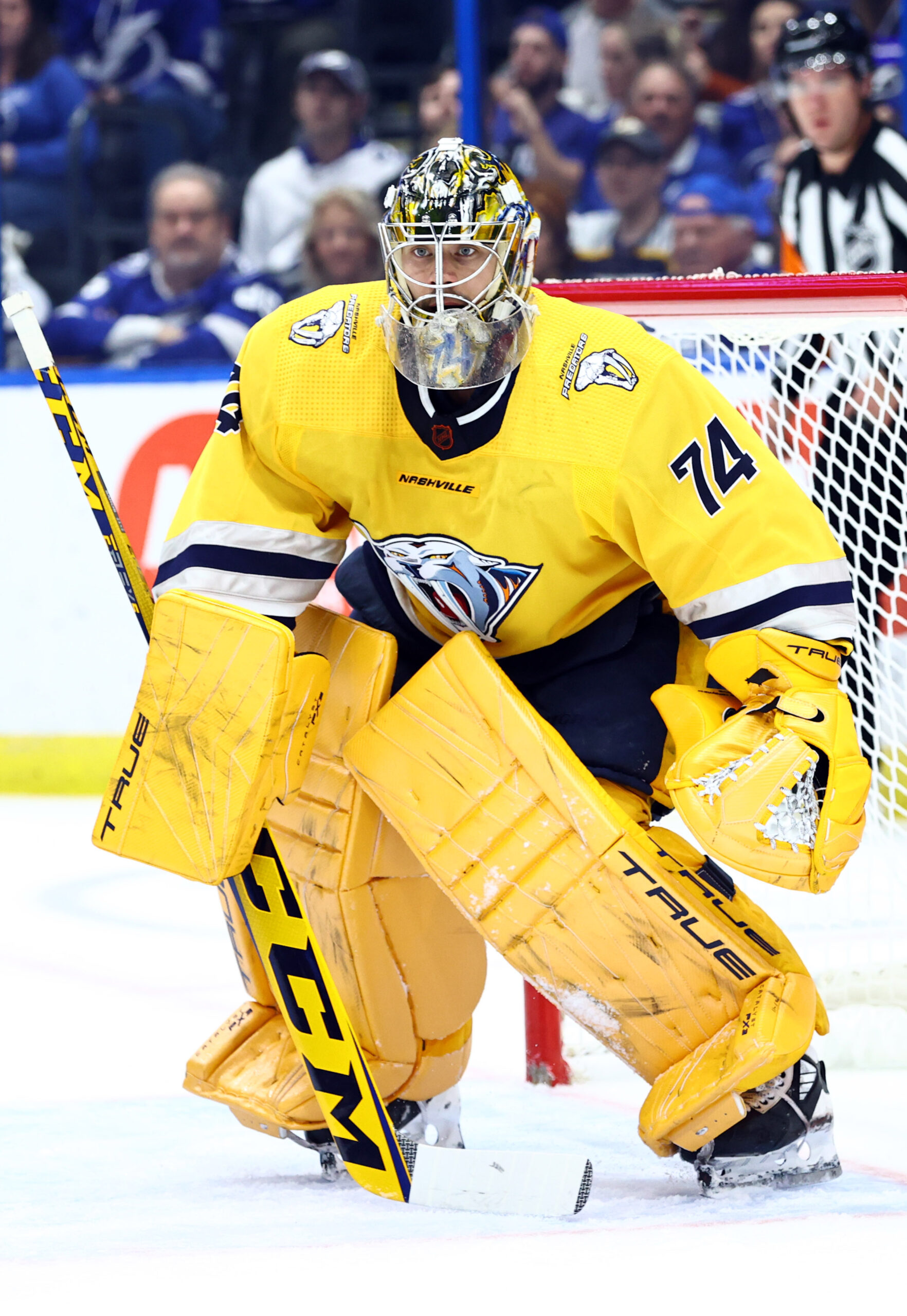
As previously mentioned, a major factor in the Predators’ run to the playoffs last season was the stellar play they received from Saros, their starting netminder.
In 67 games played Saros had a 38-25-3 record with a .918 save percentage and a 2.64 goals-against-average, a performance that made him a Vezina Trophy finalist.
This season, Saros’ play has been more uneven. In 18 games Saros has a 9-7-2 record, a .905 save percentage, and a 3.05 goals-against-average.
The Predators are still treading water in the Western Conference’s playoff race, but in order to really build positive momentum they’ll need Saros to play a bit better than he’s done so far this year.
What should be on the Predators’ holiday wishlist?
A productive top-six center.
In the press conference announcing Ryan Johansen‘s eight-year, $64MM extension in 2017, Predators general manager David Poile referenced the rarity of number-one centers across the league and the difficulty associated with acquiring one as a major part of the justification for Johansen’s hefty extension. At that point, Johansen was coming off of a season where he scored 61 points, and the Predators had just made a run to the Stanley Cup Final.
A few years later, though, it became clear that Johansen was more of a second-line center than a true top-of-the-lineup pivot. Johansen hasn’t crossed the 70-point mark since 2014-15, and recognizing his team’s need for a truly dynamic center, Poile signed Matt Duchene to a seven-year deal with an AAV identical to Johansen’s.
While Duchene has undoubtedly been productive (he scored 43 goals and 86 points last season) he’s been largely shifted away from the center position in recent years. So, the Predators’ longstanding need for a top-of-the-lineup center has persisted into this year as well. As things currently stand, rookie Juuso Parssinen, with a grand total of ten NHL games to his name, is the Predators’ first-line center.
Poile signed his team’s core to extensions with the idea that the Predators would be trying to compete for the franchise’s first-ever Stanley Cup championship. Unless Parssinen manages to author a rookie season for the ages, the Predators will be in the position of needing to win a Stanley Cup without a true top-line center. That’s an extremely challenging prospect, and the lack of a top centerman is something that has doomed many a Stanley Cup hopeful.
Picture courtesy of USA Today Sports Images
What Your Team Is Thankful For: Montreal Canadiens
With American Thanksgiving now behind us and the holiday season coming up, PHR continues its look at what teams are thankful for in 2022-23. There also might be a few things your team would like down the road. We’ll examine what’s gone well in the early going and what could improve as the season rolls on for the Montreal Canadiens.
Who are the Canadiens thankful for?
Kent Hughes.
It hasn’t even been a year since the Canadiens installed Hughes as general manager but his impact is already found throughout the organization. He has completed 14 trades in the months since arriving, adding nearly a dozen high-end future assets including Kirby Dach, Justin Barron, and multiple first- and second-round picks without taking much value out of the organization.
Yes, fans have had to say goodbye to Artturi Lehkonen, Jeff Petry, Ben Chiarot, and Tyler Toffoli, but none of those players were expected to be around the next time the Canadiens were competitive. Alexander Romanov could have been part of the rebuild but Hughes saw an opportunity and jumped at it, cashing in an asset to get a player in Dach that he more highly coveted.
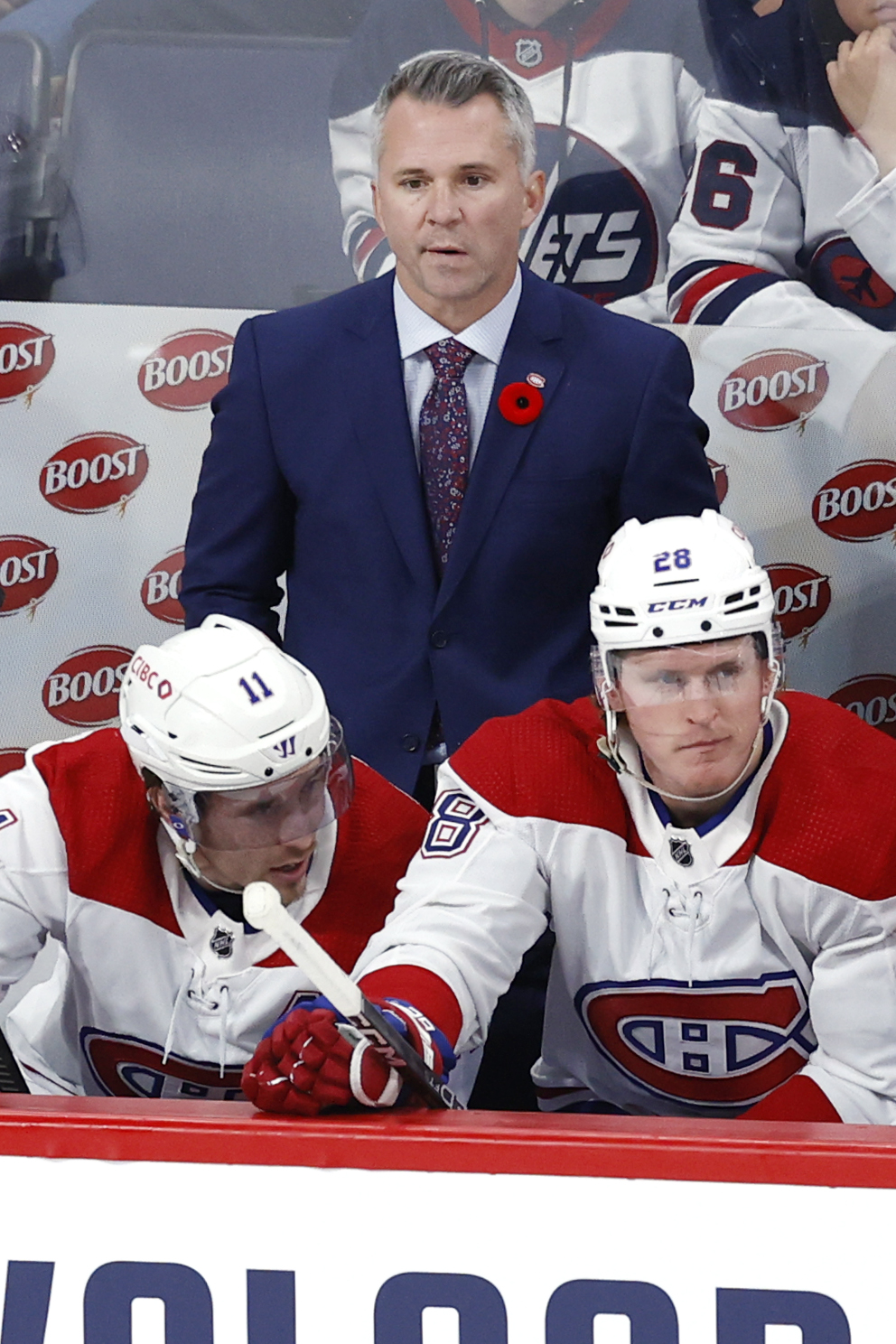 Perhaps his most important move, however, was having the guts (and relationship) to hire Martin St. Louis to run the bench, despite no formal coaching experience. The home run cut appears to have worked, as St. Louis’ impact has been felt throughout the roster – nowhere more significantly than with Cole Caufield. Last season, the young sniper didn’t score his second goal until February 10, after a stint in the minor leagues. He would score 22 times in 37 games down the stretch under the new coaching staff, and has continued that production this season. Caufield now has 37 goals in 63 games under St. Louis and has become the core piece that Montreal fans knew he could be.
What are the Canadiens thankful for?
Nazem Kadri‘s long free agent process.
There is one trade that looks like a complete gold mine for the Canadiens, and had Kadri – one of the league’s top free agents last summer – not taken so long to make a decision, who knows if Hughes would have come out so far ahead. By the time the Calgary Flames signed the free agent center to a seven-year, $49MM contract, it was already August 18, and training camp was right around the corner. Calgary didn’t have a ton of time to sort out its financial situation and clear cap off the books. Right away, they made the move to flip Sean Monahan to the Canadiens along with a first-round pick for nothing in return.
Now, after returning from another hip surgery earlier this year, Monahan looks rejuvenated and is playing big minutes for the Canadiens. If the team wants to, they shouldn’t have any trouble flipping the 28-year-old at the deadline, perhaps even for an extra first-round pick, given his strong performance so far.
Had Kadri not signed with Calgary, or had it not taken more than six weeks from the start of free agency, the Flames might not have been in such a rush to dump Monahan’s contract. Taking advantage of that timing worked out perfectly for Montreal, who gained a high pick and a top-six center to ice for the first part of this season, if not longer. They do have the option of extending his expiring contract, though the future assets that are possible with a deadline deal might seem too good to pass up.
What would the Canadiens be even more thankful for?
The return of Brendan Gallagher.
There are some players in the NHL that get by for years without suffering serious injuries, and play well into their thirties without much of a decline. Gallagher is not one of those players. The in-your-face, bang-and-crash, do-anything-required forward has long been the engine of the Montreal forward group, flying around the ice and creating havoc in the opponent’s end. For a time, he was also one of the most effective players in the league below the hash marks, despite being just 5’9″. He scored 64 goals over a two-year stretch from 2017-19, 51 of them coming at even strength.
But after years of abuse, his game has declined. Gallagher has just eight points in 22 games and is seeing fewer minutes than he has since finishing second in Calder Trophy voting in 2013. While the Canadiens aren’t desperate for his production as they move through this rebuild, the problem lies in his contract. Gallagher is signed at a $6.5MM cap hit through 2026-27, a deal that will be extremely difficult to move if the team needs additional space. Remember, this isn’t a complete teardown – the Canadiens already have some of the pieces in place for their next competitive team. Four more years of Gallagher being paid like a top-end forward is one of the only difficult contracts on the books.
There is still hope, at least, that the 30-year-old can rebound at some point. But there are a lot of miles on that body from the playstyle Gallagher has embraced and injuries just keep piling up.
What should be on the Canadiens’ holiday wishlist?
Another young, NHL-ready forward.
Grabbing first-round picks is great, but the Canadiens already have so many draft picks that they should shift their trade focus to players closer to contributing. Dach was a move in that direction, and there will be more opportunities to grab players in the same age range. As they start shedding expiring veteran contracts like Monahan, Mike Hoffman, Evgenii Dadonov, Jonathan Drouin, and even potentially Joel Armia, there will be spots and ice time to hand out.
Adding another dynamic piece to build around should be the goal now, instead of just collecting lottery tickets for the future. If one becomes available, Hughes has proven he won’t hesitate to pull the trigger, even if it costs another future asset in the process.
Photo courtesy of USA Today Sports Images.
What Your Team Is Thankful For: Minnesota Wild
With American Thanksgiving now behind us and the holiday season coming up, PHR continues its look at what teams are thankful for in 2022-23. There also might be a few things your team would like down the road. We’ll examine what’s gone well in the early going and what could improve as the season rolls on for the Minnesota Wild.
Who are the Wild thankful for?
It’s simple, really. There is no player in Minnesota Wild history that has been as dynamic or that generates as much excitement as the 25-year-old Russian superstar. Incredibly, he already ranks 17th on the team’s all-time scoring list and will pass Brian Rolston, Jason Pominville, and Nino Niederreiter this season (provided he stays healthy).
He’ll also likely catch current players Mathew Dumba and Jonas Brodin, and has a chance of leapfrogging Eric Staal, Charlie Coyle, and Jason Zucker which would get him into the top 10. That is after just three seasons with the team, one of which was shortened to just 56 games.
 With 32 points in 24 games this season he is eight ahead of his next closest teammate, and is more than living up to the $9MM price tag he received after his rookie season. Signed through 2025-26, he actually will look like quite a bargain as the cap ceiling continues to rise over the next few years.
What are the Wild thankful for?
Increasing hockey-related revenue numbers.
Speaking of a rising salary cap, the chance that it will go up ahead of schedule is music to the ears of general manager Bill Guerin. The Wild are dealing with more than $12.7MM in dead cap this season thanks to buyouts of Zach Parise and Ryan Suter, and that number is only going to go up for the next two years.
A $14,743,588 penalty will be applied to the team in 2023-24 and 2024-25 before it drops off to just $833,333 for four years after. If estimates are correct, and the players are going to pay off their escrow debt ahead of schedule, the bullet that Guerin bit will seem a little more forgiving.
Good timing, given the situation the team will face after this season. Matt Boldy, Sam Steel, Brandon Duhaime, Calen Addison, Mason Shaw, and Filip Gustavsson are all scheduled for restricted free agency, while Dumba and Frederik Gaudreau are headed for the open market. A rising cap – even if it only goes up enough to cover the buyout increase – will go a long way to help the front office make the puzzle pieces fit.
What would the Wild be even more thankful for?
A strong second half from Marc-Andre Fleury.
Even with that huge cap penalty, the Wild are a good team. They have an elite offensive talent, some excellent defenders, and enough depth to make it difficult for most teams to match up. But too often this season they have been receiving below-average goaltending.
Fleury turned 38 a few days ago and no one is expecting that he will post another Vezina-winning season this year. But the team needs him to be more than he has been so far. Through 16 games, the veteran netminder has an .895 save percentage, easily the worst of his career. There have been times in the past when people have written him off, only for his game to turn around significantly.
They don’t need him to be elite, and they don’t need him to start every game (Gustavsson has shown ability, too). But if he can give the team even average goaltending, they will be a playoff team this season and potentially even contend for the Central crown, given how undecided the division is at this point.
Minnesota has Jesper Wallstedt coming, and don’t need five more years of peak Fleury. But they do need him this year if they’re going to make any noise.
What should be on the Wild’s holiday wishlist?
A top-six center.
This has been on the team’s wishlist for a while, but Minnesota still needs an impact center. With Ryan Hartman on injured reserve, the group has been using Sam Steel as the first-line center. While he has shown some promise, they need a more established option there, and not just for this season.
Sure, Marco Rossi might eventually become that player, or Hartman could jump back in and find some of the magic he had last year, but acquiring someone from outside the organization is still probably a top priority. In a recent column, Joe Smith of The Athletic pondered about Bo Horvat, and noted he might be too expensive to acquire as a rental.
There is also the option of adding a top-six winger, which would move some players into more comfortable spots lower in the lineup. That may be a more realistic option, especially if they still believe that Hartman can be a difference-maker in the middle of Kaprizov and Mats Zuccarello when he returns.
Photo courtesy of USA Today Sports Images
What Your Team Is Thankful For: Los Angeles Kings
With American Thanksgiving now behind us and the holiday season coming up, PHR is taking a look at what teams are thankful for in 2022-23. There also might be a few things your team would like down the road. We’ll examine what’s gone well in the early going and what could improve as the season rolls on for the Los Angeles Kings.
Who are the Kings thankful for?
The Los Angeles Kings’ offseason acquisition of Kevin Fiala from the Minnesota Wild, a deal that cost them a first-round pick and top prospect Brock Faber, was seen as a transaction carrying quite a bit of risk.
While Fiala had undoubtedly reached a new stratosphere of production in Minnesota (he scored at a 65-point pace in 2020-21 and scored 85 points in 2021-22) there were some who still believed that he was too inconsistent and his playoff production was too spotty to make acquiring Fiala a shrewd acquisition.
So far, Fiala has proved to be a strong investment for GM Rob Blake and the Kings. After a somewhat slow start, Fiala’s offensive production has really picked up, and he now leads the Kings with 28 points in 26 games, a total helped by a four-assist performance in a game against the division rival Seattle Kraken, a game that featured 17 total goals scored.
While finding the ideal fit for Fiala in the Kings’ lineup has been a bit of an adventure for head coach Todd McLellan, his current spot as the right winger next to Anze Kopitar and Adrian Kempe could be a smart long-term role.
Fiala is one of those rare wingers in the NHL who can reliably drive play, and as Kopitar, 35, begins to slow down the presence of Fiala should be able to keep the Kings’ offense chugging along.
While there are other players, such as Arthur Kaliyev or Gabriel Vilardi, whose strong performances are perhaps a bit more surprising, Fiala’s strong start to his Kings career is undoubtedly the most important development for the franchise as a whole.
If Fiala can continue to be a point-per-game, play-driving winger in Los Angeles, that seven-year, $7.875MM AAV extension could start to look like a bargain, which is definitely something for the Kings to be thankful for.
What are the Kings thankful for?
Their dynamic second line.
While Fiala and Vilardi have gotten more overall attention for their performances, the bedrock of this Kings’ team and their success so far this season has been their second line. Led by Phillip Danault, that line has been one of the league’s most well-rounded trios since they were first put together.
Danault, 29, arrived from the Montreal Canadiens with serious questions attached regarding his offensive game. Many wondered if the defense-first center would be able to muster enough of an offensive game to warrant his $5.5MM cap hit.
All Danault has done in Los Angeles is prove that he has a quality offensive dimension to his game, one that he hadn’t truly flashed in the NHL since the days when he was an up-and-coming player centering the Canadiens’ top line between Max Pacioretty and Alexander Radulov.
In 79 games last season Danault flew past his previous career high of 13 goals scored to pot 27. This year has been more of the same, as he has 18 points in 26 games. By pairing elite defensive play with the ability to mesh offensively with some quality linemates, Danault has quickly become a quality top-six center in Los Angeles.
But the Kings’ second line is more than just Danault. It also features Viktor Arvidsson, who ranks third on the Kings with 19 points in 24 games this year. Finishing the trio is Trevor Moore, a California native who had a breakout year in 2021-22 after he earned a role next to the two established NHLers. Moore scored 48 points in 81 games last year and has 17 points in 26 games this year.
The consistency and all-around quality of the Kings’ second line is something that sets them apart from many other NHL teams, which is undoubtedly something to be thankful for this holiday season.
What would the Kings be even more thankful for?
Improved play in the crease.
While the Kings are currently sitting in a playoff spot, the success they’ve found this season has come despite their goaltending, not because of it.
That point was made strikingly clear when the team placed Petersen on waivers this week, a transaction that came as a major setback for a player once seen as the Kings’ future at the position.
It’s not often that a team waives an in-his-prime player making $5MM or more, and yet the fact that Petersen found himself available to every other NHL club speaks to just how dire the Kings’ goaltending situation has been this year.
Jonathan Quick‘s reliance on his superb athleticism and unbelievable instincts earned him two Stanley Cup rings and two William M. Jennings trophies. But now a 36-year-old veteran, Quick’s athleticism has waned, and much of his effectiveness has gone with it.
Quick is no longer the elite goalie he once was, and while his .910 save percentage last year was certainly acceptable, his .889 so far this year is not.
Petersen has struggled this year to an even greater extent than Quick. As mentioned earlier, he hit waivers this week after posting a grisly .868 save percentage in 10 games.
The Kings are saddled with Petersen’s backloaded $5MM AAV contract ($11MM of the total $15MM cash is due in the next two years) so getting him back to the level of performance he showed in 2020-21 will be important. If the Kings could pair their current level of play with better play from their goalies, they’d certainly be even more thankful than they are now.
What should be on the Kings’ holiday wish list?
Productive extension talks with Vilardi.
Just a year ago, it looked as though Vilardi was trending toward “bust” territory. On one hand, the 2017 11th overall pick looked to have finally put the injury troubles that came to define his early years as a prospect behind him, and he was productive in the AHL with 38 points in 39 games.
But on the other hand, Vilardi was ineffective in 25 NHL games and scored just seven points in that span. Vilardi’s skating, which had been seen as a potential issue since his days as a Windsor Spitfire, looked as though it was going to hold him back from being an impactful offensive generator in the NHL.
This year, though, Vilardi has flipped that script with a hot start. While a six-game scoreless streak has lowered his overall totals, Vilardi still leads the Kings with 13 goals and is scoring at a 62-point pace.
It looks like Vilardi may have finally found his groove in the NHL, and if he has indeed done so, the price on his next contract will only go up from here. Vilardi will be a restricted free agent with arbitration rights this summer, and with that on the horizon, the Kings should have productive extension talks with Vilardi on their holiday wishlist.
Vilardi has worked tirelessly to get past his earlier injury issues and become the productive scorer he has been so far this season.
The Kings never seemed to lose faith that Vilardi would eventually sort things out, and this year Vilardi has rewarded their faith. Next, it could be the Kings’ turn to reward Vilardi.
Photo courtesy of USA Today Sports Images