
What Your Team Is Thankful For: Toronto Maple Leafs
As we approach the end of the year, PHR continues its look at what teams are thankful for in 2022-23. There also might be a few things your team would like down the road. We’ll examine what’s gone well in the early going and what could improve as the season rolls on for the Toronto Maple Leafs.
Who are the Maple Leafs thankful for?
As special as Marner’s 23-game point streak was for both player and team, it represented something just as important to Toronto’s season: consistency. As other players went hot and cold or went down with injury, Marner continued to produce night in and night out.
The winger has arguably been the team’s MVP thus far, even with Auston Matthews, William Nylander and John Tavares all having fantastic season thus far. Marner’s 40 points are good enough to lead the team, just one ahead of Matthews and Nylander. Not only is Marner playing a key role in the team’s superb offensive output, but he’s one of not only the team’s, but the league’s best two-way forwards, playing a key role on the penalty kill and late in games.
Perhaps the most interesting statistic that shows just how vital of a role Marner plays is time-on-ice. Marner, a right wing, is second on the team in average time-on-ice, behind only Morgan Rielly, who’s currently injured. The next closest forward on the list is Matthews, who’s 20:19 average time-on-ice is over a full minute less than Marner at 21:23.
Sure, Brendan Shanahan, Kyle Dubas, and the front office built this team and Sheldon Keefe coaches it. Tavares is the captain and locker room leader while still being one of the team’s superstars. Nylander is enjoying a career year and the possibility of a 50 goal season. And yes, Matthews scores goals at a historic rate, but this year it’s been the consistent, steady play of Marner that Toronto is most thankful for. In a season of some ups and more than a few downs, the Maple Leafs may just be having their best campaign under this group, and now it seems to be Marner leading them all.
What are the Maple Leafs thankful for?
Depth, depth, and more depth.
It’s Christmas Day, the Maple Leafs have played 34 games and thus far, they’ve dressed a whopping 12 defensemen in games this season. That’s enough for their opening night lineup, plus an entire second unit too. Now, add to that their goaltenders. The team has only had three goaltenders play in games for them this season, not unusual, but all three have played in double-digit games.
With all of these injuries added onto a slow start, nobody would blame the Maple Leafs for being on the fringes of the playoff picture. But instead, Toronto sits comfortably in second place in the Atlantic Division, behind only the Boston Bruins, who are enjoying what can only be described as a historic start to their season. So, what’s going right?
The depth the Maple Leafs have put forward this season has been, in a word, impeccable. When both halves of the intended goaltending duo of Matt Murray and Ilya Samsonov went down with injury earlier this year, The Maple Leafs rested their hopes on Erik Kallgren to carry the load in net. Kallgren’s numbers this season aren’t going to win him the Vezina Trophy, but his .898 save-percentage and 2.67 goals-against average have been enough to keep the team in games, arguably their most important ones of the season. Notably, Kallgren was forced into the full-time starter’s role for a brief period, just as the team was fighting to regain itself as a winner, recently losing four straight on their west coast road trip.
On the blueline, only Justin Holl and Mark Giordano have played in every game this season, Rasmus Sandin closely behind with 33, but after those three, the next closest is Timothy Liljegren at 23. The three who were expected to make up the most important Leafs defensemen, Morgan Rielly, Jake Muzzin, and T.J. Brodie, have all missed fairly significant time, Muzzin unlikely to return this season. Mac Hollowell and Filip Kral have been solid when called upon, and Jordie Benn‘s presence as a veteran shutdown defenseman has been impactful.
Amid the rapid loss of defensemen, Toronto was forced to make a trade and acquired Conor Timmins from the Arizona Coyotes. Always highly-regarded, but just as frequently injured, Timmins has struggled to become an NHL regular for that reason. Since making his Maple Leafs debut earlier this month, Timmins has flourished, recording six assists in eight games, chipping in strong defense.
Of course, the organization will want to have it’s key pieces healthy and performing as expected, but in their absence, the next man up has been more than ready for action this season in Toronto and the ultimate success of this team will have to give large credit to this group of players.
What would the Maple Leafs be even more thankful for?
Health
We’ve just discussed the impact that Toronto’s depth additions have had on the team, such as Kallgren and Timmins and though the organization is happy to have them there, and perhaps give them a bigger role going forward, having their marquee players healthy and in the lineup would be just that much better.
The biggest injury in nature appears to go to Muzzin, who is likely done for the season. There, the health of the person is of primary importance and at this point, the Maple Leafs will likely consider how they can replace him, at least for the remainder of this season, with his $5.625MM cap hit on LTIR.
In terms of players who can come back, Rielly has been out since November 21st and while a return doesn’t appear to be imminent, there is hope the star defenseman will be back relatively shortly. Injured recently, Sandin and his status beyond being placed on IR is unknown, but having the young defenseman return would still change the dynamic of the blueline. Beyond them, returning defenseman Victor Mete and forward Nicholas Robertson to the lineup, when possible, would simply continue to add to the overall depth the team has available.
A healthy team isn’t just the players on IR returning to the lineup, but also consists of keeping the rest of the team healthy. As strong and as plentiful as the depth has been this year, it’s not endless. Furthermore, Toronto has been lucky that, with the exception of Reilly, injuries largely haven’t affected their elite players. Even losing just one of their big four of forwards for a long stretch could have a devastating effect on the season going forward.
What should be on the Maple Leafs’ holiday wishlist?
A secondary scorer
With Matthews, Marner, Nylander, and Tavares, complimented by Michael Bunting and Alexander Kerfoot, it would seem counter-intuitive to add another offensive-minded forward to the mix here, especially with injuries to the defensemen. To address the defense first, Rielly should hopefully return soon and the team will cross its fingers for a positive update on Sandin, but having both back solves many issues. Replacing Muzzin would make sense, but given the play of Benn and Timmins, it might not be necessary, at least not right now.
Up front, losing any of the big four would be drastic and though none of the four would be considered injury prone, nothing is guaranteed. Also consider the saturation of their production, the group primarily placed in the top-six and the first powerplay unit. If something goes wrong on the injury or production front, the rest of the team will have to step up and as talented as that group is, they aren’t so adept at getting the puck past the goaltender.
Toronto doesn’t necessarily need to go out and grab Patrick Kane at this year’s deadline, but a solid third-line option could do the trick, and at a relatively affordable price too. Sticking with Chicago, both Max Domi and Andreas Athanasiou are UFA’s at season’s end and both have a history of offensive production. Alternatively, a reunion with former Leafs winger James van Riemsdyk could be in the books, assuming the Flyers are willing to retain salary, which they appear to be.
If Toronto does prefer to add defense, or needs two for the price of one so to speak, perhaps adding a dynamic offensive defenseman, like Shayne Gostisbehere from the Arizona Coyotes could be in the works. With 24 points this season in 32 games, Gostisbehere would give the team the offensive boost it needs while also serving as additional defensive depth and filling the void created by Muzzin’s injury.
PHR Panel: Trade Market Memories (Part 2)
The year is almost up and NHL teams are taking breaks to spend time with their families before the second-half grind begins in earnest. Once the calendar turns to 2023, trade chatter will start again, and the push to the playoffs will begin. A break is time for reflection, and over this weekend we will be looking back with one of our favorite features: the PHR Panel.
In the spirit of the holidays, we have a special treat for the PHR community. Three of our former writers have joined in to give us their thoughts on what has been an incredible year of hockey. Welcome back Zach Leach, Holger Stolzenberg, and Nate Brown! Because we have the whole family back together, we’ll split each panel into two parts.
Now on to the meat of the thing. Our question today is simple:
What is the most memorable trade of 2022?

What Your Team Is Thankful For: Tampa Bay Lightning
As we approach the end of the year, PHR continues its look at what teams are thankful for in 2022-23. There also might be a few things your team would like down the road. We’ll examine what’s gone well in the early going and what could improve as the season rolls on for the Tampa Bay Lightning.
Who are the Lightning thankful for?
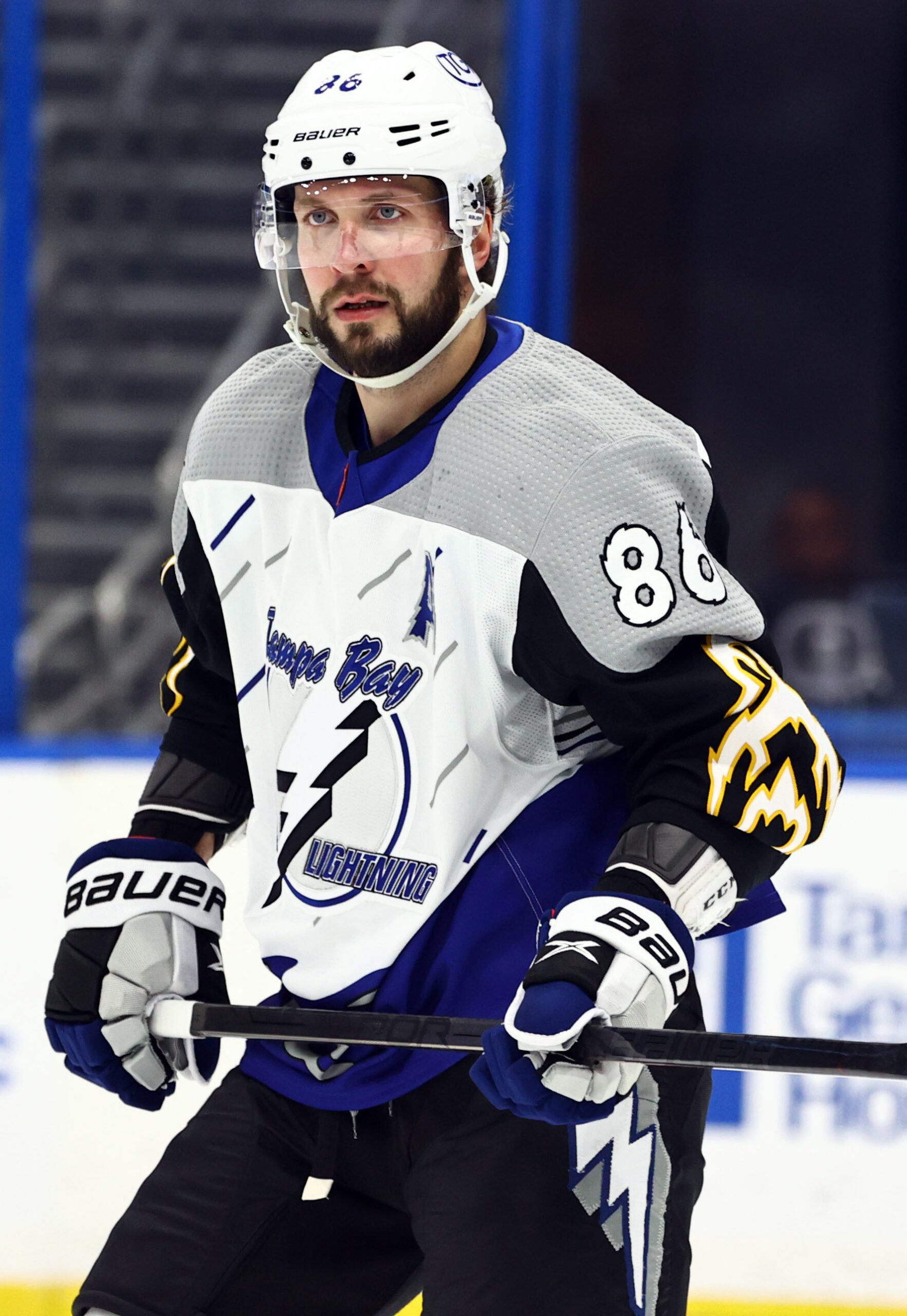
Yes, he’s healthy, and yes, he’s as good as he’s ever been. Kucherov has shone brightly this season, even among a notoriously strong supporting cast in Tampa Bay. He had played in just over a third of Tampa’s regular season games over the past two seasons, even losing the entire 2020-21 regular season to injury.
But he’s back on his world-beating pace, set to break the 120-point mark once again if he can suit up for a full 82 games. He leads all Lightning with 49 points in 32 games, 11 points ahead of Steven Stamkos. He’s also playing over 21 minutes per game, the highest mark in his NHL career.
The Lightning will have eight players with a cap hit greater than $5MM next season, not including the long-term injured reserve relief of Brent Seabrook. With that kind of top-loaded structure, you need quality depth, and you need your stars to be stars. Kucherov’s performance, especially when healthy, makes his $9.5MM cap hit seem like a bargain, even in this tight salary cap landscape. Continued elite performance from the 29-year-old is crucial in giving the Lightning a chance to remain among the league’s best.
What are the Lightning thankful for?
Financial certainty as the cap rises.
It’s been a delicate dance for the Lightning’s front office over the past few seasons. The team made three consecutive Stanley Cup Final appearances in a time of near-complete financial stagnation for the league, mainly due to their management’s ability to play with fire without getting burned.
In even better news, they’re in a position to get rewarded as the cap rises. They have very few core players to sign to new contracts anytime soon. Steven Stamkos and Victor Hedman will need new deals in the next three seasons, but they’ll be 34 and 35 at that time and won’t be able to command much of a raise, if any. Kucherov, Brayden Point, Anthony Cirelli, Mikhail Sergachev, Andrei Vasilevskiy, and even Erik Cernak and Nick Paul are locked in well past their 30th birthdays.
It finally seems like there may be some room to breathe for the Lightning, even if it’s a few seasons away.
What would the Lightning be even more thankful for?
More out of Victor Hedman.
18 points in 30 games aren’t bad by any measure, but Hedman has lost his grip on being the team’s unequivocal number-one defenseman, at least for now.
Mikhail Sergachev has dominated, potting 27 points in 30 games while seeing his usage equal nearly that of Hedman’s across 30 games. But it’s not just points separating the two this season.
Hedman’s main defense partners this year, Erik Cernak and Nicklaus Perbix, each have better defensive metrics paired with different defenders. Neither the Hedman-Cernak pairing nor the Hedman-Perbix pairing has eclipsed a 50% expected goals share this season, according to MoneyPuck’s model. It’s putting more strain on other Lightning defenders to pick up the legwork, and thankfully, they’re delivering.
What should be on the Lightning’s holiday wishlist?
A better backup goalie.
Tampa still has very little maneuverability this season financially, so any trade deadline moves they make will need to be small and effective. Their forward core still makes up the eighth-ranked offense in the league, and their defense is still capable for the most part.
Their most glaring weakness can thankfully be easily addressed. Brian Elliott is 37 years old and, despite a 7-2-0 record this year, has just a .894 save percentage. If any health issue affects Vasilevskiy in the playoffs, it’s likely game over for Tampa in a tight Eastern Conference.
Main photo courtesy of USA Today Sports Images
PHR Panel: Trade Market Memories (Part 1)
The year is almost up and NHL teams are taking breaks to spend time with their families before the second-half grind begins in earnest. Once the calendar turns to 2023, trade chatter will start again, and the push to the playoffs will begin. A break is time for reflection, and over this weekend we will be looking back with one of our favorite features: the PHR Panel.
In the spirit of the holidays, we have a special treat for the PHR community. Three of our former writers have joined in to give us their thoughts on what has been an incredible year of hockey. Welcome back Zach Leach, Holger Stolzenberg, and Nate Brown! Because we have the whole family back together, we’ll split each panel into two parts.
Now on to the meat of the thing. Our question today is simple:
What is the most memorable transaction of 2022?

What Your Team Is Thankful For: St. Louis Blues
As we approach the end of the year, PHR continues its look at what teams are thankful for in 2022-23. There also might be a few things your team would like down the road. We’ll examine what’s gone well in the early going and what could improve as the season rolls on for the St. Louis Blues.
Who are the Blues thankful for?
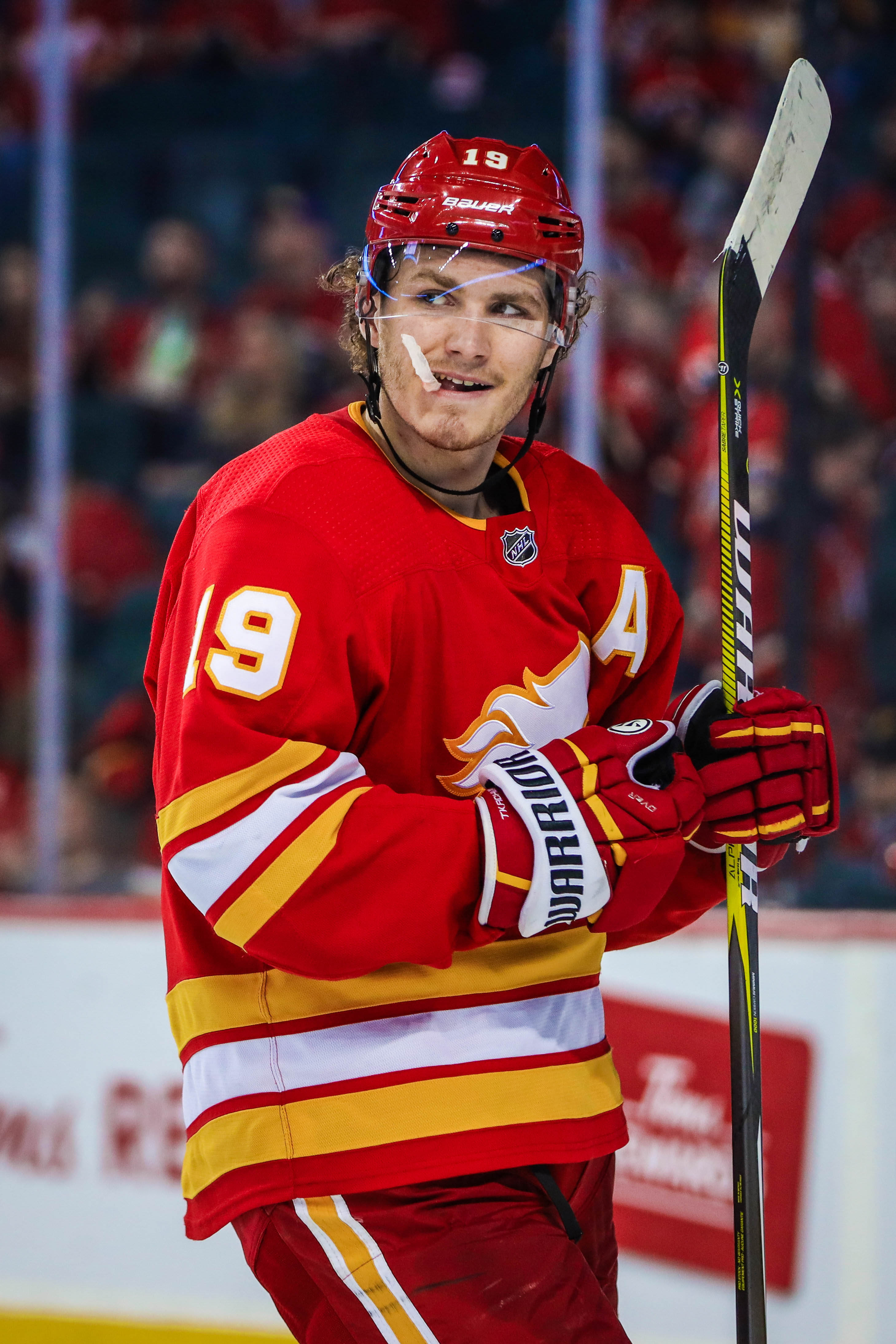
 He may have had a slow start to the season, but Kyrou’s had a torrid November and December to silence any doubters. It’s been a streaky run for the Blues this season, and seeing young cornerstones continue to develop and lead the team is always a positive.
After just three points in his first eight games, Kyrou has 29 in his past 23 and leads the team in scoring with 16 goals and 32 points. At 24 years old, Kyrou figures to be a long-term solution for elite goal-scoring in St. Louis. The team agrees and is being rewarded for their gamble, handing Kyrou an eight-year, $65MM extension that kicks in next season.
He’s rolling along at more than a point-per-game clip on the league’s 21st-ranked offense, which is underperforming, to be fair. But the Blues still remain in the playoff conversation with a .500 record as Christmas approaches, mainly in part due to Kyrou’s offensive excellence.
What are the Blues thankful for?
A rough season with good timing.
If there were ever a season for the Blues to sell, it would be this one. Ryan O’Reilly, Vladimir Tarasenko, and Ivan Barbashev are all unrestricted free agents at the season’s end. While it would be a tad out of nature for general manager Doug Armstrong, the team could certainly opt for a retool around the strong performances of players like Kyrou, Robert Thomas, and Pavel Buchnevich.
It would allow St. Louis to recoup what could be massive value early on in a retool phase, giving them a jumpstart in getting back into competitiveness without having to sacrifice players like Kyrou and Thomas later in their primes for a full-scale rebuild. If Armstrong plays his cards right, he has a unique opportunity to restock St. Louis’ cupboard at just the right time.
What would the Blues be even more thankful for?
A Jordan Binnington resurgence.
His .897 save percentage doesn’t tell the whole story. The team has not been close to the league’s upper echelon defensively, and it reflects in their goals against total, which sits near the league’s bottom.
But Binnington hasn’t stolen games the way he did earlier in his NHL career, and his behavior unrelated to his play has made more headlines this year than his saves have. He’s been average, not to blame for St. Louis’ struggles, but not the goalie that won them a Stanley Cup in 2019.
The issue lies in that St. Louis has invested in him to do just that – steal games. He’s not paid like a tandem netminder, locked in at a $6MM cap hit through 2027. With trade protection in the mix, too, it’s not looking like a pretty situation financially.
What should be on the Blues’ holiday wishlist?
Like many other teams, young defensemen.
The team’s prospect pool on D revolves around Scott Perunovich. While extremely talented, he hasn’t been able to avoid constant injury issues. He played just 36 games last season across both the NHL and AHL and hasn’t played at all this season due to a shoulder injury expected to keep him out through April.
Outside of him, there are some players who may have NHL futures, but no one who fits the bill as a solid long-term solution. Help in the D pipeline will likely be top of mind in trade returns if the Blues do sell off assets at the trade deadline.
Main photo courtesy of USA Today Sports Images
Free Agent Stock Watch: Centers
With the new year fast approaching, the NHL season is in full swing. Teams are jockeying for playoff position, and many players with expiring contracts across the NHL are playing games that could ultimately determine what type of payday they might receive in the summer.
In a multi-part series, we’ll take a look at each position group of the upcoming free agent class, and do a rundown on how those upcoming unrestricted free agents have performed this year. Which players have increased their odds of landing a massive contract? Which players have potentially hurt their earning potential with their play? We’ll break it all down here.
The Marquee Names
Bo Horvat, Vancouver Canucks
Just a few months ago, it seemed impossible to imagine this current Canucks core led by anyone other than Horvat. The Canucks’ captain has been a centerpiece player in British Columbia since being drafted ninth overall in 2013, and the value he provides to the franchise both on and off the ice can oftentimes seem irreplaceable.
But with Vancouver’s season running off the rails, the team’s recent extension of J.T. Miller to a massive new contract, and their front office’s stated desire to gain more financial flexibility, it’s getting harder and harder to imagine a path where Horvat remains in Vancouver.
While Horvat may be disappointed at the increasingly realistic prospect of his Canucks departure, what should cheer him up is his play so far this season. Horvat has scored 22 goals and 31 points in 32 games, a number that puts him tied for fourth in goals in the NHL.
Horvat will be 28 years old when he first takes the ice with a new contract, a factor that could make him a more attractive long-term investment to teams than the players in their thirties that typically populate a free agent class. That, combined with his well-regarded defensive play and value as a leader means Horvat could be in a position to potentially earn the largest contract of the 2023 free agent class.
Dylan Larkin, Detroit Red Wings
Larkin is in many ways similar to Horvat. Like Horvat, Larkin is a team captain and a player who is known for providing value on both ends of the ice as well as off of it.
Unlike Horvat, though, there is a strong possibility that Larkin remains with the only franchise he’s ever known.
With 31 points in 31 games, Larkin is currently on pace for another season at or near the point-per-game threshold.
He’ll have just turned 27 years old when he hits free agency, and the reality of the NHL is that in-their-prime centers who combine offensive production and all-around play very rarely hit the open market.
While fans may not be pleased that an extension hasn’t been hammered out yet, Larkin has played exactly as well as anyone could have reasonably expected of him, and that deal should be coming.
The Red Wings’ cap sheet is not nearly as constrained as nearly every other team in the NHL, so with how well Larkin has been playing it would be a genuinely shocking development for him to do anything but remain in the Motor City.
Ryan O’Reilly, St. Louis Blues
While this section is labeled as free agency’s “marquee names” at the center position, it could also be called “the captains.” That’s because like Horvat, Larkin, and the two other names in this section, O’Reilly is a quality center and captain of his team set to hit free agency this summer.
Unlike the four other names in this group, though, O’Reilly’s play this season has not helped his case to earn a major contract this summer. And that decline in his stock is coming from his play at both ends of the ice.
As one would expect, the 2019 Conn Smythe Trophy winner is leading the Blues in short-handed ice time per game and playing a centerpiece defensive role for his club. Last season, the Blues had a top-five penalty kill, canceling opponents’ power plays at an 84.1% clip. O’Reilly led the way in getting the Blues to that point.
This year, it’s a different story. O’Reilly is still playing in that top defensive role, but the Blues are near the bottom of the NHL with a 71.3% penalty kill rate. That’s not all on O’Reilly’s shoulders, but as the player with the most ice time in those situations and coach Craig Berube’s most trusted defensive weapon, he does bear some responsibility for that decline.
What’s also declined as sharply as the Blues penalty kill is O’Reilly’s scoring numbers. O’Reilly has scored just 15 points in 33 games, a 37-point 82-game pace. Just two years ago, O’Reilly scored at nearly a point-per-game rate. Last year, he scored a healthy 58 points in 78 games.
As far as his next contract is concerned, if he doesn’t manage to go on a hot streak and get into the 40 or 50-point range, that offensive decline could put a serious dent in his earning potential. That’s doubly true of any perceived decline in his defensive game, as that’s his calling card.
Just as the Blues are looking to right the ship during what has been so far an uneven campaign, O’Reilly is likely looking to get back to the level of play he put forth in prior seasons in order to earn the best possible contract this summer.
The playoffs have been the games where O’Reilly’s star shines the brightest, so perhaps he’ll need to lead the way on another deep playoff run to alleviate fears that a steep age-related decline is setting in.
Patrice Bergeron, Boston Bruins
Bergeron’s free agency case is quite simple. Unlike most players, he’s not really in need of a “stock watch” entry. He’s scored 26 points in 32 games, could very well win yet another Selke Trophy, and is captaining a Bruins team that is currently laying waste to the entire NHL.
And he’s also costing the Bruins just $2.5MM against the cap.
Just as Bergeron is a special player, his upcoming free agency is a special situation. As he did this past summer, Bergeron will likely take some time to reflect and decide if he wants to return for another season, and then agree with the Bruins on an extension that makes sense for both parties.
He could go on a nine-game scoreless drought. He could make a few uncharacteristic defensive lapses and single-handedly tank the Bruins’ league-leading penalty kill a few percentage points. Doesn’t matter. A decision on his future this summer is entirely in his own hands, which is a right he’s earned after nearly two decades in Boston.
Jonathan Toews, Chicago Blackhawks
Toews, a three-time Stanley Cup-winning captain, and one-time Selke Trophy winner, is in a similar situation to Bergeron. The one complicating factor in Toews’ case compared to Bergeron’s is the state of the Blackhawks.
The Blackhawks are on a fast track to the highest odds for the NHL draft lottery, and there’s been much speculation over whether Toews wants to stick around in Chicago through what appears to be a painful, scorched-earth rebuild.
If he chooses to test the market, it’s likely that choice would come from a motivation to win one more Stanley Cup ring, which means his market and next contract could ultimately be decided by personal preference, rather than financial factors.
On the ice, Toews’ play has been solid, and while he’s not the lineup-topping two-way force he once was, his 17 points in 30 games on such a poor team is nothing to scoff at, and there are far worse second or third-line centers a team could have than Toews.
The Solid Contributors
Ivan Barbashev, St. Louis Blues
If one just compares this season to 2021-22, Barbashev’s stock in advance of his potential free agency is down. Barbashev scored 26 goals and 60 points last season, and now he is scoring at a 40-point pace. That decline alone will likely mean fewer dollars on his next contract.
But if we put Barbashev’s 2021-22 offensive explosion into a bit more context and look at a longer-term outlook, his stock would undoubtedly have to be viewed as being up.
Before last season, Barbashev’s career-high in points was 26. He was seen as more of a two-way center whose offensive skills simply were not refined enough or dangerous enough to allow him to create offensive opportunities consistently in the NHL.
Last year, Barbashev changed that narrative, and even though he hasn’t reached those heights so far this season he’s still managing to play at a 40-point pace. 40-point centers who can hold their own on both ends of the ice remain valuable, and while Barbashev isn’t going to win Selke trophies he does have a defensive dimension to his game.
Barbashev just recently turned 27, and if a team buys into the idea that he can return to scoring around the 60-point mark, he could get paid. But even if teams are less optimistic about his offensive game, his play this year is still far above what he once put forth at the NHL level, and has put him in a position to earn a quality contract.
J.T. Compher, Colorado Avalanche
When Nazem Kadri faced some injury issues in the 2022 playoffs, it was Compher’s job to step into a greater role down the middle and ensure the machine that was the 2021-22 Colorado Avalanche kept moving. He did exactly that and won a Stanley Cup as a result.
This year, with Kadri now in Calgary and the Avalanche battling a downright absurd amount of injuries, Compher has quietly stepped forward and provided competence, reliability, and all-around value. He’s scored 16 points in 31 games so far this year, and that 42-point pace, if sustained, would fly past his career-high of 33 points.
He’ll be 28 years old this summer, and his ability to play under pressure and step forward into a higher role in the lineup than he was originally slotted to occupy should make him a coveted name on the market.
Sean Monahan, Montreal Canadiens
Once a slam-dunk 25-30 goal scorer, injuries had derailed Monahan’s career so severely that the Flames paid a future first-round pick to the Canadiens just so they would absorb his contract. Since that trade, Monahan has had a bit of a career revival, leading a young Canadiens squad to a surprisingly competent start and scoring at a far better rate than he’s done in the past two seasons.
So far this year, Monahan has scored 17 points in 25 games. He’s battling an injury again, but it’s not one that’s expected to keep him from making his return to the lineup with a ways to go left in the season.
While Monahan’s struggles with injuries may give teams pause about a major long-term commitment, his play in Montreal has been a resoundingly positive development for his career. He may not receive the kind of contract he once looked in line to cash in on, but he’ll likely still be an in-demand piece if he can keep up this career rebirth when he returns from IR.
Max Domi, Chicago Blackhawks
From one angle, it seems as though Domi’s decision to take a one-year, $3MM deal last summer from the Blackhawks was done largely to put himself in the best possible position for a summer of 2023 free agency. So far, he’s done just that.
After a season that saw him play unevenly with the Columbus Blue Jackets and be traded to the Carolina Hurricanes at the deadline, Domi signed with Chicago likely with the hopes that his natural offensive talent would mesh with that of the Blackhawks’ franchise face, Patrick Kane.
Domi has indeed played with Kane, and while they are far from a perfect partnership, they are first and second on the Blackhawks in scoring, with Kane at 22 points in 31 games and Domi at 21 in 31.
There has always been the possibility of a higher offensive ceiling with Domi, who scored 72 points in 2018-19, but he wasn’t able to reach that point in Columbus or in his short stay in Carolina.
While Domi is undeniably an extremely talented player on an individual basis, his vision can be lacking at times and he doesn’t always play as a member of a three-player unit, sometimes preferring to use his tantalizing skills on his own to create offense without thinking about how he can best utilize the players on the ice with him.
In the right fit, Domi can thrive, and with a bit of luck, he’s shown that he can be among a team’s top scorers. But he’s far from a sure thing. If Domi can play well after his seemingly inevitable midseason trade to a contender, and finish near his current scoring pace of 56 points, he’ll enter the market on stronger footing than he did last season.
Jordan Staal, Carolina Hurricanes
Staal is in a similar position to Toews and Bergeron, even though he’s not quite the caliber of player they are/were. He’s a beloved face of the franchise in Carolina and in a position where he’s likely to remain there at a reasonable price.
In his recent 32 Thoughts blog, Sportsnet’s Elliotte Friedman stated that “no one is expecting [Staal] to leave Carolina.” Staal has scored 14 points in 33 games so far this year, which is a 34-point pace. That’s right in line with the 36 and 38 points he’s scored in the last two seasons.
Staal still shoulders a major defensive role in Carolina, handling difficult defensive matchups and playing the most time on the penalty kill of any Hurricanes forward. Although the Hurricanes’ short-handed unit has taken a bit of a step back so far this year, that won’t stop Staal from earning a market-rate extension in Carolina if that’s the path he chooses.
The Role Players
Erik Haula, New Jersey Devils
Haula, who will be 32 when free agency opens next year, has entered a bit of a journeyman phase in his career. He’s played for six different teams in the past half-decade and could play for his eighth NHL franchise if he leaves the New Jersey Devils this summer.
A versatile forward who can play center or on the wing, Haula plays a Swiss Army Knife role, scoring at a 35-point pace and on the Devils’ second penalty-killing unit.
Haula’s age may keep him from a long-term pact, but his stock is holding steady as he provides steady veteran two-way play to a young Devils team that’s had an extremely impressive season.
Frederick Gaudreau, Minnesota Wild
Gaudreau is a bit of a late bloomer, getting his first complete season as a full-time NHLer at the age of 28. He didn’t waste that opportunity, though, scoring 14 goals and 44 points in 76 games.
This year, Gaudreau’s offense hasn’t gotten back to that point, as he has just 14 points in 33 games. But he averages the most short-handed ice time per game on the Wild, helping Minnesota’s penalty-kill to an above-average 13th-place rank so far this year.
His free agency will be somewhat difficult to predict, as he’ll have only two seasons on his resume as an everyday NHLer. But as of right now while his stock is down from where it was last season, he’s still put himself in a strong position for an undrafted former minor leaguer.
Lars Eller, Washington Capitals
While Eller, who will be 34 during free agency, isn’t the player he once was, he’s still providing value for the Capitals. He plays a reliable two-way game and has scored 13 points in 34 games. He’s a veteran who is in his seventh year as a Capital and has a Stanley Cup-winning goal on his resume.
His stock is down from where it might have been a few years ago when he was one of the league’s best third-line centers and comfortably capable of scoring 15 goals and 35-40 points. But in a league where centers are always in demand, Eller has kept up his play enough to put him in a solid position if he enters the market next year.
Oskar Sundqvist, Detroit Red Wings
Versatility is the name of the game with Sundqvist. The Red Wings, like the Blues for many years, have deployed Sundqvist in all sorts of roles, as a center or winger, as a physical fourth-liner, or as a complementary piece next to skilled players such as Pius Suter and Dominik Kubalik.
But just as versatility is what Sundqvist is the constant of Sundqvist’s game, so is battling injury issues. Sundqvist’s career-high for games played in a season is 74, and that came all the way back in 2018-19. Since that point, Sundqvist hasn’t managed to cross the 60-point mark in any given year.
The trouble he’s had staying healthy will likely be his biggest question mark on the market. Teams know what he can bring on the ice, but they might question how often he can do so. Still, so far this season Sundqvist’s play in Detroit has pushed his stock up, and what could really sustain that upward trend as he gets closer to free agency would be a continued clean bill of health.
David Kampf, Toronto Maple Leafs
An undrafted player out of the Czech Republic, Kampf is in line to cash in after turning in quality play in a bottom-six role on one of the NHL’s biggest stages. In his first year in Toronto, Kampf scored 11 goals and 26 points, while also playing nearly two and a half minutes per night on one of the league’s better penalty kills.
This year, Kampf has resumed his role anchoring the Maple Leafs’ play with a man in the box and has scored at a 31-point pace. His stock has been moving steadily upward since he arrived in Toronto.
While part of that is likely due to the fact that the size and fervor of the Toronto market magnified his performances, attributing his rising stock to the Toronto factor alone would be doing a disservice to the hard work Kampf has put forth. He’s genuinely turned himself into a reliable, quality NHL bottom-sixer.
Kampf isn’t going to break the bank, but he’ll be a 28-year-old free agent with two straight strong years on his resume in a massive market.
If he chooses to head to free agency, there’ll most definitely be interest from across the league. The only potential threat to his market could be the flat cap, as defense-first bottom-six players like Kampf could be the first in line to be squeezed in the market by the leaguewide lack of cap space.
Teddy Blueger, Pittsburgh Penguins
Blueger, 28, returned from a season-opening injury and looks like he hasn’t missed a beat. The Latvian has been a responsible bottom-six center for the Penguins, scoring 28 points in 65 games last year. He has six points in 18 games this year and has resumed his role as a defensive specialist.
As mentioned with Kampf, it’s possible that a minimal cap increase squeezes defensive specialist players into smaller contracts than they likely deserve. We saw that happen with Zach Aston-Reese last summer, as he is a capable defensive winger who was forced to sign a PTO with Toronto in the absence of suitable full contract offers.
With that in mind, it may be in Blueger’s best interest to take a one-year deal and re-enter the market in a raised-cap environment. His stock at the moment remains as steady as his play, but will the market be able to catch up?
Tomas Nosek, Boston Bruins
Nosek, 30, is the fourth-line center on what is right now the NHL’s best team. He plays responsibly in his own end, kills penalties, and chips in some offense once in a while. And now that he’s a veteran of over 350 NHL games, it’s become clear that this is the kind of player Nosek is at this point in his career, there’s no real mystery there.
He’s a consistent presence, and his consistency extends to his offensive production, where he is scoring at an 18-point pace after scoring 17 last season. There is always a place for guys like Nosek in the league, even if he doesn’t end up cashing in on a major contract.
Nick Bonino, San Jose Sharks
A veteran of nearly 800 NHL games, Bonino is a known quantity across the NHL. The two-time Stanley Cup champion will be 35 by the time free agency opens next year, and without an extension will be searching for the seventh NHL home of his career.
Bonino brings value defensively and has shown some recent flashes offensively, scoring 16 goals last season. He has four goals and nine points in 32 games this season. Looking just at his offensive production, it appears his stock is down, but with the Sharks’ penalty kill firing on all cylinders with Bonino a major part of it, one has to imagine he’s not fretting about his NHL future too much.
Others Of Note
Nick Bjugstad, Arizona Coyotes
The 30-year-old veteran signed a one-year, $900K deal in Arizona after a challenging two-year stretch in Minnesota. He’s been exactly as advertised for Arizona, scoring seven goals in 31 games. The Coyotes are a bad team, but Bjugstad has been decent and his play this year should be enough to protect his spot and earn him a deal for next season, even if it does end up being around his current $900K cap hit.
Noel Acciari, St. Louis Blues
Acciari is in a similar position to Bjugstad as a shoot-fist bottom-sixer with some goal-scoring luck so far this year. The 31-year-old has eight goals in 33 games and has managed to hold down a regular spot in St. Louis, playing anywhere from the first to fourth line.
His play likely merits a deal around what he’s earning against the cap right now, $1.25MM, but the flat salary cap could make squeezing out every last dollar a bit more of a difficult prospect, potentially making a sub-$1MM deal more likely.
Derek Stepan, Carolina Hurricanes
While Acciari and Bjugstad have found some scoring luck, the same cannot be said about Stepan. The former New York Ranger has scored just four points in 30 games so far this year.
While Stepan’s name still carries some value to some, a player’s play always does the most talking. in 2022-23, Stepan’s play has been silent, and it could cost him on the open market.
What Your Team Is Thankful For: Seattle Kraken
As we approach the end of the year, PHR continues its look at what teams are thankful for in 2022-23. There also might be a few things your team would like down the road. We’ll examine what’s gone well in the early going and what could improve as the season rolls on for the Seattle Kraken.
Who are the Kraken thankful for?
The second-overall pick in the 2021 NHL Entry Draft and the first pick in the history of the Kraken, Beniers has had a quick rise to success, and stardom, in the NHL. The recently-turned 20-year-old currently sits third on the team in points with 24 and fourth amongst Kraken forwards in average time-on-ice, playing 17:13.
Impressive as Beniers’ offensive game has been thus far, looking a little deeper at his numbers beyond just points, shows how impressive the rookie is. Coming into tonight, Beniers currently holds a +6 rating along with a 56.5 Corsi and 56.2 Fenwick, albeit with far more offensive-zone starts than defensive.
One might also expect a player of this age and experience to be fairly irresponsible, but for Beniers’ 16 giveaways in 31 games this season, he’s countered with 17 takeaways. Perhaps you’d think that surely he wouldn’t be throwing his body around much in his first full season, but Beniers also comes into today with 37 hits. You also wouldn’t be blamed for thinking a 20-year-old who plays physical hockey would definitely have piled up plenty of penalty minutes, putting his team on the penalty kill over and over. That’s also not the case with the beyond-his-years forward, who has a grand total of two penalty minutes over those 31 games.
Beniers still has plenty to work on and is a few years away from entering his prime, but when looking for reasons why Seattle was able to have such a quick turnaround after a disappointing inaugural season, at the top of the board is this rookie sensation.
What are the Kraken thankful for?
A quick turnaround
When the expansion Vegas Golden Knights reached the Stanley Cup Final in their first season, it got many prospective new franchises (their potential owners, especially) excited at the prospect of adding a team in their city too. Seattle was fortunate enough to receive the next expansion team, but their inaugural season provided the disclaimer on Vegas’ success to all future expansion franchises: results may vary.
The Kraken finished 30th overall in the NHL in their first campaign, ahead of only the Arizona Coyotes and Montreal Canadiens. While the franchise probably doesn’t appreciate being compared to the Golden Knights every step of the way, one would assume they were hoping for a comparable first season. That, of course, didn’t happen, though the team did receive a nice consolation prize: the fourth-overall pick and the opportunity to select Shane Wright.
Good as Wright is, and will be, Seattle knew it needed to flip the switch after last season and did plenty to address the situation this offseason, highlighted by adding Andre Burakovsky in free agency and acquiring Oliver Bjorkstrand from the Columbus Blue Jackets. Beniers’ breakout, along with a resurgence from Jordan Eberle and newfound success from Daniel Sprong in the bottom-six also aided Seattle’s turnaround, the team currently sitting third in the Pacific Division entering the day.
Now in their second season and the weight of last season’s poor performance off their shoulders, the group can continue to focus and push for the playoffs as just another one of the NHL’s 32 teams, a good situation for players, coaches, management, ownership, and fans of any team, including the newest.
What would the Kraken be even more thankful for?
Average (or better) goaltending
Quality goaltending was more or less impossible for the Kraken to find last season. None of their three goaltenders, Philipp Grubauer, Chris Driedger, or Joey Daccord, recorded a save-percentage over .900 and only Driedger’s goals-against average, 2.96, was below 3.00. Keeping the puck out of the net is a team effort, however it’s reasonable to suspect that had Seattle received at least league-average goaltending, they may have been competitive for a long stretch of last season.
Entering 2022-23, if the team wanted to turn things around, it appeared they would need the goaltending situation to improve in a big way. Interestingly, the team has turned things around in a major way, however the goaltending hasn’t improved all that much. Grubauer’s play has in fact deteriorated even further, though the newly-signed Martin Jones is having somewhat of a rebound.
Jones, 32, has shouldered the load for the Kraken thus far, getting into 22 of the team’s 31 games, posting an .889 save-percentage and 2.91 goals-against average. Those numbers aren’t much better than anything else Seattle has seen, but they also don’t tell a complete story. After a strong start, Jones has trailed off a little in the past couple of weeks and was impacted by an outlier 9-8 win over the Los Angeles Kings on November 29th, where he recorded 27 saves on 35 shots.
While Jones’ numbers are an improvement, they aren’t exactly good either. If Seattle wants to succeed and make a run not only at the playoffs, but in them, the internal goaltending performance will need to improve significantly. With $11.4MM tied up in goaltending for this season, there isn’t much room to make an immediate upgrade at the position. Even after this season when Jones and his $2MM come off the books, the team still has Driedger signed for another year at $3.5MM AAV and Grubauer signed for another four years at $5.9MM AAV.
Bringing in a new netminder in the offseason wouldn’t necessarily be impossible, but would be difficult given their commitments. Even then, adding a goaltender with a strong pedigree is great, but they would need him to perform like it. After all, the team signed a goaltender with a strong pedigree before last season: Grubauer.
What should be on the Kraken’s holiday wishlist?
A puck-moving defenseman
Some Vezina-quality goaltending would probably top the list in Seattle, but as we explained, that’s not as easy as it sounds. After that, the Kraken could certainly benefit from a defenseman who could get their strong crop of snipers the puck in key areas, especially on the powerplay.
The Kraken could more realistically address this need in-season, with a few options available. The team currently has just under $1.2MM in salary cap space, which should get better as the deadline approaches. Perhaps the biggest name in this category would be Anaheim Ducks defenseman John Klingberg, who could have been a fit for the Kraken in free agency. Klingberg ultimately signed a one-year, $7MM contract with the Ducks where he, like his team, hasn’t been at his best. Still, the talent is there and the last-place Ducks are expected to move the blueliner for an asset before the deadline approaches.
Another option could be Shayne Gostisbehere of the Arizona Coyotes. The 29-year-old, who is set to be a free agent this offseason, had a fantastic comeback in 2021-22 with 51 points in 82 games and is well on his way to repeating upon that success with 21 points in 31 games this year. Considering Arizona’s struggles, Gostisbehere’s performance appears that much more impressive and putting him in a situation like Seattle with a number of talented point-producers could serve to grow his production that much more.
Big Hype Prospects: Iskhakov, Raty, Eklund, Wiesblatt, Rees, Kovalenko
Welcome to PHR’s Big Hype Prospects series. Like the MLB Trade Rumors series of the same name, we’ll be taking a regular look at the performances of top prospects from across the hockey world. We’ll look at drafted prospects who are rising, others who are struggling, and prospects for the upcoming draft who are notable.
Six Big Hype Prospects
Ruslan Iskhakov, C, New York Islanders (Bridgeport, AHL)
25GP 8G 12A 20pts
When the Islanders drafted Iskhakov 43rd overall at the 2018 NHL draft, they likely did so with the idea that he would be a long-term project. Iskhakov, who is perhaps generously listed as five-foot-nine, was committed to play at the University of Connecticut immediately after the draft. While Iskhakov is inarguably a player with lots of talent, he also, immediately after being selected, faced a long road to becoming a legitimate consideration for the Islanders’ NHL roster.
Iskhakov’s collegiate career started off scarily, as he was flattened by a massive hit in one of his first games as a Husky and needed to be stretchered off the ice. That scary hit led to questions about whether Iskhakov, a Moscow native who had developed prior to that point in Russia and Slovakia, would be able to weather the physicality and oftentimes suffocating lack of space on the smaller North American ice surfaces.
Those questions remained as Iskhakov left UConn to play professionally in both the Finnish Liiga, for TPS Turku, and in the German DEL for Adler Mannheim. But since Iskhakov thrived as a pro in Europe, scoring 38 points in 58 games for Turku and 22 in 25 for Mannheim, he made the decision to return to North America and sign with the Islanders organization.
This was the major test of Iskhakov’s status as a prospect, as whether he could handle the grind that is an AHL season would determine whether he could be considered a legitimate threat to eventually make an NHL roster. At 22 years old, the long runway Iskhakov had been afforded when he was drafted was beginning to shorten.
There were some observers who pointed to Iskhakov’s size profile and believed that Iskhakov’s success in Europe wouldn’t translate to the AHL or NHL. So far, though, Iskhakov’s play has quieted those doubters. He’s currently third on the Bridgeport Islanders in scoring with 20 points in 25 games, his production only behind two seasoned veterans in Andy Andreoff and Chris Terry.
While Iskhakov remains an undersized player, he has a level of shiftiness and stealth to his game that wasn’t present when he was younger. He’s acutely aware of his physical limitations and just how dangerous the game can be because of them, and as a result, he doesn’t make it easy for defenders to simply shut him down with physicality.
While the AHL is still a ways away from how difficult the NHL can be, Iskhakov’s play so far this year in the AHL has definitely advanced his standing in the Islanders’ relatively thin prospect system, and he has made his chances of getting into NHL games far less remote than they once could have been.
Aku Raty, RW, Arizona Coyotes (Ilves Tampere, Liiga)
26GP 9G 12A 21pts
While Raty didn’t enter his draft cycle with nearly as much fanfare as his younger brother, Islanders prospect Aatu Raty, he is making a name for himself with his strong play three seasons after he was selected. The Coyotes nabbed Raty in the fifth round of the 2019 draft, 151st overall out of Karpat’s junior team.
We are now three draft classes separated from that year and are getting to the point where it’s “put up or shut up” time for many prospects. There are entry-level contracts on the line, and these past two years have gone a long way in separating the wheat from the chaff among the players who populated the 2019 draft.
Just last season, it seemed that Raty might not have done enough to earn a deal from Arizona. The team’s exclusive rights to sign him expire on June 1st, 2023, and while Raty’s third season in Liiga was an improvement (he scored 22 points in 56 games) the Coyotes did not add him to their organization perhaps preferring to get another year to evaluate his progress overseas.
So far this year, Raty has made the prospect of letting his rights expire an uncomfortable one for Coyotes management. Raty has scored 21 points in 26 games for Ilves Tampere, helping out the second line of an offensive team that has been Liiga’s most productive by a wide margin.
He’s a player with a well-rounded skillset and a balanced offensive toolbox to go along with a high energy level. He has the potential to become an NHL winger, although he’ll probably slot in lower in his team’s lineup than he’s playing in Liiga.
The Coyotes have a pretty wide-open lineup as a result of their rebuilding efforts, meaning Raty could get NHL opportunities faster than he might in another organization. So, given the dramatic improvement in his offensive production, the decision over whether to sign Raty to an entry-level deal seems to have become a no-brainer.
William Eklund, LW, and Ozzy Wiesblatt, RW, San Jose Sharks (San Jose, AHL)
29GP 8G 13A 21pts for Eklund, 15GP 1G 3A 4pts for Wiesblatt
While Eklund and Wiesblatt were the Sharks’ first-rounders in back-to-back drafts, their development paths have progressed in wildly different directions.
Eklund, the seventh-overall pick in the 2021 draft out of Djurgarden in Sweden, has developed to expectations and maintained his status as the Sharks’ undisputed top prospect.
His first year after being drafted was a little difficult, as the young Djurgarden team he was a part of was relegated to HockeyAllsvenskan, the Swedish second division. But he did get a nine-game trial immediately out of training camp and scored four points in that span, flashing the potential that made him such a highly-touted draft pick. Additionally, his 14 points in 29 games in the SHL is a fine total for someone of his age.
Eklund’s major issue seemed to be his shooting, as he would often pass up shooting opportunities to try to find a passing play. Eklund’s biggest strength is his ability as an attacker in transition, and the lethality of his offense on the rush last year in the SHL was being compromised by his inability to score goals.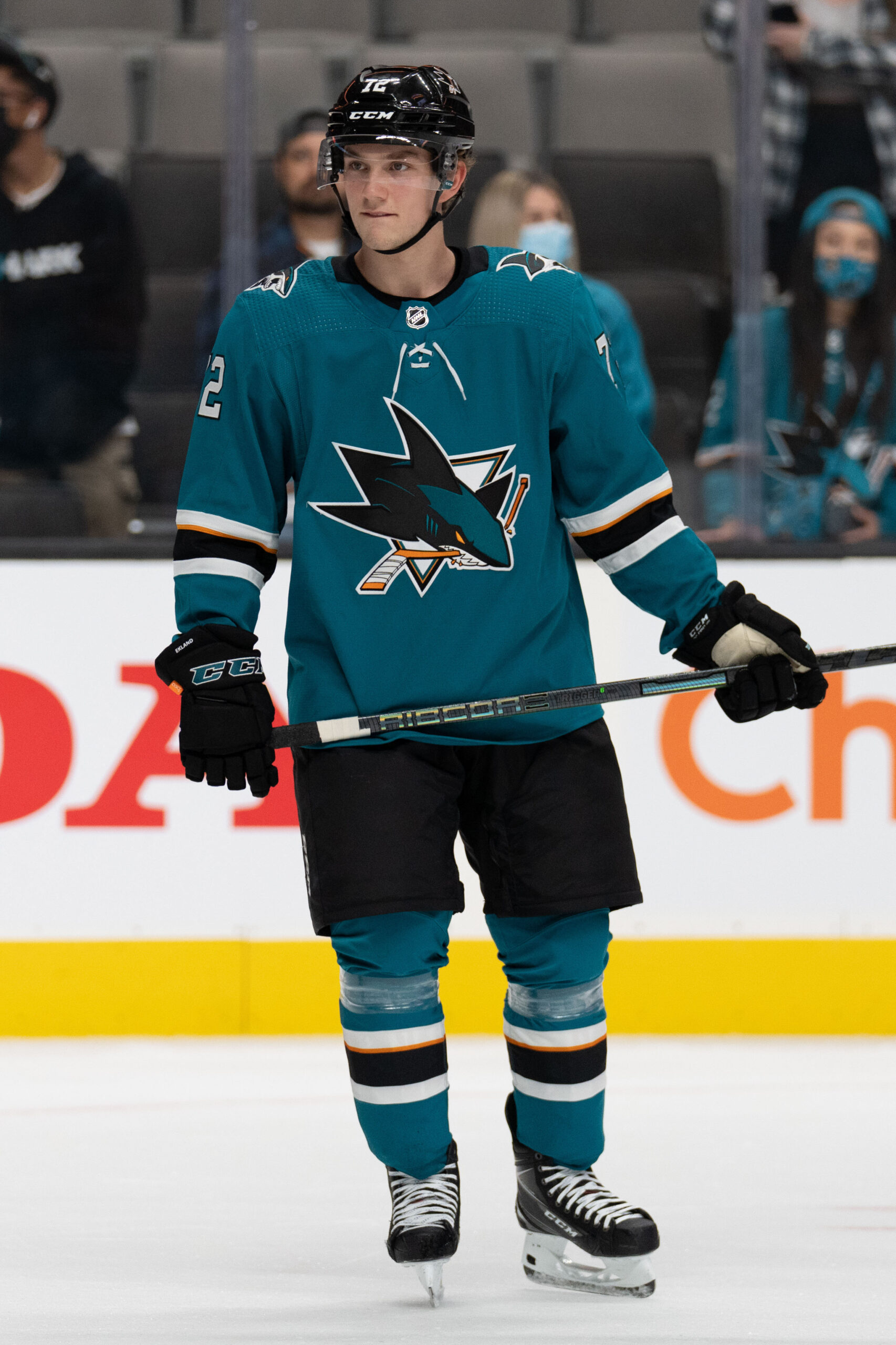
This year, Eklund decided to not play for Djurgarden in Allsvenskan and instead chose to try his luck in the AHL.
That choice has so far paid off, as Eklund has scored 21 points in 29 games, an encouraging total that ranks second on the team in scoring.
Even better than his scoring totals, though, have been Eklund’s development in terms of how he approaches creating offense.
Eklund has shown a greater eagerness to fire shots on net, and his improved shooting ability has led Barracuda head coach John McCarthy to deploy him as a one-timer threat on one of the circles on the Barracuda power play.
Helped by that role, Eklund had a recent stretch where he scored four goals in five games, a hot goal-scoring streak that seemed unthinkable just a year ago. If he can keep up his play, it’s definitely possible and maybe even likely that Eklund finds his way into a top-nine role for the Sharks in the spring.
While Eklund’s growth this season has been extremely encouraging, that’s not the case for Wiesblatt, the Sharks’ 2020 first-rounder. Wiesblatt finished his junior career last season in a relatively disappointing fashion, scoring at below a point-per-game rate in the regular season (41 points in 43 games) and notching just one point in three playoff contests.
He was battling a shoulder injury that eventually led to him being shut down for the season. While the injury he fought through is most definitely not his fault, it does not change the fact that his stock as a top prospect was on a downward trend late in his junior career.
That downward trend was emphasized by the fact that the WHL rival Wiesblatt was drafted closest to, 28th overall pick Ridly Greig, tore the WHL apart to the tune of 63 points in just 39 games. Both Wiesblatt and Greig are high-energy, physical players who attack with strength and tenacity. And yet while they play similar styles, Greig has firmly placed himself on the cusp of making the NHL while Wiesblatt looks headed in the other direction.
Wiesblatt began his professional career in earnest this fall with the Barracuda, albeit the start was delayed as he was a frequent healthy scratch. In late October, Wiesblatt get demoted to the team’s ECHL affiliate, the Wichita Thunder, in an effort to get him playing time. While Wiesblatt didn’t end up playing in the ECHL and was returned to the AHL roster, his inability to secure a regular role on a mediocre Barracuda team is troubling.
Wiesblatt has scored one goal and four points in 15 AHL games this year, operating in a limited role. The Barracuda have stressed patience with Wiesblatt, and a patient approach to his development is entirely fair. He is, after all, coming back from a campaign derailed by injury.
But even while acknowledging the need to be patient, the success of Eklund and fellow 2020 pick Thomas Bordeleau in their respective AHL careers has made feeling a little bit underwhelmed by Wiesblatt’s progress inevitable.
Jamieson Rees, C, Carolina Hurricanes (Chicago, AHL)
24GP 5G 15A 20pts
One of the most significant tests a prospect faces, one that can go a long way in determining whether that prospect truly has NHL upside, is the transition from playing against one’s peers at a junior level to playing against men in a professional setting.
Oftentimes, there are prospects who are able to thrive in a lower-intensity, less difficult junior setting, but find the habits they have built and their tried-and-true ways of playing to be ineffective at the professional level.
After last season, it seemed Rees might be headed in that sort of direction. After scoring at nearly a point-per-game rate in his draft year, Rees was selected 44th overall by Carolina. He followed that up by scoring 61 points in 39 games in his final junior season, but things got more difficult when he turned pro.
Rees turned pro with the AHL’s Chicago Wolves, a team somewhat notorious for their tendency to give premier opportunities to AHL veterans rather than their affiliated NHL club’s prospects. As an independently owned franchise, their choice to view the AHL as a league for winning rather than development is certainly respectable. And it’s worked for them too, as the Wolves are the defending Calder Cup champions.
But from Rees’ perspective, the unique difficulty prospects face in getting top-of-the-lineup opportunities in Chicago didn’t help his development, especially when combined with the injury issues he struggled with as well.
Last season, Rees’ second as a professional, he scored seven goals and 24 points on a stacked Wolves club. It seemed at that time that the 21-year-old prospect may not be able to translate his junior scoring numbers to the pro level. This year, though, the Wolves have struggled to play with the same degree of dominance they had last year, and Rees has gotten a larger opportunity than he’s had in years past.
With 20 points in 24 games, Rees has made the most of this opportunity. It’s definitely fair to wonder if Rees’ prior AHL campaigns could have been similarly successful to this one were he on a more development-oriented team, but it doesn’t appear that the Hurricanes’ management is concerned thinking about that.
Hurricanes assistant GM Darren Yorke spoke on Rees’ progress to The Athletic’s Corey Lavalette, saying: (subscription link)
Rees has battled some tough luck over the course of his amateur career and his pro career in terms of missing some time. And he’s been thrown into a high offensive role now and he’s running with it.
It’s certainly possible that this offensive jump isn’t something Rees is able to sustain and turn into a long-term NHL role. As is the case with all prospects, there remains a fair degree of uncertainty in his overall projection. But Rees’ physical, two-way style and noted ability to agitate and get under his opponents’ skin adds some depth to his profile.
That added dimension of his game sets him apart from some more traditional, straightforward high-scoring junior players, and could be what paves the way for his NHL role in the future.
Nikolai Kovalenko, RW, Colorado Avalanche (Nizhny Novgorod, KHL)
34GP 14G 16A 30pts
In the 2021-22 KHL season, there were just seven skaters with a minimum of 15 games played who managed to score at or above a point-per-game rate. Three of those players all came from the same team, SKA St. Petersburg, and another two were teammates on Dynamo Moscow.
In other words, the KHL is an extremely difficult league to stack points in. The vast majority of teams are led by scorers below the point-per-game threshold, and that difficulty in scoring points regularly is all the more present for players who are young and inexperienced.
So, when a young player comes along and manages to break through that difficulty and put up some impressive numbers, that production alone makes that player at least somewhat notable.
In the case of Kovalenko, the son of former NHLer Andrei Kovalenko, his impressive start to this season has made him one of the most intriguing prospects in a relatively thin Colorado Avalanche system.
Kovalenko spent last season with Ak Bars Kazan, and scored 14 points in 29 games as a 22-year-old KHL-er. Solid numbers, but nothing overwhelmingly impressive. This season, after a trade to Nizhny Novgorod, Kovalenko has made himself into a productive, top-of-the-lineup KHL forward.
The five-foot-ten, 185-pound winger uses his strong work rate and intelligent playmaking style to create offensive opportunities for his teammates, and he’s helped the Torpedo rank as one of the top-scoring teams in the KHL so far this year.
He’s within striking distance of that rarely-reached point-per-game plateau, and even if he doesn’t end up reaching there this season will remain an extremely impressive one. While there are still questions regarding whether Kovalenko’s game is translatable to North American ice, the most pressing issue he faces, from an NHL perspective, is availability.
The Avalanche will certainly want to add such a talented prospect to their organization, but Kovalenko could prefer to remain in the KHL until he is viewed as undoubtedly NHL-ready. It’s not uncommon KHL imports to bristle at the thought of spending major time in the minors, so one wonders if Kovalenko would rather remain in Russia than risk having to spend time with the AHL’s Colorado Eagles.
At this point, though, we don’t have any firm indication on which way Kovalenko is leaning, or when his KHL contract might expire, allowing the Avalanche to make their pitch to sign him.
What we do know, though, is that Kovalenko’s play this year has definitively raised his stock as a prospect, and that alone should be enough to keep Avalanche fans satisfied as we move deeper into the heart of the regular season.
Picture courtesy of USA Today Sports Images
What Your Team Is Thankful For: San Jose Sharks
As we approach the end of the year, PHR continues its look at what teams are thankful for in 2022-23. There also might be a few things your team would like down the road. We’ll examine what’s gone well in the early going and what could improve as the season rolls on for the San Jose Sharks.
Who are the Sharks thankful for?
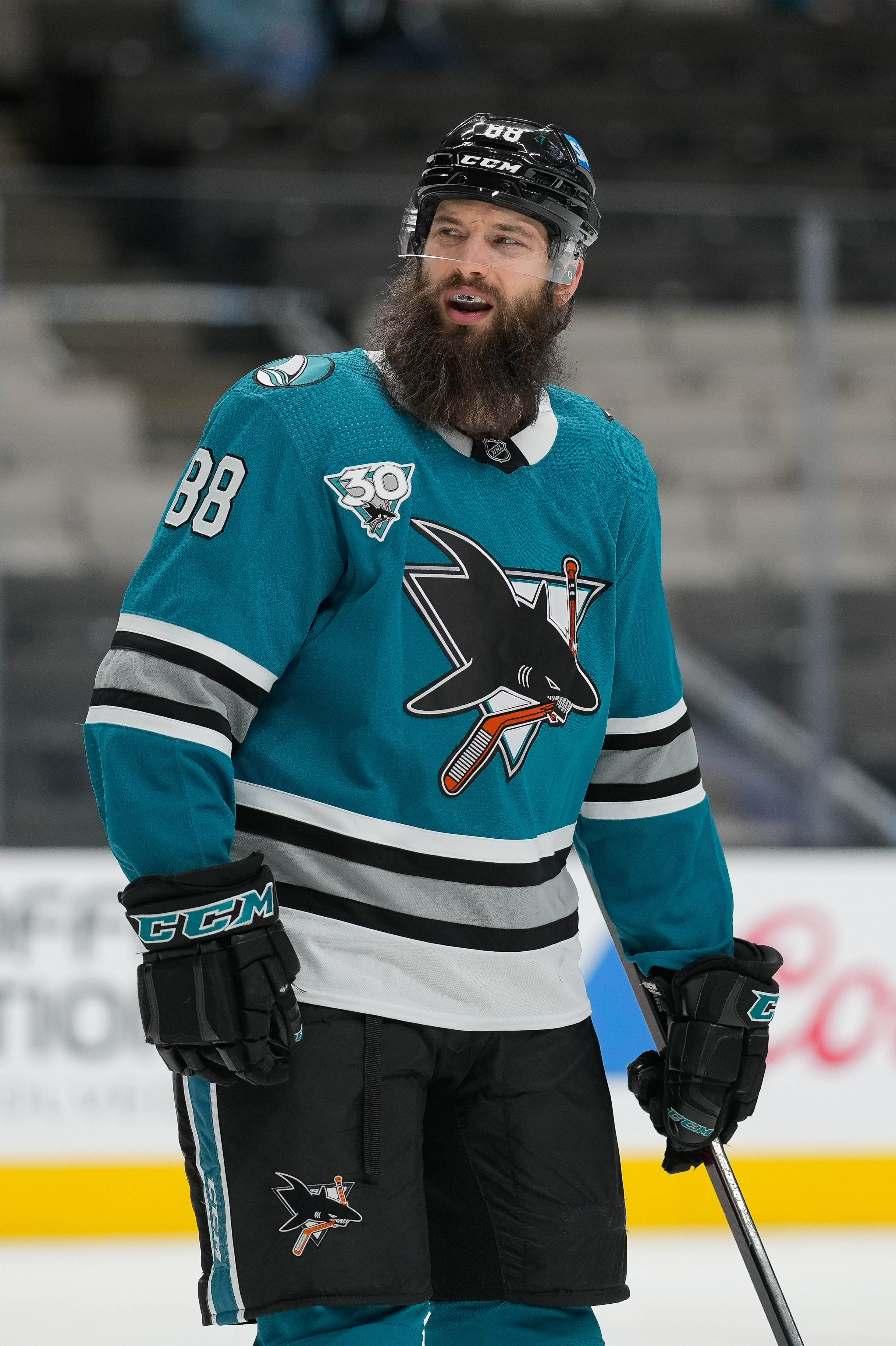
Wait, a team at the bottom of the standings is most thankful for an aging defenseman that makes $11.5MM a season? Well, there isn’t a lot of competition in San Jose these days. The Sharks probably aren’t very happy with the trade that brought him in or the extension that he signed when he arrived. The team would probably be in a much better place without ever getting Karlsson in the first place.
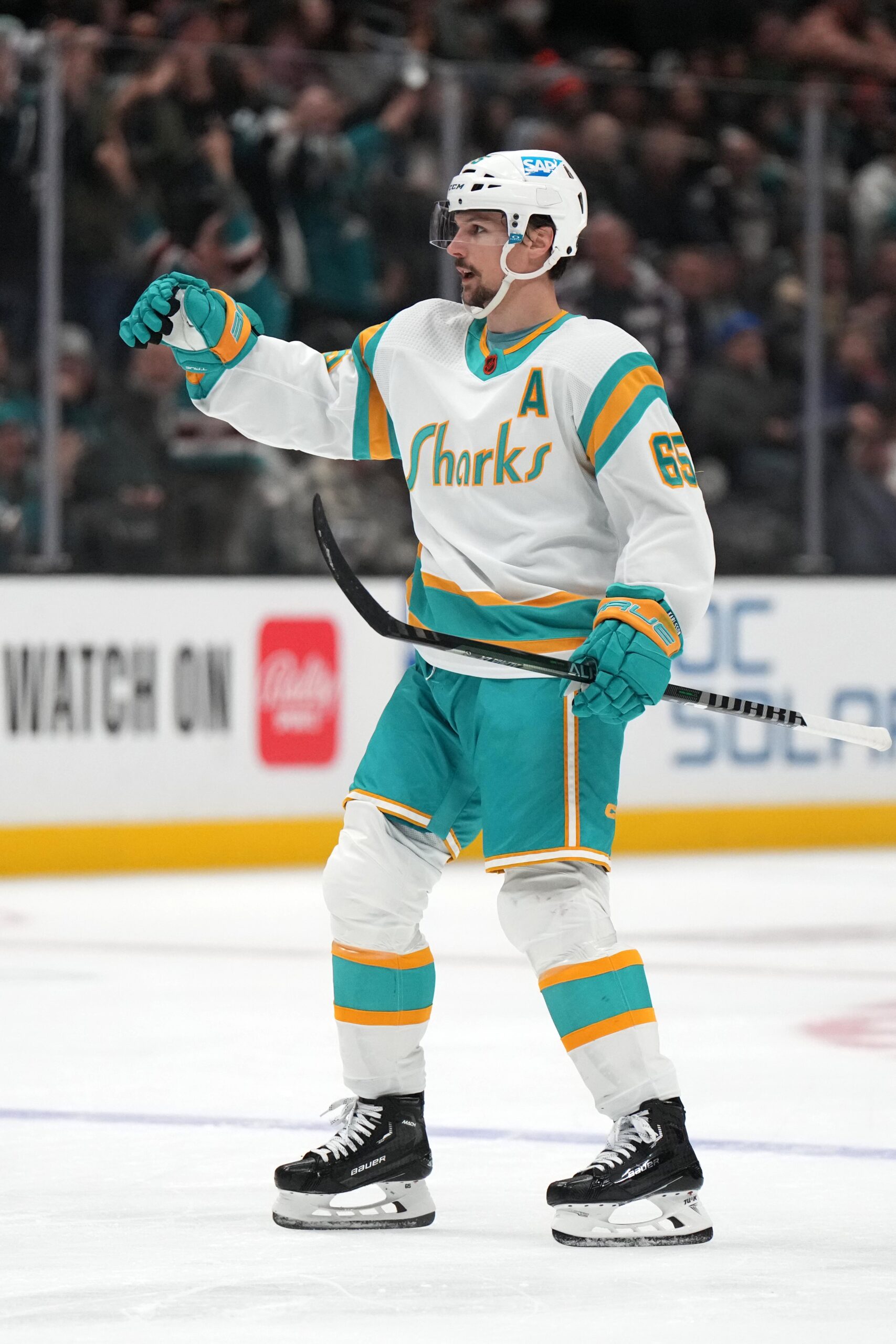 But his play this year has given them a sliver of light at the end of the tunnel. The 32-year-old defenseman has 42 points in 34 games (including an active eight-game point streak) and is playing more than 25 minutes a night for the Sharks. That has potentially opened up the possibility of a trade at some point, allowing them to get out from under the last few years of his contract.
It still will be a complicated move to pull off, but general manager Mike Grier has admitted he would listen to proposals and Karlsson is making sure people don’t forget that there was a time he was considered the best defenseman in the world. In a recent interview on Hockey Night in Canada, he promised that he still has “lots of years left” in his career.
What are the Sharks thankful for?
A rising salary cap ceiling.
Over the last couple of years, there hasn’t been anyone in a worse financial situation than the Sharks. The team was playing poorly, and yet they were locked into a number of long-term expensive contracts for aging players. It looked like they would just have to wait it out, struggling to put a competitive team on the ice for years.
But there is a chance that won’t be the case. Not only has Karlsson’s play created a chance (however small) of trading his deal, but the team has found other ways to shed salary as well. Evander Kane‘s contract was terminated, Martin Jones was bought out, and they moved most of Brent Burns‘ deal in an offseason trade.
They’re still not out of the woods. Tomas Hertl just re-signed, Timo Meier has a huge qualifying offer due, and Marc-Eduoard Vlasic still has three more seasons on his deal at $7MM. But there is at least a little breathing room, and a cap increase would only help matters.
What would the Sharks be even more thankful for?
A concrete front office direction.
The biggest problem is that for years now, the Sharks have avoided the idea of a rebuild entirely. They are stuck somewhere in the middle of buying and selling, all to the detriment of the on-ice product. Take two of the biggest moves the team has done in the past year, for instance.
In March, after deciding to hold onto him through the trade deadline, they signed Tomas Hertl to an eight-year, $65.1MM contract that keeps him in town until 2030 – essentially the rest of his career. But then a few months later they trade Burns, and retain 34% of his contract, in exchange for future assets.
Those two moves seem completely at odds with each other. One is made by a team that believes it can compete, and another is by a rebuilding club that wants to move on from older players and start collecting draft picks.
They now have another chance to point out a direction for their franchise with Meier. The 26-year-old is in the final season of a four-year bridge deal he signed in 2019 and is due a $10MM qualifying offer in the summer. Any long-term extension would be expensive because of that leverage, but he would still be a very attractive asset for contenders at the deadline looking to upgrade their top six. Does San Jose trade him, move on and start the rebuild? Or still believe they can compete with this core, and bring Meier back as they did with Hertl last year?
Whatever it is, Sharks fans are dying for some consistent direction. A plan.
What should be on the Sharks holiday wishlist?
A young defenseman.
If they are able to make some trades at the deadline, the Sharks should be targeting draft picks and young defensemen. They already have a number of interesting young forward prospects, led by William Eklund, Thomas Bordeleau, and Filip Bystedt. But it’s been a while since they had a real star defensive prospect to build around. Mario Ferraro is young enough that he can be part of the solution, but no other defenseman on the roster is under the age of 28.
Photo courtesy of USA Today Sports Images
What Your Team Is Thankful For: Pittsburgh Penguins
As we approach the end of the year, PHR continues its look at what teams are thankful for in 2022-23. There also might be a few things your team would like down the road. We’ll examine what’s gone well in the early going and what could improve as the season rolls on for the Pittsburgh Penguins.
Who are the Penguins thankful for?
The Penguins wouldn’t be the Penguins without Sidney Crosby and Evgeni Malkin leading the way, and this season is no different. The two Pittsburgh legends are first and second in team scoring with 40 and 32 points respectively through 31 games.
But you don’t get back to the pinnacle of hockey with only players selected at the very top of the draft. Any team in Pittsburgh’s place would have picked those two – it is lesser-known talents that are drafted and developed that can really push a roster over the top.
Enter Guentzel, the 77th pick of the 2013 draft and still – nearly ten years later – one of the most underrated players in the NHL. Often included as an extra forward (or left off entirely) when projecting a potential U.S. Olympic team, this two-time 40-goal scorer is one of the most consistent offensive pieces in the league. 
It’s not like that is new, either. From the moment he arrived in Pittsburgh he has been putting the puck into the net or helping his linemates do the same, and his 0.93 points/game rate since his debut is good for 28th in the entire league. He’s 21st over that same stretch in total goals, despite playing only 402 games (Phil Kessel, the league’s iron man, has played 488 for comparison).
Penguins fans thank the lottery balls for getting Crosby every day. But there’s another star on the roster that they’re even luckier to have.
What are the Penguins thankful for?
The health of Kris Letang.
There aren’t all that many medical terms scarier than stroke. When news broke last month that Letang had suffered his second in eight years, many fans (and not just those who root for the Penguins) weren’t thinking of his playing future, but his quality of life. Who cares if he gets back on the ice – will he be able to raise his kids?
Incredibly, Letang not only recovered quickly but was on the ice just a few days later, preparing to return to the lineup. He did just that on December 10 and was back to playing 28 minutes in Sunday’s game against the Carolina Hurricanes.
The Penguins’ doctors have determined that hockey doesn’t increase the risk of future events and that his issue – born with a hole in his heart that didn’t close, as it does for most – wasn’t caused by playing the sport at a high level.
But we can still only marvel at the fact that he was back on the ice so soon, if only because of the mental strain that something like this would cause most people.
What would the Penguins be even more thankful for?
A consistent Kasperi Kapanen.
There is no one that should doubt Kapanen’s raw skill at this point. If you watch him for long enough, you’ll see a moment or two when he looks like he could stand among the true stars in the league. Brilliant speed, enough size and strength to protect the puck, and a hard, quick shot – Kapanen should be able to flourish in a top-six role next to Crosby or Malkin and become a key part of the Penguins attack.
Except it just doesn’t work, not often enough anyway.
The 26-year-old has been a frustratingly inconsistent player for his whole NHL career and has ended up in the press box several times this season. That is reasonable for a depth forward still trying to find his way in the league but the Penguins re-signed Kapanen to a two-year, $6.4MM contract in the summer that cemented him as a piece that they should be able to rely on.
If somehow they are able to coax a more consistent player out of Kapanen, their forward group would be much more difficult to contain. He does have eight points through eight games in December, but there’s no way to know when he’ll drop off the map completely again. That’s a scary proposition for a team that needs to be efficiently spending every salary cap dollar it has while Crosby, Malkin, and Letang are still good enough to contend for a Stanley Cup.
What should be on the Penguins’ holiday wishlist?
A third line center.
‘Didn’t they just re-sign Jeff Carter?’ you might be asking. Yes, but through 28 games he is showing more and more of his age (he’ll turn 38 on January 1), and it’s holding the team back. Carter has just two goals in his last 24 games and four on the year, leading to head coach Mike Sullivan dropping his ice time significantly.
After playing nearly 18 minutes a night for the Penguins last season, Carter is down to 14:30 in 2022-23 and is averaging fewer than 13 minutes over his last seven games.
By acquiring a legitimate difference-maker to slot into that third-line pivot role, Carter could slide over to the wing while still helping out on faceoffs. The Penguins have always been their best when they can roll out another line behind Crosby and Malkin to keep the pressure on an opponent, and right now that’s not really the case.
This is of course assuming that Jeff Petry can return to full health. If not, defense might end up being an even more important position to shore up given how much he and Letang have been asked to do so far. That said, cap space will be limited (especially when Petry returns) so the team will have to be creative with how they approach the trade deadline and may only be able to address one or the other.
Photo courtesy of USA Today Sports Images