
Devils Offered Tomáš Tatar A One Year Contract
Colorado Avalanche forward Tomáš Tatar lingered in free agency peril for most of the summer before he finally signed a one-year deal with the team for $1.5MM. However, he recently told the Boris a Brambor Podcast that the New Jersey Devils had offered him a one-year contract earlier in the offseason.
When discussing the one-year offer from the Devils, Tatar said he wanted more term from the Devils when they made their offer, but only realized later in free agency that a multi-year deal wasn’t possible. By the time he’d changed his mind, the Devils had already acquired forward Tyler Toffoli from the Calgary Flames, making his return to New Jersey improbable.
Given Tatar’s timeline of events, it seems likely the Devils made their offer prior to June 27th when Toffoli was dealt to New Jersey. It’s hard to fault Tatar for thinking he could get a multi-year deal as he was coming off a good season in which he scored 20 goals and 28 assists in 82 games. His run-in free agency was one of the more puzzling things that happened this summer in hockey as he didn’t come close to getting the contract that many pundits predicted he would. The Athletic had Tatar projected to receive a three-year contract with an average annual value of $3.9MM but the flat cap and an underwhelming playoff hurt his earning potential.
Tatar’s situation is not unlike that of Evan Rodrigues last summer, he also signed with Colorado on a one-year deal after lingering in free agency for quite a while. Rodrigues signed a four-year $12MM contract this year with the Florida Panthers, something that Tatar could mimic next summer if he has another good year.
Free agency is often a guessing game, and it is sometimes hard to project who will take a one-year deal and who can get term. Many people were blindsided by which players received term on their new deals (Ryan Reaves) and which players took one-year deals (Jason Zucker). But with the flat cap, free agency has become harder than ever as evidenced by a useful middle six forward like Tatar going more than two months unsigned.
Latest On The Jake DeBrusk Contract Situation
Ty Anderson of 98.5 The Sports Hub wrote the latest on the Boston Bruins contract negotiations with pending unrestricted free agent forward Jake DeBrusk. Bruins General Manager Don Sweeney spoke with the media today and did little to hide the fact that the Bruins would like to re-sign the 26-year-old to a long-term contract extension.
Sweeney told reporters that the club would like to see DeBrusk remain with the Bruins and will continue to engage with him and his agent in hopes of finding common ground on an extension. The Bruins are tight to the cap for this upcoming season but at the moment are slated to have $28.5MM available in cap space (CapFriendly) next summer before any cap increases. Sweeney’s comments echo what DeBrusk told NHL.com Staff Writer Derek Van Diest back in August when he said he would like to remain in Boston long-term.
Given where both sides appear to be it seems likely that a deal can be reached, which would take one item off Boston’s to-do list over the next year. The Bruins will enter this season with tempered expectations after winning the President’s Trophy last season and suffering a historical upset at the hands of the Florida Panthers. Boston lost a lot of pieces to free agency and retirement and will have far less depth than they did last year.
The DeBrusk situation could have a happy ending after the relationship between the player and the club appeared rocky just a short time ago. Back in November of 2021, DeBrusk was benched by former Bruins coach Bruce Cassidy, and this prompted DeBrusk to request a trade. He eventually rescinded his trade request and had a terrific bounce-back last season posting 27 goals and 23 assists in 64 games.
Lightning Haven’t Spoken To Stamkos About Contract Extension
Tampa Bay Lightning captain Steven Stamkos had a frank interview with reporters that appeared on Sportsnet today. In the interview, Stamkos tells reporters that he and the team have yet to start discussions on an extension to his expiring contract. The interview created a buzz and even led Lightning General Manager Julien BriseBois to respond with an interview of his own.
The 33-year-old Stamkos is set to begin his 16th season with the club and is coming off back-to-back productive seasons after he was slowed by injuries for a few years. Stamkos posted 34 goals and 50 assists last season in 81 games and was even better the year before posting 42 goals and 64 assists in 81 games.
It’s no surprise that Stamkos is looking for long-term security after taking a big discount on his last contract to remain in Tampa Bay. Back in June 2016 Stamkos signed an eight-year $68MM extension to remain in Tampa Bay and opted to forego unrestricted free agency. The contract turned out to be a win-win as Stamkos was able to raise the Stanley Cup twice with the Lightning and the team was able to keep their captain at a bargain.
Also of little surprise are Stamkos’ feelings about the situation, Tampa Bay typically engages the players they want to extend well before the completion of their existing deals. This has been modus operandi in the past, and it begs the question as to whether or not they want to extend Stamkos at all.
From Tampa’s perspective, BriseBois was frank with Tampa Bay beat reporter Chris Krenn saying that he wanted to see the season play out before making a decision on Stamkos’ future. He also added that after the season he would work with Stamkos and his agent to hammer out a deal that works for all parties involved.
It should be an interesting season in Tampa Bay as the Lightning are coming off a season in which they took a big step back and were eliminated in the first round of the playoffs by the Toronto Maple Leafs. The Lightning looked tired at times after three straight runs to the Stanley Cup final, but should be rested this season after a long summer.
Who Will Be The NHL’s Next Highest Paid Player?
Auston Matthews recent extension with the Toronto Maple Leafs has earned him the title of highest-paid player in the NHL. His new deal doesn’t kick in until 2024-25, but at that point, he will make an average annual salary of $13.25MM (CapFriendly) per season for four years. Prior to his new deal, Matthews was the fourth highest-paid player in the game behind Nathan MacKinnon, Connor McDavid and Artemi Panarin.
MacKinnon’s new eight-year $100.8MM deal kicks in this season which will make him the highest-paid player in the league at $12.6MM for this year. His actual salary is much higher than his cap hit at $16.5MM, but the final four years of his deal will back-dive to $9.9MM in salary. McDavid has three years left on his current deal with a cap hit of $12.5MM while Panarin’s deal also concludes in three seasons and pays him $11.642MM annually.
With Matthews having topped MacKinnon’s new extension by over $600K annually the question now becomes, who will be the NHL’s next highest-paid player?
Connor McDavid – McDavid is the obvious answer. He is arguably the best player in the game and undoubtedly the best player in the world with the puck on his stick. The Richmond Hill, Ontario native will be 29 years old when he reaches unrestricted free agency and could essentially ask teams for a blank check and fill in the maximum salary under the salary cap. That is if he remains the best player in the world. While it seems hard to believe there is a world in which McDavid isn’t the game’s most explosive player, three years is a long time, and in hockey, it can be an eternity. There is also another Connor who could be the one to top Matthews’ extension.
Connor Bedard – It seems crazy that Bedard has yet to play a minute in the NHL and he could conceivably be the next highest-paid player in the NHL. But it could happen. Bedard signed his three-year entry-level contract with the Chicago Blackhawks on July 17th and should be a lock to make their opening night lineup. He will become a restricted free agent in 2026, the same time that McDavid becomes a UFA. It is fair to wonder how Bedard will produce once he is playing against men in the NHL, especially given that he will be playing on a bad Blackhawks team that will have its struggles. But he dominated the WHL with 71 goals and 72 assists in 57 games and obliterated the competition at the World Junior Championships with nine goals and 14 assists in 7 games. He’s a phenom, and in three years he could be paid like one.
Leon Draisaitl – Draisaitl has been one of the best bargains in the NHL since signing his eight-year $68MM contract back in August of 2017. All he has done during his six years under this contract is score 50+ goals three times, top 100 points four times, and win a Hart Trophy as well as an Art Ross Trophy. At 27-years-old Draisaitl is coming off the best season of his career having posted 52 goals and 76 assists in 80 games.
All things considered, it seems likely that Draisaitl will top Matthews’ contract two seasons from now when he becomes an unrestricted free agent. The native of Cologne, Germany will be 29 years old, and the salary cap should go up substantially between now and then positioning him to cash in big with any team of his choosing. Draisaitl will likely hold onto that distinction for just one season as McDavid and Bedard will be following right behind him and could top Draisaitl to earn the title of the highest-paid player in the NHL.
Arizona Coyotes Extend Bill Armstrong
The Arizona Coyotes announced this morning that they have extended the contract of general manager Bill Armstrong. Financial terms and the length of the multi-year agreement were not released. The deal comes on the heels of what was a very busy summer for Armstrong and the Coyotes as they have added a lot of talent to their NHL roster including veterans Jason Zucker, Matt Dumba, Sean Durzi, Alexander Kerfoot and Nick Bjugstad.
PHNX Sports’ Craig Morgan later reported Armstrong is now under contract for six more seasons – Armstrong signed a four-year extension, while the team picked up a previously existing option for 2024-25. He’s now under contract through the 2028-29 campaign.
The 53-year-old has been the Coyotes general manager since the 2020-21 season and has overseen a rather large rebuild during that time. Armstrong essentially stripped the Coyotes roster down to the studs and rebuilt it through drafting, trades, and free agency. Prior to joining Arizona, the Richmond Hill, Ontario, native worked in the St. Louis Blues’ scouting department from 2004-18. It wasn’t until the 2018-19 season that he earned a promotion to assistant GM before eventually joining Arizona.
The Coyotes have not qualified for the playoffs since Armstrong took over, and the team has only made the playoffs a total of four times since 2004. While they are once again going through a lean period, Arizona looks to be on the verge of a good run of hockey in the desert. Should they stay there.
The team will likely get a jolt from this summer’s signings and trades as well as top prospect Logan Cooley, who could be a difference-maker in Arizona as early as this season.
The signing of the coaching staff, Armstrong, and the player acquisitions this summer show stability within the hockey operations of Arizona, even if the team’s future off the ice is up in the air.
Jake Debrusk Wants To Stay With Boston Bruins
Boston Bruins winger Jake DeBrusk reportedly wants to stay with the team beyond this season as he is set to become a free agent on July 1st of next year. NHL.com Staff Writer Derek Van Diest writes that the 26-year-old told reporters at the Perry Pearn 3 vs. 3 Hockey Camp that he is hoping to stay with the team that he grew up with.
It’s a departure from how the former first-round pick felt about his future just a short time ago. DeBrusk requested a trade from the Bruins in November of 2021 after he was benched by former Bruins coach Bruce Cassidy. He eventually had a change of heart and rescinded his request in 2022. Through all the ups and downs Bruins management supported DeBrusk, as did his teammates.
Last year DeBrusk rewarded the team’s support with the best season of his NHL career. He set career highs with 27 goals and 23 assists in 64 games while posting a +26. It was night and day with his 2020-21 season where he posted career lows with just five goals and nine assists in 41 games.
The Bruins have seen a lot of players depart from the team that won an NHL record 65 games last season. Gone are Patrice Bergeron, David Krejci, Tyler Bertuzzi and Dmitry Orlov, and while most teams would struggle to overcome those kinds of losses, the Bruins should be able to remain competitive.
Part of remaining competitive will be to extend their upcoming free agents starting with DeBrusk. The Edmonton, Alberta native has made it clear he wants to stay, but what will his extension look like? A lot of comparisons to Brandon Hagel have been thrown around since he signed his new deal last week. However, Hagel is almost two years younger and put up 30 goals and 34 assists this past season in 81 games. On the flip side, DeBrusk has a longer track record of success and is set to hit unrestricted free agency.
While the players aren’t a mirror image of one another, Hagel’s contract is a pretty good comparison for the Bruins and DeBrusk to utilize as a framework for an extension that both sides appear eager to sign.
Free Agent Profile: Zack Kassian
Zack Kassian had one of the lowest-scoring seasons we’ve seen in quite some time as he put up just two goals last season in 51 games with the Arizona Coyotes. This prompted Arizona to buy out the 32-year-old forward prior to free agency in a move that made sense, given the lack of production from the former 13th overall pick. Kassian lasted just a single season in the desert and never really seemed comfortable playing on a very bad Coyotes team.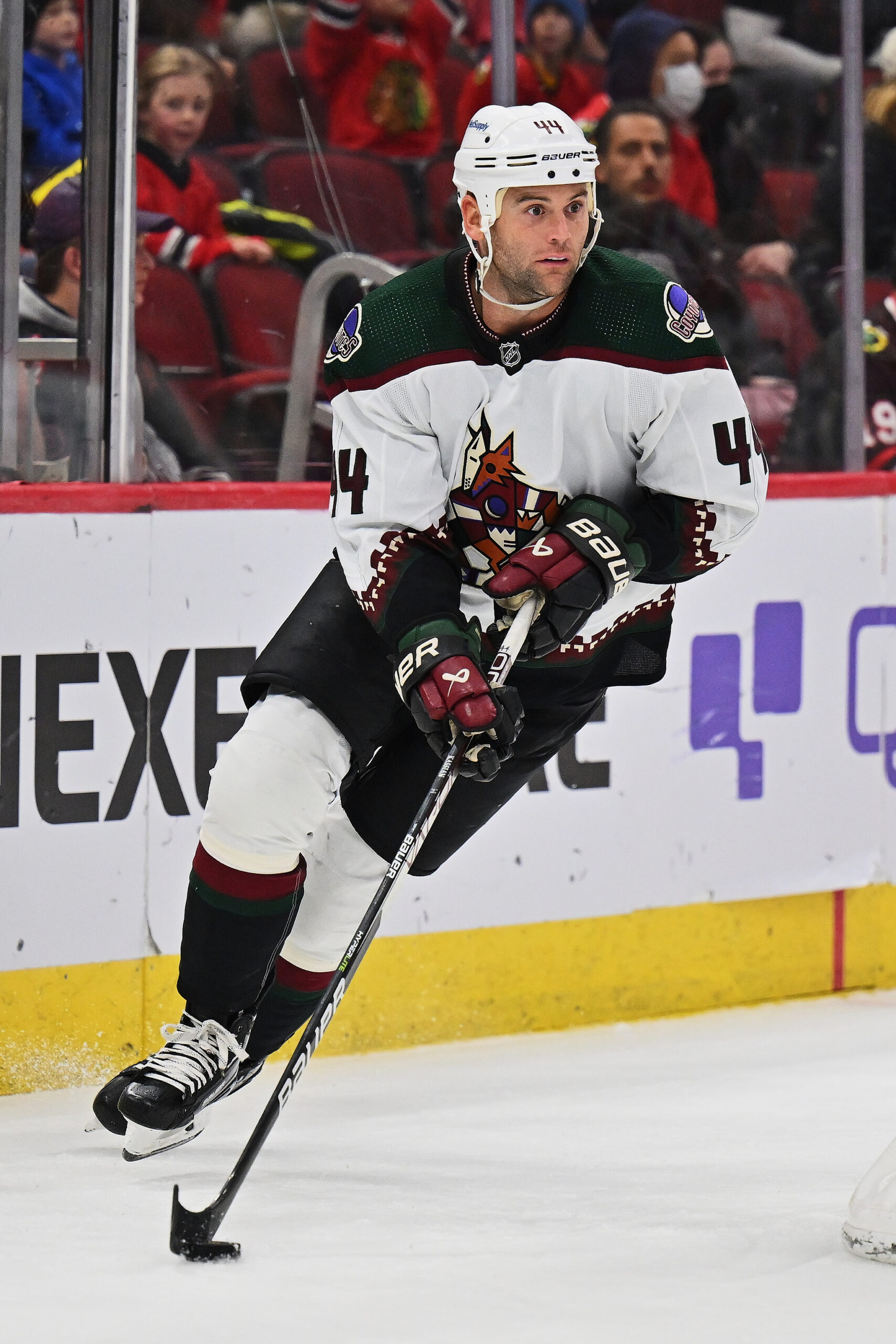
This is Kassian’s first crack at free agency and unfortunately for him he is coming off a season in which he posted career lows in many statistical categories. As mentioned earlier, he had just two points on the season, and posted a -18. His hitting was way down, which is one of the facets of the game he typically excels in. Kassian threw just 32 hits in 51 games last season, a dramatic drop from the 158 he threw the year prior with the Edmonton Oilers in 58 games. It’s not uncommon for physical players to see a decline in their 30’s, but the decline generally isn’t that steep.
Kassian deserves a ton of credit for battling several off-ice issues and resurrecting his career when it looked like it could be in trouble. At one point in 2015 Kassian bounced from Vancouver to Montreal to Edmonton in less than six months and looked like he could be out of the league. But, to his credit, he turned it around and even managed to post career highs in 2019-20 when he potted 15 goals to go along with 19 assists in 59 games. This run of good play prompted the Oilers to sign Kassian to a four-year contract extension in January 2020 worth $3.2MM annually. Unfortunately for the club and the player, Kassian struggled through the pandemic shortened 2020-21 season and hasn’t regained his footing ever since. Over the past three seasons combined Kassian has posted just 10 goals and 16 assists in 136 games, a drastic decline from his 2019-2020 numbers. The other issue that will work against Kassian is that he is strictly a 5 on 5 player. He has never been a regular contributor on the power play and hasn’t been a regular part of a penalty kill since 2018-19.
In a normal cap world, Kassian would have played out the final season of his contract with a salary that is well below his cap hit but given how poor his play was Arizona opted to move on and spread out that cost over two seasons.
Despite his struggles last season, it is still likely that Kassian will get an opportunity when training camps open in a few weeks. Teams are always looking for physical players, especially ones who can take a regular shift and will play under a reduced cap hit. Kassian checks all those boxes, which is a good indication that someone will give the Windsor, Ontario native a look to see if he still has anything to offer.
Stats
2022-23: 51 GP, 2-0-0, -18 rating, 50 PIMS, 25 shots, 37.5% faceoffs, 38.4% CF, 9:09 ATOI
Career: 661 GP, 92-111-203, -55 rating, 913 PIMS, 798 shots, 31.0% faceoffs, 48.2% CF, 12:37 ATOI
Potential Suitors
Kassian is still chasing hockey’s ultimate prize, the Stanley Cup. And after spending a dozen years in the league, he would probably prefer to spend his time chasing a championship with a Stanley Cup contender. However, given his status as a fringe NHLer at the moment, he likely won’t have the opportunity to be choosey. That doesn’t mean he won’t have a suitor, but it could mean that he would be playing on a weaker team, or a team that has a borderline chance of making the playoffs. But anything can happen, and even players that are past their best before date can catch on with good teams when it is least expected.
Let’s start out West in Edmonton. Kassian found his game almost eight years ago when it looked like his career was hanging on by a thread. It was there that he turned his intensity and physicality into effective NHL minutes on a team that was competitive for most of his run there. Kassian brought an edge that the Oilers severely lacked and gave them an option that they could plug almost anywhere in their lineup. But that was then, and this is now, and Kassian isn’t that player anymore. His body has broken down, as per normal with physical players when they hit the wrong side of 30. But Kassian could still help Edmonton, and it feels like the Oilers are always looking for bodies up front. Kassian couldn’t play in Edmonton’s top-9, but he could be a could fill-in for their fourth line if they aren’t able to find help between now and the start of the regular season.
Sticking with the West, the Colorado Avalanche were riddled with injuries last season. So much so that it looked like they might miss the playoffs entirely, however, a late-season rally secured their spot in the round of 16. But it was there that they were physically dominated by the Seattle Kraken and ousted in an exhilarating seventh game. The Avalanche were one of the lightest-hitting teams in the NHL last season, which on the surface isn’t the big of a deal given how skilled they are. However, the regular season and the playoffs are two different things and Colorado didn’t have an answer for Seattle in the postseason and really missed some of the grit they lost when Nazim Kadri departed last summer. Now, Zack Kassian is far from the answer to that problem, but he can offer Colorado something that is in short supply in their group, and it wouldn’t cost them more than a contract slot and a league minimum contract.
Finally, in the East, one team that could use a depth physical forward is the Buffalo Sabres. Coincidently, the team that took Kassian in the first round of the NHL entry draft some 14 years ago. The Sabres have a competent fourth line at the moment with Tyson Jost centering Kyle Okposo and Zemgus Girgensons, but injuries happen (see Jack Quinn), and Kassian could provide insurance to their Sabres if they were to lose any additional depth up front. The Sabres were also a team that didn’t throw the body around all that often-last year and with the talent that they have up front, they could likely place Kassian into a role that wouldn’t overextend him and could allow him to perhaps resurrect his career once again.
Projected Contract
Kassian enters free agency at a time when his free agent stock is very damaged. And while he has his shortcomings, he still offers a rare combination of physicality mixed with a bit of skill and could find success when he is sheltered in the right situation.
At this point in his career Kassian would be lucky to get a one-way contract for the league minimum of $775K. The most likely outcome for him will be a PTO with a team that is looking to add a 13th forward that offers some sandpaper and can chip in on the fourth line when a regular falls out of the lineup. A role like that would allow Kassian to play to his strengths and would offer longer windows of recovery for an aging player who has been banged up from years of throwing his body around with reckless abandon.
Photo courtesy of USA Today Sports Images.
Arizona Coyotes Extend André Tourigny
August 23: Arizona has confirmed Tourigny’s extension, which lasts for three years.
August 22: Craig Morgan of PHNX Sports is reporting that the Arizona Coyotes have officially signed head coach André Tourigny to a contract extension. It was reported earlier this month that the two sides were involved in negotiations and that a deal was close, but sources now tell Morgan it is completed.
At the time of the negotiations, Morgan reported that the holdup was Tourigny’s desire to get extensions in place for his coaching staff as well as himself – something that has reportedly been accomplished as the Coyotes have also locked up John Madden, Mario Duhamel and goalie coach Corey Schwab to extensions.
A native of Trois-Rivières, Quebec, Tourigny is about to embark on his third season at the helm of the Coyotes. And while his 53-90-21 record with Arizona is ugly on the surface, he has been guiding a roster that largely consists of prospects and castoffs. But record aside, Tourigny has done a good job keeping the group competitive on most nights and fostering a culture that must be positive given that several players who have been traded away previously have elected to return when they hit free agency.
No terms of the new contract have been released, but it should make the upcoming season more comfortable for Tourigny and his staff as they start a season where there will be expectations on the club to win some games. Arizona has been one of the busier teams in the off-season, swinging a trade for Sean Durzi and signing Jason Zucker, Alexander Kerfoot, Matt Dumba, and Nick Bjugstad.
Tourigny hasn’t had pressure to win thus far in his reign as the head coach of the Coyotes, but with a new contract in hand, and some serious depth added to the lineup, the pressure will begin to mount for Tourigny and Arizona to win some games.
Can The Pittsburgh Penguins Actually Sign Tomas Tatar?
There aren’t many impact unsigned free agents remaining at this point in the offseason, but one name of note is forward Tomas Tatar. Tatar has been linked to several teams, including the Buffalo Sabres as an inexpensive replacement for the injured Jack Quinn. One team that popped up in the rumor mill last week was the Pittsburgh Penguins. Rob Rossi of The Athletic wrote that the Penguins were keenly interested but it all came down to whether Tatar would get a guaranteed contract offer elsewhere as the Penguins appeared to be offering a PTO for training camp in Pittsburgh with the expectation of a contract after. But can the Penguins realistically fit in another contract for a player coming off a season in which he scored 20 goals and 28 assists in 82 games?
In most off-seasons, the answer to that question would be an emphatic no. But the summer of 2023 has been unlike any other offseason. Players like Blake Wheeler have signed for less than $1MM annually. Matt Duchene took a one-year contract for $3MM despite being a year removed from topping 80 points, and Tatar remains unsigned despite providing consistent secondary scoring.
But all of this doesn’t necessarily mean the answer is a resounding yes, the Penguins would need to do some cap gymnastics to fit Tatar into the sliver of room they have under the salary cap ceiling. Currently, the Penguins have just north of $220K, which is obviously well below the NHL minimum.
Penguins general manager Kyle Dubas has said previously that he would use waivers as a means of becoming cap compliant, and the Penguins have plenty of players who could be placed on waivers to open up room for Tatar. Alexander Nylander and Rem Pitlick are two players that could be exposed and sent to the AHL to open up the room, but would that be enough to sign Tatar? The answer is a giant unknown at this time, but as we inch closer to training camp it becomes more and more possible.
Dan Kingerski of Pittsburgh Hockey Now explored another idea in an article as he wondered if a potential Jeff Carter trade would be possible. The 38-year-old London, Ontario native is in the final year of his contract with a cap hit of $3.125MM and is coming off a season in which he scored just 13 goals and 16 assists in 79 games and looked lost at times both offensively and defensively. Kingerski provides options in the article, the most interesting of which would have the Penguins retain 50% of Carter’s contract and staple a second-round pick to him to facilitate a move. While this scenario seems possible, the biggest caveat to a potential deal would be Carter’s full no-movement clause. Given all these moving parts, it seems unlikely any contending team would have room to take on even half of Carter’s cap hit and even less likely that Carter would waive his no-move to make it happen. Kyle Dubas has worked one miracle this summer in moving out Jeff Petry and Mikael Granlund for Erik Karlsson, but can he make another one happen?
Much like the Karlsson situation it feels like the longer this drags out the likelier it becomes the player ends up with the Penguins. But to make it happen Tatar is going to have to take a massive pay cut and perhaps accept just a one-year contract. A far cry from the $3.3MM annually that Daily Faceoff projected he would get on a three-year deal when free agency opened.
Trade Market Quiet For Noah Hanifin
It appears that the holdup for a potential Noah Hanifin trade has been due to an underwhelming trade market. This comes from Sportsnet 960’s Pat Steinberg who also reported a few days ago that the trade market had been soft this summer for one of the Calgary Flames’ other trade chips Mikael Backlund.
Both Backlund and Hanifin will be free agents next summer, and while Backlund expressed an interest in seeing the season play out before signing an extension, Hanifin has said he doesn’t plan to sign a deal to extend his stay in Calgary.
Under normal circumstances, a 26-year-old first-pairing defenseman would be highly coveted, but as Steinberg reports, the Flames just haven’t received any strong offers. The Pittsburgh Penguins reportedly had interest earlier in the summer, but nothing ever materialized on the trade front, and given their pursuit of Erik Karlsson one must wonder if Penguins general manager used Calgary as leverage to get a better deal for Pittsburgh.
Lyle Richardson of The Hockey News wrote today that when the deal for Karlsson happened there was an expectation that there would be movement on the Hanifin front, but it has yet to materialize. He also speculates that perhaps the Flames will keep the rearguard until the March trade deadline when more teams will have accrued cap space due to injuries.
On the ice, Hanifin has been everything Calgary could have hoped for when they acquired him from the Carolina Hurricanes in a 2018 trade. He has averaged over 21 minutes a night during his time in Calgary and has put up 31 goals and 125 assists in 359 games with the Flames. Any potential team that acquires the Boston native would be getting a player capable of playing first-pairing minutes or being an exceptional second-pairing defenseman. Hanifin is an excellent skater and can generally be counted on for 35-40 points per season. He is in the final year of a contract that carries a $4.95MM cap hit and reportedly has an 8-team modified no-trade clause, meaning that Calgary has quite a few options to facilitate a potential move.
At the beginning of the summer, it looked as though the Flames would be busy in the trade market with several players approaching free agency. But, thus far general manager Craig Conroy has been quiet and may just start the season with several prominent free agents. It will make for interesting theatre as Flames fans don’t have to look back far to remember the exodus of top-end talent in the summer of 2022 that saw Johnny Gaudreau and Matthew Tkachuk take their talents south of the border. Calgary can ill afford to lose more high-end players for nothing and will likely be looking to make a flurry of moves in-season unless something materializes in the upcoming weeks.