
Rangers May Need To Use The Second Buyout Window
The fact that Rangers winger Pavel Buchnevich and defenseman Jacob Trouba filed for salary arbitration yesterday isn’t particularly noteworthy in itself. However, them doing so opens up a second buyout window later this offseason and it certainly appears as if GM Jeff Gorton is going to need to use it.
As things stand, New York has a little over $8MM in cap space, per CapFriendly. Most, if not all of that, will be earmarked to Trouba. Buchnevich is looking at a sizable raise on the $925K he made on his entry-level deal. Meanwhile, defenseman Anthony DeAngelo and winger Brendan Lemieux are also restricted free agents in need of raises on their new contracts but weren’t arbitration-eligible this summer. There’s no way all four sign new deals without the Rangers going over the $81.5MM Upper Limit.
There are two prominent buyout candidates on their roster in defenseman Kevin Shattenkirk and Brendan Smith. Both have two years left on their contracts and have been shopped around the league with no takers thus far. Buying one (or both) blueliners out would give Gorton some much-needed cap space to work with.
A buyout for Shattenkirk would free up over $5MM alone for next season. However, given the front-loaded nature of the contract, the savings would drop to just $567K for 2020-21 while adding an extra $1.433MM on the books for two years after that so there would be some long-term pain for that short-term gain. Smith’s deal was also slightly front-loaded but doesn’t have as extreme of year-to-year variances in the buyout cost. Buying him out would save $3.379MM next season and $1.2MM in 2020-21 while adding $1.145MM for two seasons after that.
Back when the first buyout window closed, Gorton didn’t know whether or not he’d be able to land the big fish on the free agent market in Artemi Panarin. That wound up happening with the winger signing for over $11.6MM per season so their financial situation is a lot different now than it was just a week ago. They didn’t need to buy anyone out then. Unless they decide to start trading a couple of players away for future assets, they may need to this time.
The window will open up once both Buchevich and Trouba are under contract, something that could still take a month or more to happen depending on where they’re slated on the arbitration schedule. As a result, it may be a while before Gorton is forced to make a decision on how to free up that extra cap room but he certainly still has some work to do to get the team cap compliant for October.
New York Rangers Won’t Rule Out Buyouts
The New York Rangers are on their way to a quick rebuild, armed with a huge number of young talented players that should make an NHL impact as soon as this season. That’s why they’ve been connected to several top free agents, who could potentially propel them back into the playoffs right away. The question of whether they can afford said free agents has also been asked however, given some of the bad contracts still on the books for another few seasons. GM Jeff Gorton spoke about that with Larry Brooks of the New York Post about the team’s offseason, and admitted that they haven’t ruled out buying someone out this summer.
 Brooks suggests two candidates for the process, Brendan Smith and Kevin Shattenkirk, who combined would save the Rangers more than $8MM in cap space this season if bought out. The first buyout window opens on Saturday, but another one will also open later in the summer as long as multiple restricted free agents file for arbitration (the Rangers currently have six players in the organization eligible to file). The scribe also notes that the team has found no interest on the trade market for either player, even offering to retain 50% of their remaining salary.
Smith, 27, has performed poorly since signing his four-year $17.4MM contract with the Rangers in 2017. He ended up clearing waivers and being sent to the minor leagues in 2017-18, and even suited up at forward several times this season just to get him into some game action. In 63 games during the 2018-19 season he recorded just 13 points.
Shattenkirk meanwhile was the prize of free agency in 2017, but ended up signing just a four-year $26.6MM deal in order to play for New York. That relatively short term looks like a brilliant decision by the Rangers now, given how far his game has fallen since the deal was inked. Once a premiere offensive defenseman that logged at least 40 points in five consecutive (full-length) seasons, Shattenkirk has seen his point production fall off and his playing time with it. He recorded just 28 points in 73 games this season and was a healthy scratch at times. While he still provides excellent possession numbers, it’s clear that head coach David Quinn can’t trust him enough in the defensive zone to give him the 22+ minutes a night he was once earning in St. Louis.
Even if they don’t go down the buyout road, the Rangers are in pretty good health financially when it comes to the salary cap. Only two players on the entire roster are signed for more than two seasons, and both—Brady Skjei and Mika Zibanejad—are young enough that a decline should not be expected during those deals. Nearly the entire forward core is on their last season under contract, meaning the team can structure their salary situation however they please over the next 12 months. If that includes going after a big name in free agency so be it, but it also could revolve around new deals for players like Chris Kreider, who will enter next season as a pending unrestricted free agent and top trade bait if the year starts without an extension.
Photo courtesy of USA Today Sports Images
Buyout Watch: Most Likely Candidates As Buyout Window Nears
At this time next week, there could already be a few notable additions to the impending unrestricted free agent class. The NHL’s buyout window is set to open on Saturday, June 15th, after which teams will have 15 days to buy out unwanted contracts before the month ends and free agency begins on July 1st. This year in particular, there seem to be a surplus of teams upset with their current salary cap position and itching to remove a contract from their books that has not yielded the expected results. Yet, at a cost of two-thirds of the remaining salary and double the remaining term (in most cases), as well as the side effects of pay and bonus structure, it may not always be the best route. The following are some of the top names that could be bought out later this month and the cost to do so:
Corey Perry, Anaheim Ducks
Contract Remaining: Two years, $8.625MM cap hit
Buyout Cost (each year): $2.625MM/$6.625MM/$2MM/$2MM
The most recent name to hit the buyout rumor mill, Perry’s contract is undoubtedly an albatross and it is difficult to see him getting back to the pace and production that initially warranted his high cap hit. A buyout would give the Ducks immediate relief this year and $2MM in years three and four is not bad. However, the 2020-21 cost is not ideal. However, it’s hard to see anyone trading for Perry’s contract with so many unknowns about his game, so this could be the only choice for Anaheim.
Dion Phaneuf, Los Angeles Kings
Contract Remaining: Two years, $7MM cap hit
Buyout Cost (each year): $2.917MM/$5.417MM/$1.417MM/$1.417MM
The Kings want to get younger and faster and want some cap space to improve. Moving Phaneuf accomplishes all of that, and L.A. has good blue line depth to fall back on in the short-term. Like Perry, this buyout hurts in year two, but is otherwise tolerable. The Kings will try to trade Phaneuf and may succeed, otherwise this is a likely buyout scenario.
Scott Darling, Carolina Hurricanes
Contract Remaining: Two years, $4.15MM cap hit
Buyout Cost (each year): $1.233MM/$2.333MM/$1.183MM/$1.183MM
One of the earliest reported buyout rumors was that of Darling, and for good reason. The former star backup has not panned out as a starter for Carolina, a team that made it to the Eastern Conference Final with a tandem of a UFA flier and a veteran waiver claim. The Hurricanes may not have any experienced goalies under contract for next season yet besides Darling, but that won’t stop them from moving on and going back to the free agent market or their talented pipeline for answers, especially with this very palatable buyout and few cap concerns.
Ryan Callahan, Tampa Bay Lightning
Contract Remaining: One year, $5.8MM cap hit
Buyout Cost (each year): $2.667MM/$1.567MM
Callahan won’t be in Tampa one way or another next season. The team is facing a difficult cap crunch and there’s no room for the veteran, who has played little role in recent years. A buyout doesn’t give the Bolts the full savings they’d hope for this upcoming season and a trade likely remains preferable, but Callahan’s stock is not high and a buyout remains the more likely resolution.
Valeri Nichushkin, Dallas Stars
Contract Remaining: One year, $2.95MM cap hit
Buyout Cost (each year): $700K/$450K
Nichushkin’s age makes his buyout fall under the second category of buyout wherein only one-third of the remaining salary is accounted for. As such, his buyout would mean almost nothing for Dallas’ cap calculations. The young winger failed to score a goal last season as a regular player and both sides would seemingly benefit from a split. It’s not certain that the Stars will move on, but should they choose to, a buyout is a painless option.
Brendan Smith, New York Rangers
Contract Remaining: Two years, $4.35MM cap hit
Buyout Cost (each year): $971K/$3.146MM/$1.146MM/$1.146MM
Smith has been a disaster in New York and certainly not the player that the Rangers saw perform well in the postseason as a deadline addition in 2016-17. It’s hard to see a fit for Smith moving forward, even more so than other unfriendly defense contracts like Marc Staal and Kevin Shattenkirk. It’s even more difficult to see him having any trade value, so the team would have to go the buyout route. It’s not a terrible option, but as frequently happens, the year one savings come back to bite with a hefty year two increase.
Karl Alzner, Montreal Canadiens
Contract Remaining: Three years, $4.625MM cap hit
Buyout Cost (each year): $1.069MM/$4.194MM/$2.194MM/$1.069MM/$1.069MM/$1.069MM
Alzner had one point in nine games with Montreal last season, which is enough to say he’s not in the Canadiens’ long-term plans. He could be on their books for a long time to come with a potential six-year buyout structure, but at a relatively low cost most years. Alzner needs a fresh start and it’s fair to assume that Montreal will give him one.
Milan Lucic, Edmonton Oilers
Contract Remaining: Four years, $6MM cap hit
Buyout Cost (each year): $3.625MM/$5.625MM/$4.125MM/$5.625MM/$625K/$625K/$625K/$625K
Loui Eriksson, Vancouver Canucks
Contract Remaining: Three years, $6MM cap hit
Buyout Cost (each year): $5.556MM/$5.556MM/$3.556MM/$556K/$556K/$556K
Lucic and Eriksson have been tied together by rumors all off-season and one more thing they share: poor buyout possibilities. As bad as Lucic’s contract is, based on his drop-off in performance, his buyout is still very expensive for four more years and then extends another four years beyond that. The Oilers would be better off continuing to search for some way to trade him, no matter how slim the chances. As for Eriksson, his front-loaded contract makes a buyout pointless. The Canucks would pay almost the same amount in each of the next two years as if he was still on the team, then would have the cap penalty for another four years after that. Vancouver and Edmonton are likely stuck with these players, unless of course they swap them for each other.
Salary Cap Deep Dive: New York Rangers
Navigating the Salary Cap is probably one of the more important tasks for any general manager to have. Teams that can avert total cap chaos by walking the tightrope of inking players to deals that match their value (or compensate for future value without breaking the bank) remain successful. Those that don’t see struggles and front office changes.
PHR will look at every NHL team and give a thorough look at their cap situation heading into the 2018-19 season. This will focus more on those players who are integral parts of the roster versus those who may find themselves shuttling between the AHL and NHL. All cap figures are courtesy of CapFriendly.
New York Rangers
Current Cap Hit: $73,823,569 (under the $79.5MM Upper Limit)
Entry-Level Contracts
F Pavel Buchnevich (one year remaining, $925K)
D Neal Pionk (one year remaining, $925K)
F Lias Andersson (three years remaining, $894K)
F Filip Chytil (three years remaining, $894K)
D Anthony DeAngelo (one year remaining, $863K)
G Alexandar Georgiev (two years remaining, $793K)
Potential Bonuses
Pionk: $850K
Andersson: $850K
Deangelo: $400K
Chytil: $350K
Total: $2.45MM
With the team in quick rebuild mode, there are some entry-level deals already and if the team continues to trend in that direction, they will have quite a bit more. The team’s most prominent player at the NHL level to date would be Buchnevich, who improved on his rookie campaign with a 14-goal, 43-point season last year. He saw more ice time as well, improving from 13:16 ATOI to 15:01 as well as saw significant time on the team’s power play, potting five goals and 11 assists with the man advantage and has earned himself a solid spot in the team’s top-six. Another improved season could see him being an expensive restricted free agent.
The team has high expectations for their two 2017 first-rounders in Andersson and Chytil. Both have shown excellent skills and have received some time playing for the NHL with Andersson seeing seven games, while saw nine games. Both are expected to earn time with the Rangers out of training camp, but both may find themselves on bottom-six lines unless they can prove that they can center the second or third lines in training camp.
One Year Remaining, Non-Entry-Level
F Kevin Hayes ($5.18MM, UFA)
F Mats Zuccarello ($4.5MM, UFA)
D Rob O’Gara ($874K, RFA)
F Cody McLeod ($750K, UFA)
D Fredrik Claesson ($863K, RFA)
F Peter Holland ($675K, UFA)
D Steven Kampfer ($650K, UFA)
G Marek Mazanec ($650K, UFA)
The team agreed to a one-year deal with Hayes, avoiding arbitration, but now face the possibility that Hayes could walk away at the end of the season as he will be unrestricted, which will force the team into two possible directions, including attempting to work out a long-term deal with the team after Jan. 1, 2019, or trading him, possibly at the trading deadline if the two sides can’t agree on anything. Hayes, who has been a jack of all trades playing multiple positions, seems to have developed into a solid center as he produced his best season ever, which included 25 goals, eight more than any previous year. The question is, do the Rangers view him as a fixture in their lineup as they continue to rebuild?
At age 30, Zuccarrello still puts up solid numbers, but despite the high-end minutes that the veteran gets, he falls into a similar category to that of Hayes where you have to ask whether he is in the team’s long-term plans. The winger is penciled in to play on the team’s top line once again, but has only put up 31 goals over the past two seasons. He does produce quite a few assists (81 over the past two years), but what the Rangers need more than anything is goals. Zuccarello will also turn 32 before he begins his next contract and at that age, how long are the Rangers willing to commit to him?
Two Years Remaining
F Chris Kreider ($4.63MM, UFA)
F Ryan Spooner ($4MM, UFA)
F Vladislav Namestnikov ($4MM, UFA)
F Jimmy Vesey ($2.28MM, UFA)
F Matt Beleskey ($1.9MM, UFA)
F Jesper Fast ($1.85MM, UFA)
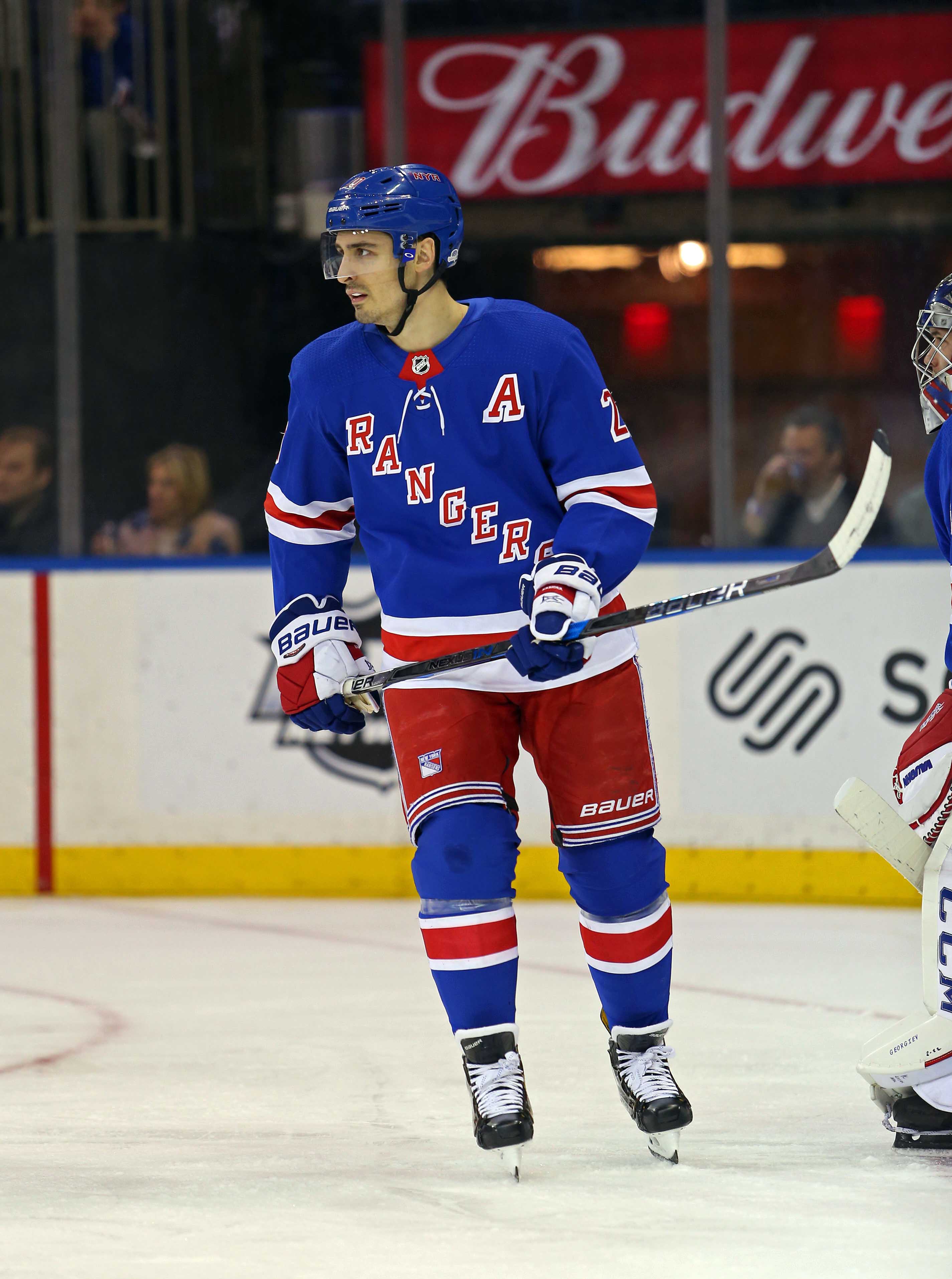
Kreider is coming off a tough year in which he had to deal with blood clots and had surgery to relieve the pressure and missed almost two months of time. The 27-year-old didn’t have as solid of a season as he tallied just 16 goals in 58 games, which is a far cry from the 28 goals he scored in 2016-17 although a lot of that is due to the fact that his playing time dipped as the team didn’t want to play him too many minutes due to the blood clot issue. Regardless with a full offseason to rest and recuperate, Kreider should be able to bounce back as one of the team’s top scorers.
The team also have high expectations from two other forwards that the team acquired through at the trade deadline a year ago in Namestnikov and Spooner. Namestnikov was the biggest name to arrive in New York in the Ryan McDonagh trade with Tampa Bay. He was a key player for the Lightning, posting 20 goals and 44 points with them, but he actually lost playing time once he arrived in New York and put up just two goals and four points in 19 games. The team hopes that a new coach and proper training camp with his new team will make quite a difference. Spooner came over in the Rick Nash trade with Boston and has posted solid numbers with the Bruins over the past few seasons and could turn out to be a top-six wing or third-line center in New York. Between the two teams, Spooner combined for 13 goals and 28 assists.
The team also expect big things from Vesey, who signed as a undrafted collegiate free agent a couple of years ago and if finally starting to show that he belongs in the NHL. The 25-year-old winger has put up solid numbers for two years, but could find himself getting more opportunities in the team’s rebuild. In two years, he’s combined for 33 goals and 55 points.
The Contract Each Team Would Most Like To Trade: Part II
Nearly every team has one of those players: a top talent they were excited to sign and never thought could do anything but help them. In hindsight, history shows that more often than not, expensive, long-term free agent contracts don’t work out. It may look good at first (or it may look bad right away to the outside observer), but players struggle to make their value last throughout a lengthy contract. Those contracts come back to bite teams and are hard to get rid of. As teams begin to finalize their rosters at this point in the off-season, many are struggling to make everyone fit under the salary cap and are regretting these past signings that exasperate a cap crunch that can be tough for even a mistake-free club. We already took a look at the first third of the league; here are the contracts that each team would most like to trade, from Detroit to Ottawa:
Detroit Red Wings: Frans Nielsen – four years, $21MM remaining
As speculated by some readers in the comments section, it was no mistake that Part I ended with Dallas. Detroit deserved both some extra consideration and to lead off an article about poor contracts. There is an argument to be made that almost every single player age 28 and over on the Red Wings roster is signed to a bad contract for one reason or another. Detroit is a team that ranks towards the bottom of the standings and towards the top of the salary cap and that is not just bad luck. However, some are much worse than others and they are so bad that it is tough to choose between them. Take this scenario: Player A scored 35 points in 75 games last season. It was 14 points more than the season prior, including six more goals, and Player A also led the team in hits. He is 31 years old and signed for five more years at $4.25MM per. Player B scored 33 points in 79 games last season. It was eight points less than the season prior, and Player B also had the worst face-off percentage among the team’s centers. He is 34 years old and signed for four more years at $5.25MM per. Still undecided about which contract the team would rather trade? Player A is a Michigan native and career Red Wing and Player B is entering only his third year after signing a lucrative free agent contract. Player A of course is perennial whipping boy Justin Abdelkader. Yes, the Abdelkader contract is terrible. At no point in his career has he been worth his current contract value. Yet, he improved last season, is younger and brings a defensive element to his game, and is also loyal to the current administration – the call of the question after all is which contract the team would most like to trade. That would instead be Player B, Frans Nielsen, who at 34 is predictably declining and last year made more than Abdelkader for less production and there is no reason to believe that trend won’t continue. The team rewarded Adbelkader for years of service, whereas they took a gamble on Nielsen that hasn’t paid off. One of those moves is far more regrettable. Nielsen is the guy, but he only narrowly edged out Abdelkader and defenseman Danny DeKeyser, who also has relative age and Detroit roots to his advantage.
Edmonton Oilers: Milan Lucic – five years, $30MM remaining
The Oilers can refute trade rumors surrounding Milan Lucic all they want. The truth of the matter is that GM Peter Chiarelli signed Lucic hoping that he could both produce with and protect Connor McDavid in Edmonton as he did for David Krejci in Boston. The only problem is that the 30-year-old power forward can no longer keep up with a player of McDavid’s caliber. Lucic managed to score 34 points last season, tied for fourth on the team, but that is nowhere near what is expected of a $6MM player, especially when he scored 50 in year one with the Oilers and topped that mark many times with the Bruins. Edmonton still may be holding out hope that Lucic can turn it around and be just as much of a scoring threat as he is a physical threat, but make no mistake that the team would be quick to get rid of his contract if the right deal came along. In contrast, the team would be far more hesitant to move a hefty contract like defenseman Andrej Sekera who has been good and injury-prone, rather than healthy and underwhelming.
Florida Panthers: Roberto Luongo – four years, $18.13MM remaining
Florida is a tough one. Dale Tallon has done a good job of locking up his core long-term and, despite being right up against the cap, there are few egregious contracts on the roster right now. Give it a few years and maybe Michael Matheson will hold this title, but for now it goes to Roberto Luongo by default. Of course, Luongo is beloved in Florida and the team doesn’t even have to carry the whole of his cap hit, with the Vancouver Canucks retaining $800K each year. However, the reality is that Luongo will turn 40 this season and it will be only the first of four years left on his deal. The Panthers have almost $8MM committed to two goalies for the next few years and the other, James Reimer, is younger and outplayed Luongo in 2016-17 and in more games to boot. While they both fought injuries this past season, it was Luongo back on top performance-wise, but the impressive numbers he did post came in just 35 appearances versus Reimer’s 44. Florida paying over $4.5MM per year to a backup goalie in his forties just doesn’t make sense and the team would be better off moving forward with just Reimer and Michael Hutchinson if they could find a way to trade Luongo. Another reason this contract is bad: both the Panthers and Canucks will be hit with cap recapture penalties if Luongo retires prior to 2022.
Los Angeles Kings: Dustin Brown – four years, $23.5MM remaining
For the first time in years, Kings fans are feeling good about Dustin Brown. That is why now is the perfect time to trade him. Brown had been the bane of L.A.’s existence for four years, registering no more than 36 points each year while eating up $5.875MM in cap space, when he finally broke out of his funk in 2017-18 with a massive 61-point season and one of the league’s best plus/minus ratings. The question now is whether the past four years were an aberration with this season setting a new baseline or will Brown regress back to his bottom-six production. With a cap-strapped roster full of expensive contracts for older players, L.A. can’t take the risk of keeping Brown around if the right opportunity presents itself. They would be forced to trade the career King if a taker came forward rather than hold out hope that he doesn’t revert back to his old ways of being drastically overpaid.
Minnesota Wild: Zach Parise – seven years, $52.77MM remaining
When the Wild signed 28-year-old’s Zach Parise and Ryan Suter to matching 13-year contracts worth almost $100MM apiece, they knew that those deals would have dark days at some point in the future. However, they never could have imagined that Parise’s decline would come so soon. Parise remains one of the most popular players on the team, but injuries have kept him off the ice and affected his play when on the ice over the ice and his stock is falling quickly. Parise has never been able to reach the peaks he enjoyed in New Jersey, but he still produced at a high level over his first four seasons with the team. The past two years have been a different story and Parise appears to be trending in the wrong direction. Now 33, Parise isn’t totally beyond help and could turn it around. If back at 100%, Parise has enough natural ability and enough talent around him to still be a $7.5MM player. However, it would be nearly impossible for Minnesota to ever move the behemoth that is his contract so, if somehow they received an offer, they would take it without a second thought. Fan favorite or not, there is too much risk associated with Parise moving forward.
Montreal Canadiens: Shea Weber – seven years, $55MM remaining
I know what you’re thinking and yes, the Carey Price contract doesn’t look great right now. However, an extension of any length and value for any player coming off an injury-riddled season would bring a skewed perception. Price has been one of the best goalies in the league for years and one bad season doesn’t change that. Will he lose that title in the next eight years? For sure, but it would be a shock to see the Canadiens move their poster boy any time soon. Their #1 defenseman is another question though. When Montreal acquired Shea Weber for P.K. Subban, they never could have anticipated that his body would break down so soon after. Injuries cost Weber all but 26 games last season and he will miss the beginning of 2018-19 as well. Weber doesn’t seem like the type of player who will retire early, but there is no guarantee that these injuries won’t slow him down significantly for the remainder of his contract. In fact, the only guarantee is that he will slow down over the next seven years. At $7.86MM, the Canadiens need Weber to be his dynamic two-way self. The team already has one overpaid stay-at-home defenseman in Karl Alzner and can’t afford another. If they could move Weber, they would.
Nashville Predators: None
GM David Poile flat out doesn’t sign bad contracts. Criticize the deals for Ryan Johansen and Kyle Turris if you like, but the bargain contracts throughout the rest of the lineup have allowed Poile to overpay for reliable centers and that is a team-building model that anyone can get behind.
New Jersey Devils: Corey Schneider – four years, $24MM remaining
The easy answer is that the Devils don’t feel any pressure to trade anyone on the roster. They currently have the lowest payroll in the league with nearly every player signed to a fair deal. Those who are overpriced – Travis Zajac and Andy Greene – play important leadership role and the only player signed to a substantially long-term deal is electric young blue liner Damon Severson. The one and only player that sticks out as a potential long-term cap problem is starting goaltender Corey Schneider. This may surprises some; after all Schneider trails only Tuukka Rask among active save percentage leaders. Schneider had been elite since arriving in New Jersey, but something started to change in 2016-17. His SV% fell to .908 and his GAA inflated to 2.82 and then things only got worse last season with a SV% of .907 and a GAA of 2.93. He was also limited to just 40 appearances this year and was outplayed by journeyman Keith Kinkaid. The Devils can’t count on Kinkaid to repeat his 2017-18 performance moving forward and if Schneider’s back-to-back bad years are more than a fluke, they can’t depend on him for four more years either. He’s not going to be a $6MM backup either. New Jersey will give Schneider the time he needs to return to form, but they may not hesitate if the right trade comes their way as well.
New York Islanders: Andrew Ladd – five years, $27.5MM remaining
The Islanders without John Tavares are a totally different animal. A six-year, $30MM extension for Josh Bailey now looks bad. A $5.75MM cap hit this season for free agents Leo Komarov and Valtteri Filppula signed to make up for Tavares’ lost production looks bad. The likes of Cal Clutterbuck, Casey Cizikas, and Matt Martin now look worse on a team that needs more offense and less grit. However, the one contract that looked miserable well before Tavares bolted to Toronto is Andrew Ladd and it is only going to get much worse. The veteran forward was intended to find chemistry with Tavares when he was signed to a seven-year, $38.5MM contract two years ago. Instead, Ladd has just 60 points over the past two seasons combined and has by all accounts been relegated to a bottom-six role. The 32-year-old will now be asked to take a bigger role in Tavares’ stead and that is a scary proposition. The Islanders aren’t in any cap trouble, but the team should be thinking rebuild and would likely take any offer at all to rid themselves of Ladd.
New York Rangers: Brendan Smith – three years, $13.05MM remaining
Has any free agent contract in recent memory soured as quickly as Brendan Smith’s? Smith signed a four-year deal with the Rangers last June and was expected to play a top-four role for the team for years to come. By February, he had been placed on waivers and buried in the AHL. Smith played in only 44 games with New York and saw less and less ice time as the season wore on and he continued to turn the puck over at an alarming rate and cost his team goals. Now what? One would assume that Smith will be given a second chance this season, but the relationship between he and the team may be beyond repair. There is no doubt that the Rangers would take a re-do on that deal and would move him if possible. Marc Staal is another player that New York wouldn’t mind moving, but as a player who can eat minutes and provide solid play most of the time, his $5.7MM contract seems like nothing next to Smith’s $4.35MM deal.
Ottawa Senators: Bobby Ryan – four years, $29MM remaining
No contract in the league has become as notorious for being labeled a “bad deal” that the team is desperate to trade like Bobby Ryan’s. The Senators are so determined to move on from Ryan that they are trying to force Erik Karlsson trade suitors to take the overpaid forward as well. At one point in time, $7.25MM per year for Ryan seemed like a fair deal. At 23 years old he was a 71-point player with the Anaheim Ducks and even after moving to Ottawa, Ryan started his tenure with three straight seasons in the 50-point range. However, the last two years have been very different. Ryan has only suited up for 62 games in each campaign and has looked like a different player on offense. At his best, he looks disinterested and lucky to be in the right place at the right time and at his worst he costs his team goals. Ryan has managed to register only 58 points combined over the past two years; he had 56 alone in 2015-16. Ryan may just need a change of scenery to jump start what used to be dynamic goal-scoring game, but the Senators don’t care about that. All he is to them is a waste of cap space and of owner Eugene Melnyk‘s dwindling wealth. They want him gone at any cost.
Look out for Part III of this three-part series early next week…
Eastern Notes: Kovalchuk, Marner, Smith, Rasmussen
Could the Boston Bruins be the front-runners for Russian free agent and former NHL superstar Ilya Kovalchuk? Evidently, the Sports Hub’s Ty Anderson thinks so.
As reported by NBC Sports, Anderson appeared on Toucher & Rich on 98.5 and said he believes the Bruins are currently the leading candidates to get the 35-year-old winger due to the Bruins cap space. While the Bruins are listed by CapFriendly as having just $6.5MM in available cap space, the team has few free agents of their own to deal with and a loaded roster, including multiple talented veterans such as Brad Marchand and Patrice Bergeron and a core of youth of which many had solid rookie years last season.
Kovalchuk, who tallied 31 goals for SKA St. Petersburg in the KHL has been touring NHL cities, looking for a new home. While his preference has been to stay on the East Coast, especially either New York or Florida, he’s broadened his search this year including a trip to Los Angeles and San Jose as he’s made it clear that he wants to win a Stanley Cup as soon as possible.
- Kevin McGran of The Star interviewed Mitch Marner about multiple topics, but the 21-year-old star said that there has been no discussion yet with management about a potential contract extension. The fourth-overall pick from the 2015 draft will be eligible for a contract extension on July 1 along with teammate Auston Matthews, but there is no word on whether Marner will sign an extension this year or will have to wait until next year. “Nothing has been said yet, but nothing you can do,” said Marner. “If nothing happens, you still have a year to play under your rookie contract. Just go out there and try to prove you can make the team better.”
- While the New York Rangers are looking for defense, the New York Post’s Larry Brooks writes that veteran defenseman Brendan Smith has stayed in New York following the season and has been working with fitness trainer with Ben Prentiss to get into better shape. Smith, who was placed on waivers on Feb. 9, after signing a four-year, $17.4MM contract in the offseason, came into camp out of shape and struggled on the Rangers’ blueline all season long. The scribe writes that the Rangers not only expect him to compete for a job at training camp, but they expect him to return to the status of the player they handed that contract to.
- Helene St. James of the Detroit Free Press writes she believes it looks promising that 2017 first-round pick Michael Rasmussen makes the Detroit Red Wings team out of training camp this year. The ninth-overall pick last year put up 31 goals and 58 points for the Tri-City Americans of the WHL and even got some time at the wing position during the season because Detroit would likely like for him to start at the wing if he makes the team next season. What’s more impressive is that he scored 16 goals and 33 points in just 14 playoff games, suggesting he might be ready for Detroit. If he doesn’t make the team, he will have to return for one more year to Tri-City.
Red Wings And Canadiens To Clash At The Draft
Before the 2018-19 season even begins, there will be some conflict between divisional foes. The Montreal Canadiens and Detroit Red Wings are both coming off disappointing seasons and are looking to reinforce their franchises with their own high draft slots as well as acquired picks. Both teams are hoping to cash in on several picks in the first and second rounds to find multiple players that will grow to become regular NHLers. However, they may have to battle each other to do so.
The Athletic’s Craig Custance published an article this week about Detroit’s possible plans and potential targets for a trio of picks in the 30’s. His colleague Arpon Basu was quick to respond with his own article about Montreal’s potential marks with their two picks in the early second round. Basu also added that the two teams share similar organizational needs. Among them, both the Canadiens and Red Wings could use a top-flight center and defenseman in the pipeline.
With no suitable centers available when either team picks in the first round – the Habs at #3 and the Wings at #6 – what those teams do early on could dictate their priorities in the early second. Many expect that Montreal cannot pass up the elite forward talent that is winger Filip Zadina. The Canadiens (or Red Wings) could reach for center Jesperi Kotkaniemi, but it is unlikely. They could also take a defenseman, as there are plenty of supremely talented names available in this draft. After Rasmus Dahlin presumably goes first overall, most consider Quinn Hughes to be the next best name. Of course, Detroit is the heavy favorite to take the University of Michigan product if he’s still on the board. If Montreal chose to steal him, it would be the first conflict between these two teams.
Things heat up even more later on though. Detroit has a second first-rounder at #30, courtesy of the Tomas Tatar trade with the Vegas Golden Knights. While this is a prime position for the Wings to trade out of, they could also simply make the pick. It is here that the Red Wings could beat the Canadiens to one of the top available centers. Both Custance and Basu list Ty Dellandrea as a prime target in the late first and early second, and Basu also offers Isac Lundestrom and Jacob Olofsson as candidates if either is still available. Then, in the second, Detroit picks again at #33, the pick they received from the Ottawa Senators through the New York Rangers in the Brendan Smith deal. So while the Habs get the first shot at selecting ahead of the Wings early in the first round, Detroit then has the next three consecutive picks ahead of Montreal. Here, it would be easy to see the Red Wings double up on defensemen, aiming for a more physical specimen. Both Custance and Basu tab K’Andre Miller as a likely target, while Basu also lists Mattias Samuelsson and, if he’s still there, Jared McIsaac. Both writers are also intrigued by the boom-or-bust talent of defenseman Ryan Merkley, another swift puck-mover like Hughes. Don’t rule out Detroit looking his way as well. Finally, Montreal gets their next shot at #35 and Detroit picks right after at #36. Montreal may again have to pick up the scraps at #38, the selection they landed from the Chicago Blackhawks along with Phillip Danault in the very favorable Tomas Fleischmann/Dale Weise trade in 2016.
Montreal also has picks #56 and #62 later in the second round, leaving open a very real opportunity that they could change this whole dynamic by packaging multiple second-rounders – in a draft that many feel is homogeneous in the #20 to #60 range – to move back into the first round and ahead of Detroit at #30. It would then be the Canadiens who could take the best available center or defenseman and put the Red Wings in a tough spot.
It’s always a good time to see two Original Six teams battle on the ice, but the war for position brewing between Detroit and Montreal in the upcoming draft could be just as fun to watch.
Free Agent Focus: New York Rangers
Free agency is now a little less than a month away from opening up and there are quite a few prominent players set to hit the open market while many teams have key restricted free agents to re-sign. Here is a breakdown of New York’s free agent situation.
Key Restricted Free Agents: F Vladislav Namestnikov – The Rangers have plenty of restricted free agents to sign this summer, and while Kevin Hayes and other forwards may have had a bigger impact on the team, it’s Namestnikov that remains the biggest enigma. After coming over from the Tampa Bay Lightning at the deadline as part of the Ryan McDonagh trade, Namestnikov failed to find much chemistry with his new team. The 25-year old registered just four points in 19 games down the stretch, after notching 44 in Tampa Bay (mostly alongside Steven Stamkos and Nikita Kucherov). Those 44 had already guaranteed he would reach a career-high in points, and he had already cracked 20 goals by the end of February.
There is still some question as to where he fits into the Rangers plans though. As the team continues to try and get younger, they essentially swapped two players the same age when they sent J.T. Miller along with McDonagh to Tampa Bay. Now Namestnikov, the 27th-overall pick from 2011, will have to show that the team actually upgraded with that trade and show he can be a top-six contributor in 2018-19 and beyond. Since he’ll be turning 26 in November any long-term deal will be buying out several unrestricted free agent seasons, substantially increasing the cap hit of the overall deal. After being paid an average of just $1.94MM the last two years, Namestnikov will be looking for a substantial raise. It’s not clear if New York wants to commit long-term to a player that has had trouble producing when not playing alongside elite linemates.
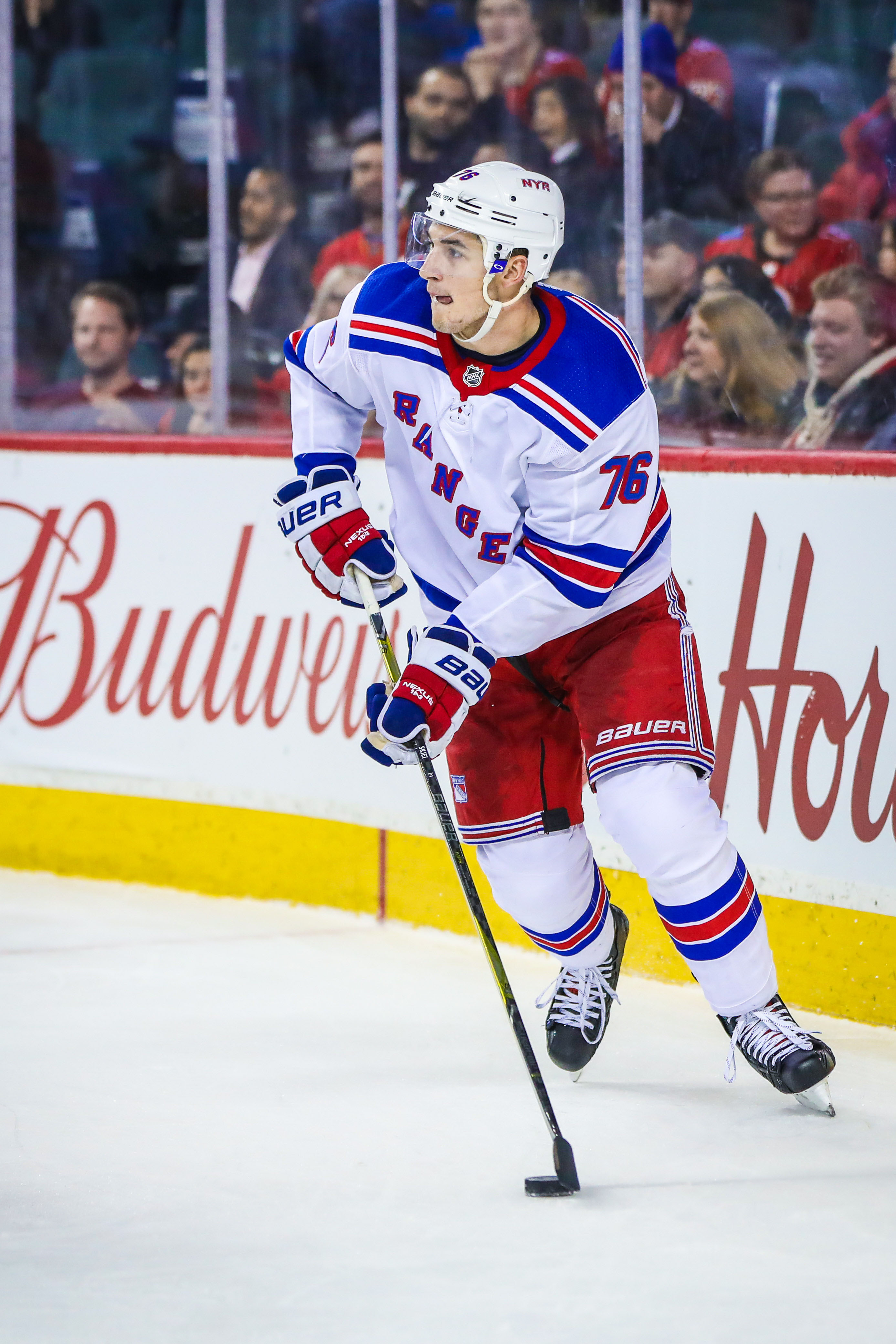 D Brady Skjei – If Namestnikov is the most unclear decision on the team’s RFA list, Skjei might be the most important. The 24-year old turned into one of the team’s most reliable defensemen in the second half of 2016-17, and showed again that he could be a big time contributor this season. Though his point production dropped significantly, Skjei was asked to log more than 21 minutes a night for a team whose defensive unit was constantly in flux. McDonagh was traded midseason, Kevin Shattenkirk dealt with injury and Brendan Smith was banished to the minor leagues, leaving Skjei the lone defender who could be counted on all season.
Skjei is coming off his entry-level contract later than many other impact players, meaning that he’s closer to unrestricted free agency than many would be heading into their second deal. It’s clear that he is a player to build around for the Rangers, and signing him long-term right now is the only way to really keep his cap hit to a reasonable amount. If the team (or player, for that matter) decides to mitigate risk and sign a short-term bridge deal, it could end up costing them in the long run if Skjei continues to improve and looks for a big-money extension when he’s 26 or 27.
Other RFAs: F Ryan Spooner, F Kevin Hayes, F Jimmy Vesey, D Rob O’Gara, D John Gilmour, G Marek Mazanec, F Steven Fogarty, F Boo Nieves, F Chris Bigras, F Adam Tambellini
Key Unrestricted Free Agent: G Ondrej Pavelec – The Rangers sold hard at the deadline to rid themselves of nearly all valuable unrestricted free agents, leaving Pavelec as the last remaining big ticket. The team does have other potential internal options as a backup for Henrik Lundqvist, but there’s not much to complain about with their situation this year. Pavelec recorded a .910 save percentage in 19 games, and though his record was poor that’s more a reflection on the team in front of him than his performance. The former Winnipeg Jets goaltender signed for just $1.3MM this season, and could likely be brought back for a similar amount in 2018-19.
Otherwise, Pavelec would likely have several suitors around the league as a reasonably priced backup with plenty of experience. The 30-year old goaltender has played 398 games in the NHL, and could come in as a 20-game backup for one of the more established goaltenders in the league. There is also always a chance he could return to the Czech Republic as a starter, though it’s been more than a decade since he played there full-time.
Other UFAs: F Paul Carey, F Cody McLeod, D Ryan Sproul, F Daniel Catenacci, F John Albert
Projected Cap Space: The Rangers currently project to have somewhere around $30MM in cap space to spend this summer, but a lot of that will be eaten up by the group of RFAs requiring new contracts. If every one of Skjei, Spooner, Hayes, Vesey and Namestnikov are signed, the team could be looking at a lot less room to operate with for the rest of the summer. The idea that they’ll just re-sign what they have and go into next season with the same group seems foolish, especially with young players like Filip Chytil and Lias Andersson knocking down the door.
With three first-round picks and plenty of young prospects starting to fill the cupboards, it wouldn’t be surprising if New York was one of the most active teams this offseason. Either continuing to trade experience for youth and building towards a window of contention in a few years, or reloading to get back to the playoffs in the short-term, the Rangers are a team to watch closely as the draft approaches in a few weeks.
Rangers Must Continue To Upgrade Their Defense
The New York Rangers still have to hire a coach, but the team’s top goal is to continue to improve its blueline this offseason. Just a year ago, the Rangers invested heavily into a veteran defense that was expected to be among the best in the league. The team went out and signed highly coveted free agent Kevin Shattenkirk and re-signed Brendan Smith to go with captain Ryan McDonagh and Marc Staal and a rising Brady Skjei.
Instead the defense struggled mightily as they were ranked fourth in goals against, allowing 3.21 goals per game during the 2017-18 season. Now with McDonagh gone and the team in a rebuild, the Rangers must make more changes to improve their struggling blueline.
The Athletic’s Shayna Goldman (subscription required) writes that a few pieces are certain. A healthy Shattenkirk should boost the team’s defense after the team shut him down in the middle of the year with a torn meniscus. Throw in a much improved year for Staal and the Rangers have a couple of solid pieces to aid them. The team still has high hopes for Skjei, despite his second-year struggles, but Smith is a complete unknown as it will be up to him to get into game shape and prove he was worth the four-year, $17.4MM deal he signed last offseason. The team did like the way rookie Neal Pionk played in his 28-game trial at the end of the year. Even defenseman Anthony DeAngelo showed improvement at the end of the year as well. The team also added a number of new young d-men at the trade deadline that aren’t too far off, including Ryan Lindgren, Libor Hajek and Yegor Rykov.
Regardless, the team could use a boost from an experienced young defenseman that can help stabilize last year’s crew or at the very least, more young talent that will be ready within a year. The New York Post’s Larry Brooks writes that the team should consider offering up either Kevin Hayes or Mike Zibanejad in exchange for defensive help, assuming the player they get back is a current or future top-four defenseman. While he believes that Dougie Hamilton would be the perfect trade target, he doubts the Calgary Flames would move him. However, Calgary is loaded with defensive prospects that are stuck behind their veteran defense, suggesting the Rangers go after prospect Adam Fox, who is a top defenseman at Harvard University, and who was the former partner of Lindgren. Trading one of those young veterans could work as centermen are in high demand right now with few available on the free agent market and with the Rangers putting much of their hopes on both of last year’s first-round picks in Lias Andersson and Filip Chytil at center next season.
No matter what, the team will have to make some changes if they hope to improve on their disappointing 2017-18 season.
Evening Notes: Red Wings, DeBrincat, Vegas
The Tomas Tatar trade seems so far to be a big win for the Detroit Red Wings writes the Detroit Free Press’ Helene St. James. Dealt at the deadline for Vegas’ 2018 1st rounder, a 2019 second rounder and a 2021 third rounder, Tatar is a healthy scratch for the Golden Knights as they made quick work of Los Angeles. St. James believes Tatar will see time again in the playoffs, but she cites this trade as one in a series where the Red Wings got the better of another team. St. James points out that the Brendan Smith trade a year prior with the Rangers is now considered a heist with the Wings picking up a 2017 third round pick, and Ottawa’s 2018 second round pick, which will be the 33rd overall pick. Smith, meanwhile, had a tumultuous season with the Blueshirts that saw healthy scratches, a demotion, and a fight in practice–all of this occurring after signing a four-year, $17.4MM deal. Petr Mrazek was flipped for a conditional 2018 fourth round pick that is now a third rounder along with a conditional 2019 third round pick should Mrazek re-sign with the Flyers. Not a bad haul for players who haven’t really lived up to their end of the bargain for their new teams.
- The Athletic’s Scott Powers reviews Blackhawks rookie Alex DeBrincat‘s season, and the marks are unsurprisingly positive. Powers writes (subscription required) that the Hawks’s first year forward was hoping to just make it out of camp with the team, but 52 points (28 of them coming as goals) was certainly more than anyone could have envisioned. The future is bright for a Hawks squad that missed the playoffs and saw a lot go wrong this season. DeBrincat’s performance is a silver lining, Powers reports, and the 20-year-old had one of the best rookie performances in Blackhawks history. Powers adds that the goal totals could be higher next season should DeBrincat see more time on the powerplay. Last season, he logged the sixth most minutes when the Hawks were on the man advantage, a metric that should certainly rise given his propensity to find the back of the net.
- The USA Today’s Kevin Allen gives five reasons why the Vegas Golden Knights are suddenly one of the trendy picks to win the Stanley Cup in their first season. A raucous home ice advantage is one of the reasons Allen believes the Golden Knights are finding success. But Allen cites the chip on the shoulders of players and staff who were spurned by a previous organization as one of the main reasons for Vegas’ success. Allen writes that such an attitude gave the players a “passion and purpose” and has carried onto the playoffs, making the Golden Knights a dangerous opponent.