
Salary Cap Deep Dive: New York Rangers
Navigating the salary cap is one of the more important tasks for any GM. Teams that can avoid total cap chaos by walking the tightrope of inking players to deals that match their value (or compensate for future value without breaking the bank) remain successful. Those that don’t see struggles and front office changes.
PHR will look at every NHL team and give a thorough look at their cap situation heading into the 2021-22 season. This will focus more on players who are regulars on the roster versus those who may find themselves shuttling between the AHL and NHL. All cap figures are courtesy of CapFriendly.
New York Rangers
Current Cap Hit: $72,103,969 (under the $81.5MM Upper Limit)
Entry-Level Contracts
F Morgan Barron (two years, $925K)
F Adam Fox (one year, $925K)
F Kaapo Kakko (one year, $925K)
F Vitali Kravtsov (one year, $925K)
F Alexis Lafreniere (one year, $925K)
D Nils Lundkvist (three years, $925K)
D K’Andre Miller (two years, $925K)
Potential Bonuses
Barron: $850K
Fox: $850K
Kakko: $2.65MM
Kravtsov: $850K
Lafreniere: $2.85MM
Lundkvist: $850K
Miller: $350K
Total: $9.25MM
Kakko’s first two seasons haven’t gone particularly well as he hasn’t been able to produce with much consistency. That can certainly change but at this point, a shorter-term second contract seems likelier than a long-term pact while the bulk of those bonuses won’t be met. Lafreniere’s rookie campaign was similar to Kakko’s and he is one of New York’s big wild cards heading into this season. A strong sophomore year could put him in position to meet most of his ‘A’ bonuses at least, totaling $850K though the ‘B’ bonuses remain unlikely. Kravtsov had a good season in the KHL but was relatively quiet in his first taste of NHL action. Now only a year away from his second contract, a bridge deal should be forthcoming. Barron may wind up also seeing action in AHL Hartford but if he winds up being a regular, he’s likely not going to be able to hit most of his ‘A’ bonuses.
Fox, the Norris Trophy winner, is on quite the bargain of a contract. His sophomore season was a dominant one and it’s safe to say he’ll be using some of the recent contracts for Dallas’ Miro Heiskanen (eight years, $8.45MM AAV) and Colorado’s Cale Makar (six years, $9MM AAV) as comparables. As long as he stays healthy, he should hit all of his ‘A’ bonuses. Miller is likely to have a similar role on New York’s back end this season which should give him a shot at two or three of his ‘A’ bonuses while setting him up for a nice second contract though nowhere near what Fox’s will be. Lundkvist is expected to contend for a regular role but if they ease him in, it’s unlikely he’ll be able to hit most of his bonuses.
There’s more emphasis on bonuses here than usual for a reason. While the Rangers are more than $9MM under the cap, that doesn’t factor in bonuses. Knowing that several million of those bonuses are likely to be hit, their effective cap space is lower unless they want to face an overage penalty in 2022-23 which would not be a wise idea if it can be avoided.
One Year Remaining, Non-Entry-Level
F Sammy Blais ($1.5MM, RFA)
F Julien Gauthier ($775K, RFA)
G Alexandar Georgiev ($2.425MM, RFA)
D Libor Hajek ($874K, RFA)
F Ryan Strome ($4.5MM, UFA)
F Mika Zibanejad ($5.35MM, UFA)
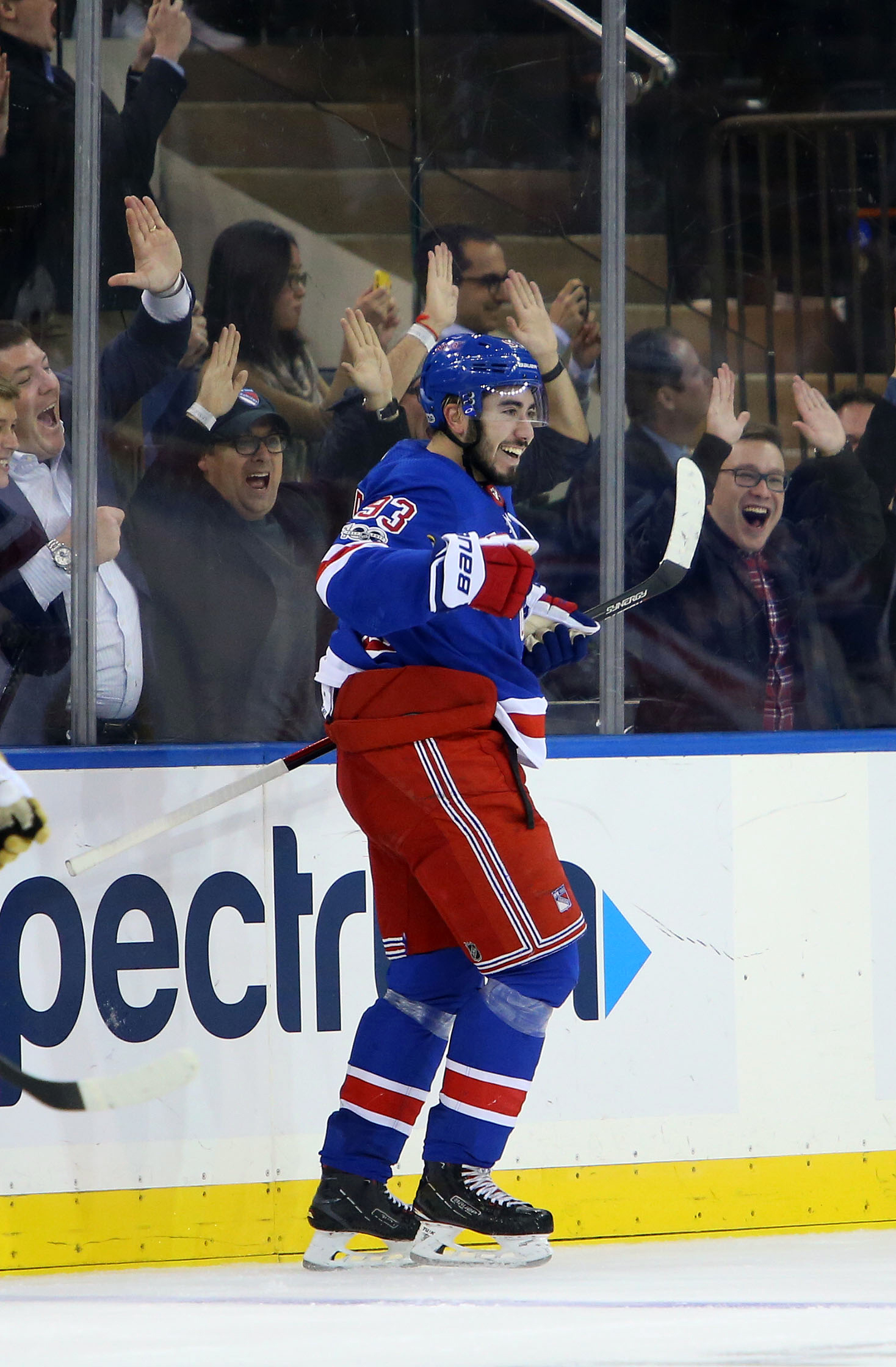 All eyes are on Zibanejad as what happens with him will greatly affect their plans moving forward. If they lock him up to a long-term extension which could cost upwards of $10MM based on his current asking price, it’s going to take them out of the mix for adding down the middle. On the flip side, if they don’t re-sign the 28-year-old, they’ll be entering next summer with a significant void down the middle to try to fill if they aren’t able to trade for a certain Buffalo center by then. For the time being, Zibanejad is a number one pivot that’s being paid like a number two center which is a great bargain for the Rangers but that is going to change before next season one way or the other.
New York reportedly gave consideration to non-tendering Strome in the 2020 offseason before signing him to this deal and he responded with a career year. Part of that is playing with a top winger but another showing like that will give him a lot more leverage than he’s accustomed to having as he enters the UFA market for the first time. Blais was brought in to give the team some more grit but he will need to produce more offensively if he wants to get much more than his $1.6MM qualifying offer. Gauthier managed to earn a spot on the fourth line for a good chunk of last season but will need to bring something offensively to the table. He has produced at the lower levels but two goals in 47 career games isn’t going to help his cause for a new deal.
Georgiev has seen his save percentage dip each season which is never a good sign while he is now firmly entrenched as the backup. His $2.65MM qualifying offer may be a bit high for what they’ll be able to afford next season so it wouldn’t be surprising to see him in trade speculation again. With the going rate for a good backup, Georgiev’s next deal should come in only a bit higher than his qualifier unless he has a big platform year.
Two Years Remaining
F Filip Chytil ($2.3MM, RFA)
F Ryan Reaves ($1.75MM, UFA)
D Jarred Tinordi ($900K, UFA)
The Rangers drafted Chytil hoping that he would eventually fill a role down the middle. That could still happen but so far, he has primarily been on the wing while his production has largely been limited so far. Still just 22, that could change between now and 2023 where he’ll be owed a $2.6MM qualifying offer. He’ll need to improve his offensive output to have a shot at earning a bigger raise beyond his qualifier. Reaves is high-paid for the limited minutes he plays but players like him are always in demand. He’ll be 36 when his one-year extension is up and at that point, it seems unlikely that he’ll be looking at a raise.
Tinordi has taken a long time to get to the NHL but a good showing in the second half of last season allowed him to land a two-year, one-way commitment on the open market. If he can hold down a regular spot on the third pairing each season, he’ll have a shot at a bigger deal in 2023 but if he winds up being more of a depth player as he typically has been, this is about as high as his salary will get.
Three Years Remaining
D Ryan Lindgren ($3MM, RFA)
D Patrik Nemeth ($2.5MM, UFA)
Lindgren moved into a regular top-four role for the first time last season and handled the extra responsibility well, earning him this three-year bridge deal that allows both sides to reassess before he gets to the open market. Owed a $3.6MM qualifying offer (120% of the AAV is lower than the final-year salary), Lindgren will need to do more at the offensive end if he wants to get more than that. Stay-at-home defenders can provide value still but at a lower price point than more offensive counterparts. Nemeth is a good example of that. He was in Detroit’s top four for most of the last two seasons (plus a short stint on Colorado’s third pairing) but while he’s steady in his own end, his market value is capped by a lack of production.
Salary Cap Deep Dive: Ottawa Senators
Navigating the salary cap is one of the more important tasks for any GM. Teams that can avoid total cap chaos by walking the tightrope of inking players to deals that match their value (or compensate for future value without breaking the bank) remain successful. Those that don’t see struggles and front office changes.
PHR will look at every NHL team and give a thorough look at their cap situation heading into the 2021-22 season. This will focus more on players who are regulars on the roster versus those who may find themselves shuttling between the AHL and NHL. All cap figures are courtesy of CapFriendly.
Ottawa Senators
Current Cap Hit: $59,048,333 (under the $81.5MM Upper Limit and minimum cap threshold)
Entry-Level Contracts
D Erik Brannstrom (one year, $863K)
F Alex Formenton (one year, $748K)
F Joshua Norris (one year, $925K)
F Shane Pinto (two years, $925K)
F Tim Stutzle (two years, $925K)
Potential Bonuses
Brannstrom: $450K
Formenton: $107.5K
Norris: $850K
Pinto: $600K
Stutzle: $2.5MM
Total: $4.508MM
Norris is going to be the next big contract on the horizon for the Senators. He was one of the top rookies in the league last season and should spend all of the upcoming season in a top-six role at the very least. Impact centers get paid quickly and if they move to sign him to a long-term deal, he could jump into the $7MM range assuming he has a strong sophomore season. Stutzle, another long-term building block, had some ups and downs in his rookie campaign but the high-end potential is certainly there. If he progresses as expected, he could also be looking at a similar price tag on his next deal. Pinto certainly didn’t look out of place late in the season and should see extended NHL action this year. How he fares in that should determine if he’s heading for a long-term deal of his own or something shorter. As for Formenton, the speedster split last season between Ottawa and AHL Belleville. He should be able to lock down more of a regular spot in 2021-22 but is likely heading for a short-term second contract.
Brannstrom was the centerpiece of the Mark Stone trade back in 2019 although he hasn’t yet been able to lock down a full-time NHL role let alone show signs of the offensive upside he has displayed in the minors. He should push for a regular spot this season but he’s also waiver-exempt which could make him the odd one out in training camp. In either scenario, a bridge deal makes more sense for him. Considering the bigger contracts they have on the horizon for Norris and Stutzle, they’ll need some shorter-term deals to balance those out anyway.
One Year Remaining, Non-Entry-Level
D Josh Brown ($1.2MM, UFA)
G Anton Forsberg ($900K, UFA)
D Nick Holden ($1.7MM, UFA)
D Victor Mete ($1.2MM, RFA)
F Nick Paul ($1.35MM, UFA)
F Zach Sanford ($2MM, UFA)
F Chris Tierney ($3.5MM, UFA)
Tierney has been in trade speculation dating back to last season and that won’t change anytime soon as he’s unlikely to be in Ottawa’s long-term plans. He’s a serviceable middle-six center who is probably better off on the third line but players like that have landed similar contracts to the one he has recently. A big raise is unlikely but neither is a big dip this summer. Sanford, acquired in the Logan Brown trade, has been a capable bottom-six winger but unless he has an uptick in production with his new team, it’s unlikely he’ll be able to get much more than his current price tag on the open market. Paul hasn’t been able to make the most of his increased playing time the last couple of years but as a physical player that can play both the wing and down the middle, he’s someone that’s probably going to garner a fair bit of interest which could push his next AAV past the $2MM range.
Holden was acquired as a salary offset in the Evgenii Dadonov trade this summer and is likely to have a similarly limited role with the Senators as he did with the Golden Knights. Barring a surprisingly strong season, he’s someone that is more of a candidate to land a PTO than a raise. Brown also is expected to play a depth role which doesn’t bode well for his first chance in unrestricted free agency. That said, he’ll only be 28 next summer so he should be able to land a guaranteed deal but at this point, it probably won’t be more than this one. Mete impressed after coming over from Montreal on waivers and will be looking to earn a top-four role for the first time since his rookie season. That will determine if he can potentially double his AAV in that situation or whether he’ll be a non-tender candidate with him having arbitration eligibility again.
Forsberg was claimed off waivers three times last season but held his own when called upon down the stretch with Ottawa, earning this new deal. If he can establish himself as a quality backup, he could double his price tag or more but having been more of a third-stringer in his career, the likelier scenario is that he winds up in a similar spot next season which would come with a bit of a dip in pay.
Two Years Remaining
F Connor Brown ($3.6MM, UFA)
D Michael Del Zotto ($2MM, UFA)
F Austin Watson ($1.5MM, UFA)
D Artem Zub ($2.5MM, UFA)
Brown’s offensive output has increased with Ottawa as he has been used in a bigger role than he was with Toronto but it hasn’t come at the expense of his defensive play. All of a sudden, he has become a strong two-way player. His ice time may dip as younger players move up the depth chart but for the time being, his deal is a nice bargain and the longer he plays at that level, the more expensive he’s going to be two summers from now. Watson makes perhaps a bit much for someone that’s primarily on the fourth line but it certainly isn’t a big overpayment and with the cap space they have, it’s one that they can certainly afford. It’s hard to see him getting more on his next deal, however.
Zub had to wait a bit to get into the lineup but when he did, he quickly became an important part of their back end which earned him this two-year extension. Given that he only has 47 career NHL games under his belt, pegging his value on his next contract will be tough; it’ll go up if he can stay in the top four but if he winds up settling in as more of a third-pairing option, he might be in tough to land a raise. Del Zotto’s contract came as a surprise to many for someone that has had to settle for discount deals the last two seasons but the Sens believe he can be a capable veteran to hold down a spot while their prospects develop. He’ll be 33 when his next deal gets signed and it’s hard to imagine he’ll get more than this.
Three Years Remaining
G Matt Murray ($6.25MM, UFA)
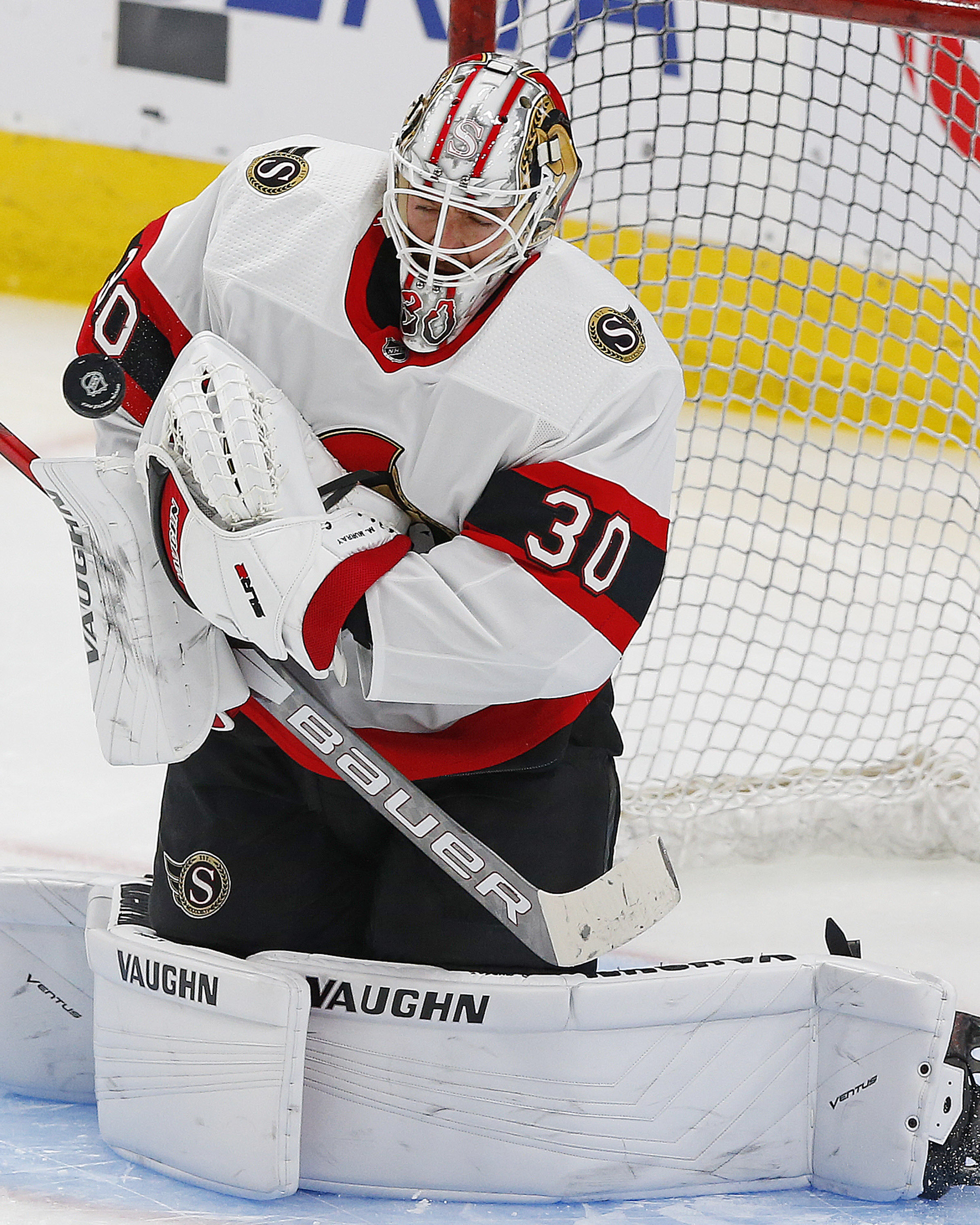 When Ottawa acquired Murray early on the second day of the 2020 NHL Entry Draft, they were hoping that they found not only their goalie of the present but also potentially their goalie of the future. But things didn’t go swimmingly for him as he followed up the lowest save percentage of his career with an even lower one in his first year with Ottawa. Yes, the Senators weren’t a great team but his struggles certainly contributed to that. In terms of AAV, only five goalies have a higher one than Murray but so far, he hasn’t provided an adequate level of goaltending let alone a high-end showing for someone making more than most starters do.
PHR Mailbag: Rangers, Lightning, Predictions, Bruins, Bounce Back Candidates, Penguins, PTOs
Topics in this edition of the PHR Mailbag include the Rangers and their long-term center situation, some candidates to step up for the Lightning this season, players that have a shot at having their tryouts converted to an NHL contract, and much more. If your question doesn’t appear here, check back in last weekend’s mailbag.
jchancel: If the NYR are going to sign Zibanejad long term, what salaries do they move if they want to sign a front-line center? Personally, I’d like to see who they could possibly get that would play better with Panarin than Strome has. I know his faceoff % and defensive abilities aren’t the best, but he plays a very adequate game feeding Panarin.
Stop the Eichel nonsense!!! Crazy to overpay for damaged goods. If he’s gettable for two returns and a draft pick maybe. But not all your youth!!
I don’t see a scenario where they can afford to give Mika Zibanejad the long-term contract he’s seeking and still try to bring in a number one center. With Artemi Panarin not going anywhere and their young core heading for pricier deals in a hurry – headlined by Adam Fox next summer – they’re not going to be able to carry two high-priced pivots on their roster. If they were absolutely adamant about trying to add another impact center (perhaps a high-end second option), Chris Kreider feels like the one that they’d try to move. His contract probably won’t age well and with the young wingers they have coming, he could be pushed down the depth chart in a hurry.
I understand the temptation to try to upgrade on Ryan Strome given his track record but at some point, he deserves some credit at least. Yes, he plays well with Panarin but it shouldn’t necessarily be taken for granted that whichever potential upgrade they try to get will have similar chemistry. It could be better but it could be worse. I’m not necessarily advocating that they keep him but at the frequency he’s thrown into trade suggestions, it should at least be said that he has had the best two seasons of his career in the last two years. That should count for something.
Eichel’s trade value is dipping right now but I don’t see Buffalo accepting that low of a return for him at this point. With the Sabres not trying to compete, I think they’re perfectly content dragging this out a little while longer.
denny816: If the Rangers do not see a considerable jump in production from Kaapo Kakko (assuming he is given an increased role for the upcoming season), could you see Drury dangling him and one of their plethora of young defense prospects to fill the hole they have at center?
That would certainly make sense in theory but at the same time, if Kakko doesn’t have a big jump in production, how much does his trade value drop? I wouldn’t want to put him into ‘bust’ territory but there’s no doubt it would make it harder for him to be the centerpiece of such a move. If they had any inclination of trying to move Kakko for a center, it may make more sense to try to do it now. There’s some risk in that Kakko breaks out elsewhere but if he landed a promising young, cost-controllable pivot, it could be worth doing sooner than later.
The Captain 11: The NYR are in a no-win situation with the center position right now. Both Zibanejad and Strome are UFA after this season. They have no internal options to replace them and it doesn’t look like there are upgrades available in the 2022 UFA market. Are there any possible RFA’s ripe for an offer sheet possibly?
Do the NYR overpay both Zibanejad and Strome in both money and term or do they trade one or both to not risk losing them for nothing? With Dolan mandating making the playoffs (or something close to that), it seems like the latter is off the table. A true no-win situation for Drury. I don’t see Chytil as a center moving forward even though Drury recently said he does see it. Barron might make a good 3C one day but prob needs more seasoning and some time before being ready. Most people have them both as better suited to wing.
Also, is it me or do the NYR seem to have an organizational aversion to drafting and developing centers? Very few really good centers have been drafted as they tend to get them through trade and free agency.
And, does Gallant finally break up the trio of pairs? Kreider/Zibanejad, Strome/Panarin, Kakko/Chytil. Should they name Kreider captain, would it be a smart move to slide him to the 3rd line and ease that burden on him a bit while simultaneously giving Laffy a good look on the top line?
Let’s stick with the Rangers for one more set of questions. If you’re looking for a proven option, an offer sheet probably isn’t the best route to try to go. Even if they find an impact center they like, how much will it cost to get them to sign and get the team to walk away? Carolina more than doubled Jesperi Kotkaniemi’s value and even then, it was far from a guarantee that Montreal wouldn’t match. Let’s say there’s a center worth $6MM in the RFA class that is willing to sign an offer sheet, they’re going to have to offer substantially more than that to get the team to walk away. That’s more cap space and draft picks down the drain and if you’re going upwards of $8MM to $9MM, wouldn’t they be better off just keeping Zibanejad?
I don’t see Zibanejad being moved in-season (I think he re-signs) and if the Rangers are in the mix, I don’t think Strome moves either. There’s always risk to that approach but it’s hard to see them voluntarily weakening their playoff fortunes to add a pick or a prospect.
I don’t think the Rangers have an aversion to drafting centers. Chytil and Lias Andersson were both drafted as first-round centers and that was just in 2017. Kakko and Lafreniere are wingers, sure, but they were the consensus top options where they were picked; reaching for a center wouldn’t have made sense. In between that, they added a pair of decent winger prospects and a pretty good defenseman in K’Andre Miller. Sometimes, sticking with BPA over positional need pays off in terms of stockpiling assets. Now, they’ll have to develop those into trade chips to fill the need unless Chytil is able to establish himself there.
Line combos are meant to be shuffled around so sure, Gallant will probably split them up at points, especially in training camp. Kreider will be on the third line down the road but if they want to keep his value high (if they have eyes on trading him for cap flexibility purposes), moving him down would make that hard. That would also take the captaincy off the table. I wouldn’t be surprised if Zibanejad is named captain if they get an extension worked out before the season starts.
Jack10: Which prospect(s) from the defending Stanley Cup champion Tampa Bay Lightning will have the biggest impact, if any after their free agent signings, during the upcoming season in which they have lost their entire 3rd line from their back-to-back championships?
I mentioned him in a recent mailbag but I’ll go again with Alex Barre-Boulet here. He produced at a high-end rate in junior. He went to the minors and produced at a high-end rate in both of his full seasons while averaging more than a point per game in limited action last year. His NHL numbers don’t stand out – three goals in 15 games – but it was his first taste of NHL action. He’s someone I see having a limited role to start but working his way up into an important secondary scoring role before too long.
He’s slightly more proven but I’ll also add Mathieu Joseph to the mix. He may not be a true prospect but he’s only a few months older than Barre-Boulet. He has had a limited role so far in his career but he’s someone who should play higher in the lineup now. He has produced in the past and if he does this season, he’ll be a very interesting restricted free agent next summer with salary arbitration rights.
The Duke: Let’s once again dust off the Mailbag’s Crystal Ball, which sees all & knows all: 1. Fastest path to – and most scoring success in – a top-six role between Newhook, Krebs, Veleno & Tomasino? 2. Brightest scoring future between Eklund, Raymond & Holtz? And lastly 3. the top three scoring forwards in NJ’s next 3-4 years? As always, much thanks.
1) The fastest path should be Nashville’s Philip Tomasino as there’s a very good chance he’ll be in that role this season. The Predators didn’t exactly add up front this summer with an eye on giving some youngsters like him and Eeli Tolvanen a chance to step up. Alex Newhook will get there at some point but it won’t be this season. Peyton Krebs will need some time in the minors and Joseph Veleno I suspect will be more of a high-end third liner than a top-six guy. Long term, Newhook might have the best path to success if he eventually ascends to the 2C role in Colorado but for the upcoming season, Tomasino should have the most points.
2) If we go strictly with SHL success, it’d be William Eklund who had a nice showing with Djurgardens last season where he was a teammate of Alexander Holtz. But I’ll take Lucas Raymond, who is going to be a focal point of Detroit’s rebuild that will eventually come to an end, to slightly outscore the others. All three should be impact players before too long though.
3) I expect Jack Hughes to continue to develop offensively so he’ll certainly be in that mix. So, too, should Nico Hischier. Holtz won’t play enough to have a shot at that and I don’t see many high-scoring forwards coming out of the rest of their group. I’d like to take Dougie Hamilton as I think he’ll out-produce the rest of their forwards over that stretch but he’s a defenseman. I’m not sold on Yegor Sharangovich being a key long-term piece for them but he’ll be around long enough to get an honest look so I’ll give him the slight edge for the third forward slot.
ericl: If the Bruins struggle to find a center who plays well with Hall, who are some centers that could be available as the trade deadline approaches that could be possible trade targets?
Max Domi would be one but I touched on that scenario earlier this month already so I won’t get into that one here. I suspect the target would be a rental with an eye on extending the right fit which is basically what they did with Taylor Hall. A lot will depend on where teams are at the deadline as to whether they’re selling or not so keep in mind that these names could wind up not being available midseason.
I’d look at someone like Joe Pavelski as a primary target if the Stars aren’t in the playoff race. Dallas would need to retain and Boston would still need to send a salary offset but if they’re making one last run with this core and their internal options can’t get the job done, I would be surprised if he wasn’t Plan ‘A’.
Ryan Strome’s future with the Rangers is in question and if they’re not in the mix, he’s someone that could move. He’s another question mark but his price tag would be more affordable. Paul Stastny would be a good fit if Winnipeg is out of contention and now that his AAV is lower, Ryan Getzlaf is more palatable at the deadline as well. I doubt all of these players will be available but if they’re thinking about a possible rental player already, these players could very well be on the list.
Salary Cap Deep Dive: Philadelphia Flyers
Navigating the salary cap is one of the more important tasks for any GM. Teams that can avoid total cap chaos by walking the tightrope of inking players to deals that match their value (or compensate for future value without breaking the bank) remain successful. Those that don’t see struggles and front office changes.
PHR will look at every NHL team and give a thorough look at their cap situation heading into the 2021-22 season. This will focus more on players who are regulars on the roster versus those who may find themselves shuttling between the AHL and NHL. All cap figures are courtesy of CapFriendly.
Philadelphia Flyers
Current Cap Hit: $81,118,523 (under the $81.5MM Upper Limit)
Entry-Level Contracts
F Wade Allison (one year, $925K)
F Joel Farabee (one year, $925K)
F Morgan Frost (one year, $863K)
Potential Bonuses
Allison: $425K
Farabee: $600K
Total: $1.025MM
Farabee’s second season was a good one as he earned an extension that we’ll look at closer to the end of this article. For the upcoming season, those performance bonuses could be met with a similar showing so either the Flyers will need to leave themselves some wiggle room at the end of the season or face a reduced cap for the overage next year. Frost was limited to just two games last season due to injury so he may see some AHL time but should be a regular before too long. With his limited production and game action so far, he’s a strong candidate for a short-term deal. If Allison lands a full-time spot, the ‘A’ bonuses in his deal could be achievable but if he bounces back and forth between the Flyers and Phantoms, those shouldn’t be an issue and, like Frost, he’s likely to get a short-term second contract.
One Year Remaining, Non-Entry-Level
F Nicolas Aube-Kubel ($1.075MM, RFA)
D Justin Braun ($1.8MM, UFA)
F Derick Brassard ($825K, UFA)
F Claude Giroux ($8.275MM, UFA)
G Martin Jones ($2MM, UFA)
D/F Samuel Morin ($750K, RFA)
D Rasmus Ristolainen ($5.4MM, UFA)
F Nate Thompson ($800K, UFA)
D Keith Yandle ($900K, UFA)
Giroux, Philadelphia’s captain, has been a fixture in their lineup for the past 13 seasons. However, his production is starting to tail off and it has already been stated that he won’t sign an in-season deal. His next contract could very well be his last, especially if it’s a four-year pact or longer and it seems like a lot will be riding on how things go this season. Either way, his next deal should come in a couple million cheaper than this one. Aube-Kubel, as a role player, shouldn’t be commanding much more than his qualifying offer of $1.225MM unless his production ticks up this season. Brassard has seen his value dip in recent years to the point where he has had to settle for what feels like a below-market contract based on his production for the second year in a row. This seems to be his new baseline deal moving forward. Thompson is a capable veteran depth piece that can win faceoffs. There is always a market for those players but it typically is close to the minimum.
The Flyers paid a big price to add Ristolainen just before the draft to add what they hope will be an impact piece to their back end. He has struggled with Buffalo as of late but still logs heavy minutes which will keep his earnings potential fairly high. He’ll need to bounce back offensively to have a chance at landing a sizable raise on his next deal. Braun doesn’t produce much but is a steady defensive player. As he ages, it’s hard to see him landing a pricier contract next year but he could come close to his current rate. Yandle signed for cheap after being bought out by Florida and is looking to restore some value. However, he’ll be 36 for 2022-23 and will likely have to go year to year. An incentive-laden contract for that season would make a lot of sense for him. Morin served as a depth option both up front and on the back end last year and shouldn’t be able to command much more than that unless he locks down a regular role defensively. The recent report that he has sustained another significant knee injury will make that quite difficult to accomplish.
Jones has not played well lately which led to the Sharks paying him a lot of money ($10MM over six years) to no longer play for them. When he’s on, he’s capable of pushing for closer to a 50/50 share of starts and that would certainly help his case for free agency next summer. At 31, a good showing could land him a multi-year commitment.
Two Years Remaining
F Oskar Lindblom ($3MM, RFA)
D Travis Sanheim ($4.765MM, UFA)
F James van Riemsdyk ($7MM, UFA)
The second stint in Philadelphia hasn’t gone as well for van Riemsdyk. He’s still fairly productive – he tied for the team lead in points last season – but he’s more of a supporting player being paid like a front-liner. It’s not a massive overpayment but his deal has definitely become an above-market one and he will be facing a cut two summers from now. Lindblom’s first full season back from cancer was a quiet one. Similar showings would make him a non-tender candidate but he still has time to turn his fortunes around.
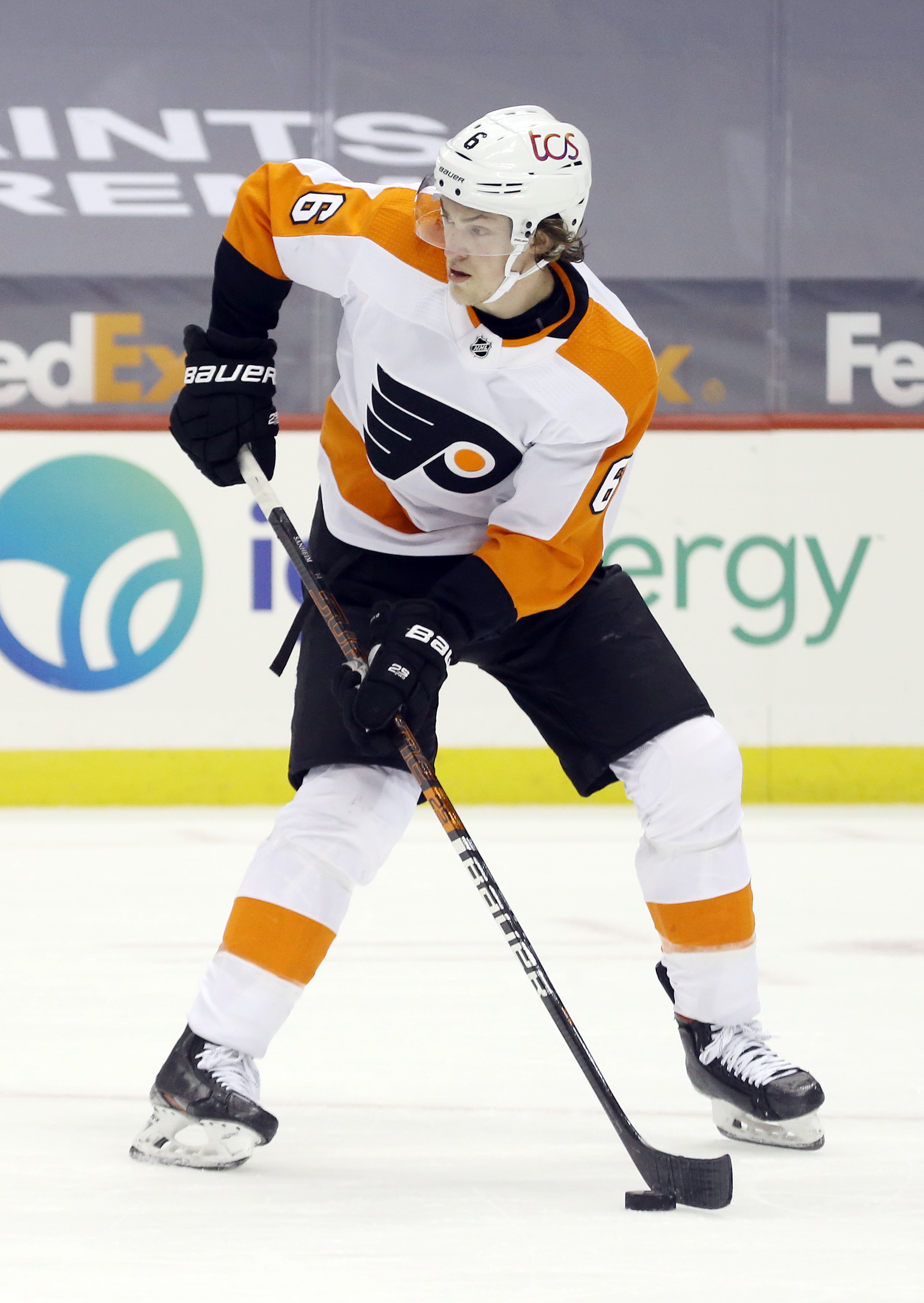 The Flyers were one of two teams to take a restricted free agent to arbitration this offseason as they did so with Sanheim. That guaranteed that they’d get a contract in place before training camp but it also gave Sanheim more leverage as he could have elected to take a two-year deal from an arbitrator to get to free agency early. They didn’t go to arbitration but he still got the two-year pact and the quick trip to the open market. He’s coming off a down season but if he can get back to his production from two years ago, he could be looking at a substantial jump in pay on a long-term deal based on what the defensive market was this year.
Three Years Remaining
G Carter Hart ($3.979MM, RFA)
Hart had a year to forget but his first two were strong enough to give him what was still a pretty strong second contract. He has the potential to be a high-end starter and if that happens, he could come close to doubling that on his next deal. The qualifying offer here is $4.479MM so if Hart doesn’t bounce back or is more of a 1B netminder, that could be a bit too rich for them at that time.
Four Or More Years Remaining
F Cam Atkinson ($5.875MM through 2024-25)
F Sean Couturier ($4.333MM in 2021-22, $7.775MM from 2022-23 through 2029-30)
D Ryan Ellis ($6.25MM through 2026-27)
F Joel Farabee ($5MM from 2022-23 through 2027-28)
F Kevin Hayes ($7.143MM through 2025-26)
F Travis Konecny ($5.5MM through 2024-25)
F Scott Laughton ($3MM through 2024-25)
D Ivan Provorov ($6.75MM through 2024-25)
Couturier isn’t going to win any scoring titles but he’s a premier two-way center in this league and would have landed that price tag on the open market. The last couple of years could be a bit pricey but in the short term, they shouldn’t have any issues with that deal. Hayes, like van Riemsdyk, has been productive but is a bit overpaid relative to the role he fills which is more of a complementary one than a top one. That could be an issue down the road. Atkinson is making high-end second-line money and as long as he plays and produces like a top-six forward – there’s little reason to think he won’t – they’ll get a good return on this deal. Farabee’s deal carries some risk given that he has just 107 career games under his belt but he’s already trending towards being a long-term top-six piece and $5MM for that is pretty good value. Konecny is making market value for a second liner and that’s basically the role he fills even though he is coming off a bit of a disappointing season. Laughton opted for some security at the trade deadline when he signed this extension. Good third-line centers have made more than that in free agency and he’s at least a capable third liner so there shouldn’t be too many issues with this one other than the term may be a little longer than they’d probably have preferred.
Provorov may not be a true number one defenseman but that’s the role he fills on the Flyers. He’s in the prime of his career and is making a lot less than a typical number one defender gets. As a number two, he is making market value and if they keep relying on him as their top blueliner, it becomes a below-market contract. Ellis was their biggest acquisition on the back end, coming over from Nashville. He should take some of the pressure off Provorov and will be a key cog offensively. As long as he plays in their top two, they’ll get a good return on this deal.
Buyouts
G Ilya Bryzgalov ($1.643MM through 2026-27, $0 cap hit as it was a cap-exempt buyout)
Retained Salary Transactions
None
Still To Sign
None
Best Value: Couturier (current contract, not next year’s extension)
Worst Value: Hayes
Looking Ahead
The Flyers project to be tight to the salary cap all season long and will need to be healthy to bank enough space to add an impact player at the deadline. Looking ahead to next summer, with nearly $66M in commitments already, keeping both Giroux and Ristolainen and having enough space to fill out the rest of their roster could be a bit difficult.
Long term, Philadelphia has over $47MM in commitments for 2024-25 already which is near the top of the league in that regard; that number will certainly go up if Giroux and/or Ristolainen re-sign while Hart will be in line for a new deal at that point as well. The odds of them being able to add another core piece will be low as a result with the cap not expected to go up much between now and then. The long-term core is pretty much in place already and any changes will need to come on the trade front. GM Chuck Fletcher has already shown an ability to make core-changing trades based on his moves this summer and more could be coming down the road if this team is unable to get into contention.
Photo courtesy of USA Today Sports Images.
PHR Mailbag: Maple Leafs, Olympics, Flyers, Panthers, Surprises, Futa, Kings, TV, Penguins
Topics in this edition of the PHR Mailbag include Toronto’s playoff potential, Philadelphia’s summer shuffle and goaltending situation, predictions for some surprises this season, and much more. If your question doesn’t appear here, check for it in next weekend’s mailbag.
jimmertee: Can the Leafs ever win in the playoffs with Matthews on the team and the core that’s getting paid so much money but don’t produce in the playoffs? How long do the Leafs stick with that core?
I think they can definitely win a round although that’s about as far as I’m willing to go this season; Tampa Bay is in their division after all and would be the likely favorite in what would be a second-round matchup. They’ve come close enough in recent years and have done some things well; a good bounce here and there and they’d have won a series already. So no, this core isn’t doomed to lose forever and they can definitely get over the proverbial hump.
There really isn’t an easy jumping-off point with this core, especially among their four high-priced forwards. High-paid players are hard enough to move and getting top value for them will be even harder. It’s not that those players aren’t any good but moving and matching money is going to be tough for a while. The overall core group will weaken as the flattened salary cap ultimately prevents players from re-signing but I believe they’re locked into this team structure for a few more years yet.
wreckage: Do you see anyone declining an invite to play at the Olympics?
I’m assuming you’re asking on the political and public pressure fronts. Lots can change as we get closer to February so this answer may not hold up in the end but I’m going to say no. There hasn’t been a chance for an NHL player to participate in eight years so it’s going to be the first opportunity for many and the last chance for many others. It’s hard to pass up on that.
There’s also the fact that the NHL isn’t overly enthusiastic about long-term participation in this event. There’s a commitment to try for 2026 but after that, if they can rekindle and make money off the World Cup, they’re going to push for that so Olympic participation is hardly a guarantee. With the opportunities being so infrequent, I just can’t see anyone declining for that reason. Players will withdraw/decline due to injury but I think that will be the only reason.
Black Ace57: After a busy offseason, is this going to be the make-or-break year for the Flyers? At this point, if they can’t play up to expectations is there really any option but retooling for a year or two?
It sure feels like there’s a lot riding on this season, doesn’t it? GM Chuck Fletcher has made several key changes to their roster with the additions of Cam Atkinson, Ryan Ellis, and Rasmus Ristolainen with the sole design of getting back to the playoffs and doing some damage when they get there. If that doesn’t happen, changes are going to be made.
Claude Giroux is an unrestricted free agent next summer and he’s someone whose odds of returning will likely directly be tied to Philadelphia’s success. Once James van Riemsdyk moves to being an expiring contract which happens next summer, he’s likelier to be gone as well. Those two leaving would be another significant retooling. We’ll see what happens with Ristolainen, another pending UFA, as well.
With the commitments they have on the books already – nearly $66MM in a dozen players per CapFriendly – a big overhaul seems less likely so while there could be a big name or two coming and going again, most of the core would stay intact so I like your classification of a retool instead of a rebuild in that situation.
Emoney123: Do the Flyers have a goalie problem? Hart is coming off a down year so should he be looking over his shoulder at Sandstrom, Ersson, Ustimenko, Ross, Tomek, and Fedotov? Is there a generational talent in there somewhere or just prospects hyped by the organization?
I’ll answer the second one first. No, there isn’t a generational goalie in the pipeline. I’m not even sure there’s an NHL starting goalie in there let alone a rare elite talent. Samuel Ersson has some upside but he needs to do well in North America before calling him good enough to potentially push Carter Hart for playing time.
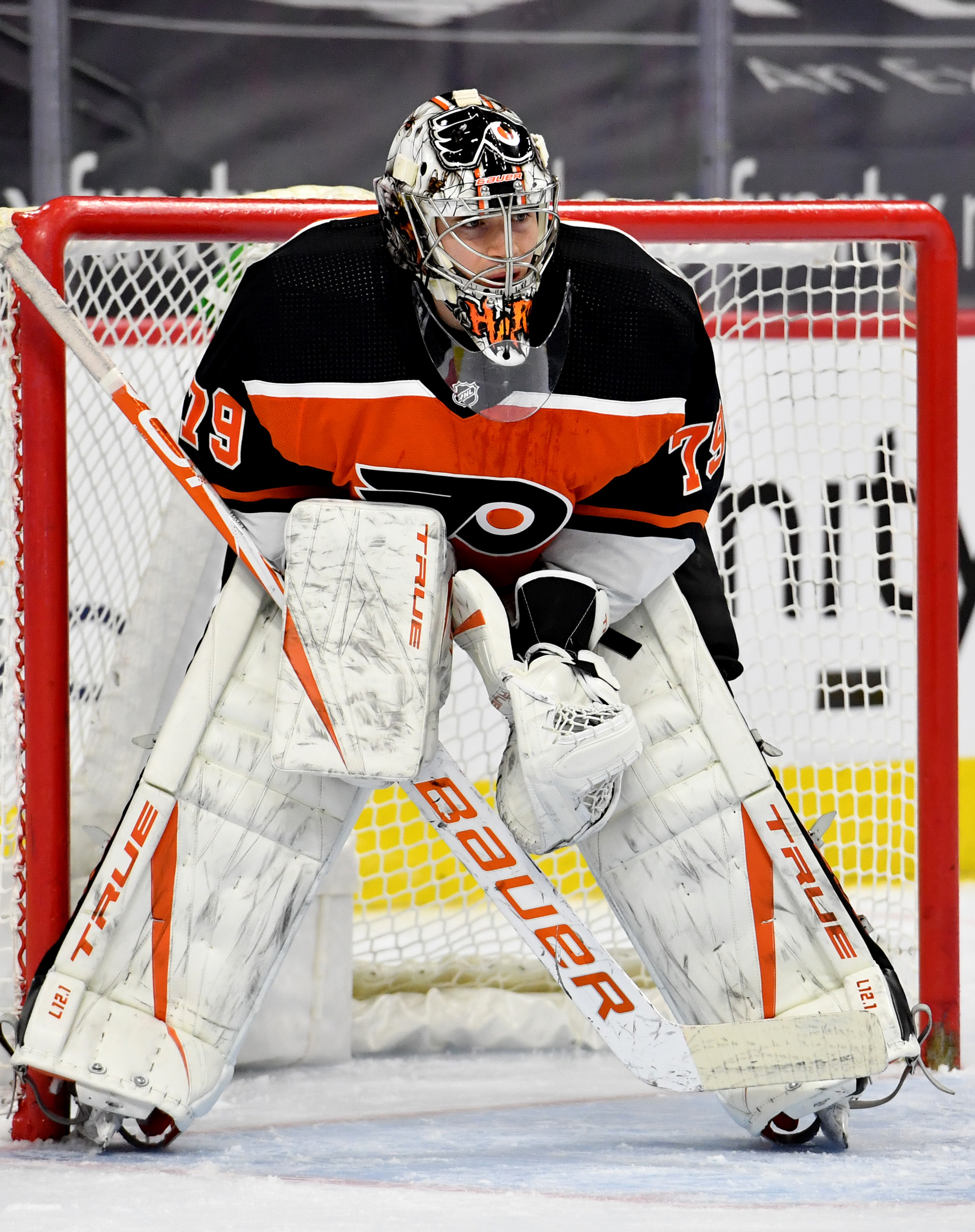 So, is that a problem? I’m not ready to call it that yet. I expect Hart to bounce back playing behind an improved defensive group and even if he isn’t a long-term star netminder, they’ll settle for someone that’s capable of being a decent starter. He’s 23, signed for three years and under team control for four. That’s a good foundation and finding a capable second goalie is certainly doable although I don’t think they necessarily landed one in Martin Jones who they’re also hoping will benefit behind a better defense. If they have to reallocate some cap space to goaltending, they should be able to get a better backup to push Hart and, in the process, give them at a minimum a serviceable tandem. If you have that, it’s not a problem.
In the meantime, adding a quality goalie prospect should be fairly high on the priority list.
YzerPlan19: Predictions for Bennett and Reinhart in Florida’s top six? Can Reinhart get 30 goals playing on Barkov’s wing? Did they bring him in to add more offense or does he slot in at 3C? Can Bennett exorcise his demons and continue on a point per game clip as 2C with Huberdeau?
I can’t see Florida paying a first-round pick and a pretty good goalie prospect in Devon Levi to have Sam Reinhart play on the third line. He’s there to be an impact scorer and will be in their top six, potentially on the wing alongside Aleksander Barkov. I think he’s absolutely capable of scoring 30 this season. Very quietly, he scored at a 38-goal pace last season on a Buffalo team that was bereft of offense. Put him in a more offensive-oriented environment while still being with a high-end center and 30 is definitely attainable.
Bennett, to me, is one of the biggest wildcards in the league. I don’t think he’s going to be able to keep playing at a point-per-game pace as he did after the trade. 10 regular season games is a pretty small sample size as is five playoff contests. But he absolutely can put up more than he was providing with Calgary. If he had a 45-50-point season while being a capable center and playing with plenty of grit, I think they’d take that. If he can hover closer to that point per game mark though, his contract will wind up being one of the better bargains in the league.
pawtucket: What are your top surprises in each division? Could be team, player, standings, whatever.
Atlantic: Will Butcher (Buffalo) gets back to being an impact offensive defenseman. He was a bit better down the stretch in New Jersey but was still given away (with retention). He’s not going to a winning environment but he will have a chance to play a bigger role and has the offensive skills to be a real weapon. With his lowered price tag ($2.822MM after retention), he becomes one of the most sought-after rentals at the trade deadline.
Metropolitan: Columbus doesn’t bottom out and finish last in the division. They’ve blown up their roster and at some point, one of their two pending UFA goalies is going to have to go as well. The end result is a mishmash of players that are supposed to have the Blue Jackets contending for the top pick. They’re not making the playoffs but they’ll be more competitive than many realize at and the end of the day, someone else is last in the Metro.
Central: Vladimir Tarasenko (St. Louis) is still with the Blues after the trade deadline. There’s a mutual desire for a change of scenery and he has been in all sorts of trade speculation but they don’t want to give him away in case he bounces back. Tarasenko produces close to a 20-goal level which still isn’t a good return on a $7.5MM AAV but it’s enough that they decide to hold onto him. Many expect him to move – particularly since they need to re-sign Robert Thomas – but someone else becomes the cap casualty to make that happen.
Pacific: Nolan Patrick is this year’s Chandler Stephenson. Stephenson’s trade to Vegas gave him a chance to play a bigger role and he certainly made the most of it. Now, Patrick, freed somewhat from the expectations that come from being a second-overall pick, has a similar opportunity and puts up 35-40 points, giving the Golden Knights the center depth they’ve lacked lately. He’s not going to be the number one that would make a huge difference but he’ll be a big part of their secondary core, not too shabby for a reclamation project.
RFA Profile: Elias Pettersson
Elias Pettersson burst onto the scene in 2018-19, immediately becoming a top-line player on the Canucks. He has been a fixture in that role since then, putting him in line for a substantial raise once he signs his second contract which should be at some point over the next few weeks with training camps fast approaching.
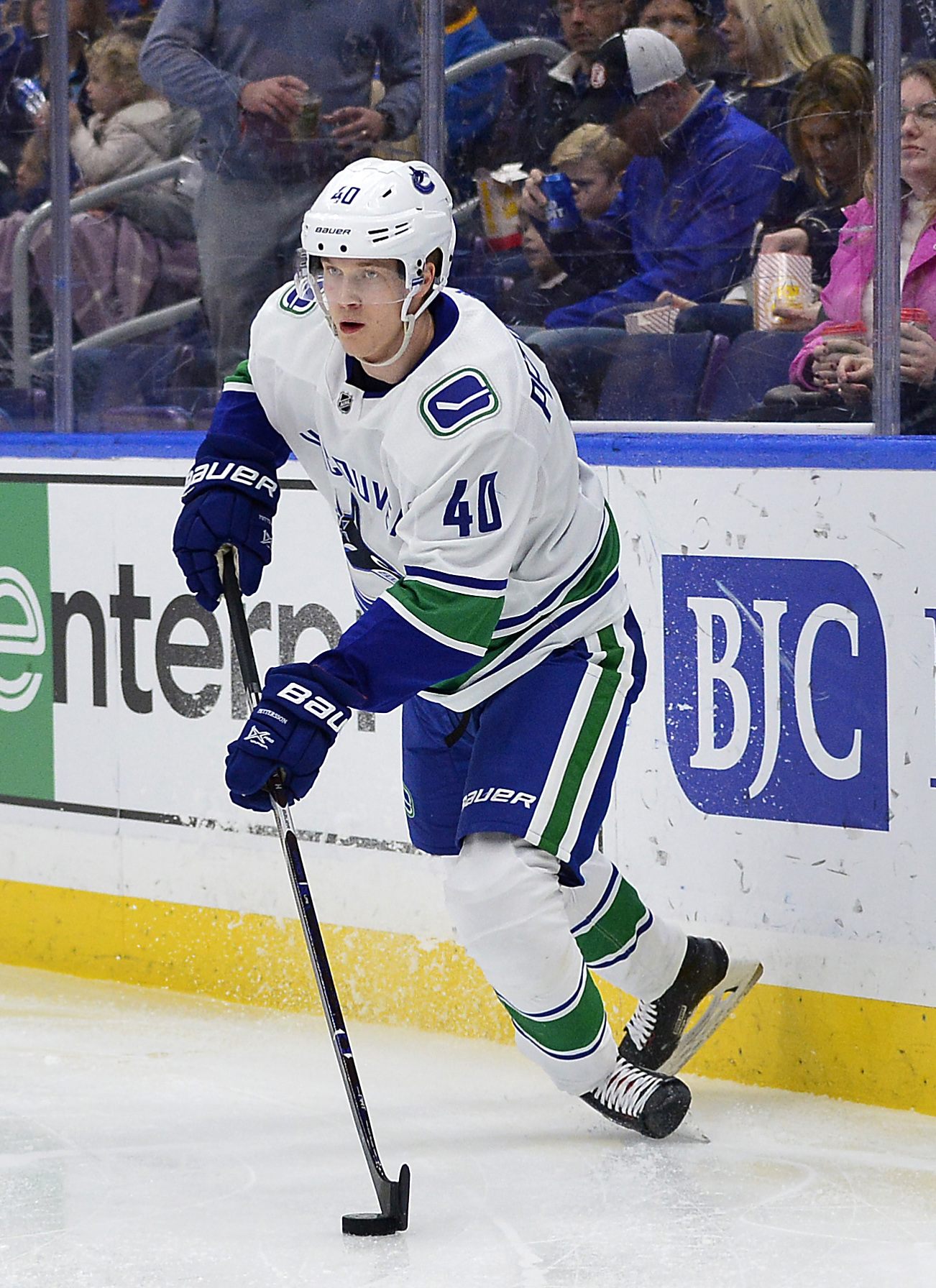 Drafted as a center, the 22-year-old has split time between playing down the middle and on the wing which expands the pool of comparable players to work from. Either way, Pettersson is going to be staying on the top trio.
There are a couple of elements that are going to be at play in these talks. One is that he missed the last 30 games with a wrist injury and while no one is saying he had something to prove there, he’s basically working off of two years worth of NHL games played whereas many of his comparables had three full years under their belt. It’s not going to drastically affect his value but it’s going to be something to keep in mind.
The other is Vancouver’s cap situation. By the time they whittle their roster down and place Micheal Ferland on LTIR, they’re going to have around $15MM to spend. That’s plenty for Pettersson but there’s also Quinn Hughes that needs to be signed. They can’t both get long-term deals; at least one of them is getting a bridge. How talks go with one will play a big role in negotiations for the other. (Both happen to be represented by CAA’s Pat Brisson as well.)
Statistics
2020-21: 26 GP, 10-11-21, even, 66 PIMS, 63 shots, 18:34 ATOI
Career: 165 GP, 65-88-153 (0.93 points per game), +19, 36 PIMS, 369 shots, 18:24 ATOI
Comparables
Brayden Point (Tampa Bay, 2019) – Let’s look at a couple of bridge options first. Point was basically stuck signing one due to Tampa’s cap situation, a situation that Pettersson could be in as well depending on what happens with Hughes. Point’s trajectory is different than Pettersson’s in that he started slower but had a dominant platform year which wasn’t an option for Pettersson but the per-game average numbers are somewhat close overall.
Platform Year Stats: 79 GP, 41-51-92, +27, 28 PIMS, 191 shots, 18:55 ATOI
Career Stats at ELC Expiration: 229 GP, 91-107-198 (0.86 points per game), +49, 66 PIMS, 530 shots, 18:38 ATOI
Contract: Three years, $20.25MM
Cap Hit Percentage: 8.28%
Current Equivalent: Same as above
Mathew Barzal (NY Islanders, 2021) – Barzal wasn’t able to repeat his rookie-season performance over his second and third years but still notched at least 60 points each time, a level of production Pettersson hit in his first two years, albeit with fewer games played. Like Point, this deal was basically forced by New York’s cap situation and as it was signed earlier this year, it also stands as the most recent comparable out there.
Platform Year Stats: 68 GP, 19-41-60, +5, 44 PIMS, 171 shots, 20:03 ATOI
Career Stats at ELC Expiration: 234 GP, 59-148-207 (0.88 points per game), -1, 126 PIMS, 520 shots, 18:25 ATOI
Contract: Three years, $21MM
Cap Hit Percentage: 8.59%
Current Equivalent: Same as above
Those are basically the only two comparable players in the price range that it’s going to cost on a short-term contract so let’s look at a few longer-term deals. The cost gets a lot higher with some UFA years being bought out as a result.
Jack Eichel (Buffalo, 2017) – Yes, this is a big contract but the offensive output between the two at the end of their entry-level deals is pretty close. Eichel had the strength of a higher draft seed (second) and the fact he was basically Buffalo’s franchise player from the moment he was drafted. Those gave him a bit of a boost that Pettersson might not be able to get but the numbers – which matter the most in contract talks – arguably have Pettersson in this range. This contract was also viewed as a reach at the time but it’s still usable as a comparable.
Platform Year Stats: 67 GP, 25-39-64, -25, 32 PIMS, 246 shots, 20:09 ATOI (deal was signed pre-platform)
Career Stats at ELC Expiration: 209 GP, 73-104-177 (0.85 points per game), -54, 76 PIMS, 733 shots, 19:41 ATOI
Contract: Eight years, $80MM
Cap Hit Percentage: 13.33%
Current Equivalent: Eight years, $86.91MM ($10.864MM AAV)
Mikko Rantanen (Colorado, 2019) – The two players had very different trajectories – Rantanen started slow and then became a high-end performer while Pettersson has been more consistent – but again, the totals at the end of their respective entry-level deals are certainly comparable. It’s fair to question if Pettersson has the offensive ceiling that Rantanen does which is an argument GM Jim Benning would certainly use in talks when this comes up as a possible comparable deal.
Platform Year Stats: 74 GP, 31-56-87, +13, 54 PIMS, 193 shots, 20:51 ATOI
Career Stats at ELC Expiration: 239 GP, 80-129-209 (0.87 points per game), -19, 112 PIMS, 513 shots, 18:53 ATOI
Contract: Six years, $55.5MM
Cap Hit Percentage: 11.35%
Current Equivalent: Same as above
Mitch Marner (Toronto, 2019) – This one would certainly represent the high end of the scale but it’s important to get one player on here whose point per game average at the end of his entry-level deal is at the same mark as Pettersson’s. The only ones with a higher average that were recent high picks to sign long-term deals were Auston Matthews and Connor McDavid and Pettersson certainly isn’t in that range although that’s impressive company to be in. Again, Marner’s offensive trajectory was higher at this point than Pettersson’s is now which is why this basically represents a bar he won’t clear but he could come close.
Platform Year Stats: 82 GP, 26-68-94, +22, 22 PIMS, 233 shots, 19:49 ATOI
Career Stats at ELC Expiration: 241 GP, 67-157-224 (0.93 points per game), +21, 86 PIMS, 603 shots, 17:41 ATOI
Contract: Six years, $65.408MM
Cap Hit Percentage: 13.38%
Current Equivalent: Same as above
Projected Contract
If you were looking at those last few comparables and thinking that Pettersson isn’t in that range, it’d certainly be understandable. The fact is that he hasn’t played anywhere as many games as those players have thanks to the wrist injury and the last two years being shortened. But the point per game average is there and Brisson is going to hammer that home in talks and not settle for considerably less than that. Accordingly, a long-term deal that buys out at least a couple of UFA-eligible seasons could very well have an AAV starting with a nine.
That’s why the short-term contract is the easier play here. If they’re able to work out a long-term deal with Hughes, they should still be able to afford a two-year or three-year bridge around the high $6MM/low $7MM range without creating any significant cap casualties. Either way, while they don’t necessarily have to have a deal done with Hughes beforehand, the two basically need to get their deals done pretty much around the same time. At this point, it may make more sense for Pettersson to get the short-term deal.
Photo courtesy of USA Today Sports Images. Contract information via CapFriendly.
Salary Cap Deep Dive: Seattle Kraken
Navigating the salary cap is one of the more important tasks for any GM. Teams that can avoid total cap chaos by walking the tightrope of inking players to deals that match their value (or compensate for future value without breaking the bank) remain successful. Those that don’t see struggles and front office changes.
PHR will look at every NHL team and give a thorough look at their cap situation heading into the 2021-22 season. This will focus more on players who are regulars on the roster versus those who may find themselves shuttling between the AHL and NHL. All cap figures are courtesy of CapFriendly.
Seattle Kraken
Current Cap Hit: $73,106,666 (under the $81.5MM Upper Limit)
Entry-Level Contracts
None projected to play a full-time role in the NHL this coming season.
One Year Remaining, Non-Entry-Level
F Mason Appleton ($900K, RFA)
F Colin Blackwell ($725K, UFA)
D Dennis Cholowski ($900K, RFA)
F Ryan Donato ($750K, RFA)
D Cale Fleury ($750K, RFA)
D Haydn Fleury ($1.4MM, UFA)
F Morgan Geekie ($750K, RFA)
D Mark Giordano ($6.75MM, UFA)
D Jeremy Lauzon ($825K, RFA)
F Kole Lind ($874K, RFA)
F Calle Jarnkrok ($2MM, UFA)
F Marcus Johansson ($1.5MM, UFA)
F Jared McCann ($2.94MM, RFA)
F Riley Sheahan ($850K, UFA)
F Carsen Twarynski ($750K, RFA)
McCann has shown flashes of being an above-average contributor in the past but hasn’t been able to do so consistently. He’ll get the chance to play a bigger role with Seattle and if it all comes together, he could be in line for a sizable pay bump next year. Jarnkrok has been on a bargain deal for the last five years and will also get to play a bigger role with a shot at bumping up his numbers before hitting the open market. Johansson and Sheahan are both coming off quiet years and have seen their value dip lately and will need stronger seasons to land guaranteed deals next summer. Appleton is coming off a strong season with Winnipeg and is already looking like a candidate to more than double his AAV next summer. A similar performance this season could triple it. Donato had to settle for a minimum contract after a tough year in San Jose but should be able to rebuild his value with the Kraken somewhat. Blackwell had a breakout year with the Rangers and is a candidate for a big jump in salary next summer. Geekie, Lind, and Twarynski will also be battling for depth roles but if they land a roster spot, it’s unlikely they’ll be able to land a big raise as they’d be in a limited role.
Giordano – who turns 38 next month – is nearing the end of his career but is still a capable top-four blueliner. He’s going to get an opportunity to play a bigger role than he probably should and he’s a candidate to be moved at the trade deadline to a contender who can cut his ice time. He’ll be going year to year from here on out and while his next deal will be cheaper than this, he could still command an AAV in the $5MM range. The Fleury brothers are at different stages of their careers. Haydn played close to the full season in 2020-21 and should be able to land a small raise a year from now while Cale was in the minors last season and is merely looking to stick on the roster. A limited role is likely which will yield a cheap deal next summer. Lauzon did well in Boston last year in his first stint of regular duty and with arbitration rights, he could double his current AAV next summer. Cholowski’s AAV is a little high for someone who may be on the fringes of making the roster but that may be by design in order to try to help sneak him through waivers next month.
Two Years Remaining
F Nathan Bastian ($825K, RFA)
D William Borgen ($900K, RFA)
F Joonas Donskoi ($3.9MM, UFA)
D Vince Dunn ($4MM, RFA)
D Carson Soucy ($2.75MM, UFA)
Donskoi hasn’t had a lot of consistent top-six opportunities but has surpassed the 30-point mark in each of the last four seasons. His price tag is a little high for his level of production but with a bigger role in Seattle, that could change. Bastian has basically just been an energy player in the early stages of his career and as long as he can hold down a spot on the roster, they won’t have any issues with his price tag. Gritty energy players can still land a pretty good payday as long as they can put up some production which is something Bastian will have to work on.
Dunn’s offensive production landed him a big raise this summer and it’s telling that Seattle opted for basically a second bridge contract to get one more opportunity to work out a long-term deal before he becomes UFA-eligible. He’s going to get the opportunity for a bigger role than he had with the Blues and if he can establish himself as a top-pairing player, that next deal could be quite a pricey one. Soucy is a serviceable third-pairing defenseman making a bit much for that role but Seattle has ample cap space to afford the small overpayment in the short term. Borgen is merely looking to establish himself as a regular NHL player so his next contract shouldn’t be much higher than this one unless he winds up in a big role fairly quickly.
Three Years Remaining
G Chris Driedger ($3.5MM, UFA)
F Jordan Eberle ($5.5MM, UFA)
F Alexander Wennberg ($4.5MM, UFA)
Eberle isn’t the top-line winger that he was in his prime but he’s still a fairly consistent secondary scorer. He’s going to be asked to do more than that in Seattle which could give him a chance to crack the 20-goal mark again, something he was on pace to do the last two shortened seasons. If he gets there, it may not be a bargain contract but they’ll get a reasonable return. Wennberg’s contract showed how difficult it is to land impact centers in free agency. He did well with Florida last season but was bought out by Columbus the year before after struggling in a top-six role and has only reached double-digit goals twice in his career. He’s going to have a big role with the Kraken and this is a contract that certainly carries some risk.
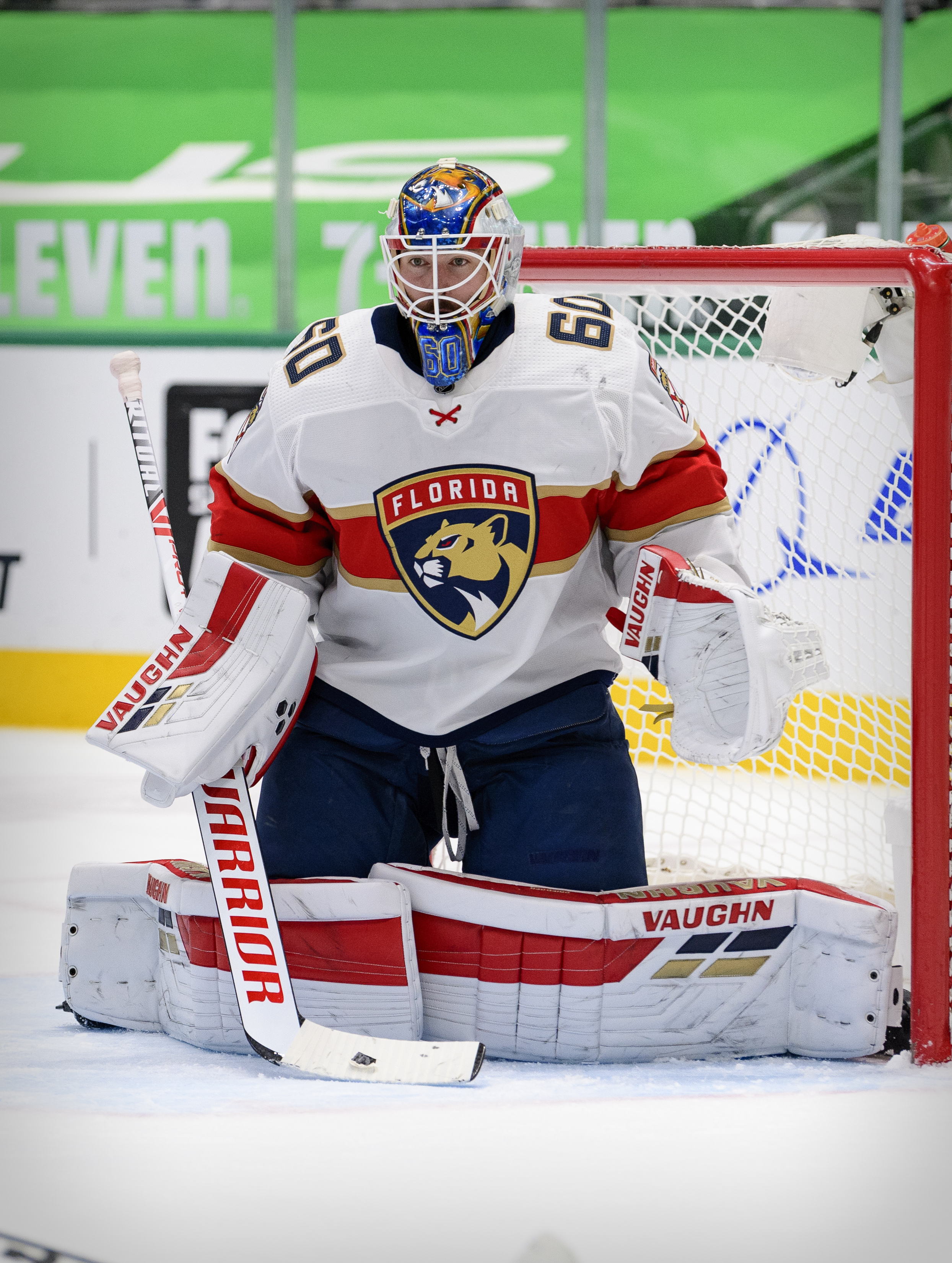 Driedger is one of the more impressive success stories in recent years. After bouncing around the minors, he finally got an opportunity with the Panthers and quickly became one of the better backups in the league. But with the late start, his track record is minimal – just 41 career NHL appearances and that includes playoff action. Landing a three-year commitment towards the upper echelon of price tags for a backup goaltender was pretty good, especially when it looked like he might be the starter. Of course, that changed early in free agency but Driedger should be able to still play enough games to justify the small premium for a backup netminder.
Salary Cap Deep Dive: Pittsburgh Penguins
Navigating the salary cap is one of the more important tasks for any GM. Teams that can avoid total cap chaos by walking the tightrope of inking players to deals that match their value (or compensate for future value without breaking the bank) remain successful. Those that don’t see struggles and front office changes.
PHR will look at every NHL team and give a thorough look at their cap situation heading into the 2021-22 season. This will focus more on players who are regulars on the roster versus those who may find themselves shuttling between the AHL and NHL. All cap figures are courtesy of CapFriendly.
Pittsburgh Penguins
Current Cap Hit: $81,378,205 (under the $81.5MM Upper Limit)
Entry-Level Contracts
None projected to play a full-time role in the NHL this coming season.
One Year Remaining, Non-Entry-Level
F Zach Aston-Reese ($1.725MM, UFA)
F Jeff Carter ($2.636MM, UFA)*
G Casey DeSmith ($1.25MM, UFA)
D Mark Friedman ($725K, RFA)
F Danton Heinen ($1.1MM, UFA)
F Kasperi Kapanen ($3.2MM, RFA)
F Sam Lafferty ($750K, UFA)
D Kris Letang ($7.25MM, UFA)
F Evgeni Malkin ($9.5MM, UFA)
D Juuso Riikola ($1.15MM, UFA)
F Evan Rodrigues ($1MM, UFA)
D Chad Ruhwedel ($750K, UFA)
F Bryan Rust ($3.5MM, UFA)
*-Los Angeles is paying 50% of Carter’s cap hit.
Malkin had a quiet year by his standards last season as he notched 28 points in 33 games and isn’t expected to be ready to start the upcoming campaign due to knee surgery. Now 35, Malkin’s days of being an elite producer may have come to an end which means a pay cut should be on the horizon. Rust didn’t put up a point per game last season but still produced at a top-line level. Showing that over a full season would have him very well-positioned for a sizable raise on his next deal. Kapanen’s second go-round in Pittsburgh was better than his first as he established himself as a strong second-liner. He’ll be a year away from UFA eligibility at the end of this contract so a long-term, pricier contract is heading his way. If not, he’d be wise to just file for arbitration and head to the open market in 2023.
Carter made an immediate impact after coming over from Los Angeles, notching 13 goals in 20 games (regular season and playoffs combined). If he even comes close to that pace this coming season, they’ll get good value on the contract and Carter, who seemed to be a candidate to retire when this deal was up, could wind up sticking around the league a little longer. Aston-Reese couldn’t work out a long-term contract (the cap situation played a role in that) which sends him to the open market next summer. The market for bottom-six players improved considerably this offseason which bodes quite well for his future earnings. Heinen was non-tendered by Anaheim following a tough run with them and lands in a favorable situation where he’ll be in a better offensive environment to try to rebuild his value. He can be controlled through a qualifying offer although salary arbitration could be a factor. Rodrigues was a serviceable role player and got a small raise this summer but unless his offensive numbers take a step forward, he won’t get much of one next year. Lafferty brings grit but not a lot of production which will keep his price tag close to the minimum moving forward.
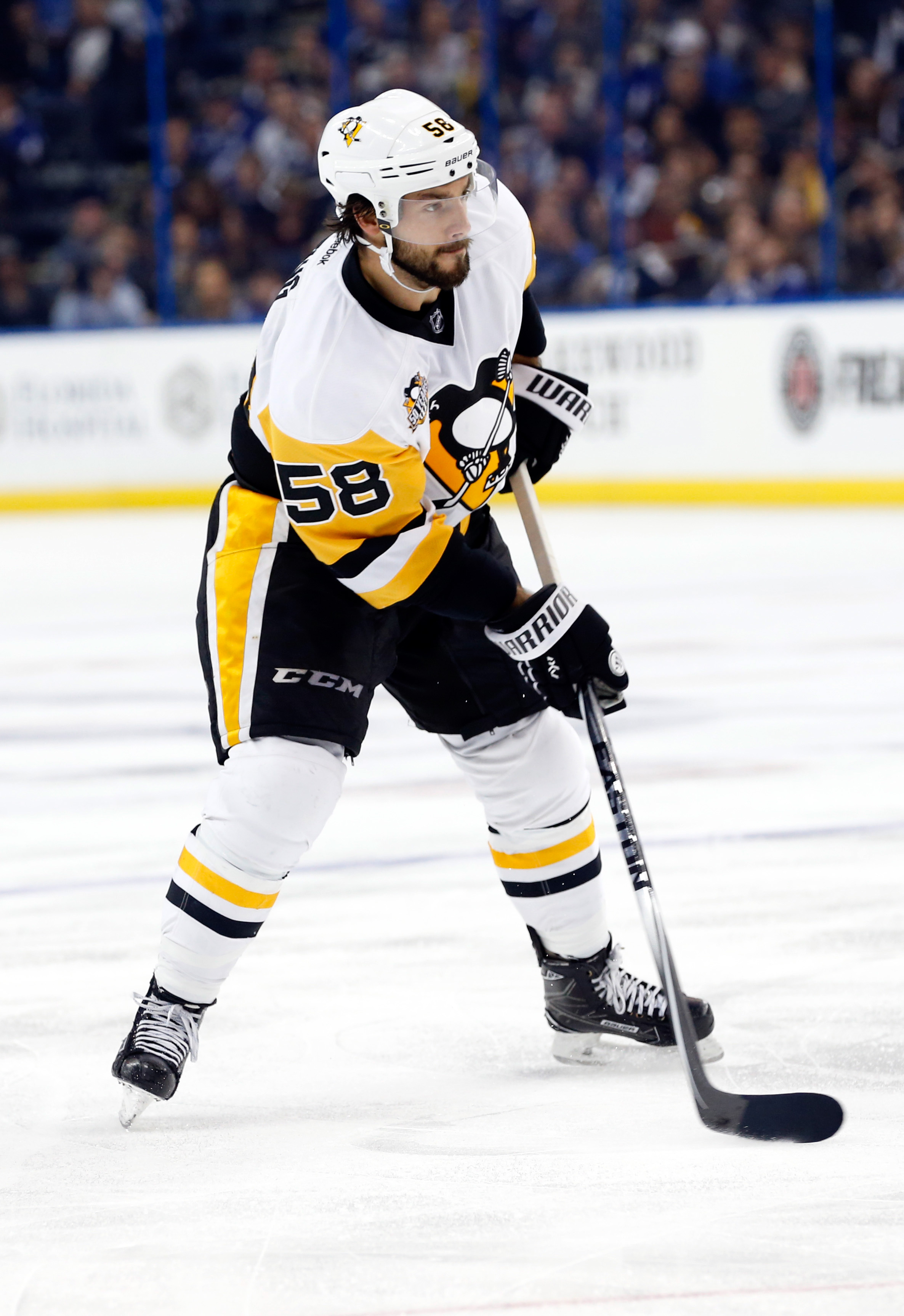 While Malkin is probably heading for a smaller salary, the same can’t necessarily be said for Letang, another long-time core piece that’s set to hit the open market. The top-end production is still there as he very quietly finished tied for third in the league for points by a defenseman last season. With the way the cost for top-pairing blueliners has gone up, Letang could have a decent case for a small raise. If he’s willing to take a discount to stay in Pittsburgh – a reasonable possibility – the discount may simply be signing for something close to what he’s making now. He’ll be subject to 35-plus provisions (unless a multi-year deal has equal compensation throughout) on his next contract but Letang still should still land a multi-year commitment. Ruhwedel and Friedman are depth defenders whose biggest value comes from their low cap hits and those will need to be low-cost slots beyond this season.
DeSmith returned to the NHL last season after being the third-stringer in 2019-20 and the results were mixed as Pittsburgh’s goaltending ran hot and cold at times but overall, he provided slightly above average numbers at a price tag well below many recent backup signings. A repeat showing could put him in a spot to double his current AAV next summer.
Two Years Remaining
F Teddy Blueger ($2.2MM, UFA)
D Brian Dumoulin ($4.1MM, UFA)
G Tristan Jarry ($3.5MM, UFA)
F Radim Zohorna ($750K, UFA)
F Jason Zucker ($5.5MM, UFA)
At the time that Pittsburgh acquired Zucker, his contract looked more than reasonable. He was a quality top-six winger with the expectation that joining the Penguins would help improve his production. That hasn’t happened and he wound up being unclaimed in expansion. All of a sudden, his deal is an overpayment relative to the production he has provided which won’t help his market value two years from now. Blueger has become an important bottom-six piece and should have an opportunity to play a bit of a bigger role this season. Even capable bottom-six centers can land notable contracts so he should be looking at a raise in 2023. Zohorna held his own in his NHL debut last season but is waiver-exempt for one more year. He’s likely to be shuffled back and forth as a result to save some money on the cap.
Dumoulin doesn’t generate a lot of buzz around the league but he has been a key cog on their back end for several years. His limited offensive production won’t help his chances of landing top dollar in free agency but as a reliable defensive defender that can log top-pairing minutes, he’s still looking at a fairly hefty raise on his next deal.
Jarry’s first season as the undisputed number one goalie didn’t exactly go as planned. He struggled with consistency throughout the year with a propensity for allowing untimely weak goals. Even so, he’s still only making what a top backup does so while he was overpaid for what he did last season, it wasn’t by as much as it might seem. Needless to say, he’ll have to be a lot better to get a contract for number one money two years from now.
Three Years Remaining
F Jake Guentzel ($6MM, UFA)
Guentzel was once again slightly above the point per game mark last season and has basically been a point per game player over the last three seasons. Not many can say that and even fewer have an AAV that is closer to a second-liner than a top-line forward. He’s still young enough to land close to a max-term contract in his next negotiation and it could be a pricey one if this keeps up.
Salary Cap Deep Dive: San Jose Sharks
Navigating the salary cap is one of the more important tasks for any GM. Teams that can avoid total cap chaos by walking the tightrope of inking players to deals that match their value (or compensate for future value without breaking the bank) remain successful. Those that don’t see struggles and front office changes.
PHR will look at every NHL team and give a thorough look at their cap situation heading into the 2021-22 season. This will focus more on players who are regulars on the roster versus those who may find themselves shuttling between the AHL and NHL. All cap figures are courtesy of CapFriendly.
San Jose Sharks
Current Cap Hit: $78,138,334 (under the $81.5MM Upper Limit)
Entry-Level Contracts
D Mario Ferraro ($925K in 2021-22)
D Nikolai Knyzhov ($797K in 2021-22)
F John Leonard ($925K in 2021-22)
Leonard managed to hold down a regular spot in the lineup in his rookie season, albeit in a limited role. Barring a jump forward offensively, he’s unlikely to land much more than his current price tag on his second contract which would almost certainly be a short-term one.
Ferraro’s sophomore season didn’t see him upping his production all that much but his role certainly changed. Instead of being on the third pairing in sheltered minutes, the 22-year-old was a regular on the top pairing, playing in all situations. There’s little reason to think that will change this coming season and while limited production will limit his earnings upside, Ferraro could triple his current AAV on a bridge deal. Knyzhov had the role that Ferraro had in his rookie season, seeing some sheltered minutes on the third pairing but played in every game. Even if he stays in that role in 2021-22, he’ll be able to pass the $1MM mark on his second contract.
One Year Remaining, Non-Entry-Level
F Alexander Barabanov ($1MM, UFA)
F Andrew Cogliano ($1MM, UFA)
F Jonathan Dahlen ($750K, RFA)
D Dylan Gambrell ($1.1MM, RFA)
F Tomas Hertl ($5.625MM, UFA)
D Nicolas Meloche ($750K, RFA)
F Nick Merkley ($750K, RFA)
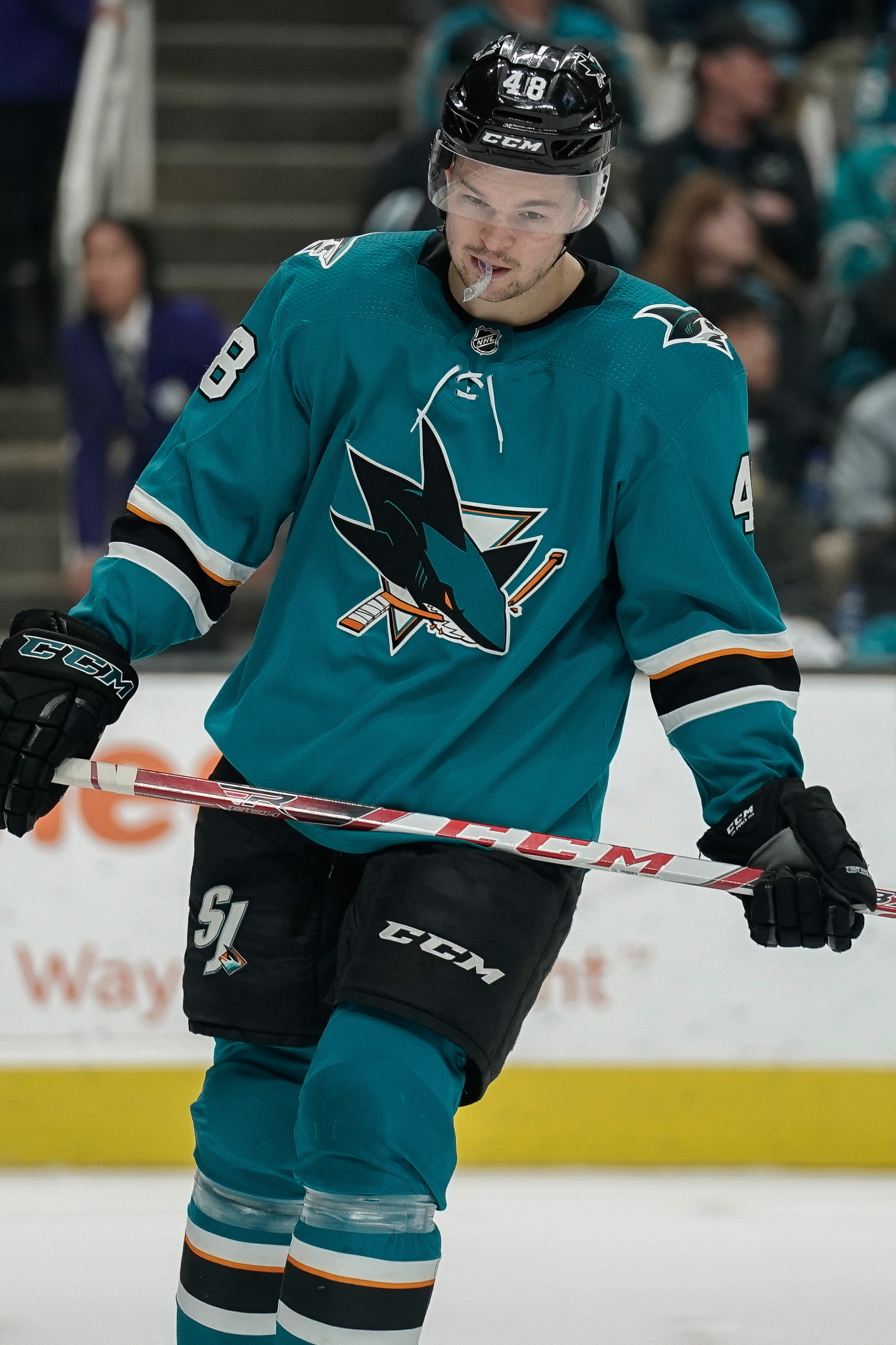 Hertl’s name has been in trade speculation over the last couple of weeks following some comments earlier this month that suggested he may not be with the Sharks beyond the upcoming season. He has become their top-producing center, successfully making the transition from playing the wing at the start of his career. In doing so, his market value has increased considerably. While he may not be able to market himself as a true number one center, quality middlemen are always in high demand and low supply on the open market. Accordingly, a $2MM jump in AAV seems realistic and if it’s not coming from the Sharks, will whoever acquires him closer to the trade deadline hand him an extension as part of the swap?
Gambrell had a big jump in playing time last season but the production was still middling. He’s serviceable in a limited role and can kill penalties but that’s not a spot where they can afford to pay much more than what they’re currently paying and his arbitration eligibility could work against him. Cogliano is a capable placeholding veteran that could be a trade candidate if they’re out of contention at the trade deadline. He’ll be subject to the 35-plus designation next year so he’ll probably be going year-to-year from here on out. Barabanov did well in a very limited stretch after coming over from Toronto and should get a shot at a bigger role. A good showing could have him in line for a considerable raise but if that doesn’t happen, he’ll be a candidate to go back to the KHL. Dahlen managed to land a one-way deal which is impressive for someone who played in Sweden’s second division last season. He’ll get a shot at earning a regular spot in camp and if that doesn’t happen, his time in North America could be short-lived. Merkley came over in an offseason trade from New Jersey and will push for a spot on the fourth line; that roster spot will likely continue to be filled by someone making the minimum or close to it moving forward.
Meloche split last season between the Sharks and the taxi squad and at this point, they’re likely to carry a seventh defender that can clear waivers and go back and forth when needed. He’ll battle Jacob Middleton ($725K) for that role unless someone else is brought in between now and then.
Two Years Remaining
F Rudolfs Balcers ($1.55MM, RFA)
F Nick Bonino ($2.05MM, UFA)
D Adin Hill ($2.175MM, UFA)
F Timo Meier ($6MM, RFA)
F Matt Nieto ($850K, UFA)
F Lane Pederson ($750K, RFA)
G James Reimer ($2.25MM, UFA)
Meier hasn’t been able to get back to the per-game production he had before signing this contract, one that carries the poison pill of a $10MM qualifying offer at its expiry. It’d be hard to justify paying him that much while that qualifier also hurts his trade value unless an early extension can be worked out in 2022-23. Bonino came over in free agency, signing a deal that was below our projection for him. As far as third centers go, he’s a decent one on a below-market contract. Balcers has been one of the better recent waiver claims around the league and is in a spot where he can play a regular middle-six role. As long as he stays there, they’ll get a good return on this deal. Nieto and Pederson will be cheap depth players and will be retained around that price point or replaced by someone else making that money.
Hill hasn’t had much of an NHL opportunity but he’ll get one now as he goes from being Arizona’s backup to the starter with the Sharks. We’ve seen the type of money even top backups get let alone starters; both are price points well beyond what he’s making now so the opportunity for a big jump in salary will soon be there. Reimer returns for his second stint with the Sharks and after effectively being relegated to third-string duty in Carolina by the end of the year, he still landed a decent contract. He’ll be 35 for next trip to free agency and likely will have to go year-to-year at that point.
Three Years Remaining
F Kevin Labanc ($4.725MM, UFA)
D Radim Simek ($2.25MM, UFA)
Labanc’s contract was a pricey one for the year he was coming off of but it was also a reward for taking a very team-friendly deal the year before. Unfortunately for him and the Sharks, last season wasn’t much of an improvement. If he gets even close to his 2018-19 numbers, they will get a reasonable return on his deal but right now, this one is a bit of an overpayment.
Simek’s deal also falls under that category. He was their sixth defender some nights and that type of term and money for someone in that role is not good value.
Salary Cap Deep Dive: St. Louis Blues
Navigating the salary cap is one of the more important tasks for any GM. Teams that can avoid total cap chaos by walking the tightrope of inking players to deals that match their value (or compensate for future value without breaking the bank) remain successful. Those that don’t see struggles and front office changes.
PHR will look at every NHL team and give a thorough look at their cap situation heading into the 2021-22 season. This will focus more on players who are regulars on the roster versus those who may find themselves shuttling between the AHL and NHL. All cap figures are courtesy of CapFriendly.
St. Louis Blues
Current Cap Hit: $79,968,849 (under the $81.5MM Upper Limit)
Entry-Level Contracts
None projected to play with some regularity at the NHL level this coming season.
One Year Remaining, Non-Entry-Level
D Robert Bortuzzo ($1.375MM, UFA)
F Kyle Clifford ($1MM, UFA)
G Ville Husso ($750K, UFA)
F Mackenzie MacEachern ($900K, UFA)
D Niko Mikkola ($788K, RFA)
F David Perron ($4MM, UFA)
F Zach Sanford ($2MM, UFA)
D Jake Walman ($725K, RFA)
Some players just fit on a certain team and that appears to be the case for Perron who has vastly outperformed his contract in this, his third go-around with the organization. He cracked the point per game mark last season for the first time in his career and a repeat performance would set him up for a considerable raise if he opted to test free agency. Given that he has already come back twice though, it’s also understandable to think that he may take a little less to stay where he’s comfortable. Sanford has been a capable depth scorer the last few seasons and after seeing that market bounce back a bit for unrestricted free agents this summer, he should be able to land a small raise. If they have to spend more to retain Perron though, some of that money may come from Sanford’s expiring deal. Clifford had a limited role last season and a similar showing will have him looking at playing for the minimum salary in 2022-23. MacEachern has been a depth piece and will need to establish himself as a regular to have a shot at a nominal raise moving forward; his spot will likely need to go to someone making the minimum beyond this season.
Bortuzzo has had a limited role the last few seasons and while they may want to keep him around in that same role, it’s hard to see him getting more on his next deal as players logging the minutes he does often sign for the minimum or close to it. Mikkola will have a chance to push for a regular spot on the third pairing but as he hasn’t produced much even in the minors, a minor pay bump is likelier than a big jump. Walman will be battling Mikkola for that spot and while he has produced more in the minors, again, only a small raise is probable unless one of them really takes a big step and locks down a spot in the top four.
Husso’s first NHL opportunity didn’t go as well as he or the Blues had hoped for but with their cap situation, they couldn’t really afford to bring in a more proven backup. That’s the case again for 2021-22 where he’ll get a chance to prove himself as a viable NHL second option. If it doesn’t happen, he may be back to looking for two-way deals. Either way, St. Louis will need to stay with a low-priced backup to make their salary structure work.
Two Years Remaining
F Ivan Barbashev ($2.25MM, UFA)
F Jordan Kyrou ($2.8MM, UFA)
F Ryan O’Reilly ($7.5MM, UFA)
F Oskar Sundqvist ($2.75MM, UFA)
F Vladimir Tarasenko ($7.5MM, UFA)
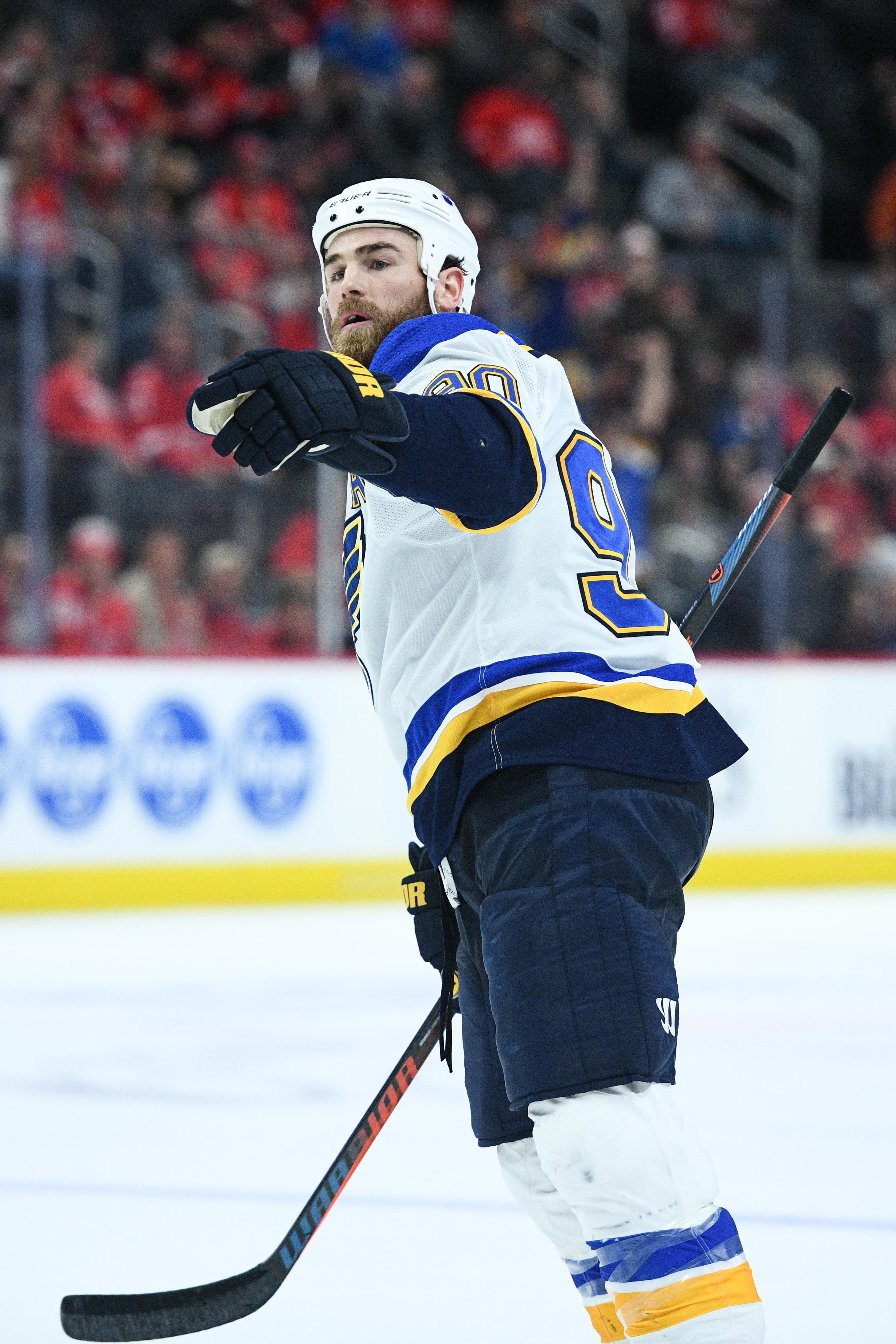 When Buffalo signed O’Reilly to this contract just one year after acquiring him from Colorado back in 2016, the price tag seemed steep. The hope was that he’d become a top-line center but it took getting traded again for him to truly get to that level. With St. Louis, O’Reilly has upped his production while continuing his strong defensive play, earning a Selke Trophy and finishing in the top five in voting the other two seasons. He has made a case for a small raise – he doesn’t put up elite offensive numbers to get him into that $10MM or more tier – but he’ll be 32 when his next contract starts, taking away the potential for a max-term pact.
On the other end of the scale is Tarasenko. You all know the story by now, multiple shoulder surgeries, decreased offensive production, and a mutual desire for a change of scenery though one has yet to materialize. He’ll need to bounce back in a big way to have a shot at a contract anywhere near this two years from now. Kyrou’s first full NHL season was a strong one but with his limited track record and their cap situation, a bridge deal was the only way to go. He’ll at least get a small raise with a $3.2MM qualifying offer but it also wouldn’t be shocking to see him double his current AAV on a long-term pact. Sundqvist, when healthy, has become a capable third liner and as a center, he plays a premium position but he will need to improve his production if he wants more than a nominal raise two years from now. The same can be said for Barbashev who, while he has been used more as a winger, can also play down the middle which will help his value on the open market.
Three Years Remaining
D Marco Scandella ($3.275MM, UFA)
Scandella made an immediate impact after being acquired from Montreal in 2020, earning this extension soon after. He doesn’t produce much but is a capable shutdown defender that can play on the second pairing. It’s not a value contract but it’s not an overpayment either.