
Free Agent Profile: Dan Hamhuis
With Rick Nash’s playing future in jeopardy, defenseman Dan Hamhuis is the highest-rated player on our Top 50 UFA list. The veteran has been a stable defender for quite a few years so why is he still on the open market?
Last season, Hamhuis logged over 20 minutes per night for Dallas while chipping in more than usual offensively with 24 points in 80 games, his highest output since 2012-13. While his days of being a top pairing player that can be used in any situation have come and gone, he should still be able to carry a third pairing and move up when injuries strike. That’s still a pretty useful part of any defense corps.
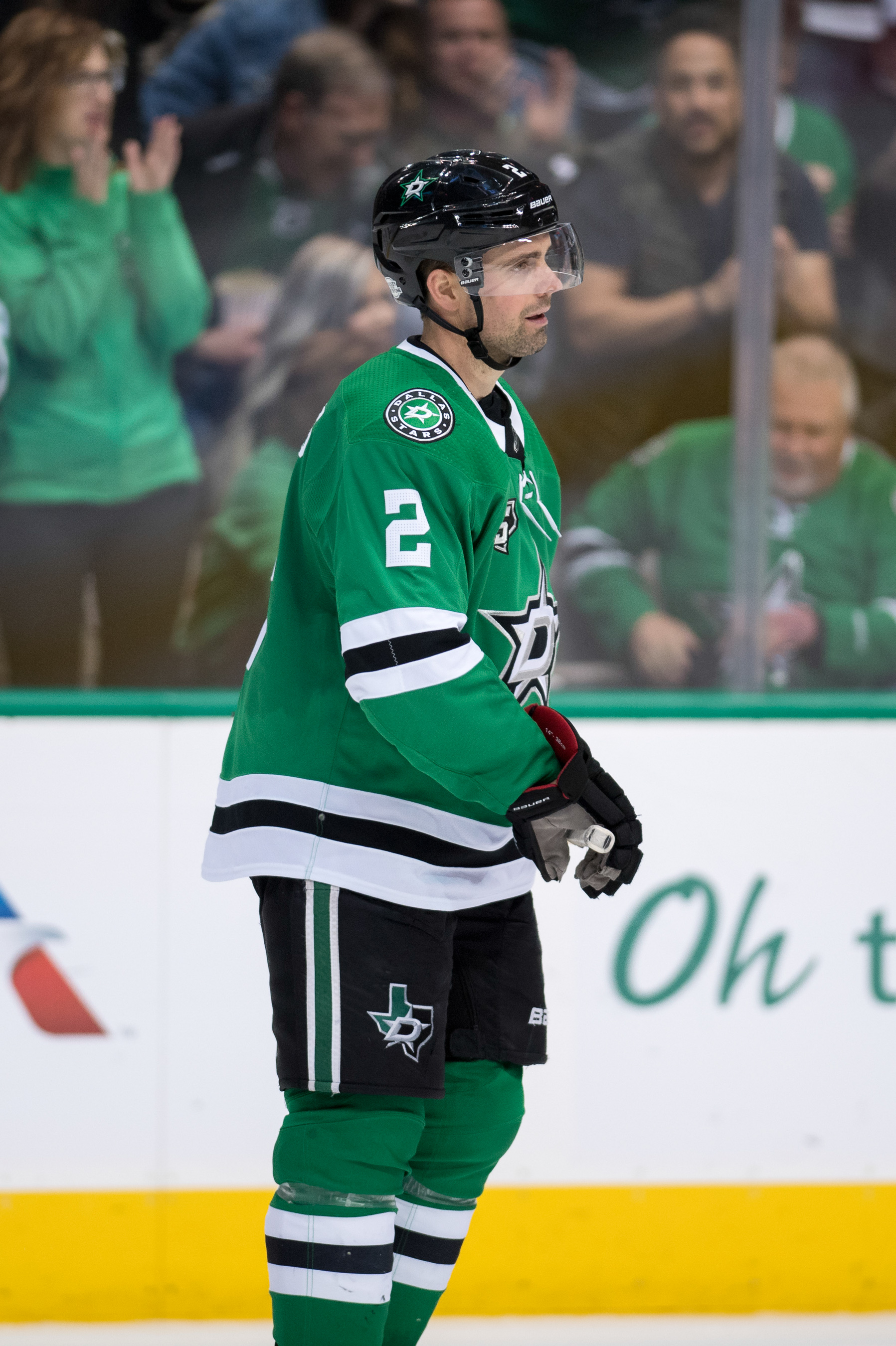 One area that hasn’t fallen off over the years is his penalty killing. He is still someone that can play on a top group and really anchor that unit. Special teams are obviously a big part of the game so finding someone that can impact a penalty kill unit as much as he can at this stage of free agency isn’t something that happens very often.
One element that could be making teams a little wary is the fact that Hamhuis is now 35 which makes a multi-year offer a little bit more of a risk as it would qualify for 35+ status. (This locks in the cap hit even if he is sent to the minors, retires, or is bought out.) It wouldn’t be surprising to see Hamhuis seeking a multi-year commitment giving the year he just had but that doesn’t appear to be something teams are open to, at least for now.
Potential Suitors
Teams that are rebuilding or have outside chances of making the playoffs aren’t likely to have interest in Hamhuis. He’s best served as a role player on a contender that can move up the lineup from time to time as needed.
Last week, Hamhuis indicated that Dallas wasn’t interested in re-signing him as they were saving up for a big-name acquisition. With John Tavares now gone to Toronto, they could certainly try to circle back to see if they can come to terms on a deal to keep him around. Chicago’s movement this summer suggests they believe they still have one more run left in them and Hamhuis would certainly represent an upgrade on their third pairing. Nashville could also use some insurance beyond their big four and going there would bring his career full circle as they originally drafted him in the first round back in 2001.
Out East, Washington makes a lot of sense to give them another penalty killer that can also help shelter their younger players on the third pairing. The Devils would undoubtedly like to add another top-four player to their back end but if they can’t do so, Hamhuis would still be a decent consolation prize. Toronto’s strength in depth is on the left side but the veteran could still fill a role with them as well but he probably would have to be willing to take a one-year deal for that to become an option.
Projected Contract
Before free agency, we projected a two-year, $6MM deal for Hamhuis. For someone capable of playing 20 minutes per game (or close to it), that AAV is a bargain but his age is clearly working against him to some degree. A contract like that is still certainly a possibility but the closer this drags out towards training camp, he may have to settle for a one-year pact instead.
Photo courtesy of USA Today Sports Images.
New Jersey Devils Pursued Patrick Maroon, James Van Riemsdyk
The New Jersey Devils have signed just one forward—Kurtis Gabriel—in free agency, but it hasn’t been for lack of trying. GM Ray Shero spoke to media today including radio play-by-play announcer Matt Loughlin and admitted that the team had pursued James van Riemsdyk and Patrick Maroon, before they both ultimately signed elsewhere. Maroon specifically was offered more money to stay in New Jersey than he received from the St. Louis Blues, but made the decision to return to his hometown and play closer to his young son.
New Jersey has an incredible amount of cap space this summer, but can’t seem to find any free agents to spend it on after trying and failing with a few forwards. Michael Grabner, who also was acquired at the trade deadline like Maroon, signed a three-year deal with the Arizona Coyotes. The Devils have a good young group of players and a superstar in Taylor Hall they have to start thinking about an extension for—Hall has two years remaining on his current deal—but could still afford to add a few names and salary before the beginning of the year. They made the playoffs in 2017-18 somewhat surprisingly and should try to continue that level of play going forward.
There’s plenty of work to do for the Devils, who have seven restricted free agents still to sign, but it is surprising there hasn’t been more announced so far. There is obviously opportunities to use that cap space as an asset, similar to the way they took Marcus Johansson off the hands of the Washington Capitals last year for a discounted price. If more situations like the reported Erik Karlsson-Tampa Bay negotiations—ones that have apparently included a search for a third team to take on salary—arise this summer you can bet the Devils will be involved.
Still, it is disappointing for a fan base that was hoping for some substantial additions in free agency. Maroon fit in quite well with the team after coming over from the Edmonton Oilers, scoring 13 points in 17 games for them down the stretch and adding some size up front. van Riemsdyk too could have given them an elite net front presence and added goal scoring, something they could use as they try to support Hall and Nico Hischier going forward. There isn’t much left on the open market, meaning they might have to wait until next season to really take part in the free agent frenzy.
Value Still Available Among UFA Defensemen
The free agent market is almost tapped, with Patrick Maroon and his on-again-off-again deal with the St. Louis Blues the last of the real impact players available. That is other than Rick Nash, who still hasn’t announced a decision one way or another on whether he’ll play next season. But beyond the big names there are still a few options for teams who want to add reliable NHL defensemen, and at this point in the summer they should come at a relatively inexpensive price.
 Dan Hamhuis is the belle of the ball among those names, and would still represent an upgrade for many teams around the league. Though the Dallas Stars’ defensive work in 2017-18 isn’t something to hold up an example of championship caliber play, Hamhuis is still an effective option at age 35. Logging more than 20 minutes a night last season, Hamhuis and teammate Greg Pateryn were tasked with shutting down the opponent’s best players, while also seeing huge penalty kill time each and every night. The veteran defenseman excelled in the role, and even posted 24 points on the season—almost all of which came at even strength.
If there’s something to be said about experience, Hamhuis would deliver on that front as well. With over 1,000 games in the NHL, he’s quietly been one of the most consistent two-way defensemen in the league for the past decade and a half. He moves the puck quickly and effectively, can be hard-matched against superstars, and could likely be had on a short-term deal at this point. If Hamhuis still wants to play—which he apparently does, according to his Sportsnet radio appearance recently—several teams around the league should be in touch.
It doesn’t just stop with Hamhuis though, as there are several other defensemen who could still add some value around the league. Luca Sbisa dealt with injury for much of last season and was pushed down the depth chart in Vegas, but can still skate and is still young enough—he’ll still be 28 at the start of the season—to have a bounce-back campaign. Toby Enstrom has had a career similar to Hamhuis in that he’s been a consistent two-way defenseman, but is coming off his worst season in the NHL and has injury concerns. He’s 33 now but still wants to play, and could be a good pickup for a bottom pairing somewhere.
One of the more interesting names is Alexei Emelin, who hits free agency after disappearing from the spotlight by playing down in the lineup in Nashville. The 32-year old was once a highly touted defensive option who was feared for his open ice hitting, but filled a depth role for the Predators as they waited for Ryan Ellis‘ return midseason. Emelin ended up playing in 76 games for Nashville, but saw his usage decline sharply in the playoffs. Still, there’s obvious upside for any team looking at Emelin in a bottom pairing role, as he’s shown the ability to log big minutes at times without hurting his team. No one is going out of their way to sign him to an expensive multi-year deal, but if he decides to forego returning to Russia for a short-term NHL contract there should still be plenty of interest.
Photo courtesy of USA Today Sports Images
Salary Cap Floor Should Not Pose Problems For Any Team In 2018-19
The purpose of the salary cap in the NHL is to maintain a sense of competitive balance across the league. That means both limiting how much a team can spend, the salary cap ceiling, but also ensuring that every team is competitive with a minimum expenditure, the salary cap floor. Some teams, generally those in smaller markets or undergoing rebuilds, tend to try to toe the line of the salary cap floor, paying as close to the minimum as possible for their roster. In years past, some teams have even struggled to hit that mark, taking on injured players or overpaying players in order to pass the floor. It’s unlikely that any of the 31 franchises will face that problem in 2018-19.
This season, with a corresponding jump in the salary cap ceiling, the floor moved to $58.8MM. With the bulk of unrestricted free agency accounted for, just three teams currently sit below that mark: the New Jersey Devils, New York Rangers, and Winnipeg Jets. However, both the Rangers and Jets can immediately be crossed off as a salary floor concern. The pair are perhaps the two teams with the most potential salary tied up in salary arbitration this off-season.
The Jets currently have the lowest projected payroll in the league, with a 16-man roster that accounts for approximately $52.7MM. However, Winnipeg’s list of restricted free agents who have filed for arbitration include Vezina candidate Connor Hellebuyck, defenseman Jacob Trouba, and forwards Adam Lowry, Chris Tanev, and Marko Dano, as well as defenseman Tucker Poolman who did not file. Those six players could easily combine for more than $20MM in combined salary when all is said and done, putting the Jets well clear of the floor and closer to the ceiling. Defenseman Josh Morrissey, who is not arbitration eligible also needs a new contract. Winnipeg is far from a floor concern.
In New York, the Rangers sit at $55.8MM in projected cap committed to 16 players, just $3MM shy of the floor. They also need to re-sign a majority of their young core, with forwards Kevin Hayes, Ryan Spooner, and Jimmy Vesey and defenseman Brady Skjei having filed for arbitration. The Rangers could pass the floor by extending just one of those players, nevertheless all four. New deals for those three forwards still leaves New York one or two shy of a full roster as well, meaning more salary will come into the fold via promotion or an additional acquisition.
As for the Devils, New Jersey is already close to the floor at a projected $56.4MM for 19 players. Forwards Blake Coleman and Stefan Noesen have filed for arbitration and the deals for both could be enough to push the Devils to where they need to be. Even if it doesn’t, the team will still need to sign non-arbitration eligible RFA’s Miles Wood and Steve Santini, whose deals should definitely be enough. New Jersey will likely be a team that hovers close to the floor next season; that didn’t stop them from making the playoffs in 2017-18, though.
Perhaps the only team who should be legitimately concerned about the salary cap floor next season in Ottawa. The Senators and owner Eugene Melnyk have made it no secret that they are trying to shed salary and come in as close to the minimum as possible. Right now, the team sits just $3MM above the floor at a projected $61.8MM roster for 20 players. However, that isn’t including the arbitration resolutions for both defenseman Cody Ceci and forward Mark Stone. Those two deals will put Ottawa well above the floor. Even if the team was to trade star defenseman Erik Karlsson, they should remain above the floor, especially with additional salaries likely to be added in the trade return. The one scenario in which Melnyk could succeed in dropping significant salary would be if both Karlsson and Bobby Ryan were to be traded away. The resulting $13.75MM loss in payable salary would more than offset the contracts for Stone and Ceci and likely the contracts of those players coming back as well, potentially dropping the team below $58.8MM. Yet, even in that case, the Senators’ efforts to fill out their roster after losing Karlsson and Ryan – either by promotion or acquisition – could easily be used to get back to that mark.
The salary cap floor was never intended to be used as a target for teams to hover above and spend as little as possible. The goal of the NHL is have each and every team be competitive, not simply trying to maximize profits. As such, the 2018-19 season has some parity promise as seemingly no team will struggle to get over the floor or have to use contracts for the old and injured to get there. For the first time in years, every team seems set to be competitive and comfortably over the minimum cap hit.
All cap figures are courtesy of CapFriendly.com.
Snapshots: Ducks, Arbitration, Panarin
The Anaheim Ducks will retire two numbers this season, honoring Paul Kariya‘s #9 and Scott Niedermayer‘s #27 at two different ceremonies. Both players have been inducted into the Hockey Hall of Fame following outstanding playing careers, and were huge parts of a franchise that has had quite a bit of success over its first 25 years in existence.
Kariya, the team’s very first draft pick, recorded 669 points in 606 games for the then-Mighty Ducks of Anaheim and was named captain just a few years into his career. His dynamic offensive skill and speed brought the team international attention, and when paired with Teemu Selanne formed one of the most exciting young duos to watch in the NHL. He won just about everything he could in his career except for a Stanley Cup, including Olympic, World Junior and World Championship gold medals, an NCAA title and a pair of Lady Byng trophies.
Niedermayer had a different path to success in Anaheim, coming as an unrestricted free agent in the summer of 2005. The superstar defenseman brought championship experience to the Ducks, and quickly led them to a Stanley Cup of their own in 2007. That was the team’s first and only NHL championship, and Niedermayer’s Conn Smythe-winning performance was good enough to cement him in their history forever. Another three seasons at an elite level only confirmed his designation as one of the greatest players to ever suit up in Anaheim.
- A few arbitration dates have already been set, as Michael Russo of The Athletic reports that Mathew Dumba and Jason Zucker of the Minnesota Wild have hearings on July 23 and 28th respectively. Members of the Washington Capitals will also be in Toronto on one of those days, as Liam O’Brien has a hearing set for the 23rd. It’s important to note that teams can sign these players to contracts at any time before an arbitrator actually makes a decision, and only a few (if any) of those who filed for player-elected salary arbitration will even make it that far. For Zucker, an arbitrator could only grant a one-year contract since the Minnesota forward is already 26 and is scheduled to reach unrestricted free agency in the summer of 2019.
- Rumors have been swirling for some time about the status of Columbus Blue Jackets’ forward Artemi Panarin, given that he isn’t willing to open negotiations with the team regarding his upcoming free agency. Panarin is scheduled to hit the open market next summer, and agent Dan Milstein spoke with The Athletic’s Aaron Portzline (subscription required) to make it clear that his client holds no grudge or animosity towards his current team. Quite the contrary, Milstein explains that the Blue Jackets have been an outstanding organization for Panarin, but that the 26-year old forward simply hasn’t make a decision on his future. Panarin is one of the league’s very best offensive talents, but the Blue Jackets would have to consider trading him if there is a clear indication that he won’t entertain a long-term extension at some point.
Snapshots: Hossa, Zadina, Brassard
The Chicago Blackhawks have been quieter than usual this offseason and one reason that has been the case is that while it has some cap room to work with, the team didn’t have enough to make a major splash in free agency. The team had been linked at one time or another to players such as James van Riemsdyk, James Neal and David Perron, but were unable to work out a deal and a lot of that has to do with cap space. With its minor moves made after free agency began when the team inked Chris Kunitz, Cam Ward and Brandon Manning, the team only has just over $2MM to work with.
That’s where the contract of Marian Hossa comes in. His contract of $5.275MM is still stuck on the books for yet another offseason until the team can put it on LTIR to free up the money at the start of the NHL season. That’s what Chicago did last season, using that money to sign defenseman Cody Franson and using it on shuttling AHL talent back and forth all season. However, that didn’t work, according to The Athletic’s Scott Powers.
The general belief was the team wasn’t going to make the same mistake twice and would attempt to deal the bloated contract to a team that needs the contract to get them to the cap floor. However, there haven’t been any takers as teams want an asset in return for them to take on the 39-year-old’s contract, which the Blackhawks don’t want to do. They were burned back in 2016 when they threw in Teuvo Teravainen to Carolina to get the Hurricanes to take Bryan Bickell‘s final year of his contract off their books. Teravainen put up 64 points this season.
One way or another, especially if the team still has plans to make a big offseason move, is to find a way to get Hossa and his contract permanently off their books, even if they have to give up a prospect.
- With questions surrounding where prized 2018 first-rounder Filip Zadina may end up if he doesn’t make the Detroit Red Wings NHL lineup next season has been up for debate as there are rumors that the sixth-overall pick does not have to return to his junior team next season and could be eligible to jump right to the AHL. However, regardless on how the NHL decides that case, NBC Sports James O’Brien writes that it shouldn’t even matter. He writes that the team shouldn’t want Zadina to make the team next season as the team’s main focus should be to garner another high-end lottery pick next season to complete their rebuild. A 25-goal season by the flashy winger, who many had pegged as the No. 3 pick in the draft, could vault the team to that unenviable position of not being good enough to make the playoffs, but not being bad enough to get an elite prospect either. O’Brien hopes that the addition of free agent Thomas Vanek might help force Zadina to get much needed development time in the minors, no matter where he ends up.
- Paul Zeise of the Pittsburgh Post-Gazette writes that while he envisions the Pittsburgh Penguins keeping Phil Kessel, who has been rumored to be moved out for much of the offseason, he could see the team move on from trade deadline acquisition Derick Brassard. The team suddenly has five centers and of them all Brassard is the most expendable. He has one year remaining on his deal at $3MM, but struggled to produce once he got to Pittsburgh, especially in the playoffs, posting just four points in 12 playoff games.
Canucks’ Offseason Signings Were Critical To Improve Team
The Vancouver Canucks dealt with a lot of criticism when free agency started last week when they went out and signed bottom-six players Jay Beagle, Antoine Roussel and Tim Schaller to long-term deals (Beagle & Roussel got four years, while Schaller signed for two). While the general addition of these three players was to add some size, grit and leadership to an incredibly young team, there is another key advantage of bringing in those three, especially with their abilities to help with penalty killing. Both Beagle and Schaller were solid contributors to their teams last season on the penalty kill and they both will bring those skills to Vancouver now.
“We’ve added some players which is, I think, important. We need guys who can kill penalties,” Vancouver head coach Travis Green said. “The longer you’re in the league, the better the penalty killer you are. Some won’t understand what that means, but there’s a lot of reading plays, and making changes on the fly that you get better at over time. It’s an art learned. You don’t see a lot of young guys come in who are great penalty killers.”
The hope is that Beagle and Schaller should improve the team’s 21st-ranked penalty killing unit, which must improve dramatically if the team wants to start winning. However, their signings also have another key importance to the team.
Perhaps more than anyone, the most likely benefactor to these signings will be center Bo Horvat, who has always been forced to take penalty killing minutes in the past as part of his responsibilities. However with the retirement of Henrik Sedin, suddenly Horvat’s responsibilities have changed, according to Jason Botchford of the Vancouver Sun. The team needs more scoring without the Sedin twins and the team will turn to their four-year pro to take his game to that next level and reducing his minutes on the penalty kill should only help him carry that out.
Horvat’s numbers have been solid, but now that he’s likely moving into the No. 1 center position, he must continue to improve. The 23-year-old has increased his scoring over the past four years, going from 14 goals in his rookie campaign, to 16, then 20 and this year posting 22 goals, even though he played in the least amount of games in his career (64).
That grit created by Beagle and Roussel especially should benefit someone like Elias Pettersson, who the team hopes will become one of the next great scorers in Vancouver. However, while the 19-year-old is 6-foot-2, he weighs in at 161 pounds and the presence of one of those players could remind other teams to stay away from their prized prospect.
The Salary Cap Implications Of A Shea Weber Early Retirement
When Shea Weber signed a 14-year, $110MM offer sheet from the Philadelphia Flyers in 2012, everyone knew right away that it would end badly. Yes, Weber was 27 years old and one of the top defensemen in the league, but the contract was top-heavy and carried a $7.86MM cap hit through his age-40 season. The chances of him playing to a level matching that value over a full 14 years was very slim. The Flyers knew this and specifically structured it in a way that they hoped would scare the Nashville Predators and frugal GM David Poile away – it didn’t. The Predators had just watched Ryan Suter walk in free agency and couldn’t afford to let Weber leave as well. They matched the deal and held on to their superstar defenseman.
When Weber was then traded to the Montreal Canadiens for P.K. Subban in 2016, the risk in Weber’s contract increased exponentially. The league had since banned all similarly long-term contracts – setting a limit of seven years on the open market and eight years for an extension – nevertheless the front-loaded, cap-circumventing type that Weber had signed. To combat teams continuing to front-load contracts, the NHL implemented salary cap recapture penalties. This system punishes teams for lengthening contracts with low-salary seasons in order to lower the cap hit during prime years by issuing a salary cap charge if the player retires prior to the end of the contract, thereby negating the years that lowered his cap hit. The calculation is the difference in total salary and total cap hit over the course of the contract with which the player played with the team, divided by the number of years remaining on the contract after retirement. In Weber’s case, the scenario looks like this:
Year Team Cap Hit Salary Difference
2012-13 NSH $7.857MM $14MM $6.143MM
2013-14 NSH $7.857MM $14MM $6.143MM
2014-15 NSH $7.857MM $14MM $6.143MM
2015-16 NSH $7.857MM $14MM $6.143MM
2016-17 MTL $7.857MM $12MM $4.143MM
2017-18 MTL $7.857MM $12MM $4.143MM
2018-19 MTL $7.857MM $6MM -$1.857MM
2019-20 MTL* $7.857MM $6MM -$1.857MM
2020-21 MTL* $7.857MM $6MM -$1.857MM
2021-22 MTL* $7.857MM $6MM -$1.857MM
2022-23 MTL* $7.857MM $3MM -$4.857MM
2023-24 MTL* $7.857MM $1MM -$6.857MM
2024-25 MTL* $7.857MM $1MM -$6.857MM
2025-26 MTL* $7.857MM $1MM -$6.857MM
So far over the course of Weber’s contract, both Nashville and Montreal have paid him far beyond what his cap hit would suggest. If Weber was to retire today, they would both be penalized. Nashville’s total penalty is $24.572MM, while Montreal’s is fluid. However, next season marks a drop for Weber below his cap number for the remaining eight years of his contract. Now, Weber is not going to retire this off-season. However, the chances that he retires early are very high. Earlier this week, it was reported that Weber had undergone a second off-season surgery and would likely be out until mid-season. Many expected when Weber was traded to Montreal that he still had many years left of strong play in him, but it appears that the deterioration of his body has already begun. Facing a decreasing salary for the remainder of his contract and concerns about his long-term health, it would be no surprise to see Weber retire in the next two years or so nevertheless by the end of the remaining eight years. By year, here is how the penalties would play out for both Nashville and Montreal:
If Weber retires before: Penalty per year – NSH Penalty per year – MTL
2019-20 $3.51MM $918K
2020-21 $4.1MM $762K
2021-22 $4.91MM $543K
2022-23 $6.14MM $215K
2023-24 $8.19MM None
2024-25 $12.29MM None
2025-26 $24.57MM None
Obviously, the Predators have a lot to lose if Weber retires early. It is very unlikely that Weber, if he makes it that far, is likely to retire with one or even two years left on his contract. At that point, it is likely the Canadiens would just place him on long-term injured reserve to finish his career, as has become a growing trend in the NHL. However, if Weber is unable to get over the injuries that have plagued him in Montreal, could he call it quits within the next few years and stick Nashville with a $3.5-$5MM yearly penalty? Absolutely. It is a scary possibility for the Predators and a situation worth watching as Weber battles back from injury yet again next season and beyond.
All salary and cap figures are approximations. Data courtesy of CapFriendly.com.
San Jose Sharks Promote Tim Burke To Assistant GM
The San Jose Sharks announced changes to their front office today with several moves coming in their scouting department. Highlighting these changes was the promotion of Tim Burke to Assistant General Manager. Burke joins long-time Assistant GM Joe Will working under GM Doug Wilson. It is a well-earned recognition for Burke, who has spent the past 20 years with the franchise.
Burke had previously served as the team’s Director of Scouting prior to his new promotion. As the Sharks pointed out in their press release, the team has owned the lowest average draft slot in the league over the past 15 years, but Burke and his staff have managed to uncover gems like Joe Pavelski, Logan Couture, and Marc-Edouard Vlasic. Burke’s primary responsibility will continue to be evaluating amateur talent and orchestrating the draft for the Sharks, but he will also take a larger role in the evaluation of professional talent at all levels as well.
Replacing Burke as Director of Scouting is none other than Doug Wilson Jr., the GM’s son. Wilson Jr. is entering his seventh season with the team, most recently as the Sharks’ Director of Hockey Operations, and will continue his previous duties relating to the NHL Draft. Working with Burke, Wilson Jr. will hope to continue San Jose’s success of finding strong players in both the draft and undrafted free agency.
San Jose Signs Undrafted Forward Vladislav Kotkov
The San Jose Sharks have employed the window to sign undrafted first-year draft eligible players by inking a promising forward prospect. The team announced this evening that they signed Vladislav Kotkov to an entry-level contract. Kotkov has been attending development camp with the Sharks this past week and did enough to earn a deal.
Kotkov, 18, was ranked 81st among North American skaters by NHL Central Scouting heading into the 2018 NHL Draft and was one of the biggest surprises among undrafted players. Kotkov was a first-round pick in the CHL Import Draft last year and enjoyed success in his first season playing major junior, posting 49 points in 61 games for the Chicoutimi Sagueneens of the QMJHL.
The hulking winger stands 6’4″, 205 lbs. and plays a heavy power forward game that matches his frame. Kotkov also developed a surprising finesse game given his stature while developing in his native Russia. Kotkov’s skating concerns likely drove down his draft stock this year, but he was clearly a priority undrafted free agent for the Sharks and can now return to Chicoutimi for another year or two now with some additional guidance from his NHL squad. Kotkov is out to prove to the rest of the league that he was worthy of a draft pick. That chip on his shoulder and size that you can’t teach could mean that Kotkov could one day see NHL action.