
The offseason has arrived for half of the league’s teams that aren’t taking part in the playoffs plus those who have already been eliminated. Accordingly, it’s now time to examine what they will need to accomplish over the coming months. Next up is a look at San Jose.
While the Sharks extended their franchise-worst playoff drought to seven consecutive years, it’s fair to say that this season was a step in the right direction for their rebuild. The team saw their point total jump by 34, allowing them to hang around the playoff picture longer than a lot of people would have expected coming into the year. Even with that big jump, they still have a lot to try to accomplish this offseason.
Rebuild The Back End
Last summer, GM Mike Grier put his back end through a bit of an overhaul as he tried to raise the floor of his group. That resulted in the signings of Dmitry Orlov and John Klingberg, while Nick Leddy was brought in via a rare summer waiver claim. There was some hit-and-miss within that group but on the whole, the back end was better so Grier gets a passing grade on that front.
Now, he needs to do it all over again, perhaps to an even bigger extent this summer. Among regulars on their roster this season, the only ones under contract are Orlov and Sam Dickenson. Meanwhile, Shakir Mukhamadullin is a pending restricted free agent. Everyone else – Klingberg, Leddy, Mario Ferraro, and Vincent Desharnais – will hit the open market this summer, potentially leaving four roster spots to try to fill.
Ferraro is the one that they’d undoubtedly like to keep and he has made it clear that he’d like to stay. But as one of the better players set to be available, he’ll have the leverage to command a long-term deal, something that the Sharks don’t appear inclined to offer just yet. Short-term reunions with Klingberg and Desharnais could be explored while Leddy almost certainly won’t be back.
It’s safe to say that Grier will need to make a move or two on the free agent market but given the thinned-out group, he’ll also need to do something on the trade front. With a deep cupboard of draft picks and prospects, they’ll be in a good position to add there. But after a summer of turnover last year, it could be an even bigger one with potentially four newcomers (perhaps including prospect Eric Pohlkamp) joining San Jose’s blueline.
Core Extension Talks
The Sharks were led offensively this season by a pair of sophomore players, Macklin Celebrini and Will Smith. Both players will be extension-eligible on July 1st, leaving a 10-week window to try to work out an eight-year deal before that option gets eliminated with the new CBA beginning in mid-September. It’s fair to say that both players are part of the long-term core group so getting them locked up should be high on the priority list.
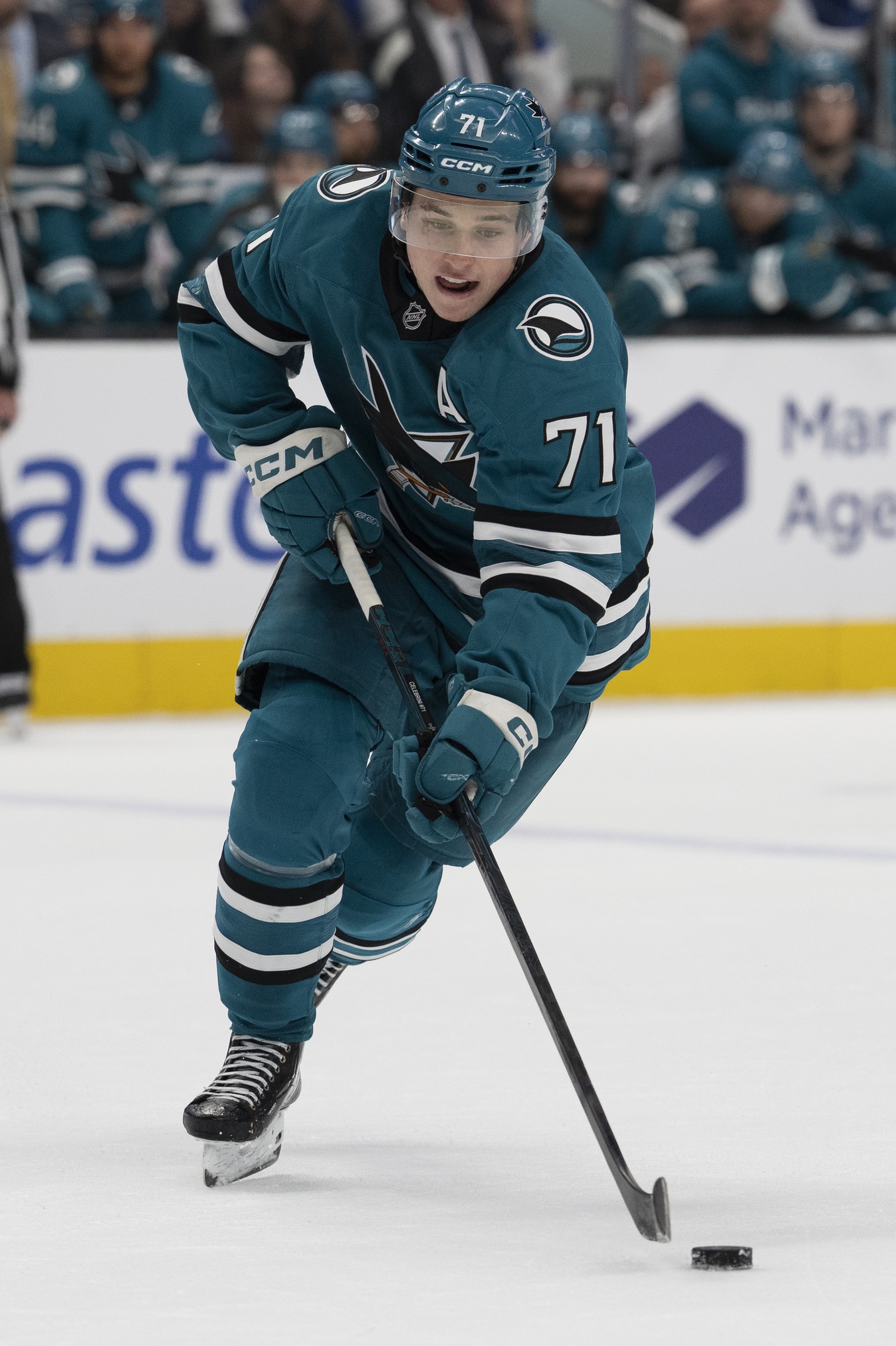 Celebrini is coming off an absolutely dynamic season. He took his offensive game to an elite level, potting 45 goals and 70 assists to finish fourth in the league in scoring, a performance that likely will have him finishing within the top five in Hart Trophy balloting (although he’s not among the three finalists). It’s very rare for a second-year player to have that type of impact and he has already become the elite piece they hoped they were getting when they made him the first-overall pick in 2024. And while this won’t factor directly into his contract talks, he played quite well for Canada at the Olympics and is currently impressing at the Worlds as well.
The priciest post-entry-level contract in terms of AAV is Edmonton’s Connor McDavid, who signed an eight-year pact worth $12.5MM per season. Given Celebrini’s performance this year and the considerable upward movement in the salary cap, there’s a good chance there will soon be a new record on that front. In terms of cap percentage, McDavid’s deal was 15.72% of the Upper Limit when it was signed, an amount that would equate to around $17.8MM in 2027-28 based on current cap projections. It’s fair to say Celebrini won’t command something in that territory but something in the $14MM range or even $15MM on an eight-year deal certainly feels palatable. And if that’s not a number San Jose is willing to go to just yet, they can wait out the year but would only be able to do a seven-year pact next summer.
Smith, meanwhile, had a solid second NHL season himself, recording 24 goals and 35 assists in 69 games to finish second on the team in scoring. While he was drafted as a center, he hasn’t played there much so far in the NHL but that could change down the road depending on how Michael Misa, another high draft pick, performs in that role. Whether it’s at center or the wing, the Sharks are hoping he’s a top-line fixture and Smith’s camp will be expecting an extension offer in that territory. Again, given the big bumps coming to the salary cap, there could be some sticker shock on the price, which plausibly could approach the $10MM mark on an eight-year agreement.
Given that there is some variance potential in where both sides think Smith will land, it’s entirely possible that an extension isn’t worked out this summer. In that case, they can simply let next season play out and use that performance to help shape contract talks. While it’s possible that they could look to do a bridge contract as they did with William Eklund last summer, that’s probably not the most advisable approach at this time; there’s no need to commit that soon to a short-term second pact.
Add PK Help
With a patchwork (albeit improved) back end and a goalie tandem that was a little shaky (Yaroslav Askarov’s rookie year was hot and cold and Alex Nedeljkovic is an okay backup), it’s unsurprising that the Sharks were once again a team that got scored on a lot. While they shaved 20 goals off last year’s number, they still allowed 290, more than 3.5 per game. Some of that can be attributed to what was just noted but the penalty kill also has to wear some of the blame.
San Jose allowed 58 power play goals this season, sixth-most in the NHL. Their success rate was 76.4%, 26th in the league. These are numbers that can definitely stand to be improved upon. And if they have genuine playoff aspirations next season, then these numbers have to be improved upon.
One way to do that is to get some help up front. San Jose’s four most-used forwards shorthanded in terms of ATOI per game were Ty Dellandrea, Collin Graf, Alexander Wennberg, and Barclay Goodrow. Dellandrea and Wennberg were second-wave players in 2024-25, Graf was a rookie, and Goodrow is widely expected to be a buyout waiting to happen. With due respect to these players, they can certainly be improved upon.
With a young team, it should come as little surprise that the Sharks struggle at the faceoff dot. Getting a checker who can win draws is a good place to start. A veteran who can fill a fourth-line checking specialist role would also help. This isn’t going to turn things around by any stretch but adding a few percent to the success rate is probably worth a few points in the standings as well. Those adds would also allow the young core a bit more time to develop before potentially being thrust into that role down the road as well.
It’s also worth noting here that San Jose’s four most-used blueliners shorthanded in terms of ATOI were Ferraro, Desharnais, Timothy Liljegren, and Vincent Iorio. In other words, two pending UFAs, someone who was traded at the deadline, and someone lost to a waiver claim. As Grier looks to reshape his back end, finding some reliable penalty killers will be a particular point of emphasis.
Add A Core Piece
Over the course of the rebuild, the Sharks have brought in several core pieces, headlined up front by Celebrini, Smith, Misa, and Eklund, with Dickinson representing the future on the back end. Their good fortune in the Draft Lottery will ensure they get another one as they now hold the second selection in next month’s draft. They should get a core piece from that pick.
In a nutshell, that alone would check the box in this section. They will get a future core player in the draft to add to their stockpile. But if they’re aiming on getting to the playoffs next season, Grier needs to be aiming for a current core addition as well.
In a perfect world, that player would be in the same age group as the current core. Having said that, the only way to get that is to probably trade the number two pick. For the right young player, that shouldn’t be off the table but it’s probably not Plan A either.
But this is a young enough group that they could stand to add a top-six forward up front as they did with Tyler Toffoli two summers ago. And, obviously, a core defender or two would go a long way. They were in on Dougie Hamilton last offseason but it’s believed he invoked his trade protection to stay in New Jersey. It’s possible they could try to circle back on that front but they might be better off looking elsewhere.
San Jose has more than ample cap space this summer, more than $41MM, per PuckPedia. They have plenty of trade chips. So, even with a thinned-out UFA market, Grier should be able to add at least one core player to help his current group while getting a long-term core addition via the draft. They’re already set up nicely for the future and should add to that upside this summer.
Photo courtesy of Stan Szeto-Imagn Images.