
Cost Per Point: The Best Value Deals In The NHL
When working with a salary cap, especially one that has not been increasing as expected in recent year, it is vital for general managers to get the most production out of their players. Teams with players who meet the expected level of production implied by their contracts and teams that lack wasted dollars in bad, expensive deals are often the same teams that thrive in today’s NHL. Forget market size or free agent appeal, the key to a winning franchise nowadays is getting the best bang for your buck on every player on the roster. While no player can be fully quantified by their scoring, cost per point is an easy way to look at which players are producing at the most team-friendly rate and which have been more of a cap space killer than a positive member of the team. Thanks to CapFriendly, that information is readily available to fans and NHL executives alike.
The benchmark for this metric is about $100K/point, as GM’s expect those big-time forwards and offensive defenseman who they award with $6MM, $7MM, and $8MM per year contracts to be putting up 60, 70, or 80 points respectively. For the second year in a row, St. Louis Blues superstar Vladimir Tarasenko was the poster boy for this standard, coming in at exactly $100K/point with 75 points on a $7.5MM deal. Winnipeg’s Bryan Little and New Jersey’s Adam Henrique are two other notable names that hit the mark exactly, while phenoms like Sidney Crosby and Duncan Keith landing close to the $100K/point mark show that it is an accurate expectation.
However, the exception to the rule is obviously entry-level contracts. It is no secret that drafting and developing well is the best way to improve you team, beginning with affordable scoring from players on their rookie deals. Nowhere is that more apparent than in cost per point, where nine of the top ten and 17 of the top 20 best contracts were rookie deals. To no one surprise, 20-year-old MVP Connor McDavid and his 100 points on a $925K entry-level contract was far and away the best bargain in hockey. McDavid cost the Oilers only $9,250 per point in 2016-17. That will all change soon, as McDavid is set to begin an eight-year, $100MM contract in 2018-19, after which a 100-point campaign will cost Edmonton $125,000/point, closer to the expectations of a standard contract. For now, the Oilers can enjoy one more year of McDavid likely being the best deal in the NHL, as well as the best player. Entry-level deals joining McDavid in the top ten last year (in order) were Viktor Arvidsson, Artemi Panarin, teammate Leon Draisaitl, Conor Sheary, David Pastrnak, Auston Matthews, Nikolaj Ehlers, and Patrik Laine. Not all entry-level deals are created equal, so while Draisaitl and Pastrnak were second and fourth respectively in entry-level scoring, they were also on the ELC maximum deal of $925K and of slightly lesser value to their teams than the likes of Arvidsson ($632K) and Sheary ($667.5K). Panarin had the best contract in the league in 2015-16 and fell only to third with $10,980/point for the Chicago Blackhawks. Now in Columbus and on a two-year, $12MM deal, the Blue Jackets have to hope that they can continue to get 70+ point seasons out of him to maximize the value of that deal.
So, entry-level contracts aside, who was the best contract in hockey last season? Another easy answer, former Blue Jacket gamble Sam Gagner. After a horrendous 2015-16 campaign with the Philadelphia Flyers, Gagner struggled to find a new team last summer, eventually settling on a $650K “show me” deal with Columbus. Right away people tagged that contract, for a six-time 40+ point scorer, as an absolute bargain, even if Gagner simply bounced back to normal production. He did one better, posting a career-high 50 points for the Jackets and coming in at $13K/point, good enough for sixth in the NHL. Gagner has since moved on to the Vancouver Canucks, signing a three-year, $9.45MM contract on July 1st. However, if he is able to continue to produce at 40-50 point levels over that deal, his $3.15MM cap hit will remain a great bargain deal. Behind Gagner, another player on the move this summer, former Florida Panther and current Vegas Golden Knight Jonathan Marchessault had the 13th-ranked cost per point last year at $14,706/point. Marchessault had a breakout year, netting 51 points in the first season of a two-year, $1.5MM deal. Rather than take advantage of one more $750K season for a 30-goal scorer, the Panthers allowed Marchessault to be selected in the Expansion Draft and Vegas surely hopes he continues to be one of the best values in hockey in 2017-18. The final contract in the top 20 not belonging to an entry-level player, and the only 35+ veteran contract in the top 50, belongs to Marchessault’s replacement in Florida, Radim Vrbata. Vrbata returned home to Arizona last season after a down year in Vancouver the season prior, and the swift 36-year old proceeded to score 55 points, more than double his previous year’s total. On a one-year deal with a $1MM base salary, that only cost the Coyotes $18,182/point last season. Now at a base salary of $2.5MM in Florida, the Panthers hope that Vrbata isn’t starting to slow down just yet. Other impressive value contracts included Patrick Eaves, whose breakout season in Dallas led to a trade and subsequent extension with the Anaheim Ducks, Derek Ryan, who shocked the hockey world with 29 points for the Carolina Hurricanes in his first full NHL season at age 30, and a quartet of recently re-signed RFAs in Richard Panik, Ryan Dzingel, Ryan Spooner, and Jordan Martinook.
With the good comes the bad, and there were certainly some poor value contracts in the NHL last year. Many of the worst belong to players who were injured or AHL depth players that saw only limited time. With zero points in 13 games with a $1.25MM cap hit, Tampa Bay Lightning winger Erik Condra‘s value was not even quantifiable it was so bad, and at the highest salary of any player who went pointless last season. Limited to just 18 games with only four points, another Bolts forward, Ryan Callahan, was one of the worst values due to injury with $1.45MM per point on his $5.8MM cap hit. However, the truly worst contract in the NHL has to belong to a player that player a majority of the season. Sadly for a Detroit fan base that is already feeling pretty down-and-out, that designation belongs to Red Wings defenseman Danny DeKeyser, who began a six-year, $30MM extension by scoring about a third less points for the third season in a row. With 12 points in 82 games at $5MM, DeKeyser’s $416.7K/point is pretty ugly. The Buffalo Sabres struck out twice on the blue line, with both Dmitry Kulikov (five points in 47 games at $4.33MM) and Josh Gorges (six points in 66 games at $3.9MM) coming in at $866.7K/point and $650K/point respectively, though neither is known as a major point producer. The worst forward contract? Andrew Desjardins may not have been relied upon as a full-time player with much ice time last season with the Chicago Blackhawks, but with only one point in 46 games, $800K/point, it’s not difficult to see why he remains an unsigned free agent.
While statistics and analytics in hockey are normally geared toward displaying on-ice production, it is always interesting to look at the game from a business perspective. It is important for teams and fans alike to understand not just the absolute of how a player is producing, but the relative value of that production based on how much money that player is being paid. In a salary cap league, there is nothing more important that production value, and as the game grows the focus will only further tighten on scoring as a function of dollars and the cost per point metric.
Red Wings Sign Michael Rasmussen To Entry-Level Contract
The Red Wings have locked up their top pick from June’s draft, announcing the signing of center Michael Rasmussen to a three-year, entry-level contract. Financial terms of the deal were not disclosed.
Rasmussen has spent the past two seasons with the Tri-City Americans of the WHL. Last season, he finished second on the team in goals with 32 despite missing the final 22 games of the year due to a wrist injury that also kept him out of the playoffs. He finished with 55 points in total over 50 regular season contests.
Between that and his size (6’6), Detroit decided to take him ninth overall back at the draft. He’s not expected to contend for a roster spot with the Red Wings in training camp and will likely be sent back for his third full junior campaign. He’s currently suited up with Canada at the World Junior Summer Showcase and should be in the mix for a spot for their entry at the World Junior Championships in December.
Pittsburgh’s Alternative Third-Line Center Options
While many teams across the NHL still have holes to fill before the puck drops on the 2017-18 season, no vacancy has received more attention than the third-line center slot for the two-time defending champion Pittsburgh Penguins. In fact, we’ve already written about it once before. However, the scenario has changed over the last few weeks, as the new contracts for RFAs Brian Dumoulin and Conor Sheary have left the Pens with just over $3MM in salary cap space. Jason Mackey of the Pittsburgh Post Gazette recently spoke with GM Jim Rutherford, who essentially stated that he does not plan to move out significant salary in a deal to acquire a new bottom-six center. What that means is that the Penguins are left with a much smaller margin to work with to acquire Nick Bonino‘s replacement.
So who will it be? Who it won’t be is easier to say. The pipe dreams of Colorado’s Matt Duchene or Carolina’s Jordan Staal are now all but over, as are more reasonable targets like Toronto’s Tyler Bozak or Dallas’ Radek Faksa now seem out of reach as well. The Vegas Golden Knights have not shown any indication that they are interested in moving forwards, so strike their group of suitable centers off the list as well. With each passing day, it seems a Matt Cullen return grows less and less likely as well.
What the Penguins are left with are a group of guys who fit their needs well: young, two-way centers on affordable contracts. The most common name bandied about is Detroit Red Wings forward Riley Sheahan. Sheahan struggled mightily in 2016-17 and is relatively expensive compared to some other available names at $2.075MM this season. However, Detroit desperately needs to shed salary and may have reached the end of the line with Sheahan. It could be a good match, with Sheahan very likely bouncing back on a far more talented Penguins team. Pittsburgh’s top target may be Arizona’s Jordan Martinook, who just resigned with the team, but is part of a Coyotes forward corps that is crowded with young talent. Martinook is an underrated two-way player and would fit in nicely with the Pens, but Arizona may not be keen to move him in a deal that Rutherford stated would not included salary players. The Coyotes have had their fill of picks and prospects and might be on the lookout for only veteran contributors at this point. The Penguins could turn to the Los Angeles Kings, who have great depth at center including Nick Shore and Nic Dowd. Both would fit the need nicely in Pittsburgh and come in at under $1MM. The 25-year-old Shore would be especially nice, as the team can retain RFA rights over him beyond 2017-18, but Dowd may be easier to acquire from a Kings squad that is not any closer to returning to the playoffs. One final option, staying out west, could be San Jose Sharks center Chris Tierney. It is rumored that the two sides are on rocky grounds, with Tierney signing just a one-year extension this summer, and could be looking for a trade. Tierney has proven to be a solid defensive force in the San Jose bottom six and could play the same role in Pittsburgh. The Sharks have done nothing this off-season and could see replacing Tierney with a Penguins forward prospect as at least some kind of roster shakeup.
Obviously, the available names are not of the sexy variety. The Penguins have been spoiled with center depth through their Stanley Cup years and fans are surely hoping they can find another Staal or Bonino. However, with little cap space to play with and a reluctance to change the current roster any further, this is what Rutherford is left with. Any of these guys could be a valuable piece on another strong Penguins team, as each plays a solid two-way game, but none are gonna be the big-name acquisition that many expected. Pittsburgh will be back in the Cup race again next year even if they do nothing at all and stick someone from Wilkes-Barre/Scranton at third-line center, so maybe the better question is not who will play there, but why does everyone care so much?
RFA Extension Candidates
While veteran players like Carey Price and Cam Fowler have received huge extensions this summer a full year before hitting the open market, some younger players aren’t usually locked up as early. We saw the Edmonton Oilers jump on Connor McDavid right away, handing him a $100MM contract before even dealing with their current free agents, and there are others who may see an extension before the season is up.
Teams often don’t want to commit to young players before they have to, unsure of how they’ll react to bigger roles or a full-time NHL position. Still, there are some who are already well established and deserve a long-term deal. It’s obviously up to them to decide whether they want to lock themselves into an extension before playing the year, as many can leverage a solid season into even more money. That said, some players just like the stability of a long-term contract. Here are some who could earn extensions before the end of the season.
Jacob Trouba – Winnipeg Jets
Trouba held out last year until the beginning of November, and made it clear he wanted a bigger role somewhere else. He didn’t see himself getting that opportunity in Winnipeg, where the team had Dustin Byfuglien and Tyler Myers penciled in ahead of him on the right side. As it happens, Myers was hit with injury and Trouba excelled in his increased role, logging 25 minutes a night and registering 33 points in just 60 games.
He’s now established himself as one of the best young defenders in the league and a key piece for Winnipeg going forward. They should try hard to sign him to an extension now, instead of letting this linger again and ending up in another hold out situation. Trouba has overtaken Myers on the depth chart, but allowing him to hold all the cards next summer would make for another messy situation, and it’s clear that he can provide ample value even on a big contract.
J.T. Miller – New York Rangers
Miller has always seemed like a good fit in New York, and signed an early deal with the Rangers last summer. He improved once again and continues to show why the team invested a 15th-overall pick in him. With 56 points in 82 games he was often the most dangerous player on the ice, and coming into his age-24 season he’s poised to put up even bigger numbers.
The Rangers have a ton of money coming off the books next summer with Rick Nash‘s $7.8MM cap hit expiring, but will need all of it for extensions for some of their top young players. After committing big money to Mika Zibanejad this summer, they could lock in Miller now and provide some cap-certainty as they hit what will be a huge summer for the team.
Dylan Larkin – Detroit Red Wings
Larkin is coming off a down year and probably won’t want to take a discount because of it, but Detroit could lock him in as the face of the franchise going forward and start jettisoning other assets to continue the rebuild. They’re in no danger of him going anywhere next year, but it could be a clear sign to their fans that he’ll lead the next wave of Detroit success.
William Nylander – Toronto Maple Leafs
The Maple Leafs have some huge contracts coming up, with Auston Matthews and Mitch Marner both entering similar circumstances to these next summer. Nylander is first up, and could be locked up to a long-term deal right now. Like Edmonton the team may want to see how much Matthews will cost them first, but it’s not like they’re heading for a series of bridge deals with Nylander. He’s a key piece who will be there for a long time.
Locking him up now gives you some idea of what there will be left for free agency next season, as it would be tough to go after anyone with Matthews’ negotiations not technically allowed to start until July 1st (though they often are discussed anyway). Toronto might be the busiest team in the league next year, as seven forward contracts are expiring.
Is Andrei Svechnikov The Next Generational Prospect?
It’s never too far to look ahead to the draft and as the offseason enters the dog days of summer, Russian prospect Andrei Svechnikov is already projecting to be the top pick in the 2018 NHL draft. The question, before the season even begins, is if Svechnikov is a generational talent in the mold of Connor McDavid, or Auston Matthews. Taken first overall in the CHL Import Draft by the Barrie Colts, the upcoming season will reveal if Svechnikov is the high end prospect many believe he’s developing into. Svechnikov will sign with the Colts prior to training camp, and could even push the words “generational” into the conversation.
Svechnikov’s older brother Evgeny plays in the Detroit Red Wings system and though an exciting prospect Wings fans are waiting to see, Andrei looks to be even better. MLive’s Mark Opfermann penned a piece on Svechnikov back in March when the ’18 class was in the shadow of the soon-to-be-drafted ’17 class. Opfermann wrote this about him:
“For his age, and you don’t even have to look at his age, let’s just say he’s a first-year player in the league, whatever age he is,” Muskegon Lumberjacks coach John LaFontaine said. “He doesn’t get pushed off the puck, he outmuscles guys to the net, his shot is deceptive and his ability to create plays is high end no matter what level you’re playing at. There’s no question, if he was a ’99 (birth year) and on the list this year, they’d be talking about him this year.”
The Hockey News’ Daniel Nugent-Bowman wrote back in December that Svechnikov has the potential to be the “next big thing” out of Russia. The big bodied, goal scorer has excelled on both the world stage and the amateur stage, taking USHL Rookie of the Year honors with Muskegon–playing in the league primarily as a 16-year-old. It’s expected that he’ll take the OHL by storm, cementing his status as the #1 overall pick.
But does it make him generational?
If looking strictly at points, McDavid put up 120 the year he was drafted by the Oilers first overall. Matthews, while playing for ZSC had 46 points in 36 games, but that was also in a professional league. Patrik Laine and Jack Eichel have put up elite numbers in the NHL, and also showed the same flash while playing prior to the NHL.

Svechnikov tore up the USHL with 58 points in just 48 games, with 29 of those points being goals. Measuring him against McDavid in the OHL at the same age, (albeit a much different measuring stick), McDavid had 99 points in 56 games, though he did spend the 2012-13 season with the Otters as well–turning 16 during the middle of that season. McDavid also showed a high IQ on the ice from a very early age and also drew comparisons to Crosby and Gretzky as well.
Svechnikov, from scouts, to coaches, to teammates, and backed by statistics, looks like the real deal. A season with Barrie will be the best indicator of whether or not he’s generational. Barring significant injury, Svechnikov is shaping up to be a prize for the team that selects him.
Salary Cap Deep Dive: Detroit Red Wings
Navigating the Salary Cap is probably one of the more important tasks for any general manager to have. Teams that can avert total Cap chaos by walking the tightrope of inking players to deals that match their value (or compensate for future value without breaking the bank) remain successful. Those that don’t see struggles and front office changes.
PHR will look at every NHL team and give a thorough look at their cap situation heading into the 2017-18 season. This will focus more on those players who are integral parts of the roster versus those who may find themselves shuttling between the AHL and NHL. All cap figure were taken from CapFriendly.
Detroit Red Wings
Projected Cap Hit: $78,021,212 (Over by $3,021,212)
Entry Level Deals:
Dylan Larkin (1 year remaining/$925K)
Anthony Mantha (1 year remaining/$863,333)
Things will get interesting when the Wings sit down to negotiate with both Larkin and Mantha following the 2017-18 season. Both are considered the foundation that the Red Wings will build on for the future, but Larkin saw regression after a torrid rookie campaign in 2015-16. Larkin, who moved back to his native center position after spending the season at wing during his first season, is expected to bounce back. Mantha who scored at a high clip when given the ice time, will command a higher payout should his scoring continue. Mantha could be a 30-goal scorer in the league if the Red Wings allow him to play the role of goal scorer instead of two-way forward. Regardless, both will see a significant bump and this will only tighten things further.
1 Year Remaining
Mike Green ($6MM AAV)
Petr Mrazek ($4MM AAV)
Riley Sheahan ($2.08MM AAV)
Tyler Bertuzzi ($661K AAV)
Ryan Sproul ($625K AAV)
Jared Coreau ($613K AAV)
The deals falling off after the current season will account for a good chunk of change that will allow for Larkin and Mantha to be re-signed with ease. Additionally, some of these contracts, should Detroit struggle again as they’re widely expected to, could net some prospects or draft picks. Green is the likeliest candidate to be spun off while Sheahan is expected to bounce back after an offensive challenging season that saw him left off the goal sheet until the final game of the season.
Sproul will either be re-signed to a minor deal or left to go as other defensemen have rocketed up the prospect list. His suspect defense takes away from his roaring slap shot, which was counted on to one day sustain the Red Wings powerplay. Bertuzzi should see time with the big club, but with Witkowski being a hybrid defenseman/forward, he may be stuck in Grand Rapids as the tie always goes to the veteran in Detroit.
Mrazek is an odd case. Bemoaned for a bad attitude coupled with a below average season, it can’t be expected that unless he puts up Vezina like numbers or dramatically changes his standing with the team that he’ll be back. Though he could be dealt, teams have made it clear they’re not interested, which makes it likely both teams walks away at the end of the term. Coreau will likely see time like he did last season when either Mrazek or Howard were injured.
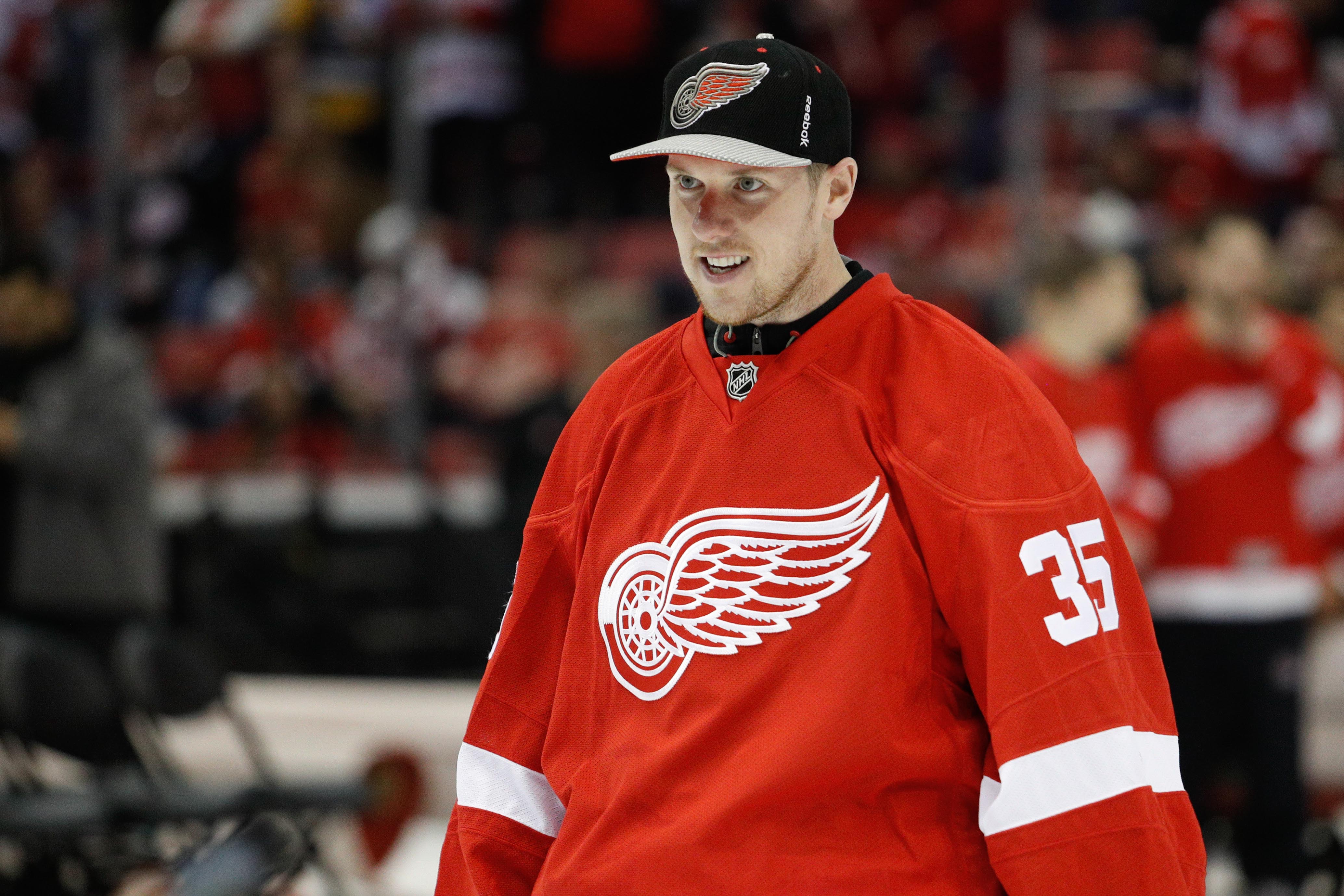
2 Years Remaining
Jimmy Howard ($5.29MM AAV)
Niklas Kronwall ($4.75MM AAV)
Gustav Nyquist ($4.75MM AAV)
Xavier Ouellet ($1.25MM AAV)
Nick Jensen ($812.5K AAV)
Luke Witkowski ($750K AAV)
Howard was expected to be dealt or drafted in the expansion draft until stories of Mrazek surfaced. Instead, Howard is now seen as the #1 goalie in Detroit. The contract itself, however, has been a bust as Howard has either not been healthy or inconsistent during the duration of the deal. It’s very likely that Kronwall ends up on the LTIR as he is literally skating on one knee. His mobility, and puck moving ability has deteriorated quickly, but the Red Wings still insist on giving him minutes on the power play. Should he not end up on the LTIR, he will most likely see his minutes decrease, which only makes his contract look worse.
Nyquist is a curious story as he was paid to score goals, but has still been very productive on the ice, being a boon for teammates in terms of setting up scoring chances. Witkowski was added for “grit” at a relatively cheap price.
The Red Wings cap issues began with some of these deals–offering money for players who didn’t exactly stay consistent with expectations. Things get considerably worse as years were added.
3 or More Years
Jonathan Ericsson ($4.25MM AAV – 3 years remaining)
Trevor Daley ($3.167MM AAV – 3 years remaining)
Henrik Zetterberg ($6.08MM AAV – 4 years remaining)
Tomas Tatar ($5.3MM AAV – 4 years remaining)
Darren Helm (3.85MM AAV – 4 years remaining)
Luke Glendening ($1.8MM AAV – 4 years remaining)
Frans Nielsen ($5.25MM AAV – 5 years remaining)
Danny DeKeyser ($5MM AAV – 5 years remaining)
Justin Abdelkader ($4.25MM AAV – 6 years remaining)
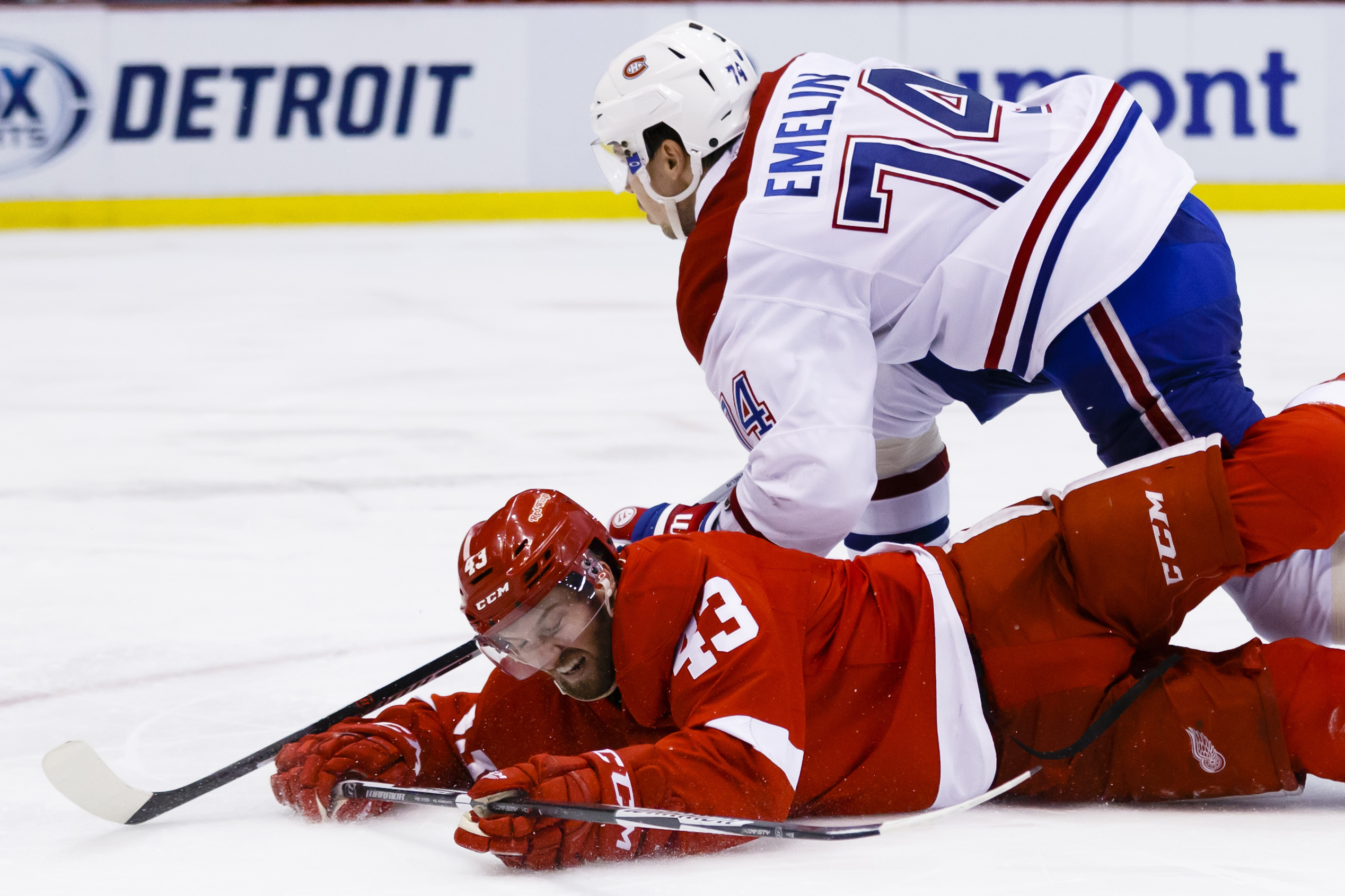
Here’s where the Red Wings have run into problems. The vast majority of players owed the bulk of dollars and years are not living up to expectations or are regressing with age. Zetterberg will be owed a sizable contract for another four years, and Father Time will slow him from his great season last year. Nielsen is also on the books for awhile, and is nearing his mid-30’s which doesn’t bode well for his numbers or the team’s overall performance.
But Ericsson, Glendening, Helm, DeKeyser, and Abdelkader have head scratching deals that could cripple Detroit for years to come. None of the aforementioned are top tier players, and Helm, Glendening, and Abdelkader are at best, third line forwards. Ericsson continues to struggle while DeKeyser is not a top pairing defenseman, yet is paid as one. The addition of Daley seems more cosmetic–an indicator that Detroit still wants to be considered a playoff team. But his projected 20 points will do little to help a team that has yet to reach bottom. When the figures are added, Detroit owes approximately $38.94MM of its cap to these players. Outside of Tatar, who just re-signed, this is problematic for a team that believes it can compete in the playoffs.
Buyouts
Stephen Weiss ($2.566MM AAV this season, $1.67MM AAV through 2021)
LTIR
Johan Franzen ($3.94MM AAV – 3 years remaining)
Un-signed
Andreas Athanasiou (RFA)
Best Value – Tomas Tatar
Worst Value – Justin Abdelkader
What does the future hold?
These aren’t the Red Wings of the 90’s or 2000’s where a blank check is afforded to get the best players. Detroit has serious issues in terms of cap management, and recent stories of the no-trade clauses afforded with many of these contracts are problematic as well. General manager Ken Holland has painted himself into a lonely corner, and a poor showing this season could possibly spell doom for his long tenure with Detroit. Maybe things will go favorably for Detroit this season, but after a challenging 2016-17 campaign and very little improvement on the roster, the Red Wings will be hard pressed to stay afloat in a competitive division and conference. Though they could try to peddle contracts away, the long terms and excessive dollars make it challenging for Holland and company to get them off the books–or worse–getting any value for those players shipped off.
Photos courtesy of USA Today Sports Images
East Notes: Bylsma, Guentzel, Rowney
The Athletic’s Craig Custance caught up with former Pittsburgh Penguins and Buffalo Sabres head coach Dan Bylsma who had some thoughts on how the Detroit Red Wings should approach their roster. Ironically enough, Bylsma grew up a Detroit fan, since he was a Michigan resident. Custance quizzed Bylsma on a number of topics, including a Red Wings rebuild and his time with the Sabres. On the Red Wings, Bylsma admits that Detroit is no longer model franchise in the league and that fans will “never see” the team they once saw that featured bonafide stars like Luc Robitaille, Brett Hull, Steve Yzerman, and Sergei Fedorov, to name a few. The former bench boss guesses that the Red Wings roster will look dynamically different in three years as they’ll be forced to rebuild a team that has certainly struggled. He also believes fans are ready for a rebuild, preferring to see a competitive team that grows into playoff dominance instead of keeping the “streak” alive with aging players and early playoff exits. He doesn’t believe, however, that the Red Wings need a total teardown to win. Instead, he thinks that steady drafting can keep Detroit relevant without ripping out the foundation.
- When it came to talking about Buffalo, however, Bylsma was coy. When he arrived in Buffalo, the team was in the midst of a tear down and rebuilding with the likes of Jack Eichel, and other young, dynamic players. While there were some strides, last season was disastrous, costing both Bylsma and former general manager Tim Murray their jobs. Bylsma admits to Custance that he didn’t want to talk about what happened in Buffalo while explaining that Detroit hasn’t gutted things like Buffalo did. He also believes that a teardown-build up program takes several years, sometimes up to five. That’s understandable from his vantage point, given that he only had two years in Buffalo to try and win. It has to be said that Toronto’s resurgence couldn’t have helped matters, as the Leafs not only qualified for the playoffs, but gave Washington a scare in the first round.
- NBC Sports’ Adam Gretz writes that with Connor Sheary re-signed, the Pittsburgh Penguins will turn their attention to grabbing a third line center. He makes a couple suggestions, wondering if Jake Guentzel could move over to center line or if youngster Carter Rowney is ready for full time duty. The most realistic option, Gretz believes, is for Pittsburgh general manager Jim Rutherford to explore trades to fill the vacancy and give the Pens a solid chance to win their third consecutive Cup.
Detroit On Top Of NHL In No-Trade Clauses
No trade clauses seem to have become the “in-thing” in negotiations as NTC’s are more prevalent than ever. Many general managers are forced to offer them to entice free agents to come to their teams. Other teams just give them to their top players to prove their loyalty to that player. For instance, the Tampa Bay Lightning have eight no-trade clauses on their roster, but that’s normal for a team that is expected to contend for a Stanley Cup.
However, what about the Detroit Red Wings. The struggling franchise is tied with Ottawa for a league-high 10 no-trade clauses on their roster for a team that’s already capped out with nothing to show for it but a roster of aging, overpriced veterans. The best option for Detroit and general manager Ken Holland, who handed out those no-trade clauses would be to trade off their veterans and start a massive rebuild. Can’t do that, according to Yahoo Sports Greg Wyshynski, who writes that Detroit is in a tough situation compared to other teams. One key to the way general managers use no-trade clauses is how they are utilized and with all of their no-trade clauses, the team will be hamstrung for many years.
Holland and the Red Wings have given full no-trade clauses to Justin Abdelkader, who has three more years of a no-trade clause before it becomes a modified trade clause, but the 30-year-old is locked up for another six years. Gustav Nyquist has a full no-trade clause for the two years remaining on his contract. Darren Helm also has a full no-trade clause through next season, although that can be voided beyond that if he fails to be among the team’s top-nine forwards or if the team doesn’t make the playoffs. However, again, he has a four-year deal. Four defensemen have full no-trade clauses, including Mike Green, Danny DeKeyser, Jonathan Ericsson and newly signed Trevor Daley. Other than Green, all of them possess full no-trade clauses for the next year, but eventually turn into modified no-trade clauses in 2018-19 or later. To make matters even more difficult, Detroit also has three players with modified no-trade clauses, including Frans Nielsen, Niklas Kronwall and goaltender Jimmy Howard, that will only make a rebuild more challenging for the Red Wings.
Perhaps the biggest problem, according to Wyshynski, is that seven of the 10 no-trade clauses are in the hands of players that are 30 or older and whether there was a need to give one this offseason to Daley, who many viewed as a questionable acquisition in the first place, let alone that they gave him a two years worth of a full no-trade clause to go with his three-year, $9.5MM contract at age 33.
While some no trade clauses are unavoidable and even necessary to get a player to sign on the dotted line, it’s critical to know when to offer one and when not to. Wyshynski uses the Minnesota Wild as an example of a team who has six no-trade clauses on their roster and used them wisely. They handed ones out to Zach Parise, Mikko Koivu and Ryan Suter, where they were critical in negotiations and are franchise-type players. They used one on veteran Eric Staal to convince him to come to Minnesota last year, which worked out quite well. Finally, defenseman Jared Spurgeon and goaltender Devan Dubnyk each received modified no-trade clauses, but again, both are key pieces to the team’s success. That’s how it should be done.
The question is, how long will it take for Detroit to recover from these long-term contracts with all these no-trade clauses in place. Of course, after the Daley deal, it doesn’t necessarily mean that Detroit has learned from its mistakes anyway.
Detroit Red Wings Will Pursue Will Butcher
The Colorado Avalanche were unable to convince reigning Hobey Baker award winner Will Butcher to sign with them after his final season with the University of Denver, and he will become a free agent after August 15th. Like last year with Jimmy Vesey, we’ll see plenty of teams reach out to the young defensemen to try and add a prospect to their organization for nothing more than an entry-level contract. We’ve already heard that Pittsburgh will likely be interested in him and that Butcher’s camp would welcome a call from the reigning Stanley Cup champions, and now Craig Custance of The Athletic reports that the Detroit Red Wings will also be involved.
The Red Wings have gone hard after free agents from college and Europe this offseason, trying to infuse as much young talent as they can into their franchise as it begins its next chapter. The Wings missed the playoffs for the first time since 1990 and are in quite the precarious situation salary cap-wise. It looks like the next few years will be a rough patch for one of the NHL’s oldest teams, and adding young cheap talent like Butcher could help that cause. Custance is quick to point out though that some scouts think of Butcher as more of a bottom-pairing player, and it would be tough to assume more than that. It’s rare that top-4 defensemen slip through the cracks and into the fifth round, and even rarer that they’re not offered a contract until their senior year. It’s clear that Butcher has some sort of NHL upside, but he is already 22-years old.
An interesting note is that the Toronto Maple Leafs—often a rival of Detroit in pursuing college free agents—don’t currently have a contract spot open for Butcher if they wanted to go after him. The team has 49 contracts already, and with Connor Brown still to sign they wouldn’t have room for Butcher on an entry-level contract. That’s not to say they couldn’t get him to agree to an AHL deal this year, only to sign him next season but Butcher would be giving up a year of ELC to do that. It would have to be quite a pitch to convince him, especially if teams like Detroit and Pittsburgh are offering more immediate opportunities.
Minor Transactions: 07/27/17
While the whole league considers their options now that the Montreal Canadiens have announced Andrei Markov will not return, teams will continue to make minor changes and signings to finalize the fringes of their roster before training camp. Here we’ll keep track of all the minor signings of the day.
- The New York Islanders have signed Connor Jones according to Arthur Staple of Newsday, inking the 26-year old forward to a one-year two-way contract. Jones got into four games for the Islanders this season, his first taste of NHL action. A graduate of Quinnipac University, Jones has had a hard time replicating any offensive success in the professional ranks, and was held scoreless in his short NHL stint last year.
- The Milwaukee Admirals, the AHL affiliate of the Nashville Predators, inked former Detroit Red Wings goalie prospect Jake Paterson to a minor league contract today, per a team release. A 2012 third-round pick from the OHL’s Saginaw Spirit, the 23-year-old keeper was one of the best goalies in the ECHL last year. Not only did he lead the league in wins with 34, but he posted an impressive 2.28 GAA and .918 save percentage as well. This is the second season in a row that Paterson had dominated the ECHL and has likely earned a shot at regular AHL time. However, he joins a crowded pipeline in Milwaukee that includes Marek Mazanec, Matt O’Connor, and veteran Anders Lindback fighting for time in net. Barring an injury or two, Paterson will likely be back in the ECHL next year. Yet, Paterson was still one of the top free agent goalies remaining on the market before the Admirals scooped him up.
- If Paterson had stayed in the Red Wings organization, he would have faced a similar roadblock to AHL play time behind Calder Cup hero Jared Coreau, the recently re-acquired Tom McCollum, and Czech import Matej Machovsky. However, Pat Nagle appears to be up for the challenge. The 29-year-old minor league veteran has signed on with Detroit’s AHL affiliate, the Grand Rapids Griffins, on a minor league deal, the team announced. The Michigan-native has played with Grand Rapids before – a two-game stint on loan from the ECHL’s Fort Wayne Komets in 2014-15 – and was loaned again to the Griffins last season, but did not see any action. Now officially part of the team, the veteran keeper will look to earn a permanent spot in Grand Rapids, but faces an uphill battle against both the trio of goalies ahead of him on the depth chart and his own age in inferior play at the AHL level.