
Red Wings Notes: Cholowski, Svechnikov, Daley
The Detroit News’ Gregg Krupa ranks the Red Wings prospects, indicating that the franchise objective right now is to stockpile young talent. Krupa goes by position, placing defenseman Dennis Cholowski as his #1 defensive prospect and Evgeny Svechnikov as his #1 forward prospect. Though he expects Cholowski to be slow to develop, he writes that the wait could be well worth it as the slick skating, puck moving defenseman could be a top pairing for the Wings in a few seasons, something the team hasn’t boasted since Nicklas Lidstrom‘s retirement in 2012. Svechnikov is the prospect many Red Wings fans are desperately waiting for in Detroit, especially after he scored an electrifying shootout goal back in April. Krupa predicts the 20-year-old Russian to see close to a full season in the NHL, especially if the Red Wings struggle to put up points and choose to hand the team over to the kids.
- Fan Rag’s Franklin Steele believes that Trevor Daley will be an “invaluable” pickup for the goal-scoring starved blue line. While Steele doesn’t see Daley producing more than twenty points, it’s his value on the ice with skating and production as well as his value within the locker room that justifies his signing. Daley is expected to mentor several of the younger players on the team, including Cholowski, who was told by Wings brass to “watch” Daley’s every move. The Daley signing, however, is still a curious one as the Red Wings are in quite the roster flux. Steele points out that between a myriad of bad contracts, Petr Mrazek‘s inability to be the #1 goalie, and the Wings hope that Dylan Larkin can play well at center, Daley is about the only certainty in terms of what he’s bringing to the roster–leadership and speed. If that doesn’t work out, Steele offers advice to the organization as to how to proceed next.
Top 2018 Draft Picks That Have Already Been Traded
About 11 months from now, 31 NHL general managers will come together in a room with thousands of people watching and select the next group of young players destined to make it to the professional ranks. The 2018 NHL Entry Draft will be a huge event, mostly because of the elite talent that will be available at the top.
Without a clear consensus on the top pick so far, the next year will be extremely interesting to watch for prospect hounds. Andrei Svechnikov, Rasmus Dahlin, Joe Veleno, Quinn Hughes and others all have incredible talent, and could push for the top spot with a big year (and perhaps a growth spurt or two). Like this year, we could also see a relative outsider like Nico Hischier fly up the ranks to take over the top spot by draft day. One thing is for sure though, that there is plenty of talent to find in the first round and beyond at next year’s draft.
It has already been clear that teams don’t want to give up their 2018 draft picks, as we saw with the collection of selections acquired by the Vegas Golden Knights. They have multiple second-round picks in 2019 and 2020, but couldn’t secure an extra top pick in 2018. That said, there have already been many transactions that have moved picks around. Here are the teams that have acquired extra picks in the first three rounds of the 2018 draft (key player traded in parentheses).
Arizona Coyotes:
Acquired 2018 2nd-round pick from Minnesota Wild (Hanzal)
Detroit Red Wings:
Acquired 2018 2nd-round pick (OTT) from New York Rangers (Smith)
Florida Panthers:
Acquired 2018 2nd-round pick from Arizona Coyotes (Crouse)
Minnesota Wild:
Acquired 2018 3rd-round pick from Buffalo Sabres (Scandella)
Acquired 2018 3rd-round pick from Vegas Golden Knights (Tuch)
Montreal Canadiens:
Acquired 2018 2nd-round pick from Chicago Blackhawks (Weise)
New York Islanders:
Acquired 2018 1st-round pick from Calgary Flames (Hamonic)
Acquired 2018 2nd-round pick from Calgary Flames (Hamonic)
Philadelphia Flyers:
Acquired conditional 2018 1st-round from St. Louis Blues (Schenn)
Tampa Bay Lightning:
Acquired conditional 2018 2nd-round pick (WSH) from Montreal Canadiens (Drouin)
Toronto Maple Leafs:
Acquired 2018 2nd-round pick from San Jose Sharks (Polak)
Acquired 2018 3rd-round pick from San Jose Sharks (Reimer)
Washington Capitals:
Acquired 2018 2nd-round pick (FLA) from New Jersey Devils (Johansson)
Acquired 2018 3rd-round pick (TOR) from New Jersey Devils (Johansson)
Adam Larkin Relishes Chance At Detroit Red Wings Development Camp
- There was a new Larkin in town for the Detroit Red Wings’ development camp, and as Dana Wakiji of NHL.com writes he’ll try to make a return visit in the future. Adam Larkin, the cousin of Red Wings’ star Dylan Larkin, will be a senior at Yale this season and has steadily improved his game since going undrafted out of the USHL. He’ll work even harder this year to try and impress Red Wings scouts and those from other organizations that he’s deserved of a professional contract next spring when he becomes a free agent. Detroit would surely have the inside track, but Larkin will need a big senior season to show that he is ready for the next level.
Dead Space: Bought-Out, Buried, And Retained Salaries For Every Team
It’s something that often goes unnoticed, but with the cap showing minimal growth the last few years, teams are starting to feel the crunch more than ever. Buyouts have become more common, especially with players with under three remaining years on their contracts. And it’s not just the big name busts that have seen the ax lately – we’ve seen lesser names at lesser money take the fall for their respective teams, then needing to scramble for work elsewhere in the league. Additionally, salary retention in trades has become a more utilized tactic as of late. Teams with “unmovable” contracts have offered to retain part of a poor contract in order to entice a team into giving them some relief.
All this said, some teams have been better with foresight than others. Some teams have shown a track record of being entirely unable of handing out poor contracts over the past five or so seasons. Considering many teams showed some progress in being more frugal this off-season, it seems a wise time to review the dead space every team has accumulated, either due to poor management decisions or poor luck.
Colorado Avalanche – $4.83 MM in 2017-18, issues resolved after current year – Francois Beauchemin buyout; Cody McLeod retained
Arizona Coyotes – $4.61 MM in 2017-18, issues resolved after 2020-21 – Mike Smith retained; Mike Ribeiro, Antoine Vermette buyouts
Columbus Blue Jackets – $4.025 MM in 2017-18, issues resolved after 2020-21 – Fedor Tyutin, Jared Boll, Scott Hartnell buyouts
Carolina Hurricanes – $3.71 MM in 2017-18, issues resolved after 2020-21 – Eddie Lack retained; Alexander Semin, James Wisniewski buyouts
Toronto Maple Leafs – $3.28 MM in 2017-18, issues resolved after 2021-22 – Tim Gleason, Jared Cowen buyouts; Phil Kessel retained
Nashville Predators – $2.83 MM in 2017-18, issues resolved after 2018-19 – Viktor Stalberg, Eric Nystrom, Barret Jackman buyouts
Boston Bruins – $2.73 MM in 2017-18, issues resolved 2019-20 – Dennis Seidenberg, Jimmy Hayes buyouts
New York Rangers – $2.61 MM in 2017-18, issues resolved after 2022-23 – Dan Girardi buyout
Minnesota Wild – $2.5 MM in 2017-17, issues resolved after current year – Thomas Vanek buyout
Los Angeles Kings – $2.4 MM in 2017-18, issues resolved after 2023-24 – Matt Greene buyout; Mike Richards termination/recapture
Edmonton Oilers – $2.33 MM in 2017-18, issues resolved after 2020-21 – Lauri Korpikoski, Benoit Pouliot buyouts
Anaheim Ducks – $2.21 MM in 2017-18, issues resolved after 2023-24 – Mark Fistric, Simon Despres buyouts; Patrick Maroon retained
Vancouver Canucks – $2.13 MM in 2017-18, issues resolved after 2021-22 – Roberto Luongo, Jannik Hansen retained; Chris Higgins buyout
New Jersey Devils – $2.09 MM in 2017-18, issues resolved after 2023-24 – Mike Cammalleri, Devante Smith-Pelly buyouts; Ilya Kovalchuk recapture
Tampa Bay Lightning – $1.83 MM in 2017-18, issues resolved after 2019-20 – Matt Carle buyout
Calgary Flames – $1.82 MM in 2017-18, issues resolved after 2018-19 – Mason Raymond, Lance Bouma, Ryan Murphy buyouts
Detroit Red Wings – $1.67 MM in 2017-18, issues resolved after 2020-21 – Stephen Weiss buyout
Dallas Stars – $1.5 MM in 2017-18, issues resolved after 2018-19- Antti Niemi buyout
Philadelphia Flyers – $1.5 MM in 2017-18, issues resolved after current year – R.J. Umberger buyout
Winnipeg Jets – $1.46 MM in 2017-18, issues resolved after 2018-19 – Mark Stuart buyout
Florida Panthers – $1.33 MM in 2017-18, issues resolved after 2018-19 – Jussi Jokinen buyout
Las Vegas Golden Knights – $1.1 MM in 2017-18, issues resolved after current year – Alexei Emelin retained
Ottawa Senators – $350,000 in 2017-18, issues resolved after current year – Andrew Hammond buried
Buffalo Sabres – Minimal in 2017-18, increased issues ($791,00) resolved after 2022-23 – Cody Hodgson buyout
Chicago Blackhawks, St. Louis Blues, Washington Capitals, Pittsburgh Penguins, New York Islanders, San Jose Sharks, Montreal Canadiens – No dead cap space
After compiling the list, it became clear that utilizing these options isn’t a complete hindrance to competing in the NHL. In fact, most clubs have between $1 MM and $3 MM in dead space. That said, of the teams that have not needed to utilize the buyout or retention options, there has been a great deal of success. And among the five worst offenders, the Leafs, Hurricanes, Blue Jackets, Avalanche, and Coyotes, none has moved past the first-round in multiple years. It’s hard to draw massive conclusions without taking the context of each individual situation into account, but there is something to be said for making every dollar of cap space count. Perhaps this is merely a byproduct of past success rather than an indicator of future success, but considering how amenable many managers have become to the option, it bears consideration.
(All totals courtesy of the fantastic CapFriendly.com)
Red Wings Plan To Limit Jimmy Howard's Starts
- The Red Wings are hoping to cap Jimmy Howard’s workload somewhere between 50-55 games next season, goalie coach Jeff Salajko told Helene St. James of the Detroit Free Press. That falls in line with the recent trend around the league that most teams are starting to follow that sees the starter rest a bit more often in the hopes of keeping them fresher down the stretch. Detroit is fortunate enough to have Petr Mrazek, who has handled a large workload himself at times over the past couple of seasons, still in the mix while Salajko noted that they’re comfortable with Jared Coreau, who got into 14 games with the Wings this past season, as a second or third option as well.
Tomas Tatar Signs Four-Year Deal With Detroit Red Wings
Even after the arbitration hearing went down yesterday, the Detroit Red Wings and Tomas Tatar have come to an agreement on a long-term contract. The four-year deal will pay Tatar $21.2MM, for an average of $5.3MM per season. With less than 24 hours left before an arbitrator made a decision on a one-year contract, the two sides found common ground that will keep Tatar in Detroit for a few years more. The breakdown is as follows: 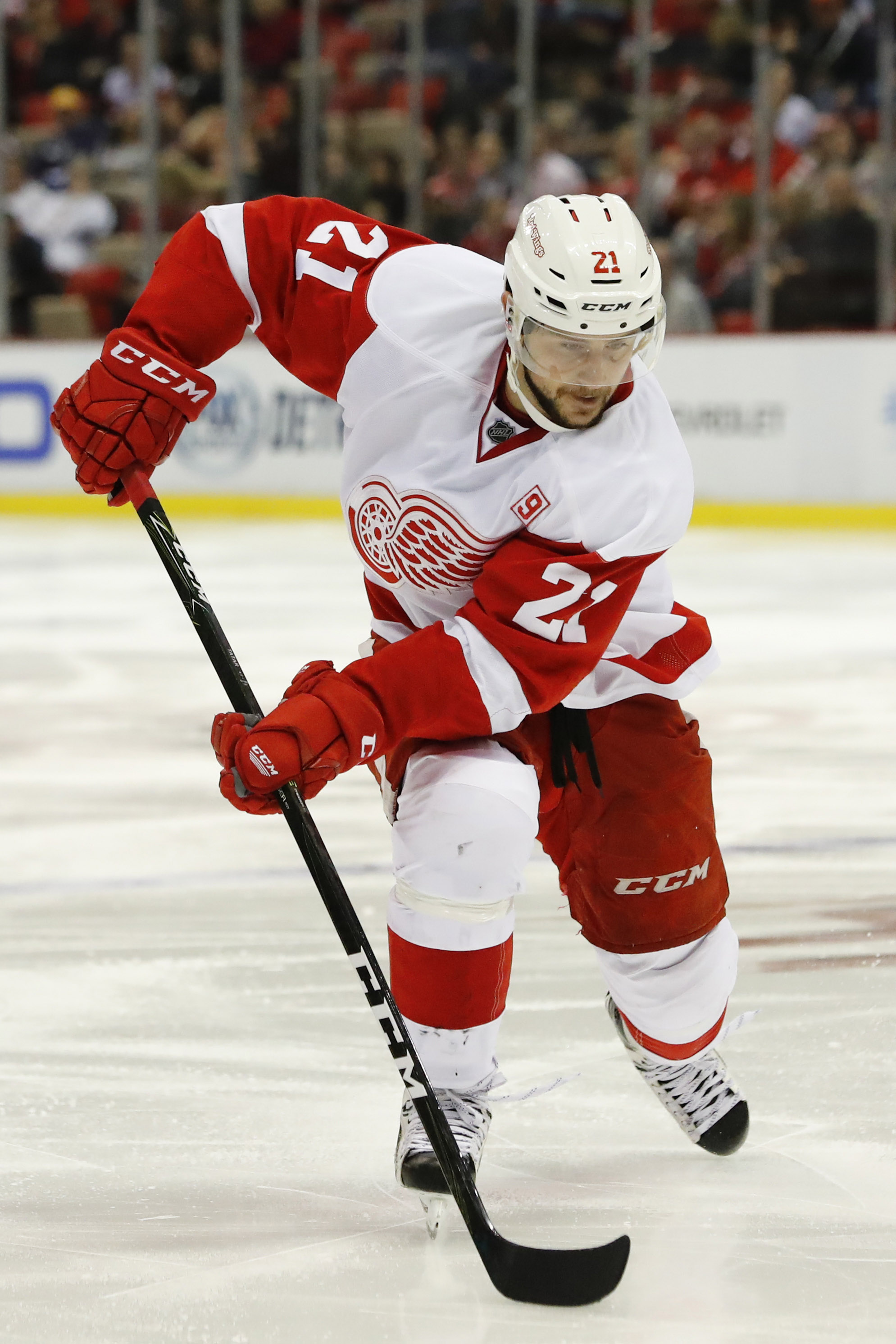
- 2017-18: $4.875MM salary + $1.125MM signing bonus
- 2018-19: $5.5MM salary
- 2019-20: $5.5MM salary
- 2020-21: $3.2MM salary + $1MM signing bonus
Craig Custance of the Athletic pointed out this morning that the two sides could still reach an agreement in time, and we’ve seen this before in cases like P.K. Subban who signed an eight-year deal after his arbitration hearing in 2014. Tatar was set to become an unrestricted free agent next summer, and would have been one of the most interesting names at the trade deadline if Detroit hadn’t been in playoff contention this year.
Now, the Red Wings have more work to do. With Tatar signed, the team is now more than $3MM over the salary cap for next season with Andreas Athanasiou still to sign. The team does have Johan Franzen still under contract and heading for long-term injured reserve, but like in Toronto and Chicago the team may not want to use “summer LTIR” because of the restrictions it comes with. Instead, they could look to move out some of the hefty contracts for their declining veterans through trade or a buyout.
Like Ottawa earlier today when they signed Ryan Dzingel, this move will open a second 48-hour buyout window for the Red Wings on Monday that they could use to clear cap space. Buying out Niklas Kronwall or Jonathan Ericsson would give them around $2.6MM in savings each next season, though both seem unlikely candidates to be cast aside from the only teams they’ve ever known. Mike Green, effective but expensive leads the list of trade candidates, as he is on the final year of his current contract and likely doesn’t fit into the Red Wings timeline going forward. Moving his $6.0MM cap hit would provide quite the cap relief, if they could ever find a buyer to give them some real value in return.
Salary cap issues aside, this contract actually comes in with less total money than the five-year $25MM contract that Tatar reportedly turned down. Though it is a slightly higher cap hit, it seems as though holding firm worked out for Ken Holland in the end as he got the player for a reasonable contract. Tatar signs at the same cap hit as Ondrej Palat in Tampa Bay, a player with similar production throughout his career. Even if Detroit does decide to throw in the towel and try a real rebuild, this deal is still palatable enough to move for a solid return.
Elliotte Friedman of Sportsnet was first to break the deal, while Craig Morgan of AZ Sports provided the financial breakdown.
Photo courtesy of USA Today Sports Images
Arbitration Breakdown: Tomas Tatar
After not being able to reach terms on an agreement, the Red Wings and winger Tomas Tatar had their arbitration hearing today. Assuming they’re unable to reach a settlement before the arbitrator’s decision is rendered, what type of one year deal might Tatar be in for?
The Numbers
Tatar put up his third straight season with at least 20 goals and 45 points after collecting 25 goals and 21 assists in 81 games with Detroit in 2016-17. His 25 tallies marked the second highest single-season total of his career. He ranked third in team scoring in large part due to a strong finish to his year where he recorded 18 points (11-7-18) in March and April, spanning 21 contests.
The Red Wings gave Tatar a career high in ice time, as he logged 17:17 per night which was nearly three minutes a game more than 2015-16. Despite that boost in playing time, his point-per-game average was no different between the two campaigns at 0.56 which is something that the team likely brought up during the hearing.
Potential Comparables
Here are some comparable players and their contracts within the range of submissions from both sides ($4.1MM by the team, $5.3MM by Tatar).
Chris Kreider (NY Rangers) – Stylistically speaking, Kreider plays a different way than Tatar but at the time his current deal was signed (last offseason), he was coming off a similar season statistically with a point-per-game average of 0.54 while logging nearly 16 minutes a night. His cap hit checks in at $4.625MM but it’s worth noting that his deal bought out two RFA years.
Gustav Nyquist (Detroit) – Nyquist had a better platform season (54 points in 82 games) than Tatar did but their career numbers thus far are quite similar. The Wings were able to lock Nyquist up a couple of years ago for four years at an AAV of$4.75MM and the deal only contained one RFA-eligible season which is the situation Tatar is in.
Tyler Johnson (Tampa Bay) – His deal was just reached recently and could stand to impact Tatar’s contract. Johnson is coming off a couple of injury-plagued seasons (conversely, Tatar has been healthy the last three) but has either equalled or surpassed Tatar’s points-per-game averages over the past four seasons while also playing a bigger role. He checks in at $5MM and considering the impact he has, Detroit can make a compelling case that Tatar should check in at a lower cap charge, especially for just one year.
Comparable contracts are restricted to those signed within restricted free agency.
Projection
Most of the comparable contracts check in between 6.3% and 7% of the salary cap which, in 2017-18, increases to $75MM. That provides a salary range of $4.725MM and $5.25MM. It’s hard to imagine that Tatar will get close to his one-year asking price; not many do when it comes to arbitration awards. The midpoint is $4.7MM which is close to the lower end of the range based on percentages and that’s the likelier outcome here as quite often deals will fall around the middle mark. Based on that, I’d project the award to come in at $4.75MM.
What will be interesting is if talks can rekindle on a long-term pact. Tatar has already turned down five years at $5MM which is pretty close to market value for a player who shifts between the first and second lines. If Detroit adds a little bit more to their offer, it might be enough to get something done as it’s hard to envision Tatar landing considerably more on the open market next summer unless he has a career season in 2017-18.
Photo courtesy of USA Today Sports Images.
48-Hour Window For Tatar Arbitration Decision Opens
Tomas Tatar‘s arbitration hearing took place this morning, at the conclusion of which the arbitrator was given 48 hours to reach a decision on his salary for next season. Tatar cannot be awarded a two-year contract through arbitration since he will reach unrestricted free agency next year, but as Craig Custance of The Athletic points out could still work out a long-term deal with the Red Wings before the decision come in. We saw a similar situation play out in 2014 with P.K. Subban, who had his hearing with the Montreal Canadiens before signing an eight-year contract a day later.
Last week it was reported the two sides were still quite a bit away in terms of an agreement, with Tatar turning down a five-year $25MM contract. While they may have worked closer to a deal, a one-year decision through arbitration would likely spell the forward’s end in Detroit. Tatar would immediately hit the trade block if he hadn’t already, with many teams likely after him as a rental piece as the season went on. If Ken Holland and the Red Wings didn’t think they could get a deal done, they would have to look long and hard at any proposals for Tatar that would improve the club long-term.
Detroit Red Wings Sign Martin Frk
The Detroit Red Wings have come to a one-year agreement with forward Martin Frk, signing the restricted free agent for the 2017-18 season. The deal is a two-way contract worth $650K in the NHL. Frk was not eligible for salary arbitration this summer.
Frk is coming off a Calder Cup victory with the Grand Rapids Griffins that saw him continue his excellent scoring performance throughout the playoffs. With a combined 65 points in 81 games, Frk was one of the most reliable options for the Griffins for most of the season. There was a period during the year when Frk was actually claimed by Carolina and suited up for two NHL games before making his way back to the Detroit organization.
Selected in the second round of the 2012 draft, Frk has come slowly through the Red Wings development system to become a genuine NHL option for next season. With back to back 27-goal seasons in the AHL, he’s shown a nose for the net and an ability to contribute on special teams. Detroit, looking for any help they can get up front could take a long look at Frk in training camp this season.
Detroit Red Wings, St. Louis Blues Exchange Arbitration Figures With RFAs
Arbitration is coming fast and furious later this week, with the hearings kicking off on Thursday with Colton Parayko and Tomas Tatar. Before that happens, teams and players need to exchange figures for the arbitrator to rule on. Elliotte Friedman of Sportsnet is reporting that the St. Louis Blues have submitted a two-year offer for $7MM (total), while Parayko wants a one-year deal worth $4.85MM. Friedman also reports that the Detroit Red Wings have offered Tatar $4.1MM, while the forward has asked for $5.3MM.
Unlike baseball, the arbitrator does not need to decide with one side or the other and can find a “middle-ground” salary for the player. Both of these teams would have walk-away rights from a potential decision, though it would be hard to see either of them allowing Parayko or Tatar to hit the open market. As always, a deal before the hearing is still likely between both sides as cases rarely actually reach arbitration.
Parayko, 24, is known as a budding superstar around the league but doesn’t have the experience or huge point totals to give him much leverage in the process. That said, there is leeway for an “intangibles” component which can use things like leadership and public appeal to sway the decision. Parayko is extremely popular in St. Louis as the team and fans see him as a building block for any future contender.
Tatar, 26, on the other hand has a much longer track record of success in the NHL after completing his fourth full season, but cannot be awarded a two-year deal because of his proximity to unrestricted free agent. It seems likely that the two sides will either take the one-year deal and part ways next summer, or somehow find a long-term deal that works. It was recently reported that Tatar turned down a five-year, $25MM deal and it’s clear that he values himself much higher than that.