
Projecting Jordan Spence’s Contract Negotiations
Senators defenseman Jordan Spence is in his first year with the team and has proven himself to be a worthwhile gamble after Ottawa acquired him last summer from the Kings in exchange for a 2025 third-round pick – 67th overall – and a 2026 sixth-round pick. He has become an absolute steal for the Senators, as Spence has continued his strong possession game and is headed toward a career-high in points.
That’s not bad for a 25-year-old right-shot defenseman who still has plenty of upside. That being said, Spence is a restricted free agent this summer. After counting just $1.5MM against the cap this year, he is headed for a healthy raise.
The talk about Spence when he joined the Senators was that he was sheltered in Los Angeles. This year in Ottawa has been much the same story. Spence has mostly played third-pairing minutes but is averaging a career-high ice time of 18:02 per night, with well over 20 minutes a game in the Senators’ last ten games. That said, Spence still starts 70% of his shifts in the offensive zone, which indicates very favorable usage.
The challenging part for the Senators in the negotiations is that Spence will want to be paid like a top-four defenseman, and all indications suggest he should develop into one fairly quickly. However, if you’re Ottawa, you’d prefer to see him log significant top-four minutes before paying him a salary that reflects that role. That’s the risk for the Senators, but with fellow defenseman Nick Jensen done for the regular season and unlikely to return this summer, Ottawa might get a decent opportunity to assess Spence’s abilities while he plays on the second defensive pairing.
As was previously mentioned, the Senators have been relying on Spence more than usual lately, and he has been up to the challenge with five points in his last five games. But offensive capabilities aren’t really the concern when it comes to Spence, and if you look at the data from last year and this year, Spence has been outstanding.
Last year with Los Angeles, Spence led all Kings defenders in goal share and expected goal share, and he surprisingly led the entire league in expected goals against per 60. This season, it’s been more of the same as Spence leads the Senators in expected goals percentage, and he has posted the Senators’ top three results for defensive pairings with all three of his defense partners this season (Thomas Chabot, Jake Sanderson, and Tyler Kleven).
Some will criticize Spence for being prone to turnovers, say he needs to be sheltered because he’s not strong in his own zone, or point to the healthy scratches at the start of this season. However, since those scratches, Spence has been as reliable as they come, and defensively, he’s excellent at puck retrieval and moving the puck out of the zone. It’s also not Spence’s fault that head coach Travis Green is using his skill set more in the offensive zone.
So, who are some of Spence’s comparables? That’s where it gets tricky, given how unique the situation is with Spence and the ever-increasing NHL salary cap. A potential comparable for Spence could be former teammate Sean Durzi, who is now with the Utah Mammoth. Durzi signed a four-year, $24MM contract extension back in 2024 when he was 25 years old, but that $6MM AAV is likely too high for Spence, even though it’s a two-year-old contract.
Durzi is a better offensive player than Spence, had a longer track record of NHL success at the time he signed, and played top-four minutes consistently. Given all of that, it’s likely that Spence signs for less than Durzi if he opts for a medium-length deal.
A more recent comparable, though also on the higher end compared to Spence, is J.J. Moser of the Tampa Bay Lightning. Moser has just signed an eight-year deal worth $54MM that comes on the heels of a career-best year this season. He is another two-way defenseman who posts excellent underlying numbers and had a 60% expected goals share at the time of signing, ranking third in the entire NHL. The main difference between Spence and Moser is that Moser has a proven track record of playing in the top four, which suggests Spence is unlikely to reach the $6.75MM AAV that Moser received.
If talk of a salary in the $6MM range for a player who has mostly played third pairing throughout his career seems excessive, that’s because it probably is. Nonetheless, as the salary cap rises, so do player salaries, and $6MM is considered high; however, projections for Spence are not far from that figure. AFP Analytics predicts a four-year extension for Spence this summer with an AAV of $4.94MM. In the short term, they’ve projected a one-year deal at $1.7MM, but given that former Senators defenseman Jacob Bernard-Docker recently signed a two-year deal at $1.6MM annually, that estimate might be outdated.
If the Senators sign Spence to a multi-year deal worth $5 million annually, there will surely be sticker shock across the league, but considering Spence is only 25, has significant upside, shows solid two-way metrics, and is just two years away from becoming a UFA, the amount isn’t unreasonable given the current inflated salary cap.
Can The Canucks Move Elias Pettersson?
The Canucks are wrapping up a difficult season, set to finish at the bottom of the standings after trading their captain, Quinn Hughes. This rebuild came just a year after another disappointing season, during which they traded their arguably best forward, J.T. Miller.
It’s been a tumultuous period in Vancouver, and with numerous bad contracts on the books, the outlook doesn’t seem much better. The worst of those deals, and possibly the worst in the NHL, concerns Canucks forward Elias Pettersson, who is ending another disappointing season, his second in a row.
With two subpar seasons on his record and six years remaining on his contract at $11.6MM annually, is it even practical for the Canucks to move on from Pettersson, or are they stuck with the 27-year-old for the foreseeable future?
To provide some context, let’s start by examining Pettersson’s contract, which was signed just over two years ago on March 2, 2024, when Pettersson was a year removed from a 102-point season and was amid an 89-point year. The contract committed Vancouver and Pettersson to an agreement that Vancouver hoped would see him through his prime years and lead to significant success.
However, with roughly $63.8MM still remaining on the deal, Vancouver has not received good value for its investment, and, even more concerning, it is tied to arguably the most unmovable contract in hockey.
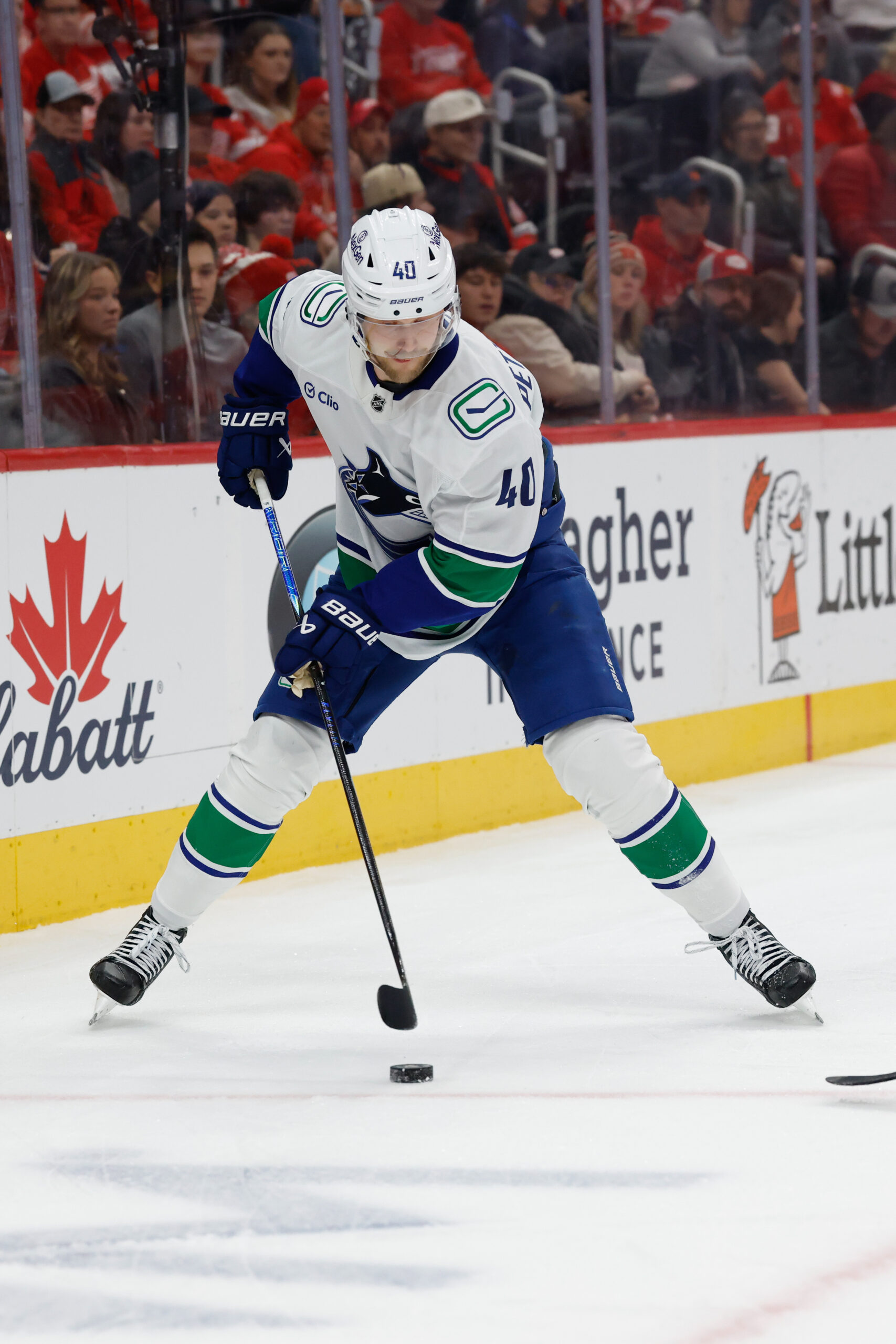 The deal is effectively designed to be buyout-proof, thanks to the five separate $5MM bonuses spread across the final five seasons of Pettersson’s contract. These signing bonuses don’t offer much savings for Vancouver if they choose a buyout, meaning Pettersson remains their problem unless they can trade him.
Now, if Pettersson were a $5MM or $6MM center, there would be no problem. He would be a relatively productive middle-six centre with some offensive flair.
But, given that he earns the money he does, Vancouver can’t afford to insulate Pettersson or give him the additional support needed to bring out the best in his game. It’s a problem for both sides, and one without an easy fix.
So, is there a solution? It’s possible, and Elliotte Friedman has previously discussed an Eastern Conference team showing interest in Pettersson, likely the Red Wings.
Besides the clear Swedish connections in Detroit, Pettersson could fit well as a second-line center behind Dylan Larkin, where he would face less pressure and scrutiny. Detroit could afford Pettersson’s salary, but probably wants Vancouver to cover some of the cap hit, something the Canucks are unlikely to be interested in.
If Vancouver isn’t interested in retaining significant money on Pettersson, they essentially have only two options left. The first is to keep Pettersson and hope he works his way out of his slump long enough to be traded. This is similar to what the Penguins did with Tristan Jarry, and it has worked well for them, although it has been disastrous so far for the Oilers, who paid the price to acquire him.
The other option for Vancouver would be to trade Pettersson for another expensive contract or multiple poor-value deals. Vancouver might also look beyond provincial borders to Alberta, where two players – the Flames’ Jonathan Huberdeau and Edmonton’s Darnell Nurse — are currently tied to hefty, hard-to-trade contracts.
Like Pettersson, both Huberdeau and Nurse have buyout- and trade-proof contracts, thanks to the high price tags attached to them for the foreseeable future. Huberdeau has five years remaining on his deal at $10.5MM annually, while Nurse has four years left at a $9.25MM AAV.
Considering their performance, these players could be candidates to be traded for Pettersson. However, another major obstacle to any trade involving these players is the trade protection embedded in their contracts.
Nurse has a full no-movement clause through the 2026-27 season, which then becomes a 10-team no-trade list for the last three years of his deal (per PuckPedia). While Huberdeau carries a full no-move clause for another three years after this one, it then shifts to a 12-team no-trade list for the final two seasons of his contract.
Although both Nurse and Huberdeau could benefit from a fresh start, the Canucks are about to rebuild, and veteran players won’t be lining up to join Vancouver at the bottom of the league standings.
All of that doesn’t put Vancouver in a strong position, and unless a team takes a big risk on Pettersson, Vancouver is likely stuck with him and his $11.6MM contract. Even though it seems like a deal that’s hard to move, it’s not unheard of for large cap hits to be traded.
Dion Phaneuf carried a $7MM cap hit on a long-term deal a decade ago while he was mainly a third-pairing defenceman, but that didn’t stop Ottawa from acquiring him and his full cap hit, which they eventually traded to the Kings in 2018 while retaining 25% of the cap hit.
The same applies to Oliver Ekman-Larsson, who was acquired by the Vancouver Canucks along with Conor Garland in exchange for a ninth overall pick, a 2022 second-round pick, and forwards Antoine Roussel, Loui Eriksson, and Jay Beagle. The deal mainly helped Vancouver offload several spare parts with high cap hits, but make no mistake, Ekman-Larsson was a failure in Vancouver, which is why he was bought out in June 2023.
Trades involving Phaneuf and Larsson show that trades for bloated contracts are possible. However, there are many cases like Marc-Edouard Vlasic, who could never be dealt because his play declined so much that no matter what assets were included, no team wanted him. Pettersson isn’t quite there yet, but another season or two like this past one and he probably won’t be moved without 50% retention of his cap hit.
Photo by Rick Osentoski-Imagn Images
Projecting Patrik Laine’s Future After This Season
Canadiens forward Patrik Laine is headed for free agency this summer. Despite a limited free agent market, he isn’t expected to attract much interest after another season marred by injuries.
Laine has only played five games this season, with just one assist, and until the trade deadline, he was a frequent topic of trade rumors as Montreal hoped to clear salary. Reports indicate he was mentioned in discussions with both the Maple Leafs and Flyers.
Laine hasn’t been a good fit with the Canadiens, and as summer approaches, it’s almost certain he will be wearing a different NHL jersey next season, likely at a cap hit significantly lower than his current $8.7MM salary. The question remains whether NHL teams will be interested and whether a good fit exists for the 2016 second overall pick.
Despite the injuries and inconsistencies that have challenged Laine’s career over the past half-decade, his shot remains among the best in the NHL, especially from long range, where he continues to be an elite scorer even if he hasn’t displayed his full skill set this year. Last season, Laine scored 20 goals in just 52 games, and he still likely projects as a 20- to 25-goal scorer despite limitations in nearly every other aspect of his game.
But that is the core issue with Laine: he is limited in what he can do, and his analytics away from the puck are appalling. This will cause many NHL teams to hesitate before considering him a viable free-agent target.
Laine has long been a liability in puck possession, and it wasn’t any better last season, when he was mainly used in an offensive role but still hindered his teammates’ possession. Given his health concerns, especially regarding his skating and agility, it’s unlikely these metrics will improve. This means any team that acquires Laine will need to isolate and shelter him, which is acceptable if he is earning close to the league minimum on a one-year deal.
When considering comparables, there aren’t many. In fact, this year, AFP Analytics can’t even project Laine’s potential contract for the 2026-27 season because there isn’t enough information available on Laine, which makes sense given that he’s only played five games this season.
A potential comparison who is by no means an exact match would be Anthony Mantha of the Penguins, who is currently earning $2.5MM on a one-year “prove it” deal he signed last summer. Mantha had a consistent track record of scoring 20 goals before last season, but he suffered a season-ending ACL injury and missed most of the year with the Calgary Flames. After posting just seven points in 13 games with Calgary, the 31-year-old bet on himself last summer, and it appears to be paying off as he looks set to be one of the top UFAs available this summer, which should give him a chance at a long-term contract in the coming years.
Although Mantha and Laine are very different players, there aren’t many better comparisons, but Jeff Skinner provides another example of what free agency could mean for Laine. Skinner has spent the last two seasons signing one-year, $3MM contracts as a UFA. However, like Mantha, he is over 30, at 33. Similar to Laine, Skinner is a fairly one-dimensional offensive player who can score goals but does little else, especially away from the puck, where he’s not exactly a Selke Trophy candidate.
Looking at Mantha and Skinner as reasonable comparables, since both are wingers, have notable flaws in their games, and can score, what can Laine expect in free agency? Mantha received a one-year, $2.5MM deal last summer, while Skinner signed a one-year, $3MM contract with San Jose.
Laine has several factors that position him above Mantha and Skinner. Laine was the second overall pick; he’s three years younger than Mantha was during his recent free agency and five years younger than Skinner. There’s a solid argument that Laine is a purer goal scorer than both Mantha and Skinner, which is mainly shown by his NHL career goal numbers. All these points suggest that Laine deserves a larger payday than both Mantha and Skinner.
But Mantha is arguably a more complete player than Laine, and Skinner has a longer track record of scoring goals than Laine. Those factors will work against Laine, but overall, he probably deserves a more substantial one-year contract than Mantha or Skinner received last summer. That said, this is a very thin free-agent crop, and teams will be desperate on July 1st to add scoring, which could make Laine appealing to more than one team despite the warts on his resume.
Where Laine ends up remains uncertain, but some contending teams facing the salary cap hurdle would likely be interested in acquiring a motivated, scoring forward at a low cost. Colorado and Dallas come to mind as possible destinations, as do the Penguins, who may lose Mantha to free agency unless they can negotiate a deal. In any case, Laine desperately needs to find a suitable fit if he wants to secure another lucrative NHL contract.
Jake Guentzel Is One Of The Best UFA Signings Of This Era
Building a team through free agency is rarely a recipe for success in the NHL. Just ask the Predators, who are only two years removed from “winning” the 2024 UFA sweepstakes but have yet to see any on-ice success from their spending spree (Steven Stamkos, Brady Skjei, and Jonathan Marchessault).
However, some teams do find success in the free agent market by acquiring players on the fringes. Last summer is a good example, as the Penguins struck gold by signing Justin Brazeau and Parker Wotherspoon to two-year contracts that have given them some of the best value in the NHL.
All of that being said, it’s rare to see a high-end UFA sign for big money and provide substantial extra value on their long-term deal, which is why the Lightning’s Jake Guentzel stands out as one of the best free agent signings of the last 10-15 years.
When Guentzel signed his seven-year, $63MM contract, he was brought to Tampa Bay to step into the lineup for former captain and long-time star Stamkos. Those were big shoes to fill, as Stamkos was a first-overall pick who had captained Tampa Bay to multiple Cups and was beloved by the city and the organization.
But the Lightning saw an opportunity to get younger and refresh the top of their lineup. It’s paid off in spades. However, it didn’t come without significant risk.
No one knew whether Guentzel would thrive outside of Pittsburgh after spending the first eight seasons of his NHL career with the Penguins, skating alongside Sidney Crosby on the top line. Many believed that Guentzel might have been a product of playing with Crosby and not a player who could excel elsewhere.
Since being traded by Pittsburgh in March 2024, all Guentzel has done is improve his impressive offensive numbers. In 503 games with the Penguins, Guentzel scored 219 goals and 247 assists, averaging 0.93 points per game. However, since the trade, Guentzel has tallied 78 goals and 97 assists in 163 games, averaging 1.07 points per game. While the increase is slight, it is still surprising — and quite welcome for the Lightning.
This season, the 31-year-old has 29 goals and 41 assists in 66 games and is on track for his third 80-point season. If he achieves that, it will mark the seventh time in eight seasons that he has surpassed a point-per-game, a remarkable streak of consistency for a player whose on-ice ability is often questioned.
Guentzel isn’t the flashiest player, nor is he the biggest or fastest. But he has a high hockey IQ and a rare ability to anticipate plays. That’s what made him the best player Crosby has ever played with long-term (an argument can be made that Marián Hossa was the best winger Crosby ever had), and it’s why he’s fit in with Tampa Bay so seamlessly.
There have been other UFA success stories over the past twenty years. Artemi Panarin had an outstanding run with the New York Rangers; the previously mentioned Hossa in Chicago won three Stanley Cups and played a key role in all of them, while Joe Pavelski left San Jose for the Dallas Stars and was a major contributor to their success from 2019 to 2024.
An argument could be made that John Tavares‘ signing with the Toronto Maple Leafs in 2018 was also a success, and in a vacuum, that is probably true. Tavares signed a seven-year, $77MM contract on the first day of free agency in 2018, and the deal itself worked out well for both Tavares and the Maple Leafs, as he remained an important contributor throughout the term and is currently playing on a bargain extension he signed last year. While Matthews was the captain of Toronto and a key piece of one of their better eras of regular-season success, the Maple Leafs had almost no playoff success, and the acquisition of Tavares led to one of the worst trades in recent memory.
Without Tavares signing, the Maple Leafs likely wouldn’t have traded Nazem Kadri to the Colorado Avalanche, a move that eventually helped Colorado win a Stanley Cup and left the Maple Leafs with a significant gap down the middle of the ice. In theory, the trade made sense; Kadri was destined to be a third-line center, and Toronto believed it was best to swap him for defensive help in Tyson Barrie and another center in Alexander Kerfoot. The move didn’t work out and ultimately contributed to Toronto’s decline.
And that parallel from Toronto highlights how impressive Guentzel’s run in Tampa Bay really is. He was brought in to replace arguably the best player in franchise history, and all Guentzel has done is put up better numbers than ever before in his career. There are still five years remaining on his contract, so it’s not guaranteed that Guentzel’s deal won’t become a problem later on, but for now, it’s one of the best UFA signings in recent memory.
Making Sense Of The Maple Leafs’ Downfall
Much has been said about the Maple Leafs’ decline this season, and rightly so. The team has shifted from a serious Stanley Cup contender just three years ago to a potential lottery pick this year.
Along the way, several targets have drawn criticism from Leafs fans and the media alike. From former head coach Mike Babcock to ex-GM Kyle Dubas and current captain Auston Matthews, no one has escaped the fans’ wrath or the media glare.
Still, amid all the turmoil, it’s unclear what specific factors brought about the end of an era that started with great promise and finished with a whimper this season.
Noticeably missing from the paragraph above is the name Brendan Shanahan, the man who sparked this entire era from the moment he was hired in April 2014. Shanahan was appointed president and alternate governor at the time and oversaw all Maple Leafs operations.
Some may forget, but back then, questions arose about whether Shanahan had the experience for such a role. Fair or unfair, those questions were valid since he was only five years removed from his last NHL game and lacked prior executive experience with an NHL team.
Shanahan did have executive experience, working at the NHL’s head office after his playing career. He was hired in December 2009 as the league’s vice president of hockey and business development and served in that role for just over a year before succeeding Colin Campbell as the senior vice president in June 2011.
Much of Shanahan’s role involved issuing suspensions for illegal hits and plays, and Shanahan modernized this system by introducing videos in which he narrated the plays in question. While this was relevant experience for an executive role in an NHL club, it is fair to question whether Shanahan had the appropriate experience to make management, coaching, and player personnel decisions and oversee the entire operation.
Ultimately, Shanahan was responsible for many of the key figures involved in this era of Maple Leafs hockey. Shanahan brought in figures like Babcock, Dubas, Lou Lamoriello, and eventually Brad Treliving. These men played major roles in shaping the team, from the coaching staff to the backup goaltender.
It’s impossible to know who made the final decisions on every move, but since Babcock, Dubas, and Lamoriello all exited at different times, it’s fair to say Shanahan held the overall authority and was accountable for nearly everything that occurred under his leadership.
So, what actions did Shanahan take when Lamoriello was in charge? There were certainly some good and bad decisions, but overall, they didn’t lead to the downfall this piece suggests.
Lamoriello attached the Maple Leafs to some problematic contracts during his time as general manager. Nikita Zaitsev received a seven-year, $31.5MM extension that proved disastrous and led to his trade, along with forward Connor Brown.
Patrick Marleau was signed as a free agent to a three-year deal worth $6.25MM per year. Toronto had to trade Marleau’s contract along with a first-round pick in 2019 because of salary-cap pressure.
There was also a four-year deal for veteran forward Matt Martin at $2.5MM per season, another far-from-ideal contract that took up valuable cap space. Although these contracts weren’t great and cost assets to unload, none of this was catastrophic, and Lou was out of Toronto before any serious damage was done.
Moving on from Lamoriello to Dubas, much of his work has been criticized as the downfall of the Maple Leafs. Dubas became a popular target for Maple Leafs fans, blamed for the decline of this era of hockey in Toronto.
It’s hard to judge if these criticisms are fair, considering we don’t know how much power Dubas actually held or how much veto power Shanahan exercised. It’s also fair to look at Dubas’ record in Pittsburgh and wonder if he learned from his mistakes in Toronto or if he is now benefiting from full autonomy in his new role with the Penguins.
But was the Dubas era in Toronto really that bad?
Dubas was responsible for the large contracts awarded to the Big Three after their entry-level deals expired. He signed William Nylander to a six-year deal, Auston Matthews to a five-year contract, and Mitch Marner to a six-year agreement. He also signed UFA John Tavares to a seven-year, $77MM deal, which many felt was unnecessary because it led to the departure of fellow center Nazem Kadri, who was traded to the Colorado Avalanche in a move that didn’t work out for Tyson Barrie.
The Kadri trade is probably the biggest blemish on Dubas’s resume, although some fans might argue that other moves by Dubas, such as the Morgan Rielly extension, the Petr Mrazek signing, and the subsequent trade that saw Toronto give up a first-round pick to rid itself of his contract, are also questionable.
Signing the big four essentially meant the Maple Leafs had to spend nearly $40MM of their cap space on four players, and there is a fair argument that this forced Dubas to tighten the budget elsewhere on the roster. While that’s true, Dubas managed to find affordable depth over the years, with Michael Bunting being a good example.
There was also significant criticism of Dubas’ handling of several trade deadlines, during which he traded away many assets for short-term rentals. Despite these additions late in the season (such as Ryan O’Reilly, for example), Toronto was never able to get past the second round, and in most cases, they couldn’t win a single series.
While this isn’t entirely Dubas’ fault, he bears most of the criticism, since it was technically his decision to go all-in at these deadlines. He also left the Maple Leafs with many assets missing when he was dismissed.
Without delving too much into the drama surrounding Dubas’s departure, it seemed to be something that wasn’t part of Shanahan’s plan and ultimately led to the hiring of Treliving as general manager. Despite some of the flaws on Dubas’ résumé, it was difficult to argue at the time that moving to Treliving was an upgrade for Toronto. Treliving had just left his role as GM in Calgary, leaving the Flames with an aging, costly core that wasn’t a playoff team and needed a rebuild.
Treliving arrived in Toronto and enjoyed a fairly good first summer with the Maple Leafs as he signed Max Domi and Tyler Bertuzzi to one-year contracts. These moves provided the Maple Leafs with some flexibility, but that suddenly diminished when Matthews signed a four-year extension in August 2023, making him the NHL’s highest-paid player at that time with a $13.25MM AAV.
A few months later, Treliving managed to sign Nylander to an eight-year deal worth $92MM. This was the first time the Maple Leafs had secured a member of the original Big Three with a maximum-length contract. Neither of the contracts for Matthews nor Nylander was particularly egregious; however, they fully committed Toronto to this core, a group that had not reached the third round of the playoffs.
Treliving didn’t do too badly in the UFA market, although signing Domi to a four-year extension after his first season in Toronto was a risky move that hasn’t worked out. Another tough contract to evaluate now is the six-year deal with defenseman Chris Tanev, which still has four years remaining after this season.
Those two deals essentially committed Toronto to $8.25MM in salary for two veteran players whose best years are behind them. This pattern reflects a tendency Treliving has often shown throughout his career as a GM.
Treliving’s first two seasons with Toronto were mostly decent, as the Maple Leafs made the playoffs and even won the Atlantic Division in 2025. The pivotal moment in his tenure occurred in the summer of 2025 when it became evident that Marner was planning to leave Toronto.
The star forward headed to Vegas, and although Treliving managed to acquire Nicolas Roy in a trade for Marner, what followed revealed a GM who was unprepared for the situation. Treliving’s moves after Marner’s departure didn’t make a significant difference and did little to replace the scoring loss.
Dakota Joshua, Matias Maccelli, and Roy were brought in, and it was assumed these three could fill Marner’s scoring gap. He couldn’t have been more wrong. Not only did they fail to replace Marner’s scoring, but they also left the Maple Leafs with a roster that was ineffective defensively.
Now, Treliving is left in Toronto as the de facto last man standing from a management regime that will likely be criticized for decades for squandering a golden opportunity to bring a Stanley Cup to Toronto. Folks will point fingers and blame the hierarchy from Shanahan to the backup goaltender, but the truth is this: The Maple Leafs’ downfall was not immediate; it was built on bad hires, bad trades, bad signings, and bad bets.
While it’s hard to narrow ten years down to one defining moment, there is a key two-month period that occurred in 2023.
The two moments that stand out as the beginning of Toronto’s decline are the firing of Dubas in May 2023 and Mitch Marner’s no-move clause kicking in on July 1, 2023. It’s long been speculated that Dubas wanted to reshape the Maple Leafs roster if he remained in the GM role, but he was fired before he could do so, and Toronto let Marner’s no-move condition trigger in his contract.
Dubas’ firing led to the hiring of Treliving and to the recent three seasons of moves in Toronto (including Marner’s departure). Now, most people will compare Treliving’s record to Dubas’s and claim Treliving has been more successful as a GM.
However, Dubas inherited a complete mess in Pittsburgh, as the Penguins were old, stagnant, in cap trouble, and lacked prospects. Treliving, on the other hand, inherited a top team in the Eastern Conference and kept it competitive for two seasons. It’s an apples-to-oranges comparison between Dubas and Treliving; however, one crucial fact remains: Dubas put the Penguins on the upswing, while Treliving has overseen the Maple Leafs’ decline.
Then there is Marner, who was never traded until the summer of 2025, and fetched only Roy in return for the Maple Leafs. Losing a top NHL player and failing to recoup the asset were major cases of disastrous asset management.
Sure, the Maple Leafs got two extra years of Marner, but not trading him in 2023 would have allowed them to acquire a haul of players back then and give Matthews, Tavares, and Nylander more depth.
That eight-week period in the spring of 2023 was a turning point, and for Maple Leafs fans, it’s hard not to look back and wonder what would have happened if Dubas had stayed in Toronto and Shanahan had been the one to depart.
We’ll never know, and for Maple Leafs fans, it doesn’t do any good to speculate; the era is over, and what comes next is unknown.
Photo by Nick Turchiaro-USA TODAY Sports
Assessing The Hurricanes’ Underwhelming Trade Deadline
There have been many unpredictable developments in the NHL this season, especially in the Metropolitan Division, where the Penguins and Islanders are unexpectedly holding playoff spots while the Devils and Capitals appear to be out of the race. Yet, one constant this year — as it has been nearly every year this decade — is that the Hurricanes are leading the division and poised for a strong playoff run.
Despite their impressive record and deep roster, it still seems like the Hurricanes missed an opportunity at this year’s trade deadline to elevate their team into the top tier of contenders by making just one or two small moves.
The Stars are in a similar position to Carolina, but Dallas made some moves by acquiring forward Michael Bunting and defenseman Tyler Myers. This isn’t to say those players were exactly what the Hurricanes needed, but Dallas only traded a second-, third-, and fourth-round draft pick for them.
Carolina didn’t need to be as bold as the Stars, given the depth on their roster, but they could have made a few small pickups to try and win their first Eastern Conference title in nearly 20 years.
There are reasons why Carolina might have been apprehensive. Sure, they got burned last season with the Mikko Rantanen deal, a short-lived acquisition that led to his quick trade to Dallas, and the year before, they traded for forward Jake Guentzel, only to see him leave and join Tampa Bay after their playoff elimination.
But again, Carolina didn’t need to add much, and what they did felt underwhelming as they only made one move to acquire physical forward Nicolas Deslauriers in exchange for a conditional seventh-round pick.
Much has been said about the Hurricanes’ lack of success in the postseason after the second round, and for good reason. The Hurricanes have made a habit of reaching at least the second round and have regularly played in the Eastern Conference Finals.
However, they have had almost no success advancing past the third round in the last two decades, dating back to 2009 when they were swept by the eventual Stanley Cup champion Penguins. Carolina was also swept in 2019 by Boston and in 2023 by Florida. Last year, they were eliminated in the third round once again, but this time they managed to secure a single win against the Panthers.
While their regular-season success is well documented, it seems their window is beginning to close, as their prospect pool is only average at best, and depth will eventually run out. Now, folks might point to their big acquisitions last summer and say those were the major moves, suggesting they were going all in, which is fair enough.
Last summer, Carolina acquired K’Andre Miller from the New York Rangers and also signed Nikolaj Ehlers as a UFA, giving him a six-year deal worth $51MM. Both moves indicated that the Hurricanes were willing to take risks and aim for a Stanley Cup.
Those moves, however, make the silence at this year’s trade deadline all the more puzzling. Why load up last summer only to hold back and not address shortcomings right before the playoffs?
You might look at Carolina’s lineup and think they have a flawless roster fill-out, but they do have some gaps in the lineup that could have been addressed.
The biggest issue for Carolina is on their fourth line, where journeyman center Mark Jankowski is anchoring the fourth-line center spot. No disrespect to Jankowski, who has kept his NHL career alive after several AHL stints, but he is not a center for a team with visions of winning a Stanley Cup this spring.
Jankowski is a suitable injury replacement or 13th forward, but regularly dressing him in every game of the playoffs probably isn’t ideal in a best-of-seven series. The 31-year-old Jankowski has six goals and nine assists in 51 games this season, which is acceptable for a fourth liner, but he has been used mostly in offensive zone situations, suggesting some sheltered usage.
The bigger issue for Carolina is what would happen to their center depth if someone like Sebastian Aho or Logan Stankoven were to get injured. Jordan Staal could step up to play in the top six, although it wouldn’t be ideal.
But suddenly, Jankowski becomes a top-nine center on a team with Stanley Cup ambitions. It’s a lot of hypotheticals, but injuries do happen, and an injury to a center could be disastrous for the Hurricanes.
Carolina didn’t need to make a big splash with a major acquisition; Teddy Blueger from Vancouver would have been enough, or even a Lars Eller from Ottawa (if he was available) would have worked too. Another option could have been a veteran like Erik Haula out of New Jersey. But Carolina chose to stand pat and hope they have the depth to make a run.
The same could apply to their defense, where Mike Reilly is currently getting regular shifts on their third pairing. Although Reilly has been a solid professional for quite some time, it’s not ideal to have him in the everyday lineup for the playoffs at this stage of his career.
It’s a bit less of a concern with Reilly because the Hurricanes have reinforcements on the way, including returning injured players like Shayne Gostisbehere and Charles-Alexis Legault. Reilly’s underlying stats have been quite good this season, but much like Jankowski, he’s been sheltered when he’s in the lineup.
Given the high costs at the trade deadline, it is understandable why Carolina would hesitate to add to their lineup. However, since they are firmly in their contention window, it was surprising to see them do so little to address their lineup deficiencies.
They might still make a deep run; however, if they fall short of their ultimate goal once again, they could end up regretting their inaction last week.
Kyle Dubas Deserves Praise For Retooling The Penguins
When the Pittsburgh Penguins dismissed GM Ron Hextall and president of hockey operations Brian Burke in April 2023, it created a vacancy that needed to be filled by an individual with a clear vision. The Penguins arguably had the least desirable job in the NHL, and there was no extensive list of candidates capable of stepping in and transforming a struggling franchise.
Pittsburgh had missed the playoffs for the first time in 16 seasons, had an aging, costly roster, lacked prospects in the pipeline, had very few draft picks, and had minimal cap space. Despite all the negatives linked to the role, Pittsburgh leveraged its considerable resources at the time to attract Kyle Dubas to lead the organization, offering him a lengthy, substantial financial commitment and full autonomy to run the team as he deemed fit.
It was a significant gamble, and one that appears to be paying off nearly three years later.
Make no mistake: during the first two months Dubas was in charge, he did almost nothing right. The Ryan Graves contract remains a complete disaster; the Tristan Jarry deal was a major failure; and the other contracts he signed that summer did little to benefit the Penguins the following season.
The only positive from that summer was acquiring three-time Norris Trophy winner Erik Karlsson, who hasn’t been his usual offensive self but has become a more complete defender this season.
But during the 2023-24 season, when it became clear the Penguins were out of contention, they shifted to a retooling approach that resembled a rebuild. At the deadline, Dubas traded pending UFA Jake Guentzel to the Carolina Hurricanes for forward Michael Bunting, a second-round pick that would become defenseman Harrison Brunicke, forward prospects Ville Koivunen, Vasiliy Ponomarev, and Cruz Lucius, along with a 2024 conditional fifth-round pick.
It was a significant haul for Dubas, although it lacked top-tier assets and was viewed as a move focused on quantity rather than quality. Nevertheless, the move sparked a run for Dubas that allowed him to avoid a full-scale rebuild, despite widespread belief that he was rebuilding the Penguins.
Dubas started dismantling the Penguins’ roster by trading away several veterans. At the same time, he added draft picks and young players who hadn’t panned out elsewhere, along with veterans on overpriced contracts that their former teams needed to shed for salary-cap reasons.
Dubas was happy to acquire these types of players in exchange for draft picks, as shown in his trades for Kevin Hayes and Cody Glass, in which he received second-, third-, and sixth-round picks for taking on their contracts. He also made short-term bets on players with potential upside, signing forward Anthony Beauvillier to a one-year deal and defenceman Matt Grzelcyk for just one year.
During the first part of the 2024-25 season, Dubas’ decisions seemed disastrous. The Penguins were out of playoff contention by January and began selling off pending UFAs, starting with Marcus Pettersson and Drew O’Connor, whom they traded to the Vancouver Canucks for a first-round pick and several other veterans who were eventually moved out.
Dubas kept retooling, moving on from Glass to acquire more assets, including Bunting, who eventually helped the Penguins land Thomas Novak and additional draft picks. He also traded Beauvillier for a second-round draft pick at the deadline and acquired Connor Dewar and Conor Timmins for a fifth-rounder.
It all seemed like a video game. Dubas was wheeling and dealing as if he had a controller in his hand, but on-ice results were underwhelming at best.
The Penguins missed the playoffs for a third straight year, and fans and media alike began questioning whether Sidney Crosby should remain in Pittsburgh, since Dubas wasn’t building a strong team around him. Despite missing postseason hockey, the Penguins weren’t building for the here and now, as Dubas was adding draft picks and younger assets – something many believed was impossible without a full rebuild.
Aside from the asset acquisition, another big story was brewing. Dubas had pulled the Penguins out of an awful cap situation, and they had flexibility on the horizon.
Pittsburgh has over $47MM in cap space available this summer (per PuckPedia) and won’t have a ton of holes to fill, as they finally have a youth movement coming.
Then there was the mastery Dubas showed during the summer of 2025, first drafting Benjamin Kindel with the 11th overall pick, which most people thought was a reach. He then traded down with his second pick and ultimately left the first round of the entry draft with Bill Zonnon and Will Horcoff.
Dubas then spent the rest of the summer acquiring castoffs and second-round picks, taking on Matt Dumba’s contract and the sweetener from the Stars, as well as Connor Clifton from Buffalo. By late summer, the Penguins had more draft capital for the next three NHL drafts than any other team, all without a full-scale rebuild.
Dubas also went bargain-hunting among free agents last summer and found great success, signing Anthony Mantha to a one-year deal that has been a significant bargain, as well as defensemen Parker Wotherspoon and Justin Brazeau, who fill top four and top six roles on the Penguins for just $2.5MM combined and are signed for another season.
But Dubas’s best work this season has been the Jarry for Stuart Skinner swap and the Egor Chinakhov trade with the Columbus Blue Jackets. Skinner has outperformed Jarry since the trade, playing exceptionally well and helping the Penguins re-enter playoff contention.
Pittsburgh also received a second-round pick and Brett Kulak from Edmonton, who was later traded for Samuel Girard and an additional second-round pick. The Chinakhov trade, on the other hand, has worked out splendidly, as he has fit seamlessly alongside Evgeni Malkin, and the Penguins have been red hot since the trade.
Pittsburgh is now firmly in a playoff race, even without Crosby and, more recently, Malkin. The team isn’t a Stanley Cup favourite, but Dubas has achieved the impossible with this roster in just a few short years.
He made the team younger and faster, overhauled the prospect system, accumulated draft picks, and gained cap flexibility. He managed all of this while keeping the team in playoff contention during the final years of Crosby, Malkin, and Kris Letang.
Dubas provided the Penguins with direction and made the tough decisions and bold moves that come with having a clear vision. Make no mistake, Dubas had the term and independence when he was hired; he could have torn down the roster and taken the easy route to rebuild.
But he chose the more challenging path of retooling on the fly, one of the toughest ways to build. Dubas took one of the league’s oldest rosters and revitalized it, and for that, he deserves a lot of credit.
Trade Deadline Primer: Utah Mammoth
With the Olympic break now over, the trade deadline is tomorrow. Where do each team stand, and what moves should they be targeting? We continue our look around the league, focusing on playoff-hunting teams, and we’re back with the Mammoth.
The Mammoth are currently in a wild-card spot in the Western Conference and would love nothing more than to give their fans some playoff home games in just their second season. Utah has been mentioned as a potential suitor for St. Louis Blues forward Robert Thomas, who, at just 26 years of age, would fit with the Mammoth’s contention timeline. There are a few teams that can match Utah’s stockpile of future assets and young players, making that link a real possibility.
Record
32-25-4, 4th in the Central
Deadline Status
Buyer
Deadline Cap Space
$25.72MM on deadline day, 2/3 retention slots used, 45/50 contracts used, per PuckPedia.
Upcoming Draft Picks
2026: UTA 1st, UTA 3rd, CAR 3rd, UTA 4th, UTA 5th, CHI 5th, UTA 7th
2027: UTA 1st, UTA 2nd, UTA 3rd, TOR 3rd, UTA 4th, EDM 4th, UTA 5th, TBL 5th, UTA 6th, UTA 7th
Trade Chips
The Mammoth have a key UFA this summer in forward Nick Schmaltz, a player expected to be among, if not the best, free-agent forwards available. The Mammoth are unlikely to move the 30-year-old, who is having a career year and should be a major part of their playoff push. Other pending UFAs include forwards Alexander Kerfoot, Kevin Stenlund, defenseman Ian Cole, and backup goaltender Vitek Vanecek. Aside from Schmaltz, none of these players are expected to fetch much value on the trade market, and considering Utah’s position, it doesn’t make sense to move them.
Looking down the list of other potential trade chips, Utah has a top-five prospect system in the NHL with an embarrassment of riches, including Tij Iginla, Caleb Desnoyers, Dmitri Simashev, Daniil But, and Maveric Lamoureux.
Iginla has name recognition thanks to his father Jarome Iginla’s illustrious career, but he is a very different player from his dad. Iginla works quickly and plays a speed-based game that excels in transition and on the rush. He is a decent playmaker, though not exceptional, but his shot can do a lot of damage. Iginla plays with a high motor and isn’t afraid to be first in on the forecheck. If Utah were to make him available, there would be teams interested in him because of his abilities and pedigree.
As promising as Iginla is, he isn’t the Mammoth’s top prospect; that distinction belongs to forward Desnoyers, who was the fourth overall pick in last year’s NHL Entry Draft. Desnoyers had an outstanding playoff last year in the QMJHL, showcasing his skills and size by scoring 30 points in just 19 playoff games. Desnoyers plays a well-rounded game overall, but his skill level wouldn’t be considered high-end. That said, he is quite responsible defensively and is one of the hardest workers on the ice.
On the back end is Simashev, a towering defenseman who dominates the defensive zone and rarely gets caught running around in his own zone. Big defensemen remain in demand regardless of skill level and effectiveness, which is quite evident if you look at recent NHL trades (Tyler Myers, for example). Simashev doesn’t light up the score sheet (one assist in 24 NHL games), and no one will mistake him for an offensive defenseman, but he is a capable puck carrier, has fairly good passing skills, and, of course, can hit. Simashev’s already broken into the NHL roster at 21 years of age and has top-four NHL potential; he would be an ideal partner for an offensive defenseman, which is something teams are always looking for.
Finally, let’s look at Daniil But, who has spent some time in the NHL with the Mammoth and is having a solid offensive showing in the AHL as well. At 6’6” and just 21 years old, you might expect some awkwardness or clumsiness in But’s game, but he is actually quite smooth and refined in his puck handling, shooting, and passing. Not to be overlooked is his shooting, which is excellent, as his large frame allows him to generate plenty of torque on his shots, no matter which foot he uses. Teams often pay a premium for size, but the combination of size and skill gives But significant trade value if Utah decides to move him.
Team Needs
A Top Nine Forward: This team’s primary need was a top-four defenseman; however, since the Mammoth recently acquired MacKenzie Weegar, Utah now has a solid defensive unit. Up front, they could benefit from a scoring forward to better balance their top nine, as their offense is only average, ranking 16th in the NHL in scoring. As mentioned earlier, Utah was in talks with the Blues for Thomas, but no deal was reached. It’s difficult to determine whether Utah needs to acquire a player with Thomas’ skill level, but a top-six forward would definitely be ideal to move players down the lineup into roles better suited to their abilities. The player they acquire could also be a third liner, but their main focus will likely be scoring, whether it’s depth scoring or improving overall.
A Backup Goaltender: Utah is among the top defensive teams in the NHL, ranking fifth in goals against this season. The team has relied heavily on starter Karel Vejmelka and has used backup netminder Vaněček sparingly. The reason for Vaněček’s limited play is quite clear, given his poor performance this season in just 14 games. The 30-year-old has a 3-9-2 record, a 2.94 GAA, and a .884 SV%. Vaněček’s -1.3 goals saved above expected (according to MoneyPuck) isn’t the worst figure, but his lack of appearances and record with the team indicate a goaltender who hasn’t exactly boosted confidence among his teammates. Utah also lacks a reliable third option if Vejmelka or Vaněček were to get injured.
Photo by Kim Klement Neitzel-Imagn Images
Trade Deadline Primer: Nashville Predators
With the Olympic break now over, the trade deadline is this week. Where do each team stand, and what moves should they be targeting? We continue our look around the league, focusing on playoff-hunting teams, and we’re back with the Predators.
Nashville isn’t a strong hockey team, but luckily for them, they play in the Western Conference. Despite an unimpressive record, they are still fighting for a playoff spot. The Predators have an ageing and costly core and would likely prefer to get younger now. However, they have several high-priced contracts that are hard to move, and a few others they might deal if they can persuade the players to accept a trade. What Nashville will do remains uncertain, but they do have options despite their fragile roster setup.
Record
27-26-8, 5th in the Central
Deadline Status
Conservative Seller
Deadline Cap Space
$31.75MM on deadline day, 2/3 retention slots used, 41/50 contracts used, per PuckPedia.
Upcoming Draft Picks
2026: NAS 1st, NAS 2nd, MIN 2nd, NAS 3rd, NAS 4th, NAS 5th, EDM 5th, CAR 5th, UTA 6th, NAS 7th
2027: NAS 1st, NAS 2nd, STL 2nd, NAS 3rd, EDM 3rd, VGK 3rd, COL 3rd, NAS 4th, NYR 4th, NAS 5th, COL 5th, NAS 6th, NAS 7th
Trade Chips
What the Predators do over the next two days will depend on several factors, including the offers they receive and how they play this week. They don’t have to do anything. They could retain their pending UFAs and make a run for the playoffs if they wanted, and it would be understandable given the age of their core players.
That being said, if a team makes a high-priced offer for center Ryan O’Reilly, you have to believe the Predators would listen. O’Reilly has one year left on a team-friendly $4.5MM cap hit and would bring Nashville a substantial return if traded. It’s difficult to assess whether it’s a buyer’s or a seller’s market. Some people have said it leans heavily towards the sellers, but a few teams have committed to selling in recent days, which will change the market a bit. That being said, if it turns out to be a seller’s market, Nashville will likely trade him. If the opposite is true, they will probably hold onto him until at least the summer.
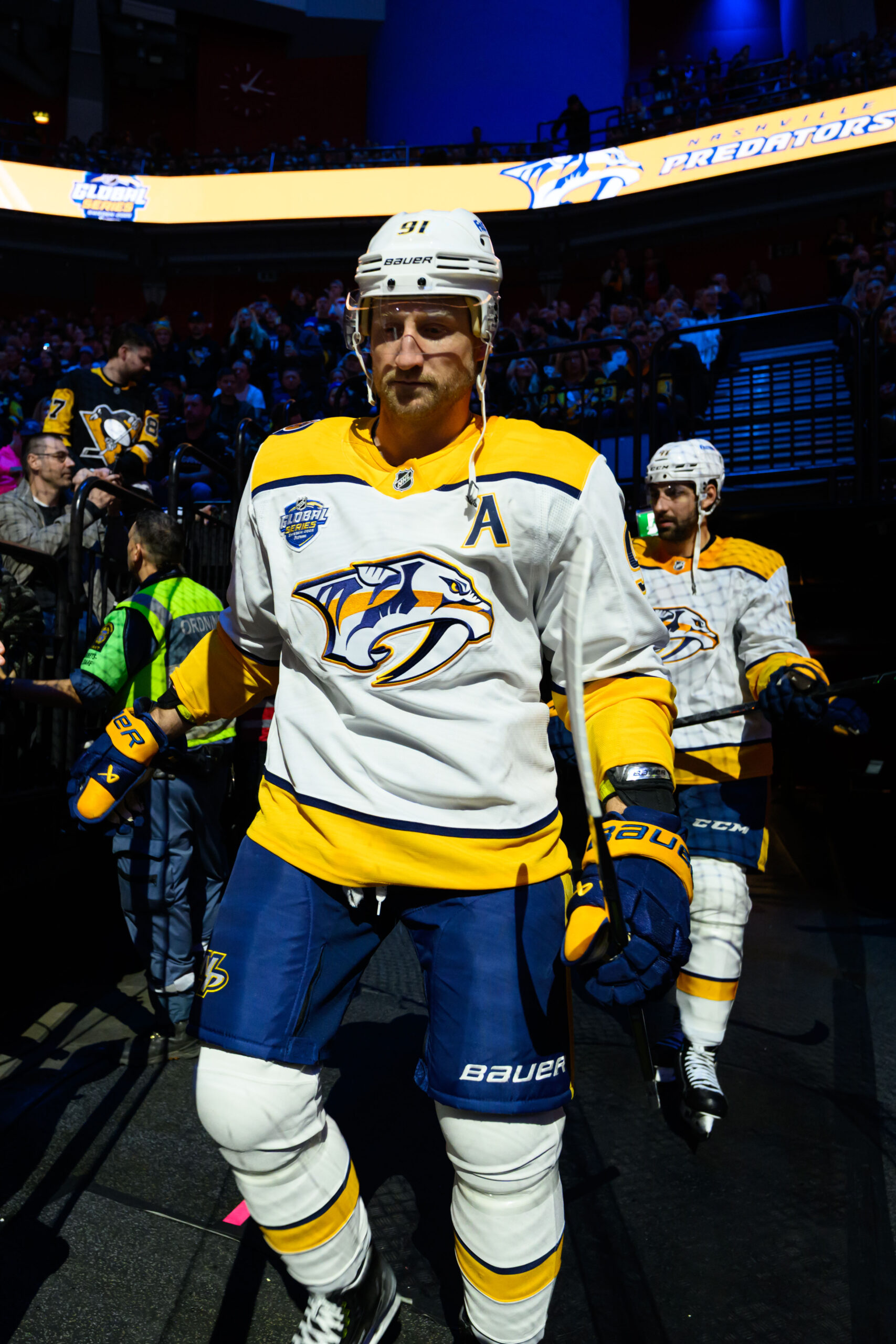 Steven Stamkos has also been mentioned as a potential trade candidate in recent weeks. Stamkos is in his second year with the Predators after a widely discussed departure from the Tampa Bay Lightning. The 36-year-old Stamkos didn’t have an ideal first year in Nashville by his standards, but he has improved significantly this season, with 30 goals and 17 assists in 61 games. His near 0.5 goals per game would be very attractive to any NHL team, but Stamkos holds sway over his own fate thanks to a full no-movement clause and can remain with the team if he chooses. Given the limited time to make a move, it seems likely Stamkos could be a summer trade candidate, but anything is possible if teams and players are motivated to facilitate deals.
Beyond the two veterans, Nashville has a few other players they could trade at the deadline, starting with forward Michael Bunting, who is a UFA this summer. The 30-year-old has been traded twice in the last two years, both times around the trade deadline, and could be moved for a third time during his current three-year contract. There is nothing wrong with Bunting’s game; he remains a solid depth scorer with a bit of sandpaper to his game. Bunting could be a good addition to a team seeking more scoring from their middle six and likely wouldn’t cost too much if Nashville decides to move him.
Erik Haula is another veteran forward with an expiring deal who might be moved. The 34-year-old is having a solid offensive season, with nine goals and 21 assists in 61 games, making him a decent addition to a team’s bottom six. Like Bunting, he is a UFA this summer, and the cost to acquire him shouldn’t be too high, which could attract teams working within an asset budget. Haula is a fantastic penalty killer, decent on faceoffs, and a good defensive forward, but he takes far too many minor penalties, which might be problematic for a contending team.
Team Needs
A Center: The Predators currently lack sufficient center depth, and trading O’Reilly would weaken what little they have. The team recently moved Michael McCarron to the Minnesota Wild and needs to acquire some centers — preferably young ones — who can eventually play behind the 2025 fifth-overall pick, Brady Martin, once he makes his full-time transition to the NHL. The Predators have a few other center prospects who project as NHLers, but it’s hard to tell if they will develop into top-six options. O’Reilly won’t be around during the Predators’ next contention window, but if they want to develop strong center prospects, he could serve as a mentor, similar to how Sidney Crosby has helped 18-year-old Benjamin Kindel develop in Pittsburgh.
Prospects: The Predators have a slightly above-average farm system if you look at conventional prospect rankings. But if they are keen on launching their rebuild while the likes of Juuse Saros and Filip Forsberg are still key contributors, they will need to ramp up their drafting and development. The optimal way to do that would be to sell off any veteran assets that can be moved and trade for futures or young roster players. As the Pittsburgh Penguins and Washington Capitals have demonstrated in recent years, teams can retool on the fly with a veteran core and compete quickly if they are willing to make tough decisions and take chances. Current GM Barry Trotz won’t be the one to make those decisions, but he can lay a foundation on his way out the door that will allow the next general manager to make those hard choices. Nashville has Saros signed until 2033 and Forsberg until 2030. It’s not unrealistic to believe that the Predators could be competitive again in another 2-3 years, giving them some runway with their vets to serve as both mentors and contributors while their young players find their way in the NHL.
Photo by Per Haljestam-Imagn Images
Trade Deadline Primer: Columbus Blue Jackets
With the Olympic break now over, the trade deadline is this week. Where do each team stand, and what moves should they be targeting? We continue our look around the league, focusing on playoff-hunting teams, and we’re back with the Blue Jackets.
The Blue Jackets haven’t made the playoffs since the 2020 bubble and were close last season, finishing with 89 points and narrowly missing the postseason. Coming into this year, there was an air of optimism in Columbus. However, a 19-19-7 start under former head coach Dean Evason quickly let the air out of the balloon and left many fans wondering whether Columbus would sell off their pending UFAs. They haven’t done that to this point and have climbed back into the playoff picture, going 11-2-1 under new head coach Rick Bowness. Now heading into the deadline, Columbus sits five points out of the final wild-card spot in the Eastern Conference with a game in hand and 23 games to go. What they will do at the trade deadline is anyone’s guess, but they have dropped hints.
Record
30-21-8, 5th in the Metropolitan (39.2% playoff probability)
Deadline Status
Conservative Buyer
Deadline Cap Space
$45.55MM on deadline day, 0/3 retention slots used, 46/50 contracts used, per PuckPedia.
Upcoming Draft Picks
2026: CBJ 1st, STL 2nd, CBJ 3rd, COL 3rd, TOR 4th, CBJ 5th, PIT 6th, CBJ 7th
2027: CBJ 1st, CBJ 3rd, WAS 3rd, COL 3rd, CBJ 4th, CBJ 5th, CBJ 6th, CBJ 7th
Trade Chips
The Blue Jackets dealt their best trade chip at the end of December, trading Egor Chinakhov to the Pittsburgh Penguins for Danton Heinen and two draft picks. That move wasn’t a trade for this season, but it did give the Blue Jackets two additional draft picks to potentially make additions with, on top of their other catalogue of picks. Columbus GM Don Waddell doesn’t sound like he is ready to make a big splash or punt on this season, so it could be a quiet deadline in Ohio.
2021 fifth overall pick, Kent Johnson, is a potential trade chip who has been a healthy scratch for a few games now. The 23-year-old has a pair of successful NHL seasons under his belt, but they are sandwiched between several seasons of inconsistency, including this year. Johnson has just six goals and 12 assists in 56 games, after registering 24 goals and 33 assists last year in 68 games. Johnson was once touted as the Blue Jackets’ top prospect, but at this point, he could be their best trade chip if they want to make additions at the deadline. There is a gamble in moving him while he is slumping, though he does have a track record of scoring in the NHL, and it might be best to be patient with him and see if he can rediscover his game, particularly given that the Chinakhov trade looks quite bad right now for Columbus.
Columbus will likely keep this next player, but there will be interest in center Charlie Coyle. The 34-year-old has 126 games of NHL playoff experience, and many teams would love to have him as their third-line center should he be available. Coyle has 15 goals and 30 assists in 59 games this season and fits a need that many teams have, but very few sellers are currently offering. The Blue Jackets likely want to keep Coyle, but they might get offers that are too difficult to ignore for a player who likely doesn’t figure in much of the Blue Jackets’ long-term future. Even if they re-sign Coyle to a multi-year deal, he likely won’t be producing at his current levels when Columbus enters their contention window.
In terms of prospects, the Blue Jackets aren’t dealing their top picks, Cayden Lindstrom or Jackson Smith, but a prospect such as Luca Del Bel Belluz could be the centerpiece of a big trade in Columbus, had the team changed its mind and gone big-game hunting. Belluz was the Jackets’ second-round pick (44th overall) in 2022 and is likely to return to the NHL very soon, given his impressive AHL numbers this year (15 goals and 28 assists in 41 games). The 22-year-old was with Columbus until just before Christmas, when he was demoted to the AHL after posting just a single point in 13 NHL games. It was Belluz’s second lengthy NHL audition, with his previous opportunity yielding eight points in 15 games. Belluz might not have the name recognition of some of Columbus’s other prospects, but he does have a solid resume thus far and is in just his third professional season.
Team Needs
A Top Six Forward: Unfortunately for the Blue Jackets, Johnson’s poor season has left the team in a spot where they could use another top-six forward. With Johnson playing his way off the top two lines, Heinen has occasionally taken a spot, as have other depth forwards. Columbus has a below-average offense, and a top-six forward could push others in the lineup into a more advantageous position and unlock additional offense. Unfortunately for the Blue Jackets, things didn’t work out with Chinakhov, as he has filled that top-six role in Pittsburgh for the Penguins, leaving them in a spot where they have to hunt down their own top-six solution.
A Top Pairing Defenseman: Damon Severson is a very good NHL player and has long been an analytical darling. But the once-offensive defenseman has struggled with turnovers over the last two seasons and is better served on the second pairing. The 31-year-old has yet to top the 30-point mark in Columbus, something he did four times in New Jersey and would be better served to play against lesser competition, which could free him up more offensively. It’s unlikely the Columbus could find a right-shot top-pairing defender before the deadline, but in a perfect world, they would supplant Severson. It’s also possible that the Blue Jackets feel they have the heir apparent in Denton Mateychuk, who is just 21 years old and has been terrific this season.
Photo by Timothy T. Ludwig-USA TODAY Sports