
The Maple Leafs Are The League’s Most Troubled Team
The headlines about the Maple Leafs over the past 12 months have been largely negative, and for good reason. The team hasn’t been good since being knocked out of last year’s playoffs in the second round, and they’ve been a circus off the ice as well.
But a team that just a few years ago had quiet, steady confidence has become a tsunami of chaos wrapped in a corporate blanket. The Maple Leafs are in trouble, not the kind that can be “fixed” in a season or two – as we’ve seen in Pittsburgh or Washington – but the kind that can lead to a decade of futility.
Before diving too deep into the rabbit hole, a quick caveat. If the right lottery balls fall and Toronto turns this boondoggle of a season into the first overall pick, Gavin McKenna, then all the points that follow could become moot.
However, if the lottery balls fall the other way and Toronto ends up with a non-top-five pick that will be sent to the Bruins, it would lead to a more disillusioned fanbase and more toxicity around an organization that has watched a once-promising rebuild completely unravel in just a few years.
Some might argue that it all came apart in the last 12 months, and there is a good case for that, given that Toronto saw its biggest year-over-year point decline in 109 years. But the truth is that the seeds of this tree of woe were planted years ago, and they’ve been soaking up water for the last couple of seasons, only to emerge as the Maple Leafs’ first playoff absence in ten years.
The issue for the Maple Leafs isn’t a single item on a checklist. It’s a systemic issue that has filtered down from the top and has culminated in this week’s news from The Athletic that Maple Leafs Sports and Entertainment president Keith Pelley has become deeply involved in roster construction, something he’d never done before.
The Athletic piece (subscription required), written in partnership by Jonas Siegel, Chris Johnston and James Mirtle, delves extensively into the Maple Leafs’ past season and pulls no punches in its depiction of their fall. History is littered with empires that fell, but for the Maple Leafs, the empire they were supposed to become when they emerged from a rebuild ten years ago never materialized.
How they turn things around at this time is incredibly unclear. There is perhaps only one quick fix: the aforementioned McKenna lottery ball going their way.
Outside of that, the road back to relevancy is paved with speed bumps, and at the moment, there isn’t an obvious candidate in the organization who can lead them to the promised land. There isn’t exactly a litany of candidates outside the organization, either, who could undo all the damage that’s been done to their roster.
Lots of names will get tossed around, but there aren’t many free-agent managers available who have built perennial Stanley Cup contenders, with the exception of Stanley Cup winner Peter Chiarelli, who is probably not high on Toronto’s list of candidates due to a litany of other roster construction blemishes on his record
Some have mentioned Mark Hunter of the London Knights as a potential candidate to take over, but Hunter had a somewhat sour experience with the Maple Leafs earlier in his career as an assistant GM, passed over for promotion in favor of Kyle Dubas, and may not want to leave the stability of the OHL Knights for the chaos of the Leafs. However, money can heal a ton of wounds, and if Toronto wanted to, they could probably find enough to mend fences with Hunter.
That is what Toronto will have to try to do if it wants to turn its current luck around in a hurry and flex its financial might. There is no cap on management, scouting, and player development, and it is an area where Toronto could invest heavily again to quickly retool or rebuild its roster. However, based on the story from The Athletic, it appears that Maple Leafs ownership has plans to move in the opposite direction, though they might not have a choice given the state of their roster and prospect pool.
When Toronto’s lineup is fully healthy, it’s not exactly a group that will strike fear into many opponents. There are significant gaps throughout, and not much toughness to speak of.
The biggest hole is on defense, where the team lacks a true number one defenseman who can run the power play, kill penalties, and play a solid two-way game at five-on-five. Many fans hoped Morgan Rielly would fill that role, but his game is all offense at this point, and that offense has been drying up in recent years.
The good news for Toronto is that they have plenty of cap space this summer ($22.2MM, with just three roster players to sign, per PuckPedia). However, the bad news is that there isn’t much available in free agency, and Toronto doesn’t have many draft picks or prospects to trade.
There are a few future pieces they could deal, but would it even make sense at this point to add to a core group of players who have won exactly nothing in ten years and have now gone through several management groups with almost no variation in results? The constant during that time has been Auston Matthews, William Nylander, and Rielly, who have all been on this ship while the deckchairs have shuffled around them year after year.
Is it time to move one of them? Can Toronto even move any of them, given their contracts, no-trade clauses, and last season’s struggles?
The core players have said they want to run things back in Toronto and give it another shot, which seems foolish at this point, given the track record. A new GM who comes in and tries to build around Matthews and company could be in for a fool’s errand, throwing good money after bad as they fall victim to the sunk-cost fallacy.
Make no mistake, every GM falls victim to it, throwing good assets out the window to undo previous errors. It usually doesn’t end well and can ultimately lead to a reduction in the contention window, which is exactly what happened in Toronto and elsewhere.
Many teams have done this before, burning through draft picks and prospects in pursuit of a playoff berth, only to miss and have nothing to show for it. The Penguins notoriously let Ron Hextall burn through assets in an attempt to save his job in 2023.
He traded a second-round pick for Mikael Granlund, who had the worst run of his career in Pittsburgh before the Penguins missed the playoffs. Hextall was fired shortly after the season, and Dubas came in and immediately made the same mistakes as Hextall, trading good assets for aging ones, before realizing his errors and pivoting to a retool.
Dubas then systematically moved out the Penguins’ veterans who didn’t fit the plan and moved on, recouping tons of young assets in the process. He also took on bad contracts along with draft picks to help teams that were strapped against the cap.
Some might look at the Dubas strategy and think it could work for Toronto, and who knows, maybe it could. But the issue is that it took Dubas two years to see results from those moves, and we haven’t fully seen those results yet.
Many of the draft picks Dubas acquired are in upcoming drafts. That strategy takes time, a lot of time, and time is something Toronto doesn’t have, given that Matthews has just two years left on his deal now.
Another issue for Toronto in deploying the Dubas strategy is that there simply aren’t as many teams up against the cap as there were a year or two ago, when Dubas made his moves. This means teams may be more inclined to simply bury bad contracts rather than trade them for an asset to get rid of them.
It was still painful for Pittsburgh, as they missed the playoffs for three straight years before making it this year. Retools take time; even when most of the moves work out well, there is no quick fix, only trade-offs. Toronto’s management has to decide which trade-off they are comfortable making before making management hires and pointing this team in a different direction.
Whatever direction is ultimately chosen, the road will be bumpy, but any team that finds success has to endure adversity, some more than others. And for the Maple Leafs, if they do eventually find success, they will have endured more adversity than any other team.
The Capitals’ Roster Outlook With Or Without Alex Ovechkin
The Capitals were a surprise omission from this year’s playoffs after an impressive regular season and a playoff appearance a year ago. The disappointing result wasn’t the biggest news out of D.C., though. Superstar captain Alex Ovechkin has been non-committal about his future, while also implying he hasn’t played his last game.
Ovechkin’s possible departure from the game poses an interesting conundrum for the Capitals after they successfully navigated a retool to remain competitive during the final years of Ovechkin’s NHL career. Washington might need to prepare to welcome him back next season, but they might also need to prepare for life without the face of their franchise.
Even if Ovechkin were to return for his age-41 season, he’s not a long-term fixture on the team and not someone they should really count on to log massive minutes, regardless of whether he’s there. So, what are their options?
The first thing that could happen is that Ovechkin does, in fact, hang up his skates. This would mark the end of an era, creating a massive void both on the ice and in the dressing room.
There would be a leadership void in the Capitals’ room, an identity shift, and a need to rethink their power-play structure, which runs through Ovechkin. In fact, almost everything in the organization runs through him, or has been done with him in mind. That includes the recent retool Washington went through, rather than attempting a full teardown while he was still on the roster.
For those thinking the Capitals will embark on a rebuild without Ovechkin, that doesn’t appear to be the case, given what Washington has done over the past few years. The team is committed long-term to Pierre-Luc Dubois, Matt Roy, Jakob Chychrun, Logan Thompson, and Tom Wilson, and isn’t likely to blow up the roster anytime soon, especially given that they have the 11th-ranked prospect pool in the NHL (as per Scott Wheeler of The Athletic).
There is simply no need for the Capitals to tear the roster down, but how they proceed with the rest of their roster could depend heavily on whether Ovechkin is in the mix.
In any event, Washington needs to add to their offense next season and appears inclined to do so. Pierre LeBrun of The Athletic spoke with Capitals general manager Chris Patrick last week, and they discussed Patrick’s attempts to sign Nikolaj Ehlers last summer prior to him joining the Hurricanes, as well as the team’s pursuit of Artemi Panarin at the trade deadline.
Neither of those attempts bore fruit, but it does indicate that the Caps know they need more scoring, with or without Ovechkin. One thing that will become clear is that Washington can’t run the offense through Ovechkin anymore, and he will need to fill more of a depth-scoring role than an offensive focal point, even as he comes off a team-leading 32-goal, 64-point season.
Realistically, the best thing for the Capitals would be to have Ovechkin return for one more season, while adding secondary scoring options. That would allow the team to transition slowly away from Ovechkin while onboarding additional players who don’t have to be the guy right away.
Just who those players could be is up in the air, but the Capitals do have significant assets in the draft pick catalog and their farm system who could be moved in a trade, which will likely be the path to acquiring a player unless they want to overpay for an Alex Tuch-type player in free agency.
The Capitals could get aggressive there, as they have $36.5MM in cap space with 17 players signed. Even if they extended Ovechkin for one year at market value ($9.068MM, according to AFP Analytics), Washington would still have $27.5MM available to sign five players.
The scenario where Ovechkin returns for another season could be special if the Capitals make strong moves in the summer. It would allow Ovechkin to control his exit, give the team the aforementioned transition year, and, if the team has better depth, they could use Ovechkin situationally to maximize his contributions.
Some folks might say it delays necessary changes or leaves the team stuck in the middle between eras, but given the state of Washington’s depth, that line of thinking seems silly. Ovechkin can still play and lead the Capitals’ younger players into the next era without being a distraction or dominating their development.
Washington was in a gray area this season, but long-term, with their prospect pool and available cap space, they have a chance to move into contender status with or without Ovechkin. It will just take some foresight and some luck to accomplish it.
One thing Ovechkin’s possible departure will force in Washington is some focus on the future. Whether or not he returns next season, his career is almost done, and Washington knows that now.
They don’t have to reset their timeline entirely, but they do need to be realistic about where they’re going when Ovechkin eventually goes. However things play out, the Capitals are approaching a summer that will define the franchise’s next decade.
It’s much more complicated than it has been in the past, because the mission has been simple for two decades: build around Ovechkin. But now the mission has become one of building after Ovechkin.
Why Has The Steve Yzerman Era Been A Failure?
When Steve Yzerman rejoined the Red Wings in 2019 and began a rebuild in the Motor City, many wondered how long it would take the NHL Hall-of-Famer to build a powerhouse like the one he’d built for the Lightning. Some seven years into that tenure, the questions within the organization have shifted, and one narrative has become clear. Yzerman’s plan has been a colossal disaster thus far, raising the question of how much more time he will get to turn around a Red Wings team that hasn’t been in the playoffs in a decade.
It’s not as though Yzerman hasn’t built decent teams. The Red Wings have been competitive in the Eastern Conference over the past handful of seasons but haven’t made the postseason, despite being in a position to secure a playoff spot. This year, the Red Wings spent most of the season in a playoff spot, only to fall apart at the end and miss by just a few points. This pattern repeated in previous years as well. So, what happened, and what needs to happen next?
When Yzerman took over, he did a terrific job pivoting to a rebuild and trading roster players for future assets. The Anthony Mantha trade with Washington in 2021 was a home run, acquiring Jakub Vrána, a first-round pick, and a second-round pick. He also made the 2023 Tyler Bertuzzi trade, which brought in another first-round pick, and the Filip Hronek trade with Vancouver, which brought in an additional first- and second-round pick.
The Hronek trade didn’t work out well for Detroit, but it was an okay move given where the team was. Not long after, Detroit acquired forward Alex DeBrincat from the Ottawa Senators, a move that suggested Yzerman felt the team was ready to move from rebuilding to trying to win now.
He also did well to identify core players to build around through trades and the draft, before locking them into reasonable long-term deals. Dylan Larkin, Moritz Seider, and Lucas Raymond are all signed to solid long-term contracts, with Seider and Raymond being Yzerman draft picks. Overall, it’s hard to find fault with Yzerman’s early work, as he laid a solid foundation to build on.
Where Yzerman has gone wrong is in his pursuit of veteran talent to insulate his younger stars; and to say he’s gone wrong is putting it very kindly. Yzerman has failed at almost every turn in his attempts to acquire veteran players, both in trades and in free agency.
The summer of 2022 was an especially egregious period for the Red Wings’ salary-cap structure, as Yzerman signed defenseman Ben Chiarot and forward Andrew Copp to bloated multi-year deals that have been awful value for Detroit. Chiarot received a four-year deal worth $4.75MM per year, which was a lot of money for a defenseman who generally makes his defense partners worse and is constantly on the wrong end of the possession game. Chiarot had his strengths, too, but given how he’d fared in his career when asked to do too much, it was inevitable that the results wouldn’t be good in Detroit.
Copp, on the other hand, signed a five-year deal worth $5.625MM annually and came to Detroit with a lot of promise and versatility. However, he had only one season with over 20 goals and 50 points, so expecting him to be a consistent offensive contributor was too high a bar for Copp, which is part of why his run has been disappointing for Red Wings fans. The issue was ultimately that Copp was paid to be a top-six forward, but he slots better as a middle-six option.
Yzerman’s poor work in free agency continued in 2023 when he signed UFA defenseman Justin Holl to a three-year deal worth $10.2MM, which proved disastrous for Detroit. Holl recorded two goals and 11 assists in 111 games as a member of the Red Wings and had to be dealt to St. Louis at the deadline as part of the Justin Faulk trade.
The Holl signing, and even the Faulk trade to a lesser degree, highlight a major flaw in Yzerman’s building strategy, as he has consistently tried to patch together his defense core with veteran players who don’t move particularly well and are on the backside of their careers. Chiarot, Faulk, Holl, and especially Jeff Petry all highlight this issue. In fact, Yzerman’s moves on his backend could be the ultimate undoing of his tenure in Detroit, as he has sent Jake Walman and Hronek out the door and essentially replaced them with Chiarot and company.
The Walman sequence was an especially curious error. Walman was dealt to San Jose along with a second-round pick, only to be traded less than a year later by the Sharks to Edmonton for a first-round pick. The move gift-wrapped two premium draft picks for the Sharks, who paid 50 games’ worth of Walman’s $3.4MM contract in exchange for them. Edmonton eventually signed Walman to a regrettable seven-year extension, but the real loser in the sequence of events was Detroit, which traded Walman along with an asset only to see him traded for an asset. The Walman trade tree is a real indictment of Yzerman and company’s pro scouting, which has failed Detroit in free agency too often.
The defensive contraction and the free agency failures have been Yzerman’s downfall thus far in Detroit, and even though he has won many of the trades he’s made, he hasn’t been able to undo some of the damage he’s done in the summertime and now the Red Wings are at a crossroads where many teams who never rebuilt (Washington and Pittsburgh) have lapped them, even though Detroit went through a long painful rebuild.
Darren Raddysh Is Going To Get Paid This Summer
Lightning defenseman Darren Raddysh had been a consistent point producer for a couple of seasons, but what he’s done in Tampa Bay this year is out of this world. Raddysh entered the season with last year’s 37 points (six goals and 31 assists) in 73 games as the high-water mark in his NHL career, but he has obliterated those numbers with 22 goals and 48 assists in 73 games at season’s end. Those kinds of numbers are certain to attract attention in the free-agent market, as Raddysh is a pending unrestricted free agent and couldn’t have picked a better time to have a career year.
At the start of this season, the 30-year-old Raddysh seemed poised to secure something in the range of a three-year, $9MM contract that would give him a solid raise and some stability. However, Raddysh went on to make this the most interesting free agency period of the offseason. It’s not often that a defenseman is the top-scoring free agent available, especially a right-handed one. Raddysh is a special case, and the bidding for his services could get wacky if he hits the open market.
The longer Raddysh remains unsigned, the more likely it becomes that he will test the market. Even though he would probably appreciate the security of a long-term deal with Tampa Bay during the season, the idea of free agency has to be on his mind. Raddysh has earned NHL money for only a few seasons and has never carried a cap hit over $1MM, even though he made $1.114MM in actual salary in the first year of his current two-year, $1.95MM deal.
There is danger in waiting too long to sign, and that danger is that Raddysh’s luck runs out. While Raddysh and his defense partner, J.J. Moser, have had terrific puck luck, with Raddysh carrying a goal share above 80% and a PDO of 101.6, their streak of good fortune won’t last forever. For Raddysh, that could mean a swing of millions of dollars if it runs out in the playoffs. But his success hasn’t been built solely on luck; he’s also been incredibly effective in Tampa Bay, as the team has largely controlled the play when he is on the ice.
So, what kind of contract could Raddysh be looking at this summer? AFP Analytics projects him to receive a four-year deal worth just over $5.3MM per season, which feels a bit light given how thin the free-agent market is, particularly for right-shot defensemen. For Raddysh, the term is also likely shorter than he would like, given how little security he’s had to this point in his career.
There will never be a better time for the 30-year-old to cash in, with the market set up for him to pursue a maximum-term contract. There are many teams with ample cap space to get involved, and right-shot defenders always command a premium. $6MM-$7MM might seem like a wild number for a player with such a small sample size of high-level play, but the rising salary cap has created a new economic climate that NHL teams and players have never encountered before.
Will Tampa Bay step up and give Raddysh an extension? To this point, they’ve been hesitant, and for good reason. There aren’t many players with the career progression Raddysh has shown, so the Lightning are rightfully cautious.
With so many high-ticket, long-term deals already on the books, and another to be signed when Nikita Kucherov becomes a UFA in the summer of 2027, getting a Raddysh deal wrong could be a real issue for the team as it moves toward the end of its contention window. But Tampa Bay might be forced to get it wrong if they want to keep Raddysh, because not only is he the best defenseman available, but he might also be the best free agent available at all.
If Tampa doesn’t sign Raddysh, which teams could be interested? The Maple Leafs will likely be mentioned as a potential suitor. The Ducks will surely be in on him with their entire right side set for UFA status this summer. The list could be 10-15 teams long, given that 23 teams have more than $15MM available this summer and nine have more than $30MM in cap space.
The Sharks and Penguins have the most cap space, but it’s hard to imagine Raddysh getting attention from Pittsburgh, as they already have Kris Letang and Erik Karlsson on the right side, with prospect Harrison Brunicke on the way as well. However, the Sharks could be interested, as they are set to enter their contention window and could look to add offense to their back end.
In any event, Raddyish is going to have a ton of suitors, and he will have full control of his own destiny, provided he reaches free agency on July 1. Tampa Bay remains a premium destination for players thanks to the nice weather, favorable tax situation, and a premier NHL franchise with a long track record of recent success. Raddyish is going to have a difficult decision to make, but one that almost every NHL player would love to have one day.
Assessing This Summer’s Buyout Candidates
Every summer, several NHL teams issue buyouts to veteran players who have significantly underperformed on their often high-priced contracts. It is usually difficult for a team to admit this mistake and make such a move, as it often reflects poorly on management’s initial decision to acquire the player. As Kyle Dubas once said, “buyouts are a last resort.”
There will undoubtedly be some this year, though, and it’s probably not who you would expect to see be bought out. Most fans might expect Darnell Nurse, Jonathan Huberdeau, Tristan Jarry, Elias Pettersson, or even Ryan Graves among the buyout candidates. However, those five players all have contracts with large signing bonuses, making their buyout prospects slim. Still, several underperforming players on big contracts could find themselves in the buyout discussion.
The first player has become a lightning rod for criticism within the Toronto Maple Leafs. No, it isn’t Auston Matthews; it’s defenseman Morgan Rielly. The 32-year-old Rielly was once a top offensive defenseman, but he’s never been particularly strong defensively.
Now his offensive game has declined, exposing many of his defensive flaws even more. When Rielly led Toronto’s transition game, you could accept everything he sacrificed defensively as the cost of his offensive contributions, but without elite offense, he’s a middle-tier offensive defenseman who struggles in his own zone.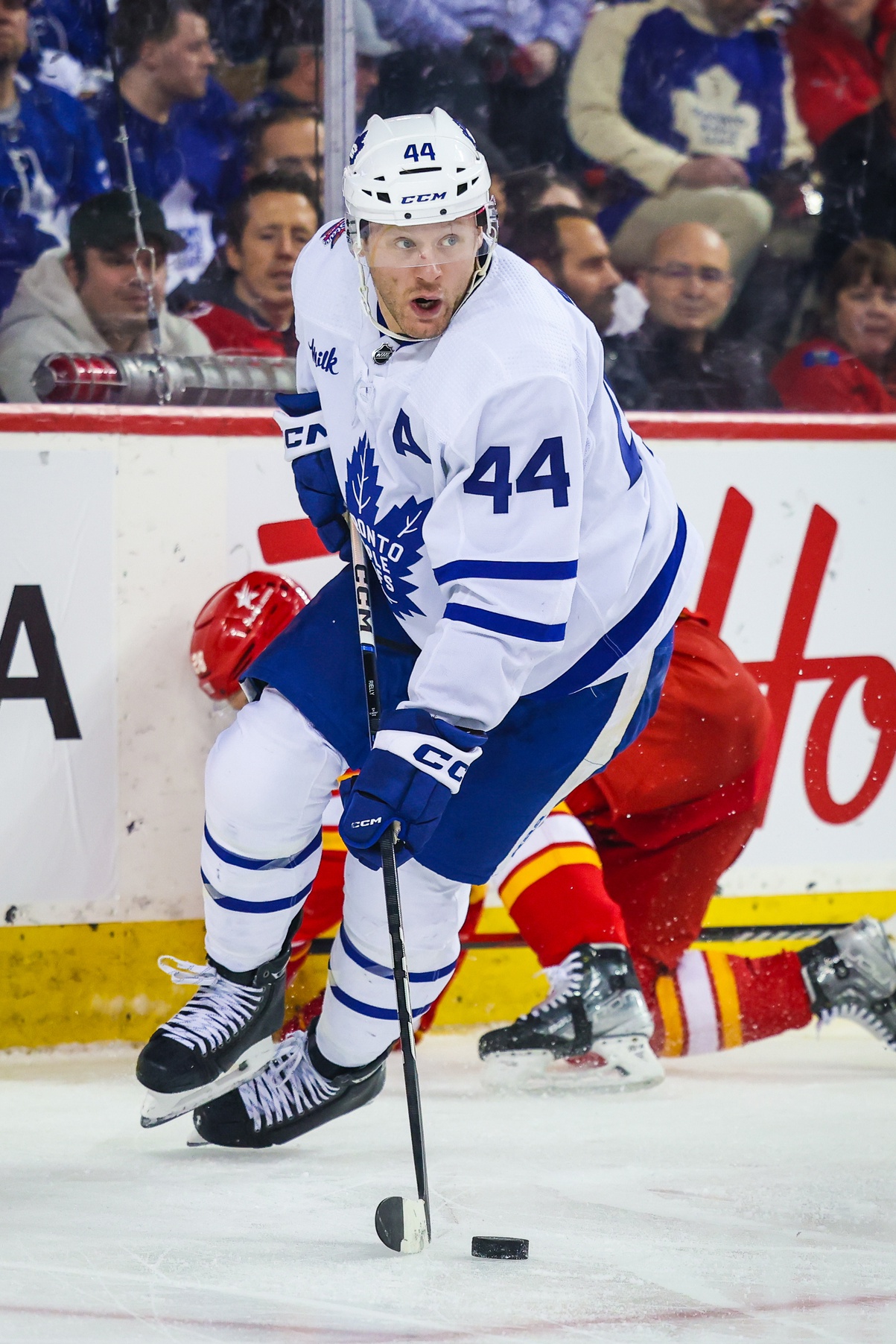
You could argue that Rielly’s defensive struggles are mainly due to being on a poor defensive team, but the truth is that he wasn’t strong defensively even when the Maple Leafs had a solid possession numbers. Still, is it worth buying him out? Probably not. Rielly currently earns $7.5MM a year and has four years left on his contract. Despite the cost, he might be worth keeping or trading.
A Rielly buyout would have Toronto paying him $3.5MM per season for the next four years, followed by $2MM annually for the subsequent four years. Sure, the cost savings over the next four years would be $4MM annually, but then the team needs to find a top four defender to replace Rielly, and the Maple Leafs likely won’t find one for less than the savings amount. A trade would be the best option for Toronto, but Rielly still has the leverage for the next two years with a full no-movement clause, which could complicate any potential trade.
Sliding east of Toronto, the Canadiens have a potential buyout candidate in veteran forward Brendan Gallagher. Including the 33-year-old on this list will upset some, but his decline since 2021 has been well-documented.
Prior to 2021, Gallagher was one of the most consistently effective 5-on-5 scorers in the NHL. However, Father Time is undefeated, and Gallagher is no longer a top-nine forward, even though he still earns like one. With just six goals and 16 assists in 76 games this season, he has been a healthy scratch for Montreal this week, which could be a sign of what’s to come. Montreal boasts a strong group of forwards, with more young prospects on the way, and it could become a numbers game that Gallagher loses.
The other side of the argument with Gallagher is that he has only one year left on his contract, with a cap hit of $6.5MM, but he is owed just $4MM in actual salary. It’s possible he could be traded to a team trying to reach the salary cap floor or swapped for another problematic contract. If Montreal considers a buyout, it would save them $2.67MM next season but add a $1.33MM cap charge in 2027-28.
Since Montreal has most of its core signed and over $12MM in cap space available this summer, it has no immediate need to part ways with Gallagher unless it plans a major move. There’s also a potential morale issue if the Canadiens decide to release a popular veteran who has given everything to the organization, the fans, and the city.
Staying in Canada shifted the focus westward. Oilers forward Trent Frederic and his contract sent shockwaves through the NHL just 12 months ago when it was signed. Many pundits were left scratching their heads when the Oilers inked Frederic to an eight-year, $30.8MM contract extension just days before free agency opened.
The $3.85MM cap hit was a bit high for many people’s tastes, but not outrageous, given that Frederic was a pending UFA. However, the length of the deal seemed excessive for a role player, especially one who wasn’t very effective last season.
This year, Frederic has four goals and three assists in 70 games. That’s poor offensive production for anyone, let alone a player earning nearly $4MM annually. Some of this can be attributed to an unusually low shooting percentage of 5.7%, about half of his typical success rate. If he regresses to the mean next season, he should score more goals, but it’s not just his offensive numbers this season that are concerning.
Aside from one season when he tallied 40 points, Frederic has never been a significant offensive contributor or a player who drives or controls the pace of play, making the eight-year contract a particularly poor decision.
There is just a lot wrong with Frederic’s game, and in an era where making mistakes on mid-tier contracts can be disastrous due to the parity in the NHL, this one is particularly bad. That said, Edmonton would have to absorb a 14-year cap hit if it bought out the 28-year-old, which means he’s probably staying beyond this season.
Finally, we come to the most obvious candidate: Jesperi Kotkaniemi, who is somehow still just 25 years old. When the Hurricanes sent an offer sheet to Kotkaniemi back in August 2021, they were betting on his potential to become a top-six center.
After all, Kotkaniemi was a third overall pick in 2018 and had the skill set to elevate his game and move up the lineup. However, the offer sheet was very ill-advised, with the idea reportedly coming from Hurricanes owner Tom Dundon in response to the Montreal Canadiens’ offer sheeting Sebastian Aho two years prior.
Kotkaniemi never really developed an offensive side to his game, and at this stage of his career, he is what he is – a reasonably good defensive center (although his numbers there have dipped this season as well) who doesn’t score much. This year, Kotkaniemi has two goals and seven assists in 38 games. Although he put up 43 points a few years ago, it doesn’t seem likely that he’ll become a consistent 40-point player. At $4.82MM a year for four more seasons, the Hurricanes have an opportunity to save some serious cash by buying him out.
Due to his age, Carolina could buy out Kotkaniemi this summer for just 33% of the remaining money on his deal, which is about $6.8MM. That would save Carolina almost $4MM next season, and $4.35MM in each of the three years after that.
Now, the Hurricanes are usually not a cap team, but they have only $14MM available this summer (as per PuckPedia) and four players to sign. If they want to add to the lineup and improve their chances in the quest for the Stanley Cup, this could be a way to create some much-needed breathing room under the salary cap.
Photo by Sergei Belski-USA TODAY Sports
How Much Longer Will Sidney Crosby Play?
Sidney Crosby extended his NHL record for most seasons averaging at least a point per game to 21 years, which, if you’re keeping score at home, means every season he’s played in the league. Crosby’s achievement is one that probably won’t be matched for a long time, if ever, and it raises a few questions.
How much longer will Crosby continue to play? How much longer can he maintain an elite level of performance?
To be honest, the first question likely has the same answer as the second. Given Crosby’s pride, he’s probably not going to keep playing if his game declines and he turns into a nostalgia act.
There is a lot to consider when projecting Crosby’s future. He is clearly in top physical condition and takes pride in being a gym rat. That said, Crosby’s physical skills have not yet declined, and that could remain the case for at least a few more seasons. Crosby doesn’t rely on speed or a skill-based game, though he still retains significant ability in both areas.
Nonetheless, his hockey IQ, puck skills in tight spaces, legendary lower-body strength, puck protection, and edge work are his bread and butter. His fierce backhand, which hasn’t lost any velocity, is another key asset. In fact, none of those skills has diminished, and they might not for a while.
The best comparison in most of these categories is probably another former Penguins player, Jaromír Jágr. Jágr was arguably the best puck protector in NHL history, and very few have ever viewed the game the way he did.
Now, that’s not to say Crosby will play into his 50s. But Jágr played in the NHL until he was 45, and he was still rather effective right up to the end. It wasn’t until his last few games with the Flames during the 2017-18 season that Jágr’s scoring really slowed down, as he scored just a goal and six assists in 22 games and finished his career halfway through that season. It was a bit of an anti-climactic ending to one of the greatest NHL careers ever, but Jágr still managed to go out on his own terms for the most part.
Therein lies a difference between Crosby and Jágr, and it rests solely on the perception of Crosby as a prideful man who cares deeply about winning and being elite. Jagr was willing to accept the fact that if he continued playing, he would no longer be an elite NHL player. He was still incredibly effective, but his skills had diminished. It’s hard to imagine a scenario in which Crosby does the same thing, especially given that his mentor, Mario Lemieux, walked away at 40 when he felt his game slip and the physical toll of playing became too much, plus an atrial fibrillation diagnosis.
That physical toll is another significant consideration for Crosby, given that his 21-year career has taken a physical and sometimes mental toll on the 38-year-old. Obviously, the recent knee injury at the Olympics is at the forefront of Crosby’s mind, but it is far from the only physical ailment he has faced. Crosby has experienced other lower-body injuries, facial injuries, and a documented long history of concussions. The concussions are particularly unpredictable, and it’s difficult to know what might happen if Crosby were to suffer another one this late in his career. This factor greatly influences his longevity in the game.
Perhaps the biggest factor is that the Penguins are actually good again, playing a high-flying, exciting brand of hockey that Crosby loves. Josh Yohe of The Athletic has previously written that he doesn’t believe Crosby will retire after his current contract, which expires next summer. That would mean Crosby could conceivably sign a deal that takes him through his age-40 season at a minimum. Crosby loves to win and has previously stated that it’s what drives him; if Pittsburgh is in a position to go on a run, he would want to be part of it.
Finally, the race is on for Crosby to become only the second player ever to reach 2,000 career points and to move into second place on the all-time scoring list. That position is currently held by Jágr, who is 162 points ahead of Crosby, who is now seventh overall in NHL scoring. With 1,759 points, Crosby needs 241 more to hit the 2,000 mark. It’s not impossible, but it will require some elite-level production from him well into his early 40s.
Crosby has averaged 1.09 points per game this season, down from his previous years’ production, which hovered around 1.13-1.14. If Crosby can maintain that rate and play 70 games a season over the next two years, he would reach approximately 153 points, putting him close to Jagr and less than 100 points shy of 2,000.
Of course, all of this remains speculation, and injuries can disrupt the projections, just as skill regression and age are inevitabilities. However, it’s not unreasonable to envision a scenario where Crosby plays three or four more seasons, which, if he stays healthy, is likely to see him reach 2,000 points. It could also coincide with a period when the Penguins are firmly in a win-now phase with their new core of young players, some of whom Crosby is already playing alongside and winning with.
These Pending UFAs Mishandled Their Prior Trips Through Free Agency
In the NHL, some players welcome the chance to bet on themselves when it comes to unrestricted free agency. But not every player likes taking that risk, because there is always the possibility that the bet doesn’t pay off or that the player and their representatives misjudge the market and miss out on a payday. Sometimes, these players land big contracts later in their careers, and that is the hope for the three players in this article, who are approaching free agency again this summer and have another chance to learn from their previous attempts and finally cash in.
The first player on this list and one of the most recent is Chicago Blackhawks defenceman Matt Grzelcyk, who had to settle for a PTO this past offseason after his market never materialized despite coming off a career year. Grzelcyk posted a goal and 39 assists last season, playing all 82 games with the Pittsburgh Penguins, and was projected by AFP Analytics to receive a three-year deal worth $3.77MM annually. However, he ended up with a PTO and eventually signed a one-year, $1MM deal.
It was clearly a massive disappointment for the 32-year-old, and it’s hard to say exactly what transpired in his negotiations. His market did not develop as expected, and his contract fell well below the projected market value. Nonetheless, it should have been evident to Grzelcyk’s representatives that his market probably wouldn’t be very strong after the Penguins were unable to trade him at last year’s trade deadline. Grzelcyk remained in Pittsburgh after the deadline despite the team being well out of the playoff picture at that point, which suggested that teams weren’t exactly eager to add him. In any case, Grzelcyk is a free agent once again this summer after a disappointing campaign with the Blackhawks, and it’s fair to wonder if he will get a multi-year deal this offseason. AFP Analytics has him pegged for a two-year deal worth $2.8MM per season, but that may be a touch optimistic given his struggles this year.
Another player who struggled to secure a contract last summer was forward Jack Roslovic. The then 28-year-old was coming off a solid year with Carolina, where he scored 22 goals and 17 assists in 81 games. While his scoring stats looked decent, Roslovic was not exactly a seamless fit with the Hurricanes and benefited from a 15.8% shooting rate, about 3% higher than his career average. For the second consecutive summer, it seemed Roslovic misjudged the free agent market but didn’t land as softly in 2024 as he did in Carolina. In summer 2024, Roslovic signed with the Hurricanes on July 4 for $2.8MM on a one-year deal, serving as a cautionary tale for players hitting the market in 2025. Roslovic was one of those players, and unfortunately for him, his luck was much worse this time, as he had to settle for another one-year deal with the Edmonton Oilers, this time for $1.5MM.
Roslovic was projected last summer to sign a three-year deal worth $4.094MM, making his contract just over 10% of his projected earnings. He eventually changed agents and signed a one-year contract, setting himself up to hit free agency again. This summer, AFP Analytics predicts he could land a four-year deal worth $4.434MM per season, and it seems more likely this will happen given his new agent and the rising salary cap, while the free-agent class remains very thin.
Now we come to John Klingberg of the San Jose Sharks, who just a few years ago was a top-pairing defenseman with the Dallas Stars and helped lead them to the Stanley Cup Finals in 2020. Back in 2021, much of the conversation around Klingberg centered on his impending free agency, and he and the Dallas Stars were engaged in contract talks to keep him in Dallas long term. At the time, Klingberg reportedly wanted over $60MM on an eight-year contract, which would have him around an $8MM AAV, and while some sources said he turned down $7MM a season, he never came close to reaching those numbers on his eventual contracts and never even sniffed that kind of long-term security.
Klingberg finally reached free agency in 2022 and had to settle for a one-year $7MM contract with the Anaheim Ducks, then followed it up with a one-year $4.15MM deal with Toronto. Last season, he played part of the year under a one-year $1.35MM contract with the Edmonton Oilers before signing a one-year $4MM deal this season in San Jose. Regardless of what the contract discussions were like with Dallas, Klingberg left tens of millions of dollars on the table and could have avoided the stress of moving teams five times. Additionally, he went from a low-tax state like Texas to high-tax states and provinces such as California and Ontario.
The NHL is full of cautionary tales regarding free agency. For example, defenseman Cody Franson is a case from a decade ago, and Thomas Vanek is another. More recent examples include Anthony Duclair and Evan Rodrigues, who eventually secured their contracts after a few seasons of uncertainty. This summer, players like Grzelcyk, Roslovic, and Klingberg hope to cash in and recover some of the money they left on the table. The salary cap is expected to rise, which should benefit them, but none of these players have performed at their best this season, so they may face another challenging period in free agency.
Brad Treliving Was Never A Good Fit With The Maple Leafs
Last week, news broke that the Maple Leafs had relieved general manager Brad Treliving of his duties, ending an underwhelming tenure with the team that never made sense from the day he was hired in late May 2023. Treliving had previously been with the Flames for nine seasons before he and the team mutually agreed to part ways just weeks before the Maple Leafs hired him.
At the time of his departure from Calgary, PHR’s Josh Erickson noted that Treliving was well respected in NHL front offices, and it was likely he would find a new role quickly, which proved to be a spot-on prediction. However, that likely won’t be the case this time, at least not for an NHL general manager role, as Treliving may need to step away from the game or rebuild his reputation before another team offers him a prominent position.
Treliving’s career in NHL management is similar to that of former Pittsburgh Penguins general manager Ron Hextall, who was let go by the team around the time Treliving left Calgary. Hextall has not held an NHL role since then, and it’s possible Treliving might also need to take some time away from the game or be forced to do so if he can’t find work as an NHL executive.
Some folks might find it unfair to compare Treliving to Hextall, but their two recent runs as GMs show many similarities, as does their history in previous organizations. And as unflattering as it may be, both Hextall and Treliving inherited teams capable of winning the Stanley Cup, with star players at the top, and both oversaw the dismantling of their contention windows.
Folks in Philadelphia would argue that Hextall did the same thing when he was with the Flyers, just as fans of the Flames might feel the same about Treliving’s tenure there. Hextall and Treliving both operated without much semblance of a plan, so many of their moves appeared to be reactions to a changing market, attempts to undo a previous mistake, or attempts to pick up what they could when they realized they had a glaring hole in their roster.
But were Treliving’s moves in Toronto really that bad? The short answer is yes, and the long answer is much more complicated.
It wasn’t all bad for Treliving in Toronto, as the team did win a division title and pushed the eventual Stanley Cup champion Florida Panthers to seven games in the second round last year. However, mistakes made early in Treliving’s tenure eventually compounded, leading to a year where almost nothing went right for him and the Maple Leafs.
In his first summer on the job in 2023, Treliving signed David Kämpf to a regrettable four-year contract worth $9.6MM before free agency. He then entered free agency and made a couple of solid short-term signings in Max Domi and Tyler Bertuzzi.
However, those deals were surrounded by a series of poor bets as Treliving signed Ryan Reaves to a multi-year deal, and agreed to one-year contracts with John Klingberg, Ilya Samsonov, and Martin Jones. Except for the Reaves deal, none of the other moves were particularly bad on their own, but they left the Maple Leafs in a similar spot come playoff time, as they bowed out in the first round to the Bruins. During that season, Treliving also extended Auston Matthews and William Nylander, essentially doubling down on a core four template that had yet to produce a deep playoff run.
Most of Treliving’s early mistakes during his tenure involved trades, where he often traded away depth players for very little and then spent a lot to acquire slightly better players. A clear example is a series of transactions late in the 2024-25 season, when he traded Connor Dewar and Conor Timmins to the Pittsburgh Penguins for a fifth-round pick, and then acquired Scott Laughton, along with a fourth- and sixth-round draft pick, for a conditional 2027 first-rounder and prospect Nikita Grebenkin.
Now, Timmins might not be an NHL defenseman at this point, but it’s hard to argue that Laughton is much of an upgrade on Dewar, especially after the season both players have had. In fact, it’s fair to say that Dewar would be an upgrade on Laughton at this stage of their careers, and he is five years younger than the 31-year-old Laughton. Essentially, those two trades marked a significant loss of talent for Toronto in just a few hours. It made their existing NHL roster worse and removed a key draft asset from their future. These two trades highlight a major issue for Treliving: he lost nearly every trade he made in Toronto, and this was nothing new.
The list of poor trades could fill an entire article on its own, with the most glaring example being the Brandon Carlo trade, which could haunt the Maple Leafs for years depending on how the first-round pick turns out.
But again, many of the moves weren’t necessarily bad; quite a few were unnecessary and revealed that Treliving didn’t have a clear sense of where his team was or what they needed to improve. A good example is the March 2024 trade when Treliving acquired Joel Edmundson from the Washington Capitals in exchange for a 2024 third-round pick and a 2025 fifth-round pick.
This move wasn’t terrible, but Edmundson was only a depth player at that point, and Treliving traded for him when the team desperately needed a top-four defenseman. It felt like a half measure, more like the Maple Leafs’ GM doing something just to say he did it. Critics will note that giving up two mid-round picks isn’t a big deal, but making three such trades a season quickly depletes your draft pool — which is exactly what has happened to Toronto. The prospect pipeline is now empty, and if the Maple Leafs are to have any hope for the future, the next GM will have to make the most of the few draft picks they do have.
Overall, Treliving’s tenure will be remembered as a period when he and the team never quite aligned, leading to a lot of movement but little results. The reality is that Maple Leafs fans and media may claim that Treliving didn’t do enough to push Toronto over the hump and to the next level in the playoffs, but the truth is that Treliving didn’t do enough right, and in fact, he barely got anything right for the Maple Leafs. That’s why they need to conduct another hockey management search at a time when their competitive window is closing quickly.
Assessing The Best Free Agent Signings From Summer 2025
As we move into the final month of the season, it has become quite clear which moves from last summer paid off and which ones did not. While long-term effects of summer trades and signings are always part of the picture, it’s interesting to look back and assess the best free-agent signings to see which teams got value for their money and which did not.
Players don’t always succeed immediately with their new teams; sometimes there’s a settling-in period. However, many moves made last summer in free agency have significantly impacted playoff races this year.
For this exercise, we will focus specifically on players who were unrestricted free agents and moved to new teams. This excludes players like Brad Marchand or John Tavares, who re-signed with their respective teams before July 1.
The first player that comes to mind is the Penguins’ top goal scorer, Anthony Mantha, who signed a one-year, $2.5MM contract (plus $2MM in performance bonuses) with the Penguins after missing most of last season with the Flames due to an ACL tear. Many believed that Mantha would have a chance to improve his free-agent stock in Pittsburgh by playing top-six minutes before cashing in during the summer of 2026.
Last summer, the Penguins seemed like a team that would be selling at the trade deadline, so it made sense that they would give Mantha a one-year deal and then trade him for future assets in February or March. However, that outlook couldn’t have been further from the truth, as Mantha has become a key part of a Pittsburgh team that has surprised the NHL this season and remains competitive in the Eastern Conference. With 30 goals and 28 assists in 75 games, Mantha has provided considerable surplus value to the Penguins and is likely to secure a major contract this summer, particularly among one of the thinnest free-agent fields in the salary cap era.
Last year, much of the talk during free agency was that the goaltending market was incredibly thin, and on paper, it certainly looked that way. But that didn’t stop the Buffalo Sabres from exploring the free agency waters, signing Alex Lyon to a two-year, $3MM contract that has proven to be an absolute steal.
Lyon has split duties with his goalie partner, Ukko-Pekka Luukkonen and has appeared in 35 games this season, posting a record of 20-9-4 with a 2.69 GAA and a .909 SV%. While those stats are solid, the standout figure in Lyon’s line is his goals saved above expected, which currently sits at 14.8 (according to MoneyPuck). Lyon won’t be winning any awards this year, but considering how much money teams are spending on ineffective goaltending, Lyon has been a real boon for Buffalo.
Sticking with the goalies, another underrated signing that has paid off is Daniel Vladař of the Philadelphia Flyers. The 28-year-old was mainly a backup before this season but has become the Flyers’ starting goaltender, dressing in 45 games while posting a 24-13-7 record, a 2.50 GAA, and a .904 SV%.
Vladař has been excellent value on a two-year deal with a $3.35MM AAV. Not only is Vladař’s save percentage above average, but his goals saved above expected is up to 9.6, suggesting that his underlying numbers indicate a goaltender who has stolen some games for Philadelphia.
A signing that didn’t happen until the fall was forward Jack Roslovic, who again had to accept an under-market one-year deal. Roslovic signed a one-year, $1.5MM contract with the Oilers on Oct. 8 after his second straight unsuccessful free agency run, where he failed to secure a multi-year deal that suited him.
In Edmonton, the 29-year-old has already achieved his second straight 20-goal season and has been a reliable playmaker for the Oilers. Given his consistent production over the past two seasons, it’s unlikely he’s willing to settle for another one-year deal, especially in a tight free agent market.
Moving to the backend, veteran Brent Burns was a free agent for the first time in his career at age 40. Burns signed a one-year deal with the Avalanche that included a potential $4MM in bonuses, of which he will likely earn $3MM this season.
Burns is no longer an elite offensive defenseman, but he has still scored 10 goals and 19 assists in 73 games this year while playing in every game and averaging almost 19 minutes per game. Burns has benefited from playing on a top team and from a high PDO, but for a veteran right-shot defenseman or a bargain one-year deal, he’s worked out as well as the Avs could have hoped for.
Finally, we return to the Penguins and the skillful work of general manager Kyle Dubas accomplished in the early days of free agency last year. Not only did Dubas sign 30-goal scorer Mantha, but he also secured Justin Brazeau with a two-year deal worth just $3MM, as well as defenseman Parker Wotherspoon on a two-year, $2MM deal. The contracts gave Dubas a top-nine forward in Brazeau and a top-pairing defenseman to play alongside Erik Karlsson, all at a total cost of $2.5MM per season for this year and the next.
Dubas and Penguins Director of Player Personnel Wes Clark did excellent work last summer, finding players with lots of potential who hadn’t been given the chance to succeed. By betting on low-risk, high-upside free agents, Dubas effectively accelerated the Penguins’ retooling plans, which seemed unlikely just a year ago, when the team had missed the playoffs for a third consecutive year.
Earlier this season, there was talk that Penguins captain Sidney Crosby should request a trade because he might not make the playoffs again. However, thanks to Dubas’s bargain shopping, the Penguins now seem to be on track for the playoffs and have plenty of cap space this summer to strengthen their already impressive lineup.
Breaking Down The Future Of The Penguins’ Goaltending
Penguins general manager Kyle Dubas faced a major challenge last year, juggling two inconsistent yet talented goaltenders on his roster while desperately needing stability. He knew he had a promising prospect in Sergey Murashov, but the young player needed time in the minors to develop, which meant Dubas had to rely on temporary solutions.
Those stopgaps have become Stuart Skinner and Arturs Silovs, who have formed a tandem that isn’t spectacular but has been enough to keep the Penguins in the playoff hunt despite some bumps in the road. As both contribute fairly evenly, with a rookie netminder waiting in the wings, this has created an interesting dynamic in the Penguins’ crease, potentially leading to some roster moves this summer.
One year ago, the Penguins had Tristan Jarry and Alex Nedeljkovic as their goaltenders, earning a combined $7.875MM per season. Jarry, in particular, was earning $5.375MM and had three years remaining on his contract.
Dubas started the summer by trading Nedeljkovic to the Sharks for a third-round pick on July 1. Many questioned whether Pittsburgh believed that another goalie prospect, Joel Blomqvist, was ready to be an NHL backup, but Dubas quickly dismissed this idea by acquiring Silovs from the Canucks for a fourth-round pick and a prospect. Since Silovs had to clear waivers in Vancouver, they would have to let him go for free, effectively making it a discount. The trade meant Pittsburgh would begin the season with Jarry as the starter and Silovs as the backup.
Jarry actually started the season quite well for Pittsburgh, posting a 9-3-1 record with a .909 SV% and a 2.66 GAA. This beginning had Penguins fans calling for Dubas to act and trade Jarry to another team, even though his play was decent.
Dubas did just that, trading Jarry and his overpriced contract to the Oilers in exchange for Stuart Skinner, Brett Kulak, and a second-round pick. The move was a surprising development since Pittsburgh retained none of Jarry’s contract, and it involved moving a player who had been on waivers the previous year.
It marked a turning point for Pittsburgh, as they effectively moved on from the volatility of Jarry and Nedeljkovic in favor of what amounts to average goaltending. Now, the Penguins face some decisions heading into the summer, as Skinner is a UFA on July 1 and Silovs is an RFA. It’s almost certain that Pittsburgh will retain Silovs and keep him in the fold, but Skinner is far less of a certainty.
AFP Analytics is projecting a two-year deal for the 27-year-old Skinner worth $3.86MM per season, but given the thin free-agent market and the lack of potential starters, that projection and term seem quite light. At $3.86MM, Pittsburgh would likely be in line to retain him and let Murashov develop in the AHL, but it’s unlikely Skinner would accept that deal now, considering he has plenty of leverage.
That’s where it gets interesting for the Penguins: if they let Skinner walk, they have his potential replacement waiting in the wings. But do they need to wait for Murashov, or is he the guy next year?
If the Penguins decide to make Murashov a full-time NHL player next season, do they trust that Silovs can step up and handle most of the starts? The 25-year-old Silovs has a projected AAV of $2.033MM on a one-year deal, which makes sense since he has shown he can play in the NHL this season, but he hasn’t proven he can be a consistent starter.
Silovs is 16-10-8 this year with an .890 SV% and a 2.98 GAA. Those stats don’t exactly scream consistency, but they are a noticeable improvement over his numbers with Vancouver when he was with the Canucks, and given his age, he can still improve.
Still, can the Penguins rely on him to be a full-time NHL backup behind an inexperienced rookie next season? It’s hard to say for certain, but Silovs’ underlying numbers don’t exactly indicate he’s a sure thing as a starter, and there’s no guarantee Murashov can play 50 games next season — in fact, there’s a good chance he won’t.
So, should Pittsburgh keep Skinner and Silovs and retain Murashov in the AHL? In an ideal world, yes, they’d hold onto both netminders for the next year or two, with Murashov excelling in the AHL, and then the Penguins would promote Murashov full-time.
However, Skinner will likely seek every year and dollar he can get, considering his career has been quite unstable so far, and it might be his best shot at becoming a very wealthy man. This means Pittsburgh has to decide if it’s Murashov or someone else.
It’s not ideal for the Penguins, as they probably don’t have a clear sense if Murashov’s ready to be the guy yet, and they aren’t likely to commit to anyone in free agency, nor could they even if they wanted to give the poor free agent market for goaltenders, so it really comes down to Murashov or Skinner being the guy next season with Silovs as their backup.
The most likely scenario is that Pittsburgh will offer Skinner a short-term deal to bridge the gap until Murashov becomes a full-time NHL player, while allowing both players to share duties in the NHL if Murashov is set to play full-time. Contractually, this would likely be a short-term deal in the $4MM–$5MM a year range.
Would this be enough to persuade Skinner to forgo free agency? Not likely, but if Skinner enters the market and doesn’t receive the salary he’s hoping for, he and the Penguins could revisit negotiations. However, he might also receive a lucrative offer from another NHL team, leading him to leave Pittsburgh, which could put Dubas in a tough spot.