
What Your Team Is Thankful For: Toronto Maple Leafs
As the holiday season approaches, PHR will look at what teams are thankful for as the season nears the quarter point of completion. There also might be a few things your team would like down the road. We take a look at what’s gone well in the first month and what could improve as the season rolls on. So far we’ve covered ANA, ARZ, BUF, CGY, CAR, CBJ, COL, DET, LAK, NYI, STL, WSH, and VGK.
What are the Toronto Maple Leafs most thankful for?
A diverse front office.
When Brendan Shanahan took over as President of the Maple Leafs in 2014, the team was reeling from a late-season collapse that took them out of the playoffs and showed what the club was really made of. Shanahan was a new voice, running a team for the first time since his Hall of Fame playing career ended and within the next few years he would surround himself with a diverse group.
Lou Lamoriello, a legendary GM who had been with the New Jersey Devils for nearly 30 years was brought in to orchestrate the team’s tear down and subsequent rebuild, scouting guru Mark Hunter and whiz-kid Kyle Dubas were added to give the group a few different voices, and Mike Babcock was brought in as coach. Though his role is technically not in the front office, Babcock has a big impact on personnel, including recruiting trips to Russia to bring in extra talent.
The Maple Leafs blew up the team, trading away key players like Phil Kessel and Dion Phaneuf for underwhelming returns and added several top prospects over the last few seasons. Now everything is coming together for Shanahan and company, and some tough decisions will have to be made on how to navigate their upcoming salary obstacles. With the versatility that’s been shown so far from this group, Maple Leafs fans should feel secure in their team’s future.
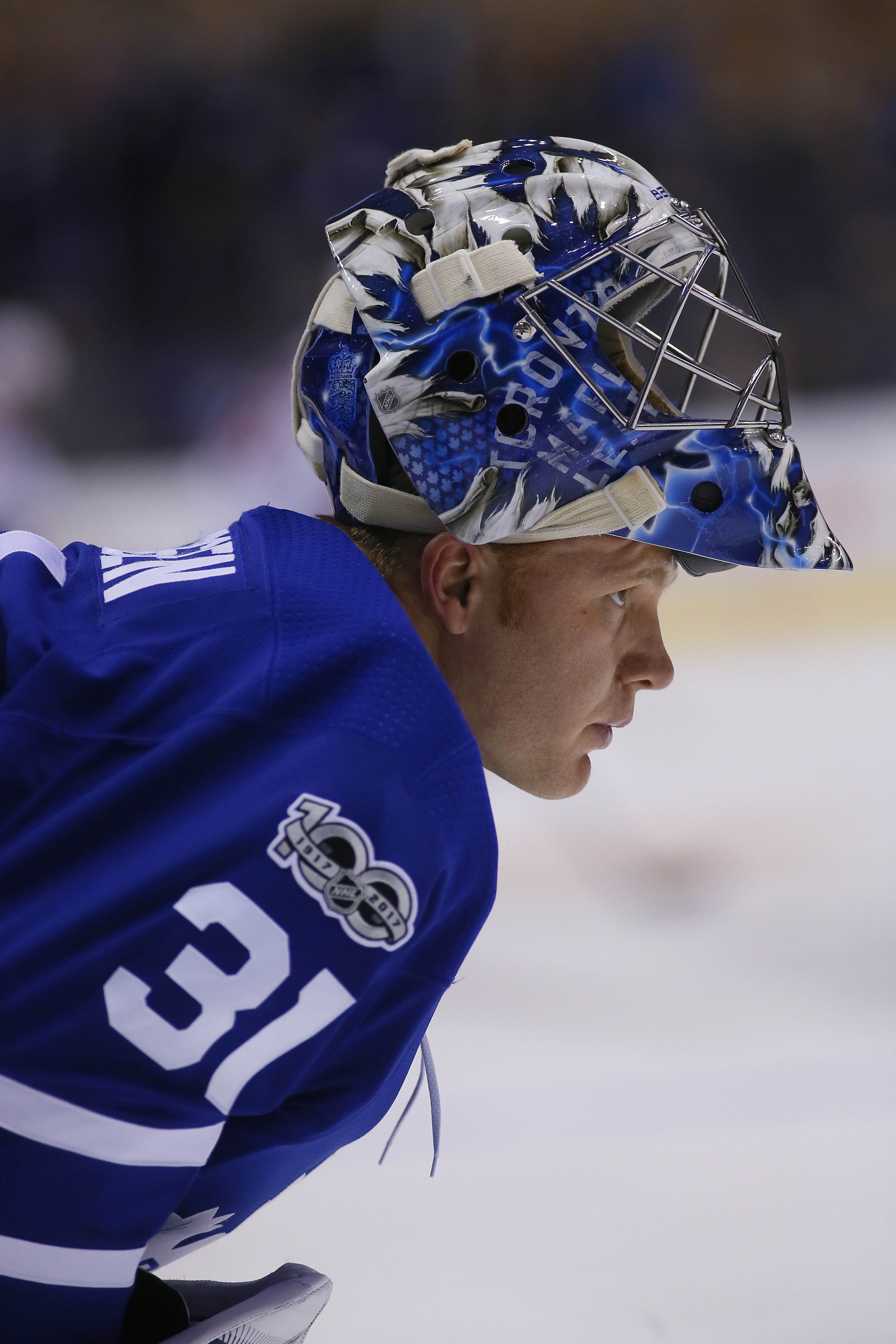 Who are the Maple Leafs most thankful for?
Yes, things changed in Toronto right around the time Auston Matthews got to town. Last season was built on nightly incredible performances by the rookie, helping the team jump from dead last in the league to a playoff spot overnight. But it was also the first season for Andersen, who immediately (or, at least after a shaky October) gave stability to the Maple Leafs’ crease and helped the team become a contender.
This season after another inconsistent first month, Andersen has shown even more improvement and remains arguably the most important part of the Maple Leafs. Carrying a .958 save percentage over his last eight games, Andersen is looking the part of an All-Star level goaltender and one that could legitimately take the young Maple Leafs team deep into the playoffs. Leading the league in minutes, shots faced and saves, it’s not clear where the team would be without their top netminder.
What would the Maple Leafs be even more thankful for?
Consistency from two of their “Big Three”
While Matthews has still led the team in points even as he works through a mysterious upper-body injury, both Mitch Marner and William Nylander have had their share of troubles. Both have been relegated to the fourth line at times, and though their point totals would be more than acceptable for any other sophomores these two have already shown higher highs.
Both scored 61 points last season and were expected to improve on those totals in their second full-seasons. They’ve combined for just four even-strength goals, but it’s not all bad. Babcock told the media after last night’s 4-1 win in Calgary that he though it was Marner’s best of the season, and the pair is shooting a combined 5.6%. That number is sure to improve over the year, making the Maple Leafs even more dangerous down the stretch.
What should be on the Maple Leafs Holiday Wish List?
Another full-time defenseman.
Andreas Borgman has been a revelation for the Maple Leafs this season, coming over from the SHL to jump right onto their third pairing. The 21-year old Swede doesn’t log a ton of ice time for the team, as he’s not on either special teams group, but has still shown an ability to play on a nightly basis.
The other side of that third pairing though hasn’t been as stable. Babcock has shuffled through Connor Carrick, Roman Polak and Calle Rosen at different points this year, and the team could benefit from that revolving door becoming a little more stationary in the second half. Pittsburgh’s Ian Cole has been linked to them recently, though a right-handed option would likely be more beneficial.
Interestingly, the Maple Leafs do have quite a bit of trade capital as they head towards the deadline. James van Riemsdyk, Leo Komarov and Tyler Bozak are all pending unrestricted free agents, while the team carries an extra second-round pick from a previous trade with the San Jose Sharks. It seems unlikely that they’ll try to make a huge splash on the defensive market, but an addition that could be trusted on the penalty kill and play a full-time role of 15-18 minutes a night would help take some pressure off the rest of the group.
Photo courtesy of USA Today Sports Images
East Notes: Jarry, Rodrigues, Matthews, Milano
The Penguins currently find themselves in a situation where top prospect Tristan Jarry is backing up in the NHL instead of playing a starting role in the minors. Generally, teams would rather see a young and waiver-exempt netminder play as many games as possible in the AHL over making 15-20 appearances in the NHL. Accordingly, it has been expected that GM Jim Rutherford would be on the lookout for more of a veteran backup that could push Jarry back to the minors.
However, Jason Mackey of the Pittsburgh Post-Gazette suggests that while Rutherford is keeping tabs on what’s out there, he’s not actively pursuing another goalie at the moment. Jarry is off to a decent start with the Penguins this season so it’s not as if his performance is dictating that they need to make a move just yet. As the weeks progress though, that could change if he’s only starting once every four or five games.
Elsewhere in the East:
- The Sabres have assigned center Evan Rodrigues to Rochester of the AHL, per the AHL’s Transactions page. This means that he has been activated off season-opening injury reserve. He suffered a hand injury early in the preseason against Toronto. Although he has been sent down, there’s a decent change Rodrigues will factor into Buffalo’s plans before too long as he played in 30 games with them last season, averaging just shy of 13 minutes per game.
- Maple Leafs center Auston Matthews will be a game-time decision for Saturday’s game in Montreal, notes Mark Zwolinski of the Toronto Star. Matthews has missed the last four games with a lower-body injury although he did participate in his second practice of the week earlier today. Even if he is cleared to return, the 20-year-old acknowledged that his conditioning may not be back where it was right away before he suffered the injury.
- Although the Blue Jackets are struggling offensively at the moment, it doesn’t appear like winger Sonny Milano is in line for more playing time just yet. Head coach John Tortorella told Steve Gorten of the Columbus Dispatch that Milano needs to play better in his own end before he can be trusted with more playing time even though he sits tied for second on the team in goals with five.
Morning Notes: Houston, Fedun, Matthews
The new owner of the Houston Rockets met with NHL Commissioner Gary Bettman recently, according to a report from Katie Strang of The Athletic. Tilman Fertitta, who purchased the Rockets this summer for $2.2 billion, had previously suggested he’d be interested in bringing the NHL to Houston. One meeting doesn’t prove that anything is set to happen, but it does have to throw Houston into the ring for potential expansion or relocation in the future. Bettman did admit to The Athletic that they would have to consider Houston if there was interest “under the right circumstances.”
There are several teams around the league with uncertain futures, most notably in Calgary, Arizona and New York (Islanders), and now two US locations that seem like legitimate new possibilities. Seattle, with its new arena proposal headed by Oak View Group, and now Houston with interest from an owner who is more than financially capable. While many Canadian hockey fans wish that Quebec City was first on the list, they may remain in the NHL’s back pocket even longer if viable locations are popping up in the United States. There is no clear path for expansion right now, nor is the league actively looking for relocation at the moment.
- Buffalo’s season is getting even worse with the announcement that Taylor Fedun and Matt Tennyson have been put on injured reserve today. An already thin blueline gets even thinner, and head coach Phil Housley announced that Fedun would be out six to eight weeks with a lower-body injury. In the meantime the team has recalled Casey Nelson because Zach Redmond is also nursing an injury in the minor leagues. The Sabres need defensive help even when all of their starters are healthy, and risk falling out of the playoff race altogether if they don’t find an answer on the back end.
- Auston Matthews is out once again for the Toronto Maple Leafs tonight, despite practicing for much of the week. The 20-year old superstar hasn’t played in ten days, though the team is 3-0 in his absence. Nikita Soshnikov will enter the lineup in his absence, though it likely means Patrick Marleau will regain his position at center ice. Marleau has been a winger for the last several years, but was forced into the center role in Toronto due to their lack of depth behind Matthews. Beyond the NHL, the Maple Leafs don’t have a ton of other options down the middle, a concern that could lead to some interesting decisions this summer. Tyler Bozak is a pending unrestricted free agent, but could be too expensive to bring back on anything other than a short-term deal. The team may have to look elsewhere to fill the third-line center role next year.
Snapshots: MacArthur, Predators, Matthews, Zajac
Clarke MacArthur failed his physical before the season, and according to GM Pierre Dorion on TSN radio he likely won’t be playing at all this year. MacArthur is not with the team and has moved to Florida, which could signal the disappointing end to a solid career.
MacArthur came back for the Senators just before the playoffs last year, and was an integral part of their run to game seven of the Eastern Conference Finals. His career was derailed by head injuries, but he was once a consistent offensive producer and reliable top-six winger. In 552 games he scored 304 points. Dorion did admit that they’d look at bringing him back in should he want to play next season, as he’s under contract for $4.65MM per season through 2019-20. More likely he’ll spend the next few seasons on long-term injured reserve.
- The Nashville Predators also have some bad news when it comes to injuries, as the team announced Yannick Weber and Scott Hartnell would each be out several weeks with their respective injuries. While Nick Bonino is back from his injured reserve stint, losing Weber and Hartnell will put some more stress on the Predators’ depth chart. Luckily, the team already relies so heavily on their top three defensemen that Weber’s role shouldn’t be too difficult to fill. While Hartnell is a bit tougher, there are several young wingers ready to step into the situation.
- The New Jersey Devils and Toronto Maple Leafs could each get a boost to their forward group when they meet on Thursday night, as both Travis Zajac and Auston Matthews have a chance to play. Zajac was back at practice centering the top line for the Devils today, while Matthews was on the ice for an hour with a few teammates despite being given the day off. The Devils and Maple Leafs each have 24 points through the first part of the season, and it should be a good matchup on Thursday especially if both get their top centers back.
Maple Leafs Notes: Andersen, Rielly, Marner, Rask
The Toronto Maple Leafs started the season scoring tons of points, but still finding it hard to close out games as their defense and their goaltending was under constant scrutiny. Things looked even worse last week when they team wrapped up its road trip and allowed 11 goals in two games against the St. Louis Blues and Los Angeles Kings combined. However, the tide seems to be turning and suddenly the goaltending seems to have shaken their rust off, according to Eric Koreen of The Athletic (subscription required).
The scribe points out that starting goaltender Frederik Andersen has steadied the ship on their recent three-game homestand in which Andersen has allowed just seven goals in three games, a much stronger percentage that previously. With a save percentage hovering well under .900, Andersen seems to have settled down in net this week with a .930 save percentage. Even backup Curtis McElhinney got into the act, putting up a strong performance Saturday against the Boston Bruins, stopping 38 of 39 shots for the win.
Koreen admits that Toronto’s defense has improved, but the goaltenders have had to make quite a few big saves during the games, suggesting that if the goaltenders can keep it up, the team should find itself continually atop of the Eastern Conference standings.
- Howard Berger of Between the Posts praises the offensive play of Toronto Maple Leafs’ Morgan Rielly. He notes that Rielly is the unsung hero of the team as he has quietly put up 16 points in 19 games so far this year. Only John Klingberg, Kevin Shattenkirk and Erik Karlsson have more points for a defenseman that Rielly, who is on pace to amass 74 points on the year, which would be the fourth-highest number for a Toronto Maple Leafs blueliner. Rielly’s highest points total in his career is 36 points, which he attained in the 2015-16 season.
- James Mirtle of The Athletic writes that the Maple Leafs have high hopes that Mitch Marner can get back on track after a quality performance against the Boston Bruins on Friday night. He points out that after 55 games last year, Marner was 22nd in scoring, but then got injured and has never really seemed the same since then. In fact, he’s had just five goals in his last 39 games from that point on. He finished the season with 19 goals and 61 points, but has struggled this season. However, with Auston Matthews down, Marner stepped up and has started to show his skills on the ice. He added his second goal of the season last night, suggesting he might be ready to be a key contributor to the team going forward.
- Lance Hornby of The Toronto Sun writes that the Maple Leafs are beginning to find some success against goaltender Tuukka Rask, best known to be one of the worst trades the team has made in a long time. Rask’s rights (he was a first-round pick in 2005) were traded back in 2006 in exchange for goaltender Andrew Raycroft, who started one year for Toronto and put up a 2.99 GAA that year before taking a backup role the next year. The team, however, has had some success against the now-veteran, 10 years later, as they have bested him in their last four meetings, dating back to last year.
Injury Notes: Devils, Sabres, Maple Leafs
The New Jersey Devils have activated Kyle Palmieri from injured reserve, and could get him back in the lineup for the first time since October 20th. Palmieri had been dealing with a lower-body injury, which derailed what was an excellent start to the season. The 26-year old had seven points in his first seven games, and looked well on his way to a third straight 50-point season.
To make room, the Devils have moved Marcus Johansson to IR with his concussion issues. His stint is retroactive to November 1st when he last played, meaning he is eligible to come off as soon as he’s ready to play. Johansson left after crashing hard into the boards on his first shift of a game against the Vancouver Canucks, and hasn’t played since.
- Buffalo Sabres head coach Phil Housley has updated Rasmus Ristolainen‘s injury, now calling the defender week-to-week in his recovery. The team should get Nathan Beaulieu and Josh Gorges back soon, but missing Ristolainen for any length of time is a big hit to the Sabres defense corps. The 23-year old was originally day-to-day with an upper-body injury, but it’s unclear now when he’ll return to the team. With Buffalo sitting at 5-8-2 on the season, a loss of their best defenseman for very long could put them in an impossible hole.
- The Toronto Maple Leafs didn’t have Auston Matthews at practice again as he continues to deal with his upper-body injury, but there were also two conspicuous absences. Jake Gardiner and Frederik Andersen were both given what have been called maintenance days according to Kristen Shilton of TSN. Andersen took a blow to his blocking hand in last night’s game that was reminiscent of the injury to Roberto Luongo earlier this year, but stayed in the game to earn the Maple Leafs the win. For a team that was so injury-free last season, any lengthy absence from a single member of that trio would be something new to overcome. They’ll be careful not to aggravate any minor injury.
Morning Notes: Matthews, Waivers, Kulemin
Auston Matthews will miss the first game of his career tonight when the Toronto Maple Leafs take on the Minnesota Wild. Matthews was a game-time decision on Monday night against the Vegas Golden Knights, but ended up playing (and playing well). Today, coach Mike Babcock confirmed that his upper-body injury will keep him out of the match, which sparked an interesting take from former TSN radio host Matt Cauz.
Glad Leafs are resting Auston Matthews. If stars rest the odd game in the less physical NBA than why not in the NHL? Rather have a fresh Matthews in back-to-back vs. Boston.
While Matthews’ injury has been described as “soreness” by Babcock and the team doesn’t seem too concerned about it, it does raise the question about playing through injury or resting to remain healthy all year. Goaltenders are already treated this way due to the demand on their bodies, and perhaps teams should consider it more for their star players. The Maple Leafs though aren’t in the same situation as some basketball teams who decide to give their stars a night off. In the NHL, playoff spots are far from guaranteed throughout the year and any team can surprise on a given night. It’s unlikely that Matthews is sitting just to be fresh for the weekend series against Boston.
- Erik Condra and Brian Ferlin have cleared waivers and will be assigned to their respective AHL teams. Both players started the year injured, and had to clear to be sent to their minor league affiliates. Condra is headed to the Syracuse Crunch where will be welcomed back with open arms as he continues his role of team captain, while Ferlin will be assigned to the Bakersfield Condors to try and get his professional career back on track. The 25-year old Ferlin has been limited by injuries since leaving Cornell University for the pros, playing in just 28 games (playoffs included) over the past two seasons.
- Nikolai Kulemin has been placed on injured reserve by the New York Islanders, giving them one additional roster spot to call up a forward. Alan Quine came back from his minor league conditioning stint, but many expect Joshua Ho-Sang to get another chance with the big club. Ho-Sang has five points in five games since being sent down, and is a key part of the Islanders’ future up front. New York plays the Dallas Stars on Friday night.
Snapshots: Three Stars, Calvert, Matthews
The NHL has named its three stars for the previous week, with goaltender Corey Crawford taking top honors. Crawford earned two shutouts for the Chicago Blackhawks last week, and recorded a .919 save percentage. Unfortunately, Chicago is still just 7-6-2 on the season after dropping last night’s game against Montreal 2-0. They’ll need more solid performances from Crawford going forward if they’re to really climb towards the top of the standings.
Josh Bailey and Martin Jones took home second and third respectively, after impressive weeks of their own. Bailey had an incredible seven assists last week and now has 15 on the season, and Jones led the Sharks to three straight wins. Both the Sharks and Islanders have climbed out of early holes to establish themselves as relevant playoff possibilities once again.
- Matt Calvert will be out three to four weeks with an upper-body injury according to the Columbus Blue Jackets’ GM Jarmo Kekalainen. Calvert was injured in Saturday’s loss to the Tampa Bay Lightning and has been placed on injured reserve. Losing Calvert will test the Blue Jackets’ forward depth even more, as they’re already without Lukas Sedlak and Cam Atkinson for the time being. The team has not made a corresponding move yet, and will take on the New York Rangers tonight.
- Auston Matthews is a game-time decision for the Toronto Maple Leafs tonight as he deals with “soreness” according to head coach Mike Babcock. If Matthews does miss the game, it would be the first time in his career he failed to suit up. In 97 career regular season games, Matthews now has 50 goals and is showing he could be even more dominant than anyone expected when he was selected first overall. The Maple Leafs can’t afford to lose him for very long though, as their slide continued with a 6-4 loss at the hands of the St. Louis Blues on Saturday night.
- Unfortunately for the fans in Stockholm, Carl Soderberg may not be in the lineup when the Colorado Avalanche and Ottawa Senators play NHL regular season games in Sweden later this week. The Swedish-born forward did not travel with the team, instead staying at home in Denver with his pregnant wife. Since the couple is expecting the baby on Tuesday, he hasn’t yet been ruled out for the back-to-back games.
Performance Bonuses Still A Consideration For Maple Leafs
The Toronto Maple Leafs are one of the teams in the league who are almost always right up against the salary cap ceiling. With their tremendous financial backing from corporate ownership, and a rabid fan base that is hard to scare away with even the most futile rosters, they use their situation to get every advantage possible. With that in mind, they’ve previously completed moves that a less wealthy team would just not be able to—moving David Clarkson (who was healthy but ineffective at the time) for the injured Nathan Horton for instance.
 Last year brought the next wave of Maple Leafs stars, with rookies like Auston Matthews, Mitch Marner, William Nylander, Connor Brown and Nikita Zaitsev all finding great success as freshmen. While all of them were on inexpensive entry-level contracts, their excellent play earned them all hefty performance bonuses. Leading the way was Matthews, who earned $2.85MM thanks to his 40-goal performance. Chris Johnston of Sportsnet broke down the bonuses for the Maple Leafs, which totaled a whopping $5.37MM on the year, the second most of all-time.
Because the Maple Leafs were using long-term injured reserve (from the aforementioned Horton along with a few others) last season and were above the salary cap ceiling, that entire bonus pool of $5.37MM was applied to this year’s salary cap as an overage. That hurts their ability to manipulate the cap, but not nearly as much as it could in the future.
The Maple Leafs are still in relative safety when it comes to the cap, with their stars still vastly underpaid and a pair of long-term injuries to use as a cushion of sorts. They were able to use some of that room to bring in Patrick Marleau and Ron Hainsey to augment the roster, while seeing almost their entire core return from last year. The problem arises when these entry-level contracts start to expire.
Much has been written over the past year on the Maple Leafs impending contract negotiations with Matthews, Nylander and Marner, but little of it has concerned the impact bonuses could still have. With the team again over the cap and using LTIR, any bonuses earned will again be carried over. With the roster they’re currently carrying, there is the possibility for up to $6.25MM in bonuses, though it doesn’t look early like they’ll have to pay the maximum.
Matthews, with his explosive start looks like a good bet to max out at $2.85MM, though he’d have to finish in the top-10 in goals once again. He’s currently tied for fourth, though obviously it is still early. Nylander and Marner each could earn up to $850K again.
 The two wildcards are Swedish defenders Andreas Borgman and Calle Rosen. The pair have rotated in and out of the lineup early on, and are generally limited to the bottom pairing. If that changes because of injury, or they show improved ability and force head coach Mike Babcock into giving them more minutes they too could each earn up to $850K.
While performance bonuses are never exactly a bad thing—they do after all reward success—the Maple Leafs don’t want to have to deal with overages as they head into the next contracts for their big three. Though right now they project to have over $26MM in cap space for next season, that’s not including Nylander’s new deal or possible new contracts for James van Riemsdyk, Tyler Bozak or Leo Komarov. Hacking 20% off that amount with another $5MM bonus penalty will certainly hurt their ability to re-sign the pending unrestricted free agents, and push them even closer to the 2018-19 cap ceiling where they really need to be careful.
Obviously, the Maple Leafs are quite a distance away from being locked into any cap situation. But they have to be considering how to manage the cap for the 2019-20 season when the rest of the big three (Matthews and Marner) move onto their next contracts. That’s not even considering a Jake Gardiner extension, as he’s headed for UFA status in the summer of 2019 as well. When the Maple Leafs are spending next offseason, don’t be surprised if they leave themselves a little bit of extra room to avoid an overage. If not, they could be putting themselves in a very tricky situation.
Photos courtesy of USA Today Sports Images
Snapshots: Three Stars, Marner, Hill
The NHL released its “Three Stars of the Week” today, and after Alex Ovechkin was #1 a week ago, Nikolaj Ehlers takes home the title this time around. Ehlers scored five goals and two assists in just three games, including sending Jets fans home happy with two game-winners. The 21-year old Dane is looking even better than last year when he broke out with 64 points, and more than deserved of the seven-year, $42MM extension he signed earlier this month.
Auston Matthews and Nicklas Backstrom rounded out the three stars, after impressive performances of their own. Backstrom is currently tied for the NHL lead in points with 11, including six on the powerplay already. With Ovechkin looking determined to get back to the 50-goal club this year, Backstrom will certainly continue to rack up points. Speaking of offense, Matthews’ four-goal week included a few highlight reel tallies as the 20-year old Maple Leafs forward continues to show off his incredible skill set. The Maple Leafs wouldn’t be sitting at 4-1 without his two overtime winners.
- Speaking of the 4-1 Maple Leafs, head coach Mike Babcock tinkered with the lines today in practice. According to Chris Johnston of Sportsnet, Babcock had Mitch Marner practicing on the fourth line with Matt Martin and Dominic Moore. Connor Brown was the recipient of a promotion, moving up into Marner’s spot alongside Tyler Bozak. Though Maple Leafs’ Twitter immediately went into panic mode, but Babcock gave a quick explanation to reporters including Kristen Shilton of TSN: “Let’s not read too much into this. Their line wasn’t going. Tie goes to the veteran.” That veteran would be James van Riemsdyk on the other wing, who continues to struggle in the defensive zone despite his six points in five games.
- The Arizona Coyotes have sent Marek Langhamer to the AHL and recalled Adin Hill. The goalie swap comes after a 22-save shutout by Hill for the Tucson Roadrunners on Saturday night, and could be a move just to get both goalies some work. Langhamer hadn’t suited up for a game yet in the NHL, and the team likely wants him to stay fresh during the season. We saw a similar situation last year in Columbus after the Blue Jackets waived Curtis McElhinney. Anton Forsberg and Joonas Korpisalo flip-flopped constantly between the two leagues thanks to their waiver-exempt statuses, something the Coyotes could do as well. While Antti Raanta continues to nurse a lower-body injury, Louis Domingue looks to get the lion’s share of the work for the Coyotes.