
Trevor Smith Signs AHL Contract With San Antonio
Journeyman forward Trevor Smith will be back in the AHL next season, but for the first time in his career it won’t be on an NHL contract. The long-time pro has played on a one- or two-year two-way contract since his first full season in 2007-08, but that streak has come to an end. Smith has signed a one-way minor league contract with the San Antonio Rampage, the AHL announced today.
Smith, 33, has been a constant presence in the AHL for a long time, with at least one game played in eleven of the past twelve years, for a total of 593 games. During that time, he has also skated in 107 NHL games, including a career-high 54 games with the Toronto Maple Leafs in 2014-15. The University of New Hampshire alum signed with the New York Islanders to begin his pro career and has since signed contracts with the Anaheim Ducks, Tampa Bay Lightning, Pittsburgh Penguins, Toronto Maple Leafs, and most recently a two-year deal with the Nashville Predators. Smith has always had incredible production in the AHL – 438 total points and .75 points per game – but transitioning that offense has been a constant struggle; Smith has only 20 career NHL points and has never cracked double-digits in a single season.
As such, it is no surprise that the aging Smith is no longer considered a valued NHL asset. Although just last season he scored 43 points in 66 games in the AHL, he has only one scoreless NHL game on his resume over the past three years and has a history of being a non-factor at the top level. Nevertheless, he will still be a major boost for the Rampage in 2018-19. The former captain of both the Toronto Marlies and Milwaukee Admirals will play an important leadership role in San Antonio and his offensive experience and ability will help the team succeed as well as assist in the development of top young St. Louis Blues forward prospects like Jordan Kyrou, Klim Kostin, Erik Foley, and Nolan Stevens. Smith’s NHL days may be over, but he can still be a difference-maker in the AHL, where he has thrived for more than a decade.
Miikka Salomaki Signs Two-Year Contract With Nashville Predators
Teams aren’t waiting around for their arbitration hearings, as the Nashville Predators have joined Calgary this morning in signing one of their restricted free agents. Miikka Salomaki, who was scheduled for a hearing on August 2nd, has signed a two-year contract worth a total of $1.5MM.
Salomaki, 25, is one of several forwards who will be battling for playing time at the bottom of the Nashville roster. The Predators signed several veterans like Zac Rinaldo, Connor Brickley and Rocco Grimaldi, while still having plenty of youth in players like Eeli Tolvanen and Ryan Hartman. While his playing time isn’t guaranteed, Salomaki does give the team another inexpensive option to soak up fourth-line minutes while the Predators dish out big money to other parts of their roster. Amazingly, the team still has around $7.6MM in cap space for this season even after inking their final restricted free agent. The team looks ready to compete for the Stanley Cup again in 2018-19, and has plenty of room to make an in-season addition if necessariy.
Through 58 games with the team last season Salomaki recorded just eight points, but was used for his high energy and physical play. Ready to go into the corners against any defender, he won’t hurt you on the scoreboard despite not contributing much offensively either. That’s enough for a team like the Predators, who have plenty of offensive weapons to carry them through the game. That responsible defensive presence actually still may bring about a role for Salomaki on the team this season, especially given Tolvanen’s inexperience. At the very least he’ll be a reliable 13th forward on the club for almost league minimum.
Free Agent Profile: Tommy Wingels
Depth center options are always in need, so it’s a bit of a surprise to see a fourth-line forward like Tommy Wingels remain unemployed at this point in the offseason. Teams are especially now starting to look for depth to add to their system and Wingels could find himself near the top of a list of quality veterans that teams can pick from.
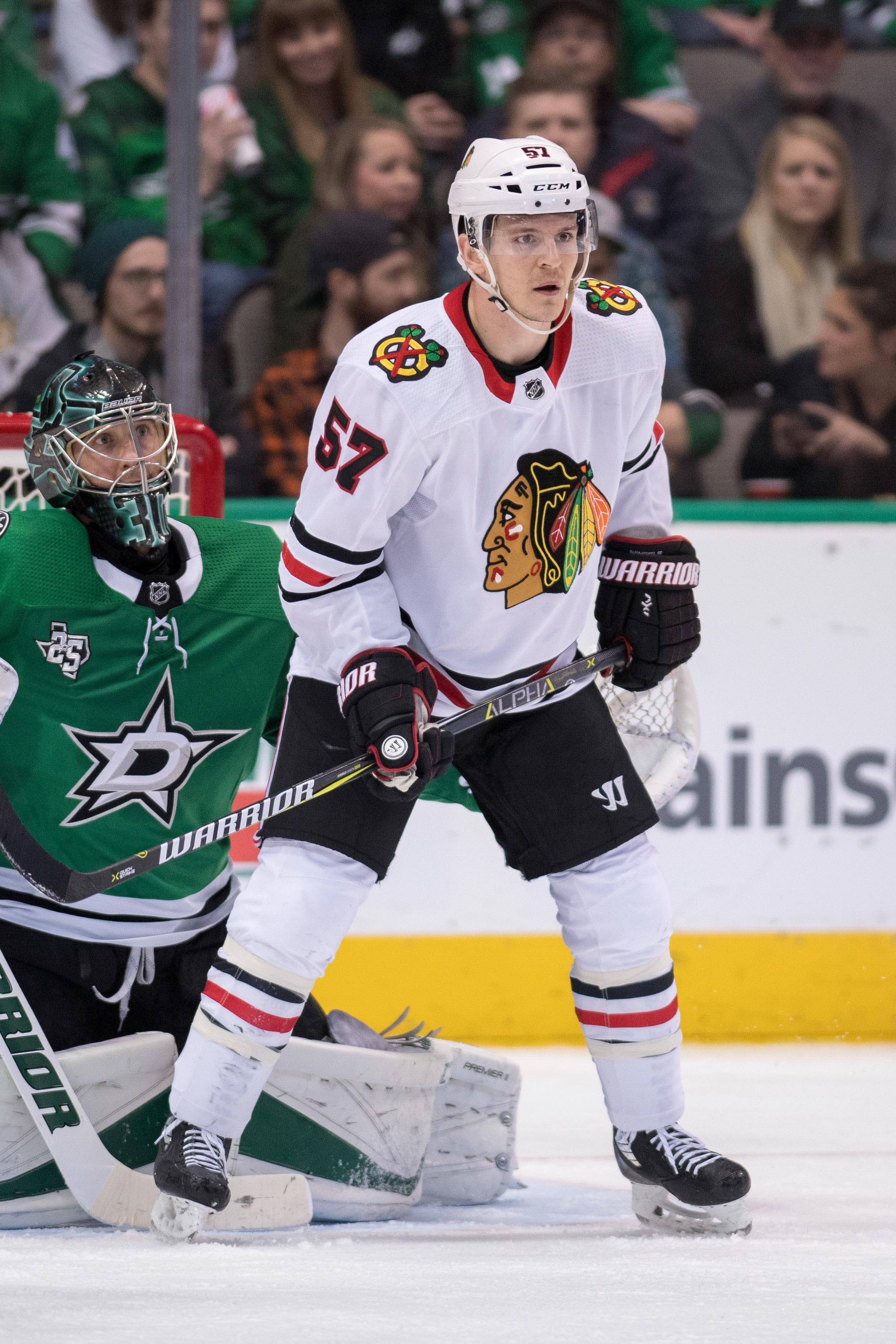 Wingels, who was a solid contributor for years with the San Jose Sharks as a bottom-six forward, signed with the Chicago Blackhawks last offseason who were in desperate need of depth. Wingels performed well, but as Chicago’s season began to go south, the team instead opted to trade him, sending him to the Boston Bruins for a conditional 2019 fifth-round pick.
Wingels provides teams with that gritty edge and experience that many teams covet for their fourth line. On top of that, he has the ability to produce some offense despite his limited minutes. He posted two goals and five points in 18 games when he arrived in Boston, but failed to produce in four playoff games as he missed time after taking a hit to the head from Toronto’s Nazem Kadri. Wingels is also only four years from two 30-point seasons. In all, he totaled nine goals, 17 points, 179 hits and 45 penalty minutes in 75 games, while averaging 11:29 of ATOI.
Potential Suitors
The most obvious match would be for the Bruins to bring back Wingels. While the veteran helped fill in for an injury-plagued team in their stretch run, Wingels hardly dominated and with the plethora of young talent waiting in the wings, it’s hard to tell whether Boston would want to bring Wingels back. On top of that, the 2019 fifth-rounder they gave to Chicago would turn into a 2019 fourth-rounder if they brought Wingels back, although that may not be that significant if they wanted him.
While there are a number of teams that may look to add some grit to their depth, there are a few teams known to hoard depth, especially at the center position. The Nashville Predators are already deep, but there are some who believe the team might continue to look at a player like Wingels if they think they can pass him eventually through waivers.
A potential return to Chicago would also make sense as the Blackhawks, with their salary cap issues, are always in need for depth and are already familiar with Wingels. The team even has some cap room to afford a relatively cheap contract that Wingels would require.
Projected Contract
Wingels days of making big numbers are gone as he had to settle for $750K last year in Chicago and likely will sign a deal with similar numbers this offseason, which will make him a solid bargain. However, if he can’t get an official contract, the veteran may have to settle for a PTO.
Photo courtesy of USA Today Sports Images.
The Contract Each Team Would Most Like To Trade: Part II
Nearly every team has one of those players: a top talent they were excited to sign and never thought could do anything but help them. In hindsight, history shows that more often than not, expensive, long-term free agent contracts don’t work out. It may look good at first (or it may look bad right away to the outside observer), but players struggle to make their value last throughout a lengthy contract. Those contracts come back to bite teams and are hard to get rid of. As teams begin to finalize their rosters at this point in the off-season, many are struggling to make everyone fit under the salary cap and are regretting these past signings that exasperate a cap crunch that can be tough for even a mistake-free club. We already took a look at the first third of the league; here are the contracts that each team would most like to trade, from Detroit to Ottawa:
Detroit Red Wings: Frans Nielsen – four years, $21MM remaining
As speculated by some readers in the comments section, it was no mistake that Part I ended with Dallas. Detroit deserved both some extra consideration and to lead off an article about poor contracts. There is an argument to be made that almost every single player age 28 and over on the Red Wings roster is signed to a bad contract for one reason or another. Detroit is a team that ranks towards the bottom of the standings and towards the top of the salary cap and that is not just bad luck. However, some are much worse than others and they are so bad that it is tough to choose between them. Take this scenario: Player A scored 35 points in 75 games last season. It was 14 points more than the season prior, including six more goals, and Player A also led the team in hits. He is 31 years old and signed for five more years at $4.25MM per. Player B scored 33 points in 79 games last season. It was eight points less than the season prior, and Player B also had the worst face-off percentage among the team’s centers. He is 34 years old and signed for four more years at $5.25MM per. Still undecided about which contract the team would rather trade? Player A is a Michigan native and career Red Wing and Player B is entering only his third year after signing a lucrative free agent contract. Player A of course is perennial whipping boy Justin Abdelkader. Yes, the Abdelkader contract is terrible. At no point in his career has he been worth his current contract value. Yet, he improved last season, is younger and brings a defensive element to his game, and is also loyal to the current administration – the call of the question after all is which contract the team would most like to trade. That would instead be Player B, Frans Nielsen, who at 34 is predictably declining and last year made more than Abdelkader for less production and there is no reason to believe that trend won’t continue. The team rewarded Adbelkader for years of service, whereas they took a gamble on Nielsen that hasn’t paid off. One of those moves is far more regrettable. Nielsen is the guy, but he only narrowly edged out Abdelkader and defenseman Danny DeKeyser, who also has relative age and Detroit roots to his advantage.
Edmonton Oilers: Milan Lucic – five years, $30MM remaining
The Oilers can refute trade rumors surrounding Milan Lucic all they want. The truth of the matter is that GM Peter Chiarelli signed Lucic hoping that he could both produce with and protect Connor McDavid in Edmonton as he did for David Krejci in Boston. The only problem is that the 30-year-old power forward can no longer keep up with a player of McDavid’s caliber. Lucic managed to score 34 points last season, tied for fourth on the team, but that is nowhere near what is expected of a $6MM player, especially when he scored 50 in year one with the Oilers and topped that mark many times with the Bruins. Edmonton still may be holding out hope that Lucic can turn it around and be just as much of a scoring threat as he is a physical threat, but make no mistake that the team would be quick to get rid of his contract if the right deal came along. In contrast, the team would be far more hesitant to move a hefty contract like defenseman Andrej Sekera who has been good and injury-prone, rather than healthy and underwhelming.
Florida Panthers: Roberto Luongo – four years, $18.13MM remaining
Florida is a tough one. Dale Tallon has done a good job of locking up his core long-term and, despite being right up against the cap, there are few egregious contracts on the roster right now. Give it a few years and maybe Michael Matheson will hold this title, but for now it goes to Roberto Luongo by default. Of course, Luongo is beloved in Florida and the team doesn’t even have to carry the whole of his cap hit, with the Vancouver Canucks retaining $800K each year. However, the reality is that Luongo will turn 40 this season and it will be only the first of four years left on his deal. The Panthers have almost $8MM committed to two goalies for the next few years and the other, James Reimer, is younger and outplayed Luongo in 2016-17 and in more games to boot. While they both fought injuries this past season, it was Luongo back on top performance-wise, but the impressive numbers he did post came in just 35 appearances versus Reimer’s 44. Florida paying over $4.5MM per year to a backup goalie in his forties just doesn’t make sense and the team would be better off moving forward with just Reimer and Michael Hutchinson if they could find a way to trade Luongo. Another reason this contract is bad: both the Panthers and Canucks will be hit with cap recapture penalties if Luongo retires prior to 2022.
Los Angeles Kings: Dustin Brown – four years, $23.5MM remaining
For the first time in years, Kings fans are feeling good about Dustin Brown. That is why now is the perfect time to trade him. Brown had been the bane of L.A.’s existence for four years, registering no more than 36 points each year while eating up $5.875MM in cap space, when he finally broke out of his funk in 2017-18 with a massive 61-point season and one of the league’s best plus/minus ratings. The question now is whether the past four years were an aberration with this season setting a new baseline or will Brown regress back to his bottom-six production. With a cap-strapped roster full of expensive contracts for older players, L.A. can’t take the risk of keeping Brown around if the right opportunity presents itself. They would be forced to trade the career King if a taker came forward rather than hold out hope that he doesn’t revert back to his old ways of being drastically overpaid.
Minnesota Wild: Zach Parise – seven years, $52.77MM remaining
When the Wild signed 28-year-old’s Zach Parise and Ryan Suter to matching 13-year contracts worth almost $100MM apiece, they knew that those deals would have dark days at some point in the future. However, they never could have imagined that Parise’s decline would come so soon. Parise remains one of the most popular players on the team, but injuries have kept him off the ice and affected his play when on the ice over the ice and his stock is falling quickly. Parise has never been able to reach the peaks he enjoyed in New Jersey, but he still produced at a high level over his first four seasons with the team. The past two years have been a different story and Parise appears to be trending in the wrong direction. Now 33, Parise isn’t totally beyond help and could turn it around. If back at 100%, Parise has enough natural ability and enough talent around him to still be a $7.5MM player. However, it would be nearly impossible for Minnesota to ever move the behemoth that is his contract so, if somehow they received an offer, they would take it without a second thought. Fan favorite or not, there is too much risk associated with Parise moving forward.
Montreal Canadiens: Shea Weber – seven years, $55MM remaining
I know what you’re thinking and yes, the Carey Price contract doesn’t look great right now. However, an extension of any length and value for any player coming off an injury-riddled season would bring a skewed perception. Price has been one of the best goalies in the league for years and one bad season doesn’t change that. Will he lose that title in the next eight years? For sure, but it would be a shock to see the Canadiens move their poster boy any time soon. Their #1 defenseman is another question though. When Montreal acquired Shea Weber for P.K. Subban, they never could have anticipated that his body would break down so soon after. Injuries cost Weber all but 26 games last season and he will miss the beginning of 2018-19 as well. Weber doesn’t seem like the type of player who will retire early, but there is no guarantee that these injuries won’t slow him down significantly for the remainder of his contract. In fact, the only guarantee is that he will slow down over the next seven years. At $7.86MM, the Canadiens need Weber to be his dynamic two-way self. The team already has one overpaid stay-at-home defenseman in Karl Alzner and can’t afford another. If they could move Weber, they would.
Nashville Predators: None
GM David Poile flat out doesn’t sign bad contracts. Criticize the deals for Ryan Johansen and Kyle Turris if you like, but the bargain contracts throughout the rest of the lineup have allowed Poile to overpay for reliable centers and that is a team-building model that anyone can get behind.
New Jersey Devils: Corey Schneider – four years, $24MM remaining
The easy answer is that the Devils don’t feel any pressure to trade anyone on the roster. They currently have the lowest payroll in the league with nearly every player signed to a fair deal. Those who are overpriced – Travis Zajac and Andy Greene – play important leadership role and the only player signed to a substantially long-term deal is electric young blue liner Damon Severson. The one and only player that sticks out as a potential long-term cap problem is starting goaltender Corey Schneider. This may surprises some; after all Schneider trails only Tuukka Rask among active save percentage leaders. Schneider had been elite since arriving in New Jersey, but something started to change in 2016-17. His SV% fell to .908 and his GAA inflated to 2.82 and then things only got worse last season with a SV% of .907 and a GAA of 2.93. He was also limited to just 40 appearances this year and was outplayed by journeyman Keith Kinkaid. The Devils can’t count on Kinkaid to repeat his 2017-18 performance moving forward and if Schneider’s back-to-back bad years are more than a fluke, they can’t depend on him for four more years either. He’s not going to be a $6MM backup either. New Jersey will give Schneider the time he needs to return to form, but they may not hesitate if the right trade comes their way as well.
New York Islanders: Andrew Ladd – five years, $27.5MM remaining
The Islanders without John Tavares are a totally different animal. A six-year, $30MM extension for Josh Bailey now looks bad. A $5.75MM cap hit this season for free agents Leo Komarov and Valtteri Filppula signed to make up for Tavares’ lost production looks bad. The likes of Cal Clutterbuck, Casey Cizikas, and Matt Martin now look worse on a team that needs more offense and less grit. However, the one contract that looked miserable well before Tavares bolted to Toronto is Andrew Ladd and it is only going to get much worse. The veteran forward was intended to find chemistry with Tavares when he was signed to a seven-year, $38.5MM contract two years ago. Instead, Ladd has just 60 points over the past two seasons combined and has by all accounts been relegated to a bottom-six role. The 32-year-old will now be asked to take a bigger role in Tavares’ stead and that is a scary proposition. The Islanders aren’t in any cap trouble, but the team should be thinking rebuild and would likely take any offer at all to rid themselves of Ladd.
New York Rangers: Brendan Smith – three years, $13.05MM remaining
Has any free agent contract in recent memory soured as quickly as Brendan Smith’s? Smith signed a four-year deal with the Rangers last June and was expected to play a top-four role for the team for years to come. By February, he had been placed on waivers and buried in the AHL. Smith played in only 44 games with New York and saw less and less ice time as the season wore on and he continued to turn the puck over at an alarming rate and cost his team goals. Now what? One would assume that Smith will be given a second chance this season, but the relationship between he and the team may be beyond repair. There is no doubt that the Rangers would take a re-do on that deal and would move him if possible. Marc Staal is another player that New York wouldn’t mind moving, but as a player who can eat minutes and provide solid play most of the time, his $5.7MM contract seems like nothing next to Smith’s $4.35MM deal.
Ottawa Senators: Bobby Ryan – four years, $29MM remaining
No contract in the league has become as notorious for being labeled a “bad deal” that the team is desperate to trade like Bobby Ryan’s. The Senators are so determined to move on from Ryan that they are trying to force Erik Karlsson trade suitors to take the overpaid forward as well. At one point in time, $7.25MM per year for Ryan seemed like a fair deal. At 23 years old he was a 71-point player with the Anaheim Ducks and even after moving to Ottawa, Ryan started his tenure with three straight seasons in the 50-point range. However, the last two years have been very different. Ryan has only suited up for 62 games in each campaign and has looked like a different player on offense. At his best, he looks disinterested and lucky to be in the right place at the right time and at his worst he costs his team goals. Ryan has managed to register only 58 points combined over the past two years; he had 56 alone in 2015-16. Ryan may just need a change of scenery to jump start what used to be dynamic goal-scoring game, but the Senators don’t care about that. All he is to them is a waste of cap space and of owner Eugene Melnyk‘s dwindling wealth. They want him gone at any cost.
Look out for Part III of this three-part series early next week…
Nashville Predators Sign Dan Hamhuis
Dan Hamhuis is heading back to where it all began. The Nashville Predators have signed the veteran defenseman to a two-year contract worth a total of $2.5MM. Hamhuis ranked 24th on our Top 50 UFA list this offseason which predicted his return to Nashville, though for much more money that he ended up getting. This deal comes in at an incredible bargain for the Predators, given Hamhuis’ recent play.
 The 35-year old Hamhuis logged more than 20 minutes a night last season for the 13th time in his career, anchoring the shutdown pairing for the Dallas Stars alongside Greg Pateryn. Given almost every tough defensive matchup to allow John Klingberg and others to contribute offensively, Hamhuis still provided the Stars with 24 points on the year. His 2:40 of average short-handed ice time easily led the Stars, and will likely be a role he takes up in Nashville now that he has returned to the place his career began.
Selected 12th overall in 2001, Hamhuis played 483 regular season games for the Predators over six seasons before moving on to the Vancouver Canucks, and was part of a group that continually made the playoffs but couldn’t get out of the first round. He was part of a defensive factory that also produced players like Ryan Suter, Shea Weber and Kevin Klein, and will now likely end his career after having come full circle.
Turning 36 this year means there isn’t a ton of miles left on Hamhuis, especially after playing more than 1,000 games in the NHL. What he will bring is a excellent experienced and capable option for the Predators third pairing, slotting in at the bottom of what has become an elite group. Alexei Emelin held this role last season for the team but was relatively ineffective when asked to fill in for injuries, something that Hamhuis should be able to do with ease. Behind the likes of P.K. Subban, Roman Josi, Mattias Ekholm and Ryan Ellis, Hamhuis should be able to prey on easier matchups and contribute with his excellent two-way style. The fact that it will cost the team just $1.25MM per season brings almost no risk, especially given his recent play.
The only thing the Predators would have to worry about is potential retirement by Hamhuis next offseason, since this contract was signed after he turned 35. His $1.25MM cap hit will be counted against the Nashville cap regardless of whether he’s playing on the team, but with the way they’ve built their salary structure it shouldn’t be a problem. The Predators still have more than $8MM in cap space this season, and though they do have some big contracts coming up—like a Ryan Ellis extension—are still in pretty good shape financially.
Austin Watson Pleads No Contest In Domestic Violence Case
Predators winger Austin Watson pleaded no contest to his domestic violence charge today, notes Natalie Neysa Alund of The Tennessean. Watson will spend the next three months on probation and has been placed on judicial diversion. That means that if he abides by the terms set, his case will be expunged.
What Happened To The Antoine Vermette Market?
Approaching July 1st this year, one name had been given a somewhat surprising amount of attention. Veteran center Antoine Vermette, who was coming off the least productive season of his long career, was nevertheless reported to be a target of several teams by several different sources. TVA’s Renaud Lavoie went so far as to say that with a high demand for centermen, there was “significant interest” across the league in Vermette. Yet, three weeks later, he remains a free agent with little to no discussion of any potential landing spots.
What could have caused Vermette’s market to fall apart? It could be that many teams taking a look at the two-way pivot were able to land superior options, while others found comparable players at a cheaper price. Vermette hasn’t made under $1MM in a season since 2006 and at 36 years old he may not have been willing to return to that price point to extend his career. However, several other unrestricted free agent centers with similar (and superior) 2017-18 production have signed at cap hit between the $650K minimum and Vermette’s previous $1.75MM salary. They include Matt Cullen and Derek Grant to the Pittsburgh Penguins, Kyle Brodziak to the Edmonton Oilers, and Vermette’s Anaheim teammate Chris Wagner to the Boston Bruins, as well as Connor Brickley to the Nashville Predators, Paul Carey to the Ottawa Senators, and Michael Sgarbossa to the Washington Capitals. That’s at least six teams who likely kicked the tires on Vermette but may have found a better fit at an more comfortable price in who they decided to sign.
The other possibility is that the market was overblown in the first place. It did seem as though Vermette was slowing down substantially last season. The 14-year veteran recorded eight goals and eight assists for 16 points with the Ducks last season; each of those marks is Vermette’s lowest since his rookie year in 2003-04. His physicality tailed off and he was not as successful with his trademark defensive play, lagging in turnovers and zone exits and posting career-low possession numbers. Vermette was still dominant at the face-off dot, but teams may have been overplaying that one trait and Vermette’s years of experience, when other options with higher potential for offense and defense were waiting for them on the open market.
It could be that Vermette’s name value alone lands him a job this summer. It may be that he was overpricing himself early on to teams or that the market simply never developed, but it seems unlikely that if the well-respected and well-traveled center wanted to play next season, that he couldn’t find a shot somewhere. However, the demand is not what it once was in the past and not what it was made out to be earlier this month. Perhaps Vermette’s time to hang up the skate has come.
Minor Transactions: 7/18/18
The past few days have been a busy stretch for fringe NHL free agents deciding whether to hold out for a big league deal or look elsewhere. Significant names such as Torrey Mitchell and Teemu Pulkkinen have signed overseas, while other players have settled for minor league employment. Similar deals have continued throughout the day:
- Count Michael Latta as a player making the jump across the Atlantic. Or would it be the Pacific? Latta has signed with the Kunlun Red Star, the sole Chinese member of the KHL. He announced the deal himself today, while European insider Aivis Kalnins adds that it is a one-year contract. Latta, who is most well known for his days as a serviceable bottom-six regular with the Washington Capitals, has actually not played in an NHL game since 2015-16 in D.C. Latta has landed NHL contracts in each of the past two off-seasons with the Los Angeles Kings and Arizona Coyotes respectively and has even been a sought-after trade acquisition in both years, but nevertheless has played only in the AHL. Latta’s numbers in the minors are not all that impressive either, so perhaps his move to the KHL presents an opportunity for his two-way game to be better appreciated.
- Veteran forward Mike Blunden is making a similar move but to a lesser-known team and league. The long-time depth forward has made an NHL appearance in all but one season since turning pro in 2006, including multiple seasons where more than half of his time was spent at the top level, but saw only three games with the Ottawa Senators over the course of his recently-expired two-year contract. A proven scorer in the AHL, Blunden is likely in pursuit of a new opportunity and higher compensation outside of North America. Per a team release, Blunden has signed a contract with HC Bolzano of the Austria-based EBEL. However, the “Foxes” are actually located in Italy and are the premiere pro team of the country. Bolzano is the reigning EBEL champion and has been loading up this off-season to defend their title, adding Blunden and fellow AHLers Leland Irving, Brett Findlay, and Matt MacKenzie. Blunden could turn out to be a top scorer for the team this season.
- Experienced goaltender Tom McCollum is not quite ready to leave North America or even the Great Lakes region. The Buffalo-area native has spent all but one season of his nine-year pro career in the Detroit Red Wings system, appearing in over 250 games with the AHL’s Grand Rapids Griffins. However, without an offer from the Red Wings or presumably an AHL offer from the Griffins this summer, McCollum has decided to take his talents to their arch rival. The Milwaukee Admirals have announced that they have signed the veteran netminder to a one-year minor league deal. The team’s release calls McCollum a “proverbial thorn in the Admirals’ side” for years, but he has now joined them in their pursuit of a Calder Cup. Milwaukee’s parent club, the Nashville Predators, could also come calling if injuries strike; the team has just three goalies signed who have pro experience in North America.
- Forward Tyler Randell is sticking around in the AHL as well. The 27-year-old enforcer has been unable to land a two-way NHL contract, but will settle for a minor league deal. The Rochester Americans have announced that they have signed Randell to a one-year AHL contract. Randell, a 2009 sixth-round draft pick of the Boston Bruins, is an impressive physical force and a smart defensive player. He even earned himself 27 NHL games with the Bruins in 2015-16 and a nice $700K free agent contract from the Ottawa Senators last summer. However, his offensive game is severely limited at all levels and it’s no surprise that his NHL market was lacking this off-season after an eight-point campaign with the Belleville Senators last season. Randell brings energy and grit to Rochester, but if his scoring doesn’t improve in consistency and frequency, he’s unlikely to end up back in the NHL.
Juuse Saros Signs Three-Year Deal With Nashville Predators
The Nashville Predators continue to re-sign their young restricted free agents, this time inking goaltender Juuse Saros to a three-year $4.5MM ($1.5MM AAV) contract. That leaves just Miikka Salomaki as the team’s lone unsigned RFA after Ryan Hartman also signed earlier today.
Just like Hartman’s $875K deal, this appears to be an incredible bargain for the Predators. While Saros is still technically a backup goaltender as long as Pekka Rinne continues to put up Vezina-winning seasons, he also has been one of the league’s best netminders the last two seasons. Posting a .925 save percentage in 26 appearances, he ranked ninth in the entire league among goaltenders who saw at least 20 games. He and Rinne formed one of the best tandems in the league, and could again this season for a reasonable combined cap hit of $8.5MM.
It’s the final two years that could be really interesting for the Predators, as Rinne’s current contract expires after the 2018-19 season. If the team decides not to extend a contract to Rinne (who will be 36 at the end of the season) they would still have a potentially elite starter for an incredibly low cap hit of $1.5MM. The fact that Saros is still a restricted free agent at the end of this deal makes it even more impressive, as they are almost guaranteed to not have to pay him a big contract until he takes over as the full-time starter. That’s a perfect situation to be in for the Predators, who are right in the middle of a Stanley Cup contention window that looks like it will be wide open for quite some time. Though there are big extensions to come for the likes of Ryan Ellis and Roman Josi over the next two years, the rest of their core is already locked in to reasonably priced, if not bargain-basement contracts.
For Saros, he gets the chance to continue developing under an exemplary starter in Rinne and should still get a healthy raise when his contract expires. He’ll be 26 when the deal expires and on his final year of restricted free agency, meaning any long-term deal would be buying out almost exclusively UFA seasons. While that is a fine situation for the Predators, it still leaves Saros with plenty of earning potential for his career and a good chance to spend it behind a solid defense in Nashville.
Ryan Hartman Re-Signs With Nashville Predators
The Nashville Predators will have Ryan Hartman back next season for a relative discount, after the team announced a new one-year contract worth $875K for the restricted free agent. Hartman is coming off his entry-level contract but won’t get much of a raise despite consecutive seasons with 31 points.
Hartman, 23, was acquired from the Chicago Blackhawks at the deadline for a package that included a first-round pick and talented prospect Victor Ejdsell. Nashville clearly believed that Hartman could be a key piece up front going forward for them, given his blend of physicality and skill. He scored 19 goals for the Blackhawks during the 2016-17 season and though that number dropped to just 11 last season his presence was still felt in the Predators lineup. In nine playoff games he recorded three points including a game-winning goal against the Colorado Avalanche.
Going forward, Hartman should be able to negotiate a bigger contract. Though he’ll be part of an extremely deep forward group in Nashville, there’s good reason to believe he can break that 31-point mark this season and represent one of the best bargains in the league. Making less than $1MM is usually reserved for fringe NHL players or veterans holding on to the end of their careers, not full-time roster players with enough upside to garner big trade packages at the deadline. The Predators are actually heading into the season with plenty of cap space given the relatively inexpensive restricted free agents that remain unsigned. The team could still make a big move this summer to bring in some more salary, but will have to be careful not to limit their ability to retain Ryan Ellis going forward. The defenseman is scheduled for unrestricted free agency in 2019 and could receive a huge extension at any time.
This is the epitome of a “prove it” contract for Hartman, who only scored six points down the stretch for the Predators following the trade. Though he is effective in more ways than just offense, it will look like a big miss on the part of GM David Poile if he can’t generate the kind of offense he did in Chicago. If a career-high mark is coming this season he’ll certainly set himself up to negotiate a long-term contract next summer, especially given that he will be arbitration eligible for the first time. Hartman is putting most of the risk on his shoulders though, as any struggles could limit his earning potential going forward. For both sides, offensive production and on-ice success is the goal of any contract, but especially so in such an inexpensive short-term deal.