
Draft Day Notes: Ruff, Markov, Phaneuf
While the New York Rangers continue to select the next wave of talent in the NHL draft, the front office is also busy working on the NHL coaching staff. Larry Brooks of the New York Post is reporting that Lindy Ruff will join the team as an assistant coach, replacing Jeff Beukeboom who will move into a scouting role with the club.
Ruff of course has decades of experience as a head coach in the league, with his latest stint ending in Dallas at the end of the year. This will be the first time he takes an assistant role since 1997, and will be mostly in charge of the defense group.
- Though it’s been clear there is interest between Andrei Markov and the Montreal Canadiens, Renaud Lavoie of TVA Sports is reporting that Markov now wants a two-year contract. That could be too long for the Canadiens, who are set to give Carey Price a huge raise next summer and have to make sure they spend every dollar appropriately. That’s not even mentioning that Markov will turn 39 this season, and at any point could fall off a cliff in terms of production. The cap hit would have to be very reasonable for the long-time Montreal defender to get those two years.
- Before the Travis Hamonic deal went down, Bob McKenzie of TSN tweeted out some details about Dion Phaneuf continuing to draw trade interest from teams that aren’t on his approved list. Remember that Phaneuf would not waive his no-movement clause for the expansion draft, and though Pierre Dorion has had chats with his representation, there is no movement on the trade list as of yet.
Brian Flynn, Dwight King Will Not Return To Montreal
According to Montreal Canadiens GM Marc Bergevin, both Brian Flynn and Dwight King will not be re-signed to return to the team next year. The pair are unrestricted free agents on July 1st, and join Nikita Nesterov as players already told they will not be returning.
Flynn has spent the couple of years with the Canadiens after being acquired from the Buffalo Sabres at the 2015 deadline. Though he has been an effective checker, he’s never quite lived up to the hype he had when signed out of the University of Maine. At the time, he was a pretty sought-after forward prospect that many thought would be able to contribute offensively at the NHL level. Instead, he’s only been able to put up 61 points in 275 games.
King is another deadline acquisition, this time from the Los Angeles Kings just a few months ago. The hulking forward was brought in to add some toughness to the lineup and actually has a history as a pretty effective secondary scoring threat. In 2013-14, King put up 15 goals and 30 points.
It wouldn’t be surprising to see both land somewhere in fourth-line roles, especially King who is hitting the open market at 27 and has the size many coaches and GM love to add to their bottom-six forwards.
New Jersey Devils Inquire About Alex Galchenyuk
In an interesting turn, Pierre LeBrun of TSN reports that the New Jersey Devils have made inquiries with the Montreal Canadiens on restricted free agent Alex Galchenyuk. While it’s clear that Galchenyuk is being discussed with several teams, this is the first we’ve heard of a New Jersey connection.
As LeBrun notes, there may not be a fit between the two sides. Montreal is in need of defensemen even after acquiring David Schlemko earlier today, and New Jersey could use some of those themselves. They’ve had trouble scoring even with Taylor Hall added to the picture, and Galchenyuk would certainly do that, but it’s not clear what a possible return could be.
The 23-year old Galchenyuk is an odd case in Montreal. Even though he’s just a year removed from a 30-goal season, and put up 44 points in 61 games this year he’s the subject of much trade speculation due to his lack of defensive responsibility when playing the center position. The team went out and added Jonathan Drouin, a similarly skilled player (if not exactly stylistically identical) and immediately inked him to a long-term deal. Galchenyuk on the other hand still sits without a deal for next year, and no clear role on the roster.
Previously Minnesota had been rumored to be an expected landing spot, and while New Jersey making an inquiry doesn’t necessarily mean anything to dispute their claim, Minnesota will have more bidders than just the Devils to fight off. The third-overall pick from 2012 has incredible scoring ability, even if he is a winger long-term.
New Jersey could really use him, as though they have some depth coming up the middle—Michael McLeod, Pavel Zacha and likely one of Nolan Patrick or Nico Hischier to name a few—they aren’t as deep on the wings and could use another top-flight offensive player to plug in with Hall, even if they likely wouldn’t play together. Other than Damon Severson though, who is as close to untouchable as anyone on the New Jersey roster, there isn’t much defensive help that Montreal could be after.
Montreal Canadiens Acquire David Schlemko From Vegas
Another pick-and-flip from the Vegas Golden Knights as the Montreal Canadiens have traded for David Schlemko. The Golden Knights will receive a 2019 fifth-round pick in return. Schlemko was the expansion selection from the San Jose Sharks last night. 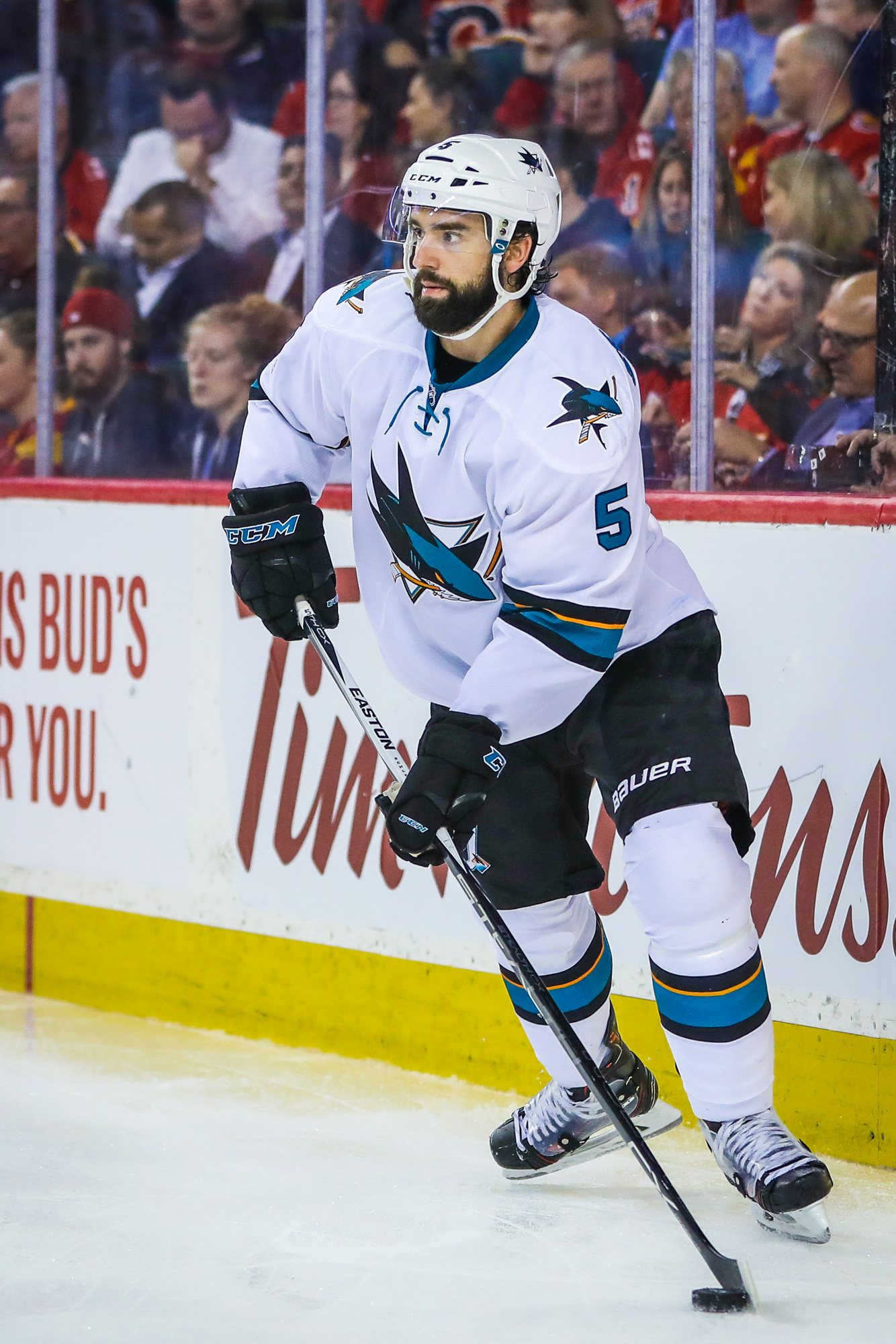
It was clear that the Montreal Canadiens needed to add defense after trading away Mikhail Sergachev and Nathan Beaulieu while losing Alexei Emelin in the expansion draft. They’ve found that depth in the former Sharks defender, and it comes at a very low price. The 30-year old defender will join his seventh career team, previously suiting up for the Coyotes, Stars, Flames and Devils in addition to the Golden Knights and Sharks.
Impressively, Schlemko turned a one-year $625K contract in 2015-16 with the Devils into a four-year $8.4MM deal which still has three years left on it. That $2.1MM cap hit is reasonable for a player who can contribute at both ends of the rink, and actually has sneaky-good possession numbers. His shot suppression ability is excellent, and he’s put up nearly 20 points in each of the last two seasons.
In fact, Schlemko likely adds more than Emelin ever did even if they play very different styles and it will come for just over half the salary next season. George McPhee seems to have done the Canadiens a favor, clearing cap space and providing a better defender. Even so, Montreal still has quite a bit of work to do as this can’t be the only acquisition they make on the back end.
It is interesting that this is all the Golden Knights received for their San Jose selection, even though there doesn’t seem to have been any side-deal with the team. Brenden Dillon, Dylan DeMelo and Paul Martin were all left unprotected, and each of them seems to have more value than a 2019 fifth-round pick. Perhaps there is something else going on behind the scenes, but it does seem like a rather poor return for a serviceable defenseman.
Photo courtesy of USA Today Sports Images
Early Notes: Galchenyuk, Arizona, Pronger
Ah the morning after. The Vegas Golden Knights finally selected their expansion roster last night, and with it came a barrage of trades. Teams lined up to offer draft picks for protection slots, but one team conspicuously silent were the Montreal Canadiens. After making two major moves before the draft—acquiring Jonathan Drouin and shipping off Nathan Beaulieu—the team watched as Alexei Emelin was selected to be part of the expansion franchise. That leaves the team with just five NHL defensemen, and that’s including Jakub Jerabek who will try to prove he’s ready right away.
Enter Alex Galchenyuk, who again dominated the headlines this morning. Bob McKenzie of TSN noted as much, saying that he still believes the talented forward would be moved at some point and counts Minnesota as a team with assets that would interest the Canadiens. Interestingly, he also doesn’t think the Wild are very high on Galchenyuk, making it a tough fit for any potential deal. Eric Engels of Sportsnet still believes they’re the most likely destination and that it’s still more likely that he moves somewhere.
- The Arizona Coyotes are an interesting team in the next few days as they begin to turn the corner from rebuild to contention. While the team shouldn’t be expected to compete for the Stanley Cup just yet, they’d like their days of finishing last in the league to be behind them. Darren Dreger of TSN notes that they’re in the market for a goaltender, centers and defensemen, making them a possibility on most names floated recently. McKenzie thinks they might re-open negotiations with the New York Rangers, a team they’d had conversations with last week. For a squad who has said goodbye to two long-time veterans in recent times, young GM John Chayka looks determined to turn over a new page in Coyotes history and build around the young core of forwards he’s acquired.
- Chris Pronger has taken a position as senior adviser to the President of Hockey Operations Dale Tallon in Florida for one year, according to Dan Murphy of Sportsnet. Pronger hasn’t been shy about his goal of becoming an NHL GM one day, even reaching out to former rival Steve Yzerman for advice. Yzerman of course also took a lesser role in Detroit after retiring, in order to learn the trade from Ken Holland and company. In the next few years, it wouldn’t be shocking to see Pronger given the reins of a team.
NHL Awards Preview
Caught up in the excitement of the Expansion Draft, it’s easy to forget that there is also an awards show tonight. Yes, the best trophy in all of sports, the Stanley Cup, has already been presented to the Pittsburgh Penguins, as has the Conn Smythe Trophy for playoff MVP to their captain, Sidney Crosby. Crosby also already locked up the Maurice “Rocket” Richard Trophy for the most regular season goals. Edmonton Oilers wunderkind Connor McDavid captured the Art Ross Trophy for the most regular season points as well. Braden Holtby locked up the William M. Jennings Trophy already too, as the Washington Capitals allowed the least amount of goals against in the regular season. Yet, all three of these players and many more still have a lot on the line tonight. Here are the nominees for tonight’s NHL Awards:
Hart Trophy – Most Valuable Player
Sergei Bobrovsky, Columbus Blue Jackets
- Star goalie helped to lead the Blue Jackets to their best record in franchise history, all while topping the league in save percentage (.931) and goals against average (2.06)
Sidney Crosby, Pittsburgh Penguins
- The NHL’s leading goal-scorer and back-to-back winner of the Stanley Cup and Conn Smythe Trophy
Connor McDavid, Edmonton Oilers
- 20-year-old phenom led the league in points and assists and took his team from the draft lottery to the second round of the playoffs
Norris Trophy – Best Defenseman
Brent Burns, San Jose Sharks
- Not only led all defenseman in scoring with 76 points, but finished ninth overall among some of the league’s most dynamic forwards. Can check with the best of them as well.
Victor Hedman, Tampa Bay Lightning
- A down year for the Bolts was a career year for Hedman, who finished just four points behind Burns with 72, and led all blue liners with 56 assists
Erik Karlsson, Ottawa Senators
- If this award had been voted on after the playoffs, it might have been a different result. The NHL’s best puck-mover may still pull it off behind a 71-point campaign and an improved defensive game
Rumored Vegas Golden Knights Expansion Selections
The Vegas Golden Knights will reveal their expansion selections at tonight’s NHL Awards show, but details have started to come in on who each team will lose. There are many rumors floating around, but these are the most reputable. As with anything, nothing is final until the actual selections are announced tonight. This page will be updated with new information as it comes in.
Here are the latest rumored selections along with their source:
Anaheim Ducks: Clayton Stoner — Bob McKenzie of TSN
Arizona Coyotes:
Boston Bruins: Colin Miller — Elliotte Friedman of Sportsnet
Buffalo Sabres: William Carrier — Frank Seravalli of TSN
Calgary Flames: Deryk Engelland — John Shannon of Sportsnet
Carolina Hurricanes:
Chicago Blackhawks: Trevor van Riemsdyk — Frank Seravalli of TSN
Colorado Avalanche:
Columbus Blue Jackets: William Karlsson — Aaron Portzline of the Columbus Dispatch
Dallas Stars: Cody Eakin — Jim Toth of TSN
Detroit Red Wings: Tomas Nosek — Craig Custance of The Athletic.
Edmonton Oilers: Griffin Reinhart — John Shannon of Sportsnet
Florida Panthers: Jon Marchessault — Elliotte Friedman of Sportsnet
Los Angeles Kings: Brayden McNabb — John Shannon of Sportsnet
Minnesota Wild: Erik Haula — Michael Russo of the Star Tribune
Montreal Canadiens: Alexei Emelin — Eric Engels of Sportsnet
Nashville Predators: James Neal — Bob McKenzie of TSN
New Jersey Devils: Jon Merrill — Frank Seravalli of TSN
New York Islanders: Jean-Francois Berube — Bob McKenzie of TSN
New York Rangers: Oscar Lindberg — Larry Brooks of the New York Post and Frank Seravalli of TSN.
Ottawa Senators: Marc Methot — Pierre LeBrun of TSN
Philadelphia Flyers: Pierre-Edouard Bellemare — Craig Custance of The Athletic
Pittsburgh Penguins: Marc-Andre Fleury – Bob McKenzie of TSN
San Jose Sharks: David Schlemko — Pierre LeBrun of TSN
St. Louis Blues: David Perron — James Mirtle of The Athletic
Tampa Bay Lightning:
Toronto Maple Leafs: Brendan Leipsic — Darren Dreger of TSN
Vancouver Canucks:
Washington Capitals: Nate Schmidt — Pierre LeBrun of TSN
Winnipeg Jets:
Alexei Emelin Targeted By Vegas Golden Knights
In our mock expansion draft, Nate Schmidt edged out Philipp Grubauer as the selection from the Washington Capitals mainly due to the wealth of goaltending talent available to the Vegas Golden Knights. Schmidt has shown potential to be able to log time as a top-4 defender, and has the elite skating ability that would allow him to fit into what should be a young group in Vegas.
That said, Isabelle Khurshudyan of the Washington Post reports that Schmidt’s camp hasn’t been told if he was the selection. Several players have been notified already in order to get them there for the reveal tonight, but as Khurshudyan explains it’s still early yet. Schmidt would be of interest to many teams around the league immediately after selection, though he’s also young enough (25) to fit in long-term in Vegas.
- Frank Seravalli of TSN got some bad info on the expansion target in Montreal earlier, but has since found out that Alexei Emelin may be headed to Vegas. Originally, Seravalli believed there was a connection to Brandon Davidson who shares an agent with Spencer Foo, the college free agent that Vegas is currently trying to sign. Emelin has just one year remaining on his contract and holds a 10-team no-trade list should Vegas want to flip him. At 31, it doesn’t seem like he fits into their competitive window but could be used—like James Neal and others—as trade bait either in the summer or at next season’s trade deadline.
- Arthur Staple of Newsday has been all over the New York Islanders expansion situation from the beginning, but still can’t lock down who will be selected tonight. What he can share is that it’s likely not someone “who saw regular NHL time last season.” That would seem to rule out many of the exposed Islanders’ exposed players including Brock Nelson, Casey Cizikas and Josh Bailey. Even Ryan Strome spent the majority of the season in New York. That could point to defenseman Scott Mayfield, as the 34th overall pick in 2011 still hasn’t cracked the NHL roster full-time. In 25 games with the Islanders this season he scored nine points, and at 24 would still have time to develop further in Vegas.
- Darren Dreger of TSN notes that Toby Enstrom may have been protected after all by the Winnipeg Jets, as there is likely a side-deal with Vegas to not select the veteran defender. Enstrom waived his no-movement clause in order for the Jets to protect Tyler Myers, and would probably cost less in terms of assets to protect in a deal.
Offseason Keys: New York Rangers
While tomorrow’s expansion draft is currently headlining a busy NHL offseason, there are still several other storylines for each team in the months to come. Here is a closer look at what lies ahead for the New York Rangers.
The Rangers were one of the top scoring teams in the league in 2016-17 and made it to the second round of the playoffs before being ousted by the Ottawa Senators. GM Jeff Gorton already made one move of significance this offseason with the buyout of Dan Girardi but there is still work to be done. Here’s what else will likely be on the to-do list for New York this summer.
Add A Right Side Top Pairing Defender
Of the six defensemen the Rangers have under contract for next season, only one is a right hand shot. That one player is Steven Kampfer who is signed on a two year, two-way league minimum contract and is a depth player at this stage of his career. In other words, New York is on the hunt for someone to play the right side in a top role.
New York has been linked to pending unrestricted free agent defenseman Kevin Shattenkirk pretty much all season long with the speculation being that the blueliner would like to play there as well. His defensive shortcomings don’t make him a prototypical top pairing player but he’s the best available on the open market and would still represent a significant upgrade on that side.
Finding the right fit financially for Shattenkirk or someone via a trade may be a bit of a tight squeeze though unless they’re swapping out a big contract in return. As things stand, the team has $61.6MM committed to 18 players per CapFriendly but have a few of their own free agents to re-sign including one particularly prominent one (more on him shortly). However, the Girardi buyout saved them nearly $2.9MM for this season and it’s expected that they’ll reinvest that money and more into landing a much-needed defensive upgrade.
New Deal For Zibanejad
After being New York’s top acquisition last summer, Mika Zibanejad had a solid first season in the Big Apple with 37 points (14-23-37) in 56 for the highest points-per-game average of his career. He did, however, miss 25 games with a broken fibula. Despite that, he should be in line for a nice raise this summer.
The Rangers owe Zibanejad a qualifying offer of $3.25MM (his 2016-17 salary) and however long his next contract is, it should surpass that without any issue. He’s arbitration eligible and is two years away from unrestricted free agency which suggests that a short-term contract isn’t something New York will want to pursue at this time.
Given his status as a top six center and the fact that any real long-term deal will buy out more UFA years than RFA ones, Zibanejad’s next contract will likely cross the $5MM range. That will take a big bite out of their remaining cap space but getting this deal done will no doubt be one of Gorton’s top priorities with an eye on getting pen to paper sooner rather than later.
Determine Stepan’s Future
Center Derek Stepan has been one of the more consistent point producers for the Rangers over the years and is in the middle of a six year, $39MM contract. Part of that pact calls for a full no-trade clause to kick in as of July 1st. Accordingly, if Gorton has any intentions of moving him (or at least sizing up the market for Stepan), it will be much easier to get a deal done before the calendar flips to next month. Early indications are that the GM is looking at what might be out there at the very least.
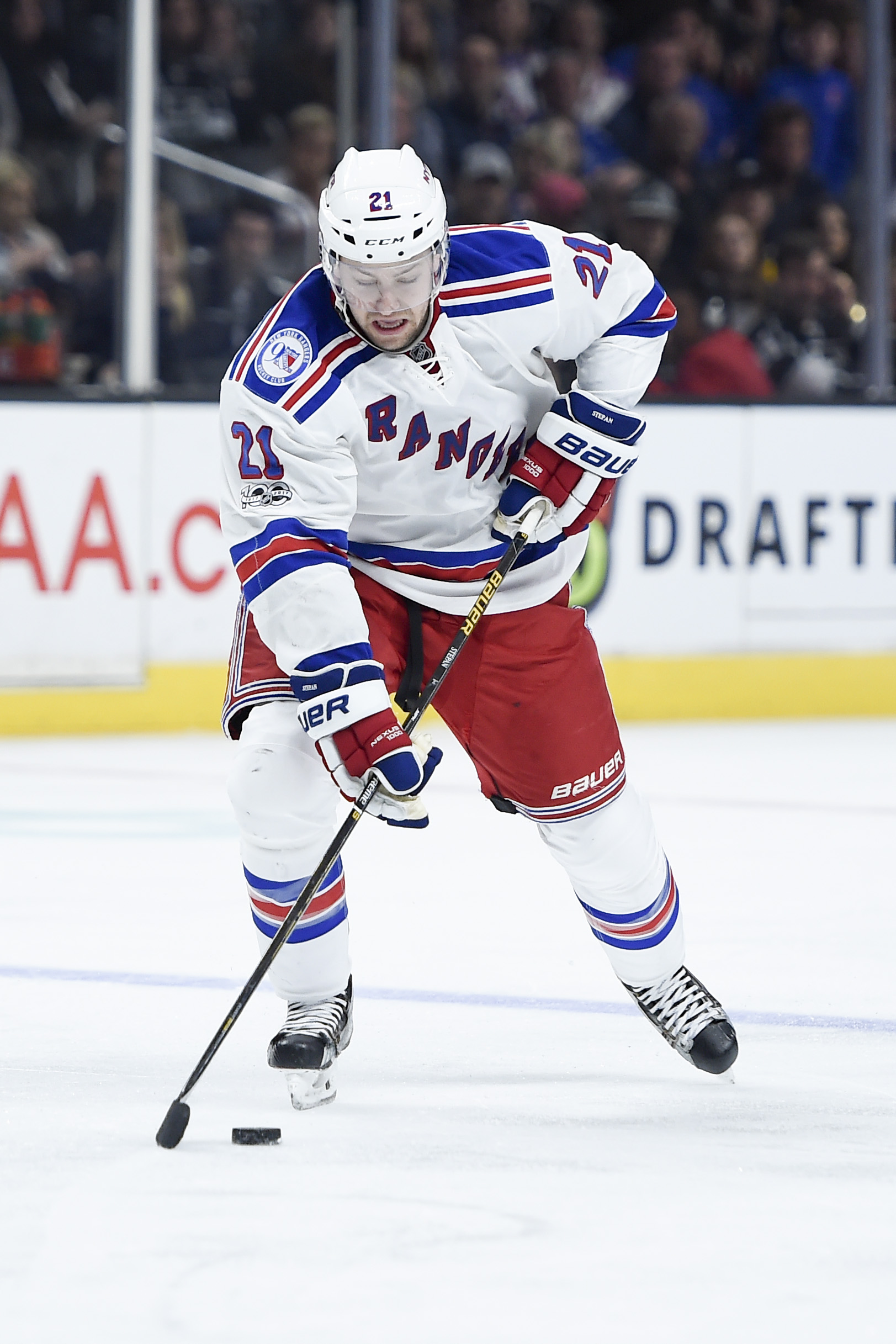 Although Stepan carries a hefty cap hit at $6.5MM, there’s bound to be plenty of interest in him. He has hit more than 50 points in five of the last six seasons and the one he didn’t was the lockout-shortened 48 game campaign (where he tallied 44 points). In a market where available top six centers are extremely difficult to find, he rises up the list in a hurry.
Gorton could also potentially dangle Stepan for defensive help if they want to trade for a high priced defender instead of trying to land a free agent. Of course, they could also keep him and once again run with him and Zibanejad as their one-two punch which would still represent one of the younger top six duos in the league.
With his no-trade clause kicking in less than two weeks from now though, a decision will need to be made on Stepan’s future with the team in the not-too-distant future.
Photo courtesy of USA Today Sports Images.
Latest On Alexander Radulov’s Free Agency
While the hockey world focuses on the expansion draft and upcoming entry draft, many fans in Montreal are turning their attention to next season and the possibility of an Alexander Radulov return to the Canadiens. The pending unrestricted free agent has been expected to re-sign with the Habs for some time, though things have gone silent in recent weeks as the team focused on other things. Today when speaking to TSN 690, Bob McKenzie explained that the two sides could still be pretty far away from each other in regards to contract length.
I’m sure that initially [Radulov] was looking for a home run; six, seven, eight years. Take your pick from one of those numbers, and I’m sure the Montreal Canadiens are saying ‘not a chance in the world we’re going any longer–we’d like two but we know that’s not possible.’
Because Vegas is in a unique position, they’ve already got [Vadim] Shipachyov the 30-year old Russian center that they signed. They don’t have cap issues, they don’t have to worry as much about the dollars and cents…they’re in a unique position to maybe give Radulov more years and more money than the Montreal Canadiens could.
Signing Radulov would mean that Vegas forfeits their selection from the Montreal Canadiens, but after dealing away Nathan Beaulieu and protecting most of their core players, it could be an easy choice for the Golden Knights. McKenzie also points out that Montreal signing Radulov even for three years would hinge quite a bit on a potential Carey Price extension. Price hits the open market next summer, and could be looking at the biggest contract of all-time among goaltenders. After adding Jonathan Drouin on a six-year deal, money could get very tight for Montreal in a hurry.
It also will hinge on what happens with Alex Galchenyuk, who is up for a new contract but may have played his final game in Montreal. There has been much speculation about a possible trade for the young forward, especially after Drouin was acquired. Paying Galchenyuk a similar $5-6MM long-term deal would essentially eat up a third of the cap space Montreal has remaining, and they still need to make at least one addition to their defense corps. Radulov may fit for next season in that scenario, but going forward would be even tighter.