
Alexei Emelin Signs Three-Year Pact With KHL’s Avangard Omsk
Long-time Montreal Canadiens defenseman Alexei Emelin agreed to terms this morning with Avangard Omsk, one day after the KHL team signed Kris Versteeg. The 32-year-old Emelin, who played six years in Montreal and then finished out his contract last year with the Nashville Predators, was having trouble finding work in the NHL, but opted to return to the KHL where he played parts of eight seasons.
Emelin arrived in the NHL at age 25, but almost immediately stepped into the Canadiens’ top-four and averaged close to 20 minutes a night throughout most of his NHL career. However, Montreal opted to expose Emelin and his $4.1MM contract in the expansion draft last year and Vegas took the bait, selecting him and then flipping him to Nashville for a third-round pick in the 2019 draft. The Predators brought the veteran defenseman on board to provide top-four depth while Ryan Ellis sat out for the first three months of the season after undergoing knee surgery. Emelin did that, but saw his minutes decrease significantly once Ellis returned as he was forced into the team’s third-line pairing.
Once a free agent, the 32-year-old struggled finding work as his lack of speed worked against him in a league where teams are looking to get faster. Emelin, however, showed he still has value as he managed to register 181 hits as well as blocking 109 shots last season, suggesting he should continue to fare well in the KHL. While Emelin will join Versteeg, he will also join up with two former Habs as well, including Alexander Perezhogin and David Desharnais.
Salary Cap Deep Dive: San Jose Sharks
Navigating the Salary Cap is probably one of the more important tasks for any general manager to have. Teams that can avert total cap chaos by walking the tightrope of inking players to deals that match their value (or compensate for future value without breaking the bank) remain successful. Those that don’t see struggles and front office changes.
PHR will look at every NHL team and give a thorough look at their cap situation heading into the 2018-19 season. This will focus more on those players who are integral parts of the roster versus those who may find themselves shuttling between the AHL and NHL. All cap figures are courtesy of CapFriendly.
San Jose Sharks
Current Cap Hit: $75,119,584 (under the $79.5MM Upper Limit)
Entry-Level Contracts
F Dylan Gambrell (one year, $925K)
F Timo Meier (one year, $894K)
F Maxim Letunov (one year, $833K)
F Kevin Labanc (one year, $718K)
Potential Bonuses
Meier: $850K
Gambrell: $425K
Labanc: $183K
Total: $1.46MM
The team has gotten great play from their youth in the last couple of years as several players have taken that next step and become regular contributors to the Sharks’ lineup. Meier may be one of the best as the 21-year-old broke out with a 21-goal season last year. The ninth-overall pick in the 2015 draft looks ready to continue a top-six role and perhaps become a key contributor there for many more years. Meier is also playing for a big payday, so if he can take that next step and develop into a 30-goal winger, he would be heading in the right direction.
Gambrell only managed to appear in three games for the playoff-bound Sharks after he signed out of the University of Denver. The 22-year-old center is likely to force his way into a forward role in the bottom-six after he posted three straight 40-point seasons in college. Labanc, who had struggled with consistency in previous years with San Jose, finally broke into a full-time role with San Jose and produced 11 goals and 40 points. He could be primed for an even bigger year, just in time as his entry-level deal will run out.
One Year Remaining, Non-Entry-Level
F Joe Pavelski ($6MM, UFA)
F Joe Thornton ($5MM, UFA)
F Joonas Donskoi ($1.9MM, UFA)
F Marcus Sorensen ($700K, UFA)
F Barclay Goodrow ($650K, RFA)
D Joakim Ryan ($650K, RFA)
D Tim Heed ($650K, UFA)
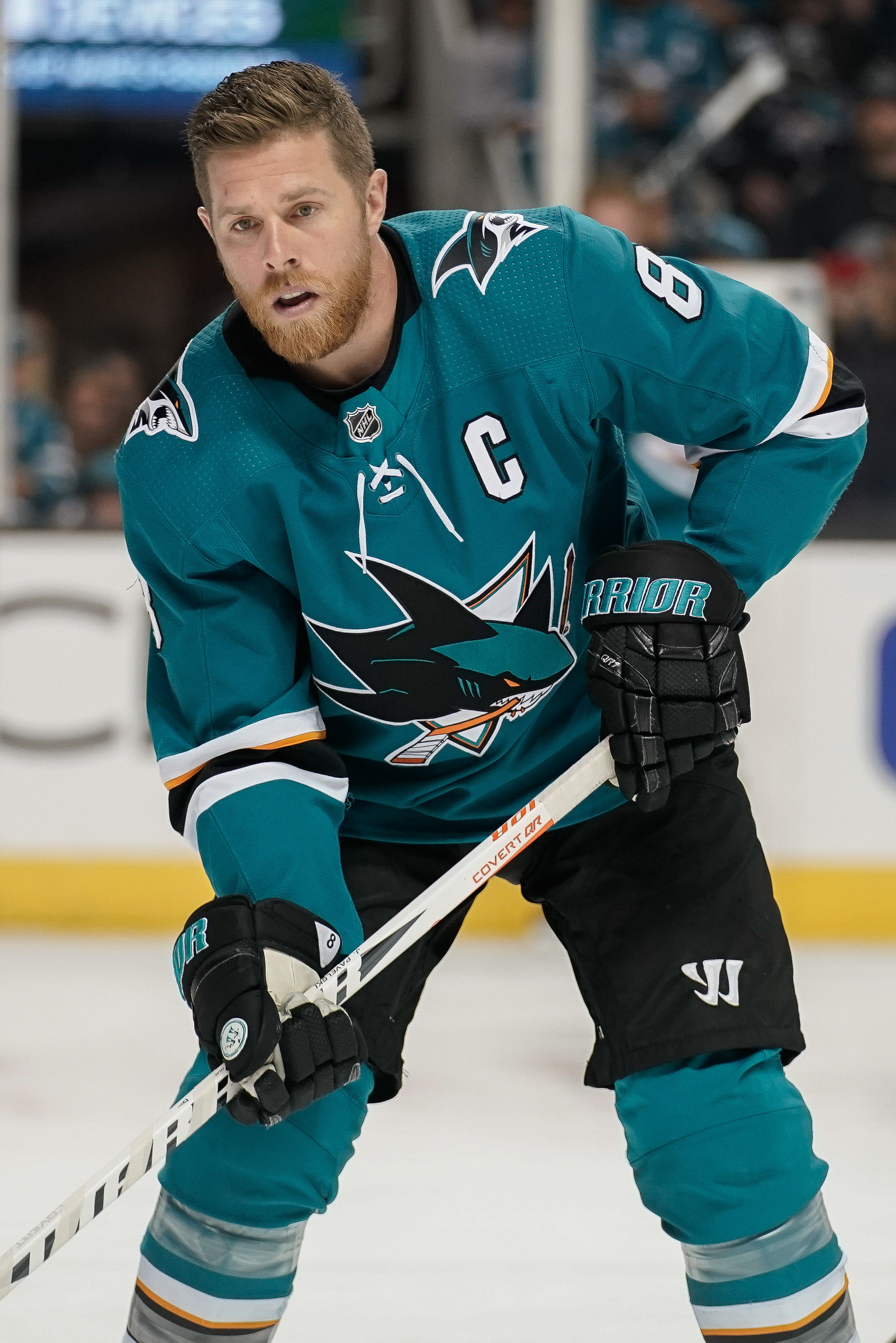
Much of the Sharks success in the next few years will come down to the play of Thornton and Pavelski, two players that have helped carry the team during their years of success. Both players are on their final year of their deal. Thornton signed a one-year deal and only time will tell whether he will continue that career at age 39. Despite suffering a torn MCL in January, he still posted solid numbers, scoring 13 goals and 36 points in 47 games. His days of posting 80 points are likely over, but if he can prove he can still produce, he could be back for several more one-year deals. Pavelski is another matter. The 34-year-old is starting to decline, but likely wants to ink one last long-term deal. While it makes sense that both sides will eventually come to an agreement, much is depending on the success that Pavelski has this season as well.
Donskoi shows improvement as well, posting a career-high 14 goals last season. His play improved to the point that he got some playing time on the first line as he generates shots as the team attempted 53.73 percent of five-on-five shots, while the team shot just 49 percent without him on the ice.Read more
Devils Notes: Schneider, Hischier, Smith, Hall
With New Jersey having made a significant jump in the Metropolitan Division, the Devils now must show that they can continue their success after 27-point increase in the standings and their first playoff berth since the 2011-12 season. The team was carried by Hart Trophy winner Taylor Hall and a group of young players who had a quick impact on the team.
However, the team accomplished all this with goaltender issues as 32-year-old Cory Schneider had a second disappointing season as he struggled with injuries throughout the year, while posting a 2.93 GAA and a .907 save percentage in just 40 games. The team got a great season out of backup Keith Kincaid, who helped the Devils reach the playoffs. However, if the team has any hopes of reaching the playoffs for a second-straight season, the team will need Schneider to be healthy-free and at the top of his game, according to Scott Billeck of NBC Sports.
In fact, there is hope that Schneider can bounce back after two disappointing years as a nagging hip injury was hopefully fixed this offseason when he underwent surgery. He is listed as questionable to start training camp and may miss the early portion of the season while recovering from surgery that has a five-month timeline.
- In another story, Billeck writes that the team can’t expect Hall to produce at another 93-point season like he did last year. If the team wants to return to the playoffs, they will have to rely on other players to pick up their games. After Hall, the team’s next best scorer was No. 1 overall pick Nico Hischier at 52 points, which is a big dropoff. The team will need better secondary scoring. Hischier could provide some of that as Billeck believes that Hischier could become a 70-point scorer in his second year, while the team has to hope that winger Marcus Johansson can bounce back to his 50-point averages after being limited to just 29 games last season.
- Mike Morreale of NHL.com writes that the team has several top prospects who could complement the team this year if they can prove themselves in training camp as 2018 first-round pick Ty Smith has a chance to earn a spot on a young blue line. He lists the team’s top five prospects, including Smith at No. 1, and while he believes that Smith will likely need another year in juniors, Smith still has a chance to win a spot on an improved, but hardly established blue line. He scored 73 points in 69 games for Spokane of the WHL last season and might be the perfect player to replace veteran John Moore, who left for Boston this offseason. Morreale also writes that the Devils should expect Michael McLeod and John Quenneville to make the teams next year.
- The Athletic’s Cory Masisak (subscription required) breaks down what the Devils could look like in the 2020-21 season and quickly assumes that New Jersey will lock up Hall to a long-term deal of more than $10MM. Hall has two years remaining on his current deal.
Poll: Can Connor McDavid Win The Art Ross Trophy For A Third-Straight Year?
The Edmonton Oilers went from a top performing playoff team in 2016-17 to a struggling franchise that didn’t even come close to earning a playoff spot last year. Quite a difference in years. Yet among all that went wrong last season, the team got the most out of their star player Connor McDavid, who captured the Art Ross Trophy for a second year in a row.
McDavid, who enters his fourth NHL season and first as the highest paid player in the league, posted 30 goals and 70 assists in the 2016-17 season for 100 points. He easily walked away with the Art Ross Trophy as the next closest were Chicago’s Patrick Kane and Pittsburgh’s Sidney Crosby with 89 points. Behind them was Washington’s Nicklas Backstrom with 86, as well as Boston’s Brad Marchand and Tampa Bay’s Nikita Kucherov who both had 85 points.
In 2017-18, despite a lesser team that struggled, McDavid’s numbers only got better as he posted 41 goals, 67 assists and 108 points, but the competition only increased as two other players broke the 100-point barrier, including Philadelphia’s Claude Giroux who had 102 points and Kucherov who went from 85 points to 100. Pittsburgh’s Evgeni Malkin (98 points) and Colorado’s Nathan MacKinnon (97 points) rounded out the top five. However, while five players in 2016-17 had 85 points or more, that number altered quite a bit last year as 15 players had 85 points or more, giving McDavid even more competition.
There are several players who could compete with McDavid this year, including Kucherov who continues to improve at 24. Hart Trophy winner Taylor Hall finished the season with 93 points, while MacKinnon, who is just 22, is also a young player who can still take his game to the higher level. Or could someone else take that next step?
So the question is, can Connor McDavid lead the league in points again?
Will Connor McDavid win the Art Ross Trophy (for most points in an NHL season) for a third-straight year?
-
Yes 70% (385)
-
No 18% (99)
-
Only if the Oilers get better 12% (65)
Total votes: 549
Pro Hockey Rumors app users, click here to vote.
The Case For Expanding NHL Rosters
Last week, the NCAA passed a rule change allowing hockey teams to dress 19 skaters per game. Rather than the typical 18-man lineup – six defensemen and twelve forwards (not including goalies) – each squad is now allowed an extra man that can be used at either position. The college level is after all a developmental league and the ability to expose another player to game action each night benefits the growth of a greater majority of the roster. Yet, this rule change is one that could also benefit the NHL. For a variety of reasons, the league should consider expanding the allowable number of players who may dress for a game.
The first, and perhaps the most glaring reason, to consider this change is that hockey is the only mainstream sport that doesn’t allow an extra player to enter the game that doesn’t fit neatly into the lineup. Yes, hockey does have a large roster of 18 skaters and yes the lines and pair do substitute one another all game long. However, consider football, which has 11 starters on offense and 11 starters on defense for a 22-man starting roster that also substitutes one another. Yet, NFL game day rosters are 46 men deep, more than double the amount of starters. The same goes for lacrosse (field lacrosse), a more similar game to hockey, as only nine men play in the field but the average active roster in the NCAA is 44 players, nearly five times the starting roster. Even soccer (11 men in the field) and baseball (nine batters) allow for multiple substitutes who weren’t a part of a rather large starting lineup. Why then should the NHL limit teams to using only the 18 skaters who fit nicely into four forward lines and three defensive pairs?
There is also the fact that the NHL has reached a point that it needs to accommodate more talent at both ends of the spectrum. Young players often don’t have an easy fit on a roster. Developing offensive forwards may not yet have the ability and awareness for a top-nine role, but they certainly can’t help the team or themselves on the checking line. Young defensemen may not be ready to play major minutes against elite talent at the top level, but that doesn’t mean they aren’t ready at all. With the league trending in a more youthful direction, teams could drastically improve their development of certain players if there was an alternate choice between giving a prospect a starting job, sitting him in the press box, or banishing him to the AHL or back to juniors. If teams could slowly bring along pro-ready prospects by giving them the “extra slot” that the NCAA has approved, limiting their ice time and situations but exposing them to NHL action, it would likely be a popular move. However, some teams may instead like to use that slot on a veteran specialist. Just look at the current free agent market: last week we identified more than 40 useful players still available, yet the results of our poll strongly predict that less than ten of those players will find NHL employment. That might not be the case if each team had an extra slot to fill with an experienced penalty-killing forward or power play quarterback for example. Each off-season, more and more capable veterans go unsigned while teams still have needs due to roster limits alone. These players would rather not retire or move overseas, but they have often outgrown the minor leagues as well. Being that spare part on an NHL club would be an optimum fit.
For more evidence on the overflowing talent in the NHL, see the Vegas Golden Knights. An expansion team filled with rejects, young and old, managed to make it to the Stanley Cup Final in their inaugural season and used 35 different players along the way. Even when the league likely adds another expansion team in Seattle in the next year or two, there will likely still be players – young and old – capable of playing in the NHL but without ample opportunity. Just by allowing one more player in the game each night, it will create more opportunities for many different types of players.
The easy way to refute the idea of expanding rosters is the salary cap. Expanding the number of players who dress for a game to 19 would likely mean expanding the roster limit to 24 players and thus increasing the salary cap ceiling in turn and the owners won’t go for that. Not so fast though; with the bulk of this off-season complete, CapFriendly projects that just six teams will enter the upcoming season with less than $2.4MM in cap space, the average NHL salary last season. Consider that the “extra man” will likely be an entry-level prospect or a discounted veteran and there is a case that nearly every team in the league (except for the St. Louis Blues) could add another player right now without touching the cap. Those that would rather push to the cap with just a 23-man roster would also be welcome to do so – the league mandates a maximum roster size, but not a minimum. Teams that carry the maximum 23 players on their roster already have three players that don’t dress each night and could simply make one of them the 19th man.
The NCAA seems to be on to something with expanding game day rosters in hockey. Most sports have this option and the NHL should too. While there is no underestimating the importance of chemistry to the game of hockey, having an alternate or strategic extra man makes a lot of sense. Be it a raw young player, a specifically-skilled veteran, a bench player there as an injury replacement, or even a playoff contender using the spot for a hired gun, there are many ways that an expanded roster could benefit prospect development, elongate careers, improve game play, and simply increase overall interest and excitement due to the strategy of it all. It’s time the league take a look at the possibility.
Central Notes: Fabbro, O’Reilly, Polak, Seguin
While Predators prospect Dante Fabbro is set to return to Boston University next season, he is not planning on pushing his way into free agency in 2020, notes NHL.com’s Robby Stanley. The team tried to convince the defenseman to turn pro this summer, but the 20-year-old wanted to stick around for his junior campaign.
“I’ve always said that I want to play in Nashville and I want to be a Predator,” Fabbro said during Predators development camp in June. “I honestly don’t think it’ll come to that, but a lot of things can happen. Nashville was my favorite team. So I have no reason to want to go somewhere else. With their record of developing defensemen in the League, I think it would definitely be a perfect fit for me. I’m excited to play here. I want to play here. It’s definitely going to be a dream come true if I can.”
He would be eligible to suit up in Nashville late in the year once his NCAA season wraps up which is a route a few teams have taken with their top prospects in recent years (including the Preds last year with winger Eeli Tolvanen) so that could certainly be an option come March or April.
- Evan Sporer of The Athletic (subscription required) writes that one side benefit from the St. Louis Blues trade to acquire center Ryan O’Reilly is his special teams skills. Those skills will be critical for the Blues, who finished 30th in the league in power play as they converted goals on just 15.4 percent of the time. One problem, according to Sporer, is that the team had trouble getting to star forward Vladimir Tarasenko. O’Reilly has the passing skills to make Tarasenko the focal point on offense. Most important, his ability to win face-offs will be critical to the team’s chances of making major improvements on their power play.
- The Athletic’s Sean Shapiro (subscription required) breaks down the play of veteran defenseman Roman Polak, who signed with the Dallas Stars this offseason. The 32-year-old blueliner has always been loved by coaches for his old-school style and excellent locker room demeanor, but his statistical breakdown always looks questionable and he outlives his usefulness. Regardless, Shapiro writes that he is a perfect fit in Dallas, who have two young defensemen in Miro Heiskanen and Julius Honka, who look NHL-ready, but if one of them isn’t, Polak is the perfect fill-in. Regardless, the veteran should provide much-needed mentoring to the young players.
- SportsDay’s Joshua Friemel breaks down the Tyler Seguin trade from five years ago and how the Dallas Stars stole away a franchise player for next to nothing from the Boston Bruins.
New Jersey Devils To Hire Mark Dennehy As AHL Head Coach
The New Jersey Devils have snatched a coach from the Pittsburgh Penguins organization, agreeing to terms with Mark Dennehy as head coach of their AHL affiliate. Dennehy had been hired earlier this offseason to lead the Wheeling Nailers of the ECHL, but was given permission to interview for the advanced position in the AHL. New Jersey AGM Tom Fitzgerald released a statement thanking the Penguins:
I want to thank Jim Rutherford, Bill Guerin, the Penguins’ organization and the Wheeling Nailers ownership group for the opportunity to speak with Mark on this position. Mark has spent considerable time building, coaching and recruiting in one of college hockey’s most competitive conferences. His experience will help him connect with players coming from the collegiate and junior hockey levels. Mark is extremely excited for a new challenge and to take the next step in his coaching career.
Dennehy has spent the last 13 years coaching Merrimack College, where he was tasked with developing young players and getting them ready for their transition into the professional ranks. He’ll be given a similar role with the Binghamton Devils, where the job is to get picks and prospects ready for their NHL futures while still maintaining a culture of winning.
Behind The Scenes Of The Jacob Trouba Arbitration Case
Arbitration cases rarely go through the hearing stage in the NHL, so for Jacob Trouba and the Winnipeg Jets to have reached this point in their negotiations – on the first scheduled day of hearing dates no less – is a major surprise. TSN’s Sara Orlesky reports that the two sides did in fact sit down for their hearing with the arbitrator and that a decision will be handed down in the next 48 hours. The Jets and Trouba have until that decision is made to agree to a deal on their own terms, likely a long-term extension, otherwise they will be stuck with a one-year deal and have to go through the process once again next summer.
So what exactly did it look like in the hearing today? Likely not what many would think. While the player and team are present during presentations to the arbitrator, neither team executives nor the player’s representation are in charge of arguing the case. The NHL Players’ Association handles the player side, while the teams use one of three lawyers to present their side: Dan Rabinowitz and Andre Nowakowski of Miller-Thomson in Toronto or Andre Lepage of BFC in Montreal. Each side makes their case based on briefs that they have previously filed to both the opposing side and the arbitrator, bringing in exhibits to support their arguments as well. The briefs contain the salary figures sought; the Jets reportedly filed at $4MM and Trouba at $7MM. It is a wide spread for the abitrator to consider and he may decide at or in between those figures.
What is the content of the arguments? Also somewhat contrary to what one may think, the two sides spend little time actually arguing the merits of the player, at least in absolute terms. The backbone of a salary arbitration case is the comparable players. For Trouba, the NHLPA would generally have comparable players that make $7MM or more to show that their filing number is fair, while the team reps will use comparable players around $4MM or less to prove their value. Each side will identify strengths or weaknesses to the player and find comparables that they can use to strengthen those points. The use of concrete search criteria to choose comparable players is key and often results in both sides tweaking their criteria ever so much that it includes only player who benefit their case. There are also rules regarding the players used: they must be current contracts, they must be recent contracts, and they must be contracts signed by a player who was or would have been an arbitration-eligible restricted free agent. Any deviation from this criteria would seriously injure the persuasiveness of the use of that comparable player. Other things that cannot be considered are off-ice behavior, even including something like Trouba’s previous contract holdout, or the team’s salary cap or roster depth status, which the Jets wish they could use in this case.
So who might be comparables in the Trouba case? The filing numbers for both sides suggest that there could be a wide range of possibilities. Using only the most basic metrics – games played and points-per-game – players like Justin Schultz, Colton Parayko, and Tyson Barrie lie right in the middle of the two values at $5.5MM and either side might struggle to use them effectively. Unfortunately for the NHLPA, those appear to be their best options. The case for any might be percentage of the salary cap rather than actual salary, given the major jump this off-season. Players like Torey Krug, Jared Spurgeon, Sami Vatanen and Dmitry Orlov would favor the Jets slightly more, but their home run option is likely a player like David Savard at $4.25MM.
After all the comparables have been presented, arguments have been made, and rebuttals and closing comments have been heard, the arbitrator will take his time to make the decision on just how much Trouba is worth based on everything he has witnessed. During that time, the two sides – who have also been enlightened to some extent – also come back together and talk contract terms. In recent years, hearings have more often than not led to independent agreements and not official decisions. Will it be the same for Jacob Trouba and the Winnipeg Jets? We will know soon enough.
Morning Notes: Chelios, Pacioretty, Forbes
Chris Chelios has left the Detroit Red Wings organization almost two decades, deciding to move back to Chicago and be closer to his family. Chelios has served in several different roles for the club since retiring from his playing career, but will now take a step back from the NHL life. He released a long statement, including this thank you to Red Wings fans:
To the fans in Detroit – I want to say thank you. You embraced me from day one. My experience in Detroit was a lot of fun and we definitely had some unforgettable times together. Just know that I won’t be a stranger. I plan on visiting the area whenever I can, especially now that my son, Jake, is playing in the Wings organization.
Jake Chelios was signed by the team earlier this offseason to play for the Grand Rapids Griffins, meaning there will still be a thread of the Hall of Fame defenseman in the organization. Though Jake isn’t expected to make a huge impact for the Red Wings, he’ll try to follow his father’s footsteps and bring a title to the organization—even if it’s a Calder Cup.
- Max Pacioretty has been in the rumor mill for quite some time, and in his latest mailbag for NHL.com Dan Rosen explains why he thinks the Montreal Canadiens’ captain will be traded before the season. An extension continues to be the sticking point when it comes to Pacioretty, as the Canadiens or any acquiring team wants him locked up long-term. That may not be in the best interest of the player though, who is just a year away from unrestricted free agency and coming off one of the worst seasons of his career. Waiting to see if he can bounce back and become the 30-goal man he was consistently in the past would certainly improve his market next summer.
- A grand total of zero NHL franchises made it onto Forbes’ top-50 most valuable organizations this year, with the Dallas Cowboys coming out on top with a $4.8B value. The Cleveland Browns bring up the rear at #50 with a $1.95B value, ahead of the New York Rangers‘ $1.5B valuation late last year. While this doesn’t necessarily indicate any troubles for the NHL, it does show just how far behind the league is still compared with some of the other sports leagues in the world. The NFL, NBA and MLB all have teams in the top-10, while several soccer clubs from around the world find themselves near the top.
Columbus Signs Defenseman Adam Clendening
The Blue Jackets continue to add to their defensive depth, now adding journeyman blue liner Adam Clendening to their ranks. The Athletic’s Aaron Portzline reports that it is a one-year, two-way deal for Clendening and adds that he will be paid $700K at the NHL level and $300K at the AHL level, with a $400K final salary guaranteed. Clendening is expected to compete for a job in Columbus with fellow new addition Tommy Cross and returning prospects Dean Kukan and Gabriel Carlsson.
Clendening, 25, is on his seventh NHL organization already and has never been able to secure a full-time role. Selected 36th overall in 2011, the former Boston University standout has just 86 NHL games under his belt and was allowed to walk into free agency when he went unqualified by the Chicago Blackhawks. Even if he doesn’t make an impact at the highest level for the Blue Jackets, Clendening is an excellent minor league defender that can put up big point totals and log huge minutes.
The Cleveland Monsters, Columbus’ AHL affiliate, have fallen on tough times recently and need help turning things around. After winning the Calder Cup in 2016, the team finished second-last in the entire league with just 25 wins. That included ranking in the bottom three in both goals for and goals against, something that Clendening will try to change next year.