
Mark Stone, Ottawa Senators Avoid Arbitration
With neither side really wanting to go through the arbitration process today in Toronto, Mark Stone and the Ottawa Senators have settled on a one-year contract. The deal will pay Stone $7.35MM this season, and carry him through to unrestricted free agency in the summer of 2019. The two sides cannot sign an extension until January. Our Brian La Rose projected this exact contract yesterday when he broke down the Stone arbitration case.
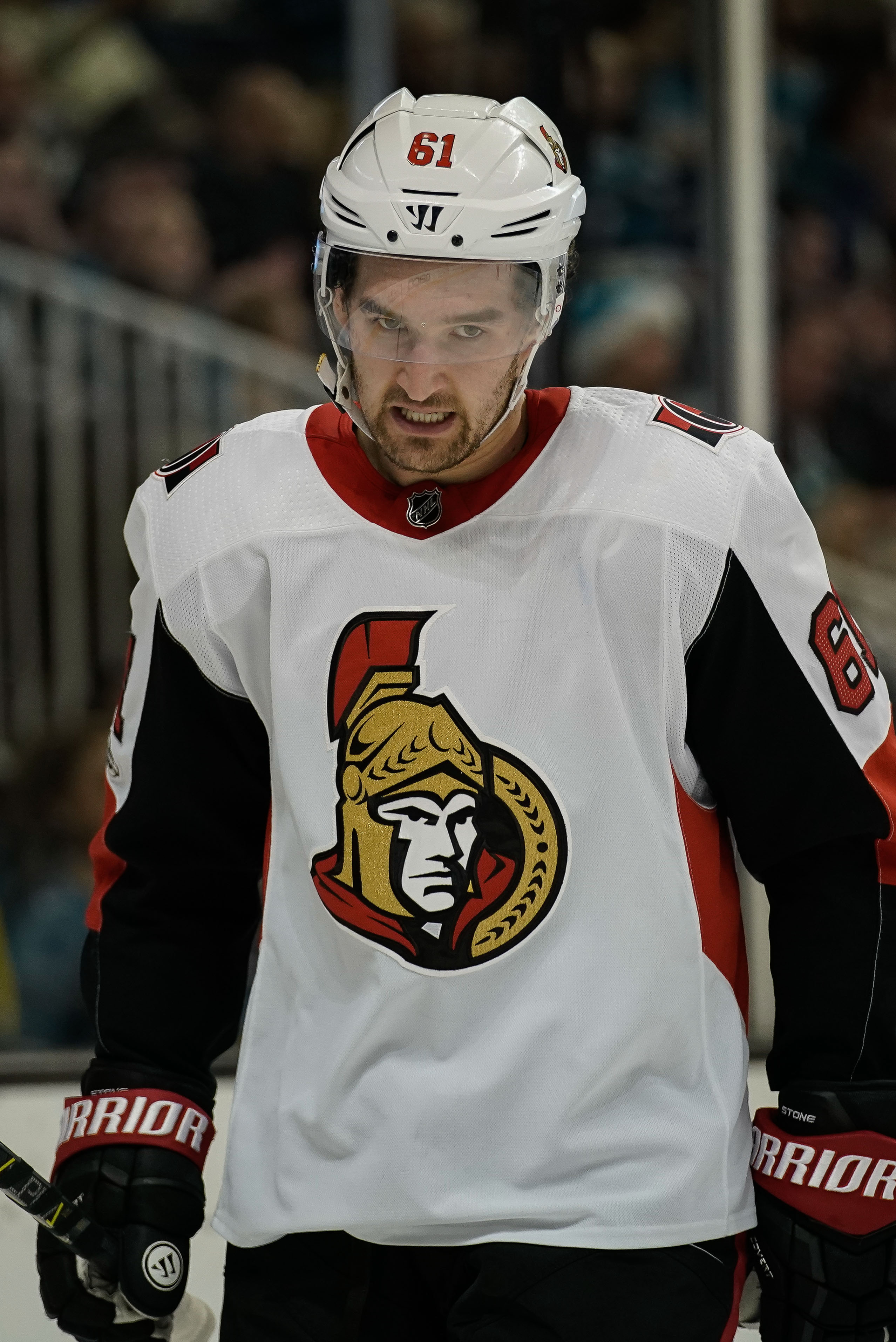 The 26-year old played just 58 games for the Senators last season, but was easily the team’s best forward registering 20 goals and 62 points. That point-per-game pace pushed Stone from a very good player to one of the league’s best, especially when combined with his trademark takeaway ability and solid defensive presence. Even with the limited number of games, he still earned Selke votes for the fourth consecutive year and led all Senators in takeaways.
For all the positive things Stone brings, a one-year contract will lead to immediate speculation about his future in Ottawa. The team is heading for a rebuild, and now all three of their best players are scheduled to become unrestricted free agents next summer. Stone, Erik Karlsson and Matt Duchene all have just one year remaining on their deals, making them prime trade candidates over the next few months. Even if things go better than expected during the first half of the 2018-19 season, the team still has to consider moving these big assets for whatever they can get, depending on whether they’re willing to sign a long-term extension. Though it’s unclear if Stone would even re-enter negotiations, the fact that the two sides couldn’t come to an agreement this summer only puts creates more pressure down the road.
The Senators will have a two-month window to sign Stone at the beginning of 2019 before facing the trade deadline. If he remains unsigned, you can bet there will be dozens of teams clamoring to get a piece of him as a playoff rental with a chance to re-sign him to a long-term deal. Evander Kane, Paul Stastny and others set the market this season, but Stone is a more effective offensive piece than either of them and could bring back a bigger package should his contributions on the ice continue this season. As one of only a few top-end options in Ottawa, it wouldn’t be surprising to see him receive more than 20 minutes a night once again.
Those first line minutes shouldn’t come as a surprise now that Stone carries such a huge salary. His new contract makes him the 24th-highest paid forward in the league for 2018-19, putting pressure on him to perform as the best player up front for Ottawa. It also means that a long-term extension would be incredibly pricey, something that the Senators may just not have the money for. Remember this was a restricted free agent year still, which usually comes in at a lower price than the player would be demanding on the UFA market. If Stone wanted an even bigger cap hit for seven or eight years, Ottawa might have to back out of negotiations purely from a financial standpoint.
Photo courtesy of USA Today Sports Images
Arbitration Breakdown: Mark Stone
While the Senators have already gone through one arbitration hearing this week with defenseman Cody Ceci, they’re on the verge of needing to do so with winger Mark Stone as well as his hearing is set for Friday morning. The pre-hearing filings were exchanged on Wednesday with Ottawa offering $5MM and Stone asking for $9MM. This has the potential to be a record-setting award so let’s take a closer look at this case.
The Numbers
Over the past four seasons, the 26-year-old has been pretty consistent offensively. He has scored at least 20 times in each of those years and has had between 54-64 points in those seasons as well. That type of production lines up with a high-end second liner or quality top liner.
However, 2017-18’s numbers have to be looked at a little closer. Stone posted 62 points (20-42-62) last year but did so in only 58 games. In other words, he played at an 88-point pace which ranked 14th league-wide among qualifying players. That would put him in the high-end front liner range which likely has played a big role in his asking price.
The Senators haven’t hesitated to use Stone in all situations. He led the team in ice time by a forward by a sizable margin (while ranking 11th league-wide) and averaged more than three minutes per night on the power play with a couple of shorthanded shifts as well.
With that in mind, it’s going to be difficult for Ottawa to argue that Stone deserves to be paid like a second-line player when their own usage of him is considerably different not to mention his big jump in points per game last season.
Potential Comparables
Comparable contracts are restricted to those signed within restricted free agency. For this exercise, I’ve taken it a step further and restricted this list to deals inked with arbitration eligibility which takes post-ELC deals like Nathan MacKinnon, Mark Scheifele, and Vladimir Tarasenko off the table.
Jonathan Huberdeau (Florida) – Huberdeau signed his current deal that carries a $5.9MM cap hit (4.45 cap hit percentage) after a 59-point season and was viewed as the time as someone that could be a top line player but would be even better on the second line. That seems to be what Ottawa is going for here so it wouldn’t be surprising if they’re citing this deal as a comparable although it seems fair to say that this comparable is going to be on the low end.
Ryan Johansen (Nashville) – Johansen inked an eight-year, $64MM deal (10.67 cap hit percentage) coming off a three-year bridge contract which is the same situation as Stone is currently in. At that time, he had four seasons of 60 or more points under his belt so Ottawa could try to argue that Johansen’s track record offensively is better. However, Johansen hasn’t gotten particularly close to the point-per-game mark that Stone passed last season either.
Ryan O’Reilly (St. Louis) – While Stone isn’t elite at the faceoff dot like O’Reilly ($7.5MM AAV, 10.5 cap hit percentage) is, the similarities are fairly strong otherwise. At the time the deal was signed, O’Reilly was coming off seasons of 64 and 55 points and his production since then has ranged between 55-61 points which is right in Stone’s range as well. On top of that, they’re both well-regarded as two-way forwards.
Blake Wheeler (Winnipeg) – While Wheeler’s contract ($5.6MM AAV, 8.71 cap hit percentage) is now viewed as a bargain, the fact he’s significantly outperformed the contract since he signed it back in 2013 doesn’t really matter much. At the time of the deal, Wheeler only had one 60-point year under his belt (although he played at that pace in the lockout-shortened year as well). His cap hit is close to Ottawa’s submission but once you factor in the increase in the salary cap since then, the value in today’s dollars is just shy of $7MM.
Projection
The awards thus far have been right down the middle of the filings and there’s a decent chance that will be the case here as well. It may be a bit tough for Stone to get the 10% or higher that Johansen and O’Reilly got as he doesn’t play the premium position they do either. It will also be difficult for the arbitrator to really assess the season Stone just had – is that a sign of things to come or the statistical outlier? Given that he has been closer to a 0.8 point-per-game average for the better part of his career, I think the arbitrator may skew a little more conservatively here.
Could this award (if it gets that far) set the record for the biggest one ever, surpassing Shea Weber’s $7.5MM? It could, but I don’t think it will. The cap percentage for that deal was 11.66 which is higher than what Stone’s probably going to get.
That said, Stone has a shot at setting a new award record for a forward ($7MM for John LeClair in 2000). It wouldn’t be surprising to see the award come in between the filings midpoint of $7MM and Weber’s record award. I think if Stone had put up a second season of close to point-per-game production, an award closer to $8MM would have been a legitimate possibility. Instead, a one-year, $7.35MM contract (9.25 cap hit percentage) feels like a reasonable projection, one that lines him up for unrestricted free agency next summer and a whole lot of trade speculation between now and then.
Photo courtesy of USA Today Sports Images.
Mark Stone, Ottawa Senators Exchange Arbitration Numbers
The Ottawa Senators have an arbitration hearing today with Cody Ceci to decide on a contract for next season, but the offseason doesn’t end there for them. Mark Stone, who is scheduled for a hearing of his own on Friday, has exchanged arbitration filings with the team. According to Elliotte Friedman of Sportsnet, Stone has asked for $9MM while the team has countered with $5MM. As always, the decision will likely come somewhere in the middle of the two numbers, though as Friedman points out that could still make this a record-breaking case. Shea Weber‘s $7.5MM award in 2011 is currently the highest ever given through arbitration.
Stone, 26, can only be awarded a one-year deal in arbitration as he is just a single season away from becoming an unrestricted free agent. That freedom could be enticing to a player who has developed into one of the best two-way wingers in the league, and is coming off a season in which he scored at better than a point-per-game pace. His 62 points in 58 games for the Senators tied him with Erik Karlsson for the team lead, while recording his fourth consecutive 20+ goal campaign. Stone also possesses an almost unmatched ability to create turnovers and strip opposing players of the puck, which has led to Selke votes in each of his four full seasons.
Even accounting for the normal arbitration practice of asking for much more than you expect to be awarded, the $9MM figure will shock some people. Only nine forwards in the entire NHL will have a cap hit of $9MM or greater for the 2018-19 season, and though an exceptional player Stone is still not in the upper echelon of NHL stars. Even if the decision lands right in the middle at $7MM, he’ll vault into the top-30 highest paid forwards in the league and set himself up for a huge contract next summer. Whether that contract comes with the Senators isn’t clear.
Last month we asked whether the Senators should trade Stone, given that he is just a year away from unrestricted free agency and the team looks like it may struggle this season. Our readership was split 55-45 in favor of a move, which may be indicative of the hesitation GM Pierre Dorion would feel. Stone can be a leader in whatever turnaround is coming in Ottawa, and is still young enough to have several prime seasons remaining after 2018-19. If the team could work out a long-term extension with him in the next few days, perhaps there would be a little bit of hope for the Senators this season. If not, a one-year award would also bring with it restrictions on negotiating extensions. Players on one-year contracts cannot discuss or sign an extension until January, at which point Stone would be just a few months away from testing the open market. The trade deadline would also be right around the corner, forcing the Senators to make a quick decision on whether they had a real shot at retaining their talented winger.
Remaining Restricted Free Agents
We’re getting closer to turning the calendar over to August, and there is still a lot of work to do for teams around the NHL. 10 arbitration cases remain unsettled, including for star players like William Karlsson and Mark Stone. Both will be extremely interesting to follow, as their respective teams have tough decisions on their hands.
For the Vegas Golden Knights, do you hand out a long-term expensive contract to a player that is still relatively unproven. Though Karlsson scored 43 goals this season he had just 18 career tallies beforehand, and finished this season with an impossible 23.4% shooting percentage. There is almost no chance that he can maintain that rate going forward, meaning his huge 2017-18 season may be a career-high. On the other side of that coin though is the increased opportunity he was given after switching teams, which could provide a realistic chance for him to be a 30-goal, 65-point player going forward. Signing him now would likely get you a bit of a discount on that type of scoring threat, though Vegas would assume almost all of the risk.
In Ottawa, there’s no clear direction on how the team will deal with Stone’s impending unrestricted free agency. Obviously one of the team’s most talented players, an arbitration award of one year would stop the Senators from negotiating with Stone’s camp until January on any potential extension and could make him a prime trade candidate. The 26-year old posted his fourth consecutive 20-goal season in 2017-18 despite playing in just 58 games. With all the turmoil in Ottawa it could be difficult to convince him to stick around long-term.
Beyond the arbitration cases though there is an incredible amount of talent left on the RFA board. Dylan Larkin, William Nylander, Sam Reinhart, Shea Theodore, Josh Morrissey and many others remain unsigned and could all be looking at expensive long-term deals with their respective clubs. These players are already excellent players in the NHL before they’ve even become eligible for arbitration and could really grind the offseason to a halt if they decide to hold out. There’s no indication that anyone is planning a long negotiation, but we’re now almost a month into the signing period without any deals.
Below is the full list of unsigned restricted free agents:
Ondrej Kase (ANA)
Nick Ritchie (ANA)
Marek Langhamer (ARZ)
Sam Reinhart (BUF)
Noah Hanifin (CGY)
Garnet Hathaway (CGY) – Scheduled for arbitration, July 30
Hunter Shinkaruk (CGY)
Patrik Nemeth (COL) – Scheduled for arbitration, August 4
Gemel Smith (DAL) – Scheduled for arbitration, August 1
Dylan Larkin (DET)
Matt Puempel (DET)
Darnell Nurse (EDM)
Michael McCarron (MTL)
Kerby Rychel (MTL)
Miikka Salomaki (NSH) – Scheduled for arbitration, August 2
Kevin Rooney (NJD)
Steven Santini (NJD)
Miles Wood (NJD)
Kevin Hayes (NYR) – Scheduled for arbitration, August 2
Ryan Spooner (NYR) – Scheduled for arbitration, August 4
Cody Ceci (OTT) – Scheduled for arbitration, August 1
Mark Stone (OTT) – Scheduled for arbitration, August 3
Robert Hagg (PHI)
Jordan Schmaltz (STL)
William Nylander (TOR)
William Karlsson (VGK) – Scheduled for arbitration, August 4
Shea Theodore (VGK)
Eric Comrie (WPG)
Nicolas Kerdiles (WPG)
J.C. Lipon (WPG)
Josh Morrissey (WPG)
Nic Petan (WPG)
Poll: Should The Ottawa Senators Trade Mark Stone?
The Ottawa Senators have just two weeks to sign Mark Stone before an arbitrator awards a one-year contract that would send him to unrestricted free agency in the summer of 2019. His hearing is scheduled for August 3rd, after which there will still be a short window to get a deal done before the one-year deal is awarded. Getting him signed to a multi-year contract appears to be a priority, but what if the team can’t get him to sign this summer?
If Stone makes it to the arbitration award and the Senators decide not to walk away from it, it would put them in an interesting situation. He wouldn’t be eligible to sign an extension—or even discuss one—until January 1st, 2019 since he’s on a one-year deal, which would also put him just a few months from the end of the season and a potential bidding war for his services on the open market. After all, Stone has developed into one of the most consistent two-way wingers in the NHL and put up 62 points in just 58 games during the 2017-18 season. His ability to create turnovers and strip unsuspecting players of the puck is almost unmatched around the league, and he can be used in many different offensive roles depending on the situation. Though there are other top forwards scheduled for free agency next offseason, Stone would be right among them as one of the top options available.
So, if there is any indication that Stone won’t sign a multi-year contract in the next two weeks should the Senators consider trading him? The team has already lost Mike Hoffman this summer to the Florida Panthers, and traded Dion Phaneuf at the deadline to free up some cap space last season. If it’s to be believed that captain Erik Karlsson is the next one out the door, what is left for Stone to accomplish this season for the club? The Senators aren’t expected to compete for the playoffs let alone the Stanley Cup, and could be several years away from contention given that they also owe their 2019 first-round pick to Colorado for Matt Duchene—who is also scheduled to become an unrestricted free agent in 2019. Would moving Stone following his arbitration hearing be the ideal time? Should the team be considering it even if they can work out a multi-year deal with their 26-year old forward? Or is waiting to see how the team reacts this year the best option?
Cast your vote below and explain how you’d be approaching the situation in Ottawa if you were GM Pierre Dorion. Is Stone part of the turnaround, or just an asset to get a head start on the incoming rebuild?
Should the Ottawa Senators trade Mark Stone?
-
Yes 56% (538)
-
No 44% (429)
Total votes: 967
[Mobile users click here to vote!]
Full 2018 Arbitration Hearing Schedule
Almost four dozen players decided to file for salary arbitration this summer, and while some of them have already been signed to contracts many others now know when their hearing will take place. The NHLPA released the full schedule of hearings, spread out from July 20th to August 4th. Remember that players can sign up until an arbitrator awards a contract, including in the short window after the hearing.
July 20
Jacob Trouba – Team filing: $4.0MM, Player filing: $7.0MM. Awarded one-year, $5.5MM contract.
July 23
Brett Kulak – Team filing: $650K, two-way contract, Player filing: $1.15MM, one-way contract. Awarded one-year, $850K contract.
July 24
Brandon Montour – Team filing: $1.5MM, Player filing: $4.5MM Settled before hearing, two years $6.775MM
July 30
Garnet Hathaway – Team filing: $650K, Player filing: $975K Settled before hearing, one-year $850K
August 1
Cody Ceci – Team filing: $3.35MM, Player filing $6.0MM. Awarded one-year, $4.3MM contract.
Gemel Smith – Team filing: two-way contract, Player filing: $900K. Awarded one-year one-way, $720K contract.
August 3
Mark Stone – Team filing: $5.0MM, Player filing $9.0MM Settled before hearing, one-year, $7.35MM
August 4
William Karlsson – Team filing: $3.5MM, Player filing $6.5MM
Remaining 2018 Arbitration Dates
As usual, arbitration hearings scheduled for later this month have been getting cancelled every day as teams lock up their restricted free agents. Hearings are scheduled each year between July 20th and August 4th, but we’ve already seen 18 players that filed for player-elected salary arbitration reach a settlement with their respective teams. Those players are listed below, with their contract details:
Elias Lindholm (CGY) – 6 years, $4.85MM AAV
Trevor van Riemsdyk (CAR) – 2 years, $2.3MM AAV
Matthew Nieto (COL) – 2 years, $1.98MM AAV
Devin Shore (DAL) – 2 years, $2.3MM AAV
Joel Armia (MTL) – 1 year, $1.85MM AAV
Phillip Danault (MTL) – 3 years, $3.08MM AAV
Blake Coleman (NJD) – 3 years, $1.8MM AAV
Stefan Noesen (NJD) – 1 year, $1.73MM AAV
Jimmy Vesey (NYR) – 2 years, $2.28MM AAV
Taylor Leier (PHI) – 1 year, $720K AAV
Alex Lyon (PHI) – 2 years, $750K AAV
Jamie Oleksiak (PIT) – 3 years, $2.14MM AAV
Dmitrij Jaskin (STL) – 1 year, $1.1MM AAV
Oskar Sundqvist (STL) – 1 year, $700K AAV
Colin Miller (VGK) – 4 years, $3.88MM AAV
Liam O’Brien (WSH) – 1 year, $650K AAV
Connor Hellebuyck (WPG) – 6 years, $6.17MM AAV
Tomas Nosek (VGK) – 1 year, $962.5K AAV
The remaining arbitration schedule looks like this:
July 20
Chris Tierney (SJS)
Jacob Trouba (WPG)
July 22
Adam Lowry (WPG)
July 23
Brett Kulak (CGY)
Mathew Dumba (MIN)
July 24
Brandon Montour (ANA)
July 25
Joel Edmundson (STL)
Brandon Tanev (WPG)
July 27
Mark Jankowski (CGY)
July 28
David Rittich (CGY)
Jason Zucker (MIN)
July 29
Troy Stecher (VAN)
July 30
Garnet Hathaway (CGY)
MacKenzie Weegar (FLA)
Marko Dano (WPG)
July 31
Brady Skjei (NYR)
August 1
Cody Ceci (OTT)
Gemel Smith (DAL)
August 2
Miikka Salomaki (NSH)
Kevin Hayes (NYR)
August 3
Mattias Janmark (DAL)
Mark Stone (OTT)
Brock Nelson (NYI)
August 4
Ryan Spooner (NYR)
Patrik Nemeth (DAL)
William Karlsson (VGK)
Salary Cap Floor Should Not Pose Problems For Any Team In 2018-19
The purpose of the salary cap in the NHL is to maintain a sense of competitive balance across the league. That means both limiting how much a team can spend, the salary cap ceiling, but also ensuring that every team is competitive with a minimum expenditure, the salary cap floor. Some teams, generally those in smaller markets or undergoing rebuilds, tend to try to toe the line of the salary cap floor, paying as close to the minimum as possible for their roster. In years past, some teams have even struggled to hit that mark, taking on injured players or overpaying players in order to pass the floor. It’s unlikely that any of the 31 franchises will face that problem in 2018-19.
This season, with a corresponding jump in the salary cap ceiling, the floor moved to $58.8MM. With the bulk of unrestricted free agency accounted for, just three teams currently sit below that mark: the New Jersey Devils, New York Rangers, and Winnipeg Jets. However, both the Rangers and Jets can immediately be crossed off as a salary floor concern. The pair are perhaps the two teams with the most potential salary tied up in salary arbitration this off-season.
The Jets currently have the lowest projected payroll in the league, with a 16-man roster that accounts for approximately $52.7MM. However, Winnipeg’s list of restricted free agents who have filed for arbitration include Vezina candidate Connor Hellebuyck, defenseman Jacob Trouba, and forwards Adam Lowry, Chris Tanev, and Marko Dano, as well as defenseman Tucker Poolman who did not file. Those six players could easily combine for more than $20MM in combined salary when all is said and done, putting the Jets well clear of the floor and closer to the ceiling. Defenseman Josh Morrissey, who is not arbitration eligible also needs a new contract. Winnipeg is far from a floor concern.
In New York, the Rangers sit at $55.8MM in projected cap committed to 16 players, just $3MM shy of the floor. They also need to re-sign a majority of their young core, with forwards Kevin Hayes, Ryan Spooner, and Jimmy Vesey and defenseman Brady Skjei having filed for arbitration. The Rangers could pass the floor by extending just one of those players, nevertheless all four. New deals for those three forwards still leaves New York one or two shy of a full roster as well, meaning more salary will come into the fold via promotion or an additional acquisition.
As for the Devils, New Jersey is already close to the floor at a projected $56.4MM for 19 players. Forwards Blake Coleman and Stefan Noesen have filed for arbitration and the deals for both could be enough to push the Devils to where they need to be. Even if it doesn’t, the team will still need to sign non-arbitration eligible RFA’s Miles Wood and Steve Santini, whose deals should definitely be enough. New Jersey will likely be a team that hovers close to the floor next season; that didn’t stop them from making the playoffs in 2017-18, though.
Perhaps the only team who should be legitimately concerned about the salary cap floor next season in Ottawa. The Senators and owner Eugene Melnyk have made it no secret that they are trying to shed salary and come in as close to the minimum as possible. Right now, the team sits just $3MM above the floor at a projected $61.8MM roster for 20 players. However, that isn’t including the arbitration resolutions for both defenseman Cody Ceci and forward Mark Stone. Those two deals will put Ottawa well above the floor. Even if the team was to trade star defenseman Erik Karlsson, they should remain above the floor, especially with additional salaries likely to be added in the trade return. The one scenario in which Melnyk could succeed in dropping significant salary would be if both Karlsson and Bobby Ryan were to be traded away. The resulting $13.75MM loss in payable salary would more than offset the contracts for Stone and Ceci and likely the contracts of those players coming back as well, potentially dropping the team below $58.8MM. Yet, even in that case, the Senators’ efforts to fill out their roster after losing Karlsson and Ryan – either by promotion or acquisition – could easily be used to get back to that mark.
The salary cap floor was never intended to be used as a target for teams to hover above and spend as little as possible. The goal of the NHL is have each and every team be competitive, not simply trying to maximize profits. As such, the 2018-19 season has some parity promise as seemingly no team will struggle to get over the floor or have to use contracts for the old and injured to get there. For the first time in years, every team seems set to be competitive and comfortably over the minimum cap hit.
All cap figures are courtesy of CapFriendly.com.
Snapshots: Offer Sheets, Wideman, Bergevin
The NHL has restricted free agency for a reason, but instead of it being a way for talent-deprived teams to sign away top young players, offers sheets are ignored and never used. The last offer sheet signed was five years ago when Ryan O’Reilly signed an offer sheet with the Calgary Flames in 2013 and there have only been eight offer sheets signed in the salary cap era.
After all, with a weak unrestricted free agent class this season, teams would benefit if they had an equally good chance at competing for restricted free agents. This year’s restricted free agent class is quite impressive. Led by Vegas’ William Karlsson, Ottawa’s Mark Stone, Winnipeg’s Jacob Trouba and Toronto’s William Nylander, teams should be making a move on some of these players.
Sportsnet’s Sean McIndoe writes the main reason for the lack of offer sheets comes down to the compensation that is returned if a team allows a team to leave. The scribe writes that the compensation is not good enough and forces teams to sign their restricted free agents regardless of their cap situation. He points out that the compensation looks impressive when dealing with a player that makes more that $10.15MM per year. A team that signs a restricted free agent in that bracket would receive four first-round picks. Unfortunately, few players are in that salary bracket unless your name is Connor McDavid. If he was a restricted free agent, any team would give up four first-rounders for McDavid.
If the NHL wants to improve on restricted free agency, then they must double the compensation so teams really need to think about whether they would rather have that player or let him go and take the compensation package. Unfortunately right now, no team wants the compensation package.
- Bruce Garrioch of the Ottawa Sun writes that unrestricted free agent Chris Wideman said that he wants to return to the Ottawa Senators next season, but isn’t sure he’s in the team’s plans for next season. The 28-year-old defenseman said he talked to general manager Pierre Dorion recently and was told that the organization had other matters to attend to before addressing whether they plan to bring him back. Wideman missed most of the season last year after having surgery in December to repair a torn hamstring after Pittsburgh’s Evgeni Malkin fell on him on Nov. 16. Used as a depth defenseman for his three years in Ottawa, he averaged a career-low 11:33 of ATOI in 16 NHL contests, despite putting up eight points in that time period.
- Stu Cowan of The Montreal Gazette writes that general manager Marc Bergevin said today that the team is willing to trade the No. 3 pick in the NHL Entry Draft. “I’ll listen, I’m open,” Bergevin said. “I’ve told teams if they want to make me an offer, I’ll look at it. But again, sometimes teams don’t want to move up. As much as a team wants to move back or move up, if there’s no takers or buyers then you just sit where you’re at.”
Free Agent Focus: Ottawa Senators
Free agency is now a little more than a month away from opening up and there are quite a few prominent players set to hit the open market while many teams have key restricted free agents to re-sign. Here is a breakdown of Ottawa’s free agent situation.
Key Restricted Free Agents: D Cody Ceci – While Ceci may not be universally loved by the traditional scouting or analytics community, his role on the Senators is clear. He’s expected to anchor the shutdown second pair and allow Erik Karlsson‘s unit to play more offensively against weaker competition. Ceci logged over 23 minutes a night last season, easily registering more short-handed time than any other player for the Senators. His 2:46 of penalty killing time every night was a minute more than any defenseman expected to be with the club next season, with only Dion Phaneuf (now with the Kings) and Johnny Oduya (free agent) closer than Ben Harpur‘s 1:43 average.
That’s a heavy load for Ceci under noted defensive coach Guy Boucher, and one that has limited any offensive upside he showed as a young player. Ceci recorded just 19 points last season, with only 14 of those coming at even-strength. That doesn’t give him a lot of firepower when going into contract negotiations, as defensive metrics are harder to argue. Still, he should see a raise on the $2.8MM he earned in 2017-18, especially if he signs long-term. Ceci is on track to become an unrestricted free agent in the summer of 2020 since he started his career so young, meaning anything longer than a two-year contract will be buying out UFA years.
F Mark Stone – Though Ceci is important, it all comes down to Stone this summer for the Senators as they look to lock up their best offensive player. Any contract Stone signs will send him to unrestricted free agency at its conclusion, meaning both sides will probably be looking for a long-term deal. The 26-year old is coming off arguably his best season even though he played in just 58 games due to injury, as he was more than a point-per-game player during those contests. With 62 points on the year he registered his fourth consecutive 20+ goal, 50+ point season and is one of the league’s top takeaway artists, able to strip the puck from unsuspecting defensemen with ease.
Nearly everyone that watches the Senators on a regular basis realizes that Stone is an elite player in the NHL, but unfortunately for the club (and their frustrated ownership) that doesn’t necessarily mean that he’s very well-known around the league to fans of other teams. That might help them in negotiations, as his lack of All-Star notoriety may keep his cap hit relatively reasonable. After earning an average of $3.5MM for the past three seasons, it’s not out of the question that he could double his salary should he sign long-term, and end up with a contract like Evander Kane‘s recent seven-year, $49MM deal.
Other RFAs: D Fredrik Claesson, G Chris Driedger, F Nick Moutrey, F Nick Paul
Key Unrestricted Free Agent: D Chris Wideman – If Ceci has been overused in his time in Ottawa, the opposite could be said for Wideman who despite good possession statistics and excellent offensive pedigree has averaged just under 14 minutes a night during his Senators career. This season was even more disappointing for the 28-year old defenseman, as he tore his hamstring in November and played only 16 games all year. He had eight points in those 16 contests, showing off the ability that made him a 61-point player in the AHL in 2014-15, but never could return before the end of the year despite his hard rehab schedule.
Wideman seems like he’s destined to go unsigned by the Senators, unless of course they’ve made the decision to trade Karlsson after all. If they do end up moving their captain, bringing back a good puck-moving right-handed defenseman like Wideman makes a lot of sense. Otherwise there isn’t a lot of room for him on a club that looks like it will have at least six NHL defensemen already under contract. Perhaps since he missed most of the season Wideman wouldn’t be looking for much of a raise on his $800K salary from 2017-18, but with the free agent market thin on talent from the right side there ought to be plenty of suitors for his services come July 1.
Other UFAs: F Tyler Randell, F Mike Blunden, F Max Reinhart
Projected Cap Space: Ottawa only has around $60MM committed for next season, and with the cap ceiling expected to climb to something around $80MM there is plenty of room for Stone and Ceci to be re-signed without hamstringing the team on the free agent market. That said, the Senators have never been a team to spend heavily on big name free agents and have an owner that sets an internal budget separate from the league’s cap. After a season at the bottom of the league without playoff revenue, it’s not clear how flush with cash the Senators will be this summer.
Photo courtesy of USA Today Sports Images