
Tavares To Toronto Highly Unlikely
Although it seems to occur every time a high-profile free-agent could hit the market, Toronto media have once again conjured a dream of landing a superstar. John Tavares is experiencing major difficulty in coming to terms with the New York Islanders, primarily because of the uncertainty of their arena situation. The team needs to prove that they are both competitive and can secure a home for the foreseeable future. Enter Toronto, who believes that the contract negotiation difficulty automatically propels them into a top-3 competitor for Tavares’ services. If this story may sound familiar, that’s because it occurred just last off-season when Steven Stamkos was stalling his new deal with Tampa Bay.
Toronto inarguably is in a far superior negotiating position than they were in 2016. They’ve made the playoffs and took the Washington Capitals to their limits, and flaunt a young core who established itself as dominant quite before most believed possible. Given another season of success, the Leafs could be serious contenders for any UFA on the market. That said, a Tavares signing would be absurdly difficult and ultimately impractical for a multitude of reasons. The Leafs’ fanbase is already (rightfully) fretting over the difficulty of keeping Mitch Marner, Auston Matthews, and William Nylander together while staying under the cap ceiling. Each player will command hefty money on long-term deals, and the best case scenario (cap-wise) is that one of the three might have a “down” statistical year.
Even ignoring those future contracts, Toronto already made matters more complicated by signing Patrick Marleau to a 3-year contract worth $6.25 MM AAV. Assuming that the team keeps one or two of James van Riemsdyk, Leo Komarov, and Tyler Bozak (all UFAs in 2018), they will have precious room to devote to Tavares beyond 2018-19. After that point, Matthews and Marner will both be on new deals with heavy cap hits. Craig Button of TSN suggests that the Leafs could offer Tavares a one-year deal, but there is little to no security in such an arrangement. If the Islanders are unable to move Tavares or simply fall short of securing a new contract, Tavares will be likely seek a long-term arrangement. His primary stated concern at present is security, and a one-year contract elsewhere certainly doesn’t achieve said goal.
By signing Marleau, the writing for Toronto fans should have been clear and visible. Still, the Tavares hope persists. It’s not impossible that Tavares could sign a long-term contract in Toronto, but it would take a major roster overhaul to achieve. One of Marner or Nylander would necessarily need to depart, and the amount of money spent on the offense would only increase further. It seems likely that GM Lou Lamoriello will simply build upon the core that has been so successful without gutting the progress made. It would be unrealistic to expect Lamoriello to not at least inquire about Tavares if he indeed hits unrestricted free agency, but it would require a major organizational commitment without any real certainty in the matter. Tavares will receive a long-term contract, whether it is from New York or another franchise, but as of now the Leafs are not in a position to extend such an offer.
Upcoming UFA Goaltenders With Something To Prove
Next year’s goaltending UFA crop may lack star power, but it does contain many interesting potential rehabilitation projects. This season provides those pending UFA goaltenders with an opportunity to turn things around and show teams that they are worth more than their current reputation belies. Whether it’s a former starter regulated to backup duties, or an aging veteran with just enough left in the tank, the following goaltenders can significantly improve their stock going into unrestricted free agency.
Jonathan Bernier – Colorado Avalanche – $2.75MM
The Colorado Avalanche signed the former Toronto Maple Leafs starter to a one-year deal worth $2.75MM this season to back up presumed starter Semyon Varlamov. Varlamov struggled last season, dealing with injuries and his worst stat line in his career. The Avalanche hope that Bernier can provide steady goaltending if Varlamov continues to slide or cannot shoulder a full starter’s load. If Bernier steps up and performs admirably, he could be in line for a starters position during the offseason. Last season saw Bernier player with the Anaheim Ducks and put up his best numbers in years. Part of that is the superior team in front of him, but it shows that given the proper tools, Bernier can be a serviceable starter in the league.
Eddie Lack – Calgary Flames – $2.75MM ($1.375 retained)
The Carolina Hurricanes traded Lack to the Calgary Flames this summer and agreed to retain 50% of his salary. Lack now has the opportunity to back up new Flames signee Mike Smith. Smith turns 36 this season, and will experience the injury woes that go along with veteran goaltenders. Lack will have an opportunity to step up and show teams that he still has the skills to become a starting goaltender. He is only two seasons removed from posting a .921 SV% and a 2.45GAA in 41 games for the Vancouver Canucks.
Ondrej Pavelec – New York Rangers – $1.3MM
Continuing with the reclamation projects backing up older veterans, Pavelec has a chance to show NHL GMs what he can do behind a very good team. In Pavelec’s ten year career he has seen the playoffs just once—with the Winnipeg Jets in 2014-15—and can benefit from the Rangers’ stacked defensive corps. Luckily, his bar is set low after his worst statistical season since 2008-09. Last season Pavelec played in just eight games, earning a .888 SV% and a 3.55 GAA. He was not much better the season before, with a .904 SV% and a 2.78 GAA. Mired by a reputation for being shaky and inconsistent, this may be Pavelec’s last opportunity to convince GMs to take a flier on the former 2nd round pick.
Cam Ward – Carolina Hurricanes – $3.3MM
Ward is over a decade removed from his Stanley Cup-winning playoff performance, but since then he has been the model of consistency. Unfortunately, he has been consistently average. And once again, Ward will have some true competition coming into camp. The Carolina Hurricanes signed former Chicago Blackhawks backup Scott Darling to a $4.15MM a year contract, signalling who the team prefers to earn the starting role going forward. Ward has already experienced this before with Eddie Lack, and eventually Lack was moved out to Calgary. This time, however, a decent season may not end with a new contract from the Hurricanes, but it will garner interest from other NHL teams.
Antti Raanta – Arizona Coyotes – $1MM
Raanta is the only goaltender on this list who is not a reclamation project. The Finnish netminder has backed up elite goaltenders Corey Crawford and Henrik Lundqvist, and now has the opportunity to take the starting reins in Arizona. The New York Rangers shipped Raanta alongside Derek Stepan to the Arizona Coyotes for Anthony DeAngelo and the 7th overall pick earlier this summer. Raanta is fresh off of a 30 games season where he earned a .922 GAA and a 2.26 SV%, significantly better than Lundqvist’s .910 SV% and 2.74 GAA. If Raanta can maintain his statline for a full season in Arizona, he will be in line for a large pay increase.
Free Agent Profile: Lauri Korpikoski
Unrestricted free agent winger Lauri Korpikoski hasn’t been able to build upon the offensive potential he displayed earlier in his career with the Coyotes but he has still successfully carved out a bottom six niche role over the past few years. Despite being a safe bet for around 20 points in a lower spot in the lineup, he has yet to land somewhere for 2017-18.
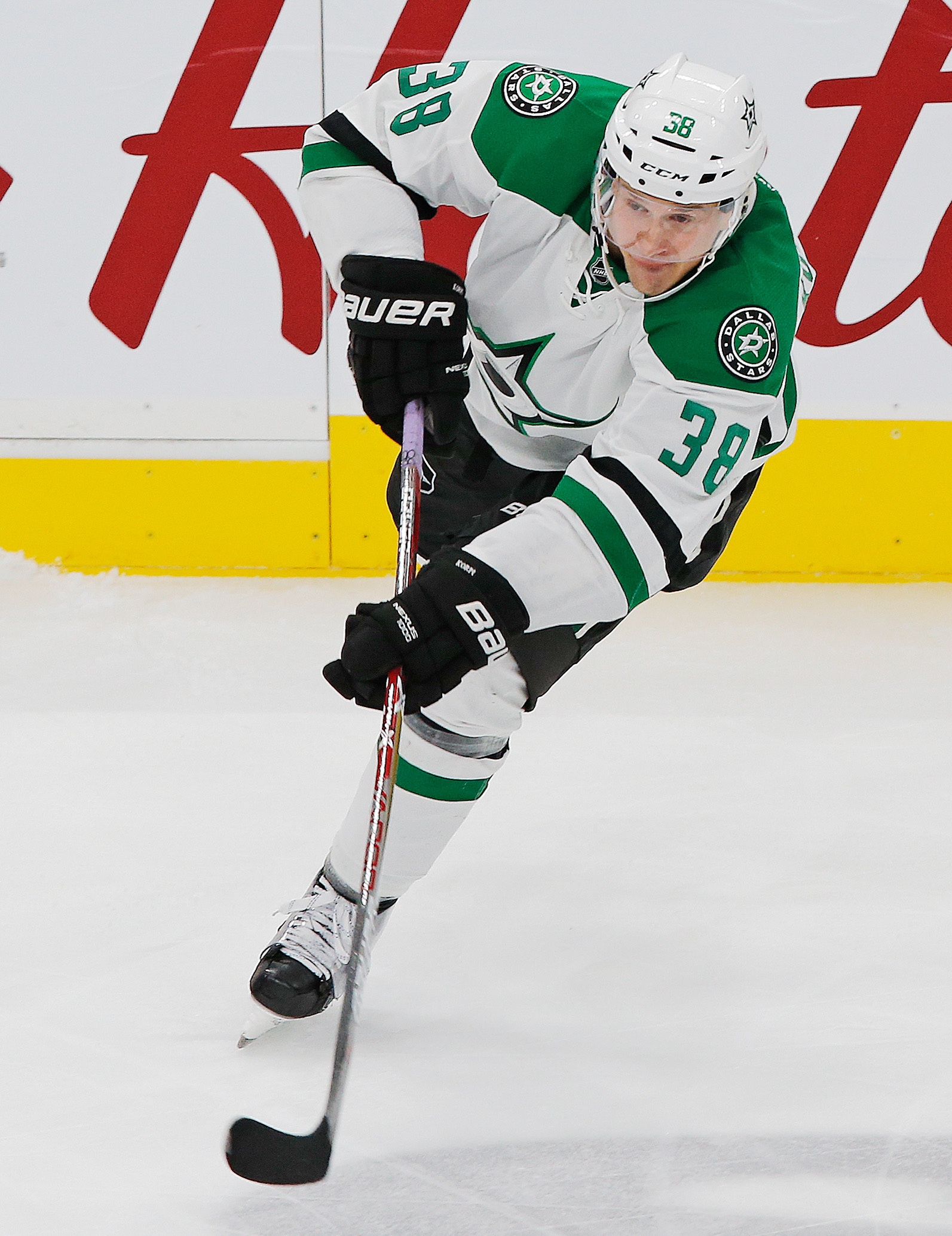 Last year, he hit the free agent market a year earlier than expected as the Oilers opted to buy him out of the final year of his contract instead of carrying a $2.5MM cap hit. He wound up joining Dallas on a one-year, $1MM deal and fared relatively well for an injury-laden Stars team, picking up 20 points (8-12-20) in 60 games before being flipped to Columbus at the trade deadline. Things didn’t go as well for Korpikoski with his new team as he was a frequent healthy scratch and got into just nine regular season games (and zero in the postseason) which certainly doesn’t help his cause.
While the hit stat isn’t entirely consistent from team-to-team, it’s at least worth noting that his physical play dropped considerably last season. While his career average in hits per game is a little over 1.5, he checked in at barely over half of one per night in 2016-17. It’s easier to make a case for earning a contract as a bottom six player if a player can show there’s a physical element to their game but that’s something Korpikoski can’t say this time around.
Where the 31-year-old can hang his hat is on his ability to play the penalty kill and his speed. Those are elements that can still get a player a regular spot in the lineup and between that and a consistent level of production in that role, he should be able to land a deal between now and the start of the season.
Potential Suitors
Two types of teams fit the bill. The first is a team lacking in depth that can use Korpikoski for a few months until a younger player is ready to come up from the minors that would then flip him at the deadline. The usual suspects come to mind, including Florida, New Jersey, and even his old organization in Arizona where he had the most success of his career.
The other type is more of a veteran team that could use him as a 12th/13th forward to start or who is facing a cap crunch and need cheaper depth. Washington is certainly a team that needs some veteran forwards and will be looking for bargains to fill out their fourth line and Korpikoski would fit in nicely. Minnesota, which is where we projected him to sign, is a team that typically covets veteran depth and he’d hedge against some of their youngsters not being ready for full-time duty right away.
Projected Contract
Back in June, Korpikoski landed the 48th slot in our Top 50 Free Agents with a one-year, $800K contract. With the minimum salary rising to $650K this season, the pre-camp PTO agreements will likely come in around $800K so that’s still a reasonable target as he can’t realistically land much more than that. As the market has hit its annual lull, he may have to wait a while yet to find his next team.
Photo courtesy of USA Today Sports Images.
Free Agent Notes: Howden, Somerby, Moroz, Crisp
After spending most of last season in the minors, forward Quinton Howden is crossing the pond. The 25-year-old has signed with Dinamo Minsk, the KHL team announced (link in Russian).
The former first round pick (25th overall to Florida in 2010) spent 2016-17 with Winnipeg’s organization after the Panthers didn’t tender him a qualifying offer last summer. He suited up in 58 games with their AHL affiliate in Manitoba, collecting 24 points (13-11-24). Howden also got into five games with the Jets, being held off the scoresheet while averaging a career low 8:39 per night. He has a total of 97 NHL games under his belt in his career and if he rediscovers his scoring touch overseas, he might be one to watch for down the road to see if he takes another chance in North America.
More notes from the open market:
- The Islanders remain interested in signing defenseman Doyle Somerby who became an unrestricted free agent yesterday, agent Brent Peterson told Newsday’s Arthur Staple. Pederson noted that the interest is mutual although he is still soliciting interest from other teams as well. It was reported earlier this month that as many as five other teams were likely to show interest in the 23-year-old stay-at-home blueliner.
- Unrestricted free agent winger Mitchell Moroz has signed a one-year contract with Idaho of the ECHL, the minor league team announced. He became unrestricted after the Coyotes declined to tender him a qualifying offer in June. Moroz was a second round pick of the Oilers (32nd overall) but didn’t progress past the AHL level in any of his three professional seasons. Last year, the 23-year-old split the campaign between Bakersfield and Tuscon of the AHL, recording four goals, five assists, and 36 penalty minutes.
- Canadiens UFA winger Connor Crisp is also ECHL-bound after the Toledo Walleye announced that they signed him to a one-year deal. Crisp was a 2013 third round pick (71st overall) after being unpicked in his first trip through the draft. He dealt with concussion and other injury troubles on his entry-level pact, playing just over 100 regular season games in total. Last year, he spent most of the season with ECHL Brampton, tallying 14 goals and 19 assists along with 60 PIMS in 43 games and was also non-tendered in June.
Poll: Which UFA Contract Will Look The Worst Next Year?
Famously stated by former NHL GM Brian Burke, July 1st is the day which teams make the most mistakes. They see players on the unrestricted free agent market and pay too much and for too long based entirely on what they’ve already accomplished in their careers. Rarely is there a contract to a star player that accurately reflects his future value, and never does an offseason pass without someone drastically overpaying.
Last year there were immediate doubts about the long-term deals handed out to players like David Backes, Milan Lucic and Loui Eriksson, and though each had varying levels of success in their first year could all be called disappointments. Those contracts could get even uglier as they go on, and look like a ridiculous deal in a few seasons.
This year had less star power on the free agent market, and a headliner in Kevin Shattenkirk that actually took less money and term than almost anyone expected. He headed to the Rangers for just four seasons despite being arguably the most sought-after player on the market, and while he easily could start his decline it’s hard to call his contract much of an albatross. In fact, only two UFAs even received a contract of five years in what was a relatively tame free agent period. Karl Alzner and Alexander Radulov led the way, though much longer extensions were given out to players like Carey Price and Brent Burns.
Looking at just the UFA deals from this summer (which excludes things like T.J. Oshie‘s contract that was signed on June 23rd), which do you think will look the worst in a year? We’ve included some of the top candidates, but don’t hesitate to list another contract in the comments below and explain why you think it will be the worst.
Which UFA contract will look the worst in a year?
-
Patrick Marleau (TOR): 3 years, $18.75MM 29% (367)
-
Alexander Radulov (DAL): 5 years, $31.25MM 20% (255)
-
Karl Alzner (MTL): 5 years, $23.125MM 16% (194)
-
Kevin Shattenkirk (NYR): 4 years, $26.6MM 8% (105)
-
Nick Bonino (NSH): 4 years, $16.4MM 7% (86)
-
Martin Hanzal (DAL): 3 years $14.25MM 6% (70)
-
Dmitry Kulikov (WPG): 3 years, $13MM 5% (68)
-
Trevor Daley (DET): 3 years, $9.5MM 5% (64)
-
Ron Hainsey (TOR): 2 years, $6MM 2% (26)
-
Other (leave in comments) 1% (10)
Total votes: 1,245
[Mobile users click here to vote!]
Morning Notes: Tavares, World Cup, Krushelnyski
The New York Islanders continue to be the center of attention when it comes to 2018 free agency. As we creep closer to training camp and the start of the regular season, many are questioning why superstar center John Tavares hasn’t signed an extension yet. Tavares is set to become an unrestricted free agent next summer but doesn’t seem worried about the lack of a deal. He told Arthur Staple of Newsday that “there’s really no rush” and that he’d take as much time as he needs.
He did admit that he’s keeping an eye on the Islanders’ search for a new home, but that those things are out of his hands. It’s interesting that Tavares so publicly stated his attachment to the arena search, and will drum up a new round of speculation over whether he’ll leave if a permanent home isn’t found within the next 10 months. There’s obviously much more going into his decision, but the Islanders need to soon find some stability on and off the ice.
- Rick Westhead of TSN reports on the financial take from last fall’s World Cup of Hockey, announcing that the NHL and NHLPA split a $44MM profit. Though that may sound like a big number, players who participated earned just $86K while others got $10K. Both of those numbers are pre-tax, meaning many of the players earned even less. $86K may seem like a lot to some, but for the top players who gave up much of their training camp and put themselves at risk of injury it doesn’t seem like enough. While both sides want this event to continue, it’ll likely take a bigger paycheck to have it run long-term.
- Alex Krushelnyski is back in the AHL, after signing with the Lehigh Valley Phantoms today. The 26-year old played 43 games for the Binghamton Senators last year, recording just seven points. Krushelnyski has been an outstanding scoring threat in the ECHL but has had trouble finding his footing in the upper minor league. He’ll join the Philadelphia Flyers’ affiliate as they look to repeat their 48-23-5 season from a year ago.
Salary Cap Deep Dive: Boston Bruins
Navigating the Salary Cap is probably one of the more important tasks for any general manager to have. Teams that can avert total cap chaos by walking the tightrope of inking players to deals that match their value (or compensate for future value without breaking the bank) remain successful. Those that don’t see struggles and front office changes.
PHR will look at every NHL team and give a thorough look at their cap situation heading into the 2017-18 season. This will focus more on those players who are integral parts of the roster versus those who may find themselves shuttling between the AHL and NHL. All cap figures are courtesy of CapFriendly.
Boston Bruins
Current Cap Hit: $64,848,335 (under the $75MM Upper Limit)
Entry Level Contracts
D Charlie McAvoy (two years remaining, $917K)
D Brandon Carlo (two years remaining, $789K)
F Frank Vatrano (one year remaining, $792.5K)
F Jakob Forsbacka Karlsson (two years remaining, $917K)
F Anders Bjork (three years remaining, $925K)
Boston has one of the deeper prospect pipelines in the NHL with upwards of a dozen players in the system on entry-level deals who could earn a call-up before that deal expires. However, this group of five stands the best chance of having a major impact on the Bruins right away in 2017-18.
Carlo, of course, already has a full year under his belt in which he skated in all 82 regular season games and played in over 20 minutes per night, all under the tutelage of one of the best defensive players of his generation: Zdeno Chara. Carlo has already made his #37 overall draft slot look like a steal, but with two more years at under $800K as he develops into a shutdown NHL defender, he could be one of the best blue line bargains in the league.
McAvoy is certainly ready to give Carlo a run for that title though. One of the Calder Trophy favorites for the upcoming season, McAvoy was thrown into the fire last season, making his NHL debut in the Bruins opening round playoff series. McAvoy performed admirably among a ragtag group of replacement players on Boston’s battered blue line and showed that he is more than ready for NHL action. Burning a season off of McAvoy’s ELC was a tough call for GM Don Sweeney and company, but giving McAvoy a taste last year could pay off this year. The former Boston University star and 2016 first-rounder will have all eyes on him in 2017-18.
Burning a year off of Forsbacka Karlsson’s entry-level deal for just one late-season game may have been ill-advised however. The Bruins love “JFK” and his two-way ability and cerebral play at center, with some in the organization and outside observers comparing him to Boston’s own Patrice Bergeron, widely considered the best two-way forward in the game. Those are big expectations to meet, but the Bruins will give Forsbacka Karlsson every chance to earn a regular role this season as they work to develop him into a well-rounded pro. JFK may not have the immediate impact, and expected pay day, of Carlo or McAvoy, but in two years he will certainly be worth more than $917K.
Vatrano has been a revelation for Boston since he was signed as an undrafted free agent, leaving UMass Amherst early in 2015. Vatrano led the AHL in goal scoring in 2015-16 with a stunning 36 goals in 36 games, while tallying 29 points in 83 NHL games along the way as well. Injury and inconsistency slowed down Vatrano’s rapid ascension last season, making 2017-18, his final ELC season, a major year in his career.
Finally, the Bruins were able to convince Bjork, a superstar at Notre Dame and the team’s 2014 fifth-round pick, to leave school early and sign on in Boston. The maximum three-year, $925K per ELC was nice motivation, but the team likely had to promise some play time as well. While Bjork’s spot on the team this season is not set in stone, with fellow high-end prospects Jake DeBrusk, Zach Senyshyn, Peter Cehlarik, and Danton Heinen clamoring for NHL play time, it seems that he’ll certainly get a chance. If the 2016-17 Hobey Baker candidate can find even remotely similar success in the big leagues compared to his past two NCAA seasons, his three-years of production at under $1MM will look mighty nice on the Bruins’ payroll.
One Year Remaining
D Zdeno Chara ($4MM, UFA)
F Ryan Spooner ($2.825MM, RFA)
F Riley Nash ($900K, UFA)
G Anton Khudobin ($1.2MM, UFA)
While it is a relatively painless 2018 free agency class for Boston, the end of Chara’s contract does loom large. The NHL’s tallest man has been the Bruins top defenseman since he signed with the team originally back in 2006 and very well could continue to be next season. It is possible that the Bruins re-sign Chara, whose cap hit drops from nearly $7MM to just $4MM this year, to a more affordable, short-term contract, but the more likely scenario is that the 40-year-old simply retires. He’ll leave the Boston blue line in much better condition than he found it back in ’06, with Torey Krug ready to lead the next wave of McAvoy, Carlo, and prospects like Jakub Zboril, Jeremy Lauzon, Ryan Lindgren, and Uhro Vaakanainen, but his size, strength, experience, and most of all, leadership, will not be easy to replace. The captain’s absence will be felt before the team even takes the ice for 2018-19 and could lead to the Bruins using the cap space Chara leaves behind to explore the free agent market.
Spooner and the Bruins nearly went to salary arbitration this summer, agreeing to terms on a one-year extension the morning of the hearing. Next year could be a very similar situation, whether Spooner performs or not. If Spooner can bounce back from a down 2016-17 season and prove that he is more than just a one-dimensional power play asset, then the Bruins will have to give him a raise on his new $2.825MM deal. If Spooner yet again struggles with the two-way and positional aspects of the game and is overshadowed by the Bruins’ younger talent, Sweeney will have to decide between bringing Spooner back again at a similar price and using up a roster spot or instead trading him away.
Nash and Khudobin, both signed on July 1st, 2016 to affordable two-year deals, also had incredibly similar seasons last year. Both were very disappointing for much of the year before their play picked up toward the end of the season. Going into 2017-18, Nash faces more pressure as he could take on the full responsibility of being the veteran presence on the checking line with Dominic Moore now gone. If Nash rises to the occasion, the Bruins have shown a fondness and loyalty toward their veteran fourth-liners and could reward Nash with an extension and a raise. If not, he’ll be gone. Khudobin also needs to have a big year, with starter Tuukka Rask in need of more rest than he got last season, but if Khudobin flops or if 24-year-old Zane McIntyre continues to light up the AHL, it seems very unlikely that he will re-sign.
Matt Cullen Signs With Minnesota Wild
Matt Cullen has agreed to a one-year contract with the Minnesota Wild. The deal is worth $1MM in salary, with an additional $700K in potential performance bonuses. Cullen had been reportedly deciding between the Wild and Penguins, but eventually decided to return home to Minnesota and forego his shot at a “three-peat” with Pittsburgh. Cullen himself told Jason Mackey of the Pittsburgh Post-Gazette that leaving the Penguins was “probably the hardest decision I ever had to make.”
“Dad” as many Penguins fans (and media) like to call Cullen was beloved in Pittsburgh, and you could hear the entire team chanting “ONE MORE YEAR!” as they celebrated their latest Stanley Cup victory. 2017-18 will mark his 20th season in the NHL, and he remains a very effective two-way center. Despite playing some of the lowest minutes of his career, he registered more than 30 points for the 13th time, and continued his career-long streak of winning more than 50% of his draws. He’ll likely slot into the fourth-line role in Minnesota, but will provide ample depth behind the star-studded forward group.
[Updated: Minnesota Wild Depth Chart]
In 1,366 career regular season games, Cullen has 689 points but has always been relied upon for more than scoring. His penalty killing ability and leadership on and off the ice will add a new dimension the a Wild team that struggled in the playoffs last season. Cullen has three Stanley Cup victories under his belt, including one from 2005-06 with Carolina, a team that was led by a young superstar named Eric Staal. The two will be reunited in Minnesota where Staal has re-energized his career, and try to bring some playoff success to a team that desperately thirsts for it.
Michael Russo of the Star Tribune was first to break the deal.
Alexey Marchenko Heads To KHL, Wants NHL Return Eventually
Yesterday Alexey Marchenko was placed on unconditional waivers by the Toronto Maple Leafs ahead of a mutual contract termination, with many suspecting he’d return to the KHL for the upcoming season. That has been confirmed by his agent Dan Milstein, who also reports that Marchenko would like to return to the NHL at some point in the future. Milstein didn’t confirm which team Marchenko would play for, though it’s widely believed that CSKA Moscow will be his destination. Igor Eronko of Sport-Express reports that it will be a three-year deal. The Maple Leafs will gain a contract slot and $1.45MM in cap space for this season, the same amount Marchenko was due in the final year of his contract.
Both the cap space and contract slot are huge assets for the Maple Leafs, who remain over the $75MM salary cap and now have 48/50 players under contract. That’s not including Connor Brown, who is a restricted free agent but expected to sign before the start of training camp. Brown and Maple Leafs GM Lou Lamoriello have expressed no concern over negotiations, and likely wer waiting for transactions like this in order to free up some room.
The Maple Leafs could also now be players in NCAA free agency tomorrow, when Will Butcher and Alex Kerfoot will headline a group of players that also includes former Toronto draft pick Dominic Toninato. Toninato has said that there wasn’t room for him in Toronto in the past, which could have just changed with the termination of Marchenko. Still, Ted Kulfan of the Detroit News listed the Maple Leafs as a possible destination for Butcher, though another left-handed defenseman seems unlikely for a team already loaded with them.
A final possibility is now free agency for the Maple Leafs, as they previously couldn’t have added another player without risking their not being room for Brown to sign. With several useful names still out there, the upstart Toronto team could add some more veteran presence to one of the youngest squads in the league.
NCAA Free Agent Rules
Some of the most intricate rules in the NHL Collective Bargaining Agreement have to do with player draft rights. Depending both on where the player was when drafted, and the path he takes after being selected exclusive negotiating rights can be held for anywhere between two years and indefinitely. When it comes to players joining the NCAA ranks, it gets even trickier.
We saw one of the less often used tactics earlier this summer, when Cal Petersen declared he would not return to Notre Dame for his senior season. Since Petersen had been drafted four years ago, the Buffalo Sabres were given 30 days in which to sign him or lose his exclusive negotiating rights. The Sabres couldn’t get him under contract, and a month later the Los Angeles Kings scooped him up. Petersen could use this tactic because of the year he spent in the USHL after his draft, pushing his scheduled graduation to five years out from his draft year.
But this isn’t the method you want to hear about today. Will Butcher and Alex Kerfoot lead a group of players who will see their draft rights expire today after completing their senior seasons, and will be allowed to sign with any team in the NHL tomorrow, August 16th. Though their free agency is being widely reported as starting today, teams actually retain their negotiating rights through the end of day. From Section 8.6(c)(i) of the NHL’s Collective Bargaining Agreement:
If a Player drafted at age 18 or 19 is a bona fide college student at the time of his selection in the Entry Draft, or becomes a bona fide college student prior to the first June 1 following his selection in the Entry Draft, and remains a bona fide college student through the graduation of his college class, his drafting Club shall retain the exclusive right of negotiation for his services through and including the August 15 following the graduation of his college class. The Club need not make a Bona Fide Offer to such Player to retain such rights.
Though it’s quite possible that teams are already talking to the upcoming free agents—probable even, despite not technically being allowed to do so—they won’t be signing with anyone until tomorrow. Since this version of the CBA was introduced only Robbie Russo signed right away, inking with the Detroit Red Wings on August 16th nearly immediately after becoming a free agent. Last year we saw John Gilmour lead the pack by signing with the New York Rangers on August 18th, before Thomas DiPauli and Jimmy Vesey followed on the 19th to Pittsburgh and New York respectively.
While Butcher and Kerfoot are exciting players, and should sign within a few days of becoming free agents we will have to wait for one more day before anything can be officially announced. For now, they’re still tied to the Colorado Avalanche and New Jersey Devils.
*Note: Kerfoot actually could have used the method described in Petersen’s case to become a free agent last summer, since he played an additional season in the BCHL after being selected by the Devils in 2012. For ease of reading we did not include all of the CBA provisions, but if you’d like to read more about why his rights are held through and including August 15th, check out Section 8.6(c)(iii).