
Influx Of Foreign Talent A Trend In 2018 Off-Season
While the NHL free agent market remains flush with talented veteran players, some now beginning to depart for Europe without any leads around the league, NHL teams have quietly imported a fair amount of foreign talent this off-season. While few of these players are stars or even surefire regulars at the NHL level, the fact remains that those on two-way deals slated for depth roles are nevertheless taking those jobs from the current remnants of the market, who at this point would gladly take an AHL assignment with upside. Teams clearly have felt this off-season that taking a chance on a promising foreign player was a better use of a contract than recycling aging domestic veterans. A total of 36 players who played in Europe last season are now headed to North America, where they will suit up for 24 different organizations – showing the popularity of importing talent this off-season. Here are the foreign free agent signings this summer:
D Ilya Lyubushkin (Arizona Coyotes)
F David Ullstrom (Arizona Coyotes)
F Martin Bakos (Boston Bruins)
D Lawrence Pilut (Buffalo Sabres)
F Yasin Ehliz (Calgary Flames)
D Marcus Hogstrom (Calgary Flames)
F Saku Maenalanen (Carolina Hurricanes)
F Dominik Kahun (Chicago Blackhawks)
G Kevin Lankinen (Chicago Blackhawks)
F Jacob Nilsson (Chicago Blackhawks)
G Pavel Francouz (Colorado Avalanche)
F Valeri Nichushkin (Dallas Stars)*
G Patrik Rybar (Detroit Red Wings)
G Mikko Koskinen (Edmonton Oilers)
D Joel Persson (Edmonton Oilers)
D Bogdan Kiselevich (Florida Panthers)
F Ilya Kovalchuk (Los Angeles Kings)
D Eric Martinsson (Minnesota Wild)
D Michal Moravcik (Montreal Canadiens)
D David Sklenicka (Montreal Canadiens)
F Carl Persson (Nashville Predators)
D Filip Pyrochta (Nashville Predators)
G Miroslav Svoboda (Nashville Predators)
D Egor Yakovlev (New Jersey Devils)
F Jan Kovar (New York Islanders)
D Yannick Rathgeb (New York Islanders)
F Michael Lindqvist (New York Rangers)
F Ville Meskanen (New York Rangers)
D Juuso Riikola (Pittsburgh Penguins)
F Lukas Radil (San Jose Sharks)
F Antti Suomela (San Jose Sharks)
F Par Lindholm (Toronto Maple Leafs)
D Igor Ozhiganov (Toronto Maple Leafs)
F Brooks Macek (Vegas Golden Knights)
F Juuso Ikonen (Washington Capitals)
F Maximilian Kammerer (Washington Capitals)
F Dennis Everberg (Winnipeg Jets)
While the obvious highlight of this list is the return of Kovalchuk, inking a substantial deal with the L.A. Kings, the rest are far more than just AHL placeholders. Nichushkin, albeit not a true free agent signing since his rights never left the Stars, is back in Dallas and looking to make an impact. Koskinen is set to be the primary backup to Cam Talbot in Edmonton and, while his role was muddied somewhat by the acquisition of Philipp Grubauer, Francouz is sure to see some action in net with Colorado. Kovar was brought in to be a starter in New York, while Ullstrom – a former Islander – will push for a roster spot with Arizona. After a couple of years abroad, Everberg is back in the league and hoping to find a role in Winnipeg. If Simon Despres, on a PTO with the Montreal Canadiens, earns a contract, he could make a difference as well.
Several more of these players could wind up winning spots in training camp battles, while even more will earn call-ups throughout the year. It is an extensive list and each and every name bears watching as they begin or continue their North American pro careers. Both the risk and upside of bringing over fresh, foreign talent versus sticking with experienced yet stagnant veterans is apparent. For some teams these gambles will fail, while others may find a diamond in the rough.
Retained Salary For 2018-19
Among the ways teams can increase the value of potential trade candidates is by retaining a portion of their salary. These moves are often used on star players who may have declined slightly and are no longer deemed worthy of their big cap hits, or at the deadline in order to fit in as many contracts as possible for the playoff stretch. Any team can retain up to 50% of a player’s salary for the remainder of the contract, though a single player can only be involved in two of these transactions per contract.
Teams meanwhile are limited to three retained salary transactions on the books at any one time, and they cannot in aggregate equal more than 15% of the cap ceiling. That means, for this season a team can retain up to $11,925,000 in salary given the $79.5MM cap ceiling. Some teams have already started in on that number given the previous retained salary transactions that they are still paying off. Below is a list of all the active contracts involved in transactions like this:
Arizona Coyotes
Mike Smith – Retained $1,416,667 per season through 2018-19
Boston Bruins
Matt Beleskey – Retained $1,900,000 per season through 2019-20
Carolina Hurricanes
Marcus Kruger – Retained $308,333 per season through 2018-19
Florida Panthers
Jason Demers – Retained $562,500 per season through 2020-21
Ottawa Senators
Dion Phaneuf – Retained $1,750,000 per season through 2020-21
Toronto Maple Leafs
Phil Kessel – Retained $1,200,000 per season through 2021-22
Vancouver Canucks
Roberto Luongo – Retained $800,000 per season through 2021-22
Vegas Golden Knights
Derick Brassard – Retained $2,000,000 per season through 2018-19
While these transactions are hardly crippling the above teams, they are something to remember when the trade deadline rolls around and clubs are trying to swap contracts. Teams like Toronto and Vancouver who have retained salary for another four years might not want to get into a similar situation and lock up two of their three possible options for the future.
The other question surrounding retained salary transactions will be how they affect the upcoming CBA negotiations, after teams like Vegas have acted as a sort of middle man. Brassard was never really part of the Golden Knights, only coming there on his way from Ottawa to Pittsburgh in order to reduce his salary for the Penguins. Though Vegas received compensation, it is not how the rule was intended to be used.
2017 Draft Pick Jiri Patera Signs With Brandon (WHL)
- Golden Knights goaltending prospect Jiri Patera has signed with Brandon of the WHL, the junior team announced. The netminder was selected in the CHL Import Draft back in June after spending last season with Cedar Rapids of the USHL. The Wheat Kings have the rights to a pair of NHL first-round picks as well in defenseman Erik Brannstrom (also a Vegas prospect) and winger Martin Kaut; teams can only have two import players on their active roster so if all three were to make it there, they would have an issue. However, it’s possible that one of Brannstrom or Kaut could start at the AHL level next season which would allow Patera to suit up in Brandon.
Arizona Coyotes Lack Flexibility Due To Roster Limits
One of the CBA rules that rarely gets the spotlight of media attention, yet affects NHL organizations every year is that of the Standard Player Contract (SPC) limit. Each team is only allowed to have 50 NHL contracts on the books at any one time, including two-way contracts and players on injured or long-term injured reserve. The Arizona Coyotes currently find themselves at that limit, with 50 players already signed. That’s why the recent Marian Hossa trade included Andrew Campbell and Jordan Maletta going back to the Blackhawks, despite neither really being very valuable to an NHL team. The Coyotes couldn’t take on all three of the contracts for Hossa, Vinnie Hinostroza and Jordan Oesterle without matching with the same outgoing number.
The Coyotes do have a pair of players who likely will not count towards the 50-contract limit this season, as Barrett Hayton and Pierre-Olivier Joseph are both young enough—18 or 19 years old—to be removed from the SPC list when they are sent back to junior hockey. That of course assumes that they won’t make the Coyotes out of camp, something that isn’t necessarily guaranteed but should be expected. Even with those two added slots, the Coyotes will have to be wary of their contract totals all season long. Staying right at the limit is dangerous given that you may run into injury trouble and want to sign a veteran out of free agency or promote a player on an AHL contract. It also limits what you can do in terms of signing players out of the college ranks.
Today a list of sixteen players became unrestricted free agents after failing to reach an entry-level contract with the team that drafted them. One of those players, Jared Fiegl, couldn’t have been signed because of the Coyotes current situation even if they had wanted to. While Fiegl was just a seventh-round pick and likely wouldn’t have earned an NHL contract anyway—he has since signed with the Orlando Solar Bears of the ECHL—there are always players who deserve contracts at the end of the college season, both drafted and undrafted.
In Arizona’s system for instance, there are Ty Emberson and Cameron Crotty who will both be playing in the NCAA this season. Each a third-round pick, there is always a chance of a breakout season and the desire to turn pro in early spring. If there are no contract slots available, the Coyotes won’t be able to bring them into their system on an entry-level deal right away and run the risk of them returning to school for another season. The undrafted players pose an even bigger risk, as a team without a contract slot would be at a severe disadvantage in free agent negotiations.
Though the Coyotes are currently the only team right at the limit, there are several others who are flirting with it. The Anaheim Ducks and Vegas Golden Knights are already at 48 contracts and each have a restricted free agent left to sign in Nick Ritchie and Shea Theodore respectively. The Ottawa Senators are also at 48, and two players that could potentially come off the list in Brady Tkachuk and Alex Formenton both might not be playing in junior this season. Tkachuk could potentially go to the AHL to work with the Binghamton Senators if he doesn’t make the NHL, while Formenton already has an NHL game under his belt and might jump right to Ottawa this season.
Living on the edge doesn’t cripple a team, but it does reduce their flexibility when working out trades or negotiating with free agents. Teams like the Minnesota Wild and Toronto Maple Leafs dealt with that issue at times last year, and many others could this time around. Though it rarely gets much attention it is definitely something to keep an eye on as training camp comes around next month, and injuries start to pile up.
Pacific Notes: Flames Forwards, Haula, Horvat
The Calgary Flames have made quite a few moves this offseason in hopes of reshaping their roster after a dismal second half that saw them out of the playoffs. However, the Flames new signings may have caused other issues that the team will have to deal with in a few years — namely the expansion draft.
The Athletic’s Kent Wilson (subscription required) writes that the team might be in trouble if/when the unnamed Seattle franchise has its expansion draft in 2020. Assuming all the rules are the same as they were for Vegas, Calgary will have a logjam of players at the forward position and won’t have enough spaces to protect some quality players.
Assuming there are no changes among forwards over the next two seasons, the team would likely protect or have to protect Johnny Gaudreau, Sean Monahan, Elias Lindholm, Mikael Backlund, Matthew Tkachuk, James Neal as six forwards they would likely protect. That would leave one spot open for players like Derek Ryan, Mark Jankowski, Sam Bennett, Andrew Mangiapane and Spencer Foo, which could leave several high quality players exposed to Seattle. Unless the team addresses these issues, the team may be giving Seattle a solid player.
- Adam Hill of the Las Vegas Review-Journal writes that the Vegas Golden Knights still haven’t decided on a plan for what they intend to do with second-line center Erik Haula after they signed Paul Stastny away from the Winnipeg Jets this offseason. Haula had a great offensive season, centering the second line with 29 goals and 55 points, but the line (along with the departed Neal and David Perron) struggled defensively. In fact, Vegas’ second line was one of the worst defensive lines in the league. “It produced, but the goals against per 60 minutes was not good enough,” said Vegas general manager George McPhee. “We were actually dead last among second lines in the league. You can just sort of look the other way on that or you can address it. We’re trying to address it.”
- J.D. Burke of The Athletic (subscription required) writes that he believes that Vancouver Canucks center Bo Horvat should continue to take his game to a new level as he has every year. However, if there is one area of Horvat’s game that could use some upgrading it would be his defensive game as that’s the weakest part of his game. The 23-year-old took his scoring game up a notch last year when he potted 22 goals, an improvement on his previous career-high of 20 goals, but Horvat missed 15 games last year, so to put up a career-high in goals is key. However, with the additions of players like Jay Beagle, Antoine Roussel and Tim Schaller, maybe defense won’t be that imperative.
The Case For Expanding NHL Rosters
Last week, the NCAA passed a rule change allowing hockey teams to dress 19 skaters per game. Rather than the typical 18-man lineup – six defensemen and twelve forwards (not including goalies) – each squad is now allowed an extra man that can be used at either position. The college level is after all a developmental league and the ability to expose another player to game action each night benefits the growth of a greater majority of the roster. Yet, this rule change is one that could also benefit the NHL. For a variety of reasons, the league should consider expanding the allowable number of players who may dress for a game.
The first, and perhaps the most glaring reason, to consider this change is that hockey is the only mainstream sport that doesn’t allow an extra player to enter the game that doesn’t fit neatly into the lineup. Yes, hockey does have a large roster of 18 skaters and yes the lines and pair do substitute one another all game long. However, consider football, which has 11 starters on offense and 11 starters on defense for a 22-man starting roster that also substitutes one another. Yet, NFL game day rosters are 46 men deep, more than double the amount of starters. The same goes for lacrosse (field lacrosse), a more similar game to hockey, as only nine men play in the field but the average active roster in the NCAA is 44 players, nearly five times the starting roster. Even soccer (11 men in the field) and baseball (nine batters) allow for multiple substitutes who weren’t a part of a rather large starting lineup. Why then should the NHL limit teams to using only the 18 skaters who fit nicely into four forward lines and three defensive pairs?
There is also the fact that the NHL has reached a point that it needs to accommodate more talent at both ends of the spectrum. Young players often don’t have an easy fit on a roster. Developing offensive forwards may not yet have the ability and awareness for a top-nine role, but they certainly can’t help the team or themselves on the checking line. Young defensemen may not be ready to play major minutes against elite talent at the top level, but that doesn’t mean they aren’t ready at all. With the league trending in a more youthful direction, teams could drastically improve their development of certain players if there was an alternate choice between giving a prospect a starting job, sitting him in the press box, or banishing him to the AHL or back to juniors. If teams could slowly bring along pro-ready prospects by giving them the “extra slot” that the NCAA has approved, limiting their ice time and situations but exposing them to NHL action, it would likely be a popular move. However, some teams may instead like to use that slot on a veteran specialist. Just look at the current free agent market: last week we identified more than 40 useful players still available, yet the results of our poll strongly predict that less than ten of those players will find NHL employment. That might not be the case if each team had an extra slot to fill with an experienced penalty-killing forward or power play quarterback for example. Each off-season, more and more capable veterans go unsigned while teams still have needs due to roster limits alone. These players would rather not retire or move overseas, but they have often outgrown the minor leagues as well. Being that spare part on an NHL club would be an optimum fit.
For more evidence on the overflowing talent in the NHL, see the Vegas Golden Knights. An expansion team filled with rejects, young and old, managed to make it to the Stanley Cup Final in their inaugural season and used 35 different players along the way. Even when the league likely adds another expansion team in Seattle in the next year or two, there will likely still be players – young and old – capable of playing in the NHL but without ample opportunity. Just by allowing one more player in the game each night, it will create more opportunities for many different types of players.
The easy way to refute the idea of expanding rosters is the salary cap. Expanding the number of players who dress for a game to 19 would likely mean expanding the roster limit to 24 players and thus increasing the salary cap ceiling in turn and the owners won’t go for that. Not so fast though; with the bulk of this off-season complete, CapFriendly projects that just six teams will enter the upcoming season with less than $2.4MM in cap space, the average NHL salary last season. Consider that the “extra man” will likely be an entry-level prospect or a discounted veteran and there is a case that nearly every team in the league (except for the St. Louis Blues) could add another player right now without touching the cap. Those that would rather push to the cap with just a 23-man roster would also be welcome to do so – the league mandates a maximum roster size, but not a minimum. Teams that carry the maximum 23 players on their roster already have three players that don’t dress each night and could simply make one of them the 19th man.
The NCAA seems to be on to something with expanding game day rosters in hockey. Most sports have this option and the NHL should too. While there is no underestimating the importance of chemistry to the game of hockey, having an alternate or strategic extra man makes a lot of sense. Be it a raw young player, a specifically-skilled veteran, a bench player there as an injury replacement, or even a playoff contender using the spot for a hired gun, there are many ways that an expanded roster could benefit prospect development, elongate careers, improve game play, and simply increase overall interest and excitement due to the strategy of it all. It’s time the league take a look at the possibility.
Snapshots: Gibson, Kesler, Subban, Cross
While the Anaheim Ducks didn’t have to discuss a long-term extension with goaltender John Gibson this summer, the team wanted to get their 25-year-old netminder signed as quickly as possible, according to The Athletic’s Eric Stephens (subscription required). They did that Saturday when they signed him to an eight-year, $51.2MM signing with an AAV of $6.4MM.
One of the key reasons general manager Bob Murray and the Ducks negotiated the deal now was the team wanted to avoid the possibility that Gibson would have an even greater year than what he had, which would have driven up the price even more. The team now expects Gibson to raise his game anyway as he must improve his playoffs stats and attempt to remain healthy, which has occasionally been a problem, because eight years is a long ways down the road.
- In an interview with Anaheim Ducks coach Randy Carlyle, The Athletic’s Lisa Dillman (subscription required) asked several questions about Ryan Kesler, who missed the first three months of last season after undergoing hip surgery in the offseason, and really struggled after returning. With rumors of Kesler potentially missing more time or sitting out an entire season this year, Carlyle said everything will come down to training camp. “His body will have three months of rest and rehabilitation,” said Carlyle. “Now here we go, training camp is going to be another test. What he went through last year wasn’t what he envisioned or we envisioned. He’s a guy who is very determined. I don’t think it’s about excuses. It’s about finding the right fit. It’s hard to point a finger in any one direction when you’ve got people that are not 100 percent. We’ll support the players and try to find the right combination. But we went through this once. I’m sure we’re not going to take the same route as we did the last time. There’s going to have to be a different approach taken.”
- Las Vegas Review-Journal’s Ed Graney wonders whether the Vegas Golden Knights should be worried about their backup goaltending situation. The team had issues with 33-year-old starter Marc-Andre Fleury in the past as he missed two months earlier in the season due to a possible concussion. The team has 24-year-old Malcolm Subban as the backup, but he also dealt with numerous injuries throughout the season and then the playoffs. While Subban finished the season with 13 victories in 22 appearances, his numbers weren’t that good as he posted a 2.68 GAA and a .910 save percentage. Is he the goaltender of the future? Most don’t think so.
- The Athletic’s Fluto Shinzawa (subscription required) featured veteran minor league defenseman Tommy Cross, who didn’t want to leave the Boston Bruins. However, with a goal to become an NHL-level defenseman and time running out, the 28-year-old blueliner opted to sign with the Columbus Blue Jackets. Cross has played 279 games with the Providence Bruins in the AHL after signing out of Boston College, but has managed to appear in just six NHL games so far and been passed over by so many prospects that the three-year AHL captain felt it was time to move on.
Salary Cap Deep Dive: Vegas Golden Knights
Navigating the Salary Cap is probably one of the more important tasks for any general manager to have. Teams that can avert total cap chaos by walking the tightrope of inking players to deals that match their value (or compensate for future value without breaking the bank) remain successful. Those that don’t see struggles and front office changes.
PHR will look at every NHL team and give a thorough look at their cap situation heading into the 2018-19 season. This will focus more on those players who are integral parts of the roster versus those who may find themselves shuttling between the AHL and NHL. All cap figures are courtesy of CapFriendly.
Vegas Golden Knights
Current Cap Hit: $70,812,500 (under the $79.5MM Upper Limit)
Entry-Level Contracts
F Alex Tuch (One year remaining, $925K)
D Zach Whitecloud (Two years remaining, $925K)
Among the many things that went right for Vegas was the play of Tuch, who was a surprise in training camp and quickly earned himself a full-time role. The 6-foot-4, 222-pound winger had an impressive rookie season with the Golden Knights, scoring 15 goals and 37 points with much of his playing time coming with the team’s third line. He only improved over time, showing an ability to get into the corners and extend offensive opportunities for the team. He tallied six goals in the playoffs as well, which allowed the Golden Knights to let go veterans James Neal and David Perron, knowing that the 22-year-old Tuch is ready to take his game to the next level. With one year remaining on his entry-level deal, expect him to become a key restricted free agent for the team next season.
Potential Bonuses
Tuch: $93K
Whitecloud: $93K
Total: $186K
One Year Remaining, Non Entry-Level
F William Karlsson ($5.25MM, RFA)
D Nate Schmidt ($2.23MM, UFA)
F Oscar Lindberg ($1.7MM, UFA)
D Deryk Engelland ($1.5MM, UFA)
F Pierre-Edouard Bellemare ($1.45MM, UFA)
F Tomas Nosek ($963K, RFA)
F Ryan Carpenter ($650K, UFA)
D Brad Hunt ($650K, UFA)
G Malcolm Subban ($650K, RFA)
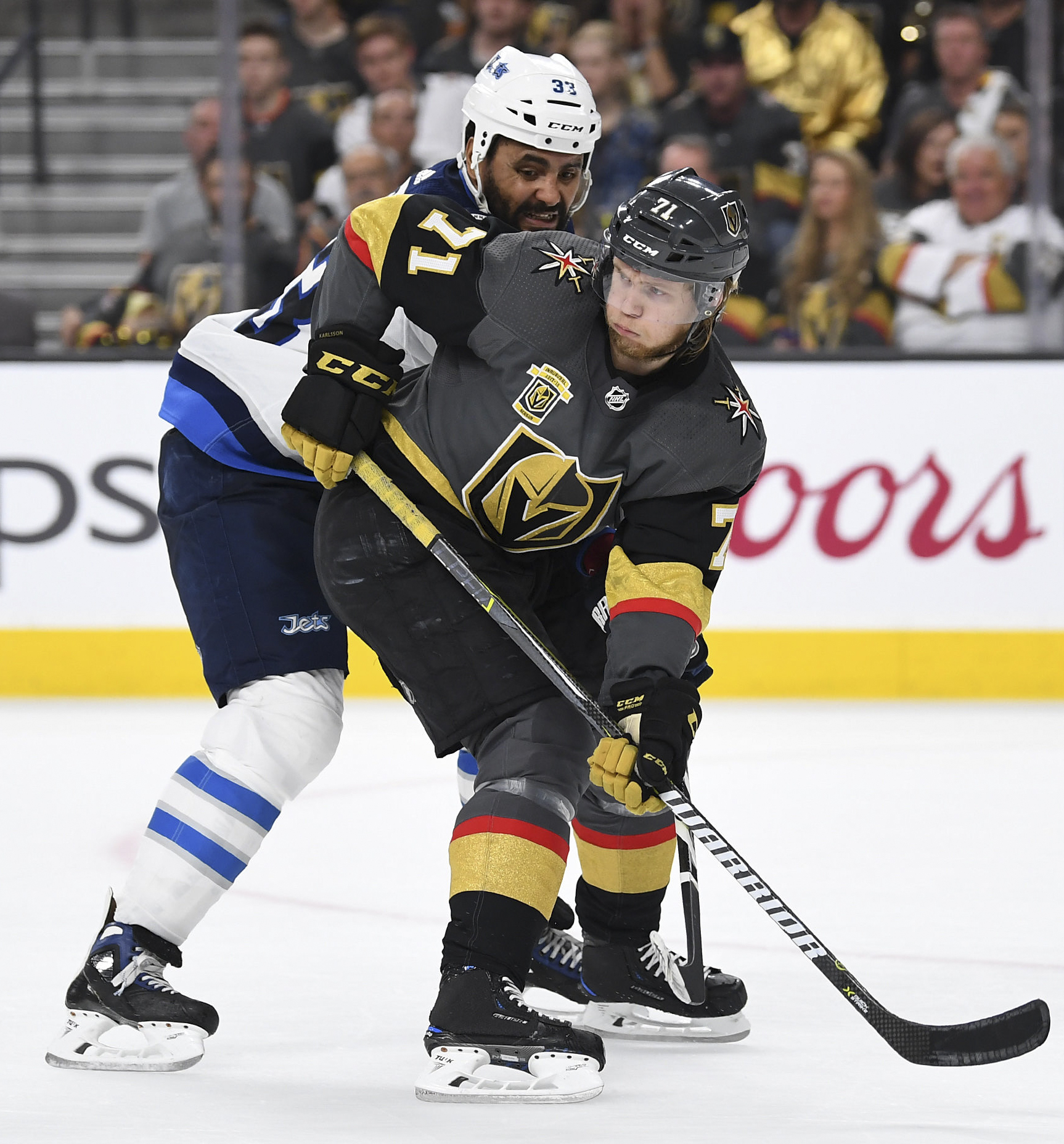
The most important piece the Vegas Golden Knights need to lock up is Karlsson, who just signed a one-year deal with Vegas Saturday. However, now the team has just one year to lock up Karlsson, the team’s top scorer, to a long-term extension. Less than a year, actually, as the team can’t agree to an extension until Jan. 1, 2019. That gives Vegas time to see how 25-year-old will respond in his second year. After piling up 43 goals last season (and seven more in the playoffs), the team wants to see that he can put up similar numbers before handing him a major deal considering the most he’s ever scored in his NHL career was nine goals.
The team will also have to lock up the speedy Schmidt, as well to a long-term deal at some point. The 27-year-old was a key figure on the Golden Knights defense, posting career highs of five goals and 36 points, but also showed his mettle in the playoffs, putting up another three goals and seven points. He could easily get a similar deal to the one that Miller signed with the team (four years, $15.5MM) earlier in the offseason. With an influx of prospects likely to hitting the team for the 2019-20 season, several veterans will have to prove they deserve new contracts this coming year, including Lindberg, Bellemare, Engelland, Carpenter, Hunt and Subban, although unless someone has a breakout year, none should cost the team too much.
Two Years Remaining
F David Clarkson ($5.25MM, UFA)
F Cody Eakin ($3.85MM, UFA)
F Ryan Reaves ($2.78MM, UFA)
F Erik Haula ($2.75MM, UFA)
D Nick Holden ($2.2MM, UFA)
D Jonathon Merrill ($1.38MM, UFA)
F William Carrier ($725K, RFA)
The team likely will have to pay up if they want to keep Haula. The team’s second-line center may move to the third line now that the team locked up Stastny to a free agent deal. However, if Huala can continue to produce like he did last season, the 27-year-old should be able to fetch a nice contract. He had a career-high in goals last season as he scored 29 and 55 points.
The team should also recoup some of their losses as well in two years as Clarkson’s deal will expire, so that will free up $5.25MM for the team as the team currently has to wait till the start of the season before they can place his contract on LTIR. Others like Eakin and Reaves will likely have to earn another deal over the next two seasons. Both had solid showings for Vegas this year, but will have to prove their consistency. While Reaves deal looks overpaid on paper, the team opted to give him three years worth of money as long as he only signed for two years.

Pacific Notes: Sutter, Karlsson, Talbot, Stone, McPhee
Much of the attention that has come towards the Vancouver Canucks this offseason either fell to their plethora of prospects, many of which seem to be ready to contribute next season, or their highly criticized signings of Jay Beagle, Antoine Roussel and Tim Schaller on the first day of free agency (not including the resignation of Trevor Linden). Regardless, The Athletic’s J.D. Burke (subscription required) writes that forgotten man Brandon Sutter‘s stock is definitely heading up this season.
The 29-year-old forward has provided the Canucks with a physical and defensive presence, but hasn’t been required to show his offensive skills. Suddenly, with scoring becoming a great team need and the addition of players like Beagle, Roussel and Schaller, the opportunity to play a more offensive role is suddenly in front of him.
One suggestion is to have Sutter center the team’s second line with Elias Pettersson playing next to him to start the season. Then once, Pettersson has adjusted to North American play, allow the two to switch places.
- After signing a one-year deal for $5.25MM this morning, Vegas Golden Knights center William Karlsson remained positive about staying in Las Vegas long-term, according to Jesse Granger of the Las Vegas Sun. He hopes he can duplicate the 43-goal season from last year, which should hand him the long-term deal he wants when he goes through restricted free agency again next season. “In an ideal world I would’ve liked a long term deal, but I like to bet on myself and that’s what this is. Now I can go prove myself,” Karlsson said.
- The Edmonton Sun’s Robert Tychkowski interviewed Edmonton Oilers goaltender Cam Talbot about the team’s signing of Mikko Koskinen to a one-year, $2.5MM deal. Koskinen is likely to take a much bigger role than the 15 games that Talbot didn’t play in. That signing likely had something to do with Talbot’s on-ice struggles as he went from a 2.39 GAA and a .919 save percentage in 2016-17 to a 3.02 GAA and a .909 save percentage. However, Talbot welcomes the challenge. “I like the competition,” Talbot said. “I enjoy it. It pushes everyone to be better. Maybe it will take a little bit of the starts away from me and I can be at the top of my game.”
- The Athletic’s Kent Wilson (subscription required) writes that the Calgary Flames made a poor move last offseason when they signed defenseman Michael Stone to a three-year, $10.5MM deal. The veteran defenseman was thought to be a top-four defenseman, but once the team added Travis Hamonic via trade, Stone was sent to the team’s third pairing and truly struggled last year. Now, with $7MM remaining on his deal over the next two years, Stone stands in the way of multiple young defenseman, including Rasmus Andersson. With little trade value, things could get ugly at some point in the next year.
- In another tweet, Granger interviewed Vegas Golden Knights general manager George McPhee about the talent at the forward position. The team added center Paul Stastny, but lost two quality players in James Neal and David Perron. Despite the losses, the team has several in-house candidates like Alex Tuch and Tomas Tatar ready to step up. “I like where we are, but if there’s an opportunity to upgrade at the forward position at any time over the next year we will,” McPhee said.
Golden Knights, William Karlsson Agree To Terms On A One-Year Contract
While Golden Knights center William Karlsson was slated to go to arbitration this morning, the hearing didn’t go ahead. Instead, the team announced that they have agreed to a one-year, $5.25MM contract with their top scorer. The deal includes just $500K in signing bonuses.
Before the hearing, the two sides had filed their salary requests. Karlsson was seeking $6.5MM while the team came in at $3.5MM so the settlement comes in beyond the $5MM midpoint.
 The 25-year-old had a breakout season in 2017-18, one that no one could have reasonably expected. After putting up 25 points in 81 games in 2016-17, the Blue Jackets reached a deal with Vegas for them to take Karlsson instead of winger Josh Anderson or goalie Joonas Korpisalo in the Expansion Draft. It’s safe to say that the deal worked out extremely well for the Golden Knights.
While he started out in a bottom-six role, that didn’t last long and Karlsson took off after that. He wound up scoring a whopping 43 goals which ranked third overall in the league while adding 35 assists while becoming their top line pivot. He also led the league in plus/minus with a +49 rating. However, he also led the league with a 23.4 shooting percentage, a number that many view as unsustainable and use that as an argument that he is due to regress in 2018-19.
Although he cooled off a little bit in the Stanley Cup Final, Karlsson also had a productive postseason, notching seven goals and eight assists in 20 games which certainly helped to bolster his case and helped him earn a $4.25MM raise in salary compared to what he made last season.
Karlsson will be eligible for restricted free agency with arbitration rights once again next season. His $5.25MM salary for next season will also represent his qualifying offer at that time.
With the signing, Vegas has all but one of their players signed for 2018-19 with nearly $8MM in salary cap room to work with; RFA defenseman Shea Theodore is still in need of a new deal.
Sportsnet’s Chris Johnston was the first to report (Twitter link) that the two sides reached a settlement before the hearing. Sportsnet’s Elliotte Friedman was the first to note via Twitter the value of the deal.
Photo courtesy of USA Today Sports Images.