
Pacific Notes: Toffoli, Giordano, Goldobin, Pettersson
While the Los Angeles Kings did add Ilya Kovalchuk to their roster and have a healthy dose of veterans around, one key for the Kings will be whether the team can get Tyler Toffoli to show off more of his offensive prowess. The 26-year-old rebounded from a 13-goal season in 2016-17 to post a 24-goal season, but that’s still a far cry from the 31-goal season back in 2015-16 when he was considered one of the upcoming goal scorers in the league.
The Athletic’s Lisa Dillman (subscription required) writes that Toffoli feels that the team and especially coach John Stevens feel that it’s time for him to take that next step in his development.
“He obviously wants me to score more goals,” Toffoli said. “He said I didn’t have a bad season. Scoring 24 goals is not bad. He thinks that’s just something I need to focus on, bearing down on opportunities and not worrying about having the ups and downs.”
Many feel that Toffoli struggled over the last couple of years due to the lack of having Milan Lucic in 2016-17 as well as a healthy Jeff Carter playing alongside him last season. However, consistency has also been a problem as he tallied 11 goals in the first two months of the season and then struggled at different times to put numbers up, including one goal in January and just three goals in the Kings’ final 18 games, including going scoreless in the playoffs.
- The Athletic’s Scott Kruikshank (subscription required) looks into the fitness level of Calgary Flames defenseman Mark Giordano. The team’s top defender just turned 34 and remains in the best shape of his career. Giordano’s conditioning is one of the main reasons for his success. He has ranked first, first, first and second (last year to Michael Frolik) over the last four camps, despite his age. “I want to keep my speed as I get older,” Giordano says. “So I do a lot of strengthening of my hips and groins, working on some ankle-mobility stuff. Little things to keep my skating up to par. Speed and conditioning are the two things I like to focus on the most. But you need that strength out there, too.”
- Jason Brough of The Athletic (subscription required) wonders who will win the final spot on the Vancouver Canucks first line with Brock Boeser and Bo Horvat. The scribe says the team has three candidates in mind for that final spot, including veteran Sven Baertschi as well as Brendan Leipsic and Nikolay Goldobin. While Baertschi might sound like a logical candidate as he got some time with them last season, Brough wonders whether the team is giving every opportunity to Goldobin or Leipsic to seize the spot, which would allow Baertschi to play on the second line. The team has been hoping Goldobin, in particular, is capable of breaking out this season. He tallied eight goals in 38 games last season.
- The Vancouver Canucks got a flash of their upcoming future when top prospects Elias Pettersson and Jonathan Dahlen combined for three goals, three assists in Friday’s first game of the Young Stars Classic, according to Ed Willes of the Vancouver Sun. The two Swedes showed a chemistry together that suggests they could play together for a long time. Pettersson potted two goals, while Dahlen added a third. The two played together for parts of three years in the Timra system.
Is Vancouver Looking To Make A Big Splash?
It is no secret that the Vancouver Canucks do not operate like a typical rebuilding team. Make no mistake, the team has accrued plenty of talented young building blocks over the past few years: Bo Horvat, Brock Boeser, Elias Pettersson, Jonathan Dahlen, Adam Gaudette, Quinn Hughes, Olli Juolevi, Thatcher Demko, Michael DiPietro and the list goes on. However, the team has also gone about business as usual, signing free agents and at times even overpaying to add veterans to the roster. Over the past two off-seasons, Vancouver has taken roster spots away from younger players in order to sign the likes of Erik Gudbranson, Sam Gagner, Michael Del Zotto, Anders Nilsson, Thomas Vanek, Darren Archibald, Jay Beagle, Antoine Roussel, Tim Schaller and more. The moves have put the team no closer to being a contender. The Canucks have not advanced past the first round of the playoffs since their 2011 Stanley Cup Final appearance and have failed to reach the postseason altogether in each of the past three years. It seems unlikely that the trend will change any time soon, either.
The Province’s Ed Willes is worried that things might get even worse. Willes claims that recently departed team president Trevor Linden ” lost his job because he favored a patient, methodical approach to the team’s rebuild”. With Linden gone, the team has been even more aggressive than usual this summer in targeting older players. Vancouver made an offer to John Tavares that was rejected and more recently has been linked to Erik Karlsson. While he isn’t convinced the team has the means to acquire Karlsson, the fear is that some player will come along on the trade market that they can afford and will deplete their promising prospect ranks to acquire. Willes firmly believes that Benning and the Canucks are in the hunt for a cornerstone player, no matter the cost.
Just as it has in recent years, even adding an elite veteran player is unlikely to get the Canucks to where they want to be. As it is currently composed, the team lacks the supporting cast to be a true contender. The greatest strength of the organization is the youth waiting in the wings, with at least two goaltenders, four defensemen, and eight forwards under the age of 25 that are all almost universally expected to be NHL regulars for a long time to come. Yet, the cost of adding a marquee player would be a package of those exact players or upcoming (early) draft picks. The patient approach that Linden fought for could transform the Canucks into one of the league’s top teams in five years time. An impatient acquisition could cost them what progress they have made and, in Willes’ opinion, cost them fans as well. So perhaps the question is not “is Vancouver looking to make a big splash?”, but “should Vancouver be looking to make a big splash?” and the answer seems to be a convincing no.
Brock Boeser, Vancouver Canucks To Discuss Extension Next Week
Though a ton of the focus in Vancouver this offseason has been on the somewhat odd additions they made in free agency, or the performance of top draft pick Quinn Hughes at the World Junior Summer Showcase, there is still plenty of work to be done to keep the organization on the tracks of their rebuild. One of those things is negotiating an extension with star forward Brock Boeser, who is already heading into the final year of his entry-level contract despite having just one full season under his belt in professional hockey.
Since Boeser was already 20 when he signed his first contract out of the University of North Dakota, he burned the first year of his ELC in just those nine games at the end of the 2016-17 season. He’s been eligible to sign an extension since July 1st, and according to Ben Kuzma of The Province the two sides had preliminary discussions last month. They also plan on talking again next week, though GM Jim Benning isn’t putting a deadline on anything:
We haven’t got down to talking term. We plan to circle back and I’m not sure where it’s going to go, but we want to see if we can get somewhere. There’s no time frame on it.
Brock is going to see the best matchup line and best defensive pair, but I don’t expect a drop-off. He has pushed himself hard to pick up where he left off and there are other contracts coming up in the league in the next six months that could drive up the price — I understand that part of it.
Benning is right about the fact that there are several potential extensions coming up around the league that could change the price tag for Boeser. Though he likely won’t quite match up with the mega contracts that Auston Matthews and Patrik Laine are headed for in their negotiations, there is a big group of other players that find themselves in a similar situation to Boeser after performing well early in their careers. Kyle Connor, Sebastian Aho, Matthew Tkachuk, Mikko Rantanen and Mitch Marner are all wingers who have found incredible success in their first few seasons, and are scheduled for restricted free agency in 2019.
All of them will be looking at other contracts signed by players like David Pastrnak, Nikolaj Ehlers and soon William Nylander as potential starting points but could eclipse the $6-7MM range that each of those players will fall into. Boeser could be the same, especially if he can prove he’s back to full health and can get back on a 40-goal pace to start the season.
There is little worry here that the two sides won’t be able to eventually come to some agreement, but the question is will the Canucks get any sort of discount by betting on Boeser before he’s shown his ability for a second season. With added pressure and tougher defensive matchups, there is always a real possibility that his numbers decline this season. Boeser did after all shoot 16.2% in 2017-18, though the eye test would lead you to believe that he’ll post above-average shooting percentages for his entire career. If that number drops significantly though, the Canucks might be able to parlay a down year into a better deal for themselves. The two sides are in a game of poker at the moment, wondering when to push all their chips to the middle. Whether that happens this summer or much further down the road still is yet to be seen.
Brock Boeser Camp In No Rush For New Contract
The Vancouver Canucks signed several veteran forwards in this summer to insulate their young core, bringing in Antoine Roussel, Jay Beagle and Tim Schaller on multi-year deals. While that solidifies the roster for the next few years, everyone is watching to see if the team will lock up Brock Boeser long term before he becomes a restricted free agent next summer. Boeser is eligible to sign an extension already, but his agent Ben Hankinson was on Sportsnet radio today explaining that they’re not in a rush to get something done.
I don’t think there’s any rush. Obviously Brock knows he has another year left and he’s going to go out there and play no matter what. He’ll probably be on the ice the next October in 2019 to start that season with a new contract too. Whenever it happens it happens. There’s no rush on our end.
I’d say, without putting a deadline on it, we’d like to get going once the season rolls and just play hockey. But there’s no deadline on it. [Canucks GM] Jim [Benning’s] a very level-headed guy and we have a really good relationship. So I’m not gonna say we won’t talk during the season if we don’t get something done, but who knows, it’s too early to say.
Boeser has been a star for the Canucks since the day he signed with them, scoring in his first NHL game just a day after being eliminated from the NCAA tournament. The young sniper went on to record 29 goals and 55 points in his first full season, though he was limited to just 62 games due to a scary back injury that put him on the shelf in early March. He’ll be back and ready to go in 2018-19, and could set himself up for a huge extension with another big season.
Though Boeser has just one season under his belt he’ll be 22 in February, meaning that entry-level contract will come to an end next summer at which point he could easily eclipse Loui Eriksson and Bo Horvat as the team’s highest-paid forward. He’ll have five years of restricted free agency left, but as we’ve seen with other young stars teams now like to lock up their future right away. If both sides wait until after this season and he puts up another near point-per-game campaign, you can expect him to be asking for a deal somewhere along the lines of David Pastrnak ($6.67MM AAV) or Nikolaj Ehlers ($6.0MM AAV). Where Dylan Larkin and William Nylander land in their respective contract talks will also likely be a good comparison, though there could be an argument that Boeser is an even more valuable piece than either given his impressive goal scoring ability.
If the two sides can reach an agreement this summer the Canucks may be able to keep that cap hit slightly lower given that Boeser still has just 71 games under his belt in the NHL. Vancouver has plenty of cap space to fit Boeser in going forward, especially given that several other key players should be joining the organization in the next few years on entry-level deals.
Pacific Notes: Kovalchuk, Kings, Canucks, Ducks
Los Angeles Kings free agent signee Ilya Kovalchuk finally spoke to the media today after agreeing to sign a three-year, $18.75MM deal with the Kings on June 23. The 35-year-old superstar has now spent the past five years in the KHL, putting up some great numbers and has made it clear that he believes that despite his age, he has three or four good years left in him, according to Fox Sports’ Jon Rosen.
The winger said one of his main reasons for choosing the Kings was because he wanted to play next to a high-end center like Anze Kopitar. Kovalchuk could be a perfect complement to Kopitar. The 35-year-old has been playing some of the best hockey of his career, posting 63 goals in his last two KHL seasons as well as winning MVP for Team Russia in the Olympics this past year.
Kovalchuk also believes he is young for 35, but declined to say that he could put up a 30-goal season next season, according to Helene St. James of the Los Angeles Times. Kovalchuk last posted a 30-goal season in the NHL back in the 2011-12 season when he scored 37.
- Sticking with the Kings, Lisa Dillman of The Athletic (subscription required) does a Q&A with head coach John Stevens, who says that the Kings had no choice, but to place more responsibility on young players on their defense. The team has five veterans to hold down the core of the defense in Drew Doughty, Jake Muzzin, Alec Martinez, Dion Phaneuf and Derek Forbort. However, the team will have to rely on younger players, like Paul Ladue, Daniel Brickley and Kurtis MacDermid to fill out the rest of the roster. “There comes a point in time especially with the [salary] cap where you’ve got so many young guys. You have to make decisions,” Stevens said.
- Jason Brough of The Athletic (subscription required) writes that after assessing the offseason in which the team spent money on multiple bottom-six forwards, the Vancouver Canucks are putting all their success next season on the scoring ability of their young prospects. For one, the team lost three of the team’s top five scorers and now besides Bo Horvat and Brock Boeser, the team will need to get increased scoring output from other forwards, including Elias Pettersson, Sven Baertschi, Nikolay Goldobin, Brendan Leipsic and Jake Virtanen. If they can’t make up for that offense, it should be another long season.
- Eric Stephens of The Athletic (subscription required) looks at the Anaheim Ducks salary cap situation now and in one year from now to see if it will improve. Unfortunately the Ducks will not have much in terms of bad contracts that will come off the books in a year and the team will have to deal with other salary cap challenges instead. The team must deal with the cost of bringing back forwards Adam Henrique and Jakob Silfverberg, who will be unrestricted free agents as well as goaltender John Gibson, who will be a restricted free agent.
Canucks Have Held Preliminary Extension Discussions With Brock Boeser
The Canucks have been discussing a contract extension with winger Brock Boeser, GM Jim Benning acknowledged to Postmedia’s Ben Kuzma. However, talks have yet to advance past the preliminary stage although Benning expects that to change in the coming weeks, stating that:
“I talked to his agent this past week and we’ll have more time in the next couple of weeks to talk about it internally and then hear from their side. If we’re going to do something, we’d do it then. We’ll see where they’re at and where we’re at and see if something works.”
Boeser has fully recovered from back and wrist injuries that prematurely ended his season. Before being shut down, the 21-year-old was in the midst of a strong year, posting 29 goals and 26 assists in just 62 games to lead Vancouver in scoring which is pretty good for someone in their first professional season.
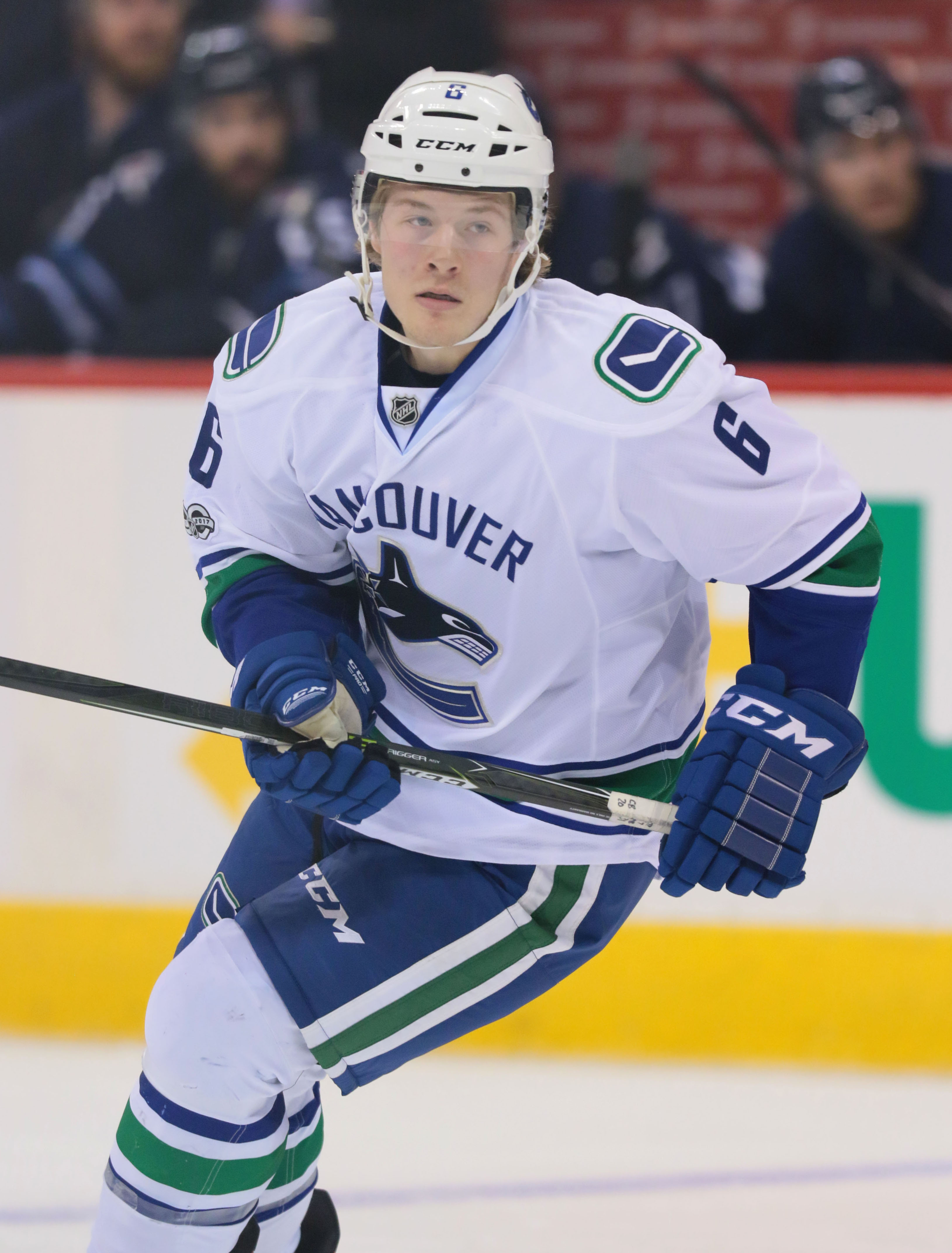 That lack of overall NHL experience (totalling 71 games which includes a brief post-college stint in 2016-17) makes this a particularly interesting case to follow. Generally, players that are signing early extensions while still on their entry-level deals have two full years of NHL experience under their belts; Boeser has yet to play a full season worth of games.
Despite that, it’s certainly understandable that the Canucks are at least looking into an extension with their young sniper. Boeser has been touted as a top prospect since being drafted in the first round three years ago and had been expected to be a key part of their future. Not many were expecting him to be a top-liner so quickly but it’s reasonable to think that this level of production will continue (if not improve) in the coming years.
As for what Boeser may be looking for, it’s likely that he’ll be looking at teammate Bo Horvat’s six-year, $33MM deal that was signed last September as a baseline. While Horvat had three full NHL seasons under his belt at that time, none of them were as productive as Boeser’s 2017-18 performance. If Boeser is indeed open to signing now, his next contract is probably going to be pretty close to Horvat’s as otherwise, he may as well just play out the 2018-19 campaign and hope to head to restricted free agency with even more leverage for a bigger deal next summer.
With two restricted free agents left to re-sign (including defenseman Troy Stecher who filed for arbitration), this is something that can be put on the backburner for now but a new deal for Boeser will be something to keep an eye on later this summer.
Photo courtesy of USA Today Sports Images.
Free Agent Focus: Vancouver Canucks
Free agency is now a little more than a month away from opening up and there are quite a few prominent players set to hit the open market while many teams have key restricted free agents to re-sign. Here is a breakdown of Vancouver’s free agent situation.
Key Restricted Free Agent: F Sven Baertschi —  Considered to be a player who could break out at any time, the 25-year-old restricted free agent never has had the opportunity as injuries have derailed any true success so far. Having already played in parts of seven seasons and three complete seasons, Baertschi has never played a full season or even close to that much (his season high is 69 games back in 2015-16). This past year, the winger only got into 53 games as he dealt with a jaw injury in December after being hit in the face with a puck and then separated his shoulder in March that ended his season. With 14 goals and 29 points, Baertschi has the potential to contribute to a young team if he can stay healthy.
While the team will likely find a way to ink him to a one-year extension (he made $1.85MM each of the last two years), the team must also determine if he’s a core player who will be a major contributor on his team in the future. Another injury prone year could force the team to move on from him if he can’t prove that he can stay on the ice.
Other RFA’s: F Reid Boucher, F Cole Cassels, D Anton Cederholm, F Michael Chaput, F Markus Granlund, F Griffen Molino, D Derrick Pouliot, D Troy Stecher, D Mackenze Stewart, F Jake Virtanen.
Key Unrestricted Free Agent: F Darren Archibald — Archibald’s name suggests that the team has little to worry about when it comes to their own free agents. With just three NHL-level unrestricted free agents, Archibald’s value stands out. The 6-foot-3, 210-pound wing provides the team with grit, solid skating and physicality and has started to step up for Vancouver this season. A long-time AHL player, Archibald got into 27 games for the Canucks this season, putting up four goals and nine points and was a favorite of coach Travis Green and might be a cheap fourth-line option for Vancouver (he made $650K last season) rather than the franchise go out and sign a veteran for that spot.
Other UFA’s: G Richard Bachman, F Nic Dowd, F Jussi Jokinen, F Joseph Labate, F Jayson Megna, D Patrick Wiercioch.
Projected Cap Space: The team should have plenty of cap space if the team is ready to spend after the retirements of Henrik Sedin and Daniel Sedin. They have a little less than $53MM committed to players for the 2018-19 season and few contracts of their own that they have to deal with. The team could attempt to add a few veterans to mesh with their young core of Bo Horvat, Brock Boeser and Elias Pettersson and must focus more of their attention on their defense, but they do have plenty of space to do that.
Photo courtesy of USA Today Sports Images.
Pacific Notes: Boeser, Viveiros, Cammalleri, Carrier
While most people have been under the impression that rookie sensation Brock Boeser would be ready for the start of the 2018-19 season, general manager Jim Benning confirmed that, according to an NHL.com report.
Boeser suffered a back injury back on March 5 when he hit his back on an open bench door and broke a transverse process, a spur that projects off the side off each vertebrae. The injury, which Boeser once referred to as “career threatening,” ended a dominant rookie season to that point. In 62 games, he tallied 29 goals and 55 points. On top of all of that, he also was dealing with a wrist injury he suffered in February, which required platelet-rich plasma injections and four weeks of immobilization.
“My understanding is he’ll be 100 percent for training camp,” Benning said. “My understanding is the cast was taken off a week ago. I haven’t talked to Brock about it, but I believe the cast had to be on a month. The doctor that he went back to see in Minnesota is the Vikings’ hand specialist and that’s the doctor that did Brock’s surgery two years ago. We were able to get an appointment for him and we wanted to get him in there and have the doctor have a look at him. The worst-case scenario was that he would require another surgery, but he didn’t need to do that.”
- Edmonton Journal’s David Staples writes that the Edmonton Oilers’ hiring of WHL Swift Current head coach Emaneul Viveiros is an underrated hire after the team announced their new assistant coaches Friday. What impresses the scribe the most is the way Viveiros’ Broncos, which captured the WHL title this season, had the league’s best power-play unit with a 29.4 percent success rate. If he can bring that ability to an Oilers team that struggled immensely in the last year in special teams play, Edmonton could be on their way to a rebound season. Staples himself adds that he believes the team was misusing both Connor McDavid and Ryan Nugent-Hopkins on the power play as they were usually placed in the right face-off circle, a position that didn’t benefit either player.
- Sticking with the Oilers, the Edmonton Journal’s Kurt Leavins analyzes the value of bringing back forward Mike Cammalleri for next season. The soon-to-be 36-year-old veteran joined the Oilers in a November trade with the Los Angeles Kings and will be an unrestricted free agent on July 1. While his numbers on offense (seven goals and 22 assists in 66 games last year) don’t stand out, they are actually quite solid for bottom-tier forward. His experience and IQ on the ice could prove valuable to a team with a lot of young players. His suspect defense doesn’t help his cause, but his solid face-off skills even out some of that. The scribe concludes that if the Oilers consider bringing him back, it should only be for the league minimum.
- While a report yesterday stated that Vegas Golden Knights coach Gerard Gallant said that he expects forward William Carrier to be available for the Stanley Cup Finals, it looks doubtful that he’ll be available for Game 1 on Monday, according to Las Vegas Review-Journal’s David Schoen. Carrier was wearing a red no-contact sweater in practice today, suggesting he’s likely not ready yet to rejoin the team. He missed the entire Western Conference Finals against the Winnipeg Jets with an undisclosed injury.
Vancouver’s Pettersson Should Be A Canuck Immediately
Now that the Vancouver Canucks have their 2017 first-round pick Elias Pettersson locked up to a maximum-level entry-level contract, the next question about the talented young forward will be when will the Canucks see him playing with the team?
With talk of him possibly being loaned back to the SHL for another season to a potential start with the Utica Comets in the AHL to adjust to the North American game, to immediately throwing the 19-year-old into the fire with the Canucks, there are multiple options.
One of the biggest obstacles is the fractured left thumb that Pettersson sustained while playing in the IIHF World Championships. According to Mike Halford of The Athletic (subscription required), Pettersson has already underwent a surgical procedure and will have his wrist in a cast for the next three to four weeks. Then the team must decide whether it is willing to put him out for the team’s annual summer prospect camp in the first week of July and then the Young Stars Classic in Pentiction in September.
Regardless, Halford writes whether he plays in either of those events or not, he expects that Pettersson will still be in a Canucks uniform at the start of the season, writing that while Vancouver general manager Jim Benning didn’t guarantee that Pettersson would be on the opening-day roster, he came awfully close.
“We’ll see where he’s at when he comes to training camp,” Benning explained. “We had Brock Boeser step in and be a big part of our team last year, and I think [Pettersson] can come in next year and step in. With the Sedins not playing, we’re going to have openings on the power play and we need offensive skill players, and I think he’s going to be one of those guys that can fill that need for us.”
The team also intends to start Pettersson at the right wing position before eventually moving him to center. That switch to center could last anywhere from two to three months to even his entire rookie season.
“Up the middle he gets more puck touches, and he can handle the puck [and use] his vision of the ice to make plays,” said Benning. “At some point he’s going to play centre for us.”
The scribe adds that rumor has it that Pettersson could be slated on a line next season with center Bo Horvat and rookie winger Jonathan Dahlen, a fellow countryman and former Swedish teammate. In fact, don’t be surprised if Pettersson ends up on the power play as well. With the loss of both Henrik Sedin and Daniel Sedin, the team will have multiple holes in their power play lineup and it is believed that Pettersson will likely take over Henrik’s spot on the half wall, his preferred spot.
“[Pettersson’s] got a great release on his shot,” Benning said. “On the power play, if we have him on one side and Brock on the other, we’ve got two real good shooters. I think he’s going to step in and make the adjustment and be successful.”
Canucks’ Pettersson Out For World Championships With Fractured Thumb
The Vancouver Canucks injuries keep coming. After a season in which the team lost several of their key players for chunks of time, including Brock Boeser, Sven Baertschi, Chris Tanev, Markus Granlund and Erik Gudbranson among others, the Canucks now have learned that 2017 first-round pick Elias Pettersson, who was playing for Sweden at the IIHF World Championships in Denmark, will miss the rest of the tournament after suffering an injured thumb against Switzerland today, according to international correspondent Uffe Bodin.
ESPN’s Chris Peters reports the injury is a fractured thumb. It’s a setback for Pettersson, who many expect to join the Canucks next season after a monster rookie season in the SHL last season. The 19-year-old center scored 24 goals and 32 assists in 44 regular season games with Vaxjo. However, he even outdid himself in the SHL playoffs by putting up 10 goals and nine assists in 13 games. Combined, he put up the best rookie season in the SHL in the history of the league.
Still unsigned by the Canucks, there is no word or timetable on how long the injury will take to heal or whether this changes the Canucks plan to bring him to the U.S. after the tournament. It was believed the team intended to bring the youngster over this year and move him to the wing to acclimate him to the NHL. Pettersson was the fifth-overall pick in the 2017 draft last year. In five games so far at the World Championships, he had a goal and two assists.