
The offseason has arrived for half of the league’s teams that aren’t taking part in the playoffs plus those who have already been eliminated. Accordingly, it’s now time to examine what they will need to accomplish over the coming months. Next up is a look at Washington.
Having gone from reaching the second round last season to narrowly missing the playoffs this season, it would be fair to view 2025-26 as a disappointment. On the other hand, this group was the only team in the salary cap era to have a +23-goal differential or better and miss the playoffs with a point total (95) that is usually enough to get into the postseason. Most years, they’d have comfortably made the playoffs with a season like they had. With that in mind, GM Chris Patrick might opt for a safer summer than another drastic overhaul like 2024. Their checklist has been drafted with that assumption in mind.
Wait For Ovechkin’s Decision
Admittedly, it feels weird making the first item on here something that’s entirely out of their control. Long-time captain Alex Ovechkin’s contract is up and the NHL’s all-time goal leader hasn’t decided if he wants to return for a 22nd season. It’s safe to say that the Capitals want him back and they’ve indicated to Ovechkin’s camp that they’re willing to be patient although they prefer that he decides by next month’s draft.
What the decision is will ultimately influence a chunk of how the team plans to proceed this summer. If Ovechkin stays, he fills a top-six spot on the wing, though not the top-line one he had for most of his career. And if he opts to move on, then they have a big hole to fill on the wing. Notably, despite his age (40), only one pending UFA forward (Alex Tuch) had more points than Ovechkin’s 64. Accordingly, they’d likely have to turn to the trade market to try to fill that vacancy.
Considering his age, it certainly wouldn’t be surprising if Ovechkin’s next contract is a one-year deal, should he decide to stay. If that’s the case, he’s eligible to sign one with performance bonuses in the deal, something that could be done to give Washington more cap flexibility. With over $31MM in room at the moment, per PuckPedia, they may not necessarily need that flexibility but if Patrick has big plans, maybe they will. Ovechkin’s now-expiring deal carried a $9.5MM AAV; it wouldn’t be entirely shocking if his next contract (including bonuses, if any) was in that price range as well.
Re-Sign McMichael
Two years ago, Washington opted to sign forward Connor McMichael to a bridge deal. That kept more money free for their shopping spree and considering he had just become a full-time player the year before, there was lots of logic to the decision. McMichael, meanwhile, went and had two pretty strong seasons on his two-year, $4.2MM pact. He notched 57 points in 2024-25 and followed that up with 46 in 78 outings this season while transitioning toward playing down the middle on more of a regular basis.
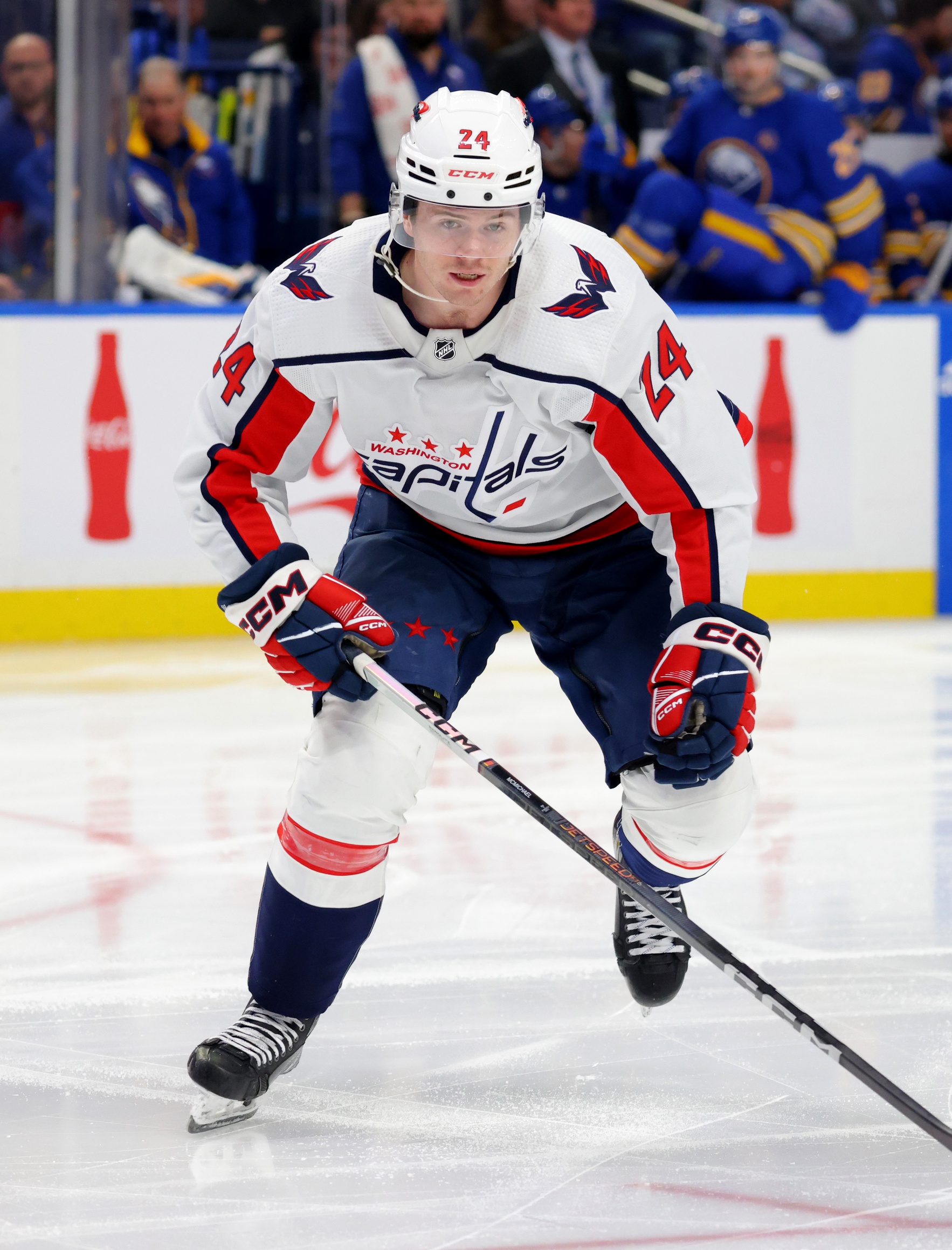 All things considered, that’s a pair of solid seasons to bolster his arbitration case as he reaches eligibility for that for the first time. McMichael is two years away from being able to test the open market so while they could kick the can down the road and try to do a one-year pact, the more probable outcome is a longer-term agreement. The Capitals could opt to take him to a hearing but that would allow his camp to ask for a two-year contract that walks him right to unrestricted free agency so it would be surprising to see the team go down that road. Conversely, if McMichael files, Washington gets to pick the term and would almost certainly choose a one-year agreement.
AFP Analytics pegs McMichael at a five-year pact worth a shade under $6.5MM per season while getting three extra years of club control. In this marketplace, that might even be a little light while adding more seasons to the agreement could push the price tag more toward the $8MM mark. By the time they re-sign him and re-sign or replace Ovechkin, more than half of that cap space will already be gone but getting McMichael locked up on a longer-term deal should be a big priority this summer.
Add Right-Shot Defender
With Jakob Chychrun, Martin Fehervary, Rasmus Sandin, Cole Hutson, and Declan Chisholm, the Capitals are more than well-set on that side of their back end. If anything, their depth there could allow Patrick to shop someone to try to fill another hole elsewhere.
However, things aren’t as great on the other side. Their right-shot options are Matt Roy, Timothy Liljegren, and Dylan McIlrath. Roy has been solid in his first two years in Washington but is ideally a second-pairing player. Liljegren, who just re-signed, hasn’t progressed beyond being a third-pairing option for most of his career, while McIlrath is more of a veteran journeyman who shouldn’t be counted on to play too much.
In other words, they need to try to replace John Carlson, who was moved to Anaheim a little before the trade deadline. Interestingly enough, one of the players they could plausibly look at is Carlson himself, as the sides explored extension talks before the trigger was pulled on a swap. Other impactful right-shot rearguards set to reach unrestricted free agency are Darren Raddysh, Rasmus Andersson, and Jacob Trouba, although it should be expected that at least one of those players will ultimately re-sign.
With Sandin being able to shift to his off-side, this isn’t a must-add for the Capitals this summer. Chychrun is a top-pairing piece and Hutson showed plenty of potential late in the year; those two anchoring the back end with above-average depth could work. But in a very tight Eastern Conference, augmenting the group with another impact right-shot option would even be better.
Work On Leonard Extension
When Ryan Leonard joined the Capitals for the stretch run last season, they were hoping that he’d be able to add some key secondary scoring. Instead, his entrance to the NHL was a little quieter as he managed just two points in 17 games (regular season and playoffs combined) with his role shrinking as the postseason went on.
But those struggles ultimately helped Leonard prepare for his first full NHL season which certainly was an improvement. He finished fifth in rookie scoring with 20 goals and 25 assists, doing so despite averaging a little over 14 minutes per game, or basically third-line ice time. That earned him an eighth-place finish in Calder Trophy voting for Rookie of the Year. Considering Washington drafted Leonard eighth overall in 2023, it’s safe to say that they envision him being able to take on a bigger role.
Because they burned the first season of his entry-level pact for the 2025 stretch run, Leonard will be entering the final year of that contract this summer, making him extension-eligible. And with this being the last offseason that a team can do an eight-year contract, it would make sense for Washington to explore what the parameters of an agreement like that would be.
There would be a lot of forecasting being done on both sides in terms of trying to determine what Leonard’s long-term offensive upside is to try to find a number that would work. AFP Analytics’ extension projections suggest a seven-year agreement would be worth a little under $8.5MM per year. To get that eighth season, the AAV might have to land closer to the $9MM mark. That might seem like a lot for a player with 46 career regular season points but if they want to get something done early, there’s going to be some shared risk on both sides.
This isn’t necessarily a must-accomplish item on the checklist this summer. It’s possible that one or both sides would prefer the extra year of data before committing. But having some certainty for what Leonard’s next deal will cost would help the Capitals in their long-term planning this offseason so expect Patrick to approach Leonard’s camp to see what this could cost.
Photo courtesy of Timothy T. Ludwig-USA TODAY Sports.