
Broadcaster Dave Strader Passes Away at 62
Former Detroit Red Wings broadcaster Dave Strader passed away this morning at his home in Glens Falls, New York, at the age of 62, according to the Detroit Red Wings. He had been fighting a form of bile duct cancer. Known as “The Voice,” Strader called the Red Wings games from 1985 to 1996, but also worked as a broadcaster for the Arizona Coyotes, Florida Panthers and worked three Olympics. He received the Foster Hewitt Memorial Award from the Hockey Hall of Fame earlier this year.
Strader started his career as a broadcaster for the Red Wings’ AHL affiliate in Adirondack from 1979 to 1985, before taking over in Detroit. He eventually went on to cover national games in 1996 with ESPN, ABC and ESPN. He eventually took a full-time job in 2011 calling games for NBC Sports Group.
He spent the last two years calling games for the Dallas Stars even after being diagnosed with cancer in June of 2016. His Foster Hewitt Memorial plaque will go on display in the Hockey Hall of Fame on Nov. 13.
Training Camp Cuts And Recalls: 10/1/17
Today marks the end of the preseason for all those NHL teams who haven’t yet wrapped up their exhibition schedules. With games coming to an end, expect lots of action throughout the day and keep track of it all right here:
Arizona Coyotes
D Dakota Mermis – Tucson (AHL)
Colorado Avalanche
D David Warsofsky – waivers for purpose of assignment
Dallas Stars
D Chris Martenet – Texas (AHL)
Detroit Red Wings
F Colin Campbell – released from PTO
G Jared Coreau – waivers for purpose of assignment
F Matthew Ford – released from PTO
D Joe Hicketts – Grand Rapids (AHL)
F Axel Holmstrom – Grand Rapids (AHL)
D Filip Hronek – Grand Rapids (AHL)
D Brian Lashoff – waivers for purpose of assignment
F Matt Lorito – waivers for purpose of assignment
G Thomas McCollum – Grand Rapids (AHL)
D Dylan McIlrath – waivers for purpose of assignment
F P.A. Parenteau – released from PTO
F Michael Rasmussen – Tri-City (WHL)
D Dan Renouf – Grand Rapids (AHL)
D Vili Saarijarvi – Grand Rapids (AHL)
F Dylan Sadowy – Grand Rapids (AHL)
F Dominik Shine – released from PTO
F Ben Street – waivers for purpose of assignment
F Dominic Turgeon – Grand Rapids (AHL)
Edmonton Oilers
D Mark Fayne – waivers for purpose of assignment
F Jesse Puljujarvi – Bakersfield (AHL)
Florida Panthers
F Brandon Pirri – released from PTO
F Harry Zolnierczyk – released from PTO
D Josh Brown – Springfield (AHL)
Los Angeles Kings
G Jack Campbell – waivers for purpose of assignment
F Justin Auger – waivers for purpose of assignment
New York Rangers
F Robin Kovacs – waivers for purpose of assignment
Ottawa Senators
D Thomas Chabot – Belleville (AHL)
D Ben Harpur – Belleville (AHL)
F Max McCormick – waivers for purpose of assignment
Philadelphia Flyers
F Oskar Lindblom – Lehigh Valley (AHL)
Tampa Bay Lightning
F Stefan Fournier – Brampton (ECHL)
Vancouver Canucks
G Richard Bachman – waivers for purpose of assignment
F Michael Chaput – waivers for purpose of assignment
F Jayson Megna – waivers for purpose of assignment
Recalls:
San Jose Sharks
D Nick DeSimone
D Cavan Fitzgerald
F Adam Helewka
F John McCarthy
Montreal’s Holland, Carr Among Seven On Waivers
While Saturday’s group heading to the waiver wire is not as large or containing as many noteworthy names as each of the last few days, it contains over 150 2016-17 NHL games played and a handful of players with some substantial NHL pedigree. The following seven players were placed on waivers today:
F Peter Holland, Montreal Canadiens
F Daniel Carr, Montreal Candiens
F Anton Rodin, Vancouver Canucks
F Nicolas Deslauriers, Buffalo Sabres
D Taylor Fedun, Buffalo Sabres
D Viktor Loov, New Jersey Devils
G Tom McCollum, Detroit Red Wings
The two biggest names on the list are the pair of Montreal Canadiens wingers. Carr, 25, has played in 58 games in the past season and a half with the Habs after signing with the team following a prolific collegiate career at Union College. While Carr only recorded nine points in his 33 2016-17 games, many expected him to take on a larger role this season. Instead, the Canadiens will try to send him down to the AHL to begin the new season. The more surprising decision may be Holland, who signed a two-year deal with Montreal as an unrestricted free agent this off-season. Granted, the reason the 26-year-old was able to sign such a deal was that he was first not qualified by the Arizona Coyotes, but Holland is still a veteran of 243 NHL games and showed promise with the Toronto Maple Leafs from 2014 to 2016. Holland is in a very similar situation to Kenny Agostino, recently placed on waivers by the Boston Bruins after signing with the team this off-season. Both have shown ample ability on the ice, but have been unable to show the consistency of an NHL regular. Agostino cleared waivers and Holland may too, but there is some risk involved in this move by Montreal.
The Other Option For Josh Anderson And Andreas Athanasiou
There are just two remaining restricted free agents in the league in Columbus winger Josh Anderson and Red Wings winger Andreas Athanasiou. Both players appear to be at an impasse when it comes to multi-year contract talks and it has been suggested that they could go overseas for the season and suit up in the Olympics.
While that would solve a problem in terms of getting them playing time and a paycheck (not to mention a nice bonus of playing in the Olympics, an opportunity that wouldn’t typically be afforded to them), there would still one other problem that will be lingering, a lack of arbitration rights.
Both Anderson and Athanasiou are coming off of their entry-level contracts so arbitration isn’t an option for them and that will still be the case a year from now if they play overseas for the full season. In theory, an offer sheet is a possibility but if a team was willing to extend one by now at a salary that the player wants, it would have already been signed.
As a result, this is a rare circumstance where the teams hold a lot more leverage than they typically do at other times in restricted free agency and that’s likely part of the reason that there hasn’t been much movement lately on either side, short of Anderson reportedly asking for a trade. And even with that, it’s not likely that Blue Jackets GM Jarmo Kekalainen will be willing to entertain that option considering how hard they worked to keep him away from Vegas in expansion not to mention the precedent it could set in negotiations with future players down the road.
While it would seem like both players are basically at an impasse, there is another option that isn’t really being discussed too much. Pretty much all contract talks thus far have been multi-year deals but why not focus on a one-year pact instead?
While Anderson and Athanasiou would likely be leaving a bit of money on the table for 2017-18, a one-year contract would also set them up with arbitration eligibility next summer. The threat of having an arbitrator side with their numbers in a hearing shifts at least some of the negotiating leverage back in their favor.
Meanwhile, the teams would get their players under contract and playing for them which is the desired outcome while also allowing them some more time to try to hammer out a long-term deal; both players could sign extensions as early as July 1st. In Detroit’s case, getting Athanasiou a bit cheaper would also help in their efforts to work around a tight salary cap situation this season.
Of course, finding the right salary number on a one-year deal is easier said than done. However, it would appear that there’s a better chance of trying to bridge the gap on a contract like that than a multi-year one considering the fact little progress has been made since July.
There are still a few more days before the regular season gets underway so there is still time for Columbus and Detroit to work out multi-year contracts with their respective players. But if talks can’t gain traction soon, the time might be right to compromise and focus on a one-year deal instead.
2017-18 Primer: Detroit Red Wings
With the NHL season now less than a week away, we continue our look at what each team has done this summer and what to watch for in the year to come. Today, we focus on the Detroit Red Wings.
Last Season: 33-36-13 record (79 points), seventh in Atlantic Division (missed playoffs)
Remaining Cap Space: $-3.02MM per CapFriendly—including Johan Franzen ($3.95MM), who will go on LTIR.
Key Additions: D Trevor Daley (free agency, Pittsburgh), F/D Luke Witkowski (free agency, Tampa Bay), F David Booth (PTO), F P.A. Parenteau (PTO)
Key Departures: F Drew Miller (free agency, unsigned), F Andreas Athanasiou (RFA, unsigned)
[Related: Detroit Depth Chart From Roster Resource]
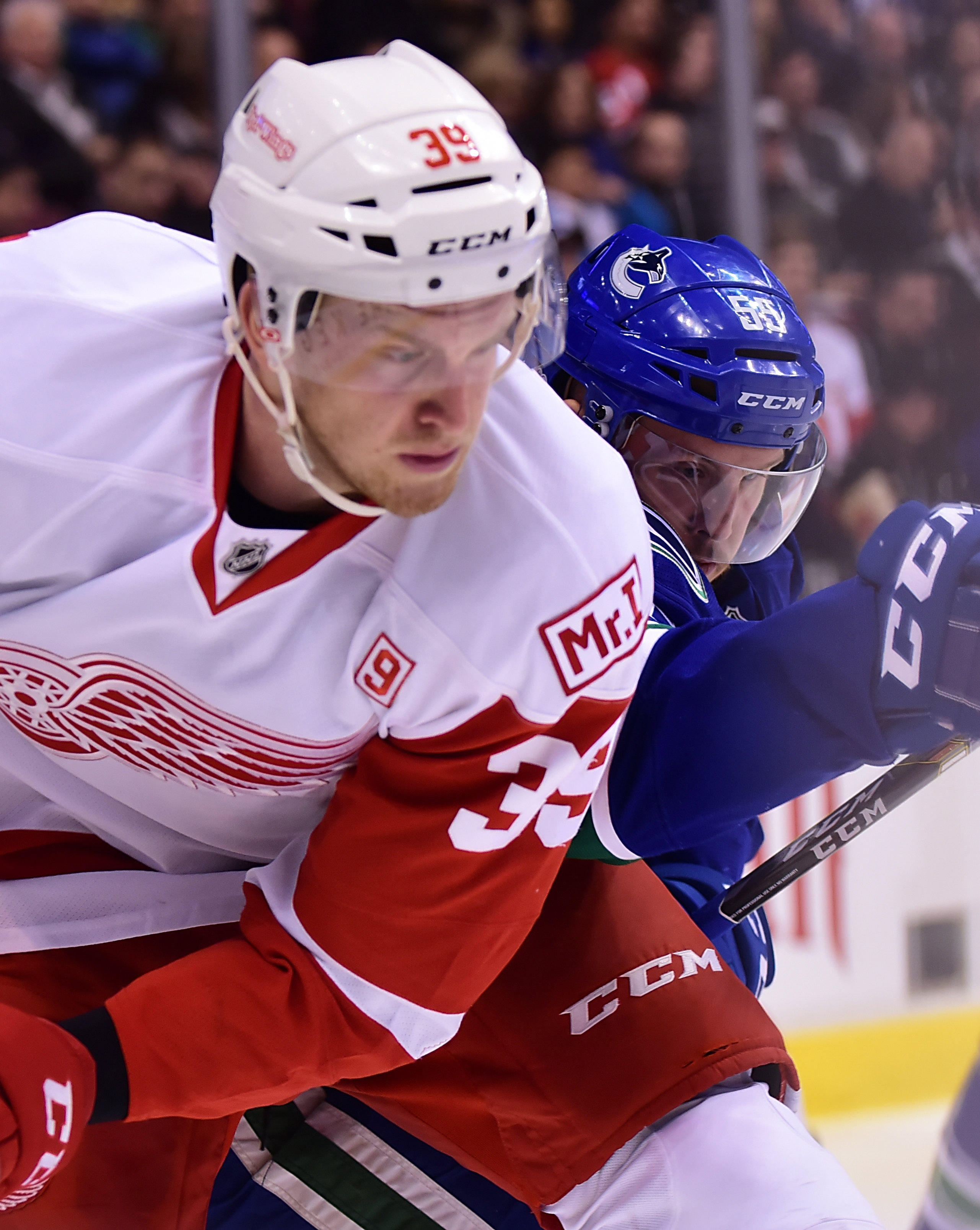 Player To Watch: F Anthony Mantha – Mantha is an enigma for many Red Wings fans. Despite having the size, strength and skating ability to be a dominant force in the league, he at times drifts into the background or disappears completely. His coaching staff has felt the same, moving him into the press box at times during his rookie campaign, and ultimately demanding more from him on a game-by-game basis.
This year will be a telling one. Mantha comes into the year after scoring 17 goals and 36 points in just 60 games, but even their distribution showed his inconsistency. Seven goals and fifteen points came in a 12-game span in the middle of the season, where he showed off just how forceful he can be with the right work ethic. He would score just 14 points in the remaining 32 games.
Now, with the Red Wings pivoting towards their youth and a sort of on-the-fly rebuild, Mantha must be better. At 23, the time is now for him to prove that he can be more than just a secondary scoring threat, and team up with other youngsters like Dylan Larkin to bring the next wave of Detroit success.
Key Storyline: Last year after the Red Wings fell out of contention, they did something they hadn’t done in some time. At the trade deadline, they moved Brendan Smith, Tomas Jurco and Thomas Vanek for future assets. That idea of selling mid-season is something almost entirely foreign to this generation of Red Wings fans, as the team hadn’t missed the playoffs since 1990.
Going into this season with a new arena and new hopes, the team will have to make a similar decision. If they aren’t competing for a playoff spot in early 2018, selling off some assets is a necessary next step. Though they’re expected to struggle once again, the team is over the cap and used some of their room to bring in a veteran Trevor Daley. That move seemed to show that they weren’t willing to go for a full rebuild, at least not yet.
While there is certainly upside in parts of their roster, players like Mike Green, Gustav Nyquist and Jimmy Howard are all unlikely to be around for the next great Red Wings team. Moving on from them whenever they can would help both the salary structure and the on-ice product down the line. Green especially will be a sought-after commodity at the trade deadline as he heads towards free agency, as the 31-year old can still provide offense from the back end. He has a full no-trade clause that would have to be worked around though, taking away some of the Red Wings’ leverage in trade talks.
Photo courtesy of USA Today Sports Images
Kronwall, Abdelkader, Zetterberg All Close To Returning
- The Red Wings are expecting a trio of veterans to return from injuries, notes MLive’s Ansar Khan. Niklas Kronwall is expected to make his preseason debut on Thursday after missing time with back spasms while Justin Abdelkader is hopeful to play then as well; he has missed the last ten days with a groin issue. Meanwhile, captain Henrik Zetterberg is slated to play on Friday for the first time as his neck soreness is improving.
Snapshots: Duchene, Athanasiou, Vegas, Belmont Park
Matt Duchene has been suiting up in the preseason for the Colorado Avalanche despite continuing trade speculation, and Adrian Dater of BSN Denver has now been told it’s very likely the unhappy forward will begin the year with the team. That does seem like the only option at this point, as a team has still yet to step forward and meet GM Joe Sakic‘s asking price.
Some of the hesitation to pony up for Duchene comes from his disappointing season a year ago, when he scored just 18 goals and 41 points. Those numbers were both career-lows in full seasons, and there has been some debate over whether Duchene can handle top center duties any longer. From all accounts, the 26-year old has looked great in training camp so far as he tries to prove that he can still help turn the tide for any organization.
- Unsigned restricted free agent Andreas Athanasiou hasn’t spoken to the Detroit Red Wings in almost ten days according to Helene St. James of the Detroit Free Press. St. James says that since a face-to-face meeting on September 16th, there has been “nothing but silence.” It’s starting to look like Athanasiou will not start the season with the Red Wings, despite multiple offers extended from the team. Holdouts rarely end in big raises for players involved in them, and it’s not clear exactly why the two sides are so far apart.
- Jason Pothier of SinBin examined the history of George McPhee when he was the GM of the Washington Capitals, and shows that if he’s operating similarly a trade may be coming in the next few days. McPhee has completed eight trades in the last week before the season in the past, and since there still seems to be too many NHL-level defensemen in town, it could happen once again.
- As expected, there will be at least one other bid for the Belmont Park location is a potential spot for a new New York Islanders’ arena and it will indeed be New York City FC. Jim Baumbach of Newsday reports that the soccer franchise will submit a bid, but it’s actually not the team’s preferred location. We’ve heard before that it could take months to be given a decision, but proposals must be officially submitted by Thursday afternoon.
Sproul Set To Return On Monday
Red Wings GM Ken Holland confirmed to Khan that the team plans to carry only seven defensemen to start the season so right now it appears that the 24-year-old is on the outside looking in at a roster spot despite playing in 27 games with Detroit in 2016-17. Sproul will require waivers in order to be assigned to AHL Grand Rapids.
Tyler Bertuzzi Out Three-To-Four Weeks
Red Wings winger Tyler Bertuzzi will be out three-to-four weeks due to tendon inflammation in his wrist, GM Ken Holland told reporters including MLive’s Ansar Khan. That will keep him out of the lineup for the first week or two of the season which should give converted defenseman Luke Witkowski a bit more of an edge on a lineup spot on the wing.
Bertuzzi will likely be headed for season-opening injured reserve which will allow them to prorate his cap hit. Bertuzzi spent 50 days on the NHL roster last season (playing seven games with Detroit) so he will carry a discounted cap hit of nearly $184K on the Red Wings’ books once the season gets underway.
Poll: The Fate Of The Remaining RFA’s
Notable players have begun to be cut from training camps and placed on waivers as the season draws closer, under two weeks away now. Yet, two restricted free agents still have yet to even sign a new contract, nevertheless compete in camp. Columbus’ Josh Anderson and Detroit’s Andreas Athanasiou still remain unsigned long after agreements were reached in more difficult RFA cases like those of David Pastrnak and Sam Bennett. Not only do the pair still not have contracts for the coming year, but seemingly no progress has been made recently either.
After it was reported more than a week ago that there was a “vast gap” in negotiations between Anderson and the Blue Jackets, a recent update stated that “no progress” had been made since then either. The newest piece of information has Anderson traveling to Switzerland, where he could potentially meet with several NLA teams. Anderson has also spoken about the possibility of starring for Team Canada at the Olympics. Anderson scored 17 goals for Columbus last year, which would be quite a lot of production for a team chasing a division title to lose.
Athanasiou is beyond overseas speculation; he has several hard offers on the table from KHL clubs. While “talks continue” between the two sides, there has been no concrete news for days. The “Riley Sheahan-to-Pittsburgh” rumor, that is supposedly contingent on an agreement with Athanasiou, has obviously not happened either, as it has been all quiet from both the Red Wings and their talented, young player. Athanasiou scored 29 points in 64 games for the struggling Wings last year. Can a team lacking much game-breaking talent afford to lose such a player?
There are a lot of different ways that this could all end up. Either or both could simply sign with their current teams, whether it be in the coming weeks or early in the season like several 2016 cases. Either one could be traded to a team with greater need and greater ability to sign them to a deal that comes closer to their desired term and salary. Or, the nuclear option, both have expressed and interest (read: threatened) in going overseas and could pull the trigger if their team will not sign or trade them. Take a crack at the poll below and sort through a variety of endings to these RFA sagas:
What will happen to Anderson and Athanasiou
-
Both sign with their respective teams 35% (90)
-
Both play overseas 18% (47)
-
Anderson signs, Athanasiou plays in KHL 13% (34)
-
Both traded 11% (29)
-
Athanasiou signs, Anderson traded 8% (22)
-
Anderson signs, Athanasiou traded 8% (21)
-
Athanasiou signs, Anderson plays in NLA 6% (16)
Total votes: 259