
As the Vancouver Canucks continue to ponder seismic, franchise-altering changes, significant attention has been paid to the possibility of the club moving on from top center Elias Pettersson. TSN’s Darren Dreger spoke on that possibility on today’s Insider Trading segment, saying “the Vancouver Canucks are listening and will listen to interest in Pettersson.” Dreger also noted that the Canucks firmly believe that Pettersson will thrive if he ends up receiving a new opportunity and fresh start elsewhere.
This current Canucks management group, led by veteran executive Jim Rutherford and GM Patrik Allvin, is not shy about making franchise-altering deals. They traded Quinn Hughes to the Minnesota Wild earlier this season, for example. But it’s worth noting that Hughes’ trade was, on some levels, quite a bit more straightforward than a potential Pettersson trade.
Hughes is widely considered one of the game’s best players, and he had communicated, in no uncertain terms, that he was not prepared to commit to signing an extension in Vancouver. As a result, trading Hughes became a foregone conclusion for the franchise.The Canucks were able to shift their focus to figuring out the best way to maximize their return in a Hughes deal, rather than trying to decide whether or not to trade Hughes in the first place.
Pettersson’s situation is quite a bit more complicated. First and foremost, the full no-move clause on his $11.6MM AAV deal gives the player and his representatives (led by CAA’s Pat Brisson) full control over where he is dealt to. Pettersson needs to sign off on any trade before it can be completed. Dreger reported today that the Canucks have yet to communicate with Brisson regarding specific trade possibilities.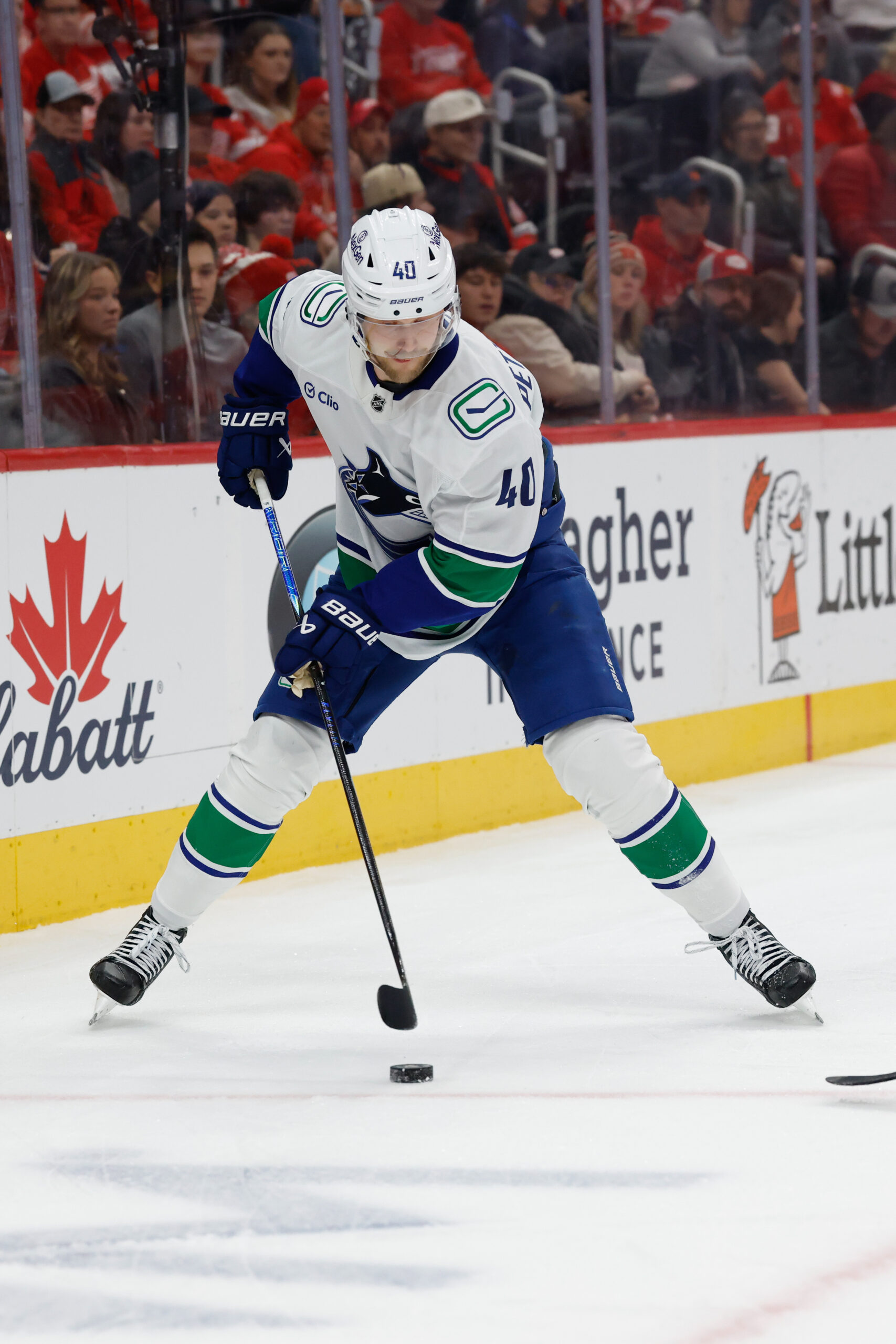
Pettersson could very well be receptive to a whole host of trade possibilities, so the more significant complicating factor is how exactly to properly value Pettersson in a trade. Hughes’ situation was, as mentioned, far more straightforward straightforward.
He is one of the NHL’s best players and a massive offer containing high-end young talent would be necessary to acquire him. But in Pettersson’s case, he has a few competing factors clouding where his exact trade value might land.
On one hand, Pettersson seems like a hugely valuable trade asset. He’s just 27 years old, and under contract through the 2031-32 season. He also has a 102-point season on his résumé, and managed 89 points as recently as 2023-24. He’s looked like an elite No. 1 center in some years, and at worst has played like a second-line pivot.
The center market is, at the moment, defined by its scarcity. When the Philadelphia Flyers signed Christian Dvorak recently to a five-year contract extension, GM Danny Briere cited the state of the center market, and the difficulty of acquiring centers, is part of the reason why he decided to push forward with the deal.
That environment could be one the Canucks are able to leverage to gain a significant return in any Pettersson deal. Put simply: centers in their prime who have scored at a point-per-game rate simply don’t become available very often. Even with his faults, Pettersson is likely to be a coveted trade asset.
There are some headwinds, of course, complicating Pettersson’s value on the market. Like Jack Eichel before him, Pettersson as a trade target carries a notable degree of risk. For Eichel, the risk largely lay in his uncertain medical situation. For Pettersson, the uncertainty and risk is largely of an on-ice variety. Pettersson hasn’t looked like the same player over the last season and a half, and his diminished level of production reflects that.
Despite scoring at a far lower rate than the best years of his career (he’s at 28 points in 38 games this season, and scored 45 points in 64 games last year), Pettersson’s salary still reflects his early-career promise. He’s set to make $11.6MM against the cap through 2031-32. While the cap is rising and it’s a less weighty commitment than it would have been a few years ago, $11.6MM is still an enormous cap hit. A team that is interested in acquiring Pettersson runs the risk of significant financial inefficiency down the middle should Pettersson be unable to return to his prior levels of play.
To be clear, the team control afforded by Pettersson’s contract also gives the acquiring team a significant amount of potential upside with a deal. They could get a top center they don’t have to worry about re-signing for the rest of the decade and beyond. That’s an extraordinarily valuable thing for an NHL team, something that can anchor a contending lineup. But that team control also brings with it a significant amount of risk in the event Pettersson isn’t able to excel in his new environment.
Regardless of those risk factors, it still seems overwhelmingly likely that a laundry list of teams will be interested in acquiring Pettersson. He’s simply too talented, and centers of his caliber are simply too rare. It also doesn’t hurt the Canucks’ efforts that teams have found success in similar deals in the past few years, most notably including the Flyers’ recent rehabilitation of Trevor Zegras or the Golden Knights’ Stanley Cup win soon after acquiring Eichel.
But even though Pettersson will likely still command a fair amount of interest, his deal won’t be a simple one to complete. His situation in Vancouver is emerging as one of this season’s most intriguing storylines to watch.
Photos courtesy of Rick Osentoski-Imagn Images
Do it Drury
Dammit,you beat me to the punch. JT beating him down in the locker room and them being separated by Rempe. 😆🤣
Get Georgiev and DeAngelo back too. What could go wrong.
Yes do it Drury. Please do it! ;)
@HockeyRules21 – That could bust my ribs all over again! 😄
He wants to join Alex Steen and the Swedish Mafia in St. Louis. Send Kyrou to Vancover
Now this might be a guy for the Hawks. 27 years old and signed through 2031.
That works.
And under performing his contract
I have no idea what KD or the Hawks think of Pettersson, I was just basically saying this is the kind of guy the Hawks should be trading for. He’s in the right age range and is a guy who isn’t happy where he is so he’s available. The Hawks have a ton of C’s and you only need 4 so they need guys who are adaptable at least. At least until they can draw FA’s themselves. They don’t need 34 year old guys no matter how good they are. At least not yet.
Trading Elias Pettersson might be easier in the offseason than it is during the regular season. Only about 11 teams right now could take the bloated $11.6M AAV on their cap. Some of those teams would be cutting it tight pending who’s being moved in the transaction. It’s not going to be an easy trade to make at this time but maybe one GM will be desperate enough to go for it before the trade deadline.
Hughes trade was more straight forward, yet they still bungled it. At that moment the organization was still in denial that a rebuild was necessary; every deal they pitched focused on “plug-in return”. You trade an undisputed superstar they needed to garner a couple future frontliners, and best way is to get as many firsts as possible. Buium has the potential, but Rossi – who Rutherford-Allvin coveted & offered last year’s first for, is being paid as 2nd line centre but all last years success was tied to kaprisov. Ohgren has potential, but some lustre had gone… they also got the Wild’s first this year, which is 26-28 overall. They didn’t counter Guerin’s offer! Didn’t demand another pick, even tied to them making a conference final over next two seasons. I think I prefer a Detroit package, based around one of Danielson or Kasper, a young defenceman, a young winger and their first…
Detroit was NOT giving them Edvinsson, that is when they turned to Minny. Obviously, Minny had a better package to put on ICE!
The whiny one or the whiny one?
Patrik Allvin has to go, He isn’t capable of a rebuild, He just wants, Soft, small European players.
He’s just JRs puppet
Agreed. JR makes all the moves. He can’t help himself.
Pettersson was looking pretty mediocre during the 2nd half of the season that the Canucks had their playoff run, so he’s been bad across the last 3 seasons now. He appears to suffer from chronic tendonitis. Buyer beware
Canes need a 2C like waaay bad
CAR is the best fit with a possible positive outcome I could see… question is how he would fit into their cap structure?
I simply cannot see EP40 playing in Brind’Amour’s system.
Which Elias Pettersson?
Seriously though, the current NHL center or the different player he was 2.5 years ago?
That’s the legacy Rick Tocchet leaves behind.
EP came into the league in 2018. Received the large contract in October 2021 and pretty much immediately did not live up to it. Rick Tocchet was his coach for all of two of his years in the NHL, yet EPs poor performance is Tocchet’s fault? Where do you come up with this stuff?
“did not live up to it”.
Really? 102 points in 22-23 and 89 the next year.
In the same 2 years Kaprizov got 75 and 96, then 56 last year. For that, he’s gotten a contract that dwarfs Pettey’s. Even if Kaprizov scores 150 points, he won’t live up to it by your measuring stick.
This front office is a joke. Maybe think before you sign players to long term contracts.
The title of this article is hilarious. Of course they’re “willing” to listen. They’re BEGGING to “listen”. Problem is, nobody’s talking. Rats.
Don’t be ridiculous. Plenty of NHL teams are talking.
They’re saying, “not even with your first rounder.”
I’m wondering if The Hawks 1st in 26, Korchinski, and either Greene or Nazar would get it done? Oliver Moore is untouchable. The guy is a rocket. Obviously none of the Hawks Dmen on the NHL roster are going anywhere. At least not the young ones. The Hawks also have 3 2nd round picks in this draft plus Florida’s 1st. I’m sure something could be done.
The Hawks wouldn’t trade Nazar straight up for him, much less adding the potential #1 overall. Don’t be ridiculous.
Petey won’t go there either. So the whole point is moot.
The Hawks 1st *what* in 2026? Player successfully passed through waivers?
Y’all wild thinking EP goes for more than a bag of pucks that’s empty upon closer inspection. His contract has a legitimate claim to the Albatross Throne.
If there was an expansion draft and they offered him up in it, how many of y’all would take him?
Too bad about that full no-move…
He’d waive for Southern California…
straightforward straightforward
Wherever he ends up going, I think it would be best for him to thrive if its in a smaller market. I’m intrigued by Chicago but IDK if that’s the best fit for him. I think a team like Carolina or San Jose or even Nashville where hockey isn’t the end all be all in the hockey world might do him some good.
I’m pretty sure the Hawks would have to give up their 1st this year to acquire him. I’m also guessing that the Hawks are hoping the ping pong ball Gods smile on them one last time as I’m sure they would love to put either McKenna or Stenberg( To stay with Frondell) to add one last time. Still if the Hawks did get Pettersson he would help make that draft pick drop before it was over. It’s something to toss around for sure.
As a Red Wings fan, I would much rather see the Wings trade for Robert Thomas than Pettersson to finally get the legit top two center they’ve needed for years.