
Notable Former NHLers Playing In The SHL Next Year
As overseas campaigns get ready to kick off at the beginning of next month, we’ll highlight some notable former NHLers suiting up for teams in major European leagues over the next few days. First up is the Swedish Hockey League, which sees a new face this year in Örnsköldsvik’s MoDo Hockey, which earned promotion from the second-tier Allsvenskan to play in the top flight for the first time since 2016.
D Christian Folin – Frölunda HC
Suiting up as an alternate captain for Frölunda this season, the 32-year-old Folin has two years remaining on a deal with the club he signed in 2021. A veteran of 244 NHL games, the left-shot defender most recently suited up for 16 games with the Montreal Canadiens in the 2019-20 campaign. His career-best season came with the Los Angeles Kings in 2017-18, the second of three consecutive seasons he managed to avoid AHL assignment. In 65 games, Folin recorded average possession numbers and finished the year with three goals and ten assists for 13 points. He appeared in all four playoff games as his Kings lost to the expansion Vegas Golden Knights in a first-round sweep. Since returning to his home country, the two-way defender has represented Sweden internationally at the World Championship and Winter Olympics, although his offensive game is beginning to decline. He recorded just seven assists in 37 games for Frölunda in 2022-23.
F Oscar Lindberg – Skellefteå AIK
Lindberg has played overseas for the past four seasons, but only in Russia and Switzerland. 2023-24 will be his first time playing in the Swedish top flight since 2013, and he’s doing so with the only SHL club he’s ever known in Skellefteå. Initially a second-round pick of the Phoenix Coyotes in 2010, Lindberg saw 134 out of his 252 games of NHL action in a New York Rangers uniform after he was sent there in a 2011 swap of prospects. Now 31, Lindberg recorded a career-high 13 goals and 28 points in 68 games during his rookie season with New York in 2015-16, but he never quite displayed the ability to become a long-term top-nine fixture in the NHL. He made later career stops with the Golden Knights and Ottawa Senators before leaving for Switzerland’s EV Zug after the conclusion of the 2018-19 season.
F Magnus Pääjärvi – Timrå IK
The most NHL-seasoned forward on this list, Pääjärvi will play a depth role in helping Timrå avoid relegation to the Allsvenskan for a third straight season after getting promoted in 2021. Pääjärvi also played his last NHL game with Ottawa in 2019, much like Lindberg, although he’d been in the league since the start of the decade. Now 32, Pääjärvi was the tenth overall pick in the 2009 NHL Draft, going off the board to the Edmonton Oilers. It looked like a solid selection at first – he rattled off 34 points in 80 games during his rookie season as a 19-year-old in 2010-11 on a struggling Oilers squad. However, he wouldn’t put up double-digit goal totals again until his final season in the NHL with Ottawa, instead bouncing around the Oilers, Blues and Senators as a depth forward in a fourth-line role over nearly a decade. He did appear in a very respectable 467 NHL contests before heading overseas in 2019 with the KHL’s Lokomotiv Yaroslavl, however. He hasn’t been a huge offensive factor since returning to Europe, recording just seven goals and 13 points in 40 games for Timrå last season.
F Tobias Rieder – Växjö Lakers HC
This will be Rieder’s third consecutive year suiting up for Växjö after he departed the NHL for Sweden in 2021. It’s been a fruitful tenure for the German-born forward, as he’s put up double-digit goal totals in both seasons and won an SHL title in 2022-23. Once a promising middle-six talent with the Arizona Coyotes in the mid-2010s, things went off the rails for Rieder after signing as a free agent with the Edmonton Oilers in 2018. Viewed as a surefire bet for at least around 15 goals and 30 points, Rieder instead put up a goose egg in the goal column despite playing in 67 games. Later tenures with the Buffalo Sabres and Calgary Flames went similarly poor, and the 30-year-old will likely play the rest of his career overseas.
D Anton Strålman – HV71
Strålman is returning home to Sweden after spending last season in the Boston Bruins organization. He played just eight games in the NHL, however, instead being relegated to the AHL’s Providence Bruins for most of 2022-23 after earning a contract off a PTO. The 37-year-old is likely done in the NHL after quite a respectable 938-game, 16-season career, but he’ll look to log heavy minutes for HV71 and try and rediscover his offensive touch against some easier competition. It’s a nice bookend for Strålman, who was once one of the better complementary defenders in the game and played against tough competition as a premier two-way defender for the Tampa Bay Lightning in the mid-to-late 2010s.
Honorable Mentions: F Henrik Borgström (HV71), D Brandon Davidson (Rögle), F Christoffer Ehn (Linköping), F Remi Elie (Linköping), G Jhonas Enroth (Örebro), D Oscar Fantenberg (Linköping), F Janne Kuokkanen (Malmö), F Anton Lander (Timrå), F Pär Lindholm (Skellefteå), F Alan Quine (Malmö), D David Rundblad (MoDo), D Joakim Ryan (Malmö), F Mattias Tedenby (HV71)
Free Agent Profile: Brian Elliott
It would be fair to say Brian Elliott‘s had a rather long and winding NHL career. Now 38 years old, he’s got quite the career resume for someone taken in the ninth round of the NHL Draft in 2003.
The Newmarket, Ontario native put up some okay numbers when he was breaking into the league with the Ottawa Senators in the late 2000s, but it wasn’t until he landed with the St. Louis Blues in free agency in 2011 that he became solidified as a more well-known NHL netminder.
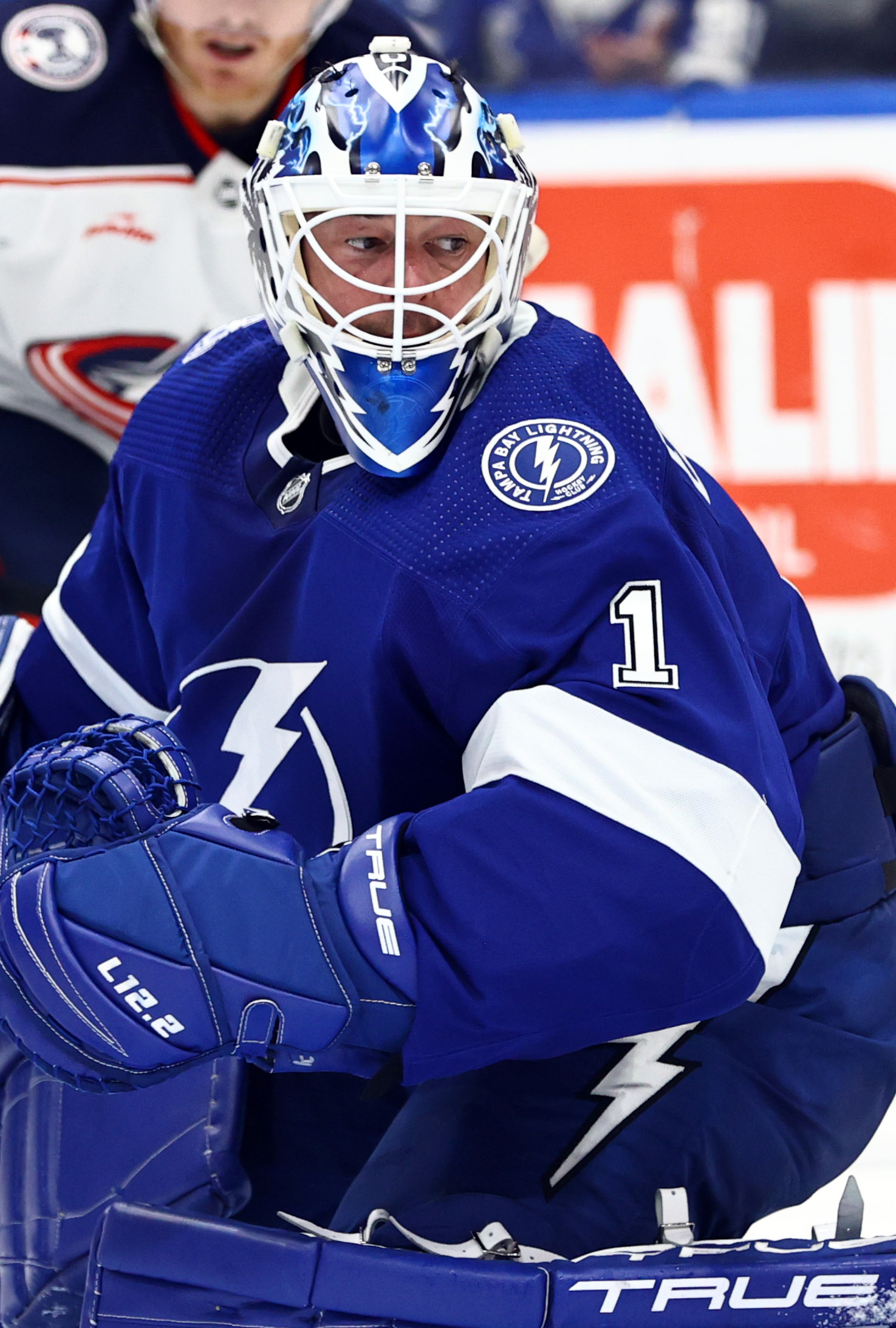 He was coming off a rather conflicting 2010-11 season at the time. Despite starting a career-high 51 games between the Senators and Colorado Avalanche, his numbers were abysmal, especially for someone pegged as a starter – his .893 save percentage was well below the league average at the time, and he conceded more than 30 goals above what an average netminder would’ve allowed throughout the season.
That all changed once he landed in St. Louis, where he became a solid tandem netminder over the years with Jake Allen. While he never displayed the consistency necessary to be a high-end, full-time starter, he did earn Vezina consideration thanks to a couple of years (including his first in St. Louis) where he boasted above a .930 save percentage.
The days of Elliott being able to take over the crease like that are long gone, however. He hasn’t started more than 30 games since the 2017-18 campaign with the Philadelphia Flyers, and he’s posted a save percentage above .900 just once in the past four years.
His last season didn’t do much to inspire confidence that he could still compete at the highest level. Behind a slightly weakened but still stout Tampa Bay Lightning defense, Elliott put together a substandard season more in line with what we’ve seen from him since the Blues traded him to the Calgary Flames in 2016. In fact, he’s put together just one above-average season since departing the Blues – 2021-22 with Tampa, in which he started just 17 games but posted a respectable .912 save percentage.
There could still be some suitors for Elliott on the market. However, it’ll likely be limited to teams looking for insurance behind an injury-prone or unproven young backup. If he wants to keep lacing up the skates for an opportunity for NHL action, it’ll need to be with the understanding that a demotion to the AHL could be possible.
Stats
2022-23: 22 GP, 12-8-2, 2 SO, 3.40 GAA, .891 SV%
Career: 543 GP, 279-167-54, 45 SO, 2.57 GAA, .909 SV%
Potential Suitors
Elliott was linked to the Toronto Maple Leafs earlier this summer for a third-string role, but Toronto filled that gap on their depth chart earlier this month by signing Martin Jones to a one-year deal. While it won’t be Toronto, Elliott could still find a home for a similar type of role elsewhere.
Obviously, his most desired fit would be on a contending team looking for insurance, similar to how Jonathan Quick ended up in a Vegas Golden Knights jersey after last season’s trade deadline. He didn’t see any playoff action but was around the team and ended the season lifting his third Stanley Cup. Elliott is still looking for his first.
One of the suitors in the Eastern Conference who immediately jumps out is his old team in Tampa Bay, but it’s unlikely for a handful of reasons. First, it seems rather puzzling that Elliott would go un-signed this late in the summer only to return to Tampa, although a PTO with the Lightning could still be an option if he doesn’t have another offer by the time training camps roll around. Tampa also signed Jonas Johansson to a contract earlier this summer – prying him out of a deal in the Swedish Hockey League he’d signed prior, likely with the guarantee of NHL time behind Andrei Vasilevskiy. With the Lightning’s minor league tandem already seemingly set with Matt Tomkins and Hugo Alnefelt, Elliott’s been boxed out of the depth chart there.
The only team with playoff aspirations in the East with a glaring hole on their goalie depth chart is the New York Islanders. Their options are quite slim behind Ilya Sorokin and Semyon Varlamov, and 23-year-old Jakub Skarek is currently pegged as their third-string option without much development to showcase after four seasons in the minors. The organization’s had Cory Schneider play a veteran third-string role the past handful of seasons, and if Elliott is okay with a similar arrangement, he could see some limited playing time on the Island should a long-term injury affect either of Sorokin or the aging Varlamov.
His options open up considerably if he wanted to head to the Western Conference, however. The Golden Knights might be looking for a third-string netminder still, depending on how they feel about 24-year-old Jiri Patera being their first available call-up option behind Adin Hill and Logan Thompson. He could also be an option to return to Colorado if they don’t feel Justus Annunen is ready to take on a full-time backup role if called upon. Backup Pavel Francouz has a firm grip on the second NHL job behind Alexandar Georgiev, but he’s missed lengthy periods of time with injury since coming over to North America in 2018.
Projected Contract
Given he won’t be landing a full-time backup role anywhere, Elliott is looking, at best, at a one-year, one-way league-minimum deal for $775K with the expectation he could be placed on waivers to start the season, much like Jones in Toronto. If he does feel like he’s got enough in the tank to hold out for some more guaranteed opportunity, he could hunt for a PTO with a team in the coming days to try and compete for a backup role. This late into August, though, his options would be extremely limited as few teams are still looking to fill a bonafide backup spot on their depth chart.
Photo courtesy of USA Today Sports Images.
Summer Synopsis: Buffalo Sabres
For the 12th season in a row, the Buffalo Sabres failed to make the playoffs at the end of the regular season. However, for the first time in several years, the end of the regular season did matter quite a lot to the Sabres. Being one of the best scoring teams throughout the year, Buffalo finished one point back of the last wild card spot in the Eastern Conference, raising expectations for the upcoming 2023-24 NHL season. There are still some weak spots in the lineup, but the Sabres made some moves this summer to address other areas of need.
Draft
1-13: F Zach Benson, Winnipeg (WHL)
2-39: F Anton Wahlberg, IF Malmo (SHL)
2-45: D Maxim Strbak, Sioux Falls (USHL)
3-86: D Gavin McCarthy, Muskegon (USHL)
4-109: F Ethan Miedema, Kingston (OHL)
5-141: G Scott Ratzlaff, Seattle (WHL)
6-173: D Sean Keohane, Dexter School (USHS)
7-205: D Norwin Panocha, Eisbaren Berlin (DNL U20)
Benson becomes the prize of the draft for the Sabres, falling to Buffalo at 13th overall after being projected to go in the top 10 throughout much of the year. Now joining former Sabres’ first-round selection, Matthew Savoie, with the Wenatchee Wild of the WHL for the 2023-24 season, Benson capped off his three-year career with the Winnipeg Ice scoring 36 goals and 62 assists in 60 games.
Strbak and McCarthy represent solid young defenders that the team has been craving over the last several years. Both players will join the NCAA for the 2023-24 season, Strbak to Michigan State University, and McCarthy to Boston University. They both carry solid skating ability, with an even better ability to get the puck out of their zone and into transition. Overall, factoring in the team’s need to keep the puck out of their net, McCarthy likely projects as the best long-term solution to that problem.
Key UFA Signings
D Kale Clague (one year, $775K)*
D Connor Clifton (three years, $10MM)
G Devin Cooley (one year, $775K)*
D Erik Johnson (one year, $3.25MM)
F Tyson Jost (one year, $2MM)
F Justin Richards (one year, $775K)*
G Dustin Tokarski (one year, $775K)*
*-denotes two-way contract
Even with an abundance of cap space heading into the offseason, the Sabres stayed relatively quiet on the free-agent market. They were quick to address their lack of defensive prowess on the back end by inking Clifton and Johnson to contracts on day one and even brought back Jost on a one-year deal to fill the gap left by the injury to Jack Quinn.
Although finished the 2022-23 regular season as the third-highest-scoring team in the league, the Sabres finished 26th in goals against, largely due to inefficient defensemen and goaltending. By bringing in Clifton and Johnson, who both play on the right side, Buffalo should dramatically improve the quality of their blue line. Both players finished with a solid oiSV% last season at 93.2% and 91.7%, respectively.
Already carrying solid defensemen such as Rasmus Dahlin, Owen Power, and Mattias Samuelsson with the ability to play on the left side of the blue line, the additions of Clifton and Johnson immediately make the team more well-rounded. If their offense can at the very least repeat the goal-scoring from a year ago, the Sabres should be in line to dramatically increase their year-on-year goal differential mark.
Key RFA Re-Signings
F Brett Murray (one year, $775K)*
F Lukas Rousek (two years, $1.55MM)*
F Linus Weissbach (one year, $775K)*
*-denotes two-way contract
All three of these players will likely spend the majority of next season rostered with the organization’s AHL team, the Rochester Americans. Of the trio, Rousek was the only one to suit up for the Sabres, scoring one goal and one assist in two games played. At the AHL level, Rousek led the Americans in most scoring categories, scoring 56 points in 70 games.
Murray and Weissbach had solid seasons in Rochester last year in their own right, finishing third and fourth on the team in scoring, respectively. Both players bring a nice scoring touch to the AHL level and do carry the potential of being rostered on the Sabres next year in case of injury or suspension to a regular forward.
Key Departures
G Craig Anderson (retirement)
F Vinnie Hinostroza (Pittsburgh, one year, $775K)
D Ilya Lyubushkin (trade with Anaheim)
G Malcolm Subban (St.Louis, one year, $775K)
For the most part, Buffalo didn’t stand to lose too much entering into this offseason. Their top two unrestricted free agents, Kyle Okposo, and Zemgus Girgensons, both re-upped with the Sabres on separate one-year, $2.5MM contracts, leaving the team with a fairly clean outlook for the remainder of the summer.
The trade that sent Lyubushkin, which was made just under 10 days ago now, was strictly due to a looming roster crunch on the back end for Buffalo. Because the team had brought in Clifton and Johnson and did not lose any defensemen via free agency, the team simply had too many viable options on the blue line, and Lyubushkin became a consequence.
To pick out one, the departure that may hurt the team the most is the retirement of Anderson. Being 41 years old last season, Anderson provided Buffalo with stability between the pipes at the very least, carrying an 11-11-2 record in 24 starts, posting a .908 SV% and a 3.06 GAA. These are not great numbers by any stretch of the imagination but would end up being some of the better goaltending numbers posted for the Sabres last season. However, if Anderson becomes the biggest loss of the offseason for Buffalo, it would be hard to consider this summer anything other than a complete success for the organization.
Salary Cap Outlook
Even with large extensions kicking in this season for Tage Thompson and Dylan Cozens, as well as carrying the relatively high-cap hit of $9MM for forward Jeff Skinner, the Sabres have one of the cleanest cap futures of any team in the NHL. They will still need to dole out extensions for Dahlin and potentially Power by the end of next summer, but with just over $8.7MM in cap space to start this season, should be able to fit those in rather easily.
There will come a time when Buffalo will likely be forced to move some names from the roster, as having so much top-end talent either on the team or still coming through the pipeline becomes expensive, but that can has been kicked far down the road for this organization. If the team reaches their potential this season, or even next, they will have plenty of cap space to become one of the juggernauts in the Eastern Conference and even the league as a whole.
Key Questions
What’s Their Answer Between The Pipes? Having already been addressed in this piece, it is no secret that Buffalo has had a serious problem with goaltending over the last several years. For the most part, Ukko-Pekka Luukkonen does not appear as the long-term answer in the net, and the Sabres appear to be putting all their eggs in the basket of Devon Levi. Levi does have serious long-term potential, but there is always a potential he does not live up to the hype. Luckily for Buffalo, with ample amount of cap space, prospect, and draft capital, they could look to poach already established goaltenders such as Ilya Samsonov, Connor Hellebuyck, Carter Hart, or Jeremy Swayman off the market sometime in the near future. 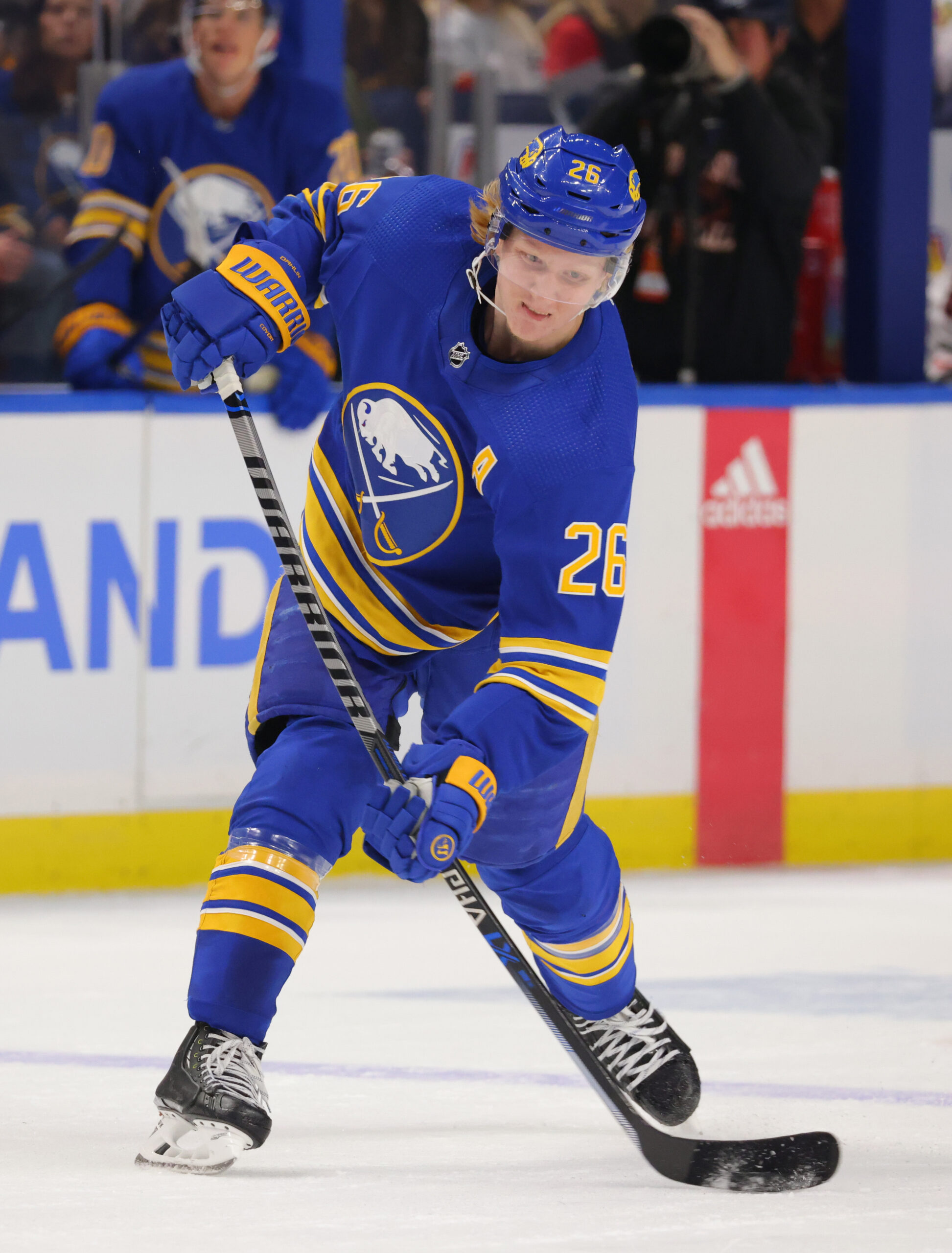
What Will Dahlin’s Extension Look Like? With one year and $6MM remaining on his current contract, Dahlin has set himself up nicely for a max extension with the Sabres by this time next year. Last season, in 78 games played, Dahlin would score 15 goals and 58 assists, finishing eighth place in Norris voting. Dahlin played much more physically last season than in years past and improved drastically on his defensive numbers as well. There is no question that he has earned a massive extension from the Sabres, but what that will look like is another question in its own right. Buffalo has done incredibly solid work in getting their star players signed to below-market deals and could do the same with Dahlin. If the Sabres are able to sign Dahlin for anything less than $10MM a season at this point, it will be a tremendous success for the team’s front office.
How Will The Team Replace Quinn? The most unfortunate news for the offseason is that the team will be without Quinn to start the regular season. Suffering an Achilles tear while training at the end of June, even by conservative estimates he will not start the season until the end of December. In 75 games last season, Quinn would score 14 goals and 23 assists, showing that he is ready for NHL minutes. To start the year, it likely makes the most sense to start John-Jason Peterka in Quinn’s absence, who had a very similar year last season to Quinn. However, although unlikely, if the top six does not reach expectations in Quinn’s absence, the team could look to bring in hometown star, Patrick Kane, to replace the minutes lost.
Photos courtesy of USA Today Sports Images.
Examining An Upcoming Montreal Canadiens Roster Crunch
On paper, the Montreal Canadiens don’t look like the type of team one would typically associate with an excess of NHL-caliber talent. The team is in the midst of a full-scale rebuild, attempting to construct a new core of players around some intriguing young pieces such as captain Nick Suzuki, sniper Cole Caufield, and 2022 first overall pick Juraj Slafkovský, among others.
The priority in Montreal under head coach Martin St. Louis has been player development rather than playoff contention, and that mandate to develop players as a top priority is likely to extend at least another season. But even though Montreal is widely expected to finish well outside the NHL playoff picture, they still have an abundance of capable NHL players to choose from when they construct their opening-night 23-man roster, particularly on defense.
Thanks to the Canadiens’ involvement in the three-team Erik Karlsson blockbuster trade, they dealt away Mike Hoffman and Rem Pitlick.
Those two departures did wonders to alleviate what was shaping up to be a crowded situation for the team at the forward position, one that may have even led to the Canadiens taking the somewhat drastic step of placing Hoffman on season-opening waivers.
Earlier this month, we covered the possibility that Hoffman, a well-traveled veteran scorer, could end up on season-opening waivers. With Hoffman and Pitlick departed, the possibility of the Canadiens exposing a relatively established NHLer on waivers has shifted focus to their defense and goaltending.
As a result of the Karlsson trade, (and subsequent deal that sent Jeff Petry to the Detroit Red Wings) the Canadiens ended up acquiring Gustav Lindström, a soon-to-be 25-year-old blueliner with 128 NHL games under his belt. The acquisition of Lindström gives the Canadiens a group of nine defensemen under strong consideration for the seven or even eight roster spots set to be available for that position.
Two veterans are locks to retain their prominent roles on the team: Mike Matheson scored at an impressive 58-point pace in his first season in Montreal and is likely to be the team’s number-one defenseman this season. David Savard is an experienced defensive defenseman who will be counted on to handle difficult minutes and penalty-killing time. Similar to those two veterans, Kaiden Guhle, should be considered a roster lock after a strong (albeit injury-shortened) rookie year.
Beyond those names, the Canadiens have Lindström, Arber Xhekaj, Jordan Harris, Johnathan Kovacevic, Justin Barron, and Chris Wideman left, a group of six defenseman competing for the likely four NHL jobs that remain.
Accordingly, the threat of waivers looms large over the Canadiens’ roster-building calculus as they seek to decide who to roster out of that set of names. Only Xhekaj, Harris, and Barron are able to be sent down to the AHL’s Laval Rocket without needing to hit the waiver wire. But as things currently stand, the Canadiens’ elevation of player development to their number-one organizational goal makes Xhekaj and Harris two highly likely candidates to make the opening-night roster, nearing “lock” territory.
Barron isn’t on quite as strong ground, but the 2020 first-rounder showed flashes of strong play as a rookie and could easily force his way into a roster spot with a strong preseason. Set to turn 22 in November, the Canadiens’ preference is undoubtedly for Barron to do exactly that.
Assuming Barron can manage to either put together a strong training camp and preseason, or at the very least do enough to motivate the Canadiens to spend an opening-night roster spot on him rather than start him in Laval, the result would be only one roster spot left for Lindström, Wideman, and Kovacevic.
Wideman’s valued presence in the Canadiens’ locker room kept him on Montreal’s NHL roster for the entirety of 2022-23, but with so many options to choose from the team may not be able to do the same for Wideman this upcoming season.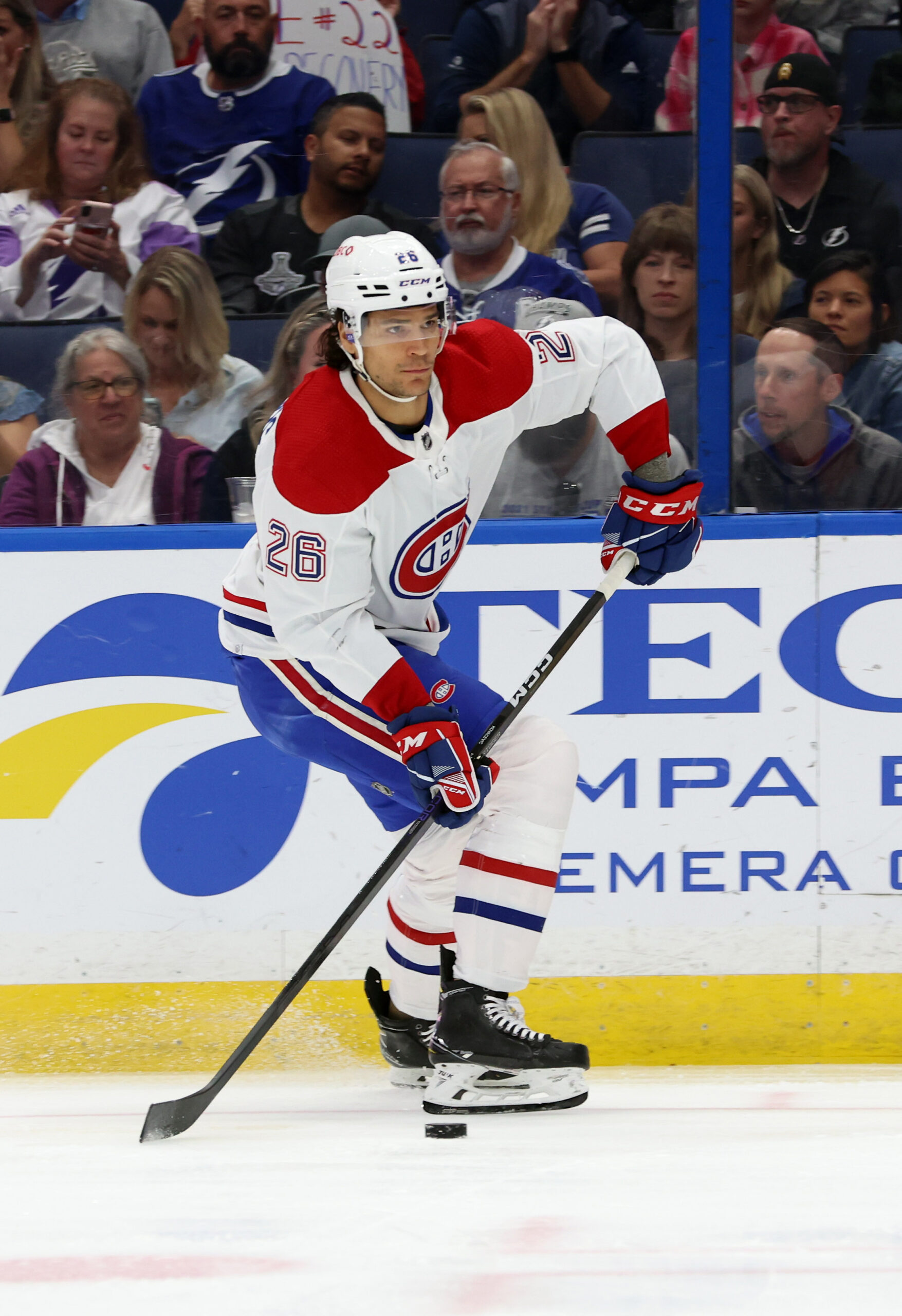
The likeliest of the three to win the potential last spot available on the team’s blueline is Kovacevic, who the Canadiens claimed off of waivers from the Winnipeg Jets at the start of last season.
Kovacevic acquitted himself well in his rookie season in Montreal and is a big right-shot defenseman on a highly affordable $766k cap hit for the next two seasons. He is therefore highly unlikely to be placed on season-opening waivers, something that would force the Canadiens into making a difficult choice.
Will they want to carry three netminders on their opening-night roster (Sam Montembeault, Jake Allen, Casey DeSmith) or are they okay with waiving one of those names (likely DeSmith) in order to be able to keep an eighth defenseman, saving Lindström or Wideman from waivers?
The current makeup of the Canadiens roster makes it likely that they’ll only be able to keep one of DeSmth, Lindström, or Wideman away from the season-opening waiver wire, barring a trade. That could present an opportunity for another club, as each name could reasonably be under consideration for rival teams to claim.
Lindström is a six-foot-two right-shot defenseman who saw regular penalty-killing time under former Red Wings head coach Jeff Blashill in 2021-22. DeSmith, 32, played in 38 games last season, a personal best, and has a strong .912 career save percentage in the NHL. Wideman is probably the least likely candidate to be claimed due to his age (he’ll turn 34 in January) but as mentioned he’s a valued veteran voice in Montreal and did manage to score 27 points in 64 games in 2021-22.
It’s obviously too early to predict what the Canadiens will ultimately do with their roster dilemma, and the preseason and training camp will go a long way in determining their ultimate course of action. Perhaps a netminder on another team suffers an unexpected injury, motivating them to make a trade offer for DeSmith, or maybe the opportunity will arise for the Canadiens to exchange some of their defensive depth for help in other areas.
But as things currently stand, the Canadiens are facing the prospect of placing a few notable players on waivers. That makes their training camp and preseason one to watch for not only Canadiens fans but also fans of rival NHL teams, especially fans whose clubs could potentially need a right-shot blueliner or backup goalie.
Photos courtesy of USA Today Sports Images
2009 NHL Draft Take Two: Seventh Overall Pick
Hindsight is an amazing thing, and allows us to look back and wonder “what could have been.” Though perfection is attempted, scouting and draft selection is far from an exact science and sometimes, it doesn’t work out the way teams – or players – intended. For every Patrick Kane, there is a Patrik Stefan.
We’re looking back at the 2009 NHL Entry Draft and asking how it would shake out knowing what we do now. Will the first round remain the same, or will some late-round picks jump up to the top of the board?
The results of our redraft so far are as follows, with their original draft position in parentheses:
1st Overall: Victor Hedman, New York Islanders (2)
2nd Overall: John Tavares, Tampa Bay Lightning (1)
3rd Overall: Ryan O’Reilly, Colorado Avalanche (33)
4th Overall: Matt Duchene, Atlanta Thrashers (3)
5th Overall: Chris Kreider, Los Angeles Kings (19)
6th Overall: Nazem Kadri, Phoenix Coyotes (7)
Rather than have history repeat itself by selecting Oliver Ekman-Larsson with the sixth pick, PHR readers instead opted to give the Coyotes a center with nearly 30% of the votes cast coming in for Kadri.
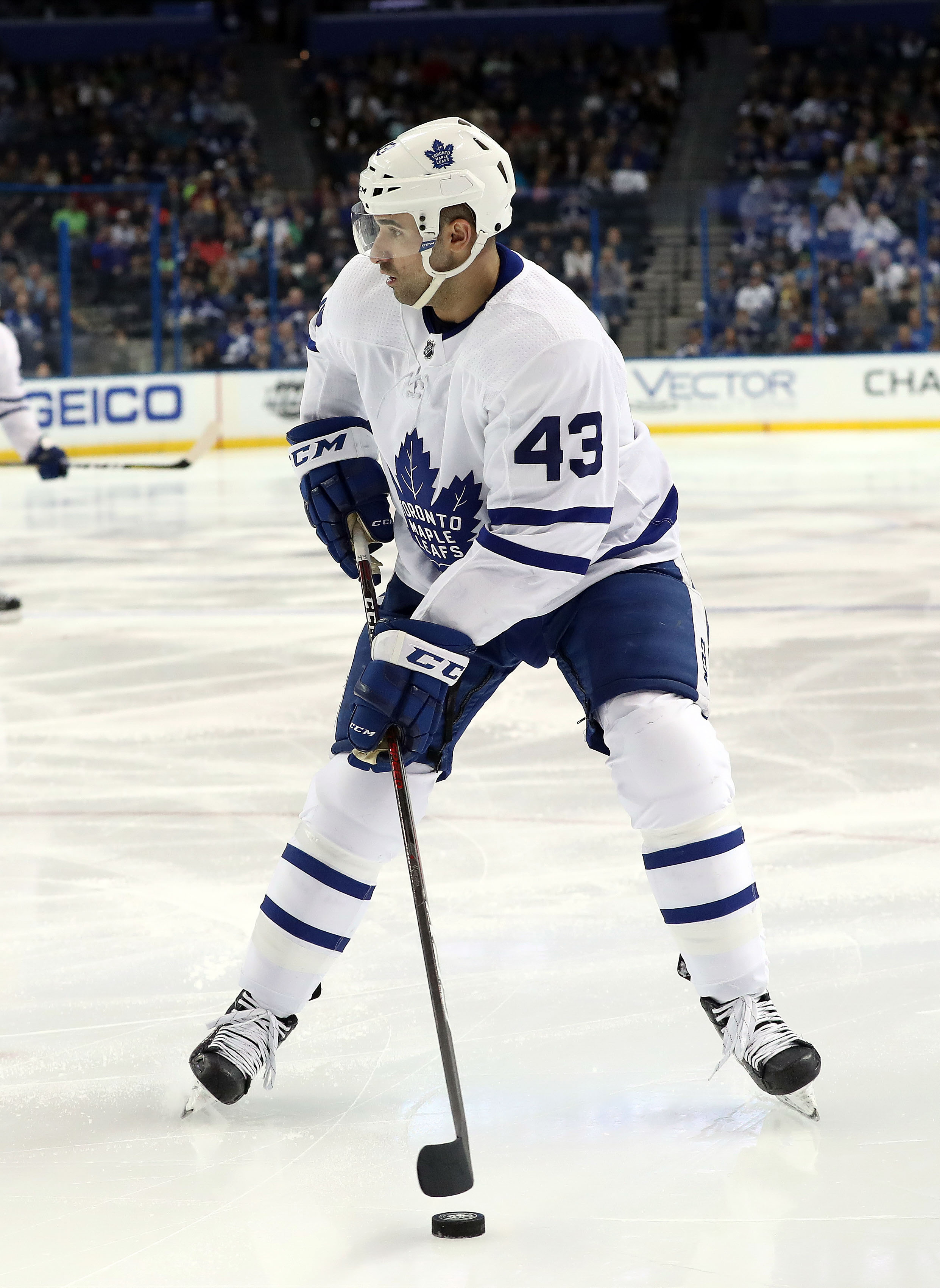 It took some time for Kadri to find his footing in the NHL but a breakout performance in the lockout-shortened 2012-23 campaign saw him secure a full-time role. That year, he posted a 0.93 points per game average and it looked like Toronto had found a true impact center, a vacancy they had dealt with for several seasons by that time with the likes of Mikhail Grabovski, Tyler Bozak, and Matt Stajan playing big minutes in the previous seasons.
However, it took a while for Kadri to really take off as he wasn’t able to produce like a true top-line middleman with consistency. In fact, it wasn’t until Auston Matthews arrived in 2016-17 that Kadri was able to reach the 30-goal mark, a milestone he then reached in back-to-back years. Unfortunately for Toronto, discipline issues became too much of a concern and in the 2019 offseason, he was traded to Colorado with Tyson Barrie and Alexander Kerfoot as part of the package coming the other way. Barrie lasted one season in Toronto before signing with Edmonton while Kerfoot held a middle-six role for each of the last four years and signed with Arizona last month.
Meanwhile, with the Avs, Kadri started slow, recording just 30 goals in his first two seasons combined, spanning 107 games. But in 2021-22, he had a career year, exploding for 87 points; his previous career-high was only 61. He then followed that up with an impressive playoff performance, notching 15 points in 16 games while helping lead Colorado to the Stanley Cup.
That made Kadri one of the more sought-after players last summer and while it took a while for Calgary to create enough cap room to sign him, a seven-year, $49MM deal eventually got done. Year one didn’t go so well (as was the case for many Flames) as his production dipped to 56 points. That’s still the third-best single-season mark of his career but they were undoubtedly hoping for a bit more from him as Calgary ultimately missed the playoffs. With six years left on that contract, he should be a fixture in their lineup for a while.
While Ekman-Larsson was a franchise fixture in the desert for more than a decade, they spent a lot of that time also searching for a center and it certainly is interesting to wonder what might have been had Kadri been the pick for them.
In the meantime, we move on to Toronto with the seventh selection. Obviously, their original pick (Kadri) is off the board so they’ll be getting someone new here. Who should they take? Make your selection using the ballot below.
2009 Redraft: Seventh Overall
-
Mattias Ekholm 31% (229)
-
Evander Kane 19% (143)
-
Brayden Schenn 10% (77)
-
Oliver Ekman-Larsson 10% (74)
-
Dmitry Orlov 8% (57)
-
Anders Lee 5% (39)
-
Ryan Ellis 4% (28)
-
Tyson Barrie 2% (14)
-
Reilly Smith 2% (14)
-
Darcy Kuemper 1% (11)
-
Kyle Palmieri 1% (11)
-
Tomas Tatar 1% (9)
-
Robin Lehner 1% (5)
-
Marcus Foligno 1% (4)
-
Mike Hoffman 1% (4)
-
Dmitry Kulikov 0% (3)
-
Nick Leddy 0% (3)
-
Jakob Silfverberg 0% (3)
-
Craig Smith 0% (3)
-
Sami Vatanen 0% (3)
-
Calvin de Haan 0% (2)
-
Brian Dumoulin 0% (2)
-
Erik Haula 0% (2)
-
David Savard 0% (2)
-
Marcus Johansson 0% (1)
-
Brayden McNabb 0% (1)
Total votes: 744
If you can’t access the poll above, click here to vote.
Photo courtesy of USA Today Sports Images.
Summer Synopsis: Boston Bruins
Last season, things couldn’t have gone any better for Boston from October through the beginning of April. They were the top team in the NHL and not by a small margin. GM Don Sweeney made multiple moves to add at the trade deadline, cementing themselves as a heavy favorite for the Stanley Cup. However, they were ousted in the opening round, blowing a 3-1 series lead to Florida. Their additions last season came at a cost and as a result, their roster looks considerably different now than it did just a few months ago.
Draft
3-92: F Christopher Pelosi, Sioux Falls (USHL)
4-124: F Beckett Hendrickson, USA U-18 (NTDP)
6-188: F Ryan Walsh, Cedar Rapids (USHL)
7-214: F Casper Nassen, Vasteras (Sweden U20)
7-220: D Kristian Kostadinski, Frolunda (Sweden U20)
Not surprisingly, with the Bruins being a buyer for several years in a row, they didn’t have a lot to work with here. Their first-round pick was traded for Dmitry Orlov and Garnet Hathaway while their second-round selection belonged to Anaheim as part of the Hampus Lindholm acquisition, their big move the year before. (And if you’re looking ahead a year, the cupboard is even thinner as Boston has already moved their top three picks plus their seventh-rounder.)
Pelosi and Hendrickson (son of former NHLer Darby Hendrickson) are set to be teammates with Sioux Falls of the USHL this season before beginning their college careers in 2024-25. Walsh, meanwhile, is joining Cornell in 2023-24 after finishing second in USHL scoring last season. All of these picks have at least four years before they need to sign so this is a draft class that won’t be making an impact anytime soon.
Trade Acquisitions
D Ian Mitchell (from Chicago)
D Alec Regula (from Chicago)
D Reilly Walsh (from New Jersey)
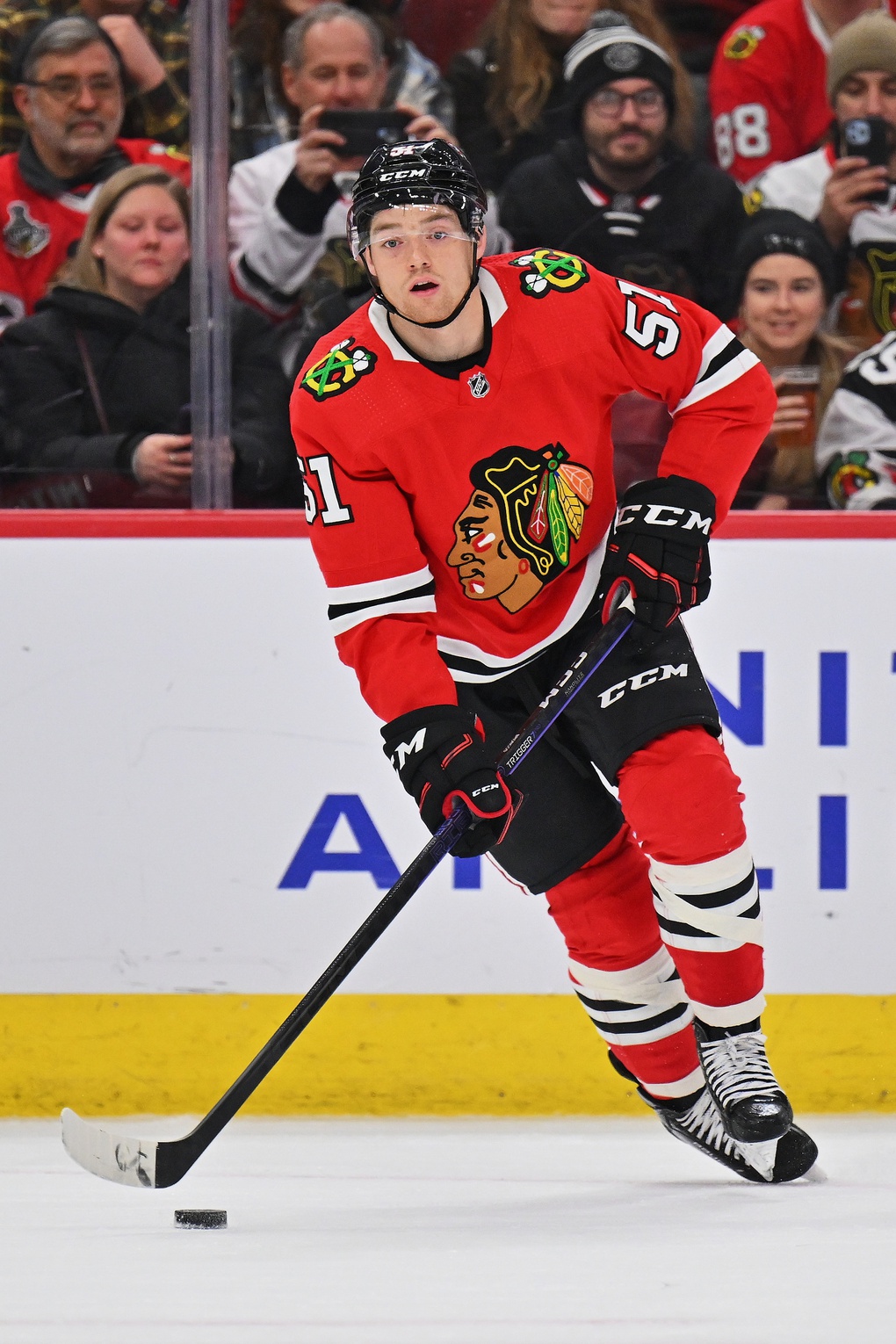 Mitchell showed some promise offensively at the college level, making him one of Chicago’s better prospects just a few years ago. However, while he has been productive in the minors (with 42 points in 67 games over three seasons), that hasn’t translated to the NHL where he has just four goals and a dozen assists in 82 games. The 24-year-old did get into 35 games with the Blackhawks last season but had been passed over by a few players on their depth chart, making him expendable. Now waiver-eligible for the first time, there’s no guarantee he’ll make it through waivers if Boston tries to send him down to AHL Providence. Accordingly, he could stick in a depth role in training camp.
Regula and Walsh, meanwhile, will also be battling to try to land a spot toward the back of Boston’s blueline but don’t have as much pedigree or NHL experience as Mitchell. Pending waivers, both will likely be with Providence this season. All three players agreed to one-year deals worth the NHL minimum in July.
Key UFA Signings
F Jesper Boqvist (one year, $775K)
F Patrick Brown (two years, $1.6MM)
F Alex Chiasson (PTO)
F John Farinacci (two years, $1.82MM)*
F Morgan Geekie (two years, $4MM)
F Milan Lucic (one year, $1MM plus $500K in bonuses)
D Kevin Shattenkirk (one year, $1.05MM)
F James van Riemsdyk (one year, $1MM)
*-denotes two-way contract
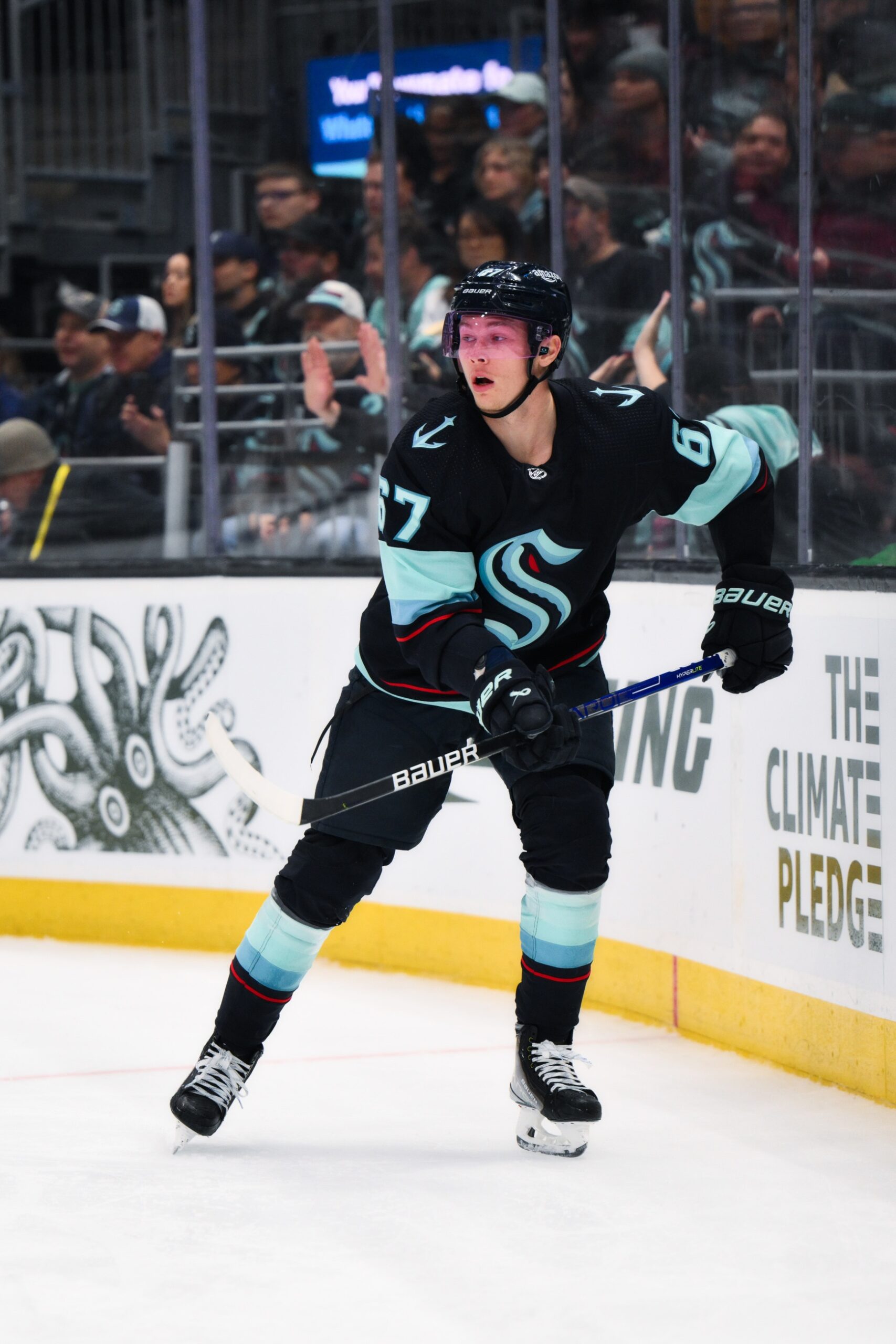 Spreading the wealth was the name of the game for the Bruins who had several spots to fill and not a lot of money to spend. Their biggest splash up front was Geekie, a player who was somewhat surprisingly non-tendered by Seattle, likely to avoid the risk of an arbitration award higher than they wanted to pay. The 25-year-old has been a producer in junior and in the minors and while that hasn’t translated to the NHL level just yet, he should have a good opportunity to play a bigger role in Boston which should give him a chance to be more of an impactful player.
The other addition they’re likely counting on for consistent production is van Riemsdyk. The 34-year-old is coming off a down year in Philadelphia but has either reached the 20-goal mark or had a goal-per-game pace at that level in every other season since his rookie campaign back in 2009-10. While he has slowed down, this was quite a reasonable pickup as he looks for a bounce-back showing.
Most of their other additions are of the depth variety. Lucic isn’t close to the player he was in his prime with Boston but should play a regular role on the fourth line. Brown, Boqvist, and Chiasson (if he earns a deal) are likely to battle for spots on that trio as well or to be the reserve forward. Farinacci, meanwhile, could also get into the mix after signing earlier this month as part of the August 15 free agent group but may be better off starting his pro career in the minors.
As for Shattenkirk, the 34-year-old has been a contributor offensively for most of his career and should be able to do so here. He’s a top-four defender who’s being paid like a depth one, making the veteran one of the better bargain additions of the summer. He played with Lindholm in Anaheim and the two could see time together this season as well.
Key RFA Re-Signings
F Trent Frederic (two years, $4.6MM)
G Jeremy Swayman (one year, $3.475MM)
Frederic has developed slowly but steadily since being a first-round pick (29th overall) back in 2016 and had a breakout performance last season, notching 17 goals and 14 assists in 79 games despite averaging less than 12 minutes a night. With a long list of departures, Frederic is likely to land a higher spot on the depth chart and could even see time down the middle, his natural position.
Swayman, meanwhile, followed up an All-Rookie performance in 2021-22 with an even better showing last year, albeit in fewer games with Linus Ullmark also having a career year between the pipes. With just 88 NHL appearances under his belt during the regular season, a long-term deal wasn’t feasible and this one ultimately wound up in the hands of an arbitrator.
Key Departures
F Patrice Bergeron (retirement)
F Tyler Bertuzzi (Toronto, one year, $5.5MM)
D Connor Clifton (Buffalo, three years, $10MM)
F Nick Foligno (trade with Chicago)
F Taylor Hall (trade with Chicago)
F Garnet Hathaway (Philadelphia, two years, $4.75MM)
F David Krejci (retirement)
F Tomas Nosek (New Jersey, one year, $1MM)
D Dmitry Orlov (Carolina, two years, $15.5MM)
D Mike Reilly (buyout, signed with Florida, one year, $1MM)
The departures of Bergeron and Krejci shouldn’t come as much surprise. Bergeron pondered hanging up his skates the year before while Krejci (whose retirement only covers the NHL, not international play) had already left once before coming back last season. That said, the expectation of their departures doesn’t make it any easier to stomach for the Bruins. Bergeron was a premier two-way center and even though his production had dipped a bit, he was still a catalyst for their top line. Krejci, meanwhile, was the perfect fit as a second option while being someone that could move up when Bergeron was injured. Boston will try to fill their departures internally for now with Pavel Zacha and Charlie Coyle but with all due respect to those capable veterans, that’s a considerable step back.
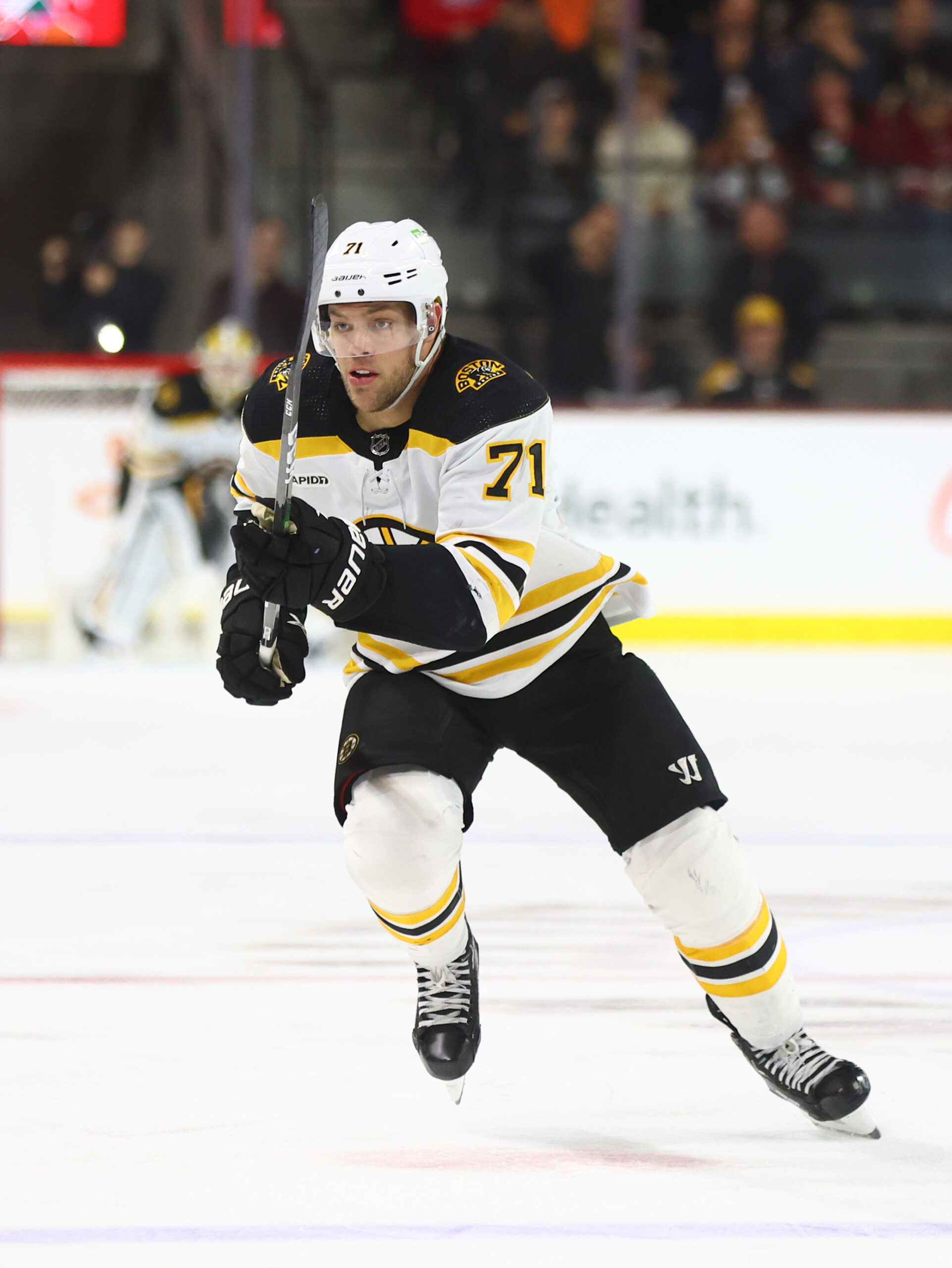 Hall (and the rights to Foligno) were moved to Chicago in a move that amounted to a straight salary dump that was necessarily to open up enough cap space to fill out their roster. His $6MM went to several of the players they inked on the first day of free agency. Hall wasn’t a top-line player for most of his tenure with Boston but was a capable secondary scorer. The same can be said for Bertuzzi, whose time with the Bruins was much shorter. A deadline acquisition, the 28-year-old only managed four goals after being acquired but was one of their top playoff performers, collecting five goals and five helpers in their loss to Florida. Bertuzzi wanted a long-term deal this summer but wasn’t able to land it, resulting in him opting for a one-year deal in Toronto.
Nosek’s departure isn’t as significant as Bergeron and Krejci’s but the 30-year-old was a capable depth center. He won over 56% of his faceoffs over his two seasons with the Bruins while playing a prominent role on their penalty kill. Hathaway, meanwhile, didn’t light up the scoresheet after being acquired but gave Boston extra physicality. His role is likely to be filled by Lucic next season.
On the back end, the departure of Orlov comes as no surprise either as there was no way that Boston could realistically find a way to afford to keep him. He picked up 17 points in 21 games while logging 22 minutes a night and while they’ll be hoping that Shattenkirk can cover some of the lost production, Orlov’s all-around impact will be harder to replace. As for Reilly, he was buried in the minors for the bulk of last season. They could have gone that way again this year but the buyout only costs them $333K this coming season which means they saved enough to fill close to two roster spots by making that move. In 2024-25, however, the buyout cost increases by $1MM.
Salary Cap Outlook
It wasn’t easy and the exodus of talent certainly was tough to watch from a Boston perspective but the team is now cap-compliant with CapFriendly projecting them having around $429K in cap room as things stand. That number is bogged down by $4.5MM in bonus overage penalties incurred from the contracts for Bergeron and Krejci last year, meaning that they’re carrying a bigger cap charge when they’re not playing compared to when they were in the lineup last year. That was a well-known outcome when the Bruins structured those deals they way they did a year ago; it’s not as if that penalty came as a surprise to them.
Key Questions
Can They Upgrade Down The Middle? Sweeney has made it known that they’d like to find a way to upgrade at center. With who they’ve lost, that goal makes plenty of sense. However, they’re in a spot where they basically have to match money while they lack the draft pick and prospect capital needed to help put their offers over the top. That makes a top-six upgrade difficult but if they’re open to making a smaller-scale one to improve their depth, that option might be a bit more palatable (and affordable).
 What’s Next For DeBrusk? Winger Jake DeBrusk is now extension-eligible and you can be sure that his camp will be pointing to the eight-year, $52MM extension that Tampa Bay just gave Brandon Hagel as a starting point for discussions. Is that a price point that Boston is willing to go to in order to keep the 26-year-old? It’s not as if his tenure with the team has been smooth throughout with a long-lasting trade request only being rescinded a couple of years ago. And if it’s not a price tag they’re willing to pay, could they justify trying to move him to help match money to get an impact center? If they want to make a move for a center sooner than later, it would behoove them to have an idea of what DeBrusk is looking for extension-wise soon if they haven’t already started discussions.
What Will The Goalies Do For An Encore? The combination of Ullmark and Swayman was nothing short of dominant last season. Ullmark led the league in wins, save percentage, and goals-against average, becoming only the third goalie in the last three decades to lead all three categories; the win mark is particularly impressive considering he only played in 49 games. Swayman, meanwhile, was fourth in the NHL in SV% and GAA. With a weaker roster now in front of them, how much will their performance be affected? If the two can play at even a close rate to 2022-23, the Bruins could still be quite dangerous.
Photos courtesy of USA Today Sports Images.
Examining An Upcoming Columbus Blue Jackets Roster Crunch
After a miserable 2022-23 campaign, the Blue Jackets’ mandate for the 2023 offseason was to pursue significant and meaningful upgrades to their roster that could result in the team having a legitimate chance to reach the postseason next spring.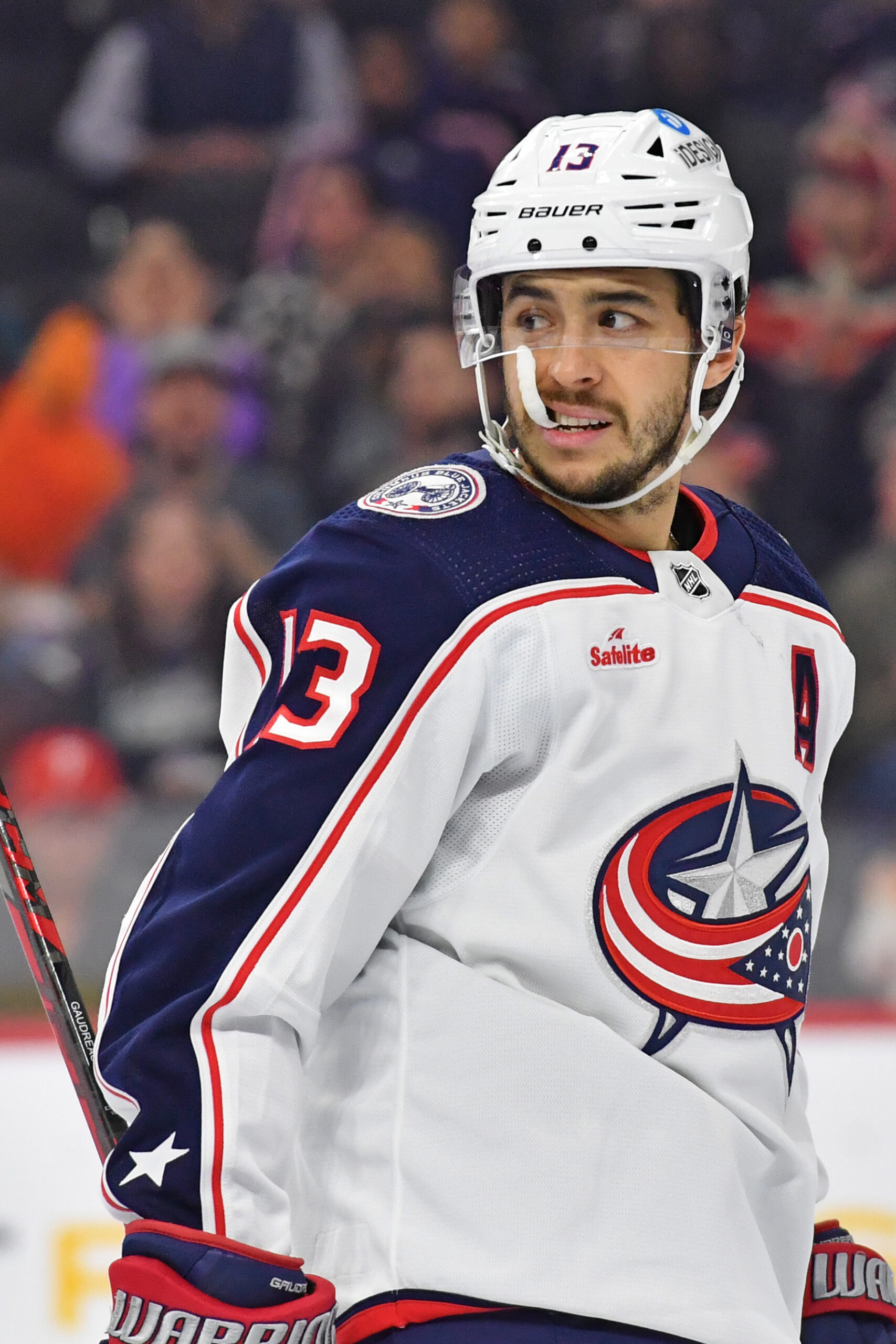
New head coach Mike Babcock’s contract reportedly only carries a two-year term, suggesting immediate results are expected from his hire. Seeing as marquee 2022 free agent signing Johnny Gaudreau turned 30 earlier this month, it’s easy to see why the team’s general manager, Jarmo Kekäläinen, has so earnestly pursued NHL-ready talent for his club.
The team made some big additions this summer, headlined by two experienced blueliners: Ivan Provorov and Damon Severson. They also have quite a few intriguing young players set to take on potentially significant roles for the franchise, such as 2022 top draft pick David Jiříček, 2021 top pick Kent Johnson (who authored an impressive 40-point rookie season), and Kirill Marchenko, who scored 21 goals as a rookie.
In addition to those names, they could end up getting meaningful contributions from rookie players, such as Hobey Baker winner Adam Fantilli (who could even instantly slot in as a top-six center) and Russian import Dmitri Voronkov, a rangy six-foot-three pivot who scored 26 goals and 43 points across 78 KHL games last season. Babcock will have a diverse group of players to choose from for any role he seeks to fill in his lineup, and with franchise defenseman Zach Werenski back from injury, there’s legitimate hope for a major bounce-back season in Ohio.
The byproduct of the number of new players the Blue Jackets have is that competition for spots in the team’s opening-night lineup will be stiff, and Kekäläinen and Babcock will have some important decisions to make this fall that could massively impact the careers of a few players.
Columbus simply has more players who may legitimately merit NHL roles than they have NHL jobs to offer. As a result, some players could end up in the AHL or exposed to waivers when were they employed by another team they’d be preparing to skate in an NHL opening night.
Up front, there are significant training camp battles likely to occur both at center and along the wings. Gaudreau, Laine, and Johnson are locks for top-six roles and Marchenko isn’t far behind them, but after those names, the competition for roles on the third line, fourth line, or spare forward spots is set to be fierce.
Soon-to-be-24-year-old Alexandre Texier scored 11 goals and 20 points in his most recent 36-game NHL season and is returning to the NHL after a productive season playing with the ZSC Lions in Switzerland. Jack Roslovic has had his fair share of inconsistencies in Columbus, but has nonetheless scored 123 points in 206 total games as a Blue Jacket, a 49-point 82-game pace.
They should each be seen as front-runners for roles along the wings of Babcock’s third line, though they’ll have some stiff competition.
Last season, Trey Fix-Wolansky, at the age of 23, scored 71 points in just 61 games for the AHL’s Cleveland Monsters. He’ll now need to clear waivers in order to be sent to the AHL, and therefore could be an intriguing name to watch for teams looking to profit off of the number of NHL-relevant wingers the Blue Jackets have.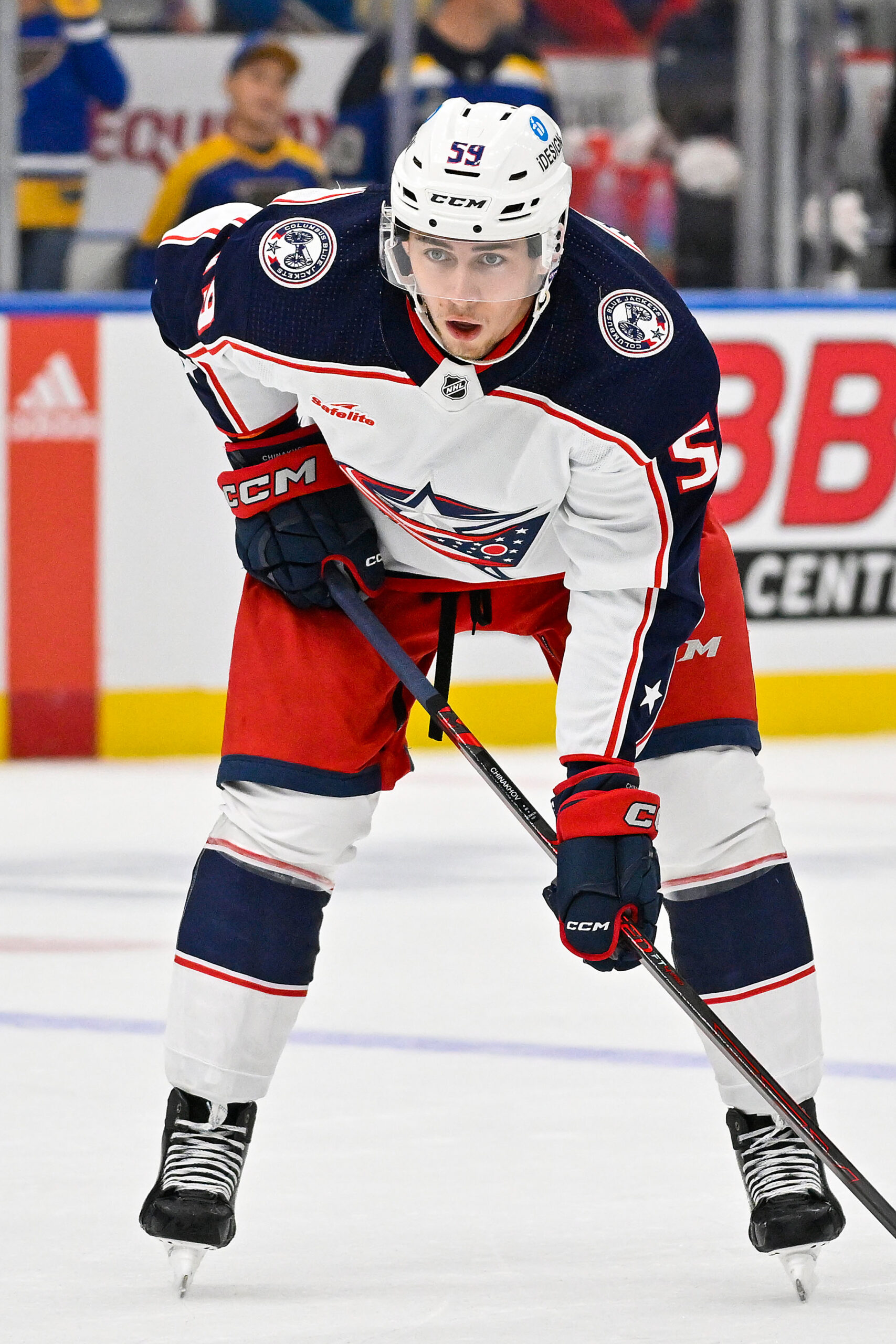
Another player in contention for a roster spot is 22-year-old Yegor Chinakhov, a 2020 first-round pick. He remains waiver-exempt but has only played seven career games in the AHL. At this stage of his career, it would likely be less than ideal for Chinakhov to spend this season (the last before he’s waivers-eligible) in the AHL.
It’s an important year for Chinakhov to deliver on the faith the Blue Jackets showed in him when they picked him 21st overall, and he’ll have his work cut out for him in the preseason as he tries to beat out Roslovic or Texier for a third-line role.
A second Blue Jackets first-rounder, Liam Foudy, finds himself on the team’s roster bubble. Unlike Chinakhov, he has the disadvantage of being waivers-eligible for the first time in his career.
Foudy faces a make-or-break preseason as he looks to secure a fourth-line role competing against more established names such as Eric Robinson and Mathieu Olivier. While it would be a surprise to see the 2018 18th overall pick’s name on season-opening waivers, the possibility can’t be ruled out.
This immense level of competition along the wings extends to the center position, where the Blue Jackets have a wide-open set of options. The team has flirted with the possibility of trying out Laine as a pivot, and it’s that possibility as well as the presence of players such as Fantilli that could force a player like Roslovic, a longtime center, onto the wing. The most intriguing spot to look out for is likely to be the third-line center role, assuming Jenner and one of Laine or Fantilli each take up a top-six job.
2022 first-rounder Cole Sillinger had a brutal sophomore campaign but scored 31 points as a rookie and is still viewed as a crucial part of Columbus’ long-term future. But a variety of factors could lead to him starting the year with AHL Cleveland.
First and foremost, there were many who believed that Sillinger would have been better served last season regaining his confidence in the AHL with the Monsters, where he ended up playing in 11 total games. (compared to 64 in the NHL) That attitude could lead to Columbus opting to start Sillinger off in Cleveland, hoping that he’ll force his way into the NHL roster with some strong play and re-emerge in the NHL with sky-high confidence.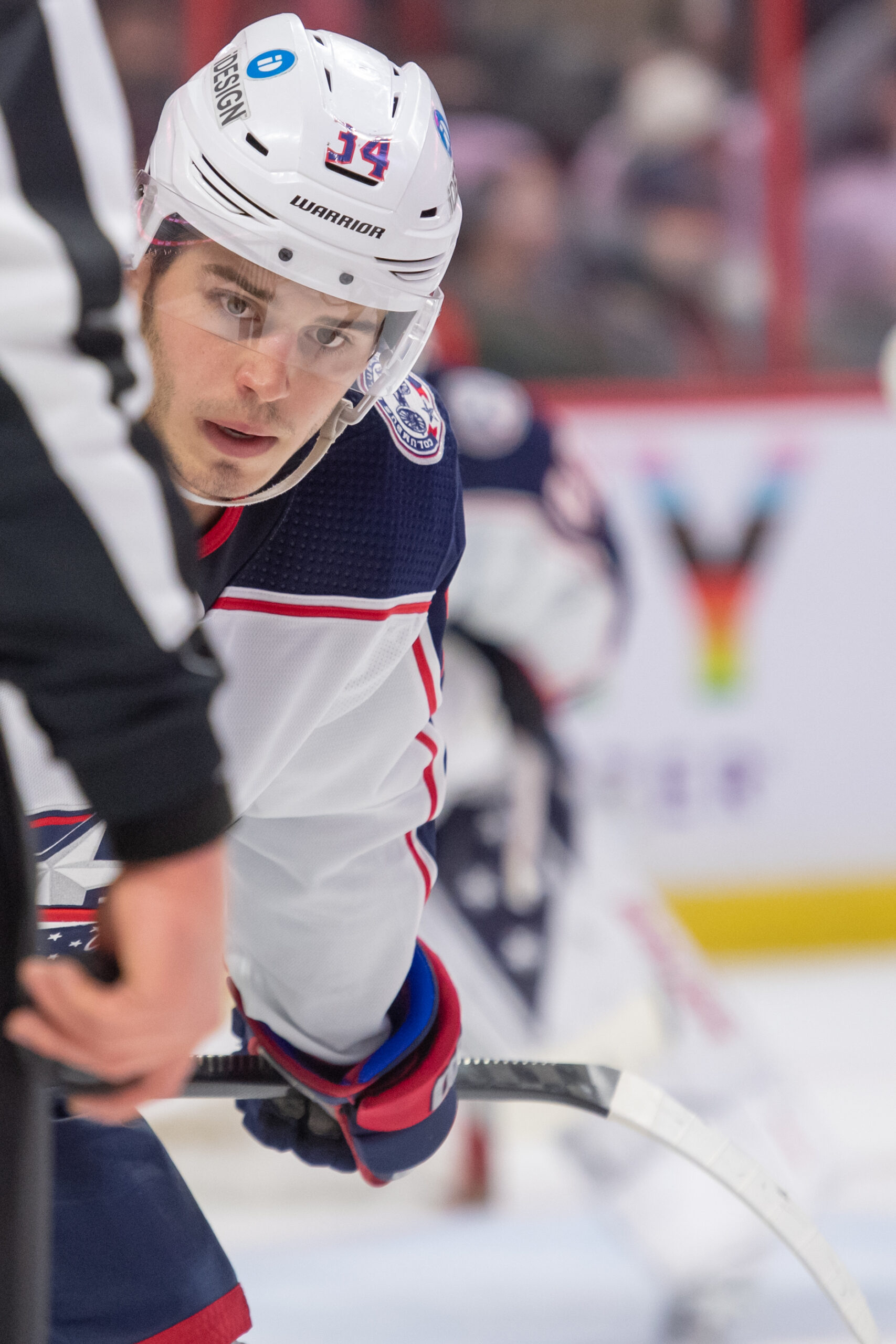
Sillinger is waivers-exempt, so the team could prefer to begin his season in the minors in order to avoid having to place a player such as Fix-Wolansky, Justin Danforth, or a defenseman on waivers.
The addition of Voronkov could also push Sillinger to the AHL, assuming the Russian is able to quickly translate his KHL success to the smaller North American ice surfaces.
A potential battle between Voronkov and Sillinger for an opening-night job down the middle of Babcock’s lineup could be the most intriguing storyline to track during the Blue Jackets’ preseason.
On defense, Columbus faces an arguably even more crowded situation. The top three defensemen are set in stone, with Werenski, Provorov, and Severson guaranteed to play top-four roles. Beyond them, the team has a group of five players competing for what is likely to be just four open NHL jobs: Andrew Peeke, Erik Gudbranson, Jake Bean, Adam Boqvist, and Jiříček.
Jiříček, 19, was exceptional in the AHL last season (he scored 38 points in 55 games, leading all regular under-21 defensemen in scoring on a points-per-game basis) and appears more than ready for an NHL role. But handing Jiříček an NHL job could mean placing one of those names on season-opening waivers, or forcing Kekäläinen to carry eight defensemen on his roster when the team already, as mentioned, has an abundance of capable forwards and a few who would need to be waived if they don’t earn NHL jobs.
While a battle between young centers such as Sillinger and Voronkov could end up a highlight of the preseason, the situation of the Blue Jackets’ defense means the ultimately higher-stakes lineup competition is on Babcock’s blueline, where the threat of waivers potentially looms large for some experienced players.
The NHL preseason isn’t a time generally associated with high-stakes battles. The games don’t count for the standings and the priority for many players is simply preparing themselves for the rigor that comes with the regular season. But for the many players who find themselves on their team’s roster bubble or competing for an open lineup spot, the preseason carries an immense importance for the future of their career.
With a new head coach, many Blue Jackets players will have a blank slate to prove themselves and earn a role this fall. That presents numerous opportunities for not only Blue Jackets players, but also the 31 other teams who could be eyeing up a Columbus skater they hope will end up on the season-opening waiver wire. The training camp battles set to play out at every skater position in Columbus are likely to make the team’s training camp and preseason one of the league’s most interesting this fall.
Photos courtesy of USA Today Sports Images
Free Agent Profile: Zack Kassian
Zack Kassian had one of the lowest-scoring seasons we’ve seen in quite some time as he put up just two goals last season in 51 games with the Arizona Coyotes. This prompted Arizona to buy out the 32-year-old forward prior to free agency in a move that made sense, given the lack of production from the former 13th overall pick. Kassian lasted just a single season in the desert and never really seemed comfortable playing on a very bad Coyotes team.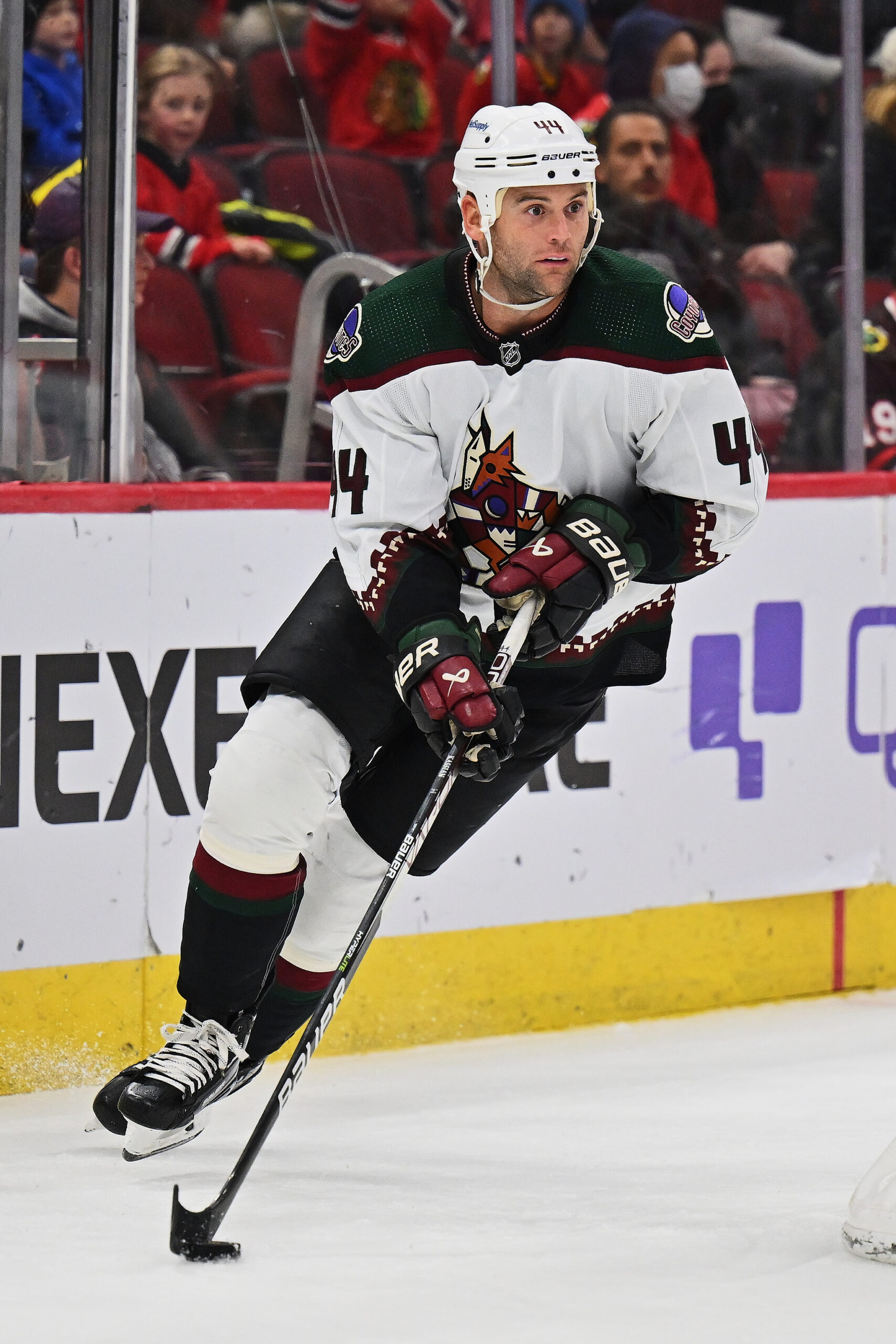
This is Kassian’s first crack at free agency and unfortunately for him he is coming off a season in which he posted career lows in many statistical categories. As mentioned earlier, he had just two points on the season, and posted a -18. His hitting was way down, which is one of the facets of the game he typically excels in. Kassian threw just 32 hits in 51 games last season, a dramatic drop from the 158 he threw the year prior with the Edmonton Oilers in 58 games. It’s not uncommon for physical players to see a decline in their 30’s, but the decline generally isn’t that steep.
Kassian deserves a ton of credit for battling several off-ice issues and resurrecting his career when it looked like it could be in trouble. At one point in 2015 Kassian bounced from Vancouver to Montreal to Edmonton in less than six months and looked like he could be out of the league. But, to his credit, he turned it around and even managed to post career highs in 2019-20 when he potted 15 goals to go along with 19 assists in 59 games. This run of good play prompted the Oilers to sign Kassian to a four-year contract extension in January 2020 worth $3.2MM annually. Unfortunately for the club and the player, Kassian struggled through the pandemic shortened 2020-21 season and hasn’t regained his footing ever since. Over the past three seasons combined Kassian has posted just 10 goals and 16 assists in 136 games, a drastic decline from his 2019-2020 numbers. The other issue that will work against Kassian is that he is strictly a 5 on 5 player. He has never been a regular contributor on the power play and hasn’t been a regular part of a penalty kill since 2018-19.
In a normal cap world, Kassian would have played out the final season of his contract with a salary that is well below his cap hit but given how poor his play was Arizona opted to move on and spread out that cost over two seasons.
Despite his struggles last season, it is still likely that Kassian will get an opportunity when training camps open in a few weeks. Teams are always looking for physical players, especially ones who can take a regular shift and will play under a reduced cap hit. Kassian checks all those boxes, which is a good indication that someone will give the Windsor, Ontario native a look to see if he still has anything to offer.
Stats
2022-23: 51 GP, 2-0-0, -18 rating, 50 PIMS, 25 shots, 37.5% faceoffs, 38.4% CF, 9:09 ATOI
Career: 661 GP, 92-111-203, -55 rating, 913 PIMS, 798 shots, 31.0% faceoffs, 48.2% CF, 12:37 ATOI
Potential Suitors
Kassian is still chasing hockey’s ultimate prize, the Stanley Cup. And after spending a dozen years in the league, he would probably prefer to spend his time chasing a championship with a Stanley Cup contender. However, given his status as a fringe NHLer at the moment, he likely won’t have the opportunity to be choosey. That doesn’t mean he won’t have a suitor, but it could mean that he would be playing on a weaker team, or a team that has a borderline chance of making the playoffs. But anything can happen, and even players that are past their best before date can catch on with good teams when it is least expected.
Let’s start out West in Edmonton. Kassian found his game almost eight years ago when it looked like his career was hanging on by a thread. It was there that he turned his intensity and physicality into effective NHL minutes on a team that was competitive for most of his run there. Kassian brought an edge that the Oilers severely lacked and gave them an option that they could plug almost anywhere in their lineup. But that was then, and this is now, and Kassian isn’t that player anymore. His body has broken down, as per normal with physical players when they hit the wrong side of 30. But Kassian could still help Edmonton, and it feels like the Oilers are always looking for bodies up front. Kassian couldn’t play in Edmonton’s top-9, but he could be a could fill-in for their fourth line if they aren’t able to find help between now and the start of the regular season.
Sticking with the West, the Colorado Avalanche were riddled with injuries last season. So much so that it looked like they might miss the playoffs entirely, however, a late-season rally secured their spot in the round of 16. But it was there that they were physically dominated by the Seattle Kraken and ousted in an exhilarating seventh game. The Avalanche were one of the lightest-hitting teams in the NHL last season, which on the surface isn’t the big of a deal given how skilled they are. However, the regular season and the playoffs are two different things and Colorado didn’t have an answer for Seattle in the postseason and really missed some of the grit they lost when Nazim Kadri departed last summer. Now, Zack Kassian is far from the answer to that problem, but he can offer Colorado something that is in short supply in their group, and it wouldn’t cost them more than a contract slot and a league minimum contract.
Finally, in the East, one team that could use a depth physical forward is the Buffalo Sabres. Coincidently, the team that took Kassian in the first round of the NHL entry draft some 14 years ago. The Sabres have a competent fourth line at the moment with Tyson Jost centering Kyle Okposo and Zemgus Girgensons, but injuries happen (see Jack Quinn), and Kassian could provide insurance to their Sabres if they were to lose any additional depth up front. The Sabres were also a team that didn’t throw the body around all that often-last year and with the talent that they have up front, they could likely place Kassian into a role that wouldn’t overextend him and could allow him to perhaps resurrect his career once again.
Projected Contract
Kassian enters free agency at a time when his free agent stock is very damaged. And while he has his shortcomings, he still offers a rare combination of physicality mixed with a bit of skill and could find success when he is sheltered in the right situation.
At this point in his career Kassian would be lucky to get a one-way contract for the league minimum of $775K. The most likely outcome for him will be a PTO with a team that is looking to add a 13th forward that offers some sandpaper and can chip in on the fourth line when a regular falls out of the lineup. A role like that would allow Kassian to play to his strengths and would offer longer windows of recovery for an aging player who has been banged up from years of throwing his body around with reckless abandon.
Photo courtesy of USA Today Sports Images.
Summer Synopsis: Arizona Coyotes
Last season, Coyotes GM Bill Armstrong suggested that he felt his team was still a few years away from truly getting to a point of contention. However, Arizona made several moves this summer to improve their team in the short term. While it probably won’t be enough to get them into the playoff picture, these moves shouldn’t have them in the discussion for 32nd in the NHL either.
Draft
1-6: D Dmitri Simashev, Yaroslavl (MHL)
1-12: F Daniil But, Yaroslavl (MHL)
2-38: G Michael Hrabal, Omaha (USHL)
3-70: F Jonathan Castagna, St. Andrew’s (CAHS)
3-72: F Noel Nordh, Brynas (Sweden U20)
3-81: F Tanner Ludtke, Lincoln (USHL)
3-88: F Vadim Moroz, Minsk (KHL)
4-102: D Terrell Goldsmith, Prince Albert (WHL)
5-134: G Melker Thelin, Bjorkloven (Sweden U20)
5-160: D Justin Kipkie, Victoria (WHL)
6-162: F Samu Bau, Ilves (Liiga)
6-166: G Carsen Musser, USA U-18 (NTDP)
The Coyotes made a pair of selections that many would qualify as perceived reaches with their first two selections. Simashev is a tall, strong-skating blueliner who hasn’t really had much of a chance to show his offensive upside just yet. Arizona is hoping that he’ll become a top-half option in time but they’ll have to wait at least two years to bring him over. But, meanwhile, was one of the tallest forwards in the draft and showed a nice scoring touch at the MHL level in Russia. He isn’t a true power forward, however, as he isn’t particularly physical overseas. Nonetheless, there’s a profile there that makes him an intriguing top-six option down the road but one that went 10-15 spots earlier than most rankings had him.
On the flip side, their lone second-round selection is someone who slid a bit more than most expected. Hrabal, one of the tallest goalies in the draft, was viewed as a possible first-round selection but in the end, he wasn’t even the first netminder off the board. Hrabal did relatively well in his first season in North America in the USHL and is going the college route and thus is several years away from being a possible option for the Coyotes.
Trade Acquisitions
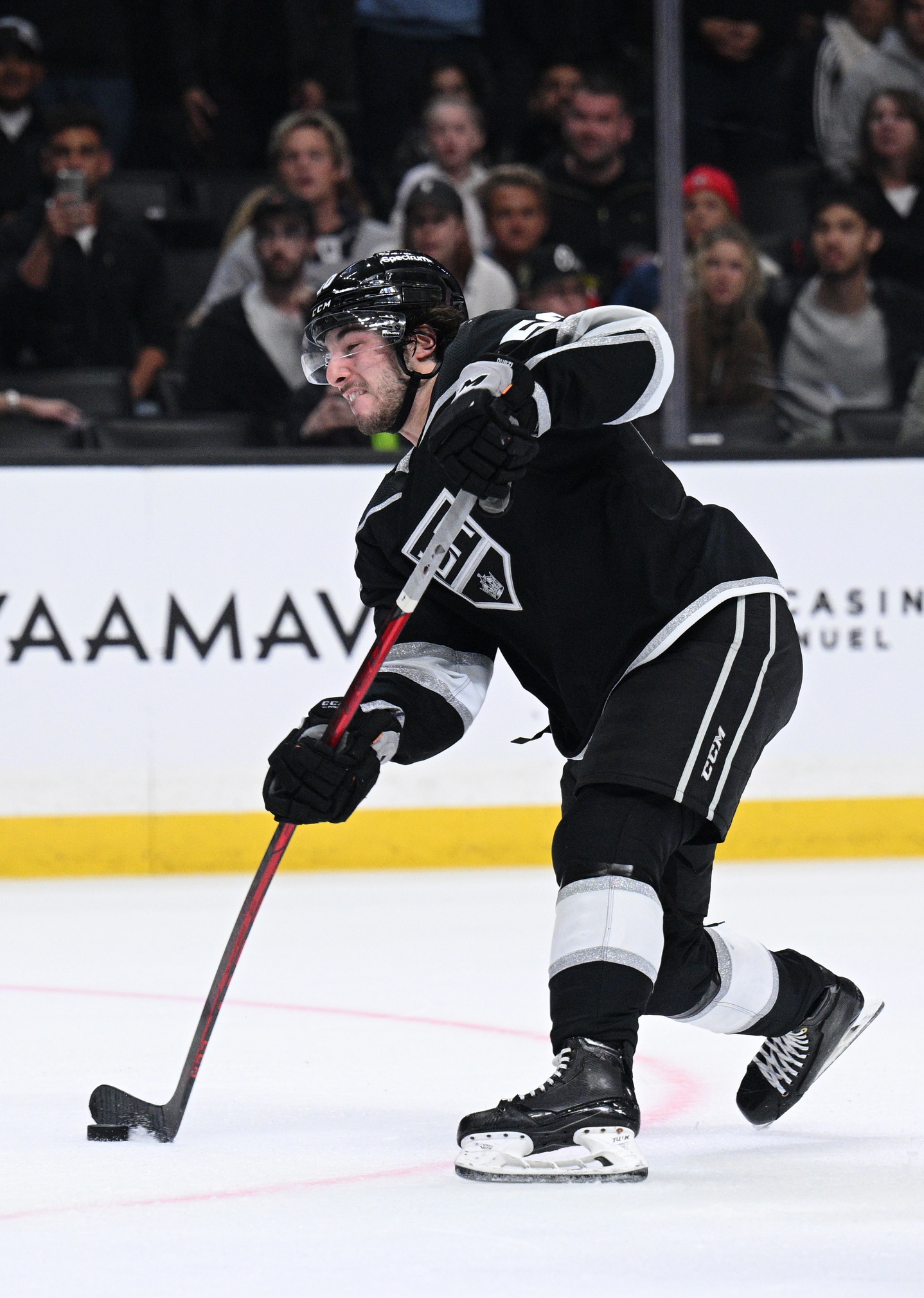 D Sean Durzi (from Los Angeles)
Durzi has shown considerable promise offensively in his first two NHL seasons and was second on the Kings in points by a blueliner last season. However, their cap situation and strong right-side depth made him the odd man out. Durzi goes from being in a more limited role with Los Angeles to one where he should play a much bigger role. Considering he’s heading into the final year of his bridge deal and has arbitration eligibility for the first time next summer, the timing of this move could work out quite well for the 24-year-old.
Key UFA Signings
F Nick Bjugstad (two years, $2.1MM)
D Travis Dermott (one year, $800K)*
D Matt Dumba (one year, $3.9MM)
F Alexander Kerfoot (two years, $7MM)
D Troy Stecher (one year, $1.1MM)
F Jason Zucker (one year, $5.3MM)
*-denotes two-way contract
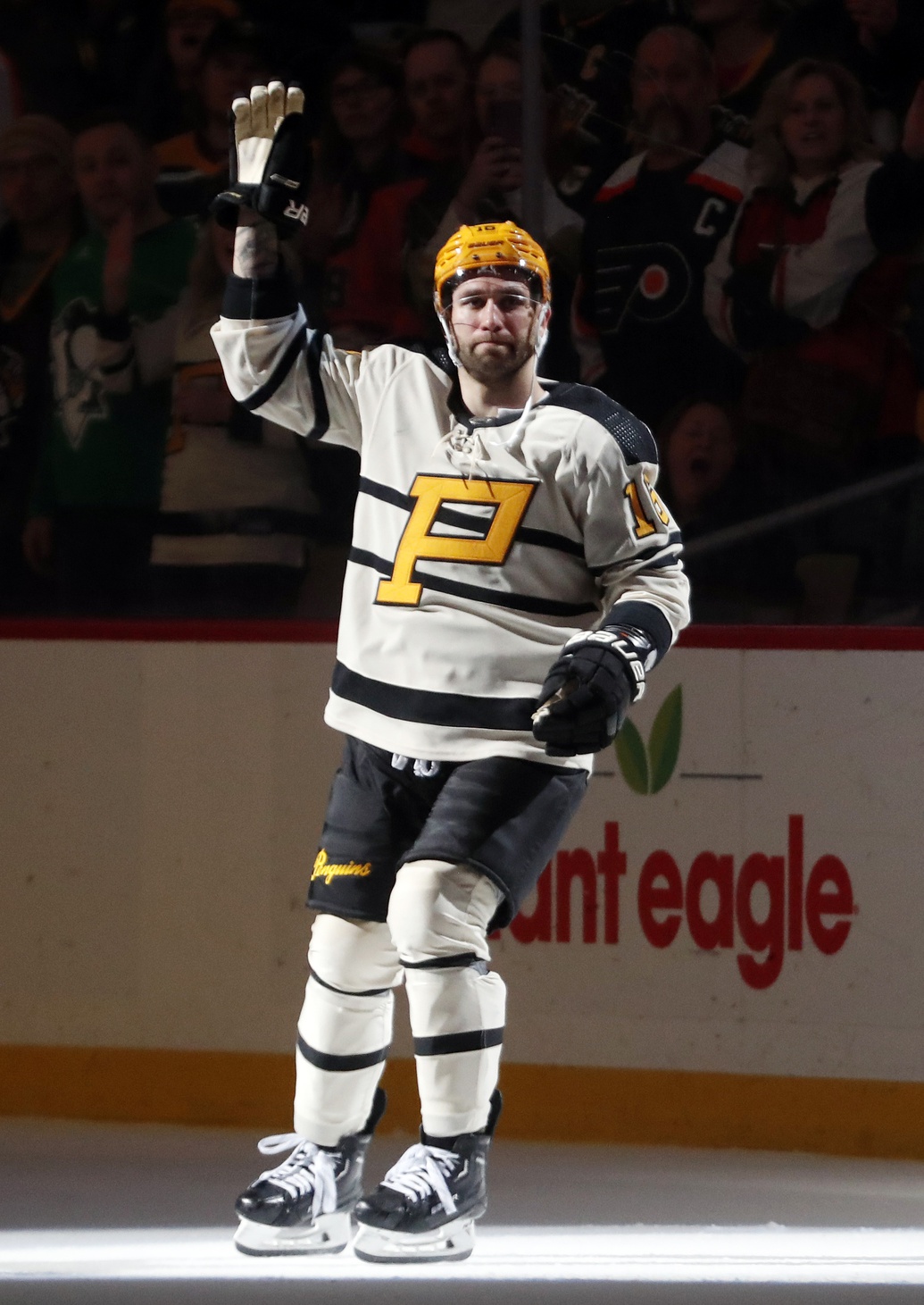 Zucker’s addition raised some eyebrows as they weren’t expected to be shopping in the higher end of the UFA pool up front. However, it’s worth noting that several players didn’t get the type of interest they were hoping for and the 31-year-old wasted little time pivoting toward a pillow contract instead. Zucker should be able to land a top-six role which could give him a shot at another 25-goal campaign. In a perfect world for him, another performance like last year could boost his value in what he (like many others) hopes will be a more favorable market next summer. Meanwhile, in a perfect world for the Coyotes, Zucker becomes one of the more prominent rental players to move closer to the trade deadline.
Kerfoot feels like a transition player for the Coyotes. When they signed him, they likely eyed him on the second line (before Logan Cooley had a change of heart and decided to turn pro). Now, he might be a better fit on the third line. Either way, he’s the type of player that can fill a few different roles in a lineup while allowing prospects more time to develop. Bjugstad returns after being flipped at the deadline. He went to the Coyotes last summer to rebuild his value and did just that, scoring more goals last season than he did in the previous three combined. He should give them a bit more scoring punch in their bottom six compared to the group that finished up the year. Dermott missed most of last season due to continuing concussion symptoms but with 279 career NHL appearances under his belt, he could push for a full-time spot on the roster.
Dumba is another player who simply didn’t have as strong of a market as he hoped for. Unlike Zucker who took his one-year deal on the first day of free agency, Dumba opted to wait it out but still had to take a one-year pact himself. After a tough year with Minnesota, the 29-year-old should get plenty of opportunities to play a bigger role, see some power play time, and try to improve his value for next summer. Meanwhile, the Coyotes likely have another strong trade deadline asset. Stecher also returns after being flipped at the deadline and is likely to reprise his role on the third pairing.
Key RFA Re-Signings
F Michael Carcone (two years, $1.55MM)
G Connor Ingram (three years, $5.85MM)
F Jack McBain (two years, $3.2MM)
McBain (who took $1 less than $1.6MM for his cap hit) is coming off his first full NHL campaign. He brought plenty of physicality to the table and showed some offensive promise with 26 points but with such a limited track record, a bridge deal was the only route they could realistically take. Carcone has spent most of his career in the minors but made an impression at the Worlds back in May. In doing so, he gave himself enough leverage to land a one-way deal which should give him a legitimate opportunity to make Arizona’s roster in training camp.
Ingram got off to a rough start, posting a save percentage of just .866 in his first eight appearances. However, he played at a .921 mark the rest of the way (spanning 19 games), bolstering his case heading into arbitration eligibility. He’s set to remain Karel Vejmelka’s backup for the upcoming season and could push for more playing time if he starts out the way he finished last year.
Key Departures
F Christian Fischer (Detroit, one year, $1.125MM)
F Zack Kassian (buyout, unsigned UFA)
D Connor Mackey (NY Rangers, one year, $775K)*
D Patrik Nemeth (buyout, Bern, NLA)
F Brett Ritchie (unsigned UFA)
Kassian’s primary value to Arizona came on the trade front when they moved up three spots in the first round in 2022 while also picking up a pair of other picks for assuming the rest of his contract. The 32-year-old struggled mightily last season, however, managing just two goals without a single assist in 51 games, resulting in Arizona opting to pay him to go away. Fischer was considerably more effective with 27 points but the Coyotes didn’t want to run the risk of an arbitration award coming in higher than they were willing to pay. With the added depth up front, they should be well-positioned to cover these two departures. Ritchie came over at the trade deadline from Calgary (in a swap for his brother, no less) and held his own with five points in 16 games. He’s a candidate to land a PTO in the coming days.
Like Kassian, Nemeth’s main value for the Coyotes came in the draft picks (a pair of second-rounders) that came with him to take on the two remaining years of his contract. The 31-year-old held down a regular spot on the third pairing but wasn’t going to be part of their future plans, resulting in the buyout. As for Mackey, he had a very limited role with Calgary for the bulk of last season but averaged nearly 16 minutes a night after being acquired at the deadline but Arizona opted to go in another direction rounding out their back end for the upcoming season.
Salary Cap Outlook
Even with more than $21MM of injured veterans on the roster, the Coyotes find themselves nearly $4MM under the cap ceiling, per CapFriendly. That gives them ample room to free up in-season space while if they get hit with a rash of injuries, any of Shea Weber, Bryan Little, or Jakub Voracek can be placed onto LTIR so the cap will not be a problem for them at all in 2023-24.
Key Questions
What Will Cooley’s Impact Be? Cooley’s decision to opt to turn pro gives Arizona a player who could push for big minutes relatively quickly. As one of the key cogs of their rebuild, he should find himself with a prominent role right away. His presence as a top rookie is likely to be overshadowed by another freshman in his division (who will be playing for Chicago) but a strong showing could help to provide some light at what has already been a long rebuild for Arizona.
Notably, Cooley is also worth keeping an eye on to see how his presence affects Barrett Hayton’s progress. The 2018 fifth-overall pick had somewhat of a breakout year last season while working his way onto the top line in the process. If Cooley is able to play his way up the depth chart quickly, will Hayton’s numbers dip? It’s a contract year for the 23-year-old so Cooley’s presence and performance could make an impact in those discussions for Hayton.
Can Ingram Secure A Bigger Role? Which version of Ingram will the Coyotes get this season? He certainly finished up on a strong note which helped him land nearly $6MM guaranteed despite having just 30 career regular season games under his belt. Vejmelka has done a nice job in his two seasons in the desert but Ingram outperformed him in the second half of last season. If Ingram secures a bigger share of the workload, it’s possible that Vejmelka – who has been in trade speculation before – could become a more plausible candidate to move.
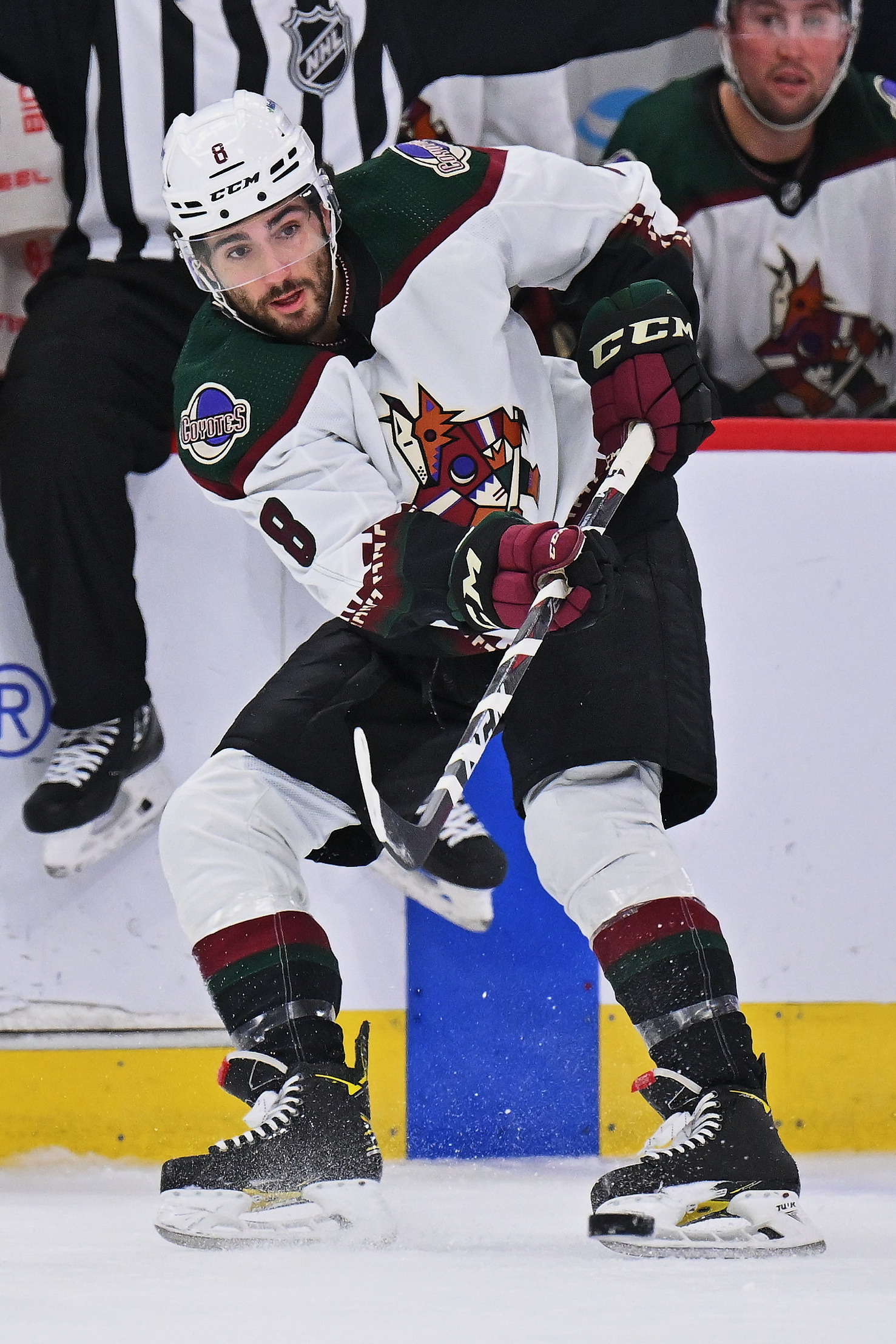 Is Schmaltz Next? In recent seasons, there has been no shortage of veterans moving out of Arizona. One who hasn’t moved yet is Nick Schmaltz. He is coming off two productive seasons of 59 and 58 points, each in 63 games while moving primarily to the wing after spending a lot of time down the middle. However, his heavily backloaded contract starts to loom large as he’s owed $24.45MM over the final three years of his deal. If the Coyotes are still a few years away from contention, Schmaltz might not be part of their longer-term plans. If that’s the case, it stands to reason that Arizona might look to move him at some point to save some money while landing some strong younger assets as well. It might not be the case early but it wouldn’t be surprising to see Schmaltz in trade speculation as the season progresses.
Photos courtesy of USA Today Sports Images.
Extension Candidate: Mark Scheifele
The Winnipeg Jets are approaching a potentially franchise-altering season. Two of the organization’s key players, former Vezina Trophy winner Connor Hellebuyck and team number-one center Mark Scheifele are each on expiring contracts that stand to walk them straight to the unrestricted free agent market next summer.
The Jets are intent on remaining competitive with key players such as Kyle Connor, Josh Morrissey, Nikolaj Ehlers, and recent acquisition Gabriel Vilardi still on their roster. So it stands to reason that the team would be interested in retaining Scheifele, the player with the most goals in Jets history since they arrived from Atlanta.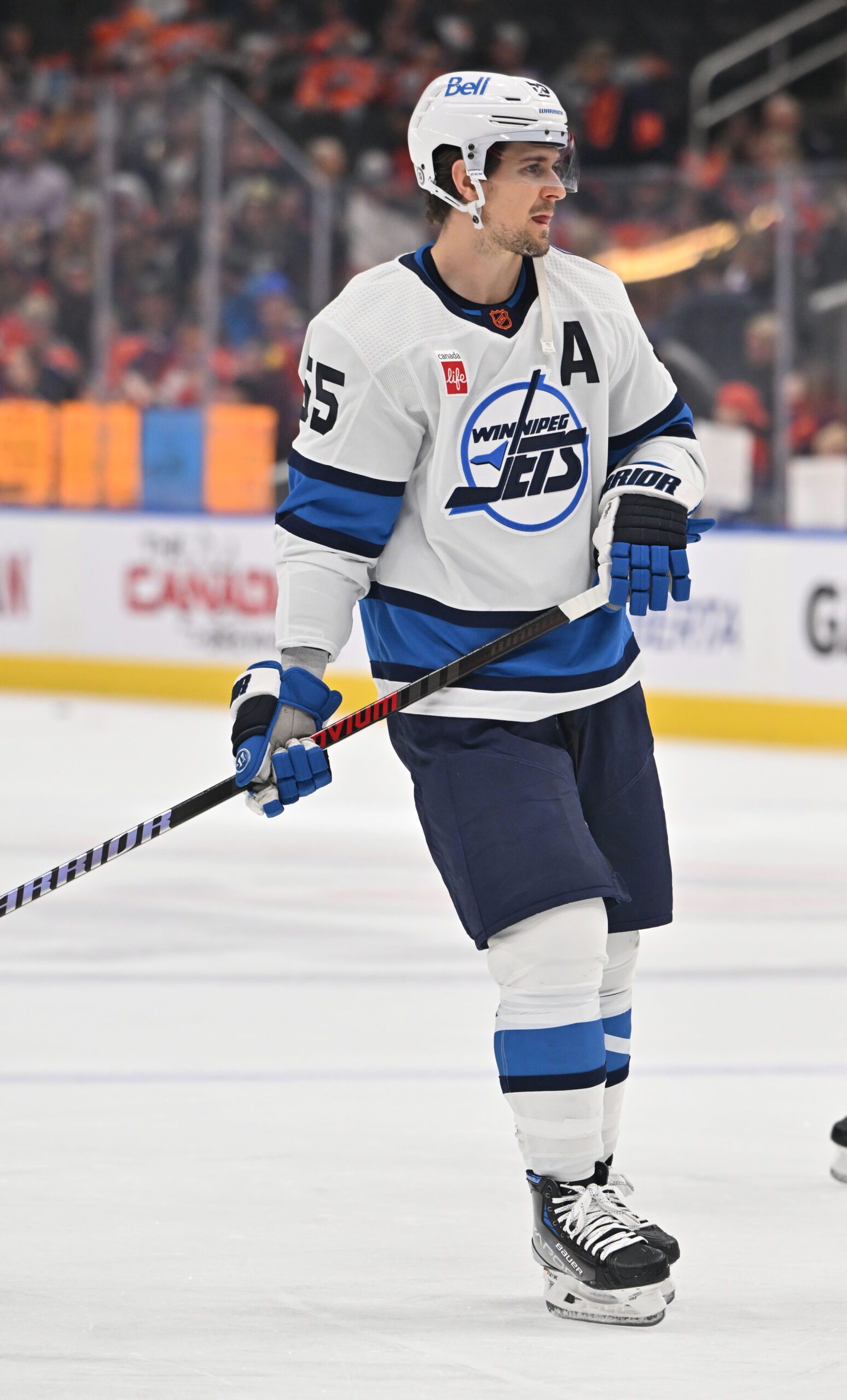
But seeing as his name has come up in trade rumors this summer, it’s also a very real possibility that he ends up on a different team next season. A poor campaign by Winnipeg could finally catalyze the type of re-tool that seems off the table at this current moment entering 2023-24.
The likeliest scenario that would result in Winnipeg engaging in serious discussions about a long-term contract with Scheifele next season would be if the team sprints out of the gate at the start of the regular season and looks like a legitimate Stanley Cup contender.
If that ends up happening, the Jets finding a way to retain their number-one center would likely become an organizational top priority. Should the Jets make a determined effort to extend Scheifele — assuming they haven’t already — what might that contract look like?
2022-23
For quite a while now, the question of Scheifele’s true on-ice value has been a hotly debated one. He’s a divisive player, and that’s not even a reference to the vicious hit he laid on an unsuspecting Jake Evans during the 2021 playoffs — one that got him suspended for the team’s final three games as well as Winnipeg’s season-opener the following campaign — but rather a reference to the way in which Scheifele approaches the game.
Scheifele places a premium on offensive creation and offensive production, something that is certainly admirable, but often comes at the detriment of his all-around value. His fixation on always maximizing his and his linemates’ offensive production has made him something of a lightning rod for criticism as the Jets franchise has declined since their 2018 run to the Western Conference Final.
Scheifele’s approach to the game has at times attracted harsh criticism from those who would like to see him take a more committed approach to the defensive side of the game. A lot is typically asked of elite centers in the NHL, and nothing Scheifele has shown in recent seasons has suggested he is able to capably manage the sort of defensive commitment many coaches want to see out of top pivots. Jets coach Rick Bowness even appeared to show some frustration at Scheifele during last season, per The Athletic’s Murat Ates, suggesting that many fans’ frustration with Scheifele’s offensive focus could be shared, to a certain extent, by figures within the Jets organization.
But on the flip side of those negatives is the undeniable reality that Scheifele is among the most offensively gifted centers in the NHL. He scored a career-high 42 goals last season and has frequently been an at-or-above point-per-game scorer. He’s a two-time NHL All-Star and has even been productive in the playoffs, with 32 points in 37 career games. He undoubtedly has the numbers of a true first-line center, and first-line centers are extremely rare. But then the question becomes, he has number-one center numbers, but does he play like one?
Statistics
2022-23: 81 GP, 42 G, 26 A, 68 pts, -16 rating, 43 PIMs, 206 shots, 20:29 ATOI, 58.5% CF
Career: 723 GP, 272 G, 373 A, 645 pts, +46 rating, 303 PIMs, 1,620 shots, 19:59 ATOI, 55.7% CF
The Market
Centers who put up the kind of numbers Scheifele has throughout his career don’t come cheap. While Scheifele is undoubtedly a cut below the dynamic, league-defining centers such as Nathan MacKinnon that are at the top of the financial leaderboard, he nonetheless has the profile of a player who merits a franchise-defining contract.
It’s very rare for a point-per-game top-line center to hit the open market, and while it’s certainly up for debate if Scheifele truly fits that mold, he’d certainly end up the best center on the open market assuming both Auston Matthews and Steven Stamkos re-sign with their current clubs.
That would likely aid Scheifele significantly should he be seeking the highest AAV mark possible on his next deal, as it’s probable that teams desperate for a true scoring center (such as the Boston Bruins, who lost David Krejci and Patrice Bergeron to retirement) would be ready to open their wallets for Scheifele.
The Jets have the sort of cap space to afford a hefty raise for Scheifele, in large part thanks to the nearly $7MM set to come off their books at the expiration of Brenden Dillon and Dylan DeMelo‘s contracts. The team shifting to a cheaper goaltender should Hellebuyck depart could also make fitting a pricey Scheifele extension all that much easier for Jets GM Kevin Cheveldayoff.
Comparable Contracts
Dylan Larkin (Detroit Red Wings) – Detroit invested an $8.7MM AAV in Larkin’s next contract, and although Scheifele is three years older he has a decent argument to have earned more than that number. Scheifele has a more extensive track record of offensive production than Larkin, though Larkin’s defensive game certainly surpasses Scheifele’s. It’s also worth noting that Larkin was signing with his hometown team and the club he captains, and although Scheifele has spent his entire pro career with the Jets it’s unlikely he has ties as deep, long-lasting ties as Larkin had, the sort of ties that would make a player particularly motivated to re-sign.
Bo Horvat (New York Islanders) Horvat has posted numbers far below Scheifele’s career standards for much of his time in the NHL, and he earned an $8.5MM AAV from the New York Islanders. Horvat’s commitment to defense far surpasses Scheifele’s and he is two years younger. But NHL teams first and foremost pay for production when it comes to scoring forwards, and as a result, it’s difficult to imagine Scheifele earning less than Horvat on his next deal, at least on an average annual value basis.
Projected Contract
In our preview of the 2024 free agent class, we projected a $9.4MM AAV on Scheifele’s next contract, on a seven-year term. That’s certainly a fair number looking at Scheifele’s offensive production, but one wonders if teams would give pause to committing that kind of money to a player with Scheifele’s defensive warts now that he’s past the age of 30.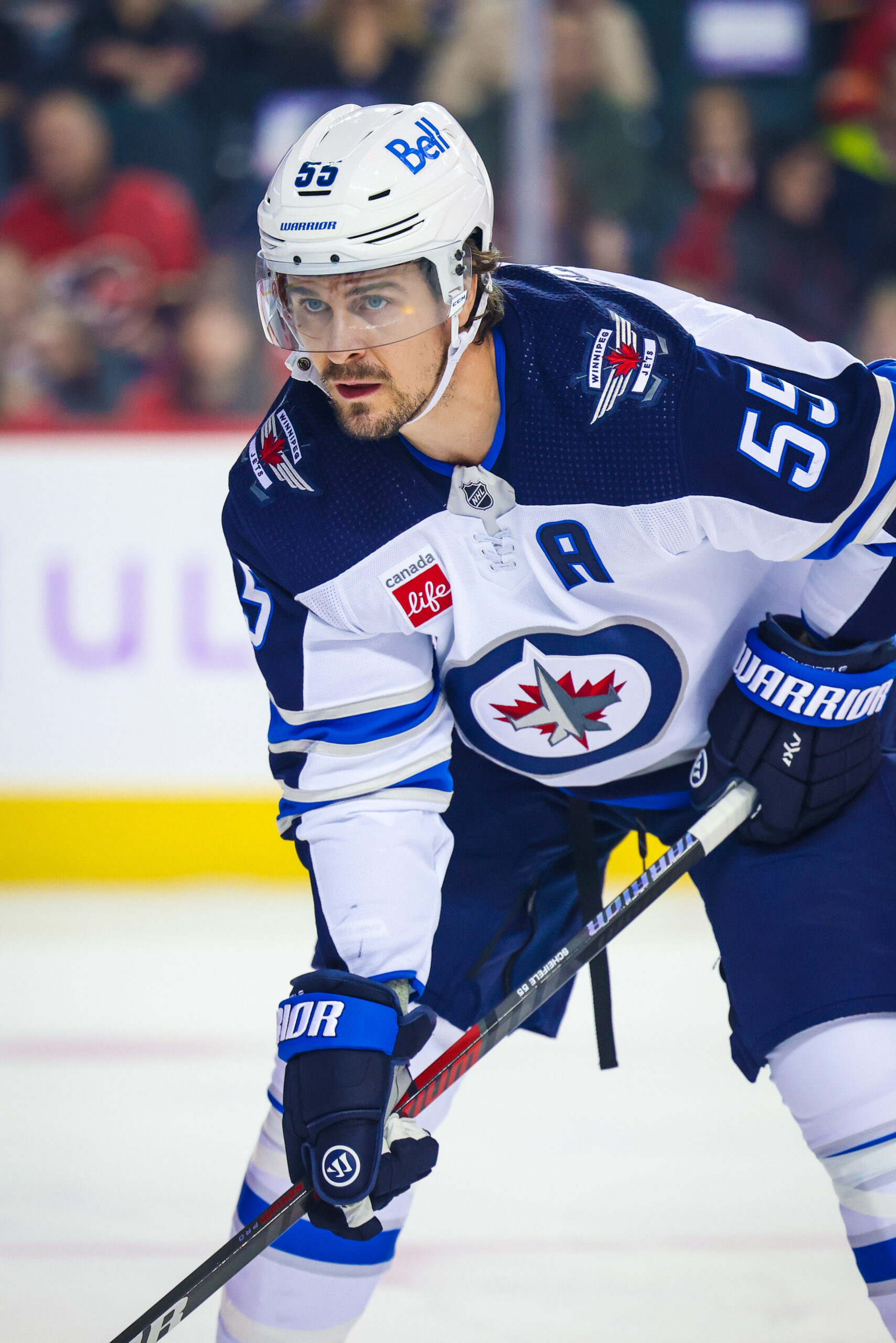
That being said, the type of bidding war that would be likely to take place should Scheifele hit the open market would almost undoubtedly see Scheifele offered a contract at that AAV, if not higher. Quite simply, centers of his caliber are among the rarest commodities in the NHL, and almost never hit unrestricted free agency.
If the Jets want to motivate Scheifele to forgo a likely highly lucrative trip to the free agent market, they’ll likely need to pony up, potentially giving him a maximum-term deal above the $10MM mark.
Similarly, for a team to prevail in what is likely to be a hotly contested battle for his signature in any potential Scheifele unrestricted free agency, they’ll likely need to cross that $10MM threshold as well.
It’s far from a given we reach that point since Scheifele still needs to have a productive 2023-24 season, but if he has another near or above-point-per-game season he could very well end up the star of next summer’s free agent frenzy. Though if he does, there will undoubtedly be quite a bit of debate over whether he truly merits the contract he’ll receive.
Photos courtesy of USA Today Sports Images