
Salary Cap Deep Dive: Arizona Coyotes
Navigating the salary cap is one of the more important tasks for any GM. Teams that can avoid total cap chaos by walking the tightrope of inking players to deals that match their value (or compensate for future value without breaking the bank) remain successful. Those that don’t see struggles and front office changes.
PHR will look at every NHL team and give a thorough look at their cap situation heading into the 2023-24 season. This will focus more on players who are regulars on the roster versus those who may find themselves shuttling between the AHL and NHL. All cap figures are courtesy of CapFriendly.
Arizona Coyotes
Current Cap Hit: $79,596,310 (under the $83.5MM Upper Limit)
Entry-Level Contracts
F Logan Cooley (three years, $950K)
F Dylan Guenther (two years, $894K)
D J.J. Moser (one year, $887K)
D Victor Soderstrom (one year, $863K)
Potential Bonuses:
Cooley: $3.5MM
Guenther: $850K
Soderstrom: $850K
Total: $5.2MM
Cooley’s contract came as a bit of a surprise this summer since he had originally indicated that he planned to return to the University of Minnesota for his sophomore year. The 2022 third-overall pick is likely to have a fair-sized role right away and it wouldn’t be shocking to see him on the top line before long. While it’s way too early to forecast his second deal, the market is pretty well-defined when it comes to signing impact middlemen off their entry-level pacts. Start with an eight (especially when the cap is higher in three years) and go from there.
Guenther burned the first season of his ELC last season but notably, was sent back to junior before he accrued a season of service time toward UFA eligibility (meaning he still has seven years of club control). At this point, it seems likely that he’ll be a regular this season but unless he winds up in a prominent role quickly, the safer bet here is that he winds up with a bridge contract.
The same can be said for Soderstrom who is looking to establish himself as a full-time regular. If that happens, he should be able to command an AAV just past the $1MM mark on a one-way deal. Otherwise, a one-year contract around his $874K qualifying offer could be coming his way. As for Moser, he has quickly played his way into a top-four role, pretty impressive for someone who was a late second-round pick two years ago. He doesn’t really fit the profile of the type of player who makes sense for a long-term agreement at this point but a bridge pact in the $3MM AAV range should be achievable.
Signed Through 2023-24, Non-Entry-Level
D Josh Brown ($1.275MM, UFA)
F Travis Boyd ($1.75MM, UFA)
D Travis Dermott ($800K, UFA)
D Mathew Dumba ($3.9MM, UFA)
D Sean Durzi ($1.7MM, RFA)
F Barrett Hayton ($1.775MM, RFA)
F Bryan Little ($5.292MM, UFA)
F Liam O’Brien ($775K, UFA)
D Troy Stecher ($1.1MM, UFA)
D Juuso Valimaki ($1MM, RFA)
F Jakub Voracek ($8.25MM, UFA)
F Jason Zucker ($5.3MM, UFA)
Let’s get the easy two out of the way first. Voracek (who was quietly acquired at the trade deadline last season) and Little remain injured and won’t play in 2023-24. They will be LTIR-eligible if Arizona runs into enough injury trouble this season that requires them to create some extra cap flexibility.
Zucker had a nice bounce-back campaign last season with Pittsburgh. He was healthy for the most part and the end result was him playing with some consistency and posting the second-best goal total of his career with 27. That didn’t yield the long-term deal he was hoping for this summer, however. Assuming he’s able to have a repeat performance in 2023-24, Zucker should be able to push for a similar price tag next summer while getting a shot at a multi-year agreement.
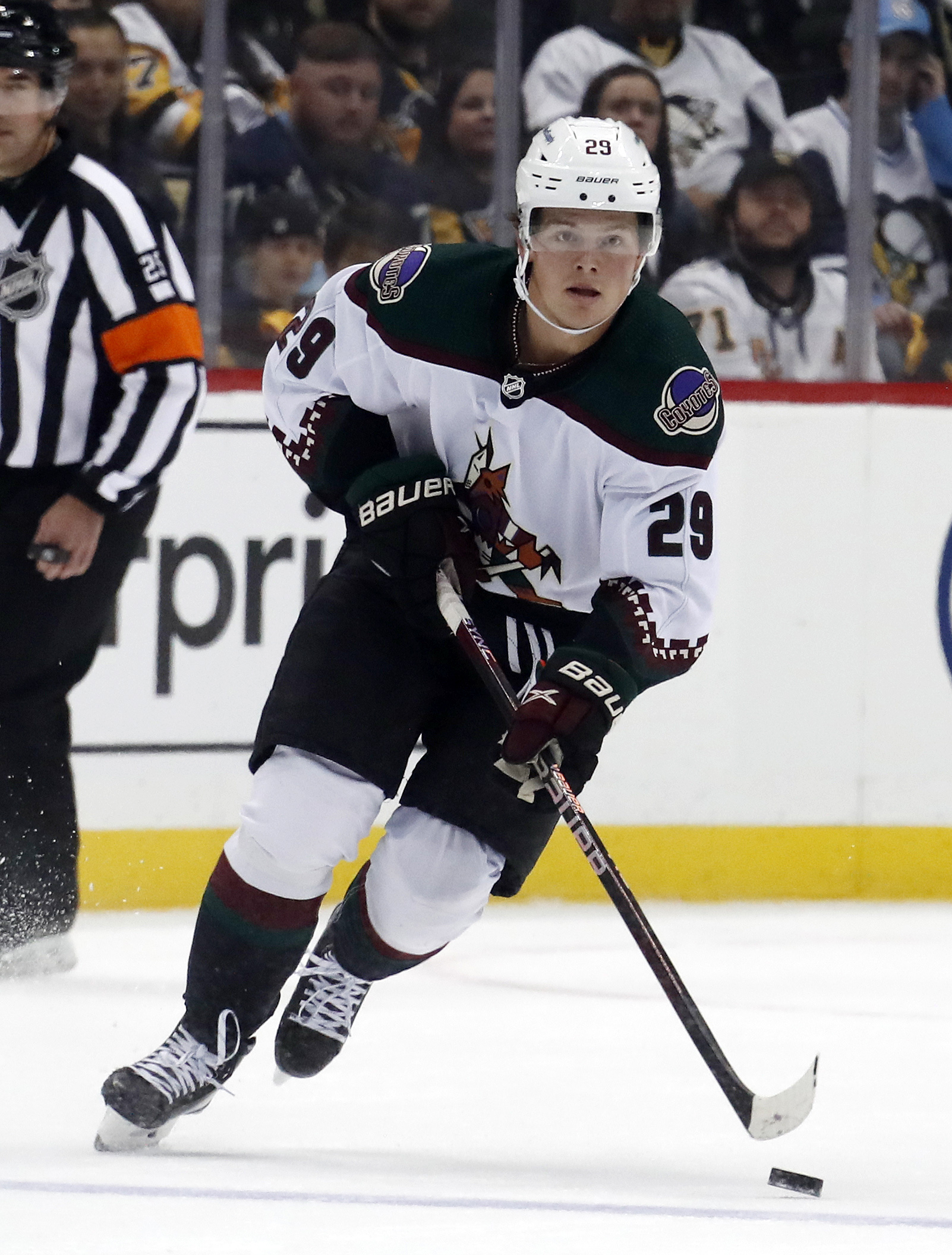 Hayton is one of Arizona’s more interesting expiring contracts. The 23-year-old didn’t exactly light it up on his entry-level deal, resulting in a two-year bridge pact. Last season, he worked his way up to the top line and put up by far his best season, notching 19 goals and 43 points. A repeat performance could push his AAV into the $4MM range. But with Cooley signing, there’s a good chance that he will cut into Hayton’s minutes which could hamper his production next season somewhat and cut into the price tag of that next contract. Had Cooley stayed in college and Hayton remained relatively unimpeded on the top line, his projection could have been more favorable than it seems like it will be now. Either way though, he appears to be part of the future plans for the Coyotes, something that wasn’t guaranteed to be the case a couple of years ago.
While Boyd has played a much bigger role in the last two years than he did beforehand, he has shown himself to be a capable secondary scorer. In the 2022 summer, he didn’t have enough of a track record to command a big raise. But if he has another year like these last two, he could push for a price tag north of $3MM on his next deal. O’Brien, meanwhile, saw regular action for really the first time last year, putting up his best numbers. But his role in the lineup is typically one that teams will want to spend the minimum or close to it to fill. Unless he can show a bit more offensively, it’s hard to see his next contract reaching the $1MM mark.
If you were reading the list of expiring deals and thought to yourself that there were a lot of defensemen on there, you weren’t wrong. Between these contracts and the two entry-level ones, all of Arizona’s defenders are in the final year of their deals. That’s a situation that doesn’t present itself very often league-wide.
Dumba struggled last season in his final year with Minnesota which undoubtedly hurt his market this summer. Once the dust settled on the Erik Karlsson trade, he quickly settled for this agreement, one that is for less than he was probably seeking. However, it gives him a chance to play a much more prominent role, one that could land him a fair bit more (perhaps in the $5MM range many expected this time around) next summer if things go well. Durzi is in a similar situation as instead of being a player sitting fairly low on the depth chart in Los Angeles, he will have a chance to play more minutes and produce more. He’s already likely to land a fair bit more than his $2MM qualifier next summer; it’s possible that he could double that if he can push his point output past 40.
Brown and Stecher are in similar spots in their careers. Both are third-pairing players and the market hasn’t been kind to those players in recent years. Brown might be hard-pressed to make what he’s getting now unless he can play his way up the depth chart while Stecher’s value is pretty well established considering he signed this deal just under two months ago. Valimaki opted to sign early last season, foregoing a higher qualifying offer in exchange for some guaranteed money and a longer look. Considering how he finished last season, he left some money on the table. If he can even come close to putting up 34 points again while maintaining a similar role on the depth chart, he could push for something in the $3MM range as well. Now healthy, Dermott will be looking to re-establish himself as an NHL regular but unless he can lock down a full-time spot, his next contract is likely to be below the $1MM mark as well.
Signed Through 2024-25
F Nick Bjugstad ($2.1MM, UFA)
F Michael Carcone ($775K, UFA)
F Alexander Kerfoot ($3.5MM, UFA)
F Jack McBain ($1.6MM, RFA)
G Karel Vejmelka ($2.725MM, UFA)
Kerfoot spent the last four seasons primarily in Toronto’s middle six, spending time both on the wing and at center. He goes to Arizona on a contract that pays him the same money and will likely result in him playing the same role. He’ll need to establish himself as more of a full-time top-six forward if he wants to command a sizable raise in 2025. Bjugstad returned to the desert after being moved as a rental at the trade deadline. He took a cheap one-year deal last summer to get an opportunity to play a bigger role and made the most of it. If he can stay on the third line, they’ll get a good return here but if he winds up on the fourth more often than not, he’ll have a hard time beating this next time out.
McBain (who took a dollar less than the AAV listed above) had a good rookie year, providing plenty of physicality with a bit of scoring from the bottom six. This deal gives both sides more time to evaluate to see if he can be a full-time third-liner which would position him to add a million (more if the offense really picks up) in 2025. Carcone has been a minor leaguer for most of his career but a strong showing at the Worlds landed him this one-way commitment and what should be a chance to carve out a full-time roster spot which will go a long way toward determining his future.
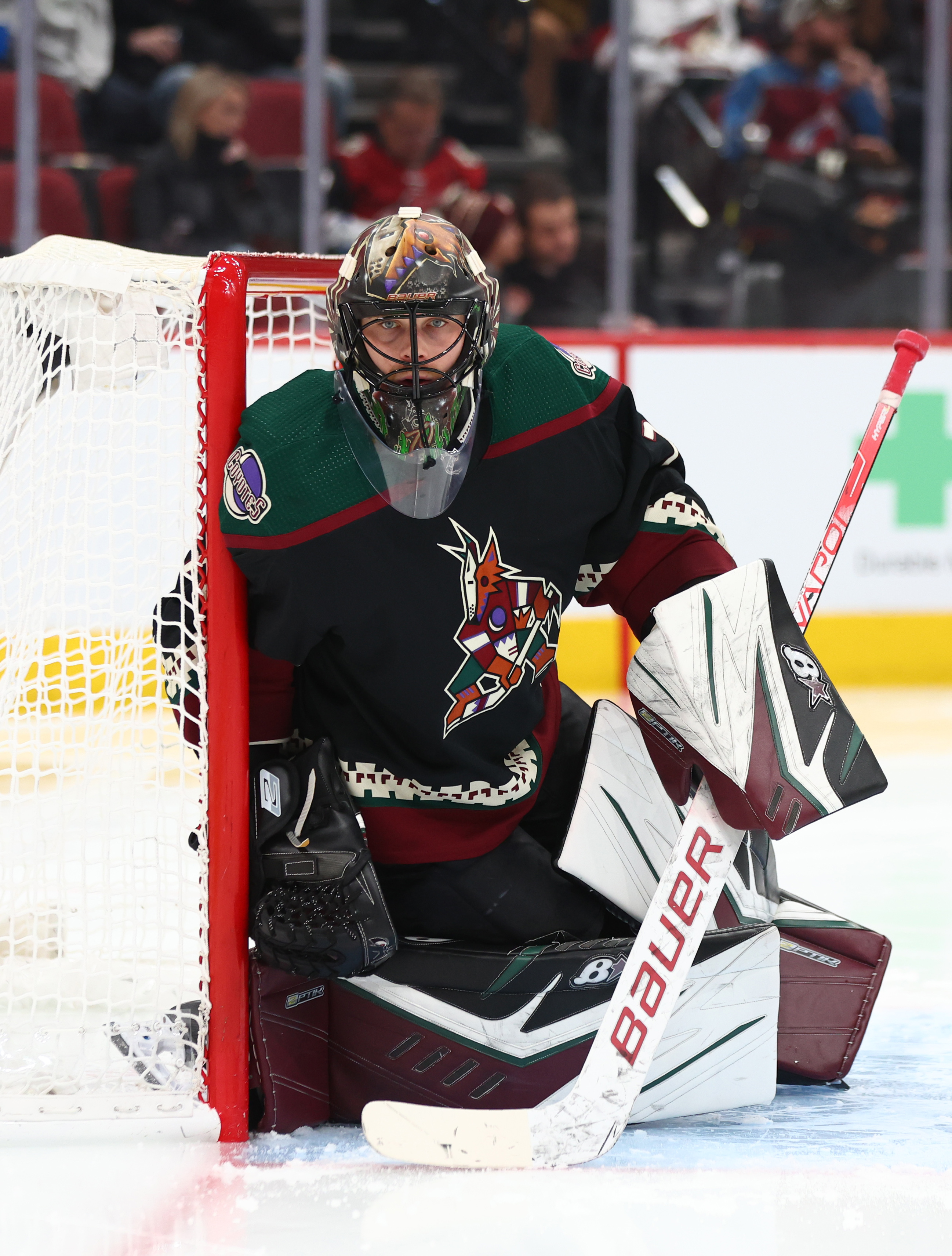 At the time Vejmelka signed this contract (which was still in his rookie season), his name was in trade speculation. Since then, not much has really changed. The 27-year-old has helped keep things respectable at a time when winning was pretty low on the priority list but it remains to be seen if he’s going to be part of Arizona’s long-term plans. If he puts up numbers like his first two seasons over these next two, his market value isn’t going to be much higher than this. If he happens to be moved onto a team looking for more short-term success and takes a step forward, however, then he could shoot toward the top tier of the backup market. Assuming the cap jumps up, that could push him to the $4MM range.
Signed Through 2025-26
G Connor Ingram ($1.95MM, UFA)
F Matias Maccelli ($3.425MM, RFA)
F Nick Schmaltz ($5.85MM, UFA)
D Shea Weber ($7.857MM, UFA)
Again, let’s get the injured player out of the way first. Weber hasn’t played since the 2021 Stanley Cup Final when he was with Montreal and he isn’t expected to play again. He’s LTIR-eligible as well if Arizona needs to open up more cap room.
Schmaltz has averaged just shy of a point per game in each of the last two seasons, albeit years that he missed nearly a quarter of the campaign due to injuries. He has shifted to playing on the wing much more often, a move that has suited him so far. The issue for Arizona is the back-loaded nature of the contract. For a team that is trying to keep salary costs down, Schmaltz being owed $24.45MM in money over these next three seasons stands out considerably. From a cap perspective, he’s a nice bargain if he continues to produce at this level. But with the salary situation, it wouldn’t be surprising to see the Coyotes at least assess what the trade market might be for the 27-year-old.
Maccelli was a nice surprise for the Coyotes last season. After having a very limited impact in 22 games in 2021-22, he wound up finishing third on the team in scoring with 49 points, making the All-Rookie Team, and finishing fourth in Calder Trophy voting for Rookie of the Year. Considering the small sample size of NHL success, Arizona opted for the bridge contract. If the 22-year-old can build on those numbers, he could add a couple million or more with the benefit of arbitration eligibility at that time.
Ingram’s debut in the desert didn’t go to well as he struggled mightily in his first eight games. After that, however, he posted a .921 SV% in his final 19 appearances, a number that is well above average. That has warranted him a longer look and if he’s able to continue playing anywhere close to that level, he’ll be a nice bargain for Arizona.
Summer Synopsis: Columbus Blue Jackets
The Blue Jackets shocked the hockey world last summer. After years where the prevailing narrative surrounding the Blue Jackets was about the multitude of star players who left the team to commit their long-term playing future elsewhere (Sergei Bobrovsky, Artemi Panarin, Seth Jones, et cetera) the team managed to sign the top free agent on the open market. They got superstar Johnny Gaudreau to commit the rest of his prime playing years to Columbus, and on the way seemed to accelerate their path back to contention.
Significant injury issues, regression from some important players (such as Cole Sillinger and Elvis Merzlikins), and a lack of talent down the middle left Columbus as one of the league’s worst teams last season, and according to some has firmly placed GM Jarmo Jarmo Jarmo Kekäläinen on the hot seat. In response to mounting pressure to return to contention, Kekäläinen had an aggressive summer and added a big-name head coach. Will this new-look Blue Jackets team be able to turn the team’s fortunes around as soon as next season?
Draft
1-3: F Adam Fantilli, Michigan (NCAA)
2-34: F Gavin Brindley, Michigan (NCAA)
3-66: F William Whitelaw, Youngstown (USHL)
4-98: D Andrew Strathmann, Youngstown (USHL)
4-114: F Luca Pinelli, Ottawa (OHL)
5-156: G Melvin Strahl, MoDo Jr. (J20)
7-194: F Oiva Keskinen, Tappara Jr. (SM-Sarja)
7-224: F Tyler Peddle, Drummondville (QMJHL)
While the Blue Jackets were undoubtedly disappointed to have lost in the draft lottery and missed out on a once-in-a-generation player in Connor Bedard, their luck definitely turned around on draft night. The Anaheim Ducks selected Leo Carlsson, a fantastic prospect in his own right, second overall, leaving the Blue Jackets the chance to pick Fantilli, the reigning Hobey Baker award winner.
There were many rumors that the Blue Jackets would have selected USNTDP product Will Smith had Fantilli been selected by Anaheim over Carlsson, meaning they would have been left with a player who’ll only hit the NHL ice next spring at the earliest. (Smith is committed to play college hockey next season at Boston College) Since the Ducks took Carlsson, though, the Blue Jackets were able to land a prospect widely considered to be NHL-ready, and a player many believe to be the clear-cut best player in the class behind Bedard.
Fantilli could very well end up the franchise-defining first-line center the Blue Jackets have been searching for since their very first season in the NHL, and getting that caliber of a player after losing a draft lottery is an amazing stroke of luck. Behind Fantilli, the Blue Jackets invested heavily in prospects playing in America, investing their next three selections in NCAA and USHL players. Brindley was Fantilli’s linemate at Michigan and could very well end up playing that role in the NHL. Whitelaw and Strathmann were teammates for the USHL Champion Youngstown Phantoms, with Whitelaw the team’s leading scorer and Strathmann a minutes-eating blueliner. Both USHL products play with an edge and will develop in college hockey before turning pro.
Trade Acquisitions
D Ivan Provorov (from Philadelphia)
D Damon Severson (from New Jersey)
This is where the Blue Jackets really made their mark on the offseason. The team identified its defense as a core area of need entering into the summer. Their lack of established defensive talent was exposed last season after numerous injuries took out the team’s more experienced players, such as Zach Werenski. In order to make the playoffs, Columbus knew that they would have to give top-four minutes to reliable players rather than resort to unproven names such as Tim Berni, Marcus Bjork, and Gavin Bayreuther, three names who saw time on the Blue Jackets’ defense last season.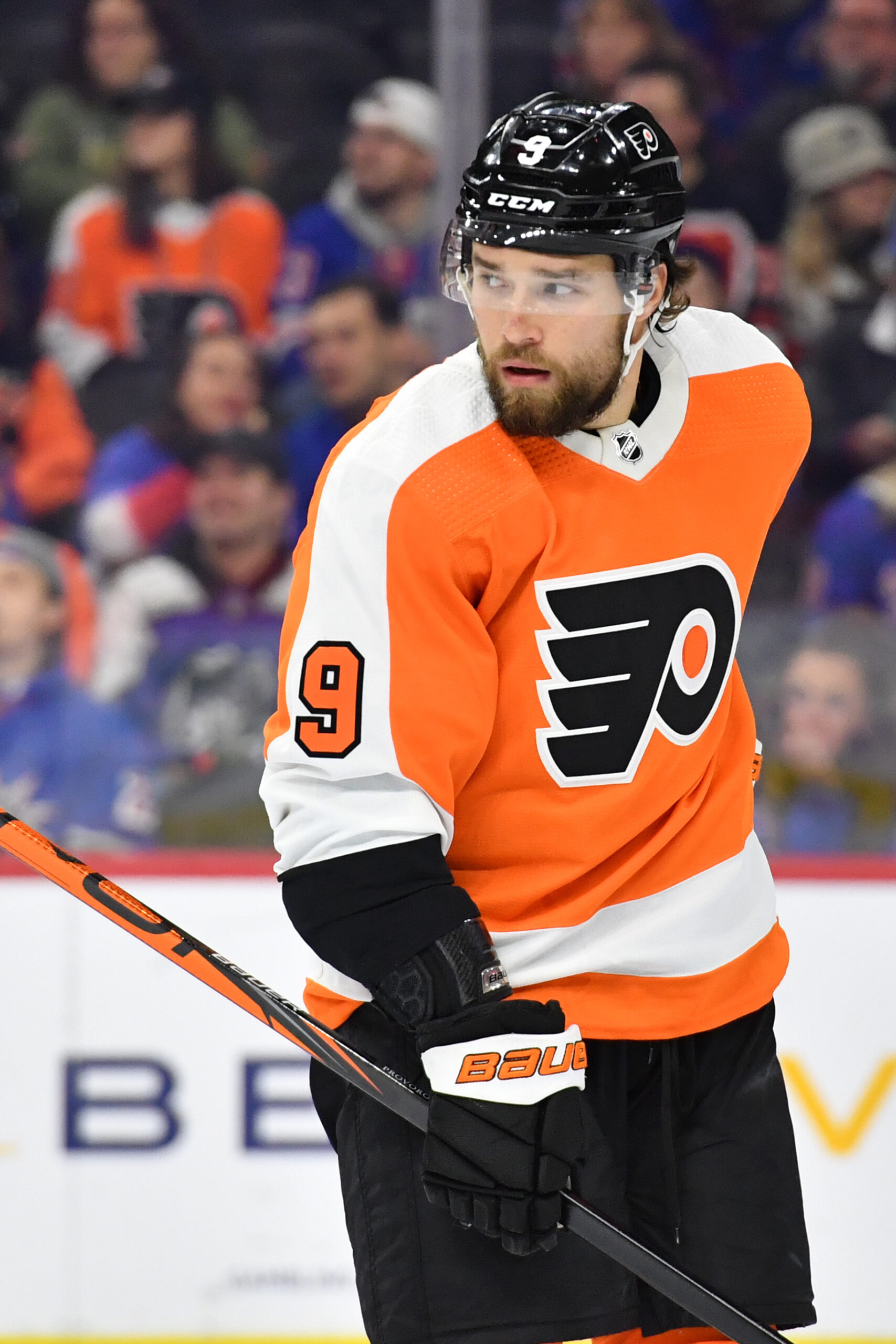
In Provorov, Columbus acquired a somewhat enigmatic defenseman whose career features some very high highs and some even lower lows. Provorov was once viewed as an up-and-coming future number-one defenseman for the Flyers, and at times he looked like an elite all-situations minutes-eater.
He earned some stray Norris Trophy votes after his 2019-20 season, when at the age of 23 he played nearly 25 minutes per night and scored 36 points in 69 games.
In Columbus, Provorov won’t need to be that kind of number-one blueliner his team relies on. With Werenski entrenched in that role, the hope in Columbus is that Provorov will be able to thrive on a second pairing.
As for Severson, the Blue Jackets surrendered a mid-round pick to be able to sign Severson to a maximum-term $6.25MM AAV contract. The at-the-time pending UFA committed to Columbus without testing the wider market, and lands as a potential partner for Provorov. Severson has more of an offensive bent to his game and scored 46 points in 2021-22. He took a step back last season as the Devils injected more defensive talent into their lineup, relegating Severson to a smaller role.
In Columbus, he’ll be a go-to offensive creator from the back end, and while many fairly question whether Severson merited such a lengthy commitment (he’ll be under contract with the Blue Jackets through 2030-31, and is already 29 years old) he undoubtedly makes their team better for next season.
Key RFA Signings
F Mathieu Olivier (two-years, $2.2MM)
F Trey Fix-Wolansky (two-years, $1.55MM)
D Jake Christiansen (one year, $775k)
The Blue Jackets didn’t have any major RFA’s to re-sign, just some NHL-relevant players who figure to factor into new head coach Mike Babcock’s roster picture at some point next season. Getting Olivier, 26, locked into a two-year deal gives Columbus a physical presence on its fourth line at a reasonable cost. The Blue Jackets want to be a difficult team to play against, and re-signing Olivier helps them do that.
Fix-Wolansky, 24, torched the AHL last season to the tune of 71 points in 61 games. This two-year deal keeps him on the Blue Jackets at a cheap price for the foreseeable future, although since he’s not waivers-exempt there’s always the chance that he doesn’t finish this contract playing in Ohio. As for Christiansen, this will be his first season subject to waivers and his league-minimum price tag makes him an intriguing option to be claimed should he fail to make Columbus’ opening-night roster. The soon-to-be-24-year-old blueliner scored 34 points in 50 AHL games last season.
Key Departures
D Gavin Bayreuther (Dallas, one year, $775k)
The Blue Jackets were in the relatively uncommon position this summer of not really being at risk of losing any major contributors to their NHL roster without explicitly choosing to do so. Their most experienced player to sign elsewhere was Bayreuther, a journeyman defenseman who stepped in after Columbus was hit by significant injuries and ended up playing 51 NHL games.
The 29-year-old signed in Dallas and will likely remain a depth defenseman there. The Blue Jackets could certainly have used Bayreuther’s experience for another season, but the reality is if he ended up having another extended NHL stay in Columbus it would mean the team’s defensive corps is once again in dire shape.
Salary Cap Outlook
The Blue Jackets have some hefty contracts on their books, starting with Gaudreaus and extending to some expensive mid-range deals cap hits belonging to Severson, Provorov, and Erik Gudbranson. They have a bit of wiggle room to make a mid-season addition, and since they’re set to avoid long-term injured reserve will be able to bank cap space during the season for a potential trade deadline spending spree.
The most important aspect of this season from a financial perspective is the team’s performance in net. Columbus has committed $5.4MM AAV for the next few years into Merzlikins. Can he get back to playing like a quality starting netminder and reward the team’s faith in him?
Key Questions
Can Mike Babcock steer this team to the playoffs?: The Blue Jackets are looking to reach the postseason in an extremely competitive Metro division. They’ve enlisted the services of Babcock, a controversial coach who, at the very least, has quite a bit of winning on his resume. He helped turn a lost Toronto Maple Leafs franchise into the regular season juggernaut we see today, and won a Stanley Cup ring running the bench of the Detroit Red Wings. Will he be able to engineer a similar success in Ohio?
Which of the team’s young players will rise, who will fall?: The Blue Jackets have an enviable crop of young talent and a few players who have a chance to become stars in the NHL. Sillinger, the team’s 2021 first-round pick, looked to be on that track before a brutal sophomore campaign. Similarly, many had questions over whether Kent Johnson‘s high-octane offensive game would translate from college to the pro ranks without serious adjustment time. Johnson had a promising 40-point rookie campaign, to a strong degree silencing those questions. The Blue Jackets have even more ascending talents set to battle for roles on Babcock’s roster, so a main question regarding their 2023/24 season will be who among that group will rise to the top.
Can Merzlikins bounce back?: As mentioned, the Blue Jackets have committed much of their future to Merzlikins in net. They don’t really have any great method of getting out from under that contract, so their best bet is to support Merzlikins with an improved defense and hope he can return to the form he flashed earlier in his career. Whether he does so will go a long way in determining if this Blue Jackets competitive push ends up successful.
Photos courtesy of USA Today Sports Images
Poll: Which Team Had The Worst Offseason?
During this time of year, some organizations have plenty of excitement surrounding their clubs, as fans are eager to see new players wear the jerseys of their favorite teams headed into training camp. Whether picking up exciting players through the draft, free agency, or trades, there are plenty of teams that significantly improved their rosters heading into next season. However, there are some teams that have been unable to improve or have even seen the talent on their roster take a substantial decrease this summer.
One of the most important teams that factors into this conversation, is the defending President Trophy champions, Boston Bruins. This summer, the Bruins have had to deal with the untimely retirements of franchise legends Patrice Bergeron and David Krejci, while also watching Dmitry Orlov, Tyler Bertuzzi, Nick Foligno, Taylor Hall, as well as several others join separate organizations for the 2023-24 season. Seeing their name pop up in plenty of trade conversations lately, their cap situation has halted Boston from replacing any of these players on their team. The team still features top-end talent such as David Pastrnak and Brad Marchand, but in arguably the strongest division in the NHL, their competitive window may take a brief hiatus.
Unlike the Bruins, one team who had been projected to be competitive last season, but ultimately failed short of the playoffs at season’s end, was the Calgary Flames. The organization is only a season away from seeing quite a few players hit unrestricted free agency, but with an open wild-card situation in the Western Conference, the team did not do much to improve their chances next year. The organization may be banking on a serious change in direction from new head coach, Ryan Huska, but after trading away Tyler Toffoli to the New Jersey Devils early in the summer, the team only brought in Yegor Sharangovich, Dryden Hunt, and Jordan Oesterle. Time will tell if Huska truly has the ability to move the needle for the Flames behind the bench, but the acquired players this summer do not generate much confidence in that happening.
Lastly, for another straight summer, the New York Islanders did very little to address their lack of goal-scoring. The team did hand long-term deals to both Pierre Engvall and Scott Mayfield but failed to bring in any players such as Jason Zucker or Vladimir Tarasenko, who could have provided an extra boost to their offense. They may benefit from a full season from center Bo Horvat, but even after deploying him for over 35% of the season last year, still finished 22nd in the league in Goals For. The team is limited by the way of salary cap space and does typically put much more emphasis on keeping the puck out of their net, but the lack of additional goal-scoring is severely limiting this team in their quest for success.
There are other teams that may be in contention for the worst offseason, and now it’s time for a vote.
Which Team Had The Worst Offseason?
-
Boston Bruins 55% (790)
-
Calgary Flames 18% (262)
-
New York Islanders 16% (226)
-
Anaheim Ducks 6% (84)
-
Other (Comment Below) 6% (84)
Total votes: 1,446
Summer Synopsis: Colorado Avalanche
Last season, the Colorado Avalanche finished atop the Central Division as most expected. That’s despite missing captain Gabriel Landeskog and other core pieces such as Bowen Byram, Josh Manson and Valeri Nichushkin missing significant amounts of time. The 2022 Stanley Cup champions couldn’t find the magic for two seasons in a row, however, instead making history in another way by becoming the first team to lose to the Seattle Kraken in a playoff series, albeit in a hard-fought seven-game battle. That series loss was largely due to a lack of depth scoring, something GM Chris MacFarland addressed in a targeted manner this summer. Was it enough to return the Avs to 2022’s glory, however?
Draft
1-27: F Calum Ritchie, Oshawa (OHL)
1-31: D Mikhail Gulyayev, Omsk (MHL)
5-155: D Nikita Ishimnikov, Yekaterinburg (MHL)
6-187: D Jeremy Hanzel, Seattle (WHL)
7-219: F Maros Jedlicka, Zvolen (Slovakia)
While the Avalanche didn’t transform a weak prospect pool, they did make a shrewd move the day before the draft by trading Alex Newhook to the Montreal Canadiens, acquiring a second first-round pick in the process. Their two top selections, Gulyayev and Ritchie, were rather spectacular value moves for where they were taken – some public scouts had both ranked within the top 15 prospects available.
Ritchie is the closest to NHL-ready and could potentially see some time with the Avs as soon as 2024-25, but he’ll still need to be returned to juniors then if he’s not NHL-ready. All five players the Avalanche drafted are expected to return to the clubs listed above for the 2023-24 season, with the exception of Gulyayev, who is expected to join Omsk’s KHL team full-time.
Trade Acquisitions
F Ross Colton (from Tampa Bay)
D Gianni Fairbrother (from Montreal)
F Ryan Johansen (from Nashville)
F Fredrik Olofsson (from Dallas)
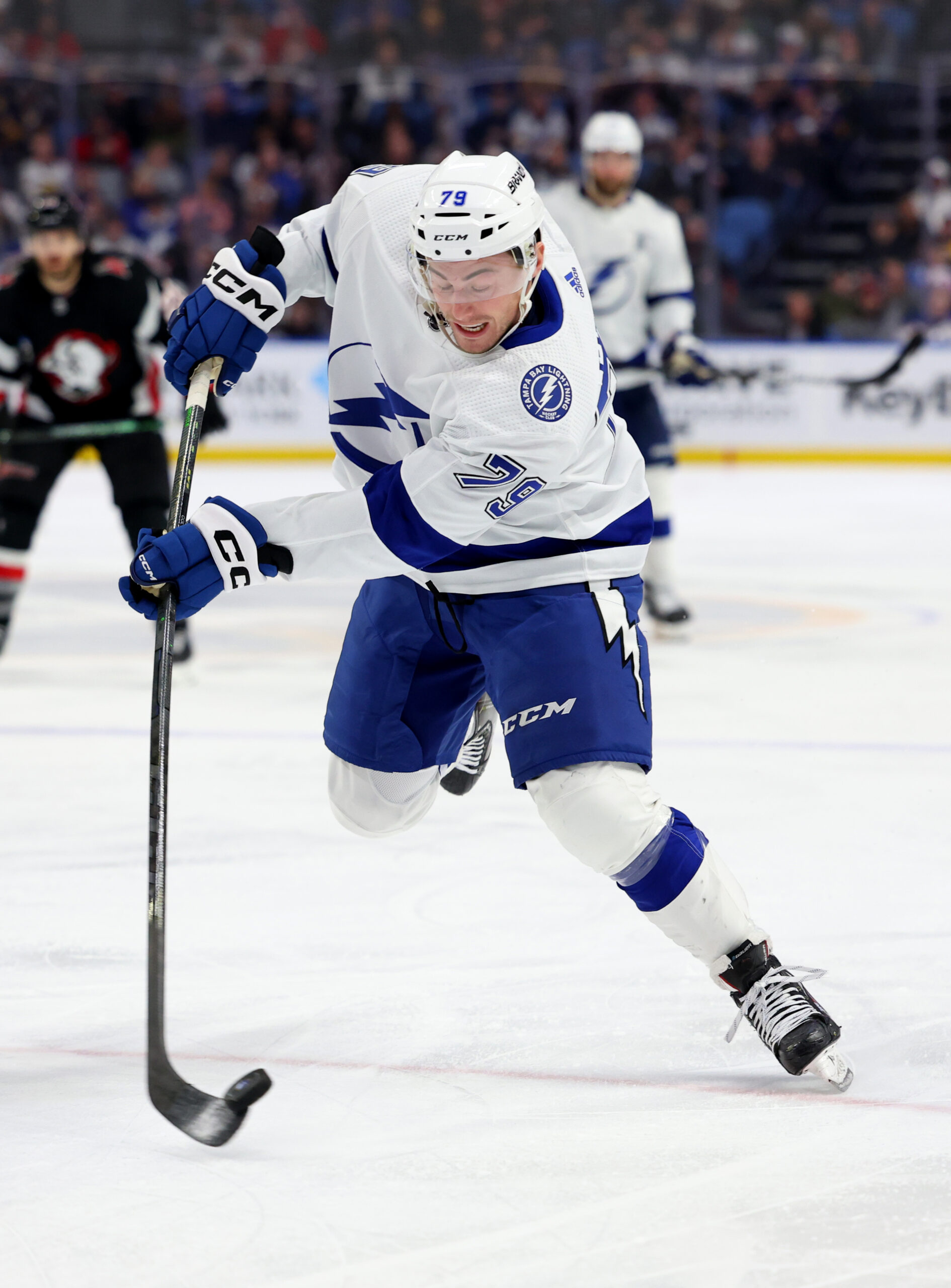 Colton has developed into the type of middle-six point-producing forward that the Lightning have relied upon so much over the past handful of seasons, but they simply couldn’t afford to keep him as he was a restricted free agent this summer in need of a new contract. Colorado, who had some additional flexibility with Landeskog slated to go on LTIR for a second straight season, swooped in and acquired the 26-year-old, who for now is projected to center the third line after scoring 16 goals and 16 assists for 32 points in 81 games last season. His defensive reputation becomes a bit inflated publically once you dig deeper into his possession metrics, but he has maintained a role as an excellent play-driver with an accurate shot – something the Avalanche desperately needed to add to their second and third lines.
Johansen is projected to slot in just above Colton on the Avs’ center depth chart, but he’s more of a reclamation project than the former, and the two could easily swap roles if things don’t go as planned. The 31-year-old has a previous first-line center pedigree but has been wildly inconsistent over the past few campaigns, scoring just 28 points in 55 games last season after notching 26 goals and 63 points in 79 games with the Predators the year before. The Avalanche are hoping that by sticking likely one of Artturi Lehkonen or Nichushkin on his wing, they can help unlock some of the offense that’s been missing and re-elevate him to the 60-point range.
Fairbrother came from Montreal as part of the return for Newhook and will spend next year in the AHL with the Colorado Eagles. Olofsson, whose signing rights were acquired from the Stars, was immediately signed to an extension after the trade and will be one of many names looking to lock down a roster spot and contribute on the team’s fourth line.
Key UFA Signings
F Andrew Cogliano (one year, $825K)
F Jonathan Drouin (one year, $825K)
D Jack Johnson (one year, $775K)
F Fredrik Olofsson (one year, $775K)*
F Chris Wagner (one year, $775K)*
F Miles Wood (six years, $15MM)
*-denotes two-way contract
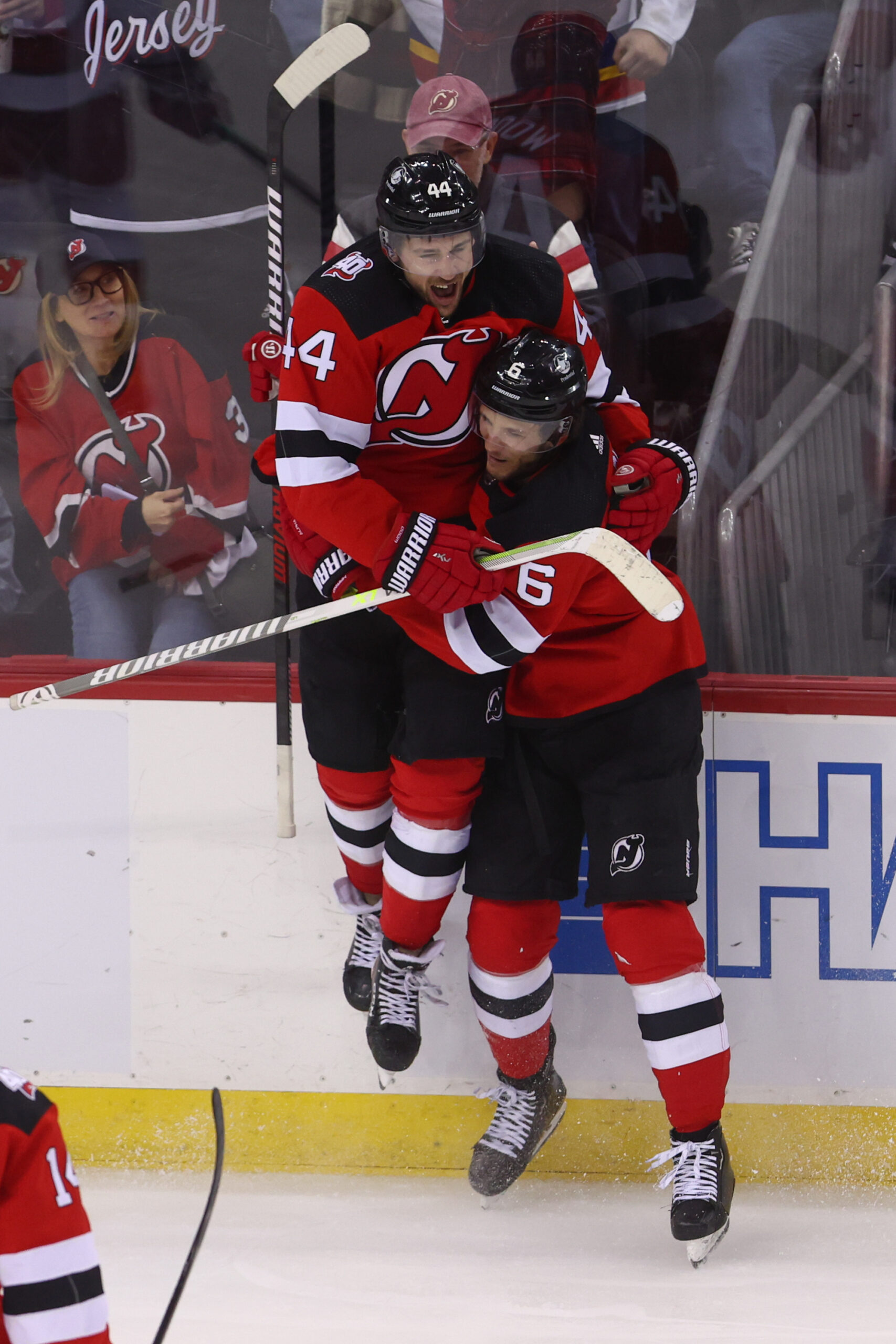 Most of their key boosts to their forward core came via trade in Colton and Johansen, but the Avs did dish out some money to fill out bottom-six spots via unrestricted free agency. While he may not play the highest in the lineup, their biggest move (and perhaps one of the more surprising contracts of the entire summer) was Wood, earning a lengthy commitment to play a bottom-six checking role in Denver. The 27-year-old missed all but three games in the 2021-22 season with injury but suited up for a full campaign last year, scoring 13 goals and adding 14 assists for 27 points in 76 games whilst playing a fourth-line role for the New Jersey Devils. His reputation as defensively responsible did take a hit last year after the rather serious hip injury, raising some concerns about the rather extravagant length of the deal.
Another player who could end up playing quite a large role is Drouin, who, for now, projects to slide into the team’s top-six on the cheap to hopefully revitalize the former third-overall pick’s point production. If they opt to spread out the wealth and play wingers like Lehkonen and Nichushkin on the second line, they could match Drouin alongside former Halifax Mooseheads teammate Nathan MacKinnon and hope for him to reach the 40-50-point ceiling he showed earlier in his career with the Montreal Canadiens and Tampa Bay Lightning. He scored just two goals last season in 58 games and hasn’t played close to a full 82 games since the 2018-19 campaign.
A handful of re-signings, including Cogliano, Johnson and Olofsson, aim to play fourth-line or third-pair roles. Wagner, who spent most of the last two seasons in the minors, does have a history of full-time NHL play and will aim to regain such a role on the team’s fourth line.
Key RFA Re-Signings
D Bowen Byram (two years, $7.7MM)
F Ross Colton (four years, $16MM)
F Ben Meyers (one year, $775K)
We covered Colton’s acquisition in the trade section of this piece, but Byram’s two-year bridge warrants some analysis. Despite his development being derailed multiple times by serious injuries and concussion concerns remain, the 2019 fourth-overall pick is a bonafide top-four defender among one of the highest-powered defense corps in the league. He recorded a career-high 24 points in 40 games last season (a 49-point pace) and shouldered nearly 22 minutes per game – a significant workload for such a young, developing defender. Posting better defensive results than his defense partner, Samuel Girard, he could be in line for even more ice time next season and will likely exceed the value of his new deal.
Meyers, on the other hand, takes a league-minimum deal after failing to elevate himself in the Avs’ lineup in his first full pro season. The highly-touted college free agent signing out of the University of Minnesota last season skated in 39 games with Colorado at the NHL level, collecting four goals. He’ll likely get a crack at the fourth-line center spot out of camp but needs to show strides in order to avoid another demotion to the minors.
Key Departures
F J.T. Compher (Detroit, five years, $25.5MM)
F Lars Eller (Pittsburgh, two years, $4.9MM)
G Jonas Johansson (Tampa Bay, two years, $1.55MM)
D Erik Johnson (Buffalo, one year, $3.25MM)
F Denis Malgin (Switzerland’s ZSC Lions, five years)
F Alex Newhook (trade with Montreal)
F Matthew Nieto (Pittsburgh, two years, $1.8MM)
F Evan Rodrigues (Florida, four years, $12MM)
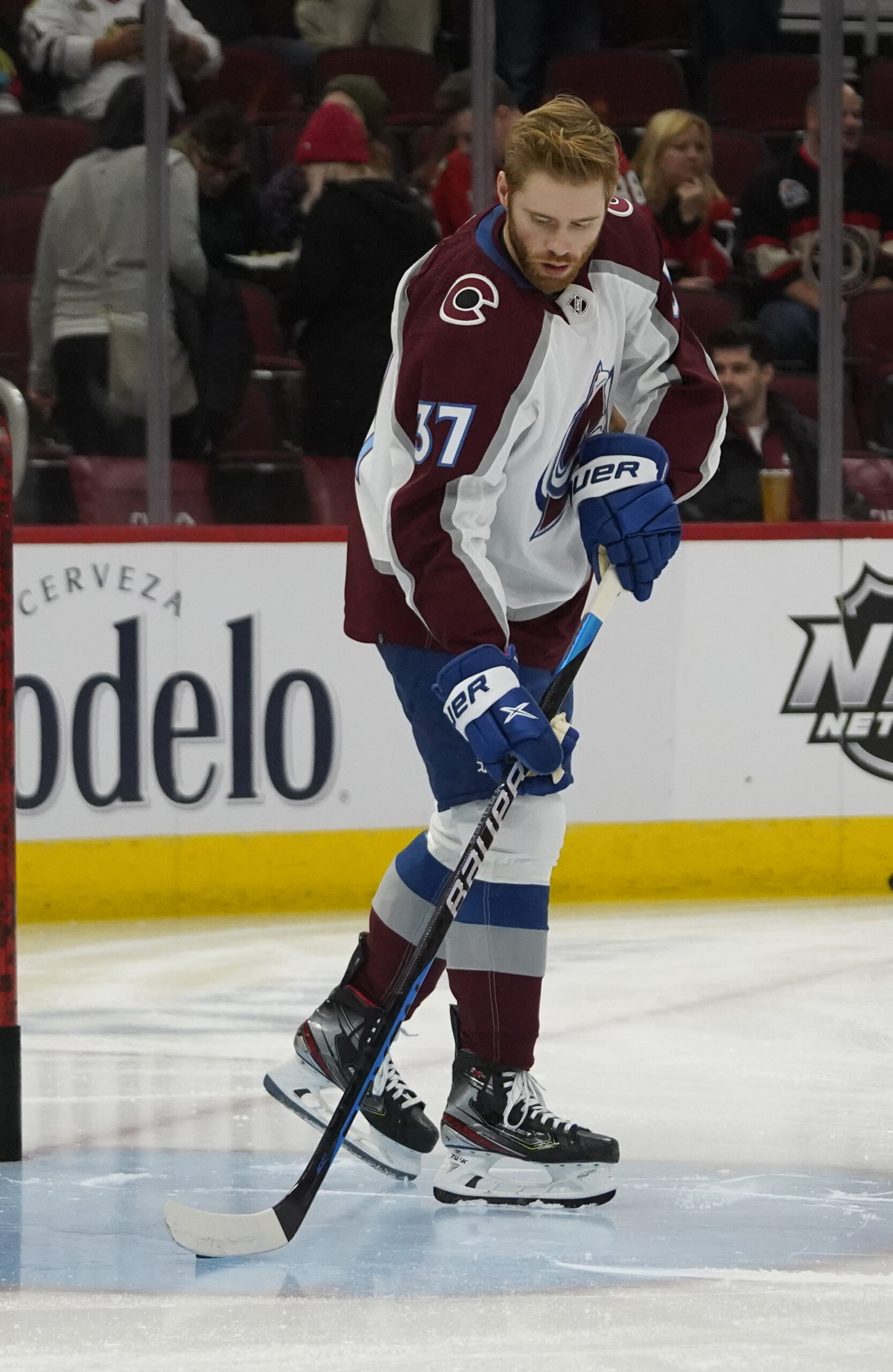 Compher played the biggest role in Colorado last season out of anyone on this list, claiming the second-line center spot by default after Newhook failed to capture it in the opening weeks of the season. He would average over 20 minutes per game and record a career-high 52 points, not something that he should be expected to replicate in Detroit (even though they paid him as such). In fact, Johansen could very well be seen as an upgrade on Compher, given his track record, so despite the gargantuan minutes he covered last season, the Avalanche likely won’t feel his absence too much after their other offseason moves.
Rodrigues was a solid two-way middle-six forward for the Avs in his lone season there, as he has been for the past few seasons. He recorded 39 points in 69 games (a 46-point pace), something they’ll likely look for Drouin to replace, although he provides no guarantee.
Eller and Nieto found roles in Pittsburgh under new GM Kyle Dubas after they were both late-season trade acquisitions by the Avs who had a marginal impact on their record. Perhaps the biggest supplementary loss here is Johnson, who was the longest-tenured member of the Avalanche roster and had logged over 700 games with the team and was still a reliable defensive presence, albeit a declining one. His leadership will be missed, undoubtedly.
Malgin was a bit of an intriguing depth scorer last season, notching 11 goals in 42 games in an Avalanche jersey, but he’s opted to return home to Switzerland to play out the prime of his pro career.
Salary Cap Outlook
With Landeskog again expected to miss the entire season due to an additional knee surgery, the Avalanche are in a better salary cap situation than many other contenders. The team still has a fair amount of wiggle room and is expected to be cap-compliant by around $2.025MM once Landeskog is placed on LTIR, per CapFriendly. They have no dead money on their books: no retained salary transactions, buyouts, or projected buried salaries in the minors. It still leaves room for them to make one more marginal addition from the free-agent market if they choose.
Key Questions
Can Georgiev Repeat?: 27-year-old Bulgaria-born Alexandar Georgiev was a revelation in the crease last season. Coming over after a handful of inconsistent years in a backup role with the New York Rangers, the Avalanche caught lightning in a bottle with Georgiev, who churned out true starting-caliber numbers with a .919 save percentage and 2.52 goals-against average with a heavy workload – 62 games played, by far a career-high. He had just a .898 with the Rangers in 33 games the year before, however. While goalies often hit their primes closer to age 30 like Georgiev, the Avalanche will need another strong season from him with diminished defense depth in front of him.
Do They Have A Second-Line Answer?: One of Johansen or Colton commanding second-line minutes will be a must for Colorado to fix last season’s Achilles heel. If they can do so enough to give the team a legitimate secondary scoring option behind MacKinnon, much like Nazem Kadri did before his departure in 2022, it could very well keep them atop the Central. If not, they’ll need full health and full power from their stars to avoid slipping down the standings in a tight division headlined by improved Dallas Stars and Winnipeg Jets teams.
What To Do With Devon Toews?: He’s not-so-quietly transformed into a top-flight defender who would be the best defenseman on about half the teams in the league. However, he’s entering the final season of a contract paying just $4.1MM per season and is hurtling toward unrestricted free agency next summer. If they aren’t close to an extension by the time the deadline rolls around, will the Avalanche keep him around as a self-rental or aim to flip him for an asset with more control?
Photos courtesy of USA Today Sports Images.
Summer Synopsis: Chicago Blackhawks
The Chicago Blackhawks hit the lottery this past spring when they won the opportunity to draft junior phenom Connor Bedard. Chicago has been mired in a rebuild for several years without ever calling it a rebuild. That all changed in the summer of 2022 when the Blackhawks made the difficult decision to rip off the band-aid and move out some good players that didn’t fit their rebuild timeline. Alex DeBrincat and Kirby Dach were two young players that could have helped Chicago in the future, however, they would have been much older than many of Chicago’s good prospects. With their moves this summer, the Blackhawks appear poised to bottom out once again this season, albeit with a much more competitive roster than last year. The Blackhawks brought in a few veterans, presumably to insulate the younger players and teach them how to be good pros, while simultaneously helping the club reach the cap floor. Chicago didn’t seek out top-end veterans, or stars that are in the prime of their career, they overpaid veterans who were at the tail end of their careers.
Draft
1-1: F Connor Bedard, Regina (WHL)
1-19: F Oliver Moore, U.S. U18 National (US National Team)
2-35: G Adam Gajan, Chippewa (NAHL)
2-44: F Roman Kantserov, Stalnye Lisy Magnitogorsk (MHL)
2-55: F Martin Misiak, Youngstown (USHL)
3-67: F Nick Lardis, Hamilton (OHL)
3-93: F Jiri Felcman, Langnau (Swiss-Jr)
3-99: F Alex Pharand, Sudbury (OHL)
4-131: F Marcel Marcel, Gatineau (QMJHL)
5-167: F Milton Oscarson, Orebro (SHL)
6-195: D Janne Peltonen, Kärpät U20 (U20 SM-sarja)
As mentioned earlier, Chicago won the Bedard sweepstakes and was able to draft a generational player to kick off their rebuild. While Chicago was gifted the centerpiece of their franchise moving forward, they will still need to insulate him and provide depth around him in order to win, but they have the hardest thing to acquire already in place.
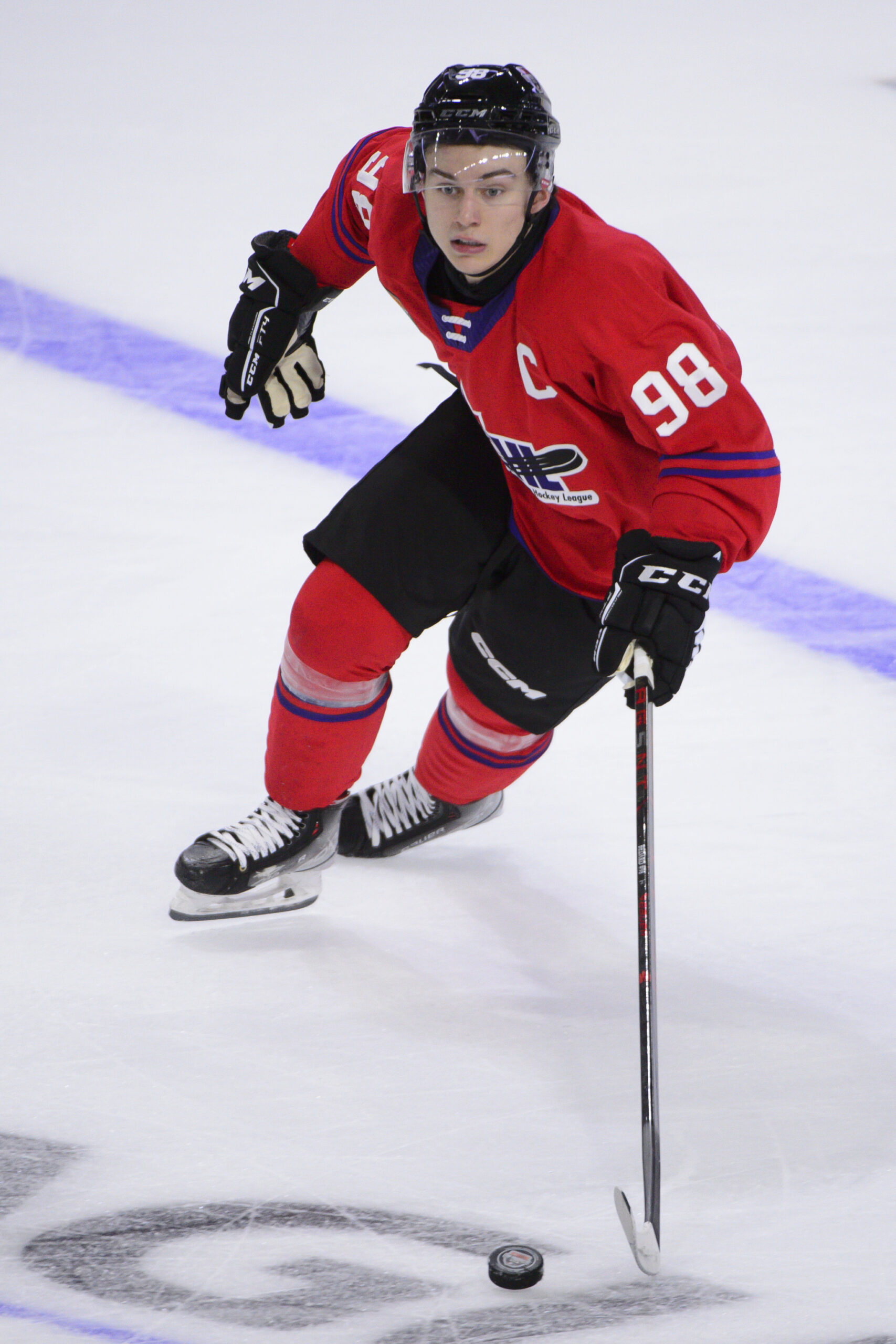 Chicago opted to go forward-heavy in the 2023 NHL entry draft as they selected nine forwards, a defenseman, and a goaltender. Like most teams, the Blackhawks were surprised to see Moore available at the 19 spot and they were fortunate enough to draft the speedy center. He could potentially become Chicago’s number two centerman behind Bedard if his development goes to plan.
With their first second-round pick the Blackhawks selected goaltender Gajan who at 6-foot-3, has the height to be an NHL goaltender, but he will need to put mass on his 181-pound frame. Goaltending is a very difficult position to project long-term but given his pedigree and his body of work thus far, Gajan could be Chicago’s goalie of the future. He posted a 19-12-1 record in the NAHL with the Chippewa Steel and was terrific at the U20 World Juniors for Slovakia. He is very flexible and has a strong, quick push from one side of the net to the other.
Kantersov was a good choice at 44 as he offers a good blend of speed and skill that could mesh well with Bedard or Moore. The Russian winger is undersized; however, his skating and stickhandling is very fluid, and he could give teams fits if his game does develop so that he can play alongside Chicago’s elite center.
Trade Acquisitions
F Nick Foligno (Boston)
F Taylor Hall (Boston)
F Corey Perry (Tampa Bay)
Chicago weaponized their cap space this summer to acquire former first-overall pick Taylor Hall from the Boston Bruins. The former Hart Trophy winner is coming off a down season in which he still posted 16 goals and 20 assists in 61 games with the Bruins and will likely see time alongside Bedard. Hall is due for a bounce back in Chicago as he should see more minutes on the powerplay and will be more than capable of flanking the rookie Bedard.
Coming over in the trade alongside Hall were the signing rights of Nick Foligno. The 35-year-old quickly signed a one-year extension with Chicago for $4MM in a move that largely left people scratching their heads. Foligno did provide Boston with some offense last year as he posted 10 goals and 16 assists in 60 games, however, the Bruins had poor possession numbers with Foligno on the ice and it became fairly apparent last season that he is well past his best before date. Foligno’s impacts will probably be greater off the ice than on it as the Buffalo, New York native will offer the young players some guidance and leadership throughout what is sure to be a tough season in the Windy City.
Another veteran who was acquired by the Blackhawks is former Lightning forward Corey Perry. The former Hart Trophy winner isn’t the player he once was, but he has remained an effective bottom-six player at the late stages of his career. Perry put up 31 goals and 34 assists in 163 games in two seasons with the Lightning and should be able to offer some depth scoring and toughness to Chicago’s lineup. His presence is sure to be a positive for the younger players in the Blackhawks lineup, but it comes at a massive cost as Chicago will pay the former Rocket Richard winner $4MM this season.
UFA Signings
F Ryan Donato (Two years, $4MM)
Donato was an under-the-radar signing for the Blackhawks on the first day of unrestricted free agency. His game isn’t splashy, and he won’t tear up the score sheet, but he is a versatile player who can offer a lot to the Blackhawks forward group. Last year in Seattle, Donato posted 14 goals and 13 assists in 71 games as he was part of Seattle’s four-line offensive attack. For the cost of the player Chicago is almost certain to get their money’s worth from the 27-year-old, Donato has been a consistent 25–30-point scorer and is a decent defensive forward.
RFA Re-Signings
F Joey Anderson (one year, $800K) *
F Philipp Kurashev (two years, $4.5MM)
*-denotes two-way contract
Kurashev’s arbitration award surprised some people as the 23-year-old was coming off a season in which he posted nine goals and 16 assists in 70 games. While those offensive numbers aren’t anything to write home about, Kurashev does offer responsible play away from the puck that doesn’t always show up on the scoresheet. He also offers youth and is likely only scratching the surface as far as his potential goes and he could one day find himself as Chicago’s number three center when the club is ready to contend.
Anderson came over to Chicago as part of the Jake McCabe trade with the Toronto Maple Leafs. The 25-year-old dressed in 38 games split between Chicago and Toronto and posted six goals and three assists. The native of Roseville, Minnesota has an element of sandpaper in his game that should serve him well in Chicago’s bottom six this season should he make the big club. He also has the ability to separate player from puck evidenced by his 20 takeaways last season. There are certainly warts to Anderson’s game as he is limited offensively, but he is able to play a physical brand of hockey while remaining disciplined.
Departures
F Anders Bjork (AHL Rockford)
D Hunter Drew (AHL Tucson)
D Andreas Englund (Los Angeles, two years, $2MM)
D Jakub Galvas (SHL Malmö Redhawks)
F Maxim Golod (Nybro Vikings IF)
F Cameron Hillis (Detroit, PTO)
D Caleb Jones (Carolina, one year, $775K)
F Jujhar Khaira (Unsigned)
G Anton Khudobin (Unsigned)
F Buddy Robinson (Unsigned)
G Alex Stalock (Anaheim, one year, $800K)
F Michal Teply (AHL Rockford)
F Jonathan Toews (Unsigned)
F Austin Wagner (Unsigned)
D Andy Welinski (Unsigned)
Up front, Toews is the biggest loss for the Blackhawks. He is a Chicago icon and was the face of an era in which the team captured three Stanley Cups. However, Toews future is murky as he has health issues that he’s battled the past few seasons and it is unclear if he will play again.
Outside of Toews, Chicago didn’t have a lot to lose. Caleb Jones seemed like a strange choice for a non-tender candidate, however, given the lack of interest he had in free agency it might have been the right choice for the Blackhawks to not overpay for a depth defenseman, even if he does have some upside.
Englund found a role with the Kings in Los Angeles which was a surprise given how little he has shown at the NHL level. The 27-year-old defenseman has dressed in 80 NHL games split over five seasons and has yet to score and has just seven assists during that time. He was acquired in the Jack Johnson trade with Colorado and really didn’t show much during his time in Chicago. The Blackhawks opted to let the Swede walk and he surprisingly was able to find a multi-year deal with Los Angeles who were looking to add some physicality to their back end.
Salary Cap Outlook
Few teams have less money committed long term than the Blackhawks. Chicago has just two players signed to NHL money beyond next season in Seth Jones and Connor Murphy. That flexibility will be necessary when Connor Bedard comes out of his ELC in three seasons and if some of the Blackhawks’ top prospects begin to flourish.
The Seth Jones contract is an albatross on their books given where his game is at, however by the time his deal becomes a major problem the Salary Cap will have likely increased by a significant amount. Teams always seem to find ways to rid themselves of bad contracts, particularly when the cap is going up so Chicago should have no issue in dealing with Jones deal should it become problematic.
Key Questions
Can Chicago Win Games: The Blackhawks will win some games, it’s inevitable when they play 82 times a year. But how many games they will win is an interesting question. This is a bad hockey team on paper, but hockey is a funny game and even bad teams can fluke their way into a few wins a year. Chicago doesn’t have much offensively beyond Bedard and Hall, but they will have decent depth on their fourth line and might make it difficult for teams on some nights. They will likely finish near the bottom of the league when the season is over, but I don’t believe it will be as bad as some people think.
How Many Points Will Bedard Score? Not since Connor McDavid has there been this much hype over a first-overall pick. Auston Matthews was close, but Bedard is in a different stratosphere. Will he put up 100 points in his rookie season like Sidney Crosby? Or will the NHL season grind away at his offensive prowess? Bedard is going to have to drag a bad team on his back through the season and it’s going to be interesting to see how far he can take them.
Who Will Play With Connor? Chicago acquired Hall to presumably play with Bedard on the top line. While he is certainly one of their most gifted players with the puck, there are no guarantees that Hall and Bedard will find chemistry together. Corey Perry was another player Chicago targeted early in the summer and despite his limitations at this stage in his career, he knows how to play with offensively elite players. Chicago will have the benefit of not having any expectations this season, which opens the door for the club to experiment with different players throughout their lineup. Perhaps a young prospect will emerge to become Bedard’s running mate. Only time will tell.
Photos courtesy of USA Today Sports Images.
Notable Former NHLers Playing In The Liiga In 2023-24
As overseas campaigns kick off at the beginning of next month, we’ll highlight some notable former NHLers suiting up for teams in major European leagues over the next few days. After highlighting some key Swedish Hockey League contributors last weekend, we’re moving on to Finland with the Liiga, the country’s top pro league, routinely churning out premier draft prospects and marquee European free agents.
D Michal Jordán – Lahden Pelicans
Jordan, 33, was a 2008 fourth-round pick of the Carolina Hurricanes who played 79 games there in 2012 and 2016, serving as captain of their AHL affiliate in Charlotte for a short time as well. He went overseas in 2016 after scoring just one goal in 36 games with the Hurricanes the year prior, and he would spend most of the next seven seasons with Amur Khabarovsk in Russia. The Czech defender is now entering his first Liiga season, joining after registering 15 combined points in 41 games split between Khabarovsk and the NL’s Rapperswil-Jona Lakers last season. He’s still logging minutes internationally, representing Czechia at the last two World Championships. He’s expected to log top-four minutes and play a leadership role for Pelicans, who have already named him an alternate captain.
F Leo Komarov – HIFK Helsinki
Komarov, 36, will play in Finland’s top league for the first time since 2009. The long-time New York Islanders and Toronto Maple Leafs forward left the NHL ranks via mutual contract termination at the beginning of the 2021-22 season, and he’s since played for Luleå HF in Sweden and SKA St. Petersburg in the KHL. He’ll look to regain some offensive confidence in his twilight years with HIFK after recording just nine goals and 18 points in 49 games for Luleå in 2022-23. The versatile, physical forward recorded 63 goals and 170 points in 491 games across nine NHL seasons.
F Lauri Korpikoski – TPS Turku
Korpikoski, now 37, primarily spent his NHL career with the Arizona Coyotes and Edmonton Oilers after the New York Rangers selected him 19th overall in 2004. He’s returning to TPS in the 2023-24 season after playing four out of the last five years there, returning to his youth club in 2018 after a ten-year NHL career and one season in Switzerland with ZSC Lions. A versatile winger with a history of reliable two-way play, Korpikoski finished second on TPS in points last season, scoring 11 goals and adding 13 assists for 24 points in 43 games. In 609 NHL games, Korpikoski recorded 86 goals and 201 points. He last suited up in the 2016-17 season for the Columbus Blue Jackets and Dallas Stars.
F Jori Lehterä – HIFK Helsinki
Lehterä was a top-six center at one point with the St. Louis Blues in the mid-2010s but eventually left for Europe after Finnish police charged him with purchasing and possessing cocaine in early 2019 (as well as his offensive production dropping off a cliff with the Philadelphia Flyers beforehand). Returning to Finland in 2022-23 with Tappara after three years in Russia, Lehtera led the Liiga champions in scoring with 57 points in 57 games and is one of the premier players in the league today. The 35-year-old will suit up alongside Komarov in the country’s capital and biggest city.
D Sami Niku – JYP Jyväskylä
Niku could never really transform into a full-time NHL defender with the Winnipeg Jets and Montreal Canadiens, and he’s now gearing up for his second season in JYP after a strong first campaign back home in 2022-23. The 26-year-old blueliner erupted for 42 points in 54 games after spending five seasons in the NHL. A 2015 seventh-round pick, Niku did give the Jets decent value for his selection, but it was frustrating watching him not being able to convert high-end point totals in the minors to an everyday NHL role. He’s now routinely averaging over 25 minutes per game in Finland and is a bonafide power-play quarterback.
Honorable mentions: F Nicholas Baptiste (Tappara), F Connor Bunnaman (Kärpät), F Jesse Joensuu (Ässät), F Iiro Pakarinen (HIFK), F Kristian Vesalainen (HIFK)
2009 NHL Draft Take Two: Eighth Overall Pick
Hindsight is an amazing thing, and allows us to look back and wonder “what could have been.” Though perfection is attempted, scouting and draft selection is far from an exact science and sometimes, it doesn’t work out the way teams – or players – intended. For every Patrick Kane, there is a Patrik Stefan.
We’re looking back at the 2009 NHL Entry Draft and asking how it would shake out knowing what we do now. Will the first round remain the same, or will some late-round picks jump up to the top of the board?
The results of our redraft so far are as follows, with their original draft position in parentheses:
1st Overall: Victor Hedman, New York Islanders (2)
2nd Overall: John Tavares, Tampa Bay Lightning (1)
3rd Overall: Ryan O’Reilly, Colorado Avalanche (33)
4th Overall: Matt Duchene, Atlanta Thrashers (3)
5th Overall: Chris Kreider, Los Angeles Kings (19)
6th Overall: Nazem Kadri, Phoenix Coyotes (7)
7th Overall: Mattias Ekholm, Toronto Maple Leafs (102)
With Toronto’s initial selection being plucked by the Coyotes one pick prior, PHR voters opted to give the Leafs a defenseman, doling out the biggest riser so far in Ekholm. It was a rather sizable win for the Swedish defender, earning 31% of the PHR reader vote, coming in ahead of second-place Evander Kane, who’s now fallen at least four spots from his original fourth-overall billing. He received 19% of the vote.
Like most defenders, especially those drafted in the later rounds, it took Ekholm a few years to develop into a full-time NHLer. After playing single-digit game totals the previous two seasons, Ekholm played 62 contests for Nashville in 2013-14 as a 23-year-old, losing his rookie status. It was another couple of years until Ekholm transformed into the top-four fixture we know today, however. That came in the 2015-16 campaign when he eclipsed the 20-minutes-per-game average for the first time and notched a career-high eight goals, 27 assists and 35 points while playing in all 82 games.
Since then, Ekholm has been a model of consistency, logging heavy minutes while posting consistent point totals and possession metrics. His career-best season came in the 2018-19 campaign, when his 44 points, +27 rating and 23:22 average ice time per game earned him some Norris Trophy consideration, finishing tenth in voting that year. The Predators certainly got their value out of Ekholm, finally moving on from him earlier this year after 12 years and 719 games. He’s now part of perhaps the most skilled core in the league with the Edmonton Oilers, projecting to play a crucial role in helping develop young Evan Bouchard as his defense partner.
Now, we move to the Dallas Stars at eighth overall – a pick on which they’d certainly love a mulligan. They had the only complete whiff of the top ten, selecting speedy winger Scott Glennie from the WHL’s Brandon Wheat Kings. It looked like a fine pick at the time – he’d just rattled off 70 points in 55 games during his draft year. His development stunted once he turned pro in 2011, however, and he would play just one NHL game for the Stars in the 2011-12 season.
There are a handful of solid options for the Stars to pick from here. Kane is still on the board, as mentioned earlier, as are fifth-overall pick Brayden Schenn and sixth-overall pick Oliver Ekman-Larsson. PHR readers, tell us: Who would you take from the remaining crop at eighth overall? Vote in our poll below:
2009 Redraft: Eighth Overall
-
Evander Kane 32% (209)
-
Brayden Schenn 16% (104)
-
Oliver Ekman-Larsson 15% (100)
-
Dmitry Orlov 8% (55)
-
Anders Lee 8% (51)
-
Ryan Ellis 6% (38)
-
Tyson Barrie 3% (17)
-
Reilly Smith 3% (17)
-
Darcy Kuemper 2% (15)
-
Tomas Tatar 1% (8)
-
Marcus Johansson 1% (7)
-
Nick Leddy 1% (5)
-
Robin Lehner 1% (5)
-
Jakob Silfverberg 1% (5)
-
Brian Dumoulin 1% (4)
-
Marcus Foligno 1% (4)
-
Erik Haula 1% (4)
-
Mike Hoffman 0% (3)
-
Kyle Palmieri 0% (3)
-
Mikko Koskinen 0% (2)
-
David Savard 0% (2)
-
Dmitry Kulikov 0% (1)
-
Craig Smith 0% (1)
-
Sami Vatanen 0% (1)
-
Calvin de Haan 0% (0)
-
Brayden McNabb 0% (0)
Total votes: 661
If you can’t access the poll above, click here to vote.
Summer Synopsis: Carolina Hurricanes
The Carolina Hurricanes have been a good hockey team for a very long time now. Despite all kinds of regular season success, the current group of Hurricanes haven’t been able to sustain a long playoff run which has resulted in spring disappointment becoming a bit of an annual tradition in Carolina. Last year, through two rounds, the Hurricanes looked poised to be on their way to the Stanley Cup Finals, however, they ran into the white-hot Florida Panthers and were swept in the Eastern Conference Finals. Even the best teams stumble when faced with a hot goaltender, but for the Hurricanes scoring became an issue in the playoffs, as has been the case several times now. Carolina went into this summer with question marks in the crease, as well as on their blue line. They addressed both, however scoring could remain an issue once again for the Hurricanes as they head into another cup or bust season.
Draft
1-30: F Bradly Nadeau, Penticton (BCHL)
2-62: F Felix Unger Sorum, Leksands (Sweden U20)
3-94: F Jayden Perron, Chicago (USHL)
4-100: F Alexander Rykov, Chelmet Chelyabinksk (VHL)
4-126: F Stanislov Yaravoy, Vityaz (KHL)
5-139: D Charles-Alexis Legault, Quinnipiac (NCAA)
5-158: G Ruslan Khazheyev, Chelyabinsk (MHL)
6-163: F Timur Mukhanov, Omskie Krylia (MHL)
6-190: F Michael Emerson, Chicago (USHL)
7-222: G Yegor Velmakin, Proton Novovoronezh (NMHL)
Carolina opted to hang onto their first round pick this past year rather than moving it for trade deadline help or in a potential Erik Karlsson trade. It was an interesting move given the timeline that they are currently on. Nadeau was one of the analytical darlings of the 2023 NHL entry draft and is a pure scorer. He is slightly undersized; however, he will have time to pack on size as he is committed to the University of Maine. Nadeau played Junior A in British Columbia last season, leaving some scouts wishing they could have seen him play in U-18s to assess him against the other top competition in his age bracket.
In the second round of the draft Carolina continued to demonstrate that they wanted to take swings at offensively talented players as they took Felix Unger Sorum. The 18-year-old Norwegian-born winger spent last season in Sweden playing for Leksands and had 10 goals and 46 points in 42 games. Sorum possess incredible hockey sense and projects to be a terrific puck distributor in the future. Carolina’s draft strategy of taking offensively gifted players has paid off in previous drafts and in 2023 they employed much of the same strategy.
Trade Acquisitions
F David Kase (Philadelphia)
Kase was acquired from the Philadelphia Flyers in early August in exchange for C Massimo Rizzo and a 2025 fifth-round draft pick. The 26-year-old hasn’t been overly productive in very limited NHL action thus far as he has just a single goal in seven career games. Kase hasn’t dressed in an NHL game since 2020-21 and has spent the past two seasons in Czechia where he has been somewhat productive posting 10 goals and 27 assists in 68 games. Kase is still under contract with HC Litvinov for this upcoming season, making Carolina’s acquisition of him a bit curious given their logjam at forward and his lack of offensive punch.
UFA Signings
D Nathan Beaulieu (PTO)
F Michael Bunting (three years, $13.5MM)
D Tony DeAngelo (one year, $1.675MM)
D Caleb Jones (one years, $775K)
F Brendan Lemieux (one year, $800K)
D Dmitry Orlov (two years, $15.5MM)
Orlov was the prized defenseman of free agency and wound up opting for a short-term lucrative deal with the Hurricanes that leaves the possibility of cashing in once again in two seasons when the cap is expected to rise significantly. Orlov also gave himself an opportunity to take two runs at the Stanley Cup with a team that is sure to remain a contender through the duration of his two-year deal. The downside for the 32-year-old is the risk of injury or a drop-in play that could substantially impact his earning ability once his current pact with Carolina expires. From Carolina’s perspective,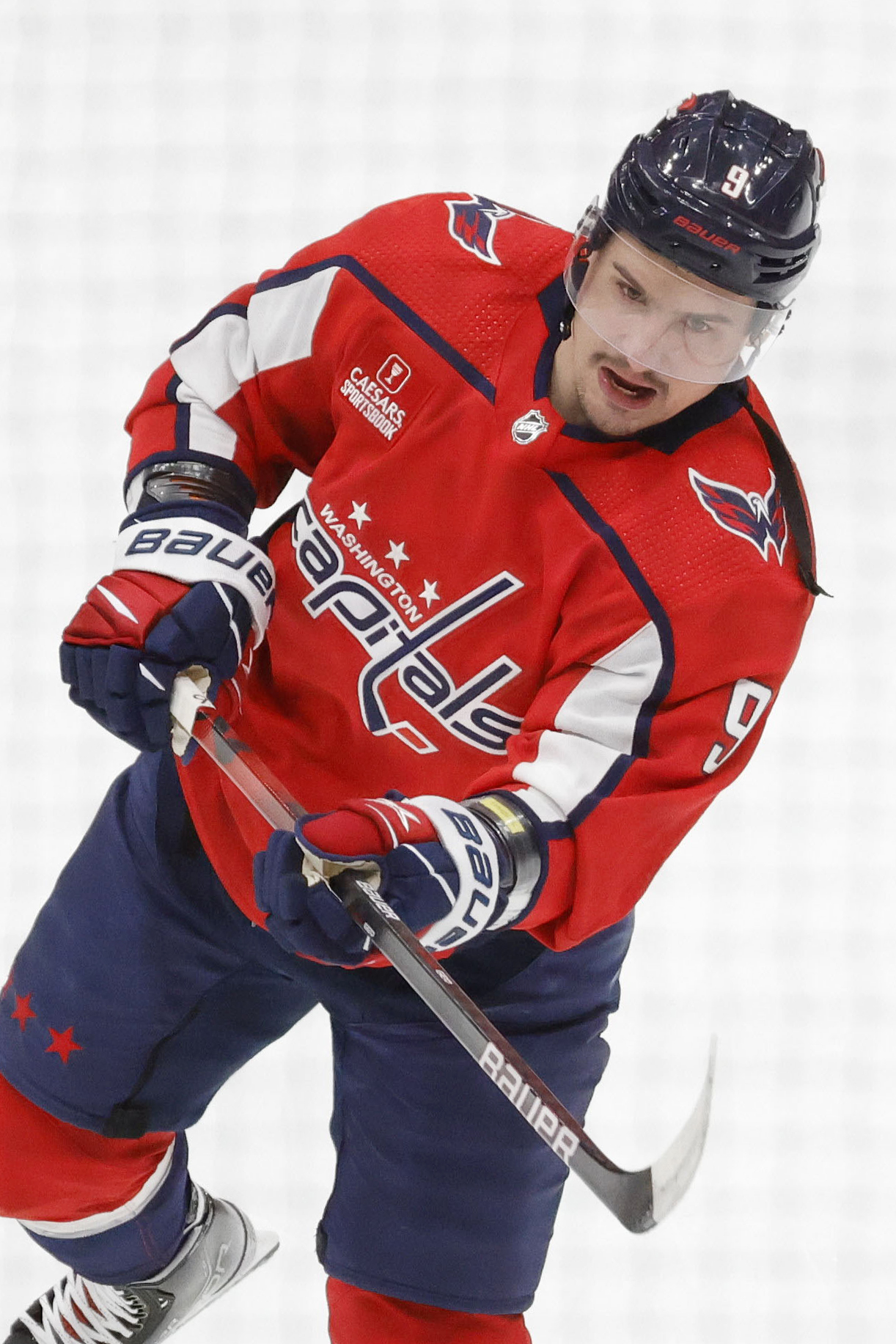 they get a terrific defenseman that can plug in on either of their top two pairings on the backend. Carolina already boasted one of the best defensive groups in the league and Orlov is sure to add to that distinction.
Bunting bolstered his free agent stock after a pair of terrific offensive seasons with the Toronto Maple Leafs, however he was likely hoping to cash in on a longer-term deal but may not have found the kind of money he was looking for. He settled on a three-year deal and will have every opportunity to continue to play with skilled players in Carolina. Something he has done a very good job of in Toronto. A suspension in the playoffs for a hit on Erik Cernak likely hurt his free agent stock a little bit as it further added to a reputation that was starting to develop around the league. Bunting had a few questionable plays last season including run-ins with the referees, taking bad penalties and some embellished falls. This may have hurt his market as some people in the media have speculated that Bunting has run out of runway with the NHL head office.
Tony DeAngelo resurrected his career last year with the Hurricanes before they dealt him to the Flyers for three draft picks. He was a model citizen in Carolina and fit in well with their offensive and defensive schemes. Never known to be defensively adept, DeAngelo managed to avoid a lot of his defensive shortcomings while a member of Carolina. However, once he was moved to Philadelphia, a lot of his defensive miscues began to re-emerge, and the 27-year-old once again found himself drowning in his own defensive zone. Now, he is back in Carolina and there is no reason to think he won’t be able to settle back in as a solid option for the Hurricanes. Carolina can shelter the Sewell, New Jersey native and allow him to focus more on his offensive side of the game. Something he excels in.
RFA Re-Signings
D Dylan Coghlan (one year, $850K)
A year ago, Coghlan was a sweetener when the Vegas Golden Knights traded, he and Max Pacioretty to the Carolina Hurricanes for future considerations. It was a cap dump and it allowed Vegas to make room for other signings, and Carolina received two players for what essentially amounted to nothing. Pacioretty has since moved on to Washington, but Coghlan remains in Carolina. After going undrafted out of the WHL, Coghlan wound up in the AHL where he posted two solid offensive seasons with the Chicago Wolves before joining the Golden Knights. While he has never been able to carry his offensive production from the minors into the NHL, he has shown some glimpses while with Vegas and will now be given another look by Carolina.
Coghlan struggled in his first season with the Hurricanes as he posted just three assists in 17 NHL games, however, he continued to put up good offensive numbers in the AHL, albeit in limited action. At just 25 years of age, it is quite possible that Coghlan has more to give, but with the depth that Carolina has at the position, it’s possible that he may find himself on the outside looking in when the season begins.
Key Departures
F Max Pacioretty (Washington, one year, $2MM)
G Zach Sawchenko (Vancouver)*
D William Lagesson (Toronto)*
D Max Lajoie (Toronto)*
D Shayne Gostisbehere (Detroit, one year, $4.125MM)
F Mackenzie MacEachern (St. Louis)
D Calvin de Haan (Tampa Bay, one year, $775K)
F Ondrej Kase (HC Litvinov)
D Cavan Fitzgerald (Chicago Wolves, AHL)
F Malte Strömwall (Frolunda)
Up front, Pacioretty is the most notable loss, however, given how often he was injured last season, he is more of a never was. The Hurricanes obtained Pacioretty for a song, and unfortunately, he was never able to stay in the lineup for a sustained period of time. Pacioretty had three goals in five games with Carolina including two goals in his second game, but a series of unfortunate injuries led to a lost season for the 34-year-old. A reunion seemed possible, but both the Hurricanes and Pacioretty opted to move in different directions.
Kase is another loss to the Hurricanes offense but much like Pacioretty he too was injured for almost the entire season. Kase was coming off a decent season in Toronto after posting 14 goals and 13 assists in 50 games and seemed like a good bet to provide middle six minutes for the Hurricanes. But injuries kept him from getting into the lineup and Kase has now elected to return home to play.
Carolina had equally as much turnover on the back end as they lost two regulars in Gostisbehere and de Haan. Gostisbehere was a trade deadline acquisition from Arizona and was a good pickup at the time as he added some offensive punch to their backend in a sheltered role. However, given that the club signed Orlov, Gostisbehere was effectively replaced by a much better player, albeit at a much high cap number.
Calvin de Haan looked like a blueliner on the rise back in his New York Islanders days as he posted several solid seasons as a stay-at-home defenceman that could chip in on offense occasionally. As his career has gone on, he has seen his offense dry up and he has struggled at times to keep up with the pace of the NHL. He is still an NHL defenseman, but at this point in his career, he is best served as a seventh defenseman. He did find NHL work with Tampa Bay and will likely be counted on to serve as a 6-7 defenseman.
Lagesson and Lajoie both left Carolina for two-way deals with Toronto and both will most likely find themselves in the AHL playing for the Marlies. The story is the same for goaltender Sawchenko who departed Carolina for Vancouver and will most likely see time as a third or fourth option in the crease.
Salary Cap Outlook
Few teams have the ability to lose players in free agency and immediately replace them internally. Carolina has been able to do it over the past few years and may need to do it again next summer as they may face a cap crunch with Brett Pesce, Brady Skjei, Seth Jarvis and Teuvo Teravainen due new contracts. Carolina has almost $56MM committed to 10 players next season, and although they have over $30MM in cap space for next year, that money will dry up quickly when Carolina is locking up gifted free agents.
Key Questions
Can Carolina Score: The Hurricanes have a lot of offensively gifted players, but can they score when it matters the most? Carolina couldn’t solve Sergei Bobrovsky in last year’s playoffs, and it wasn’t the first time they’ve had that issue. Carolina has done little this offseason to bring in more offense, despite this being a fatal flaw. Can they address this in season, or do they even see this as a problem? DeAngelo and Orlov will provide more offense from the backend, and maybe it will be enough. Time will tell.
Will Pesce Re-sign? The Hurricanes have several high profiles pending free agents and none bigger than Pesce, who is a homegrown, beloved, rock-solid defender for the Canes. Defensemen are always in demand, particularly those who shoot right and provide a rare combination of size, skill, grit, and playmaking. There has been no shortage of trade speculation involving Pesce and it reached a point where a trade seemed inevitable, but it never materialized. It could still happen in season as Carolina can opt to move Pesce to shore up other parts of their lineup, or maybe they wait for a different kind of trade. The Hurricanes have options and have nearly eight months to decide what they want to do with the pending free agents on the backend.
Who Will Emerge In Net? Carolina opted to bring back the same goalie trio that they employed last season. The team re-signed pending free agents Antti Raanta and Frederik Andersen and are now committed to run it back again with the same goalie pairing. This isn’t a knock on either goalie as they’ve both had terrific careers, but it has felt for quite a while like the Hurricanes were just a goalie away from being a true Stanley Cup contender. But given the low cost of the tandem and their track records of regular season success, it’s hard to argue with rolling in back rather than opting to roll the dice in the trade market or unrestricted free agency. The Canes do have Pyotr Kochetkov waiting in the wings should either veteran netminder falter, and given the youngster’s track record he could very well be the goalie of the future in Carolina.
Photos courtesy of USA Today Sports Images.
Summer Synopsis: Calgary Flames
Last season was a trajectory-altering one for the Calgary Flames, although not in the way they’d hoped. A major reshuffling of their top stars was expected to keep the Flames near the top of the Pacific Division, but they missed the playoffs entirely after a season mired by inconsistency. Multiple players underperformed, their goaltending tandem of Jacob Markström and Daniel Vladar struggled, and most players seemed to rejoice when the team moved on from head coach Darryl Sutter after the season. With Ryan Huska now behind the bench and Craig Conroy steering the ship as general manager, the Flames enter a truly pivotal 2023-24 campaign with multiple core players destined for free agency next summer.
Draft
1-16: F Samuel Honzek, Vancouver (WHL)
2-48: D Étienne Morin, Moncton (QMJHL)
3-80: F Aydar Suniev, Penticton (BCHL)
4-112: F Jaden Lipinski, Vancouver (WHL)
6-176: G Yegor Yegorov, Dynamo Moscow (MHL)
7-208: D Axel Hurtig, Rögle (J20 Nationell)
Without sensibly being able to buy at last season’s trade deadline, former GM Brad Treliving held on to their premier draft choices – a move that quickly paid off. While they aren’t franchise-altering talents, Honzek and Morin make up a high-end haul from the first two rounds and should yield a future everyday top-nine forward and top-six defender, respectively. Honzek is the class star here, but he’s expected to return to WHL Vancouver next season after posting 56 points in 43 games there last year in an injury-shortened campaign.
Morin was also a player who could very well have gone in the late first round, and he was one of, if not the best, defender available out of the QMJHL after recording 72 points and a +29 rating in 67 games with Moncton last season. Suniev, Lipinski and Yegorov round out a list of some high-risk, high-reward picks, while Hurtig projects as a hulking shutdown defender if he can manage a pro career.
Trade Acquisitions
F Yegor Sharangovich (from New Jersey)
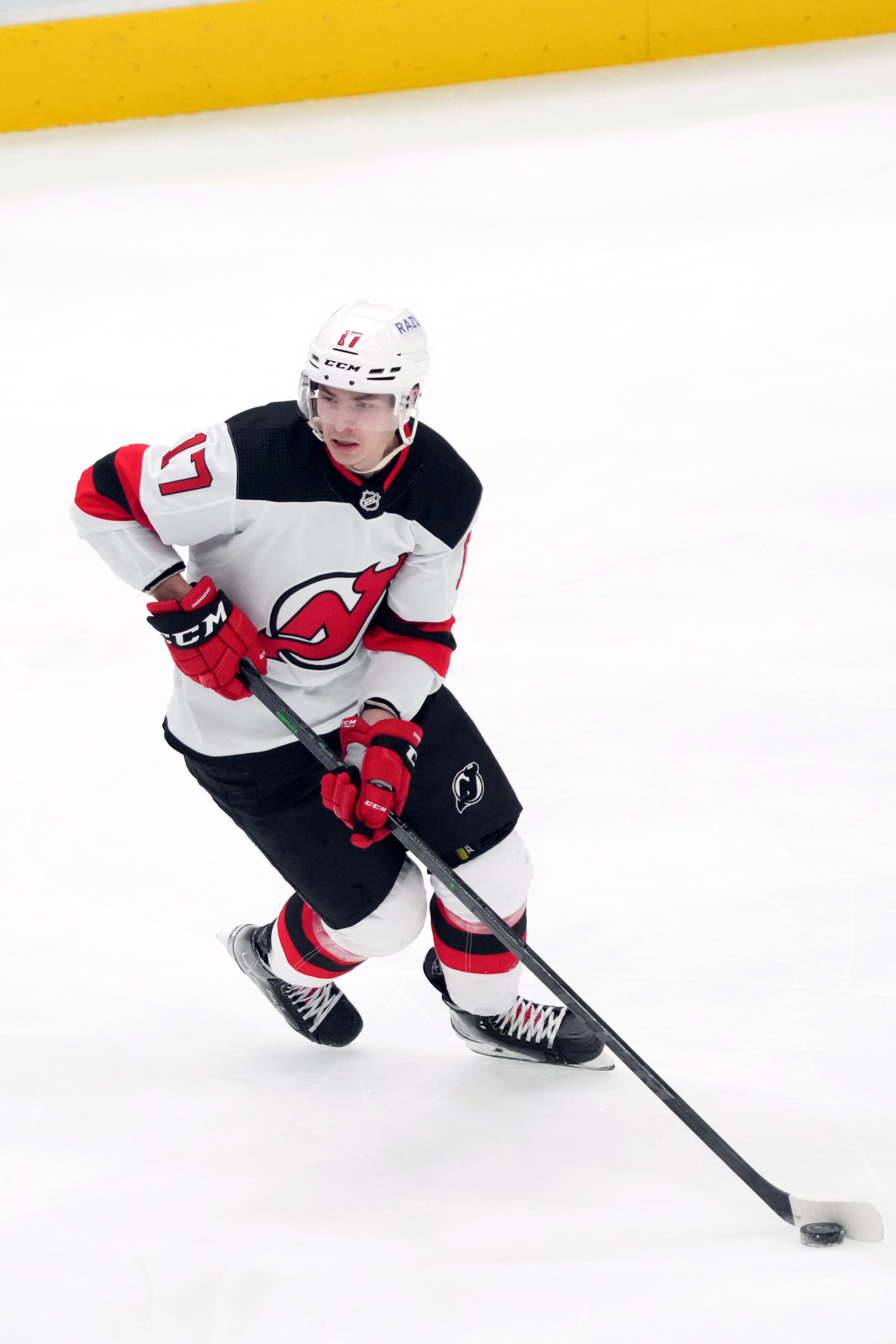 While a dependable top-nine scorer, Sharangovich had a down year after a strong first two campaigns in New Jersey. The Devils’ 2018 fifth-round pick burst onto the scene in 2020-21, posting 16 goals and 30 points in 54 games (a 24-goal, 46-point pace over 82 games that he would replicate in 2021-22). His production, relative possession numbers and ice time all dipped last season, though, earning him a spot in the press box at times when the postseason rolled around. Slated for restricted free agency, the Devils had no issue moving on from him to acquire a short-term upgrade from Calgary in Tyler Toffoli. The Flames now have him locked into an affordable $3.1MM cap hit for the next two seasons, and they’re hoping by giving him a top-six role, he can get back to hovering around the 45-to-50-point mark and churn out another 20-goal campaign. He could potentially play as high as a first-line role alongside Elias Lindholm, replacing Toffoli’s spot in the lineup directly.
Key UFA Signings
F Dryden Hunt (two years, $1.55MM)*
D Jordan Oesterle (one year, $925K)
*-denotes two-way contract
After Treliving doled out a healthy amount of cash last summer, the Flames weren’t left with much space to work with. Even with just the two sub-$1MM cap hit signings, the Flames are currently $213K over the cap with a roster of 22 players, according to CapFriendly’s projections. The 31-year-old Oesterle is technically their biggest addition on the UFA market, and he’s far from a lock to play an everyday role, let alone make the team out of camp with their cap restraints. He’d spent the last two seasons in Detroit, where he’s recorded the worst possession metrics of his nine-year NHL career and averaged 15:39 per game last season in a decidedly depth role. It’s a long shot from his days with the Arizona Coyotes and Chicago Blackhawks in the late 2010s when he looked like an option that could slide into the top four in a pinch. With Oliver Kylington ready to return to the team next season after taking 2022-23 off on personal leave, Oesterle will likely start the season as Calgary’s seventh defenseman.
Hunt will also battle to make the Flames roster in a 13th forward-type role. Last season was a rollercoaster for the 27-year-old, who played for the New York Rangers, Colorado Avalanche and Toronto Maple Leafs in the span of just a few months after being claimed on waivers and then traded. Playing in 37 NHL games, he scored just three goals after posting 17 points in 76 games with the Rangers in 2021-22. He was traded yet another time at last season’s deadline to the Flames, playing out the rest of the season with their AHL affiliate, the Calgary Wranglers. His 15 points in 17 games there were enough to warrant the team bringing him back after the UFA period opened.
Key RFA Re-Signings
F Walker Duehr (two years, $1.65MM)
F Yegor Sharangovich (two years, $6.2MM)
We’ve already covered Sharangovich’s impact on the team at length above, so Duehr gets our full attention regarding the Flames’ notable RFA signings this summer. Calgary signed the 6-foot-2 undrafted winger out of Minnesota State after his senior campaign ended in 2021, during which he recorded 10 goals and seven assists for 17 points in 28 games en route to a WCHA regular-season championship. He’s since shown the ability to translate his low-ceiling but effective checking game to the pro ranks, posting decent offensive totals in the minors with the Wranglers. He appeared in 27 games for the Flames last season in a bottom-six role, scoring seven goals in 27 games – a feat that’s likely earned him a spot on the team’s opening night roster come October. The 25-year-old would require waivers at this stage to be returned to the Wranglers.
 Key Departures
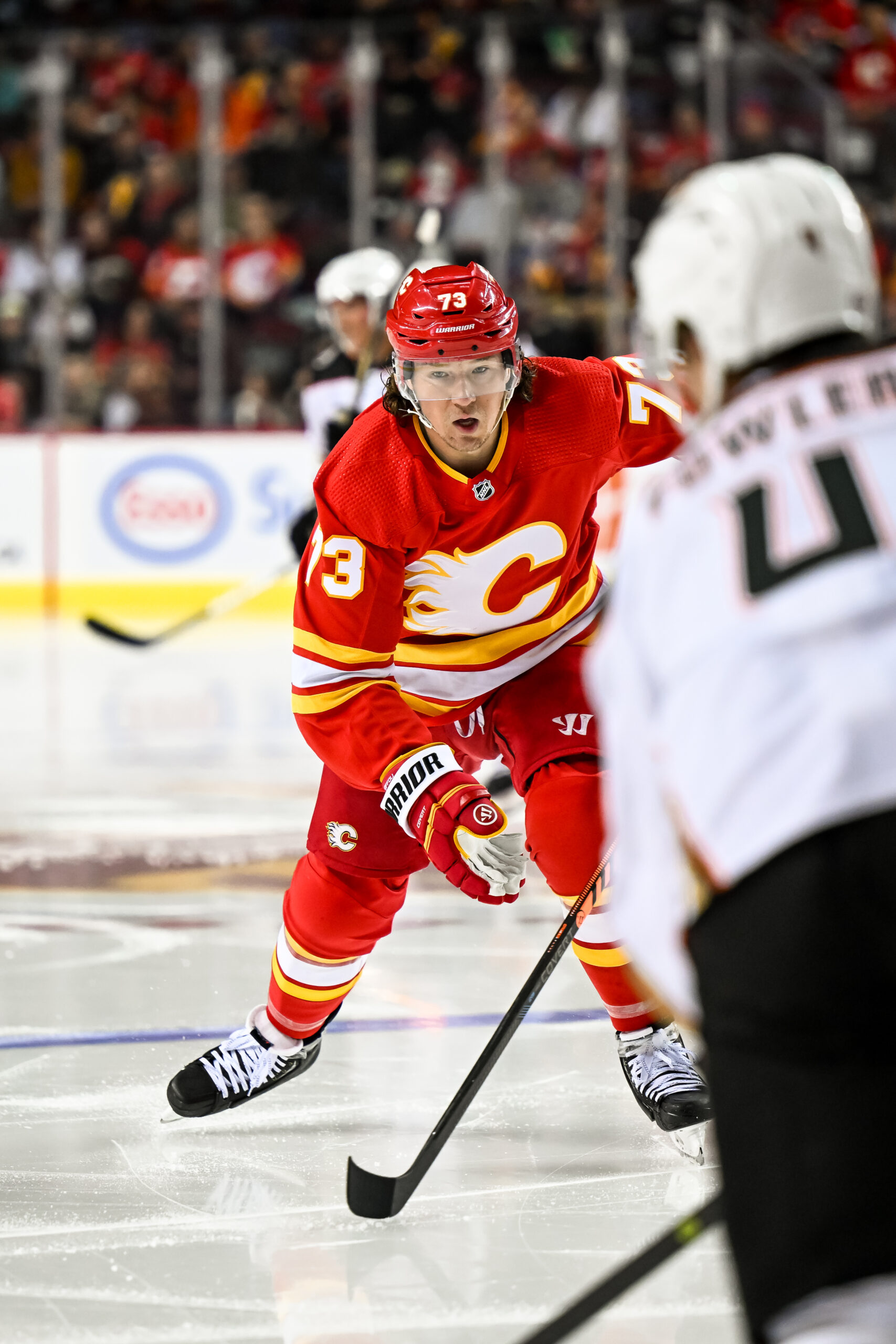
F Trevor Lewis (Los Angeles, one year, $775K)
F Milan Lucic (Boston, one year, $1MM)
D Connor Mackey (NY Rangers, one year, $775K)
F Brett Ritchie (UFA)
F Nick Ritchie (UFA)
D Troy Stecher (Arizona, one year, $1.1MM)
D Michael Stone (retirement)
F Tyler Toffoli (trade with New Jersey)
The only extremely notable departure here is Toffoli, with whom the organization hopes they’ve replaced somewhat laterally with Sharangovich. If the latter doesn’t pan out, however, it will be a tough loss to swallow. Toffoli was their best player last season, leading the team with 34 goals and 73 points while posting high-end possession metrics and taking on 16:37 per game. There’s no other internal option ready to step up and replace that production without causing a domino effect on the team’s depth.
The rest on this list either played fourth-line or other depth roles for the majority of the season, while some (Nick Ritchie and Stecher) were only part of the team for a handful of games post-deadline and had a minimal effect on the team’s success as a whole last season. In Lucic and Lewis, though, they lose a couple of veterans with cup-winning pedigree, although their on-ice performance had withered in recent seasons to the point where they were maybe better served for press-box roles, especially in Lucic’s case.
Mackey and Stone move on after sitting near the high-end of the Flames’ “extra defensemen” list, although Stone will stay with the Flames in an off-ice capacity.
Salary Cap Outlook
Calgary will be cap-compliant to start the season, but it won’t be with a full roster, as we discussed earlier, per CapFriendly. As things stand, they’ll only have room for one extra skater (or none and one extra goalie should they opt to carry Dustin Wolf with the team to start the season). It means a corresponding move could very well be coming before the puck drops on the 2023-24 campaign, and teams need to turn in their cap-compliant rosters, but it’s not an absolute necessity. The Flames have no dead cap complicating things, either, unless they demote Kevin Rooney to the minors again – that will result in a buried penalty of $150K, given his $1.3MM cap hit.
Key Questions
Who Stays And Who Goes?: The slate of pending UFAs has been widely discussed at this point, especially the trio of Mikael Backlund, Noah Hanifin and Elias Lindholm. The team’s play over the first few months of the season will likely dictate which of those players are still team members after the 2024 trade deadline. There are some other important depth players on expiring deals like Christopher Tanev and Nikita Zadorov, too, who could command decent returns as rentals if the team doesn’t anticipate being able to re-sign them.
Who Takes Over In The Crease?: There’s no sugarcoating it – Jacob Markström had his worst season as a full-time starter last season after finishing second in Vezina Trophy voting the year prior, a remarkable falloff for the 33-year-old who’s halfway through a six-year, $6MM AAV deal. He barely crawled over the .500 mark, posting a 23-21-2 record, and had just a .892 save percentage and a lone shutout after leading the NHL with nine last season. If he can’t recapture his previous top-ten form, look for the Flames to turn to the young Wolf, who is still 22 years old but has won back-to-back AHL Goalie of the Year awards in his first two pro seasons.
Can The Young Guns Add Scoring Depth?: The Flames have a pair of wingers slated to start the season in bottom-six roles who could very well end up higher in the lineup by season’s end – Matthew Coronato and Jakob Pelletier. First-round picks in 2021 and 2019, respectively, Pelletier tore up the AHL with 37 points in 35 games last season but didn’t necessarily jump off the page in the NHL, recording seven points in 24 games. Coronato got just one game of action after turning pro after two seasons at Harvard, during which he recorded 36 points in 34 games in back-to-back campaigns.
Photos courtesy of USA Today Sports Images.
PHR Originals: 8/21/23 – 8/27/23
With training camps on the horizon, many teams are enjoying their last few weeks of summer, resulting in a slowdown of activity league-wide. But that hasn’t resulted in things slowing down here as our writers have kept busy with a wide range of original pieces which we’ll run through here.
Our 2009 Redraft series continues. With the sixth pick, our readers assigned Nazem Kadri to the Coyotes over their original selection of Oliver Ekman-Larsson. Now, the Maple Leafs are on the clock with the seventh selection (voting is still open) and with Kadri off the board, they’ll be getting a new player here as well.
Speaking of the Coyotes, they’ve been a busy team this summer with the team opting to add some short-term veterans to their roster. I took a look at their offseason activity as well as Boston’s while Brennan did the same for Buffalo.
Each year, quite a few NHL players opt to try their hand at playing overseas or return there after spending some time at the top level. Josh Eriksson provided an overview of some of the notable former NHLers who will be plying their trade in the SHL in 2023-24.
At the moment, Mark Scheifele doesn’t appear likely to sign an extension in Winnipeg but that doesn’t mean he won’t sign an extension period. At this point, a team interested in acquiring the middleman would likely want an extension as part of the agreement. Ethan ran the numbers to provide an idea of how much of a raise the 30-year-old is about to get.
We saw several players land PTO agreements throughout the week while many other veterans are likely to get one in the coming weeks. Josh Cybulski assessed the markets for non-tendered winger Max Comtois and bought out winger Zack Kassian while Josh Eriksson looked into what teams might have a need for veteran netminder Brian Elliott.
Lastly, with camps coming up next month, there will be some teams with some tough decisions to make with their roster. Ethan examined several of those, previewing the defensive battles that will be ongoing for the Rangers and Canadiens while the Blue Jackets appear to have an intriguing battle on the horizon for the final few forward spots on their roster.