
Poll: Ottawa’s Impending Free Agents
The Ottawa Senators are a team in trouble. The Senators finished with a 28-43-11 record last season for a total of 67 points, second-lowest in the NHL. The team also placed close to the bottom in both goals for and goals against, which combined for a the league’s second-worst goal differential of -70. Ottawa dealt with a public relations nightmare this summer surrounding Mike Hoffman and ended up having to deal the dependable scorer away for pennies on the dollar. They have thus far failed to add any difference-makers via trade or free agency this off-season as well. On top of that, owner Eugene Melnyk is reportedly hemorrhaging money and appears to have a singular focus of spending as little as possible this season. That task is made difficult by a roster that features overpaid, ineffective veterans such as Bobby Ryan, Marian Gaborik, and Mikkel Boedker and a 37-year-old goalie coming off the worst season of his career in Craig Anderson. The Senators are the popular pick to be the worst team in the NHL in 2018-19, but even that has no silver lining, as the Colorado Avalanche own Ottawa’s first-round pick, potentially the first overall pick in next year’s draft.
It almost seems like so much is going wrong in Ottawa that things can only get better. Unfortunately, that is simply not the case. Early in this off-season, the Senators made a contract extension offer to all-world defenseman Erik Karlsson, who is slated for free agency next summer. When Karlsson dismissed this initial offer, the team made it know that they were open to trading the face of the franchise. Just this week, the team was unable to come to terms on a long-term extension with top scorer Mark Stone, instead signing him to a one-year deal that will make him an unrestricted free agent after the season, where he will potentially be the biggest available name behind Karlsson. Perhaps the biggest bargain on the team, Ryan Dzingel‘s team-friendly contract runs out after next season and the young forward will want a significant raise, even if that means it doesn’t come from the penny-pinching Senators. Finally, Matt Duchene, who Ottawa gave up substantial trade capital to acquire early last season – when their future looked much brighter – is also entering the final year of his contract and may not want to stick around any longer in Ottawa after the team fell apart soon after his acquisition.
With Hoffman and Derick Brassard already gone, the Senators face a very real possibility that they will begin the 2019-20 season without all of their top six scorers from the 2017-18 season (make that top seven if they succeed in trading Ryan). Between the value each would have on the open market prompting them to test the waters and the mounting pressure on the team to trade them during what will almost certainly be another season of struggles, the odds of each of them returning is slim. If the team was second-worst last year, did nothing to improve this off-season, and doesn’t have the pick that could otherwise land them a franchise cornerstone in next year’s draft, it is scary to think about how much worse things could get in Ottawa if all four of these prominent free agents depart.
This begs the question: how many of Karlsson, Stone, Dzingel, and Duchene will still be Senators this time next year?
How Many Impending Senators' Star Free Agents Will Return To Ottawa?
-
None 51% (426)
-
One 27% (224)
-
Two 13% (112)
-
All Four 6% (48)
-
Three 3% (28)
Total votes: 838
Showcase Notes: Tkachuk, Hughes, Formenton
The World Junior Summer Showcase wrapped up yesterday with a pair of rivalry games, as the USA and Canada did battle before Sweden and Finland took to the ice in Kamloops. The USA-Canada game ended as chippy as contests between the two countries often do, with the final few seconds not even being played. At the final draw, 89 penalty minutes were handed out between several players when a melee broke out in the Canadian zone. In the middle of it was none other than Brady Tkachuk, who is already following in his brother’s footsteps as a player capable of getting under his opponent’s skin. He was given a 10 minute misconduct and a match penalty for intent to injure, though it wasn’t clear exactly what he did.
Tkachuk now has to decide whether to return to Boston University or sign with the Ottawa Senators and turn pro, a decision that was supposed to be at least partially based on his performance at this tournament if reports are to believed. Tkachuk can obviously compete physically with any player his age, but was held to just two assists in the tournament while recording several minor penalties throughout the tournament. It is quite clear that he’ll have an NHL career before long, but could still use some refinement in the offensive zone.
- One of the real stories in the tournament was supposed to be the play of potential 2019 first-overall pick Jack Hughes, but while the 17-year old was quite good his brother may have stolen the show. Quinn Hughes, selected seventh-overall by the Vancouver Canucks, was all over the ice for Team USA and showed off his wizardry with the puck in the offensive zone. The elder Hughes is headed back for another year at the University of Michigan, where he should be considered a real threat for the Hobey Baker if his scoring numbers take another step forward. For those who are still worried about his size and physicality, it should be noted that both Hughes brothers were involved in the final scrum and each received roughing penalties and game misconducts.
- While Hughes will have to wait for his chance at the NHL, one of the players from the Canadian squad might be ready to take the next step. Alex Formenton scored a brilliant goal against the Swedes earlier in the tournament when he used his blazing speed to drive wide, and head coach Tim Hunter believes he’s obviously “NHL caliber.” Formenton played one game for the Ottawa Senators at the beginning of last season and suited up twice in the AHL at the end of the year. While the London Knights are a great development option for him if he goes back to junior, the Senators might feel as though he can make an impact at the highest level right away.
Mark Stone, Ottawa Senators Avoid Arbitration
With neither side really wanting to go through the arbitration process today in Toronto, Mark Stone and the Ottawa Senators have settled on a one-year contract. The deal will pay Stone $7.35MM this season, and carry him through to unrestricted free agency in the summer of 2019. The two sides cannot sign an extension until January. Our Brian La Rose projected this exact contract yesterday when he broke down the Stone arbitration case.
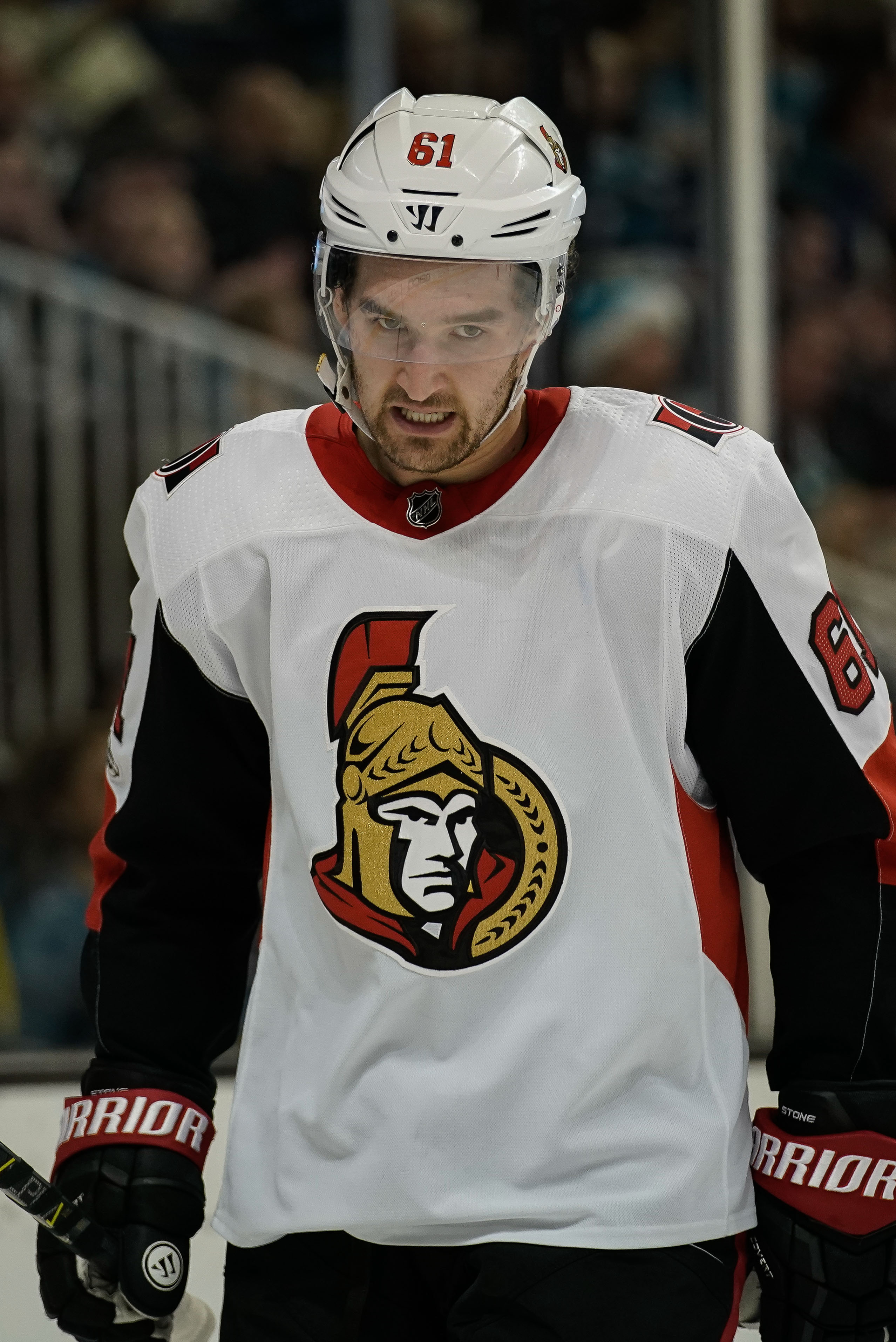 The 26-year old played just 58 games for the Senators last season, but was easily the team’s best forward registering 20 goals and 62 points. That point-per-game pace pushed Stone from a very good player to one of the league’s best, especially when combined with his trademark takeaway ability and solid defensive presence. Even with the limited number of games, he still earned Selke votes for the fourth consecutive year and led all Senators in takeaways.
For all the positive things Stone brings, a one-year contract will lead to immediate speculation about his future in Ottawa. The team is heading for a rebuild, and now all three of their best players are scheduled to become unrestricted free agents next summer. Stone, Erik Karlsson and Matt Duchene all have just one year remaining on their deals, making them prime trade candidates over the next few months. Even if things go better than expected during the first half of the 2018-19 season, the team still has to consider moving these big assets for whatever they can get, depending on whether they’re willing to sign a long-term extension. Though it’s unclear if Stone would even re-enter negotiations, the fact that the two sides couldn’t come to an agreement this summer only puts creates more pressure down the road.
The Senators will have a two-month window to sign Stone at the beginning of 2019 before facing the trade deadline. If he remains unsigned, you can bet there will be dozens of teams clamoring to get a piece of him as a playoff rental with a chance to re-sign him to a long-term deal. Evander Kane, Paul Stastny and others set the market this season, but Stone is a more effective offensive piece than either of them and could bring back a bigger package should his contributions on the ice continue this season. As one of only a few top-end options in Ottawa, it wouldn’t be surprising to see him receive more than 20 minutes a night once again.
Those first line minutes shouldn’t come as a surprise now that Stone carries such a huge salary. His new contract makes him the 24th-highest paid forward in the league for 2018-19, putting pressure on him to perform as the best player up front for Ottawa. It also means that a long-term extension would be incredibly pricey, something that the Senators may just not have the money for. Remember this was a restricted free agent year still, which usually comes in at a lower price than the player would be demanding on the UFA market. If Stone wanted an even bigger cap hit for seven or eight years, Ottawa might have to back out of negotiations purely from a financial standpoint.
Photo courtesy of USA Today Sports Images
Arbitration Breakdown: Mark Stone
While the Senators have already gone through one arbitration hearing this week with defenseman Cody Ceci, they’re on the verge of needing to do so with winger Mark Stone as well as his hearing is set for Friday morning. The pre-hearing filings were exchanged on Wednesday with Ottawa offering $5MM and Stone asking for $9MM. This has the potential to be a record-setting award so let’s take a closer look at this case.
The Numbers
Over the past four seasons, the 26-year-old has been pretty consistent offensively. He has scored at least 20 times in each of those years and has had between 54-64 points in those seasons as well. That type of production lines up with a high-end second liner or quality top liner.
However, 2017-18’s numbers have to be looked at a little closer. Stone posted 62 points (20-42-62) last year but did so in only 58 games. In other words, he played at an 88-point pace which ranked 14th league-wide among qualifying players. That would put him in the high-end front liner range which likely has played a big role in his asking price.
The Senators haven’t hesitated to use Stone in all situations. He led the team in ice time by a forward by a sizable margin (while ranking 11th league-wide) and averaged more than three minutes per night on the power play with a couple of shorthanded shifts as well.
With that in mind, it’s going to be difficult for Ottawa to argue that Stone deserves to be paid like a second-line player when their own usage of him is considerably different not to mention his big jump in points per game last season.
Potential Comparables
Comparable contracts are restricted to those signed within restricted free agency. For this exercise, I’ve taken it a step further and restricted this list to deals inked with arbitration eligibility which takes post-ELC deals like Nathan MacKinnon, Mark Scheifele, and Vladimir Tarasenko off the table.
Jonathan Huberdeau (Florida) – Huberdeau signed his current deal that carries a $5.9MM cap hit (4.45 cap hit percentage) after a 59-point season and was viewed as the time as someone that could be a top line player but would be even better on the second line. That seems to be what Ottawa is going for here so it wouldn’t be surprising if they’re citing this deal as a comparable although it seems fair to say that this comparable is going to be on the low end.
Ryan Johansen (Nashville) – Johansen inked an eight-year, $64MM deal (10.67 cap hit percentage) coming off a three-year bridge contract which is the same situation as Stone is currently in. At that time, he had four seasons of 60 or more points under his belt so Ottawa could try to argue that Johansen’s track record offensively is better. However, Johansen hasn’t gotten particularly close to the point-per-game mark that Stone passed last season either.
Ryan O’Reilly (St. Louis) – While Stone isn’t elite at the faceoff dot like O’Reilly ($7.5MM AAV, 10.5 cap hit percentage) is, the similarities are fairly strong otherwise. At the time the deal was signed, O’Reilly was coming off seasons of 64 and 55 points and his production since then has ranged between 55-61 points which is right in Stone’s range as well. On top of that, they’re both well-regarded as two-way forwards.
Blake Wheeler (Winnipeg) – While Wheeler’s contract ($5.6MM AAV, 8.71 cap hit percentage) is now viewed as a bargain, the fact he’s significantly outperformed the contract since he signed it back in 2013 doesn’t really matter much. At the time of the deal, Wheeler only had one 60-point year under his belt (although he played at that pace in the lockout-shortened year as well). His cap hit is close to Ottawa’s submission but once you factor in the increase in the salary cap since then, the value in today’s dollars is just shy of $7MM.
Projection
The awards thus far have been right down the middle of the filings and there’s a decent chance that will be the case here as well. It may be a bit tough for Stone to get the 10% or higher that Johansen and O’Reilly got as he doesn’t play the premium position they do either. It will also be difficult for the arbitrator to really assess the season Stone just had – is that a sign of things to come or the statistical outlier? Given that he has been closer to a 0.8 point-per-game average for the better part of his career, I think the arbitrator may skew a little more conservatively here.
Could this award (if it gets that far) set the record for the biggest one ever, surpassing Shea Weber’s $7.5MM? It could, but I don’t think it will. The cap percentage for that deal was 11.66 which is higher than what Stone’s probably going to get.
That said, Stone has a shot at setting a new award record for a forward ($7MM for John LeClair in 2000). It wouldn’t be surprising to see the award come in between the filings midpoint of $7MM and Weber’s record award. I think if Stone had put up a second season of close to point-per-game production, an award closer to $8MM would have been a legitimate possibility. Instead, a one-year, $7.35MM contract (9.25 cap hit percentage) feels like a reasonable projection, one that lines him up for unrestricted free agency next summer and a whole lot of trade speculation between now and then.
Photo courtesy of USA Today Sports Images.
Franchise Reset In Ottawa Could Come Quickly
The Ottawa Senators have had one of the worst years imaginable, going from overtime in Game 7 of the Eastern Conference Finals, to a good bet for the bottom of the NHL standings in the upcoming season. During that time they used a big package of future assets to acquire Matt Duchene, had a public locker room problem that forced a clearance sale of Mike Hoffman, dealt with a legal scandal for one of their front office executives and couldn’t even win a draft lottery spot. That’s not even mentioning the potential trade of franchise defenseman and captain Erik Karlsson, which still may occur before the start of the season.
Even though there has been nothing but struggles for the Senators of late, a successful navigation of the next few seasons could set them up for a quick rebuild. The Senators currently only have one player, forward Bobby Ryan, signed for more than three seasons and will see at least eight roster players hit the unrestricted free agent market in 2019. That kind of financial freedom can really help a franchise, even one like Ottawa that doesn’t usually spend up to the salary cap and instead operates on an internal budget.
In a perfect world, the team would be able to re-sign Karlsson, Duchene and Mark Stone to multi-year contracts and supplement them with some young talent to compete right away. But it doesn’t seem like any of those things will be possible for the Senators, which might still leave them with a perfectly acceptable second option. Trading all three could immediately jump the Senators prospect pool to one of the best in the NHL, especially given their recent addition of Brady Tkachuk and Jacob Bernard-Docker. The fact that they don’t own their 2019 first-round pick hurts, but at this point is a sunk cost and has to be worked around.
There are other roster players who could still bring value back in trade, and given that almost all of them will hit UFA status in the next two seasons there may be a firesale coming before long. While that will cause a painful season (or two), there’s no reason to believe that the Senators can’t put it behind them in short order. They have just over $17MM committed to roster players in 2020-21, and a good chunk of that is Ryan who could potentially be strapped to Karlsson on his way out. Even if they’re only hitting the salary cap floor, by that point they’d still need to be adding somewhere around $45MM.
It’s hard to believe that a team experiencing such lows could be close to bouncing back, but we’ve seen it multiple times over the last few seasons. The Toronto Maple Leafs went from dead last to the playoffs in just one season, but it was clearing their future salaries that allowed them to have so much success so quickly. The team traded away hefty contracts like Phil Kessel and Dion Phaneuf for whatever they could get, and built around a young core instead. Auston Matthews was obviously the spark that set the Maple Leafs competitive fire, but they were already headed in the right direction.
The Colorado Avalanche just experienced something similar, ironically moving Duchene to Ottawa in order to give their younger players more opportunity. Colorado jumped from a historically bad 2016-17 back to the playoffs last season, riding a young core of Nathan MacKinnon and Mikko Rantanen all season. Before signing Ian Cole, Philipp Grubauer and Matt Calvert this summer, the Avalanche too had a very bare future salary book. Only MacKinnon, Erik Johnson and Gabriel Landeskog were signed through 2020-21, giving them the flexibility to add when they were ready.
Ottawa already decided not to sign Kyle Turris and Derick Brassard to extensions, instead trading them away during the season. They also dealt Phaneuf’s contract away, though had to take Marian Gaborik back to do it. There’s more work to be done to build up the prospect system to a point where it could really compete in just a few years, but there is definitely potential to do so.
Negotiation Notes: Arbitration Hearings, Nylander, Islanders
Two more players sat down for arbitration hearings today, as Sportsnet’s Chris Johnston reports that neither the Ottawa Senators and Cody Ceci nor the Dallas Stars and Gemel Smith were able to come to terms beforehand. Both situations bear watching over the next 48 hours, as they must agree to a deal in that window or else get stuck with the arbitrator’s award. Ceci’s case is similar to that of the Winnipeg Jets’ Jacob Trouba, which went through to a decision earlier this off-season. Both Ceci and Trouba filed at a number that shares few reasonable comparisons – Trouba at $7MM and Ceci at $6MM. While Trouba’s side likely tried to use several recent cases of offensive-minded defenseman who settled for $5.5MM and then argue that he is the superior defensive player, Ceci does not have the comparable offense to make as strong a case. As such, he is unlikely to get the $5.5MM award that Trouba landed, the midpoint of his case. Instead, look for Ceci to get somewhere in the $4-4.5MM range. Smith’s is a much different scenario, similar to another previously decided case this summer, that of Calgary Flames defenseman Brett Kulak. In both cases, the team offered only a minimum, two-way contract while the player filed at a higher value for a one-way deal – Kulak at $1.15MM and Smith at $900K. While Kulak was able to land a $850K one-way deal from the arbitrator, he also played in 71 games in the platform year, while Smith only suited up for 46. Smith faces a far tougher argument that he is a bona fide NHL player at this point in his career.
- Restricted free agent William Nylander continues to negotiate with the Toronto Maple Leafs, but the explosive young forward is not interested in a short-term bridge deal. Sportsnet’s Luke Fox suggests that Nylander is only talking about a long-term deal right now. While the Leafs might be trying to play it safe, with both Auston Matthews and Mitch Marner also in need of extensions next summer (along with the majority of their roster), Nylander doesn’t seem willing to take a bridge deal only to watch his fellow budding stars sign long-term contracts instead. Nylander may have hit restricted free agency earlier than Matthews and Marner, but the trio all have similar games played and points since Nylander only played in 22 games with Toronto in his first season before the other two joined the squad. All three have been remarkably consistent early on and, given their similarities, it is hard to blame Nylander for wanting a long-term deal when he knows that Matthews and Marner are likely to get them.
- While it makes sense that the New York Islanders have focused on adding forwards and a new goaltender this season, after losing superstar center John Tavares and starting goalie Jaroslav Halak to free agency, Newsday’s Andrew Gross thinks it’s strange that the team has not added to the blue line at all. The team re-signed Thomas Hickey and Ryan Pulock, but have added no one else while losing Calvin de Haan and opting not to bring back Brandon Davidson and Dennis Seidenberg. Gross notes that recently re-signed center Brock Nelson, an impending free agent, could be used as a trade chip to add to a blue line that struggled greatly last season. There are certainly teams out there with a plethora of defensemen who could use Nelson up front. The Carolina Hurricanes, Boston Bruins, and Winnipeg Jets are clubs that fit the bill, but Nelson would not be nearly enough to land a Justin Faulk, Torey Krug, or Jacob Trouba and an expendable piece that he might fetch, like a Trevor van Riemsdyk, Adam McQuaid, or Tucker Poolman might not be enough to fix the Islanders blue line. New York may have to up the ante beyond Nelson to land a difference-maker on the back end.
Mark Stone, Ottawa Senators Exchange Arbitration Numbers
The Ottawa Senators have an arbitration hearing today with Cody Ceci to decide on a contract for next season, but the offseason doesn’t end there for them. Mark Stone, who is scheduled for a hearing of his own on Friday, has exchanged arbitration filings with the team. According to Elliotte Friedman of Sportsnet, Stone has asked for $9MM while the team has countered with $5MM. As always, the decision will likely come somewhere in the middle of the two numbers, though as Friedman points out that could still make this a record-breaking case. Shea Weber‘s $7.5MM award in 2011 is currently the highest ever given through arbitration.
Stone, 26, can only be awarded a one-year deal in arbitration as he is just a single season away from becoming an unrestricted free agent. That freedom could be enticing to a player who has developed into one of the best two-way wingers in the league, and is coming off a season in which he scored at better than a point-per-game pace. His 62 points in 58 games for the Senators tied him with Erik Karlsson for the team lead, while recording his fourth consecutive 20+ goal campaign. Stone also possesses an almost unmatched ability to create turnovers and strip opposing players of the puck, which has led to Selke votes in each of his four full seasons.
Even accounting for the normal arbitration practice of asking for much more than you expect to be awarded, the $9MM figure will shock some people. Only nine forwards in the entire NHL will have a cap hit of $9MM or greater for the 2018-19 season, and though an exceptional player Stone is still not in the upper echelon of NHL stars. Even if the decision lands right in the middle at $7MM, he’ll vault into the top-30 highest paid forwards in the league and set himself up for a huge contract next summer. Whether that contract comes with the Senators isn’t clear.
Last month we asked whether the Senators should trade Stone, given that he is just a year away from unrestricted free agency and the team looks like it may struggle this season. Our readership was split 55-45 in favor of a move, which may be indicative of the hesitation GM Pierre Dorion would feel. Stone can be a leader in whatever turnaround is coming in Ottawa, and is still young enough to have several prime seasons remaining after 2018-19. If the team could work out a long-term extension with him in the next few days, perhaps there would be a little bit of hope for the Senators this season. If not, a one-year award would also bring with it restrictions on negotiating extensions. Players on one-year contracts cannot discuss or sign an extension until January, at which point Stone would be just a few months away from testing the open market. The trade deadline would also be right around the corner, forcing the Senators to make a quick decision on whether they had a real shot at retaining their talented winger.
Latest On Brady Tkachuk’s Upcoming Decision
After Vancouver Canucks draft pick Quinn Hughes decided to return to Michigan for another season instead of turning pro, all eyes turned to Brady Tkachuk to see if he would make the same decision. The Ottawa Senators prospect is expected to make a final decision by August 12th on whether he’ll return to Boston University or sign his first professional contract, but Jeff Cox of the New England Hockey Journal adds that his performance in the current World Junior Summer Showcase could have a big effect on his choice. Cox tweeted that “all indications point” towards a return to BU, unless he finds himself at a level above his competitors in the junior tournament.
For what it’s worth, Tkachuk was held off the scoresheet—except for an early holding penalty—during his first game of the tournament yesterday, when the United States fell to Sweden 3-1. There’s obviously quite a few more matches to show off his talent, but it’s not a good start for those hoping a big performance would lead him to leave the NCAA after just one season.
If Tkachuk does go back, the Senators could always sign him at the end of the NHL season and even get him into a few games without burning a contract year. Because Tkachuk won’t turn 20 until September 20th, he could play up to 10 games and still see his contract slide forward, though it’s not clear when his year would end. If Boston University finds themselves in the Frozen Four mix, there might not be much time for him to join the Senators, making a 2019-20 debut more likely.
Hughes, Tkachuk and Oliver Wahlstrom, who is expected to report to Boston College this season are all extremely talented players who shouldn’t be in the NCAA ranks for very long. While there is always a slight chance that one could finish his college years and become an unrestricted free agent down the road, players selected early in the first round virtually never go this route. All should be joining their respective organizations before long, and making an impact in the NHL in short order.
Cody Ceci, Ottawa Senators Exchange Arbitration Filings
With Garnet Hathaway re-signing this morning, the next player scheduled for an arbitration hearing is Cody Ceci of the Ottawa Senators. That meeting is on the books for Wednesday in Toronto, and Elliotte Friedman of Sportsnet reports on the filings from both sides. The Senators have filed a $3.35MM ask, while Ceci is looking for $6.0MM. As usual, the ruling will likely come down somewhere in the middle of those two numbers should they not come to an agreement in the next few days.
Ceci, 24, is a player that has drawn quite a lot of attention over the years due to his continual inclusion in trade negotiations. In almost every discussion about the Senators and their pursuit of a high-end player, Ceci has been part of a potential return. That inclusion has been derided by the analytical community at times given Ceci’s poor possession numbers, but he continues to be an extremely valued piece of the Ottawa blue line. In fact, he may be the team’s top option should Erik Karlsson be traded before the season begins. That would put an incredible amount of pressure on the young right-handed defenseman, who has failed to put up big offensive numbers despite obvious ability and huge opportunity over the past few years.
Logging more than 23 minutes a night in each of the past two seasons, Ceci has been deployed in a defensive role (usually alongside Dion Phaneuf, who is now part of the Los Angeles Kings organization) to balance some of the offensive starts given to Karlsson. Though that is certainly a limiting factor in Ceci’s offensive numbers, there are other warts in his game that hinder his impact for the team and keep him from really reaching the top echelon of defensemen in the NHL. Those numbers should also lead an arbitrator to rule for much less than the $6.0MM ask, though probably well above the team’s filing as well. Ceci earned just $2.8MM last season, and should get a nice raise either way.
The Senators will almost certainly choose a one-year contract for their young defenseman, as he is scheduled to hit unrestricted free agency after the 2019-20 season. Leaving with just a one-year deal will allow them to continue to negotiate with him as a restricted free agent next summer, and try to get him to re-sign long-term. Otherwise, he could hit the open market as a 26-year old and really cash in as a right-handed option. Even with his poor possession numbers, there are still many who see Ceci as a key defender for the Senators and one who could step into top-four minutes for many teams around the league.
Brady Tkachuk To Decide Where He Will Play Next Year Within The Next Two Weeks
Senators winger prospect Brady Tkachuk will make a decision on whether he will sign with the team or return to Boston University for his sophomore season by August 12th, reports NHL.com’s Mike Morreale. Leading up to the draft, there was speculation that Tkachuk was leaning towards staying in college but he clarified things saying that he would discuss the situation with whoever drafted him and make a decision at that time.
Tkachuk was drafted fourth overall by the Sens last month following a strong showing in his freshman campaign, one that saw him collect 31 points (8-23-31) in just 40 games. He also stood out at the World Juniors where he finished tied for fifth in tournament scoring with three goals and six assists in seven contests.
Physically, many believe Tkachuk is ready to make the NHL jump and considering Ottawa isn’t set to field a lineup full of high-end players, there is certainly room for him to step in and make an impact.
Is that necessarily the smart play, however? Many expect the Senators to be near the league basement next season with an expected trade of their franchise player in defenseman Erik Karlsson so is it in their best interest to burn one of their cheap entry-level years in a season where they’re not expected to really compete? Staying with Boston University and working on his all-around game while continuing to physically mature is far from a bad idea.
There are two other options though. By signing his ELC, Tkachuk wouldn’t be eligible to go back to college but being drafted out of the NCAA, he isn’t subject to the AHL age restriction that CHL players are so he could suit up for their minor league affiliate in Belleville where the usual 10 and 40-game thresholds apply in terms of burning a contract year and accruing a year towards UFA eligibility. Alternatively, he could theoretically be loaned to London of the OHL as they hold his junior rights although, on the surface, that’s the least likely option.
Where Tkachuk will play next year has been in question for a while now. It appears that question will now be answered within the next two weeks.