Snapshots: Butcher, Beauchemin, Rampage
Will Butcher is still taking things slow in regards to his first professional destination, as Kevin Allen of USA Today reports that he’ll soon narrow down his list of teams from 12 to three or four. Those teams will each get a personal visit, after which he’ll make a decision. Allen suggests the process could take “a week or so.”
Butcher has been connected to the Blue Jackets, Devils, Golden Knights, Penguins, over the past week and some speculation that he’d already met with the Buffalo Sabres. The reigning Hobey Baker trophy winner is arguably the most interesting NCAA free agent on the market this summer, and could find an NHL opportunity right away.
- Francois Beauchemin is going back to the Anaheim Ducks, and in a conference call this afternoon told Eric Stephens of the Orange County Register that he was prepared to retire before the team reached out. He had turned down interest from several other teams which he had no history with, but was “thrilled” that Anaheim expressed interest. Beauchemin thinks it is likely that 2017-18 is his final season in the NHL.
- The San Antonio Rampage have signed a pair of veteran minor leaguers, inking goaltender Sam Brittain and defenseman Josh Atkinson to AHL deals. Brittain was a fourth-round pick of the Florida Panthers 2010 but has yet to make it to the NHL. He spent last season split between the Springfield Thunderbirds (AHL) and Manchester Monarchs (ECHL), and became a Group VI unrestricted free agent this summer. Atkinson has spent almost all of his professional career in the ECHL, but got a two-game chance in the AHL with the Chicago Wolves after scoring 50 points in 66 games last season. The offensive explosion was a new development for Atkinson, who didn’t register more than 16 points in a single season at the University of Alaska.
Francois Beauchemin Signs With Anaheim Ducks
Francois Beauchemin has signed with the Anaheim Ducks for one-year, and will earn $1MM plus up to $500K in performance bonuses. Beauchemin was bought out by the Colorado Avalanche earlier this spring, and will return to the Ducks for a third stint. 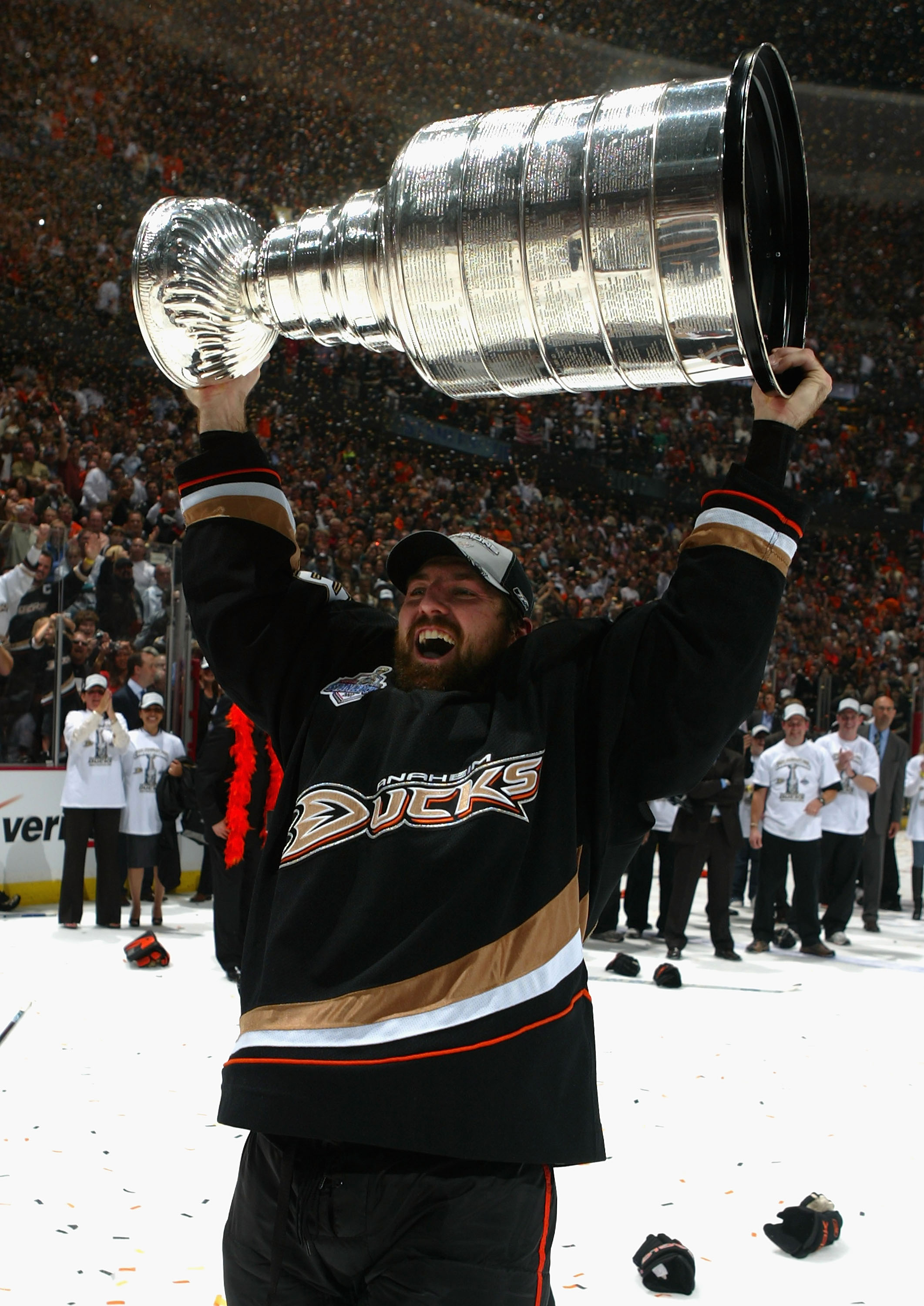
Now 37, Beauchemin actually still recorded an average of more than 21 minutes of ice time last season for the Avalanche, a number he’s eclipsed in every season of his 12-year career. One of the most reliable defensive options over the last decade, Beauchemin found his greatest success with the Ducks when he won a Stanley Cup in 2007. Beauchemin at that time was playing third fiddle on the blueline to hall of fame players Scott Niedermayer and Chris Pronger, and will now be asked again to provide some veteran depth to what is a very young group.
Both Hampus Lindholm and Sami Vatanen underwent surgery at the conclusion of the playoffs to repair various injuries, and still both have their season debuts in jeopardy. With that and the loss of Shea Theodore and Clayton Stoner to the Vegas Golden Knights, there was a need to add a depth option to help the Ducks get off to a good start. Jacob Larsson was an option to start the year, but the signing of Beauchemin likely means that the young defender can start in the minor leagues.
[Updated: Anaheim Ducks Depth Chart]
For Beauchemin this season could total as much as $3MM, since the Avalanche are paying him $1.5MM to not play for them. Due to his age, Colorado will still have to deal with his whole $4.5MM cap hit. Moving him would have cost them an asset, something that they clearly didn’t want to do.
Starting his career in Montreal, Beauchemin has played in 836 regular season NHL games and 97 additional playoff contests. He actually has 39 points in those postseason games, a rate significantly higher than his regular season production. For a Ducks team that saw their defensemen play through injury all playoffs only to fall at the hands of the Nashville Predators, adding some experience should help them down the stretch. Beauchemin will likely not be asked to play over 20 minutes a night, but clearly still has the capability to contribute to an NHL team.
Renaud Lavoie of TVA Sports was the first to break the deal, and provided the financial details.
Photo courtesy of USA Today Sports Images
Summer Predictions: Pacific Division
The hockey world is at a standstill now that August has rolled around. With all of the arbitration cases now decided and just a few restricted free agents left to sign, players and fans alike are counting the days until training camp starts. While there are still several names in free agency that could still help an NHL club, it seems like many are destined either for professional tryouts or late-summer deals after injuries strike.
So now we’ll get into our summer predictions. Before the start of the year we’ll be releasing a full season preview with projections for each club and the expected playoff teams, but first we’ll ask you to give us your take on how you believe each division will end up. We’ve already looked at the Metropolitan and Atlantic divisions, where the Pittsburgh Penguins and Tampa Bay Lightning are leading respectively. The Lightning didn’t even make the playoffs last season, but as we’ve examined before could have a bounce-back year if they can stay healthy. The upstart Maple Leafs are currently second, despite barely getting into the postseason last year.
Today, we’ll move to the other Conference and take a look at highly contested Pacific division. They’ll welcome in a new franchise this season, but could still be one of the most competitive groups in the NHL with four teams who have legitimate claims as a Stanley Cup contender. Choose who you think will win the division this season, and make sure to leave your full prediction for the division standings in the comments. As a proxy for the overall standings, we’ll be sure to publish these results alongside our own PHR rankings in September.
[Mobile users click here to vote!]
Expiring NCAA Draft Rights
Will Butcher and Alex Kerfoot have graced many headlines over the last few months, as players who will be heading to free agency next week when their exclusive draft rights expire. Since they finished their senior years without an NHL entry-level contract, they can test the market on August 16th and sign wherever they want.
They’re not the only two, and CapFriendly provides us with a full list of players whose rights will expire next week. Several of the names listed have already signed minor league contracts with various organizations for next year, and will be excluded from the list below. The remaining players are as follows:
Sam Kurker – St. Louis Blues (2nd round, 2012)
Taylor Cammarata – New York Islanders (3rd round, 2013)
Chris Calnan – Chicago Blackhawks (3rd round, 2013)
Rhett Holland – Arizona Coyotes (4th round, 2012)
Zach Nagelvoort – Edmonton Oilers (4th round, 2014)
Will Butcher – Colorado Avalanche (5th round, 2013)
Doyle Somerby – New York Islanders (5th round, 2012)
Dominic Toninato – Toronto Maple Leafs (5th round, 2012)
Evan Campbell – Edmonton Oilers (5th round, 2013)
Connor Clifton – Arizona Coyotes (5th round, 2013)
Teemu Kivihalme – Nashville Predators (5th round, 2013)*
Grant Besse – Anaheim Ducks (5th round, 2013)
Alex Kerfoot – New Jersey Devils (5th round, 2012)
Ben Storm – Colorado Avalanche (6th round, 2013)
Tim Harrison – Calgary Flames (6th round, 2013)
Collin Olson – Carolina Hurricanes (6th round, 2012)
Chris Leblanc – Ottawa Senators (6th round, 2013)
Clifford Watson – San Jose Sharks (6th round, 2012)
James De Haas – Detroit Red Wings (6th round, 2012)
Blaine Byron – Pittsburgh Penguins (6th round, 2013)
Wade Murphy – Nashville Predators (7th round, 2013)
Brendan Collier – Carolina Hurricanes (7th round, 2012)
Jedd Soleway – Arizona Coyotes (7th round, 2013)
Nolan De Jong – Minnesota Wild (7th round, 2013)
*Has signed with Karpat of the Finnish Liiga.
Many of these players spent time in the minor leagues this past spring on amateur tryout contracts, but will become free agents if not signed by end of day on August 15th. That gives teams time to still get them into their system, but in cases like Toninato there may just not be enough room to fit him in on an entry-level contract. Even those on minor league deals will be free agents at the end of their contract, as those do not protect exclusive draft rights.
Third-Year Breakout Candidates
In the NFL, there is a prevailing theory that it takes wide receivers a few years to really establish themselves as forces in the league. Their third year is pointed at as a potential “breakout” period, when they can take a substantial step forward after learning how to better control their bodies and become accustomed to the league. While every year there are impact rookies in the NHL, there are still those that follow this same path. Despite getting plenty of playing time, they just don’t seem to put it together until that third season.
 In 2016-17 we had plenty of examples of a player taking a huge step forward in his third NHL season. Many follow a normal development path like Leon Draisaitl, jumping from nine points in limited action, to 51 in his sophomore year and 77 in his third and best season so far. David Pastrnak—who remains unsigned by the Boston Bruins—on the other hand may be the best example of a third-year breakout. He registered 27 and 26 points in his first two seasons before finding another level last year to score 70 points. His jump of 54 points was one of the biggest in the league, and it came in just 75 games.
Jonathan Drouin came back from his troubled 2014-15 season to post a career-high 53 points last year in his third go-round, finally coming through on his drool-worthy offensive potential with some real production. Viktor Arvidsson was finally given a full-time opportunity in his third season and jumped from 22 career points to 61 in a single season (though it’s hard to even call his first year a real season since he only got into six games).
This year there are plenty of candidates for a breakout. Players who though performing admirably haven’t quite reached their potential during the first two seasons of their NHL careers, and could take a considerable step forward this season.
Colton Parayko – St. Louis Blues
Normally a defenseman who has started his career with 68 points in 160 games would be seen as a glowing success and not a breakout candidate, but that’s just how high the ceiling is for Parayko. With Kevin Shattenkirk moved on to greener pastures, Parayko should have even more opportunity to prove himself as one of the league’s young superstars. There is ample room to improve on his career-high of 35 points, and it’s not out of the question that he will receive Norris trophy votes as soon as this season.
Remember Parayko was drafted back in 2012, and ended up going to the University of Alaska for three seasons before entering professional hockey. He’s now 24, armed with a huge contract extension and ready to make it clear that he should be considered among the top tier of defensemen.
 Noah Hanifin – Carolina Hurricanes
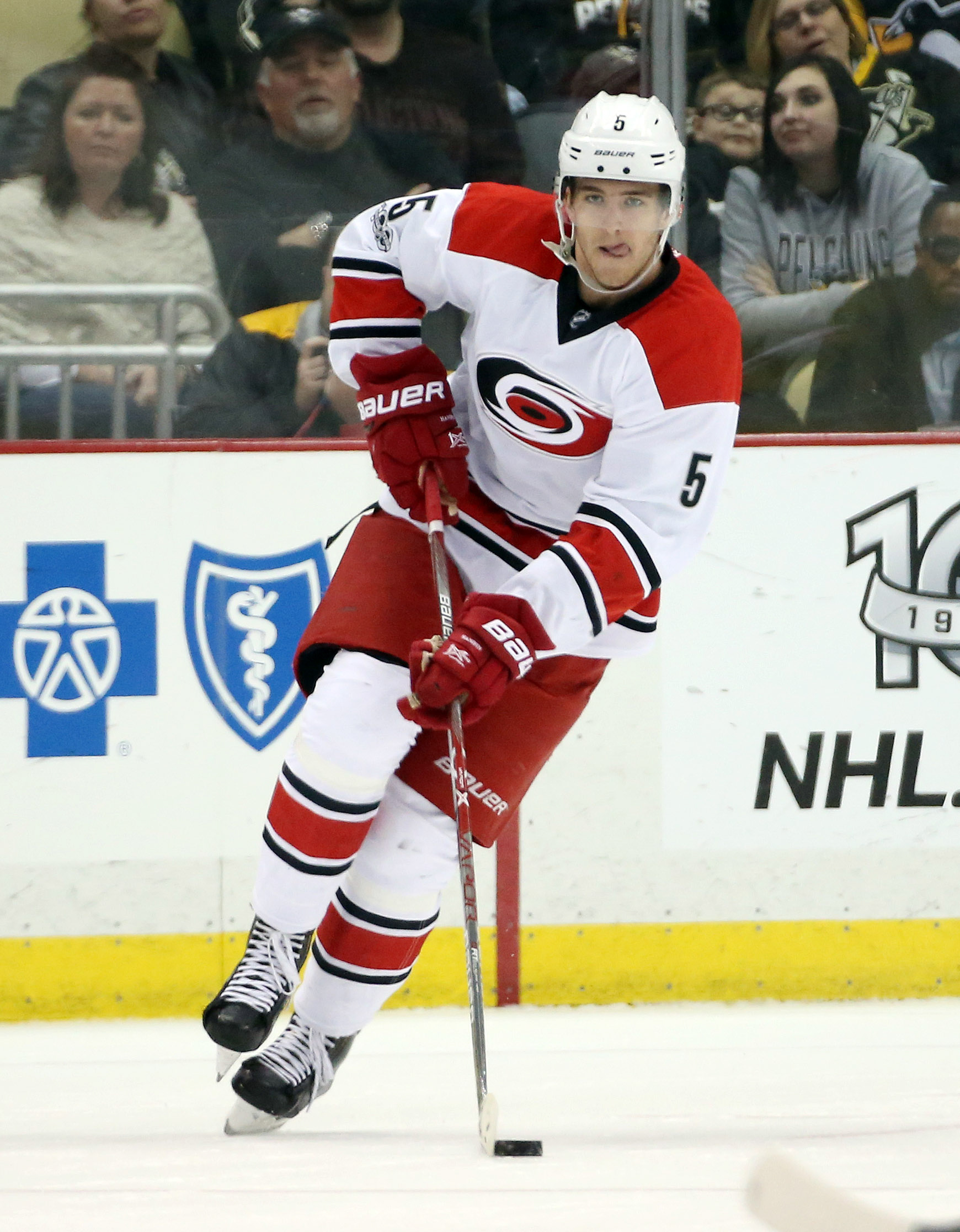
Hanifin has done everything the Hurricanes have asked of him, but still hasn’t come close to the rock solid top-pairing player that he flashed as a freshman in Boston College. Hanifin took over games in the college ranks, but has settled into a good-but-not-great role in Carolina. Sitting behind Jaccob Slavin, Brett Pesce and Justin Faulk on the depth chart, Hanifin could experience a similar breakout to Jacob Trouba if an injury forces him into a bigger role.
It’s interesting that fans have speculated on Hanifin being the odd man out in Carolina in trade scenarios for an upgrade at forward, even though his draft pedigree and early results should make him almost untouchable. He won’t turn 21 until January of next year and could easily find himself in the conversation as the Hurricanes’ best defenseman should he reach his immense ceiling.
Robby Fabbri – St. Louis Blues
Fabbri was well on his way to having a breakout season in his second year, playing at a near-50 point pace through 51 games. His season would be cut short in February when he suffered a knee injury, making 2017-18 one to watch for the young forward. In what should be an exceptional St. Louis offense, Fabbri is still sort of a wild card. Right now it looks like he may get to play with newcomer Brayden Schenn on the team’s second line, and in that spot he’ll hardly ever face the opponent’s best defensive group (they’ll be reserved for Vladimir Tarasenko and company).
Fabbri could easily find himself with a 60-point season this year, as long as the knee is back to 100% by the start of the year. Playing with offensive players like Schenn and Alex Steen will only help him work his magic in the attacking zone.
Nick Ritchie – Anaheim Ducks
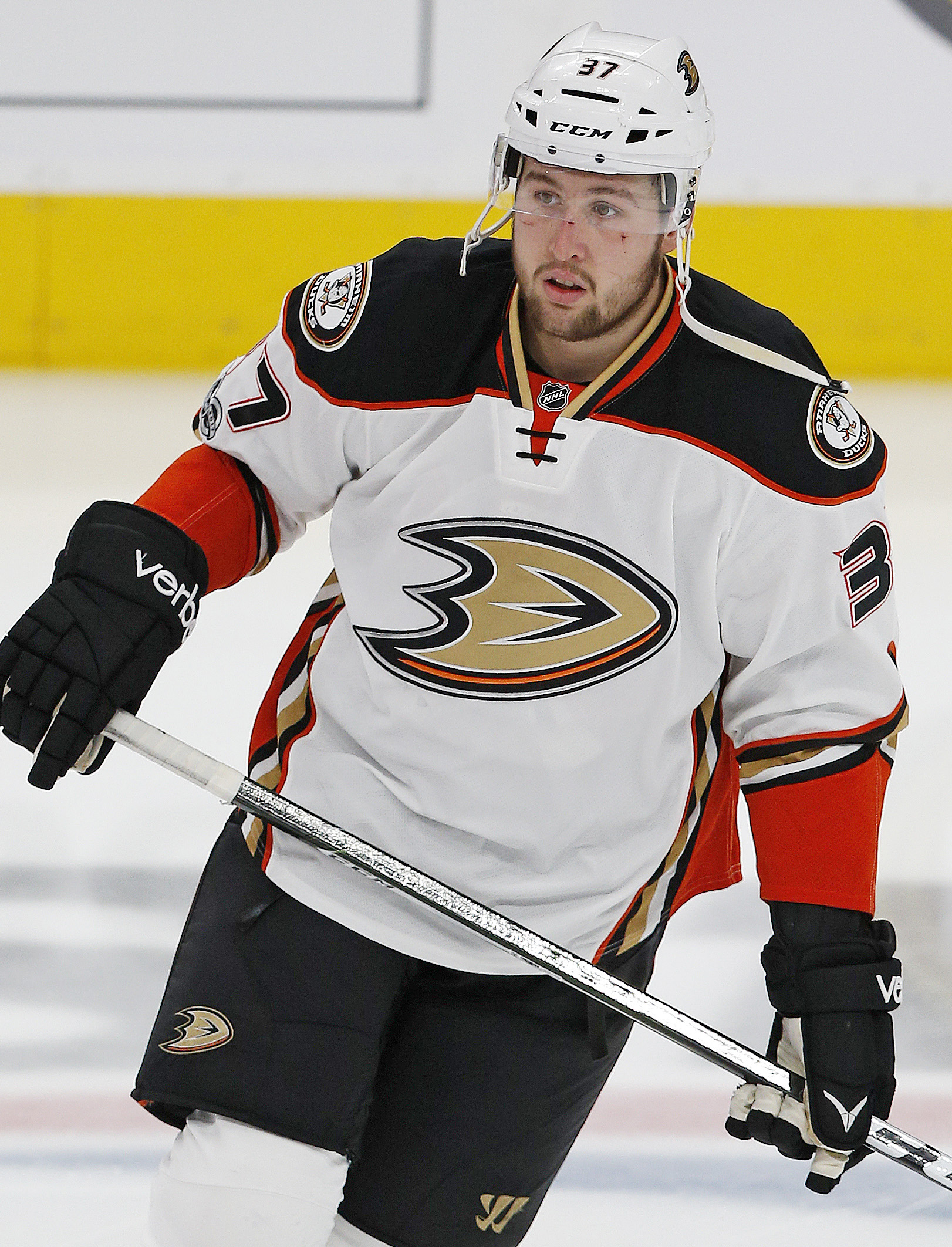 Power forwards often take a little more time to develop, and the Ducks are still waiting on Ritchie to take the next step. In 77 games last year he put up 28 points, which while respectable isn’t the top-end goal scoring numbers they’d hoped for when they drafted him 10th overall. That production though came in limited minutes, and if he’s given the opportunity the numbers are sure to follow.
Ritchie played just under 13 minutes a night last season, but saw that number drop even further after Anaheim acquired Patrick Eaves at the deadline. Eaves is back, but he’s also now 33-years old and could take a big step back next season. If powerplay time becomes available, Ritchie could have a breakout season on his hands.
Oliver Bjorkstrand – Columbus Blue Jackets
Like Arvidsson, you can barely call Bjorkstrand’s first two years with Columbus seasons. He’s played in 38 games over the past two years, spending most of the time in the AHL instead. Still, he has provided tantalizing results in the minor leagues and has 21 points in his limited NHL sample. Even if that rate continued it would be a 45 point season for the third-round pick, good enough to constitute a breakout in his third season. But with Bjorkstrand there is even more upside.
In the WHL, the Danish forward dominated the competition scoring 144 goals in 193 games and has elite hockey sense with the puck. His nose for the net and ability to slide into undefended areas would allow him to be a consistent NHL scoring threat if given the chance. There are a ton of weapons in the Blue Jackets forward group, but if he were to find some early camp chemistry with one of the stars Bjorkstrand could easily slide into a top-six option without much resistance.
(*There are many other players who could experience a third-year breakout, and some will be discussed in future articles. This is not meant to be a ranking of any kind.)
Cost Per Point: The Best Value Deals In The NHL
When working with a salary cap, especially one that has not been increasing as expected in recent year, it is vital for general managers to get the most production out of their players. Teams with players who meet the expected level of production implied by their contracts and teams that lack wasted dollars in bad, expensive deals are often the same teams that thrive in today’s NHL. Forget market size or free agent appeal, the key to a winning franchise nowadays is getting the best bang for your buck on every player on the roster. While no player can be fully quantified by their scoring, cost per point is an easy way to look at which players are producing at the most team-friendly rate and which have been more of a cap space killer than a positive member of the team. Thanks to CapFriendly, that information is readily available to fans and NHL executives alike.
The benchmark for this metric is about $100K/point, as GM’s expect those big-time forwards and offensive defenseman who they award with $6MM, $7MM, and $8MM per year contracts to be putting up 60, 70, or 80 points respectively. For the second year in a row, St. Louis Blues superstar Vladimir Tarasenko was the poster boy for this standard, coming in at exactly $100K/point with 75 points on a $7.5MM deal. Winnipeg’s Bryan Little and New Jersey’s Adam Henrique are two other notable names that hit the mark exactly, while phenoms like Sidney Crosby and Duncan Keith landing close to the $100K/point mark show that it is an accurate expectation.
However, the exception to the rule is obviously entry-level contracts. It is no secret that drafting and developing well is the best way to improve you team, beginning with affordable scoring from players on their rookie deals. Nowhere is that more apparent than in cost per point, where nine of the top ten and 17 of the top 20 best contracts were rookie deals. To no one surprise, 20-year-old MVP Connor McDavid and his 100 points on a $925K entry-level contract was far and away the best bargain in hockey. McDavid cost the Oilers only $9,250 per point in 2016-17. That will all change soon, as McDavid is set to begin an eight-year, $100MM contract in 2018-19, after which a 100-point campaign will cost Edmonton $125,000/point, closer to the expectations of a standard contract. For now, the Oilers can enjoy one more year of McDavid likely being the best deal in the NHL, as well as the best player. Entry-level deals joining McDavid in the top ten last year (in order) were Viktor Arvidsson, Artemi Panarin, teammate Leon Draisaitl, Conor Sheary, David Pastrnak, Auston Matthews, Nikolaj Ehlers, and Patrik Laine. Not all entry-level deals are created equal, so while Draisaitl and Pastrnak were second and fourth respectively in entry-level scoring, they were also on the ELC maximum deal of $925K and of slightly lesser value to their teams than the likes of Arvidsson ($632K) and Sheary ($667.5K). Panarin had the best contract in the league in 2015-16 and fell only to third with $10,980/point for the Chicago Blackhawks. Now in Columbus and on a two-year, $12MM deal, the Blue Jackets have to hope that they can continue to get 70+ point seasons out of him to maximize the value of that deal.
So, entry-level contracts aside, who was the best contract in hockey last season? Another easy answer, former Blue Jacket gamble Sam Gagner. After a horrendous 2015-16 campaign with the Philadelphia Flyers, Gagner struggled to find a new team last summer, eventually settling on a $650K “show me” deal with Columbus. Right away people tagged that contract, for a six-time 40+ point scorer, as an absolute bargain, even if Gagner simply bounced back to normal production. He did one better, posting a career-high 50 points for the Jackets and coming in at $13K/point, good enough for sixth in the NHL. Gagner has since moved on to the Vancouver Canucks, signing a three-year, $9.45MM contract on July 1st. However, if he is able to continue to produce at 40-50 point levels over that deal, his $3.15MM cap hit will remain a great bargain deal. Behind Gagner, another player on the move this summer, former Florida Panther and current Vegas Golden Knight Jonathan Marchessault had the 13th-ranked cost per point last year at $14,706/point. Marchessault had a breakout year, netting 51 points in the first season of a two-year, $1.5MM deal. Rather than take advantage of one more $750K season for a 30-goal scorer, the Panthers allowed Marchessault to be selected in the Expansion Draft and Vegas surely hopes he continues to be one of the best values in hockey in 2017-18. The final contract in the top 20 not belonging to an entry-level player, and the only 35+ veteran contract in the top 50, belongs to Marchessault’s replacement in Florida, Radim Vrbata. Vrbata returned home to Arizona last season after a down year in Vancouver the season prior, and the swift 36-year old proceeded to score 55 points, more than double his previous year’s total. On a one-year deal with a $1MM base salary, that only cost the Coyotes $18,182/point last season. Now at a base salary of $2.5MM in Florida, the Panthers hope that Vrbata isn’t starting to slow down just yet. Other impressive value contracts included Patrick Eaves, whose breakout season in Dallas led to a trade and subsequent extension with the Anaheim Ducks, Derek Ryan, who shocked the hockey world with 29 points for the Carolina Hurricanes in his first full NHL season at age 30, and a quartet of recently re-signed RFAs in Richard Panik, Ryan Dzingel, Ryan Spooner, and Jordan Martinook.
With the good comes the bad, and there were certainly some poor value contracts in the NHL last year. Many of the worst belong to players who were injured or AHL depth players that saw only limited time. With zero points in 13 games with a $1.25MM cap hit, Tampa Bay Lightning winger Erik Condra‘s value was not even quantifiable it was so bad, and at the highest salary of any player who went pointless last season. Limited to just 18 games with only four points, another Bolts forward, Ryan Callahan, was one of the worst values due to injury with $1.45MM per point on his $5.8MM cap hit. However, the truly worst contract in the NHL has to belong to a player that player a majority of the season. Sadly for a Detroit fan base that is already feeling pretty down-and-out, that designation belongs to Red Wings defenseman Danny DeKeyser, who began a six-year, $30MM extension by scoring about a third less points for the third season in a row. With 12 points in 82 games at $5MM, DeKeyser’s $416.7K/point is pretty ugly. The Buffalo Sabres struck out twice on the blue line, with both Dmitry Kulikov (five points in 47 games at $4.33MM) and Josh Gorges (six points in 66 games at $3.9MM) coming in at $866.7K/point and $650K/point respectively, though neither is known as a major point producer. The worst forward contract? Andrew Desjardins may not have been relied upon as a full-time player with much ice time last season with the Chicago Blackhawks, but with only one point in 46 games, $800K/point, it’s not difficult to see why he remains an unsigned free agent.
While statistics and analytics in hockey are normally geared toward displaying on-ice production, it is always interesting to look at the game from a business perspective. It is important for teams and fans alike to understand not just the absolute of how a player is producing, but the relative value of that production based on how much money that player is being paid. In a salary cap league, there is nothing more important that production value, and as the game grows the focus will only further tighten on scoring as a function of dollars and the cost per point metric.
Minor Transactions: 8/5/17
It may be August, but hockey transactions are still ongoing. While the major names on the NHL free agent market appear to still be in a holding pattern, AHL teams have begun to fill out their rosters with minor leagues deals. The result has been a recent influx of minor news, both of AHL signings and those with less luck finding a contract in North America signing overseas. Keep track of these moves today right here:
- The EBEL has already made their presence felt this summer more so than ever before with the signings of NHL veterans like Matt Fraser, Ben Walter, and Rob Flick, and now the small Austrian-based league is back at it again. Defenseman Mat Clark has signed on with HC Bolzano for the coming season, the team announced yesterday. Clark, a veteran of nine NHL games with the Anaheim Ducks and over 400 AHL games since turning pro in 2010, is a big addition for the Foxes. Like most North American signings in the EBEL, Clark should step in and compete right away for the title of best player on the team. The big blue liner, a second-round draft pick of the Ducks in 2009, is a dominating stay-at-home threat, but has also contributed some modest offense in the AHL as well.
- If Clark had been able to find a good fit in the AHL for the 2017-18 season, one would think he would have jumped on it. Instead, he decided to take a deal overseas. Dalton Thrower, another defenseman, has chosen a different path. Thrower has signed with Allen Americans of the ECHL for the upcoming campaign. It’s quite the change in direction for Thrower’s career path, as he was not tendered a qualifying offer by the Montreal Canadiens this off-season and goes from an NHL contract to an ECHL contract. A second-round pick of the Habs just five years ago, Thrower has not come close to reaching his lofty expectations, having played almost exclusively in the ECHL since turning pro. However, softening the blow of Thrower losing his NHL connection is a familiar face joining him in Allen. The Americans announced that they have signed both he and his younger brother, Josh Thrower, who aged out of the WHL after last season. The pair are set to dominate the Allen blue line in 2017-18.
- Nolan Zajac is having the opposite fortunes of Thrower, as he’ll jump up a level ahead of next season. The younger brother of New Jersey Devils’ mainstay Travis Zajac, the 25-year-old defenseman has signed an AHL deal with the Lehigh Valley Phantoms. Zajac had signed with the ECHL’s Toledo Walleye out of college last off-season, but after 54 points in 61 games and strong performances on loan to three different AHL teams, he has earned a full-time role at the next level. The former University of Denver standout is a strong skater who has left his mark on the score sheet wherever he has played, Zajac will look to continue to climb through the ranks of pro hockey next season. With a big year in Lehigh Valley, the Philadelphia Flyers’ affiliate, Zajac may just end up with an NHL contract next summer and a possible divisional sibling rivalry down the road.
- The AHL’s Ontario Reign, the affiliate to the Los Angeles Kings, have re-signed two-way forward Sam Herr to a one-year extension. The former Notre Dame winger made his pro debut in 2016-17 with 14 points in 61 regular season games with the Reign and looked his best during the team’s short playoff run. The 24-year-old may not have NHL chops, but is a smart player and hard worker who will surely be able to help Ontario out in the coming season.
More to come…
San Diego Gulls Sign Jeff Schultz To One-Year AHL Contract
- The San Diego Gulls have signed NHL veteran Jeff Schultz to a one-year AHL contract, bringing him back for another year. Schultz, 31, was once a key part of the Washington Capitals’ defense corps, but has spent the majority of the last several years in the minor leagues. In 65 games for the Gulls last year, Schultz recorded 15 points but was a big part of their 43-20 record and has taken on a sort of mentor role for many of the Anaheim Ducks young defensemen.
Minor Transactions: 7/25/17
For a Tuesday in late July, it’s been an especially busy day for hockey transactions, including the NHL signings of Mika Zibanejad with the New York Rangers, Robin Lehner with the Buffalo Sabres, Mark Streit with the Montreal Canadiens, and several deals by the Colorado Avalanche and New Jersey Devils. Yet, there has been a flurry of notable activity in the AHL and overseas today too, including the following:
- The once-promising NHL career of Matt Fraser has taken another odd turn away from its original path. Fraser, still just 27 years old, has signed with Dornbirner EC of the EBEL, a lower tier European league based mostly out of Austria. The team has announced the deal, though terms have not been released. Fraser moves to the EBEL after a season in Sweden, where injuries limited him to only four games with Rogle BK. Before that, many will remember Fraser as a star in the AHL for the Texas Stars and, after the Tyler Seguin trade, the Providence Bruins. Fraser even played in 60 NHL games with the Boston Bruins and Edmonton Oilers in 2014-15 and looked to be on his way to becoming an NHL regular. However, after signing a one-year deal with the Winnipeg Jets in 2015 and failing to make the team, Fraser had the worst AHL season of his career and decided to head overseas. So far, it has not worked out, but Fraser will now try his hand at EBEL action, where he could easily be the best player for Dornbirner, who currently count another former Bruin, Jamie Arniel, as their top scorer.
- Another player who failed to meet expectatiosn in North America and will now head to a lesser European league is Dane Fox. The former Erie Otters superstar, who scored 107 points in 67 games in his final OHL season, has not found anywhere near the same success at the pro level. A high-profile signing by the Vancouver Canucks in 2014, the undrafted forward has made his last junior season look very much like a fluke with his play since then. Fox has skated almost exclusively in the ECHL over the past three seasons, playing in only two AHL games and not even in consideration for an NHL look with the Canucks and Carolina Hurricanes. Now, Fox will head to Germany to play with the Nurnberg Ice Tigers of the DEL. Nurnberg is the likely favorite in the DEL next season and roster many players with NHL experience, including 2016-17 top scorer Steve Reinprecht and recent signee Tom Gilbert. Fox’s pro hockey career is very much up in the air right now, but if he can shine through on an experience Ice Tigers roster, perhaps he’ll get another shot in North America .
- The AHL’s San Diego Gulls, the Anaheim Ducks’ affiliate, has re-signed forward Jordan Samuels-Thomas to a two-year minor league deal, the league announced. The 27-year-old recorded a pro career-high 24 points and +13 rating for the Gulls last year and is a fan favorite and active member of the San Diego community. The former NCAA standout was a seventh-round pick of the Atlanta Thrashers in 2009, but was never signed to an entry-level deal after spending five years in college.
- The Chicago Wolves, now the new affiliate of the Vegas Golden Knights, have signed one of their own, inking Scooter Vaughan to a one-year deal, according to a team release. The hard-nosed defenseman worked his way up through hockey’s ranks, spending four years at the University of Michigan, three years in the ECHL, and going on four years in the AHL, with the last two spent in Chicago. The next stop could be the NHL, now that the Wolves are associated with the Knights, who obviously have the least organizational depth of any team in the league. A career-best performance in 2017-18 could earn Vaughan his first NHL contract next year.
- A pair of AHL defenseman will change teams for the upcoming season as Paul Geiger, recently of the Rochester Americans, has signed with the Hershey Bears, the Washington Capitals’ affiliate, while the Carolina Hurricanes’ minor league partners, the Charlotte Checkers, have signed former St. John’s Ice Caps defender Josiah Didier. Both Geiger and Didier are still just 24 years old and were solid college players, at Clarkson and Denver respectively, but need big seasons with their new teams after pedestrian starts to their pro careers, that is if they want to reach the NHL someday.
- The 2016-17 captain at Rensselaer Polytechnic Institute (RPI) has found his new home, and he’s in a good spot. Riley Bourbonnais, a 23-year-old center who was nearly a point per game player for RPI last year, has inked his first AHL deal with the Wilkes-Barre Scranton Penguins, the feeder team of the two-time Stanley Cup champs. The team announced their newest addition and have high hopes that he can bring the same well-rounded game he showed in college to the pros.
Dead Space: Bought-Out, Buried, And Retained Salaries For Every Team
It’s something that often goes unnoticed, but with the cap showing minimal growth the last few years, teams are starting to feel the crunch more than ever. Buyouts have become more common, especially with players with under three remaining years on their contracts. And it’s not just the big name busts that have seen the ax lately – we’ve seen lesser names at lesser money take the fall for their respective teams, then needing to scramble for work elsewhere in the league. Additionally, salary retention in trades has become a more utilized tactic as of late. Teams with “unmovable” contracts have offered to retain part of a poor contract in order to entice a team into giving them some relief.
All this said, some teams have been better with foresight than others. Some teams have shown a track record of being entirely unable of handing out poor contracts over the past five or so seasons. Considering many teams showed some progress in being more frugal this off-season, it seems a wise time to review the dead space every team has accumulated, either due to poor management decisions or poor luck.
Colorado Avalanche – $4.83 MM in 2017-18, issues resolved after current year – Francois Beauchemin buyout; Cody McLeod retained
Arizona Coyotes – $4.61 MM in 2017-18, issues resolved after 2020-21 – Mike Smith retained; Mike Ribeiro, Antoine Vermette buyouts
Columbus Blue Jackets – $4.025 MM in 2017-18, issues resolved after 2020-21 – Fedor Tyutin, Jared Boll, Scott Hartnell buyouts
Carolina Hurricanes – $3.71 MM in 2017-18, issues resolved after 2020-21 – Eddie Lack retained; Alexander Semin, James Wisniewski buyouts
Toronto Maple Leafs – $3.28 MM in 2017-18, issues resolved after 2021-22 – Tim Gleason, Jared Cowen buyouts; Phil Kessel retained
Nashville Predators – $2.83 MM in 2017-18, issues resolved after 2018-19 – Viktor Stalberg, Eric Nystrom, Barret Jackman buyouts
Boston Bruins – $2.73 MM in 2017-18, issues resolved 2019-20 – Dennis Seidenberg, Jimmy Hayes buyouts
New York Rangers – $2.61 MM in 2017-18, issues resolved after 2022-23 – Dan Girardi buyout
Minnesota Wild – $2.5 MM in 2017-17, issues resolved after current year – Thomas Vanek buyout
Los Angeles Kings – $2.4 MM in 2017-18, issues resolved after 2023-24 – Matt Greene buyout; Mike Richards termination/recapture
Edmonton Oilers – $2.33 MM in 2017-18, issues resolved after 2020-21 – Lauri Korpikoski, Benoit Pouliot buyouts
Anaheim Ducks – $2.21 MM in 2017-18, issues resolved after 2023-24 – Mark Fistric, Simon Despres buyouts; Patrick Maroon retained
Vancouver Canucks – $2.13 MM in 2017-18, issues resolved after 2021-22 – Roberto Luongo, Jannik Hansen retained; Chris Higgins buyout
New Jersey Devils – $2.09 MM in 2017-18, issues resolved after 2023-24 – Mike Cammalleri, Devante Smith-Pelly buyouts; Ilya Kovalchuk recapture
Tampa Bay Lightning – $1.83 MM in 2017-18, issues resolved after 2019-20 – Matt Carle buyout
Calgary Flames – $1.82 MM in 2017-18, issues resolved after 2018-19 – Mason Raymond, Lance Bouma, Ryan Murphy buyouts
Detroit Red Wings – $1.67 MM in 2017-18, issues resolved after 2020-21 – Stephen Weiss buyout
Dallas Stars – $1.5 MM in 2017-18, issues resolved after 2018-19- Antti Niemi buyout
Philadelphia Flyers – $1.5 MM in 2017-18, issues resolved after current year – R.J. Umberger buyout
Winnipeg Jets – $1.46 MM in 2017-18, issues resolved after 2018-19 – Mark Stuart buyout
Florida Panthers – $1.33 MM in 2017-18, issues resolved after 2018-19 – Jussi Jokinen buyout
Las Vegas Golden Knights – $1.1 MM in 2017-18, issues resolved after current year – Alexei Emelin retained
Ottawa Senators – $350,000 in 2017-18, issues resolved after current year – Andrew Hammond buried
Buffalo Sabres – Minimal in 2017-18, increased issues ($791,00) resolved after 2022-23 – Cody Hodgson buyout
Chicago Blackhawks, St. Louis Blues, Washington Capitals, Pittsburgh Penguins, New York Islanders, San Jose Sharks, Montreal Canadiens – No dead cap space
After compiling the list, it became clear that utilizing these options isn’t a complete hindrance to competing in the NHL. In fact, most clubs have between $1 MM and $3 MM in dead space. That said, of the teams that have not needed to utilize the buyout or retention options, there has been a great deal of success. And among the five worst offenders, the Leafs, Hurricanes, Blue Jackets, Avalanche, and Coyotes, none has moved past the first-round in multiple years. It’s hard to draw massive conclusions without taking the context of each individual situation into account, but there is something to be said for making every dollar of cap space count. Perhaps this is merely a byproduct of past success rather than an indicator of future success, but considering how amenable many managers have become to the option, it bears consideration.
(All totals courtesy of the fantastic CapFriendly.com)