
Offseason Checklist: Ottawa Senators
The offseason has arrived for half of the league’s teams that aren’t taking part in the playoffs plus those who have already been eliminated. Accordingly, it’s now time to examine what they will need to accomplish over the coming months. Next up is a look at Ottawa.
It was a particularly rocky first half of the season for the Senators, who dealt with some troublesome goaltending that had them well out of the playoffs at one point. However, they were able to work their way into the final Wild Card spot before being ousted quickly in the first round by Carolina. Now, with two straight playoff appearances under their belt, GM Steve Staios has some work to do this summer if they want to take the next step in a very tight Atlantic Division.
Add A Proven Backup Goalie
Last season, Leevi Merilainen came in and did an excellent job when Linus Ullmark was sidelined, helping to stabilize the team midseason to keep them in the playoff hunt. While he ultimately returned to the minors when Ullmark returned, he received a big vote of confidence from Ottawa’s front office when they didn’t re-sign Anton Forsberg, instead giving him a one-way contract worth $1.05MM to be the undisputed backup netminder heading into this season.
You probably already know what comes next. Merilainen struggled mightily, resulting in multiple demotions to the minors. They attempted other internal options in Mads Sogaard and Hunter Shepard to little improvement. The end result was signing veteran James Reimer after the Spengler Cup in the hopes that he could at least stabilize things. While his .886 SV% wasn’t anything special, that was still higher than Ottawa’s team save percentage so mission accomplished on that front.
But Reimer is 38 years old now and not necessarily an ideal full-time backup candidate. Merilainen is a restricted free agent and might be worthy of keeping in the organization but as a third-string option with AHL Belleville, pending waiver clearance. Shepard was traded after the trade deadline and Sogaard is a Group Six unrestricted free agent who probably won’t be back.
Accordingly, Staios is going to need to look outside the organization for help on this front. In terms of pending unrestricted free agents, it’s not a great group of options. Among the backup options are Stuart Skinner, Frederik Andersen (who seems likely to stay in Carolina at this point), and Cam Talbot, veterans whose performances have been hit-or-miss recently. They could try to trade for a younger option – they’ve been linked as a possible suitor for Devon Levi already – but as they saw this season, going with an unproven option certainly carries its risks.
While Ullmark is Ottawa’s full-fledged starter, he has yet to play 50 games in an NHL regular season. It’s hard to think the Sens will want to push him more toward the 60-game mark if healthy in 2026-27 so they’re going to need someone capable of making 30-plus starts. They don’t have that option in the organization at the moment so they will have to bring in a new backup from elsewhere in the coming weeks.
Work On Batherson Extension
While the Senators still have several core players signed long-term, some of the older ones who signed a little earlier are starting to approach the expiration of their respective contracts. Once of those is winger Drake Batherson. On what has become an incredibly team-friendly deal in recent years at $4.975MM, that contract is nearing its conclusion as he’ll be eligible for unrestricted free agency for the first time in 2027. Accordingly, Batherson will be eligible to sign a contract extension as soon as July 1st.
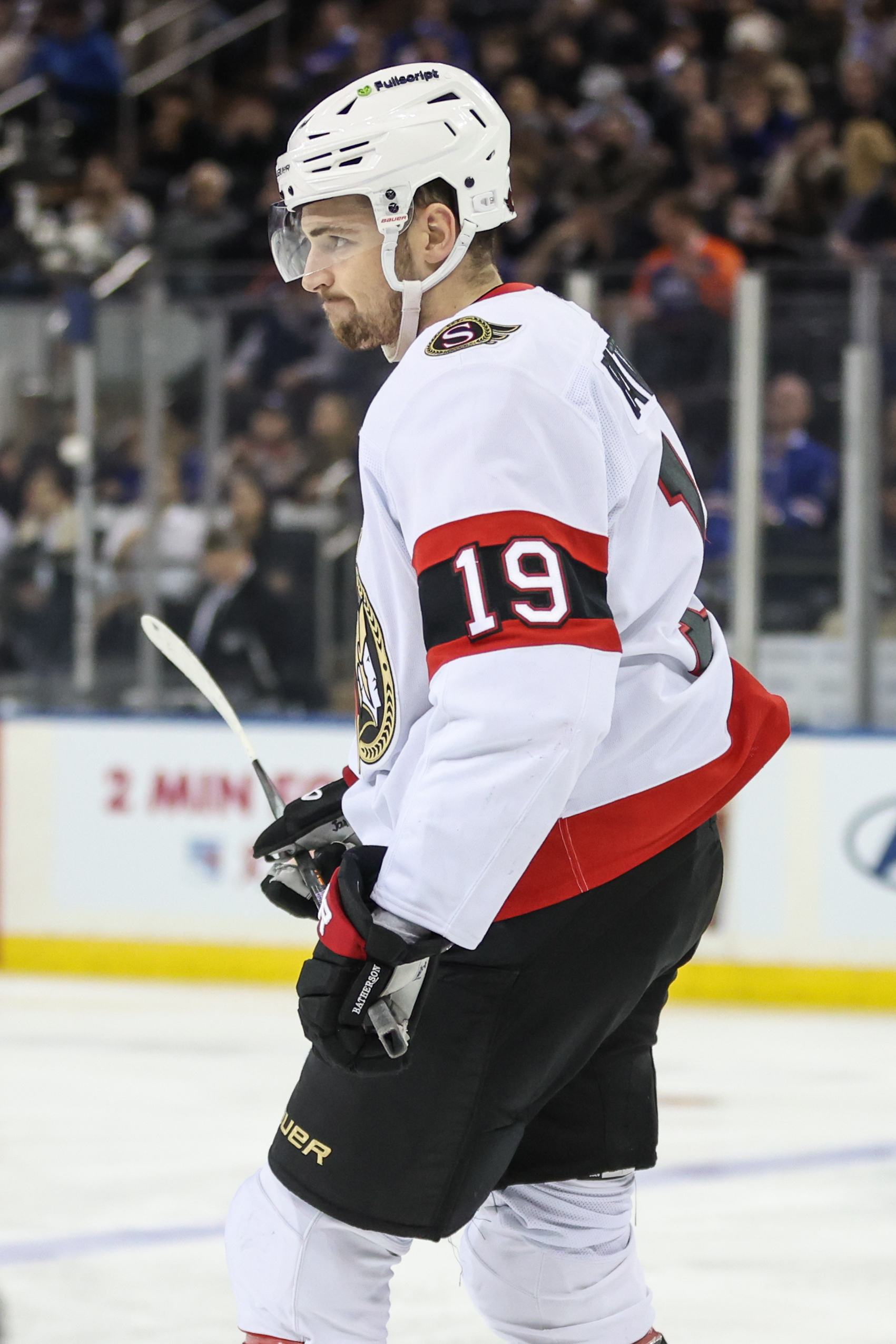 The 28-year-old has set new career highs in points every season so far. This year, he surpassed the 30-goal mark for the first time with 33 while he chipped in with 38 helpers to pass the 70-point threshold for the first time. It’s the fourth straight year he has picked up more than 60 points as he has become a steady top-line performer. He also brings above-average physicality to the table, an element we don’t always see from a lot of top-six pieces.
Basically, Batherson has lined himself up for a substantial raise on his next contract. Frankly, doubling his current price tag is very much a possibility. While that would put him considerably ahead of Tim Stutzle ($8.35MM) as Ottawa’s highest-paid player, the deals aren’t directly comparable. The state of the cap now is much different moving forward and Stutzle’s deal covered four RFA-eligible years while Batherson’s next agreement will only cover UFA-eligible seasons. And, in a market that makes it easier financially for teams to keep their top talents, losing him would certainly be a significant blow.
This doesn’t have to be something that gets finalized this summer but if they could work something out early, it would certainly send a positive message to potential additions in free agency this year. It also would give them the ability to try to do an eight-year pact, something that won’t be an option after September 15th. On top of that, it would provide them some momentum heading into a pair of potentially big extension talks next summer when Brady Tkachuk and Thomas Chabot become eligible to sign. Knowing that, expect this to be on Staios’ to-do list this offseason.
Bring In A Proven Top-Four Defender
When the Senators traded Jakob Chychrun to Washington two offseasons ago, they opened up a spot in their top four defensively. The intention was for Nick Jensen to fill that role. He did in 2024-25 but struggled while dealing with injuries this season. Meanwhile, that role was never filled with a proven defender after that. Jordan Spence (who fits better on a third pairing at five-on-five), Nikolas Matinpalo, and Tyler Kleven all had opportunities with varying degrees of success.
They’re undoubtedly hoping that Carter Yakemchuk will eventually be able to fill that role. Injuries forced them to give him a look down the stretch and he held his own in limited minutes. Meanwhile, he had a solid showing offensively in Belleville although his defensive play is still very much a work in progress. Yakemchuk could fill that spot in a few years but if they want help now, they’re going to have to turn outside the organization.
In an ideal world, that player has a right-handed shot. Artem Zub is their top player on that side with Spence, Matinpalo, and Yakemchuk the supporting cast behind him. As noted, those are all better fits on a third pairing. There is some supply of top-four right-shot rearguards on the open market this summer, including John Carlson, Jacob Trouba, Rasmus Andersson (who Staios has had interest in before), and Darren Raddysh. They would all come at a significant price tag, likely more than half of their nearly $17MM in cap space, per PuckPedia. But it would certainly represent a bigger swing at solving that roster spot.
With Jake Sanderson and Chabot, Ottawa has a solid top two. Zub is a strong second-pairing player. Now, they need to find a proven piece to fill that other spot to give the back end a needed boost in a very tight division. They’ll have plenty of competition but landing a top-four upgrade would be a big victory for Ottawa this summer.
Look To Leverage Center Depth
There are many teams across the NHL who are looking to add center help this summer. Beyond trying to re-sign pending unrestricted Claude Giroux, the Senators won’t be one of them.
Instead, the team already boasts above-average depth down the middle. Tim Stutzle and Dylan Cozens are their top options, with Shane Pinto, Ridly Greig, and youngster Stephen Halliday behind them. If they get Giroux back – a realistic possibility – they’ll be back to have six middlemen. That’s a great spot to be in compared to many teams would be envious of having that type of depth.
That puts Staios and the Senators in a great spot. With quality centers in short supply and high demand, they could be in a spot to try to capitalize on that on the trade front. If they can’t land a core blueliner in free agency, they might be able to trade a pivot (not Halliday, who is more of a fourth-line option) to try to fill that spot.
There is definitely a case to be made to simply put one (or two, if Giroux re-signs) on the wing knowing that injuries can creep up at any time. On the other hand, if you can get a core defender or a top-six winger (another position of some need) that’s a net upgrade over playing a center out of position, it’s something they should at least be considering.
If Giroux doesn’t re-sign, the Sens likely look at the center group they have and think that they’re set. But if he does return, Staios should be receiving plenty of phone calls to see if one could be pried loose. If that happens, he might receive an offer that’s simply too close to pass up.
Photo courtesy of Wendell Cruz-Imagn Images.
Free Agent Focus: Columbus Blue Jackets
Free agency is just over a month away, and teams are looking ahead to when it opens. Even with the UFA crop being thinned out in recent months, there will be some quality veterans set to hit the open market in July, while many teams also have key restricted free agents to re-sign. We continue our look around the NHL with an overview of the free agent situation for the Blue Jackets.
Key Restricted Free Agents
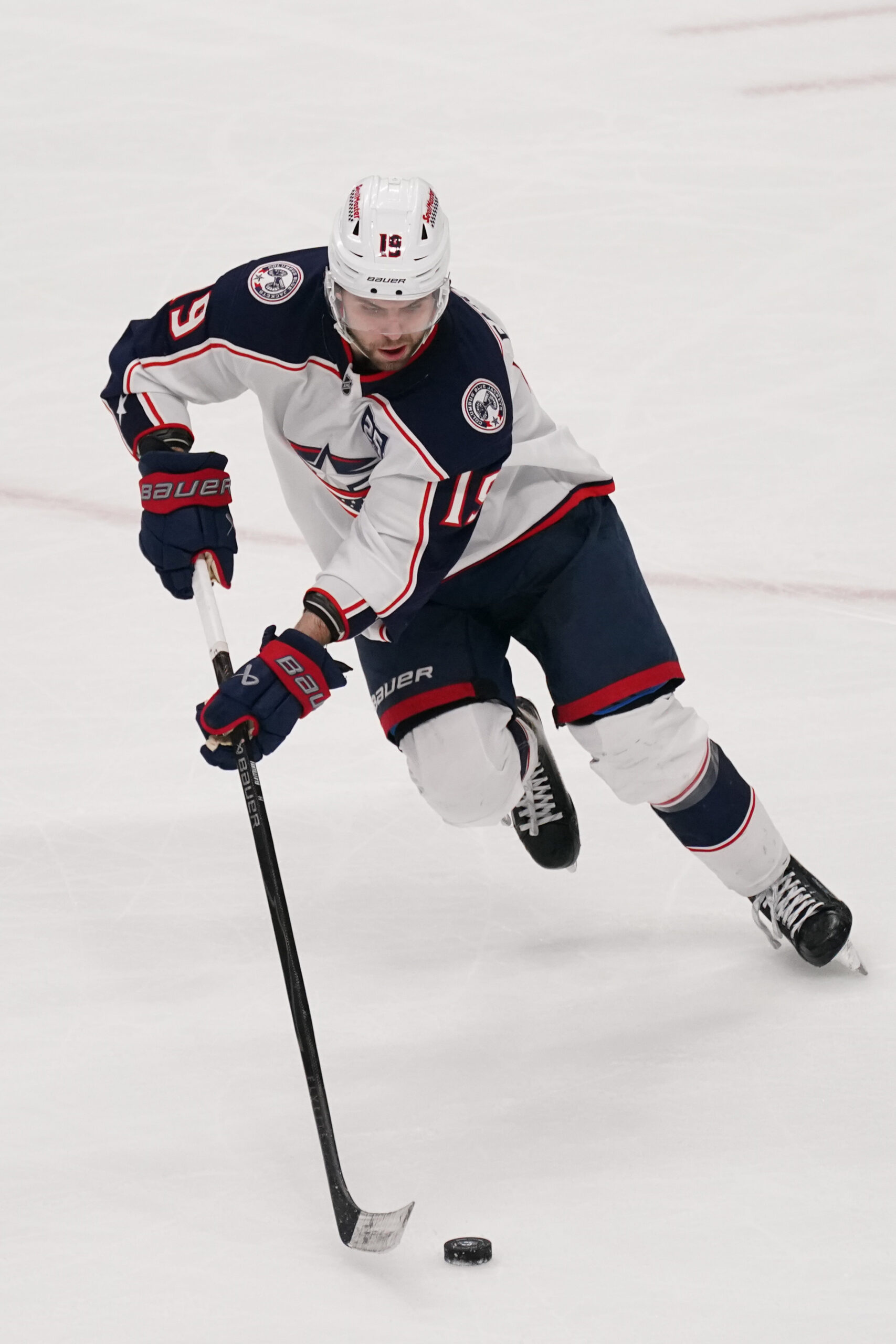 F Adam Fantilli – Fantilli’s third and final season of his entry-level contract marked something of a lateral move. Selected third overall in 2023, he’s yet to take over as the true #1 pivot Columbus has lacked for virtually its entire 26-year history. A late-season surge last year brought him to 31 goals as a sophomore, but his production plateaued this season with a 24-35–59 scoring line, only a five-point total increase from his 2024-25 performance as his shooting percentage regressed.
He’s averaging close to 19 minutes per game now, has improved in the faceoff dot, and is still the Jackets’ top center of the present and future, even if his production hasn’t really popped yet. It’ll be an interesting exercise to see whether GM Don Waddell is willing to pay for potential or make a more reserved offer, considering what he’s yet to show. AFP Analytics pegs a long-term deal at eight years and $10MM per season. It seems unlikely Fantilli would want to lock himself into that number, considering his growth potential and a rising cap, so their two-year bridge projection of $6.375MM annually seems more apt.
G Jet Greaves – Now 25, Greaves answered every question asked of him in his first season as a true starter. The undrafted free agent burst onto the scene as an exceptional third-string option over the past few years and was clearly ready for at least tandem duties with Elvis Merzļikins this season, but he ended up stealing the crease entirely from the beleaguered veteran. I
t’s hard to call him Columbus’ outright MVP considering what Zach Werenski did this season, but a 26-19-9 record, .908 SV%, and a top-10 finish in goals saved above expected (16.5, per MoneyPuck) are worthy of a hefty financial commitment to a netminder who’s yet to experience a real bump in the road in his development. Mid-term deals have been all the craze for breakout starters lately; something in the range of the six-year, $5.85MM AAV extension Logan Thompson signed with the Capitals last season is a reasonable starting point.
F Cole Sillinger – One of many high picks dotting Columbus’ forward group, Sillinger just wrapped up a two-year bridge deal that paid him $2.25MM per season. He’s due for a raise, but not an Earth-shattering one. Selected 12th overall in 2021, the 23-year-old has shown little forward progress since his unexpectedly strong showing as an 18-year-old. He’s hit 33 points in back-to-back seasons, both career highs, but is an extremely poor finisher who notched just eight goals this year and hasn’t shot above 10% since his rookie campaign. He plays a physical game and has reasonably sound defensive impacts, but his 45.7% career win rate in the dot isn’t inspiring. If not trade bait, he’s likely looking at a short-term deal in the $4MM range.
Other RFAs: D Corson Ceulemans, F James Malatesta, F Hunter McKown, F Mikael Pyyhtia, D Stanislav Svozil, F Jack Williams, D Egor Zamula
Key Unrestricted Free Agents
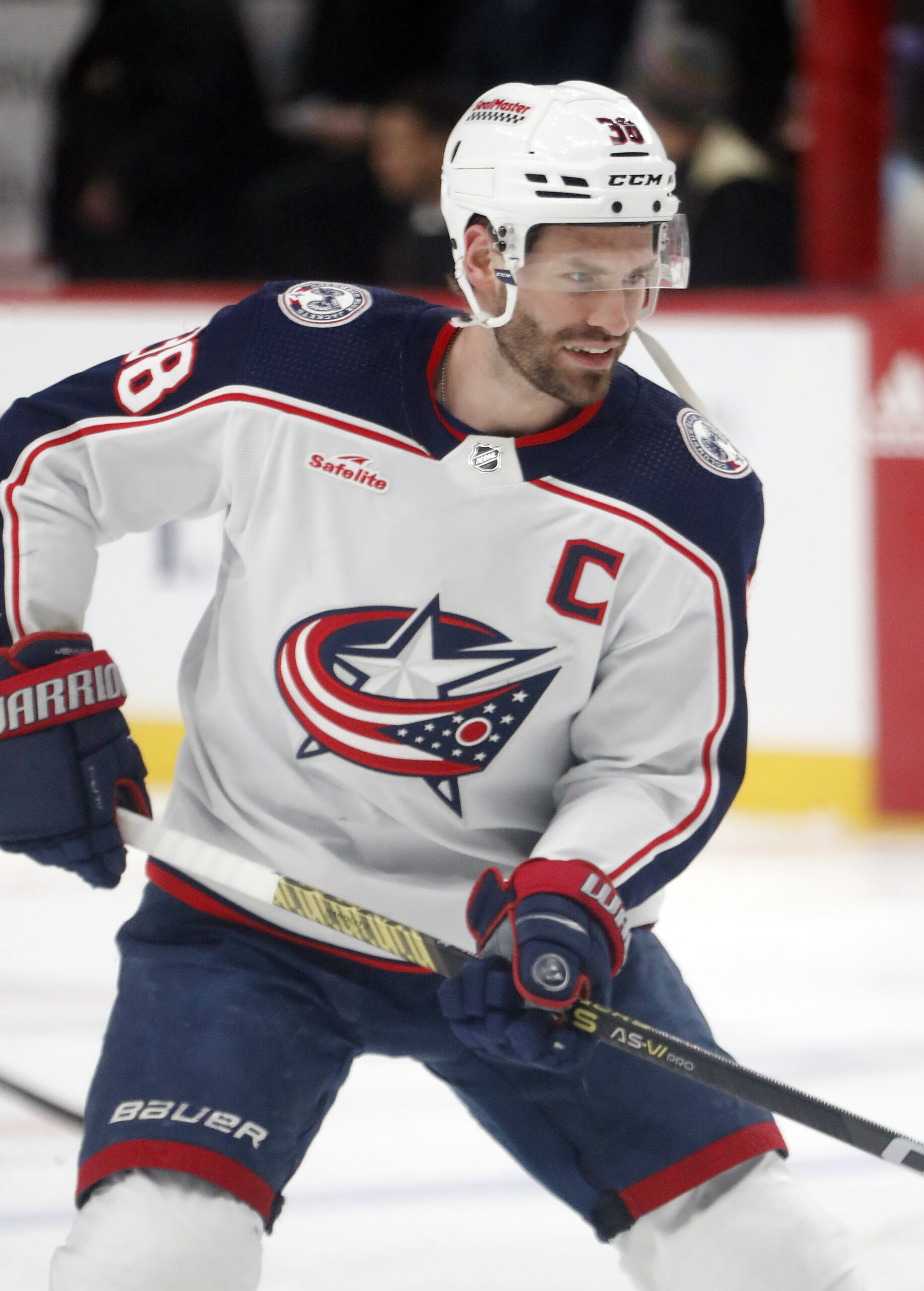 F Boone Jenner – Columbus was well in the playoff race and opted to hold onto all their big-ticket pending UFAs as a result. An April collapse left them seven points out, and while they’ve managed to extend one of their big-ticket UFA trio in Charlie Coyle, two remain unaccounted for. Jenner’s departure would be a real shock to the system. The Jackets’ captain since 2021 is well into his second decade with the organization, first acquired as a second-round pick in 2011.
He’s the franchise’s all-time leader in games played by a significant margin and is still reasonably productive despite shoulder injuries taking a large bite out of the latter half of his career. A poor finishing streak limited him to 13 goals in 67 outings this season, but he still totaled 38 points, on pace for 47 had he played a full season. He’s 33 next month, and even in a thin free agent class, his recent injury history means there won’t be any huge above-market-value offers waiting for him elsewhere. There shouldn’t be much fuss about retaining Jenner for another three or four years in the $4.5-5.5MM range to aid a team on the rise.
F Mason Marchment – It was a tale of two seasons for Marchment, who could be looking for his fourth team in three seasons if not retained. An ever-effective top-nine producer ever since his big breakout with the Panthers in 2021-22, he was traded to the Kraken last summer by the Stars as a result of their tight cap situation. Marchment fell flat in Seattle, limited to four goals and 13 points in 29 games before Columbus paid a second and a fourth-round pick to bring him in as a reclamation project.
Marchment erupted for 15 goals, 32 points, and a raucous +21 rating in 39 games down the stretch to serve as the Jackets’ best goal-scorer on a per-game basis this season. He did so on a top line with Fantilli and Kirill Marchenko that controlled 54.6% of expected goals to boot. Age works against him on the open market as well – he’ll be 31 in June – but has the best case of anyone here to exceed his three-year, $5.67MM AAV extension projection from AFP.
D Erik Gudbranson – Gudbranson was a controversial free-agent pickup back in 2022 – not for his fit, but with the four-year, $16MM price tag that was attached. He certainly never played up to his $4MM AAV for the Jackets, but the team’s lack of cap constraints during his tenure meant it ultimately didn’t matter much. Like Jenner, injuries have derailed his past few seasons, with only 53 suit-ups over the last two years. In a reduced role this season, the 34-year-old righty was a serviceable #6 option with a +6 rating and some decent defensive numbers while averaging 17:46 of ice time per game. He’s a non-factor offensively, only registering three points, but is still an NHL-caliber bottom-pairing/press box option. A one-year deal in the $1MM range will be out there for him this summer, whether it’s in Columbus or elsewhere.
Other UFAs: F Zach Aston-Reese, F Hudson Fasching, G Ivan Fedotov, F Brendan Gaunce, F Danton Heinen, D Dysin Mayo, G Zachary Sawchenko, F Owen Sillinger, D Brendan Smith
Projected Cap Space
Columbus, per usual, has plenty of spending money this summer with $32.36MM in room. Some of that will disappear quickly with Fantilli’s and Greaves’ deals but they should still have around $15-20MM in open market money. Hungry to make a playoff push, they’ll be in on virtually every “top” free agent amid a slim list, with a strong organizational need to fill out their AHL forward depth as well.
Images courtesy of David Gonzales-Imagn Images (Fantilli) and Charles LeClaire-Imagn Images (Jenner). Contract and cap information per PuckPedia.
Offseason Checklist: Washington Capitals
The offseason has arrived for half of the league’s teams that aren’t taking part in the playoffs plus those who have already been eliminated. Accordingly, it’s now time to examine what they will need to accomplish over the coming months. Next up is a look at Washington.
Having gone from reaching the second round last season to narrowly missing the playoffs this season, it would be fair to view 2025-26 as a disappointment. On the other hand, this group was the only team in the salary cap era to have a +23-goal differential or better and miss the playoffs with a point total (95) that is usually enough to get into the postseason. Most years, they’d have comfortably made the playoffs with a season like they had. With that in mind, GM Chris Patrick might opt for a safer summer than another drastic overhaul like 2024. Their checklist has been drafted with that assumption in mind.
Wait For Ovechkin’s Decision
Admittedly, it feels weird making the first item on here something that’s entirely out of their control. Long-time captain Alex Ovechkin’s contract is up and the NHL’s all-time goal leader hasn’t decided if he wants to return for a 22nd season. It’s safe to say that the Capitals want him back and they’ve indicated to Ovechkin’s camp that they’re willing to be patient although they prefer that he decides by next month’s draft.
What the decision is will ultimately influence a chunk of how the team plans to proceed this summer. If Ovechkin stays, he fills a top-six spot on the wing, though not the top-line one he had for most of his career. And if he opts to move on, then they have a big hole to fill on the wing. Notably, despite his age (40), only one pending UFA forward (Alex Tuch) had more points than Ovechkin’s 64. Accordingly, they’d likely have to turn to the trade market to try to fill that vacancy.
Considering his age, it certainly wouldn’t be surprising if Ovechkin’s next contract is a one-year deal, should he decide to stay. If that’s the case, he’s eligible to sign one with performance bonuses in the deal, something that could be done to give Washington more cap flexibility. With over $31MM in room at the moment, per PuckPedia, they may not necessarily need that flexibility but if Patrick has big plans, maybe they will. Ovechkin’s now-expiring deal carried a $9.5MM AAV; it wouldn’t be entirely shocking if his next contract (including bonuses, if any) was in that price range as well.
Re-Sign McMichael
Two years ago, Washington opted to sign forward Connor McMichael to a bridge deal. That kept more money free for their shopping spree and considering he had just become a full-time player the year before, there was lots of logic to the decision. McMichael, meanwhile, went and had two pretty strong seasons on his two-year, $4.2MM pact. He notched 57 points in 2024-25 and followed that up with 46 in 78 outings this season while transitioning toward playing down the middle on more of a regular basis.
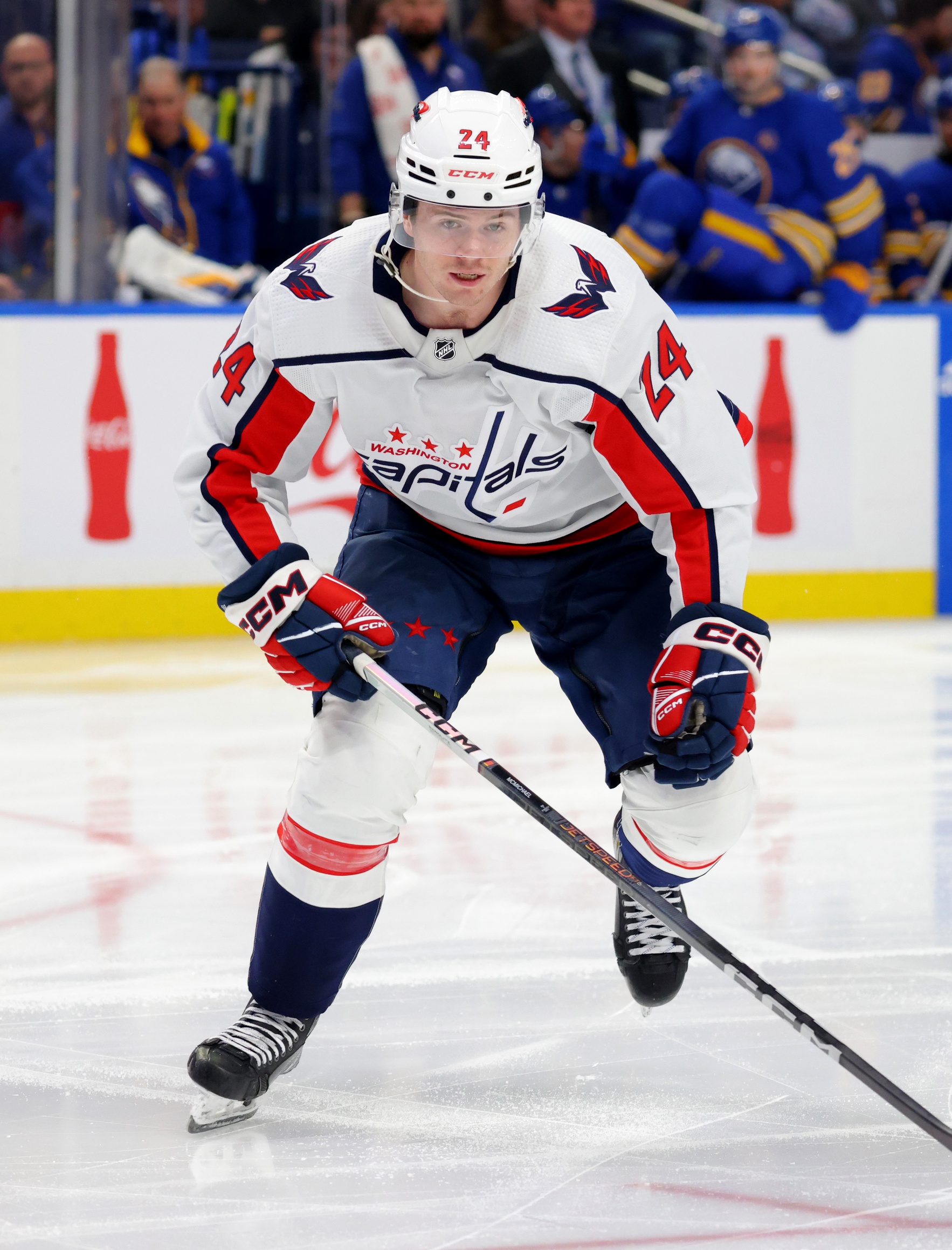 All things considered, that’s a pair of solid seasons to bolster his arbitration case as he reaches eligibility for that for the first time. McMichael is two years away from being able to test the open market so while they could kick the can down the road and try to do a one-year pact, the more probable outcome is a longer-term agreement. The Capitals could opt to take him to a hearing but that would allow his camp to ask for a two-year contract that walks him right to unrestricted free agency so it would be surprising to see the team go down that road. Conversely, if McMichael files, Washington gets to pick the term and would almost certainly choose a one-year agreement.
AFP Analytics pegs McMichael at a five-year pact worth a shade under $6.5MM per season while getting three extra years of club control. In this marketplace, that might even be a little light while adding more seasons to the agreement could push the price tag more toward the $8MM mark. By the time they re-sign him and re-sign or replace Ovechkin, more than half of that cap space will already be gone but getting McMichael locked up on a longer-term deal should be a big priority this summer.
Add Right-Shot Defender
With Jakob Chychrun, Martin Fehervary, Rasmus Sandin, Cole Hutson, and Declan Chisholm, the Capitals are more than well-set on that side of their back end. If anything, their depth there could allow Patrick to shop someone to try to fill another hole elsewhere.
However, things aren’t as great on the other side. Their right-shot options are Matt Roy, Timothy Liljegren, and Dylan McIlrath. Roy has been solid in his first two years in Washington but is ideally a second-pairing player. Liljegren, who just re-signed, hasn’t progressed beyond being a third-pairing option for most of his career, while McIlrath is more of a veteran journeyman who shouldn’t be counted on to play too much.
In other words, they need to try to replace John Carlson, who was moved to Anaheim a little before the trade deadline. Interestingly enough, one of the players they could plausibly look at is Carlson himself, as the sides explored extension talks before the trigger was pulled on a swap. Other impactful right-shot rearguards set to reach unrestricted free agency are Darren Raddysh, Rasmus Andersson, and Jacob Trouba, although it should be expected that at least one of those players will ultimately re-sign.
With Sandin being able to shift to his off-side, this isn’t a must-add for the Capitals this summer. Chychrun is a top-pairing piece and Hutson showed plenty of potential late in the year; those two anchoring the back end with above-average depth could work. But in a very tight Eastern Conference, augmenting the group with another impact right-shot option would even be better.
Work On Leonard Extension
When Ryan Leonard joined the Capitals for the stretch run last season, they were hoping that he’d be able to add some key secondary scoring. Instead, his entrance to the NHL was a little quieter as he managed just two points in 17 games (regular season and playoffs combined) with his role shrinking as the postseason went on.
But those struggles ultimately helped Leonard prepare for his first full NHL season which certainly was an improvement. He finished fifth in rookie scoring with 20 goals and 25 assists, doing so despite averaging a little over 14 minutes per game, or basically third-line ice time. That earned him an eighth-place finish in Calder Trophy voting for Rookie of the Year. Considering Washington drafted Leonard eighth overall in 2023, it’s safe to say that they envision him being able to take on a bigger role.
Because they burned the first season of his entry-level pact for the 2025 stretch run, Leonard will be entering the final year of that contract this summer, making him extension-eligible. And with this being the last offseason that a team can do an eight-year contract, it would make sense for Washington to explore what the parameters of an agreement like that would be.
There would be a lot of forecasting being done on both sides in terms of trying to determine what Leonard’s long-term offensive upside is to try to find a number that would work. AFP Analytics’ extension projections suggest a seven-year agreement would be worth a little under $8.5MM per year. To get that eighth season, the AAV might have to land closer to the $9MM mark. That might seem like a lot for a player with 46 career regular season points but if they want to get something done early, there’s going to be some shared risk on both sides.
This isn’t necessarily a must-accomplish item on the checklist this summer. It’s possible that one or both sides would prefer the extra year of data before committing. But having some certainty for what Leonard’s next deal will cost would help the Capitals in their long-term planning this offseason so expect Patrick to approach Leonard’s camp to see what this could cost.
Photo courtesy of Timothy T. Ludwig-USA TODAY Sports.
Free Agent Focus: Carolina Hurricanes
Free agency is just over a month away, and teams are looking ahead to when it opens. Even with the UFA crop being thinned out in recent months, there will be some quality veterans set to hit the open market in July, while many teams also have key restricted free agents to re-sign. We continue our look around the NHL with an overview of the free agent situation for the Hurricanes.
Key Restricted Free Agents
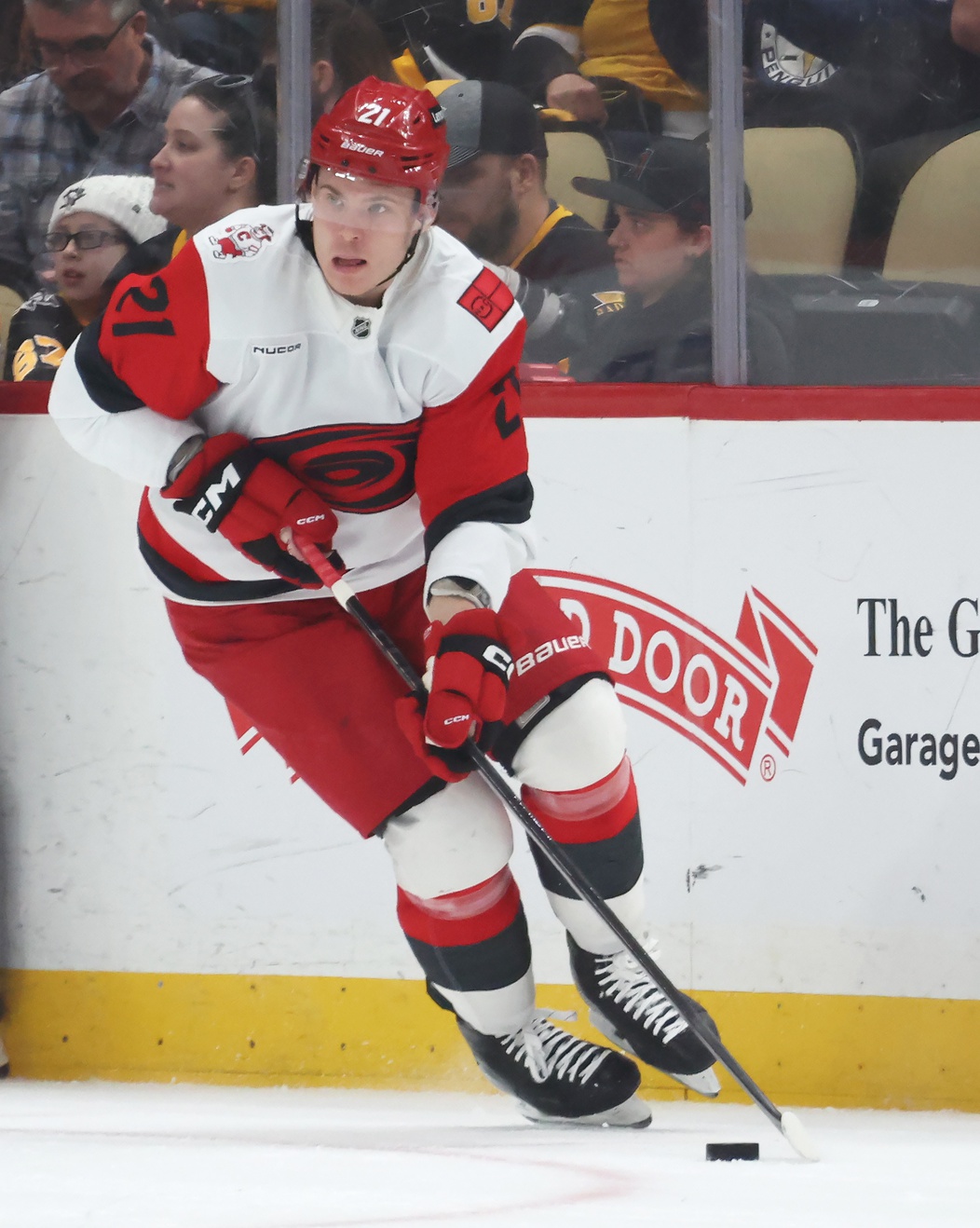 D Alexander Nikishin – Nikishin may not have lit up the NHL like he did the KHL in recent years but he still had a very strong rookie season. He finished second in rookie scoring for a defenseman after potting 11 goals and 22 assists in 81 games while averaging over 18 minutes per night of playing time. That performance earned him a seventh-place spot in Calder Trophy voting. On a deep back end, the Hurricanes were able to ease him in a bit which could impact contract talks. If Nikishin’s camp feels he has another level to get to over the next couple of years, they may prefer to work on a bridge contract and position the blueliner to cash in later. That deal could fall in the $4MM range. If both sides are content to do a longer-term pact that buys out some UFA eligibility, the market value could be closer to $7MM.
G Cayden Primeau – The word ‘key’ probably doesn’t apply here but Primeau has seen NHL action now in seven straight years, although he spent most of this season with AHL Chicago. He’s no longer viewed as a potential full-time NHL backup but the market for third-stringers with NHL experience who can come up and play a few games in a pinch has gone up lately. He should at least be able to land another one-way pact but it may have to come from elsewhere. Because Primeau has played in 58 NHL games but is more of an AHL player at this point, he’s a strong non-tender candidate to avoid giving him the chance to test salary arbitration.
F Justin Robidas – Another one who doesn’t really fit the ‘key’ descriptor (Carolina’s RFA list is pretty thin), Robidas is one of Carolina’s more intriguing youngsters. He hasn’t seen much NHL action so far (just four games) but he has been quite productive with AHL Chicago over the past two seasons, tallying 115 points in 128 games. The 23-year-old will no longer be waiver-exempt in 2026-27 and his minor-league production could make him a candidate to be claimed. It will be interesting to see if he’s able to land a one-way deal as a result.
Other RFAs: F Skyler Brind’Amour, D Domenick Fensore, F Noel Gunler, D Aleksi Heimosalmi, D Kyle Masters, F Viktor Neuchev, G Nikita Quapp, D Ronan Seeley
Key Unrestricted Free Agents
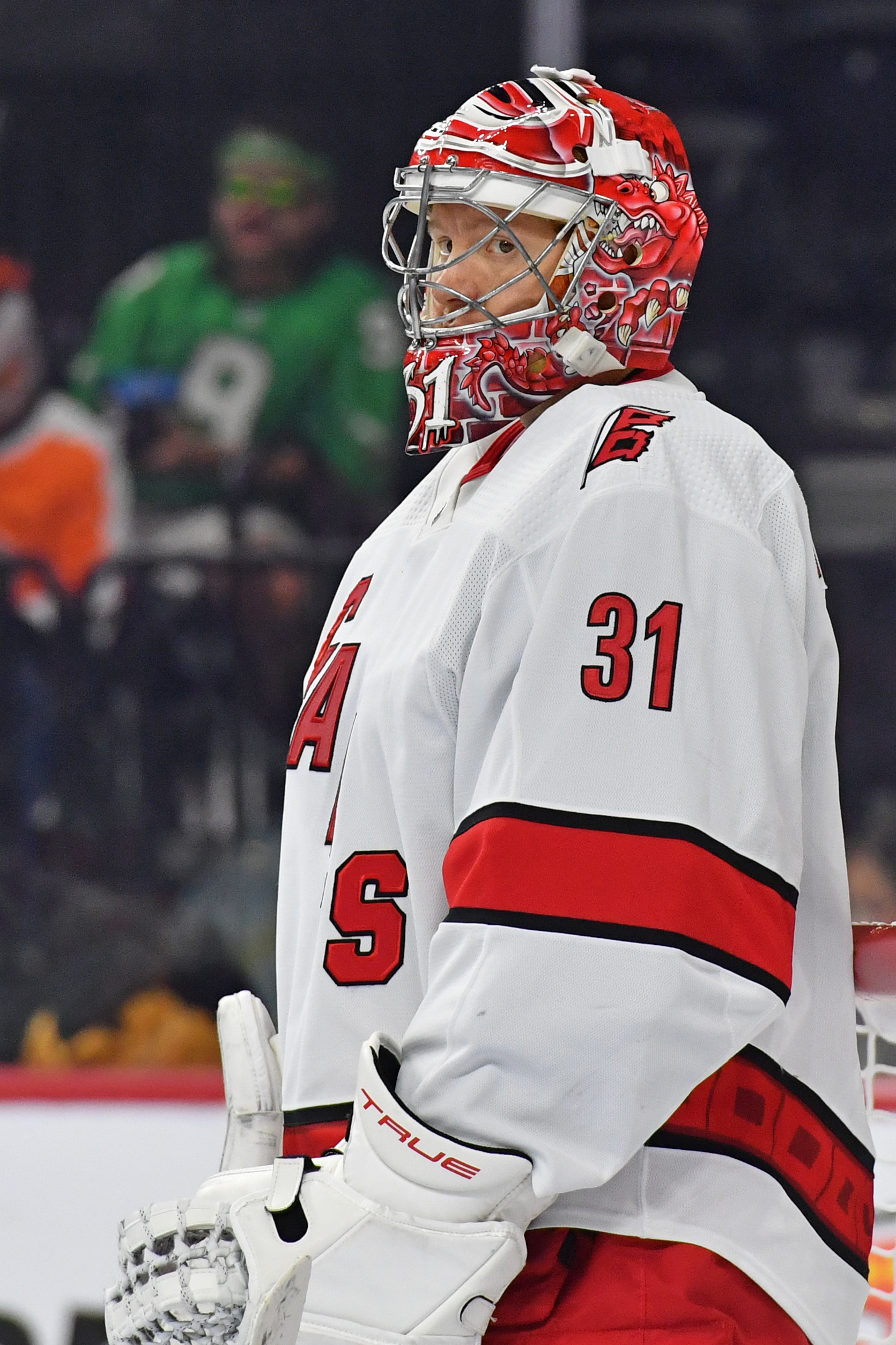 G Frederik Andersen – There may not be a player in the playoffs who has flipped the script as much as Andersen has. After a below-average regular season, he has been stellar in the postseason to the point of being a viable Conn Smythe Trophy as the most valuable player of his team in the playoffs. In doing so, he has certainly bolstered his marketability. He’ll be 37 in early October but it’s not unfathomable that Andersen could land a two-year contract around the $3.25MM he made this season (including performance bonuses). Alternatively, another one-year pact that makes him eligible for performance incentives is the other option. He should be able to at least match his current deal if he goes that route.
F Nicolas Deslauriers – Deslauriers is no longer the every-game tough guy he was in the first half of his contract a few years ago. Now, the 35-year-old profiles as more of a 13th forward who can step in against more physical teams. The market for more enforcer-type players isn’t what it used to be so while he should be able to land more than $850K minimum salary, it’s doubtful that he’ll be able to land the $1.75MM he has made in each of the last four years. Something closer to the middle is more realistic.
F Noah Philp – Philp passed through waivers and finished up the year with the Wolves but he won over 56% of his faceoffs between Edmonton and Carolina when he was in the NHL this season. The 27-year-old profiles as a minimum-salaried player this summer but he might be able to secure a one-way deal and could make a push to stick at the back of a roster in training camp.
D Mike Reilly – After missing most of 2024-25 after undergoing heart surgery, Reilly stayed healthy this season which was good to see. However, he had a fairly limited role overall, getting into just over half of Carolina’s games while logging just under 15 minutes per night of ice time and in the playoffs, he has suited up just twice so far. Profiling as more of a seventh option moving forward, Reilly is likely going to land another deal around his current $1.1MM price tag and it wouldn’t be surprising to see his streak of one-year contracts continue for a fourth consecutive season.
Other UFAs: G Amir Miftakhov, F Josiah Slavin, F Givani Smith, F Ryan Suzuki, D Juuso Valimaki
Projected Cap Space
There aren’t many teams with less cap space than the Hurricanes, who will enter the summer with a little under $12MM in room. They have room to re-sign Nikishin and Andersen (if they want to carry three goalies full-time next season) and enough space to replace Reilly as a depth defender. They might not be able to do too much beyond that, but they also don’t have a lot of holes to fill, as evidenced by a roster that’s a win away from advancing to the Stanley Cup Final.
Photos courtesy of Charles LeClaire (Nikishin) and Eric Hartline (Andersen) – Imagn Images. Contract information courtesy of PuckPedia.
Offseason Checklist: Columbus Blue Jackets
The offseason has arrived for half of the league’s teams that aren’t taking part in the playoffs plus those who have already been eliminated. Accordingly, it’s now time to examine what they will need to accomplish over the coming months. Next up is a look at Columbus.
It was an eventful year for the Blue Jackets. After narrowly missing the playoffs last season, they added Charlie Coyle over the summer and hoped that they’d be able to squeak in this time. Instead, they got off to a mediocre start, resulting in Rick Bowness being brought in as head coach. They went on a run early but faltered down the stretch, ultimately coming up just short again. Now, GM Don Waddell has some more work to do to try to get his team over the proverbial hump.
Culture Change
With Bowness only signing a deal for the rest of the season when he was first hired, he didn’t know his immediate future when, after the final game of the year, he let his team have it:
I don’t know if I’m back, but if I’m back, I’m changing this culture. These guys, they don’t care – losing is not important enough to them. It doesn’t bother them. Like, how can you go out and play like that?
Well, now he knows that he’s back as he signed a one-year extension not even 48 hours after the season ended. So, Bowness is going to get a chance to really reshape the culture but it’s not going to just be on him. This summer, it’s largely going to be on Waddell to make the types of changes that Bowness is likely seeking and model the roster to better suit that style.
One big decision that needs to be made (and frankly, might already have been made) is the fate of captain Boone Jenner. The 32-year-old has been with the Blue Jackets for 13 seasons, captaining them for the last five. When healthy, he has a quality power forward and defensive anchor. But he has dealt with a significant injury pretty much annually and his scoring touch has dipped a bit as of late. He’s a pending unrestricted free agent who has changed agents while Bowness has already signed Coyle to a six-year extension, potentially pushing Jenner more towards being out the door.
How aggressive of an overhaul Waddell will look to make is the big question here. Bowness is 71 and on an expiring contract already; he’s not the long-term voice behind the bench. But with the public vote of confidence in the form of that one-year extension, Waddell seemingly has to make meaningful changes beyond a player or two. We’ll find out just how big of a culture change they’ll be looking to make soon enough.
Re-Sign Key RFAs
While Waddell has already taken care of one of his key pending free agents, he has a few important restricted free agents to re-sign over the coming months.
The most prominent one is center Adam Fantilli. The third overall pick in 2023, his entry-level deal will officially expire at the end of next month. With the market for impact young centers jumping up considerably in recent years plus the projected increases to the Upper Limit, it’s fair to say Fantilli’s market value is going to jump considerably. If they want to sign him to a max-term eight-year contract (still legal through mid-September), they may have to go higher than Zach Werenski’s current price tag of $9.58MM. AFP Analytics pegs an eight-year pact at just over $10MM per season despite the fact he has yet to reach 60 points in a season. But to get him to give up four years of UFA eligibility, it’s going to be a hefty price tag. If they’re not willing to go that high yet, a bridge contract could still land in the $6MM-$7MM range.
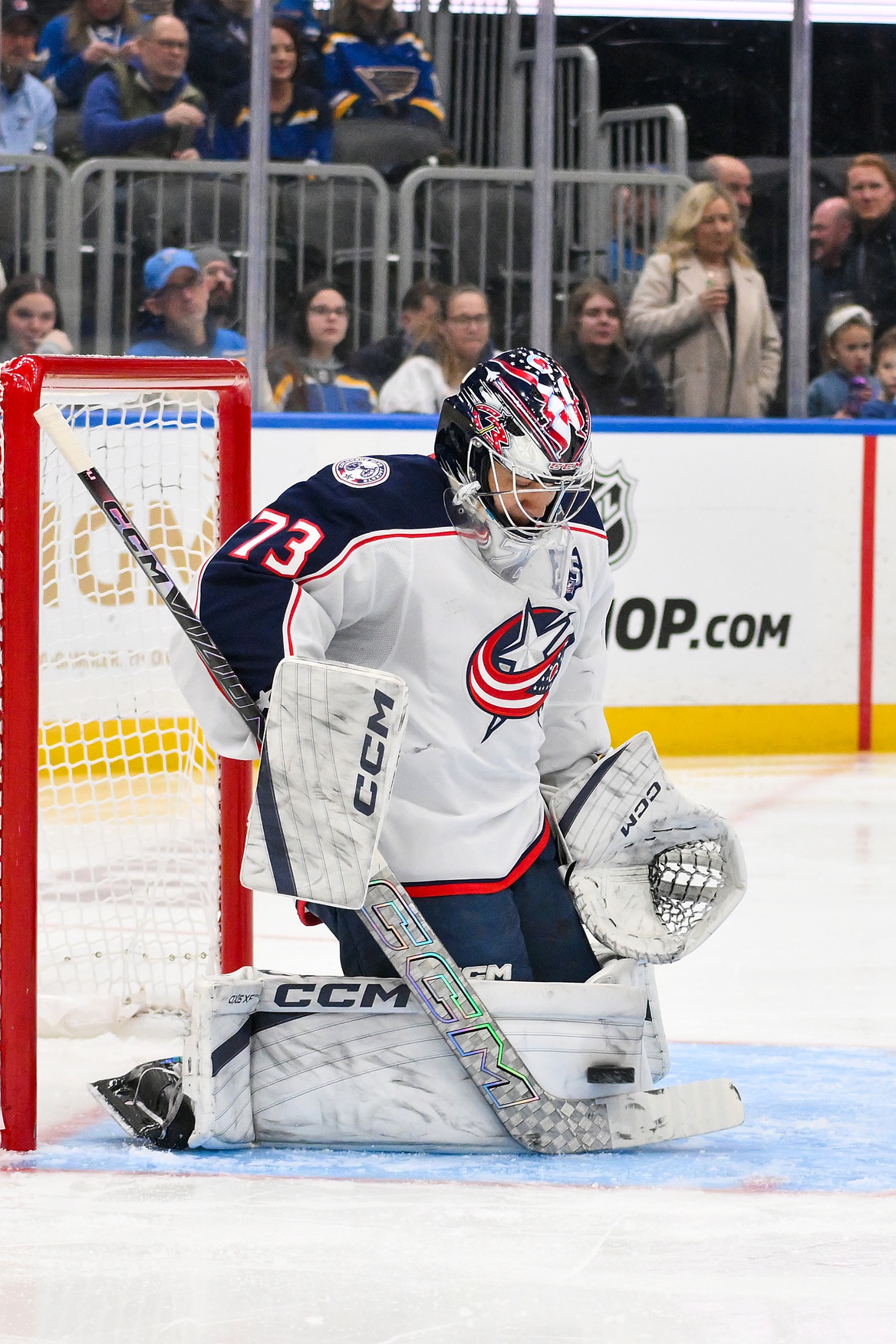 Goaltender Jet Greaves also happens to be up for a new deal. While he wasn’t going to come close to sustaining his late-season hot streak in 2024-25 over a full season, he locked down the starting job. He played the seventh-most minutes in the NHL while posting the 12th-best SV and 13th-best GAA on a non-playoff team. Traditional stats are still dominant in arbitration filings and the 25-year-old is arbitration-eligible for the first time. However, the small sample size makes this one a little harder to peg. The comparables here would be players like Ukko-Pekka Luukkonen ($4.75MM) and $5MM but the financial market is a little different now. The comparable now would be four or five years around the $5.75MM range. But if one or both sides want to see one more year before making that commitment, they can get away with it as he’s two seasons away from UFA eligibility. The price tag would be more in the $4.25MM territory in that scenario.
The other RFA of note is Cole Sillinger. His bridge deal has now come to an end and if nothing else, he has been consistent. Over the past three seasons, his lowest point total is 32 and his highest is 33. He has two years of club control left and is arbitration-eligible as well. It’s doubtful either side would want to do a long-term agreement so the options are more likely a one-year deal that allows for a bit more evaluation, or a three-or-four-year pact that buys up a bit of UFA eligibility. The former would be in the $3.5MM range and the latter more likely around double his current $2.25MM price tag.
Add Offensive Forward
One of the challenges this season for Columbus was primary scoring. They only had two players surpass the 60-point mark and one of those was Werenski, who led the team in points once again. The other was Kirill Marchenko, with 67. Fantilli and Coyle were just shy of 60 which doesn’t sound too bad. However, they’re also the only four players to reach 40 points on the campaign.
The silver lining is that their secondary scoring was fine. Eight additional players had between 30 and 40 points, including Mason Marchment, who had 32 in just 39 games after being acquired. He’s a pending unrestricted free agent and is set for a big payday on the open market. The Blue Jackets would undoubtedly want to keep him around but even if so, that’s only maintaining the status quo, not improving the roster.
While there is a young nucleus of players that they’re hoping for continued development from (with a bounce-back from Kent Johnson being first in that regard), it’s also quite evident that the Blue Jackets have a win-now mindset. While contention might not be realistic just yet, getting to the postseason should be the next step for this group.
That makes it more important for them to add an impact scorer to deepen the attack and take some pressure off the younger players (which might ultimately help them offensively). Of course, this is not a particularly deep UFA class – Marchment is one of the top forwards available – so this is something Waddell may have to accomplish on the trade front. But if Columbus wants to take that next step forward, more primary firepower will be needed.
Add A Shutdown Defender
With Werenski anchoring the back end, the emergence of Denton Mateychuk, and Ivan Provorov showing flashes of above-average offensive ability at times, the Blue Jackets quietly have one of the more talented back ends in the East from an offensive perspective. But their other regulars – Damon Severson and Dante Fabbro – aren’t known necessarily for being shutdown players. They can certainly contribute but aren’t necessarily defensive anchors.
One of their top-used defensemen shorthanded this season was Erik Gudbranson, at least when healthy. However, he’s also a pending unrestricted free agent and at this point, it would be somewhat surprising to see him return. That’s a spot in the lineup that needs to be filled. Ideally, that one isn’t filled internally, either by Jake Christiansen or a prospect like Corson Ceulemans. Again, if the goal is getting to the playoffs, they need to aim higher.
In a perfect world, the goal would be to get someone capable of playing on the top two pairings, logging over 20 minutes per game with primary penalty kill time. That player would also be matched up against top lines from other teams. It’s the type of player that a lot of teams could use although, again, there aren’t many unrestricted free agents who fit the bill. This is another spot they may have to try to acquire in a trade instead.
But this one is of particular importance from a culture standpoint as well. As Bowness wants to reshape things there, getting that gritty defender willing to go the extra mile to contain top players from other teams would be an anchor of that reshaped culture. A lot of good teams have a true shutdown piece on the back end and if they want to take the next step, the Blue Jackets need to get one too.
Photo courtesy of Jeff Curry-Imagn Images.
Free Agent Focus: Calgary Flames
Free agency is just over a month away, and teams are looking ahead to when it opens. Even with the UFA crop being thinned out in recent months, there will be some quality veterans set to hit the open market in July, while many teams also have key restricted free agents to re-sign. We start our look around the NHL with an overview of the free agent situation for the Flames.
Key Restricted Free Agents
John Beecher – The Flames don’t have any key NHL players set to become restricted free agents, in part thanks to the $7.5MM AAV extension they signed with No. 1 goalie Dustin Wolf. That deal kicks in on July 1. As a result, Beecher is the Flames RFA with the most NHL experience, though it’d be difficult to call him a key player by any means.
The Flames claimed Beecher, 25, off of waivers from the Boston Bruins in the middle of November. The speedy forward looked to have established himself in the NHL in 2024-25, playing in a career-high 78 games. But the Bruins team Beecher played those games for that season was an uncharacteristically weak one, and this past campaign, he lost his role as a lineup regular under new head coach Marco Sturm.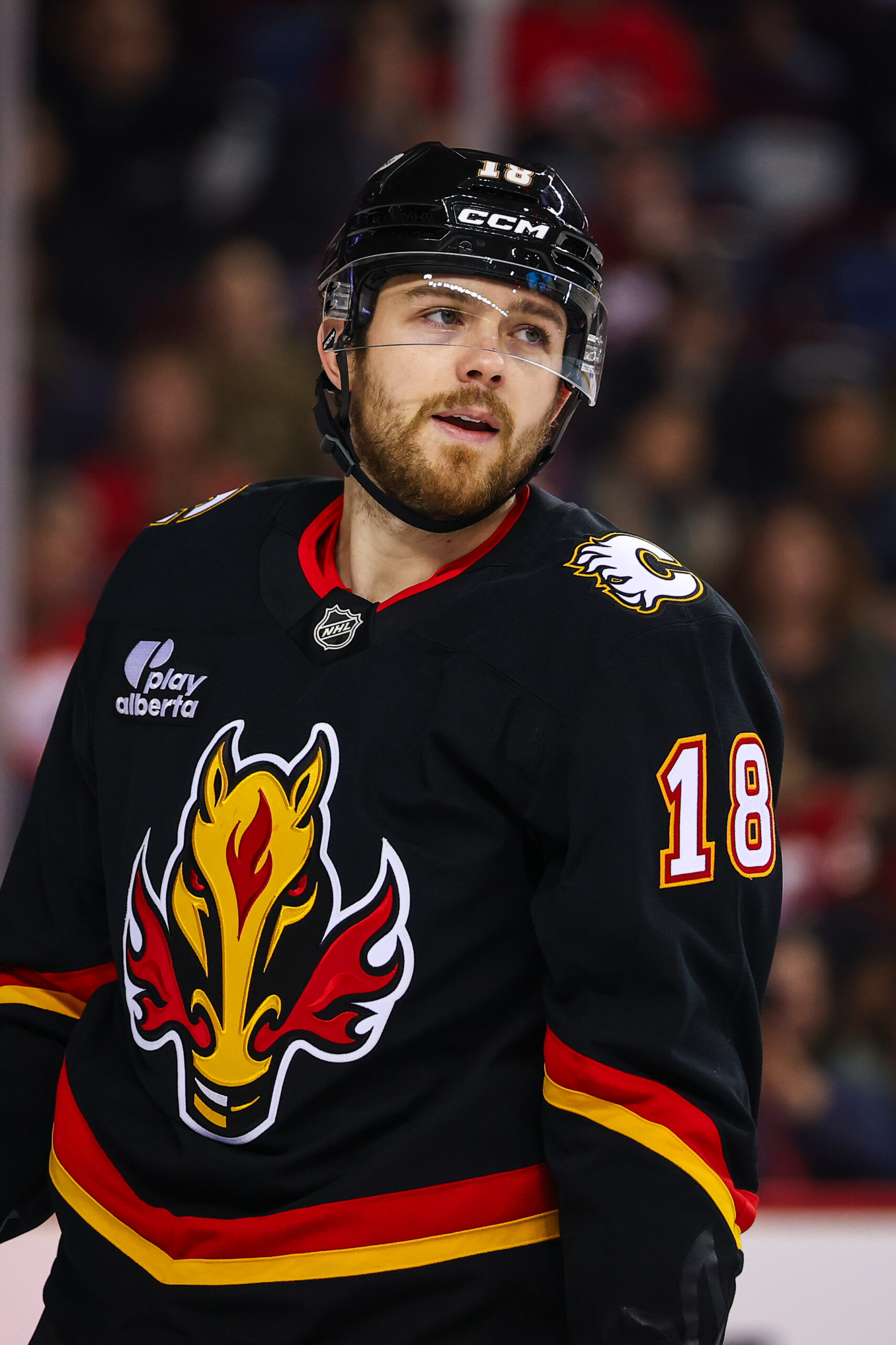
Calgary was likely intrigued by the traits in Beecher’s game that made him a first-round pick by the Bruins: he possesses a coveted combination of size (6’3″ 220 pounds) and speed, while also being able to play the center position.
That speed has allowed Beecher to carve out a spot in both Boston and Calgary’s penalty-kill rotations, but he hasn’t been able to make a more well-rounded impact on either team he’s played for.
He was not a top scorer in the AHL for the Providence Bruins, nor in college for the Michigan Wolverines, and has produced just 28 points in 165 career NHL games.
Despite the pace in his game, it’s unlikely Beecher will ever be much of a point producer. The key question is whether he’ll be able to leverage his skating and size to carve out a lengthy career as a fourth-line player with valuable penalty-kill utility. He has shown some flashes of potential to become that kind of player, but hasn’t been able to do so with much consistency.
The Flames could bring Beecher back at a relatively affordable price. He cost $900K this past season, and would need to receive a one-way deal for next year. The main complicating factor at play here is Beecher’s right to pursue arbitration, which could give the Flames some pause if they’re not certain Beecher is a part of their plans for next season’s team.
Brennan Othmann – Like Beecher, Othmann is a first-round pick by an original six franchise who thus far hasn’t been able to carve out a meaningful long-term role in an NHL lineup. Othmann is a few years younger than Beecher and therefore doesn’t have as much NHL experience, though he is a considerably more advanced player at the AHL level. The 23-year-old scored 21 goals and 49 points as an AHL rookie with the 2023-24 Hartford Wolf Pack, and has maintained a solid scoring clip at the AHL level, even as he’s struggled in call-ups to the NHL.
A skilled winger who has some valuable pest-like elements to his game, Othmann hasn’t been able to translate any of his scoring from the AHL and OHL to the NHL level. He was traded to Calgary at the deadline for 2024 second-rounder Jacob Battaglia, but managed just seven points in 14 AHL games after the trade. He did score a goal and an assist in two games for the Flames after the deal, but that is just two games.
With his entry-level deal now concluded, it’ll be interesting to see how the Flames value Othmann. It’s not unreasonable by any stretch to believe he still has NHL potential, but his star as a prospect has faded. A one-year, two-way deal likely makes the most sense here, one with the kind of solid AHL salary merited by the level of production Othmann has put forward in his minor-league career so far.
Rory Kerins – Kerins, 24, has been a real developmental success story for the Flames as a 2020 sixth-round pick. The 5’10”, 175-pound center was one of the OHL’s best players in 2021-22, scoring 43 goals and 118 points in 67 games. That raised expectations for what he might be able to do as a professional, but he ended up spending his debut pro campaign in the ECHL with the Rapid City Rush, scoring 37 points in 38 games.
In 2023-24, after that one year in the ECHL, Kerins quickly became an impactful AHLer. He scored 16 goals and 32 points that year, but the real breakout was to come a year later. In 2024-25, Kerins scored 33 goals and 61 points in 63 games, production that made him an AHL All-Star. This past season, Kerins showed that year wasn’t any fluke, scoring 22 goals and 57 points in 56 games.
The question for Kerins is whether he’ll top out as a high-end AHL scorer, or if he has something to give at the NHL level. His most recent contract was a one-year, two-way deal containing a guarantee of $125K. Without question, he’s earned a raise off that number for next season in the AHL.
Other RFAs: F Carter King, F Parker Bell, F Lucas Ciona, F Sam Morton, D Gavin White, D Artem Grushnikov, G Owen Say
Key Unrestricted Free Agents
Ryan Lomberg – After winning the Stanley Cup with the Florida Panthers in 2024, Lomberg cashed in on his status as a fan-favorite agitator playing on the league’s best team. He signed a two-year, $2MM AAV deal with the Flames, a solid contract for a player with a career-high of just 20 points. 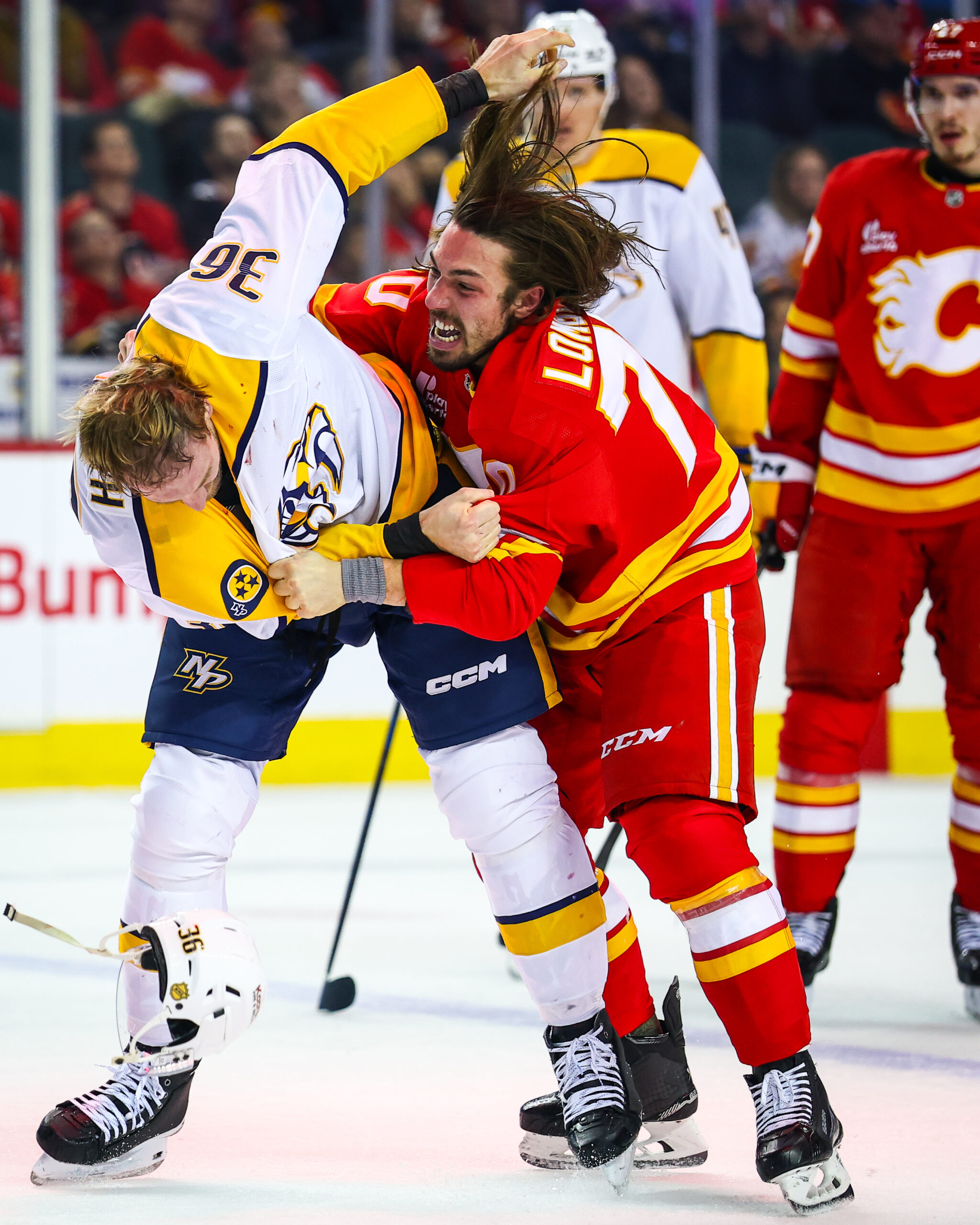
With the Flames, Lomberg has been as advertised: a low-scoring fourth-line winger who punches above his weight, plays with energy and physicality, and tries his best to get under the skin of opponents.
A player of Lomberg’s skillset is often held as most valuable in the playoffs, meaning Lomberg’s talents didn’t feel quite as meaningful playing on a rebuilding Flames team.
With that said, the experience Lomberg was able to provide to a young team full of developing prospects still held real value, even if he wasn’t able to produce nearly as much as the 12 goals and 20 points he put forward in 2022-23. He’d be an in-demand bottom-sixer on the open market.
Back in February, Lomberg made his desire to remain in Calgary very clear. He told Sportsnet’s Eric Francis:
This is where I want to be. I’ve been pretty vocal on how much I love the city, and the people, and the organization. I want to win here. My family and I love it here, and we’re extremely proud to be part of the organization and a big part of the community. I signed here with the intention of helping this team win, and being part of the solution. So that’s definitely how I would like it to stay.
The Flames certainly have the financial bandwidth to match any bid for Lomberg, but the question will be whether the team has interest in retaining the 31-year-old or if they’re eager to turn over the role he occupies to a younger player.
Victor Olofsson – Cast off by the Colorado Avalanche as part of the Nazem Kadri trade deadline deal, Olofsson has only played in 18 games for the Flames, and his time in Calgary could very well end there. Olofsson has always been something of an enigmatic player, a clearly talented sniper whose inconsistency has kept him from holding down a permanent role on any NHL team.
A two-time 20-goal scorer during his days with the Buffalo Sabres, Olofsson scored 13 goals and 31 points in 78 games across stints with Calgary and Colorado in 2025-26. The year before, he scored 15 goals and 29 points in 56 games for the Vegas Golden Knights.
While there is likely still a place for Olofsson in the NHL, it may not be in Calgary. Making the most of Olofsson on an NHL roster means giving him an offensive role with at least second-unit power play time. As the Flames look to develop as much long-term value as possible on their roster, there may be more to gain by giving a young player the opportunity to play that role, rather than reserving it for Olofsson.
Daniil Miromanov – In the immediate aftermath of when the Flames acquired Miromanov from the Golden Knights as part of the Noah Hanifin trade, there was some optimism that he could end up becoming a real steal for Calgary. He seemed to instantly elevate his game. He played in only four contests in Vegas, but got time in the NHL with the Flames down the stretch in 2024. In 20 games for the Flames, he averaged 21:15 time on ice per game, including 2:05 per game on the power play. He managed a solid seven points in 20 games, and signed a two-year, $1.25MM AAV extension.
That performance, and contract, earned Miromanov an NHL spot for the next season. But Miromanov wasn’t able to resume his role from late the season before, instead serving as a frequent healthy scratch. He only got into 44 games in 2024-25, and averaged 17:40 time on ice per game, almost entirely at even strength.
This past season, Miromanov’s decline in terms of role has only hastened. Despite Calgary’s decisions to trade away veteran talent from its defense, Miromanov wasn’t able to seize on the minutes vacated by MacKenzie Weegar and Rasmus Andersson. Instead, he spent almost all of 2025-26 in the AHL, playing in just a single game at the NHL level. While nothing has been set in stone, there is every indication that Miromanov has already played his final game in Calgary.
Jake Bean – Bean, 27, has had a disappointing two-year stint with the Flames. In his first season in Calgary, he averaged just 15:05 time on ice per game, and scored just seven points in 64 contests. He wasn’t able to take a step forward in the NHL despite looking like a future top-four defenseman earlier in his career.
This past season, Bean was limited to just 16 games. He underwent surgery in December as the result of an undisclosed injury. A fresh start could be what is best for both Bean and the Flames.
Other UFAs: F Justin Kirkland, F Clark Bishop, D Nick Cicek, G Ivan Prosvetov
Projected Cap Space
The Flames enter next season with a little over $18MM in projected cap space. While that may seem surprisingly low for a team in the midst of a full-on rebuild, that’s simply because greater financial freedom is just on the horizon. The Flames project to have over $51.5MM in cap space for 2027-28, and $83.5MM for 2028-29. But even that $18MM figure should be more than enough for the team to be able to not only comfortably retain all of their pending free agents, but also have some spending money for free agency if that’s a route they want to take.
They’ll also have the flexibility to be able to take on sub-optimal contracts in exchange for draft picks, though the market for those kinds of deals is sure to be less robust than it was during the days of the flat salary cap. In any case, Calgary will have significant financial flexibility in the year to come, especially on their back-end. Calgary’s highest-paid defenseman is Kevin Bahl at $5.35MM, and no other Flames blueliner even reaches $4MM in cap hit.
Photos courtesy of Sergei Belski-Imagn Images, Sergei Belski-Imagn Images
Free Agent Focus: Buffalo Sabres
Free agency is just over a month away, and teams are looking ahead to when it opens. Even with the UFA crop being thinned out in recent months, there will be some quality veterans set to hit the open market in July, while many teams also have key restricted free agents to re-sign. We continue our look around the NHL with an overview of the free agent situation for the Sabres.
Key Restricted Free Agents
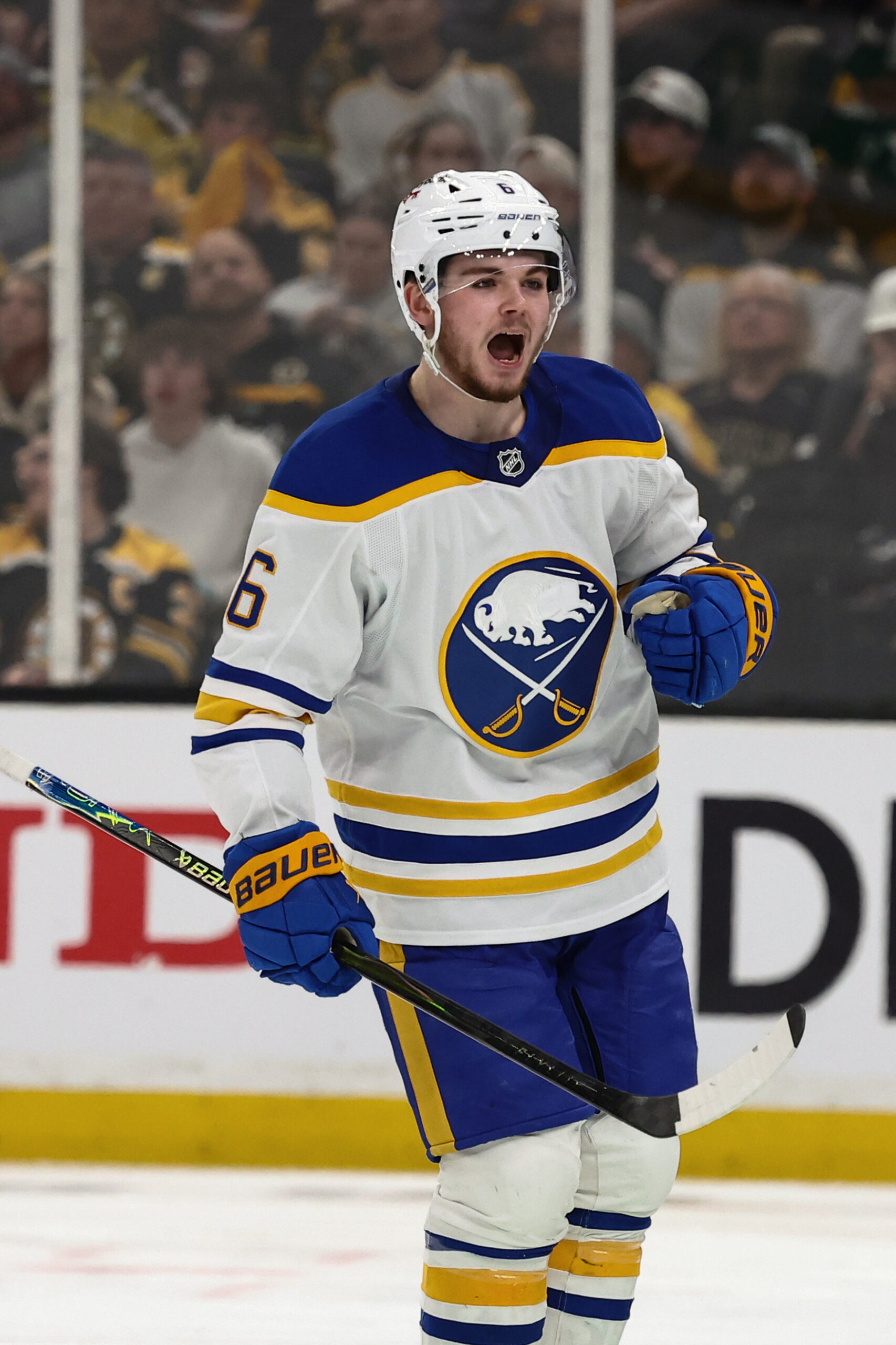
F Zach Benson – A feisty winger who already has 211 games under his belt having just turned 21, Benson’s imprints were all over Buffalo’s playoff run, tying for team lead with five goals in 13 games and nine points overall. The former 13th overall pick took another step ahead with 43 points in 65 games, getting real top line usage with the stakes at their highest this spring. Having other business to tend to, there’s a possibility of a bridge deal somewhere under $5MM, but if Buffalo is serious about locking things up now, Benson would command closer to $7MM on a contract which would shoot him right up among Tage Thompson and Joshua Norris as the club’s biggest ticket forwards. Such a commitment would have implications on their unrestricted free agent strategy, outlined below, but the sooner Benson is taken care of, the better. GM Jarmo Kekäläinen already referred to him as a “core piece” who they’re looking to reward with a long term deal.
F Peyton Krebs – Acquired as a prospect with higher end potential, Krebs is now 25, a valuable role player to the team but with questions on his long term future in Buffalo. The former Golden Knights first-round pick set a career high with 39 points, reaping the benefits of a top six role at times due to injuries, part of his campaign filling a variety of roles. Still, Krebs was scoreless in the Montreal series, not the only former Golden Knight to do that. Likely to command a contract at least doubling his current $1.45MM AAV, the Sabres will have to make some difficult decisions with cap constraints, and it makes one wonder if Krebs could emerge in trade talks. If Kekäläinen retains both him and Benson, they’d need to prepare for their second leading goal scorer to walk away, a name who comes up shortly.
D Michael Kesselring – Battling injuries throughout the campaign, the 6’5″ defender skated in just 34 games, a step down from all 82 with Utah last season. He also was unable to contribute offensively, posting just two helpers, versus 29 points put up in the Mammoth’s inaugural season. A key piece in the JJ Peterka trade, the 26-year-old struggled to find a role with the Sabres with ice time cut down over four minutes, despite being a righty, a natural fit into their lineup. While dealing Krebs would be an unfortunate result of the numbers game, Kesselring makes more sense to land on the block, both based on cap limitations and on-ice contribution. Plenty of teams would have interest in the South Carolina native, eyeing a return to his production with the Mammoth organization. Either way, a short-term agreement hovering around the $2.75MM range is realistic.
Other RFAs: D Zachary Jones, F Olivier Nadeau, D Isaac Belliveau, D Nikita Novikov
Key Unrestricted Free Agents
F Alex Tuch – Widely thought to be the best forward to hit the market, Tuch remains standing in a free agent class which has gotten thinner with each passing month. After five seasons with Buffalo, three of which he surpassed the 30-goal mark, the winger went cold in the Montreal series failing to record a point. Not the ending he wanted after helping lead the Sabres to new heights, it’s Buffalo who may be more hesitant to fork over a king’s ransom to keep him, as opposed to undeterred suitors who’d have no problem offering a long-term deal with an AAV around $10MM. Expected to circle back in the coming weeks before July rolls around, there’s reason for a resolution, as a Syracuse native who grew up a fan of the team. Yet needing to lock up Benson, the Sabres would have to shed a salary such as Jordan Greenway‘s $4MM. Even then, it wouldn’t be surprising if Tuch’s value in a deserted free agent class is just too much, leaving him with ample options for a huge payday.
D Logan Stanley – A lefty whose on-ice play is sometimes not so kind from the eye test, the Sabres surrendered meaningful assets to acquire Stanley due to his frame at 6’7″, 231 lbs, and mean streak, which are coveted in today’s game. As the 28-year-old former first-round selection enters free agency, that will continue to be the case. Starting 65% of his work in the defensive zone as a Sabre, far ahead from anything he saw in Winnipeg, Stanley came away with an impressive 51.3% corsi for at five-on-five. Having a glut of left-handers on the back end, naturally there’s questions on his fit, but that didn’t stop Buffalo from seeking him out at the trade deadline. Projected by AFP Analytics to fetch a two year contract worth just under $3MM per season, Buffalo could feasibly bring him back to fill a need physically, but Stanley’s steady play in the postseason would reward him on the open market, predictably more than the Sabres have to offer.
D Luke Schenn – The second piece coming back in the Winnipeg deal, Schenn’s on-ice contributions in Buffalo were minimal, making just four appearances closing out the regular season, and two more in the playoffs, where he averaged 7:33 of ice time against Montreal. At this point the 36-year-old is largely valued for leadership. As a veteran of 10 NHL clubs to this point, he’s no stranger to moving around in the off-season either. Any future for Schenn would be as a continued seventh defenseman on a one-year contract around $1MM. However, with Zach Metsa in the fold, along with Conor Timmins who especially makes him redundant, the Saskatchewan native will likely be searching for a new home to put the finishing touches on a career which has spanned over 1,100 games and two Stanley Cups.
F Beck Malenstyn – Acquired for a second round pick from Washington two years ago, the winger is the exact type of player whose work ethic has helped Buffalo turn the corner. A relentless forechecker and penalty killer, Malenstyn played in all but one regular season game, recording 14 points. He was a constant presence in the playoffs also, skating in all 13 games and scoring a goal to help give the Sabres a 3-1 series lead over Boston. During the Montreal series, the British Columbia native caught a skate to the hand on the penalty kill, but still cleared the zone and finished his shift while wounded. Many teams would love to staple the 28-year-old to their fourth line, so the Sabres should be prepared to offer at least a $1 million raise from his current $1.35MM cap hit. Assuming at least one of their acquisitions from Winnipeg above are not brought back, there should be no issue in affording such an offer.
Other UFAs: F Joshua Dunne, F Tanner Pearson, F Jake Leschyshyn, D Gavin Bayreuther, F Trevor Kuntar (Group 6)
Projected Cap Space
The Sabres enter this summer with just under $13MM in cap space. Taking care of Benson, along with their other restricted free agents, will quickly dissolve anything left to match what Tuch would be offered on July 1, not to mention addressing the hypothetical losses of Stanley and Schenn on the back end. A point Buffalo fans are already tired of hearing about, unfortunately Jeff Skinner‘s $6.44MM buyout charge is a huge factor this offseason. Finally having assembled the right pieces on their roster, now it’s about keeping together as much of the core as they can. If there’s any chance Tuch is back in blue and gold next year, they’ll have to find the space by trading another forward away. No doubt a difficult situation for Kekäläinen to navigate, the dilemma of keeping a playoff team together is one the Sabres only wished they had over the last decade.
Photo courtesy of Winslow Townson-Imagn Images (Benson). Contract information courtesy of PuckPedia.
Offseason Checklist: New York Islanders
The offseason has arrived for half of the league’s teams that aren’t taking part in the playoffs plus those who have already been eliminated. Accordingly, it’s now time to examine what they will need to accomplish over the coming months. Next up is a look at the Islanders.
It has been a busy first year for GM Mathieu Darche. He traded away his top defenseman at the time on draft day and added a new franchise defender that same night. He made some in-season trades to try to help his team make a second-half push for the playoffs. Then, he made a big late-season coaching change in a last-ditch effort to help them get in with Peter DeBoer taking over for Patrick Roy. The start to his second year shouldn’t be as busy but he has some work to do roster-wise over the offseason.
Add Goaltending Insurance
While the Islanders were hoping that Semyon Varlamov would be able to return at some point during the season after undergoing a pair of replacement knee surgeries, they knew they’d need some insurance. With that in mind, they brought in David Rittich who wound up as a full-timer on New York’s roster. Varlamov, meanwhile, was able to return after the season, getting into two games on an LTIR conditioning loan with AHL Bridgeport.
At this point, the hope is that Varlamov will be ready to be Ilya Sorokin’s backup next season. Now healthy, he should be able to get a full offseason of training in and, while he’ll certainly be rusty, he should be available at the start of training camp.
But hope alone isn’t a viable or prudent strategy. Varlamov has played a total of 12 games combined over the past two seasons and hasn’t played in an NHL game since November 2024. They can hope that Varlamov returns to form and gives them 25 or so starts but there’s no guarantee he’ll be able to do so. Meanwhile, they don’t have a trusted third goalie in their system at the moment. The only other goalie signed for next season is recent college free agent signing Josh Kotai, and he’s not NHL-ready by any stretch.
At a minimum, adding another Rittich-like goaltender who could be a third-string option in a perfect world but a capable backup if called upon. If they’re worried about waivers, they may have to carry three netminders for a while. Depending on what happens there, they may need a veteran starter for AHL Hamilton as well, one who could be called up in a pinch. Sorokin gives them a great foundation between the pipes but the supporting cast needs to be added to in the coming weeks.
Determine Lee’s Future
Back in 2019, captain Anders Lee was slated to hit the open market. It looked like he was ultimately going to go to free agency but former GM Lou Lamoriello signed him on the opening day of free agency to a seven-year, $49MM deal. While his role now is certainly different compared to back then, the winger now finds himself a little more than a month away from being eligible to test free agency once again.
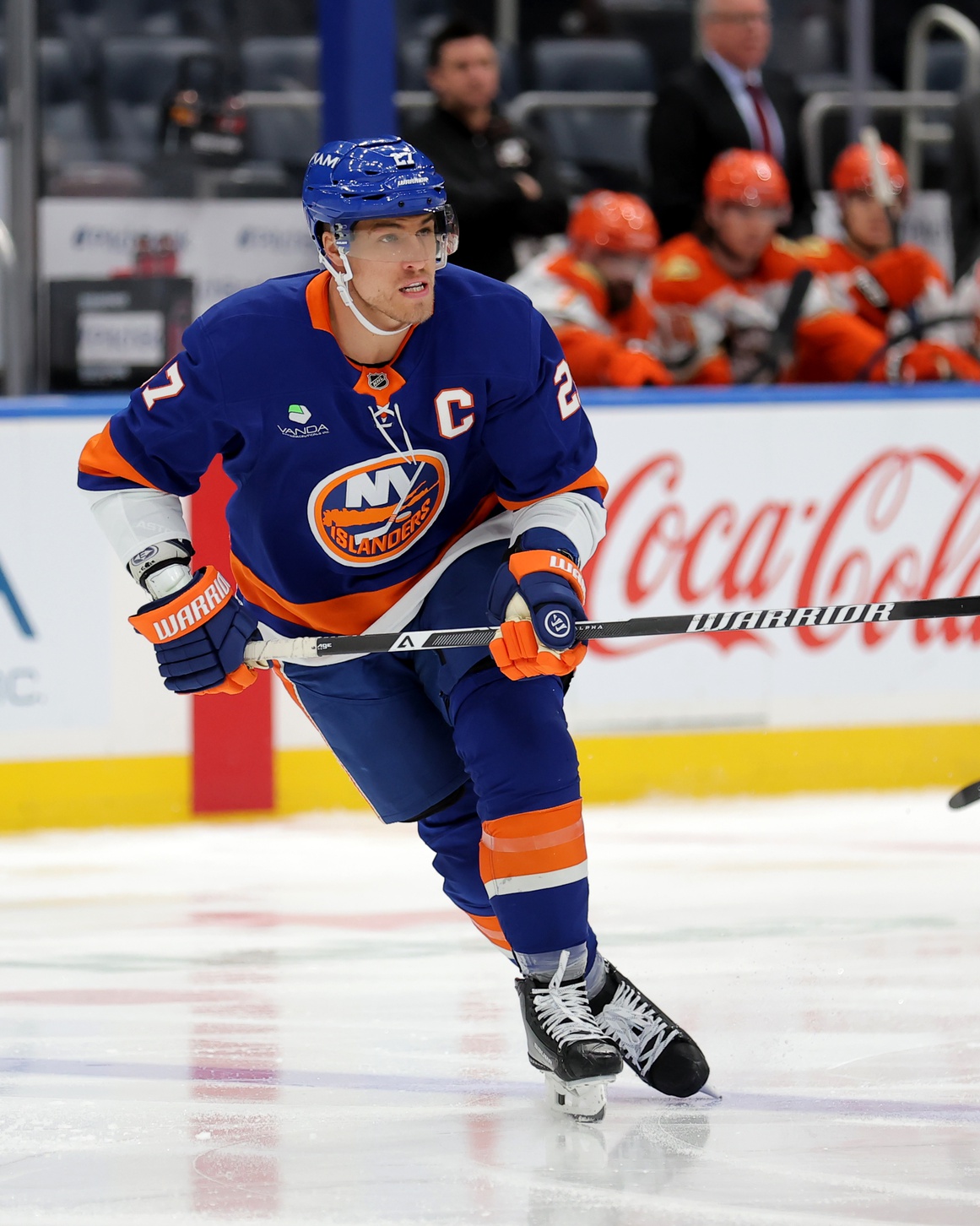 The 35-year-old has never been a high-end point producer, with his personal best being 62, set back in the 2017-18 campaign. However, he has been a steady scorer, notching at least 20 goals in eight of the last ten seasons. This season was one of the exceptions but he still managed 19, suggesting the big falloff in production hasn’t happened yet.
Although Lee is more of a middle-six forward than a top liner at this stage of his career, he’s set to benefit from a thin UFA class. While he certainly won’t come close to another seven-year deal at this stage of his career, it wouldn’t be entirely shocking if his AAV came in fairly close to this now-expiring contract. For example, AFP Analytics projects that a three-year deal for Lee would check in at a little over $6.6MM per season. That would certainly carry some risk for a player coming off a 42-point campaign but there’s also a wide expectation of some sticker shock on UFA contracts this summer. Alternatively, Lee could sign a one-year deal that makes him eligible for performance bonuses, giving the signing team a bit more cap flexibility.
Will the Islanders be that signing team? Darche would likely prefer to keep his captain around but he also needs to make some changes to a group that missed the playoffs and also try to get a bit more speed up front. But if he can keep Lee in the fold and shake the team up elsewhere, that might be his Plan A. We’ll see in the next five weeks or so if that plan works out.
Open Up Cap Space
To try to give his team some boosts, Darche added a pair of pricey contracts up front. First, they brought in Ondrej Palat from the Devils to help try to backfill Kyle Palmieri’s season-ending injury. Then, at the trade deadline, they paid a high price to add Brayden Schenn from St. Louis. In doing so, they took on an extra $12.5MM in spending for next season. They also went deep into LTIR to do so, meaning that the $3.5MM in bonuses Matthew Schaefer earned will all count against the books in 2026-27.
As a result, the Isles enter the summer with around $12.5MM in cap room, per PuckPedia. If they want to re-sign Lee, bring in goalie insurance, and likely a depth defender or two with Carson Soucy and Adam Boqvist set to hit the open market, they’ll basically be out of money at that point. While Pierre Engvall could wind up staying on LTIR, that’s not enough to move the needle in terms of giving them flexibility. And if he is cleared to return, waiving and sending him to the minors would only create $1.225MM in room.
There are some potential change-of-scenery candidates, especially up front. Anthony Duclair simply hasn’t fit in over his first two seasons but now that there are only two years left on his deal (at a $3.5MM price tag), they might be able to offload that contract for cap flexibility. With Palat not faring particularly well following the swap, moving the final year of his deal would require paying down part (if not the maximum of 50%) of it, he’s a potentially viable candidate. Max Shabanov, a pending RFA, could potentially be flipped with an eye on replacing his back-end roster spot with someone making closer to the minimum salary.
Simply making one of these moves wouldn’t be enough to bring in anyone of consequence, assuming that Lee ultimately re-signs. But if they can move out a couple of their higher-paid surplus depth pieces, they might be able to try to make an addition of consequence.
Add More Scoring
That addition of consequence, if they’re able to afford one, needs to come up front. This is a team that has had trouble scoring for a while now. The last time they were above-average in the goals scored department was back in 2017-18, when they finished seventh overall. Five players from that team are still with the Isles, one of them being Lee (a pending UFA) and three more being defensemen. Since then, they have been outside the top 20 in the goals scored department.
They upped their 2024-25 total by seven goals this season, bringing them to 229, or 2.79 per game, good for 25th in the league. Another incremental gain would certainly help but if they want to become more than just a bubble Wild Card team, they’re going to need to aim higher.
New York had two forwards surpass the 50-point mark this season, Mathew Barzal (the other 2017-18 holdover) and Bo Horvat. Lee was next at 42 and he may or may not be back. It’s fair to say that there’s a definitive need for a top-six forward (or two, or three, potentially). Of course, they’re probably not going to be able to afford to add multiple top-six forwards but even one would be a big addition.
In terms of trying to shore up their depth scoring, they could look internally. Victor Eklund made his NHL debut at the end of the season and might not be too far away from being ready for an extended audition. If he could be even a secondary contributor while Darche finds a way to add another decent scoring threat, that could go a long way toward getting them back into the top 20 in the goals department, bolstering their playoff hopes in the process.
Photo courtesy of Brad Penner-Imagn Images.
Offseason Checklist: New Jersey Devils
The offseason has arrived for half of the league’s teams that aren’t taking part in the playoffs plus those who have already been eliminated. Accordingly, it’s now time to examine what they will need to accomplish over the coming months. Next up is a look at New Jersey.
It’s safe to say this season didn’t go as planned for the Devils. Believed to be a team primed for a bounce-back year, it ultimately didn’t happen. As a result, there’s a new GM in town as Sunny Mehta has taken over from Tom Fitzgerald. Mehta has elected to keep head coach Sheldon Keefe around, taking one big item off their checklist. Here are some other things they’ll likely be looking to go over the coming months.
Decide Nemec’s Future
Things have gone well for two of the top three picks from 2022. Juraj Slafkovsky, the top pick, has become a top-line winger in Montreal while third-overall selection Logan Cooley looks like a fixture in Utah’s lineup for the long haul. But things haven’t gone as well for the blueliner selected between those two, Simon Nemec.
After getting into 60 games as a rookie in 2023-24 while averaging nearly 20 minutes a night of playing time, it looked like Nemec had made it. But things went in the wrong direction the following year, resulting in him spending more time in the minors than in the NHL. He became a full-timer on the roster this season and returned to his rookie-season usage while chipping in with 26 points in 68 games. That’s a step in the right direction, no doubt, but is he on his way to being a core piece like the other two?
The answer to that is uncertain, which is also an apt way to describe his situation in New Jersey. Nemec is a pending restricted free agent and with the rapid escalation of salaries, it’s fair to say he’ll be eyeing a significant raise from the $855K base salary he had this season. Potentially anticipating a tough negotiation, Fitzgerald was listening to calls on the youngster at the trade deadline with no deal coming to fruition. Nemec, meanwhile, had expressed frustration about his role in the past with recent conflicting reports suggesting that he might still be unhappy with his situation.
With how things went up and down on his rookie deal, it’s hard to see both sides agreeing on a long-term contract at a cap hit that’s comfortable for everyone. A bridge deal makes sense; AFP Analytics pegs a two-year bridge deal checking in around $4.4MM per season which is still on the higher side for someone who wasn’t a regular not that long ago. But, in this cap environment, some of these future bridge contracts are going to be on the high side.
If Mehta isn’t sold on Nemec’s upside or they’re too far apart in contract talks, a trade could still be on the horizon. A 22-year-old high pick who’s a right-shot defenseman is bound to have considerable trade value and he’d undoubtedly yield a strong return. Is that more valuable to the Devils than what they believe Nemec will be able to provide? They need to decide the answer to that this offseason.
Work On Hischier Extension
When Nico Hischier signed a seven-year, $50.75MM extension after his sophomore year in 2018-19, the move seemed a little risky. The salary cap was much lower back then, bypassing bridge contracts wasn’t as widely common as it is now, and a 47-point showing in his sophomore year wasn’t necessarily screaming ‘big contract’. That deal has certainly worked out quite well for New Jersey and with the captain set to enter the final season of that deal starting in July, he will be eligible for a contract extension at that time.
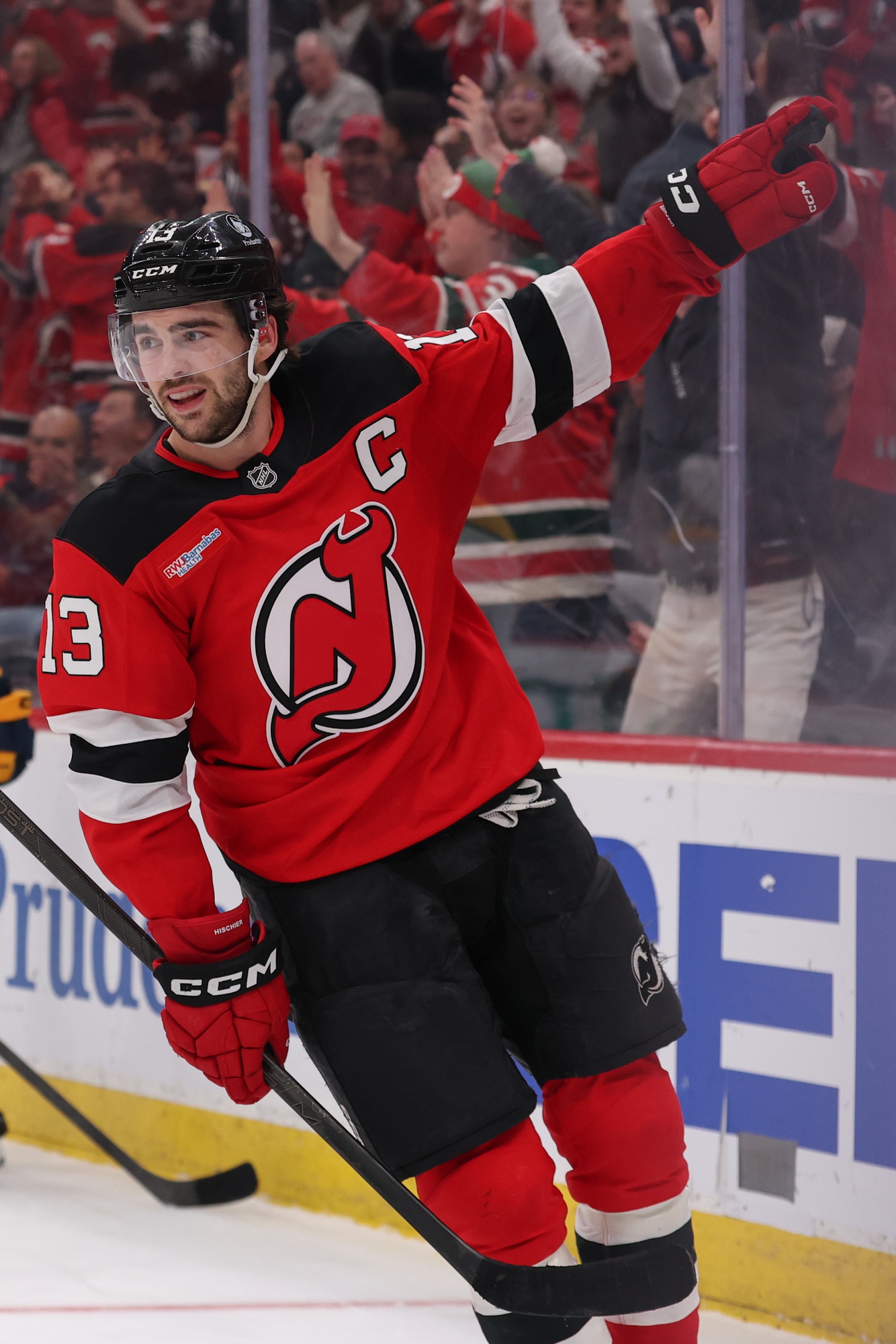 Hischier has only surpassed the 70-point mark once in his career (when he reached 80 in 2022-23) but he has notched between 60 and 69 points four times in the last five seasons. That type of offensive consistency is quite coveted, especially for centers. Meanwhile, he has been a Selke Trophy finalist and finished fourth in voting over the past five years as well. That type of defensive consistency is also quite coveted. Between that and the projected salary cap spikes, the 27-year-old is heading for quite a sizable raise on his next contract.
What type of price tag could he plausibly fetch? Let’s start by looking at the cap percentage. When he signed his current deal, Hischier received 8.9% of the cap. Forecasting that against the projected 2027-28 Upper Limit of around $113.5MM, that would put him at $10.1MM per season. Considering his current contract had four RFA years on it (his next one won’t have any) and his status in the league as a strong two-way center, it’s fair to say $10.1MM feels like the absolute minimum. Adding a million or two more to that number is a very realistic possibility. If Mehta doesn’t want to pay that (which would be a surprise, given his importance to the team), someone else undoubtedly will.
With Hischier signed through next season, this isn’t something that necessarily has to be completed this summer. But with a mid-September cutoff for an eight-year extension (when the new CBA fully kicks in), that stands as a bit of a pressure point for negotiations. And if the two sides are so far apart that a trade becomes likely (not a likely scenario), it’s better to know that now than in-season. But even with it not necessarily being overly urgent, expect this to be a big item on their summer checklist.
Clear Defensive Logjam
In the NHL, from a roster-building perspective, there are good problems to have and bad problems to have. The state of their back end is a good one. When their defensive group got fully healthy midseason, Keefe found himself rotating a few quality blueliners in and out of the lineup. That wound up seeing Dougie Hamilton get scratched with some scathing comments coming from his agent soon after, fueling trade speculation although a move never got across the finish line.
In fact, for all of the viable trade speculation surrounding their blueliners in the second half of the season, no moves were ultimately made. The logjam ultimately resolved itself when Brett Pesce landed on injured reserve right before the deadline but there’s no denying that the logjam still exists. New Jersey has $34.9MM committed to six blueliners next season, per PuckPedia. That doesn’t include Nemec so if Mehta doesn’t make a move, there’s a very good chance that the Devils will have the most expensive back end in the league next season. With less than $12MM in cap room and several roster spots to fill, moving out a defenseman works on multiple fronts.
The state of the market should work in New Jersey’s favor. Yes, other teams will know that they probably need to shed a defenseman but with the UFA class not exactly yielding a bumper crop of quality options, demand is going to outweigh supply. That should put Mehta in the driver’s seat to elicit a strong return.
It could be Hamilton getting a fresh start while clearing at least part of his $9MM cap charge off the books. It could be Nemec moving somewhere where he has a chance to play a bigger role to try to grow into the player his draft slot warranted. It could be Johnathan Kovacevic, the type of quality depth defender that stabilizes things on the third pairing but is now paid (at $4MM per season) to play a bigger role than that. All three are right-shot pieces, the side in even higher demand. If new management wants to shake up the team a bit, this is a logical spot to try to do so.
Add Firepower
Offense has been hard to come by under Keefe’s watch. They had a drop-off of 24 goals in his first season behind the bench while dropping from 12th to 20th league-wide in that department. This season, there was a similar-sized dip in scoring as they went down another 14 tallies while finishing 27th in goals scored. In two years, they’ve gone from a slightly above-average team offensively to one of the weaker ones while shedding nearly half a goal per game in the process.
Suffice it to say, this is a problem that needs to be addressed. With Jack Hughes, Jesper Bratt, and Hischier, they have some quality pieces. Timo Meier has been more hit than miss since being acquired but he could still be part of the solution while Dawson Mercer, extension-eligible himself this summer, is a solid secondary piece. There’s a decent foundation to work off here.
Adding a top-six forward would certainly put them in the right direction toward trying to even get back to the middle of the pack. But beyond that, they need some more firepower in the bottom six. Evgenii Dadonov, a UFA pickup last summer, wound up being a flop, Nick Bjugstad had just two assists in 26 games after being acquired near the trade deadline, and Maxim Tsyplakov, added in the Ondrej Palat trade, had four points in 49 games between the two teams. Upgrading one or two of those lineup spots would also go a long way in helping their fortunes.
This is where clearing the defensive logjam should help. At a minimum, they’d shed enough cap space to afford an extra addition of some consequence up front. In a perfect world, it’d come in the same trade. That way, their remaining cap space could be deployed toward upgrading the back half of the forward group, allowing them to hit both parts here. That won’t turn them into a high-end offensive squad but even getting closer to the middle would be a big boost to their playoff odds next season.
Photo courtesy of Ed Mulholland-Imagn Images.
Free Agent Focus: Anaheim Ducks
Free agency is just over a month away, and teams are looking ahead to when it opens. Even with the UFA crop being thinned out in recent months, there will be some quality veterans set to hit the open market in July, while many teams also have key restricted free agents to re-sign. We start our look around the NHL with an overview of the free agent situation for the Ducks.
Key Restricted Free Agents
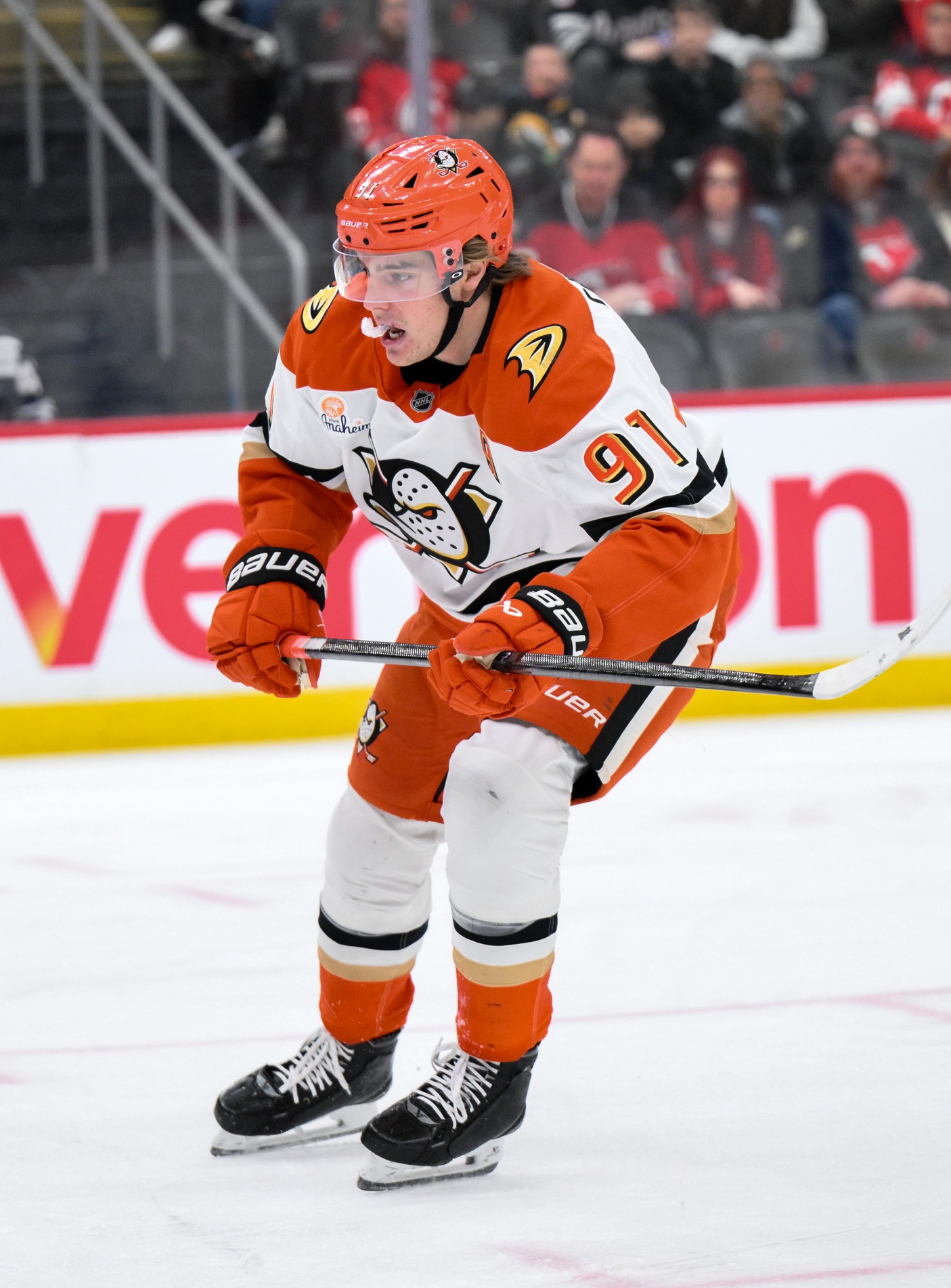 F Leo Carlsson – Let’s start with a big one. The second overall pick in 2023 showed plenty of promise in his first two seasons but took a big jump forward in 2025-26. He finished second on the team in scoring with 29 goals and 38 assists in just 70 games. He saw some shorthanded ice time. He upped his faceoff success rate. Basically, he took steps toward being the two-way top-line center the Ducks thought they’d be getting when they picked him. Now, he’s about to be paid like he is that player. A long-term deal would probably run the Ducks past the $11MM per season mark which would set the new benchmark for Anaheim’s forwards. A bridge deal, meanwhile, would keep the cost lower in the short term but even that could land in the $8MM range per year. GM Pat Verbeek has held a firm line in talks with core youngsters before. This could very well be another of those negotiations.
F Cutter Gauthier – That last sentence may wind up applying here as well. Gauthier led the Ducks offensively this season, notching 41 goals along with 28 helpers to finish two points up on Carlsson for the team lead. He even averaged a point per game in the playoffs while playing through a back injury. Wingers don’t often get the type of premium money that centers do and it should be noted that, unlike Carlsson, he isn’t eligible for an offer sheet after only playing once in the first year of his contract. Still, a long-term deal could approach the $9MM territory while a bridge pact would likely check in around the $6.5MM range. Carlsson is the headliner but Gauthier’s next deal is going to be a significant one as well.
D Pavel Mintyukov – The young blueliner hasn’t had quite the impact Anaheim hoped when they made him a top-ten pick back in 2022. An offensive dynamo in junior, the production hasn’t quite materialized in the NHL yet as he put up 28 points in his rookie year in 2023-24 and hasn’t returned to that mark since, notching 22 this season. Meanwhile, a lack of playing time earlier in the year had him believed to be amenable to a trade. With that in mind, there’s a solid case to make that a short-term bridge contract would make more sense for both sides, allowing for more time for him to make his case for a higher spot on the depth chart and improve his production. The price tag for that type of deal should check in around the $3.5MM mark.
D Olen Zellweger – There are some parallels to Mintyukov here. While he wasn’t a lottery pick, he was still a prolific producer in junior who has yet to establish himself offensively in the NHL and even spent a lot of time in the playoffs as a healthy scratch. Zellweger had 22 points in 76 games this season but saw his ATOI drop by nearly two minutes a night. He could also find himself in trade speculation this summer if Verbeek wants to reshape the back end a bit. Accordingly, a bridge deal makes a lot of sense here too. With Zellweger not having as much of a track record as Mintyukov, a short-term agreement should check in a little lower compared to his counterpart.
Other RFAs: D Jeremie Biakabutuka, G Vyacheslav Buteyets, G Calle Clang, D Tyson Hinds, F/D Ian Moore, F Jan Mysak, F Sasha Pastujov, F Jaxsen Wiebe
Key Unrestricted Free Agents
 D John Carlson – The Ducks were the surprising winners of the Carlson sweepstakes, adding him at the trade deadline to aid their playoff run. He wound up averaging nearly a point per game down the stretch at over 24 minutes per night of playing time. The production dipped in the playoffs to six assists in a dozen contests but he again was over the 24-minute mark. While he’s 36, Carlson has shown that he can still be a top-pairing player, at least for now. How quickly the potential drop-off could be will always be a concern for players his age but with the UFA market not being particularly deep, it wouldn’t be shocking to see him land a price tag in the $7MM range while getting two or three years on the contract. With demand for right-shot impact blueliners set to be quite high, he’s in great shape heading to free agency.
D Radko Gudas – The three-year deal he received in 2023 ultimately worked out pretty well for both sides. Gudas got to play a more prominent role than he was accustomed to early although he slowed down a fair bit this year and was banged up at the end of the season. It’s certainly possible that Anaheim could look to bring back their captain but it would have to be with the understanding that he’d be more of a sixth defender moving forward. Turning 36 next month with his rugged style of play, he’ll be a little more hard-pressed to command a multi-year deal although he is eligible for incentives in a one-year pact. After making $4MM per season on this last contract, there’s a good chance that ticks down by at least a million this summer.
D Jacob Trouba – Acquired in a cap-clearing move from the Rangers last season, the change of scenery worked out nicely for the veteran, especially this year. Head coach Joel Quenneville elevated Trouba’s role and he made the most of it, putting up his best offensive numbers since the 2021-22 campaign while the last time he played more than his 22:30 ATOI was back when he was in Winnipeg. Now, was this a late-career resurgence or a one-time blip? That’s a key question heading into free agency but again, given the limited right-shot impact options available, teams are likely to be offering contracts that suggest they believe this year is repeatable. The 32-year-old probably won’t hit the $8MM mark again but something in the $6MM to $7MM range on a multi-year pact could very well happen.
F Jeffrey Viel – Score one for stick-to-itiveness. A regular in the minors until this season, Viel got a chance to play more regularly following an early-season trade from Boston. The 29-year-old got to play above the fourth line at times, a rarity for someone who was basically on the roster in case a fight was needed. He then impressed in the playoffs with four points in 12 games while still averaging more than four hits per game. It’s unlikely that he’s going to command a huge deal this summer but doubling his $775K current price tag isn’t unfathomable either. At a minimum, he should have much more financial stability after bouncing around on two-way pacts for a lot of his pro career.
Other UFAs: F Jansen Harkins, F Ross Johnston, G Petr Mrazek
Projected Cap Space
The Ducks enter the offseason with a little over $40MM in cap space. Their RFA class should easily take up more than half of that number, assuming that they can work out long-term agreements with Carlsson and Gauthier. Beyond that, they will have a fair bit of flexibility to work with although Verbeek will be dealing with re-signing or replacing the right side of his back end. When all is said and done spending-wise, they may not be too far off the Upper Limit.
Photos courtesy of John Jones (Carlsson) and Perry Nelson (Carlson)-Imagn Images. Contract information courtesy of PuckPedia.